EconlibThe LibraryOther Sites |
Front Page Titles (by Subject) Freeholder, No. 2 - Cato: A Tragedy and Selected Essays
Return to Title Page for Cato: A Tragedy and Selected EssaysThe Online Library of LibertyA project of Liberty Fund, Inc.Search this Title:Also in the Library:
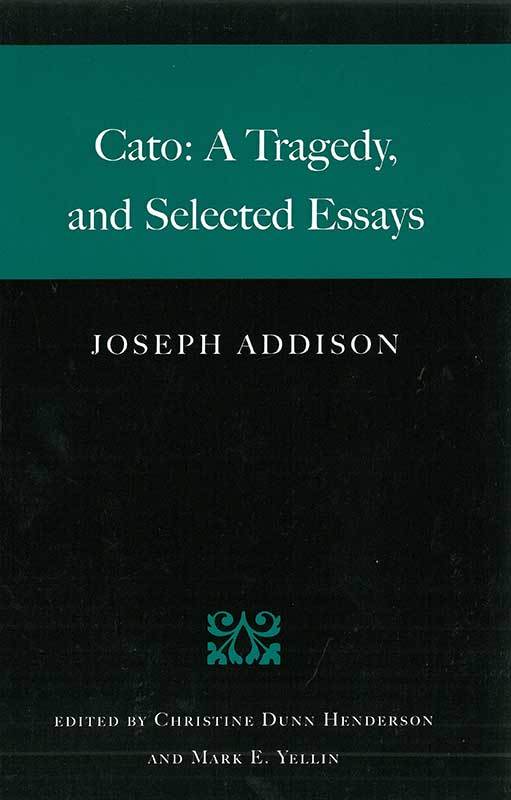
Freeholder, No. 2 - Joseph Addison, Cato: A Tragedy and Selected Essays [1710]Edition used:Cato: A Tragedy and Selected Essays, ed. by Christine Dunn Henderson and Mark E. Yellin, with a Foreword by Forrest McDonald (Indianapolis: Liberty Fund, 2004).
About Liberty Fund:Liberty Fund, Inc. is a private, educational foundation established to encourage the study of the ideal of a society of free and responsible individuals. Copyright information:The copyright to this edition, in both print and electronic forms, is held by Liberty Fund, Inc. Fair use statement:This material is put online to further the educational goals of Liberty Fund, Inc. Unless otherwise stated in the Copyright Information section above, this material may be used freely for educational and academic purposes. It may not be used in any way for profit.
Freeholder, No. 2Monday, December 26, 1715 Non de domino, sed de parente loquimur. Intelligamus ergo bona nostra, dignosque nos illius usu probemus; atque identidem cogitemus, si majus principibus praestemus obsequium, qui servitute civium, quam qui libertate laetantur. Having in my first paper set forth the happiness of my station as a Free-holder of Great Britain, and the nature of that property which is secured to me by the laws of my country; I cannot forbear considering, in the next place, that person who is entrusted with the guardianship and execution of those laws. I have lived in one reign, when the Prince, instead of invigorating the laws of our country, or giving them their proper course, assumed a power of dispensing with them:2 and in another, when the Sovereign3 was flattered by a set of men into a persuasion, that the regal Authority was unlimited and uncircumscribed. In either of these cases, good laws are at best but a dead letter; and by shewing the people how happy they ought to be, only serve to aggravate the sense of their oppressions. We have the pleasure at this time to see a King upon the throne,4 who hath too much goodness to wish for any power, that does not enable him to promote the welfare of his subjects; and too much wisdom to look upon those as his friends, who would make their court to him by the profession of an obedience, which they never practised, and which has always proved fatal to those Princes, who have put it to the tryal. His Majesty gave a proof of his sovereign virtues, before he came to the exercise of them in this kingdom. His inclination to justice led him to rule his German subjects in the same manner, that our constitution directs him to govern the English. He regarded those which are our civil liberties, as the natural rights of mankind; and therefore indulged them to a people, who pleaded no other claim to them than from his known goodness and humanity. This experience of a good Prince, before we had the happiness to enjoy him, must give great satisfaction to every thinking man, who considers how apt Sovereignty is to deprave human nature; and how many of our own Princes made very ill figures upon the Throne, who, before they ascended it, were the favourites of the people. What gives us the greatest security in the conduct of so excellent a Prince is That consistency of behaviour, whereby he inflexibly pursues those measures which appear the most just and equitable. As he hath the character of being the most prudent in laying proper schemes; he is no less remarkable for being steady in accomplishing what he has once concerted. Indeed, if we look into the history of his present Majesty, and reflect upon that wonderful series of successes which have attended him, I think they cannot be ascribed to any thing so much as to his uniformity and firmness of mind, which has always discovered it self in his proceedings. It was by this that he surmounted those many difficulties which lay in the way to his succession; and by which, we have reason to hope, he will daily make all opposition fall before him. The fickle and unsteady politicks of our late British Monarchs, have been the perpetual source of those dissensions and animosities which have made the nation unhappy: Whereas the constant and unshaken temper of his present Majesty, must have a natural tendency to the peace of his government, and the unanimity of his people. Whilst I am enumerating the publick virtues of our Sovereign, which are so conducive to the advantage of those who are to obey him, I cannot but take notice, that his Majesty was bred up from his infancy with a love to this our nation, under a Princess, who was the most accomplished woman of her age, and particularly famous for her affection to the English.5 Our countrymen were dear to him, before there was any prospect of their being his subjects; and every one knows, that nothing recommended a man so much to the distinguishing civilities of his Court, as the being born in Great Britain. To the fame of his Majesty’s civil virtues, we may add the reputation he has acquired by his martial atchievements. It is observed by Sir William Temple,6 that the English are particularly fond of a King who is valiant: upon which account his Majesty has a title to all the esteem that can be paid the most warlike Prince; though at the same time, for the good of his Subjects, he studies to decline all occasions of military glory; and chuses rather to be distinguished as the Father, than as the Captain of his people. I am glad his rebellious subjects are too inconsiderable to put him upon exerting that courage and conduct, which raised him so great a reputation in Hungary and the Morea,7 when he fought against the enemies of Christianity; and in Germany and Flanders, where he commanded against the great disturber of the peace of Europe. One would think there was reason for the opinion of those, who make personal courage to be an hereditary virtue, when we see so many instances of it in the line of Brunswick.8 To go no farther back than the time of our present King, where can we find, among the soveraign houses of Europe, any other family, that has furnished so many persons of distinguished fortitude? Three of his Majesty’s brothers9 have fallen gloriously in the field, fighting against the enemies of their native country: And the bravery of his royal Highness the Prince of Wales,10 is still fresh in our memory, who fought, with the spirit of his father, at the battel of Audenarde,11 when the children of France, and the Pretender,12 fled before him. I might here take notice of his Majesty’s more private virtues, but have rather chosen to remind my countrymen of the publick parts of his character, which are supported by such incontestable facts as are universally known and acknowledged. Having thus far considered our happiness in his Majesty’s civil and military character, I cannot forbear pleasing my self with regarding him in the view of one, who has been always fortunate. Cicero recommends Pompey under this particular head to the Romans,13 with whom the character of being fortunate was so popular, that several of their Emperors gave it a place among their titles. Good fortune is often the reward of virtue, and as often the effect of prudence. And whether it proceeds from either of these, or from both together, or whatever may be the cause of it, every one is naturally pleased to see his interests conducted by a person who is used to good success. The establishment of the Electoral dignity in his Majesty’s family, was a work reserved for him finally to accomplish. A large accession of dominion fell to him, by his succeeding to the Dukedom of Zell,14 whereby he became one of the greatest Princes of Germany; and one of the most powerful persons, that ever stood next heirs to the throne of Great Britain. The Dutchy of Bremen,15 and the Bishoprick of Osnaburg,16 have considerably strengthned his interests in the Empire, and given a great additional weight to the Protestant cause. But the most remarkable interpositions of providence, in favour of him, have appeared in removing those seemingly invincible obstacles to his succession; in taking away, at so critical a juncture, the person who might have proved a dangerous enemy; in confounding the secret and open attempts of his traiterous subjects; and in giving him the delightful prospect of transmitting his power through a numerous and still encreasing progeny. Upon the whole, it is not to be doubted but every wise and honest subject will concur with Providence in promoting the glory and happiness of his present Majesty, who is endowed with all those Royal virtues, that will naturally secure to us the national blessings, which ought to be dear and valuable to a free people. [1. ]“One who is our father not our over-lord . . . Let us then appreciate our good fortune and prove our worth by our use of it, and at the same time remember that there can be no merit if greater deference is paid to rulers who delight in the servitude of their subjects than to those who value liberty.” Pliny Panegyric 2.3–5. [2. ]James II suspended the Test Acts, which prevented Catholics from holding public office. This was one of the actions leading to the Glorious Revolution in 1688. [3. ]Queen Anne (1665–1714), last of the Stuart monarchs, reigned from 1702 until 1714. [4. ]George I (1660–1727), first of the Hanoverian kings, reigned from 1714 until 1727. [5. ]Princess Sophia (1630–1714), Electress of Hanover and mother of George I. [6. ]William Temple (1628–99), English diplomat and author. [7. ]Peloponnesian peninsula. [8. ]Dominant family line in the Protestant province of Hanover leading to George I. [9. ]Frederick Augustus (1661–90), Charles Philip (1669–90), and Christian Augustus (1671–1703). [10. ]George Augustus, the future George II (1683–1760), came to the throne in 1727 and reigned until his death. [11. ]Battle of Oudenaarde (1708), part of the War of the Spanish Succession (1701–14). Allied troops under the command of the Duke of Marlborough (1650–1722) defeated the French. [12. ]James Francis Edward Stuart (1688–1766), son of James II. [13. ]Cicero Speech on the Appointment of Gnaeus Pompeius 16.48: “No one has ever been so presumptuous that he dared hope in his heart for such great and constant favours from Heaven as those which Heaven has bestowed upon Gnaeus Pompeius.” [14. ]Duchy of Celle; province in what is now western Austria. [15. ]The Duchy of Bremen was the oldest port in Germany and was ceded by Denmark to Hanover in 1715. [16. ]City in northwest Germany famous for its linen. Osnaburg was turned over to George I in 1715. |

Titles (by Subject)