EconlibThe LibraryOther Sites |
Front Page Titles (by Subject) Whig Examiner, No. 5 - Cato: A Tragedy and Selected Essays
Return to Title Page for Cato: A Tragedy and Selected EssaysThe Online Library of LibertyA project of Liberty Fund, Inc.Search this Title:Also in the Library:
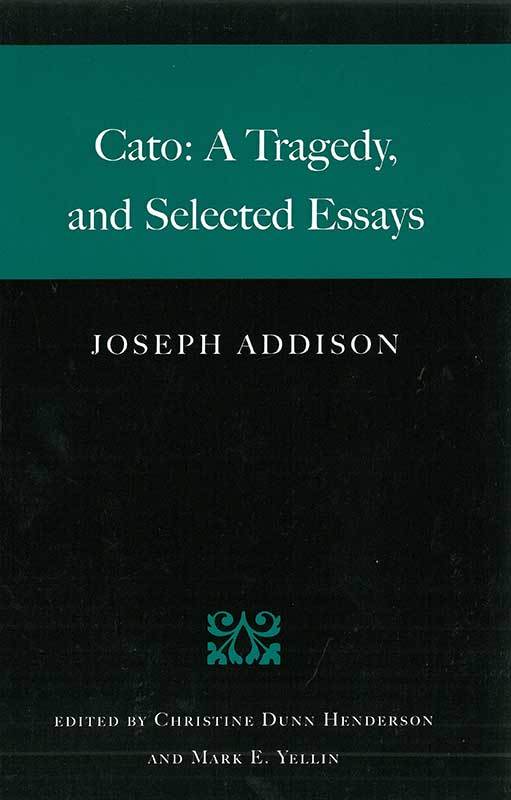
Whig Examiner, No. 5 - Joseph Addison, Cato: A Tragedy and Selected Essays [1710]Edition used:Cato: A Tragedy and Selected Essays, ed. by Christine Dunn Henderson and Mark E. Yellin, with a Foreword by Forrest McDonald (Indianapolis: Liberty Fund, 2004).
About Liberty Fund:Liberty Fund, Inc. is a private, educational foundation established to encourage the study of the ideal of a society of free and responsible individuals. Copyright information:The copyright to this edition, in both print and electronic forms, is held by Liberty Fund, Inc. Fair use statement:This material is put online to further the educational goals of Liberty Fund, Inc. Unless otherwise stated in the Copyright Information section above, this material may be used freely for educational and academic purposes. It may not be used in any way for profit.
Whig Examiner, No. 5Thursday, October 12, 1710 Parere jam non scelus est. We live in a nation where at present there is scarce a single head that does not teem with politicks. The whole Island is peopled with Statesmen, and not unlike Trinculo’s Kingdom of Vice-roys.2 Every man has contrived a scheme of government for the benefit of his fellow-subjects, which they may follow and be safe. After this short preface, by which, as an Englishman, I lay in my claim to be a Politician; I shall enter on my discourse. The chief point that has puzzled the freeholders3 of Great-Britain, as well as all those that pay scot and lot,4 for about these six months last past, is this, Whether they would rather be governed by a Prince that is obliged by laws to be good and gracious, just and upright, a friend, father, and a defender of his people; or by one who, if he pleases, may drive away or plunder, imprison or kill, without opposition or resistance. This is the true state of the controversy relating to passive-obedience and non-resistance.5 For I must observe, that the Advocates for this doctrine have stated the case in the softest and most palatable terms that it will bear: And we very well know, that there is great art in moulding a question; and that many a motion will pass with a nemine contradicente6 in some words, that would have been as unanimously rejected in others. Passive obedience and non-resistance are of a mild, gentle, and meek-spirited sound: They have respect but to one side of the relation between the sovereign and the subject, and are apt to fill the mind with no other ideas but those of peace, tranquillity, and resignation. To show this doctrine in those black and odious colours that are natural to it, we should consider it with regard to the Prince as well as to the people: The question will then take another turn, and it will not be debated whether resistance may be lawful, or whether we may take up arms against our Prince; but whether the English form of government be a tyranny or a limited monarchy? Whether our Prince be obliged by our constitution to act according to law, or whether he be arbitrary and despotical. It is impossible to state the measures of Obedience, without settling the extent of Power; or to describe the Subject, without defining the King. An arbitrary Prince is in justice and equity the master of a non-resisting people; for where the power is uncircumscribed, the obedience ought to be unlimited. Passive-obedience and non-resistance are the duties of Turks and Indians, who have no laws above the Will of a Grand Signior or a Mogul. The same power which those Princes enjoy in their respective governments, belongs to the legislative body in our constitution; and that for the same reason; because no body of men is subject to laws, or can be controuled by them, who have the authority of making, altering, or repealing whatever laws they shall think fit. Were our legislature vested in the person of our Prince, he might doubtless wind and turn our constitution at his pleasure; he might shape our government to his fancy. In a word, he might oppress, persecute, or destroy, and no man say to him, what dost thou? If therefore we would rightly consider our form of government, we should discover the proper measures of our duty and obedience; which can never rise too high to our Sovereign, whilst he maintains us in those rights and liberties we were born to. But to say that we have rights which we ought not to vindicate and assert; that Liberty and Property are the birth-right of the English nation, but that if a Prince invades them by violent and illegal methods, we must upon no pretence resist, but remain altogether passive; nay, that in such a case we must all lose our lives unjustly rather than defend them: this, I say, is to confound governments, and to join things together that are wholly repugnant in their natures; since it is plain, that such a passive subjection, such an unconditional obedience, can be only due to an arbitrary Prince or to a legislative body. Were these smooth ensnaring terms rightly explained to the people, and the controversy of Non-resistance set in this just light, we should have wanted many thousands of hands to some late Addresses. I would fain know what Free-holder in England would have subscribed the following Address, had it been offered to him; or whether Her Majesty, who values the rights of her subjects as much as her own prerogative, would not have been very much offended at it? and yet I will appeal to the Reader, if this has not been the sense of many Addresses, when taken out of several artificial qualifying expressions, and exposed in their true and genuine light. Madam, “It is with unspeakable grief of heart, that we hear a set of men daily preaching up among us, that pernicious and damnable doctrine of self-preservation; and boldly affirming, as well in their public writings, as in their private discourses, that it is lawful to resist a tyrant, and take up arms in defence of their lives and liberties. We have the utmost horror and detestation of these diabolical principles, that may induce your people to rise up in vindication of their rights and freedoms, whenever a wicked Prince shall make use of his Royal authority to subvert them. We are astonished at the bold and impious attempts of those men, who under the reign of the best of Sovereigns, would avow such dangerous tenets as may secure them under the worst. We are resolved to beat down and discountenance these seditious notions, as being altogether republican, jesuitical, and conformable to the practice of our rebellious fore-fathers; who in all ages, at an infinite expence of blood and treasure, asserted their rights and properties, and consulted the good of their posterity by resistance, arms, and pitched battles, to the great trouble and disquiet of their lawful Prince. We do therefore in the most humble and dutiful manner solemnly protest and declare, that we will never resist a Sovereign that shall think fit to destroy our Magna Charta, or invade those rights and liberties which those traytors procured for us; but will venture our lives and fortunes against such of our fellow-subjects who think they may stand up in defence of them.” It happens very unluckily that there is something so supple and insinuating in this absurd unnatural doctrine, as makes it extremely agreeable to a Prince’s ear: for which reason the publishers of it have always been the favourites of weak Kings. Even those who have no inclination to do hurt to others, says the famous Satyrist,7 would have the power of doing it if they pleased. Honest men who tell their Sovereigns what they expect from them, and what obedience they shall be always ready to pay them, are not upon an equal foot with such base and abject flatterers; and are therefore always in danger of being the last in the Royal favour. Nor indeed would that be unreasonable, if the professors of Non-resistance and Passive-obedience would stand to their principle: but instead of that, we see they never fail to exert themselves against an arbitrary power, and to cast off the oppression when they feel the weight of it. Did they not in the late Revolution rise up unanimously with those who always declared their subjection to be conditional, and their obedience limited? And very lately, when their Queen had offended them in nothing but by the promotion of a few great men to posts of trust and honour, who had distinguished themselves by their moderation and humanity to all their fellow-subjects, what was the behaviour of these men of meek and resigned principles? Did not the Church-Memorial, which they all applauded and cried up as the language and sentiments of their party, tell H. M. that it would not be safe for Her to rely upon their doctrines of Passive-obedience and Non-resistance, for that nature might rebel against principles? Is not this, in plain terms, that they will only practice Non-resistance to a Prince that pleases them, and Passive-obedience when they suffer nothing? I remember one of the rabble in Oedipus, when he is upbraided with his rebellion, and asked by the Prophet if he had not taken an oath to be loyal, falls a scratching his head, and tells him, Why yes, truly, he had taken such an oath, but it was a hard thing that an oath should be a man’s master.8 This is in effect the language of the Church in the above-mentioned Memorial. Men of these soft peaceable dispositions in times of prosperity, put me in mind of Kirke’s Lambs;9 for that was the name he used to give his dragoons that had signalized themselves above the rest of the army by many military atchievements among their own country-men. There are two or three fatal consequences of this doctrine, which I cannot forbear pointing out. The first of which is, That it has a natural tendency to make a good King a very bad one. When a man is told he may do what he pleases with impunity, he will be less careful and cautious of doing what he should do, than a man who is influenced by fear as well as by other motives to virtue. It was a saying of Thales the wise Milesian,10That of all wild beasts a tyrant is the worst, and of all tame beasts a flatterer. They do indeed naturally beget one another, and always exist together. Persuade a Prince that he is irresistible, and he will take care not to let so glorious an attribute lie dead and useless by him. An arbitrary power has something so great in it, that he must be more than man who is endowed with it, but never exerts it. This consequence of the doctrine I have been speaking of, is very often a fatal one to the people; there is another which is no less destructive to the Prince. A late unfortunate King very visibly owed his ruin to it. He relied upon the assurances of his people, that they would never resist him upon any pretence whatsoever, and accordingly began to act like a King who was not under the restraint of laws, by dispensing with them, and taking on him that power which was vested in the whole legislative body. And what was the dreadful end of such a proceeding? It is too fresh in every body’s memory. Thus is a Prince corrupted by the professors of this doctrine, and afterwards betrayed by them. The same persons are the Actors, both in the temptation and the punishment. They assure him they will never resist, but retain their obedience under the utmost sufferings: he tries them in a few instances, and is deposed by them for his credulity. I remember at the beginning of King James’s reign11 the Quakers presented an Address, which gave great offence to the High Church-men of those times. But notwithstanding the uncourtliness of their phrases, the sense was very honest. The Address was as follows, to the best of my memory, for I then took great notice of it; and may serve as a counterpart to the foregoing one. “These are to testify to thee our sorrow for our friend Charles, whom we hope thou wilt follow in every thing that is good. “We hear that thou art not of the religion of the land any more than we, and therefore may reasonably expect that thou wilt give us the same liberty that thou takest thy self. “We hope that in this and all things else thou wilt promote the good of thy people, which will oblige us to pray that thy reign over us may be long and prosperous.” Had all King James’s subjects addressed him with the same integrity; he had, in all probability, sat upon his throne till death had removed him from it. [1. ]Correct Latin is “Parere iam scelus non est” (To give birth is no longer a crime). Martial Epigrams 9.5. [2. ]William Shakespeare, The Tempest, III.2.110–13. Stephano says “Monster, I will kill this man. His daughter and I will be King and Queen—save our graces!—And Trinculo and thyself shall be viceroys. Dost thou like the plot, Trinculo?” [3. ]One possessing a freehold estate, earning at least 40 shillings per year, and eligible to vote in county elections. See Freeholder 1. [4. ]A tax or due. [5. ]Fundamental political positions of the Tory party. [6. ]No one contradicting. [7. ]Juvenal Satire X.96. “Even those who don’t want to kill anybody would like to have the power to do it.” [8. ]The exact source of this quotation is unknown, though it seems to be a reference to Sophocles’ Oedipus Rex or to Seneca’s Oedipus. [9. ]Also known as the Queens Royal Regiment, founded in 1661. The regiment took its name from Col. Percy Kirke, who had a reputation for extreme bravery and brutality. [10. ]Thales of Miletus (624–c. 547 b.c.). The source of this quote is unknown. [11. ]James II (1633–1701) reigned 1685–88 until he was deposed during the Glorious Revolution. His attempt to reintroduce the royal prerogative and reestablish Catholicism in a dominant position created resistance and led to his removal as monarch. |

Titles (by Subject)