EconlibThe LibraryOther Sites |
Front Page Titles (by Subject) Cato, A Tragedy - Cato: A Tragedy and Selected Essays
Return to Title Page for Cato: A Tragedy and Selected EssaysThe Online Library of LibertyA project of Liberty Fund, Inc.Search this Title:Also in the Library:
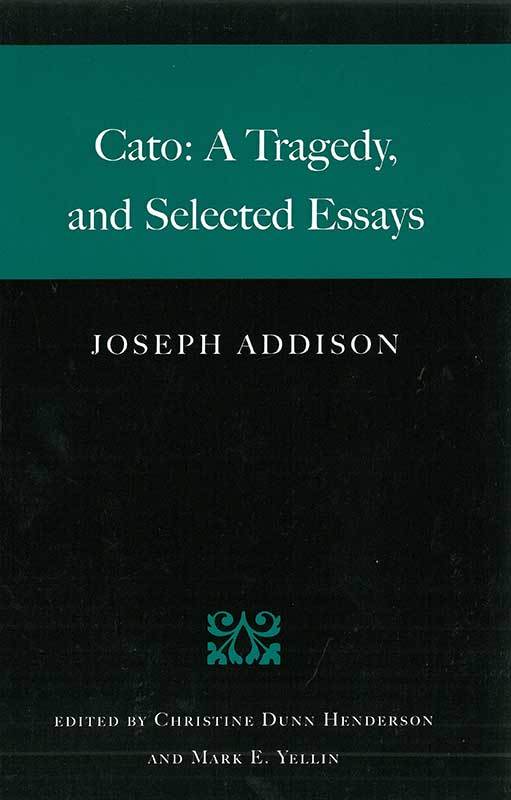
Cato, A Tragedy - Joseph Addison, Cato: A Tragedy and Selected Essays [1710]Edition used:Cato: A Tragedy and Selected Essays, ed. by Christine Dunn Henderson and Mark E. Yellin, with a Foreword by Forrest McDonald (Indianapolis: Liberty Fund, 2004).
About Liberty Fund:Liberty Fund, Inc. is a private, educational foundation established to encourage the study of the ideal of a society of free and responsible individuals. Copyright information:The copyright to this edition, in both print and electronic forms, is held by Liberty Fund, Inc. Fair use statement:This material is put online to further the educational goals of Liberty Fund, Inc. Unless otherwise stated in the Copyright Information section above, this material may be used freely for educational and academic purposes. It may not be used in any way for profit.
Cato, A TragedyAddison’s Cato, A Tragedy is based on the final days of Cato the Younger (95–46 b.c.), also known as Cato of Utica. Cato the Younger was one member of a patrician family who were historically strong supporters of Roman republicanism and traditions. Most noteworthy among his ancestors was his great-grandfather, Cato the Elder or Cato the Censor (234–149 b.c.), famous for his oft-repeated refrain of “Carthago delenda est” (“Carthage must be destroyed”) and for upholding a simple life of agrarian virtue. Like his great-grandfather, Cato the Younger epitomized a commitment both to liberty and to the republic, and he came to exemplify virtue in late Roman republican politics. Cato’s reputation for stern virtue and unwavering principle was widely known. “It is said of Cato,” wrote Plutarch in his Life of Cato the Younger, “that even from his infancy, in his speech, his countenance, and all his childish pastimes, he discovered an inflexible temper, unmoved by any passion, and firm in everything . . . to go through with what he undertook.” The mature Cato was also known for his austerity in personal habits, eating simply and frequently refusing to wear a tunic under his toga or to wear shoes. He was widely regarded as the embodiment of the Stoic virtues of self-control and stern discipline, as well as an inflexible adherent to principles of justice. According to Sallust, Cato “preferred to be, rather than to seem, virtuous; hence, the less he sought fame, the more it pursued him” (The War with Catiline, LIV.6). Cato’s concern for Roman liberty led him to oppose Pompey when he feared Pompey’s power had grown too great, then to join with Pompey against Julius Caesar once he began to appreciate the threat to Roman liberty that Caesar represented. A leading figure in the Senate, Cato was a member of the Optimates, a political faction that sought to maintain the traditional authority of the Senate within the republic as a protection against the dangers of both mob rule and the tyranny of a single individual. The Optimates stood in opposition to the Populares, who advocated political and economic reform by means of land redistribution. Caesar had embraced the Populares’ political agenda early in his career, but it was through his military success and his ability to command his troops’ continued loyalty that his political power truly grew. Prior to outbreak of the civil war that would eventually end the republic, a triumvirate of Caesar, Pompey, and Crassus shared power. With the death of Crassus, though, that alliance crumbled. Caesar’s legions crossed the Rubicon to take control of Rome, while Pompey withdrew from Italy—Senate in tow—to Greece and to the fateful meeting at Pharsalus. The political struggle between Cato and Caesar was a contest between widely divergent characters. Political restraint versus political ambition was but one facet of the conflict between these great Roman figures that was personal, intense, and well known at the time. Each represented a different response to the crisis of the Roman republic, and the tension in the Roman spirit can be seen in the comparison between them. Sallust’s The War with Catiline offers an extended discussion of their characters. According to Sallust, “They had the same nobility of soul, and equal, though quite different, reputations. Caesar was esteemed for the many kind services he rendered and for his lavish generosity; Cato for the consistent uprightness of his life. The former was renowned for his humanity and mercy; the latter had earned respect by his strict austerity. Caesar won fame by his readiness to give, to relieve, to pardon; Cato, by never offering presents. The one was a refuge for the unfortunate, and was praised for his good nature; the other was a scourge for the wicked, admired for his firmness” (Book VI). Cato stood for preserving republican virtue, tradition, and precedent; for respecting established institutions and the Senate in particular; and for his unwavering adherence to principle. By contrast, Caesar represented energy, innovation, and a willingness to break with precedent in his pursuit of advantage, territorial gains, and personal aggrandizement. If Cato embodied the austere simplicity and the moral conscience of republican Rome, Caesar personified the lavish grandiosity which came to characterize the Empire. One example of the contrast between Cato’s severity, austerity, and self-restraint and Caesar’s humanity, mercy, and generosity was the Catilinarian conspiracy. There, Cato insisted on the conspirators’ swift execution, while Caesar pled for leniency and called for their imprisonment rather than their death. Cato argued that the conspirators should be treated as if they had been caught in the act; moreover, since they planned to show no mercy to Rome, they should be shown none by Rome. Cato’s oratory carried the day in the Senate, which had initially been swayed by Caesar’s entreaties. In Act IV, scene 4, Addison echoes Sallust’s characterization when Lucius tells Cato that “the virtues of humanity are Caesar’s” and Cato responds that “such popular humanity is treason” and that Caesar’s virtues have undone Rome. One aspect of Caesar’s humanity was his well-known policy of offering clemency to his defeated enemies, and it is likely that he would have extended clemency to Cato as well. Describing a military dictator as possessing the virtues of humanity may strike the modern reader as somewhat surprising and might have struck eighteenth-century theatergoers as such, too. Audiences in the eighteenth century, however, would have appreciated that the popular, humane figure could be the greatest threat to liberty and that an unbendingly virtuous character such as Cato—willing to sacrifice his own life to freedom’s cause—could be liberty’s greatest defender. No discussion of Cato would be complete without some consideration of his relationship to Stoicism, since both to Romans and in an abstract sense, Cato exemplified the life led in accordance with Stoic ideals. Identifying the virtuous life with happiness, Stoicism emphasized the importance of self-command as a means of placing an individual beyond the reaches of the whims of fortune. Stoics believed that self-mastery and therefore true freedom could be attained only by putting aside passion, unjust thoughts, and indulgence and by fulfilling one’s duty for the right reasons. Cato’s unwavering commitment to his principles and his willingness to apply his standards of judgment to others led many Romans to admire his philosophic commitment, including Cicero, whose De Finibus Bonorum et Malorum (On the Ends of Good and Evil) casts Cato as the spokesman for Stoicism. Given the deep intermingling of morality and politics in the Roman republic, it is not entirely surprising that much of Cato’s political standing in the Senate and his place in public opinion was due to his fellow Romans’ appreciation of his moral character. This is not to suggest, however, that Cato was above criticism. There were many—including some of his political allies—who disapproved of Cato’s inflexibility and his unwillingness to compromise. Even Cicero, generally a great admirer of Cato, commented in Letters to Atticus that “the opinions he [Cato] delivers would be more in place in Plato’s Republic than among the dregs of humanity collected by Romulus” (Letters, 2.1). Addison echoes something of Cicero’s criticisms in Spectator 243’s description of Stoicism as “the pedantry of virtue.” The action of the play follows on the 46 b.c. battle at Pharsalus, a critical moment in the Roman Civil War in which Caesar won a decisive victory over Pompey’s more numerous forces. After Pharsalus, remnants of the defeated forces and senators coalesced in the North African city of Utica under the leadership of Cato, who became a living symbol of Roman republican liberty. In Utica, Cato’s forces formed an alliance with the army of Numidia’s King Juba I, who had previously been victorious against one of Caesar’s supporters. This time, however, Juba was not so fortunate, and the combined forces of Cato and Juba were defeated at Thapsus. With the military situation around him bleak and untenable, Cato encouraged those closest to him to flee; he then took his own life. Addison’s dramatization of Cato’s magnificent death scene generally accords with the ancient accounts. According to Plutarch, Cato engaged in philosophic disputation—especially regarding the Stoic paradox that only the good man is free, and that all wicked men are slaves—soon after the defeat at Thapsus. The intensity with which Cato defended his argument left all who were listening with no doubt that he intended “to put an end to his life, and set himself at liberty.” Plutarch also describes Cato’s consulting Plato’s Phaedo (which Addison calls simply by its later subtitle, “On the immortality of the soul”) in the hours before his suicide. The ancient account of Cato’s death, however, is even more dramatic than the scene staged by Addison. Cato’s first attempt was not fatal, and his horrified family summoned a physician in order to repair his partial disembowelment and to stitch up the wound, whereupon Cato “thrust away the physician, plucked out his own bowels, and tearing open the wound, immediately expired.”4 Cato’s suicide opens itself to many different interpretations. It might be viewed as the death knell of Roman liberty, with the republic itself perishing alongside Cato. It might be considered a manifestation of his philosophic strength, an example of his willingness to follow his principles wherever they would lead him. It could also be viewed as a final act of defiance against Caesar and an unwillingness to be co-opted by Caesar’s policy of clemency; by taking his own life rather than allowing Caesar to spare it, Cato would thus be denying Caesar an important moral victory in addition to the military one already claimed at Thapsus. Or, Cato’s death at his own hand might be understood as one man’s refusal to accept a life under tyranny and therefore as a vindication of individual liberty. The debate over how to understand Cato’s life and suicide was lively during Caesar’s reign, and we believe it remains a valuable point of consideration in the contemporary world. Because of Cato and his essays, Addison’s influence throughout the eighteenth century was enormous. In the period immediately following Addison’s death, two opposition Whig writers—Thomas Gordon and John Trenchard—took up the banner of Cato against governmental corruption and infringement of liberty in a series of newspaper letters (1720–1723) subsequently collected as Letters of Cato. David Hume modeled his own career as an essayist on Addison, explicitly citing Addison as the great authority and presenting his own project in language similar to Addison’s Spectator 10 statement. In “Of Essay-Writing” Hume writes that he considers himself to be a “a kind of Resident or Ambassador from the dominions of Learning to those of Conversations.” Adam Smith took up Addison’s notion of the dispassionate and moderate spectator, formalizing it as the impartial spectator that forms the cornerstone of the moral philosophy he developed in Theory of Moral Sentiments. In Émile, Jean-Jacques Rousseau cites the Spectator as an example of appropriate reading for young women to understand their duties in society. Voltaire’s Letters on the English reveals his admiration of Cato as “a masterpiece, both with regard to the diction and to the beauty and the harmony of the numbers,” and he states that “Mr. Addison’s Cato appears to me to be the greatest character that was brought upon any stage.” As Forrest McDonald notes in the foreword to this volume and elsewhere, Cato also had a tremendous impact in early America, where its words and themes influenced George Washington, John Adams, and many others. To sketch Addison’s impact on but one colonial figure, Benjamin Franklin’s Autobiography details the young Ben’s finding an edition of the Spectator and using it as his standard for cultivating a clear and precise mode of expressing his sentiments. The Autobiography’s handbook for self-improvement also draws its motto directly from Act V, scene I, of Cato: “Here will I hold. If there’s a power above us, / (And that there is, all nature cries aloud / Through all her works,) he must delight in virtue; / And that which he delights in, must be happy.” To the eighteenth century, Addison’s continued prominence seemed such a foregone conclusion that Hume suggested, “Addison, perhaps, will be read with pleasure, when Locke shall be entirely forgotten” (An Enquiry Concerning Human Understanding, 1.4). Into the nineteenth century, Addison’s influence continued, although with the passage of time he became less appreciated as the author of Cato, and better known for his Spectator essays. For much of the twentieth century, Addison’s influence has been solely as an essayist, and his work as a dramatist has been neglected almost entirely. Recently, though, interest has been rekindled in his Cato, primarily for its impact in both Britain and America. We hope that this edition will contribute to an appreciation of the play as a work of both historical importance and enduring philosophical significance. Christine Dunn Henderson and Mark E. Yellin [4. ]Plutarch, Life of Cato the Younger, vol. 4 of Plutarch’s Lives, ed. A. H. Clough (Boston: Little, Brown and Co., 1907), 442. |

Titles (by Subject)