Econlib

The Library

Other Sites

Front Page arrow Titles (by Subject) arrow The Life of Joseph Addison - Cato: A Tragedy and Selected Essays

Return to Title Page for Cato: A Tragedy and Selected Essays

Search this Title:

The Life of Joseph Addison - Joseph Addison, Cato: A Tragedy and Selected Essays [1710]

Edition used:

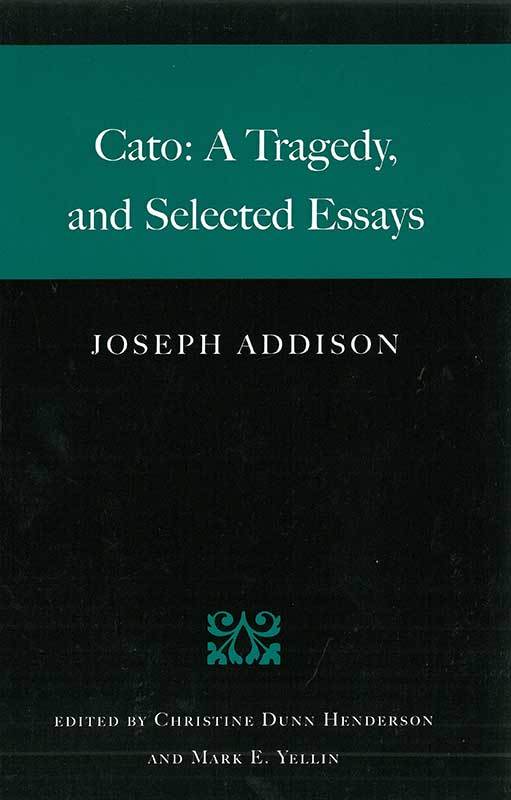
Cato: A Tragedy and Selected Essays, ed. by Christine Dunn Henderson and Mark E. Yellin, with a Foreword by Forrest McDonald (Indianapolis: Liberty Fund, 2004).

About Liberty Fund:

Liberty Fund, Inc. is a private, educational foundation established to encourage the study of the ideal of a society of free and responsible individuals.


The Life of Joseph Addison

Addison was born in 1672 in the Wiltshire hamlet of Milston, where his father was the church rector. In 1687, he matriculated at Oxford, studying first at Queen’s College before being elected to Magdalen College. At Oxford, he acquired a reputation for poetry and criticism; his studies focused on the classics, with an orientation more to Latin than to Greek. The early acts of Cato can be traced to Addison’s days as a student. After leaving Oxford in 1699, Addison traveled for four years through France, Italy, Switzerland, Austria, Germany, and Holland. Upon his return to Britain, he came quickly to the attention of key Whig political figures such as John, Lord Somers, and was commissioned to write The Campaign, a long poem commemorating Marlborough’s 1704 victory over the French at Blenheim. Addison quickly rose through the Whig political ranks, holding government positions including the position of Commissioner of Appeals (recently vacated by John Locke), Under-Secretary of State, Secretary to the Lord Lieutenant of Ireland, Chief Secretary for Ireland, and eventually Member of Parliament for Malmesbury.

During this period, Addison began his career as a popular essayist, ultimately becoming the acknowledged master of what was then a relatively new form. He contributed to the Whig Examiner (1710), which responded to the Tory paper Examiner, and worked with his boyhood friend Richard Steele on the Tatler (1709–11). From there, Addison and Steele joined forces on the paper that truly cemented Addison’s reputation, the Spectator (1711–1712, 1714). After his run with the Spectator, Addison penned the final act to the four acts he had already written for Cato, A Tragedy; during Cato’s initial London staging, Addison continued producing essays, working with Steele on the Guardian (1713) and composing several pieces that dealt explicitly with themes from Cato. Addison struck out on his own for the Freeholder (1715–16) essays, which took a decidedly more political tone. His last set of essays, in The Old Whig (1718), was marred by a personal break with his longtime collaborator Steele over matters of public policy. Addison was a prolific author; in addition to his coffeehouse essays and Cato, he composed poetry in both Latin and English, hymns, an opera, another play, literary criticism, and a variety of translations of classical authors. Joseph Addison died in 1719 at the age of 47.

Addison was born into a world that had recently witnessed the tumult of the English Civil War and the beheading of Charles I, followed by Cromwell’s Puritan commonwealth. Britain’s political instability continued in Addison’s early life, with the Restoration of the Stuart monarchy in 1660 and the Glorious Revolution of 1688, in which another king—James II—was forced by Parliament to flee the country. The mature Addison’s writing career spanned the period of British history marked by the conclusion of Queen Anne’s reign in 1714 and the inauguration of the Hanoverian succession. This was a time of political upheaval and uncertainty, filled with resistance and uprisings by Jacobites who retained loyalty to the Stuart family line. Disturbances of this nature were a challenge to the very legitimacy of the Hanoverian succession. These years were characterized by intense factional conflict between Whigs and Tories over political control, with 1710–14 being the final years of Tory control before the extended period of Whig dominance that began with the accession of George I to the throne in 1714. Addison himself was politically associated with the Whigs, yet Cato is remarkable for the manner in which both Whigs and Tories embraced it as sympathetic to their causes; leaders of both parties were present at the opening performance, and Alexander Pope’s account of the premiere describes Whigs and Tories competing to appropriate the play to their own causes. During the first performance, Whigs loudly applauded each mention of “liberty,” and between acts, the Tory Bolingbroke publicly gave Barton Booth—the actor who played Cato—fifty guineas, for defending the cause of liberty against a perpetual dictator. That Addison himself wanted the message of the play to transcend party politics can be seen in his commissioning a Tory, Pope, to write the play’s Prologue and a Whig, Sir Samuel Garth, to compose the Epilogue.