|
|
Front Page Titles (by Subject) XXII.: To the noble Youth Richard Jones. - The Prose Works of John Milton, vol. 2
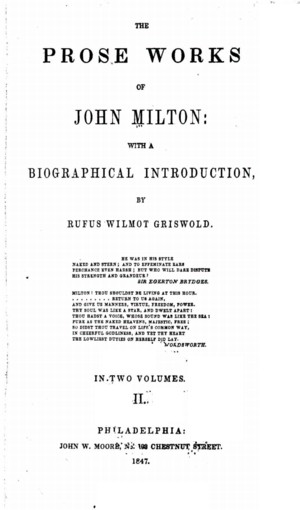
XXII.: To the noble Youth Richard Jones. - John Milton, The Prose Works of John Milton, vol. 2 [1847]Edition used:The Prose Works of John Milton, With a Biographical Introduction by Rufus Wilmot Griswold. In Two Volumes (Philadelphia: John W. Moore, 1847). Vol. 2.
About Liberty Fund:Liberty Fund, Inc. is a private, educational foundation established to encourage the study of the ideal of a society of free and responsible individuals. Copyright information:The text is in the public domain.
Fair use statement:
This material is put online to further the educational goals of Liberty Fund, Inc. Unless otherwise stated in the Copyright Information section above, this material may be used freely for educational and academic purposes. It may not be used in any way for profit.
- A Defence of the People of England, In Answer to Salmasius’s Defence of the King. *
- A Treatise of Civil Power In Ecclesiastical Causes; Showing That It Is Not Lawful For Any Power On Earth to Compel In Matters of Religion.
- Considerations Touching the Likeliest Means to Remove Hirelings Out of the Church. Wherein Is Also Discoursed of Tithes, Church-fees, and Church-revenues; and Whether Any Maintenance of Ministers Can Be Settled By Law.
- A Letter to a Friend Concerning the Ruptures of the Commonwealth.
- The Present Means and Brief Delineation of a Free Commonwealth, Easy to Be Put In Practice, and Without Delay.
- The Ready and Easy Way to Establish a Free Commonwealth, and the Excellence Thereof, Compared With the Inconveniencies and Dangers of Readmitting Kingship In This Nation.
- Brief Notes Upon a Late Sermon, Titled, the Fear of God and the King.
- The History of Britain, That Part Especially Now Called England, From the First Traditional Beginning, Continued to the Norman Conquest:—collected Out of the Ancientest and Best Authors Thereof.
- The First Book.
- The Second Book.
- The Third Book.
- The Fourth Book.
- The Fifth Book.
- The Sixth Book.
- Of True Religion, Heresy, Schism, Toleration; and What Best Means May Be Used Against the Growth of Popery.
- A Brief History of Moscovia, and of Other Less Known Countries Lying Eastward of Russia As Far As Cathay.
- The Preface.
- Moscovia: Or, Relations of Moscovia, As Far As Hath Been Discovered By English Voyages; Gathered From the Writings of Several Eye-witnesses: and the Other Less Known Countries Lying Eastward of Russia As Far As Cathay, Lately Discovered At Several Time
- Chapter I.: A Brief Description.
- Chapter II.: Of Samoëdia, Siberia, and Other Countries North-east, Subject to the Muscovites.
- Chapter III.: Of Tingoësia, and the Countries Adjoining Eastward, As Far As Cathay.
- Chapter IV.: The Succession of Moscovia Dukes and Emperors, Taken Out of Their Chroniles By a Polac, With Some Later Additions. †
- Chapter V.: The First Discovery of Russia By the North-east, 1553, With the English Embassies, and Entertainments At That Court, Until the Year 1604.
- A Declaration of Letters Patents, For the Election of This Present King of Poland, John the Third, Elected On the 22d of May Last Past, A. D. 1674.
- Letters of State to Most of the Sovereign Princes and Republics of Europe, During the Administration of the Commonwealth and the Protectors Oliver and Richard Cromwell.
- Letters Written In the Name of the Parliament.
- Letters Written In the Name of Oliver the Protector.
- Letters Written In the Name of Richard, Protector.
- A Manifesto of the Lord Protector of the Commonwealth of England, Scotland, Ireland, &c.
- The Second Defence of the People of England, Against an Anonymous Libel Entitled “the Royal Blood Crying to Heaven For Vengeance On the English Parricides.”
- Familiar Epistles, Translated From the Latin, By Robert Fellowes, A. M. Oxon.
- I.: To His Tutor Thomas Jure.
- II.: To Alexander Gill.
- III.: To the Same.
- IV.: To Thomas Jure.
- V.: To Alexander Gill.
- VI.: To Carolo Deodati.
- VII.: To the Same.
- VIII.: To Beneditto Bonomattai, a Florentine.
- IX.: To Luke Holstein, In the Vatican At Rome.
- X.: To Carolo Deodati, a Florentine Noble.
- XI.: To Hermann Milles, Secretary to the Count of Oldenburgh.
- XII.: To the Renowned Leonard Philara, the Athenian.
- XIII.: To Richard Heth.
- XIV.: To Henry Oldenburgh, Aulic Counsellor to the Senate of Bremen.
- XV.: To Leonard Philara, the Athenian.
- XVI.: To Leo of Aizema.
- XVII.: To Ezechiel Spanheim, of Geneva.
- XVIII.: To Henry Oldenburgh, Aulic Counsellor to the Senate of Bremen.
- XIX.: To the Noble Youth, Richard Jones.
- XX.: To the Accomplished Youth Peter Heinbach.
- XXI.: To the Accomplished Emeric Bigot.
- XXII.: To the Noble Youth Richard Jones.
- XXIII.: To the Illustrious Lord Henry De Bras.
- XXIV.: To Henry Oldenburgh.
- XXV.: To the Noble Youth Richard Jones.
- XXVI.: To the Illustrious Lord Henry De Bras.
- XXVII.: To the Accomplished Peter Heinbach.
- XXVIII.: To John Badiaus, Minister of the Church of Orange.
- XXIX.: To Henry Oldenburgh.
- XXX.: To the Noble Youth Richard Jones.
- XXXI.: To the Accomplished Peter Heinbach, Counsellor to the Elector of Brandenburg.
XXII.
To the noble YouthRichard Jones.
I did not receive your letter till some time after it was written; it lay fifteen days at your mother’s. With pleasure I perceive the emotions of your attachment and your gratitude. I have never ceased to promote the culture of your genius, and to justify the favourable opinion which your excellent mother entertains of me, and the confidence she places in me, by benevolence the most pure and counsels the most sincere. In that agreeable and healthy spot, to which you have retired, there are books enough for the purposes of academical education. If beauty of situation contributed as much to improve the wit of the inhabitants as it does to please the eye, the felicity of that place would be complete. The library there is rich in books, but unless the minds of the students be improved by a more rational mode of education, it may better deserve the name of a book-repository than of a library. You justly acknowledge that all these helps to learning should be associated with a taste for literature, and with diligence in the cultivation. Take care that I may never have occasion to blame you for deviating from that opinion. And this you will really avoid if you will diligently obey the weighty and friendly precepts of the accomplished Henry Oldenburgh, your associate and friend. Adieu, my dearest Richard, and let me incite you like another Timothy to the practice of virtue and of piety, by the example of your mother, who is the best of women.
Westminster.
|