Econlib

The Library

Other Sites

Front Page arrow Titles (by Subject) arrow XIII.: To Richard Heth. - The Prose Works of John Milton, vol. 2

Return to Title Page for The Prose Works of John Milton, vol. 2

Search this Title:

Also in the Library:

Subject Area: Political Theory
Subject Area: History
Subject Area: Religion
Topic: The English Revolution

XIII.: To Richard Heth. - John Milton, The Prose Works of John Milton, vol. 2 [1847]

Edition used:

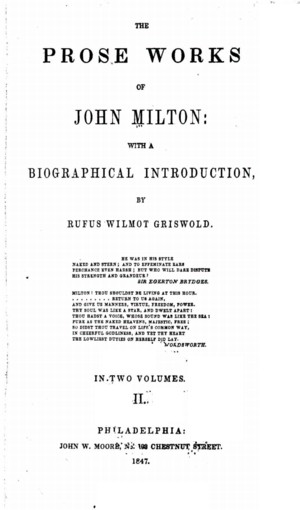
The Prose Works of John Milton, With a Biographical Introduction by Rufus Wilmot Griswold. In Two Volumes (Philadelphia: John W. Moore, 1847). Vol. 2.

Part of: The Prose Works of John Milton, 2 vols.

About Liberty Fund:

Liberty Fund, Inc. is a private, educational foundation established to encourage the study of the ideal of a society of free and responsible individuals.


XIII.

ToRichard Heth.

If I were able, my excellent friend, to render you any service in the promotion of your studies, which at best could have been but very small, I rejoice on more accounts than one, that that service, though so long unknown, was bestowed on so fruitful and so genial a soil, which has produced an honest pastor to the church, a good citizen to our country, and to me a most acceptable friend. Of this I am well aware, not only from the general habits of your life, but from the justness of your religious and political opinions, and particularly from the extraordinary ardour of your gratitude, which no absence, no change of circumstances, or lapse of time, can either extinguish or impair. Nor is it possible, till you have made a more than ordinary progress in virtue, in piety, and the improvement of the mind and heart, to feel so much gratitude towards those who have in the least assisted you in the acquisition. Wherefore, my pupil, a name which with your leave I will employ, be assured that you are among the first objects of my regard; nor would any thing be more agreeable to me, if your circumstances permit as much as your inclination, than to have you take up your abode somewhere in my neighbourhood, where we may often see each other, and mutually profit by the reciprocations of kindness and of literature. But this must be as God pleases, and as you think best. Your future communications may, if you please, be in our own language, lost (though you are no mean proficient in Latin composition) the labour of writing should make each of us more averse to write; and that we may freely disclose every sensation of our hearts without being impeded by the shackles of a foreign language. You may safely entrust the care of your letters to any servant of that family which you mention. Adieu.