EconlibThe LibraryOther Sites |
Front Page Titles (by Subject) X.: To Carolo Deodati, a Florentine Noble. - The Prose Works of John Milton, vol. 2
Return to Title Page for The Prose Works of John Milton, vol. 2The Online Library of LibertyA project of Liberty Fund, Inc.Search this Title:Also in the Library:
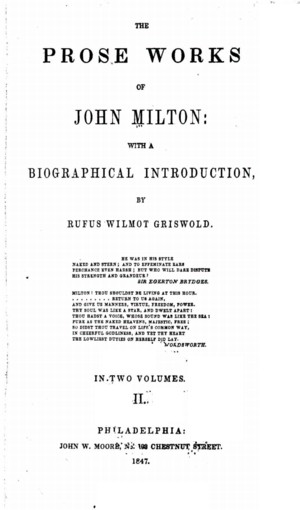
X.: To Carolo Deodati, a Florentine Noble. - John Milton, The Prose Works of John Milton, vol. 2 [1847]Edition used:The Prose Works of John Milton, With a Biographical Introduction by Rufus Wilmot Griswold. In Two Volumes (Philadelphia: John W. Moore, 1847). Vol. 2.
Part of: The Prose Works of John Milton, 2 vols.About Liberty Fund:Liberty Fund, Inc. is a private, educational foundation established to encourage the study of the ideal of a society of free and responsible individuals. Copyright information:The text is in the public domain. Fair use statement:This material is put online to further the educational goals of Liberty Fund, Inc. Unless otherwise stated in the Copyright Information section above, this material may be used freely for educational and academic purposes. It may not be used in any way for profit.
X.ToCarolo Deodati,a Florentine Noble.I derived, my dear Charles, from the unexpected receipt of your letter, a pleasure greater than I can express; but of which you may have some notion from the pain with which it was attended; and without a mixture of which hardly any great pleasure is conceded to mankind. While I was perusing the first lines of yours, in which the elegance of expression seems to contest the palm with the tenderness of friendship, I felt nothing but an unmingled purity of joy, particularly when I found you labouring to make friendship win the prize. But as soon as I came to that passage in which you tell me that you had previously sent me three letters which must have been lost, then the simplicity of my joy began to be imbued with grief and agitated with regret. But something more disastrous soon appears. It is often a subject of sorrowful reflection to me, that those with whom I have been either fortuitously or legally associated by contiguity of place, or some tie of little moment, are continually at hand to infest my home, to stun me with their noise and waste me with vexation, while those who are endeared to me by the closest sympathy of manners, of tastes and pursuits, are almost all withheld from my embrace either by death or an insuperable distance of place; and have for the most part been so rapidly hurried from my sight, that my prospects seem continually solitary, and my heart perpetually desolate. With a lively pleasure do I read your anxious inquiries about my health since I left Florence, and your unintermitted recollections of our intimacy. Those recollection have been reciprocal, though I thought that they had been cherished by me alone. I would not conceal from you that my departure excited in me the most poignant sensations of uneasiness, which revive with increased force as often as I recollect that I left so many companions so engaging, and so many friends so kind, collected in one city; which is, alas, so far removed; which imperious circumstances compelled me to quit against my inclination, but which was and is to me most dear. I appeal to the tomb of Damon, which I shall ever cherish and revere; his death occasioned the most bitter sorrow and regret, which I could find no more easy way to mitigate than by recalling the memory of those times, when, with those persons, and particularly with you, I tasted bliss without alloy. This you would have known long since, if you received my poem on that occasion. I had it carefully sent, that whatever poetical merit it might possess, the few verses which are included in the manner of an emblem might afford no doubtful proof of my love for you. I thought that by this means I should entice you or some other persons to write; for if I wrote first it seemed necessary that I should write to all, as if I wrote to one exclusively I feared that I should give offence to the rest; since I hope that many are still left who might justly claim the performance of this duty. But you, by first addressing me in a manner so truly friendly, and by a triple repetition of epistolary kindness, have laid me under an obligation to write to you, and have exonerated me from the censure of those to whom I do not write. Though I must confess that I found other reasons for silence in these convulsions which my country has experienced since my return home, which necessarily diverted my attention from the prosecution of my studies to the preservation of my property and my life. For can you imagine that I could have leisure to taste the sweets of literary ease while so many battles were fought, so much blood shed, and while so much ravage prevailed among my fellow-citizens? But even in the midst of this tempestuous period, I have published several works in my native language, which if they had not been written in English, I should have pleasure in sending to you, whose judgment I so much revere. My Latin poems I will soon send as you desire; and this I should have done long ago without being desired, if I had not suspected that some rather harsh expressions which they contained against the Roman pontiff would have rendered them less pleasing to your ears. Now I request whenever I mention the rites of your religion in my own way, that you will prevail on your friends (for I am under no apprehensions from you) to show me the same indulgence not only which they did to Aligerius and to Petrarch on a similar occasion, but which you did formerly with such singular benevolence to the freedom of my conversation on topics of religion. With pleasure I perused your description of the funeral of King Louis. I do not acknowledge the inspiration of that vulgar and mercenary Mercury whom you jocosely profess to worship, but of that Mercury who excels in eloquence, who is dear to the Muses and the patron of men of genius. It remains for us to hit upon some method by which our correspondence may in future be carried on with greater regularity and fewer interruptions. This does not seem very difficult, when we have so many merchants who trade so extensively with us; whose agents pass to and fro every week, and whose ships are sailing backward and forward almost as often. In the mean time, my dear Charles, farewell, and present my kind wishes to Cultellino, Francisco, Trescobaldo, Maltatesto, the younger Clemantillo, and every other inquiring friend, and to all the members of the Gaddian academy. Adieu. London, April 21, 1647. |

Titles (by Subject)