Econlib

The Library

Other Sites

Front Page arrow Titles (by Subject) arrow II.: To Alexander Gill. - The Prose Works of John Milton, vol. 2

Return to Title Page for The Prose Works of John Milton, vol. 2

Search this Title:

Also in the Library:

Subject Area: Political Theory
Subject Area: History
Subject Area: Religion
Topic: The English Revolution

II.: To Alexander Gill. - John Milton, The Prose Works of John Milton, vol. 2 [1847]

Edition used:

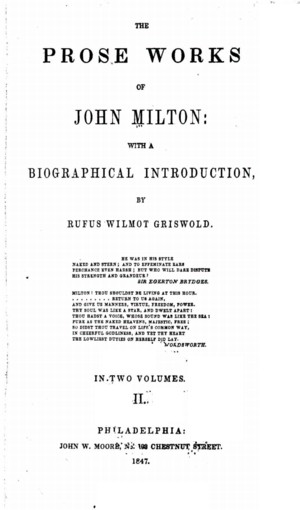
The Prose Works of John Milton, With a Biographical Introduction by Rufus Wilmot Griswold. In Two Volumes (Philadelphia: John W. Moore, 1847). Vol. 2.

Part of: The Prose Works of John Milton, 2 vols.

About Liberty Fund:

Liberty Fund, Inc. is a private, educational foundation established to encourage the study of the ideal of a society of free and responsible individuals.


II.

ToAlexander Gill.

I received your letters and your poem, with which I was highly delighted, and in which I discover the majesty of a poet, and the style of Virgil. I knew how impossible it would be for a person of your genius entirely to divert his mind from the culture of the Muses, and to extinguish those heavenly emotions, and that sacred and ethereal fire which is kindled in your heart. For what Claudian said of himself may be said of you, your “whole soul is instinct with the fire of Apollo.” If therefore, on this occasion, you have broken your own promises, I here commend the want of constancy which you mention; I commend the want of virtue, if any want of virtue there be. But, in referring the merits of your poem to my judgment, you confer on me as great an honour as the gods would if the contending musical immortals had called me in to adjudge the palm of victory; as poets babble that it formerly fell to the lot of Imolus the guardian of the Lydian mount. I know not whether I ought to congratulate Henry Nassau more on the capture of the city or the composition of your poems. For I think that this victory produced nothing more entitled to distinction and to fame than your poem. But since you celebrate the successes of our allies in lays so harmonious and energetic, what may we not expect when our own successes call for the congratulations of your muse? Adieu, learned Sir, and believe me greatly obliged by the favour of your verses.