Econlib

The Library

Other Sites

Front Page arrow Titles (by Subject) arrow I.: To his Tutor Thomas Jure. - The Prose Works of John Milton, vol. 2

Return to Title Page for The Prose Works of John Milton, vol. 2

Search this Title:

Also in the Library:

Subject Area: Political Theory
Subject Area: History
Subject Area: Religion
Topic: The English Revolution

I.: To his Tutor Thomas Jure. - John Milton, The Prose Works of John Milton, vol. 2 [1847]

Edition used:

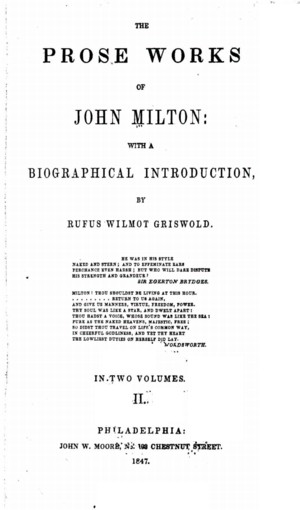
The Prose Works of John Milton, With a Biographical Introduction by Rufus Wilmot Griswold. In Two Volumes (Philadelphia: John W. Moore, 1847). Vol. 2.

Part of: The Prose Works of John Milton, 2 vols.

About Liberty Fund:

Liberty Fund, Inc. is a private, educational foundation established to encourage the study of the ideal of a society of free and responsible individuals.


I.

To his TutorThomas Jure.

Though I had determined, my excellent tutor, to write you an epistle in verse, yet I could not satisfy myself without sending also another in prose. For the emotions of my gratitude, which your services so justly inspire, are too expansive and too warm to be expressed in the confined limits of poetical metre; they demand the unconstrained freedom of prose, or rather the exuberant richness of Asiatic phraseology. Though it would far exceed my power accurately to describe how much I am obliged to you, even if I could drain dry all the sources of eloquence, or exhaust all the topics of discourse which Aristotle or the famed Parisian Logician has collected. You complain with truth, that my letters have been very few and very short; but I do not grieve at the omission of so pleasurable a duty, so much as I rejoice at having such a place in your regard as makes you anxious often to heat from me. I beseech you not to take it amiss, that I have not now written to you for more than three years; but with your usual benignity and candour to impute it rather to circumstances than to inclination. For heaven knows, that I regard you as a parent, that I have always treated you with the utmost respect, and that I was unwilling to teaze you with my compositions. And I was anxious that if my letters had nothing else to recommend them, they might be recommended by their rarity. And lastly, since the ardour of my regard makes me imagine that you are always present, that I hear your voice and contemplate your looks; and as thus (which is usually the case with lovers) I charm away my grief by the illusion of your presence, I was afraid when I wrote to you the idea of your distant separation should forcibly rush upon my mind; and that the pain of your absence, which was almost soothed into quiescence, should revive and disperse the pleasurable dream. I long since received your desirable present of the Hebrew Bible. I wrote this at my lodgings in this city, not as usual, surrounded by my books. If therefore there be any thing in this letter which either fails to give pleasure, or which frustrates expectation, it shall be compensated by a more elaborate composition as soon as I return to the dwelling of the Muses.