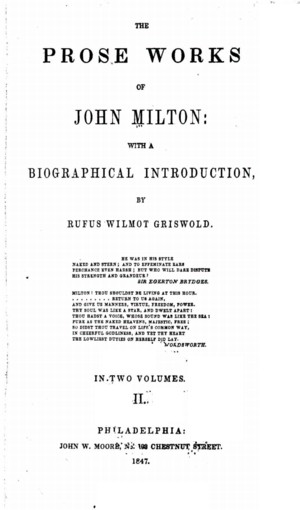
- A Defence of the People of England, In Answer to Salmasius’s Defence of the King. *
- A Treatise of Civil Power In Ecclesiastical Causes; Showing That It Is Not Lawful For Any Power On Earth to Compel In Matters of Religion.
- Considerations Touching the Likeliest Means to Remove Hirelings Out of the Church. Wherein Is Also Discoursed of Tithes, Church-fees, and Church-revenues; and Whether Any Maintenance of Ministers Can Be Settled By Law.
- A Letter to a Friend Concerning the Ruptures of the Commonwealth.
- The Present Means and Brief Delineation of a Free Commonwealth, Easy to Be Put In Practice, and Without Delay.
- The Ready and Easy Way to Establish a Free Commonwealth, and the Excellence Thereof, Compared With the Inconveniencies and Dangers of Readmitting Kingship In This Nation.
- Brief Notes Upon a Late Sermon, Titled, the Fear of God and the King.
- The History of Britain, That Part Especially Now Called England, From the First Traditional Beginning, Continued to the Norman Conquest:—collected Out of the Ancientest and Best Authors Thereof.
- The First Book.
- The Second Book.
- The Third Book.
- The Fourth Book.
- The Fifth Book.
- The Sixth Book.
- Of True Religion, Heresy, Schism, Toleration; and What Best Means May Be Used Against the Growth of Popery.
- A Brief History of Moscovia, and of Other Less Known Countries Lying Eastward of Russia As Far As Cathay.
- The Preface.
- Moscovia: Or, Relations of Moscovia, As Far As Hath Been Discovered By English Voyages; Gathered From the Writings of Several Eye-witnesses: and the Other Less Known Countries Lying Eastward of Russia As Far As Cathay, Lately Discovered At Several Time
- Chapter I.: A Brief Description.
- Chapter II.: Of Samoëdia, Siberia, and Other Countries North-east, Subject to the Muscovites.
- Chapter III.: Of Tingoësia, and the Countries Adjoining Eastward, As Far As Cathay.
- Chapter IV.: The Succession of Moscovia Dukes and Emperors, Taken Out of Their Chroniles By a Polac, With Some Later Additions. †
- Chapter V.: The First Discovery of Russia By the North-east, 1553, With the English Embassies, and Entertainments At That Court, Until the Year 1604.
- A Declaration of Letters Patents, For the Election of This Present King of Poland, John the Third, Elected On the 22d of May Last Past, A. D. 1674.
- Letters of State to Most of the Sovereign Princes and Republics of Europe, During the Administration of the Commonwealth and the Protectors Oliver and Richard Cromwell.
- Letters Written In the Name of the Parliament.
- Letters Written In the Name of Oliver the Protector.
- Letters Written In the Name of Richard, Protector.
- A Manifesto of the Lord Protector of the Commonwealth of England, Scotland, Ireland, &c.
- The Second Defence of the People of England, Against an Anonymous Libel Entitled “the Royal Blood Crying to Heaven For Vengeance On the English Parricides.”
- Familiar Epistles, Translated From the Latin, By Robert Fellowes, A. M. Oxon.
- I.: To His Tutor Thomas Jure.
- II.: To Alexander Gill.
- III.: To the Same.
- IV.: To Thomas Jure.
- V.: To Alexander Gill.
- VI.: To Carolo Deodati.
- VII.: To the Same.
- VIII.: To Beneditto Bonomattai, a Florentine.
- IX.: To Luke Holstein, In the Vatican At Rome.
- X.: To Carolo Deodati, a Florentine Noble.
- XI.: To Hermann Milles, Secretary to the Count of Oldenburgh.
- XII.: To the Renowned Leonard Philara, the Athenian.
- XIII.: To Richard Heth.
- XIV.: To Henry Oldenburgh, Aulic Counsellor to the Senate of Bremen.
- XV.: To Leonard Philara, the Athenian.
- XVI.: To Leo of Aizema.
- XVII.: To Ezechiel Spanheim, of Geneva.
- XVIII.: To Henry Oldenburgh, Aulic Counsellor to the Senate of Bremen.
- XIX.: To the Noble Youth, Richard Jones.
- XX.: To the Accomplished Youth Peter Heinbach.
- XXI.: To the Accomplished Emeric Bigot.
- XXII.: To the Noble Youth Richard Jones.
- XXIII.: To the Illustrious Lord Henry De Bras.
- XXIV.: To Henry Oldenburgh.
- XXV.: To the Noble Youth Richard Jones.
- XXVI.: To the Illustrious Lord Henry De Bras.
- XXVII.: To the Accomplished Peter Heinbach.
- XXVIII.: To John Badiaus, Minister of the Church of Orange.
- XXIX.: To Henry Oldenburgh.
- XXX.: To the Noble Youth Richard Jones.
- XXXI.: To the Accomplished Peter Heinbach, Counsellor to the Elector of Brandenburg.
CHAPTER V.
The first discovery of Russia by the north-east, 1553, with the English embassies, and entertainments at that court, until the year 1604.
The discovery of Russia by the northern ocean, made first, of any nation that we know, by Englishmen, might have seemed an enterprise almost heroic; if any higher end than the excessive love of gain and traffic had animated the design. Nevertheless, that in regard that many things not unprofitable to the knowledge of nature, and other observations, are hereby come to light, as good events ofttimes arise from evil occasions, it will not be the worst labour to relate briefly the beginning and prosecution of this adventurous voyage; until it became at last a familiar passage.
When our merchants perceived the commodities of England to be in small request abroad, and foreign merchandise to grow higher in esteem and value than before, they began to think with themselves how this might be remedied. And seeing how the Spaniards and Portugals had increased their wealth by discovery of new trades and countries, they resolved upon some new and strange navigation. At the same time Sebastian Chabota, a man for the knowledge of sea affairs much renowned in those days, happened to be in London. With him first they consult; and by his advice conclude to furnish out three ships for the search and discovery of the northern parts. And having heard that a certain worm is bred in that ocean, which many times eateth through the strongest oak, they contrive to cover some part of the keel of those ships with thin sheets of lead; and victual them for eighteen months; allowing equally to their journey, their stay, and their return. Arms also they provide, and store of munition, with sufficient captains and governors for so great an enterprise. To which among many, and some void of experience, that offered themselves, Sir Hugh Willoughby, a valiant gentleman, earnestly requested to have the charge. Of whom before all others both for his goodly personage, and singular skill in the services of war, they made choice to be admiral; and of Richard Chancelor, a man greatly esteemed for his skill, to be chief pilot. This man was brought up by Mr. Henry Sidney, afterwards deputy of Ireland, who coming where the adventurers were gathered together, though then a young man, with a grave and elegant speech commended Chancelor unto them.
After this, they omitted no inquiry after any person, that might inform them concerning those north-easterly parts, to which the voyage tended; and two Tartarians then of the king’s stable were sent for; but they were able to answer nothing to purpose. So after much debate it was concluded, that by the twentieth of May the ships should depart. Being come near Greenwich, where the court then lay, presently the courtiers came running out, the privy council at the windows, the rest on the towers and battlements. The mariners all apparelled in watchet, or skycoloured cloth, discharge their ordnance; the noise whereof, and of the people shouting, is answered from the hills and waters with as loud an echo. Only the good King Edward then sick beheld not this sight, but died soon after. From hence putting into Harwich, they staid long and lost much time. At length passing by Shetland, they kenned a far off Ægelands, being an innumerable sort of islands called Rost Islands in sixty-six degrees. Thence to Lofoot in sixty-eight, to Seinam in seventy degrees; these islands belong all to the crown of Denmark. Whence departing Sir Hugh Willoughby set out his flag, by which he called together the chief men of his other ships to counsel; where they conclude, in case they happened to be scattered by tempest, that Wardhouse, a noted haven in Finmark, be the appointed place of their meeting. The very same day afternoon so great a tempest arose, that the ships were some driven one way, some another, in great peril. The general with his loudest voice called to Chancelor not to be far from him; but in vain, for the admiral sailing much better than his ship, and bearing all her sails, was carried with great swiftness soon out of sight; but before that, the ship-boat, striking against her ship, was overwhelmed in view of the Bonaventure, whereof Chancelor was captain. The third ship also in the same storm was lost. But Sir Hugh Willoughby escaping that storm, and wandering on those desolate seas till the eighteenth of September, put into a haven where they had weather as in the depth of winter; and there determining to abide till spring, sent out three men south-west to find inhabitants; who journied three days, but found none; then other three went westward four days journey, and lastly three south-east three days; but they all returning without news of people, or any sign of habitation, Sir Hugh with the company of his two ships abode there till January, as appears by a will since found in one of the ships; but then perished all with cold. This river or haven was Arzina in Lapland, near to Kegor, where they were found dead the year after by certain Russian fishermen. Whereof the English agent at Mosco having notice, sent and recovered the ships with the dead bodies and most of the goods, and sent them for England; but the ships being unstaunch, as is supposed, by their two years wintering in Lapland, sunk by the way with their dead, and them also that brought them. But now Chancelor, with his ship and company thus left, shaped his course to Wardhouse, the place agreed on to expect the rest; where having staid seven days without tidings of them, he resolves at length to hold on his voyage; and sailed so far till he found no night, but continual day and sun clearly shining on that huge and vast sea for certain days. At length they enter into a great bay, named, as they knew after, from St. Nicholas; and spying a fisherboat, made after him to know what people they were. The fishermen amazed with the greatness of his ship, to them a strange and new sight, sought to fly; but overtaken, in great fear they prostrate themselves, and offer to kiss his feet; but he raising them up with all signs and gestures of courtesy, sought to win their friendship. They no sooner dismissed, but spread abroad the arrival of a strange nation, whose humanity they spake of with great affection; whereupon the people running together, with like return of all courteous usage receive them; offering them victuals freely, nor refusing to traffic, but for a loyal custom which bound them from that, without first the consent had of their king. After mutual demands of each other’s nation, they found themselves to be in Russia, where Juan Vasiliwich at that time reigned emperor. To whom privily the governor of that place sending notice of the strange guests that were arrived, held in the mean while our men in what suspense he could. The emperor well pleased with so unexpected a message, invites them to his court, offering them post horses at his own charge, or if the journey seemed over long, that they might freely traffic where they were. But ere this messenger could return, having lost his way, the Muscovites themselves loath that our men should depart, which they made show to do, furnished them with guides and other conveniences, to bring them to their king’s presence. Chancelor had now gone more than half his journey, when the sledman sent to court meets him on the way; delivers him the emperor’s letters; which when the Russes understood, so willing they were to obey the contents thereof, that they quarrelled and strove who should have the preferment to put his horses to the sled. So after a long and troublesome journey of fifteen hundred miles he arrived at Mosco. After he had remained in the city about twelve days, a messenger was sent to bring them to the king’s house. Being entered within the court gates, and brought into an outward chamber, they beheld there a very honourable company to the number of a hundred, sitting all apparelled in cloth of gold down to their ancles: next conducted to the chamber of presence, there sat the emperor on a lofty and very royal throne; on his head a diadem of gold, his robe all of goldsmith’s work, in his hand a chrystal sceptre garnished and beset with precious stones; no less was his countenance full of majesty. Beside him stood his chief secretary; on his other side the great commander of silence, both in cloth of gold; then sat his council of a hundred and fifty round about on high seats, clad all as richly. Chancelor, nothing abashed, made his obeisance to the emperor after the English manner. The emperor having taken and read his letters, after some inquiry of King Edward’s health, invited them to dinner, and till then dismissed them. But before dismission the secretary presented their present bareheaded; till which time they were all covered; and before admittance our men had charge not to speak, but when the emperor demanded aught. Having sat two hours in the secretary’s chamber, they were at length called in to dinner; where the emperor was set at table, now in a robe of silver, and another crown on his head. This place was called the golden palace, but without cause, for the Englishmen had seen many fairer; round about the room, but at a distance, were other long tables; in the midst a cupboard of huge and massy goblets, and other vessels of gold and silver; among the rest four great flaggons nigh two yards high, wrought in the top with devices of towers and dragons’ heads. The guests ascended to their tables by three steps; all apparelled in linen, and that lined with rich furs. The messes came in without order, but all in chargers of gold, both to the emperor, and to the rest that dined there, which were two hundred persons; on every board also were set cups of gold without number. The servitors, one hundred and forty, were likewise arrayed in gold, and waited with caps on their heads. They that are in high favour sit on the same bench with the emperor, but far off. Before meat came in, according to the custom of their kings, he sent to every guest a slice of bread; whom the officer naming, saith thus, John Basiliwich, emperor of Russ, &c., doth reward thee with bread, at which words all men stand up. Then were swans in several pieces served in, each piece in a several dish, which the great duke sends about as the bread, and so likewise the drink. In dinner-time he twice changed his crown, his waiters thrice their apparel; to whom the emperor in like manner gives both bread and drink with his own hands; which they say is done to the intent that he may perfectly know his own household; and indeed when dinner was done, he called his nobles every one before him by name; and by this time candles were brought in, for it grew dark; and the English departed to their lodgings from dinner, an hour within night.
In the year fifteen hundred and fifty-five, Chancelor made another voyage to this place with letters from Queen Mary; had a house in Mosco, and diet appointed him; and was soon admitted to the emperor’s presence in a large room spread with carpets; at his entering and salutation all stood up, the emperor only sitting, except when the queen’s name was read or spoken, for then he himself would rise: at dinner he sat bareheaded; his crown and rich cap standing on a pinnacle by. Chancelor returning for England, Osep Napea, governor of Wologda, came in his ship embassador from the Russe; but suffering shipwreck in Pettislego, a bay in Scotland, Chancelor, who took more care to save the embassador than himself, was drowned, the ship rifled, and most of her lading made booty by the people thereabout.
In the year fifteen hundred and fifty-seven, Osep Napea returned into his country with Anthony Jenkinson, who had the command of four tall ships. He reports of a whirlpool between the Rost Islands and Lofoot called Maelstrand; which from half ebb to half flood is heard to make so terrible a noise, as shakes the door-rings of houses in those islands ten miles off; whales that come within the current thereof, make a pitiful cry; trees carried in and cast out again have the ends and boughs of them so beaten, as they seem like the stalks of bruised hemp. About Zeinam they saw many whales very monstrous, hard by their ships; whereof some by estimation sixty foot long; they roared hideously, it being then the time of their engendering. At Wardhouse, he saith, the cattle are fed with fish. Coming to Mosco, he found the emperor sitting aloft in a chair of state, richly crowned, a staff of gold in his hand wrought with costly stone. Distant from him sat his brother, and a youth the emperor’s son of Casan, whom the Russe had conquered; there dined with him diverse embassadors, Christian and heathen, diversely apparelled: his brother with some of the chief nobles sat with him at table: the guests were in all six hundred. In dinner-time came in six musicians; and standing in the midst, sung three several times, but with little or no delight to our men; there dined at the same time in other halls tow thousand Tartars, who came to serve the duke in his wars. The English were set at a small table by themselves, direct before the emperor; who sent them diverse bowls of wine and meath, and many dishes from his own hand: the messes were but mean, but the change of wines and several meaths were wonderful. As oft as they dined with the emperor, he sent for them in the morning, and invited them with his own mouth. On Christmas day being invited, they had for other provision as before, but for store of gold and silver plate excessive; among which were twelve barrels of silver, hooped with fine gold, containing twelve gallons apiece.
In the year fifteen hundred and sixty was the first English traffic to the Narve in Livonia, till then concealed by Danskers and Lubeckers.
Fifteen hundred and sixty-one. The same Anthony Jenkinson made another voyage to Mosco; and arrived while the emperor was celebrating his marriage with a Circassian lady; during which time the city gates for three days were kept shut; and all men whatsoever straitly commanded to keep within their houses; except some of his household; the cause whereof is not known.
Fifteen hundred and sixty-six. He made again the same voyage; which now men usually made in a month from London to St. Nicholas with good winds, being seven hundred and fifty leagues.
Fifteen hundred and sixty-eight. Thomas Randolf, Esq., went embassador to Muscovy, from Queen Elizabeth; and in his passage by sea met nothing remarkable save great store of whales, whom they might see engendering together, and the spermaceti swimming on the water. At Colmogro he was met by a gentleman from the emperor, at whose charge he was conducted to Mosco: but met there by no man: not so much as the English; lodged in a fair house built for embassadors; but there confined upon some suspicion which the emperor had conceived; sent for at length after seventeen weeks’ delay, was fain to ride thither on a borrowed horse, his men on foot. In a chamber before the presence were sitting about three hundred persons, all in rich robes taken out of the emperor’s wardrobe for that day; they sat on three ranks of benches, rather for show than that the persons were of honour; being merchants, and other mean inhabitants. The embassador saluted them, but by them unsaluted passed on with his head covered. At the presence door being received by two which had been his guardians, and brought into the midst, he was there willed to stand still, and speak his message from the queen; at whose name the emperor stood up, and demanded her health: then giving the embassador his hand to kiss, fell to many questions. The present being delivered, which was a great silver bowl curiously graven; the emperor told him, he dined not that day openly because of great affairs; but, saith he, I will send thee my dinner, and augment thy allowance. And so dismissing him, sent a duke richly apparelled soon after to his lodging, with fifty persons, each of them carrying meat in silver dishes covered; which himself delivered into the embassador’s own hands, tasting first of every dish, and every sort of drink; that done, set him down with his company, took part, and went not thence unrewarded. The emperor sent back with this embassador another of his own called Andrew Savin.
Fifteen hundred and seventy-one. Jenkinson made a third voyage; but was staid long at Colmogro by reason of the plague in those parts; at length had audience where the court then was, near to Pereslave; to which place the emperor was returned from his Swedish war with ill success: and Mosco the same year had been wholly burnt by the Crim: in it the English house, and diverse English were smothered in the cellars, multitudes of people in the city perished, all that were young led captive with exceeding spoil.
Fifteen hundred and eighty-three. Juan Basiliwich having the year before sent his embassador Pheodor Andrewich about matters of commerce, the queen made choice of Sir Jerom Bowes, one of her household, to go into Russia; who being attended with more than forty persons, and accompanied with the Russe returning home, arrived at St. Nicholos. The Dutch by this time had intruded into the Muscovy trade, which by privilege long before had been granted solely to the English; and had corrupted to their side Shalkan the chancellor, with others of the great ones; who so wrought, that a creature of their own was sent to meet Sir Jerom at Colmogro, and to offer him occasions of dislike: until at Vologda he was received by another from the emperor; and at Heraslave by a duke well accompanied, who presented him with a coach and ten geldings. Two miles from Mosco met him four gentlemen with two hundred horse, who, after short salutation, told him what they had to say from the emperor, willing him to alight, which the embassador soon refused, unless they also lighted; whereon they stood long debating; at length agreed, great dispute followed, whose foot should first touch the ground. Their message delivered, and then embracing, they conducted the embassador to a house at Mosco, built for him purposely. At his going to court, he and his followers honourably mounted and apparelled, the emperor’s guard were set on either side all the way about six thousand shot. At the court gate met him four noblemen in cloth of gold, and rich fur caps, embroidered with pearl and stone; then four others of greater degree, in which passage there stood along the walls, and sat on benches, seven or eight hundred men in coloured satins and gold. At the presence door met him the chief herald, and with him all the great officers of court, who brought him where the emperor sat: there were set by him three crowns of Muscovy, Cazan, and Astracan: on each side stood two young noblemen, costly apparelled in white, each of them had a broad axe on his shoulder; on the benches round sat above an hundred noblemen. Having given the embassador his hand to kiss, and inquired of the queen’s health, he willed him to go sit in the place provided for him, nigh ten paces distant; from thence to send him the queen’s letters and present. Which the embassador thinking not reasonable stepped forward; but the chancellor meeting him, would have taken his letters; to whom the embassador said, that the queen had directed no letters to him; and so went on and delivered them to the emperor’s own hands; and after a short withdrawing into the council-chamber, where he had conference with some of the council, he was called in to dinner: about the midst whereof, the emperor standing up, drank a deep carouse to the queen’s health, and sent to the embassador a great bowl of Rhenish wine to pledge him. But at several times being called for to treat about affairs, and not yielding aught beyond his commission, the emperor not wont to be gainsaid, one day especially broke into passion, and with a stern countenance told him, he did not reckon the queen to be his fellow; for there are, quoth he, her betters. The embassador not holding it his part, whatever danger might ensue, to hear any derogate from the majesty of his prince, with like courage and countenance told him that the queen was equal to any in Christendom, who thought himself greatest; and wanted not means to offend her enemies whomsoever. Yea, quoth he, what sayest thou of the French and Spanish kings? I hold her, quoth the embassador, equal to either. Then what to the German emperor? Her father, quoth he, had the emperor in his pay. This answer misliked the duke so far, as that he told him, were he not an embassador, he would throw him out of doors. You may, said the embassador, do your will, for I am now fast in your country; but the queen, I doubt not, will know how to be revenged of any injury offered to her embassador. Whereat the emperor in great sudden bid him get home; and he with no more reverence than such usage required, saluted the emperor, and went his way. Notwithstanding this, the Muscovite, soon as his mood left him, spake to them that stood by many praises of the embassador, wishing he had such a servant, and presently after sent his chief secretary to tell him, that whatever had passed in words, yet for his great respect to the queen, he would shortly after dispatch him with honour and full contentment, and in the mean while he much enlarged his entertainment. He also desired, that the points of our religion might be set down, and caused them to be read to his nobility with much approbation. And as the year before he had sought in marriage the lady Mary Hastings, which took not effect, the lady and her friends excusing it, be now again renewed the motion to take to wife some one of the queen’s kinswomen, either by sending an embassage or going himself with his treasure into England. Now happy was that nobleman, whom Sir Jerom Bowes in public favoured; unhappy they who had opposed him: for the emperor had beaten Shalkan the chancellor very grievously for that cause, and threatened not to leave one of his race alive. But the emperor dying soon after of a surfeit, Shalkan, to whom then almost the whole government was committed, caused the embassador to remain close prisoner in his house nine weeks. Being sent for at length to have his dispatch, and slightly enough conducted to the council-chamber, he was told by Shalkan, that this emperor would condescend to no other agreements than were between his father and the queen before his coming: and so disarming both him and his company, brought them to the emperor with many affronts in their passage, for which there was no help but patience. The emperor, saying but over what the chancellor had said before, offered him a letter for the queen: which the embassador, knowing it contained nothing to the purpose of his embassy, refused, till he saw his danger grow too great; nor was he suffered to reply, or have his interpreter. Shalkan sent him word, that now the English emperor was dead; and hastened his departure, but with so many disgraces put upon him, as made him fear some mischief in his journey to the sea: having only one mean gentleman sent with him to be his convoy; he commanded the English merchants in the queen’s name to accompany him, but such was his danger, that they durst not. So arming himself and his followers in the best wise he could, against any outrage, he at length recovered the shore of St. Nicholas. Where he now resolved to send them back by his conduct some of the affronts which he had received. Ready therefore to take ship, he causes three or four of his valiantest and discreetest men to take the emperor’s letter, and disgraceful present, and to deliver it, or leave it at the lodging of his convoy, which they safely did; though followed with a great tumult of such as would have forced them to take it back.
Fifteen hundred and eighty-four. At the coronation of Pheodor the emperor, Jerom Horsey being then agent in Russia, and called for to court with one John de Wale, a merchant of the Netherlands and a subject of Spain, some of the nobles would have preferred the Fleming before the English. But to that our agent would in no case agree, saying he would rather have his legs cut off by the knees, than bring his present in course after a subject of Spain. The emperor and prince Boris perceiving the controversy, gave order to admit Horsey first: who was dismissed with large promises, and seventy messes with three carts of several meath sent after him.
Fifteen hundred and eighty-eight. Dr. Giles Fletcher went embassador from the queen to Pheodor then emperor; whose relations being judicious and exact are best read entirely by themselves. This emperor, upon report of the great learning of John Dee the mathematician, invited him to Mosco, with offer of two thousand pounds a year, and from prince Boris one thousand marks; to have his provision from the emperor’s table, to be honourably received, and accounted as one of the chief men in the land. All which Dee accepted not.
One thousand six hundred and four. Sir Thomas Smith was sent embassador from King James to Boris then emperor; and staid some days at a place five miles from Mosco, till he was honourable received into the city; met on horseback by many thousands of gentlemen and nobles on both sides the way; where the embassador alighting from his coach, and mounted on his horse, rode with his trumpets sounding before him; till a gentleman of the emperor’s table brought him a gennet gorgeously trapped with gold, pearl, and stone, especially with a great chain of plated gold about his neck, and horses richly adorned for his followers. Then came three great noblemen with an interpreter offering a speech; but the embassador deeming it to be ceremony, with a brief compliment found means to put it by. Thus alighting all, they saluted, and gave hands mutually. Those three, after a tedious preamble of the emperor’s title thrice repeated, brought a several compliment of three words a piece, as namely, the first, To know how the king did; the next, How the embassador; the third, That there was a fair house provided him. Then on they went on either hand of the embassador, and about six thousand gallants behind them, still met within the city by more of greater quality to the very gate of his lodging: where fifty gunners were his daily guard both at home and abroad. The prestaves, or gentlemen assigned to have the care of his entertainment, were earnest to have had the embassador’s speech and message given them in writing, that the interpreter, as they pretended, might the better translate it; but he admonished them of their foolish demand. On the day of his audience, other gennets were sent him and his attendants to ride on, and two white palfreys to draw a rich chariot, which was parcel of the present; the rest whereof was carried by his followers through a lane of the emperor’s guard; many messengers posting up and down the while, till they came through the great castle, to the uttermost court gate. There met by a great duke, they were brought up stairs through a stone gallery, where stood on each hand many in fair coats of Persian stuff, velvet, and damask. The embassador by two other counsellors being led into the presence, after his obeisance done, was to stay and hear again the long title repeated; then the particular presents; and so delivered as much of his embassage as was then requisite. After which the emperor, arising from his throne, demanded of the king’s health; so did the young prince. The embassador then delivered his letters into the emperor’s own hand, though the chancellor offered to have taken them. He bore the majesty of a mighty emperor; his crown and sceptre of pure gold, a collar of pearls about his neck, his garment of crimson velvet embroidered with precious stone and gold. On his right side stood a fair globe of beaten gold on a pyramis with a cross upon it; to which, before he spake, turning a little he crossed himself. Not much less in splendour on another throne sate the prince. By the emperor stood two noblemen in cloth of silver, high caps of black fur, and chains of gold hanging to their feet; on their shoulders two poleaxes of gold; and two of silver by the prince; the ground was all covered with arras or tapestry. Dismissed, and brought in again to dinner, they saw the emperor and his son seated in state, ready to dine; each with a skull of pearl on their bare heads, their vestments changed. In the midst of this hall seemed to stand a pillar heaped round to a great height with massy plate curiously wrought with beasts, fishes, and fowl. The emperor’s table was served with two hundred noblemen in coats of gold; the prince’s table with young dukes of Cassan, Astracan, Siberia, Tartaria, and Circassia. The emperor sent from his table to the embassador thirty dishes of meat, to each a loaf of extraordinary fine bread. Then followed a number more of strange and rare dishes piled up by half dozens, with boiled, roast, and baked, most part of them besauced with garlic and onions. In midst of dinner calling the embassador up to him he drank the king’s health, who receiving it from his hand, returned to his place, and in the same cup, being of fair chrystal, pledged it with all his company. After dinner they were called up to drink of excellent and strong meath from the emperor’s hand; of which when many did but sip, he urged it not; saying he was best pleased with what was most for their health. Yet after that, the same day he sent a great and glorious duke, one of them that held the golden poleaxe, with his retinue, and sundry sorts of meath, to drink merrily with the embassador, which some of the English did, until the duke and his followers, lightheaded, but well rewarded with thirty yards of cloth of gold, and two standing cups, departed. At second audience the embassador had like reception as before: and being dismissed, had dinner sent after him with three hundred several dishes of fish, it being Lent, of such strangeness, greatness, and goodness, as scarce would be credible to report. The embassador departing was brought a mile out of the city with like honour as he was first met; where lighting from the emperor’s sled, he took him to his coach, made fast upon a sled; the rest to their sleds, an easy and pleasant passage.
Names of the Authors from whence these Relations have been taken; being all either Eyewitnesses, or immediate Relaters from such as were.
- The journal of Sir Hugh Willoughby.
- Discourse of Richard Chancelor.
- Another of Clement Adams, taken from the mouth of Chancelor.
- Notes of Richard Johnson, servant of Chancelor.
- The Protonotaries Register.
- Two Letters of Mr. Henry Lane.
- Several voyages of Jenkinson.
- Southan and Sparks.
- The journal of Randolf the embassador.
- Another of Sir Jerom Bowes.
- The coronation of Pheodor, written by Jerom Horsey.
- Gourdon of Hull’s voyage to Pechora.
- The voyage of William Pursglove to Pechora.
- Of Josias Logan.
- Hessel Gerardus, out of Purchas, part 3. l. 3.
- Russian relations in Purch. 797. ibid. 806. ibid.
- The embassage of Sir Thomas Smith.
- Papers of Mr. Hackluit.
- Jansonius.
A DECLARATION OF LETTERS PATENTS,
FOR THE ELECTION OF THIS PRESENT KING OF POLAND, JOHN THE THIRD,
ELECTED ON THE 22d OF MAY LAST PAST, A. D. 1674.
CONTAINING THE REASONS OF THIS ELECTION, THE GREAT VIRTUES AND MERITS OF THE SAID SERENE ELECT, HIS EMINENT SERVICES IN WAR, ESPECIALLY IN HIS LAST GREAT VICTORY AGAINST THE TURKS AND TARTARS, WHEREOF MANY PARTICULARS ARE HERE RELATED, NOT PUBLISHED BEFORE.
now faithfully translated from the latin copy.
In the name of the most Holy and Individual Trinity, the Father, Son, and Holy Spirit.
We, Andrew Trezebicki, bishop of Cracovia, duke of Severia, John Gembicki of Uladislau and Pomerania, &c.; bishops to the number of ten.
Stanislaus Warszycki, Castellan of Cracovia; Alexander Michael Lubomirski of Cracovia, &c.; palatines to the number of twenty-three.
Christopherus Grzymaltouski of Posnania, Alexander Gratus de Tarnow of Sandimer; castellans to the number of twenty-four.
Hiraleus Polubinski, high marshal of the great dukedom of Lithuania, Christopherus Pac, high chancellor of the great dukedom of Lithuania, senators and great officers, to the number of seventy-five.
WE declare by these our present letters unto all and single persons whom it may concern: our commonwealth, being again left widowed by the unseasonable death of that famous Michael late king of Poland, who, having scarce reigned full five years, on the tenth day of November, of the year last past, at Leopolis, changed his fading crown for one immortal; in the sense of so mournful a funeral and fresh calamity, yet with undaunted courage, mindful of herself in the midst of dangers, forebore not to seek remedies, that the world may understand she grows in the midst of her losses; it pleased her to begin her counsels of preserving her country, and delivering it from the utmost chances of an interreign, from the divine Deity, (as it were by the only motion of whose finger, it is easy that kingdoms be transferred from nation to nation, and kings from the lowest states to thrones;) and therefore the business was begun according to our country laws, and ancestors’ institution. After the convocation of all the states of the kingdom ended, in the month of February, at Warsaw, by the common consent of all those states, on the day decreed for the election the twentieth of April: at the report of this famous act, as though a trumpet had been sounded, and a trophy of virtue erected, the wishes and desires of foreign princes came forth of their own accord into the field of the Polonian liberty, in a famous strife of merits and goodwill towards the commonwealth, every one bringing their ornaments, advantages, and gifts to the commonwealth: but the commonwealth becoming more diligent by the prodigal ambition used in the last interreign, and factions, and disagreeings of minds, nor careless of the future, considered with herself whether firm or doubtful things were promised, and whether she should seem from the present state to transfer both the old and new honours of Poland into the possession of strangers, or the military glory, and their late unheard of victory over the Turks, and blood spilt in the war, upon the purple of some unwarlike prince; as if any one could so soon put on the love of the country, and that Poland was not so much an enemy to her own nation and fame, as to favour strangers more than her own; and valour being found in her, should suffer a guest of new power to wax proud in her: therefore she thenceforth turned her thoughts upon some one in her own nation, and at length abolished (as she began in the former election) that reproach cast upon her, under pretence of a secret maxim, “That none can be elected king of Poland but such as are born out of Poland;” neither did she seek long among her citizens whom she should prefer above the rest; (for this was no uncertain or suspended election, there was no place for delay;) for although in the equality of our nobles many might be elected, yet the virtue of a hero appeared above his equals: therefore the eyes and minds of all men were willingly, and by a certain divine instinct, turned upon the high mashal of the kingdom, captain of the army, John Sobietski. The admirable virtue of the man, the high power of marshal in the court, with his supreme command in arms, senatorial honour, with his civil modesty, the extraordinary splendour of his birth and fortune, with open courtesy, piety towards God, love to his fellow citizens in words and deeds; constancy, faithfulness, and clemency towards his very enemies, and what noble things soever can be said of a hero, did lay such golden chains on the minds and tongues of all, that the senate and people of Poland and of the great dukedom of Lithuania, with suffrages and agreeing voices named and chose him their king; not with his seeking or precipitate counsel, but with mature deliberations continued and extended till the third day.
Certainly it conduced much for the honour of the most serene elect, the confirmation of a free election, and the eternal praise of the people electing, that the great business of an age was not transacted in one day, or in the shadow of the night, or by one casual heat: for it was not right that a hero of the age should in a moment of time (and as it were by the cast of a die) be made a king, wheneas antiquity by an ancient proverb has delivered, “that Hercules was not begot in one night;” and it hath taught, that election should shine openly under a clear sky, in the open light.
The most serene elect took it modestly, that his nomination should be deferred till the third day, plainly showing to endeavour, lest his sudden facility of assent being suspected, might detract from their judgment, and the world might be enforced to believe by a more certain argument, that he that was so chosen was elected without his own ambition, or the envy of corrupted liberty; or was it by the appointed counsel of God, that this debate continued three whole days, from Saturday till Monday, as if the Cotimian victory (begun on the Saturday, and at length on the third day after accomplished, after the taking of the Cotimian castle) had been a lucky presage of his royal reward; or, as if with an auspicious omen, the third day of election had alluded to the regal name of JOHN the Third.
The famous glory of war paved his way to the crown, and confirmed the favour of suffrages to his most serene elect. He the first of all the Polonians showed that the Scythian swiftness (troublesome heretofore to all the monarchies in the world) might be repressed by a standing fight, and the terrible main battalion of the Turk might be broken and routed at one stroke. That we may pass by in silence the ancient rudiments of warfare, which he stoutly and gloriously managed under the conduct and authority of another, against the Swedes, Moscovites, Borussians, Transylvanians, and Cossacks: though about sixty cities taken by him from the Cossacks be less noised in the mouth of fame; yet these often and prosperous battles were a prelude to greatest victories in the memory of man. Myriads of Tartars had overrun within this six-years with their plundering troops the coast of Podolia, when a small force and some shattered legions were not sufficient against the hostile assault, yet our general knowing not how to yield, shut himself up (by a new stratagem of war) in Podhajecy, a strait castle, and fortified in haste, whereby he might exclude the cruel destruction, which was hastening into the bowels of the kingdom; by which means the Barbarian, deluded and routed, took conditions of peace; as if he had made his inroad for this only purpose, that he might bring to the most serene elect matter of glory, victory.
For these four last years the famous victories of Sobietski have signalized every year of his warlike command on the Cossacks and Tartarians both joined together; the most strong province of Braclavia, as far as it lies between Hypanis and Tyral, with their cities and warlike people, were won from the Cossack enemy.
And those things are beyond belief, which two years ago the most serene elect, after the taking of Camenick (being undaunted by the siege of Laopolis) performed to a miracle by the hardness and fortitude of the Polonian army, scarce consisting of three thousand men, in the continual course of five days and nights, sustaining life without any food, except wild herbs; setting upon the Tartarians, he made famous the names of Narulum, Niemicrovia, Konarnum, Kalussia, obscure towns before, by a great overthrow of the Barbarians. He slew three sultans of the Crim Tartars, descended of the royal Gietian family, and so trampled on that great force of the Scythians, that in these later years they could not regain their courage, nor recollect their forces. But the felicity of this last autumn exceeded all his victories; whenas the fortifications at Chocimum, famous of old, were possessed and fortified by above forty thousand Turks, in which three and forty years ago the Polonians had sustained and repressed the forces of the Ottoman family, drawn together out of Asia, Africa, and Europe, fell to the ground within a few hours, by the only (under God) imperatorious valour and prudence of Sobietski; for he counted it his chief part to go about the watches, order the stations, and personally to inspect the preparations of warlike ordnance, to encourage the soldiers with voice, hands, and countenance, wearied with hunger, badness of weather, and three days standing in arms; and he (which is most to be admired) on foot at the head of the foot forces, made through, and forced his way to the battery, hazarding his life devoted to God and his country; and thereupon made a cruel slaughter within the camp and fortifications of the enemy; while the desperation of the Turks whetted their valour, and he performed the part of a most provident and valiant captain: at which time three bashaws were slain, the fourth scarce passed with difficulty the swift river of Tyras; eight thousand janizaries, twenty thousand chosen spachies, besides the more common soldiers, were cut off; the whole camp with all their ammunition and great ordnance, besides the Assyrian and Phrygian wealth of luxurious Asia, were taken and pillaged; the famous castle of Cotimia, and the bridge over Tyras, strong fortresses, equal to castles on each side the river, were additions to the victory. Why therefore should not such renowned heroic valour be crowned with the legal reward of a diadem? All Christendom have gone before us in example, which, being arrived to the recovery of Jerusalem under the conduct of Godfrey of Bulloin, on their own accord gave him that kingdom, for that he first scaled the walls of that city. Our most serene elect is not inferior, for he first ascended two main fortresses of the enemy.
The moment of time adorns this victory unheard of in many ages, the most serene king Michael dying the day before, as it were signifying thereby that he gave way to so great valour, as if it were by his command and favour, that this conqueror might so much the more gloriusly succeed from the helmet to the crown, from the commander’s staff to the sceptre, from his lying in the field to the regal throne.
The commonwealth recalled the grateful and never to be forgotten memory of his renowned father, the most illustrious and excellent James Sobietski, castellan of Cracovia, a man to be written of with sedulous care; who by his golden eloquence in the public councils, and by his hand in the scene of war, had so often amplified the state of the commonwealth, and defended it with the arms of his family. Neither can we believe it happened without Divine Providence, that in the same place wherein forty years ago his renowned father, embassador of the Polonian commonwealth, had made peace and covenants with Cimanus the Turkish general, his great son should revenge with his sword the peace broke, Heaven itself upbraiding the perfidious enemy. The rest of his grandsires and great grandsires, and innumerable names of famous senators and great officers, have as it were brought forth light to the serene elect by the emulous greatness and glory of his mother’s descent, especially Stanislaus, Zelkievius, high chancellor of the kingdom, and general of the army, at whose grave in the neighbouring fields, in which by the Turkish rage in the year sixteen hundred and twenty he died, his victorious nephew took full revenge by so remarkable an overthrow of the enemy: the immortal valour and fatal fall of his most noble uncle Stanislaus Danilovitius in the year sixteen hundred and thirty-five, palatine of Russia, doubled the glory of his ancestors; whom desirous of honor, and not enduring the sluggish peace wherein Poland then slept secure, valour and youthful heat accited at his own expense and private forces into the Tauric fields; that by his footing, and the ancient warlike Polonian discipline, he might lead and point the way to these merits of Sobietski, and being slain by Cantimiz the Tartarian Cham, in revenge of his son by him slain, he might by his noble blood give lustre to this regal purple. Neither hath the people of Poland forgot the most illustrious Marcus Sobietski, elder brother of our most serene elect, who, when the Polonian army at Batto was routed by the Barbarians, although occasion was offered him of escape, yet chose rather to die in the overthrow of such valiant men, a sacrifice for his country, than to buy his life with a dishonourable retreat; perhaps the divine judgment so disposing, whose order is, that persons pass away and fail, and causes and events happen again the same; that by the repeated fate of the Huniades, the elder brother, of great hopes, removed by a lamented slaughter, might leave to his younger brother surviving the readier passage to the throne. That therefore which we pray may be happy, auspicious, and fortunate to our orthodox commonwealth, and to all christendom, with free and unanimous votes, none opposing, all consenting and applauding, by the right of our free election, notwithstanding the absence of those which have been called and not appeared; We being led by no private respect, but having only before our eyes the glory of God, the increase of the ancient catholic church, the safety of the commonwealth, and the dignity of the Polish nation and name, have thought fit to elect, create, and name, JOHN in Zolkiew and Zloczew Sobietski, supreme marshal general of the kingdom, general of the armies, governor of Neva, Bara, Strya, Loporovient, and Kalussien, most eminently adorned with so high endowments, merits, and splendour, to be King of Poland, grand duke of Lithuania, Russia, Prussia, Mazovia, Samogitia, Kyovia, Volhinia, Padlachia, Podolia, Livonia, Smolensko, Severia, and Czerniechovia, as we have elected, created, declared, and named him: I the aforesaid bishop of Cracovia (the archiepiscopal see being vacant) exercising the office and authority of primate, and by consent of all the states, thrice demanded, opposed by none, by all and every one approved, conclude the election; promising faithfully, that we will always perform to the same most serene and potent elect prince, lord John the Third, our king, the same faith, subjection, obedience, and loyalty, according to our rights and liberties, as we have performed to his blessed ancestor, as also that we will crown the same most serene elect in the next assembly at Cracovia, to that end ordained, as our true king and lord, with the regal diadem, with which the kings of Poland were wont to be crowned; and after the manner which the Roman Catholic church before-time hath observed in anointing and inaugurating kings, we will anoint and inaugurate him: yet so as he shall hold fast and observe first of all the rights, immunities both ecclesiastical and secular, granted and given unto us by his ancestor of blessed memory; as also these laws, which we ourselves in the time of this present and former interreign, according to the right of our liberty, and better preservation of the commonwealth, have established. And if, moreover, the most serene elect will bind himself by an oath, to perform the conditions concluded with those persons sent by his majesty before the exhibition of this present decree of election, and will provide in best manner for the performance of them by his authentic letters; which decree of election we, by divine aid desirous to put in execution, do send by common consent, to deliver it into the hand of the most serene elect, the most illustrious and reverend lord bishop of Cracovia, together with some senators and chief officers, and the illustrious and magnificent Benedictus Sapieha, treasurer of the court of the great dukedom of Lithuania, marshal of the equestrian order; committing to them the same decree of intimating an oath, upon the aforesaid premises, and receiving his subscription; and at length to give and deliver the same decree into the hands of the said elect, and to act and perform all other things which this affair requires; in assurance whereof the seals of the lords, senators, and those of the equestrian order deputed to sign, are here affixed.
Given by the hands of the most illustrious and reverend father in Christ, the lord Andrew Olszonski, bishop of Culma and Pomisania, high chancellor of the kingdom, in the general ordinary assembly of the kingdom, and great dukedom of Lithuania, for the election of the new king. Warsaw, the twenty-second day of May, in the year of our Lord sixteen hundred and seventy-four.
In the presence of Franciscus Praskmouski, provost of Guesna, abbot of Sieciethovia, chief secretary of the kingdom; Joannes Malachowski, abbot of Mogila, referenda of the kingdom, &c.; with other great officers of the kingdom and clergy, to the number of four-score and two. And the rest, many great officers, captains, secretaries, courtiers, and inhabitants of the kingdom, and great dukedom of Lithuania, gathered together at Warsaw to the present assembly of the election of the kingdom and great dukedom of Lithuania.
Assistants at the solemn oath taken of his sacred majesty on the fifth day of the month of June, in the palace at Warsaw, after the letters patents delivered upon the covenants, and agreements, or capitulations, the most reverend and excellent lord Francisco Bonvisi, archbishop of Thessalonica, apostolic nuncio; count Christopherus a Scaffgotsch, Cæcareus Tussanus de Forbin, de Jason, bishop of Marseilles in France, Joannes free-baron Hoverbec, from the marquis of Brandenburg, embassadors, and other envoys and ministers of state.
LETTERS OF STATE
TO MOST OF THE SOVEREIGN PRINCES AND REPUBLICS OF EUROPE,
DURING THE ADMINISTRATION OF THE COMMONWEALTH AND THE PROTECTORS OLIVER AND RICHARD CROMWELL.
LETTERS WRITTEN IN THE NAME OF THE PARLIAMENT.
The Senate and People ofEngland,to the most noble Senate of the city ofHamborough.
For how long a series of past years, and for what important reasons, the friendship entered into by our ancestors with your most noble city has continued to this day, we both willingly acknowledge, together with yourselves; nor is it a thing displeasing to us, frequently also to call to our remembrance. But as to what we understand by your letters dated the twenty-fifth of June, that some of our people deal not with that fidelity and probity, as they were wont to do in their trading and commerce among ye; we presently referred it to the consideration of certain persons well skilled in those matters, to the end they might make a more strict inquiry into the frauds of the clothiers, and other artificers of the woollen manufacture. And we farther promise, to take such effectual care, as to make you sensible of our unalterable intentions, to preserve sincerity and justice among ouselves, as also never to neglect any good offices of our kindness, that may redound to the welfare of your commonwealth. On the other hand, there is something likewise which we not only required, but which equity itself, and all the laws of God and man, demand of yourselves; that you will not only conserve inviolable to the merchants of our nation their privileges, but by your authority and power defend and protect their lives and estates, as it becomes your city to do. Which as we most earnestly desired in our former letters; so upon the repeated complaints of our merchants, that are daily made before us, we now more earnestly solicit and request it; they complaining, that their safety, and all that they have in the world, is again in great jeopardy among ye. For although they acknowledge themselves to have reaped some benefit for a short time of our former letters sent you, and to have had some respite from the injuries of a sort of profligate people; yet since the coming of the same Coc--m to your city, (of whom we complained before,) who pretends to be honoured with a sort of embassy from —, the son of the lately deceased king, they have been assaulted with all manner of ill language, threats, and naked swords of ruffians and homicides, and have wanted your accustomed protection and defence; insomuch, that when two or three of the merchants, together with the president of the society, were hurried away by surprise aboard a certain privateer, and that the rest implored your aid, yet they could not obtain any assistance from you, till the merchants themselves were forced to embody their own strength, and rescue from the hands of pirates the persons seized on in that river, of which your city is the mistress, not without extreme hazard of their lives. Nay, when they had fortunately brought them home again, and as it were by force of arms recovered them from an ignominous captivity, and carried the pirates themselves into custody; we are informed, that Coc--m was so audacious, as to demand the release of the pirates, and that the merchants might be delivered prisoners into his hands. We therefore again, and again, beseech and adjure you, if it be your intention, that contracts and leagues, and the very ancient commerce between both nations should be preserved, (the thing which you desire,) that our people may be able to assure themselves of some certain and firm support and reliance upon your word, your prudence, and authority; that you would lend them a favourable audience concerning these matters, and that you would inflict deserved punishment as well upon Coc--m, and the rest of his accomplices in that wicked act, as upon those who lately assaulted the preacher, hitherto unpunished, or command them to depart your territories; nor that you would believe, that expelled and exiled Tarquins are to be preferred before the friendship, and the wealth, and power of our republic. For if you do not carefully provide to the contrary, but that the enemies of our republic shall presume to think lawful the committing of any violences against us in your city, how unsafe, how ignominious the residence of our people there will be, do you consider with yourselves! These things we recommend to your prudence and equity, yourselves to the protection of Heaven.
Westminster, Aug. 10, 1649.
To the Senate ofHamborough.
Your conspicuous favour in the doubtful condition of our affairs is now the reason, that after victory and prosperous success, we can no longer question your good-will and friendly inclination towards us. As for our parts, the war being almost now determined, and our enemies every where vanquished, we have deemed nothing more just, or more conducing to the firm establishment of the republic, than that they who by our means (the Almighty being always our captain and conductor) have either recovered their liberty, or obtained their lives and fortunes, after the pernicious ravages of a civil war, of our free gift and grace, should testify and pay in exchange to their magistrates allegiance and duty in a solemn manner, if need required: more especially when so many turbulent and exasperated persons, more than once received into protection, will make no end, either at home or abroad, of acting perfidiously, and raising new disturbances. To that purpose we took care, to enjoin a certain form of an oath, by which all who held any office in the commonwealth, or being fortified with the protection of the law, enjoyed both safety, ease, and all other conveniences of life, should bind themselves to obedience in words prescribed. This we also thought proper to be sent to all colonies abroad, or wherever else our people resided for the convenience of trade; to the end that the fidelity of those, over whom we are set, might be proved and known to us, as it is but reasonable and necessary. Which makes us wonder so much the more at what our merchants write from your city, that they are not permitted to execute our commands by some or other of your order and degree. Certainly what the most potent United Provinces of the Low Countries, most jealous of their power and their interests, never thought any way belonging to their inspection, namely, whether the English foreigners swore fidelity and allegiance to their magistrates at home, either in these or those words, how that should come to be so suspected and troublesome to your city, we must plainly acknowledge, that we do not understand. But this proceeding from the private inclinations or fears of some, whom certain vagabond Scots, expelled their country, are said to have enforced by menaces, on purpose to deter our merchants from swearing fidelity to us, we impute not to your city. Most earnestly therefore we entreat and conjure ye (for it is not now the interest of trade, but the honour of the republic itself that lies at stake) not to suffer any one among ye, who can have no reason to concern himself in this affair, to interpose his authority, whatever it be, with that supremacy which we challenge over our own subjects, not by the judgment and opinion of foreigners, but by the laws of our country; for who would not take it amiss, if we should forbid your Hamburghers, residing here, to swear fidelity to you, that are their magistrates at home? Farewel.
Jan. 4, 1649.
To the most Serene and Potent Prince,Philipthe Fourth, King ofSpain:the Parliament of the Commonwealth of England, Greeting.
We send to your majesty Anthony Ascham, a person of integrity, learned, and descended of an ancient family, to treat of matters very advantageous, as we hope, as well to the Spanish, as to the English nation. Wherefore in friendly manner we desire, that you would be pleased to grant, and order him a safe and honourable passage to your royal city, and the same in his return from thence, readily prepared to repay the kindness when occasion offers. Or if your majesty be otherwise inclined, that it may be signified to him with the soonest, what your pleasure is in this particular, and that he may be at liberty to depart without molestation.
Feb. 4, 1649.
To the most Serene and Potent Prince,Philipthe Fourth, King ofSpain.the Parliament of the Commonwealth ofEngland,Greeting.
What is the condition of our affairs, and by what heinous injuries provoked and broken, at length we began to think of recovering our liberty by force of arms; what constituted form of government we now make use of, can neither be concealed from your majesty, nor any other person, who has but cast an impartial eye upon our writings published on these occasions. Neither ought we to think it a difficult thing, among fit and proper judges of things, to render our fidelity, our equity, and patience, manifest to all men, and justly meriting their approbation; as also to defend our authority, honour, and grandeur, against the infamous tongues of exiles and fugitives. Now then, as to what is more the concern of foreign nations, after having subdued and vanquished the enemies of our country, through the miraculous assistance of Heaven, we openly and cordially profess ourselves readily prepared to have peace and friendship, more desirable than all enlargement of empire, with our neighbour nations. For these reasons we have sent into Spain, to your majesty, Anthony Ascham, of approved dexterity and probity, to treat with your majesty concerning friendship, and the accustomed commerce between both nations; or else, if it be your pleasure, to open a way for the ratifying of new articles and alliances. Our request therefore is, that you will grant him free liberty of access to your majesty, and give such order, that care may be taken of his safety and honour, while he resides a public minister with your majesty; to the end he may freely propose what he has in charge from us, for the benefit, as we hope, of both nations; and certify to us with the soonest, what are your majesty’s sentiments concerning these matters.
Westminster, Feb. 4, 1649.
To the most Serene Prince,Johnthe Fourth, King ofPortugal:the Parliament of the Commonwealth ofEngland,Greeting.
After we had suffered many, and those the utmost, mischiefs of a faithless peace, and intestine war, our being reduced to those exigencies, that if we had any regard to the safety of the republic, there was a necessity of altering for the chiefest part the form of government; is a thing which we make no question, is well known to your majesty, by what we have both publicly written and declared in justification of our proceedings. To which, as it is but reason, if credit might be rather given than to the most malicious calumnies of loose and wicked men; perhaps we should find those persons more amicably inclined, who now abroad have the worst sentiments of our actions. For as to what we justify ourselves to have justly and strenuously performed after the example of our ancestors, in pursuance of our rights, and for recovery of the native liberty of Englishmen, certainly it is not the work of human force, or wit to eradicate the perverse and obstinate opinions of people wickedly inclined, concerning what we have done. But after all, in reference to what is common to us with all foreign nations, and more for the general interest on both sides, we are willing to let the world know, that there is nothing which we more ardently desire, than that the friendship and commerce, which our people have been accustomed to maintain with all our neighbours, should be enlarged and settled in the most ample and solemn manner. And whereas our people have always driven a very great trade, and gainful to both nations, in your kingdom; we shall take care, as much as in us lies, that they may not meet with any impediment to interrupt their dealings. However, we foresee that all our industry will be in vain, if, as it is reported, the pirates and revolters of our nation shall be suffered to have refuge in your ports, and after they have taken and plundered the laden vessels of the English, shall be permitted to sell their goods by public outcries at Lisbon. To the end therefore that a more speedy remedy may be applied to ths growing mischief, and that we may be more clearly satisfied concerning the peace which we desire, we have sent to your majesty the most noble Charles Vane, under the character of our agent, with instructions and a commission, a plenary testimonial of the trust we have reposed, and the employment we have conferred upon him. Him therefore we most earnestly desire your majesty graciously to hear, to give him credit, and to take such order, that he may be safe in his person and his honour within the bounds of your dominions. These things, as they will be most acceptable to us, so we promise, whenever occasion offers, that the same offices of kindness to your majesty shall be mutually observed on all our parts.
Westminster, Feb. 4, 1649.
To the most Serene Prince,Johnthe Fourth, King ofPortugal:the Parliament of the Commonwealth ofEngland,Greeting.
Almost daily and most grievous complaints are brought before us, that certain of our seamen and officers, who revolted from us the last year, and treacherously and wickedly carried away the ships with the command of which they were entrusted, and who, having made their escape from the port of Ireland, where, being blocked up for almost a whole summer together, they very narrowly avoided the punishment due to their crimes, they have now betaken themselves to the coast of Portugal, and the mouth of the river Tagus: that there they practise furious piracy, taking and plundering all the English vessels they meet with sailing to and fro upon the account of trade; and that all the adjoining seas are become almost impassable, by reason of their notorious and infamous robberies. To which increasing mischief unless a speedy remedy be applied, who does not see, but that there will be a final end of that vast trade so gainful to both nations, which our people were wont to drive with the Portuguese? Wherefore we again and again request your majesty, that you would command those pirates and revolters to depart the territories of Portugal: and that, if any pretended embassadors present themselves from *******, that you will not vouchsafe to give them audience, but that you will rather acknowledge us, upon whom the supreme power of England, by the conspicuous favour and assistance of the Almighty, is devolved; and that the ports and rivers of Portugal may not be barred and defended against your friends and confederates fleet, no less serviceable to your emolument than the trade of the English.
To the most Serene PrinceLeopold,Archduke ofAustria,Governor of theSpanishLow Countries, under KingPhilip.
So soon as word was brought us, not without a most grievous complaint, that Jane Puckering, an heiress of an illustrious and opulent family, while yet by reason of her age she was under guardians, not far from the house wherein she then lived at Greenwich, was violently forced from the hands and embraces of her attendants; and of a sudden in a vessel to that purpose ready prepared, carried off into Flanders by the treachery of one Walsh, who has endeavoured all the ways imaginable, in contempt of law both human and divine, to constrain a wealthy virgin to marriage, even by terrifying her with menaces of present death: We deeming it proper to apply some speedy remedy to so enormous and unheard of piece of villany, gave orders to some persons to treat with the governors of Newport and Ostend (for the unfortunate captive was said to be landed in one of those two places) about rescuing the freeborn lady out of the hands of the ravisher. Who, both out of their singular humanity and love of virtue, lent their assisting aid to the young virgin in servitude, and by downright robbery rifled from her habitation: so that to avoid the violence of her imperious masters, she was as it were deposited in a nunnery, and committed to the charge of the governess of the society. Wherefore the same Walsh, to get her again into his clutches, has commenced a suit against her in the ecclesiastical court of the bishop of Ypre, pretending a matrimonial contract between him and her. Now in regard that both the ravisher and the ravished person are natives of our country, as by the witnesses upon their oaths abundantly appears; as also for that the splendid inheritance, after which most certainly the criminal chiefly gapes, lies within our territories; so that we conceive, that the whole cognizance and determination of this cause belongs solely to ourselves; therefore let him repair hither, he who calls himself the husband, here let him commence his suit, and demand the delivery of the person, whom he claims for his wife. In the mean time, this it is that we most earnestly request from your highness, which is no more than what we have already requested by our agent residing in Brussels, that you will permit an afflicted and many ways misused virgin, born of honest parents, but pirated out of her native country, to return, as far as lies in your power, with freedom and safety home again. This not only we, upon all opportunities offered, as readily prepared to return the same favour and kindness to your highness, but also humanity itself, and that same hatred of infamy, which ought to accompany all persons of virtue and courage, in defending the honour of the female sex, seem altogether jointly to require at your hands.
Westminster, March 28, 1650.
To the most Serene Prince,Johnthe Fourth, King of Portugal.
Understanding that your majesty had both honourably received our agent, and immediately given him a favourable audience, we though it became us to assure your majesty without delay, by speedy letters from us, that nothing could happen more acceptable to us, and that there is nothing which we have decreed more sacred, than not to violate by any word or deed of ours, not first provoked, the peace, the friendship, and commerce, now for some time settled between us and the greatest number of other foreign nations, and among the rest with the Portuguese. Nor did we send the English fleet to the mouth of the river Tagus with any other intention or design, than in pursuit of enemies so often put to flight, and for recovery of our vessels, which being carried away from their owners by force and treachery, the same rabble of fugitives conducted to your coasts, and even to Lisbon itself, as to the most certain fairs for the sale of their plunder. But we are apt to believe, that by this time almost all the Portuguese are abundantly convinced, from the flagitious manners of those people, of their audaciousness, their fury, and their madness. Which is the reason we are in hopes, that we shall more easily obtain from your majesty, first, that you will, as far as in you lies, be assistant to the most illustrious Edward Popham, whom we have made admiral of our new fleet, for the subduing those detested freebooters; and that you will no longer suffer them, together with their captain, not guests, but pirates, not merchants, but the pests of commerce, and violaters of the law of nations, to harbour in the ports and under the shelter of the fortresses of your kingdom; but that wherever the confines of Portugal extend themselves, you will command them to be expelled as well by land as by sea. Or if you are unwilling to proceed to that extremity, at least that with your leave it may be lawful for us, with our proper forces to assail our own revolters and sea robbers; and if it be the pleasure of Heaven, to reduce them into our power. This, as we have earnestly desired in our former letters, so now again with the greatest ardency and importunity we request of your majesty. By this, whether equity, or act of kindness, you will not only enlarge the fame of your justice over all well-governed and civil nations, but also in a great measure bind both us and the people of England, who never yet had other than a good opinion of the Portuguese, to yourself and to your subjects. Farewel.
Westminster, April 27, 1650.
To theHamburghers.
More than once we have written concerning the controversies of the merchants, and some other things which more nearly concern the dignity of our republic, yet no answer has been returned. But understanding that affairs of that nature can hardly be determined by letters only, and that in the mean time certain seditious persons have been sent to your city by *******, authorized with no other commission than that of malice and audaciousness, who make it their business utterly to extirpate the ancient trade of our people in your city, especially of those whose fidelity to their country is most conspicuous; therefore we have commanded the worthy and most eminent Richard Bradshaw, to reside as our agent among ye; to the end he may be able more at large to treat and negotiate with your lordships such matters and affairs, as are interwoven with the benefit and advantages of both republics. Him therefore we request ye with the soonest to admit to a favourable audience; and that in all things that credit may be given to him, that honour paid him, as is usual in all countries, and among all nations, paid to those that bear his character.
Westminster, April 2, 1650.
To theHamburghers.
Most Noble, Magnificent, and Illustrious, our dearest Friends—That your sedulities in the reception of our agent were so cordial and so egregious, we both gladly understand, and earnestly exhort ye that you would persevere in your good will and affection towards us. And this we do with so much the greater vehemence, as being informed, that the same exiles of ours, concerning whom we have so frequently written, now carry themselves more insolently in your city than they were wont to do, and that they not only openly affront, but give out threatening language in a most despiteful manner against our resident. Therefore once more by these our letters we would have the safety of his person, and the honour due to his quality, recommended to your care. On the other side, if you inflict severe and timely punishment upon those fugitives and ruffians, as well the old ones as the new-comers, it will be most acceptable to us, and becoming your authority and prudence.
Westminster, May 31, 1650.
ToPhilipthe Fourth, King ofSpain.
To our infinite sorrow we are given to understand, that Anthony Ascham, by us lately sent our agent to your majesty, and under that character most civilly and publicly received by your governors, upon his first coming to your royal city, naked of all defence and guard, was most bloodily murdered in a certain inn, together with John Baptista de Ripa his interpreter, butchered at the same time. Wherefore we most earnestly request your majesty, that deserved punishment may be speedily inflicted upon those parricides, already apprehended, as it is reported, and committed to custody; who have not only presumed to wound ourselves through his sides, but have also dared to stab, as it were, to the very heart, your faith of word and royal honour. So that we make no question, but what we so ardently desire would nevertheless be done effectually, by a prince of his own accord so just and pious, though nobody required it. As to what remains, we make it our further suit, that the breathless carcass may be delivered to his friends and attendants to be brought back and interred in his own country, and that such care may be taken for the security of those that remain alive, as is but requisite; till having obtained an answer to these letters, if it may be done, they shall return to us the witnesses of your piety and justice.
Westminster, June 28th, 1650.
ToPhilipthe Fourth, King ofSpain.
How heinously, and with what detestation, your majesty resented the villanous murder of our agent Anthony Ascham, and what has hitherto been done in the prosecution and punishment of his assassinates, we have been given to understand, as well by your majesty’s own letters, as from your ambassador don Alphonso de Cardenos. Nevertheless so often as we consider the horridness of that bloody fact, which utterly subverts the very foundations of correspondence and commerce, and of the privilege of embassadors, most sacred among all nations, so villanously violated without severity of punishment; we cannot but with utmost importunity repeat our most urgent suit to your majesty, that those parricides may with all the speed imaginable be brought to justice, and that you would not suffer their merited pains to be suspended any longer by any delay or pretence of religion. For though most certainly we highly value the friendship of a potent prince; yet it behoves us to use our utmost endeavours, that the authors of such an enormous parricide should receive the deserved reward of their impiety. Indeed, we cannot but with a greateful mind acknowledge that civility, of which by your command our people were not unsensible, as also your surprising affection for us, which lately your ambassador at large unfolded to us: nor will it be displeasing to us, to return the same good offices to your majesty, and the Spanish nation, whenever opportunity offers.—Nevertheless, if justice be not satisfied without delay, which we still most earnestly request, we see not upon what foundations a sincere and lasting friendship can subsist. For the preservation of which, however, we shall omit no just and laudable occasion; to which purpose we are likewise apt to believe, that the presence of your embassador does not a little conduce.
To theSpanishEmbassador.
Most Excellent Lord—The council of State, so soon as their weighty affairs would permit them, having carried into parliament the four writings, which it pleased your excellency to impart to the council upon the nineteenth of December last, have received in command from the parliament, to return this answer to the first head of those writings, touching the villanous assassinates of their late agent, Anthony Ascham.
The parliament have so long time, so often, and so justly demanded their being brought to deserved punishment, that there needs nothing further to be said on a thing of so great importance, wherein (as your excellency well observed) his royal majesty’s authority itself is so deeply concerned, that, unless justice be done upon such notorious offenders, all the foundations of human society, all the ways of preserving friendship among nations, of necessity must be overturned and abolished. Nor can we apprehend by any argument drawn from religion, that the blood of the innocent, shed by a propensely malicious murder, is not to be avenged. The parliament therefore once more most urgently presses, and expects from his royal majesty, according to their first demands, that satisfaction be given them effectually and sincerely in this matter.
To the most ExcellentLord Anthony John Lewis de la Cerda,Duke ofMedina Celi,Governor ofAndalusia:the Council of State constituted by authority of Parliament, Greeting.
We have received advice from those most accomplished persons, whom we lately sent with our fleet into Portugal, in pursuit of traitors, and for the recovery of our vessels, that they were most civilly received by your excellency, as often as they happened to touch upon the coasts of Gallæcia, which is under your government, and assisted with all things necessary to those that perform long voyages. This civility of yours, as it was always most acceptable to us, so it is now more especially at this time, while we are sensible of the illwill of others in some places towards us without any just cause given on our side: therefore we make it our request to your illustrious lordship, that you will persevere in the same good-will and affection to us, and that you would continue your favour and assistance to our people, according to your wonted civility, as often as our ships put in to your harbours: and be assured, that there is nothing which we desire of your lordship in the way of kindness, which we shall not be ready to repay both to you and yours, whenever the like occasion shall be offered us.
Sealed with the seal of the council,
J. Bradshaw, President.
Westminster, Nov. 7th, 1650.
To the Illustrious and Magnificent Senate of the City ofDantzick.
Magnificent and most Noble Lords, our dearest Friends—Many letters are brought us from our merchants trading upon the coast of Borussia, wherein they complain of a grievous tribute imposed upon them in the grand council of the Polanders, enforcing them to pay the tenth part of all their goods for the relief of the king of Scots, our enemy. Which in regard it is plainly contrary to the law of nations, that guests and strangers should be dealt withal in such a manner; and most unjust, that they should be compelled to pay public stipends in a foreign commonwealth to him from whom they are, by God’s assistance, delivered at home; we make no question, but that out of respect to that liberty, which as we understand you yourselves enjoy, you will not suffer so heavy a burden to be laid on merchants in your city, wherein they have maintained a continual amity and commerce, to the extraordinary advantage of the place for many years together. If therefore you think it convenient, to undertake the protection of our merchants trading among ye, which we assuredly expect, as well from your prudence and equity, as from the dignity and grandeur of your city; we shall take that care, that you shall be sensible from time to time of our grateful acceptance of your kindness, as often as the Dantzickers shall have any dealings within our territories, or their ships, as frequently it happens, put into our ports.
Westminster, Febr. 6, 1650.
To thePortugalAgent.
Most Illustrious Lord—We received your letters dated from Hampton the fifteenth of this month, wherein you signify, that you are sent by the king of Portugal to the parliament of the commonwealth of England; but say not under what character, whether of embassador, or agent, or envoy, which we would willingly understand by your credential letters from the king, a copy of which you may send us with all the speed you can. We would also further know, whether you come with a plenary commission, to give us satisfaction for the injuries, and to make reparation for the damages, which your king has done this republic, protecting our enemy all the last summer in his harbours, and prohibiting the English fleet, then ready to assail rebels and fugitives, which our admiral had pursued so far; but never restraining the enemy from falling upon ours. If you return us word, that you have ample and full commission to give us satisfaction concerning all these matters, and send us withal a copy of your recommendatory letters, we shall then take care, that you may with all speed repair to us upon the Public Faith: at which time, when we have read the king’s letters, you shall have liberty freely to declare what further commands you have brought along with you.
The Parliament of the Commonwealth ofEngland,to the most Serene Prince D. Ferdinand,Grand Duke ofTuscany,&c.
We have received your highness’s letters, dated April twenty-two, sixteen hundred and fifty-one, and delivered to us by your resident, Signor Almeric Salvetti, wherein we readily perceive how greatly your highness favours the English name, and the value you have for this nation; which not only our merchants, that for many years have traded in your ports, but also certain of our young nobility, either travelling through your cities, or residing there for the improvement of their studies, both testify and confirm. Which as they are things most grateful and acceptable to us, we also on our parts make this request to your highness, that your serenity will persevere in your accustomed good-will and affection towards our merchants, and other citizens of our republic, travelling through the Tuscan territories. On the other side, we promise and undertake, as to what concerns the parliament, that nothing shall be wanting, which may any way conduce to the confirmation and establishment of that commerce and mutual friendship, that now has been of long continuance between both nations, and which it is our earnest wish and desire should be preserved to perpetuity, by all offices of humanity, civility, and mutual observance.
Sealed with the seal of the parliament, and subscribed by William Lenthall, speaker of the parliament of the commonwealth of England.
Westminster, Jan. 20, 1651.
The Parliament of the Commonwealth ofEngland,to the Illustrious and Magnificent Senate of the City ofHamborough.
Most Noble, Magnificent, and Illustrious, our dearest Friends—The parliament of the commonwealth of England, out of their earnest desire to continue and preserve the ancient friendship and mutual commerce between the English nation and your city, not long since sent thither Richard Bradshaw, Esq., with the character of our resident; and among other instructions tending to the same purpose, gave him an express charge to demand justice against certain persons within your jurisdiction, who endeavoured to murder the preacher belonging to the English society, and who likewise laid impious hands upon the deputy president, and some of the principal merchants of the same company, and hurried them away aboard a privateer. And although the aforesaid resident, upon his first reception and audience, made known to your lordships in a particular manner the commands which he received from us; upon which it was expected, that you would have made those criminals ere this a severe example of your justice; yet when we understood our expectations were not answered, considering with ourselves what danger both our people and their estates were in, if sufficient provision were not made for their security and protection against the malice of their enemies, we again sent orders to our aforesaid resident, to represent to your lordships our judgment upon the whole matter; as also to exhort and persuade ye, in the name of this republic, to be careful of preserving the friendship and alliance contracted between this commonwealth and your city, as also the traffic and commerce no less advantageous for the interest of both: and to that end, that you would not fail to protect our merchants, together with their privileges, from all violation, and more particularly against the insolences of one Garmes, who has carried himself contumeliously toward this republic, and publicly cited to the Chamber of Spire certain merchants of the English company residing in your city, to the great contempt of this commonwealth, and trouble of our merchants; for which we expect such reparation, as shall be consentaneous to equity and justice.
To treat of these heads, and whatever else more largely belongs to the common friendship of both republics, we have ordered our resident aforesaid to attend your lordships, requesting that ample credit may be given to him in such matters, as he shall propose relating to these affairs.
Westminster, March 12, 1651.
Sealed with the parliament seal, and subscribed, Speaker, &c.
The Parliament of the Commonwealth ofEngland,to the most SereneChristiana,Queen of theSwedes, Goths,andVandals, &c., Greeting.
Most Serene Queen—We have received and read your majesty’s letters to the parliament of England, dated from Stockholm, the twenty-sixth of September last, and delivered by Peter Spering Silvercroon; and there is nothing which we more vehemently and cordially desire, than that the ancient peace, traffic, and commerce of long continuance between the English and Swedes may prove diuturnal, and every day increase. Nor did we question, but that your majesty’s embassador was come amply instructed to make those proposals chiefly, which should be most for the interest and honour of both nations, and which we were no less readily prepared to have heard, and to have done effectually that which should have been thought most secure and beneficial on both sides. But it pleased the Supreme Moderator and Governor of all things, that before he had desired to be heard as to those matters, which he had in charge from your majesty to propound to the parliament, he departed this life, (whose loss we took with that heaviness and sorrow, as it became persons whom it no less behoved to acquiesce in the will of the Almighty,) whence it comes to pass, that we are prevented hitherto from knowing your majesty’s pleasure, and that there is a stop at present put to this negotiation. Wherefore we thought we could do no less than by these our letters, which we have given to our messenger on purpose sent with these unhappy tidings, to signify to your majesty, how acceptable your letters, how grateful your public minister were to the parliament of the commonwealth of England; as also how earnestly we expect your friendship, and how highly we shall value the amity of so great a princess; assuring your majesty, that we have those thoughts of increasing the commerce between this republic and your majesty’s kingdom, as we ought to have of a thing of the highest importance, which for that reason will be most acceptable to the parliament of the commonwealth of England. And so we recommend your majesty to the protection of the Divine Providence.
Westminster, March —, 1651.
Sealed with the parliament seal, and subscribed, Speaker, &c.
The Parliament of the Commonwealth ofEngland,to the most Serene and Potent Prince,Philipthe Fourth, King ofSpain,Greeting.
The merchants of this commonwealth, who trade in your majesty’s territories, make loud complaints of extraordinary violence and injuries offered them, and of new tributes imposed upon them by the governors and other officers of your ports and places where they traffic, and particularly in the Canary islands, and this against the articles of the league solemnly ratified by both nations on the account of trade; the truth of which complaints they have confirmed by oath. And they make it out before us, that unless they can enjoy their privileges, and that their losses be repaired; lastly, that except they may have some certain safeguard and protection for themselves and their estates against those violences and injuries, they can no longer traffic in those places. Which complaints of theirs being duly weighed by us, and believing the unjust proceedings of those ministers either not at all to have reached your knowledge, or else to have been untruly represented to your majesty, we deemed it convenient to send the complaints themselves, together with these our letters, to your majesty. Nor do we question, but that your majesty, as well out of your love of justice, as for the sake of that commerce no less gainful to your subjects than our people, will command your governors to desist from those unjust oppressions of our merchants, and so order it, that they may obtain speedy justice, and due satisfaction for those injuries done them by Don Pedro de Carillo de Guzman, and others; and that your majesty will take care, that the merchants aforesaid may reap the fruit of those articles; and be so far under your protection, that both their persons and their estates may be secure and free from all manner of injury and vexation. And this they believe they shall for the greatest part obtain if your majesty will be pleased to restore them that expedient, taken from them, of a judge-conservator, who may be able to defend them from a new consulship more uneasy to them; lest if no shelter from injustice be allowed them, there should follow a necessity of breaking off that commerce, which has hitherto brought great advantages to both nations, while the articles of the league are violated in such a manner.
Westminster, August —, 1651.
To the most Serene Prince, the Duke ofVenice,and the most Illustrious Senate.
Most Serene Prince, most Illustrious Senate, our dearest Friends—Certain of our merchants, by name John Dickins, and Job Throckmorton, with others, have made their complaints to us, that upon the twenty-eighth of November, sixteen hundred and fifty-one, having seized upon a hundred butts of caviare in the vessel called the Swallow, riding in the Downs, Isaac Taylor master, which were their own proper goods, and laden aboard the same ship in the Muscovite Bay of Archangel, and this by the authority of our court of admiralty; in which court, the suit being there depending, they obtained a decree for the delivery of the said butts of caviare into their possession, they having first given security to abide by the sentence of that court: and that the said court, to the end the said suit might be brought to a conclusion, having written letters, according to custom, to the magistrates and judges of Venice; wherein they requested liberty to cite John Piatti to appear by his proctor in the English court of admiralty, where the suit depended, and prove his right: nevertheless, that the said Piatti and one David Rutts a Hollander, while this cause depends here in our court, put the said John Dickins, and those other merchants, to a vast deal of trouble about the said caviare, and solicit the seizure of their goods and estates as forfeited for debt. All which things, and whatever else has hitherto been done in our foresaid court is more at large set forth in those letters of request aforementioned; which after we had viewed, we thought proper to be transmitted to the most serene republic of Venice, to the end they might be assistant to our merchants in this cause. Upon the whole therefore, it is our earnest request to your highness, and the most illustrious senate, that not only those letters may obtain their due force and weight; but also, that the goods and estates of the merchants, which the foresaid Piatti and David Rutts have endeavoured to make liable to forfeiture, may be discharged; and that the said defendants may be referred hither to our court, to try what right they have in their claim to this caviare. Wherein your highness and the most serene republic will do as well what is most just in itself, as what is truly becoming the spotless amity between both republics: and lastly, what will gratefully be recompensed by the goodwill and kind offices of this republic, whenever occasions offer.
Whitehall, February —, 1652.
Sealed with the seal of the council, and subscribed President of the council.