Econlib

The Library

Other Sites

Front Page arrow Titles (by Subject) arrow CHAPTER III.: Of Tingoësia, and the countries adjoining eastward, as far as Cathay. - The Prose Works of John Milton, vol. 2

Return to Title Page for The Prose Works of John Milton, vol. 2

Search this Title:

Also in the Library:

Subject Area: Political Theory
Subject Area: History
Subject Area: Religion
Topic: The English Revolution

CHAPTER III.: Of Tingoësia, and the countries adjoining eastward, as far as Cathay. - John Milton, The Prose Works of John Milton, vol. 2 [1847]

Edition used:

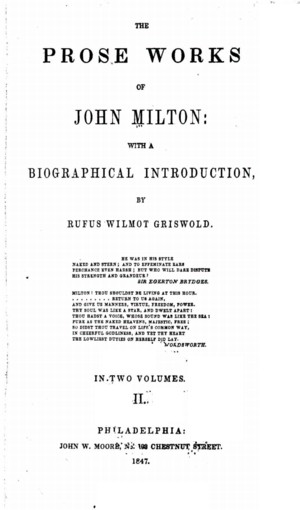
The Prose Works of John Milton, With a Biographical Introduction by Rufus Wilmot Griswold. In Two Volumes (Philadelphia: John W. Moore, 1847). Vol. 2.

Part of: The Prose Works of John Milton, 2 vols.

About Liberty Fund:

Liberty Fund, Inc. is a private, educational foundation established to encourage the study of the ideal of a society of free and responsible individuals.


CHAPTER III.

Of Tingoësia, and the countries adjoining eastward, as far as Cathay.

Beyond Narim and Comgoscoi the soldiers of those garrisons, travelling by appointment of the Russian governor in the year 1605, found many goodly countries not inhabited, many vast deserts and rivers; till at the end of ten weeks they spied certain cottages and herds, or companies of people, which came to them with reverent behaviour, and signified to the Samoëds and Tartars, which were guides to the Russian soldiers, that they were called Tingoësi; that their dwelling was on the great river Jenissey. This river is said to be far bigger than Ob,§ distant from the mouth thereof four days and nights’ sailing; and likewise falls into the sea of Naramzie: it hath high mountains on the east, some of which cast out fire, to the west a plain and fertile country, which in the spring-time it overflows about seventy leagues; all that time the inhabitants keep them in the mountains, and then return with their cattle to the plain. The Tingoësi are a very gentle nation, they have great swoln throats, like those in Italy, that live under the Alps; at persuasion of the Samoëds they forthwith submitted to the Russian government: and at their request travelling the next year to discover still eastward, they came at length to a river, which the savages of that place call Pisida,* somewhat less than Jenissey; beyond which hearing ofttimes the tolling of brazen bells, and sometimes the noise of men and horses, they durst not pass over; they saw there certain sails afar off, square, and therefore supposed to be like Indian or China sails, and the rather for that they report that great guns have been heard shot off from those vessels. In April and May they were much delighted with the fair prospect of that country, replenished with many rare trees, plants, and flowers, beasts and fowl. Some think here to be the borders of Tangut in the north of Cathay. Some of those Samoëds, about the year 1610, travelled so far till they came in view of a white city, and heard a great din of bells, and report there came to them men all armed in iron from head to foot. And in the year 1611, divers out of Cathay, and others from Alteen Czar, who styles himself the golden king, came and traded at Zergolta, or Surgoot, on the river Ob, bringing with them plates of silver. Whereupon Michael Pheodorowich the Russian emperor, in the year 1619, sent certain of his people from Tooma to Alteen, and Cathay, who returned with embassadors from those princes. These relate, that from Tooma in ten days and a half, three days whereof over a lake, where rubies and sapphires grow, they came to the Alteen king, or king of Alty; through his land in five weeks they passed into the country of Sheromugaly, or Mugalla, where reigned a queen called Manchica; whence in four days they came to the borders of Cathay, fenced with a stone wall, fifteen fathom high; along the side of which, having on the other hand many pretty towns belonging to Queen Manchica, they travelled ten days without seeing any on the wall, till they came to the gate; where they saw very great ordnance lying, and three thousand men in watch. They traffic with other nations at the gate, and very few at once are suffered to enter. They were travelling from Tooma to this gate twelve weeks; and from thence to the great city of Cathay ten days. Where being conducted to the house of embassadors, within a few days there came a secretary from King Tambur, with two hundred men well apparelled, and riding on asses, to feast them with divers sorts of wine, and to demand their message; but having brought no presents with them, they could not be admitted to his sight; only with his letter to the emperor they returned, as is aforesaid, to Tobolsca. They report, that the land of Mugalla reaches from Boghar to the north sea,§ and hath many castles built of stone, foursquare, with towers at the corners covered with glazed tiles; and on the gates alarm-bells, or watch-bells, twenty pound weight of metal; their houses built also of stone, the ceilings cunningly painted with flowers of all colours. The people are idolaters; the country exceeding fruitful. They have asses and mules, but no horses. The people of Cathay say, that this great wall stretches from Boghar to the north sea, four months’ journey, with continual towers a slight shot distant from each other, and beacons on every tower; and that this wall is the bound between Mugalla and Cathay. In which are but five gates; those narrow and so low, that a horseman sitting upright cannot ride in. Next to the wall is the city Shirokalga; it hath a castle well furnished with short ordance and small shot, which they who keep watch on the gates, towers, and walls, duly at sun-set and rising discharge thrice over. The city abounds with rich merchandise, velvets, damasks, cloth of gold, and tissue, with many sorts of sugars. Like to this is the city Yara, their markets smell odoriferously with spices, and Tayth more rich than that. Shirooan yet more magnificent, half a day’s journey through, and exceeding populous. From hence to Cathaia the imperial city is two days’ journey, built of white stone, four-square, in circuit four days’ going, cornered with four white towers, very high and great, and others very fair along the wall, white intermingled with blue, and loop-holes furnished with ordnance. In the midst of this white city stands a castle built of magnet, where the king dwells, in a sumptuous palace, the top whereof is overlaid with gold. The city stands on even ground encompassed with the river Youga, seven days’ journey from the sea. The people are very fair, but not warlike, delighting most in rich traffic. These relations are referred hither, because we have them from Russians; who report also, that there is a sea beyond Ob,* so warm, that all kind of seafowl live thereabout as well in winter as in summer. Thus much briefly of the sea and lands between Russia and Cathay.

[]Purch. part 3. p. 527.

[§ ]Ibid. 527, 551, 546, 52[Editor: illegible character]

[]Ibid.

[* ]Purch. 528

[]Ibid. 543, 546.

[]Ibid. 797.

[§ ]Ibid. 799.

[* ]Purch. p. 806.