EconlibThe LibraryOther Sites |
Front Page Titles (by Subject) THE FOURTH BOOK. - The Prose Works of John Milton, vol. 2
Return to Title Page for The Prose Works of John Milton, vol. 2The Online Library of LibertyA project of Liberty Fund, Inc.Search this Title:Also in the Library:
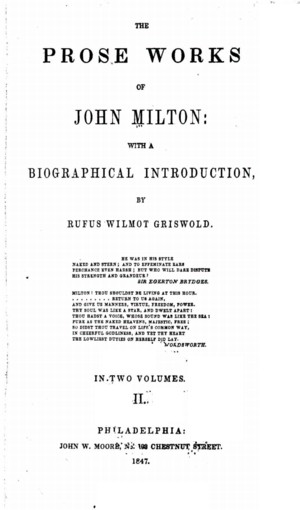
THE FOURTH BOOK. - John Milton, The Prose Works of John Milton, vol. 2 [1847]Edition used:The Prose Works of John Milton, With a Biographical Introduction by Rufus Wilmot Griswold. In Two Volumes (Philadelphia: John W. Moore, 1847). Vol. 2.
Part of: The Prose Works of John Milton, 2 vols.About Liberty Fund:Liberty Fund, Inc. is a private, educational foundation established to encourage the study of the ideal of a society of free and responsible individuals. Copyright information:The text is in the public domain. Fair use statement:This material is put online to further the educational goals of Liberty Fund, Inc. Unless otherwise stated in the Copyright Information section above, this material may be used freely for educational and academic purposes. It may not be used in any way for profit.
THE FOURTH BOOK.The Saxons grown up now to seven absolute kingdoms, and the latest of them established by succession, finding their power arrive well nigh at the utmost of what was to be gained upon the Britons, and as little fearing to be displanted by them, had time now to survey at leisure one another’s greatness. Which quickly bred among them either envy or mutual jealousies; till the west kingdom at length grown overpowerful, put an end to all the rest.* Meanwhile, above others, Ethelbert of Kent, who by this time had well ripened his young ambition, with more ability of years and experience in war, what before he attempted to his loss, now successfully attains: and by degrees brought all the other monarchies between Kent and Humber to be at his devotion. To which design the kingdom of West-Saxons, being the firmest of them all, at that time sore shaken by their overthrow at Woden’s-beorth, and the death of Keaulin, gave him, no doubt, a main advantage; the rest yielded not subjection, but as he earned it by continual victories.† And to win him the more regard abroad, he marries Bertha the French king’s daughter, though a Christian, and with this condition, to have the free exercise of her faith, under the care and instruction of Letardus, a bishop, sent by her parents along with her; the king notwithstanding and his people retaining their old religion. Beda‡ out of Gildas lays it sadly to the Britons’ charge, that they never would vouchsafe their Saxon neighbours the means of conversion; but how far to blame they were,§ and what hope there was of converting in the midst of so much hostility, at least falsehood, from their first arrival, is not now easy to determine.∥ Howbeit not long after they had the Christian faith preached to them by a nation more remote, and (as report went, accounted old in Beda’s time) upon this occasion. The Northumbrians had a custom at that time, and many hundred years after not abolished, to sell their children for a small value into any foreign land. Of which number two comely youths were brought to Rome, whose fair and honest countenances invited Gregory, archdeacon of that city, among others that beheld them, pitying their condition, to demand whence they were; it was answered by some who stood by, that they were Angli of the province Deira, subjects to Alla king of Northumberland; and by religion, pagans. Which last Gregory deploring, framed on a sudden this allusion to the three names he heard; that the Angli so like to angels should be snatched ‘de ira,’ that is from the wrath of God, to sing hallelujah: and forthwith obtaining license, of Benedict the pope, had come and preached here among them, had not the Roman people, whose love endured not the absence of so vigilant a pastor over them, recalled him then on his journey, though but deferred his pious intention. For a while after,¶ succeeding in the papal seat, and now in his fourth year, admonished, saith Beda, by divine instinct, he sent Augustin, whom he had designed for bishop of the English nation, and other zealous monks with him, to preach to them the gospel. Who being now on their way, discouraged by some reports, or their own carnal fear, sent back Austin, in the name of all, to beseech Gregory they might return home, and not be sent a journey so full of hazard, to a fierce and infidel nation, whose tongue they understood not. Gregory with pious and apostolic persuasions exhorts them not to shrink back from so good a work, but cheerfully to go on in the strength of divine assistance. The letter itself, yet extant among our writers of ecclesiastic story, I omit here, as not professing to relate of those matters more than what mixes aptly with civil affairs. The abbot Austin, for so he was ordained over the rest, re-encouraged by the exhortations of Gregory, and his fellows by the letter which he brought them, came safe to the isle of Tanet,* in number about forty, besides some of the French nation, whom they took along as interpreters. Ethelbert the king, to whom Austin at his landing had sent a new and wondrous message, that he came from Rome to proffer heaven and eternal happiness in the knowledge of another God than the Saxons knew, appoints them to remain where they had landed, and necessaries to be provided them, consulting in the mean time what was to be done. And after certain days coming into the island, chose a place to meet them under the open sky, possessed with an old persuasion, that all spells, if they should use any to deceive him, so it were not within doors, would be unavailable. They on the other side called to his presence, advancing for their standard a silver cross, and the painted image of our Saviour, came slowly forward singing their solemn litanies: which wrought in Ethelbert more suspicion perhaps that they used enchantments; till sitting down as the king willed them, they there preached to him, and all in that assembly, the tidings of salvation. Whom having heard attentively, the king thus answered: “Fair indeed and ample are the promises which ye bring, and such things as have the appearance in them of much good; yet such as being new and uncertain, I cannot easily assent to, quitting the religion which from my ancestors, with all the English nation, so many years I have retained. Nevertheless because ye are strangers, and have endured so long a journey, to impart us the knowledge of things, which I persuade me you believe to be the truest and the best, ye may be sure, we shall not recompense you with any molestation, but shall provide rather how we may friendliest entertain ye; nor do we forbid whom ye can by preaching gain to your belief.” And accordingly their residence he allotted them in Doroverne or Canterbury his chief city, and made provision for their maintenance, with free leave to preach their doctrine where they pleased. By which, and by the example of their holy life, spent in prayer, fasting, and continual labour in the conversion of souls, they won many; on whose bounty and the king’s, receiving only what was necessary, they subsisted. There stood without the city on the east side, an ancient church built in honour of St. Martin, while yet the Romans remained here: in which Bertha the queen went out usually to pray: here they also began† first to preach, baptize, and openly to exercise divine worship. But when the king himself, convinced by their good life and miracles, became Christian, and was baptized, which came to pass in the very first year of their arrival, then multitudes daily, conforming to their prince, thought it honour to be reckoned among those of his faith. To whom Ethelbert indeed principally showed his favour, but compelled none.‡ For so he had been taught by them who were both the instructors and the authors of his faith, that Christian religion ought to be voluntary, not compelled. About this time Kelwulf the son of Cutha, Keaulin’s brother, reigned over the West Saxons,§ after his brother Keola or Kelric, and had continual war either with English, Welsh, Picts, or Scots.∥ But Austin, whom with his fellows Ethelbert had now endowed with a better place for their abode in the city, and other possessions necessary to livelihood, crossing into France, was by the archbishop of Arles, at the appointment of pope Gregory, ordained archbishop of the English; and returning, sent to Rome Laurence and Peter, two of his associates, to acquaint the pope of his good success in England, and to be resolved of certain theological, or rather Levitical questions: with answers to which, not proper in this place, Gregory sends also to the great work of converting, that went on so happily, a supply of labourers, Mellitus, Justus, Paulinus, Rufinian, and many others; who what they were, may be guessed by the stuff which they brought with them, vessels and vestments for the altar, copes, reliques, and for the archbishop Austin a pall to say mass in; to such a rank superstition that age was grown, though some of them yet retaining an emulation of apostolic zeal. Lastly, to Ethelbert they brought a letter with many presents. Austin, thus exalted to archiepiscopal authority, recovered from the ruins and other profane uses a Christian church in Canterbury, built of old by the Romans, which he dedicated by the name of Christ’s church, and joining to it built a seat for himself and his successors; a monastery also near the city eastward, where Ethelbert at his motion built St. Peter’s, and enriched it with great endowments, to be a place of burial for the archbishops and kings of Kent: so quickly they stepped up into fellowship of pomp with kings. While thus Ethelbert* and his people had their minds intent, Ethelfrid the Northumbrian king was not less busied in far different affairs: for being altogether warlike, and covetous of fame, he more wasted the Britons than any Saxon king before him; winning from them large territories, which either he made tributary, or planted with his own subjects. Whence† Edan king of those Scots that dwelt in Britain, jealous of his successes, came against him with a mighty army, to a place called Degsastan; but in the fight losing most of his men, himself with a few escaped; only Theobald the king’s brother, and the whole wing which he commanded, unfortunately cut off, made the victory to Ethelfrid less entire. Yet from that time no king of Scots in hostile manner durst pass into Britain for a hundred and more years after: and what some years before Kelwulf the West Saxon is annalled to have done against the Scots and Picts, passing through the land of Ethelfrid a king so potent, unless in his aid and alliance, is not likely. Buchanan writes as if Ethelfrid, assisted by Keaulin whom he mistitles king of East Saxons, had before this time a battle with Aidan, wherein Cutha, Keaulin’s son, was slain. But Cutha, as is above written from better authority, was slain in fight against the Welsh twenty years before. The number‡ of Christians began now to increase so fast, that Augustin, ordaining bishops under him, two of his assistants, Mellitus and Justus, sent them out both to the work of their ministry. And Mellitus by preaching converted the East Saxons, over whom Sebert the son of Sleda, by permission of Ethelbert, being born of his sister Ricula, then reigned. Whose conversion Ethelbert to gratulate, built them the great church of St. Paul in London to be their bishop’s cathedral; as Justus also had his built at Rochester, and both gifted by the same king with fair possessions. Hitherto Austin laboured well among infidels, but not with like commendation soon after among Christians. For by means of Ethelbert summoning the Britain bishops to a place on the edge of Worcestershire, called from that time Augustin’s oak, he requires them to conform with him in the same day of celebrating Easter, and many other points wherein they differed from the rites of Rome: which when they refused to do, not prevailing by dispute, he appeals to a miracle, restoring to sight a blind man whom the Britons could not cure. At this something moved, though not minded to recede from their own opinions without further consultation, they request a second meeting; to which came seven Britain bishops, with many other learned men, especially from the famous monastery of Bangor, in which were said to be so many monks, living all by their own labour, that being divided under seven rectors, none had fewer than three hundred. One man there was who staid behind, a hermit by the life he led, who by his wisdom effected more than all the rest who went: being demanded, for they held him as an oracle, how they might know Austin to be a man from God, that they might follow him, he answered, that if they found him meek and humble, they should be taught by him, for it was likeliest to be the yoke of Christ, both what he bore himself, and would have them bear; but if he bore himself proudly, that they should not regard him, for he was then certainly not of God. They took his advice, and hasted to the place of meeting. Whom Austin, being already there before them, neither arose to meet, nor received in any brotherly sort, but sat all the while pontifically in his chair. Whereat the Britons, as they were counselled by the holy man, neglected him, and neither hearkened to his proposals of conformity, nor would acknowledge him for an archbishop: and in the name of the rest,* Dinothus, then abbot of Bangor, is said thus sagely to have answered him: “As to the subjection which you require, be thus persuaded of us, that in the bond of love and charity we are all subjects and servants of the church of God, yea to the pope of Rome, and every good Christian, to help them forward, both by word and deed, to be the children of God: other obedience than this we know not to be due to him whom you term the pope; and this obedience we are ready to give both to him and to every Christian continually. Besides, we are governed under God by the bishop of Caerleon, who is to oversee us in spiritual matters.” To which Austin thus presaging, some say menacing, replies, “Since ye refuse to accept of peace with your brethren, ye shall have war from your enemies; and since ye will not with us preach the word of life to whom ye ought, from their hands ye shall receive death.” This, though writers agree not whether Austin spake it as his prophecy, or as his plot against the Britons, fell out accordingly.† For many years were not past, when Ethelfrid, whether of his own accord, or at the request of Ethelbert, incensed by Austin, with a powerful host came to Westchester, then Caer-legion. Where being met by the British forces, and both sides in readiness to give the onset, he discerns a company of men, not habited for war, standing together in a place of some safety; and by them a squadron armed. Whom having learnt upon some inquiry to be priests and monks, assembled thither after three days’ fasting, to pray for the good success of their forces against him, “therefore they first,” saith he, “shall feel our swords; for they who pray against us, fight heaviest against us by their prayers, and are our dangerousest enemies.” And with that turns his first charge upon the monks. Brocmail, the captain set to guard them, quickly turns his back, and leaves above twelve hundred monks to a sudden massacre, whereof scarce fifty escaped. But not so easy work found Ethelfrid against another part of Britons that stood in arms, whom though at last he overthrew, yet with slaughter nigh as great to his own soldiers. To excuse Austin of this bloodshed, lest some might think it his revengeful policy, Beda writes, that he was dead long before, although if the time of his sitting archbishop be right computed sixteen years, he must survive this action.* Other just ground of charging him with this imputation appears not, save what evidently we have from Geoffrey of Monmouth, whose weight we know.† The same year Kelwulf made war on the South Saxons, bloody, saith Huntingdon, to both sides, but most to them of the south;‡ and four years after dying, left the government of West Saxons to Kinegils and Cuichelm, the sons of his brother Keola. Others, as Florent of Worcester, and Matthew of Westminster, will have Cuichelm son of Kinegils, but admitted to reign with his father, in whose third year§ they are recorded with joint forces or conduct to have fought against the Britons in Beandune, now Bindon in Dorsetshire, and to have slain of them above two thousand.∥ More memorable was the second year following, by the death of Ethelbert the first Christian king of Saxons, and no less a favourer of all civility in that rude age. He gave laws and statutes after the example of Roman emperors, written with the advice of his sagest counsellors, but in the English tongue, and observed long after. Wherein his special care was to punish those who had stolen aught from church or churchman, thereby showing how gratefully he received at their hands the Christian faith. Which, he no sooner dead, but his son Eadbald took the course as fast to extinguish; not only falling back into heathenism, but that which heathenism was wont to abhor, marrying his father’s second wife. Then soon was perceived what multitudes for fear or countenance of the king had professed Christianity, returning now as eagerly to their old religion. Nor staid the apostacy with one province, but quickly spread over to the East Saxons; occasioned there likewise, or set forward, by the death of their Christian king Sebert: whose three sons, of whom two are named Sexted and Seward,¶ neither in his lifetime would be brought to baptism, and after his decease re-established the free exercise of idolatry; nor so content, they set themselves in despite to do some open profanation against the other sacrament. Coming therefore into the church where Mellitus the bishop was ministering, they required him in abuse and scorn to deliver to them unbaptized the consecrated bread; and him refusing drove disgracefully out of their dominion. Who crossed forthwith into Kent, where things were in the same plight, and thence into France, with Justus bishop of Rochester. But divine vengeance deferred not long the punishment of men so impious; for Eadbald, vexed with an evil spirit, fell often into foul fits of distraction; and the sons of Sebert, in a fight against the West Saxons, perished with their whole army. But Eadbald, within the year, by an extraordinary means became penitent. For when Lawrence the archbishop and successor of Austin was preparing to ship for France, after Justus and Mellitus, the story goes, if it be worth believing, that St. Peter, in whose church he spent the night before in watching and praying, appeared to him, and to make the vision more sensible, gave him many stripes for offering to desert his flock; at sight whereof the king (to whom next morning he showed the marks of what he had suffered, by whom and for what cause) relenting and in great fear, dissolved his incestuous marriage, and applied himself to the Christian faith more sincerely than before, with all his people. But the Londoners, addicted still to paganism, would not be persuaded to receive again Mellitus their bishop, and to compel them was not in his power. Thus much through all the south was troubled in religion, as much were the north parts disquieted through ambition.* For Ethelfrid of Bernicia, as was touched before, having thrown Edwin out of Deira, and joined that kingdom to his own, not content to have bereaved him of his right, whose known virtues and high parts gave cause of suspicion to his enemies, sends messengers to demand him of Redwald king of East Angles; under whose protection, after many years wandering obscurely through all the island, he had placed his safety. Redwald, though having promised all defence to Edwin as to his suppliant, yet tempted with continual and large offers of gold, and not contemning the puissance of Ethelfrid, yielded at length, either to dispatch him, or to give him into their hands: but earnestly exhorted by his wife, not to betray the faith and inviolable law of hospitality and refuge given,† prefers his first promise as the more religious; nor only refuses to deliver him, but since war was thereupon denounced, determines to be beforehand with the danger; and with a sudden army raised, surprises Ethelfrid, little dreaming an invasion, and in a fight near to the east side of the river Idle, on the Mercian border, now Nottinghamshire, slays him,‡ dissipating easily those few forces which he had got to march out overhastily with him; who yet, as a testimony of his fortune not his valour to be blamed, slew first with his own hands Reiner the king’s son. His two sons Oswald and Oswi, by Acca, Edwin’s sister, escaped into Scotland. By this victory Redwald became so far superior to the other Saxon kings, that Beda reckons him the next after Ella and Ethelbert; who, besides this conquest of the north, had likewise all on the other side Humber at his obedience. He had formerly in Kent received baptism,§ but coming home, and persuaded by his wife, who still it seems was his chief counsellor to good or bad alike, relapsed into his old religion: yet not willing to forego his new, thought it not the worst way, lest perhaps he might err in either, for more assurance to keep them both; and in the same temple erected one altar to Christ, another to his idols. But Edwin, as with more deliberation he undertook, and with more sincerity retained, the Christian profession, so also in power and extent of dominion far exceeded all before him; subduing all, saith Beda, English or British, even to the isles, then called Mevanian, Anglesey, and Man; settled in his kingdom by Redwald, he sought in marriage Edelburga, whom others called Tate, the daughter of Ethelbert. To whose embassadors Eadbald her brother made answer, that “to wed their daughter to a pagan, was not the Christian law.” Edwin replied, that “to her religion he would be no hindrance, which with her whole household she might freely exercise. And moreover, that if examined it were found the better, he would embrace it.” These ingenuous offers, opening so fair a way to the advancement of truth, are accepted,∥ and Paulinus as a spiritual guardian sent along with the virgin. He being to that purpose made bishop by Justus, omitted no occasion to plant the Gospel in those parts, but with small success, till the next year¶ Cuichelm, at that time one of the two West-Saxon kings, envious of the greatness which he saw Edwin growing up to, sent privily Eumerus a hired swordsman to assassin him; who, under pretence of doing a message from his master, with a poisoned weapon stabs at Edwin, conferring with him in his house, by the river Derwent in Yorkshire, on an Easter-day; which Lilla one of the king’s attendants, at the instant perceiving, with a loyalty that stood not then to deliberate, abandoned his whole body to the blow; which notwithstanding made passage through to the king’s person with a wound not to be slighted. The murderer encompassed now with swords, and desperate, forerevenges his own fall with the death of another, whom his poniard reached home. Paulinus omitting no opportunity to win the king from misbelief, obtained at length this promise from him; that if Christ whom he so magnified, would give him to recover of his wound, and victory of his enemies who had thus assaulted him, he would then become Christian, in pledge whereof he gave his young daughter Eanfled, to be bred up in religion; who, with twelve others of his family, on the day of Pentecost was baptized. And by that time well recovered of his wound, to punish the author of so foul a fact, he went with an army against the West-Saxons: whom having quelled by war, and of such as had conspired against him, put some to death, others pardoned, he returned home victorious, and from that time worshipped no more his idols, yet ventured not rashly into baptism, but first took care to be instructed rightly what he learnt, examining and still considering with himself and others whom he held wisest; though Boniface the pope, by large letters of exhortation both to him and his queen, was not wanting to quicken his belief. But while he still deferred, and his deferring might seem now to have passed the maturity of wisdom to a faulty lingering, Paulinus by revelation, as was believed, coming to the knowledge of a secret which befel him strangely in the time of his troubles, on a certain day went in boldly to him, and laying his right hand on the head of the king, asked him if he remembered what that sign meant; the king trembling, and in amaze rizing up, straight fell at his feet. “Behold,” saith Paulinus, raising him from the ground, “God hath delivered you from your enemies, and given you the kingdom as you desired: perform now what long since you promised him, to receive his doctrine, which I now bring you, and the faith, which if you accept, shall to your temporal felicity add eternal.” The promise claimed of him by Paulinus, how and wherefore made, though savouring much of legend is thus related. Redwald, as we have heard before, dazzled with the gold of Ethelfrid, or by his threatening overawed, having promised to yield up Edwin, one of his faithful companions, of which he had some few with him in the court of Redwald, that never shrunk from his adversity, about the first hour of the night comes in haste to his chamber, and calling him forth for better secrecy, reveals to him his danger, offers him his aid to make escape; but that course not approved, as seeming dishonourable without more manifest cause to begin distrust towards one who had so long been his only refuge, the friend departs. Edwin left alone without the palace gate, full of sadness and perplexed thoughts, discerns about the dead of night a man neither by countenance nor by habit to him known, approaching towards him. Who after salutation asked him, “why at this hour, when all others were at rest, he alone so sadly sat waking on a cold stone.” Edwin not a little misdoubting who he might be, asked him again, “what his sitting within doors, or without, concerned him to know.” To whom he again, “Think not that who thou art, or why sitting here, or what danger hangs over thee is to me unknown: but what would you promise to that man, whoever would befriend you out of all these troubles, and persuade Redwald to the like?” “All that I am able,” answered Edwin. And he, “What if the same man should promise to make you greater than any English king hath been before you?” “I should not doubt,” quoth Edwin, “to be answerably grateful.” “And what if to all this he would inform you,” said the other, “in a way to happiness, beyond what any of your ancestors have known? would you hearken to his counsel?” Edwin without stopping promised “he would.” And the other laying his right hand on Edwin’s head, “When this sign,” saith he, “shall next befal thee, remember this time of night, and this discourse, to perform what thou hast promised;” and with these words disappearing, he left Edwin much revived, but not less filled with wonder, who this unknown should be. When suddenly the friend who had been gone all this while to listen further what was like to be decreed of Edwin, comes back and joyfully bids him rise to his repose, for that the king’s mind, though for a while drawn aside, was now fully resolved not only not to betray him, but to defend him against all enemies, as he had promised. This was said to be the cause why Edwin admonished by the bishop of a sign which had befallen him so strangely, and as he thought so secretly, arose to him with that reverence and amazement, as to one sent from heaven, to claim that promise of him which he perceived well was due to a divine power, that had assisted him in his troubles. To Paulinus therefore he makes answer, that the Christian belief he himself ought by promise, and intended to receive; but would confer first with his chief peers and counsellors, that if they likewise could be won, all at once might be baptized. They therefore being asked in council what their opinion was concerning this new doctrine, and well perceiving which way the king inclined, every one thereafter shaped his reply. The chief priest, speaking first, discovered an old grudge he had against his gods, for advancing others in the king’s favour above him their chief priest: another hiding his court-compliance with a grave sentence, commended the choice of certain before uncertain, upon due examination; to like purpose answered all the rest of his sages, none openly dissenting from what was likely to be the king’s creed: whereas the preaching of Paulinus could work no such effect upon them, toiling till that time without success. Whereupon Edwin, renouncing heathenism, became Christian: and the pagan priest, offering himself freely to demolish the altars of his former gods, made some amends for his teaching to adore them. With Edwin,* his two sons Osfrid and Eanfrid, born to him by Quenburga, daughter, as saith Beda, of Kearle king of Mercia, in the time of his banishment, and with them most of the people, both noble and commons, easily converted, were baptized; he with his whole family at York, in a church easily built up of wood, the multitude in most part in rivers. Northumberland thus christened, Paulinus, crossing Humber, converted also the province of Lindsey, and Blecca the governor of Lincoln, with his household and most of that city; wherein he built a church of stone, curiously wrought, but of small continuance; for the roof in Beda’s time, uncertain whether by neglect or enemies, was down; the walls only standing. Meanwhile in Mercia, Kearle, a kinsman of Wibba, saith Huntingdon, not a son, having long withheld the kingdom from Penda, Wibba’s son, left it now at length in the fiftieth year of his age: with whom Kinegils and Cuichelm, the West-Saxon kings, two years after,† having by that time it seems recovered strength, since the inroad made upon them by Edwin, fought at Cirencester, then made true. But Edwin seeking every way to propagate the faith, which with so much deliberation he had received, persuaded Eorpwald, the son of Redwald, king of East-Angles, to embrace the same belief;* willingly or in awe, is not known, retaining under Edwin the name only of a king. But Eorpwald not long survived his conversion, slain in fight by Riebert a pagan:† whereby the people having lightly followed the religion of their king, as lightly fell back to their old superstitions for above three years after: Edwin in the mean while, to his faith adding virtue, by the due administration of justice wrought such peace over all his territories, that from sea to sea man or woman might have travelled in safety. His care also was of fountains by the way side, to make them fittest for the use of travellers. And not unmindful of regal state, whether in war or in peace, he had a royal banner carried before him. But having reigned with much honour seventeen years, he was at length by Kedwallay or Cadwallon, king of the Britons, who with aid of the Mercian Penda had rebelled against him, slain in a battle with his son Osfrid, at a place called Hethfield, and his whole army overthrown or dispersed in the year six hundred and thirty-three,‡ and the forty-seventh of his age, in the eye of man worthy a more peaceful end. His head brought to York was there buried in the church by him begun. Sad was this overthrow, both to church and state of the Northumbrians: for Penda being a heathen, and the British king, though in name a Christian, but in deeds more bloody than the pagan, nothing was omitted of barbarous cruelty in the slaughter of sex or age; Kedwalla threatening to root out the whole nation, though then newly Christian.—For the Britons, and, as Beda saith, even to his days, accounted Saxon Christianity no better than paganism, and with them held as little communion. From these calamities no refuge being left but flight, Paulinus taking with him Ethilburga the queen and her children, aided by Bassus, one of Edwin’s captains, made escape by sea to Eadbald king of Kent: who receiving his sister with all kindness, made Paulinus bishop of Rochester, where he ended his days. After Edwin, the kingdom of Northumberland became divided as before, each rightful heir seizing his part; in Deira Osric, the son of Elfric, Edwin’s uncle, by profession a Christian, and baptized by Paulinus: in Bernicia, Eanfrid the son of Ethelfrid; who all the time of Edwin, with his brother Oswald, and many of the young nobility, lived in Scotland exiled, and had been there taught and baptized. No sooner had they gotten each a kingdom, but both turned recreant, sliding back into their old religion; and both were the same year slain; Osric by a sudden eruption of Kedwalla, whom he in a strong town had unadvisedly besieged; Eanfrid seeking peace, and inconsiderately with a few surrendering himself. Kedwalla now ranged at will through both those provinces, using cruelly his conquest;§ when Oswald the brother of Eanfrid with a small but Christian army unexpectedly coming on, defeated and destroyed both him and his huge forces, which he boasted to be invincible, by a little river running into Tine near the ancient Roman wall then called Denisburn, the place afterwards Heaven-field, from the cross reported miracles for cures, which Oswald there erected before the battle, in token of his faith against the great number of his enemies. Obtaining the kingdom he took care to instruct again the people in Christianity. Sending therefore to the Scottish elders, Beda so terms them, among whom he had received baptism, requested of them some faithful teacher, who might again settle religion in his realm, which the late troubles had much impaired; they, as readily hearkening to his request, send Aidan, a Scotch monk and bishop, but of singular zeal and meekness, with others to assist him, whom at their own desire he seated in Lindisfarne, as the episcopal seat, now Holy Island: and being the son of Ethelfrid, by the sister of Edwin, as right heir, others failing, easily reduced both kingdoms of Northumberland as before into one; nor of Edwin’s dominion lost any part, but enlarged it rather; over all the four British nations, Angles, Britons, Picts, and Scots, exercising regal authority. Of his devotion, humility, and almsdeeds, much is spoken; that he disdained not to be the interpreter of Aidan, preaching in Scotch or bad English, to his nobles and household servants; and had the poor continually served at his gate, after the promiscuous manner of those times: his meaning might be upright, but the manner more ancient of private or of church-contribution is doubtless more evangelical. About this time the West-Saxons,* anciently called Gevissi, by the preaching of Berinus, a bishop, whom pope Honorius had sent, were converted to the faith with Kinegils their king: him Oswald received out of the font, and his daughter in marriage. The next year† Cuichelm was baptized in Dorchester, but lived not to the year’s end. The East-Angles also this year were reclaimed to the faith of Christ, which for some years past they had thrown off. But Sigebert the brother of Eorpwald now succeeded in that kingdom, praised for a most Christian and learned man: who while his brother yet reigned, living in France an exile, for some displeasure conceived against him by Redwald his father, learned there the Christian faith; and reigning soon after, in the same instructed his people, by the preaching of Felix a Burgundian bishop. In the year six hundred and forty‡ Eadbold deceasing, left to Ercombert, his son by Emma the French king’s daughter, the kingdom of Kent; recorded the first of English kings, who commanded through his limits the destroying of idols; laudably if all idols without exception; and the first to have established Lent among us, under strict penalty; not worth remembering, but only to inform us, that no Lent was observed here till his time by compulsion: especially being noted by some to have fraudulently usurped upon his elder brother Ermenred,§ whose right was precedent to the crown. Oswald having reigned eight years,∥ worthy also as might seem of longer life, fell into the same fate with Edwin, and from the same hand, in a great battle overcome and slain by Penda, at a place called Maserfield, now Oswestre in Shropshire¶ miraculous, as saith Beda, after his death. His brother Oswi succeeded him;** reigning, though in much trouble, twenty-eight years; opposed either by Penda, or his own son Alfred, or his brother’s son Ethilwald. Next year†† Kinegils the West-Saxon king dying left his son Kenwalk in his stead, though as yet unconverted. About this time Sigebert king of East-Angles having learnt in France, ere his coming to reign, the manner of their schools, with the assistance of some teachers out of Kent instituted a school here after the same discipline, thought to be the university of Cambridge, then first founded; and at length weary of his kingly office, betook him to a monastical life; commending the care of government to his kinsman Egric, who had sustained with him part of that burden before. It happened some years after, that Penda made war on the East-Angles; they expecting a sharp encounter, besought Sigebert, whom they esteemed an expert leader, with his presence to confirm the soldiery; and him refusing, carried by force out of the monastery in the camp; where acting the monk rather than the captain, with a single wand in his hand, he was slain with Egric, and his whole army put to flight. Anna of the royal stock, as next in right, succeeded; and hath the praise of a virtuous and most Christian prince. But Kenwalk the West-Saxon* having married the sister of Penda, and divorced her, was by him with more appearance of a just cause vanquished in fight, and deprived of his crown: whence retiring to Anna king of East-Angles, after three years abode in his court† he there became Christian, and afterwards regained his kingdom. Oswi in the former years of his reign had sharer with him Oswin, nephew of Edwin, who ruled in Deira seven years, commended much for his zeal in religion, and for comeliness of person, with other princely qualities, beloved of all. Notwithstanding which, dissensions growing between them, it came to arms. Oswin seeing himself much exceeded in numbers thought it more prudence, dismissing his army, to reserve himself for some better occasion. But committing his person with one faithful attendant to the loyalty of Hunwald an earl, his imagined friend, he was by him treacherously discovered, and by command of Oswi slain. After whom within twelve days,‡ and for grief of him whose death he foretold, died bishop Aidan, famous for his charity, meekness and labour in the gospel. The fact of Oswi was detestable to all; which therefore to expiate, a monastery was built in the place where it was done, and prayers there daily offered up for the souls of both kings, the slain and the slayer. Kenwalk, by this time re-installed in his kingdom, kept it long, but with various fortune; for Beda relates him ofttimes afflicted by his enemies,§ with great losses: and in six hundred and fifty-two, by the annals, fought a battle (civil war Ethelwerd calls it) at Bradanford by the river Afene; against whom, and for what cause, or who had the victory, they write not. Camden names the place Bradford in Wiltshire, by the river Avon, and Cuthred his near kinsman, against whom he fought, but cites no authority; certain it is, then Kenwalk four years before had given large possessions to his nephew Cuthred, the more unlikely therefore now to have rebelled. The next year∥ Peada, whom his father Penda, though a heathen, had for his princely virtues made prince of Middle-Angles, belonging to the Mercians, was with that people converted to the faith. For coming to Oswi with request to have in marriage Alfleda his daughter, he was denied her, but on condition that he with all his people should receive Christianity. Hearing therefore not unwillingly what was preached to him of resurrection and eternal life, much persuaded also by Alfrid the king’s son, who had his sister Kyniburg to wife, he easily assented, for the truth’s sake only as he professed, whether he obtained the virgin or no, and was baptized with all his followers. Returning, he took with him four presbyters to teach the people of his province; who by their daily preaching won many. Neither did Pinda, though himself no believer, prohibit any in his kingdom to hear or believe the gospel, but rather hated and despised those, who, professing to believe, attested not their faith by good works; condemning them for miserable and justly to be despised, who obey not that God, in whom they choose to believe. How well might Penda, this heathen, rise up in judgment against many pretended Christians, both of his own and these days! yet being a man bred up to war, (as no less were others than reigning, and ofttimes one against another, though both Christians,) he warred on Anna king of the East-Angles,¶ perhaps without cause, for Anna was esteemed a just man, and at length slew him. About this time the East Saxons, who, as above hath been said, had expelled their bishop Mellitus, and renounced the faith, were by the means of Oswi thus reconverted. Sigebert, surnamed the small, being the son of Seward, without other memory of his reign, left his son king of that province, after him Sigebert the second; who coming often to visit Oswi his great friend, was by him at several times fervently dissuaded from idolatry, and convinced at length to forsake it, was there baptized; on his return home taking with him Kedda a laborious preacher, afterwards made bishop; by whose teaching, with some help of others, the people were again recovered from misbelief. But Sigebert some years after, though standing fast in religion, was by the conspiracy of two brethren, in place near about him, wickedly murdered; who being asked, “What moved them to a deed so heinous,” gave no other than this barbarous answer; “That they were angry with him for being so gentle to his enemies, as to forgive them their injuries whenever they besought him.” Yet his death seems to have happened not without some cause by him given of divine displeasure. For one of those earls who slew him, living in unlawful wedlock, and therefore excommunicated so severely by the bishop, that no man might presume to enter into his house, much less to sit at meat with him, the king not regarding his church-censure, went to feast with him at his invitation. Whom the bishop meeting in his return, though penitent for what he had done, and fallen at his feet, touched with the rod in his hand, and angrily thus foretold: “Because thou hast neglected to abstain from the house of that excommunicate, in that house thou shalt die;” and so it fell out, perhaps from that prediction, God bearing witness to his minister in the power of church-discipline, spiritually executed, not juridically on the contemner thereof. This year* 655 proved fortunate to Oswi, and fatal to Penda; for Oswi by the continual inroads of Penda having long endured much devastation, to the endangering once by assault and fire Bebbanburg,† his strongest city, now Bamborrow-castle, unable to resist him, with many rich presents offered to buy his peace, which not accepted by the pagan,‡ who intended nothing but destruction to that king, though more than once in affinity with him, turning gifts into vows, he implores divine assistance, devoting, if he were delivered from his enemy, a child of one year old, his daughter, to be a nun, and twelve portions of land whereon to build monasteries. His vows, as may be thought, found better success than his proffered gifts; for hereupon with his son Alfrid, gathering a small power, he encountered and discomfited the Mercians, thirty times exceeding his in number, and led on by expert captains,§ at a place called Laydes, now Leeds in Yorkshire. Besides this Ethelwald, the son of Oswald, who ruled in Deira, took part with the Mercians; but in the fight withdrew his forces, and in a safe place expected the event: with which unseasonable retreat the Mercians, perhaps terrified and misdoubting more danger, fled; their commanders, with Penda himself, most being slain, among whom Edilhere the brother of Anna, who ruled after him the East-Angles, and was the author of this war; many more flying were drowned in the river, which Beda calls Winwed, then swoln above its banks.∥ The death of Penda, who had been the death of so many good kings, made general rejoicing, as the song witnessed. At the river Winwed, Anna was avenged. To Edelhere succeeded Ethelwald his brother, in the East-Angles; to Sigebert in the East-Saxons, Suidhelm the son of Sexbald, saith Bede,* the brother of Sigebert, saith Malmsbury; he was baptized by Kedda, then residing in the East-Angles, and by Ethelwald the king received out of the font. But Oswi in the strength of his late victory, within† three years after subdued all Mercia, and of the Pictish nation greatest part, at which time he gave to Peada his son-in-law the kingdom of South-Mercia, divided from the Northern by Trent. But Peada the spring following, as was said, by the treason of his wife the daughter of Oswi, married by him for a special Christian, on the feast of Easter‡ not protected by the holy time, was slain. The Mercian nobles, Immin, Eaba, and Eadbert, throwing off the government of Oswi, set up Wulfer the other son of Penda to be their king, whom till then they had kept hid, and with him adhered to the Christian faith. Kenwalk the West-Saxon, now settled at home, and desirous to enlarge his dominion, prepares against the Britons, joins battle with them at Pen in Somersetshire, and overcoming, pursues them to Predridan. Another fight he had with them before, at a place called Witgeornesburg, barely mentioned by the monk of Malmsbury. Nor was it long ere he fell at variance with Wulfer the son of Penda, his old enemy, scarce yet warm in his throne, fought with him at Possentesburgh, on the Easter holydays,§ and as Ethelwerd saith, took him prisoner; but the Saxon annals, quite otherwise, that Wulfer winning the field, wasted the West-Saxon country as far as Eskesdun: nor staying there, took and wasted the isle of Wight, but causing the inhabitants to be baptized, till then unbelievers, gave the island to Ethelwald king of South-Saxons, whom he had received out of the font. The year∥ six hundred and sixty-four a synod of Scottish and English bishops, in the presence of Oswi and Alfred his son, was held at a monastery in those parts, to debate on what day Easter should be kept; a controversy which long before had disturbed the Greek and Latin churches: wherein the Scots not agreeing with the way of Rome; nor yielding to the disputants on that side, to whom the king most inclined, such as were bishops here, resigned, and returned home with their disciples. Another clerical question was there also much controverted, not so superstitious in my opinion as ridiculous, about the right shaving of crowns. The same year was seen an eclipse of the sun in May, followed by a sore pestilence beginning in the South,¶ but spreading to the North, and over all Ireland with great mortality. In which time the East-Saxons, after Swithelm’s decease, being governed by Siger the son of Sigebert the small, and Sebbi of Seward, though both subject to the Mercians; Siger and his people unsteady of faith, supposing that this plague was come upon them for renouncing their old religion, fell off the second time to infidelity. Which the Mercian king Wulfer understanding, sent Jarumannus a faithful bishop, who with other his fellow-labourers, by sound doctrine and gentle dealing, soon recured them of their second relapse. In Kent, Ercombert expiring, was succeeded by his son Ecbert. In whose fourth year,** by means of Theodore, a learned Greekish monk of Tarsus, whom pope Vitalian had ordained archbishop of Canterbury, the Greek and Latin tongue, with other liberal arts, arithmetic, music, astronomy, and the like, began first to flourish among the Saxons; as did also the whole land, under potent and religious kings, more than ever before, as Bede affirms, till his own days. Two years†† after in Northumberland died Oswi, much addicted to Romish rites, and resolved, had his disease released him, to have ended his days at Rome. Ecfrid, the eldest of his sons begot in wedlock, succeeded him. After other* three years, Ecbert in Kent deceasing, left nothing memorable behind him, but the general suspicion to have slain or connived at the slaughter of his uncle’s two sons, Elbert and Egelbright. In recompense whereof he gave to the† mother of them part of Tanet, wherein to build an abbey; the kingdom fell to his brother Lothair. And much about this time by best account it should be, however placed in Beda,‡ that Ecfrid of Northumberland, having war with the Mercian Wulfer, won from him Lindsey, and the country thereabout. Sebbi having reigned over the East-Saxons thirty years, not long before his death, though long before desiring, took on him the habit of a monk; and drew his wife at length, though unwilling, to the same devotion. Kenwalk also dying left the government to Sexburga his wife, who outlived him in it but one year, driven out, saith Mat. Westm. by the nobles disdaining female government. After whom several petty kings,§ as Beda calls them, for ten years space divided the West-Saxons; others name two, Escwin, the nephew of Kinegils, and Kentwin the son, not petty by their deeds:∥ for Escwin fought a battle with Wulfer¶ at Bedanhafde, and about a year after both deceased; but Wulfer not without a stain left behind him of selling the bishopric of London to Wini; the first simonist we read of in this story: Kenwalk had before expelled him from his chair at Winchester. Ethelred, the brother of Wulfer, obtaining next the kingdom of Mercia, not only recovered Lindsey, and what besides in those parts Wulfer had lost to Ecfrid some years before, but found himself strong enough to extend his arms another way, as far as Kent, wasting that country without respect to church or monastery,** much also endamaging the city of Rochester, notwithstanding what resistance Lothair could make against him. In August six hundred and seventy-eight†† was seen a morning comet for three months following, in manner of a fiery pillar. And the South-Saxons about this time were converted to the Christian faith, upon this occasion. Wilfred bishop of the Northumbrians entering into contention with Ecfrid the king, was by him deprived of his bishoprick, and long wandering up and down as far as Rome,‡‡ returned at length into England; but not daring to approach the north, whence he was banished, bethought him where he might to best purpose elsewhere exercise his ministry. The south of all other Saxons remained yet heathen; but Ediwalk their king not long before had been baptized in Mercia, persuaded by Wulfer, and by him, as hath been said, received out of the font. For which relation’s sake he had the Isle of Wight,§§ and a province of the Meannari adjoining given him on the continent about Meanesborow in Hantshire, which Wulfer had a little before gotten from Kenwalk. Thither Wilfrid takes his journey, and with the help of other spiritual labourers about him, in short time planted there the gospel. It had not rained, as is said, of three years before in that country, whence many of the people daily perished by famine; till on the first day of their public baptism, soft and plentiful showers descending restored all abundance to the summer following. Two years after this,∥∥ Kentwin the other West-Saxon king above named, chaced the Welsh Britons, as is chronicled without circumstance, to the very sea-shore. But in the year, by Beda’s reckoning, six hundred and eighty-three,* Kedvalla a West-Saxon of the royal line, (whom the Welsh will have to be Cadwallader, last king of the Britons,) thrown out by faction, returned from banishment, and invaded both Kentwin, if then living, or whoever else had divided the succession of Kenwalk, slaying in fight Edelwalk the South-Saxon, who opposed him in their aid;† but soon after was repulsed by two of his captains, Bertune and Andune, who for a while held the province in their power.‡ But Kedwalla gathering new force, with the slaughter of Bertune, and also of Edric the successor of Edelwalk, won the kingdom, but reduced the people to heavy thraldom.§ Then addressing to conquer the Isle of Wight, till that time pagan, saith Beda, (others otherwise, as above hath been related,) made a vow, though himself yet unbaptized, to devote the south part of that island, and the spoils thereof, to holy uses. Conquest obtained, paying his vow as then was the belief, he gave his fourth to bishop Wilfrid, by chance there present; and he to Bertwin a priest, his sister’s son, with commission to baptize all the vanquished, who meant to save their lives. But the two young sons of Arwald, king of that island, met with much more hostility: for they, at the enemy’s approach flying out of the isle, and betrayed where they were hid not far from thence, were led to Kedwaller, who lay then under cure of some wounds received, and by his appointment, after instruction and baptism first given them, harshly put to death, which the youths are said above their age to have Christianly suffered. In Kent Lothair died this year of his wounds received in the fight against the South-Saxons, led on by Edric, who descending from Ermenred, it seems challenged the crown, and wore it, though not commendably, one year and a half: but coming to a violent death,∥ left the land exposed a prey either to homebred usurpers, or neighbouring invaders. Among whom Kedwalla, taking advantage from their civil distempers, and marching easily through the South-Saxons, whom he had subdued, sorely harassed the county, untouched of a long time by any hostile incursion. But the Kentish men, all parties uniting against a common enemy, with joint power so opposed him, that he was constrained to retire back; his brother Mollo in the flight, with twelve men in his company, seeking shelter in a house was beset, and therein burnt by the pursuers:¶ Kedwalla much troubled at so great a loss, recalling and soon rallying his disordered forces, returned fiercely upon the chasing enemy;** nor could he be got out of the province, till both by fire and sword he had avenged the death of his brother.†† At length Victred, the son of Ecbert, attaining the kingdom, both settled at home all things in peace, and secured his borders from all outward hostility.‡‡ While thus Kedwalla disquieted both West and East, after his winning the crown, Ecfrid the Northumbrian, and Ethelred the Mercian, fought a sore battle by the river Trent; wherein Elfwin brother to Ecfrid, a youth of eighteen years, much beloved, was slain; and the accident likely to occasion much more shedding of blood, peace was happily made up by the grave exhortation of Archbishop Theodore, a pecuniary fine only paid to Ecfrid, as some satisfaction for the loss of his brother’s life. Another adversity befell Ecfrid in his family, by means of Ethildrith his wife, king Anna’s daughter, who having taken him for her husband, and professing to love him above all other men, persisted twelve years in the obstinate refusal of his bed, thereby thinking to live the purer life. So perversely then was chastity instructed against the apostle’s rule. At length obtaining of him with much importunity her departure, she veiled herself a nun, then made abbess of Ely, died seven years after of the pestilence; and might with better warrant have kept faithfully her undertaken wedlock, though now canonized St. Audrey of Ely. In the mean while Ecfrid had sent Bertus with a power to subdure Ireland, a harmless nation, saith Beda, and ever friendly to the English; in both which they seem to have left a posterity much unlike them at this day; miserably wasted, without regard had to places hallowed or profane; they betook themselves partly to their weapons, partly to implore divine aid; and, as was thought, obtained it in their full avengement upon Ecfrid. For he the next year, against the mind and persuasion of his sagest friends, and especially of Cudbert a famous bishop of that age, marching unadvisedly against the Picts, who long before had been subject to Northumberland, was by them feigning flight, drawn unawares into narrow straits, overtopped with hills, and cut off with most of his army. From which time, saith Beda, military valour began among the Saxons to decay, not only the Picts till then peaceable, but some part of the Britons also recovered by arms their liberty for many years after. Yet Alfrid elder, but base brother to Ecfrid, a man said to be learned in the Scriptures, recalled from Ireland, to which place in his brother’s reign he had retired, and now succeeding, upheld with much honour, though in narrower bounds, the residue of his kingdom. Kedwalla having now with great disturbance of his neighbours reigned over the West-Saxons two years, besides what time he spent in gaining it, wearied perhaps with his own turbulence, went to Rome, desirous there to receive baptism, which till then his worldly affairs had deferred; and accordingly, on Easter-day, six hundred and eighty-nine,* he was baptized by Sergius the pope, and his name changed to Peter. All which notwithstanding, surprised with a disease, he outlived not the ceremony so far sought much above the space of five weeks, in the thirtieth year of his age, and in the church of St. Peter was there buried, with a large epitaph upon his tomb. Him succeeded Ina of the royal family, and from the time of his coming in for many years oppressed the land with like grievances, as Kedwalla had done before him, insomuch that in those times there was no bishop among them. His first expedition was into Kent, to demand satisfaction for the burning of Mollo: Victred, loth to hazard all, for the rash act of a few, delivered up thirty of those that could be found accessory, or as others say, pacified Ina with a great sum of money.† Meanwhile, at the incitement of Ecbert, a devout monk, Wilbrod, a priest eminent for learning, passed over sea, having twelve others in company, with intent to preach the gospel in Germany.‡ And coming to Pepin chief regent of the Franks, who a little before had conquered the hither Frisia, by his countenance and protection, promise also of many benefits to them who should believe, they found the work of conversion much the easier, and Wilbrod the first bishopric in that nation. But two priests, each of them Hewald by name, and for distinction surnamed from the colour of their hair, the Black and the White, by his example piously affected to the souls of their countrymen the Old Saxons, at their coming thither to convert them, met with much worse entertainment. For in the house of a farmer, who had promised to convey them, as they desired, to the governor of that country, discovered by their daily ceremonies to be Christian priests, and the cause of their coming suspected, they were by him and his heathen neighbours cruelly butchered; yet not unavenged, for the governor enraged at such violence offered to his strangers, sending armed men slew all those inhabitants, and burnt their village. After three years* in Mercia, Ostrid the queen, wife to Ethelred, was killed by her own nobles, as Beda’s epitome records; Florence calls them Southimbrians, negligently omitting the cause of so strange a fact. And the year following,† Bethred a Northumbrian general, was slain by the Picts. Ethelred, seven years‡ after the violent death of his queen, put on the monk, and resigned his kingdom to Kenrid the son of Wulfer his brother. The next year§ Alfrid in Northumberland died, leaving Osred a child of eight years to succeed him. Four years after which,∥ Kenred, having a while with praise governed the Mercian kingdom, went to Rome in the time of pope Constantine, and shorn a monk, spent there the residue of his days. Kelred succeeded him, the son of Ethelred, who had reigned the next before. With Kenred went Offa the son of Siger, king of the East-Saxons, and betook him to the same habit, leaving his wife and native country; a comely person in the prime of his youth, much desired of the people; and such his virtue by report, as might have otherwise been worthy to have reigned. Ina the West-Saxon¶ one year after fought a battle, at first doubtful, at last successful, against Gerent king of Wales. The next year** Bertfrid, another Northumbrian captain, fought with the Picts, and slaughtered them, saith Huntingdon, to the full avengement of Ecfrid’s death. The fourth year after,†† Ina had another doubtful and cruel battle at Woodnesburgh in Wiltshire, with Kenred the Mercian, who died the year following a lamentable death:‡‡ for as he sat one day feasting with his nobles, suddenly possessed with an evil spirit, he expired in despair, as Boniface archbishop of Mentz, an Englishman, who taxes him for a defiler of nuns, writes by way of caution to Ethelbald his next of kin, who succeeded him. Osred also a young Northumbrian king, slain by his kindred in the eleventh of his reign for his vicious life and incest committed with nuns, was by Kenred succeeded and avenged; he reigning two years left Osric in his room. In whose seventh year,§§ if Beda calculate right, Victred king of Kent deceased, having reigned thirty-four years, and some part of them with Suebbard, as Beda testifies.∥∥ He left behind him three sons, Ethelbert, Eadbert, and Alric his heirs. Three years after which,¶¶ appeared two comets about the sun, terrible to behold; the one before him in the morning, the other after him in the evening, for the space of two weeks in January, bending their blaze toward the north; at which time the Saracens furiously invaded France, but were expelled soon after with great overthrow. The same year in Northumberland, Osric, dying or slain, adopted Kelwulf the brother of Kenred his successor, to whom Beda dedicates his story;*** but writes this only of him, that the beginning and the process of his reign met with many adverse commotions, whereof the event was then doubtfully expected. Meanwhile Ina, seven years before having slain Kenwulf, to whom Florent gives the addition of Clito, given usually to none but of the blood royal, and the fourth year after overthrown and slain Albright another Clito, driven from Taunton to the South-Saxons for aid, vanquished also the East-Angles in more than one battle, as Malmsbury writes, but not the year; whether to expiate so much blood, or infected with the contagious humour of those times, Malmsbury saith, at the persuasion of Ethelburga his wife, went to Rome, and there ended his days; yet this praise left behind him, to have made good laws, the first of Saxon that remain extant to this day, and to his kinsmen Edelard bequeathed the crown, no less than the whole monarchy of England and Wales. For Ina, if we believe a digression in the laws of Edward confessor, was the first king crowned of English and British, since the Saxons’ entrance; of the British by means of his second wife, some way related to Cadwallader last king of Wales, which I had not noted, being unlikely, but for the place where I found it. After Ina,* by a surer author, Ethelbald king of Mercia commanded all the provinces on this side Humber, with their kings: the Picts were in league with the English, the Scots peaceable within their bounds, and of the Britons part were in their own government, part subject to the English. In which peaceful state of the land, many in Northumberland, both nobles and commons, laying aside the exercise of arms, betook them to the cloister: and not content so to do at home, many in the days of Ina, clerks and laics, men and women, hasting to Rome in herds, thought themselves no where sure of eternal life till they were cloistered there. Thus representing the state of things in this island, Beda surceased to write. Out of whom chiefly has been gathered, since the Saxons’ arrival, such as hath been delivered, a scattered story picked out here and there, with some trouble and tedious work, from among his many legends of visions and miracles; toward the latter end so bare of civil matters, as what can be thence collected may seem a calendar rather than a history, taken up for the most part with succession of kings, and computation of years, yet those hard to be reconciled with the Saxon annals. Their actions we read of were most commonly wars, but for what cause waged, or by what councils carried on, no care was had to let us know; whereby their strength and violence we understand, of their wisdom, reason, or justice, little or nothing, the rest superstition and monastical affectation; kings one after another leaving their kingly charge, to run their heads fondly into a monk’s cowl; which leaves us uncertain whether Beda was wanting to his matter, or his matter to him. Yet from hence to the Danish invasion it will be worse with us, destitute of Beda. Left only to obscure and and blockish chronicles; whom Malmsbury, and Huntingdon, (for neither they nor we had better authors of those times,) ambitious to adorn the history, make no scruple ofttimes, I doubt, to interline with conjectures and surmises of their own; them rather than imitate, I shall choose to represent the truth naked, though as lean as a plain journal. Yet William of Malmsbury must be acknowledged, both for style and judgment, to be by far the best writer of them all: but what labour is to be endured turning over volumes of rubbish in the rest, Florence of Worcester, Huntingdon, Simeon of Durham, Hoveden, Matthew of Westminster, and many others of obscurer note, with all their monachisms, is a penance to think. Yet these are our only registers, transcribers one after another for the most part, and sometimes worthy enough for the things they register. This travail, rather than not know at once what may be known of our ancient story, sifted from fables and impertinences, I voluntarily undergo; and to save others, if they please, the like unpleasing labour; except those who take pleasure to be all their lifetime raking the foundations of old abbeys and cathedrals. But to my task now as it befalls. In the year seven hundred and thirty-three,† on the eighteenth kalends of September, was an eclipse of the sun about the third hour of day, obscuring almost his whole orb as with a black shield. Ethelbald of Mercia* besieged and took the castle or town of Somerton: and two years after,† Beda our historian died, some say the year before. Kelwulf in Northumberland three years after,‡ became monk in Lindisfarne, yet none of the severest, for he brought those monks from milk and water to wine and ale; in which doctrine no doubt but they were soon docile, and well might, for Kelwulf brought with him good provision, great treasure and revenues of land, recited by Simeon, yet all under pretence of following (I use the author’s words) poor Christ, by voluntary poverty: no marvel then if such applause were given by monkish writers to kings turning monks, and much cunning perhaps used to allure them. To Eadbert his uncle’s son, he left the kingdom, whose brother Ecbert, archbishop of York, built a library there. But two years after,§ while Eadbert was busied in war against the Picts, Ethelbald the Mercian, by foul fraud, assaulted part of Northumberland in his absence, as the supplement to Beda’s epitome records. In the West-Saxons, Edelard, who succeeded Ina, having been much molested in the beginning of his reign, with the rebellion of Oswald his kinsman, who contended with him for the right of succession, overcoming at last those troubles, died in peace seven hundred and forty-one,∥ leaving Cuthred one of the same lineage to succeed him; who at first had much war with Ethelbald the Mercian, and various success, but joining with him in league two years after,¶ made war on the Welsh; Huntingdon doubts not to give them a great victory. And Simeon** reports another battle fought between Britons and Picts the year ensuing. Nor was the kingdom of East-Saxons drawing to a period, for Sigeard and Senfred the sons of Sebbi having reigned a while, and after them young Offa, who soon quitted his kingdom to go to Rome with Kenred, as hath been said, the government was conferred on Selred son of Sigebert the Good, who having ruled thirty-eight years,†† came to a violent death; how or wherefore, is not set down. After whom Swithred was the last king, driven out by Ecbert the West-Saxon: but London, with countries adjacent, obeyed the Mercians till they also were dissolved. Cuthred had now reigned about nine years,‡‡ when Kinric his son, a valiant young prince, was in a military tumult slain by his own soldiers. The same year Eadbert dying in Kent, his brother Edilbert reigned in his stead. But after two years,§§ the other Eadbert in Northumberland, whose war with the Picts hath been above mentioned, made now such progress there, as to subdue Kyle, so saith the auctarie of Bede, and other countries thereabout to his dominion; while Cuthred the West-Saxon had a fight with Ethelhun, one of his nobles, a stout warrior, envied by him in some matter of the commonwealth,∥∥ as far as by the Latin of Ethelwerd can be understood, (others interpret it sedition,) and with much ado overcoming, took Ethelhun for his valour into favour, by whom faithfully served in the twelfth or thirteenth of his reign, he encountered in a set battle with Ethelbald the Mercian at Beorford, now Burford in Oxfordshire,¶¶ one year after against the Welsh, which was the last but one of his life. Huntingdon, as his manner is to comment upon the annal text, makes a terrible description of that fight between Cuthred and Ethelbald, and the prowess of Ethelhun, at Beorford, but so affectedly, and therefore suspiciously, that I hold it not worth rehearsal; and both in that and the latter conflict gives victory to Guthred; after whom Sigebert,* uncertain by what right, his kinsman, saith Florent, stepped into the throne, whom, hated for his cruelty and other evil doings, Kinwulf, joining with most of the nobility, dispossessed of all but Hamshire; that province he lost also within a year,† together with the love of all those who till then remained his adherents, by slaying Cumbran, one of his chief captains, who for a long time had faithfully served, and now dissuaded him from incensing the people by such tyrannical practices. Thence flying for safety into Andrew’s wood,‡ forsaken of all, he was at length slain by the swineherd of Cumbran in revenge of his master, and Kinwulf, who had undoubted right to the crown, joyfully saluted king. The next year Eadbert the Northumbrian,§ joining forces with Unust king of the Picts, as Simeon writes, besieged and took by surrender the city of Alcluith, now Dunbritton in Lennox, from the Britons of Cumberland; and ten days after,∥ the whole army perished about Niwanbirig, but to tell us how, he forgets. In Mercia, Ethelbald was slain at a place called Secandune, now Seckington in Warwickshire, the year following,¶ in a bloody fight against Cuthred, as Huntingdon surmises, but Cuthred was dead two or three years before; others write him murdered in the night by his own guard, and the treason, as some say, of Beornred, who succeeded him; but ere many months was defeated and slain by Offa. Yet Ethelbald seems not without cause, after a long and prosperous reign, to have fallen by a violent death; not shaming, on the vain confidence of his many alms, to commit uncleanness with consecrated nuns, besides laic adulteries, as the archbishop of Mentz in a letter taxes him and his predecessor, and that by his example most of his peers did the like; which adulterous doings he foretold him were likely to produce a slothful offspring, good for nothing but to be the ruin of that kingdom, as it fell out not long after.** The next year Osmund, according to Florence, ruling the South-Saxons, and Swithred the East, Eadbert in Northumberland, following the steps of his predecessor, got him into a monk’s hood; the more to be wondered, that having reigned worthily twenty-one years,†† with the love and high estimation of all, both at home and abroad, still able to govern, and much entreated by the kings his neighbours, not to lay down his charge; with offer on that condition to yield up to him part of their own dominion, he could not be moved from his resolution, but relinquished his regal office to Oswulf his son; who at the year’s‡‡ end, though without just cause, was slain by his own servants. And the year after died Ethelbert, son of Victred, the second of that name in Kent. After Oswulf, Ethelwald, otherwise called Mollo, was set up king; who in his third year§§ had a great battle at Eldune, by Melros, slew Oswin a great lord, rebelling, and gained the victory. But the third year after∥∥ fell by the treachery of Alcred, who assumed his place. The fourth year after which,¶¶ Cataracta an ancient and fair city in Yorkshire, was burnt by Arned a certain tyrant; who the same year came to like end. And after five years more,*** Alcred the king, deposed and forsaken by all his people, fled with a few, first to Bebba, a strong city of those parts, thence to Kinot, king of the Picts. Ethelred, the son of Mollo, was crowned in his stead. Meanwhile Offa the Mercian, growing powerful, had subdued a neighbouring people by Simeon, called Hastings; and fought successfully this year with Alric king of Kent, at a place called Occanford: the annals also speak of wondrous serpents then seen in Sussex. Nor had Kinwulf the West-Saxon given small proof of his valour in several battles against the Welsh heretofore; but this year seven hundred and seventy-five,* meeting with Offa, at a place called Besington, was put to the worse, and Offa won the town for which they contended. In Northumberland,† Ethelred having caused three of his nobles, Aldulf, Kinwulf, and Ecca, treacherously to be slain by two other peers, was himself the next year driven into banishment, Elfwald the son of Oswulf succeeding in his place, yet not without civil broils; for in his second year‡ Osbald and Athelheard, two noblemen, raising forces against him, routed Bearne his general, and pursuing burnt him at a place called Seletune. I am sensible how wearisome it may likely be, to read of so many bare and reasonless actions, so many names of kings, one after another, acting little more than mute persons in a scene: what would it be to have inserted the long bead-roll of archbishops, bishops, abbots, abbesses, and their doings, neither to religion profitable, nor to morality, swelling my authors each to a voluminous body, by me studiously omitted; and left as their propriety who have a mind to write the ecclesiastical matters of those ages? Neither do I care to wrinkle the smoothness of history with rugged names of places unknown, better harped at in Camden and other chorographers. Six years§ therefore passed over in silence, as wholly of such argument, bring us to relate next the unfortunate end of Kinwulf the West-Saxon; who having laudably reigned about thirty-one years, yet suspecting that Kineard, brother of Sigebert the former king, intended to usurp the crown after his decease, or revenge his brother’s expulsion, had commanded him into banishment:∥ but he lurking here and there on the borders with a small company, having had intelligence that Kinwulf was in the country thereabout, at Merantun, or Merton in Surrey, at the house of a woman whom he loved, went by night and beset the place. Kinwulf, over confident either of his royal presence, or personal valour, issuing forth with a few about him, runs fiercely at Kineard, and wounds him sore; but by his followers hemmed in, is killed among them. The report of so great an accident soon running to a place not far off, where many more attendants awaited the king’s return, Osric and Wifert, two earls, hasted with a great number to the house, where Kineard and his fellows yet remained. He seeing himself surrounded, with fair words and promises of great gifts attempted to appearse them; but those rejected with disdain, fights it out to the last, and is slain with all but one or two of his retinue, which were nigh a hundred. Kinwulf was succeeded by Birthric, being both descended of Kerdic the founder of that kingdom.¶ Not better was the end of Elfwald in Northumberland, two years after slain miserably by the conspiracy of Siggan, one of his nobles, others say of the whole people at Scilcester by the Roman wall; yet undeservedly, as his sepulchre at Hagustald, now Hexam upon Tine, and some miracles there said to be done,** are alleged to witness, and Siggan five years after laid violent hands on himself.†† Osred son of Alcred advanced into the room of Elfwald, and within one year driven out, left his seat vacant to Ethelred son of Mollo, who after ten years of banishment‡‡ (imprisonment, saith Alcuin) had the sceptre put again into his hand. The third year of Birthric king of West-Saxons, gave beginning from abroad to a new and fatal revolution of calamity on this land. For three Danish ships, the first that had been seen here of that nation, arriving in the west; to visit these, as was supposed foreign merchants, the king’s gatherer of customs taking horse from Dorchester, found them spies and enemies. For being commanded to come and give account of their lading at the king’s custom house, they slew him, and all that came with him; as an earnest of the many slaughters, rapines, and hostilities, which they returned not long after to commit over all the island.* Of this Danish first arrival, and on a sudden worse than hostile aggression, the Danish history far otherwise relates, as if their landing had been at the mouth of Humber, and their spoilful march far into the country; though soon repelled by the inhabitants, they hasted back as fast to their ships: but from what cause, what reason of state, what authority or public council the invasion proceeded, makes not mention, and our wonder yet the more, by telling us that Sigefrid then king in Denmark, and long after, was a man studious more of peace and quiet than of warlike matters.† These therefore seem rather to have been some wanderers at sea, who with public commission, or without, through love of spoil, or hatred of Christianity, seeking booties on any land of Christians, came by chance, or weather, on this shore. The next year‡ Osred in Northumberland, who driven out by his nobles had given place to Ethelred, was taken, and forcibly shaven a monk at York. And the year after,§ Oelf, and Oelfwin, sons of Elfwald, formerly king, were drawn by fair promises from the principal church of York, and after by command of Ethelred cruelly put to death at Wonwaldremere,∥ a village by the great pool in Lancashire, now called Winandermere. Nor was the third year¶ less bloody; for Osred, who, not liking a shaven crown, had desired banishment and obtained it, returning from the Isle of Man with small forces, at the secret but deceitful call of certain nobles, who by oath had promised to assist him, were also taken, and by Ethelred dealt with in the same manner: who, the better to avouch his cruelties, thereupon married Elfled the daughter of Offa; for in Offa was found as little faith or mercy. He the same year, having drawn to his palace Ethelbrite king of East-Angles, with fair invitations to marry his daughter, caused him to be there inhospitably beheaded, and his kingdom wrongfully seized, by the wicked counsel of his wife, saith Mat. Westm. annexing thereto a long unlikely tale. For which violence and bloodshed to make atonement, with friars at least, he bestows the relics of St. Alban in a shrine of pearl and gold. Far worse it fared the next year with the relics in Lindisfarne; where the Danes landing pillaged that monastery; and of friars killed some, carried away others captive, sparing neither priest nor lay: which many strange thunders and fiery dragons, with other impressions in the air seen frequently before, were judged to foresignify. This year** Alric third son of Victred ended in Kent his long reign of thirty-four years; with him ended the race of Hengist: thenceforth whomsoever wealth or faction advanced took on him the name and state of a king. The Saxon annals of seven hundred and eighty-four name Ealmund then reigning in Kent; but that consists not with the time of Alric, and I find him no where else mentioned. The year following†† was remarkable for the death of Offa the Mercian, a strenuous and subtlie king; he had much intercourse with Charles the Great, at first enmity, to the interdicting of commerce on either side, at length much amity and firm league, as appears by the letter of Charles himself yet extant, procured by Alcuin a learned and prudent man, though a monk, whom the kings of England in those days had sent orator into France, to maintain good correspondence between them and Charles the Great. He granted, saith Huntingdon, a perpetual tribute to the pope out of every house in his kingdom,* for yielding perhaps to translate the primacy of Canterbury to Litchfield in his own dominion. He drew a trench of wondrous length between Mercia and the British confines from sea to sea. Ecferth the son of Offa, a prince of great hope, who also had been crowned nine years before his father’s decease, restoring to the church what his father had seized on, yet within four months by a sickness ended his reign; and to Kenulf, next in the right of the same progeny, bequeathed his kingdom. Meanwhile the Danish pirates, who still wasted Northumberland, venturing on shore to spoil another monastery at the mouth of the river Don, were assailed by the English, their chief captain slain on the place; then returning to sea, were most of them shipwrecked; others driven again on shore, were put all to the sword. Simeon attributes this their punishment to the power of St. Cudbert, offended with them for rifling his convent. Two years after this† died Ethelred, twice king, but not exempted at last from the fate of many of his predecessors, miserably slain by his people, some say deservedly, as not inconscious with them who tra |

Titles (by Subject)