EconlibThe LibraryOther Sites |
Front Page Titles (by Subject) THE FIRST BOOK. - The Prose Works of John Milton, vol. 2
Return to Title Page for The Prose Works of John Milton, vol. 2The Online Library of LibertyA project of Liberty Fund, Inc.Search this Title:Also in the Library:
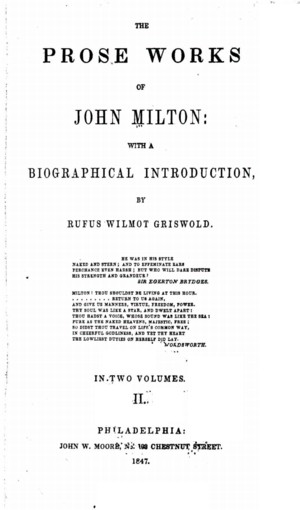
THE FIRST BOOK. - John Milton, The Prose Works of John Milton, vol. 2 [1847]Edition used:The Prose Works of John Milton, With a Biographical Introduction by Rufus Wilmot Griswold. In Two Volumes (Philadelphia: John W. Moore, 1847). Vol. 2.
Part of: The Prose Works of John Milton, 2 vols.About Liberty Fund:Liberty Fund, Inc. is a private, educational foundation established to encourage the study of the ideal of a society of free and responsible individuals. Copyright information:The text is in the public domain. Fair use statement:This material is put online to further the educational goals of Liberty Fund, Inc. Unless otherwise stated in the Copyright Information section above, this material may be used freely for educational and academic purposes. It may not be used in any way for profit.
THE FIRST BOOK.The beginning of nations, those excepted of whom sacred books have spoken, is to this day unknown. Nor only the beginning, but the deeds also of many succeeding ages, yea, periods of ages, either wholly unknown, or obscured and blemished with fables. Whether it were that the use of letters came in long after, or were it the violence of barbarous inundations, or they themselves, at certain revolutions of time, fatally decaying, and degenerating into sloth and ignorance; whereby the monuments of more ancient civility have been some destroyed, some lost. Perhaps disesteem and contempt of the public affairs then present, as not worth recording, might partly be in cause. Certainly ofttimes we see that wise men, and of best ability, have foreborne to write the acts of their own days, while they beheld with a just loathing and disdain, not only how unworthy, how perverse, how corrupt, but often how ignoble, how petty, how below all history, the persons and their actions were; who, either by fortune or some rude election, had attained, as a sore judgment and ignominy upon the land, to have chief sway in managing the commonwealth. But that any law, or superstition of our philosophers, the Druids, forbad the Britons to write their memorable deeds, I know not why any out of Cæsar* should allege: he indeed saith, that their doctrine they thought not lawful to commit to letters; but in most matters else, both private and public, among which well may history be reckoned, they used the Greek tongue; and that the British Druids, who taught those in Gaul, would be ignorant of any language known and used by their disciples, or so frequently writing other things, and so inquisitive into highest, would for want of recording be ever children in the knowledge of times and ages, is not likely. Whatever might be the reason, this we find, that of British affairs, from the first peopling of the island to the coming of Julius Cæsar, nothing certain, either by tradition, history, or ancient fame, hath hitherto been left us. That which we have of oldest seeming, hath by the greater part of judicious antiquaries been long rejected for a modern fable. Nevertheless there being others, besides the first supposed author, men not unread, nor unlearned in antiquity, who admit that for approved story, which the former explode for fiction; and seeing that ofttimes relations heretofore accounted fabulous have been after found to contain in them many footsteps and reliques of something true, as what we read in poets of the flood, and giants little believed, till undoubted witnesses taught us, that all was not feigned; I have therefore determined to bestow the telling over even of these reputed tales; be it for nothing else but in favour of our English poets and rhetoricians, who by their art will know how to use them judiciously. I might also produce example, as Diodorus among the Greeks, Livy and others among the Latins, Polydore and Virunnius accounted among our own writers. But I intend not with controversies and quotations to delay or interrupt the smooth course of history; much less to argue and debate long who were the first inhabitants, with what probabilities, what authorities each opinion hath been upheld; but shall endeavour that which hitherto hath been needed most, with plain and lightsome brevity, to relate well and orderly things worth the noting, so as may best instruct and benefit them that read. Which, imploring divine assistance, that it may redound to his glory, and the good of the British nation, I now begin. That the whole earth was inhabited before the flood, and to the utmost point of habitable ground from those effectual words of God in the creation, may be more than conjectured. Hence that this island also had her dwellers, her affairs, and perhaps her stories, even in that old world those many hundred years, with much reason we may infer. After the flood, and the dispersing of nations, as they journeyed leisurely from the east, Gomer the eldest son of Japhet, and his offspring, as by authorities, arguments, and affinity of divers names is generally believed, were the first that peopled all these west and northern climes. But they of our own writers, who thought they had done nothing, unless with all circumstance they tell us when, and who first set foot upon this island, presume to name out of fabulous and counterfeit authors a certain Samothes or Dis, a fourth or sixth son of Japhet, (who they make, about 200 years after the flood, to have planted with colonies, first the continent of Celtica or Gaul, and next this island; thence to have named it Samothea,) to have reigned here, and after him lineally four kings, Magus, Saron, Druis, and Bardus. But the forged Berosus, whom only they have to cite, no where mentions that either he, or any of those whom they bring, did ever pass into Britain, or send their people hither. So that this outlandish figment may easily excuse our not allowing it the room here so much as of a British fable. That which follows, perhaps as wide from truth, though seeming less impertinent, is, that these Samotheans under the reign of Bardus were subdued by Albion, a giant, son of Neptune; who called the island after his own name, and ruled it forty-four years. Till at length passing over into Gaul, in aid of his brother Lestrygon, against whom Hercules was hasting out of Spain into Italy, he was there slain in fight, and Bergion also his brother. Sure enough we are, that Britain hath been anciently termed Albion, both by the Greeks and Romans. And Mela, the geographer, makes mention of a stony shore in Languedoc, where by report such a battle was fought. The rest, as his giving name to the isle, or even landing here, depends altogether upon late surmises. But too absurd, and too unconscionably gross is that fond invention, that wafted hither the fifty daughters of a strange Dioclesian king of Syria; brought in, doubtless, by some illiterate pretender to something mistaken in the common poetical story of Danaus king of Argos, while his vanity, not pleased with the obscure beginning which truest antiquity affords the nation, laboured to contrive us a pedigree, as he thought, more noble. These daughters by appointment of Danaus on the marriage-night having murdered all their husbands, except Linceus, whom his wife’s loyalty saved, were by him, at the suit of his wife their sister, not put to death, but turned out to sea in a ship unmanned; of which whole sex they had incurred the hate: and as the tale goes, were driven on this island. Where the inhabitants, none but devils, as some write, or as others, a lawless crew left here by Albion, without head or governor, both entertained them, and had issue by them a second breed of giants, who tyrannized the isle, till Brutus came. The eldest of these dames in their legend they call Albina; and from thence, for which cause the whole scene was framed, will have the name Albion derived. Incredible it may seem so sluggish a conceit should prove so ancient, as to be authorized by the elder Ninnius, reputed to have lived above a thousand years ago. This I find not in him: but that Histion, sprung of Japhet, had four sons; Francus, Romanus, Alemannus, and Britto, of whom the Britains;* as true, I believe, as that those other nations, whose names are resembled, came of the other three; if these dreams give not just occasion to call in doubt the book itself, which bears that title. Hitherto the things themselves have given us a warrantable dispatch to run them soon over. But now of Brutus and his line, with the whole progeny of kings, to the entrance of Julius Cæsar, we cannot so easily be discharged; descents of ancestry long continued, laws and exploits not plainly seeming to be borrowed, or devised, which on the common belief have wrought no small impression; defended by many, denied utterly by few. For what though Brutus and the whole Trojan pretence were yielded up; (seeing they who first devised to bring us from some noble ancestor, were content at first with Brutus the consul; till better invention, although not willing to forego the name, taught them to remove it higher into a more fabulous age, and by the same remove lighting on the Trojan tales in affectation to make the Briton of one original with the Roman, pitched there;) yet those old and inborn names of successive kings, never any to have been real persons, or done in their lives at least some part of what so long hath been remembered, cannot be thought without too strict an incredulity. For these, and those causes above mentioned, that which hath received approbation from so many, I have chosen not to omit. Certain or uncertain, be that upon the credit of those whom I must follow; so far as keeps aloof from impossible and absurd, attested by ancient writers from books more ancient, I refuse not, as the due and proper subject of story. The principal author is well known to be Geoffrey of Monmouth; what he was, and whence his authority, who in his age, or before him, have delivered the same matter, and such like general discourses, will better stand in a treatise by themselves. All† of them agree in this, that Brutus was the son of Silvius; he of Ascanius; whose father was Eneas, a Trojan prince, who at the burning of that city, with his son Ascanius, and a collected number that escaped, after long wandering on the sea, arrived in Italy. Where at length by the assistance of Latinus king of Latiam, who had given him his daughter Lavinia, he obtained to succeed in that kingdom, and left it to Ascanius, whose son Silvius (though Roman histories deny Silvius to be the son of Ascanius) had married secretly a niece of Lavinia. She being with child, the matter became known to Ascanius. Who commanding his “magicians to inquire by art, what sex the maid had conceived,” had answer, “that it was one who should be the death of both his parents; and banished for the fact, should after all, in a far country, attain the highest honour.” The prediction failed not, for in travail the mother died. And Brutus (the child was so called) at fifteen years of age, attending his father to the chase, with an arrow unfortunately killed him. Banished therefore by his kindred, he retires into Greece. Where meeting with the race of Helenus king Priam’s son, held there in servile condition by Pandrasus then king, with them he abides. For Pyrrhus, in revenge of his father slain at Troy, had brought thither with him Helenus, and many others into servitude. There Brutus among his own stock so thrives in virtue and in arms, as renders him beloved to kings and great captains above all the youth of that land. Whereby the Trojans not only began to hope, but secretly to move him, that he would lead them the way to liberty. They allege their numbers, and the promised help of Assaracus a noble Greekish youth, by the mother’s side a Trojan; whom for that cause his brother went about to dispossess of certain castles bequeathed him by his father. Brutus considering both the forces offered him, and the strength of those holds, not unwillingly consents. First therefore having fortified those castles, he with Assaracus and the whole multitude betake them to the woods and hills as the safest place from whence to expostulate; and in the name of all sends to Pandrasus this message, “That the Trojans holding it unworthy their ancestors to serve in a foreign kingdom had retreated to the woods; choosing rather a savage life than a slavish: if that displeased him, that then with his leave they might depart to some other soil.” As this may pass with good allowance that the Trojans might be many in these parts, (for Helenus was by Pyrrhus made king of the Chaonians, and the sons of Pyrrhus by Andromache Hector’s wife, could not but be powerful through all Epirus,) so much the more it may be doubted, how these Trojans could be thus in bondage, where they had friends and countrymen so potent. But to examine these things with diligence, were but to confute the fables of Britain, with the fables of Greece or Italy; for of this age, what we have to say, as well concerning most other countries, as this island, is equally under question. Be how it will, Pandrasus not expecting so bold a message from the sons of captives, gathers an army; and marching towards the woods, Brutus who had notice of his approach nigh to the town called Sparatinum, (I know not what town, but certain of no Greek name,) over night planting himself there with good part of his men, suddenly sets upon him, and with slaughter of the Greeks pursues him to the passage of a river, which mine author names Akalon, meaning perhaps Achelous or Acheron; where at the ford he overlays them afresh. This victory obtained, and a sufficient strength left in Sparatinum, Brutus with Antigonus, the king’s brother, and his friend Anacletus, whom he had taken in the fight, returns to the residue of his friends in the thick woods; while Pandrasus with all speed recollecting, besieges the town. Brutus to relieve his men besieged, who earnestly called him, distrusting the sufficiency of his force, bethinks himself of this policy. Calls to him Anacletus, and threatening instant death else, both to him and his friend Antigonus, enjoins him, that he should go at the second hour of night to the Greekish leagre, and tell the guards he had brought Antigonus by stealth out of prison to a certain woody vale, unable through the weight of his fetters to move him further, entreating them to come speedily and fetch him in.—Anacletus to save both himself and his friend Antigonus swears this, and at a fit hour sets on alone toward the camp; is met, examined, and at last unquestionably known. To whom, great profession of fidelity first made, he frames his tale, as had been taught him; and they now fully assured, with a credulous rashness leaving their stations, fared accordingly by the ambush that there awaited them. Forthwith Brutus divided his men into three parts, leads on in silence to the camp; commanding first each part at a several place to enter, and forbear execution, till he with his squadron possessed of the king’s tent, gave signal to them by trumpet. The sound whereof no sooner heard, but huge havoc begins upon the sleeping and unguarded enemy, whom the besieged also now sallying forth, on the other side assail. Brutus the while had special care to seize and secure the king’s person; whose life still within his custody, he knew was the surest pledge to obtain what he should demand. Day appearing, he enters the town, there distributes the king’s treasury, and leaving the place better fortified, returns with the king his prisoner to the woods. Straight the ancient and grave men he summons to council, what they should now demand of the king. After long debate Mempricius, one of the gravest, utterly dissuading them from thought of longer stay in Greece, unless they meant to be deluded with a subtle peace, and the awaited revenge of those whose friends they had slain, advises them to demand first the king’s eldest daughter Innogen in marriage to their leader Brutus with a rich dowry, next shipping, money, and fit provision for them all to depart the land. This resolution pleasing best, the king now brought in, and placed in a high seat, is briefly told, that on these conditions granted, he might be free; not granted he must prepare to die. Pressed with fear of death, the king readily yields; especially to bestow his daughter on whom he confessed so noble and so valiant: offers them also the third part of his kingdom, if they like to stay; if not, to be their hostage himself, till he had made good his word. The marriage therefore solemnized, and shipping from all parts got together, the Trojans in a fleet, no less written than three hundred four and twenty sail, betake them to the wide sea: where with a prosperous course, two days and a night bring them on a certain island long before dispeopled and left waste by sea-rovers, the name whereof was then Leogecia, now unknown. They who were sent out to discover, came at length to a ruined city, where was a temple and image of Diana that gave oracles: but not meeting first or last, save wild beasts, they return with this notice to their ships; wishing their general would inquire of that oracle what voyage to pursue. Consultation had, Brutus taking with him Gerion his diviner, and twelve of the ancientest, with wanton ceremonies before the inward shrine of the goddess, in verse (as it seems the manner was) utters his request, “Diva potens nemorum,” &c.
To whom sleeping before the altar, Diana in a vision that night thus answered, “Brute sub occasum solis,” &c.
These verses originally Greek, were put in Latin, saith Virunnius, by Gildas a British poet and him to have lived under Claudius. Which granted true, adds much to the antiquity of this fable; and indeed the Latin verses are much better, than of the age for Geoffrey ap Arthur, unless perhaps Joseph of Exeter, the only smooth poet of those times, befriended him. In this, Diana overshot her oracle thus ending, “Ipsis totius terræ subditus orbis erit,” That to the race of Brute, kings of this island, the whole earth shall be subject. But Brutus, guided now, as he thought, by divine conduct, speeds him towards the west; and after some encounters on the Afric side, arrives at a place on the Tyrrhene sea; where he happens to find the race of those Trojans, who with Antenor came into Italy; and Corineus, a man much famed, was their chief: though by surer authors it be reported, that those Trojans with Antenor were seated on the other side of Italy, on the Adriatic, not the Tyrrhene shore. But these joining company, and past the Herculean Pillars, at the mouth of Ligeris in Aquitania cast anchor: where after some discovery made of the place, Corineus, hunting nigh the shore with his men, is by messengers of the king Goffarius Pictus met, and questioned about his errand there. Who not answering to their mind, Imbertus, one of them, lets fly an arrow at Corineus, which he avoiding, slays him: and the Pictavian himself hereupon levying his whole force, is overthrown by Brutus and Corineus; who with the battle-axe which he was wont to manage against the Tyrrhene giants, is said to have done marvels. But Goffarius having drawn to his aid the whole country of Gaul, at that time governed by twelve kings, puts his fortune to a second trial; wherein the Trojans, overborne by multitude, are driven back, and besieged in their own camp, which by good foresight was strongly situate. Whence Brutus unexpectedly issuing out, and Corineus in the meanwhile, whose device it was, assaulting them behind from a wood, where he had conveyed his men the night before: the Trojans are again victors, but with the loss of Turon a valiant nephew of Brutus: whose ashes, left in that place, gave name to the city of Tours, built there by the Trojans. Brutus finding now his powers much lessened, and this yet not the place foretold him, leaves Aquitain, and with an easy course arriving at Totness in Devonshire, quickly perceives here to be the promised end of his labours. The island, not yet Britain but Albion, was in a manner desert and inhospitable; kept only by a remnant of giants, whose excessive force and tyranny had consumed the rest. Them Brutus destroys, and to his people divides the land, which with some reference to his own name he thenceforth calls Britain. To Corineus, Cornwall, as now we call it, fell by lot; the rather by him liked, for that the hugest giants in rocks and caves were said to lurk still there; which kind of monsters to deal with was his old exercise. And here with leave bespoken to recite a grand fable, though dignified by our best poets: while Brutus, on a certain festival day solemnly kept on that shore, where he first landed, was with the people in great jollity and mirth, a crew of these savages breaking in upon them, began on a sudden another sort of game, than at such a meeting was expected. But at length by many hands overcome, Goemagog the hugest, in height twelve cubits, is reserved alive, that with him Corineus, who desired nothing more, might try his strength; whom in a wrestle the giant catching aloft, with a terrible hug broke three of his ribs: nevertheless Corineus enraged, heaving him up by main force, and on his shoulders bearing him to the next high rock, threw him headlong, all shattered, into the sea, and left his name on the cliff, called ever since Langoemagog, which is to say, the giant’s leap. After this, Brutus in a chosen place builds Troja Nova, changed in time to Trinovantum, now London: and began to enact laws; Heli being then high priest in Judæa: and having governed the whole isle twenty-four years, died, and was buried in his new Troy. His three sons, Locrine, Albanact, and Camber, divide the land by consent. Locrine had the middle part Lœgria; Camber possessed Cambria, or Wales; Albanact, Albania, now Scotland. But he in the end by Humber king of the Hunds, who with a fleet invaded that land, was slain in fight, and his people drove back into Lœgria. Locrine and his brother go out against Humber; who now marching onward, was by them defeated, and in a river drowned, which to this day retains his name. Among the spoils of his camp and navy, were found certain young maids, and Estrildis above the rest, passing fair, the daughter of a king in Germany; from whence Humber, as he went wasting the sea coast, had led her captive: whom Locrine, though before contracted to the daughter of Corineus, resolves to marry. But being forced and threatened by Corineus, whose authority and power he feared, Guendolen the daughter he yields to marry, but in secret loves the other: and ofttimes retiring, as to some private sacrifice, through vaults and passages made under ground, and seven years thus enjoying her, had by her a daughter equally fair, whose name was Sabra. But when once his fear was off by the death of Corineus, not content with secret enjoyment, divorcing Guendolen, he makes Estrildes now his queen. Guendolen, all in a rage, departs into Cornwall, where Madan, the son she had by Locrine, was hitherto brought up by Corineus his grandfather. And gathering an army of her father’s friends and subjects, gives battle to her husband by the river Sture; wherein Locrine, shot with an arrow, ends his life. But not so ends the fury of Guendolen; for Estrildis, and her daughter Sabra, she throws into a river: and, to leave a monument of revenge, proclaims that the stream be thenceforth called after the damsel’s name; which, by length of time, is changed now to Sabrina, or Severn. Fifteen years she governs in behalf of her son; then resigning to him at age, retires to her father’s dominion. This, saith my author, was in the days of Samuel. Madan hath the praise to have well and peacefully ruled the space of forty years, leaving behind him two sons, Mempricius, and Malim. Mempricius had first to do with the ambition of his brother, aspiring to share with him in the kingdom; whom therefore, at a meeting to compose matters, with a treachery, which his cause needed not, he slew. Nor was he better in the sole possession, whereof he could so ill endure a partner, killing his nobles, and those especially next to succeed him; till lastly, given over to unnatural lust, in the twentieth of his reign, hunting in a forest, he was devoured by wolves. His son Ebranc, a man of mighty strength and stature, reigned forty years. He first, after Brutus, wasted Gaul; and returning rich and prosperous, builded Caerebranc, now York; in Albania, Alclud, Mount Agned, or the Castle of Maidens, now Edinburg. He had twenty sons and thirty daughters by twenty wives. His daughters he sent to Silvius Alba into Italy, who bestowed them on his peers of the Trojan line. His sons, under the leading of Assaracus their brother, won them lands and signiories in Germany; thence called from these brethren, Germania; a derivation too hastily supposed, perhaps before the word Germanus, or the Latin tongue was in use. Some who have described Henault, as Jacobus Bergamas, and Lassabeus, are cited to affirm, that Ebranc, in his war there, was by Brunchildis, lord of Henault, put to the worse. Brutus, therefore, surnamed Greenshield, succeeding, to repair his father’s losses, as the same Lessabeus reports, fought a second battle in Henault, with Brunchild, at the mouth of Scaldis, and encamped on the river Hania. Of which our Spencer also thus sings:
But Henault, and Brunchild, and Greenshield, seem newer names than for a story pretended thus ancient. Him succeeded Leil, a maintainer of peace and equity; but slackened in his latter end, whence arose some civil discord. He built, in the North, Cairliel;* and in the days of Solomon. Rudhuddibras, or Hudibras, appeasing the commotions which his father could not, founded Caerkeynt or Canterbury, Caerguent or Winchester, and Mount Paladur, now Septonia or Shaftesbury: but this by others is contradicted. Bladud his son built Caerbadus or Bath, and those medical waters he dedicated to Minerva; in whose temple there he kept fire continually burning. He was a man of great invention, and taught necromancy; till having made him wings to fly, he fell down upon the temple of Apollo in Trinovant, and so died after twenty year’s reign. Hitherto, from father to son, the direct line hath run on: but Leir, who next reigned, had only three daughters, and no male issue: governed laudably, and built Caerleir, now Leicester, on the bank of Sora. But at last, falling through age, he determines to bestow his daughters, and so among them to divide his kingdom. Yet first, to try which of them loved him best, (a trial that might have made him, had he known as wisely how to try, as he seemed to know how much the trying behooved him,) he resolves a simple resolution, to ask them solemnly in order; and which of them should profess largest, her to believe. Gonorill the eldest, apprehending too well her father’s weakness, makes answer, invoking Heaven, “That she loved him above her soul.” “Therefore,” quoth the old man, overjoyed, “since thou so honourest my declining age, to thee and the husband whom thou shalt choose, I give the third part of my realm.” So fair a speeding, for a few words soon uttered, was to Regan, the second, ample instruction what to say. She, on the same demand, spares no protesting; and the gods must witness, that otherwise to express her thoughts she knew not, but that “She loved him above all creatures;” and so receives an equal reward with her sister. But Cordeilla, the youngest, though hitherto best loved, and now before her eyes the rich and present hire of a little easy soothing, the danger also, and the loss likely to betide plain dealing, yet moves not from the solid purpose of a sincere and virtuous answer. “Father,” saith she, “my love towards you is as my duty bids: what should a father seek, what can a child promise more? They, who pretend beyond this, flatter.” When the old man, sorry to hear this, and wishing her to recall those words, persisted asking; with a loyal sadness at her father’s infirmity, but something, on the sudden, harsh, and glancing rather at her sisters than speaking her own mind, “Two ways only,” saith she, “I have to answer what you require me: the former, your command is, I should recant; accept then this other which is left me; look how much you have, so much is your value, and so much I love you.” “Then hear thou,” quoth Leir, now all in passion, “what thy ingratitude hath gained thee; because thou hast not reverenced thy aged father equal to thy sisters, part in my kingdom, or what else is mine, reckon to have none.” And, without delay, gives in marriage his other daughters, Gonorill to Maglaunus duke of Albania, Regan to Henninus duke of Cornwall; with them in present half his kingdom; the rest to follow at his death. In the meanwhile, fame was not sparing to divulge the wisdom and other graces of Cordeilla, insomuch that Aganippus, a great king in Gaul, (however he came by his Greek name, not found in any register of French kings,) seeks her to wife; and nothing altered at the loss of her dowry, receives her gladly in such manner as she was sent him. After this, King Leir, more and more drooping with years, became an easy prey to his daughters and their husbands; who now, by daily encroachment, had seized the whole kingdom into their hands: and the old king is put to sojourn with his eldest daughter attended only by threescore knights. But they in a short while grudged at, as too numerous and disorderly for continual guests, are reduced to thirty. Not brooking that affront, the old king betakes him to his second daughter: but there also, discord soon arising between the servants of differing masters in one family, five only are suffered to attend him. Then back again he returns to the other; hoping that she his eldest could not but have more pity on his gray hairs: but she now refuses to admit him, unless he be content with one only of his followers. At last the remembrance of his youngest, Cordeilla, comes to his thoughts; and now acknowledging how true her words had been, though with little hope from whom he had so injured, be it but to pay her the last recompense she can have from him, his confession of her wise forewarning, that so perhaps his misery, the proof and experiment of her wisdom, might something soften her, he takes his journey into France. Now might be seen a difference between the silent, or downright spoken affection of some children to their parents, and the talkative obsequiousness of others; while the hope of inheritance overacts them, and on the tongue’s end enlarges their duty. Cordeilla, out of mere love, without the suspicion of expected reward, at the message only of her father in distress, pours forth true filial tears. And not enduring either that her own, or any other eye should see him in such forlorn condition as his messenger declared, discreetly appoints one of her trusted servants first to convey him privately towards some good seatown, there to array him, bathe him, cherish him, furnish him with such attendance and state as beseemed his dignity; that then, as from his first landing, he might send word of his arrival to her husband Aganippus. Which done, with all mature and requisite contrivance, Cordeilla, with the king her husband, and all the barony of his realm, who then first had news of his passing the sea, go out to meet him; and after all honourable and joyful entertainment, Aganippus, as to his wife’s father, and his royal guest, surrenders him, during his abode there, the power and disposal of his whole dominion: permitting his wife Cordeilla to go with an army, and set her father upon his throne. Wherein her piety so prospered, as that she vanquished her impious sisters, with those dukes; and Leir again, as saith the story, three years obtained the crown. To whom, dying, Cordeilla, with all regal solemnities, gave burial in the town of Leicester: and then, as right heir succeeding, and her husband dead, ruled the land five years in peace. Until Marganus and Cunedagius, her two sisters’ sons, not bearing that a kingdom should be governed by a woman, in the unseasonablest time to raise that quarrel against a woman so worthy, make war against her, depose her, and imprison her; of which impatient, and now long unexercised to suffer, she there, as is related, killed herself. The victors between them part the land; but Merganus, the eldest sister’s son, who held, by agreement, from the north side of Humber to Cathness, incited by those about him, to invade all as his own right, wars on Cunedagius, who soon met him, overcame, and overtook him in a town of Wales, where he left his life, and ever since his name to the place. Cunedagius was now sole king, and governed with much praise many years, about the time when Rome was built. Him succeeded Rivallo his son, wise also and fortunate; save what they tell us of three days raining blood and swarms of stinging flies, whereof men died. In order then Gurgustius, Jago or Lago, his nephew; Sisilius, Kinmarcus. Then Gorbogudo, whom others name Gorbodego, and Gorbodion, who had two sons, Ferrex, and Porrex. They, in the old age of their father, falling to contend who should succeed, Porrex, attempting by treachery his brother’s life, drives him into France; and in his return, though aided with the force of that country, defeats and slays him. But by his mother Videna, who less loved him, is himself, with the assistance of her women, soon after slain in his bed: with whom ended, as is thought, the line of Brutus. Whereupon the whole land, with civil broils, was rent into five kingdoms, long time waging war each on other; and some say fifty years. At length Dunwallo Molmutius, the son of Cloten king of Cornwal, one of the foresaid five, excelling in valour and goodliness of person, after his father’s decease, found means to reduce again the whole island into a monarchy; subduing the rest at opportunities. First, Ymner king of Loegria, whom he slew; then Rudaucus of Cambria, Staterius of Albania, confederate together. In which fight Dunwallo is reported, while the victory hung doubtful, to have used this art. He takes with him 600 stout men, bids them put on the armour of their slain enemies; and so unexpectedly approaching the squadron, where those two kings had placed themselves in fight, from that part which they thought securest, assaults and dispatches them. The displaying his own ensigns, which before he had concealed, and sending notice to the other part of his army what was done, adds to them new courage, and gains a final victory. This Dunwallo was the first in Britain that wore a crown of gold; and therefore by some reputed the first king. He established the Molmutine laws, famous among the English to this day; written long after in Latin by Gildas, and in Saxon by King Alfred: so saith Geoffrey, but Gildas denies to have known ought of the Britons before Cæsar; much less knew Alfred. These laws, whoever made them, bestowed on temples the privilege of sanctuary; to cities also, and the ways thither leading, yea to plows, granted a kind of like refuge; and made such riddance of thieves and robbers, that all passages were safe. Forty years he governed alone, and was buried nigh to the temple of Concord; which he, to the memory of peace restored, had built in Trinovant. His two sons, Belinus and Brennus, contending about the crown, by decision of friends, came at length to an accord: Brennus to have the north of Humber, Belinus the sovereignty of all. But the younger not long so contented, that he, as they whispered to him, whose valour had so oft repelled the invasions of Ceulphus the Morine duke, should now be subject to his brother, upon new design sails into Norway; enters league and affinity with Elsing that king: which Belinus perceiving, in his absence dispossesses him of all the north. Brennus, with a fleet of Norwegians, makes towards Britain; but encountered by Guithlac, the Danish king, who, laying claim to his bride, pursued him on the sea, his haste was retarded, and he bereft of his spouse; who, from the fight, by a sudden tempest, was with the Danish king driven on Northumberland, and brought to Belinus. Brennus, nevertheless, finding means to recollect his navy, lands in Albania, and gives battle to his brother in the wood Calaterium; but losing the day, escapes, with one single ship, into Gaul. Meanwhile the Dane, upon his own offer to become tributary, sent home with his new prize, Belinus returns his thoughts to the administering of justice, and the perfecting of his father’s law. And to explain what highways might enjoy the foresaid privileges, he caused to be drawn out and paved four main roads to the utmost length and breadth of the island, and two others athwart; which are since attributed to the Romans. Brennus, on the other side, soliciting to his aid the kings of Gaul, happens at last on Seginus duke of the Allobroges; where his worth, and comeliness of person, won him the duke’s daughter and heir. In whose right he shortly succeeding, and, by obtained leave, passing with a great host through the length of Gaul, gets footing once again in Britain. Now was Belinus unprepared: and now the battle ready to join, Conuvenna, the mother of them both, all in a fright, throws herself between, and calling earnestly to Brennus her son, whose absence had so long deprived her of his sight, after embracements and tears, assails him with such a motherly power, and the mention of things so dear and reverend, as irresistibly wrung from him all his enmity against Belinus. Then are hands joined, reconciliation made firm, and counsel held to turn their united preparations on foreign parts. Thence that by these two all Gallia was overrun, the story tells; and what they did in Italy, and at Rome, (if these be they, and not Gauls, who took that city,) the Roman authors can best relate. So far from home I undertake not for the Monmouth Chronicle; which here, against the stream of history, carries up and down these brethren, now into Germany, then again to Rome, pursuing Gabius and Porsena, two unheard-of consuls. Thus much is more generally believed, that both this Brennus, and another famous captain, Britomarus, whom the epitomist Florus and others mention, were not Gauls, but Britons; the name of the first in that tongue signifying a king, and of the other a great Briton. However, Belinus, after a while, returning home, the rest of his days ruled in peace, wealth, and honour, above all his predecessors; building some cities, of which one was Caerose upon Osca, since Caerlegion; beautifying others, as Trinovant, with a gate, haven, and a tower, on the Thames, retaining yet his name; on the top whereof his ashes are said to have been laid up in a golden urn. After him Gurguntius Barbirus was king, mild and just; but yet, inheriting his father’s courage, he subdued the Dacian, or Dane, who refused to pay the tribute covenanted to Belinus for his enlargement. In his return, finding about the Orkneys thirty ships of Spain, or Biscay, fraught with men and women for a plantation, whose captain also Bartholinus, wrongfully banished, as he pleaded, besought him that some part of his territory might be assigned them to dwell in, he sent with them certain of his own men to Ireland which then lay unpeopled, and gave them that island, to hold of him as in homage. He was buried in Caerlegion, a city which he had walled about. Guitheline his son is also remembered as a just and good prince; and his wife Martia to have excelled so much in wisdom, as to venture upon a new institution of laws. Which King Alfred translating, called Marchen Leage; but more truly thereby is meant the Mercian law, not translated by Alfred, but digested or incorporated with the West-Saxon. In the minority of her son she had the rule; and then, as may be supposed, brought forth these laws, not herself, for laws are masculine births, but by the advice of her sagest counsellors; and therein she might do virtuously, since it befell her to supply the nonage of her son; else nothing more awry from the law of God and nature, than that a woman should give laws to men. Her son Sisilius coming to years, received the rule; then, in order, Kimarus; then Danius, or Elanius, his brother. Then Morindus, his son by Tanguestela, a concubine, who is recorded a man of excessive strength, valiant, liberal, and fair of aspect, but immanely cruel; not sparing, in his anger, enemy or friend, if any weapon were in his hand. A certain king of the Morines, or Picards, invaded Northumberland; whose army this king, though not wanting sufficient numbers, chiefly by his own prowess overcame; but dishonoured his victory by the cruel usage of his prisoners, whom his own hands, or others in his presence, put all to several deaths: well fitted to such a bestial cruelty was his end; for hearing of a huge monster, that from the Irish sea infested the coast, and, in the pride of his strength, foolishly attempting to set manly valour against a brute vastness, when his weapons were all in vain, by that horrible mouth he was catched up and devoured. Gorbonian, the eldest of his five sons, than whom a juster man lived not in his age, was a great builder of temples, and gave to all what was their due: to his gods, devout worship; to men of desert, honour and preferment; to the commons, encouragement in their labours and trades, defence and protection from injuries and oppressions; so that the land flourished above her neighbours; violence and wrong seldom was heard of. His death was a general loss: he was buried in Trinovant. Archigallo, the second brother, followed not his example; but depressed the ancient nobility; and, by peeling the wealthier sort, stuffed his treasury, and took the right way to be deposed. Elidure, the next brother, surnamed the Pious, was set up in his place: a mind so noble, and so moderate, as almost is incredible to have been ever found. For, having held the sceptre five years, hunting one day in the forest of Calater, he chanced to meet his deposed brother, wandering in a mean condition; who had been long in vain beyond the seas, importuning foreign aids to his restorement; and was now, in a poor habit, with only ten followers, privately returned to find subsistence among his secret friends. At the unexpected sight of him, Elidure himself also then but thinly accompanied, runs to him with open arms; and, after many dear and sincere welcomings, conveys him to the city Alclud; there hides him in his own bedchamber. Afterwards feigning himself sick, summons all his peers, as about greatest affairs; where admitting them one by one, as if his weakness endured not the disturbance of more at once, causes them, willing or unwilling, once more to swear allegiance to Archigallo. Whom, after reconciliation made on all sides, he leads to York; and, from his own head, places the crown on the head of his brother. Who thenceforth, vice itself dissolving in him, and forgetting her firmest hold, with the admiration of a deed so heroic, became a true converted man; ruled worthily ten years, died, and was buried in Caerleir. Thus was a brother saved by a brother, to whom love of a crown, the thing that so often dazzles and vitiates mortal men, for which thousands of nearest blood have destroyed each other, was in respect of brotherly dearness, a contemptible thing. Elidure now in his own behalf re-assumes the goverement, and did as was worthy such a man to do. When Providence, that so great a virtue might want no sort of trial to make it more illustrious, stirs up Vigenius and Peredure, his youngest brethren, against him who had deserved so nobly of that relation, as least of all by a brother to be injured. Yet him they defeat, him they imprison in the tower of Trinovant, and divide his kingdom; the North to Peredure, the South to Vigenius. After whose death Peredure obtaining all, so much the better used his power, by how much the worse he got it: so that Elidure now is hardly missed. But yet, in all right owing to his elder the due place whereof he had deprived him, fate would that he should die first: and Elidure, after many years’ imprisonment, is now the third time seated on the throne; which at last he enjoyed long in peace, finishing the interrupted course of his mild and just reign, as full of virtuous deeds as days to his end. After these five sons of Morindus, succeeded also their sons in order. * Regin of Gorbonian, Marganus of Archigallo, both good kings. But Enniaunus, his brother, taking other courses, was after six years deposed. Then Idwallo, taught by a near example, governed soberly. Then Runno, then Geruntius, he of Peredure, this last the son of Elidure. From whose loins (for that likely is the durable and surviving race that springs of just progenitors) issued a long descent of kings, whose names only for many successions, without other memory, stand thus registered: Catellus, Coillus, Porrex, Cherin, and his three sons, Fulgenius, Eldadus, and Andragius, his son Urianus; Eliud, Eledaucus, Clotenus, Gurguntius, Merianus, Bleduno, Capis, Oenus, Sisillius; twenty kings in a continued row, that either did nothing, or lived in ages that wrote nothing; at least, a foul pretermission in the author of this, whether story or fable; himself weary, as seems, of his own tedious tale. But to make amends for this silence, Blegabredus next succeeding, is recorded to have excelled all before him in the art of music; opportunely, had he but left us one song of his twenty predecessors’ doings. Yet after him nine more succeeded in name; his brother Archimailus, Eldol, Redion, Rederchius, Samulius, Penissel, Pir, Capoirus; but Cliguellius, with the addition of modest, wise, and just. His son Heli reigned forty years, and had three sons, Lud, Cassibelan, and Nennius. This Heli seems to be the same whom Ninius, in his Fragment, calls Minocan; for him he writes to be the father of Cassibelan. Lud was he who enlarged and walled about Trinovant; there kept his court, made it the prime city, and called it from his own name Caerlud, or Lud’s town, now London. Which, as is alleged out of Gildas, became matter of great dissension betwixt him and his brother Nennius; who took it heinously that the name of Troy, their ancient country, should be abolished for any new one. Lud was hardy, and bold in war; in peace a jolly feaster. He conquered many islands of the sea, saith Huntingdon,† and was buried by the gate, which from thence we call Ludgate.‡ His two sons, Androgeus and Tenuantius, were left to the tuition of Cassibelan; whose bounty and high demeanor so wrought with the common people, as got him easily the kingdom transferred upon himself. He nevertheless, continuing to favour and support his nephews, confers freely upon Androgeus London with Kent; upon Tenuantius, Cornwal; reserving a superiority both over them, and all the other princes to himself, till the Romans for awhile circumscribed his power. Thus far, though leaning only on the credit of Geoffrey Monmouth, and his assertors, I yet, for the specified causes, have thought it not beneath my purpose to relate what I found. Whereto I neither oblige the belief of other person, nor overhastily subscribe mine own. Nor have I stood with others computing or collating years and chronologies, lest I should be vainly curious about the time and circumstance of things, whereof the substance is so much in doubt. By this time, like one who had set out on his way by night, and travelled through a region of smooth or idle dreams, our history now arrives on the confines, where daylight and truth meet us with a clear dawn, representing to our view, though at a far distance, true colours and shapes. For albeit Cæsar, whose authority we are now first to follow, wanted not who taxed him of misrepresenting in his Commentaries, yea in his civil war against Pompey, much more, may we think, in the British affairs, of whose little skill in writing he did not easily hope to be contradicted; yet now, in such variety of good authors, we can hardly miss, from one hand or other, to be sufficiently informed, as of things past so long ago. But this will better be referred to a second discourse. [* ]Cæs. l. 6. [* ]Hollinshed. [† ]Henry of Huntingdon, Matthew of Westminster. [* ]Called now Carlisle. [* ]Matth. Westm. [† ]Huntingd. l. i. [‡ ]Verstegan denies this; and says it was called so by the Saxons, from Lud, in our ancient language, people, and gate quasi porta populi; of all the gates of the city, that having the greatest passage of people; especially before Newgate was built, which was about the reign of Henry II. |

Titles (by Subject)