Econlib

The Library

Other Sites

Front Page arrow Titles (by Subject) arrow ἘΙΚΟΝΟΚΛΑΣΤΗΣ. IN ANSWER TO A BOOK ENTITLED, ΕΙΚΩΝ ΒΑΣΙΛΙΚΗ, THE PORTRAITURE OF HIS MAJESTY IN HIS SOLITUDES AND SUFFERINGS. - The Prose Works of John Milton, vol. 1

Return to Title Page for The Prose Works of John Milton, vol. 1

Search this Title:

Also in the Library:

Subject Area: Political Theory
Subject Area: Religion
Topic: The English Revolution

ἘΙΚΟΝΟΚΛΑΣΤΗΣ. IN ANSWER TO A BOOK ENTITLED, ΕΙΚΩΝ ΒΑΣΙΛΙΚΗ, THE PORTRAITURE OF HIS MAJESTY IN HIS SOLITUDES AND SUFFERINGS. - John Milton, The Prose Works of John Milton, vol. 1 [1847]

Edition used:

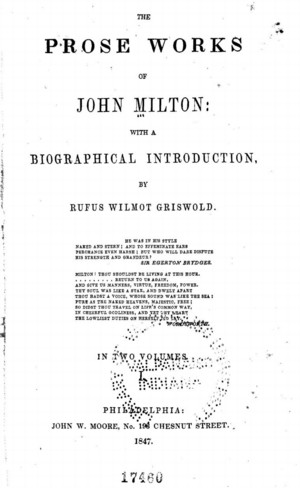
The Prose Works of John Milton: With a Biographical Introduction by Rufus Wilmot Griswold. In Two Volumes (Philadelphia: John W. Moore, 1847). Vol. 1.

Part of: The Prose Works of John Milton, 2 vols.

About Liberty Fund:

Liberty Fund, Inc. is a private, educational foundation established to encourage the study of the ideal of a society of free and responsible individuals.


ἘΙΚΟΝΟΚΛΑΣΤΗΣ.

IN ANSWER TO A BOOK ENTITLED, ΕΙΚΩΝ ΒΑΣΙΛΙΚΗ, THE PORTRAITURE OF HIS MAJESTY IN HIS SOLITUDES AND SUFFERINGS.

BY JOHN MILTON.

PUBLISHED FROM THE AUTHOR’S SECOND EDITION, PRINTED IN 1650 WITH MANY ENLARGEMENTS.

with a preface

BY RICHARD BARON,

SHOWING THE TRANSCENDENT EXCELLENCY OF MILTON’S PROSE WORKS,

to which is added,

AN ORIGINAL LETTER TO MILTON, NEVER BEFORE PUBLISHED.

  • — Morpheus, on thy dewy wing
  • Such fair auspicious visions bring,
  • As sooth’d great Milton’s injur’d age,
  • When in prophetic dreams he saw
  • The tribes unborn, with pious awe,
  • Imbibe each virtue from his heavenly page.
  • Dr. Akenside.

PREFACE.

When the last impression of Milton’s prose works was committed to my care, I executed that trust with the greatest fidelity. Not satisfied with printing from any copy at hand, as editors are generally wont, my affection and zeal for the author induced me to compare every sentence, line by line, with the original edition of each treatise that I was able to obtain. Hence, errors innumerable of the former impression were corrected: besides what improvements were added from the author’s second edition of the Tenure of Kings and Magistrates, which Mr. Toland had either not seen, or had neglected to commit to the press.*

After I had endeavoured to do this justice to my favourite author, the last summer I discovered a second edition of his Eikonoklastes, with many large and curious additions, printed in the year 1650, which edition had escaped the notice both of Mr. Toland and myself.

In communicating this discovery to a few friends, I found that this edition was not unknown to some others, though from low and base motives secreted from the public. But I, who from my soul love liberty, and for that reason openly and boldly assert its principles at all times, resolved that the public should no longer be withheld from the possession of such a treasure.

I therefore now give a new impression of this work, with the additions and improvements made by the author; and I deem it a singular felicity, to be the instrument of restoring to my country so many excellent lines long lost,—and in danger of being for ever lost,—of a writer who is a lasting honour to our language and nation;—and of a work, wherein the principles of tyranny are confuted and overthrown and all the arts and cunning of a great tyrant and his adherents detected and laid open.

The love of liberty is a public affection, of which those men must be altogether void, that can suppress or smother any thing written in its defence, and tending to serve its glorious cause. What signify professions, when the actions are opposite and contradictory? Could any high-churchman, any partizan of Charles I., have acted a worse, or a different part, than some pretended friends of liberty have done in this instance? Many high-church priests and doctors have laid out considerable sums to destroy the prose works of Milton, and have purchased copies of his particular writings for the infernal pleasure of consuming them. This practice, however detestable, was yet consistent with principle. But no apology can be made for men that espouse a cause, and at the same time conceal aught belonging to its support. Such men may tell us that they love liberty, but I tell them that they love their bellies, their ease, their pleasures, their profits, in the first place. A man that will not hazard all for liberty, is unworthy to be named among its votaries, unworthy to participate its blessings.

Many circumstances at present loudly call upon us to exert ourselves. Venality and corruption have well-nigh extinguished all principles of liberty. The bad books also, that this age hath produced, have ruined our youth. The novels and romances, which are eagerly purchased and read, emasculate the mind, and banish every thing grave and manly. One remedy for these evils is, to revive the reading of our old writers, of which we have good store, and the study whereof would fortify our youth against the blandishments of pleasure and the arts of corruption.

Milton in particular ought to be read and studied by all our young gentlemen as an oracle. He was a great and noble genius, perhaps the greatest that ever appeared among men; and his learning was equal to his genius. He had the highest sense of liberty, glorious thoughts, with a strong and nervous style. His works are full of wisdom, a treasure of knowledge. In them the divine, the statesman, the historian, the philologist, may be all instructed and entertained. It is to be lamented, that his divine writings are so little known. Very few are acquainted with them, many have never heard of them. The same is true with respect to another great writer contemporary with Milton, and an advocate for the same glorious cause; I mean Algernon Sydney, whose Discourses on Government are the most precious legacy to these nations.

All antiquity cannot show two writers equal to these. They were both great masters of reason, both great masters of expression. They had the strongest thoughts, and the boldest images, and are the best models that can be followed. The style of Sydney is always clear and flowing, strong and masculine. The great Milton has a style of his own, one fit to express the astonishing sublimity of his thoughts, the mighty vigour of his spirit, and that copia of invention, that redundancy of imagination, which no writer before or since hath equalled. In some places, it is confessed, that his periods are too long, which renders him intricate, if not altogether unintelligible to vulgar readers; but these places are not many. In the book before us his style is for the most part free and easy, and it abounds both in eloquence, and wit, and argument. I am of opinion, that the style of this work is the best and most perfect of all his prose writings. Other men have commended the style of his History as matchless and incomparable, whose malice could not see or would not acknowledge the excellency of his other works. It is no secret whence their aversion to Milton proceeds; and whence their caution of naming him as any other writer than a poet. Milton combated superstition and tyranny of every form, and in every degree. Against them he employed his mighty strength, and, like a battering ram, beat down all before him. But notwithstanding these mean arts, either to hide or disparage him, a little time will make him better known; and the more he is known, the more he will be admired. His works are not like the fugitive short-lived things of this age, few of which survive their authors: they are substantial, durable, eternal writings; which will never die, never perish, whilst reason, truth and liberty have a being in these nations.

Thus much I thought proper to say on occasion of this publication, wherein I have no resentment to gratify, no private interest to serve: all my aim is to strengthen and support that good old cause, which in my youth I embraced, and the principles whereof I will assert and maintain whilst I live.

The following letter to Milton, being very curious, and no where published perfect and entire, may be fitly preserved in this place.

A Letter from Mr. Wall to John Milton, Esquire.

Sir,—I received yours the day after you wrote, and do humbly thank you, that you are pleased to honour me with your letters. I confess I have (even in my privacy in the country) oft had thoughts of you, and that with much respect, for your friendliness to truth in your early years, and in bad times. But I was uncertain whether your relation to the court* (though I think a commonwealth was more friendly to you than a court) had not clouded your former light, but your last book resolved that doubt. You complain of the non-proficiency of the nation, and of its retrogade motion of late, in liberty and spiritual truths. It is much to be bewailed; but yet let us pity human frailty. When those who made deep protestations of their zeal for our liberty both spiritual and civil, and made the fairest offers to be assertors thereof, and whom we thereupon trusted; when those, being instated in power, shall betray the good thing committed to them, and lead us back to Egypt, and by that force which we gave them to win us liberty hold us fast in chains; what can poor people do? You know who they were, that watched our Saviour’s sepulchre to keep him from rising.

Besides, whilst people are not free, but straitened in accommodations for life, their spirits will be dejected and servile: and conducing to that end, there should be an improving of our native commodities, as our manufactures, our fishery, our fens, forests, and commons, and our trade at sea, &c., which would give the body of the nation a comfortable subsistence; and the breaking that cursed yoke of tithes would much help thereto.

Also another thing I cannot but mention, which is, that the Norman conquest and tyranny is continued upon the nation without any thought of removing it; I mean the tenure of lands by copyhold, and holding for life under a lord, or rather tyrant of a manor; whereby people care not to improve their land by cost upon it, not knowing how soon themselves or theirs may be outed it; nor what the house is in which they live, for the same reason: and they are far more enslaved to the lord of the manor, than the rest of the nation is to a king or supreme magistrate.

We have waited for liberty, but it must be God’s work and not man’s, who thinks it sweet to maintain his pride and worldly interest to the gratifying of the flesh, whatever becomes of the precious liberty of mankind.

But let us not despond, but do our duty; and God will carry on that blessed work in despite of all opposites, and to their ruin if they persist therein.

Sir, my humble request is, that you would proceed, and give us that other member of the distribution mentioned in your book; viz. that Hire doth greatly impede truth and liberty: it is like if you do, you shall find opposers: but remember that saying, Beatus est pati quam frui: or, in the apostle’s words, James v. 11, We count them happy that endure.

I have sometimes thought (concurring with your assertion of that storied voice that should speak from heaven) when ecclesiastics were endowed with worldly preferments, hodie venenum infunditur in ecclesiam: for to use the speech of Genesis iv. ult. according to the sense which it hath in the Hebrew, then began men to corrupt the worship of God. I shall tell you a supposal of mine, which is this: Mr. Dury has bestowed about thirty years time in travel, conference, and writings, to reconcile Calvinists and Lutherans, and that with little or no success. But the shortest way were,—take away ecclesiastical dignities, honours, and preferments, on both sides, and all would soon be hushed; the ecclesiastics would be quiet, and then the people would come forth into truth and liberty. But I will not engage in this quarrel; yet I shall lay this engagement upon myself to remain

Your faithful friend and servant,

John Wall.

From this letter the reader may see in what way wise and good men of that age employed themselves: in studying to remove every grievance, to break every yoke. And it is matter of astonishment, that this age, which boasts of greatest light and knowledge, should make no effort toward a reformation in things acknowledged to be wrong: but both in religion and in civil government be barbarian!

Richard Baron.

ἘΙΚΟΝΟΚΛΑΣΤΗΣ.

  • Prov. xxviii. 15. As a roaring lion, and a raging bear, so is a wicked ruler over the poor people.
  • 16. The prince that wanteth understanding, is also a great oppressor; but he that hateth covetousness, shall prolong his days.
  • 17. A man that doth violence to the blood of any person, shall fly to the pit, let no man stay him.

sallust. conjurat. catilin.

Regium imperium, quod initio, conservandæ libertatis, atque augendæ reipublicæ causâ fuerat, in superbiam, dominationemque se convertit.

Regibus boni, quam mali, suspectiores sunt, semperque his aliena virtus formidolosa est Impunè quælibet facere, id est regem esse.

idem, bell. jugurth.

published by authority.

THE PREFACE.

To descant on the misfortunes of a person fallen from so high a dignity, who hath also paid his final debt, both to nature and his faults, is neither of itself a thing commendable, nor the intention of this discourse. Neither was it fond ambition, nor the vanity to get a name, present or with posterity, by writing against a king. I never was so thirsty after fame, nor so destitute of other hopes and means, better and more certain to attain it; for kings have gained glorious titles from their favourers by writing against private men, as Henry VIIIth. did against Luther; but no man ever gained much honour by writing against a king, as not usually meeting with that force of argument in such courtly antagonists, which to convince might add to his reputation. Kings most commonly, though strong in legions, are but weak at arguments; as they who ever have accustomed from the cradle to use their will only as their right hand, their reason always as their left. Whence unexpectedly constrained to that kind of combat, they prove but weak and puny adversaries: nevertheless, for their sakes, who, through custom, simplicity, or want of better teaching, have no more seriously considered kings, than in the gaudy name of majesty, and admire them and their doings as if they breathed not the same breath with other mortal men, I shall make no scruple to take up (for it seems to be the challenge both of him and all his party) to take up this gauntlet, though a king’s, in the behalf of liberty and the commonwealth.

And further, since it appears manifestly the cunning drift of a factious and defeated party, to make the same advantage of his book, which they did before of his regal name and authority, and intend it not so much the defence of his former actions, as the promoting of their own future designs, (making thereby the book their own rather than the king’s, as the benefit now must be their own more than his;) now the third time to corrupt and disorder the minds of weaker men, by new suggestions and narrations, either falsely or fallaciously representing the state of things to the dishonour of this present government, and the retarding of a general peace, so needful to this afflicted nation, and so nigh obtained; I suppose it no injury to the dead, but a good deed rather to the living, if by better information given them, or, which is enough, by only remembering them the truth of what they themselves know to be here misaffirmed, they may be kept from entering the third time unadvisedly into war and bloodshed: for as to any moment of solidity in the book itself, (save only that a king is said to be the author, a name, than which there needs no more among the blockish vulgar, to make it wise, and excellent, and admired, nay to set it next the Bible, though otherwise containing little else but the common grounds of tyranny and popery, dressed up the better to deceive, in a new protestant guise, trimly garnished over,) or as to any need of answering, in respect of staid and well-principled men, I take it on me as a work assigned rather, than by me chosen or affected: which was the cause both of beginning it so late, and finishing it so leisurely in the midst of other employments and diversions. And though well it might have seemed in vain to write at all, considering the envy and almost infinite prejudice likely to be stirred up among the common sort, against whatever can be written or gainsaid to the king’s book, so advantageous to a book it is only to be a king’s; and though it be an irksome labour, to write with industry and judicious pains, that which, neither weighed nor well read, shall be judged without industry or the pains of well-judging, by faction and the easy literature of custom and opinion; it shall be ventured yet, and the truth not smothered, but sent abroad in the native confidence of her single self, to earn, how she can, her entertainment in the world, and to find out her own readers: few perhaps, but those few, of such value and substantial worth, as truth and wisdom, not respecting numbers and big names, have been ever wont in all ages to be contented with. And if the late king had thought sufficient those answers and defences made for him in his lifetime, they who on the other side accused his evil government, judging that on their behalf enough also hath been replied, the heat of this controversy was in all likelihood drawing to an end; and the further mention of his deeds, not so much unfortunate as faulty, had in tenderness to his late sufferings been willingly foreborne; and perhaps for the present age might have slept with him unrepeated, while his adversaries, calmed and assuaged with the success of their cause, had been the less unfavourable to his memory. But since he himself, making new appeal to truth and the world, hath left behind him this book, as the best advocate and interpreter of his own actions, and that his friends by publishing, dispersing, commending, and almost adoring it, seem to place therein the chief strength and nerves of their cause; it would argue doubtless in the other party great deficience and distrust of themselves, not to meet the force of his reason in any field whatsoever, the force and equipage of whose arms they have so often met victoriously: and he who at the bar stood excepting against the form and manner of his judicature, and complained that he was not heard; neither he nor his friends shall have that cause now to find fault, being met and debated with in this open and monumental court of his erecting; and not only heard uttering his whole mind at large, but answered: which to do effectually, if it be necessary, that to his book nothing the more respect be had for being his, they of his own party can have no just reason to exclaim. For it were too unreasonable that he, because dead, should have the liberty in his book to speak all evil of the parliament; and they because living, should be expected to have less freedom, or any for them, to speak home the plain truth of a full and pertinent reply. As he, to acquit himself, hath not spared his adversaries to load them with all sorts of blame and accusation, so to him, as in his book alive, there will be used no more courtship than he uses; but what is properly his own guilt, not imputed any more to his evil counsellors, (a ceremony used longer by the parliament than he himself desired,) shall be laid here without circumlocutions at his own door. That they who from the first beginning, or but now of late, by what unhappiness I know not, are so much affatuated, not with his person only, but with his palpable faults, and doat upon his deformities, may have none to blame but their own folly, if they live and die in such a strooken blindness, as next to that of Sodom hath not happened to any sort of men more gross, or more misleading. Yet neither let his enemies expect to find recorded here all that hath been whispered in the court, or alleged openly, of the king’s bad actions; it being the proper scope of this work in hand, not to rip up and relate the misdoings of his whole life, but to answer only and refute the missayings of his book.

First, then, that some men (whether this were by him intended, or by his friends) have by policy accomplished after death that revenge upon their enemies, which in life they were not able, hath been oft related. And among other examples we find, that the last will of Cæsar being read to the people, and what bounteous legacies he had bequeathed them, wrought more in that vulgar audience to the avenging of his death, than all the art he could ever use to win their favour in his lifetime. And how much their intent, who published these overlate apologies and meditations of the dead king, drives to the same end of stirring up the people to bring him that honour, that affection, and by consequence that revenge to his dead corpse, which he himself living could never gain to his person, it appears both by the conceited portraiture before his book, drawn out to the full measure of a masking scene, and set there to catch fools and silly gazers; and by those Latin words after the end, Vota dabunt quæ bella negarunt; intimating, that what he could not compass by war, he should achieve by his meditations: for in words which admit of various sense, the liberty is ours, to choose that interpretation, which may best mind us of what our restless enemies endeavour, and what we are timely to prevent. And here may be well observed the loose and negligent curiosity of those, who took upon them to adorn the setting out of this book; for though the picture set in front would martyr him and saint him to befool the people, yet the Latin motto in the end, which they understand not, leaves him, as it were, a politic contriver to bring about that interest, by fair and plausible words, which the force of arms denied him. But quaint emblems and devices, begged from the old pageantry of some twelfthnight’s entertainment at Whitehall, will do but ill to make a saint or martyr: and if the people resolve to take him sainted at the rate of such a canonizing, I shall suspect their calendar more than the Gregorian. In one thing I must commend his openness, who gave the title to this book, Ειϰὼν Βασιλιϰὴ, that is to say, The King’s Image; and by the shrine he dresses out for him, certainly would have the people come and worship him. For which reason this answer also is entitled, Iconoclastes, the famous surname of many Greek emperors, who in their zeal to the command of God, after long tradition of idolatry in the church, took courage and broke all superstitious images to pieces. But the people, exorbitant and excessive in all their motions, are prone ofttimes not to a religious only, but to a civil kind of idolatry, in idolizing their kings: though never more mistaken in the object of their worship; heretofore being wont to repute for saints those faithful and courageous barons, who lost their lives in the field, making glorious war against tyrants for the common liberty; as Simon de Momfort, earl of Leicester, against Henry the IIId; Thomas Plantagenet, earl of Lancaster, against Edward IId. But now, with a besotted and degenerate baseness of spirit, except some few who yet retain in them the old English fortitude and love of freedom, and have testified it by their matchless deeds, the rest, imbastardized from the ancient nobleness of their ancestors, are ready to fall flat and give adoration to the image and memory of this man, who hath offered at more cunning fetches to undermine our liberties, and put tyranny into an art, than any British king before him: which low dejection and debasement of mind in the people, I must confess, I cannot willingly ascribe to the natural disposition of an Englishman, but rather to two other causes; first, to the prelates and their fellow-teachers, though of another name and sect,* whose pulpit-stuff, both first and last, hath been the doctrine and perpetual infusion of servility and wretchedness to all their hearers, and whose lives the type of worldliness and hypocrisy, without the least true pattern of virtue, righteousness, or self-denial in their whole practice. I attribute it next to the factious inclination of most men divided from the public by several ends and humours of their own. At first no man less beloved, no man more generally condemned, than was the king; from the time that it became his custom to break parliaments at home, and either wilfully or weakly to betray protestants abroad, to the beginning of these combustions. All men inveighed against him; all men, except court-vassals, opposed him and his tyrannical proceedings; the cry was universal; and this full parliament was at first unanimous in their dislike and protestation against his evil government. But when they, who sought themselves and not the public, began to doubt, that all of them could not by one and the same way attain to their ambitious purposes, then was the king, or his name at least, as a fit property first made use of, his doings made the best of, and by degrees justified; which begot him such a party, as, after many wiles and strugglings with his inward fears, emboldened him at length to set up his standard against the parliament: whenas before that time, all his adherents, consisting most of dissolute swordsmen and suburb-roysters, hardly amounted to the making up of one ragged regiment strong enough to assault the unarmed house of commons. After which attempt, seconded by a tedious and bloody war on his subjects, wherein he hath so far exceeded those his arbitrary violences in time of peace, they who before hated him for his high misgovernment, nay fought against him with displayed banners in the field, now applaud him and extol him for the wisest and most religious prince that lived. By so strange a method amongst the mad multitude is a sudden reputation won, of wisdom by wilfulness and subtle shifts, of goodness by multiplying evil, of piety by endeavouring to root out true religion.

But it is evident that the chief of his adherents never loved him, never honoured either him or his cause, but as they took him to set a face upon their own malignant designs, nor bemoan his loss at all, but the loss of their own aspiring hopes: like those captive women, whom the poet notes in his Iliad, to have bewailed the death of Patroclus in outward show, but indeed their own condition.

Πάτροϰλον προϕασιν, σϕῶν δ’ ϰὐτῶν ϰήδε ἑϰάςη.—

Hom. Iliad. τ.

And it needs must be ridiculous to any judgment unenthralled, that they, who in other matters express so little fear either of God or man, should in this one particular outstrip all precisianism with their scruples and cases, and fill men’s ears continually with the noise of their conscientious loyalty and allegiance to the king, rebels in the meanwhile to God in all their actions besides: much less that they, whose professed loyalty and allegiance led them to direct arms against the king’s person, and thought him nothing violated by the sword of hostility drawn by them against him, should now in earnest think him violated by the unsparing sword of justice, which undoubtedly so much the less in vain she bears among men, by how much greater and in highest place the offender. Else justice, whether moral or political, were not justice, but a false counterfeit of that impartial and godlike virtue. The only grief is, that the head was not strook off to the best advantage and commodity of them that held it by the hair:* an ingrateful and perverse generation, who having first cried to God to be delivered from their king, now murmur against God that heard their prayers, and cry as loud for their king against those that delivered them. But as to the author of these soliloquies, whether it were undoubtedly the late king, as is vulgarly believed, or any secret coadjutor, and some stick not to name him; it can add nothing, nor shall take from the weight, if any be, of reason which he brings. But allegations, not reasons, are the main contents of this book, and need no more than other contrary allegations to lay the question before all men in an even balance; though it were supposed, that the testimony of one man, in his own cause affirming, could be of any moment to bring in doubt the authority of a parliament denying. But if these his fair-spoken words shall be here fairly confronted and laid parallel to his own far differing deeds, manifest and visible to the whole nation, then surely we may look on them who, notwithstanding, shall persist to give to bare words more credit than to open deeds, as men whose judgment was not rationally evinced and persuaded, but fatally stupefied and bewitched into such a blind and obstinate belief: for whose cure it may be doubted, not whether any charm, though never so wisely murmured, but whether any prayer can be available. This however would be remembered and well noted, that while the king, instead of that repentance which was in reason and in conscience to be expected from him, without which we could not lawfully readmit him, persists here to maintain and justify the most apparent of his evil doings, and washes over with a court-fucus the worst and foulest of his actions, disables and uncreates the parliament itself, with all our laws and native liberties that ask not his leave, dishonours and attaints all protestant churches not prelatical, and what they piously reformed, with the slander of rebellion, sacrilege, and hypocrisy; they, who seemed of late to stand up hottest for the covenant, can now sit mute and much pleased to hear all these opprobrious things uttered against their faith, their freedom, and themselves in their own doings made traitors to boot: the divines, also, their wizards, can be so brazen as to cry Hosanna to this his book, which cries louder against them for no disciples of Christ, but of Iscariot; and to seem now convinced with these withered arguments and reasons here, the same which in some other writings of that party, and in his own former declarations and expresses, they have so often heretofore endeavoured to confute and to explode; none appearing all this while to vindicate church or state from these calumnies and reproaches but a small handful of men, whom they defame and spit at with all the odious names of schism and sectarism. I never knew that time in England, when men of truest religion were not counted sectaries: but wisdom now, valour, justice, constancy, prudence united and embodied to defend religion and our liberties, both by word and deed, against tyranny, is counted schism and faction. Thus in a graceless age things of highest praise and imitation under a right name, to make them infamous and hateful to the people, are miscalled. Certainly, if ignorance and perverseness will needs be national and universal, then they who adhere to wisdom and to truth, are not therefore to be blamed, for being so few as to seem a sect or faction. But in my opinion it goes not ill with that people where these virtues grow so numerous and well joined together, as to resist and make head against the rage and torrent of that boisterous folly and superstition, that possesses and hurries on the vulgar sort. This therefore we may conclude to be a high honour done us from God, and a special mark of his favour, whom he hath selected as the sole remainder, after all these changes and commotions, to stand upright and stedfast in his cause; dignified with the defence of truth and public liberty; while others, who aspired to be the top of zealots, and had almost brought religion to a kind of trading monopoly, have not only by their late silence and neutrality belied their profession, but foundered themselves and their consciences, to comply with enemies in that wicked cause and interest, which they have too often cursed in others, to prosper now in the same themselves.

I.

Upon the king’s calling this last parliament.

That which the king lays down here as his first foundation, and as it were the head stone of his whole structure, that “he called this last parliament, not more by others’ advice, and the necessity of his affairs, than by his own choice and inclination;” is to all knowing men so apparently not true, that a more unlucky and inauspicious sentence, and more betokening the downfall of his whole fabric, hardly could have come into his mind. For who knows not, that the inclination of a prince is best known either by those next about him, and most in favour with him, or by the current of his own actions? Those nearest to this king, and most his favourites, were courtiers and prelates; men whose chief study was to find out which way the king inclined, and to imitate him exactly: how these men stood affected to parliaments cannot be forgotten. No man but may remember, it was their continual exercise to dispute and preach against them; and in their common discourse nothing was more frequent, than that “they hoped the king should now have no need of parliaments any more.” And this was but the copy, which his parasites had industriously taken from his own words and actions, who never called a parliament but to supply his necessities; and having supplied those, as suddenly and ignominiously dissolved it, without redressing any one grievance of the people: sometimes choosing rather to miss of his subsidies, or to raise them by illegal courses, than that the people should not still miss of their hopes to be relieved by parliaments.

The first he broke off at his coming to the crown, for no other cause than to protect the duke of Buckingham against them who had accused him, besides other heinous crimes, of no less than poisoning the deceased king his father; concerning which matter the declaration of “No more Addresses” hath sufficiently informed us. And still the latter breaking was with more affront and indignity put upon the house and her worthiest members, than the former. Insomuch that in the fifth year of his reign, in a proclamation he seems offended at the very rumour of a parliament divulged among the people; as if he had taken it for a kind of slander, that men should think him that way exorable, much less inclined: and forbids it as a presumption to prescribe him any time for parliaments; that is to say, either by persuasion or petition, or so much as the reporting of such a rumour: for other manner of prescribing was at that time not suspected. By which fierce edict, the people, forbidden to complain, as well as forced to suffer, began from thenceforth to despair of parliaments. Whereupon such illegal actions, and especially to get vast sums of money, were put in practice by the king and his new officers, as monopolies, compulsive knighthoods, coat, conduct, and ship-money, the seizing not of one Naboth’s vineyard, but of whole inheritances, under the pretence of forest or crown-lands; corruption and bribery compounded for, with impunities granted for the future, as gave evident proof, that the king never meant, nor could it stand with the reason of his affairs, ever to recall parliaments: having brought by these irregular courses the people’s interest and his own to so direct an opposition, that he might foresee plainly, if nothing but a parliament could save the people, it must necessarily be his undoing.

Till eight or nine years after, proceeding with a high hand in these enormities, and having the second time levied an injurious war against his native country Scotland; and finding all those other shifts of raising money, which bore out his first expedition, now to fail him, not “of his own choice and inclination,” as any child may see, but urged by strong necessities, and the very pangs of state, which his own violent proceedings had brought him to, he calls a parliament; first in Ireland, which only was to give him four subsidies and so to expire; then in England, where his first demand was but twelve subsidies to maintain a Scots war, condemned and abominated by the whole kingdom: promising their grievances should be considered afterwards. Which when the parliament, who judged that war itself one of their main grievances, made no haste to grant, not enduring the delay of his impatient will, or else fearing the conditions of their grant, he breaks off the whole session, and dismisses them and their grievances with scorn and frustration.

Much less therefore did he call this last parliament by his own choice and inclination; but having first tried in vain all undue ways to procure money, his army of their own accord being beaten in the north, the lords petitioning, and the general voice of the people almost hissing him and his ill acted regality off the stage, compelled at length both by his wants and by his fears, upon mere extremity he summoned this last parliament. And how is it possible, that he should willingly incline to parliaments, who never was perceived to call them but for the greedy hope of a whole national bribe, his subsidies; and never loved, never fulfilled, never promoted the true end of parliaments, the redress of grievances; but still put them off, and prolonged them, whether gratified or not gratified; and was indeed the author of all those grievances? To say, therefore, that he called this parliament of his own choice and inclination, argues how little truth we can expect from the sequel of this book, which ventures in the very first period to affront more than one nation with an untruth so remarkable; and presumes a more implicit faith in the people of England, than the pope ever commanded from the Romish laity; or else a natural sottishness fit to be abused and ridden; while in the judgment of wise men, by laying the foundation of his defence on the avouchment of that which is so manifestly untrue, he hath given a worse soil to his own cause, than when his whole forces were at any time overthrown. They therefore, who think such great service done to the king’s affairs in publishing this book, will find themselves in the end mistaken; if sense and right mind, or but any mediocrity of knowledge and remembrance, hath not quite forsaken men.

But to prove his inclination to parliaments, he affirms here, “to have always thought the right way of them most safe for his crown, and best pleasing to his people.” What he thought, we know not, but that he ever took the contrary way, we saw; and from his own actions we felt long ago what he thought of parliaments or of pleasing his people: a surer evidence than what we hear now too late in words.

He alleges, that “the cause of forbearing to convene parliaments was the sparks, which some men’s distempers there studied to kindle.” They were indeed not tempered to his temper; for it neither was the law, nor the rule, by which all other tempers were to be tried; but they were esteemed and chosen for the fittest men, in their several counties, to allay and quench those distempers, which his own inordinate doings had inflamed. And if that were his refusing to convene, till those men had been qualified to his temper, that is to say, his will, we may easily conjecture what hope there was of parliaments, had not fear and his insatiate poverty, in the midst of his excessive wealth, constrained him.

“He hoped by his freedom and their moderation to prevent misunderstandings.” And wherefore not by their freedom and his moderation? But freedom he thought too high a word for them, and moderation too mean a word for himself: this was not the way to prevent misunderstandings. He still “feared passion and prejudice in other men;” not in himself: “and doubted not by the weight of his” own “reason, to counterpoise any faction;” it being so easy for him, and so frequent, to call his obstinacy reason, and other men’s reason faction. We in the mean while must believe that wisdom and all reason came to him by title with his crown; passion, prejudice, and faction came to others by being subjects.

“He was sorry to hear, with what popular heat elections were carried in many places.” Sorry rather, that court-letters and intimations prevailed no more, to divert or to deter the people from their free election of those men, whom they thought best affected to religion and their country’s liberty, both at that time in danger to be lost. And such men they were, as by the kingdom were sent to advise him, not sent to be cavilled at, because elected, or to be entertained by him with an undervalue and misprision of their temper, judgment, or affection. In vain was a parliament thought fittest by the known laws of our nation, to advise and regulate unruly kings, if they, instead of hearkening to advice, should be permitted to turn it off, and refuse it by vilifying and traducing their advisers, or by accusing of a popular heat those that lawfully elected them.

“His own and his children’s interest obliged him to seek, and to preserve the love and welfare of his subjects.” Who doubts it? But the same interest, common to all kings, was never yet available to make them all seek that, which was indeed best for themselves and their posterity. All men by their own and their children’s interest are obliged to honesty and justice: but how little that consideration works in private men, how much less in kings, their deeds declare best.

“He intended to oblige both friends and enemies, and to exceed their desires, did they but pretend to any modest and sober sense;” mistaking the whole business of a parliament; which met not to receive from him obligations, but justice; nor he to expect from them their modesty, but their grave advice, uttered with freedom in the public cause. His talk of modesty in their desires of the common welfare argues him not much to have understood what he had to grant, who misconceived so much the nature of what they had to desire. And for “sober sense,” the expression was too mean, and recoils with as much dishonour upon himself, to be a king where sober sense could possibly be so wanting in a parliament.

“The odium and offences, which some men’s rigour, or remissness in church and state, had contracted upon his government, he resolved to have expiated with better laws and regulations.” And yet the worst of misdemeanors committed by the worst of all his favourites in the height of their dominion, whether acts of rigour or remissness, he hath from time to time continued, owned, and taken upon himself by public declarations, as often as the clergy, or any other of his instruments, felt themselves overburdened with the people’s hatred. And who knows not the superstitious rigour of his Sunday’s chapel, and the licentious remissness of his Sunday’s theatre; accompanied with that reverend statute for Dominical jigs and maypoles, published in his own name, and derived from the example of his father James? Which testifies all that rigour in superstition, all that remissness in religion, to have issued out originally from his own house, and from his own authority. Much rather then may those general miscarriages in state, his proper sphere, be imputed to no other person chiefly than to himself. And which of all those oppressive acts or impositions did he ever disclaim or disavow, till the fatal awe of this parliament hung ominously over him? Yet here he smoothly seeks to wipe off all the envy of his evil government upon his substitutes and under-officers; and promises, though much too late, what wonders he purposed to have done in the reforming of religion: a work wherein all his undertakings heretofore declared him to have had little or no judgment: neither could his breeding, or his course of life, acquaint him with a thing so spiritual. Which may well assure us what kind of reformation we could expect from him; either some politic form of an imposed religion, or else perpetual vexation and persecution to all those that complied not with such a form. The like amendment he promises in state; not a step further “than his reason and conscience told him was fit to be desired;” wishing “he had kept within those bounds, and not suffered his own judgment to have been overborne in some things,” of which things one was the earl of Strafford’s execution. And what signifies all this, but that still his resolution was the same, to set up an arbitrary government of his own, and that all Britain was to be tied and chained to the conscience, judgment, and reason of one man; as if those gifts had been only his peculiar and prerogative, entailed upon him with his fortune to be a king? Whenas doubtless no man so obstinate, or so much a tyrant, but professes to be guided by that which he calls his reason and his judgment, though never so corrupted; and pretends also his conscience. In the mean while, for any parliament or the whole nation to have either reason, judgment, or conscience, by this rule was altogether in vain, if it thwarted the king’s will; which was easy for him to call by any other plausible name. He himself hath many times acknowledged, to have no right over us but by law; and by the same law to govern us: but law in a free nation hath been ever public reason, the enacted reason of a parliament; which he denying to enact, denies to govern us by that which ought to be our law; interposing his own private reason, which to us is no law. And thus we find these fair and specious promises, made upon the experience of many hard sufferings, and his most mortified retirements, being thoroughly sifted to contain nothing in them much different from his former practices, so cross, and so reverse to all his parliaments, and both the nations of this island. What fruits they could in likelihood have produced in his restorement, is obvious to any prudent foresight.

And this is the substance or his first section, till we come to the devout of it, modelled into the form of a private psalter. Which they who so much admire, either for the matter of the manner, may as well admire the archbishop’s late breviary, and many other as good manuals and handmaids of Devotion, the lip-work of every prelatical liturgist, clapped together and quilted out of Scripture phrase, with as much ease, and as little need of Christian diligence or judgment, as belongs to the compiling of any ordinary and saleable piece of English divinity, that the shops value. But he who from such a kind of psalmistry, or any other verbal devotion, without the pledge and earnest of suitable deeds, can be persuaded of a zeal and true righteousness in the person, hath much yet to learn; and knows not that the deepest policy of a tyrant hath been ever to counterfeit religious. And Aristole in his Politics hath mentioned that special craft among twelve other tyrannical sophisms. Neither want we examples: Andronicus Commenus the Byzantine emperor, though a most cruel tyrant, is reported by Nicetas, to have been a constant reader of Saint Paul’s epistles; and by continual study had so incorporated the phrase and style of that transcendant apostle into all his familiar letters, that the imitation seemed to vie with the original. Yet this availed not to deceive the people of that empire, who, notwithstanding his saint’s vizard, tore him to pieces for his tyranny. From stories of this nature both ancient and modern which abound, the poets also, and some English, have been in this point so mindful of decorum, as to put never more pious words in the mouth of any person, than of a tyrant. I shall not instance an abstruse author, wherein the king might be less conversant, but one whom we well know was the closet companion of these his solitudes, William Shakespeare; who introduces the person of Richard the third, speaking in as high a strain of piety and mortification as is uttered in any passage of this book, and sometimes to the same sense and purpose with some words in this place; “I intended,” saith he, “not only to oblige my friends but my enemies.” The like saith Richard, Act II. Scene 1.

  • “I do not know that Englishman alive,
  • With whom my soul is any jot at odds,
  • More than the infant that is born to night;
  • I thank my God for my humility.”

Other stuff of this sort may be read throughout the whole tragedy, where in the poet used not much license in departing from the truth of history which delivers him a deep dissembler, not of his affections only, but of religion.

In praying therefore, and in the outward work of devotion, this king we see hath not at all exceeded the worst of kings before him. But herein the worst of kings, professing Christianism, have by far exceeded him. They, for aught we know, have still prayed their own, or at least borrowed from fit authors. But this king, not content with that which, although in a thing holy, is no holy theft, to attribute to his own making other men’s whole prayers, hath as it were unhallowed and unchristened the very duty of prayer itself, by borrowing to a Christian use prayers offered to a heathen god. Who would have imagined so little fear in him of the true all-seeing Deity, so little reverence of the Holy Ghost, whose office is to dictate and present our Christian prayers, so little care of truth in his last words, or honour to himself, or to his friends, or sense of his afflictions, or of that sad hour which was upon him, as immediately before his death to pop into the hand of that great bishop who attended him, for a special relic of his saintly exercises, a prayer stolen word for word from the mouth of a heathen woman* praying to a heathen god; and that in no serious book, but the vain amatorious poem of Sir Philip Sidney’s Arcadia; a book in that kind full of worth and wit, but among religious thoughts and duties not worthy to be named; nor to be read at any time without good caution, much less in time of trouble and affliction to be a Christian’s prayer-book? They who are yet incredulous of what I tell them for a truth, that this philippic prayer is no part of the king’s goods, may satisfy their own eyes at leisure, in the 3d book of Sir Philip’s Arcadia, p. 248, comparing Pamela’s prayer with the first prayer of his majesty, delivered to Dr. Juxton immediately before his death, and entitled a Prayer in time of Captivity, printed in all the best editions of his book. And since there be a crew of lurking railers, who in their libels, and their fits of railing up and down, as I hear from others, take it so currishly, that I should dare to tell abroad the secrets of their Ægyptian Apis; to gratify their gall in some measure yet more, which to them will be a kind of alms, (for it is the weekly vomit of their gall which to most of them is the sole means of their feeding,) that they may not starve for me, I shall gorge them once more with this digression somewhat larger than before: nothing troubled or offended at the working upward of their salevenom thereupon, though it happen to asperse me; being, it seems, their best livelihood, and the only use or good digestion that their sick and perishing minds can make of truth charitably told them. However, to the benefit of others much more worth the gaining, I shall proceed in my assertion; that if only but to taste wittingly of meat or drink offered to an idol, be in the doctrine of St. Paul judged a pollution much more must be his sin, who takes a prayer so dedicated into his mouth, and offers it to God. Yet hardly it can be thought upon (though how sad a thing!) without some kind of laughter at the manner and solemn transaction of so gross a cozenage, that he, who had trampled over us so stately and so tragically, should leave the world at last so ridiculously in his exit, as to bequeath among his deifying friends that stood about him such a precious piece of mockery to be published by them, as must needs cover both his and their heads with shame, if they have any left. Certainly they that will may now see at length how much they were deceived in him, and were ever like to be hereafter, who cared not, so near the minute of his death, to deceive his best and dearest friends with the trumpery of such a prayer, not more secretly than shamefully purloined; yet given them as the royal issue of his own proper zeal. And sure it was the hand of God to let them fall, and be taken in such a foolish trap, as hath exposed them to all derision; if for nothing else, to throw contempt and disgrace in the sight of all men, upon this his idolized book, and the whole rosary of his prayers; thereby testifying how little he excepted them from those, who thought no better of the living God than of a buzzard idol, fit to be so served and worshiped in reversion, with the polluted arts and refuse of Arcadias and romances, without being able to discern the affront rather than the worship of such an ethnic prayer. But leaving what might justly be offensive to God, it was a trespass also more than usual against human right, which commands, that every author should have the property of his own work reserved to him after death, as well as living. Many princes have been rigorous in laying taxes on their subjects by the head, but of any king heretofore that made a levy upon their wit, and seized it as his own legitimate, I have not whom beside to instance. True it is, I looked rather to have found him gleaning out of books written purposely to help devotion. And if in likelihood he have borrowed much more out of prayerbooks than out of pastorals, then are these painted feathers, that set him off so gay among the people, to be thought few or none of them his own. But it from his divines he have borrowed nothing, nothing out of all the magazine, and the rheum of their mellifluous prayers and meditations let them who now mourn for him as for Tamuz, them who howl in their pulpits, and by their howling declare themselves right wolves, remember and consider in the midst of their hideous faces, when they do only not cut their flesh from him like those rueful priests whom Elijah mocked; that he who was once their Ahab, now their Josiah, though feigning outwardly to reverence churchmen, yet here hath so extremely set at naught both them and their praying faculty, that being at a loss himself what to pray in captivity, he consulted neither with the liturgy, nor with the directory, but neglecting the huge fardel of all their honeycomb devotions, went directly where he doubted not to find better praying to his mind with Pamela, in the Countess’s Arcadia. What greater argument of disgrace and ignominy could have been thrown with cunning upon the whole clergy, than that the king, among all his priestery, and all those numberless volumes of their theological distillations not meeting with one man or book of that coat that could befriend him with a prayer in captivity, was forced to rob Sir Philip and his captive shepherdess of their heathen orisons to supply in any fashion his miserable indigence, not of bread, but of a single prayer to God? I say therefore not of bread, for that want may befall a good man and yet not make him totally miserable: but he who wants a prayer to beseech God in his necessity, it is inexpressible how poor he is; far poorer within himself than all his enemies can make him. And the unfitness, the indecency of that pitiful supply which he sought, expresses yet further the deepness of his poverty.

Thus much be said in general to his prayers, and in special to that Arcadian prayer used in his captivity; enough to undeceive us what esteem we are to set upon the rest.

For he certainly, whose mind could serve him to seek a Christian prayer out of a pagan legend, and assume it for his own, might gather up the rest God knows from whence; one perhaps out of the French Astræa, another out of the Spanish Diana; Amadis and Palmerin could hardly scape him. Such a person we may be sure had it not in him to make a prayer of his own, or at least would excuse himself the pains and cost of his invention so long as such sweet rhapsodies of heathenism and knight-errantry could yield him prayers. How dishonourable then, and how unworthy of a Christian king, were these ignoble shifts to seem holy, and to get a saintship among the ignorant and wretched people; to draw them by this deception, worse than all his former injuries, to go a whoring after him? And how unhappy, how forsook of grace, and unbeloved of God that people, who resolve to know no more of piety or of goodness, than to account him their chief saint and martyr, whose bankrupt devotion came not honestly by his very prayers; but having sharked them from the mouth of a heathen worshipper, (detestable to teach him prayers!) sold them to those that stood and honoured him next to the Messiah, as his own heavenly compositions in adversity, for hopes no less vain and presumptuous (and death at that time so imminent upon him) than by these goodly relics to be held a saint and martyr in opinion with the cheated people!

And thus far in the whole chapter we have seen and considered, and it not but be clear to all men, how, and for what ends, what concernments and necessities, the late king was no way induced, but every way constrained, to call this last parliament; yet here in his first prayer he trembles not to avouch as in the ears of God, “That he did it with an upright intention to his glory, and his people’s good:” of which dreadful attestation, how sincerely meant, God, to whom it was avowed, can only judge, and he hath judged already, and hath written his impartial sentence in characters legible to all Christendom; and besides hath taught us, that there be some, whom he hath given over to delusion, whose very mind and conscience is defiled; of whom St. Paul to Titus makes mention.

II.

Upon The Earl of Strafford’s Death.

This next chapter is a penitent confession of the king, and the strangest, if it be well weighed, that ever was auricular. For he repents here of giving his consent, though most unwillingly, to the most seasonable and solemn piece of justice, that had been done of many years in the land: but his sole conscience thought the contrary. And thus was the welfare, the safety, and within a little the unanimous demand of three populous nations, to have attended still on the singularity of one man’s opinionated conscience; if men had always been so to tame and spiritless, and had not unexpectedly found the grace to understand, that, if his conscience were so narrow and peculiar to itself, it was not fit his authority should be so ample and universal over others: for certainly a private conscience sorts not with a public calling, but declares that person rather meant by nature for a private fortune.

And this also we may take for truth, that he, whose conscience thinks it sin to put to death a capital offender, will as oft think it meritorious to kill a righteous person. But let us hear what the sin was, that lay so sore upon him, and, as one of his prayers given to Dr. Juxton testifies, to the very day of his death; it was his signing the bill of Strafford’s execution; a man whom all men looked upon as one of the boldest and most impetuous instruments that the king had, to advance any violent or illegal design. He had ruled Ireland, and some parts of England, in an arbitrary manner; had endeavoured to subvert fundamental laws, to subvert parliaments, and to incense the king against them; he had also endeavoured to make hostility between England and Scotland; he had counselled the king, to call over that Irish army of papists, which he had cunningly raised, to reduce England, as appeared by good testimony then present at the consultation: for which, and many other crimes alleged and proved against him in twenty-eight articles, he was condemned of high treason by the parliament. The commons by far the greater number cast him: the lords, after they had been satisfied in a full discourse by the king’s solicitor, and the opinions of many judges delivered in their house, agreed likewise to the sentence of treason. The people universally cried out for justice. None were his friends but courtiers and clergymen, the worst at that time, and most corrupted sort of men; and court ladies, not the best of women; who, when they grow to that insolence as to appear active in state-affairs, are the certain sign of a dissolute, degenerate, and pusillanimous commonwealth. Last of all the king, or rather first, for these were but his apes, was not satisfied in conscience to condemn him of high treason; and declared to both houses, “that no fears or respects whatsoever should make him alter that resolution founded upon his conscience:” either then his resolution was indeed not founded upon his conscience, or his conscience received better information, or else both his conscience and this his strong resolution strook sail, notwithstanding these glorious words, to his stronger fear; for within a few days after, when the judges at a privy council and four of his elected bishops had picked the thorn out of his conscience, he was at length persuaded to sign the bill for Strafford’s execution. And yet perhaps, that it wrung his conscience to condemn the earl of high treason is not unlikely; not because he thought him guiltless of highest treason, had half those crimes been committed against his own private interest or person, as appeared plainly by his charge against the six members; but because he knew himself a principal in what the earl was but his accessory, and thought nothing treason against the commonwealth, but against himself only.

Had he really scrupled to sentence that for treason, which he thought not treasonable, why did he seem resolved by the judges and the bishops? and if by them resolved, how comes the scruple here again? It was not then, as he now pretends, “the importunities of some, and the fear of many,” which made him sign, but the satisfaction given him by those judges and ghostly fathers of his own choosing. Which of him shall we believe? for he seems not one, but double; either here we must not believe him professing that his satisfaction was but seemingly received and out of fear, or else we may as well believe that the scruple was no real scruple, as we can believe him here against himself before, that the satisfaction then received was no real satisfaction. Of such a variable and fleeting conscience what hold can be taken? But that indeed it was a facile conscience, and could dissemble satisfaction when it pleased, his own ensuing actions declared; being soon after found to have the chief hand in a most detested conspiracy against the parliament and kingdom, as by letters and examinations of Percy, Goring, and other conspirators came to light; that his intention was to rescue the earl of Strafford, by seizing on the Tower of London; to bring up the English army out of the North, joined with eight thousand Irish papists raised by Strafford, and a French army to be landed at Portsmouth, against the parliament and their friends. For which purpose the king, though requested by both houses to disband those Irish papists, refused to do it, and kept them still in arms to his own purposes. No marvel then, if, being as deeply criminous as the earl himself, it stung his conscience to adjudge to death those misdeeds, whereof himself had been the chief author: no marvel though instead of blaming and detesting his ambition, his evil counsel, his violence, and oppression of the people, he fall to praise his great abilities; and with scholastic flourishes beneath the decency of a king, compares him to the sun, which in all figurative use and significance bears allusion to a king, not to a subject: no marvel though he knit contradictions as close as words can lie together, “not approving in his judgment,” and yet approving in his subsequent reason all that Strafford did, as “driven by the necessity of times, and the temper of that people;” for this excuses all his misdemeanors. Lastly, no marvel that he goes on building many fair and pious conclusions upon false and wicked premises, which deceive the common reader, not well discerning the antipathy of such connexions: but this is the marvel, and may be the astonishment, of all that have a conscience, how he durst in the sight of God (and with the same words of contrition wherewith David repents the murdering of Uriah) repent his lawful compliance to that just act of not saving him, whom he ought to have delivered up to speedy punishment; though himself the guiltier of the two. If the deed were so sinful, to have put to death so great a malefactor, it would have taken much doubtless from the heaviness of his sin, to have told God in his confession, how he laboured, what dark plots he had contrived, into what a league entered, and with what conspirators, against his parliament and kingdoms, to have rescued from the claim of justice so notable and so dear an instrument of tyranny; which would have been a story, no doubt, as pleasing in the ears of Heaven, as all these equivocal repentances. For it was fear, and nothing else, which made him feign before both the scruple and the satisfaction of his conscience, that is to say, of his mind: his first fear pretended conscience, that he might be borne with to refuse signing; his latter fear, being more urgent, made him find a conscience both to sign, and to be satisfied. As for repentance, it came not on him till a long time after; when he saw “he could have suffered nothing more, though he had denied that bill.” For how could he understandingly repent of letting that be treason which the parliament and whole nation so judged? This was that which repented him, to have given up to just punishment so stout a champion of his designs, who might have been so useful to him in his following civil broils. It was a worldly repentance, not a conscientious; or else it was a strange tyranny, which his conscience had got over him, to vex him like an evil spirit for doing one act of justice, and by that means to “fortify his resolution” from ever doing so any more. That mind must needs be irrecoverably depraved, which, either by chance or importunity, tasting but once of one just deed, spatters at it, and abhors the relish ever after. To the scribes and Pharisees woe was denounced by our Saviour, for straining at a gnat and swallowing a camel, though a gnat were to be strained at: but to a conscience with whom one good deed is so hard to pass down as to endanger almost a choking, and bad deeds without number, though as big and bulky as the ruin of three kingdoms, go down currently without straining, certainly a far greater woe appertains. If his conscience were come to that unnatural dyscrasy, as to digest poison and to keck at wholesome food, it was not for the parliament, or any of his kingdoms, to feed with him any longer. Which to conceal he would persuade us, that the parliament also in their conscience escaped not “some touches of remorse” for putting Strafford to death, in forbidding it by an after-act to be a precedent for the future. But, in a fairer construction, that act implied rather a desire in them to pacify the king’s mind, whom they perceived by this means quite alienated: in the mean while not imagining that this after-act should be retorted on them to tie up justice for the time to come upon like occasion, whether this were made a precedent or not, no more than the want of such a precedent, if it had been wanting, had been available to hinder this.

But how likely is it, that this after-act argued in the parliament their least repenting for the death of Strafford, when it argued so little in the king himself: who, notwithstanding this after-act, which had his own hand and concurrence, if not his own instigation, within the same year accused of high treason no less than six members at once for the same pretended crimes, which his conscience would not yield to think treasonable in the earl: so that this his subtle argument to fasten a repenting, and by that means a guiltiness of Strafford’s death upon the parliament, concludes upon his own head; and shows us plainly, that either nothing in his judgment was treason against the commonwealth, but only against the king’s person; (a tyrannical principle!) or that his conscience was a perverse and prevaricating conscience, to scruple that the commonwealth should punish for treasonous in one eminent offender that which he himself sought so vehemently to have punished in six guiltless persons. If this were “that touch of conscience, which he bore with greater regret” than for any sin committed in his life, whether it were that proditory aid sent to Rochel and religion abroad, or that prodigality of shedding blood at home, to a million of his subjects’ lives not valued in comparison to one Strafford; we may consider yet at last, what true sense and feeling could be in that conscience, and what fitness to be the master conscience of three kingdoms.

But the reason why he labours, that we should take notice of so much “tenderness and regret in his soul for having any hand in Strafford’s death,” is worth the marking ere we conclude: “he hoped it would be some evidence before God and man to all posterity, that he was far from bearing that vast load and guilt of blood” laid upon him by others: which hath the likeness of a subtle dissimulation; bewailing the blood of one man, his commodious instrument, put to death most justly, though by him unwillingly, that we might think him too tender to shed willingly the blood of those thousands whom he counted rebels. And thus by dipping voluntarily his finger’s end, yet with show of great remorse, in the blood of Strafford, whereof all men clear him, he thinks to scape that sea of innocent blood, wherein his own guilt inevitably hath plunged him all over. And we may well perceive to what easy satisfactions and purgations he had inured his secret conscience, who thought by such weak policies and ostentations as these to gain belief and absolutions from understanding men.

III.

Upon his going to the House of Commons.

Concerning his unexcusable and hostile march from the court to the house of commons, there needs not much be said; for he confesses it to be an act, which most men, whom he calls “his enemies,” cried shame upon, “indifferent men grew jealous of and fearful, and many of his friends resented, as a motion arising rather from passion than reason:” he himself, in one of his answers to both houses, made profession to be convinced, that it was a plain breach of their privilege; yet here, like a rotten building newly trimmed over, he represents it speciously and fraudulently, to impose upon the simple reader; and seeks by smooth and supple words not here only, but through his whole book, to make some beneficial use or other even of his worst miscarriages.

“These men,” saith he, meaning his friends, “knew not the just motives and pregnant grounds with which I thought myself furnished;” to wit, against the five members, whom he came to drag out of the house. His best friends indeed knew not, nor could ever know, his motives to such a riotous act; and had he himself known any just grounds, he was not ignorant how much it might have tended to his justifying, had he named them in this place, and not concealed them. But suppose them real, suppose them known, what was this to that violation and dishonour put upon the whole house, whose very door forcibly kept open, and all the passages near it, he beset with swords and pistols cocked and menaced in the hands of about three hundred swaggerers and ruffians, who but expected, nay audibly called for, the word of onset to begin a slaughter?

“He had discovered, as he thought, unlawful correspondences, which they had used, and engagements to embroil his kingdoms;” and remembers not his own unlawful correspondences and conspiracies with the Irish army of papists, with the French to land at Portsmouth, and his tampering both with the English and Scots army to come up against the parliament: the least of which attempts, by whomsoever, was no less than manifest treason against the commonwealth.

If to demand justice on the five members were his plea, for that which they with more reason might have demanded justice upon him, (I use his own argument,) there needed not so rough assistance. If he had “resolved to bear that repulse with patience,” which his queen by her words to him at his return little thought he would have done, wherefore did he provide against it with such an armed and unusual force? but his heart served him not to undergo the hazard that such a desperate scuffle would have brought him to. But wherefore did he go at all, it behoving him to know there were two statutes, that declared he ought first to have acquainted the parliament, who were the accusers, which he refused to do, though still professing to govern by law, and still justifying his attempts against law? And when he saw it was not permitted him to attaint them but by a fair trial, as was offered him from time to time, for want of just matter which yet never came to light, he let the business fall of his own accord; and all those pregnancies and just motives came to just nothing.

“He had no temptation of displeasure or revenge against those men:” none but what he thirsted to execute upon them, for the constant opposition which they made against his tyrannous proceedings, and the love and reputation which they therefore had among the people; but most immediately, for that they were supposed the chief, by whose activity those twelve protesting bishops were but a week before committed to the Tower.

“He missed but little to have produced writings under some men’s own hands.” But yet he missed, though their chambers, trunks, and studies were sealed up and searched; yet not found guilty. “Providence would not have it so.” Good Providence! that curbs the raging of proud monarchs, as well as of mad multitudes. “Yet he wanted not such probabilities” (for his pregnant is come now to probable) “as were sufficient to raise jealousies in any king’s heart;” and thus his pregnant motives are at last proved nothing but a tympany, or a Queen Mary’s cushion; for in any king’s heart, as kings go now, what shadowy conceit or groundless toy will not create a jealousy?

“That he had designed to insult the house of commons,” taking God to witness, he utterly denies; yet in his answer to the city, maintains that “any course of violence had been very justifiable.” And we may then guess how far it was from his design: however, it discovered in him an excessive eagerness to be avenged on them that crossed him; and that to have his will, he stood not to do things never so much below him. What a becoming sight it was, to see the king of England one while in the house of commons, and by-and-by in the Guildhall among the liveries and manufacturers, prosecuting so greedily the track of five or six fled subjects; himself not the solicitor only, but the pursuivant and the apparitor of his own partial cause! And although in his answers to the parliament, he hath confessed, first, that his manner of prosecution was illegal, next “that as he once conceived he had ground enough to accuse them, so at length that he found as good cause to desert any prosecution of them;” yet here he seems to reverse all, and against promise takes up his old deserted accusation, that he might have something to excuse himself, instead of giving due reparation, which he always refused to give them whom he had so dishonoured.

“That I went,” saith he of his going to his house of commons, “attended with some gentlemen;” gentlemen indeed! the ragged infantry of stews and brothels; the spawn and shipwreck of taverns and dicing-houses: and then he pleads, “it was no unwonted thing for the majesty and safety of a king to be so attended, especially in discontented times.” An illustrious majesty no doubt, so attended! a becoming safety for the king of England, placed in the fidelity of such guards and champions! happy times, when braves and hacksters, the only contented members of his government, were thought the fittest and the faithfullest to defend his person against the discontents of a parliament and all good men! Were those the chosen ones to “preserve reverence to him,” while he entered “unassured,” and full of suspicions, into his great and faithful counsel? Let God then and the world judge, whether the cause were not in his own guilty and unwarrantable doings: the house of commons, upon several examinations of this business, declared it sufficiently proved, that the coming of those soldiers, papists, and others, with the king, was to take away some of their members, and in case of opposition or denial, to have fallen upon the house in a hostile manner. This the king here denies; adding a fearful imprecation against his own life, “if he purposed any violence or oppression against the innocent, then,” saith he, “let the enemy prosecute my soul, and tread my life to the ground, and lay my honour in the dust.” What need then more disputing? He appealed to God’s tribunal, and behold! God hath judged and done to him in the sight of all men according to the verdict of his own mouth: to be a warning to all kings hereafter how they use presumptuously the words and protestations of David, without the spirit and conscience of David. And the king’s admirers may here see their madness, to mistake this book for a monument of his worth and wisdom, whenas indeed it is his doomsday-book; not like that of William the Norman his predecessor, but the record and memorial of his condemnation; and discovers whatever hath befallen him, to have been hastened on from divine justice by the rash and inconsiderate appeal of his own lips. But what evasions, what pretences, though never so unjust and empty, will he refuse in matters more unknown, and more involved in the mists and intricacies of state, who, rather than not justify himself in a thing so generally odious, can flatter his integrity with such frivolous excuses against the manifest dissent of all men, whether enemies, neuters, or friends? But God and his judgments have not been mocked; and good men may well perceive what a distance there was ever like to be between him and his parliament, and perhaps between him and all amendment, who for one good deed, though but consented to, asks God forgiveness; and from his worst deeds done, takes occasion to insist upon his righteousness!

IV.

Upon the Insolency of the tumults.

We have here, I must confess, a neat and well-couched invective against tumults, expressing a true fear of them in the author; but yet so handsomely composed, and withal so feelingly, that, to make a royal comparison, I believe Rehoboam the son of Solomon could not have composed it better. Yet Rehoboam had more cause to inveigh against them; for they had stoned his tribute-gatherer, and perhaps had as little spared his own person, had he not with all speed betaken him to his chariot. But this king hath stood the worst of them in his own house without danger, when his coach and horses, in a panic fear, have been to seek: which argues, that the tumults at Whitehall were nothing so dangerous as those at Sechem.

But the matter here considerable, is not whether the king or his household rhetoricians have a pithy declamation against tumults; but first, whether these were tumults or not; next, if they were, whether the king himself did not cause them. Let us examine therefore how things at that time stood. The king, as before hath been proved, having both called this parliament unwillingly, and as unwillingly from time to time condescended to their several acts, carrying on a disjoint and private interest of his own, and not enduring to be so crossed and overswayed, especially in the executing of his chief and boldest instrument, the deputy of Ireland first tempts the English army, with no less reward than the spoil of London, to come up and destroy the parliament. That being discovered by some of the officers, who, though bad enough, yet abhorred so foul a deed; the king, hardened in his purpose, tempts them the second time at Burrowbridge, promises to pawn his jewels for them, and that they should be met and assisted (would they but march on) with a gross body of horse under the earl of Newcastle. He tempts them yet the third time, though after discovery, and his own abjuration to have ever tempted them, as is affirmed in the declaration of “No more Addresses.” Neither this succeeding, he turns him next to the Scotch army, and by his own credential letters given to O Neal and Sir John Henderson, baits his temptation with a richer reward; not only to have the sacking of London, but four northern counties to be made Scottish, with jewels of great value to be given in pawn the while. But neither would the Scots, for any promise of reward, be brought to such an execrable and odious treachery: but with much honesty gave notice of the king’s design both to the parliament and city of London. The parliament moreover had intelligence, and the people could not but discern, that there was a bitter and malignant party grown up now to such a boldness, as to give out insolent and threatening speeches against the parliament itself. Besides this, the rebellion in Ireland was now broke out; and a conspiracy in Scotland had been made, while the king was there, against some chief members of that parliament; great numbers here of unknown and suspicious persons resorted to the city. The king, being returned from Scotland, presently dismisses that guard, which the parliament thought necessary in the midst of so many dangers to have about them, and puts another guard in their place, contrary to the privilege of that high court, and by such a one commanded, as made them no less doubtful of the guard itself. Which they therefore, upon some ill effects thereof first found, discharge; deeming it more safe to sit free, though without guard, in open danger, than enclosed with a suspected safety. The people therefore, lest their worthiest and most faithful patriots, who had exposed themselves for the public, and whom they saw now left naked, should want aid, or be deserted in the midst of these dangers, came in multitudes, though unarmed, to witness their fidelity and readiness in case of any violence offered to the parliament. The king, both envying to see the people’s love thus devolved on another object, and doubting lest it might utterly disable him to do with parliaments as he was wont sent a message into the city forbidding such resorts. The parliament also both by what was discovered to them, and what they saw in a malignant party, (some of which had already drawn blood in a fray or two at the court gate, and even at their own gate in Westminster-hall,) conceiving themselves to be still in danger where they sat, sent a most reasonable and just petition to the king, that a guard might be allowed them out of the city, whereof the king’s own chamberlain the earl of Essex, might have command; it being the right of inferior courts to make choice of their own guard. This the king refused to do, and why he refused the very next day made manifest: for on that day it was that he sallied out from Whitehall, with those trusty myrmidons, to block up or give assault to the house of commons. He had, besides all this, begun to fortify his court, and entertained armed men not a few; who, standing at his palace gate, reviled and with drawn swords wounded many of the people, as they went by unarmed, and in a peaceable manner, whereof some died. The passing by of a multitude, though neither to St. George’s feast, nor to a tilting, certainly of itself was no tumult; the expression of their loyalty and steadfastness to the parliament, whose lives and safeties by more than slight rumours they doubted to be in danger, was no tumult. If it grew to be so, the cause was in the king himself and his injurious retinue, who both by hostile preparations in the court, and by actual assailing of the people, gave them just cause to defend themselves.

Surely those unarmed and petitioning people needed not have been so formidable to any, but to such whose consciences misgave them how ill they had deserved of the people; and first began to injure them, because they justly feared it from them; and then ascribe that to popular tumult, which was occasioned by their own provoking.

And that the king was so emphatical and elaborate on this theme against tumults, and expressed with such a vehemence his hatred of them, will redound less perhaps than he was aware to the commendation of his government. For besides that in good governments they happen seldomest, and rise not without cause, if they prove extreme and pernicious, they were never counted so to monarchy, but to monarchical tyranny; and extremes one with another are at most antipathy. If then the king so extremely stood in fear of tumults, the inference will endanger him to be the other extreme. Thus far the occasion of this discourse against tumults: now to the discourse itself, voluble enough, and full of sentence, but that, for the most part, either specious rather than solid, or to his cause nothing pertinent.

“He never thought any thing more to presage the mischiefs that ensued, than those tumults.” Then was his foresight but short, and much mistaken. Those tumults were but the mild effects of an evil and injurious reign; not signs of mischiefs to come, but seeking relief for mischiefs past: those signs were to be read more apparent in his rage and purposed revenge of those free expostulations and clamours of the people against his lawless government. “Not any thing,” saith he, “portends more God’s displeasure against a nation, than when he suffers the clamours of the vulgar to pass all bounds of law and reverence to authority.” It portends rather his displeasure against a tyrannous king, whose proud throne he intends to overturn by that contemptible vulgar; the sad cries and oppressions of whom his loyalty regarded not. As for that supplicating people, they did no hurt either to law or authority, but stood for it rather in the parliament against those whom they feared would violate it.

“That they invaded the honour and freedom of the two houses,” is his own officious accusation, not seconded by the parliament, who, had they seen cause, were themselves best able to complain. And if they “shook and menaced any, they were such as had more relation to the court than to the commonwealth; enemies, not patrons of the people. But if their petitioning unarmed were an invasion of both houses, what was his entrance into the house of commons, besetting it with armed men? In what condition then was the honour and freedom of that house?

“They forebore not rude deportments, contemptuous words and actions, to himself and his court.”

It was more wonder, having heard what treacherous hostility he had designed against the city and his whole kingdom, that they forebore to handle him as people in their rage have handled tyrants heretofore for less offences.

“They were not a short ague, but a fierce quotidian fever.” He indeed may best say it, who most felt it; for the shaking was within him, and it shook him by his own description “worse than a storm, worse than an earthquake;” Belshazzar’s palsy. Had not worse fears, terrors, and envies made within him that commotion, how could a multitude of his subjects, armed with no other weapon than petitions, have shaken all his joints with such a terrible ague? Yet that the parliament should entertain the least fear of bad intentions from him or his party, he endures not; but would persuade us, that “men scare themselves and others without cause:” for he thought fear would be to them a kind of armour, and his design was, if it were possible, to disarm all, especially of a wise fear and suspicion; for that he knew would find weapons.

He goes on therefore with vehemence, to repeat the mischiefs done by these tumults. “They first petitioned, then protested; dictate next, and lastly overawe the parliament. They removed obstructions, they purged the houses, cast out rotten members.” If there were a man of iron, such as Talus, by our poet Spencer, is feigned to be, the page of justice, who with his iron flail could do all this, and expeditiously, without those deceitful forms and circumstances of law, worse than ceremonies in religion; I say, God send it done, whether by one Talus, or by a thousand.

“But they subdued the men of conscience in parliament, backed and abetted all seditious and schismatical proposals against government ecclesiastical and civil.”

Now we may perceive the root of his hatred, whence it springs. It was not the king’s grace or princely goodness, but this iron flail, the people, that drove the bishops out of their baronies, out of their cathedrals, out of the lords’ house, out of their copes and surplices, and all those papistical innovations, threw down the high-commission and star-chamber, gave us a triennial parliament, and what we most desired; in revenge whereof he now so bitterly inveighs against them; these are those seditious and schismatical proposals then by him condescended to as acts of grace, now of another name; which declares him, touching matters of church and state, to have been no other man in the deepest of his solitude, than he was before at the highest of his sovereignty.

But this was not the worst of these tumults; they played the hasty “midwives, and would not stay the ripening, but went straight to ripping up, and forcibly cut out abortive votes.”

They would not stay perhaps the Spanish demurring, and putting off such wholesome acts and counsels, as the politic cabinet at Whitehall had no mind to. But all this is complained here as done to the parliament, and yet we heard not the parliament at that time complain of any violence from the people, but from him. Wherefore intrudes he to plead the cause of parliament against the people, while the parliament was pleading their own cause against him; and against him were forced to seek refuge of the people? It is plain then, that those confluxes and resorts interrupted not the parliament, nor by them were thought tumultuous, but by him only and his court faction.

“But what good man had not rather want any thing he most desired for the public good, than attain it by such unlawful and irreligious means?” As much as to say, had not rather sit still, and let his country be tyrannized, than that the people, finding no other remedy, should stand up like men, and demand their rights and liberties. This is the artificialest piece of finesse to persuade men into slavery that the wit of court could have invented. But hear how much better the moral of this lesson would befit the teacher. What good man had not rather want a boundless and arbitrary power, and those fine flowers of the crown, called prerogatives, than for them to use force and perpetual vexation to his faithful subjects, nay to wade for them through blood and civil war? So that this and the whole bundle of those following sentences may be applied better to the convincement of his own violent courses, than of those pretended tumults.

“Who were the chief demagogues to send for those tumults, some alive are not ignorant.” Setting aside the affrightment of this goblin word; for the king, by his leave, cannot coin English, as he could money, to be current, (and it is believed this wording was above his known style and orthography, and accuses the whole composure to be conscious of some other author,) yet if the people were sent for, emboldened and directed by those demagogues, who, saving his Greek, were good patriots, and by his own confession “men of some repute for parts and piety,” it helps well to assure us there was both urgent cause, and the less danger of their coming.

“Complaints were made, yet no redress could be obtained.” The parliament also complained of what danger they sat in from another party, and demanded of him a guard; but it was not granted. What marvel then if it cheered them to see some store of their friends, and in the Roman, not the pettifogging sense, their clients so near about them; a defence due by nature both from whom it was offered, and to whom, as due as to their parents; though the court stormed and fretted to see such honour given to them, who were then best fathers of the commonwealth. And both the parliament and people complained, and demanded justice for those assaults, if not murders, done at his own doors by that crew of rufflers; but he, instead of doing justice on them, justified and abetted them in what they did, as in his public answer to a petition from the city may be read. Neither is it slightly to be passed over, that in the very place where blood was first drawn in this cause, at the beginning of all that followed, there was his own blood shed by the executioner: according to that sentence of divine justice, “in the place where dogs licked the blood of Naboth, shall dogs lick thy blood, even thine.”

From hence he takes occasion to excuse that improvident and fatal error of his absenting from the parliament. “When he found that no declaration of the bishops could take place against those tumults.” Was that worth his considering, that foolish and self-undoing declaration of twelve cipher bishops, who were immediately appeached of treason for that audacious declaring? The bishops peradventure were now and then pulled by the rochets, and deserved another kind of pulling; but what amounted this to “the fear of his own person in the streets?” Did he not the very next day after his irruption into the house of commons, than which nothing had more exasperated the people, go in his coach unguarded into the city? Did he receive the least affront, much less violence, in any of the streets, but rather humble demeanors and supplications? Hence may be gathered, that however in his own guiltiness he might have justly feared, yet that he knew the people so full of awe and reverence to his person, as to dare commit himself single among the thickest of them, at a time when he had most provoked them. Besides, in Scotland they had handled the bishops in a more robustious manner; Edinburgh had been full of tumults; two armies from thence had entered England against him; yet after all this he was not fearful, but very forward to take so long a journey to Edinburgh; which argues first, as did also his rendition afterward to the Scots army, that to England he continued still, as he was indeed, a stranger, and full of diffidence, to the Scots only a native king, in his confidence; though not in his dealing towards them. It shows us next beyond doubting, that all this his fear of tumults was but a mere colour and occasion taken of his resolved absence from the parliament, for some end not difficult to be guessed. And those instances wherein valour is not to be questioned for not “scuffling with the sea, or an undisciplined rabble,” are but subservient to carry on the solemn jest of his fearing tumults; if they discover not withal the true reason why he departed, only to turn his slashing at the court-gate to slaughtering in the field; his disorderly bickering to an orderly invading; which was nothing else but a more orderly disorder.

“Some suspected and affirmed, that he meditated a war when he went first from Whitehall.” And they were not the worst heads that did so, nor did any of his former acts weaken him to that, as he alleges for himself; or if they had, they clear him only for the time of passing them, not for whatever thoughts might come after into his mind. Former actions of improvidence or fear, not with him unusual, cannot absolve him of all aftermeditations.

He goes on protesting his “no intention to have left Whitehall,” had these horrid tumults given him but fair quarter; as if he himself, his wife, and children had been in peril. But to this enough hath been answered.

“Had this parliament, as it was in its first election,” namely, with the lord and baron bishops, “sat full and free,” he doubts not but all had gone well. What warrant this of his to us, whose not doubting was all good men’s greatest doubt?

“He was resolved to hear reason, and to consent so far as he could comprehend.” A hopeful resolution: what if his reason were found by oft experience to comprehend nothing beyond his own advantages; was this a reason fit to be intrusted with the common good of three nations?

“But,” saith he, “as swine are to gardens, so are tumults to parliaments.” This the parliament, had they found it so, could best have told us. In the mean while, who knows not that one great hog may do as much mischief in a garden as many little swine?

“He was sometimes prone to think, that had he called this last parliament to any other place in England, the sad consequences might have been prevented.” But change of air changes not the mind. Was not his first parliament at Oxford dissolved after two subsidies given him, and no justice received? Was not his last in the same place, where they sat with as much freedom, as much quiet from tumults, as they could desire; a parliament, both in his account and their own, consisting of all his friends, that fled after him, and suffered for him, and yet by him nicknamed, and cashiered for a “mongrel parliament, that vexed his queen with their base and mutinous motions,” as his cabinet-letter tells us? Whereby the world may see plainly, that no shifting of place, no sifting of members to his own mind, no number, no paucity, no freedom from tumults, could ever bring his arbitrary wilfulness, and tyrannical designs, to brook the least shape or similitude, the least counterfeit of a parliament.

Finally, instead of praying for his people as a good king should do, he prays to be delivered from them, as “from wild beasts, inundations, and raging seas, that have overborne all loyalty, modesty, laws, justice, and religion.” God save the people from such intercessors!

V.

Upon the Bill for triennial Parliaments, and for settling this, &c.

The bill for a triennial parliament was but the third part of one good step toward that which in times past was our annual right. The other bill for settling this parliament was new indeed, but at that time very necessary; and in the king’s own words no more than what the world “was fully confirmed he might in justice, reason, honour, and conscience grant them;” for to that end he affirms to have done it.

But whereas he attributes the passing of them to his own act of grace and willingness, (as his manner is to make virtues of his necessities,) and giving to himself all the praise, heaps ingratitude upon the parliament, a little memory will set the clean contrary before us; that for those beneficial acts, we owe what we owe to the parliament, but to his granting them neither praise nor thanks. The first bill granted much less than two former statutes yet in force by Edward the Third; that a parliament should be called every year, or oftener, if need were: nay, from a far ancienter law-book called the “Mirror,” it is affirmed in a late treatise called “Rights of the Kingdom,”* that parliaments by our old laws ought twice a year to be at London. From twice in one year to once in three years, it may be soon cast up how great a loss we fell into of our ancient liberty by that act, which in the ignorant and slavish minds we then were, was thought a great purchase. Wisest men perhaps were contented (for the present, at least) by this act to have recovered parliaments, which were then upon the brink of danger to be for ever lost. And this is that which the king preaches here for a special token of his princely favour, to have abridged and overreached the people five parts in six of what their due was, both by ancient statute and originally. And thus the taking from us all but a triennial remnant of that English freedom which our fathers left us double, in a fair annuity enrolled, is set out, and sold to us here for the gracious and over-liberal giving of a new enfranchisement. How little, may we think, did he ever give us, who in the bill of his pretended givings writes down imprimis that benefit or privilege once in three years given us, which by so giving he more than twice every year illegally took from us; such givers as give single to take away sixfold, be to our enemies! for certainly this commonwealth, if the statutes of our ancestors be worth aught, would have found it hard and hazardous to thrive under the damage of such a guileful liberality. The other act was so necessary, that nothing in the power of man more seemed to be the stay and support of all things from that steep ruin to which he had nigh brought them, than that act obtained. He had by his ill stewardship, and, to say no worse, the needless raising of two armies intended for a civil war, beggared both himself and the public; and besides had left us upon the score of his needy enemies for what it cost them in their own defence against him. To disengage him and the kingdom, great sums were to be borrowed, which would never have been lent, nor could ever be repaid, had the king chanced to dissolve this parliament as heretofore. The errors also of his government had brought the kingdom to such extremes, as were incapable of all recovery without the absolute continuance of a parliament. It had been else in vain to go about the settling of so great distempers, if he, who first caused the malady, might, when he pleased, reject the remedy. Notwithstanding all which, that he granted both these acts unwillingly, and as a mere passive instrument, was then visible even to most of those men who now will see nothing.

At passing of the former act, he himself concealed not his unwillingness; and testifying a general dislike of their actions, which they then proceeded in with great approbation of the whole kingdom, he told them with a masterly brow, that “by this act he had obliged them above what they had deserved,” and gave a piece of justice to the commonwealth six times short of his predecessors, as if he had been giving some boon or begged office to a sort of his desertless grooms.

That he passed the latter act against his will, no man in reason can hold it questionable. For if the February before he made so dainty, and were so loth to bestow a parliament once in three years upon the nation, because this had so opposed his courses, was it likely that the May following he should bestow willingly on this parliament an indissoluble sitting, when they had offended him much more by cutting short and impeaching of high treason his chief favourites? It was his fear then, not his favour, which drew from him that act, lest the parliament, incensed by his conspiracies against them about the same time discovered, should with the people have resented too heinously those his doings, if to the suspicion of their danger from him he had also added the denial of this only means to secure themselves.

From these acts therefore in which he glories, and wherewith so oft he upbraids the parliament, he cannot justly expect to reap aught but dishonour and dispraise; as being both unwillingly granted, and the one granting much less than was before allowed by statute, the other being a testimony of his violent and lawless custom, not only to break privileges, but whole parliaments; from which enormity they were constrained to bind him first of all his predecessors; never any before him having given like causes of distrust and jealousy to his people. As for this parliament, how far he was from being advised by them as he ought, let his own words express.

He taxes them with “undoing what they found well done:” and yet knows they undid nothing in the church but lord bishops, liturgies, ceremonies, high-commission, judged worthy by all true protestants to be thrown out of the church. They undid nothing in the state but irregular and grinding courts, the main grievances to be removed; and if these were the things which in his opinion they found well done, we may again from hence be informed with what unwillingness he removed them; and that those gracious acts, whereof so frequently he makes mention, may be Englished more properly acts of fear and dissimulation against his mind and conscience.

The bill preventing dissolution of this parliament he calls “an unparalleled act, out of the extreme confidence that his subjects would not make ill use of it.” But was it not a greater confidence of the people, to put into one man’s hand so great a power, till he abused it, as to summon and dissolve parliaments? He would be thanked for trusting them, and ought to thank them rather for trusting him: the trust issuing first from them, not from him.

And that it was a mere trust, and not his prerogative, to call and dissolve parliaments at his pleasure; and that parliaments were not to be dissolved, till all petitions were heard, all grievances redressed, is not only the assertion of this parliament, but of our ancient law-books, which aver it to be an unwritten law of common right, so engraven in the hearts of our ancestors, and by them so constantly enjoyed and claimed, as that it needed not enrolling. And if the Scots in their declaration could charge the king with breach of their laws for breaking up that parliament without their consent, while matters of greatest moment were depending; it were unreasonable to imagine, that the wisdom of England should be so wanting to itself through all ages, as not to provide by some known law, written or unwritten, against the not calling, or the arbitrary dissolving of, parliaments; or that they who ordained their summoning twice a year, or as oft as need required, did not tacitly enact also, that as necessity of affairs called them, so the same necessity should keep them undissolved, till that were fully satisfied. Were it not for that, parliaments, and all the fruit and benefit we receive by having them, would turn soon to mere abusion. It appears then, that if this bill of not dissolving were an unparalleled act, it was a known and common right, which our ancestors under other kings enjoyed as firmly, as if it had been graven in marble; and that the infringement of this king first brought it into a written act: who now boasts that as a great favour done us, which his own less fidelity than was in former kings constrained us only of an old undoubted right to make a new written act. But what needed written acts, whenas anciently it was esteemed part of his crown oath, not to dissolve parliaments till all grievances were considered? whereupon the old “Modi of Parliament” calls it flat perjury, if he dissolve them before: as I find cited in a book mentioned at the beginning of this chapter, to which and other law-tractats I refer the more lawyerly mooting of this point, which is neither my element, nor my proper work here; since the book, which I have to answer, pretends reason, not authorities and quotations: and I hold reason to be the best arbitrator, and the law of law itself.

It is true, that “good subjects think it not just, that the king’s condition should be worse by betterin