EconlibThe LibraryOther Sites |
Front Page Titles (by Subject) THE DOCTRINE AND DISCIPLINE OF DIVORCE; - The Prose Works of John Milton, vol. 1
Return to Title Page for The Prose Works of John Milton, vol. 1The Online Library of LibertyA project of Liberty Fund, Inc.Search this Title:Also in the Library:
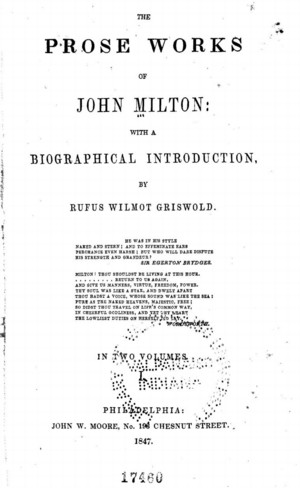
THE DOCTRINE AND DISCIPLINE OF DIVORCE; - John Milton, The Prose Works of John Milton, vol. 1 [1847]Edition used:The Prose Works of John Milton: With a Biographical Introduction by Rufus Wilmot Griswold. In Two Volumes (Philadelphia: John W. Moore, 1847). Vol. 1.
Part of: The Prose Works of John Milton, 2 vols.About Liberty Fund:Liberty Fund, Inc. is a private, educational foundation established to encourage the study of the ideal of a society of free and responsible individuals. Copyright information:The text is in the public domain. Fair use statement:This material is put online to further the educational goals of Liberty Fund, Inc. Unless otherwise stated in the Copyright Information section above, this material may be used freely for educational and academic purposes. It may not be used in any way for profit.
THE DOCTRINE AND DISCIPLINE OF DIVORCE;RESTORED TO THE GOOD OF BOTH SEXES, FROM THE BONDAGE OF CANON LAW, AND OTHER MISTAKES, TO THE TRUE MEANING OF SCRIPTURE IN THE LAW AND GOSPEL COMPARED. WHEREIN ALSO ARE SET DOWN THE BAD CONSEQUENCES OF ABOLISHING, OR CONDEMNING AS SIN, THAT WHICH THE LAW OF GOD ALLOWS, AND CHRIST ABOLISHED NOT. NOW THE SECOND TIME REVISED, AND MUCH AUGMENTED, IN TWO BOOKS: TO THE PARLIAMENT OF ENGLAND, WITH THE ASSEMBLY. Matth. xiii. 52. “Every scribe instructed in the kingdom of heaven is like the master of a house, which bringeth out of his treasury things new and old.” Prov. xviii. 13. “He that answereth a matter before he heareth it, it is folly and shame unto him.” [FIRST PUBLISHED 1643, 1644.] TO THE PARLIAMENT OF ENGLAND, WITH THE ASSEMBLY.If it were seriously asked, (and it would be no untimely question,) renowned parliament, select assembly! who of all teachers and masters, that have ever taught, hath drawn the most disciples after him, both in religion and in manners? it might be not untruly answered, Custom. Though virtue be commended for the most persuasive in her theory, and conscience in the plain demonstration of the spirit finds most evincing; yet whether it be the secret of divine will, or the original blindness we are born in, so it happens for the most part, that custom still is silently received for the best instructor. Except it be, because her method is so glib and easy, in some manner like to that vision of Ezekiel rolling up her sudden book of implicit knowledge, for him that will to take and swallow down at pleasure; which proving but of bad nourishment in the concoction, as it was heedless in the devouring, puffs up unhealthily a certain big face of pretended learning, mistaken among credulous men for the wholesome habit of soundness and good constitution, but is indeed no other than that swoln visage of counterfeit knowledge and literature, which not only in private mars our education, but also in public is the common climber into every chair, where either religion is preached, or law reported: filling each estate of life and profession with abject and servile principles, depressing the high and heaven-born spirit of man, far beneath the condition wherein either God created him, or sin hath sunk him. To pursue the allegory, custom being but a mere face, as echo is a mere voice, rests not in her unaccomplishment, until by secret inclination she accorporate herself with error, who being a blind and serpentine body without a head, willingly accepts what he wants, and supplies what her incompleteness went seeking. Hence it is, that error supports custom, custom countenances error: and these two between them would persecute and chase away all truth and solid wisdom out of human life, were it not that God, rather than man, once in many ages calls together the prudent and religious counsels of men, deputed to repress the encroachments, and to work off the inveterate blots and obscurities wrought upon our minds by the subtle insinuating of error and custom; who, with the numerous and vulgar train of their followers, make it their chief design to envy and cry down the industry of free reasoning, under the terms of humour and innovation; as if the womb of teeming truth were to be closed up, if she presume to bring forth aught that sorts not with their unchewed notions and suppositions. Against which notorious injury and abuse of man’s free soul, to testify and oppose the utmost that study and true labour can attain, heretofore the incitement of men reputed grave hath led me among others; and now the duty and the right of an instructed Christian calls me through the chance of good or evil report, to be the sole advocate of a discountenanced truth: a high enterprise, lords and commons! a high enterprise and a hard, and such as every seventh son of a seventh son does not venture on. Nor have I amidst the clamour of so much envy and impertinence whither to appeal, but to the concourse of so much piety and wisdom here assembled. Bringing in my hands an ancient and most necessary, most charitable, and yet most injured statute of Moses; not repealed ever by him who only had the authority, but thrown aside with much inconsiderate neglect, under the rubbish of canonical ignorance; as once the whole law was by some such like conveyance in Josiah’s time. And he who shall endeavour the amendment of any old neglected grievance in church or state, or in the daily course of life, if he be gifted with abilities of mind, that may raise him to so high an undertaking, I grant he hath already much whereof not to repent him; yet let me aread him, not to be the foreman of any misjudged opinion, unless his resolutions be firmly seated in a square and constant mind, not conscious to itself of any deserved blame, and regardless of ungrounded suspicions. For this let him be sure, he shall be boarded presently by the ruder sort, but not by discreet and well-nurtured men, with a thousand idle descants and surmises. Who when they cannot confute the least joint or sinew of any passage in the book; yet God forbid that truth should be truth, because they have a boisterous conceit of some pretences in the writer. But were they not more busy and inquisitive than the apostle commends, they would hear him at least, “rejoicing so the truth be preached, whether of envy or other pretence whatsoever:” for truth is as impossible to be soiled by any outward touch, as the sunbeam; though this ill hap wait on her nativity, that she never comes into the world, but like a bastard, to the ignominy of him that brought her forth; till time, the midwife rather than the mother of truth, have washed and salted the infant, declared her legitimate, and churched the father of his young Minerva, from the needless causes of his purgation. Yourselves can best witness this, worthy patriots! and better will, no doubt, hereafter: for who among ye of the foremost that have travailed in her behalf to the good of church or state, hath not been often traduced to be the agent of his own by-ends, under pretext of reformation? So much the more I shall not be unjust to hope, that however infamy or envy may work in other men to do her fretful will against this discourse, yet that the experience of your own uprightness misinterpreted will put ye in mind, to give it free audience and generous construction. What though the brood of Belial the draff of men, to whom no liberty is pleasing, but unbridled and vagabond lust without pale or partition, will laugh broad perhaps, to see so great a strength of Scripture mustering up in favour, as they suppose, of their debaucheries; they will know better when the shall hence learn, that honest liberty is the greatest foe to dishonest license. And what though others, out of a waterish and queasy conscience, because ever crazy and never yet sound, will rail and fancy to themselves that injury and license is the best of this book? Did not the distemper of their own stomachs affect them with a dizzy megrim, they would soon tie up their tongues and discern themselves like that Assyrian blasphemer, all this while reproaching not man, but the Almighty, the Holy One of Israel, whom they do not deny to have belawgiven his own sacred people with this very allowance, which they now call injury and license, and dare cry shame on, and will do yet a while, till they get a little cordial sobriety to settle their qualming zeal. But this question concerns not us perhaps: indeed man’s disposition, though prone to search after vain curiosities, yet when points of difficulty are to be discussed, appertaining to the removal of unreasonable wrong and burden from the perplexed life of our brother, it is incredible how cold, how dull, and far from all fellow-feeling we are, without the spur of self-concernment. Yet if the wisdom, the justice, the purity of God be to be cleared from foulest imputations, which are not yet avoided; if charity be not to be degraded and trodden down under a civil ordinance; if matrimony be not to be advanced like that exalted perdition written of to the Thessalonians, “above all that is called God,” or goodness, nay against them both; then I dare affirm, there will be found in the contents of this book that which may concern us all. You it concerns chiefly, worthies in parliament! on whom, as on our deliverers, all our grievances and cares, by the merit of your eminence and fortitude, are devolved. Me it concerns next, having with much labour and faithful diligence first found out, or at least with a fearless and communicative candour first published to the manifest good of Christendom, that which, calling to witness every thing mortal and immortal, I believe unfeignedly to be true. Let not other men think their conscience bound to search continually after truth, to pray for enlightening from above, to publish what they think they have so obtained, and debar me from conceiving myself tied by the same duties. Ye have now, doubtless, by the favour and appointment of God, ye have now in your hands a great and populous nation to reform; from what corruption, what blindness in religion, ye know well; in what a degenerate and fallen spirit from the apprehension of native liberty, and true manliness, I am sure ye find; with what unbounded license rushing to whoredoms and adulteries, needs not long inquiry: insomuch that the fears, which men have of too strict a discipline, perhaps exceed the hopes that can be in others, of ever introducing it with any great success. What if I should tell ye now of dispensations and indulgences, to give a little the reins, to let them play and nibble with the bait a while; a people as hard of heart as that Egyptian colony that went to Canaan. This is the common doctrine that adulterous and injurious divorces were not connived only, but with eye open allowed of old for hardness of heart. But that opinion, I trust, by then this following argument hath been well read, will be left for one of the mysteries of an indulgent Antichrist, to farm out incest by, and those his other tributary pollutions. What middle way can be taken then, may some interrupt, if we must neither turn to the right, nor to the left, and that the people hate to be reformed? Mark then, judges and lawgivers, and ye whose office it is to be our teachers, for I will utter now a doctrine, if ever any other, though neglected or not understood, yet of great and powerful importance to the governing of mankind. He who wisely would restrain the reasonable soul of man within due bounds, must first himself know perfectly, how far the territory and dominion extends of just and honest liberty. As little must he offer to bind that which God hath loosened, as to loosen that which he hath bound. The ignorance and mistake of this high point hath heaped up one huge half of all the misery that hath been since Adam. In the gospel we shall read a supercilious crew of masters, whose holiness, or rather whose evil eye, grieving that God should be so facile to man, was to set straiter limits to obedience, than God hath set, to enslave the dignity of man, to put a garrison upon his neck of empty and over-dignified precepts: and we shall read our Saviour never more grieved and troubled, than to meet with such a peevish madness among men against their own freedom. How can we expect him to be less offended with us, when much of the same folly shall be found yet remaining where it least ought, to the perishing of thousands? The greatest burden in the world is superstition, not only of ceremonies in the church, but of imaginary and scarecrow sins at home. What greater weakening, what more subtle stratagem against our Christian warfare, when besides the gross body of real transgressions to encounter, we shall be terrified by a vain and shadowy menacing of faults that are not? When things indifferent shall be set to overfront us under the banners of sin, what wonder if we be routed, and by this art of our adversary, fall into the subjection of worst and deadliest offences? The superstition of the papist is, “touch not, taste not,” when God bids both; and ours is, “part not, separate not,” when God and charity both permits and commands. “Let all your things be done with charity,” saith St. Paul; and his master saith, “She is the fulfilling of the law.” Yet now a civil, an indifferent, a sometime dissuaded law of marriage, must be forced upon us to fulfil, not only without charity but against her. No place in heaven or earth, except hell, where charity may not enter: yet marriage, the ordinance of our solace and contentment, the remedy of our loneliness, will not admit now either of charity or mercy, to come in and mediate, or pacify the fierceness of this gentle ordinance, the unremedied loneliness of this remedy. Advise ye well, supreme senate, if charity be thus excluded and expulsed, how ye will defend the untainted honour of your own actions and proceedings. He who marries, intends as little to conspire his own ruin, as he that swears allegiance: and as a whole people is in proportion to an ill government, so is one man to an ill marriage. If they, against any authority, covenant, or statute, may by the sovereign edict of charity, save not only their lives but honest liberties from unworthy bondage, as well may he against any private covenant, which he never entered to his mischief, redeem himself from unsupportable disturbances to honest peace, and just contentment. And much the rather, for that to resist the highest magistrate though tyrannizing, God never gave us express allowance, only he gave us reason, charity, nature, and good example to bear us out; but in this economical misfortune thus to demean ourselves, besides the warrant of those four great directors, which doth as justly belong hither, we have an express law of God, and such a law, as whereof our Saviour with a solemn threat forbid the abrogating. For no effect of tyranny can sit more heavy on the commonwealth, than this household unhappiness on the family. And farewell all hope of true reformation in the state, while such an evil as this lies undiscerned or unregarded in the house: on the redress whereof depends not only the spiritful and orderly life of our own grown men, but the willing and careful education of our children. Let this therefore be now examined, this tenure and freehold of mankind, this native and domestic charter given us by a greater lord than that Saxon king the confessor. Let the statutes of God be turned over, be scanned anew, and considered not altogether by the narrow intellectuals of quotationists and common places, but (as was the ancient right of councils) by men of what liberal profession soever, of eminent spirit and breeding, joined with a diffuse and various knowledge of divine and human things; able to balance and define good and evil, right and wrong, throughout every state of life; able to show us the ways of the Lord straight and faithful as they are, not full of cranks and contradictions, and pitfalling dispenses, but with divine insight and benignity measured out to the proportion of each mind and spirit, each temper and disposition created so different each from other, and yet by the skill of wise conducting, all to become uniform in virtue. To expedite these knots, were worthy a learned and memorable synod; while our enemies expect to see the expectation of the church tired out with dependencies, and independencies, how they will compound, and in what calends. Doubt not, worthy senators! to vindicate the sacred honour and judgment of Moses your predecessor, from the shallow commenting of scholastics and canonists. Doubt not after him to reach out your steady hands to the misinformed and wearied life of man; to restore this his lost heritage, into the household state; wherewith be sure that peace and love, the best subsistence of a Christian family, will return home from whence they are now banished; places of prostitution will be less haunted, the neighbour’s bed less attempted, the yoke of prudent and manly discipline will be generally submitted to; sober and well ordered living will soon spring up in the commonwealth. Yet have an author great beyond exception, Moses; and one yet greater, he who hedged in from abolishing every smallest jot and title of precious equity contained in that law, with a more accurate and lasting Masoreth, than either the synagogue of Ezra or the Galilæan school at Tiberias hath left us. Whatever else ye can enact, will scarce concern a third part of the British name: but the benefit and good of this your magnanimous example, will easily spread far beyond the banks of Tweed and the Norman isles. It would not be the first or second time, since our ancient druids, by whom this island was the cathedral of philosophy to France, left off their pagan rites, that England hath had this honour vouchsafed from heaven, to give out reformation to the world. Who was it but our English Constantine that baptized the Roman empire? Who but the Northumbrian Willibrode, and Winifride of Devon, with their followers, were the first apostles of Germany? Who but Alcuin and Wickliff our countrymen opened the eyes of Europe, the one in arts, the other in religion? Let not England forget her precedence of teaching nations how to live. Know, worthies; and exercise the privilege of your honoured country. A greater title I here bring ye, than is either in the power or in the policy of Rome to give her monarchs; this glorious act will style ye the defenders of charity. Nor is this yet the highest inscription that will adorn so religious and so holy a defence as this: behold here the pure and sacred law of God, and his yet purer and more sacred name, offering themselves to you, first of all Christian reformers to be acquitted from the long-suffered ungodly attribute of patronizing adultery. Defer not to wipe off instantly these imputative blurs and stains cast by rude fancies upon the throne and beauty itself of inviolable holiness: lest some other people more devout and wise than we bereave us this offered immortal glory, our wonted prerogative, of being the first asserters in every great vindication. For me, as far as my part leads me, I have already my greatest gain, assurance and inward satisfaction to have done in this nothing unworthy of an honest life, and studies well employed. With what event, among the wise and right understanding handful of men, I am secure. But how among the drove of custom and prejudiced this will be relished by such whose capacity, since their youth run ahead into the easy creek of a system or a medulla, sails there at will under the blown physiognomy of their unlaboured rudiments; for them, what their taste will be, I have also surety sufficient, from the entire league that hath ever been between formal ignorance and grave obstinacy. Yet when I remember the little that our Saviour could prevail about this doctrine of charity against the crabbed textuists of his time, I make no wonder, but rest confident, that whoso prefers either matrimony or other ordinance before the good of man and the plain exigence of charity, let him profess papist, or protestant, or what he will, he is no better than a Pharisee, and understands not the gospel: whom as a misinterpreter of Christ I openly protest against; and provoke him to the trial of this truth before all the world: and let him bethink him withal how he will sodder up the shifting flaws of his ungirt permissions, his venial and unvenial dispenses, wherewith the law of God pardoning and unpardoning hath been shamefully branded for want of heed in glossing, to have eluded and baffled out all faith and chastity from the marriage-bed of that holy seed, with politic and judicial adulteries. I seek not to seduce the simple and illiterate: my errand is to find out the choicest and the learnedest, who have this high gift of wisdom to answer solidly, or to be convinced. I crave it from the piety, the learning, and the prudence which is housed in this place. It might perhaps more fitly have been written in another tongue: and I had done so, but that the esteem I have of my country’s judgment, and the love I bear to my native language to serve it first with what I endeavour, made me speak it thus, ere I assay the verdict of outlandish readers. And perhaps also here I might have ended nameless, but that the address of these lines chiefly to the parliament of England might have seemed ingrateful not to acknowledge by whose religious care, unwearied watchfulness, courageous and heroic resolutions, I enjoy the peace and studious leisure to remain, The Honourer and Attendant of their noble Worth and Virtues, John Milton. BOOK I.THE PREFACE.That man is the occasion of his own miseries in most of those evils which he imputes to God’s inflicting. The absurdity of our canonists in their decrees about divorce. The Christian imperial laws framed with more equity. The opinion of Hugo Grotius and Paulus Fagius: And the purpose in general of this discourse. Many men, whether it be their fate or fond opinion, easily persuade themselves, if God would but be pleased a while to withdraw his just punishments from us, and to restrain what power either the devil or any earthly enemy hath to work us wo, that then man’s nature would find immediate rest and releasement from all evils. But verily they who think so, if they be such as have a mind large enough to take into their thoughts a general survey of human things, would soon prove themselves in that opinion far deceived. For though it were granted us by divine indulgence to be exempt from all that can be harmful to us from without, yet the perverseness of our folly is so bent, that we should never lin hammering out of our own hearts, as it were out of a flint, the seeds and sparkles of new misery to ourselves, till all were in a blaze again. And no marvel if out of our own hearts, for they are evil; but even out of those things which God meant us, either for a principal good, or a pure contentment, we are still hatching and contriving upon ourselves matter of continual sorrow and perplexity. What greater good to man than that revealed rule, whereby God vouchsafes to show us how he would be worshipped? And yet that not rightly understood became the cause, that once a famous man in Israel could not but oblige his conscience to be the sacrificer; or if not, the jailer of his innocent and only daughter: and was the cause ofttimes that armies of valiant men have given up their throats to a heathenish enemy on the sabbath day; fondly thinking their defensive resistance to be as then a work unlawful. What thing more instituted to the solace and delight of man than marriage? And yet the misinterpreting of some scripture, directed mainly against the abusers of the law for divorce given by Moses, hath changed the blessing of matrimony not seldom into a familiar and coinhabiting mischief; at least into a drooping and disconsolate household captivity, without refuge or redemption. So ungoverned and so wild a race doth superstition run us, from one extreme of abused liberty into the other of unmerciful restraint. For although God in the first ordaining of marriage taught us to what end he did it, in words expressly implying the apt and cheerful conversation of man with woman, to comfort and refresh him against the evil of solitary life, not mentioning the purpose of generation till afterwards, as being but a secondary end in dignity, though not in necessity: yet now, if any two be but once handed in the church, and have tasted in any sort the nuptial bed, let them find themselves never so mistaken in their dispositions through any error, concealment, or misadventure, that through their different tempers, thoughts, and constitutions, they can neither be to one another a remedy against loneliness, nor live in any union or contentment all their days; yet they shall, so they be but found suitably weaponed to the least possibility of sensual enjoyment, be made, spite of antipathy, to fadge together, and combine as they may to their unspeakable wearisomeness, and despair of all sociable delight in the ordinance which God established to that very end. What a calamity is this, and as the wise man, if he were alive, would sigh out in his own phrase, what a “sore evil is this under the sun!” All which we can refer justly to no other author than the canon law and her adherents, not consulting with charity, the interpreter and guide of our faith, but resting in the mere element of the text; doubtless by the policy of the devil to make that gracious ordinance become unsupportable, that what with men not daring to venture upon wedlock, and what with men wearied out of it, all inordinate license might abound. It was for many ages that marriage lay in disgrace with most of the ancient doctors, as a work of the flesh, almost a defilement, wholly denied to priests, and the second time dissuaded to all, as he that reads Tertullian or Jerom may see at large. Afterwards it was thought so sacramental, that no adultery or desertion could dissolve it; and this is the sense of our canon courts in England to this day, but in no other reformed church else: yet there remains in them also a burden on it as heavy as the other two were disgraceful or superstitious, and of as much iniquity, crossing a law not only written by Moses, but charactered in us by nature, of more antiquity and deeper ground than marriage itself; which law is to force nothing against the faultless proprieties of nature, yet that this may be colourably done, our Saviour’s words touching divorce are as it were congealed into a stony rigour, inconsistent both with his doctrine and his office; and that which he preached only to the conscience is by canonical tyranny snatched into the compulsive censure of a judicial court; where laws are imposed even against the venerable and secret power of nature’s impression, to love, whatever cause be found to loath: which is a heinous barbarism both against the honour of marriage, the dignity of man and his soul, the goodness of Christianity, and all the human respects of civility. Notwithstanding that some the wisest and gravest among the Christian emperors, who had about them, to consult with, those of the fathers then living, who for their learning and holiness of life are still with us in great renown, have made their statutes and edicts concerning this debate far more easy and relenting in many necessary cases, wherein the canon is inflexible. And Hugo Grotius, a man of these times, one of the best learned, seems not obscurely to adhere in his persuasion to the equity of those imperial decrees, in his notes upon the Evangelist; much allaying the outward roughness of the text, which hath for the most part been too immoderately expounded; and excites the diligence of others to inquire further into this question, as containing many points that have not yet been explained. Which ever likely to remain intricate and hopeless upon the suppositions commonly stuck to, the authority of Paulus Fagius, one so learned and so eminent in England once, if it might persuade, would straight acquaint us with a solution of these differences no less prudent than compendious. He, in his comment on the Pentateuch, doubted not to maintain that divorces might be as lawfully permitted by the magistrate to Christians, as they were to the Jews. But because he is but brief, and these things of great consequence not to be kept obscure, I shall conceive it nothing above my duty, either for the difficulty or the censure that may pass thereon, to communicate such thoughts as I also have had, and do offer them now in this general labour of reformation to the candid view both of church and magistrate: especially because I see it the hope of good men, that those irregular and unspiritual courts have spun their utmost date in this land, and some better course must now be constituted. This therefore shall be the task and period of this discourse to prove, first, that other reasons of divorce, besides adultery, were by the law of Moses, and are yet to be allowed by the Christian magistrate as a piece of justice, and that the words of Christ are not hereby contraried. Next, that to prohibit absolutely any divorce whatsoever, except those which Moses excepted, is against the reason of law, as in due place I shall show out of Fagius with many additions. He therefore who by adventuring, shall be so happy as with success to light the way of such an expedient liberty and truth as this, shall restore the much-wronged and over-sorrowed state of matrimony, not only to those merciful and life-giving remedies of Moses, but as much as may be, to that serene and blissful condition it was in at the beginning, and shall deserve of all apprehensive men, (considering the troubles and distempers, which, for want of this insight have been so oft in kingdoms, in states, and families,) shall deserve to be reckoned among the public benefactors of civil and human life, above the inventors of wine and oil; for this is a far dearer, far nobler, and more desirable cherishing to man’s life, unworthily exposed to sadness and mistake, which he shall vindicate. Not that license, and levity, and unconsented breach of faith should herein be countenanced, but that some conscionable and tender pity might be had of those who have unwarily, in a thing they never practised before, made themselves the bondmen of a luckless and helpless matrimony. In which argument, he whose courage can serve him to give the first onset must look for two several oppositions; the one from those who having sworn themselves to long custom, and the letter of the text, will not out of the road; the other from those whose gross and vulgar apprehensions conceit but low of matrimonial purposes, and in the work of male and female think they have all. Nevertheless, it shall be here sought by due ways to be made appear, that those words of God in the institution, promising a meet help against loneliness, and those words of Christ, “that his yoke is easy, and his burden light,” were not spoken in vain: for if the knot of marriage may in no case be dissolved but for adultery, all the burdens and services of the law are not so intolerable. This only is desired of them who are minded to judge hardly of thus maintaining, that they would be still, and hear all out, nor think it equal to answer deliberate reason with sudden heat and noise; remembering this, that many truths now of reverend esteem and credit, had their birth and beginning once from singular and private thoughts, while the most of men were otherwise possessed; and had the fate at first to be generally exploded and exclaimed on by many violent opposers: yet I may err perhaps in soothing myself that this present truth revived will deserve on all hands to be not sinisterly received, in that it undertakes the cure of an inveterate disease crept into the best part of human society; and to do this with no smarting corrosive, but with a smooth and pleasing lesson, which received hath the virtue to soften and dispel rooted and knotty sorrows, and without enchantment, if that he feared, or spell used, hath regard at once both to serious pity and upright honesty; that tends to the redeeming and restoring of none but such as are the object of compassion, having in an ill hour hampered themselves, to the utter dispatch of all their most beloved comforts and repose for this life’s term. But if we shall obstinately dislike this new overture of unexpected ease and recovery, what remains but to deplore the frowardness of our hopeless condition, which neither can endure the estate we are in, nor admit of remedy either sharp or sweet. Sharp we ourselves distaste; and sweet, under whose hands we are, is scrupled and suspected as too luscious. In such a posture Christ found the Jews, who were neither won with the austerity of John the Baptist, and thought it too much license to follow freely the charming pipe of him who sounded and proclaimed liberty and relief to all distresses: yet truth in some age or other will find her witness, and shall be justified at last by her own children. CHAPTER I.The position proved by the law of Moses. That law expounded and asserted to a moral and charitable use, first by Paulus Fagius, next with other additions. To remove therefore, if it be possible, this great and sad oppression, which through the strictness of a literal interpreting hath invaded and disturbed the dearest and most peaceable estate of household society, to the overburdening, if not the overwhelming of many Christians better worth than to be so deserted of the church’s considerate care, this position shall be laid down, first proving, then answering what may be objected either from Scripture or light of reason. “That indisposition, unfitness, or contrariety of mind, arising from a cause in nature unchangeable, hindering, and ever likely to hinder, the main benefits of conjugal society, which are solace and peace; is a greater reason of divorce than natural frigidity, especially if there be no children, and that there be mutual consent.” This I gather from the law in Deut. xxiv. 1. “When a man hath taken a wife and married her, and it come to pass that she find no favour in his eyes, because he hath found some uncleanness in her, let him write her a bill of divorcement, and give it in her hand, and send her out of his house,” &c. This law, if the words of Christ may be admitted into our belief, shall never while the world stands, for him be abrogated. First therefore I here set down what learned Fagius hath observed on this law; “the law of God,” saith he, “permitted divorce for the help of human weakness. For every one that of necessity separates, cannot live single. That Christ denied divorce to his own, hinders not; for what is that to the unregenerate, who hath not attained such perfection? Let not the remedy be despised, which was given to weakness. And when Christ saith, who marries the divorced commits adultery, it is to be understood if he had any plot in the divorce.” The rest I reserve until it be disputed, how the magistrate is to do herein. From hence we may plainly discern a twofold consideration in this law: first, the end of the lawgiver, and the proper act of the law, to command or to allow something just and honest, or indifferent. Secondly, his sufferance from some accidental result of evil by this allowance, which the law cannot remedy. For if this law have no other end or act but only the allowance of sin, though never to so good intention, that law is no law, but sin muffled in the robe of law, or law disguised in the loose garment of sin. Both which are too foul hypotheses, to save the phænomenon of our Saviour’s answer to the Pharisees about this matter. And I trust anon by the help of an infallible guide, to perfect such Prutenic tables, as shall mend the astronomy of our wide expositors. The cause of divorce mentioned in the law is translated “some uncleanness,” but in the Hebrew it sounds “nakedness of aught, or any real nakedness:” which by all the learned interpreters is referred to the mind as well as to the body. And what greater nakedness or unfitness of mind than that which hinders ever the solace and peaceful society of the married couple; and what hinders that more than the unfitness and defectiveness of an unconjugal mind? The cause therefore of divorce expressed in the position cannot but agree with that described in the best and equallest sense of Moses’ law. Which being a matter of pure charity, is plainly moral, and more now in force than ever; therefore surely lawful. For if under the law such was God’s gracious indulgence, as not to suffer the ordinance of his goodness and favour through any error to be seared and stigmatised upon his servants to their misery and thraldom; much less will he suffer it now under the covenant of grace, by abrogating his former grant of remedy and relief. But the first institution will be objected to have ordained marriage inseparable. To that a little patience until this first part have amply discoursed the grave and pious reasons of this divorcive law; and then I doubt not but with one gentle stroking to wipe away ten thousand tears out of the life of man. Yet thus much I shall now insist on, that whatever the institution were, it could not be so enormous, nor so rebellious against both nature and reason, as to exalt itself above the end and person for whom it was instituted. CHAPTER II.The first reason of this law grounded on the prime reason of matrimony. That no covenant whatsoever obliges against the main end both of itself, and of the parties covenanting. For all sense and equity reclaims, that any law or covenant, how solemn or strait soever, either between God and man, or man and man, though of God’s joining, should bind against a prime and principal scope of its own institution, and of both or either party covenanting: neither can it be of force to engage a blameless creature to his own perpetual sorrow, mistaken for his expected solace, without suffering charity to step in and do a confessed good work of parting those, whom nothing holds together but this of God’s joining, falsely supposed against the express end of his own ordinance. And what his chief end was of creating woman to be joined with man, his own instituting words declare, and are infallible to inform us what is marriage, and what is no marriage; unless we can think them set there to no purpose; “it is not good,” saith he, “that man should be alone, I will make him a help meet for him.” From which words, so plain, less cannot be concluded, nor is by any learned interpreter, than that in God’s intention a meet and happy conversation is the chiefest and the noblest end of marriage: for we find here no expression so necessarily implying carnal knowledge, as this prevention of loneliness to the mind and spirit of man. To this, Fagius, Calvin, Pareus, Rivetus, as willingly and largely assent as can be wished. And indeed it is a greater blessing from God, more worthy so excellent a creature as man is, and a higher end to honour and sanctify the league of marriage, whenas the solace and satisfaction of the mind is regarded and provided for before the sensitive pleasing of the body. And with all generous persons married thus it is, that where the mind and person pleases aptly, there some unaccomplishment of the body’s delight may be better borne with, than when the mind hangs off in an unclosing disproportion, though the body be as it ought; for there all corporal delight will soon become unsavoury and contemptible. And the solitariness of man, which God had namely and principally ordered to prevent by marriage, hath no remedy, but lies under a worse condition than the loneliest single life: for in single life the absence and remoteness of a helper might inure him to expect his own comforts out of himself, or to seek with hope; but here the continual sight of his deluded thoughts, without cure, must needs be to him, if especially his complexion incline him to melancholy, a daily trouble and pain of loss, in some degree like that which reprobates feel. Lest therefore so noble a creature as man should be shut up incurably under a worse evil by an easy mistake in that ordinance which God gave him to remedy a less evil, reaping to himself sorrow while he went to rid away solitariness, it cannot avoid to be concluded, that if the woman be naturally so of disposition, as will not help to remove, but help to increase that same God-for-bidden loneliness, which will in time draw on with it a general discomfort and dejection of mind, not beseeming either Christian profession or moral conversation, unprofitable and dangerous to the commonwealth, when the household estate, out of which must flourish forth the vigour and spirit of all public enterprises, is so illcontented and procured at home, and cannot be supported; such a marriage can be no marriage, whereto the most honest end is wanting: and the aggrieved person shall do more manly, to be extraordinary and singular in claiming the due right whereof he is frustrated, than to piece up his lost contentment by visiting the stews, or stepping to his neighbour’s bed; which is the common shift in this misfortune: or else by suffering his useful life to waste away, and be lost under a secret affliction of an unconscionable size to human strength. Against all which evils the mercy of this Mosaic law was graciously exhibited. CHAPTER III.The ignorance and iniquity of canon law, providing for the right of the body in marriage, but nothing for the wrongs and grievances of the mind. An objection, that the mind should be better looked to before contract, answered. How vain therefore is it, and how preposterous in the canon law, to have made such careful provision against the impediment of carnal performance, and to have had no care about the unconversing inability of mind so defective to the purest and most sacred end of matrimony; and that the vessel of voluptuous enjoyment must be made good to him that has taken it upon trust, without any caution; whenas the mind, from whence must flow the acts of peace and love, a far more precious mixture than the quintescence of an excrement, though it be found never so deficient and unable to perform the best duty of marriage in a cheerful and agreeable conversation, shall be thought good enough, however flat and melancholius it be, and must serve, though to the eternal disturbance and languishing of him that complains! Yet wisdom and charity, weighing God’s own institution, would think that the pining of a sad spirit wedded to loneliness should deserve to be freed, as well the impatience of a sensual desire so providently relieved. It is read to us in the liturgy, that “we must not marry to satisfy the fleshly appetite, like brute beasts, that have no understanding;” but the canon so runs, as if it dreamed of no other matter than such an appetite to be satisfied; for if it happen that nature hath stopped or extinguished the veins of sensuality, that marriage is annulled. But though all the faculties of the understanding and conversing part after trial appear to be so ill and so aversely met through nature’s unalterable working, as that neither peace, nor any sociable contentment can follow, it is as nothing; the contract shall stand as firm as ever, betide what will. What is this but secretly to instruct us, that however many grave reasons are pretended to the married life, yet that nothing indeed is thought worth regard therein, but the prescribed satisfaction of an irrational heat? Which cannot be but ignominious to the state of marriage, dishonourable to the undervalued soul of man, and even to Christian doctrine itself: while it seems more moved at the disappointing of an impetuous nerve, than at the ingenuous grievance of a mind unreasonably yoked; and to place more of marriage in the channel of concupiscence, than in the pure influence of peace and love, whereof the soul’s lawful contentment is the only fountain. But some are ready to object, that the disposition ought seriously to be considered before. But let them know again, that for all the wariness can be used, it may yet befall a discreet man to be mistaken in his choice, and we have plenty of examples. The soberest and best governed men are least practised in these affairs; and who knows not that the bashful muteness of a virgin may ofttimes hide all the unliveliness and natural sloth which is really unfit for conversation; nor is there that freedom of access granted or presumed, as may suffice to a perfect discerning till too late; and where any indisposition is suspected, what more usual than the persuasion of friends, that acquaintance, as it increases, will amend all? And lastly, it is not strange though many, who have spent their youth chastely, are in some things not so quick-sighted, while they haste too eagerly to light the nuptial torch; nor is it therefore that for a modest error a man should forfeit so great a happiness, and no charitable means to release him: since they who have lived most loosely, by reason of their bold accustoming, prove most successful in their matches, because their wild affections unsettling at will, have been as so many divorces to teach them experience. Whenas the sober man honouring the appearance of modesty, and hoping well of every social virtue under that veil, may easily chance to meet, if not with a body impenetrable, yet often with a mind to all other due conversation inaccessible, and to all the more estimable and superior purposes of matrimony useless and almost lifeless: and what a solace, what a fit help such a consort would be through the whole life of man, is less pain to conjecture than to have experience. CHAPTER IV.The second reason of this law, because without it, marriage as it happens oft is not a remedy of that which it promises, as any rational creature would expect. That marriage, if we pattern from the beginning, as our Saviour bids, was not properly the remedy of lust, but the fulfilling of conjugal love and helpfulness. And that we may further see what a violent cruel thing it is to force the continuing of those together, whom God and nature in the gentlest end of marriage never joined; divers evils and extremities, that follow upon such a compulsion, shall here be set in view. Of evils, the first and greatest is, that hereby a most absurd and rash imputation is fixed upon God and his holy laws, of conniving and dispensing with open and common adultery among his chosen people; a thing which the rankest politician would think it shame and disworship that his laws should countenance: how and in what manner that comes to pass I shall reserve till the course of method brings on the unfolding of many scriptures. Next, the law and gospel are hereby made liable to more than one contradiction, which I refer also thither. Lastly, the supreme dictate of charity is hereby many ways neglected and violated; which I shall forthwith address to prove. First, we know St. Paul saith, It is better to marry than to burn. Marriage therefore was given as a remedy of that trouble; but what might this burning mean? Certainly not the mere motion of carnal lust, not the mere goad of a sensitive desire: God does not principally take care for such cattle. What is it then but that desire which God put into Adam in Paradise, before he knew the sin of incontinence; that desire which God saw it was not good that man should be left alone to burn in, the desire and longing to put off an unkindly solitariness by uniting another body, but not without a fit soul to his, in the cheerful society of wedlock? Which if it were so needful before the fall, when man was much more perfect in himself, how much more is it needful now against all the sorrows and casualties of this life, to have an intimate and speaking help, a ready and reviving associate in marriage? Whereof who misses, by chancing on a mute and spiritless mate, remains more alone than before, and in a burning less to be contained than that which is fleshly, and more to be considered; as being more deeply rooted even in the faultless innocence of nature. As for that other burning which is but as it were the venom of a lusty and over-abounding concoction, strict life and labour, with the abatement of a full diet, may keep that low and obedient enough: but this pure and more inbred desire of joining to itself in conjugal fellowship a fit conversing soul (which desire is properly called love) “is stronger than death,” as the spouse of Christ thought; “many waters cannot quench it, neither can the floods drown it.” This is that rational burning that marriage is to remedy, not to be allayed with fasting, nor with any penance to be subdued: which how can he assuage who by mishap hath met the most unmeet and unsuitable mind? Who hath the power to struggle with an intelligible flame, not in Paradise to be resisted, become now more ardent by being failed of what in reason it looked for; and even then most unquenched, when the importunity of a provender burning is well enough appeased; and yet the soul hath obtained nothing of what it justly desires. Certainly such a one forbidden to divorce, is in effect forbidden to marry, and compelled to greater difficulties than in a single life: for if there be not a more humane burning which marriage must satisfy, or else may be dissolved, than that of copulation, marriage cannot be honourable for the meet reducing and terminating lust between two; seeing many beasts in voluntary and chosen couples live together as unadulterously, and are as truly married in that respect. But all ingenuous men will see that the dignity and blessing of marriage is placed rather in the mutual enjoyment of that which the wanting soul needfully seeks, than of that which the plenteous body would joyfully give away. Hence it is that Plato, in his festival discourse, brings in Socrates relating what he feigned to have learned from the prophetess Diotima, how Love was the son of Penury, begot of Plenty in the garden of Jupiter. Which divinely sorts with that which in effect Moses tells us, that Love was the son of Loneliness, begot in Paradise by that sociable and helpful aptitude which God implanted between man and woman toward each other. The same also is that burning mentioned by St. Paul, whereof marriage ought to be the remedy: the flesh hath other mutual and easy curbs which are in the power of any temperate man. When therefore this original and sinless penury or loneliness of the soul cannot lay itself down by the side of such a meet and acceptable union as God ordained in marriage, at least in some proportion, it cannot conceive and bring forth love, but remains utterly unmarried under a former wedlock, and still burns in the proper meaning of St. Paul. Then enters Hate, not that hate that sins, but that which only is natural dissatisfaction, and the turning aside from a mistaken object: if that mistake have done injury, it fails not to dismiss with recompense; for to retain still, and not be able to love, is to heap up more injury. Thence this wise and pious law of dismission now defended, took beginning: he therefore who lacking of his due in the most native and humane end of marriage, thinks it better to part than to live sadly and injuriously to that cheerful covenant, (for not to be beloved, and yet retained, is the greatest injury to a gentle spirit,) he, I say, who therefore seeks to part, is one who highly honours the married life and would not stain it: and the reasons which now move him to divorce, are equal to the best of those that could first warrant him to marry; for, as was plainly shown, both the hate which now diverts him, and the loneliness which leads him still powerfully to seek a fit help, hath not the least grain of a sin in it, if he be worthy to understand himself. CHAPTER V.The third reason of this law, because without it, he who has happened where he finds nothing but remediless offences and discontents, is in more and greater temptations than ever before. Thirdly, Yet it is next to be feared, if he must be still bound without reason by a deaf rigour, that when he perceives the just expectance of his mind defeated, he will begin even against law to cast about where he may find his satisfaction more complete, unless he be a thing heroically virtuous; and that are not the common lump of men, for whom chiefly the laws ought to be made; though not to their sins, yet to their unsinning weaknesses, it being above their strength to endure the lonely estate, which while they shunned they are fallen into. And yet there follows upon this a worse temptation: for if he be such as hath spent his youth unblameably, and laid up his chiefest earthly comforts in the enjoyments of a contented marriage, nor did neglect that furtherance which was to be obtained therein by constant prayers; when he shall find himself bound fast to an uncomplying discord of nature, or, as it oft happens, to an image of earth and phlegm, with whom he looked to be the copartner of a sweet and gladsome society, and sees withal that his bondage is now inevitable; though he be almost the strongest Christian, he will be ready to despair in virtue, and mutiny against Divine Providence: and this doubtless is the reason of those lapses, and that melancholy despair, which we see in many wedded persons, though they understand it not, or pretend other causes, because they know no remedy; and is of extreme danger: therefore when human frailty surcharged is at such a loss, charity ought to venture much, and use bold physic, lest an overtossed faith endanger to shipwreck. CHAPTER VI.The fourth reason of this law, that God regards love and peace in the family, more than a compulsive performance of marriage, which is more broke by a grievous continuance, than by a needful divorce. Fourthly, Marriage is a covenant, the very being whereof consists not in a forced cohabitation, and counterfeit performance of duties, but in unfeigned love and peace: and of matrimonial love, no doubt but that was chiefly meant, which by the ancient sages was thus parabled; that Love, if he be not twin born, yet hath a brother wondrous like him, called Anteros; whom while he seeks all about, his chance is to meet with many false and feigning desires, that wander singly up and down in his likeness: by them in their borrowed garb, Love though not wholly blind, as poets wrong him, yet having but one eye, as being born an archer aiming and that eye not the quickest in this dark region here below, which is not love’s proper sphere, partly out of the simplicity and credulity which is native to him, often deceived, embraces and consorts him with these obvious and suborned striplings, as if they were his mother’s own sons; for so he thinks them, while they subtilly keep themselves most on his blind side. But after a while, as his manner is when soaring up into the high tower of his Apogæum, above the shadow of the earth, he darts out the direct rays of his then most piercing eyesight upon the impostures and trim disguises that were used with him, and discerns that this is not his genuine brother as he imagined; he has no longer the power to hold fellowship with such a personated mate: for straight his arrrows lose their golden heads, and shed their purple feathers, his silken braids untwine, and slip their knots, and that original and fiery virtue given him by fate all on a sudden goes out, and leaves him undeified and despoiled of all his force; till finding Anteros at last he kindles and repairs the almost faded ammunition of his deity by the reflection of a coequal and homogeneal fire. Thus mine author sung it to me: and by the leave of those who would be counted the only grave ones, this is no mere amatorious novel (though to be wise and skilful in these matters, men heretofore of greatest name in virtue have esteemed it one of the highest arcs, that human contemplation circling upwards can make from the globy sea whereon she stands): but this a deep and serious verity, showing us that love in marriage cannot live nor subsist unless it be mutual; and where love cannot be, there can be left of wedlock nothing but the empty husk of an outside matrimony, as undelightful and unpleasing to God as any other kind of hypocrisy. So far is his command from tying men to the observance of duties which there is no help for, but they must be dissembled. If Solomon’s advice be not over-frolic, “live joyfully,” saith he, “with the wife whom thou lovest, all thy days, for that is thy portion.” How then, where we find it impossible to rejoice or to love, can we obey this precept? How miserably do we defraud ourselves of that comfortable portion, which God gives us, by striving vainly to glue an error together, which God and nature will not join, adding but more vexation and violence to that blissful society by our importunate superstition, that will not hearken to St. Paul, 1 Cor. vii. who, speaking of marriage and divorce, determines plain enough in general, that God therein “hath called us to peace, and not to bondage.” Yea God himself commands in his law more than once, and by his prophet Malachi, as Calvin and the best translations read, that “he who hates, let him divorce,” that is, he who cannot love. Hence it is that the rabbins, and Maimonides, famous among the rest, in a book of his set forth by Buxtorfius, tells us, that “divorce was permitted by Moses to preserve peace in marriage, and quiet in the family.” Surely the Jews had their saving peace about them as well as we, yet care was taken that this wholesome provision for household peace should also be allowed them: and must this be denied to Christians? O perverseness! that the law should be made more provident of peace-making than the gospel! that the gospel should be put to beg a most necessary help of mercy from the law, but must not have it; and that to grind in the mill of an undelighted and servile copulation, must be the only forced work of a Christian marriage, ofttimes with such a yokefellow, from whom both love and peace, both nature and religion mourns to be separated. I cannot therefore be so diffident, as not securely to conclude, that he who can receive nothing of the most important helps in marriage, being thereby disenabled to return that duty which is his, with a clear and hearty countenance, and thus continues to grieve whom he would not, and is no less grieved; that man ought even for love’s sake and peace to move divorce upon good and liberal conditions to the divorced. And it is a less breach of wedlock to part with wise and quiet consent betimes, than still to foil and profane that mystery of joy and union with a polluting sadness and perpetual distemper: for it is not the outward continuing of marriage that keeps whole that covenant, but whatsoever does most according to peace and love, whether in marriage or in divorce, he it is that breaks marriage least; it being so often written, that “Love only is the fulfilling of every commandment.” CHAPTER VII.The fifth reason, that nothing more hinders and disturbs the whole life of a Christian, than a matrimony found to be incurably unfit, and doth the same in effect that doth an idolatrous match. Fifthly, As those priests of old were not to be long in sorrow, or if they were, they could not rightly execute their function; so every true Christian in a higher order of priesthood, is a person dedicate to joy and peace, offering himself a lively sacrifice of praise and thanksgiving, and there is no Christian duty that is not to be seasoned and set off with cheerishness; which in a thousand outward and intermitting crosses may yet be done well, as in this vale of tears: but in such a bosom affiction as this, crushing the very foundation of his inmost nature, when he shall be forced to love against a possibility, and to use a dissimulation against his soul in the perpetual and ceaseless duties of a husband; doubtless his whole duty of serving God must needs be blurred and tainted with a sad unpreparedness and dejection of spirit wherein God has no delight. Who sees not therefore how much more Christianity it would be to break by divorce, that which is more broken by undue and forcible keeping, rather than “to cover the altar of the Lord with continual tears, so that he regardeth not the offering any more,” rather than that the whole worship of a Christian man’s life should languish and fade away beneath the weight of an immeasurable grief and discouragement? And because some think the children of a second matrimony succeeding a divorce would not be a holy seed, it hindered not the Jews from being so; and why should we not think them more holy than the offspring of a former ill-twisted wedlock, begotten only out of a bestial necessity, without any true love or contentment, or joy to their parents? So that in some sense we may call them the “children of wrath” and anguish, which will as little conduce to their sanctifying, as if they had been bastards: for nothing more than disturbance of mind suspends us from approaching to God; such a disturbance especially, as both assaults our faith and trust in God’s providence, and ends, if there be not a miracle of virtue on either side, not only in bitterness and wrath, the canker of devotion, but in a desperate and vicious carelessness, when he sees himself, without fault of his, trained by a deceitful bait into a snare of misery, betrayed by an alluring ordinance, and then made the thrall of heaviness and discomfort by an undivorcing law of God, as he erroneously thinks, but of man’s iniquity, as the truth is: for that God prefers the free and cheerful worship of a Christian, before the grievance and exacted observance of an unhappy marriage, besides that the general maxims of religion assure us, will be more manifest by drawing a parallel argument from the ground of divorcing an idolatress, which was, lest she should alienate his heart from the true worship of God: and what difference is there whether she pervert him to supersition by her enticing sorcery, or disenable him in the whole service of God through the disturbance of her unhelpful and unfit society; and so drive him at last, through murmuring and despair, to thoughts of atheism? Neither doth it lessen the cause of separating, in that the one willingly allures him from the faith, the other perhaps unwillingly drives him; for in the account of God it comes all to one, that the wife loses him a servant: and therefore by all the united force of the Decalogue she ought to be disbanded, unless we must set marriage above God and charity, which is the doctrine of devils, no less than forbidding to marry. CHAPTER VIII.That an idolatrous heretic ought to be divorced, after a convenient space given to hope of conversion. That place of 1 Cor. vii. restored from a two-fold erroneous exposition; and that the common expositors flatly contradict the moral law. And here by the way, to illustrate the whole question of divorce, ere this treatise end, I shall not be loth to spend a few lines in hope to give a full resolve of that which is yet so much controverted; whether an idolatrous heretic ought to be divorced. To the resolving whereof we must first know, that the Jews were commanded to divorce an unbelieving Gentile for two causes: First, because all other nations, especially the Canaanites, were to them unclean. Secondly, to avoid seducement. That other nations were to the Jews impure, even to the separating in marriage, will appear out of Exod. xxxiv. 16, Deut. vii. 3, 6, compared with Ezra ix. 2, also chap. x. 10, 11, Neh. xiii. 30. This was the ground of that doubt raised among the Corinthians by some of the circumcision; whether an unbeliever were not still to be counted an unclean thing, so as that they ought to divorce from such a person. This doubt of theirs St. Paul removes by an evangelical reason, having respect to that vision of St. Peter, wherein the distinction of clean and unclean being abolished, all living creatures were sanctified to a pure and Christian use, and mankind especially, now invited by a general call to the covenant of grace. Therefore saith St. Paul, “the unbelieving wife is sanctified by the husband;” that is made pure and lawful to his use, so that he need not put her away for fear lest her unbelief should defile him; but that if he found her love still towards him he might rather hope to win her. The second reason of that divorce was to avoid seducement, as is proved by comparing those two places of the law to that which Ezra and Nehemiah did by divine warrant in compelling the Jews to forego their wives. And this reason is moral and perpetual in the rule of Christian faith without evasion; therefore saith the apostle, 2 Cor. vi., “Misyoke not together with infidels,” which is interpreted of marriage in the first place. And although the former legal pollution be now done off, yet there is a spiritual contagion in idolatry as much to be shunned; and though seducement were not to be feared, yet where there is no hope of converting, there always ought to be a certain religious aversion and abhorring, which can no way sort with marriage: Therefore saith St. Paul, “What fellowship hath righteousness with unrighteousness? What communion hath light with darkness? What concord hath Christ with Belial? What part hath he that believeth with an infidel?” And in the next verse but one he moralizes, and makes us liable to that command of Isaiah; “Wherefore come out from among them, and be separate, saith the Lord; touch not the unclean thing, and I will receive ye.” And this command thus gospelized to us, hath the same force with that whereon Ezra grounded the pious necessity of divorcing. Neither had he other commission for what he did, than such a general command in Deut. as this, nay not so direct; for he is bid there not to marry, but not bid to divorce, and yet we see with what a zeal and confidence he was the author of a general divorce between the faithful and the unfaithful seed. The gospel is more plainly on his side, according to three of the evangelists, than the words of the law; for where the case of divorce is handled with such severity, as was fittest to aggravate the fault of unbounded license; yet still in the same chapter, when it comes into question afterwards, whether any civil respect, or natural relation which is dearest, may be our plea to divide, or hinder, or but delay, our duty to religion, we hear it determined that father, and mother, and wife also, is not only to be hated, but forsaken, if we mean to inherit the great reward there promised. Nor will it suffice to be put off by saying we must forsake them only by not consenting or not complying with them, for that were to be done, and roundly too, though being of the same faith, they should but seek out of a fleshly tenderness to weaken our Christian fortitude with worldly persuasions, or but to unsettle our constancy with timorous and softening suggestions; as we may read with what a vehemence Job, the patientest of men, rejected the desperate counsels of his wife; and Moses, the meekest, being thoroughly offended with the profane speeches of Zippora, sent her back to her father. But if they shall perpetually, at our elbow, seduce us from the true worship of God, or defile and daily scandalize our conscience by their hopeless continuance in misbelief; than even in the due progress of reason, and that ever equal proportion which justice proceeds by, it cannot be imagined that his cited place commands less than a total and final separation from such an adherent; at least that no force should be used to keep them together; while we remember that God commanded Abraham to send away his irreligious wife and her son for the offences which they gave in a pious family. And it may be guessed that David, for the like cause, disposed of Michal in such a sort as little differed from a dismission. Therefore against reiterated scandals and seducements, which never cease, much more can no other remedy or retirement be found but absolute departure. For what kind of matrimony can that remain to be, what one duty between such can be performed as it should be from the heart, when their thoughts and spirits fly asunder as far as heaven and hell; especially if the time that hope should send forth her expected blossoms, be past in vain? It will easily be true, that a father or a brother may be hated zealously, and loved civilly, or naturally; for those duties may be performed at distance, and do admit of any long absence: but how the peace and perpetual cohabitation of marriage can be kept, how that benevolent and intimate communion of body can be held, with one that must be hated with a most operative hatred, must be forsaken and yet continually dwelt with and accompanied; he who can distinguish, hath the gift of an affection very oddly divided and contrived: while others both just and wise, and Solomon among the rest, if they may not hate and forsake as Moses enjoins, and the gospel imports, will find it impossible not to love otherwise than will sort with the love of God, whose jealousy brooks no co-rival. And whether is more likely, that Christ bidding to forsake wife for religion, meant it by divorce as Moses meant it, whose law, grounded on moral reason, was both his office and his essence to maintain; or that he should bring a new morality into religion, not only new, but contrary to an unchangeable command, and dangerously derogating from our love and worship of God? As if when Moses had bid divorce absolutely, and Christ had said, hate and forsake, and his apostle had said no communication with Christ and Belial; yet that Christ after all this could be understood to say, divorce not, no not for religion, seduce or seduce not. What mighty and invisible remora is this in matrimony able to demur and to contemn all the divorcive engines in heaven or earth! both which may now pass away, if this be true, for more than many jots or tittles, a whole moral law is abolished. But if we dare believe it is not, then in the method of religion, and to save the honour and dignity of our faith, we are to retreat and gather up ourselves from the observance of an inferior and civil ordinance, to the strict maintaining of a general and religious command, which is written, “Thou shalt make no covenant with them,” Deut. vii. 2. 3: and that covenant which cannot be lawfully made, we have directions and examples lawfully to dissolve. Also 2 Chron. ii. 19, “Shouldest thou love them that hate the Lord?” No doubtless; for there is a certain scale of duties, there is a certain hierarchy of upper and lower commands, which for want of studying in right order, all the world is in confusion. Upon these principles I answer, that a right believer ought to divorce an idolatrous heretic, unless upon better hopes: however, that it is in the believer’s choice to divorce or not. The former part will be manifest thus first, that an apostate idolater, whether husband or wife seducing, was to die by the decree of God, Deut. xiii. 6, 9; that marriage therefore God himself disjoins: for others born idolaters, the moral reason of their dangerous keeping, and the incommunicable antagony that is between Christ and Belial will be sufficient to enforce the commandment of those two inspired reformers Ezra and Nehemiah, to put an idolater away as well under the gospel. The latter part, that although there be no seducement feared, yet if there be no hope given, the divorce is lawful, will appear by this; that idolatrous marriage is still hateful to God, therefore still it may be divorced by the pattern of that warrant that Ezra had, and by the same everlasting reason: neither can any man give an account wherefore, if those whom God joins no man can separate, it should not follow, that whom he joins not, but hates to join, those men ought to separate. But saith the lawyer, “That which ought not to have been done, once done, avails.” I answer, “this is but a crotchet of the law; but that brought against it is plain Scripture.” As for what Christ spake concerning divorce, it is confessed by all knowing men, he meant only between them of the same faith. But what shall we say then to St. Paul, who seems to bid us not divorce an infidel willing to stay? We may safely say thus, that wrong collections have been hitherto made out of those words by modern divines. His drift, as was heard before, is plain; not to command our stay in marriage with an infidel, that had been a flat renouncing of the religious and moral law; but to inform the Corinthians, that the body of an unbeliever was not defiling, if his desire to live in Christian wedlock showed any likelihood that his heart was opening to the faith; and therefore advises to forbear departure so long till nothing have been neglected to set forward a conversion: this I say he advises, and that with certain cautions, not commands, if we can take up so much credit for him, as to get him believed upon his own word: for what is this else but his counsel in a thing indifferent, “to the rest speak I, not the Lord?” for though it be true, that the Lord never spake it, yet from St. Paul’s mouth we should have took it as a command, had not himself forewarned us, and disclaimed; which notwithstanding if we shall still avouch to be a command, he palpably denying it, this is not to expound St. Paul, but to outface him. Neither doth it follow, that the apostle may interpose his judgment in a case of Christian liberty, without the guilt of adding to God’s word. How do we know marriage or single life to be of choice, but by such like words as these, “I speak this by permission, not of commandment; I have no command of the Lord, yet I give my judgment.” Why shall not the like words have leave to signify a freedom in this our present question, though Beza deny? Neither is the Scripture hereby less inspired, because St. Paul confesses to have written therein what he had not of command: for we grant that the Spirit of God led him thus to express himself to Christian prudence, in a matter which God thought best to leave uncommanded. Beza therefore must be warily read, when he taxes St. Austin of blasphemy, for holding that St. Paul spake here as of a thing indifferent. But if it must be a command, I shall yet the more evince it to be a command that we should herein be left free; and that out of the Greek word used in the 12th ver., which instructs us plainly, there must be a joint assent and good liking on both sides: he that will not deprave the text must thus render it; “If a brother have an unbelieving wife, and she join in consent to dwell with him,” (which cannot utter less to us than a mutual agreement,) let him not put her away from the mere surmise of judaical uncleanness: and the reason follows, for the body of an infidel is not polluted, neither to benevolence, nor to procreation. Moreover, this note of mutual complacency forbids all offer of seducement, which to a person of zeal cannot be attempted without great offence: if therefore seducement be feared, this place hinders not divorce. Another caution was put in this supposed command, of not oringing the believer into “bondage” hereby, which doubtless might prove extreme, if Christian liberty and conscience were left to the humour of a pagan staying at pleasure to play with, and to vex and wound with a thousand scandals and burdens, above strength to bear. If therefore the conceived hope of gaining a soul come to nothing, then charity commands that the believer be not wearied out with endless waiting under many grievances sore to his spirit; but that respect be had rather to the present suffering of a true Christian, than the uncertain winning of an obdurate heretic. The counsel we have from St. Paul to hope, cannot countermand, the moral and evangelic charge we have from God to fear seducement, to separate from the misbeliever, the unclean, the obdurate. The apostle wisheth us to hope; but does not send us a wool-gathering after vain hope; he saith, “How knowest thou, O man, whether thou shalt save thy wife?” that is, till he try all due means, and set some reasonable time to himself, after which he may give over washing an Ethiop, if he will hear the advice of the gospel; “Cast not pearls before swine,” saith Christ himself. “Let him be to thee as a heathen. Shake the dust off thy feet.” If this be not enough, “hate and forsake” what relation soever. And this also that follows must appertain to the precept, “Let every man wherein he is called, therein abide with God,” v. 24, that is, so walking in his inferior calling of marriage, as not by dangerous subjection to that ordinance, to hinder and disturb the higher calling of his Christianity. Last, and never too oft remembered, whether this be a command, or an advice, we must look that it be so understood as not to contradict the least point of moral religion that God hath formerly commanded; otherwise what do we but set the moral law and the gospel at civil war together? and who then shall be able to serve these two masters? CHAPTER IX.That adultery is not the greatest breach of matrimony: that there may be other violations as great. Now whether idolatry or adultery be the greatest violation of marriage, if any demand let him thus consider; that among Christian writers touching matrimony, there be three chief ends thereof agreed on: godly society, next civil, and thirdly, that of the marriage-bed. Of these the first in name to be the highest and most excellent, no baptized man can deny, nor that idolatry smites directly against this prime end; nor that such as the violated end is, such is the violation: but he who affirms adultery to be the highest breach, affirms the bed to be the highest of marriage, which is in truth a gross and boorish opinion, how common soever: as far from the countenance of Scripture, as from the light of all clean philosophy or civil nature. And out of the question the cheerful help that may be in marriage towards sanctity of life, is the purest, and so the noblest end of that contract: but if the particular of each person be considered, then of those three ends which God appointed, that to him is greatest which is most necessary; and marriage is then most broken to him when he utterly wants the fruition of that which he most sought therein, whether it were religious, civil, or corporal society. Of which wants to do him right by divorce only for the last and meanest is a perverse injury, and the pretended reason of it as frigid as frigidity itself, which the code and canon are only sensible of. Thus much of this controversy. I now return to the former argument. And having shown that disproportion, contrariety, or numbness of mind may justly be divorced, by proving already the prohibition thereof opposes the express end of God’s institution, suffers not marriage to satisfy that intellectual and innocent desire which God himself kindled in man to be the bond of wedlock, but only to remedy a sublunary and bestial burning, which frugal diet, without marriage, would easily chasten. Next, that it drives many to transgress the conjugal bed, while the soul wanders after that satisfaction which it had hope to find at home, but hath missed; or else it sits repining, even to atheism, finding itself hardly dealt with, but misdeeming the cause to be in God’s law, which is in man’s unrighteous ignorance. I have shown also how it unties the inward knot of marriage, which is peace and love, (if that can be untied which was never knit,) while it aims to keep fast the outward formality: how it lets perish the Christian man, to compel impossibly the married man. CHAPTER X.The sixth reason of this law; that to prohibit divorce sought for natural cases is against nature. The sixth place declares this prohibition to be as respectless of human nature, as it is of religion, and therefore is not of God. He teaches, that an unlawful marriage may be lawfully divorced: and that those who have thoroughly discerned each other’s disposition, which ofttimes cannot be till after matrimony, shall then find a powerful reluctance and recoil of nature on either side, blasting all the content of their mutual society, that such persons are not lawfully married, (to use the apostle’s words,) “Say I these things as a man or saith not the law also the same? For it is written, [Deut. xxii.] Thou shalt not sow thy vineyard with different seeds, lest thou defile both. Thou shalt not plough with an ox and an ass together;” and the like. I follow the pattern of St. Paul’s reasoning; “Doth God care for asses and oxen,” how ill they yoke together, “or is it not said altogether for our sakes? for our sakes no doubt this is written.” Yea the apostle himself, in the forecited 2 Cor. vi. 14, alludes from that place of Deut. to forbid misyoking marriage, as by the Greek word is evident; though he instance but in one example of mismatching with an infidel, yet next to that, what can be a fouler incongruity, a greater violence to the reverend secret of nature, than to force a mixture of minds that cannot unite, and to sow the sorrow of man’s nativity with seed of two incoherent and incombining dispositions? which act being kindly and voluntary, as it ought, the apostle in the language he wrote called eunoia, and the Latins, benevolence, intimating the original thereof to be in the understanding, and the will; if not, surely there is nothing which might more properly be called a male-volence rather; and is the most injurious and unnatural tribute that can be extorted from a person endued with reason, to be made pay out the best substance of his body, and of his soul too, as some think, when either for just and powerful causes he cannot like, or from unequal causes finds not recompense. And that there is a hidden efficacy of love and hatred in man as well as in other kinds, not moral but natural, which though not always in the choice, yet in the success of marriage will ever be most predominant, besides daily experience, the author of Ecclesiasticus, whose wisdom hath set him next the Bible, acknowledges, xiii. 16, “A man, saith he, will cleave to his like.” But what might be the cause, whether each one’s allotted Genius or proper star, or whether the supernal* influence of schemes and angular aspects, or this elemental crasis here below; whether all these jointly or singly meeting friendly, or unfriendly in either party, I dare not, with the men I am like to clash, appear so much a philosopher as to conjecture. The ancient proverb in Homer less abstruse, entitles this work of leading each like person to his like, peculiarly to God himself: which is plain enough also by his naming of a meet or like help in the first espousal instituted; and that every woman is meet for every man, none so absurd as to affirm. Seeing then there is a twofold seminary, or stock in nature, from whence are derived the issues of love and hatred, distinctly flowing through the whole mass of created things, and that God’s doing ever is to to bring the due likenesses and harmonies of his works together, except when out of two contraries met to their own destruction, he moulds a third existence; and that it is error, or some evil angel which either blindly or maliciously hath drawn together, in two persons ill embarked in wedlock, the sleeping discords and enmities of nature, lulled on purpose with some false bait, that they may wake to agony and strife, later than prevention could have wished, if from the bent of just and honest intentions beginning what was begun and so continuing, all that is equal, all that is fair and possible hath been tried, and no accommodation likely to succeed; what folly is it still to stand combating and battering against invincible causes and effects, with evil upon evil, till either the best of our days be lingered out, or ended with some speeding sorrow! The wise Ecclesiasticus advises rather, xxxvii. 27, “My son, prove thy soul in thy life, see what is evil for it, and give not that unto it.” Reason he had to say so; for if the noisomeness or disfigurement of body can soon destroy the sympathy of mind to wedlock duties, much more will the annoyance and trouble of mind infuse itself into all the faculties and acts of the body, to render them invalid, unkindly, and even unholy against the fundamental law book of nature, which Moses never thwarts, but reverences: therefore he commands us to force nothing against sympathy or natural order, no not upon the most abject creatures; to show that such an indignity cannot be offered to man without an impious crime. And certainly those divine meditating words of finding out a meet and like help to man, have in them a consideration of more than the indefinite likeness of womanhood; nor are they to be made waste paper on, for the dulness of canon divinity: no, nor those other allegoric precepts of beneficence fetched out of the closet of nature, to teach us goodness and compassion in not compelling together unmatchable societies; or if they meet through mischance, by all consequence to disjoin them, as God and nature signifies, and lectures to us not only by those recited decrees, but even by the first and last of all his visible works; when by his divorcing command the world first rose out of chaos, nor can be renewed again out of confusion, but by the separating of unmeet consorts. CHAPTER XI.The seventh reason, that sometimes continuance in marriage may be evidently the shortening or endangering of life to either party; both law and divinity concluding, that life is to be preferred before marriage, the intended solace of life. Seventhly, The canon law and divines consent, that if either party be found contriving against another’s life, they may be served by divorce: for a sin against the life of marriage is greater than a sin against the bed; the one destroys, the other but defiles. The same may be said touching those persons who being of a pensive nature and course of life, have summed up all their solace in that free and lightsome conversation which God and man intends in marriage; whereof when they see themselves deprived by meeting an unsociable consort, they ofttimes resent one another’s mistake so deeply, that long it is not ere grief end one of them. When therefore this danger is foreseen, that the life is in peril by living together, what matter is it whether helpless grief or wilful practice be the cause? This is certain, that the preservation of life is more worth than the compulsory keeping of marriage; and it is no less than cruelty to force a man to remain in that state as the solace of his life, which he and his friends know will be either the undoing or the disheartening of his life. And what is life without the vigour and spiritual exercise of life? How can it be useful either to private or public employment? Shall it therefore be quite dejected, though never so valuable, and left to moulder away in heaviness, for the superstitious and impossible performance of an ill-driven bargain? Nothing more inviolable than vows made to God; yet we read in Numbers, that if a wife had made such a vow, the mere will and authority of her husband might break it: how much more then may he break the error of his own bonds with an unfit and mistaken wife, to the saving of his welfare, his life, yea his faith and virtue, from the hazard of overstrong temptations? For if man be lord of the sabbath, to the curing of a fever, can he be less than lord of marriage in such important causes as these? CHAPTER XII.The eighth reason, It is probable, or rather certain, that every one who happens to marry, hath not the calling; and therefore upon unfitness found and considered, force ought not to be used. Eighthly, It is most sure that some even of those who are not plainly defective in body, yet are destitute of all other marriageable gifts, and consequently have not the calling to marry, unless nothing be requisite thereto but a mere instrumental body; which to affirm, is to that unanimous covenant a reproach: yet it is as sure that many such, not of their own desire, but by the persuasion of friends, or not knowing themselves, do often enter into wedlock; where finding the difference at length between the duties of a married life, and the gifts of a single life, what unfitness of mind, what wearisomeness, scruples, and doubts, to an incredible offence and displeasure, are like to follow between, may be soon imagined; whom thus to shut up, and immure, and shut up together, the one with a mischosen mate, the other in a mistaken calling, is not a course that Christian wisdom and tenderness ought to use. As for the custom that some parents and guardians have of forcing marriages, it will be better to say nothing of such a savage inhumanity, but only thus; that the law which gives not all freedom of divorce to any creature endued with reason so assassinated, is next in cruelty. CHAPTER XIII.The ninth reason; because marriage is not a mere carnal coition, but a human society: where that cannot reasonably be had, there can be no true matrimony. Marriage compared with all other covenants and vows warrantably broken for the good of man. Marriage the Papists’ sacrament, and unfit marriage the Protestants’ idol. Ninthly, I suppose it will be allowed us that marriage is a human society, and that all human society must proceed from the mind rather than the body, else it would be but a kind of animal or beastish meeting: if the mind therefore cannot have that due company by marriage that it may reasonably and humanly desire, that marriage can be no human society, but a certain formality; or gilding over of little better than a brutish congress, and so in very wisdom and pureness to be dissolved. But marriage is more than human, “the covenant of God,” Prov. ii. 17, therefore man cannot dissolve it. I answer, if it be more than human, so much the more it argues the chief society thereof to be in the soul rather than in the body, and the greatest breach thereof to be unfitness of mind rather than defect of body: for the body can have least affinity in a covenant more than human, so that the reason of dissolving holds good the rather. Again, I answer, that the sabbath is a higher institution, a command of the first table, for the breach whereof God hath far more and oftener testified his anger than for divorces, which from Moses to Malachi he never took displeasure at, nor then neither if we mark the text; and yet as oft as the good of man is concerned, he not only permits, but commands to break the sabbath. What covenant more contracted with God and less in man’s power, than the vow which hath once passed his lips? yet if it be found rash, if offensive, if unfruitful either to God’s glory or the good of man, our doctrine forces not error and unwillingness irksomely to keep it, but counsels wisdom and better thoughts boldly to break it; therefore to enjoin the indissoluble keeping of a marriage found unfit against the good of man both soul and body, as hath been evidenced, is to make an idol of marriage, to advance it above the worship of God and the good of man, to make it a transcendent command, above both the second and first table; which is a most prodigious doctrine. Next, whereas they cite out of the Proverbs, that it is the covenant of God, and therefore more than human, that consequence is manifestly false: for so the covenant which Zedekiah made with the infidel king of Babel, is called the Covenant of God, Ezek. xvii. 19, which would be strange to hear counted more than a human covenant. So every covenant between man and man, bound by oath, may be called the covenant of God, because God therein is attested. So of marriage he is the author and the witness; yet hence will not follow any divine astriction more than what is subordinate to the glory of God, and the main good of either party: for as the glory of God and their esteemed fitness one for the other, was the motive which led them both at first to think without other revelation that God had joined them together; so when it shall be found by their apparent unfitness, that their continuing to be man and wife is against the glory of God and their mutual happiness, it may assure them that God never joined them; who hath revealed his gracious will not to set the ordinance above the man for whom it was ordained; not to canonize marriage either as a tyranness or a goddess over the enfranchised life and soul of man; for wherein can God delight, wherein be worshipped, wherein be glorified by the forcible continuing of an improper and ill-yoking couple? He that loved not to see the disparity of several cattle at the plough, cannot be pleased with vast unmeetness in marriage. Where can be the peace and love which must invite God to such a house? May it not be feared that the not divorcing of such a helpless disagreement will be the divorcing of God finally from such a place? But it is a trial of our patience, say they: I grant it; but which of Job’s afflictions were sent him with that law, that he might not use means to remove any of them if he could? And what if it subvert our patience and our faith too? Who shall answer for the perishing of all those souls, perishing by stubborn expositions of particular and inferior precepts against the general and supreme rule of charity? They dare not affirm that marriage is either a sacrament or a mystery, though all those sacred things give place to man; and yet they invest it with such an awful sanctity, and give it such adamantine chains to bind with, as if it were to be worshipped like some Indian deity, when it can confer no blessing upon us, but works more and more to our misery. To such teachers the saying of St. Peter at the council of Jerusalem will do well to be applied: “Why tempt ye God to put a yoke upon the necks of” Christian men, which neither the Jews, God’s ancient people, “nor we are able to bear;” and nothing but unwary expounding hath brought upon us? CHAPTER XIV.Considerations concerning Familism, Antinomianism; and why it may be thought that such opinions may proceed from the undue restraint of some just liberty, than which no greater cause to contemn discipline. To these considerations this also may be added as no improbable conjecture, seeing that sort of men who follow Anabaptism, Familism, Anti-nomianism, and other fanatic dreams, (if we understand them not amiss,) be such most commonly as are by nature addicted to religion, of life also not debauched, and that their opinions having full swing, do end in satisfaction of the flesh; it may be come with reason into the thoughts of a wise man, whether all this proceed not partly, if not chiefly, from the restraint of some lawful liberty, which ought to be given men, and is denied them? As by physic we learn in menstruous bodies, where nature’s current hath been stopped, that the suffocation and upward forcing of some lower part affects the head and inward sense with dotage and idle fancies. And on the other hand, whether the rest of vulgar men not so religiously professing, do not give themselves much the more to whoredom and adulteries, loving the corrupt and venial discipline of clergy-courts, but hating to hear of perfect reformation; whenas they foresee that then fornication shall be austerely censured, adultery punished, and marriage, the appointed refuge of nature though it hap to be never so incongruous and displeasing, must yet of force be worn out, when it can be to no other purpose but of strife and hatred, a thing odious to God? This may be worth the study of skilful men in theology, and the reason of things. And lastly, to examine whether some undue and ill-grounded strictness upon the blameless nature of man, be not the cause in those places where already reformation is, that the discipline of the church, so often, and so unavoidably broken, is brought into contempt and derision? And if it be thus, let those who are still bent to hold this obstinate literality, so prepare themselves, as to share in the account for all these transgressions, when it shall be demanded at the last day, by one who will scan and sift things with more than a literal wisdom of equity: for if these reasons be duly pondered, and that the gospel is more jealous of laying on excessive burdens than ever the law was, lest the soul of a Christian, which is inestimable, should be over-tempted and cast away; considering also that many properties of nature, which the power of regeneration itself never alters, may cause dislike of conversing, even between the most sanctified; which continually grating in harsh tune together, may breed some jar and discord, and that end in rancour and strife, a thing so opposite both to marriage and to Christianity, it would perhaps be less scandal to divorce a natural disparity, than to link violently together, an unchristian dissension, committing two insnared souls inevitably to kindle one another, not with the fire of love, but with a hatred irreconcileable; who, were they dissevered, would be straight friends in any other relation. But if an alphabetical servility must be still urged, it may so fall out, that the true church may unwittingly use as much cruelty in forbidding to divorce, as the church of Antichrist doth wilfully in forbidding to marry. BOOK II.CHAPTER I.The ordinance of sabbath and marriage compared. Hyperbole no unfrequent figure in the gospel. Excess cured by contrary excess. Christ neither did nor could abrogate the law of divorce, but only reprieve the abuse thereof. Hitherto the position undertaken has been declared, and proved by a law of God, that law proved to be moral, and unabolishable, for many reasons equal, honest, charitable, just, annexed thereto. It follows now, that those places of Scripture, which have a seeming to revoke the prudence of Moses, or rather that merciful decree of God, be forthwith explained and reconciled. For what are all these reasonings worth, will some reply, whenas the words of Christ are plainly against all divorce, “except in case of fornication?” to whom he whose mind were to answer no more but this, “except also in case of charity,” might safely appeal to the more plain words of Christ in defence of so excepting. “Thou shalt do no manner of work,” saith the commandment of the sabbath. Yes, saith Christ, works of charity. And shall we be more severe in paraphrasing the considerate and tender gospel, than he was in expounding the rigid and peremptory law? What was ever in all appearance less made for man, and more for God alone, than the sabbath? yet when the good of man comes into the scales, we hear that voice of infinite goodness and benignity, that “sabbath was made for man, and not man for sabbath.” What thing ever was more made for man alone, and less for God, than marriage? And shall we load it with a cruel and senseless bondage utterly against both the good of man, and the glory of God? Let whoso will now listen; I want neither pall nor mitre, I stay neither for ordination nor induction; but in the firm faith of a knowing Christian, which is the best and truest endowment of the keys, I pronounce the man, who shall bind so cruelly a good and gracious ordinance of God, hath not in that the spirit of Christ. Yet that every text of Scripture seeming opposite may be attended with a due exposition, this other part ensues, and makes account to find no slender arguments for this assertion, out of those very scriptures, which are commonly urged against it. First, therefore, let us remember, as a thing not to be denied, that all places of Scripture, wherein just reason of doubt arises from the letter, are to be expounded by considering upon what occasion every thing is set down, and by comparing other texts. The occasion which induced our Saviour to speak of divorce, was either to convince the extravagance of the Pharisees in that point, or to give a sharp and vehement answer to a tempting question. And in such cases, that we are not to repose all upon the literal terms of so many words, many instances will teach us: wherein we may plainly discover how Christ meant not to be taken word for word, but like a wise physician, administering one excess against another, to reduce us to a permiss; where they were too remiss, he saw it needful to seem most severe: in one place he censures an unchaste look to be adultery already committed; another time he passes over actual adultery with less reproof than for an unchaste look; not so heavily condemning secret weakness, as open malice: so here he may be justly thought to have given this rigid sentence against divorce not to cut off all remedy from a good man, who finds himself consuming away in a disconsolate and unenjoined matrimony, but to lay a bridle upon the bold abuses of those overweening rabbies; which he could not more effectually do, than by a countersway of restraint curbing their wild exorbitance almost in the other extreme; as when we bow things the contrary way, to make them come to their natural straightness. And that this was the only intention of Christ is most evident, if we attend but to his own words and protestation made in the same sermon, not many verses before he treats of divorcing, that he came not to abrogate from the law “one jot or tittle,” and denounces against them that shall so teach. But St. Luke, the verse immediately foregoing that of divorce, inserts the same caveat, as if the latter could not be understood without the former; and as a witness to produce against this our wilful mistake of abrogating, which must needs confirm us, that whatever else in the political law of more special relation to the Jews might cease to us; yet that of those precepts concerning divorce, not one of them was repealed by the doctrine of Christ, unless we have vowed not to believe his own cautious and immediate profession; for if these our Saviour’s words inveigh against all divorce, and condemn it as adultery, except it be for adultery, and be not rather understood against the abuse of those divorces permitted in the law, then is that law of Moses, Deut. xxiv. 1, not only repealed and wholly annulled against the promise of Christ, and his known profession not to meddle in matters judicial; but that which is more strange, the very substance and purpose of that law is contradicted, and convinced both of injustice and impurity, as having authorized and maintained legal adultery by statute. Moses also cannot scape to be guilty of unequal and unwise decrees punishing one act of secret adultery by death, and permitting a whole life of open adultery by law. And albeit lawyers write, that some political edicts, though not approved, are yet allowed to the scum of the people, and the necessity of the times; these excuses have but a weak pulse: for first, we read, not that the scoundrel people, but the choicest, the wisest, the holiest of that nation have frequently used these laws, or such as these, in the best and holiest times. Secondly, be it yielded, that in matters not very bad or impure, a human lawgiver may slacken something of that which is exactly good, to the disposition of the people and the times: but if the perfect, the pure, the righteous law of God, (for so are all his statutes and his judgments,) be found to have allowed smoothly, without any certain reprehension, that which Christ afterward declares to be adultery, how can we free this law from the horrible indictment of being both impure, unjust, and fallacious? CHAPTER II.How divorce was permitted for hardness of heart, cannot be understood by the common exposition. That the law cannot permit, much less enact a permission of sin. Neither, will it serve to say this was permitted for the hardness of their hearts, in that sense as it is usually explained: for the law were then but a corrupt and erroneous schoolmaster, teaching us to dash against a vital maxim of religion, by doing foul evil in hope of some certain good. This only text is not to be matched again throughout the whole Scripture, whereby God in his perfect law should seem to have granted to the hard hearts of his holy people, under his own hand, a civil immunity and free charter to live and die in a long successive adultery, under a covenant of works, till the Messiah, and then that indulgent permission to be strictly denied by a covenant of grace; besides, the incoherence of such a doctrine cannot, must not be thus interpreted, to the raising of a paradox never known till then, only hanging by the twined thread of one doubtful scripture, against so many other rules and leading principles of religion, of justice, and purity of life. For what could be granted more either to the fear, or to the lust of any tyrant or politician, than this authority of Moses thus expounded; which opens him a way at will to dam up justice, and not only to admit of any Romish or Austrian dispenses, but to enact a statute of that which he dares not seem to approve, even to legitimate vice, to make sin itself, the ever alien and vassal sin, a free citizen of the commonwealth, pretending only these or these plausible reasons? And well he might, all the while that Moses shall be alleged to have done as much without showing any reason at all. Yet this could not enter into the heart of David, Psal. xciv. 20, how any such authority, as endeavours to “fashion wickedness by a law,” should derive itself from God. And Isaiah says, “Woe upon them that decree unrighteous decrees,” chap. x. 1. Now which of these two is the better lawgiver, and which deserves most a woe, he that gives out an edict singly unjust, or he that confirms to generations a fixed and unmolested impunity of that which is not only held to be unjust, but also unclean, and both in a high degree; not only as they themselves affirm, an injurious expulsion of one wife, but also an unclean freedom by more than a patent to wed another adulterously? How can we therefore with safety thus dangerously confine the free simplicity of our Saviour’s meaning to that which merely amounts from so many letters, whenas it can consist neither with its former and cautionary words, nor with other more pure and holy principles, nor finally with a scope of charity, commanding by his express commission in a higher strain? But all rather of necessity must be understood as only against the abuse of that wise and ingenuous liberty, which Moses gave, and to terrify a roving conscience from sinning under that pretext. CHAPTER III.That to allow sin by law is against the nature of law, the end of the lawgiver, and the good of the people. Impossible therefore in the law of God. That it makes God the author of sin more than any thing objected by the Jesuits or Arminians against predestination. But let us yet further examine upon what consideration a law of license could be thus given to a holy people for their hardness of heart. I suppose all will answer, that for some good end or other. But here the contrary shall be proved. First, that many ill effects, but no good end of such a sufferance can be shown; next, that a thing unlawful can, for no good end whatever, be either done or allowed by a positive law. If there were any good end aimed at, that end was then good either to the law or to the lawgiver licensing; or as to the person licensed. That it could not be the end of the law, whether moral or judicial, to license a sin, I prove easily out of Rom. v. 20, “The law entered, that the offence might abound,” that is, that sin might be made abundantly manifest to be heinous and displeasing to God, that so his offered grace might be the more esteemed. Now if the law, instead of aggravating and terrifying sin, shall give out license, it foils itself and turns recreant from its own end: it forestalls the pure grace of Christ, which is through righteousness, with impure indulgences, which are through sin. And instead of discovering sin, for “by the law is the knowledge thereof,” saith St. Paul; and that by certain and true light for men to walk in safety, it holds out false and dazzling fires to stumble men; or, like those miserable flies, to run into with delight and be burnt: for |

Titles (by Subject)