Econlib

The Library

Other Sites

Front Page arrow Titles (by Subject) arrow CHAP. III. - An Essay on the Slavery and Commerce of the Human Species

Return to Title Page for An Essay on the Slavery and Commerce of the Human Species

Search this Title:

Also in the Library:

Subject Area: Economics
Subject Area: Political Theory

CHAP. III. - Thomas Clarkson, An Essay on the Slavery and Commerce of the Human Species [1786]

Edition used:

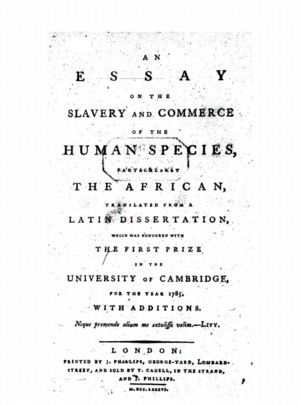
An Essay on the Slavery and Commerce of the Human Species, particularly the African, translated from a Latin Dissertation, which was Honoured with the First Prize, in the University of Cambridge, for the Year 1785, with Additions (London: J. Phillips, 1786).

About Liberty Fund:

Liberty Fund, Inc. is a private, educational foundation established to encourage the study of the ideal of a society of free and responsible individuals.


CHAP. III.

We may now deduce those general maxims concerning subordination, and liberty, which we mentioned to have been essentially connected with the subject, and which some, from speculation only, and without any allusion to facts, have been bold enough to deny.

It appears first, that liberty is a natural, and government an adventitious right, because all men were originally free.

It appears secondly, that government is a *contract; because, in these primœval subordinate societies, we have seen it voluntarily conferred on the one hand, and accepted on the other. We have seen it subject to various restrictions. We have seen its articles, which could then only be written by tradition and use, as perfect and binding as those, which are now committed to letters. We have seen it, in short, partaking of the fæderal nature, as much as it could in a state, which wanted the means of recording its transactions.

It appears, thirdly, that the grand object of the contract, is the happiness of the people; because they gave the supremacy to him alone, who had been conspicuous for the splendour of his abilities, or the integrity of his life: that the power of the multitude being directed by the wisdom and justice of the prince, they might experience the most effectual protection from injury, the highest advantages of society, the greatest possible happiness.

[* ]The author has lately read a work, intitled Paley’s Moral and Political Philosophy, which, in this one respect, favours those which have been hinted at, as it denies that government was a contract. “No social compact was ever made in fact,”—“it is to suppose it possible to call savages out of caves and deserts, to deliberate upon topicks, which the experience and studies, and the refinements of civil life alone suggest. Therefore no government in the universe begun from this original.” But there are no grounds for so absurd a supposition; for government, and of course the social compact, does not appear to have been introduced at the time, when families coming out of their caves and deserts, or, in other words, quitting their former dissociated state, joined themselves together. They had lived a considerable time in society, like the Lybians and Gætulians before-mentioned, and had felt many of the disadvantages of a want of discipline and laws, before government was introduced at all. The author of this Essay, before he took into consideration the origin of government, was determined, in a matter of such importance, to be biassed by no opinion whatever, and much less to indulge himself in speculation. He was determined solely to adhere to fact, and, by looking into the accounts left us of those governments which were in their infancy, and, of course in the least complicated state, to attempt to discover their foundation: he cannot say therefore, that upon a very minute perusal of the excellent work before quoted, he has been so far convinced, as to retract in the least from his sentiments on this head, and to give up maxims, which are drawn from historical facts, for those, which are the result of speculation. He may observe here, that whether government was a con ract or not, it will not affect the reasoning of the present Essay; since where ever the contract is afterwards mentioned, it is inferred only that its object was “the happiness of the people,” which is confessedly the end of government. Notwithstanding this, he is under the necessity of inserting this little note, though he almost feels himself ungrateful in contradicting a work, which has afforded him so much entertainment.