Econlib

The Library

Other Sites

Front Page arrow Titles (by Subject) arrow CHAP. II. - An Essay on the Slavery and Commerce of the Human Species

Return to Title Page for An Essay on the Slavery and Commerce of the Human Species

Search this Title:

Also in the Library:

Subject Area: Economics
Subject Area: Political Theory

CHAP. II. - Thomas Clarkson, An Essay on the Slavery and Commerce of the Human Species [1786]

Edition used:

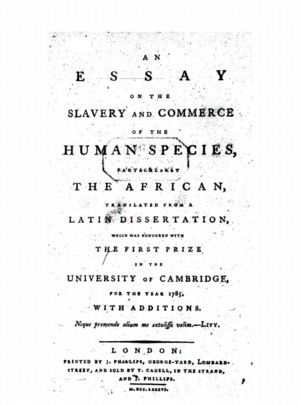
An Essay on the Slavery and Commerce of the Human Species, particularly the African, translated from a Latin Dissertation, which was Honoured with the First Prize, in the University of Cambridge, for the Year 1785, with Additions (London: J. Phillips, 1786).

About Liberty Fund:

Liberty Fund, Inc. is a private, educational foundation established to encourage the study of the ideal of a society of free and responsible individuals.


CHAP. II.

The first that will be mentioned, of the involuntary, were prisoners of war.* “It was a law, established from time immemorial among the nations of antiquity, to oblige those to undergo the severities of servitude, whom victory had thrown into their hands.” Conformably with this, we find all the Eastern nations unanimous in the practice. The same custom prevailed among the people of the West; for as the Helots became the slaves of the Spartans, from the right of conquest only, so prisoners of war were reduced to the same situation by the rest of the inhabitants of Greece. By the same principles that actuated these, were the Romans also influenced. Their History will confirm the fact: for how many cities are recorded to have been taken; how many armies to have been vanquished in the field, and the wretched survivors, in both instances, to have been doomed to servitude? It remains only now to observe, in shewing this custom to have been universal, that all those nations which assisted in overturning the Roman Empire, though many and various, adopted the same measures; for we find it a general maxim in their polity, that whoever should fall into their hands as a prisoner of war, should immediately be reduced to the condition of a slave.

It may here, perhaps, be not unworthy of remark, that the involuntary were of greater antiquity than the voluntary slaves. The latter are first mentioned in the time of Pharaoh: they could have arisen only in a state of society; when property, after its division, had become so unequal, as to multiply the wants of individuals; and when government, after its establishment, had given security to the possessor by the punishment of crimes. Whereas the former seem to be dated with more propriety from the days of Nimrod; who gave rise probably to that inseparable idea of victory and servitude, which we find among the nations of antiquity, and which has existed uniformly since, in one country or another, to the present day.*

Add to this, that they might have arisen even in a state of nature, and have been coeval with the quarrels of mankind.

[* ] “Νόμ ἐν ϖᾶσιν Ἀνθϱώπεις ἀ[Editor: illegible character]διός ἐςιν, ὅταν ϖολεμȣ́νων ϖόλις ἁλῶ, τᾶν ἑλόνων ε[Editor: illegible character][Editor: illegible character]αι ϗ̀ τὰ Σώμαα τῶν ἐν τῆ ϖόλει, ϗ̀ τὰ χϱήμαα.” Xenoph. Κυϱȣ Παιδ. L. 7. fin.

[*]

  • “Proud Nimrod first the bloody chace began,
  • A mighty hunter, and his prey was man.”
  • Pope.