EconlibThe LibraryOther Sites |
Front Page Titles (by Subject) PART II: THE ECONOMICS OF A SOCIALIST COMMUNITY - Socialism: An Economic and Sociological Analysis
Return to Title Page for Socialism: An Economic and Sociological AnalysisThe Online Library of LibertyA project of Liberty Fund, Inc.Search this Title:Also in the Library:
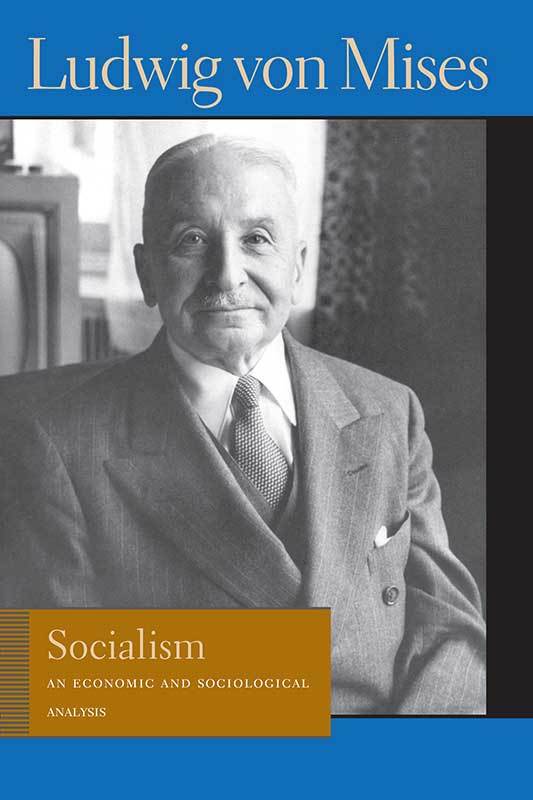
PART II: THE ECONOMICS OF A SOCIALIST COMMUNITY - Ludwig von Mises, Socialism: An Economic and Sociological Analysis [1922]Edition used:Socialism: An Economic and Sociological Analysis, trans. J. Kahane, Foreword by F.A. Hayek (Indianapolis: Liberty Fund, 1981).
About Liberty Fund:Liberty Fund, Inc. is a private, educational foundation established to encourage the study of the ideal of a society of free and responsible individuals. Copyright information:The copyright to this edition, in both print and electronic forms, is held by Liberty Fund, Inc. Fair use statement:This material is put online to further the educational goals of Liberty Fund, Inc. Unless otherwise stated in the Copyright Information section above, this material may be used freely for educational and academic purposes. It may not be used in any way for profit.
PART IITHE ECONOMICS OF A SOCIALIST COMMUNITYSection I.The Economics of an Isolated Socialist CommunityCHAPTER 5The Nature of Economic Activity1A Contribution to the Critique of the Concept “Economic Activity”Economic Science originated in discussion of the money price of goods and services. Its first beginnings are to be found in inquiries about coinage, which developed into investigations of price movements. Money, money prices, and everything concerned with calculation in terms of money—these form the problems in the discussion of which the science of Economics emerged. Those attempts at economic inquiry, which are discernible in works on household management and the organization of production—particularly agricultural—did not develop further in this direction. They became merely the starting point for various departments of technology and natural science. And this was no accident. Only through the rationalization inherent in economic calculation based on the use of money could the human mind come to understand and trace the laws of its action. The earlier economists did not ask themselves what the “economic” and “economic activity” really were. They had enough to do with the great tasks presented by the particular problems with which they were then concerned. They were not concerned with methodology. It was quite late before they began to grapple with the methods and ultimate aims of economics, and its place in the general system of knowledge. And then an obstacle was encountered which seemed to be insurmountable—the problem of defining the subject matter of economic activity. All theoretical inquiries—those of the classical economists, equally with those of the moderns—start from the economic principle. Yet, as was necessarily soon perceived, this provides no basis for clearly defining the subject matter of economics. The economic principle is a general principle of rational action, and not a specific principle of such action as forms the subject of economic inquiry.1 The economic principle directs all rational action, all action capable of becoming the subject matter of a science. It seemed absolutely unserviceable for separating the “economic” from the “non-economic,” so far as the traditional economic problems were concerned.2 But, on the other hand, it was equally impossible to divide up rational actions according to the immediate end to which they were directed, and to regard as the subject matter of economics only those actions which were directed to providing mankind with the commodities of the external world. Against such a procedure it is a decisive objection that, in the last analysis, the provision of material goods serves not only those ends which are usually termed economic, but also many other ends. Such a division of the motives of rational action involves a dual conception of action—action from economic motives, on the one side, action from non-economic motives, on the other—which is absolutely irreconcilable with the necessary unit of will and action. A theory of rational action must conceive such action as unitary. 2Rational ActionAction based on reason, action therefore which is only to be understood by reason, knows only one end, the greatest pleasure of the acting individual. The attainment of pleasure, the avoidance of pain—these are its intentions. By this, of course, we do not mean “pleasure” and “pain” in the sense in which these terms used to be used. In the terminology of the modern economist, pleasure is to be understood as embracing all those things which men hold to be desirable, all that they want and strive for. There can therefore be no longer any contrast between the “noble” ethics of duty and the vulgar hedonistic ethics. The modern concept of pleasure, happiness, utility, satisfaction and the like includes all human ends, regardless of whether the motives of action are moral or immoral, noble or ignoble, altruistic or egotistical.3 In general men act only because they are not completely satisfied. Were they always to enjoy complete happiness, they would be without will, without desire, without action. In the land of the lotus-eaters there is no action. Action arises only from need, from dissatisfaction. It is purposeful striving towards something. Its ultimate end is always to get rid of a condition which is conceived to be deficient—to fulfil a need, to achieve satisfaction, to increase happiness. If men had all the external resources of nature so abundantly at their disposal that they were able to obtain complete satisfaction by action, then they could use them heedlessly. They would only have to consider their own powers and the limited time at their disposal. For, compared with the sum of their needs, they would still have only a limited strength and a limited life-time available. They would still have to economize time and labour. But to economy of materials they would be indifferent. In fact, however, materials are also limited, so that they too have to be used in such a way that the most urgent needs are satisfied first, with the least possible expenditure of materials for each satisfaction. The spheres of rational action and economic action are therefore co-incident. All rational action is economic. All economic activity is rational action. All rational action is in the first place individual action. Only the individual thinks. Only the individual reasons. Only the individual acts. How society arises from the action of individuals will be shown in a later part of our discussion. 3Economic CalculationAll human action, so far as it is rational, appears as the exchange of one condition for another. Men apply economic goods and personal time and labour in the direction which, under the given circumstances, promises the highest degree of satisfaction, and they forgo the satisfaction of lesser needs so as to satisfy the more urgent needs. This is the essence of economic activity—the carrying out of acts of exchange.4 Every man who, in the course of economic activity, chooses between the satisfaction of two needs, only one of which can be satisfied, makes judgments of value.5 Such judgments concern firstly and directly the satisfactions themselves; it is only from these that they are reflected back upon goods. As a rule anyone in possession of his senses is able at once to evaluate goods which are ready for consumption. Under very simple conditions he should also have little difficulty in forming a judgment upon the relative significance to him of the factors of production. When, however, conditions are at all complicated, and the connection between things is harder to detect, we have to make more delicate computations if we are to evaluate such instruments. Isolated man can easily decide whether to extend his hunting or his cultivation. The processes of production he has to take into account are relatively short. The expenditure they demand and the product they afford can easily be perceived as a whole. But to choose whether we shall use a waterfall to produce electricity or extend coal-mining and better utilize the energy contained in coal, is quite another matter. Here the processes of production are so many and so long, the conditions necessary to the success of the undertaking so multitudinous, that we can never be content with vague ideas. To decide whether an undertaking is sound we must calculate carefully. But computation demands units. And there can be no unit of the subjective use-value of commodities. Marginal utility provides no unit of value. The worth of two units of a given commodity is not twice as great as one—although it is necessarily greater or smaller than one. Judgments of value do not measure: they arrange, they grade.6 If he relies only on subjective valuation, even isolated man cannot arrive at a decision based on more or less exact computations in cases where the solution is not immediately evident. To aid his calculations he must assume substitution relations between commodities. As a rule he will not be able to reduce all to a common unit. But he may succeed in reducing all elements in the computation to such commodities as he can evaluate immediately, that is to say, to goods ready for consumption and the disutility of labour and then he is able to base his decision upon this evidence. It is obvious that even this is possible only in very simple cases. For complicated and long processes of production it would be quite out of the question. In an exchange economy, the objective exchange value of commodities becomes the unit of calculation. This involves a threefold advantage. In the first place we are able to take as the basis of calculation the valuation of all individuals participating in trade. The subjective valuation of one individual is not directly comparable with the subjective valuation of others. It only becomes so as an exchange value arising from the interplay of the subjective valuations of all who take part in buying and selling. Secondly, calculations of this sort provide a control upon the appropriate use of the means of production. They enable those who desire to calculate the cost of complicated processes of production to see at once whether they are working as economically as others. If, under prevailing market prices, they cannot carry through the process at a profit, it is a clear proof that others are better able to turn to good account the instrumental goods in question. Finally, calculations based upon exchange values enable us to reduce values to a common unit. And since the higgling of the market establishes substitution relations between commodities, any commodity desired can be chosen for this purpose. In a money economy, money is the commodity chosen. Money calculations have their limits. Money is neither a yardstick of value nor of prices. Money does not measure value. Nor are prices measured in money: they are amounts of money. And, although those who describe money as a “standard of deferred payments” naively assume it to be so, as a commodity it is not stable in value. The relation between money and goods perpetually fluctuates not only on the “goods side,” but on the “money side” also. As a rule, indeed, these fluctuations are not too violent. They do not too much impair the economic calculus, because under a state of continuous change of all economic conditions, this calculus takes in view only comparatively short periods, in which “sound money” at least does not change its purchasing power to any very great extent. The deficiencies of money calculations arise for the most part, not because they are made in terms of a general medium of exchange, money, but because they are based on exchange values rather than on subjective use-values. For this reason all elements of value which are not the subject of exchange elude such computations. If, for example, we are considering whether a hydraulic power-works would be profitable we cannot include in the computation the damage which will be done to the beauty of the waterfalls unless the fall in values due to a fall in tourist traffic is taken into account. Yet we must certainly take such considerations into account when deciding whether the undertaking shall be carried out. Considerations such as these are often termed “non-economic.” And we may permit the expression for disputes about terminology gain nothing. But not all such considerations should be called irrational. The beauty of a place or of a building, the health of the race, the honour of individuals or nations, even if (because they are not dealt with on the market) they do not enter into exchange relations, are just as much motives of rational action, provided people think them significant, as those normally called economic. That they cannot enter into money calculations arises from the very nature of these calculations. But this does not in the least lessen the value of money calculations in ordinary economic matters. For all such moral goods are goods of the first order. We can value them directly; and therefore have no difficulty in taking them into account, even though they lie outside the sphere of money computations. That they elude such computations does not make it any more difficult to bear them in mind. If we know precisely how much we have to pay for beauty, health, honour, pride, and the like, nothing need hinder us from giving them due consideration. Sensitive people may be pained to have to choose between the ideal and the material. But that is not the fault of a money economy. It is in the nature of things. For even where we can make judgments of value without money computations we cannot avoid this choice. Both isolated man and socialist communities would have to do likewise, and truly sensitive natures will never find it painful. Called upon to choose between bread and honour, they will never be at a loss how to act. If honour cannot be eaten, eating can at least be forgone for honour. Only such as fear the agony of choice because they secretly know that they could not forgo the material, will regard the necessity of choice as a profanation. Money computations are only significant for purposes of economic calculation. Here they are used in order that the disposal of commodities may conform to the criterion of economy. And such calculations take account of commodities only in the proportions in which, under given conditions, they exchange for money. Every extension of the sphere of money calculation is misleading. It is misleading when in historical researches, it is employed as a measure of past commodity values. It is misleading when it is employed to evaluate the capital or national income of nations. It is misleading when it is employed to estimate the value of things which are not exchangeable as, for instance, when people attempt to estimate the loss due to emigration or war.7 All these are dilettantisms—even when they are undertaken by the most competent economists. But within these limits—and in practical life they are not overstepped—money calculation does all that we are entitled to ask of it. It provides a guide amid the bewildering throng of economic possibilities. It enables us to extend judgments of value which apply directly only to consumption goods—or at best to production goods of the lowest order—to all goods of higher orders. Without it, all production by lengthy and roundabout processes would be so many steps in the dark. Two things are necessary if computations of value in terms of money are to take place. First, not only goods ready for consumption but also goods of higher orders must be exchangeable. If this were not so, a system of exchange relationships could not emerge. It is true that if an isolated man is “exchanging” labour and flour for bread within his own house, the considerations he has to take into account are not different from those which would govern his actions if he were to exchange bread for clothes on the market. And it is, therefore, quite correct to regard all economic activity, even the economic activity of isolated man, as exchange. But no single man, be he the greatest genius ever born, has an intellect capable of deciding the relative importance of each one of an infinite number of goods of higher orders. No individual could so discriminate between the infinite number of alternative methods of production that he could make direct judgments of their relative value without auxiliary calculations. In societies based on the division of labour, the distribution of property rights effects a kind of mental division of labour, without which neither economy nor systematic production would be possible. In the second place, there must be a general medium of exchange, a money, in use. And this must serve as an intermediary in the exchange of production goods equally with the rest. If this were not so, it would be impossible to reduce all exchange relationships to a common denominator. Only under very simple conditions is it possible to dispense with money calculations. In the narrow circle of a closed household, where the father is able to supervise everything, he may be able to evaluate alterations in methods of production without having recourse to money reckoning. For, in such circumstances, production is carried on with relatively little capital. Few roundabout methods of production are employed. As a rule production is concerned with consumption goods, or goods of higher orders not too far removed from consumption goods. Division of labour is still in its earliest stages. The labourer carries through the production of a commodity from beginning to end. In an advanced society all this is changed. It is impossible to argue from the experience of primitive societies that under modern conditions we can dispense with money. In the simple conditions of a closed household, it is possible to survey the whole process of production from beginning to end. It is possible to judge whether one particular process gives more consumption goods than another. But, in the incomparably more complicated conditions of our own day, this is no longer possible. True, a socialistic society could see that 1000 litres of wine were better than 800 litres. It could decide whether or not 1000 litres of wine were to be preferred to 500 litres of oil. Such a decision would involve no calculation. The will of some man would decide. But the real business of economic administration, the adaptation of means to ends only begins when such a decision is taken. And only economic calculation makes this adaptation possible. Without such assistance, in the bewildering chaos of alternative materials and processes the human mind would be at a complete loss. Whenever we had to decide between different processes or different centres of production, we would be entirely at sea.8 To suppose that a socialist community could substitute calculations in kind for calculations in terms of money is an illusion. In a community that does not practice exchange, calculations in kind can never cover more than consumption goods. They break down completely where goods of higher order are concerned. Once society abandons free pricing of production goods rational production becomes impossible. Every step that leads away from private ownership of the means of production and the use of money is a step away from rational economic activity. It was possible to overlook all this because such Socialism as we know at first hand exists only, one might say, in socialistic oases in what, for the rest, is a system based upon free exchange and the use of money. To this extent, indeed, we may agree with the otherwise untenable socialist contention—it is only employed for propagandist purposes—that nationalized and municipalized undertakings within an otherwise capitalist system are not Socialism. For the existence of a surrounding system of free pricing supports such concerns in their business affairs to such an extent that in them the essential peculiarity of economic activity under Socialism does not come to light. In State and municipal undertakings it is still possible to carry out technical improvements, because it is possible to observe the effects of similar improvements in similar private undertakings at home and abroad. In such concerns it is still possible to ascertain the advantages of reorganization because they are surrounded by a society which is still based upon private ownership in the means of production and the use of money. It is still possible for them to keep books and make calculations which for similar concerns in a purely socialist environment would be entirely out of the question. Without calculation, economic activity is impossible. Since under Socialism economic calculation is impossible, under Socialism there can be no economic activity in our sense of the word. In small and insignificant things rational action might still persist. But, for the most part, it would no longer be possible to speak of rational production. In the absence of criteria of rationality, production could not be consciously economical. For some time possibly the accumulated tradition of thousands of years of economic freedom would preserve the art of economic administration from complete disintegration. Men would preserve the old processes, not because they were rational, but because they were sanctified by tradition. In the meantime, however, changing conditions would make them irrational. They would become uneconomical as the result of changes brought about by the general decline of economic thought. It is true that production would no longer be “anarchical.” The command of a supreme authority would govern the business of supply. Instead of the economy of “anarchical” production the senseless order of an irrational machine would be supreme. The wheels would go round, but to no effect. Let us try to imagine the position of a socialist community. There will be hundreds and thousands of establishments in which work is going on. A minority of these will produce goods ready for use. The majority will produce capital goods and semi-manufactures. All these establishments will be closely connected. Each commodity produced will pass through a whole series of such establishments before it is ready for consumption. Yet in the incessant press of all these processes the economic administration will have no real sense of direction. It will have no means of ascertaining whether a given piece of work is really necessary, whether labour and material are not being wasted in completing it. How would it discover which of two processes was the more satisfactory? At best, it could compare the quantity of ultimate products. But only rarely could it compare the expenditure incurred in their production. It would know exactly—or it would imagine it knew—what it wanted to produce. It ought therefore to set about obtaining the desired results with the smallest possible expenditure. But to do this it would have to be able to make calculations. And such calculations must be calculations of value. They could not be merely “technical,” they could not be calculations of the objective use-value of goods and services; this is so obvious that it needs no further demonstration. Under a system based upon private ownership in the means of production, the scale of values is the outcome of the actions of every independent member of society. Everyone plays a two-fold part in its establishment first as a consumer, secondly as producer. As consumer, he establishes the valuation of goods ready for consumption. As producer, he guides production-goods into those uses in which they yield the highest product. In this way all goods of higher orders also are graded in the way appropriate to them under the existing conditions of production and the demands of society. The interplay of these two processes ensures that the economic principle is observed in both consumption and production. And, in this way, arises the exactly graded system of prices which enables everyone to frame his demand on economic lines. Under Socialism, all this must necessarily be lacking. The economic administration may indeed know exactly what commodities are needed most urgently. But this is only half the problem. The other half, the valuation of the means of production, it cannot solve. It can ascertain the value of the totality of such instruments. That is obviously equal to the value of the satisfactions they afford. If it calculates the loss that would be incurred by withdrawing them, it can also ascertain the value of single instruments of production. But it cannot assimilate them to a common price denominator, as can be done under a system of economic freedom and money prices. It is not necessary that Socialism should dispense altogether with money. It is possible to conceive arrangements permitting the use of money for the exchange of consumers goods. But since the prices of the various factors of production (including labour) could not be expressed in money, money could play no part in economic calculations.9 Suppose, for instance, that the socialist commonwealth was contemplating a new railway line. Would a new railway line be a good thing? If so, which of many possible routes should it cover? Under a system of private ownership we could use money calculations to decide these questions. The new line would cheapen the transportation of certain articles, and, on this basis, we could estimate whether the reduction in transport charges would be great enough to counterweigh the expenditure which the building and running of the line would involve. Such a calculation could be made only in money. We could not do it by comparing various classes of expenditure and savings in kind. If it is out of the question to reduce to a common unit the quantities of various kinds of skilled and unskilled labour, iron, coal, building materials of different kinds, machinery and the other things which the building and upkeep of railways necessitate, then it is impossible to make them the subject of economic calculation. We can make systematic economic plans only when all the commodities which we have to take into account can be assimilated to money. True, money calculations are incomplete. True, they have profound deficiencies. But we have nothing better to put in their place. And under sound monetary conditions they suffice for practical purposes. If we abandon them, economic calculation becomes absolutely impossible. This is not to say that the socialist community would be entirely at a loss. It would decide for or against the proposed undertaking and issue an edict. But, at best, such a decision would be based on vague valuations. It could not be based on exact calculations of value. A stationary society could, indeed, dispense with these calculations. For there, economic operations merely repeat themselves. So that, if we assume that the socialist system of production were based upon the last state of the system of economic freedom which it superseded, and that no changes were to take place in the future, we could indeed conceive a rational and economic Socialism. But only in theory. A stationary economic system can never exist. Things are continually changing, and the stationary state, although necessary as an aid to speculation, is a theoretical assumption to which there is no counterpart in reality. And, quite apart from this, the maintenance of such a connection with the last state of the exchange economy would be out of the question, since the transition to Socialism with its equalization of incomes would necessarily transform the whole “set” of consumption and production. And then we have a socialist community which must cross the whole ocean of possible and imaginable economic permutations without the compass of economic calculation. All economic change, therefore, would involve operations the value of which could neither be predicted beforehand nor ascertained after they had taken place. Everything would be a leap in the dark. Socialism is the renunciation of rational economy. 4The Capitalist EconomyThe terms “Capitalism” and “Capitalistic Production” are political catchwords. They were invented by socialists, not to extend knowledge, but to carp, to criticize, to condemn. Today, they have only to be uttered to conjure up a picture of the relentless exploitation of wage-slaves by the pitiless rich. They are scarcely ever used save to imply a disease in the body-politic. From a scientific point of view, they are so obscure and ambiguous that they have no value whatever. Their users agree only in this, that they indicate the characteristics of the modern economic system. But wherein these characteristics consist is always a matter of dispute. Their use, therefore, is entirely pernicious, and the proposal to extrude them altogether from economic terminology, and to leave them to the matadors of popular agitation, deserves serious consideration.10 If, nevertheless, we do desire to discover for them a precise application, we should start from the idea of capital calculations. And since we are concerned only with the analysis of actual economic phenomena, and not with economic theory—where “capital” is often used in a sense specially extended for particular purposes—we must first ask what significance is attached to the term in business practice. There we find it used only for purposes of economic calculation. It serves to bring the original properties of a concern under one denomination, whether they consisted of money or were only expressed in money.11 The object of its computations is to enable us to ascertain how much the value of this property has altered in the course of business operations. The concept of capital is derived from economic calculation. Its true home is accountancy—the chief instrument of commercial rationality. Calculation in terms of money is an essential element of the concept of capital.12 If the term capitalism is used to designate an economic system in which production is governed by capital calculations, it acquires a special significance for defining economic activity. Understood thus, it is by no means misleading to speak of Capitalism and capitalistic methods of production, and expressions such as the capitalistic spirit and the anti-capitalistic disposition acquire a rigidly circumscribed connotation. Capitalism is better suited to be the antithesis of Socialism than Individualism, which is often used in this way. As a rule those who contrast Socialism with Individualism proceed on the tacit assumption that there is a contradiction between the interests of the individual and the interest of society, and that, while Socialism takes the public welfare as its object, individualism serves the interests of particular people. And since this is one of the gravest sociological fallacies we must avoid carefully any form of expression which might allow it secretly to creep in. According to Passow, where the term Capitalism is used correctly, the association it is intended to convey is usually bound up with the development and spread of large scale undertakings.13 We may admit this—even if it is rather difficult to reconcile with the fact that people customarily speak of “Grosskapital” and “Grosskapitalist” and then of “Kleinkapitalisten.” But, if we recollect that only capital calculation made the growth of giant enterprise and undertakings possible, this does not in any way invalidate the definitions we propose. 5The Narrower Concept of the “Economic”The common habit of economists of distinguishing between “economic” or “purely economic” and “non-economic” action is just as unsatisfactory as the old distinction between ideal and material goods. For willing and acting are unitary. All ends conflict among themselves and it is this conflict which ranges them in one scale. Not only the satisfaction of wishes, desires and impulses that can be attained through interaction with the external world, but the satisfaction also of ideal needs must be judged by one criterion. In life we have to choose between the “ideal” and the “material.” It is, therefore, just as essential to make the former subject to a unitary criterion of values as the latter. In choosing between bread and honour, faith and wealth, love and money, we submit both alternatives to one test. It is, therefore, illegitimate to regard the “economic” as a definite sphere of human action which can be sharply delimited from other spheres of action. Economic activity is rational activity. And since complete satisfaction is impossible, the sphere of economic activity is coterminous with the sphere of rational action. It consists firstly in valuation of ends, and then in the valuation of the means leading to these ends. All economic activity depends, therefore, upon the existence of ends. Ends dominate economy and alone give it meaning. Since the economic principle applies to all human action, it is necessary to be very careful when distinguishing, within its sphere, between “purely economic” and other kinds of action. Such a division is indeed indispensable for many scientifc purposes. It singles out one particular end and contrasts it with all others. This end—at this point we need not discuss whether it is ultimate or not—is the attainment of the greatest possible product measured in money. It is, therefore, impossible to assign it a specially delimited sphere of action. It is true that for each individual it has such a delimited sphere, but this varies in extent according to the general outlook of the individual concerned. It is one thing for the man to whom honour is dear. It is another for him who sells his friend for gold. Neither the nature of the end nor the peculiarity of the means is what justifies the distinction, but merely the special nature of the methods employed. Only the fact that it uses exact calculation distinguishes “purely economic” from other action. The sphere of the “purely economic” is nothing more and nothing less than the sphere of money calculation. The fact that in a certain field of action it enables us to compare means with minute exactitude down to the smallest detail means so much both for thought and action that we tend to invest this kind of action with special importance. It is easy to overlook the fact that such a distinction is only a distinction in the technique of thought and action and in no way a distinction in the ultimate end of action—which is unitary. The failure of all attempts to exhibit the “economic” as a special department of the rational and within that to discover still another sharply defined department, the “purely economic,” is no fault of the analytical apparatus employed. There can be no doubt that great subtlety of analysis has been concentrated on this problem, and the fact that it has not been solved clearly indicates that the question is one to which no satisfactory answer can be given. The sphere of the “economic” is plainly the same as the sphere of the rational: and the sphere of the “purely economic” is nothing but the sphere in which money calculation is possible. In the last resort the individual can acknowledge one end, and one end only: the attainment of the greatest satisfaction. This expression includes the satisfying of all kinds of human wants and desires, regardless of whether they are “material” or immaterial (moral). In the place of the word “satisfaction” we could employ the word “happiness,” had we not to fear the misunderstandings, for which the controversy on Hedonism and Eudaemonism was responsible. Satisfaction is subjective. Modern social philosophy has emphasized this so sharply in contrast to former theories that there is a tendency to forget that the physiological structure of mankind and the unity of outlook and emotion arising from tradition create a far-reaching similarity of views regarding wants and the means to satisfy them. It is precisely this similarity of views which makes society possible. Because they have common aims, men are able to live together. Against this fact that the majority of ends (and those the most important) are common to the great mass of mankind, the fact that some ends are only entertained by a few is of subordinate importance. The customary division between economic and non-economic motives is, therefore, invalidated by the fact that on the one hand, the end of economic activity lies outside the range of economics, and on the other, that all rational activity is economic. Nevertheless, there is good justification for separating “purely economic” activities (that is to say, activity susceptible of valuation in money) from all other forms of activity. For, as we have already seen, outside the sphere of money calculation there remain only intermediate ends which are capable of evaluation by immediate inspection: and once this sphere is left, it is necessary to have recourse to such judgments. It is the recognition of this necessity which provides the occasion for the distinction we have been discussing. If, for example, a nation desires to make war, it is illegitimate to regard the desire as necessarily irrational because the motive for making war lies outside those customarily considered as “economic”—as might be the case, e.g. with wars of religion. If the nation decides on the war with complete knowledge of all the facts because it judges that the end in view is more important than the sacrifice involved, and because it regards war as the most suitable means of obtaining it, then war cannot be regarded as irrational. It is not necessary at this point to decide whether this supposition is ever true or if it ever can be true. It is precisely this which has to be examined when one comes to choose between war and peace. And it is precisely with a view to introducing clarity into such an examination that the distinction we have been discussing has been introduced. CHAPTER 6The Organization of Production Under Socialism1The Socialization of the Means of ProductionUnder Socialism all the means of production are the property of the community. The community alone disposes of them and decides how to use them in production. The community produces, the products accrue to the community, and the community decides how those products are to be used. Modern socialists, espcially those of the Marxian persuasion, lay great emphasis on designating the socialist community as Society, and therefore on describing the transfer of the means of production to the control of the community as the “Socialization of the means of production.” In itself the expression is unobjectionable but in the connection in which it is used it is particularly designed to obscure one of the most important problems of Socialism. The word “society,” with its corresponding adjective “social,” has three separate meanings. It implies, first, the abstract idea of social interrelationships, and secondly, the concrete conception of a union of the individuals themselves. Between these two sharply different meanings, a third has been interposed in ordinary speech: the abstract society is conceived as personified in such expressions as “human society,” “civil society.” Now Marx uses the term with all these meanings. This would not matter as long as he made the distinction quite clear. But he does just the opposite. He interchanges them with a conjurer’s skill whenever it appears to suit him. When he talks of the social character of capitalistic production he is using social in its abstract sense. When he speaks of the society which suffers during crises he means the personified society of mankind. But when he speaks of the society which is to expropriate the expropriators and socialize the means of production he means an actual social union. And all the meanings are interchanged in the links of his argument whenever he has to prove the unprovable. The reason for all this is in order to avoid using the term State or its equivalent, since this word has an unpleasant sound to all those lovers of freedom and democracy, whose support the Marxian does not wish to alienate at the outset. A programme which would give the State the general responsibility and direction of all production has no prospect of acceptance in these circles. It follows that the Marxist must continually find a phraseology which disguises the essence of the programme, which succeeds in concealing the unbridgeable abyss dividing democracy and Socialism. It does not say much for the perception of men who lived in the decades immediately preceding the World War that they did not see through this sophistry. The modern doctrine of the state understands by the word “State” an authoritative unit, an apparatus of compulsion characterized not by its aims but by its form. But Marxism has arbitrarily limited the meaning of the word State, so that it does not include the Socialistic State. Only those states and forms of state organization are called the State which arouse the dislike of the socialist writers. For the future organization to which they aspire the term is rejected indignantly as dishonourable and degrading. It is called “Society.” In this way the Marxian social democracy could at one and the same time contemplate the destruction of the existing State machine, fiercely combat all anarchistic movements, and pursue a policy which led directly to an all powerful state.14 Now it does not matter in the least what particular name is given to the coercive apparatus of the socialistic community. If we use the word “State” we have a term in common use, except in the quite uncritical Marxian literature, an expression which is generally understood and which evokes the idea it is intended to evoke. But there is no disadvantage in avoiding this term if we wish, since it arouses mixed feelings in many people, and in substituting the expression “community.” The choice of terminology is purely a matter of style, and has no practical importance. What is important is the problem of the organization of this socialistic State or community. When dealing with the concrete expression of the will of the State, the English language provides a more subtle distinction by permitting us to use the term government instead of the term state. Nothing is better designed to avoid the mysticism which in this connection has been fostered by Marxian usages to the highest degree. For the Marxists talk glibly about expressing the will of society, without giving the slightest hint how ’society’ can proceed to will and act. Yet of course the community can only act through organs which it has created. Now it follows from the very conception of the socialistic community that the organ of control must be unitary. A socialist community can have only one ultimate organ of control which combines all economic and other governmental functions. Of course this organ can be subdivided and there can be subordinate offices to which definite instructions are transmitted. But the unitary expression of the common will, which is the essential object of the socialization of the means of production and of production, necessarily implies that all offices entrusted with the supervision of different affairs shall be subordinate to one office. This office must have supreme authority to resolve all variations from the common purpose and unify the executive aim. How it is constituted, and how the general will succeeds in expressing itself in and by it, is of minor importance in the investigation of our particular problem. It does not matter whether this organ is an absolute prince or an assembly of all citizens organized as a direct or indirect democracy. It does not matter how this organ conceives its will and expresses it. For our purpose we must consider this as accomplished and we need not spend any time over the question how it can be accomplished, whether it can be accomplished or whether Socialism is already doomed because it cannot be accomplished. At the outset of our inquiry we must postulate that the socialistic community is without foreign relations. It embraces the whole world and its inhabitants. If we conceive it as limited, so that it comprises only a part of the world and the inhabitants therein, we must assume that it has no economic relations with the territories and peoples outside its boundaries. We are to discuss the problem of the isolated socialistic community. The implications of the contemporaneous existence of several socialistic communities will be dealt with when we have surveyed the problem in complete generality. 2Economic Calculation in the Socialist CommunityThe theory of economic calculation shows that in the socialistic community economic calculation would be impossible. In any large undertaking the individual works or departments are partly independent in their accounts. They can reckon the cost of materials and labour, and it is possible at any time for an individual group to strike a separate balance and to sum up the results of its activity in figures. In this way it is possible to ascertain with what success each separate branch has been operated and thereby to make decisions concerning the reorganization, limitations or extension of existing branches or the establishment of new ones. Some mistakes are of course unavoidable in these calculations. They arise partly from the difficulty of allocating overhead costs. Other mistakes again arise from the necessity of calculating from insufficiently determined data, as, e.g. when in calculating the profitability of a certain process, depreciation of the machinery employed is determined by assuming a certain working life for the machine. But all such errors can be confined within certain narrow limits which do not upset the total result of the calculation. Whatever uncertainty remains is attributed to the uncertainty of future conditions inevitable in any imaginable state of affairs. It seems natural then to ask why individual branches of production in a socialistic community should not make separate accounts in the same manner. But this is impossible. Separate accounts for a single branch of one and the same undertaking are possible only when prices for all kinds of goods and services are established in the market and furnish a basis of reckoning. Where there is no market there is no price system, and where there is no price system there can be no economic calculation. Some may think that it is possible to permit exchange between the different groups of undertakings so as to establish a system of exchange relations (prices) and in this way create a basis for economic calculation in the socialistic community. Thus within a framework of a unitary economic system which does not recognize private property in the means of production, individual branches of industry with separate administration could be set up, subject of course, to the supreme economic authority, but able to transfer to each other goods and services for a consideration reckoned in a common medium of exchange. This, roughly, is how people conceive the productive organization of socialistic industry when they speak nowadays of complete socialization and the like. But here again the decisive point is evaded. Exchange relations in productive goods can only be established on the basis of private property in the means of production. If the Coal Syndicate delivers coal to the Iron Syndicate a price can be fixed only if both syndicates own the means of production in the industry. But that would not be Socialism but Syndicalism. For those socialist writers who accept the labour theory of value the problem is, of course, quite simple. “As soon,” says Engels, “as Society has taken possession of the means of production and applies them to direct social production the labour of everyone, however different its specific use may be, will immediately become direct social labour. The amount of social labour inherent in any product does not require to be ascertained in any roundabout way: everyday experience will show how much of it on the average is necessary. Society can easily reckon how many hours of labour inhere in a steam engine, in a hectolitre of wheat of the last harvest, in a hundred square metres of cloth of a certain quality. Of course society will have to find out how much work is required for the manufacture of every article of consumption. It will have to base its plans on a consideration of the means of production at its disposal—and of course the labour force falls into this category. The utility of the different objects of consumption weighed against one another and against the labour necessary for their production will finally determine the plan. The people will decide everything quite easily without the intervention of the much-vaunted value.”15 It is not part of our business here to restate the critical arguments against the labour theory of value. They interest us at this point only in so far as they enable us to judge the possibility of making labour the basis of economic calculation in a socialistic community. At first sight it would appear that calculations based on labour take into account the natural conditions of production, as well as conditions arising from the human element. The Marxian concept of the socially necessary labour time takes the law of diminishing returns into consideration in so far as it results from different natural conditions of production. If the demand for a commodity increases and less favourable natural conditions have to be exploited, then the average socially necessary time for the production of a unit also increases. If more favourable conditions of production are discovered then the necessary quantum of social labour declines.16 But this is not enough. Computation of changes in marginal labour costs only take account of natural conditions in so far as they influence labour costs. Beyond that, the “labour” calculation breaks down. It leaves, for instance, the consumption of material factors of production entirely out of account. Suppose the socially necessary labour time for producing two commodities P and Q is ten hours, and that the production of a unit both of P and of Q requires material A, one unit of which is produced by one hour of socially necessary labour, and that the production of P involves two units of A and eight hours of labour, and of Q one unit of A and nine hours of labour. In a calculation based on labour time P and Q are equivalent, but in a calculation based on value P must be worth more than Q. The former calculation is false. Only the latter corresponds to the essence and object of economic calculation. It is true that this surplus by which the value of P exceeds that of Q, this material substratum, “is furnished by nature without the help of man,”17 but provided it is present only in such quantities that it becomes an economic factor it must also in some form enter into economic calculation. The second deficiency of the labour calculation theory is that it disregards differences in the quality of labour. For Marx all human labour is economically homogeneous, because it is always the “productive expenditure of human brain, muscles, nerves, hands, etc.” “Skilled labour is only intensified, or rather multiplied simple labour, so that a small quantity of skilled labour equals a larger quantity of simple labour. Experience shows that this resolution of skilled into simple constantly happens. A commodity may be the product of highly skilled labour, but its value equates it to the product of simple labour and represents only a certain quantity of simple labour.”18 Böhm-Bawerk was justified in describing this argument as a masterpiece of astounding naivety.19 In criticizing it one may conveniently leave undecided whether one can discover a unitary physiological measure of all human labour, physical as well as “mental.” For it is certain that between men themselves there are differences of capability and skill which result in differing qualities of the goods and services produced. What is ultimately decisive for the solution of the problem of the feasibility of using labour as a basis of economic calculation is the question whether one can assimilate different kinds of work to a common denominator without a valuation of the products by the consumer. It is clear that the argument which Marx brings to bear on this point has failed. Experience does indeed show that commodities enter into exchange regardless of the question whether they are the products of skilled or simple labour. But this would only prove that a definite quantity of simple labour is equal to a definite quantity of skilled labour if it were proved that labour is the source of exchange value. But not only is this unproven; it is exactly what Marx originally set out to prove. The fact that in exchange a substitute relation between simple and skilled labour has arisen in the form of wage rates—a point to which Marx does not here allude—is not in the least a proof of this homogeneity. This process of equating is a result of the working of the market, not its presupposition. Calculations based on labour cost rather than on monetary values would have to establish a purely arbitrary relation by which to resolve skilled into simple labour, and this would make them useless as an instrument for the economic organization of resources. It was long thought that the labour theory of value provided a necessary ethical basis for the demand to socialize the means of production. We know now that this was an error. Although the majority of socialists have adopted this view and although even Marx with his professedly non-ethical standpoint could not shake it off, it is clear that, on the one hand, the political demands for the introduction of the socialistic method of production neither need nor receive support from the labour theory of value, and, on the other hand, that those who hold different views on the nature and cause of value can also have socialistic tendencies. But from another point of view, the labour theory of value is still an essential dogma for the advocates of the socialistic method of production. For socialistic production in a society based on division of labour seems practicable only if there is an objective recognizable unit of value which would enable economic calculations to be made in an exchangeless and moneyless community and labour seems the only thing to serve this purpose. 3Recent Socialist Doctrines and the Problems of Economic CalculationThe problem of economic calculation is the fundamental problem of Socialism. That for decades people could write and talk about Socialism without touching this problem only shows how devastating were the effects of the Marxian prohibition on scientific scrutiny of the nature and working of a socialist economy.20 To prove that economic calculation would be impossible in the socialist community is to prove also that Socialism is impracticable. Everything brought forward in favour of Socialism during the last hundred years, in thousands of writings and speeches, all the blood which has been spilt by the supporters of Socialism, cannot make socialism workable. The masses may long for it ever so ardently, innumerable revolutions and wars may be fought for it, still it will never be realised. Every attempt to carry it out will lead to syndicalism or, by some other route, to chaos, which will quickly dissolve the society, based upon the division of labour, into tiny autarkous groups. The discovery of this fact is clearly most inconvenient for the socialist parties, and socialists of all kinds have poured out attempts to refute my arguments and to invent a system of economic calculation for Socialism. They have not been successful. They have not produced a single new argument which I have not already taken account of.21 Nothing has shaken the proof that under Socialism economic calculation is impossible.22 The attempt of the Russian Bolsheviks to transfer Socialism from a party programme into real life has not encountered the problem of economic calculation under Socialism, for the Soviet Republics exist within a world which forms money prices for all means of production. The rulers of the Soviet Republics base the calculations on which they make their decisions on these prices. Without the help of these prices their actions would be aimless and planless. Only so far as they refer to this price system, are they able to calculate and keep books and prepare their plans. Their position is the same as the position of the state and municipal Socialism of other countries: the problem of socialist economic calculation has not yet arisen for them. State and municipal enterprises calculate with those prices of the means of production and of consumption goods which are formed on the market. Therefore it would be precipitate to conclude from the fact that municipal and state enterprises exist, that socialist economic calculation is possible. We know indeed that socialist enterprises in single branches of production are practicable only because of the help they get from their non-socialist environment. State and municipality can carry on their own enterprises because the taxes which capitalist enterprises pay, cover their losses. In a similar manner Russia, which left to herself would long ago have collapsed, has been supported by finance from capitalist countries. But incomparably more important than this material assistance, which the capitalist economy gives to socialist enterprises, is the mental assistance. Without the basis for calculation which Capitalism places at the disposal of Socialism, in the shape of market prices, socialist enterprises would never be carried on, even within single branches of production or individual countries. Socialist writers may continue to publish books about the decay of Capitalism and the coming of the socialist millennium: they may paint the evils of Capitalism in lurid colours and contrast with them an enticing picture of the blessings of a socialist society; their writings may continue to impress the thoughtless—but all this cannot alter the fate of the socialist idea.23 The attempt to reform the world socialistically might destroy civilization. It would never set up a successful socialist community. 4The Artificial Market as the Solution of the Problem of Economic CalculationSome of the younger socialists believe that the socialist community could solve the problem of economic calculation by the creation of an artificial market for the means of production. They admit that it was an error on the part of the older socialists to have sought to realize Socialism through the suspension of the market and the abolition of pricing for goods of higher orders; they hold that it was an error to have seen in the suppression of the market and of the price system the essence of the socialistic ideal. And they contend that if it is not to degenerate into a meaningless chaos in which the whole of our civilization would disappear, the socialist community equally with the capitalistic community, must create a market in which all goods and services may be priced. On the basis of such arrangements, they think, the socialist community will be able to make its calculations as easily as the capitalist entrepreneurs. Unfortunately the supporters of such proposals do not see (or perhaps will not see) that it is not possible to divorce the market and its functions in regard to the formation of prices from the working of a society which is based on private property in the means of production and in which, subject to the rules of such a society, the landlords, capitalists and entrepreneurs can dispose of their property as they think fit. For the motive force of the whole process which gives rise to market prices for the factors of production is the ceaseless search on the part of the capitalists and the entrepreneurs to maximize their profits by serving the consumers’ wishes. Without the striving of the entrepreneurs (including the shareholders) for profit, of the landlords for rent, of the capitalists for interest and the labourers for wages, the successful functioning of the whole mechanism is not to be thought of. It is only the prospect of profit which directs production into those channels in which the demands of the consumer are best satisfied at least cost. If the prospect of profit disappears the mechanism of the market loses its mainspring, for it is only this prospect which sets it in motion and maintains it in operation. The market is thus the focal point of the capitalist order of society; it is the essence of Capitalism. Only under Capitalism, therefore, is it possible; it cannot be “artificially” imitated under Socialism. The advocates of the artificial market, however, are of the opinion that an artificial market can be created by instructing the controllers of the different industrial units to act as if they were entrepreneurs in a capitalistic state. They argue that even under Capitalism the managers of joint stock companies work not for themselves but for the companies, that is to say, for the shareholders. Under Socialism, therefore, it would be possible for them to act in exactly the same way as before, with the same circumspection and devotion to duty. The only difference would be that under socialism the product of the manager’s labours would go to the community rather than to the shareholders. In such a way, in contrast to all socialists who have written on the subject hitherto, especially the Marxians, they think it would be possible to construct a decentralized, as opposed to a centralized, Socialism. In order to judge properly such proposals, it is necessary in the first place to realize that these controllers of individual industrial units would have to be appointed. Under Capitalism the managers of the joint stock companies are appointed either directly or indirectly by the shareholders. In so far as the shareholders give to the managers power to produce by the means of the company’s (i.e. the shareholders’) stock they are risking their own property or a part of their own property. The speculation (for it is necessarily a speculation) may succeed and bring profit; it may, however, misfire and bring about the loss of the whole or a part of the capital concerned. This committing of one’s own capital to a business whose outcome is uncertain and to men whose future ability is still a matter of conjecture whatever one may know of their past, is the essence of joint stock company enterprise. Now it is a complete fallacy to suppose that the problem of economic calculation in a socialist community relates solely to matters which fall into the sphere of the daily business routine of managers of joint stock companies. It is clear that such a belief can only arise from exclusive concentration on the idea of a stationary economic system—a conception which no doubt is useful for the solution of many theoretical problems but which has no counterpart in fact and which, if exclusively regarded, can even be positively misleading. It is clear that under stationary conditions the problem of economic calculation does not really arise. When we think of the stationary society, we think of an economy in which all the factors of production are already used in such a way as, under the given conditions, to provide the maximum of the things which are demanded by consumers. That is to say, under stationary conditions there no longer exists a problem for economic calculation to solve. The essential function of economic calculation has by hypothesis already been performed. There is no need for an apparatus of calculation. To use a popular but not altogether satisfactory terminology we can say that the problem of economic calculation is of economic dynamics: it is no problem of economic statics. The problem of economic calculation is a problem which arises in an economy which is perpetually subject to change, an economy which every day is confronted with new problems which have to be solved. Now in order to solve such problems it is above all necessary that capital should be withdrawn from particular lines of production, from particular undertakings and concerns and should be applied in other lines of production, in other undertakings and concerns. This is not a matter for the managers of joint stock companies, it is essentially a matter for the capitalists—the capitalists who buy and sell stocks and shares, who make loans and recover them, who make deposits in the banks and draw them out of the banks again, who speculate in all kinds of commodities. It is these operations of speculative capitalists which create those conditions of the money market, the stock exchanges and the wholesale markets which have to be taken for granted by the manager of the joint stock company, who, according to the socialist writers we are considering, is to be conceived as nothing but the reliable and conscientious servant of the company. It is the speculative capitalists who create the data to which he has to adjust his business and which therefore gives direction to his trading operations. It follows therefore that it is a fundamental deficiency of all these socialistic constructions which invoke the “artificial market” and artificial competition as a way out of the problem of economic calculation, that they rest on the belief that the market for factors of production is affected only by producers buying and selling commodities. It is not possible to eliminate from such markets the influence of the supply of capital from the capitalists and the demand for capital by the entrepreneurs, without destroying the mechanism itself. Faced with this difficulty, the socialist is likely to propose that the socialist state as owner of all capital and all means of production should simply direct capital to those undertakings which promise the highest return. The available capital, he will contend, should go to those undertakings which offer the highest rate of profit. But such a state of affairs would simply mean that those managers who were less cautious and more optimistic would receive capital to enlarge their undertakings while more cautious and more skeptical managers would go away empty-handed. Under Capitalism, the capitalist decides to whom he will entrust his own capital. The beliefs of the managers of joint stock companies regarding the future prospects |

Titles (by Subject)