EconlibThe LibraryOther Sites |
Front Page Titles (by Subject) ANSELM'S MONOLOGIUM ON THE BEING OF GOD. - Proslogium; Monologium; An Appendix in Behalf of the Fool by Gaunilon; and Cur Deus Homo
Return to Title Page for Proslogium; Monologium; An Appendix in Behalf of the Fool by Gaunilon; and Cur Deus HomoThe Online Library of LibertyA project of Liberty Fund, Inc.Search this Title:Also in the Library:
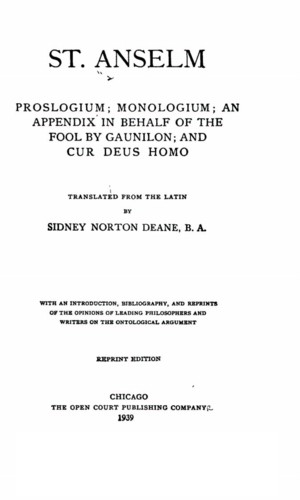
ANSELM’S MONOLOGIUM ON THE BEING OF GOD. - Saint Anselm, Proslogium; Monologium; An Appendix in Behalf of the Fool by Gaunilon; and Cur Deus Homo [1903]Edition used:Proslogium; Monologium; An Appendix in Behalf of the Fool by Gaunilon; and Cur Deus Homo, translated from the latin by Sidney Norton Deane (Chicago: Open Court, 1903).
About Liberty Fund:Liberty Fund, Inc. is a private, educational foundation established to encourage the study of the ideal of a society of free and responsible individuals. Copyright information:The text is in the public domain. Fair use statement:This material is put online to further the educational goals of Liberty Fund, Inc. Unless otherwise stated in the Copyright Information section above, this material may be used freely for educational and academic purposes. It may not be used in any way for profit.
ANSELM’S MONOLOGIUM
PREFACE.In this book Anselm discusses, under the form of a meditation, the Being of God, basing his argument not on the authority of Scripture, but on the force of reason. It contains nothing that is inconsistent with the writings of the Holy Fathers, and especially nothing that is inconsistent with those of St Augustine.—The Greek terminology is employed in Chapter LXXVIII., where it is stated that the Trinity may be said to consist of three substances, that is, three persons. Certain brethren have often and earnestly entreated me to put in writing some thoughts that I had offered them in familiar conversation, regarding meditation on the Being of God, and on some other topics connected with this subject, under the form of a meditation on these themes. It is in accordance with their wish, rather than with my ability, that they have prescribed such a form for the writing of this meditation; in order that nothing in Scripture should be urged on the authority of Scripture itself, but that whatever the conclusion of independent investigation should declare to be true, should, in an unadorned style, with common proofs and with a simple argument, be briefly enforced by the cogency of reason, and plainly expounded in the light of truth. It was their wish also, that I should not disdain to meet such simple and almost foolish objections as occur to me. This task I have long refused to undertake. And, reflecting on the matter, I have tried on many grounds to excuse myself; for the more they wanted this work to be adaptable to practical use, the more was what they enjoined on me difficult of execution Overcome at last, however, both by the modest importunity of their entreaties and by the not contemptible sincerity of their zeal; and reluctant as I was because of the difficulty of my task and the weakness of my talent, I entered upon the work they asked for. But it is with pleasure inspired by their affection that, so far as I was able, I have prosecuted this work within the limits they set. I was led to this undertaking in the hope that whatever I might accomplish would soon be overwhelmed with contempt, as by men disgusted with some worthless thing. For I know that in this book I have not so much satisfied those who entreated me, as put an end to the entreaties that followed me so urgently. Yet, somehow it fell out, contrary to my hope, that not only the brethren mentioned above, but several others, by making copies for their own use, condemned this writing to long remembrance. And, after frequent consideration, I have not been able to find that I have made in it any statement which is inconsistent with the writings of the Catholic Fathers, or especially with those of St. Augustine. Wherefore, if it shall appear to any man that I have offered in this work any thought that is either too novel or discordant with the truth, I ask him not to denounce me at once as one who boldly seizes upon new ideas, or as a maintainer of falsehood; but let him first read diligently Augustine’s books on the Trinity, and then judge my treatise in the light of those. In stating that the supreme Trinity may be said to consist of three substances, I have followed the Greeks, who acknowledge three substances in one Essence, in the same faith wherein we acknowledge three persons in one Substance. For they designate by the word substance that attribute of God which we designate by the word person. Whatever I have said on that point, however, is put in the mouth of one debating and investigating in solitary reflection, questions to which he had given no attention before. And this method I knew to be in accordance with the wish of those whose request I was striving to fulfil. But it is my prayer and earnest entreaty, that if any shall wish to copy this work, he shall be careful to place this preface at the beginning of the book, before the body of the meditation itself. For I believe that one will be much helped in understanding the matter of this book, if he has taken note of the intention, and the method according to which it is discussed. It is my opinion, too, that one who has first seen this preface will not pronounce a rash judgment, if he shall find offered here any thought that is contrary to his own belief. CHAPTER I.There is a being which is best, and greatest, and highest of all existing beings. If any man, either from ignorance or unbelief, has no knowledge of the existence of one Nature which is the highest of all existing beings, which is also sufficient to itself in its eternal blessedness, and which confers upon and effects in all other beings, through its omnipotent goodness, the very fact of their existence, and the fact that in any way their existence is good; and if he has no knowledge of many other things, which we necessarily believe regarding God and his creatures, he still believes that he can at least convince himself of these truths in great part, even if his mental powers are very ordinary, by the force of reason alone. And, although he could do this in many ways, I shall adopt one which I consider easiest for such a man. For, since all desire to enjoy only those things which they suppose to be good, it is natural that this man should, at some time, turn his mind’s eye to the examination of that cause by which these things are good, which he does not desire, except as he judges them to be good. So that, as reason leads the way and follows up these considerations, he advances rationally to those truths of which, without reason, he has no knowledge. And if, in this discussion, I use any argument which no greater authority adduces, I wish it to be received in this way: although, on the grounds that I shall see fit to adopt, the conclusion is reached as if necessarily, yet it is not, for this reason, said to be absolutely necessary, but merely that it can appear so for the time being. It is easy, then, for one to say to himself: Since there are goods so innumerable, whose great diversity we experience by the bodily senses, and discern by our mental faculties, must we not believe that there is some one thing, through which all goods whatever are good? Or are they good, one through one thing, and another through another? To be sure, it is most certain and clear, for all who are willing to see, that whatsoever things are said to possess any attribute in such a way that in mutual comparison they may be said to possess it in greater, or less, or equal degree, are said to possess it by virtue of some fact, which is not understood to be one thing in one case and another in another, but to be the same in different cases, whether it is regarded as existing in these cases in equal or unequal degree. For, whatsoever things are said to be just, when compared one with another, whether equally, or more, or less, cannot be understood as just, except through the quality of justness, which is not one thing in one instance, and another in another. Since it is certain, then, that all goods, if mutually compared, would prove either equally or unequally good, necessarily they are all good by virtue of something which is conceived of as the same in different goods, although sometimes they seem to be called good, the one by virtue of one thing, the other by virtue of another. For, apparently it is by virtue of one quality, that a horse is called good, because he is strong, and by virtue of another, that he is called good, because he is swift. For, though he seems to be called good by virtue of his strength, and good by virtue of his swiftness, yet swiftness and strength do not appear to be the same thing. But if a horse, because he is strong and swift, is therefore good, how is it that a strong, swift robber is bad? Rather, then, just as a strong, swift robber is bad, because he is harmful, so a strong, swift horse is good, because he is useful. And, indeed, nothing is ordinarily regarded as good, except either for some utility—as, for instance, safety is called good, and those things which promote safety—or for some honorable character—as, for instance, beauty is reckoned to be good, and what promotes beauty. But, since the reasoning which we have observed is in no wise refutable, necessarily, again, all things, whether useful or honorable, if they are truly good, are good through that same being through which all goods exist, whatever that being is. But who can doubt this very being, through which all goods exist, to be a great good? This must be, then, a good through itself, since every other good is through it. It follows, therefore, that all other goods are good through another being than that which they themselves are, and this being alone is good through itself Hence, this alone is supremely good, which is alone good through itself. For it is supreme, in that it so surpasses other beings, that it is neither equalled nor excelled. But that which is supremely good is also supremely great. There is, therefore, some one being which is supremely good, and supremely great, that is, the highest of all existing beings. CHAPTER IIThe same subject continued. But, just as it has been proved that there is a being that is supremely good, since all goods are good through a single being, which is good through itself; so it is necessarily inferred that there is something supremely great, which is great through itself. But I do not mean physically great, as a material object is great, but that which, the greater it is, is the better or the more worthy,—wisdom, for instance. And since there can be nothing supremely great except what is supremely good, there must be a being that is greatest and best, i. e., the highest of all existing beings. CHAPTER IIIThere is a certain Nature through which whatever is exists, and which exists through itself, and is the highest of all existing beings Therefore, not only are all good things such through something that is one and the same, and all great things such through something that is one and the same; but whatever is, apparently exists through something that is one and the same. For, everything that is, exists either through something, or through nothing. But nothing exists through nothing. For it is altogether inconceivable that anything should not exist by virtue of something. Whatever is, then, does not exist except through something. Since this is true, either there is one being, or there are more than one, through which all things that are exist. But if there are more than one, either these are themselves to be referred to some one being, through which they exist, or they exist separately, each through itself, or they exist mutually through one another. But, if these beings exist through one being, then all things do not exist through more than one, but rather through that one being through which these exist. If, however, these exist separately, each through itself, there is, at any rate, some power or property of existing through self (existendi per se), by which they are able to exist each through itself. But, there can be no doubt that, in that case, they exist through this very power, which is one, and through which they are able to exist, each through itself. More truly, then, do all things exist through this very being, which is one, than through these, which are more than one, which, without this one, cannot exist. But that these beings exist mutually through one another, no reason can admit; since it is an irrational conception that anything should exist through a being on which it confers existence. For not even beings of a relative nature exist thus mutually, the one through the other. For, though the terms master and servant are used with mutual reference, and the men thus designated are mentioned as having mutual relations, yet they do not at all exist mutually, the one through the other, since these relations exist through the subjects to which they are referred. Therefore, since truth altogether excludes the supposition that there are more beings than one, through which all things exist, that being, through which all exist, must be one. Since, then, all things that are exist through this one being, doubtless this one being exists through itself. Whatever things there are else, then, exist through something other than themselves, and this alone through itself. But whatever exists through another is less than that, through which all things are, and which alone exists through itself. Therefore, that which exists through itself exists in the greatest degree of all things. There is, then, some one being which alone exists in the greatest and the highest degree of all. But that which is greatest of all, and through which exists whatever is good or great, and, in short, whatever has any existence—that must be supremely good, and supremely great, and the highest of all existing beings. CHAPTER IVThe same subject continued. Furthermore, if one observes the nature of things he perceives, whether he will or no, that not all are embraced in a single degree of dignity; but that certain among them are distinguished by inequality of degree. For, he who doubts that the horse is superior in its nature to wood, and man more excellent than the horse, assuredly does not deserve the name of man. Therefore, although it cannot be denied that some natures are superior to others, nevertheless reason convinces us that some nature is so preëminent among these, that it has no superior. For, if the distinction of degrees is infinite, so that there is among them no degree, than which no higher can be found, our course of reasoning reaches this conclusion: that the multitude of natures themselves is not limited by any bounds. But only an absurdly foolish man can fail to regard such a conclusion as absurdly foolish. There is, then, necessarily some nature which is so superior to some nature or natures, that there is none in comparison with which it is ranked as inferior. Now, this nature which is such, either is single, or there are more natures than one of this sort, and they are of equal degree. But, if they are more than one and equal, since they cannot be equal through any diverse causes, but only through some cause which is one and the same, that one cause, through which they are equally so great, either is itself what they are, that is, the very essence of these natures; or else it is another than what they are. But if it is nothing else than their very essence itself, just as they have not more than one essence, but a single essence, so they have not more than one nature, but a single nature. For I here understand nature as identical with essence. If, however, that through which these natures are so great is another than that which they are, then, certainly, they are less than that through which they are so great. For, whatever is great through something else is less than that through which it is great. Therefore, they are not so great that there is nothing else greater than they. But if, neither through what they are nor through anything other than themselves, can there be more such natures than one, than which nothing else shall be more excellent, then in no wise can there be more than one nature of this kind. We conclude, then, that there is some nature which is one and single, and which is so superior to others that it is inferior to none. But that which is such is the greatest and best of all existing beings. Hence, there is a certain nature which is the highest of all existing beings. This, however, it cannot be, unless it is what it is through itself, and all existing beings are what they are through it. For since, as our reasoning showed us not long since, that which exists through itself, and through which all other things exist, is the highest of all existing beings; either conversely, that which is the highest exists through itself, and all others through it; or, there will be more than one supreme being. But it is manifest that there cannot be more than one supreme being. There is, therefore, a certain Nature, or Substance, or Essence, which is through itself good and great, and through itself is what it is; and through which exists whatever is truly good, or great, or has any existence at all; and which is the supreme good being, the supreme great being, being or subsisting as supreme, that is, the highest of all existing beings. CHAPTER V.Just as this Nature exists through itself, and other beings through it, so it derives existence from itself, and other beings from it. Seeing, then, that the truth already discovered has been satisfactorily demonstrated, it is profitable to examine whether this Nature, and all things that have any existence, derive existence from no other source than it, just as they do not exist except through it. But it is clear that one may say, that what derives existence from something exists through the same thing; and what exists through something also derives existence from it. For instance, what derives existence from matter, and exists through the artificer, may also be said to exist through matter, and to derive existence from the artificer, since it exists through both, and derives existence from both. That is, it is endowed with existence by both, although it exists through matter and from the artificer in another sense than that in which it exists through, and from, the artificer. It follows, then, that just as all existing beings are what they are, through the supreme Nature, and as that Nature exists through itself, but other beings through another than themselves, so all existing beings derive existence from this supreme Nature. And therefore, this Nature derives existence from itself, but other beings from it CHAPTER VIThis Nature was not brought into existence with the help of any external cause, yet it does not exist through nothing, or derive existence from nothing —How existence through self, and derived from self, is conceivable Since the same meaning is not always attached to the phrase, “existence through” something, or, to the phrase, “existence derived from” something, very diligent inquiry must be made, in what way all existing beings exist through the supreme Nature, or derive existence from it. For, what exists through itself, and what exists through another, do not admit the same ground of existence. Let us first consider, separately, this supreme Nature, which exists through self; then these beings which exist through another. Since it is evident, then, that this Nature is whatever it is, through itself, and all other beings are what they are, through it, how does it exist through itself? For, what is said to exist through anything apparently exists through an efficient agent, or through matter, or through some other external aid, as through some instrument. But, whatever exists in any of these three ways exists through another than itself, and it is of later existence, and, in some sort, less than that through which it obtains existence. But, in no wise does the supreme Nature exist through another, nor is it later or less than itself or anything else. Therefore, the supreme Nature could be created neither by itself, nor by another; nor could itself or any other be the matter whence it should be created; nor did it assist itself in any way; nor did anything assist it to be what it was not before. What is to be inferred? For that which cannot have come into existence by any creative agent, or from any matter, or with any external aids, seems either to be nothing, or, if it has any existence, to exist through nothing, and derive existence from nothing. And although, in accordance with the observations I have already made, in the light of reason, regarding the supreme Substance, I should think such propositions could in no wise be true in the case of the supreme Substance; yet, I would not neglect to give a connected demonstration of this matter. For, seeing that this my meditation has suddenly brought me to an important and interesting point, I am unwilling to pass over carelessly even any simple or almost foolish objection that occurs to me, in my argument; in order that by leaving no ambiguity in my discussion up to this point, I may have the better assured strength to advance toward what follows; and in order that if, perchance, I shall wish to convince any one of the truth of my speculations, even one of the slower minds, through the removal of every obstacle, however slight, may acquiesce in what it finds here. That this Nature, then, without which no nature exists, is nothing, is as false as it would be absurd to say that whatever is is nothing. And, moreover, it does not exist through nothing, because it is utterly inconceivable that what is something should exist through nothing. But, if in any way it derives existence from nothing, it does so through itself, or through another, or through nothing. But it is evident that in no wise does anything exist through nothing. If, then, in any way it derives existence from nothing, it does so either through itself or through another. But nothing can, through itself, derive existence from nothing, because if anything derives existence from nothing, through something, then that through which it exists must exist before it. Seeing that this Being, then, does not exist before itself, by no means does it derive existence from itself. But if it is supposed to have derived existence from some other nature, then it is not the supreme Nature, but some inferior one, nor is it what it is through itself, but through another. Again: if this Nature derives existence from nothing, through something, that through which it exists was a great good, since it was the cause of good. But no good can be understood as existing before that good, without which nothing is good; and it is sufficiently clear that this good, without which there is no good, is the supreme Nature which is under discussion. Therefore, it is not even conceivable that this Nature was preceded by any being, through which it derived existence from nothing. Hence, if it has any existence through nothing, or derives existence from nothing, there is no doubt that either, whatever it is, it does not exist through itself, or derive existence from itself, or else it is itself nothing. It is unnecessary to show that both these suppositions are false. The supreme Substance, then, does not exist through any efficient agent, and does not derive existence from any matter, and was not aided in being brought into existence by any external causes. Nevertheless, it by no means exists through nothing, or derives existence from nothing; since, through itself and from itself, it is whatever it is. Finally, as to how it should be understood to exist through itself, and to derive existence from itself: it did not create itself, nor did it spring up as its own matter, nor did it in any way assist itself to become what it was not before, unless, haply, it seems best to conceive of this subject in the way in which one says that the light lights or is lucent, through and from itself. For, as are the mutual relations of the light and to light and lucent (lux, lucere, lucens), such are the relations of essence, and to be and being, that is, existing or subsisting. So the supreme Being, and to be in the highest degree, and being in the highest degree, bear much the same relations, one to another, as the light and to light and lucent. CHAPTER VII.In what way all other beings exist through this Nature and derive existence from it. There now remains the discussion of that whole class of beings that exist through another, as to how they exist through the supreme Substance, whether because this Substance created them all, or because it was the material of all. For, there is no need to inquire whether all exist through it, for this reason, namely, that there being another creative agent, or another existing material, this supreme Substance has merely aided in bringing about the existence of all things: since it is inconsistent with what has already been shown, that whatever things are should exist secondarily, and not primarily, through it. First, then, it seems to me, we ought to inquire whether that whole class of beings which exist through another derive existence from any material. But I do not doubt that all this solid world, with its parts, just as we see, consists of earth, water, fire, and air. These four elements, of course, can be conceived of without these forms which we see in actual objects, so that their formless, or even confused, nature appears to be the material of all bodies, distinguished by their own forms.—I say that I do not doubt this. But I ask, whence this very material that I have mentioned, the material of the mundane mass, derives its existence. For, if there is some material of this material, then that is more truly the material of the physical universe. If, then, the universe of things, whether visible or invisible, derives existence from any material, certainly it not only cannot be, but it cannot even be supposed to be, from any other material than from the supreme Nature or from itself, or from some third being—but this last, at any rate, does not exist. For, indeed, nothing is even conceivable except that highest of all beings, which exists through itself, and the universe of beings which exist, not through themselves, but through this supreme Being. Hence, that which has no existence at all is not the material of anything. From its own nature the universe cannot derive existence, since, if this were the case, it would in some sort exist through itself and so through another than that through which all things exist. But all these suppositions are false. Again, everything that derives existence from material derives existence from another, and exists later than that other. Therefore, since nothing is other than itself, or later than itself, it follows that nothing derives material existence from itself. But if, from the material of the supreme Nature itself, any lesser being can derive existence, the supreme good is subject to change and corruption. But this it is impious to suppose. Hence, since everything that is other than this supreme Nature is less than it, it is impossible that anything other than it in this way derives existence from it. Furthermore: doubtless that is in no wise good, through which the supreme good is subjected to change or corruption. But, if any lesser nature derives existence from the material of the supreme good, inasmuch as nothing exists whencesoever, except through the supreme Being, the supreme good is subjected to change and corruption through the supreme Being itself. Hence, the supreme Being, which is itself the supreme good, is by no means good; which is a contradiction. There is, therefore, no lesser nature which derives existence in a material way from the supreme Nature. Since, then, it is evident that the essence of those things which exist through another does not derive existence as if materially, from the supreme Essence, nor from itself, nor from another, it is manifest that it derives existence from no material. Hence, seeing that whatever is exists through the supreme Being, nor can aught else exist through this Being, except by its creation, or by its existence as material, it follows, necessarily, that nothing besides it exists, except by its creation. And, since nothing else is or has been, except that supreme Being and the beings created by it, it could create nothing at all through any other instrument or aid than itself. But all that it has created, it has doubtless created either from something, as from material, or from nothing. Since, then, it is most patent that the essence of all beings, except the supreme Essence, was created by that supreme Essence, and derives existence from no material, doubtless nothing can be more clear than that this supreme Essence nevertheless produced from nothing, alone and through itself, the world of material things, so numerous a multitude, formed in such beauty, varied in such order, so fitly diversified. CHAPTER VIIIHow it is to be understood that this Nature created all things from nothing. But we are confronted with a doubt regarding this term nothing. For, from whatever source anything is created, that source is the cause of what is created from it, and, necessarily, every cause affords some assistance to the being of what it effects. This is so firmly believed, as a result of experience, by every one, that the belief can be wrested from no one by argument, and can scarcely be purloined by sophistry. Accordingly, if anything was created from nothing, this very nothing was the cause of what was created from it. But how could that which had no existence assist anything in coming into existence? If, however, no aid to the existence of anything ever had its source in nothing, who can be convinced, and how, that anything is created out of nothing? Moreover, nothing either means something, or does not mean something. But if nothing is something, whatever has been created from nothing has been created from something. If, however, nothing is not something; since it is inconceivable that anything should be created from what does not exist, nothing is created from nothing; just as all agree that nothing comes from nothing. Whence, it evidently follows, that whatever is created is created from something; for it is created either from something or from nothing. Whether, then, nothing is something, or nothing is not something, it apparently follows, that whatever has been created was created from something. But, if this is posited as a truth, then it is so posited in opposition to the whole argument propounded in the preceding chapter. Hence, since what was nothing will thus be something, that which was something in the highest degree will be nothing. For, from the discovery of a certain Substance existing in the greatest degree of all existing beings, my reasoning had brought me to this conclusion, that all other beings were so created by this Substance, that that from which they were created was nothing. Hence, if that from which they were created, which I supposed to be nothing, is something, whatever I supposed to have been ascertained regarding the supreme Being, is nothing. What, then, is to be our understanding of the term nothing?—For I have already determined not to neglect in this meditation any possible objection, even if it be almost foolish.—In three ways, then—and this suffices for the removal of the present obstacle—can the statement that any substance was created from nothing be explained. There is one way, according to which we wish it to be understood, that what is said to have been created from nothing has not been created at all; just as, to one who asks regarding a dumb man, of what he speaks, the answer is given, “of nothing,” that is, he does not speak at all. According to this interpretation, to one who enquires regarding the supreme Being, or regarding what never has existed and does not exist at all, as to whence it was created, the answer, “from nothing” may properly be given; that is, it never was created. But this answer is unintelligible in the case of any of those things that actually were created. There is another interpretation which is, indeed, capable of supposition, but cannot be true; namely, that if anything is said to have been created from nothing, it was created from nothing itself (de nihilo ipso), that is, from what does not exist at all, as if this very nothing were some existent being, from which something could be created. But, since this is always false, as often as it is assumed an irreconcilable contradiction follows. There is a third interpretation, according to which a thing is said to have been created from nothing, when we understand that it was indeed created, but that there is not anything whence it was created. Apparently it is said with a like meaning, when a man is afflicted without cause, that he is afflicted “over nothing.” If, then, the conclusion reached in the preceding chapter is understood in this sense, that with the exception of the supreme Being all things have been created by that Being from nothing, that is, not from anything; just as this conclusion consistently follows the preceding arguments, so, from it, nothing inconsistent is inferred; although it may be said, without inconsistency or any contradiction, that what has been created by the creative Substance was created from nothing, in the way that one frequently says a rich man has been made from a poor man, or that one has recovered health from sickness; that is, he who was poor before, is rich now, as he was not before; and he who was ill before, is well now, as he was not before. In this way, then, we can understand, without inconsistency, the statement that the creative Being created all things from nothing, or that all were created through it from nothing; that is, those things which before were nothing, are now something. For, indeed, from the very word that we use, saying that it created them or that they were created, we understand that when this Being created them, it created something, and that when they were created, they were created only as something. For so, beholding a man of very lowly fortunes exalted with many riches and honors by some one, we say, “Lo, he has made that man out of nothing”; that is, the man who was before reputed as nothing is now, by virtue of that other’s making, truly reckoned as something. CHAPTER IX.Those things which were created from nothing had an existence before their creation in the thought of the Creator. But I seem to see a truth that compels me to distinguish carefully in what sense those things which were created may be said to have been nothing before their creation. For, in no wise can anything conceivably be created by any, unless there is, in the mind of the creative agent, some example, as it were, or (as is more fittingly supposed) some model, or likeness, or rule. It is evident, then, that before the world was created, it was in the thought of the supreme Nature, what, and of what sort, and how, it should be. Hence, although it is clear that the beings that were created were nothing before their creation, to this extent, that they were not what they now are, nor was there anything whence they should be created, yet they were not nothing, so far as the creator’s thought is concerned, through which, and according to which, they were created. CHAPTER XThis thought is a kind of expression of the objects created (locutio rerum), like the expression which an artisan forms in his mind for what he intends to make. But this model of things, which preceded their creation in the thought of the creator, what else is it than a kind of expression of these things in his thought itself; just as when an artisan is about to make something after the manner of his craft, he first expresses it to himself through a concept? But by the expression of the mind or reason I mean, here, not the conception of words signifying the objects, but the general view in the mind, by the vision of conception, of the objects themselves, whether destined to be, or already existing. For, from frequent usage, it is recognised that we can express the same object in three ways. For we express objects either by the sensible use of sensible signs, that is, signs which are perceptible to the bodily senses; or by thinking within ourselves insensibly of these signs which, when outwardly used, are sensible; or not by employing these signs, either sensibly or insensibly, but by expressing the things themselves inwardly in our mind, whether by the power of imagining material bodies or of understanding thought, according to the diversity of these objects themselves. For I express a man in one way, when I signify him by pronouncing these words, a man; in another, when I think of the same words in silence; and in another, when the mind regards the man himself, either through the image of his body, or through the reason; through the image of his body, when the mind imagines his visible form; through the reason, however, when it thinks of his universal essence, which is a rational, mortal animal. Now, the first two kinds of expression are in the language of one’s race. But the words of that kind of expression, which I have put third and last, when they concern objects well known, are natural, and are the same among all nations. And, since all other words owe their invention to these, where these are, no other word is necessary for the recognition of an object, and where they cannot be, no other word is of any use for the description of an object. For, without absurdity, they may also be said to be the truer, the more like they are to the objects to which they correspond, and the more expressively they signify these objects. For, with the exception of those objects, which we employ as their own names, in order to signify them, like certain sounds, the vowel a for instance—with the exception of these, I say, no other word appears so similar to the object to which it is applied, or expresses it as does that likeness which is expressed by the vision of the mind thinking of the object itself. This last, then, should be called the especially proper and primary word, corresponding to the thing. Hence, if no expression of any object whatever so nearly approaches the object as that expression which consists of this sort of words, nor can there be in the thought of any another word so like the object, whether destined to be, or already existing, not without reason it may be thought that such an expression of objects existed with (apud) the supreme Substance before their creation, that they might be created; and exists, now that they have been created, that they may be known through it. CHAPTER XI.The analogy, however, between the expression of the Creator and the expression of the artisan is very incomplete. But, though it is most certain that the supreme Substance expressed, as it were, within itself the whole created world, which it established according to, and through, this same most profound expression, just as an artisan first conceives in his mind what he afterwards actually executes in accordance with his mental concept, yet I see that this analogy is very incomplete. For the supreme Substance took absolutely nothing from any other source, whence it might either frame a model in itself, or make its creatures what they are; while the artisan is wholly unable to conceive in his imagination any bodily thing, except what he has in some way learned from external objects, whether all at once, or part by part; nor can he perform the work mentally conceived, if there is a lack of material, or of anything without which a work premeditated cannot be performed. For, though a man can, by meditation or representation, frame the idea of some sort of animal, such as has no existence; yet, by no means has he the power to do this, except by uniting in this idea the parts that he has gathered in his memory from objects known externally. Hence, in this respect, these inner expressions of the works they are to create differ in the creative substance and in the artisan: that the former expression, without being taken or aided from any external source, but as first and sole cause, could suffice the Artificer for the performance of his work, while the latter is neither first, nor sole, nor sufficient, cause for the inception of the artisan’s work. Therefore, whatever has been created through the former expression is only what it is through that expression, while whatever has been created through the latter would not exist at all, unless it were something that it is not through this expression itself. CHAPTER XII.This expression of the supreme Being is the supreme Being. But since, as our reasoning shows, it is equally certain that whatever the supreme Substance created, it created through nothing other than itself; and whatever it created, it created through its own most intimate expression, whether separately, by the utterance of separate words, or all at once, by the utterance of one word; what conclusion can be more evidently necessary, than that this expression of the supreme Being is no other than the supreme Being? Therefore, the consideration of this expression should not, in my opinion, be carelessly passed over. But before it can be discussed, I think some of the properties of this supreme Substance should be diligently and earnestly investigated. CHAPTER XIIIAs all things were created through the supreme Being, so all live through it. It is certain, then, that through the supreme Nature whatever is not identical with it has been created But no rational mind can doubt that all creatures live and continue to exist, so long as they do exist, by the sustenance afforded by that very Being through whose creative act they are endowed with the existence that they have. For, by a like course of reasoning to that by which it has been gathered that all existing beings exist through some one being, hence that being alone exists through itself, and others through another than themselves—by a like course of reasoning, I say, it can be proved that whatever things live, live through some one being; hence that being alone lives through itself, and others through another than themselves. But, since it cannot but be that those things which have been created live through another, and that by which they have been created lives through itself, necessarily, just as nothing has been created except through the creative, present Being, so nothing lives except through its preserving presence. CHAPTER XIV.This Being is in all things, and throughout all; and all derive existence from it and exist through and in it. But if this is true—rather, since this must be true, it follows that, where this Being is not, nothing is. It is, then, everywhere, and throughout all things, and in all. But seeing that it is manifestly absurd that as any created being can in no wise exceed the immeasurableness of what creates and cherishes it, so the creative and cherishing Being cannot, in any way, exceed the sum of the things it has created; it is clear that this Being itself, is what supports and surpasses, includes and permeates all other things. If we unite this truth with the truths already discovered, we find it is this same Being which is in all and through all, and from which, and through which, and in which, all exist. CHAPTER XV.What can or cannot be stated concerning the substance of this Being. Not without reason I am now strongly impelled to inquire as earnestly as I am able, which of all the statements that may be made regarding anything is substantially applicable to this so wonderful Nature. For, though I should be surprised if, among the names or words by which we designate things created from nothing, any should be found that could worthily be applied to the Substance which is the creator of all; yet, we must try and see to what end reason will lead this investigation. As to relative expressions, at any rate, no one can doubt that no such expression describes what is essential to that in regard to which it is relatively employed. Hence, if any relative predication is made regarding the supreme Nature, it is not significant of its substance. Therefore, it is manifest that this very expression, that this Nature, is the highest of all beings, or greater than those which have been created by it; or any other relative term that can, in like manner, be applied to it, does not describe its natural essence. For, if none of those things ever existed, in relation to which it is called supreme or greater, it would not be conceived as either supreme or greater, yet it would not, therefore, be less good, or suffer detriment to its essential greatness in any degree. And this truth is clearly seen from the fact that this Nature exists through no other than itself, whatever there be that is good or great. If, then, the supreme Nature can be so conceived of as not supreme, that still it shall be in no wise greater or less than when it is conceived of as the highest of all beings, it is manifest that the term supreme, taken by itself, does not describe that Being which is altogether greater and better than whatever is not what it is. But, what these considerations show regarding the term supreme or highest is found to be true, in like manner, of other similar, relative expressions. Passing over these relative predications, then, since none of them taken by itself represents the essence of anything, let our attention be turned to the discussion of other kinds of predication. Now, certainly if one deligently considers separately whatever there is that is not of a relative nature, either it is such that, to be it is in general better than not to be it, or such that, in some cases, not to be it is better than to be it. But I here understand the phrases, to be it and not to be it, in the same way in which I understand to be true and not to be true, to be bodily and not to be bodily, and the like. Indeed, to be anything is, in general, better than not to be it; as to be wise is better than not to be so; that is, it is better to be wise than not to be wise. For, though one who is just, but not wise, is apparently a better man than one who is wise, but not just, yet, taken by itself, it is not better not to be wise than to be wise. For, everything that is not wise, simply in so far as it is not wise, is less than what is wise, since evrything that is not wise would be better if it were wise. In the same way, to be true is altogether better than not to be so, that is, better than not to be true; and just is better than not just; and to live than not to live. But, in some cases, not to be a certain thing is better than to be it, as not to be gold may be better than to be gold. For it is better for man not to be gold, than to be gold; although it might be better for something to be gold, than not to be gold—lead, for instance. For though both, namely, man and lead are not gold, man is something as much better than gold, as he would be of inferior nature, were he gold; while lead is something as much more base than gold, as it would be more precious, were it gold. But, from the fact that the supreme Nature may be so conceived of as not supreme, that supreme is neither in general better than not supreme, nor not supreme better, in any case, than supreme—from this fact it is evident that there are many relative expressions which are by no means included in this classification. Whether, however, any are so included, I refrain from inquiring; since it is sufficient, for my purpose, that undoubtedly none of these, taken by itself, describes the substance of the supreme Nature. Since, then, it is true of whatever else there is, that, if it is taken independently, to be it is better than not to be it; as it is impious to suppose that the substance of the supreme Nature is anything, than which what is not it is in any way better, it must be true that this substance is whatever is, in general, better than what is not it. For, it alone is that, than which there is nothing better at all, and which is better than all things, which are not what it is. It is not a material body, then, or any of those things which the bodily senses discern. For, than all these there is something better, which is not what they themselves are. For, the rational mind, as to which no bodily sense can perceive what, or of what character, or how great, it is—the less this rational mind would be if it were any of those things that are in the scope of the bodily senses, the greater it is than any of these. For by no means should this supreme Being be said to be any of those things to which something, which they themselves are not, is superior; and it should by all means, as our reasoning shows, be said to be any of those things to which everything, which is not what they themselves are, is inferior. Hence, this Being must be living, wise, powerful, and all-powerful, true, just, blessed, eternal, and whatever, in like manner, is absolutely better than what is not it. Why, then, should we make any further inquiry as to what that supreme Nature is, if it is manifest which of all things it is, and which it is not? CHAPTER XVI.For this Being it is the same to be just that it is to be justice; and so with regard to attributes that can be expressed in the same way: and none of these shows of what character, or how great, but what this Being is. But perhaps, when this Being is called just, or great, or anything like these, it is not shown what it is, but of what character, or how great it is. For every such term seems to be used with reference to quantity or magnitude; because everything that is just is so through justness, and so with other like cases, in the same way. Hence, the supreme Nature itself is not just, except through justness. It seems, then, that by participation in this quality, that is, justness, the supremely good Substance is called just. But, if this is so, it is just through another, and not through itself. But this is contrary to the truth already established, that it is good, or great, or whatever it is at all, through itself and not through another. So, if it is not just, except through justness, and cannot be just, except through itself, what can be more clear than that this Nature is itself justness? And, when it is said to be just through justness, it is the same as saying that it is just through itself. And, when it is said to be just through itself, nothing else is understood than that it is just through justness. Hence, if it is inquired what the supreme Nature, which is in question, is in itself, what truer answer can be given, than Justness? We must observe, then, how we are to understand the statement, that the Nature which is itself justness is just. For, since a man cannot be justness, but can possess justness, we do not conceive of a just man as being justness, but as possessing justness. Since, on the other hand, it cannot properly be said of the supreme Nature that it possesses justness, but that it is justness, when it is called just it is properly conceived of as being justness, but not as possessing justness. Hence, if, when it is said to be justness, it is not said of what character it is, but what it is, it follows that, when it is called just, it is not said of what character it is, but what it is. Therefore, seeing that it is the same to say of the supreme Being, that it is just and that it is justness; and, when it is said that it is justness, it is nothing else than saying that it is just; it makes no difference whether it is said to be justness or to be just. Hence, when one is asked regarding the supreme Nature, what it is, the answer, Just, is not less fitting than the answer, Justness. Moreover, what we see to have been proved in the case of justness, the intellect is compelled to acknowledge as true of all attributes which are similarly predicated of this supreme Nature. Whatever such attribute is predicated of it, then, it is shown, not of what character, or how great, but what it is. But it is obvious that whatever good thing the supreme Nature is, it is in the highest degree. It is, therefore, supreme Being, supreme Justness, supreme Wisdom, supreme Truth, supreme Goodness, supreme Greatness, supreme Beauty, supreme Immortality, supreme Incorruptibility, supreme Immutability, supreme Blessedness, supreme Eternity, supreme Power, supreme Unity; which is nothing else than supremely being, supremely living, etc. CHAPTER XVII.It is simple in such a way that all things that can be said of its essence are one and the same in it: and nothing can be said of its substance except in terms of what it is. Is it to be inferred, then, that if the supreme Nature is so many goods, it will therefore be compounded of more goods than one? Or is it true, rather, that there are not more goods than one, but a single good described by many names? For, everything which is composite requires for its subsistence the things of which it is compounded, and, indeed, owes to them the fact of its existence, because, whatever it is, it is through these things; and they are not what they are through it, and therefore it is not at all supreme. If, then, that Nature is compounded of more goods than one, all these facts that are true of every composite must be applicable to it. But this impious falsehood the whole cogency of the truth that was shown above refutes and overthrows, through a clear argument. Since, then, that Nature is by no means composite, and yet is by all means those so many goods, necessarily all these are not more than one, but are one. Any one of them is, therefore, the same as all, whether taken all at once or separately. Therefore, just as whatever is attributed to the essence of the supreme Substance is one; so this substance is whatever it is essentially in one way, and by virtue of one consideration. For, when a man is said to be a material body, and rational, and human, these three things are not said in one way, or in virtue of one consideration. For, in accordance with one fact, he is a material body; and in accordance with another, rational; and no one of these, taken by itself, is the whole of what man is. That supreme Being, however, is by no means anything in such a way that it is not this same thing, according to another way, or another consideration; because, whatever it is essentially in any way, this is all of what it is. Therefore, nothing that is truly said of the supreme Being is accepted in terms of quality or quantity, but only in terms of what it is. For, whatever it is in terms of either quality or quantity would constitute still another element, in terms of what it is; hence, it would not be simple, but composite. CHAPTER XVIIIIt is without beginning and without end. From what time, then, has this so simple Nature which creates and animates all things existed, or until what time is it to exist? Or rather, let us ask neither from what time, nor to what time, it exists; but is it without beginning and without end? For, if it has a beginning, it has this either from or through itself, or from or through another, or from or through nothing. But it is certain, according to truths already made plain, that in no wise does it derive existence from another, or from nothing; or exist through another, or through nothing. In no wise, therefore, has it had inception through or from another, or through or from nothing. Moreover, it cannot have inception from or through itself, although it exists from and through itself. For it so exists from and through itself, that by no means is there one essence which exists from and through itself, and another through which, and from which, it exists. But, whatever begins to exist from or through something, is by no means identical with that from or through which it begins to exist. Therefore, the supreme Nature does not begin through or from, itself. Seeing, then, that it has a beginning neither through nor from itself, and neither through nor from nothing, it assuredly has no beginning at all. But neither will it have an end. For, if it is to have end, it is not supremely immortal and supremely incorruptible. But we have proved that it is supremely immortal and supremely incorruptible. Therefore, it will not have an end. Furthermore, if it is to have an end, it will perish either willingly or against its will. But certainly that is not a simple, unmixed good, at whose will the supreme good perishes. But this Being is itself the true and simple, unmixed good. Therefore, that very Being, which is certainly the supreme good, will not die of its own will. If, however, it is to perish against its will, it is not supremely powerful, or all-powerful. But cogent reasoning has asserted it to be powerful and all-powerful. Therefore, it will not die against its will. Hence, if neither with nor against its will the supreme Nature is to have an end, in no way will it have an end. Again, if the supreme nature has an end or a beginning, it is not true eternity, which it has been irrefutably proved to be above. Then, let him who can conceive of a time when this began to be true, or when it was not true, namely, that something was destined to be; or when this shall cease to be true, and shall not be true, namely, that something has existed. But, if neither of these suppositions is conceivable, and both these facts cannot exist without truth, it is impossible even to conceive that truth has either beginning or end. And then, if truth had a beginning, or shall have an end; before it began it was true that truth did not exist, and after it shall be ended it will be true that truth will not exist. Yet, anything that is true cannot exist without truth. Therefore, truth existed before truth existed, and truth will exist after truth shall be ended, which is a most contradictory conclusion. Whether, then, truth is said to have, or understood not to have, beginning or end, it cannot be limited by any beginning or end. Hence, the same follows as regards the supreme Nature, since it is itself the supreme Truth. CHAPTER XIXIn what sense nothing existed before or will exist after this Being. But here we are again confronted by the term nothing, and whatever our reasoning thus far, with the concordant attestation of truth and necessity, has concluded nothing to be. For, if the propositions duly set forth above have been confirmed by the fortification of logically necessary truth, not anything existed before the supreme Being, nor will anything exist after it. Hence, nothing existed before, and nothing will exist after, it. For, either something or nothing must have preceded it; and either something or nothing must be destined to follow it. But, he who says that nothing existed before it appears to make this statement, “that there was before it a time when nothing existed, and that there will be after it a time when nothing will exist.” Therefore, when nothing existed, that Being did not exist, and when nothing shall exist, that Being will not exist. How is it, then, that it does not take inception from nothing or how is it that it will not come to nothing?—if that Being did not yet exist, when nothing already existed; and the same Being shall no longer exist, when nothing shall still exist. Of what avail is so weighty a mass of arguments, if this nothing so easily demolishes their structure? For, if it is established that the supreme Being succeeds nothing,1 which precedes it, and yields its place to nothing, which follows it, whatever has been posited as true above is necessarily unsettled by empty nothing. But, rather ought this nothing to be resisted, lest so many structures of cogent reasoning be stormed by nothing; and the supreme good, which has been sought and found by the light of truth, be lost for nothing. Let it rather be declared, then, that nothing did not exist before the supreme Being, and that nothing will not exist after it, rather than that, when a place is given before or after it to nothing, that Being which through itself brought into existence what was nothing, should be reduced through nothing to nothing. For this one assertion, namely, that nothing existed before the supreme Being, carries two meanings. For, one sense of this statement is that, before the supreme Being, there was a time when nothing was. But another understanding of the same statement is that, before the supreme Being, not anything existed. Just as, supposing I should say, “Nothing has taught me to fly,” I could explain this assertion either in this way, that nothing, as an entity in itself, which signifies not anything, has taught me actually to fly—which would be false; or in this way, that not anything has taught me to fly, which would be true. The former interpretation, therefore, which is followed by the inconsistency discussed above, is rejected by all reasoning as false. But there remains the other interpretation, which unites in perfect consistency with the foregoing arguments, and which, from the force of their whole correlation, must be true. Hence, the statement that nothing existed before that Being must be received in the latter sense. Nor should it be so explained, that it shall be understood that there was any time when that Being did not exist, and nothing did exist; but, so that it shall be understood that, before that Being, there was not anything. The same sort of double signification is found in the statement that nothing will exist after that Being. If, then, this interpretation of the term nothing, that has been given, is carefully analysed, most truly neither something nor nothing preceded or will follow the supreme Being, and the conclusion is reached, that nothing existed before or will exist after it. Yet, the solidity of the truths already established is in no wise impaired by the emptiness of nothing. CHAPTER XX.It exists in every place and at every time. But, although it has been concluded above that this creative Nature exists everywhere, and in all things, and through all; and from the fact that it neither began, nor will cease to be, it follows that it always has been, and is, and will be; yet, I perceive a certain secret murmur of contradiction which compels me to inquire more carefully where and when that Nature exists. The supreme Being, then, exists either everywhere and always, or merely at some place and time, or nowhere and never: or, as I express it, either in every place and at every time, or finitely, in some place and at some time, or in no place and at no time. But what can be more obviously contradictory, than that what exists most really and supremely exists nowhere and never? It is, therefore, false that it exists nowhere and never Again, since there is no good, nor anything at all without it; if this Being itself exists nowhere or never, then nowhere or never is there any good, and nowhere and never is there anything at all. But there is no need to state that this is false. Hence, the former proposition is also false, that that Being exists nowhere and never. It therefore exists finitely, at some time and place, or everywhere and always. But, if it exists finitely, at some place or time, there and then only, where and when it exists, can anything exist. Where and when it does not exist, moreover, there is no existence at all, because, without it, nothing exists. Whence it will follow, that there is some place and time where and when nothing at all exists. But seeing that this is false—for place and time themselves are existing things—the supreme Nature cannot exist finitely, at some place or time. But, if it is said that it of itself exists finitely, at some place and time, but that, through its power, it is wherever and whenever anything is, this is not true. For, since it is manifest that its power is nothing else than itself, by no means does its power exist without it. Since, then, it does not exist finitely, at some place or time, it must exist everywhere and always, that is, in every place and at every time. CHAPTER XXI.It exists in no place or time. But, if this is true, either it exists in every place and at every time, or else only a part of it so exists, the other part transcending every place and time. But, if in part it exists, and in part does not exist, in every place and at every time, it has parts; which is false. It does not, therefore, exist everywhere and always in part. But how does it exist as a whole, everywhere and always? For, either it is to be understood that it exists as a whole at once, in all places or at all times, and by parts in individual places and times; or, that it exists as a whole, in individual places and times as well. But, if it exists by parts in individual places or times, it is not exempt from composition and division of parts; which has been found to be in a high degree alien to the supreme Nature. Hence, it does not so exist, as a whole, in all places and at all times that it exists by parts in individual places and times. We are confronted, then, by the former alternative, that is, how the supreme Nature can exist, as a whole, in every individual place and time. This is doubtless impossible, unless it either exists at once or at different times in individual places or times. But, since the law of place and the law of time, the investigation of which it has hitherto been possible to prosecute in a single discussion, because they advanced on exactly the same lines, here separate one from another and seem to avoid debate, as if by evasion in diverse directions, let each be investigated independently in discussion directed on itself alone. First, then, let us see whether the supreme Nature can exist, as a whole, in individual places, either at once in all, or at different times, in different places. Then, let us make the same inquiry regarding the times at which it can exist. If, then, it exists as a whole in each individual place, then, for each individual place there is an individual whole. For, just as place is so distinguished from place that there are individual places, so that which exists as a whole, in one place, is so distinct from that which exists as a whole at the same time, in another place, that there are individual wholes. For, of what exists as a whole, in any place, there is no part that does not exist in that place. And that of which there is no part that does not exist in a given place, is no part of what exists at the same time outside this place. What exists as a whole, then, in any place, is no part of what exists at the same time outside that place. But, of that of which no part exists outside any given place, no part exists, at the same time, in another place. How, then, can what exists as a whole, in any place, exist simultaneously, as a whole, in another place, if no part of it can at that time exist in another place? Since, then, one whole cannot exist as a whole in different places at the same time, it follows that, for individual places, there are individual wholes, if anything is to exist as a whole in different individual places at once. Hence, if the supreme Nature exists as a whole, at one time, in every individual place, there are as many supreme Natures as there can be individual places; which it would be irrational to believe. Therefore, it does not exist, as a whole, at one time in individual places. If, however, at different times it exists, as a whole, in individual places, then, when it is in one place, there is in the meantime no good and no existence in other places, since without it absolutely nothing exists. But the absurdity of this supposition is proved by the existence of places themselves, which are not nothing, but something. Therefore, the supreme Nature does not exist, as a whole, in individual places at different times. But, if neither at the same time nor at different times does it exist, as a whole, in individual places, it is evident that it does not at all exist, as a whole, in each individual place. We must now examine, then, whether this supreme Nature exists, as a whole, at individual times, either simultaneously or at distinct times for individual times. But, how can anything exist, as a whole, simultaneously, at individual times, if these times are not themselves simultaneous? But, if this Being exists, as a whole, separately and at distinct times for individual times, just as a man exists as a whole yesterday, to-day, and to-morrow; it is properly said that it was and is and will be. Its age, then, which is no other than its eternity, does not exist, as a whole, simultaneously, but it is distributed in parts according to the parts of time. But its eternity is nothing else than itself. The supreme Being, then, will be divided into parts, according to the divisions of time. For, if its age is prolonged through periods of time, it has with this time present, past, and future. But what else is its age than its duration of existence, than its eternity? Since, then, its eternity is nothing else than its essence, as considerations set forth above irrefutably prove; if its eternity has past, present, and future, its essence also has, in consequence, past, present, and future. But what is past is not present or future; and what is present is not past or future; and what is future is not past or present. How, then, shall that proposition be valid, which was proved with clear and logical cogency above, namely, that that supreme Nature is in no wise composite, but is supremely simple, supremely immutable?—how shall this be so, if that Nature is one thing, at one time, and another, at another, and has parts distributed according to times? Or rather, if these earlier propositions are true, how can these latter be possible? By no means, then, is past or future attributable to the creative Being, either its age or its eternity. For why has it not a present, if it truly is? But was means past, and will be future. Therefore that Being never was, nor will be. Hence, it does not exist at distinct times, just as it does not exist, as a whole, simultaneously in different individual times. If, then, as our discussion has proved, it neither so exists, as a whole, in all places or times that it exists, as a whole, at one time in all, or by parts in individual places and times; nor so that it exists, as a whole, in individual times and places, it is manifest that it does not in any way exist, as a whole, in every time or place. And, since, in like manner, it has been demonstrated that it neither so exists in every time or place, that a part exists in every, and a part transcends every, place and time, it is impossible that it exists everywhere and always. For, in no way can it be conceived to exist everywhere and always, except either as a whole or in part. But if it does not at all exist everywhere and always, it will exist either finitely in some place or time, or in none. But it has already been proved, that it cannot exist finitely, in any place or time. In no place or time, that is, nowhere and never does it exist. For it cannot exist, except in every or in some place or time. But, on the other hand, since it is irrefutably established, not only that it exists through itself, and without beginning and without end, but that without it nothing anywhere or ever exists, it must exist everywhere and always. CHAPTER XXII.How it exists in every place and time, and in none. How, then, shall these propositions, that are so necessary according to our exposition, and so necessary according to our proof, be reconciled? Perhaps the supreme Nature exists in place and time in some such way, that it is not prevented from so existing simultaneously, as a whole, in different places or times, that there are not more wholes than one; and that its age, which does not exist, except as true eternity, is not distributed among past, present, and future. For, to this law of space and time, nothing seems to be subject, except the beings which so exist in space or time that they do not transcend extent of space or duration of time. Hence, though of beings of this class it is with all truth asserted that one and the same whole cannot exist simultaneously, as a whole, in different places or times; in the case of those beings which are not of this class, no such conclusion is necessarily reached. For it seems to be rightly said, that place is predicable only of objects whose magnitude place contains by including it, and includes by containing it; and that time is predicable only of objects whose duration time ends by measuring it, and measures by ending it. Hence, to any being, to whose spatial extent or duration no bound can be set, either by space or time, no place or time is properly attributed. For, seeing that place does not act upon it as place, nor time as time, it is not irrational to say, that no place is its place, and no time its time. But, what evidently has no place or time is doubtless by no means compelled to submit to the law of place or time. No law of place or time, then, in any way governs any nature, which no place or time limits by some kind of restraint. But what rational consideration can by any course of reasoning fail to reach the conclusion, that the Substance which creates and is supreme among all beings, which must be alien to, and free from, the nature and law of all things which itself created from nothing, is limited by no restraint of space or time; since, more truly, its power, which is nothing else than its essence, contains and includes under itself all these things which it created? Is it not impudently foolish, too, to say either, that space circumscribes the magnitude of truth, or, that time measures its duration—truth, which regards no greatness or smallness of spatial or temporal extent at all? Seeing, then, that this is the condition of place or time; that only whatever is limited by their bounds neither escapes the law of parts—such as place follows, according to magnitude, or such as time submits to, according to duration—nor can in any way be contained, as a whole, simultaneously by different places or times; but whatever is in no wise confined by the restraint of place or time, is not compelled by any law of places or times to multiplicity of parts, nor is it prevented from being present, as a whole and simultaneously, in more places or times than one—seeing, I say, that this is the condition governing place or time, no doubt the supreme Substance, which is encompassed by no restraint of place or time, is bound by none of their laws. Hence, since inevitable necessity requires that the supreme Being, as a whole, be lacking to no place or time, and no law of place or time prevents it from being simultaneously in every place or time; it must be simultaneously present in every individual place or time. For, because it is present in one place, it is not therefore prevented from being present at the same time, and in like manner in this, or that other, place or time. Nor, because it was, or is, or shall be, has any part of its eternity therefore vanished from the present, with the past, which no longer is; nor does it pass with the present, which is, for an instant; nor is it to come with the future, which is not yet. For, by no means is that Being compelled or forbidden by a law of space or time to exist, or not to exist, at any place or time—the Being which, in no wise, includes its own existence in space or time. For, when the supreme Being is said to exist in space or time, although the form of expression regarding it, and regarding local and temporal natures, is the same, because of the usage of language, yet the sense is different, because of the unlikeness of the objects of discussion. For in the latter case the same expression has two meanings, namely: (1) that these objects are present in those places and times in which they are said to be, and (2) that they are contained by these places and times themselves. But in the case of the supreme Being, the first sense only is intended, namely, that it is present; not that it is also contained. If the usage of language permitted, it would, therefore, seem to be more fittingly said, that it exists with place or time, than that it exists in place or time. For the statement that a thing exists in another implies that it is contained, more than does the statement that it exists with another. In no place or time, then, is this Being properly said to exist, since it is contained by no other at all. And yet it may be said, after a manner of its own, to be in every place or time, since whatever else exists is sustained by its presence, lest it lapse into nothingness. It exists in every place and time, because it is absent from none; and it exists in none, because it has no place or time, and has not taken to itself distinctions of place or time, neither here nor there, nor anywhere, nor then, nor now, nor at any time; nor does it exist in terms of this fleeting present, in which we live, nor has it existed, nor will it exist, in terms of past or future, since these are restricted to things finite and mutable, which it is not. And yet, these properties of time and place can, in some sort, be ascribed to it, since it is just as truly present in all finite and mutable beings as if it were circumscribed by the same places, and suffered change by the same times. We have sufficient evidence, then, to dispel the contradiction that threatened us; as to how the highest Being of all exists, everywhere and always, and nowhere and never, that is, in every place and time, and in no place or time, according to the consistent truth of different senses of the terms employed. CHAPTER XXIII.How it is better conceived to exist everywhere than in every place But, since it is plain that this supreme Nature is not more truly in all places than in all existing things, not as if it were contained by them, but as containing all, by permeating all, why should it not be said to be everywhere, in this sense, that it may be understood rather to be in all existing things, than merely in all places, since this sense is supported by the truth of the fact, and is not forbidden by the proper signification of the word of place? For we often quite properly apply terms of place to objects which are not places; as, when I say that the understanding is there in the soul, where rationality is. For, though there and where are adverbs of place, yet, by no local limitation, does the mind contain anything, nor is either rationality or understanding contained. Hence, as regards the truth of the matter, the supreme Nature is more appropriately said to be everywhere, in this sense, that it is in all existing things, than in this sense, namely that it is merely in all places. And since, as the reasons set forth above show, it cannot exist otherwise, it must so be in all existing things, that it is one and the same perfect whole in every individual thing simultaneously. CHAPTER XXIVHow it is better understood to exist always than at every time. It is also evident that this supreme Substance is without beginning and without end; that it has neither past, nor future, nor the temporal, that is, transient present in which we live; since its age, or eternity, which is nothing else than itself, is immutable and without parts. Is not, therefore, the term which seems to mean all time more properly understood, when applied to this Substance, to signify eternity, which is never unlike itself, rather than a changing succession of times, which is ever in some sort unlike itself? Hence, if this Being is said to exist always; since, for it, it is the same to exist and to live, no better sense can be attached to this statement, than that it exists or lives eternally, that is, it possesses interminable life, as a perfect whole at once. For its eternity apparently is an interminable life, existing at once as a perfect whole. For, since it has already been shown that this Substance is nothing else than its own life and its own eternity, is in no wise terminable, and does not exist, except as at once and perfectly whole, what else is true eternity, which is consistent with the nature of that Substance alone, than an interminable life, existing as at once and perfectly whole? For this truth is, at any rate, clearly perceived from the single fact that true eternity belongs only to that substance which alone, as we have proved, was not created, but is the creator, since true eternity is conceived to be free from the limitations of beginning and end; and this is proved to be consistent with the nature of no created being, from the very fact that all such have been created from nothing. CHAPTER XXVIt cannot suffer change by any accidents.1 But does not this Being, which has been shown to exist as in every way substantially identical with itself, sometimes exist as different from itself, at any rate, accidentally? But how is it supremely immutable, if it can, I will not say, be, but, be conceived of, as variable by virtue of accidents? And, on the other hand, does it not partake of accident, since even this very fact that it is greater than all other natures and that it is unlike them seems to be an accident in its case (illi accidere)? But what is the inconsistency between susceptibility to certain facts, called accidents, and natural immutability, if from the undergoing of these accidents the substance undergoes no change? For, of all the facts, called accidents, some are understood not to be present or absent without some variation in the subject of the accident—all colors, for instance—while others are known not to effect any change in a thing either by occurring or not occurring—certain relations, for instance. For it is certain that I am neither older nor younger than a man who is not yet born, nor equal to him, nor like him. But I shall be able to sustain and to lose all these relations toward him, as soon as he shall have been born, according as he shall grow, or undergo change through divers qualities. It is made clear, then, that of all those facts, called accidents, a part bring some degree of mutability in their train, while a part do not impair at all the immutability of that in whose case they occur. Hence, although the supreme Nature in its simplicity has never undergone such accidents as cause mutation, yet it does not disdain occasional expression in terms of those accidents which are in no wise inconsistent with supreme immutability; and yet there is no accident respecting its essence, whence it would be conceived of, as itself variable. Whence this conclusion, also, may be reached, that it is susceptible of no accident; since, just as those accidents, which effect some change by their occurrence or non-occurrence, are by virtue of this very effect of theirs regarded as being true accidents, so those facts, which lack a like effect, are found to be improperly called accidents. Therefore, this Essence is always, in every way, substantially identical with itself; and it is never in any way different from itself, even accidentally. But, however it may be as to the proper signification of the term accident, this is undoubtedly true, that of the supremely immutable Nature no statement can be made, whence it shall be conceived of as mutable. CHAPTER XXVI.How this Being is said to be substance: it transcends all substance and is individually whatever it is. But, if what we have ascertained concerning the simplicity of this Nature is established, how is it substance? For, though every substance is susceptible of admixture of difference, or, at any rate, susceptible of mutation by accidents, the immutable purity of this Being is inaccessible to admixture or mutation, in any form. How, then, shall it be maintained that it is a substance of any kind, except as it is called substance for being, and so transcends, as it is above, every substance? For, as great as is the difference between that Being, which is through itself whatever it is, and which creates every other being from nothing, and a being, which is made whatever it is through another, from nothing; so much does the supreme Substance differ from these beings, which are not what it is. And, since it alone, of all natures, derives from itself, without the help of another nature, whatever existence it has, is it not whatever it is individually and apart from association with its creatures? Hence, if it ever shares any name with other beings, doubtless a very different signification of that name is to be understood in its case. CHAPTER XXVII.It is not included among substances as commonly treated, yet it is a substance and an indivisible spirit. It is, therefore, evident that in any ordinary treatment of substance, this Substance cannot be included, from sharing in whose essence every nature is excluded. Indeed, since every substance is treated either as universal, i.e., as essentially common to more than one substance, as being a man is common to individual men; or as individual, having a universal essence in common with others, as individual men have in common with individual men the fact that they are men; does any one conceive that, in the treatment of other substances, that supreme Nature is included, which neither divides itself into more substances than one, nor unites with any other, by virtue of a common essence? Yet, seeing that it not only most certainly exists, but exists in the highest degree of all things; and since the essence of anything is usually called its substance, doubtless if any worthy name can be given it, there is no objection to our calling it substance. And since no worthier essence than spirit and body is known, and of these, spirit is more worthy than body, it must certainly be maintained that this Being is spirit and not body. But, seeing that one spirit has not any parts, and there cannot be more spirits than one of this kind, it must, by all means, be an indivisible spirit. For since, as is shown above, it is neither compounded of parts, nor can be conceived of as mutable, through any differences or accidents, it is impossible that it is divisible by any form of division. CHAPTER XXVIII.This Spirit exists simply, and created beings are not comparable with him. It seems to follow, then, from the preceding considerations, that the Spirit which exists in so wonderfully singular and so singularly wonderful a way of its own is in some sort unique; while other beings which seem to be comparable with it are not so. For, by diligent attention it will be seen that that Spirit alone exists simply, and perfectly, and absolutely; while all other beings are almost non-existent, and hardly exist at all. For, seeing that of this Spirit, because of its immutable eternity, it can in no wise be said, in terms of any alteration, that it was or will be, but simply that it is; it is not now, by mutation, anything which it either was not at any time, or will not be in the future. Nor does it fail to be now what it was, or will be, at any time; but, whatever it is, it is, once for all, and simultaneously, and interminably. Seeing, I say, that its existence is of this character, it is rightly said itself to exist simply, and absolutely, and perfectly. But since, on the other hand, all other beings, in accordance with some cause, have at some time been, or will be, by mutation, what they are not now; or are what they were not, or will not be, at some time; and, since this former existence of theirs is no longer a fact; and that future existence is not yet a fact; and their existence in a transient, and most brief, and scarcely existing, present is hardly a fact—since, then, they exist in such mutability, it is not unreasonably denied that they exist simply, and perfectly, and absolutely; and it is asserted that they are almost non-existent, that they scarcely exist at all. Again, since all beings, which are other than this Spirit himself, have come from non-existence to existence, not through themselves, but through another; and, since they return from existence to non-existence, so far as their own power is concerned, unless they are sustained through another being, is it consistent with their nature to exist simply, or perfectly, or absolutely, and not rather to be almost non-existent And since the existence of this ineffable Spirit alone can in no way be conceived to have taken inception from non-existence, or to be capable of sustaining any deficiency rising from what is in non-existence; and since, whatever he is himself, he is not through another than himself, that is, than what he is himself, ought not his existence alone to be conceived of as simple, and perfect, and absolute? But what is thus simply, and on every ground, solely perfect, simple, and absolute, this may very certainly be justly said to be in some sort unique. And, on the other hand, whatever is known to exist through a higher cause, and neither simply, nor perfectly, nor absolutely, but scarcely to exist, or to be almost non-existent—this assuredly may be rightly said to be in some sort non-existent. According to this course of reasoning, then, the creative Spirit alone exists, and all creatures are non-existent; yet, they are not wholly non-existent, because, through that Spirit which alone exists absolutely, they have been made something from nothing. CHAPTER XXIX.His expression is identical with himself, and consubstantial with him, since there are not two spirits, but one. But now, having considered these questions regarding the properties of the supreme Nature, which have occurred to me in following the guidance of reason to the present point, I think it reasonable to examine this Spirit’s expression (locutio), through which all things were created. For, though all that has been ascertained regarding this expression above has the inflexible strength of reason, I am especially compelled to a more careful discussion of this expression by the fact that it is proved to be identical with the supreme Spirit himself. For, if this Spirit created nothing except through himself, and whatever was created by him was created through that expression, how shall that expression be anything else than what the Spirit himself is? Furthermore, the facts already discovered declare irrefutably that nothing at all ever could, or can, exist, except the creative Spirit and its creatures. But it is impossible that the expression of this Spirit is included among created beings; for every created being was created through that expression; but that expression could not be created through itself. For nothing can be created through itself, since every creature exists later than that through which it is created, and nothing exists later than itself. The alternative remaining is, then, that this expression of the supreme Spirit, since it cannot be a creature, is no other than the supreme Spirit. Therefore, this expression itself can be conceived of as nothing else than the intelligence (intelligentia) of this Spirit, by which he conceives of (intelligit) all things. For, to him, what is expressing anything, according to this kind of expression, but conceiving of it? For he does not, like man, ever fail to express what he conceives. If, then, the supremely simple Nature is nothing else than what its intelligence is, just as it is identical with its wisdom, necessarily, in the same way, it is nothing else than what its expression is. But, since it is already manifest that the supreme Spirit is one only, and altogether indivisible, this his expression must be so consubstantial with him, that they are not two spirits, but one. CHAPTER XXX.This expression does not consist of more words than one, but is one Word. Why, then, should I have any further doubt regarding that question which I dismissed above as doubtful, namely, whether this expression consists of more words than one, or of one? For, if it is so consubstantial with the supreme Nature that they are not two spirits, but one; assuredly, just as the latter is supremely simple, so is the former. It therefore does not consist of more words than one, but is one Word, through which all things were created. CHAPTER XXXI.This Word itself is not the likeness of created beings, but the reality of their being, while created beings are a kind of likeness of reality.—What natures are greater and more excellent than others. But here, it seems to me, there arises a question that is not easy to answer, and yet must not be left in any ambiguity. For all words of that sort by which we express any objects in our mind, that is, conceive of them, are likenesses and images of the objects to which they correspond; and every likeness or image is more or less true, according as it more or less closely imitates the object of which it is the likeness. What, then, is to be our position regarding the Word by which all things are expressed, and through which all were created? Will it be, or will it not be, the likeness of the things that have been created through itself? For, if it is itself the true likeness of mutable things, it is not consubstantial with supreme immutability; which is false. But, if it is not altogether true, and is merely a sort of likeness of mutable things, then the Word of supreme Truth is not altogether true; which is absurd. But if it has no likeness to mutable things, how were they created after its example? But perhaps nothing of this ambiguity will remain if—as the reality of a man is said to be the living man, but the likeness or image of a man in his picture—so the reality of being is conceived of as in the Word, whose essence exists so supremely that in a certain sense it alone exists; while in these things which, in comparison with that Essence, are in some sort non-existent, and yet were made something through, and according to, that Word, a kind of imitation of that supreme Essence is found. For, in this way the Word of supreme Truth, which is also itself supreme Truth, will experience neither gain nor loss, according as it is more or less like its creatures. But the necessary inference will rather be, that every created being exists in so much the greater degree, or is so much the more excellent, the more like it is to what exists supremely, and is supremely great. For on this account, perhaps,—nay, not perhaps, but certainly,—does every mind judge natures in any way alive to excel those that are not alive, the sentient to excel the non-sentient, the rational the irrational. For, since the supreme Nature, after a certain unique manner of its own, not only exists, but lives, and is sentient and rational, it is clear that, of all existing beings, that which is in some way alive is more like this supreme Nature, than that which is not alive at all; and what, in any way, even by a corporeal sense, cognises anything, is more like this Nature than what is not sentient at all; and what is rational, more than what is incapable of reasoning. But it is clear, for a like reason, that certain natures exist in a greater or less degree than others. For, just as that is more excellent by nature which, through its natural essence, is nearer to the most excellent Being, so certainly that nature exists in a greater degree, whose essence is more like the supreme Essence. And I think that this can easily be ascertained as follows. If we should conceive any substance that is alive, and sentient, and rational, to be deprived of its reason, then of its sentience, then of its life, and finally of the bare existence that remains, who would fail to understand that the substance that is thus destroyed, little by little, is gradually brought to smaller and smaller degrees of existence, and at last to non-existence? But the attributes which, taken each by itself, reduce an essence to less and less degrees of existence, if assumed in order, lead it to greater and greater degrees. It is evident, then, that a living substance exists in a greater degree than one that is not living, a sentient than a non-sentient, and a rational than a non-rational. So, there is no doubt that every substance exists in a greater degree, and is more excellent, according as it is more like that substance which exists supremely and is supremely excellent. It is sufficiently clear, then, that in the Word, through which all things were created, is not their likeness, but their true and simple essence; while, in the things created, there is not a simple and absolute essence, but an imperfect imitation of that true Essence. Hence, it necessarily follows, that this Word is not more nor less true, according to its likeness to the things created, but every created nature has a higher essence and dignity, the more it is seen to approach that Word. CHAPTER XXXIIThe supreme Spirit expresses himself by a coeternal Word. But since this is true, how can what is simple Truth be the Word corresponding to those objects, of which it is not the likeness? Since every word by which an object is thus mentally expressed is the likeness of that object, if this is not the word corresponding to the objects that have been created through it, how shall we be sure that it is the Word? For every word is a word corresponding to some object. Therefore, if there were no creature, there would be no word. Are we to conclude, then, that if there were no creature, that Word would not exist at all, which is the supreme self-sufficient Essence? Or, would the supreme Being itself, perhaps, which is the Word, still be the eternal Being, but not the Word, if nothing were ever created through that Being? For, to what has not been, and is not, and will not be, there can be no word corresponding. But, according to this reasoning, if there were never any being but the supreme Spirit, there would be no word at all in him. If there were no word in him, he would express nothing to himself; if he expressed nothing to himself, since, for him, expressing anything is the same with understanding or conceiving of it (intelligere), he would not understand or conceive of anything; if he understood or conceived of nothing, then the supreme Wisdom, which is nothing else than this Spirit, would understand or conceive of nothing; which is most absurd. What is to be inferred? For, if it conceived of nothing, how would it be the supreme Wisdom? Or, if there were in no wise anything but it, of what would it conceive? Would it not conceive of itself? But how can it be even imagined that the supreme Wisdom, at any time does not conceive of itself; since a rational mind can remember not only itself, but that supreme Wisdom, and conceive of that Wisdom and of itself? For, if the human mind could have no memory or concept of that Wisdom or of itself, it would not distinguish itself at all from irrational creatures, and that Wisdom from the whole created world, in silent meditation by itself, as my mind does now. Hence, that Spirit, supreme as he is eternal, is thus eternally mindful of himself, and conceives of himself after the likeness of a rational mind; nay, not after the likeness of anything; but in the first place that Spirit, and the rational mind after its likeness. But, if he conceives of himself eternally, he expresses himself eternally. If he expresses himself eternally, his Word is eternally with him. Whether, therefore, it be thought of in connection with no other existing being, or with other existing beings, the Word of that Spirit must be coeternal with him. CHAPTER XXXIII.He utters himself and what he creates by a single consubstantial Word. But here, in my inquiry concerning the Word, by which the Creator expresses all that he creates, is suggested the word by which he, who creates all, expresses himself. Does he express himself, then, by one word, and what he creates by another; or does he rather express whatever he creates by the same word whereby he expresses himself? For this Word also, by which he expresses himself, must be identical with himself, as is evidently true of the Word by which he expresses his creatures. For since, even if nothing but that supreme Spirit ever existed, urgent reason would still require the existence of that word by which he expresses himself, what is more true than that his Word is nothing else than what he himself is? Therefore, if he expresses himself and what he creates, by a Word consubstantial with himself, it is manifest that of the Word by which he expresses himself, and of the Word by which he expresses the created world, the substance is one. How, then, if the substance is one, are there two words? But, perhaps, identity of substance does not compel us to admit a single Word. For the Creator himself, who speaks in these words, has the same substance with them, and yet is not the Word. But, undoubtedly the word by which the supreme Wisdom expresses itself may most fitly be called its Word on the former ground, namely, that it contains the perfect likeness of that Wisdom. For, on no ground can it be denied that when a rational mind conceives of itself in meditation the image of itself arises in its thought, or rather the thought of the mind is itself its image, after its likeness, as if formed from its impression. For, whatever object the mind, either through representation of the body or through reason, desires to conceive of truly, it at least attempts to express its likeness, so far as it is able, in the mental concept itself. And the more truly it succeeds in this, the more truly does it think of the object itself; and, indeed, this fact is observed more clearly when it thinks of something else which it is not, and especially when it thinks of a material body. For, when I think of a man I know, in his absence, the vision of my thought forms such an image as I have acquired in memory through my ocular vision and this image is the word corresponding to the man I express by thinking of him. The rational mind, then, when it conceives of itself in thought, has with itself its image born of itself that is, its thought in its likeness, as if formed from its impression, although it cannot, except in thought alone, separate itself from its image, which image is its word. Who, then, can deny that the supreme Wisdom, when it conceives of itself by expressing itself, begets a likeness of itself consubstantial with it, namely, its Word? And this Word, although of a |

Titles (by Subject)