EconlibThe LibraryOther Sites |
Front Page Titles (by Subject) A LEARNED DISCOURSE OF JUSTIFICATION, WORKS, AND HOW THE FOUNDATION OF FAITH IS OVERTHROWN 1 . - The Works of Richard Hooker, vol. 3
Return to Title Page for The Works of Richard Hooker, vol. 3The Online Library of LibertyA project of Liberty Fund, Inc.Search this Title:Also in the Library:
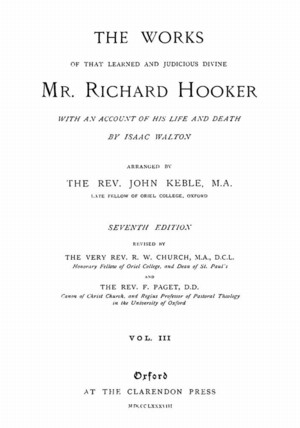
A LEARNED DISCOURSE OF JUSTIFICATION, WORKS, AND HOW THE FOUNDATION OF FAITH IS OVERTHROWN 1 . - Richard Hooker, The Works of Richard Hooker, vol. 3 [1888]Edition used:The Works of that Learned and Judicious Divine Mr. Richard Hooker with an Account of His Life and Death by Isaac Walton. Arranged by the Rev. John Keble MA. 7th edition revised by the Very Rev. R.W. Church and the Rev. F. Paget (Oxford: Clarendon Press, 1888). 3 vols. Vol. 3.
Part of: The Works of that Learned and Judicious Divine Mr. Richard Hooker with an Account of His Life and Death by Isaac Walton, 3 vols.About Liberty Fund:Liberty Fund, Inc. is a private, educational foundation established to encourage the study of the ideal of a society of free and responsible individuals. Copyright information:The text is in the public domain. Fair use statement:This material is put online to further the educational goals of Liberty Fund, Inc. Unless otherwise stated in the Copyright Information section above, this material may be used freely for educational and academic purposes. It may not be used in any way for profit.
A LEARNED DISCOURSE OF JUSTIFICATION, WORKS, AND HOW THE FOUNDATION OF FAITH IS OVERTHROWN1 .Habak. i. 4.“The wicked doth compass about the righteous: therefore perverse judgment doth proceed.” SERM. II. 1.FOR bettera manifestation of the prophet’s meaning in this place, we are, first, to consider “the wicked,” of whom he saith, that they “compass about the righteous:” secondly, “the righteous” that are compassed about by them: and thirdly, that which is inferred; “thereforeb perverse judgment proceedeth.” Touching the first, there are two kinds of wicked men, of whom in the fifth of the former to the Corinthiansc , the blessed Apostle speaketh thus2 : “Do ye not judge them that are within?SERM. II. 2. but God judgeth them that are without.” There are wicked, therefore, whom the Church may judge, and there are wicked whom God only judgeth; wicked within, and wicked without, the walls of the Church. If within the Church particular persons, being apparently such, cannotd otherwise be reformed, the rule of apostolicale judgment is this1 , “Separate them from amongf you:” if whole assemblies, this, “Separate yourselves from amongf them: for what society hath light with darkness?” But the wicked, whom the prophet meaneth, were Babylonians, and therefore without. For which cause we have heard at large heretofore in what sort he urgeth God to judge them. 2. Now concerning the righteous, there neither is, nor everh was, any mere natural man absolutely righteous in himself: that is to say, void of all unrighteousness, of all sin. We dare not except, no not the blessed Virgin herself; of whom although we say with St. Augustine2 , for the honour’si sake which we owe to our Lord and Saviour Christ, we are not willing, in this cause, to move any question ofk his mother; yet forasmuch as the schools of Rome have made it a question, we mustl answer with Eusebius Emissenus3 , who speaketh of her, and to her tom this effect: “Thou didst by special prerogative nine months together entertain within the closet of thy flesh the hope of all the ends of the earth, the honour of the world, the common joy of men. He, from whom all things had their beginning,SERM. II. 3. hathn had his owno beginning from thee; of thy body he took the blood which was to be shed for the life of the world; of thee he took that which even for thee he paid. ‘A peccati enim veteris nexu, per se non est immunis nec ipsa genitrix Redemptoris1 :’ The mother of the Redeemer herself, otherwise than by redemption, is not loosed from the bandp of that ancient sinq2 .” If Christ have paid a ransom for all, even for her, it followeth, that all without exception were captives. If one have died for all, allr were dead, dead in sins ; all sinful, therefore none absolutely righteous in themselves; but we are absolutely righteous in Christ. The world then must shew a Christiant man, otherwise it is not able to shew a man that is perfectly righteous: “Christ is made unto us wisdom, justice, sanctification, and redemption3 :” wisdom, because he hath revealed his Father’s will; justice, because he hath offered himselfu a sacrifice for sin; sanctification, because he hath given us ofx his Spirit; redemption, because he hath appointed a day to vindicate his children out of the bands of corruption into liberty which is glorious4 . How Christ is made wisdom, and how redemption, it may be declared when occasion serveth; but how Christ is made the righteousness of men, we are now to declare. 3. There is a glorifying righteousness of men in the world to come: andy there is a justifying and a sanctifying righteousness here. The righteousness, wherewith we shall be clothed in the world to come, is both perfect and inherent. That whereby here we are justified is perfect, but not inherent. That whereby we are sanctified, inherentz , but not perfect. This openeth a way to the plainz understanding of that grand question,SERM. II. 4, 5. which hangeth yet in controversy between us and the Church of Rome, about the matter of justifying righteousness. 4. First, although they imagine that the mother of our Lord and Saviour Jesus Christ were, for his honour, and by his special protection, preserved clean from all sin, yet touching the rest, they teach as we do, that all have sinneda ; that infants which did neverb actually offend, have their natures defiled, destitute of justice, and averted from God. They teach as we do, that God doth justify the soul of man alone, without any other coefficient cause of justicec ; that in making man righteous, none do work efficientlyd with God, but God1 . They teach as we do, that unto justice no man ever attained, but by the merits of Jesus Christ. They teach as we do, that although Christ as God be the efficient, as man the meritorious cause of our justice; yet in us also there is somethinge required. God is the cause of our natural life; in him we live: but he quickeneth not the body without the soul in the body. Christ hath merited to make us just: but as a medicine which is made for health, doth not heal by being made, but by being applied; so, by the merits of Christ there can be no justification, without the application of his merits. Thus far we join hands with the Church of Rome. The difference betwixt the Papists and us about Justification.5. Wherein then do we disagree? We disagree about the nature of the very essencef of the medicine whereby Christ cureth our disease; about the manner of applying it; about the number and the power of means, which God requireth in us for the effectual applying thereof to our soul’s comfort. When they are required to shew, what the righteousness is whereby a Christian man is justified, they answer1 , that it is a divine spiritual quality;SERM. II. 5. which quality received into the soul, doth first make it to be one of them who are born of God: and, secondly, endue it with power to bring forth such works, as they do that are born of him; even as the soul of man being joined untog his body, doth first make him to be inh the number of reasonable creatures, and secondly enablei him to perform the natural functions which are proper to his kind; that it maketh the soul gracious and amiablek in the sight of God, in regard whereof it is termed Grace; that it purgeth, purifieth, washeth outl , all the stains and pollutions of sinm ; that by it, through the merit of Christ we are delivered as from sin, so from eternal death and condemnation, the reward of sin. This grace they will have to be applied by infusion; to the end, that as the body is warm by the heat which is in the body, so the soul might be righteous by the inherent grace: which grace they make capable of increase; as the body may be more and more warm, so the soul more and more justified2 , according as grace shall be augmented; the augmentation whereof is merited by good works1 , as good works are made meritorious by it2 . Wherefore, the first receipt of grace is in their divinityn the first justification; the increase thereof, the second justification3 . As grace may be increased by the merit of good works; so it may be diminished by the demerit of sins venial4 ; it may be lost by mortal sin5 . Inasmuch, therefore, as it is needful in the one case to repair, in the other to recover, the loss which is made; the infusion of grace hath her sundry after-meals; for whicho cause they make many ways to apply the infusion of grace. It is applied to infants6 through baptism, without either faith or works, and in them really it taketh away original sin, and the punishment due unto it; it is applied to infidels and wicked men in their firstp justification through baptism, without works7 , yet not without faith; and it taketh away both sins actual and original, together with all whatsoever punishments, eternal or temporal, thereby deserved8 . Unto such as have attained the first justification, that is to say, the first receipt of grace, it is applied farther by good works to the increase of former grace, which is the second justification. If they work more and more, grace doth more and more increase, and they are more and more justified. To such as have diminishedq it by venial sins, it is applied by holy water, Ave Maries, crossings, papal salutations1 , and such like, which serve for reparations of grace decayed. To such as have lost it through mortal sin, it is applied by the sacrament (as they term it) of penance; which sacrament hath force to confer grace anew2 , yet in such sort, that being so conferred, it hath not altogether so much power3 as at the first. Forr it only cleanseth out the stain or guilt of sin committed, and changeth the punishment eternal into a temporal satisfactory punishment, here, if time do serve, if not, hereafter to be endured, except it be eithers lightened by masses, works of charity, pilgrimages, fasts, and such like; or else shortened by pardon for term, or by plenary pardon quite removed and taken away4 . This is the mystery of the Man of sin. This maze the Church of Rome doth cause her followers to tread, when they ask her the way of justificationt . I cannot stand now to unrip this building,SERM. II. 6. and to sift it piece by piece; only I will set a frame of apostolical erection by it in few wordsu , that itx may befall Babylon, in presencey of that which God hath builded, as itz happened unto Dagon before the ark. 6. “Doubtless,” saith the Apostle1 , “I have counted all things lossa , and I dob judge them to be dung, that I may win Christ; and be foundc in him, not having mine own righteousness, but that which is through the faith of Christ, the righteousness which is of God through faith.” Whether they speak of the first or second justification, they make the essence of itd a divine quality inherent, they make it righteousness which is in us. If it be in us, then it ise ours, as our souls are ours, though we have them from God, and can hold them no longer than pleaseth him; for if he withdraw the breath of our nostrils, we fall to dust: but the righteousness wherein we must be found, if we will be justified, is not our own; therefore we cannot be justified by any inherent quality. Christ hath merited righteousness for as many as are found in him. In him God findeth us, if we be faithful; for by faith we are incorporated into himf . Then, although in ourselves we be altogether sinful and unrighteous, yet even the man which in himself is impiousg , full of iniquity, full of sin; him being found in Christ through faith, and having his sin in hatredh through repentance; him God beholdethi with a gracious eye; putteth away his sin by not imputing itk ; taketh quite away the punishment due thereunto, by pardoning it; and accepteth him in Jesus Christ, as perfectly righteous, as if he had fulfilled all that isl commanded him in the law: shall I say more perfectly righteous than if himself had fulfilled the whole law? I must take heed what I say: but the Apostle saith2 , “God made him which knew no sin, to be sin for usm ; that we might be made the righteousness of God in him.” Such we are in the sight of God the Father, as is the very Son of God himself. Let it be counted folly, or phrensy, or fury, orn whatsoever.SERM II. 7. It is our wisdom, and our comforto ; we care for no knowledge in the world but this, That man hath sinned, and God hath suffered; that God hath made himself the sinp of menq , and that men are made the righteousness of God. You see therefore that the church of Rome, in teaching justification by inherent grace, doth pervert the truth of Christ; and that by the hands of hisr Apostles we have received otherwise than she teacheth. s Now concerning the righteousness of sanctification, we deny it not to be inherent; we grant, that unlesst we work, we have it not; only we distinguish it asu a thing in nature different from v the righteousness of justification: we are righteous the one way, by the faith of Abraham; the other way, except we do the works of Abraham, we are not righteous. Of the one, St. Paul1 , “To him that worketh not, but believeth, faith is counted for righteousness.” Of the other, St. John2 , “Qui facit justitiam, justus est:—He is righteous which worketh righteousness.” Of the one, St. Paul3 doth prove by Abraham’s example, that we have it of faith without works. Of the other, St. James4 by Abraham’s example, that by works we have it, and not only by faith. St. Paul doth plainly sever these two parts of Christian righteousness one from the other. For in the sixth to the Romans thus he writeth5 , “Being freed from sin, and made servants tow God, yex have your fruit in holiness, and the end everlasting life.” “Ye are made free from sin, and made servants unto God;” this is the righteousness of justification: “Ye have your fruit in holiness;” this is the righteousness of sanctification. By the one we are interessed in the right of inheriting; by the other we are brought to the actual possessingy of eternal bliss, and so the end of both is everlasting life. 7. The Prophet Habakkukz doth here term the Jews “righteous men,” not only because being justified by faith they were free from sin; but also for thata they had their measure of fruitb in holiness. According to whose example of charitable judgment, which leaveth it to God to discern what menb are, and speaketh of them according to that which they do professc themselves to be, although they be not holyd whom men do think, but whom God doth know indeed to be such; yet let every Christian man know, that in Christian equity, he standeth bound soe to think and speak of his brethren, as of men that have af measure in the fruit of holiness, and a right unto the titles wherewith God, in token of special favour and mercy, vouchsafeth to honour his chosen servants. So we see the Apostles of our Saviour Christ do use every where the name of saints; so the prophet the name of righteous. But let us all endeavour tog be such as we desire to be termed: Reatus impii est pium nomen, saith Salvianus1 ; “Godly names do not justify godless men.” We are but upbraided, when we are honoured with names and titles whereunto our lives and manners are not suitable. If we have indeedh our fruit in holiness, notwithstanding we must note, that the more we abound thereini , the more need we have to crave that we may be strengthened and supported. Our very virtues may be snares unto us. The enemy that waiteth for all occasions to work our ruin, hath everj found it harder to overthrow an humble sinner, than a proud saint. There is no man’s case so dangerous as his, whom Satan hath persuaded that his own righteousness shall present him pure and blameless in the sight of God. If we could say, “we arek not guilty of any thing at all in our ownl consciences,” (we know ourselves far from this innocency; we cannot say, we know nothing by ourselves; but if we could,) should we therefore plead not guilty inm the presence of our Judge, that sees furthern into our hearts than we ourselves are able to seeo ? If our hands did never offer violence to our brethren, a bloody thought doth prove us murderers before him: if we had never opened our mouthsp to utter any scandalous, offensive, or hurtful word, the cry of our secret cogitations is heard in the ears of God. If we didq not commit the evils which we do daily and hourly, either in deeds, words, or thoughtsr , yet in the good things which we do, how many defects are there intermingled! God, in that which is done, respecteth speciallys the mind and intention of the doer. Cut off then all those things wherein we have regarded our own glory, those things which wet do to please men, oru to satisfy our own liking, those things which we do with any by-respectw , not sincerely, and purely for the love of God; and a small score will serve for the number of our righteous deeds. Let the holiest and best thing we do be considered. We are never better affected unto God than when we pray; yet when we pray, how are our affections many times distracted! How little reverence do we shew to the grand majesty of thatx God, unto whom we speak! How little remorse of our own miseries! How little taste of the sweet influence of his tender mercyy do we feel! Are we not as unwilling many times to begin, and as glad to make an end, as if God z in saying, “Call upon me,” had a set us a very burdensome task? It may seem somewhat extreme, which I will speak; therefore let every manb judge of it, even as his own heart shall tell him, and no otherwise; I will but only make a demand: If God should yield to us, not as unto Abraham, if fifty, forty, thirty, twenty, yea, or if ten good persons could be found in a city, for their sakes thatc city should not be destroyed; but, if Godd should make us an offer thus large, Search all the generations of men sithence the fall of youre father Adam, find one man, that hath done anyf one action, which hath past from himg pure, without any stain or blemish at all; and for that one man’s oneh only action, neither man nor angel shall feel the torments which are prepared for both: do you think that this ransom, to deliver men and angels, would be foundi among the sons of men? The best things we doj have somewhat in them to be pardoned. How then can we do any thing meritorious, andk worthy to be rewarded? Indeed, God doth liberally promise whatsoever appertaineth to a blessed life, unto as many as sincerely keep his law, though they be not able exactlyl to keep it.SERM. II. 8, 9. Wherefore, we acknowledge a dutiful necessity of doing well; but the meritorious dignity of well doingm we utterly renounce. We see how far we are from the perfect righteousness of the law; the little fruit which we have in holiness, it is, God knowethn , corrupt and unsound: we put no confidence at all in it, we challenge nothing in the world for it, we dare not call God to a reckoningo , as if we had him in our debt-books: our continual suit to him is, and must be, to bear with our infirmities, to p pardon our offences. 8. But the people of whom the Prophet speaketh, were they all, or were the most part of them, such as had care to walk uprightly? did they thirst after righteousness? did they wish, did they long with the righteous Prophet1 , “O that our ways were made so direct that we might keep thy statutes?” did they lament with the righteous Apostle2 , “Miserable men, the good which we wish and purpose, and strive to do, we cannot?” No; the words of other prophetsq concerning this people do shew the contrary. How grievously doth Esay mourn over them3 ! “Ah sinful nation, people laden with iniquity, wicked seed, corrupt children!” All which notwithstanding, so wide are the bowels of his compassion enlarged, that he denieth us not, no not when we arer ladens with iniquity, leave to commune familiarly with him, liberty to crave and entreat, that what plagues soever we have deserved, we may not be in worse case than unbelievers, that we may not be hemmed in by pagans and infidels. Jerusalem is a sinful polluted city; but Jerusalem compared with Babylon is righteous. And shall the righteous be overborne, shall they be compassed about by the wicked? But the prophet doth not only complain; Lord, how cometh it to pass that thou handlest us so hardly, overt whom thy name is called, and bearest with the heathen nations, that despise thee? no, he breaketh out through extremity of grief, and inferreth thusu violently, This proceeding is perverse; the righteous are thus handled, “therefore perverse judgment doth proceed.” 9. Which illation containeth many things, whereof it were better much both for youx to hear, and me to speak,SERM. II. 9. if necessity did not draw me to another tasky . Paul and Barnabas being requested1 to preach the same things again which once they had preached, thought it their duties to satisfy the godly desires of men sincerely affected towardsz the truth. Nor may it seem burdenous to me, or for youa unprofitable, that I follow their example, the like occasion unto theirs being offered me. When we had last the Epistle of St. Paul to the Hebrews in our handsb , and of that epistle these words2 , “In these last days he hath spoken unto us by his Son;” after we had thence collected the nature of the visible Church of Christ, and had defined it to be a community of men3 sanctified through the profession of that truth which God hath taught the world by his Son; and had declared, that the scope of Christian doctrine is the comfort of them whose hearts are overcharged with the burden of sin; and had proved that the doctrine professed in the church of Rome doth bereave men of comfort, both in their lives, and atc their deaths: the conclusion in the end, whereunto we camed , was this; “The church of Rome, being in faith so corrupted, as she is, and refusing to be reformed, as she doth, we are to sever ourselves from her: the example of our fathers may not retain us in communion and fellowshipe with that church, under hope that we so continuing, mightf be saved as well as they. God, I doubt not, was merciful to save thousands of them, though they lived in popish superstitions, inasmuch as they sinned ignorantly: but the truth is now laid openg before our eyes.” The former part of this last sentence, namely, these words, “I doubt not but God was merciful to save thousands of our fathers living in popish superstitions, inasmuch as they sinned ignorantly:” this sentence I beseech you to mark, and to sift it with the stricth severity of austere judgment, that if it be found as goldi , it may stand, suitablek to the precious foundation whereupon it was then laid;SERM. II. 10. for I protest, that if it prove tor be hay or stubble, my own hand shall set fire to its . Two questions have risen by occasion of thet speech before alleged: the one, “Whether our fathers, infected with popish errors and superstitions, mightu be saved:” the other, “Whether their ignorance be a reasonable inducement to make us think thatx they might.” We are thereforey to examine, first, what possibility, andz then, what probability there is, that God might be merciful unto so many of our fathers. 10. So many of our fathers living in popish superstitions, yet by the mercy of God to be saved? No; this could not be: God hath spoken by his angel from heaven unto his people concerning Babylon (by Babylon we understand the church of Rome)1 : “Go out of her, my people, that ye be not partakers of her sins, and that ye receive not of her plaguesa .” For answer whereunto, first, I do not take the words to be meant only of temporal plagues, of the corporal death, sorrow, famine, and fire, whereunto God in his wrath hadb condemned Babylon; and that to save his chosen people from these plagues, he saith, “Go out;” with like intent, as in the Gospel, speaking of Hierusalem’s desolations, he saith2 , “Let them that are in Judea flee unto the mountains, and them which are in the midst thereof depart out;” or, as in former times unto Lot3 , “Arise, take thy wife and thy daughters which are here, lest thou be destroyed in the punishment of the city:” but forasmuch as here it is said, “Go out of Babylon, that ye be not partakers of her sins, and by consequence of her plagues;” plagues eternal being due to the sins of Babylonc ; no doubtd , their everlasting destruction, which are partakers herein, is either principally meant, or necessarily implied in this sentence. How then was it possible for so many of our fathers to be saved, sith they were so far from departing out of Babylon, that they took her for their mother, and in her bosom yielded up the ghost? SERM. II. 11.11. First, the plaguese being threatened unto them that are partakers in the sins of Babylon, we can define nothing concerning our fathers out of this sentence; unless we shew what the sins of Babylon be, and whof they be thatg are such partakers inh them, that their everlasting plagues are inevitable. The sins which may be common both to them of the church of Rome, and toi others departed thence, must be severed from this question. He which saith, “Depart out of Babylon, lest you be partakers of her sins,” sheweth plainly, that he meaneth such sins, as except we separate ourselves, we have no power in the world to avoidj ; such impieties, as by lawk they have established, and whereunto all that are amongl them, either do indeed assent, or else are by powerable means forced in show and inm appearance to subject themselves. As for example, in the church of Rome, it is maintained, that the same1 credit and reverence whichn we give to the Scriptures of God, ought also to be given to unwritten verities; that the pope is supreme head ministerial2 over the universal Church militant; that the bread in the Eucharist is transubstantiated3 into Christ; that it is to be adored4 , and to be offered up unto God as a sacrifice propitiatory1 for quick and dead;SERM. II. 12. that images are to be worshipped, saints to be called upon as intercessors2 , and such like. Now, because some heresies do concern things only believed, as transubstantiating ofn sacramental elements in the Eucharist; some concern things which are practised alsoo and put in ure, as adorationp of the elements transubstantiated: we must note that erroneously the practice of that is sometime received, whereof the doctrine whichq teacheth it is not heretically maintained. They are all partakers in the maintenance of heresies, who by word or deed allow them, knowing them, although not knowing them to be heresies; as also they, and that most dangerously of all others, who knowing heresy to be heresy, do notwithstanding, in worldly respects, make semblance of allowing that, which in heart and inr judgment they condemn: but heresy is heretically maintained, by such as obstinately hold it after wholesome admonition. Of the last sort, as alsos of the next before, I make no doubt, but that their condemnation, without actualt repentance, is inevitable. Lest any man therefore should think, that in speaking of our fathers, I speaku indifferently of them all; let my words, I beseech you, be well notedx , “I doubt not but God was merciful to save thousands of our fathers;” which thing I will now by God’s assistance set more plainly before your eyes. 12. Many are partakers of the error, which are not ofy the heresy of the church of Rome. The people following the conduct of their guides, and observing as they did,SERM. II. 13. exactly that which was prescribed themy , thought they did God good service, when indeed they did dishonour him. This was their error: but the heresiesz of the Church of Rome, their dogmatical positions opposite unto Christian truth, what one man amongst ten thousand did ever understand? Of them, which understand Roman heresies, and allow them, all are not alike partakers in the action of allowing. Some allow them as the first founders and establishers of thema ; which crime toucheth none but their Popes and Councils: the people are clear and freeb from this. Of them which maintain popish heresyc not as authors, but receivers of it from others, all maintain it not as Masters. In this are not the people partakers neither, but only their Predicants and theird Schoolmen. Of them which have been partakers in thee sin of teaching popish heresy, there is also a difference; for they have not all been teachers of all popish heresies. “Put a difference,” saith St. Jude1 ; “have compassion upon some.” Shall we lapf up all in one condition? shall we cast them all headlong, shall we plunge them all ing that infernal and ever-flamingh lake? them that have been partakers ini the errorj of Babylon, together with them withink the heresy? them which have been the authors of heresy, with them that by terror and violence have been forced to receive it? them which have taught it, with theml whose simplicity hath by sleights and conveyances of false teachers been seduced to believe it? them which have been partakers in one, with them whichm have been partakers in many? them which in many, with them which in all? 13. Notwithstanding I grant, that although the condemnation of onen be more tolerable than of anothero ; yet from the man that laboureth at the plough, to him that sitteth in the Vatican; to all partakers in the sins of Babylon, our fathersp , though they did but erroneously practise that which their guides did heretically teachq ; to all without exception, plagues worldlyr were due. The pit is ordinarily the end, as well of the guided as the guides in blindness.SERM. II. 14. But woe worth the hour wherein we were born, except we might persuadet ourselves better things; things that accompany men’su salvation, even where we know that worse and such as accompany condemnation are due. Then must we shew some way how possibly they might escape. What way is there for sinners tox escape the judgment of God, but only by appealing to the seat of his saving mercy? Which mercy we do not with Origen extend to devils and damned spirits. God hath mercy upon thousands, but there be thousands also which he hardenedy . Christ hath therefore set the bounds, he hath fixed the limits of his saving mercy, within the compass of these twoz terms. In the thirda of St. John’s Gospel, mercy is restrained to believers1 : “God sent not his Sonb to condemn the world, but that the world through him might be saved.” “2 He that believeth shall not be condemned: he that believeth not, is condemned already, because he believed not in the Son of God.” In the second of the Revelation, mercy is restrained to the penitent. For of Jezebel and her sectaries thus he speaketh3 : “I gave her space to repent, and she repented not. Behold, I will cast her into a bed, and them that commit fornication with her, into a great affliction, except they repent them of their works; and I will kill her children with death.” Our hope therefore of the fathers is vain, if they were altogether faithless and impenitentc . 14. They bed not all faithless that are eithere weak in assenting to the truth, or stiff in maintaining things any wayf opposite to the truth of Christian doctrine. But as many as hold the foundation which is precious, though they hold it but weakly, and as it were byg a slender thread, although they frame many base and unsuitable things upon it, things that cannot abideh the trial of the fire; yet shall they pass the fieryi trial and be saved, which indeed have builded themselves upon the rock, which is the foundation of the Church. If then our fathers did not hold the foundation of faith,SERM. II. 15, 16. there is no doubt but they were faithless. If many of them held it, then is there hereink no impediment, but that1 many of them might be saved. Then let us see what the foundation of faith is, and whether we may think that thousands of our fathers livingm in popish superstitions, did notwithstanding hold the foundation. 15. If the foundation of faith do import the general ground whereupon we rest when we do believe, the writings of the Evangelists and the Apostles are the foundation of the Christian faith: “Credimus quia legimus,” saith St. Jerome1 . O that the church of Rome did as2 soundly interpret thosen fundamental writings whereupon we build our faith, as she doth willingly hold and embrace them! 16. But if the name Foundationo do note the principal thing which is believed, then is that the foundation of our faith which St. Paul hath unto Timothy: “God manifested in the flesh, justified in the Spirit,” &c.3 : that of Nathaniel, “Thou art the Son of the living God: thou art the king of Israel4 :” that of the inhabitants of Samaria, “This is Christ the Saviour of the world:” he that directly denieth this, doth utterly razep the very foundation of our faith. I have proved heretofore, that although the church of Rome hath played the harlot worse than ever did Israel, yet are they not, as now the synagogue of the Jews, which plainly deniethq Christ Jesus, quite and clean excluded from the new covenant. But as Samaria compared with Hierusalem is termed Aholath, a church or tabernacle of her own; contrariwise, Jerusalem Aholibath, the resting place of the Lord: so, whatsoever we term the church of Rome, when we compare her tor reformed churches, still we put a difference, as then between Babylon and Samaria, as now between Rome and heathenishs assemblies.SERM. II. 17. Which opinion I must and will recall; I must grant, and will, that the church of Rome, together with all her children, is clean excluded; there is no difference in the world between our fathers and Saracens, Turks, ort Painims, if they did directly deny Christ crucified for the salvation of the world. 17. But how many millions of them areu known so to have ended their mortalx lives, that the drawing of their breath hath ceased with the uttering of this faith, “Christ my Saviour, my Redeemer Jesus!” And shall we say that such did not hold the foundation of Christian faithy ? Answer is made, that this they might unfeignedly confess, and yet be far enough from salvation. For behold, saith the Apostle, “I, Paul, say unto you, that if yez be circumcised, Christ shall profit you nothing1 .” Christ, in the work of man’s salvation, is alone: the Galatians were cast away by joining circumcision and othera rites of the law with Christ: the church of Rome doth teach her children to join other things likewise with him; therefore their faith, their belief, doth not profit them any thing at all. It is true, theyb do indeed join other things with Christ; but how? Not in the work of redemption itself, which they grant that Christ alone hath performed sufficiently for the salvation of the whole world; but in the application of this inestimable treasure, that it may be effectual to their salvation: how demurely soever they confess that they seek remission of sins no otherwise than by the blood of Christ, using humbly the means appointed by him to apply the benefit of his holy blood; they teach, indeed, so many things pernicious toc Christian faith, in setting down the means whereof they speak, that the very foundation of faith which they hold, is thereby plainly overthrown2 , and the force of the blood of Jesus Christ extinguished.SERM. II. 18. We may therefore dispute with them, press them, urgec them even with as dangerous sequels as the Apostle doth the Galatians. But I demand, if some of those Galatians, heartily embracing the Gospel of Christ, sincere and sound in faith, this onlyd error excepted, had ended their lives before they were ever taught how perilous an opinion they held; shall we think that the damage of this error did so overweigh the benefit of their faith, that the mercy of God, his mercye , might not save them? I grant they overthrew the very foundation of faith by consequent: doth not that so likewise which the1 Lutheran churches do at this day so stiffly and so fiercelyf maintain? For mineg own part, I dare not hereuponh deny the possibility of their salvation, which have been the chiefest instruments of ours, albeit they carried to their grave a persuasion so greatly repugnant to the truth. Forasmuch therefore, as it may be said of the church of Rome, she hath yet “a little strength2 ,” she doth not directly deny the foundation of Christianity: I may, I trust without offence, persuade myself, that thousands of our fathers in former times, living and dying within her walls, have found mercy at the hands of God. 18. What although they repented not of their errors? God forbid that I should open my mouth to gainsay that which Christ himself hath spoken: “Except ye repent, ye shall all perish3 .” And if they did not repent, they perished. But withal note, that we have the benefit of a double repentance: the least sin which we commit in deed, word, or thoughti , is death, without repentance.SERM. II. 10. Yet how many things do escape us in every of these, which we do not know, how many, which we do not observe to be sins! and without the knowledge, without the observation of sin, there is no actual repentance. It cannot then be chosen, but that for as many as hold the foundation, and have all known sin and errorj in hatred, the blessing of repentance for unknown sins and errorsk is obtained at the hands of God, through the gracious mediation of Christ Jesus, for such suitors as cry with the prophet David, “Purge me, O Lord, from my secret sinsl .” 19. But we wash a wall of loam; we labour in vain; all this is nothing; it doth not prove, it cannot justify, that which we go about to maintain. Infidels and heathen men are not so godless, but that they may, no doubt, cry God mercy, and desire in general to have their sins forgiven them. To such as deny the foundation of faith, there can be no salvation, according to the ordinary course which God doth use in saving men, without a particular repentance of that error. The Galatians, thinking that except1 they were circumcised, they could not be saved, overthrew the foundations of faith directly: therefore if any of them did die so persuaded, whether before or after they werem told of their errorn , their caseo is dreadful; there is no way with them but one, death and condemnation. For the Apostle speaketh nothing of men departed, but saith generally of all, “If ye be circumcised, Christ shall profit you nothing. Ye are abolished from Christ, whosoever are justified by the law; ye are fallen from grace2 .” Of them in the church of Rome the reason is the same. For whom Antichrist hath seduced, concerning them did not St. Paul speak long before, “That becausep they received not the love of the truthq , that they might be saved; therefore God would send them strong delusions to believe lies, that all they might be damned which believed not the truth, but had pleasure in unrighteousness3 ?” And St. John, “All that dwell upon the earth shall worship him, whose names are not written in the Book of Life1 ?”SERM. II. 20. Indeed many of themr in former times, as their books and writings do yet shew, held the foundation, to wit, salvation by Christ alone, and therefore might be saved. Fors God hath always had a Church amongst them, which firmly kept his saving truth. As for such as hold with the church of Rome, that we cannot be saved by Christ alone without works; they do not only by a circle of consequence, but directly, deny the foundation of faith2 ; they hold it not, no not so much as by a slendert thread. 20. This, to my remembrance, being all that hath been as yetu opposed with any countenance or shew of reason, I hope, if this be answered, the cause in question is at an end. Concerning general repentance, therefore: what? a murderer, a blasphemer, an unclean person, a Turk, a Jew, any sinner to escape the wrath of God by a generalx “God forgive me?” Truly, it never came within my heart, that a general repentance doth serve for all sins or for all sinnersy : it serveth only for the common oversightsz of our sinful life, and for faultsa which either we do not mark, or do not know that they are faults. Our fathers were actually penitent for sins, wherein they knew they displeased God: or else they comeb not within the compass of my first speech. Again, that otherwise they could not be saved, than holding the foundation of Christian faith, we have not only affirmed, but proved. Why is it not then confessed, that thousands of our fathers, although they livedc in popish superstitions, might yet, by the mercy of God, be saved? First, if they had directly denied the very foundationd of Christianity, without repenting them particularly of that sin, he which saith, there could be no salvation for them, according to the ordinary course which God doth use in saving men, granteth plainly, or at the leastwisee closely insinuateth, that an extraordinary privilege of mercy might deliver their souls from hell; which is more than I required. Secondly, if the foundation be denied, it is denied by forcef of some heresy which the church of Rome maintaineth. But how many were there amongst our fathers, who being seduced by the common error of that church, never knew the meaning of her heresies! So that ifg all popish heretics did perish, thousands of them which lived in popish superstitions might be saved. Thirdly, seeing all that held popish heresies did not hold all the heresies of the pope: why might not thousands which were infected with other leaven, live andh die unsoured byi this, and so be saved? Fourthly, if they all had heldk this heresy, many there were that held it no doubt onlyl in a general form of words, which a favourable interpreterm might expound in a sense differing far enough from the poisoned conceit of heresy. As for example; did they hold that we cannot be saved by Christ without worksn1 ? We ourselves do, I think, all say as much, with this construction, salvation being taken as in that sentence, “Corde creditur ad justitiam, ore fit confessio ad salutem;” except infants, and men cut off upon the point of their conversion, of the rest none shall see God, but such as seek peace and holiness, though not as a cause of their salvation, yet as a way througho which they must walk thatp will be saved. Did they hold, that without works we are not justified? Take justification so thatq it may also imply sanctification, and St. James doth say as much. r For except there be an ambiguity in somes term, St. Paul and St. James do contradict each othert ; which cannot be. Now, there is no ambiguity in the name either of faith or of works, bothx being meant by them both in one and the same sense.SERM. II. 21. Finding therefore that justification is spoken of by St. Paul without implying sanctification, when he proveth that a man is justified by faith without works; finding likewise that justification doth sometimes imply sanctification also with it; I suppose nothing more soundy , than so to interpret St. James asz speaking not in that sense, but in this. 21.a We have already shewed, that there areb two kinds of Christian righteousness: the one without us, which we have by imputation; the other in us, which consisteth of faith, hope, charityc , and other Christian virtues; and St. James doth prove that Abraham had not only the one, because the thing hed believed was imputed unto him for righteousness; but also the other, because he offered up his son. God giveth us both the one justice and the other: the one by accepting us for righteous in Christ; the other by working Christian righteousness in us. The proper and most immediate efficient cause in us of this latter, is, the spirit of adoption whiche we have received into our hearts. That whereof it consisteth, whereof it is really and formally made, are those infused virtues proper and particular unto saints; which the Spirit, in thatf very moment when first it is given of God, bringeth with it: the effects thereofg are such actions as the Apostle doth call the fruits, the worksh , the operations of the Spirit; the difference of whichi operations from the root whereof they spring, maketh it needful to put two kinds likewise of sanctifying righteousness, Habitual and Actual. Habitual, that holiness, wherewith our souls are inwardly endued, the same instant when first we begin to be the temples of the Holy Ghost; Actual, that holiness which afterward beautifieth all the parts and actions of our life, the holiness for which Enoch, Job, Zachary, Elizabeth, and other saints, are in Scripturesk so highly commended. If here it be demanded, which of these we do first receive; I answer, that the Spirit, the virtues of the Spirit, the habitual justice, which is ingrafted, the external justice of Christ Jesusl which is imputed, these we receive all at one and the same time; whensoever we have any of these, we have all; they go together. Yet sith no man is justified except he believe, and no man believeth except he havem faith, and no man hath faith, unlessn he haveo received the Spirit of Adoptionp , forasmuch as theseq do necessarily infer justification, butr justification doth of necessity presuppose them; we must needs hold that imputed righteousness, in dignity being the chiefest, is notwithstanding in order the lasts of all these, but actual righteousness, which is the righteousness of good works, succeedeth all, followeth after all, both in order and int time. Which thingu being attentively marked, sheweth plainly how the faith of true believers cannot be divorced from hope and love; how faith is a part of sanctification, and yet unto justification necessary; how faith is perfected by good works, and yet no works of ours good without faithx : finally, how our fathers might hold, Wey are justified by faith alone, and yet hold truly that without goodz works we are not justified. Did they think that men do merit rewards in heaven by the works they perform on earth? The ancient Fathersa use meriting for obtaining, and in that sense they of Wittenberg have in their Confession: “We teach that good works commanded of God are necessarily to be done, and thatb by the free kindness of God they merit their certain rewards1 .” Othersc therefore, speaking as our fathers did, and we taking their speech in a sound meaning, as we may take our fathers’, and oughtd , forasmuch as their meaning is doubtful, and charity doth always interpret doubtful things favourably; what should induce us to think that rather the damage of the worsee construction did light upon them all, than that the blessing of the better was granted unto thousands?SERM. II. 22. Fifthly, if in the worst construction that canf be made, they had generally all embraced it living, might not many of them dying utterly renounce it? Howsoever men, when they sit at ease, do vainly tickle their owng hearts with the wanton conceit of I know not what proportionable correspondence between their merits and their rewards, which, in the trance of their high speculations, they dream that God hath measured, weighed, and laid up, as it were, in bundles for them; notwithstanding we see by daily experience, in a number even of them, that when the hour of death approacheth, when they secretly hear themselves summoned forthwith to appear, and stand at the bar of thath Judge, whose brightness causeth the eyes of angelsi themselves to dazzle, all thosek idle imaginations do then begin to hide their faces; to name merits then, isl to lay their souls upon the rack, the memory of their own deeds is loathsome unto them, they forsake all things wherein they have put any trust andm confidence; no staff to lean upon, no ease, no rest, no comfort then, but only in Christ Jesusn . 22. Wherefore if this proposition were true, “To hold in such wise, as the church of Rome doth, that we cannot be saved by Christ alone without works, is directly to deny the foundation of faith;” I say, that if this proposition were true, nevertheless so many ways I have shewed, whereby we may hope that thousands of our fathers livingo in popish superstitionsp might be saved1 . But whatq if it be not true?SERM. II. 23. What if neither that of the Galatians concerning circumcision, nor this of the church of Rome aboutr works, be any direct denial of the foundation, as it is affirmed that both are? I need not wade so far as to discuss this controversy, the matter which first was brought into question being so cleareds , as I hope it is. Howbeit, because I desire that the truth even in thist also mayu receive light, I will do minex endeavour to set down somewhat more plainly: first, the foundation of faith, what it is: secondly, what it is directly to deny the foundation: thirdly, whether they whom God hath chosen to be heirs of life, may fall so far as directly to deny it: fourthly, whether the Galatians did so by admitting the error about circumcision and the law: last of all, whether the church of Rome, for this one opinion of works, may be thought to do the like, and thereupon to be no more a Christian church, than are the assemblies of Turks ory Jews. What the foundation of faith is.23. This word foundation being figuratively used, hath always reference to somewhat which resembleth a material building, as both the doctrine of the Christianityz [of Christianity] and the community of Christians do. By the Masters of civil policy nothing is so much inculcated, as that commonwealths are founded upon laws; for that a multitude cannot be compacted into one body otherwise than by a common acceptationa of laws, whereby they are to be kept in order1 . The ground of all civil laws is this; “No man ought to be hurt or injured by another:” take away this persuasion, and youb take away all lawsc ; take away laws, and what shall become of commonwealths? So it is in our spiritual Christian community: I do not nowd mean that body mystical2 whereof Christ is the onlye head, that building undiscernible by mortal eyes, wherein Christ is the chief corner-stone: but I speak of the visible church; the foundation whereof is the doctrine3 off the Prophets and Apostles profest. The mark whereunto their doctrine tendeth, is pointed at in thoseg words of Peter unto Christ, “Thou hast the words of eternal life:” in those ofh Paul to Timothy, “The holy Scriptures are able to make thee wise unto salvation.” It is the demand of nature itselfi , “What shall we do to have eternal life4 ?” The desire of immortality and ofk the knowledge of that whereby it may be attainedl , is so natural unto all men, that even they whichm are not persuaded that they shall, don notwithstanding wish that they might, know a way how to see no end of life. And because natural means are not able stillo to resist the force of death, there is no people in the earth so savage, which hath not devised some supernatural help or other, to fly unto for aid and succour in extremities, against the enemies of their livesp . A longing therefore to be saved, without understanding the true way how, hath been the cause of all the superstitions in the world. O that the miserable state of others, which wander in darkness, and wot not whither they go, could give us understanding hearts, worthily to esteem the riches of the merciesq of God towards us, before whose eyes the doors of the kingdom of heaven are set wide open! Should we notr offer violence unto it? It offereth violence to us, and we gather strength to withstand it. But I am besides my purpose when I fall to bewail the cold affection which we bear towards that whereby we should be saved; my purpose being only to set down what the ground of salvation is. The doctrine of the Gospel proposeth salvation as the end: and doth it not teach the way of attaining thereunto? Yess , the damosel possestt with a spirit of divination spake the truth: “These men are the servants of the most high God, which shew unto us the way of salvation:” “A new and living way, which Christ hath prepared for us through the vail, that is, his flesh1 ;” salvation purchased by the death of Christ. By this foundation the children of God, before the time of the writtenu law, were distinguished from the sons of men; the reverend patriarchs both profestx it living, and spake expressly2 of it at the hour of their death. It comforted Job3 in the midst of grief; it was afterwards likewisey the anchor-hold of all the righteous in Israel, from the writing of the law to the time of grace. Every prophet maketh mention of it. It was soz famously spoken of, about the time, when the coming of Christ to accomplish the promises, which were made long beforea , drew near, that the sound thereof was heard even amongst the Gentiles. When he was come, as many as were his acknowledged that he was their salvation; he, that long-expected hope of Israel; he, that “seed, in whom all the nations of the worldb shouldc be blestd .” So that now his name is a namee of ruin, a name of death and condemnation, unto such as dream of a new Messias, to as many as look for salvation by any other thanf by him: “For amongst men there is given no other name under heaven whereby we must be saved4 .” Thus much St. Mark doth intimate by that which he puttethg in the veryh front of his book,SERM. II. 24. making his entrance with these words: “The beginning of the Gospel of Jesus Christ, the Son of God.” His doctrine he termeth the Gospel, because it teacheth salvation; the Gospel of Jesus Christi , the Son of God, because it teacheth salvation by him. This is then the foundation, whereupon the frame of the Gospel is erected; that very Jesus whom the Virgin conceived of the Holy Ghost, whom Simeon embraced in his arms1 , whom Pilate condemned, whom the Jews crucified, whom the Apostles preached, he is Christ, the Lord, the only Saviour of the world: “other foundation can no man lay2 .” Thus I have briefly opened that principle in Christianity, which we call the foundation of our faith. It followeth now that I declare unto you, what itj is directly to overthrow it. This will better appeark , if firstl we understand, what it is to hold the foundation of faith. 24. There are which defend, that many of the Gentiles, who never heard the name of Christ, held the foundation of Christianity: and why? they acknowledged many of them the providence of God, his infinite wisdom, strength, andm power; his goodness, and his mercy towards the children of men; that God hath judgment in store for the wicked, but for the righteous that seeksn him, rewards, &c. In this which they confessed, that lieth covered which we believe; in the rudiments of their knowledge concerning God, the foundation of our faith concerning Christ lieth secretly wrapto up, and is virtually contained: therefore they held the foundation of faith, though they never heardp it. Might we not with as good colourq of reason defend, that every ploughman hath all the sciences, wherein philosophers have excelled? For no man is ignorant of ther first principles, which do virtually contain whatsoever by natural means eithers is or can be known. Yea, might we not with as goodt reason affirm, that a man may put three mighty oaks wheresoever three acorns may be put? For virtually an acorn is an oak. To avoid such paradoxes, we teach plainly, that to hold the foundation is, in express terms to acknowledge it.SERM. II. 25. 25. Now, because the foundation is an affirmative proposition, they all overthrow it, who deny it; they directly overthrow it, who deny it directly; and they overthrow it by consequent, or indirectly, which hold any one assertion whatsoever, whereupon the direct denial thereof may be necessarily concluded. What is the question between the Gentiles and us, but this, Whether salvation be by Christ? What between the Jews and us, but this, Whether by this Jesus, whom we call Christ, yea, or no? This to be the main point whereupon Christianity standeth, it is clear by that one sentence of Festus concerning Paul’s accusers: “They brought no crime of such things as I supposed, but had certain questions against him of their ownu superstition, and of one Jesus which was dead, whom Paul affirmed to be alive1 .” Where we see that Jesus, dead and raised for the salvation of the world, is by Jewsw denied, despised by a Gentile, and by a Christian apostle maintained. The Fathers therefore in the primitive church when they wrote; Tertullian, the book which he callethxApologeticus; Minutius Felix, the book which he entitlethyOctavius; Arnobius, hisz seven books against the Gentiles; Chrysostom, his orations against the Jews; Eusebius his ten books of Evangelical Demonstration: they stooda in defence of Christianityb against them, by whom the foundation thereof was directly denied. But the writings of the Fathers against Novatians, Pelagians, and other heretics of the like note, refel positions, whereby the foundation of Christian faith was overthrown by consequent only. In the former sort of writings the foundation is proved; in the latter, it is alleged as a proof, which to men that had been known directly to deny it, must needs have seemed a very beggarly kind of disputing. All infidels therefore deny the foundation of faith directly: by consequent, many a Christian man, yea whole Christian churches, havec denied it, and do deny it at this present day. Christian churches denyingd the foundation of Christianity? Note directly, for then they cease to be Christian churches;SERM. II. 26. but by consequent, in respect whereof we condemn them as erroneous, although, for holding the foundation, we do and must hold them Christian. 26. We see what it is to hold the foundation; what directly, and what by consequent, to deny it. The next thing which followeth is, whether they whom God hath chosen to obtain the glory of our Lord Jesus Christ, may, beingf once effectually called, and through faith truly justifiedg , afterwards fall so far, as directly to deny the foundation which their hearts have before embraced with joy and comfort in the Holy Ghost; for such is the faith, which indeed doth justify. Devils know the same things which we believe, and the minds of the most ungodly may be fully persuaded of the truth; which knowledge in the one and persuasionh in the other, is sometimes termed faith, but equivocally, being indeed no such faith as that whereby a Christian man is justified. It is the spirit of adoption which worketh faith in us, in them not; the things which we believe, are by us apprehended, not only as true, but also as good, and that to us: as good, they are not by them apprehended; as true, they are. Whereupon followeth a thirdi difference; the Christian man the more he increaseth in faith, the more his joy and comfort aboundeth: but they, the more sure they are of the truth, the more they quake and tremble at it. This begetteth another effect, whereink the hearts of the one sort have a different disposition from the other. Non ignoro plerosque conscientia meritorum, nihil se esse post1mortem magis optare quam credere; malunt enim exstingui penitus, quam ad supplicia repararil . I am not ignorant, saith Minutius, that there are too manym , who being conscious what they are to look for, do rather wish that they might, than think that they shall, cease to ben , when they cease to live; because they hold it better that death should consume them unto nothing, than God reviveo them untop punishment. So it is in other articles of faith, whereof wicked men think, no doubt, many times they are too true: on the contrary side, to the other, there is no grief norp torment greater, than to feel their persuasion weak in things, whereof, when they are persuaded, they reap such comfort and joy of spirit: such is the faith whereby we are justified; such, I mean, in respect of the quality. For touching the principal object of faith, longer than it holdeth thatq foundation whereof we have spoken, it neither justifieth, nor is; but ceaseth to be faith when it ceaseth to believe, that Jesus Christ is the only Saviour of the world. The cause of life spiritual in us, is Christ, not carnally or corporally inhabiting, but dwelling in the soul of man, as a thing which (when the mind apprehendeth it) is said to inhabit andr possess the mind. The mind conceiveth Christ by hearing the doctrine of Christianity. As the light of nature doth cause the mind to apprehend those truths which are merely rational; so that saving truth, which is far above the reach of human reason, cannot otherwise, than by the Spirit of the Almighty, be conceived. All these are implied, wheresoever any ones of them is mentioned as the cause of spiritualt life. Wherefore when we readu , that1 “the Spirit is our life;” or2 , “the Word our life;” or3 , “Christ our life:” we are in every of these to understand, that our life is Christ, by the hearing of the Gospel apprehended as a Saviour, and assented unto byx the power of the Holy Ghost. The first intellectual conceit and comprehension of Christ so embraced, St. Peter calleth4 the seed whereof we be new born: our first embracing of Christ, is our first reviving5 from the state of death and condemnation. “He that hath the Son hath life,” saith St. John6 , “and he that hath not the Son of God, hath not life.” If therefore he which once hath the Son, may cease to have the Son, though it be buty a moment, he ceaseth for that moment to have life. But the life of them whichz live by the Son of Goda , is everlasting, not only for that it shall be everlasting7 in the world to comeb , but because1 as “Christ being raised from the dead diethc no more, death hath no more power over him;” so thed justified man, being alivee to God in Jesus Christ our Lord, doth as necessarily from that time forward always live, as Christ, by whom he hath life, liveth always2 . I might, if I had not otherwhere largely done it already, shew by sundryf manifest and clear proofs, how the motions and operations of life are sometimes so undiscernible, and secretg , that they seem stone-dead, who notwithstanding are still alive unto God in Christ. For as long as that abideth in us, which animateth, quickeneth, and giveth life, so long we live; and we know that the cause of our lifeh abideth in us for ever. If Christ, the fountain of life, may flit and leave the habitation where once he dwelleth, what shall become of his promise, “I am with you to the world’s end?” If the seed of God, which containeth Christ, may be first conceived and then cast out; how doth St. Peter3 term it immortal? How doth St. John4 affirm it abideth? If the Spirit, which is given to cherish and preserve the seed of life, may be given and taken away, how is it the earnest5 of our inheritance until redemption; how doth it continue6 with us for ever? If therefore the man which is once just by faith, shall live by faith, and live for ever, it followeth, that he which once doth believe the foundation must needs believe the foundation for ever. If hei believe it for ever, how can he ever directly deny it7 ? Faith holding the direct affirmation; the direct negation, so long as faith continueth, is excluded. k But yel will say, “That as he which to-daym is holy, may to-morrow forsake his holiness, and become impure; as a friend may change his mind, and becomen an enemy; as hope may wither: so faith may die in the heart of man, the Spirit may be quenched, Grace may be extinguished, they which believe may be quite turned away from the truth.” Then caseo is clear, long experience hath made this manifest, it needs no proof. I grant we are apt, prone, and ready, to forsake God1 ; but is God as ready to forsake us? Our minds are changeable; is his so likewise? Whom God hath justified, hath not Christ assured, that it is “his Father’s will to give them a kingdom?” Which kingdomp , notwithstanding, shall notq otherwise ber given them, than “2 if they continue grounded and stablished in the faith, and be not moved away from the hope of the gospel;” “3 if they abide in love and holiness.” Our Saviour therefore, when he spake of the sheep effectually called, and truly gathered into his fold4 , “I give unto them eternal life, and they shall never perish, neither shall any pluck them out of my hands;” in promising to save them, promiseds , no doubt, to preserve them in that without the which there can be no salvation, as also from that whereby salvation ist irremediablyu lost. Every error in things appertaining tov God is repugnant unto faith; every fearful cogitation, unto hope; unto love, every straggling inordinate desire; unto holiness, every blemish wherebyx either the inward thoughts of our minds, or the outward actions of our lives, are stained. But heresy, such as that of Ebion, Cerinthus, and others, against whom the Apostles were forced to bend themselves, both by word and also by writing; that repining discouragement of heart which tempteth God, whereof we have Israel in the desert for a pattern; coldness, such as that in the angely of Ephesus; foul sins, known to be expressly against the first or second table of the law, such as Noah, Manasses, David, Salomon, and Peter, committed: these are each in their kind so opposite to the former virtues, that they leave no place for salvation without an actual repentance. But infidelity, extreme despair, hatred of God and all godlinessz , obduration in sin, cannot stand where there is the leasta spark of faith, hope, love, orb sanctity; even as cold in the lowest degree cannot be, where heat in the firstc degree is found. Whereupon I conclude, that although in the first kind, no man liveth thatd sinneth not; and in the second, as perfect as any do live, may sin: yet sith the man which is born of God hath a promise, that in him “the seed of God shall abide1 ;” which seed is a sure preservative against the sins ofe the third suit; greater and clearer assurance we cannot have of any thing, than of this, that from such sins God shall preserve the righteous, as the apple of his eye, for ever. Directly to deny the foundation of faith, is plain infidelity; where faith is entered, there infidelity is for ever excluded: therefore by him which hath once sincerely believed in Christ, the foundation of Christian faith can never be directly denied. Did not Peter, did not Marcellinus2 , did not many others, both directly deny Christ after theyf had believed, and again believe after they had denied? No doubt, as they mayg confess in wordh , whose condemnation nevertheless isi their not believing (for example we have Judas); so likewise, they may believe in heart, whose condemnation, without repentance, is their not confessing. Although therefore Peter and the rest, for whose faith Christ hadj prayed that it might not fail, did not by denial sin the sin of infidelity, which is an inward abnegation of Christ (fork if they had done this, their faith had clearly failed): yet, because they sinned notoriously and grievously, committing that which they knew to be sol expressly forbidden by the law, which saith, “Thou shalt worship the Lord thy God, and him only shalt thou serve:” necessary it was, that he which purposed to save their souls, should, as he did, touch their hearts with true unfeigned repentance, that his mercy might restore them again to life, whom sin had made the children of death and condemnation. Touching this point therefore, I hope I may safely set itm down, that if the justified err, as he may, and never come to understand his error, God doth save him through general repentance: but if he fall into heresy, he calleth himn either ato one time or other by actual repentance; but from infidelity, which is an inward direct denial of the foundation, preservethp him by special providence for ever. Whereby we may easily know what to think of those Galatians, whose hearts were so possest with loveq of the truth, that, if it had been possible, they would have plucked out their veryr eyes, to bestow upon their teachers. It is true, that they were afterwardss greatly1 changed, both in persuasion and affection; so that the Galatians, when St. Paul wrote unto them, were not now the Galatians which they had been in former timess , for that through error they wandered, although they were his sheep. I do not deny, but It should deny, that they were his sheep, if I should grant, that through error they perished. It was a perilous opinion which they held, in themu whichv held it only as an error, because it overthroweth the foundation by consequent. But in them which obstinately maintainedw it, I cannot think it lessx than a damnable heresy. We must therefore put a difference between them which err of ignorance, retaining nevertheless a mind desirous to be instructed in they truth, and them which, after the truth is laid open, persist in stubbornz defence of their blindness. Heretical defenders, froward and stiffnecked teachers of circumcision, the blessed Apostle calletha dogs: silly men, that were seduced to think they taughtb the truth, he pitieth, he taketh up in his arms, he lovingly embraceth, he kisseth, and with more than fatherly tenderness doth so temper, qualify, andc correct the speech he useth towards them, that a man cannot easily discern, whether did most abound, the love which he bare to their godly affection, or the grief which the danger of their opinion bred himd . Their opinion was dangerous; was not theirs soe likewise who thought thatf the kingdom of Christ should be earthly? was not theirs which thought thatg the gospel should be preachedh only to the Jews? What more opposite to prophetical doctrine, concerning the coming of Christ, than the one? concerning the catholic Church, than the other? Yet they which had these fancies, even when they had them, were not the worst men in the world. The heresy of freewill was a millstone about the Pelagians’ necki ; shall we therefore give sentence of death inevitablek against all those Fathers in the Greek church, which being mispersuaded, died in the error of freewill1 ? Of thosel Galatians, therefore, which first were justified1 , and then deceived, as I can see no cause, why as many as died before admonition might not by mercy be savedm , 2 even in error; so I make no doubt, but as many as lived till they were admonished, found the mercy of God effectual in converting them from their error3 , lest any one that is Christ’s should perish. Of this, asn I take it, there is no controversy: only against the salvation of them which died, though before admonition, yet in error, it is objected, that their opinion was a very plain direct denial of the foundation. If Paul and Barnabas had been so persuaded, they would haply have used theiro terms otherwise, speaking of the masters themselves, who did first set that error abroach, “certain of the sect of the Pharisees which believed4 .” What difference was there between these Phariseesp and other, from whom by a special description they are distinguished, but this? Theyq which came to Antioch, teaching the necessity of circumcision, were Christians; the other, enemies of Christianity. Why then should these be termed so distinctly believers, if they did directly deny the foundation of our belief; besides which, there was noner other thing, that made the rest to be unbelieverss ? We need go no farther than St. Paul’s very reasoning against them, for proof of this matter5 , “Seeing yet know God, or rather are known of God, how turn you again unto impotent rudiments? 6 The law engendereth servants, her children are in bondage: they which are begottenu by the gospel, are free. 7 Brethren, we are not children of the servant, but of the free woman, and will ye yet be under the law?” That they thought it unto salvation necessary, for the Church of Christ to observe days, and months, and times, and years, to keep the ceremonies and the sacraments of the law, this was their error1 . Yet he which condemneth their error, confesseth notwithstandingw , that they knew God2 , and were known of him; he taketh not the honour from them to be termed sons begotten ofx the immortal seed of the gospel. Let the heaviest words whichy he useth be weighed; consider the drift of those dreadful conclusions3 : “If yez be circumcised, Christ shall profit you nothing: as many as are justified by the law, yea are fallen from grace.” It had been to no purpose in the world so to urge them, had not the Apostle been persuaded, that at the hearing of such sequels, “No benefit by Christ,” “a defection from grace,” their hearts would tremble and quake within them: and why? because theyb knew, that in Christ, in gracec , their salvation lay, which is a plaind direct acknowledgment of the foundation. Lest I should herein seem to hold that which no one godly and learnede hath done, let these words be considered, which import as much as I affirm4 . “Surely those brethren which, in St. Paul’s time, thought that God did lay a necessity upon them to make choice of days and meats, spake as they believed, and could not but in words condemn that liberty, which they supposed to be brought in against the authority of divine Scripture. Otherwise it had been needless for St. Paul to admonish them, not to condemn such as eat, without scrupulosity, whatsoever was set before them. This error, if you weigh what it is of itself, did at once overthrow all Scriptures, whereby we are taught salvation by faith in Christ, all that ever the prophets did foretell, all that ever the Apostles did preach of Christ; it drew with it the denial of Christ utterly: insomuch thatf St. Paul complaineth, that his labour was lost upon the Galatiansg , unto whom this error was obtruded; affirming that Christ, if so be they were circumcised, should not profit them any thing at all. Yet so far was St. Paul from striking their names out of Christ’s book, that he commanded others to entertain them, to accept them with singular humanity, to use them like brethren; he knew man’s imbecillity, he had a feeling of our blindness which are mortal men, how great it is, and being sure that they are the sons of God, whosoever be endued with his fear, would not have them counted enemies of that whereunto they could not as yet frame themselves to be friends, but did even ofh a very religious affection to the truth, unwittinglyi reject and resistk the truth. They acknowledged1 Christ to be their only and theirl perfect Saviour, but saw not how repugnant their believing them necessity of Mosaical ceremonies was to their faith in Jesus Christ.” Hereunton replyo is made, that if they had not directly denied the foundation, they might have been saved; but saved they could not be; therefore their opinion was, not only by consequent, but directly, a denial of the foundation. When the question was about the possibility of their salvation, their denying of the foundation was brought for proofp that they could not be saved: now that the question is about their denialq , the impossibility of their salvation is alleged to prove they denied the foundation. Is there nothing which excludeth men from salvation, but only the foundation of faith denied? I should have thought, that besider this, many other things are death, except they be actually repented of: as indeed this opinion of theirs was deaths , unto as many as, being given to understandt that to cleave thereunto was to fall from Christ, did notwithstanding cleave unto it. But of this enough. Wherefore I come to the last question, “Whether theu doctrine of the Church of Rome, concerning the necessity of works unto salvation, be a direct denial of the foundation ofx our faith?” SERM. II. 27.27. I seek not to obtrude unto you any private opinionsy of mine own. The best learned1 in our profession are of this judgment, that all the heresies andz corruptions of the Church of Rome do not prove her to deny the foundation directly; if they did, they should provea her simply to be no Christian church. “But I suppose,” saith one2 , “that in the papacy some church remaineth, a church crazed, or, if you will, broken quite in pieces, forlorn, misshapen, yet some church:” his reason is this, “Antichrist must sit in the temple of God.” Lest any man should think such sentences as thisb to be true only in regard of them whom that church is supposed to have kept by the special providence of God, as it were, in the secret corners of his bosom, free from infection, and as sound in the faith, as we trust, by his mercy, we ourselves are; I permit it to yourc wise considerations, whether it be notd more likely, that as frensy, though itself take away the use of reason, doth notwithstanding prove them reasonable creatures which have it, because none can be frantic but they; so Antichristianity being the bane and plain overthrow of Christianity, may nevertheless argue the church whereine Antichrist sitteth to be Christian3 . Neither have I everf hitherto heard or read any one word alleged of force to warrant, that God doth otherwise than so as hath been in the two next questions before declaredg , bind himself to keep his elect from worshipping the Beast, and from receiving his mark in their foreheads; but he hath preserved, and will preserve, them from receiving any deadly wound at the hands of the Man of sin, whose deceit hath prevailed over none unto death, but only suchh as never loved the truth, such as took pleasurei in unrighteousness: they in all ages, whose hearts have delighted in the principal truth, and whose souls have thirsted after righteousness, if they received the mark of error, the mercy of God, even erring, and dangerously erring, might save them; if they received the mark of heresy, the same mercy did, I doubt not, convert them1 . How far Romish heresies may prevail over God’s elect, how many God hath kept from falling into them, how many have been converted from them, is not the question now in hand: for if heaven had not received any one of that coat for these thousand years, it may still be true2 , that the doctrine which atk this day they do profess, doth not directly deny the foundation, and so prove them simply to be no Christian church. One I have alleged, whose words, in my ears, sound that way; shall I add another, whose speech is plainerl ? “I deny her not the name of a church,” saith another3 , “no more than to a man the name of a man, as long as he liveth, what sickness soever he hath.” His reason is this: “Salvation in Jesus Christ, which is the mark that joineth the Head with the body, Jesus Christ with Hism Church, itn is so cut off by man’so merits, by the merits of saints, by the pope’s pardons, and such other wickedness, that the life of the Church holdeth by a very littlep thread,” yet still the life of the Church holdeth. A third hath these words4 : “I acknowledge the church of Rome, even at this present day, for a church of Christ, such a church as Israel underq Jeroboam, yet a church.”SERM. II. 28. His reason is this: “Every man seeth, except he willingly hoodwink himself, that as always, so now, the church of Rome holdeth firmly and steadfastly the doctrine of truth concerning God, and the Person of our Lord Jesusr Christ; and baptizeth in the name of the Father, the Son, and the Holy Ghost; confesseth and avoucheth Christ fors the only1 Redeemer of the world, and the Judge that shall sit upon quick and dead, receiving true believers into endless joy, faithless and godless men being cast with Satan and his angels into flames unquenchable.” 28. I may, and will, rein the question shorter than they do. Let the Pope take down his top, and captivate no more men’s souls by his papal jurisdiction; let him no longer count himself Lord Paramount over the princes of the eartht , no longer useu kings as his tenantsvparavaile2 ; let his stately senate submit their necks to the yoke of Christ, and cease to dye their garments, like Edom, in blood; let them, from the highest to the lowest, hate and forsake their idolatry, abjure all their errors and heresies, wherewith they have any way perverted the truth; let them strip their church, till they leave no polluted rag, but only this one about her; “By Christ alone, without works3 , we cannot be saved:”SERM. II. 29. it is enough for me, if I shew, that the holding of this one thing doth not prove the foundation of faith directly denied in the Church of Rome. 29. Works are an addition to the foundationx : be it so, what then? the foundation is not subverted by every kind of addition. Simply to add unto those fundamental words, is not to mingle wine with puddley , heaven with earth, things polluted with the sanctified blood of Christ: of which crime indict them, whichz attribute those operations in whole or in part to any creature, which in the work of our salvation are whollya peculiar unto Christ: and, if I open my mouth to speak in their defence, if I hold my peace, and plead not against them as long as breath is inb my body, let me bec guilty of all the dishonour that ever hath been done to the Son of God. But the more dreadful a thing it is to deny salvation by Christ alone, the more slow and fearful I am, except it be too too manifestd to lay a thing so grievous unto any man’s charge. Let us beware, lest if we make too many ways of denying Christ, we scarce leave any way for ourselves truly and soundly to confess him. Salvation only by Christ is the true foundation whereupon indeed Christianity standeth. But what if I say, yee cannot be saved only by Christ, without this addition, Christ believed in heart, confessed with mouth, obeyed in life and conversation? Because I add, do I therefore deny that which directly I didf affirm? There may be an additament of explication, which overthroweth not, but proveth and concludeth the proposition whereunto it is annexed. He thatg saith, Peter was a chief Apostle, doth prove that Peter was an Apostle: he which saith1 , Our salvation is of the Lord, through sanctification of the Spirit, and faith of the truth, proveth that our salvation is of the Lord. But if that which is added, be such a privation as taketh away the very essence of that whereunto it is adjoinedh , then by sequeli it overthroweth. He which saith, Judas is a dead man, though in word he grantk Judas to be a man, yet in effect he proveth him by that very speech no man, because death depriveth him of his beingl . In like sort, he that should say, Our election is of grace for our works’ sake,SERM. II. 30. should grant in sound of words, but indeed by consequent deny, that our election is of grace; for the grace which electeth us is no grace1 , if it elect us for our works’ sake. 30. Now whereas the church of Rome addeth works, we must note farther, that the adding worksm2 is not like the adding of circumcision unto Christ. Christ came not to abrogate and to take awayn good works3 : he did, to change circumcision; for we see that in place thereof he hath substituted holy baptism. To say, ye cannot be saved by Christ except ye be circumcised, is to add a thing excluded, a thing not only not necessary to be kept, but necessary not to be kept4 by them that will be saved. On the other side, to say, ye cannot be saved by Christ without works5 , is to add things not only not excluded, but commanded, as being in theiro place and in their kind necessary, and therefore subordinated unto Christ, evenp by Christ himself, by whom the web of salvation is spun6 : “Except your righteousness exceed the righteousness of the scribes and Pharisees, yeq shall not enter into the kingdom of heaven7 .” They were rigorous exacters of things not utterly to be neglected and left undone8 , washings and tithingsr , &c. As they were in these thingss , so must we be in judgment and the love of God. Christ, in works ceremonial, giveth more liberty, in moral much less9 , than they did. Works of righteousness therefore are not so repugnantly1 added in the one proposition; as in the other circumcision is.SERM. II. 31. 31. But we say, our salvation is by Christ alone; therefore howsoever, or whatsoever, we add unto Christ in the matter of salvation, we overthrow Christ. Our case were very hard, if this argument, so universally meant as it is proposed, were sound and good. We ourselves do not teach Christ alone, excluding our own faith2 , unto justification; Christ alone, excluding our own works, unto sanctification; Christ alone, excluding the one or the other asx unnecessary unto salvation. It is a childish cavil wherewith in the matter of justification our adversaries do so greatly please themselves, exclaiming, that we tread all Christian virtues under oury feet, and require nothing in Christians but faith; because we teach that faith alone justifieth: whereas we by this speechz never meant to exclude either hope anda charity from being always joined as inseparable mates with faith in the man that is justified; or works from being added as necessary duties, required at the hands of every justified man: but to shew that faith is the only hand which putteth on Christ unto justification; and Christ the only garment, which being so put on, covereth the shame of our defiled natures, hideth the imperfections of our works, preserveth us blameless in the sight of God, before whom otherwise the veryb weakness of our faith were cause sufficient to make us culpable, yea, to shut us outc from the kingdom of heaven, where nothing that is not absolute can enter. That our dealing with them be not as childish as theirs with us; when we hear of salvation by Christ alone, considering that (“alone” isd an) exclusive particle, we are to note what it doth exclude, and where. If I say, “Such a judge only ought to determine such a causee ,” all things incident to the determination thereof, besides the person of the judge, as laws, depositions, evidences, &c. are not hereby excluded; persons are, yet notf from witnessing herein, or assisting, but only from determining and giving sentence. How then is our salvation wrought by Christ alone? is it our meaningg , that nothing is requisite to man’s salvation, but Christ to save, and he to be saved quietly without any more to doh ? No, we acknowledge no such foundationi .SERM. II. 32. As we have received, so we teach that besides the bare and naked work1 , wherein Christ, without any other associate, finished all the parts of our redemption, and purchased salvation himself alone; for conveyance of this eminent blessing unto us, many things are requiredj , as, to be known and chosen of God before the foundations of the world; in the world to be called, justified, sanctified: after we have left the world, to be received intok glory; Christ in every of these hath somewhat which he worketh alone. Through him, according to the eternal purpose of God before the foundation of the world2 , born, crucified, buried, raised, &c., we were in a gracious acceptationl known unto God long before we were seen of men: God knew us, loved us, was kind towards usm in Christ Jesusn , in him we were elected to be heirs of life. Thus far God through Christ hath wrought in such sort alone, that ourselves are mere patients, working no more than dead and senseless matter, wood, or stone, or iron, doth in the artificer’s hando , no more than the clay, when the potter appointeth it to be framed for an honourable use; nay, not so much. For the matter whereupon the craftsman worketh he chooseth, being moved byp the fitness which is in it to serve his turn; in us no such thing. Touching the rest, thatq which is laid for the foundation of our faith, importethr farther, that by him we bes called, that we have redemption, remission of sins through his blood, health by his stripes; justice by him; that he doth sanctify his Church, and make it glorious to himself; that entrance into joy shall be given us by him; yea, all things by him alone. Howbeit, not so by him alone, as if in us, to our vocation, the hearing of the gospel; to our justification, faith; to our sanctification, the fruits of the spirit; to our entrance into rest, perseverance in hope, in faith, in holiness, were not necessary. 32. Then what is the fault of the church of Rome? Not that she requireth works at their hands that will be saved: but that she attributeth unto works a power of satisfying God for sin; andt a virtue to merit both grace here, and in heaven glory. That this overthroweth the foundation of faith, I grant willingly; that it is a direct1 denial thereof, I utterly deny. What it is to hold, and what directly2 to deny, the foundation of faith, I have already opened. Apply it particularly to this cause, and there needs no more ado. The thing which is handled, if the form under which it is handled be added thereunto, it sheweth the foundation of any doctrine whatsoever. Christ is the matter whereof the doctrine of the gospel treateth; and it treateth of Christ as of a Saviour. Salvation therefore by Christ is the foundation of Christianity: as for works, they are a thing subordinate, no otherwise necessaryu than because our sanctification cannot3 be accomplished without them. The doctrine concerning them is a thing builded upon the foundation; therefore the doctrine which addeth unto them powerw of satisfying, or of meriting, addeth unto a thing subordinated, builded upon the foundation, not tox4 the very foundation itself; yet is the foundation consequently by this additiony overthrown, forasmuch as out of this addition it may negatively bez concluded, He which maketh any work good and acceptable in the sight of God, to proceed from the natural freedom of our will; he which giveth unto any good worka of ours the force of satisfying the wrath of God for sin, the power of meriting either earthly or heavenly rewards; he which holdeth works going before our vocation, in congruity to merit our vocation; works following our first, to merit our second justification, and by condignity our last reward in the kingdom of heaven, pulleth up the doctrine of faith by the roots; for out of every of these the plain direct denial thereof may be necessarily concluded. Norb this only, but what other heresy is there whichc doth not raze the very foundation of faith by consequent? Howbeit, we make a difference of heresies; accounting them in the next degree to infidelity, whichd directly deny any one thing to be, which is expressly acknowledged in the articles of our belief; for out of any one article so denied, the denial of the very foundation itself is straightwaye inferred1 . As for example; if a man should say, “There is no catholic Church,” it followeth immediately hereuponf , that this Jesus whom we call the Saviour, is not the Saviour of the world; because all the prophets bearg witness, that the true Messias should “shew light unto the Gentiles2 ;” that is to say, gather such a Church as is catholic, not restrained any longer unto one circumcised nation. In ah second rank we place them, out of whose positions the denial of any ofi the foresaid articles may be with like facility concluded; such arej they which have denied, either the divinity of Christ, with Hebion, or with Marcion, his humanity; an example whereof may be that of Cassianus defending the incarnation of the Son of God against Nestorius bishop of Antioch3 , whichk held, that the Virgin, when she brought forth Christ, did not bring forth the Son of God, but a sole and a mere man. Out of which heresy the denial of the articles of Christianl faith he deduceth thus4 : “If thou dost deny our Lord Jesus Christ to be Godm , in denying the Son, thou canst not choose but deny the Father; for, according to the voice of the Father himself, ‘He that hath not the Son, hath not the Father.’ Wherefore denying him thatn is begotten, thou deniest him which doth beget. Again,o denying the Son of God to have been born in the flesh, how canst thou believe him to have suffered? believing not his passion, what remaineth, but that thou deny his resurrection? For we believe him not raised, except we first believe him dead: neither can the reason of his rising from the dead stand, without the faith of his death going before. The denial of his death and passion inferreth the denial of his rising from the depthp . Where upon it followeth, that thou also deny his ascension into heaven: the Apostle affirmingq , ‘That he which ascended, did first descend.’ So that, as much as lieth in thee, our Lord Jesus Christ hath neither risen from the depthr , nor is ascended into heaven, nor sitteth at the right hand of God the Father, neither shall he come at the day of final account, which is looked for, nor shall judge the quick and dead. And darest thou yet set foot in the Church? Canst thou think thyself a bishop, when thou hast denied all those things whereby thou didsts obtain a bishoply calling?” Nestorius confessed all the articles of the creed, but his opinion did imply the denial of every part of his confession. Heresies there are of a thirdt sort, such as the church of Rome maintaineth, which beingu removed by a greater distance from the foundation, although indeed they overthrow it; yet because of that weakness, which the philosopher1 noteth in men’s capacities when he saith, that the common sort cannot see things which follow in reason,SERM. II. 33. when they follow, as it were, afar off by many deductions; therefore the repugnancy betweenx such heresy and the foundation is not so quickly nory so easily found, but that an heretic of this, sooner than of the former kind, may directly grant, and consequently nevertheless deny, the foundation of faith. 33. If reason be suspected, trial will shew that the church of Rome doth noz otherwise, by teaching the doctrine she doth teach concerning worksa . Offer them the very fundamental words, and what oneb man is there that will refuse to subscribe unto them? Can they directly grant, and deny directlyc one and the very selfsame thing? Our own proceedings in disputing against their works satisfactory and meritorious do shew, not only that they hold, but that we acknowledge them to hold, the foundation, notwithstanding their opinion. For are not these our arguments against them? “Christ alone hath satisfied and appeased his Father’s wrath: Christ hath merited salvation alone.” We should do fondly to use such disputes, neither could we think to prevail by them, if that whereupon we ground, were a thing which we know they do not holdd , which we are assured they will not grant. Their very answers to all such reasons, as are in this controversy brought against them, will not permit us to doubt whether they hold the foundation or no. Can any man, whiche hath read their books concerning this matter, be ignorant how they draw all their answers unto these heads? “That the remission of all our sins, the pardon of all whatsoever punishments thereby deserved, the rewards which God hath laid up in heaven, are by the blood of our Lord Jesus Christ purchased, and obtained sufficiently for all men: but for no man effectually for his benefit in particular, except the blood of Christ be applied particularly unto him by such means as God hath appointed itf to work by: That those means of themselves being but dead things, only the blood of Christ is that which putteth life, force, and efficacy in them to work, and to be available, each in his kind, to our salvation: Finally, that grace being purchased for us by the blood of Christ, and freely without any merit or desert at the first bestowed upon us, the good things which we do, after grace received, areg thereby made satisfactory and meritorious.” Some of their sentences to this effect I must allege for mine own warrant. If we desire to hear foreign judgments, we find in one this confession: “He that could reckon how many the virtues and merits of our Saviour Jesus Christ haveh been, might likewise understand how many the benefits have been that are comei unto us by him, forasmuchk as men are made partakers of them all by the meanl of his passion: by him is given unto us remission of our sins, grace, glory, liberty, praise, [peace,] salvation, redemption, justification1 , justice, sanctificationm , sacraments, merits, doctrinen , and all other things which we [he] had, and were behovefulo for our salvation2 .” In another we have these oppositions and answers made unto them: “All grace is given by Christ Jesus. True; but not except Christ Jesus be applied. He is the propitiation for our sinsp ; by his stripes we are healed; he hath offered up himselfq for us: all this [us all: this?r ] is true, but apply it. We put all satisfaction in the blood of Jesus Christ; but we hold, that the means whichs Christ hath appointed for us in this case to apply it, are our penal works3 .” Our countrymen in Rhemes make the like answer1 , that they seek salvation no other way than by the blood of Christ; and that humbly they do use prayers, fastingt , alms, faith, charity, sacrifice, sacraments, priests, only as the means appointed by Christ, to apply the benefit of his holy blood unto them: touching our good works, that in their own natures they are not meritorious, nor answerable unto the joys of heaven; it cometh by the grace of Christ, and not of the work itself, that we have by well-doing a right to heaven, and deserve it worthily. If any man think that I seek to varnish their opinions, to set the better foot of a lame cause foremost; let him know, that sinceu I began throughly to understand their meaning, I have found their halting in this doctrinex greater than perhaps it seemeth to them which know not the deepness of Satan, as the blessed Divine speaketh2 . For, although this be proof sufficient, that they do not directly deny the foundation of faith; yet, if there were no other leaven in the whole lump of their doctrine but this, this were sufficient to prove, that their doctrine is not agreeable withy the foundation of Christian faith. The Pelagians, being over-great friends unto nature, made themselves enemies unto grace, for all their confessing, that men have their souls, and all the faculties thereof, their wills and the abilityz of their wills, from God. And is not the church of Rome still an adversary unto Christ’s merits, because of her acknowledging, that we have received the power of meriting by the blood of Christ? Sir Thomas More setteth down the odds between us and the church of Rome in the matter of works thus: “Like as we grant them, that no good work of man is rewardable in heaven of hisb own nature, but through the mere goodness of God, that listc to set so high a price upon so poor a thing; and that this price God setteth through Christ’s passion, and for that also that they bed his own works with us; (for good works to God-ward worketh no man, without God work in him:) and as we grant them also, that no man may be proud of his works, for his owne imperfectf working; and for that in all that man may do, he can do no goodg , but is a servant unprofitable, and doth but his bare duty: as we, I say, grant unto them these things, so this one thing or twain do they grant us again, that men are bound to work good works, if they have time and power; and that whoso worketh in true faith most, shall be most rewarded: but then set they thereto, that all his rewards shall be given him for his faith alone, and nothing for his works at all, because his faith is the thing, they say, that forceth him to work well1 .” I see by this of sir Thomas More, how easy it is for men of greath capacity and judgmenti to mistake things written or spoken, as well on one side as on anotherk . Their doctrine, as he thought, maketh the worksl of man rewardable in the world to come through the merem goodness of God, whom it pleaseth to set so high a price upon so poor a thing; and ours, that a man doth receive that eternal and high reward, not for his works, but for his faith’s sake, by which he worketh: whereas in truth our doctrine is no other than that whichn we have learned at the feet of Christ; namely, that God doth justify the believing man, yet not for the worthiness of his belief, but for his worthinesso which is believed; God rewardeth abundantly every one which worketh, yet not for any meritorious dignity which is, or can be, in the work, but through his mere mercy, by whose commandment he worketh. Contrariwise, their doctrine is2 , that as pure water of itself hath no savour, but if it pass through a sweet pipe, it taketh a pleasant smell of the pipe through which it passeth;SERM. II. 34. so, although before grace received, our works do neither satisfy nor merit; yet after, they do both the one and the other. Every virtuous action hath then power in such sortp to satisfy; that if we ourselves commit no mortal sin, no heinous crime, whereupon to spend this treasure of satisfaction in our own behalf, it turneth to the benefit of other men’s release, on whom it shall please the steward of the house of God to bestow it; so that we may satisfy for ourselves and others, but merit only for ourselves. In meriting, our actions do work with two hands: with theq one, they get their morning stipend, the increase of grace; with the other, their evening hire, the everlasting crown of glory. Indeed they teach, that our good works do not these things as they come from us, but as they come from grace in us; which grace in us is another thing in their divinity, than is the mere goodness of God’s mercy towardr us in Christ Jesus. 34. If it were not a strong deluding spirit which hath possession of their hearts; were it possible but that they should see how plainly they do herein gainsay the very grounds of apostolic faith? Is this that salvation by grace, whereof so plentiful mention is made in the sacredt Scriptures of God? was this their meaning, which first taught the world to look for salvation only by Christ? By grace, the Apostle saith, and by grace in such sort as a gift; a thing that cometh not of ourselves, not of our works, lest any man should boast and say, “I have wrought out mine own salvation1 .”SERM. II. 35. By grace they confess; but by grace in suchu sort, that as many as wear the diadem of bliss, they wear nothing but what they have won. The Apostle, as if he had foreseen how the church of Rome would abuse the world in time by ambiguous terms, to declare in what sense the name of grace must be taken, when we make it the cause of our salvation, saith, “He saved us according to his mercy;” which mercy, although it exclude not the washing of our new birth, the renewing of our hearts by the Holy Ghost, the means, the virtues, the duties, which God requireth atw their hands which shall be saved; yet it is so repugnant unto merits, that to say, we are saved for the worthiness of any thing which is ours, is to deny we are saved by Grace. Grace bestoweth freely; and therefore justly requireth the glory of that which is bestowed. We deny the grace of our Lord Jesus Christ; we imbasex , disannul, annihilatey the benefit of his bitter passion, if we rest in thosez proud imaginations, that life everlastinga is deservedly ours, that we merit it, and that we are worthy of it. 35. Howbeit, considering how many virtuous and just men, how many saints, how many martyrs, how many of the ancient Fathers of the church, have had their sundry perilous opinions; and among sundry of theirb opinions this, that they hoped to make God some part of amends for their sins, by the voluntary punishmentsc which they laid upon themselves; because by a consequent it may follow hereupon, that they were injurious untod Christ, shall we therefore make such deadly epitaphs, and set them upon their graves, “They denied the foundation of faith directly, they are damned, there is no salvation for them?” St. Augustine hath saide of himself, Errare possum, hæreticus esse nolo2 . And, except we put a difference between them that err, and them that obstinately persist in error, how is it possible that ever any man should hope to be saved? Surely, in this case, I have no respect of any person alive or dead. Give me a man, of what estate or condition soever, yea, a cardinal or a pope, whom atf the extreme point of his life affliction hath made to know himself; whose heart God hath touched with true sorrow for all his sins, and filled with love toward the Gospel of Christ; whose eyes are opened to see the truth, and his mouth to renounce all heresy and error any wayg opposite thereunto, this one opinion of merits excepted; whichh he thinketh God will require at his hands, and because he wanteth, therefore, trembleth, and is discouraged; it may be I am forgetful, ori unskilful, not furnished with things new and old, as a wise andk learned scribe should be, nor able to allege that, whereunto, if it were alleged, he doth bear a mind most willing to yield, and so to be recalled, as well from this, as from other errors: and shall I think, because of this only error, that such a man toucheth not so much as the hem of Christ’s garment? If he do, wherefore should not I have hope, that virtue may proceed from Christ to save him? Because his error doth by consequent overthrow his faith, shall I therefore cast him off, as one which hath utterly cast off Christ? one whichl holdeth not so much as by a slender thread? No; I will not be afraid to say unto a cardinal or to a popem in this plight, Be of good comfort, we have to do with a merciful God, ready to make the best of that littlen which we hold well, and not with a captious sophister, which gathereth the worst out of every thing wherein we err. Is there any reason that I should be suspected, or you offended, for this speech? Let all affection be laid aside; let the matter be indifferentlyo consideredp . Is it a dangerous thing to imagine, that such men may find mercy? The hour may come, when we shall think it a blessed thing to hear, that if our sins were asq the sins of the poper and cardinals, the bowels of the mercy of God are larger. I do not propose unto you a pope with the neck of an emperor under his foots ; a cardinal riding his horse to the bridle in the blood of saints; but a pope or a cardinal sorrowful, penitent, disrobed, striptt , not only of usurped power, but also delivered and recalled from error and u Antichrist, converted and lying prostrate at the feetw of Christ; and shall I think that Christ willx spurn at him? shally I cross and gainsay the merciful promises of God, generally made unto penitent sinners, by opposing the name of a pope orz cardinal? What difference is there in the world between a pope and a cardinal, and John a Stylea1 , in this case? If we think it impossible for them, after they be once come within thatb rank, to be afterwards touched with any such remorse, let that be granted. The Apostle saith, “If I, or an angel from heaven, preach unto you,” &c. Let it be as likely, that St. Paul or an angel from heaven shouldc preach heresy, as that a pope or ad cardinal should be brought so far forth to acknowledge the truth; yet if a pope or cardinal should, what find we in their persons why they might not be saved? It is not theire persons, you will say, but the error wherein I suppose them to die, which excludeth them from hopef of mercy; the opinion of merits doth take away all possibility of salvation from them. What, althoughg they hold it only as an error? although they hold the truth soundlyh and sincerely in all other parts of Christian faith? although they have in some measure all the virtues and graces of the Spirit, all other tokens of God’s elect children in them? although they be far from having any proud presumptuous opinion, that they shall be saved fori the worthiness of their deeds? although the only thing which troubleth and molesteth them be but a little too much dejection, somewhat too great a fear, rising from an erroneous conceit that God will require a worthiness in them, which they are grieved to find wanting in themselves? although they be not obstinate in this persuasion? although they be willing, and would be glad to forsake it, if any one reason were brought sufficient to disprove it? although the only let, why they do not forsake it ere they die, be the ignorance of the meank wherebyl it might be disproved? although the cause why the ignorance in this point is not removed, be the want of knowledge in such as should be able, and are not, to remove it?SERM. II. 36. Let me die, if ever it be proved, that simply an error doth exclude a pope or a cardinal, in such a case, utterly from hope of life. Surely, I must confess unto you, if it be an error to thinkm , that God may be merciful to save men even when they err1 , my greatest comfort is my error; were it not for the love I bear unto this error, I would neithern wish to speak nor to live. 36. Wherefore to resume that mother-sentence, whereof I little thought that so much trouble would have grown, “I doubt not but God was merciful to save thousands of our fathers living in popish superstitions, inasmuch as they sinned ignorantly:” alas! what bloody matter is there contained in this sentence, that it should be an occasion of so many hard censures? Did I say, “That thousands of our fathers might be saved?” I have shewed which way it cannot be denied. Did I say, “I doubt ito not but they were saved?” I see no impiety in this persuasion, though I had no reason in the worldp for it. Did I say, “Their ignorance doth make me hope they did find mercy, and so were saved?” What doth hinderq salvation but sin? Sins are not equal; and ignorance, though it dor not make sins to be no sin, yet seeing it did make their sin the less, why should it not make our hope concerning their life the greater? We pity the most, and It doubt not but God hath most compassion over them that sin for want of understanding. As much is confessed by sundry others, almost in the selfsame words which I have used. It is but only my illu hap, that the same sentences which favourx verity in other men’s books, should seem to bolster heresy when they are once by me recited. If I be deceived in this point, not they, but the blessed Apostle hath deceived me2 . What I said of others, the same he saithy of himself, “I obtainedz mercy3 , for I did it ignorantly.”SERM. II. 37, 38. Construe his words, and yea cannot misconstrue mine. I speak no otherwise, I meant no otherwiseb . 37. Thus have I brought the question concerning our fathers at the length unto an end. Of whose estate, upon so fit an occasion as was offered me, handling the weighty causes of separation between the church of Rome and us, and the weak motives which commonly arec brought to retain men in that society; amongst which motives the exampled of our fathers deceased is one; although I saw it convenient to utter that sentence which I did, to the end that all men might thereby understand, how untruly we are said to condemn as many as have been before us otherwise persuaded than we ourselves are: yet more than that one sentence I did not think it expedient to utter, judging it a great deal meeter for us to have regard to our own estate, than to sift over curiously what is become of other men; and fearing, lest that such questions as thise , if voluntarily they should be too far waded in, might seem worthy of that rebuke which our Saviour thought needful in a case not unlike, “What is this unto thee1 ?” When asf I was forced, much besides mineg expectation, to render a reason of my speech, I could not but yield at the call of others, toh proceed asi duty bound me, for the fuller satisfaction of men’s mindsk . Wherein I have walked, as with reverence, so with fear: with reverence, in regard of our fathers, which lived in former times; not without fear, considering them that are alive. 38. I am not ignorant how ready men are to feed and soothe up themselves in evil. Shall I (will the man say, that loveth thel present world more than he loveth Christ), shall I incur the high displeasure of the mightiest upon earth? shall I hazard my goods, endanger my estatem , put my life inn jeopardy, rather than yield to that which so many of my fathers haveo embraced, and yet found favour in the sight of God? “Curse Meroz,” saith the Lord, “curse her inhabitants, because they helpp not the Lord, they helpq him not against the mighty1 .”SERM. II. 38. If I should not only notr help the Lord against the mighty, but help to strengthen them that are mighty against the Lord; worthily might I fall under the burden of that curse, worthy I were to bear my own judgment. But if the doctrine which I teach be a flower gathered in the garden of the Lord, a part of the saving truth of the Gospel, from whence notwithstanding poisoneds creatures do suck venom; I can but wish it were otherwise, and content myself with the lot that hath befallen me, the rather, because it hath not befallen me alone. St. Paul did preacht a truth, and a comfortable truth, when he taught, that the greater our misery is in respect of our iniquities, the readier is the mercy of ouru God for our release, if we seek unto him; the more we have sinned, the more praise, and gloryw , and honour unto him that pardoneth our sin. But mark what lewd collections were made hereupon by some2 : “Why then am I condemned for a x sinner?” And, saith the Apostle, “as we are blamed, and as some affirm that we say, ‘Why do we not evil that good may come of it?’ ” He was accused to teach that which ill-disposed men did gather by his teaching, though it were clean not only besidey , but against his meaning. The Apostle addeth, “Their condemnation which thus do is just.” I am not hasty to apply sentences of condemnation: I wish from my heart their conversion, whosoever are thus perversely affected. For I must needs say, their case is fearful, their estate dangerous, which harden themselves, presuming onz the mercy of God towards others. It is true, that God is merciful, but let us beware of presumptuous sins. God delivered Jonah from the bottom of the sea; will you therefore cast yourselves headlong from the tops of rocks, and say in your hearts, God shall deliver us? He pitieth the blind that would gladly see; but will Goda pity him that may see, and hardeneth himself in blindness? No; Christ hath spoken too much unto you, for youb to claim the privilege of your fathers. SERM. II. 39.39. As for us that have handled this cause concerning the condition of our fathers, whether it be this thing or any other which we bring unto you, the counsel is good which the Wise Man giveth1 , “Stand thou fast in thy sure understanding, in the way and knowledge of the Lord, and have but one manner of word, and follow the word of peace and righteousness.” As a loose tooth is a greatc grief unto him that eateth, so doth a wavering and unstable word, in speech that tendeth to instruction, offend. “Shall a wise man speak words of the wind2 ,” saith Eliphaz; light, unconstant, unstable words? Surely the wisest may speak words of the wind: such is the untoward constitution of our nature, that we neither dod so perfectly understand the way and knowledge of the Lord, nor so steadfastly embrace it, when it is understood; nor so graciously utter it, when it is embraced; nor so peaceably maintain it, when it is uttered; but that the best of us are overtaken sometimes through blindness, sometimes through hastiness, sometimes through impatience, sometime through other passions of the mind, whereunto (God doth know) we are too subject. We must therefore be contented both to pardon others, and to crave that others maye pardon us for such things. Let no man, whichf speaketh as a man, think himself (whilestg he liveth) always freed from scapes and oversights in his speech. The things themselves which I have spoken unto you I hopeh are sound, howsoever they have seemed otherwise unto some; at whose hands ifi I have, in that respect, received injury, I willingly forget it; although, in truthj , considering the benefit which I have reaped by this necessary searchk of truth, I rather incline unto that of the Apostle3 , “They have not injured me at all.” I have cause to wish, and I do wishl , them as many blessings in the kingdom of heaven, as they have forced me to utter words and syllables in this cause; wherein I could not be more sparing inm speech than I have been. “It becometh no man,” saith St. Jerome4 , “to be patient in the crime of heresy.”SERM. II. 40. Patient, as I take it, we should be always, though the crime of heresy were intended; but silent in a thing of so great consequence, I could not, beloved, I durst not be; especially the love, which I bear to the truth inn Christ Jesus, being hereby somewhat called in question. Whereof I beseech them, in the meekness of Christ, that have been the first original cause, to consider that a watchman may cry “An enemy!” when indeed a friend cometh. In which caseo , as I deemp such a watchman more worthy to be loved for his care, than misliked for his error; so I have judged it my own part in this caseq , as much as in me lieth, to take away all suspicion of any unfriendly intent or meaning against the truth, from which, God doth know, my heart is free. 40. Now to you, beloved, which have heard these things, I will use no other words of admonition, than those which are offered me by St. James1 , “My brethren, have not the faith of our glorious Lord Jesus Christr , in respect of persons.” Ye are not now to learn, that as of itself it is not hurtful, so neither should it be to any mans scandalous and offensive, in doubtful cases, to hear the differentt judgmentu of men. Be it that Cephas hath one interpretation, and Apollos hath another; that Paul is of this mind, andx Barnabas of that; if this offend you, the fault is yours. Carry peaceable minds, and yey may have comfort by this variety. Now the God of peace give you peaceable minds, and turn it to your everlasting comfort. [d ]the om. E. [e ]allied E. [2 ]John xiv. 19. [f ]many and sundry E. [g ]so secret E. [h ]faith E. [3 ]1 Pet. i. 23. [4 ]1 John iii. 9. [5 ]Ephes. i. 14. [6 ]John xiv. 17. [i ]he om. D. [7 ][“Mr. Miller in his madness denied it, and yet died faithful as I hear.” Anonymous note in the Dublin MS. of this sermon.] [k ]Object. (ob. F.) But E. [l ]you E. [m ]that is to-day E. [n ]be made E. [n ]Sol. The E. [o ]cause E. [1 ][“Bolton’s end in despair, after persecution suffered in Queen Mary’s time.” Ibid. Strype, Mem. iii. i. 576. “John Bolton, sometime of Reading, who lying in gaol for religion, grew mad, and in his raving fits railed upon Queen Mary; who thereupon was cruelly tormented in the said prison. Which Bolton becoming sober, and of a better mind, Thackham took pity upon the man, because he seemed to be of good religion, and . . when by reason of the time, his very friends durst not become surety for such a traitor and rank heretic, as Bolton was then thought to be, he desired the mayor to take him alone with Bolton, which the mayor gently granted. And so this poor man was set at liberty and departed. But when the sessions came, Bolton left Thackham to pay the forfeiture.” It seems by a letter among Strype’s documents, Mem. iii. ii. 427, that this Bolton recanted so far as to attend mass, and yet afterwards printed “a certain story of his own great trouble and another’s recanting.” He was a silk weaver in Long-lane, Smithfield.] [p ]Which kingdom om. E. [q ]it shall not E. [r ]be otherwise E. [2 ]Col. i. 23. [3 ]1 Tim. ii. 15. [4 ]John x. 28. [s ]he promised E. [t ]whereby it is E. [u ]irrecoverably E. [v ]unto E. [x ]wherewith E. [y ]angeis F. Gaud. [z ]goodness E. [a ]but the least E. [b ]and E. [c ]highest E. [d ]which E. [1 ]1 John iii. 9. [e ]that are of E. [2 ][Platin. Vitt. Pontiff. p. 39. Colon. Ubiorum. 1600. “Marcellinus pontifex” ( 304) “ad sacrificia gentium ductus, cum minis instarent carnifices, ut thura diis exhiberet, metu perterritus, deos alienos adoravit. Habito deinde non ita multo post concilio clxxx. episcoporum in Sinuessa urbe Campaniæ, eo et Marcellinus squalidus et pulverulentus et cilicio indutus proficiscitur, petitque ut sibi pro inconstantia debita pœna tribuatur. Qui eum damnaret, in tanto concilio nemo unus inventus est, cum dicerent omnes ea ferme ratione Petrum peccasse, ac flendo peccati pœnam luisse. Rediit Romam Marcellinus iratus, Diocletianum adiit hominemque increpat, qui se impulerit diis gentium immolare. Ducitur ad martyrium Diocletiani jussu . . . . Inter eundum vero Marcellum presbyterum admonet, ne corpus suum sepulturæ traderet, quod diceret ob negatum Salvatorem se id nequaquam mereri.” This story is examined by Tillemont (among others) and shewn to be incredible, Mem. t. v. p. 613. The Donatists in Africa circulated such an account, which is mentioned by St. Augustin, contra Lit. Petil. lib. ii. § 202. t. ix. 276; and rejected by him as unworthy of notice, § 208. p. 280.] [f ]after that they E. [g ]may om. E. [h ]words E. [i ]is nevertheless E. [j ]hath E. [k ]but F. [l ]so om. E. [m ]it om. E. [n ]him om. D. [o ]either at om. E. [p ]he preserveth E. [q ]the love E. [r ]very om. E. [s ]afterwards om. E. [1 ]Howsoever men be changed, (for changed they may be, even the best amongst men,) if they that have received, as it seemeth some of the Galatians, which fell into error, had received, the gifts and graces of God, which are called ἀμεταμέλητα, such as faith, hope, and charity are, which God doth never take away from him to whom they are given, as if it repented him to have given them; if such might be so far changed by error, as that the very root of faith should be quite extinguished in them, and so their salvation utterly lost, it would shake the hearts of the strongest and stoutest of us all. See the contrary in Beza’s Observations upon the Harmony of Confessions* . [s ]time E. [t ]but that I, E. [u ]perilous even in them E. [v ]that E. [w ]maintain E. [x ]it is less D. [y ]the om E. [z ]the stubborn E. [a ]calls E. [b ]thought F. [c ]and om. D. [d ]them E. (not) F. [e ]theirs also E. [f ]that om. E. [g ]that om. E. [h ]only should be preached E. [i ]necks D. [k ]inevitably E. (not) F. [1 ][“They might err in freewill, yet not as Pelagius, who was enemy to the grace of God.” Anonymous note in D.] [l ]these E. [1 ][“How were they justified, when their faith was subverted?” Ibid.] [m ]received E. [2 ][“S. Paul saw they were turned to another gospel, therefore in a damnable state.” Note in D.] [3 ]Error convicted, and afterwards maintained, is more than error; for although opinion be the same it was, in which respect I still call it error, yet they are not now the same they were, when they are taught what the truth is, and plainly taught* . [n ]as om. E. [o ]the E. [4 ]Acts xv. 5. [“Equivocally, as the priests, John xii.” Note in D.] [p ]other Pharisees E. these Pharisees, and other Pharisees F. [q ]These E. [r ]no E. [s ]no believers E. [5 ]Gal. iv. 9. [t ]you E. [6 ]Ver. 24. [u ]gotten F. [7 ]Ver. 31. [1 ]Ver. 10. [w ]that notwithstanding E. [2 ][“The elect among them all were to be reclaimed from that error.” Note in D.] [x ]by D. [y ]which om. D. [3 ]Gal. v. 2, 4. [z ]you D. [a ]ye om. E. [b ]because that they E. [c ]and in grace E. [d ]with a plain D. [e ]godly or learned E. learned or godly F. [4 ]Bucer. de Unit. Eccles. Servanda* . [The editor has not found in Bucer’s works any tract with this title, and suspects that the name is put erroneously for that of some other reformer.] [f ]as D. [g ]spent upon the Galatians in vain D. [h ]ever upon E. [i ]willingly E. [k ]and resist om. E. [1 ][“Not true.” Note in D.] [l ]their om. E. [m ]of D. [n ]Hereupon E. not F. [o ]a reply E. [p ]to prove E. [q ]their denial of the foundation E. [r ]besides E. [s ]except . . death om. E. [t ]understanding E. [u ]that the E. [x ]the foundation of om. E. [y ]opinion E. [1 ][“Who be they?” Ibid.] [z ]heresies and om. E. [a ]grant E. [2 ]Calv. Ep. 104. [p. 126. ed. Gen. 1617. “Quod Ecclesiæ reliquias manere in Papatu dico, non restringo ad electos, qui illic dispersi sunt, sed ruinas dissipatæ Ecclesiæ illic extare intelligo. Ac ne mihi longis rationibus disputandum sit, nos Pauli auctoritate contentos esse decet, qui Antichristum in templo Dei sessurum pronunciat. Quanquam et hoc rationibus satis validis me probasse puto, Ecclesiam licet semiruptam, immo si lubet diruptam ac deformem, aliquam tamen manere in Papatu.” This is from a letter to Lælius Socinus, 9 Dec. 1549.] [b ]these E. [c ]permit at your D. [d ]not om. E. [e ]where E. [3 ][“God’s house a den of thieves.” Note in D.] [f ]heretofore D. [g ]before hath been declared E. [h ]unto such E. [i ]took a pleasure D. [1 ][“Giving Christian repentance, and knowledge of the truth necessary to salvation, 1 Tim. ii.” Note in D.] [2 ][“They deny the sufficiency of the scriptures, which you make the foundation.” Ibid.] [k ]at om. E. [l ]plain E. [3 ]Morn. de Eccles. [c. 2. p. 32. ed. 1594. “Si de Christi officio, et quærenda in Christo salute agatur, quo, tanquam jugulo, corpori caput, Ecclesiæ Christus conjungitur: sic meritis hominum et sanctorum, indulgentiarum sordibus, et infinitis blasphemiarum machinis pars hæc doctrinæ labefactata est, ut jam e tenui filo vita ecclesiæ penderet, eoque mox abrumpendo, (quæ fuit Antichristi in agendo sedulitas,) nisi tempore Dominus, qui eum compescerent, servos suos emisisset. Quamdiu vel tenui illud filum reliquum manet, Ecclesiæ nomen non denegamus, ut nec ei qui morbo contabescit nomen hominis quamdiu vivit.” The author of this work was the Breton nobleman, Philip Mornay du Plessis, leader of the more serious party among the French protestants: it was first published 1577.] [m ]the E. [n ]it om. E. [o ]many E. [p ]little om. E. [4 ]Zanch. Præfat. de Relig. [“Nescio quo singulari Dei beneficio, hoc adhuc boni in Rom. ecclesia servari nemo non videt, nisi qui videre non vult; quod nimirum, sicut semper, sic nunc etiam constans et firma in vera de Deo, deque personæ D. N. Jesu Christi doctrina persistit; et baptizat in nomine Patris et Filii et Spiritus Sancti; Christumque agnoscit ac prædicat pro unico mundi redemptore, futuroque vivorum et mortuorum judice, qui veros fideles secum in æternam vitam recepturus, incredulos autem et impios in æternum ignem cum Diabolo et angelis ejus ejecturus sit: quæ causa est, cur ecclesiam hanc pro ecclesia Christi etiamnum agnoscam: sed quali? qualis et ab Osea aliisque Prophetis ecclesia Israelis sub Jeroboamo, et deinceps, fuisse describitur: nunquam enim resipuit a suis fornicationibus.” Ad calc. Operis de Sacra Scriptura. t. viii. ed. 1605.] [q ]did E. [r ]God . . . . Jesus om. F. [s ]to be E. [1 ][“Not true altogether.” Note in D.] [t ]world E. [u ]hold E. [v ]servants E. [2 ][Blackstone’s Commentaries, vol. ii. p. 60. ed. Coleridge. “If the King granted a manor to A, and he granted a portion of the land to B, . . . the King was styled Lord Paramount, A was both tenant and lord, or was a mesne lord; and B was called tenant paravail, or the lowest tenant; being he who was supposed to make avail, or profit, of the land. 2 Inst. 296.”]* [3 ][“Ambiguous, if they hold Christ’s redemption without works to be insufficient.” Note in D. Dr. Todd states that “this note is not easily decyphered, and ends imperfect, as if it had never been finished. It seems to be, ‘Ambiguous, if they hold workes, Christ’s Redemption without works thus to be unsufficient or—’ ”] [x ]to the foundation om. E. [y ]water E. [z ]that D. [a ]wholly are E. [b ]within E. [c ]be om. D. [d ]too manifest E. [e ]you E. [f ]I did directly E. [g ]which E. [1 ][2 Thess. ii. 13.] [h ]added E. [i ]by the sequel E. [k ]granteth E. [l ]of being E. [1 ]Rom. xi. 6. [m ]adding of works E. [2 ]I deny not but that the church of Rome requireth some kinds of works which she ought not to require at men’s hands. But our question is general about the adding of good works, not whether such or such works be good. In this comparison it is enough to touch so much on the matter in question between St. Paul and the Galatians, as inferreth those conclusions, “Ye are fallen from grace; Christ can profit you nothing:” which conclusions will follow upon circumcision and rites of the law ceremonial, if they be required as things necessary to salvation. This only was alleged against me: and need I touch more than was alleged* ? [n ]and put away E. [3 ][“But to justify us by faith without the merit of good works.” Note in D.] [4 ][“The keeping of circumcision hindereth not salvation, but the opinion of the necessity thereof.” Ibid.] [5 ][“Ambiguous.” Ibid.] [o ]their om. D. [p ]even om. E. [6 ][The words “web” and “spun” in D. are underlined, and upon them written “tapinosis.”] [q ]you D. [7 ]Matt. v. 20. [8 ]Luke xi. 39. [r ]tithing E. not F. [s ]things om. E. [9 ]Matt. v. 21. [1 ][“The merit of works is most repugnant.” Note in D.] [2 ][“Sophistry.” Note in D.] [x ]as om. E. [y ]our om. D. [z ]by this speech we E. [a ]or E. [b ]very om. E. [c ]out om. E. [d ]as E. [e ]case E. [f ]are not excluded E. [g ]it is not one meaning E. not F. [h ]ado? E. [i ]This sentence om. E. not F. [1 ][“A base phrase.” Note in D.] [j ]are of necessity required E. [k ]unto E. (?) [2 ]Eph. i. 11. [l ]acception E. not F. [m ]to us E. [n ]Jesus Christ E. [o ]hands E. [p ]with D. [q ]that om. E. [r ]it importeth E. it om. F. [s ]are F. [t ]yea E. [1 ][“All the controversy brought to a term.” Note in D.] [2 ][“All men take not ‘directly’ as he doth.” Ibid.] [u ]necessary om. E. [3 ][“How is the sanctification of infants accomplished?” Ibid.] [w ]the power E. [x ]to om. D. [4 ][“Merit addeth to the very foundation, as the papists themselves will confess.” Ibid.] [y ]by this addition consequently E. [z ]be negatively E. [a ]works E. [b ]Not E. [c ]that E. [d ]who D. [e ]straightwaies D. [1 ]“Hæc ratio ecclesiastici sacramenti et Catholicæ Fidei est, ut qui partem divini sacramenti negat, partem non valeat confiteri. Ita enim sibi connexa et concorporata sunt omnia, ut aliud sine alio stare non possit, et qui unum ex omnibus denegaverit, alia ei omnia credidisse non prosit.” Cassian. lib. vi. de Incarnat. Dom. [c. 17* .] [f ]thereupon E. [g ]bere or bare D. [2 ]Acts xxvi. 23. [h ]the E. [i ]of om. E. [j ]such as are E. [3 ][“I think he was bishop of Constantinople.” Note in D.] [k ]who E. [l ]the Christian E. [4 ]Lib. vi. de Incar. Dom. cap. 17. [“Si negas Deum Dominum Jesum Christum, necesse est ut Filium Dei denegans etiam Patrem neges. Quia juxta ipsius Patris vocem, ‘Qui non habet Filium, nec Patrem habet; qui autem habet Filium et Patrem habet.’ Negans ergo genitum, etiam genitorem negas. Negans quoque Filium Dei in carne natum, consequens est, ut etiam in spiritu natum neges, quia idem natus in carne, qui prius natus in spiritu. Non credens ergo in carne editum, necesse est etiam passum esse non credas. Non credens autem illius passionem, quid reliquum est, nisi ut etiam resurrectionem neges? Quia fides suscitati ex fide mortui est. Nec stare potest ratio resurrectionis, nisi fides mortis ante præcesserit. Negans ergo passum et mortuum, negas quoque ab inferis resurgentem. Consequens utique est, ut neges etiam ascendentem: quia ascensio sine resurrectione esse non potuit. Et qui resurrexisse non creditur, necesse est nec ascendisse credatur: dicente Apostolo, ‘Qui enim descendit, ipse est qui ascendit.’ Ergo, quantum in te est, Dominus Jesus Christus neque ab inferis resurrexit, neque cœlum ascendit, neque ad dexteram Dei Patris sedet, neque ad illum qui expectatur examinationis ultimæ diem veniet, nec vivos nec mortuos judicabit.” c. 18. “Intelligis itaque, O infelix et furiosa perversitas, evacuasse te penitus omnem symboli fidem, omnem spei sacramentique virtutem? Et in ecclesia insuper stare ausus es, et esse te sacerdotem putas, cum illa omnia denegaveris, per quæ sacerdos esse cœpisti?” in Bibl. Patr. Colon. t. v. pars ii. p. 80.] [m ]to be God om. E. [n ]which E. [o ]again om. E. [p ]from death D. [q ]affirmeth D. so 1618, 1676. [r ]death D. [s ]dost E. [t ]the third E. [u ]be E. [1 ][v. Arist. Rhet. 1. 2. p. 8. Bekk. 1831.] [x ]of E. [y ]or E. [z ]not D. [a ]good works E. [b ]one om. E. [c ]directly deny E. [d ]hold with D. [e ]that E. [f ]that E. [g ]be E. [h ]hath D. [i ]are to come E. [k ]for so much E. [l ]means E. [1 ][The word “justification” is not either in the original or the English translation.] [m ]satisfaction E. [n ]doctrine om. E. [o ]behooful D. [2 ]Lewis of Granada, Medit. ch. last. 3. [“Of Prayer and Meditation. Wherein are contained fourteen devout Meditations for the seven days of the week, both for the Mornings and Evenings. And in them is treated of the consideration of the principal Mysteries of our Faith. Written first in the Spanish tongue by the famous religious Father, F. Lewis de Granada, Provincial of the holy order of Preachers in the Province of Portugal.” Paris, 1582. fol. 317. The writer was one of the most distinguished ascetic and devotional writers of Spain. He was confessor to the Queen Regent of Portugal, and died 1588. Biog. Univ.] [p ]sin E. not 1618. [q ]himself up E. [r ]No stop in D. [s ]of D. [3 ]Panigarola, lett. 11. [“Disceptationes Calvinicæ a Joanne Tonso Mediolan. Patritio in Latinum conversæ.” Milan 1594. Discept. xi. p. 272, 3. “ ‘Omnis gratia data est nobis per Christum Jesum:’ verum; at per applicationem. ‘Ipse est propitiatio pro peccatis nostris:’ verum; at applica. ‘Livore ejus sanati sumus:’ at applica. ‘Pro nobis se obtulit:’ at applica . . . Omnem enim satisfactionem in sanguine locamus; sed applicationem hac in re tribuimus, quibus ipse tribuit Christus, pœnalibus scilicet nostris operibus.” Francis Panigarola was one of the most distinguished preachers of Italy in the 16th century. The work from which the above is translated was a course of lectures against the Calvinists, addressed to Charles Emanuel, Duke of Savoy, by whom Panigarola was made Bishop of Asti, 1587: he died in 1594. See Tiraboschi, Storia della Letteratura Italiana, t. vii. part. i. lib. iii. c. 6. N°. 12-14.] [1 ]Annot. in 1 John i. [v. 7. “Whether sins be remitted by prayers, by fasting, by alms, by faith, by charity, by sacrifice, by sacraments, or by the priests, (as the holy Scriptures do plainly attribute remission to every of these,) yet none of all these do otherwise remit, but in the force, by the virtue and merit, of Christ’s blood: these being but the appointed means and instruments, by which Christ will have his holy blood to work effectually in us.”] [t ]fastings E. [u ]seyns D. [x ]in this doctrine om. E. [2 ][Apoc. ii. 24.] [y ]unto E. [z ]all the ability E. [b ]its E. his F. [c ]lists E. [d ]also they be E. [e ]own om. E. [f ]unperfitt D. [g ]do God no good E. [1 ]In his Book of Consolation, [i. 11. Works, p. 1153, ed. 1557.] [h ]the greatest E. [i ]and judgment om. E. [k ]as well on the one side as on the other E. [l ]work E. [m ]mere om. E. [n ]which om. E. [o ]the worthiness of him E. [2 ]Panigarola, p. 264. [“Gratiam mereri non possumus, (alioqui gratia non esset gratia, sed præmium: nam meritum sequeretur); gloriam autem possumus. Præterea, (et in hoc summa consistit), opera nostra tanquam nostra, nunquam spiritalia et æterna bona merentur; cum vero merentur, id contingit, quoniam ab anima proficiscuntur, quæ gratiam habet. Simili nempe ratione, qua ex aquæ puræ rivulo nullus odor afflatur; sed si per odoratum canalem ea defluat, odorifera fit. Quare priusquam in gratia simus, res hujusmodi mereri non possumus; sed ante justificationem a gratia longe absumus; igitur ante justificationem non meremur: quo probato, consequens est, ut primam justificationem non mereamur, et primam gratiam mereri nunquam possimus. Atque ut rem absolvamus: opera nostra triplicia sunt, vel tribus modis considerare opera nostra possumus: tanquam quæ idoneos reddunt, quæ merentur, et quæ satisfaciunt. Antequam simus in gratia, quod ad eam attinet, opera nostra ad eam obtinendam nos præparant, et reddunt idoneos. Postquam vero gratiam obtinuimus, si pœnam tempore definitam, quæ reliqua est, spectemus, satisfaciunt; si vero gloriam, merentur.”] [p ]sort om. E. [q ]the om. E. [r ]towards E. [s ]grounds D. [t ]sacred om. E. [1 ][“S. Paul commandeth us so to do.” Note in D.] [u ]such om. F. [w ]of E. [x ]abuse E. F. [y ]and annihilate E. adnichillate D. [z ]these E. [a ]everlasting om. E. [b ]of their om. D. [c ]punishment D. [d ]to D. [e ]saith E. [2 ][This has not been found in S. Aug. It was previously however quoted from him by Bp. Jewel, (iii. p. 210, Parker Soc. ed.) but with non possum for nolo (E. M.): also by Pilkington, p. 610, and Whitgift, i. 8. ii. 539. iii. 460, Parker Soc. ed.] 1886. [f ]in E. [g ]wise E. [h ]which om. E. [i ]and E. [k ]and om. E. [l ]that E. [m ]pope or cardinal E. [n ]a little E. [o ]indifferently be E. [p ]This sentence in marg. E. [q ]as om. E. [r ]popes E. [s ]feet E. [t ]stripped E. [u ]and om. F. Antichrist converted &c. F. [w ]foot E. [x ]shall E. [y ]and shall E. [z ]or of a E. [a ]John Stile D. John Style F. [1 ][“John a Stile is not the son of perdition.” Note in D.] [b ]the D. [c ]that Paul or an angel should D. [d ]a om. E. [e ]the E. [f ]the hope E. [g ]if E. [h ]truly E. [i ]by E. [k ]means E. [l ]by which E. [m ]to think om. E. [1 ][“In these things whereof the truth is necessary to be known.” Note in D.] [n ]never E. [o ]doubted E. it om. F. [p ]in the world om. E. [q ]hindereth E. [r ]doth E. [s ]sin om. F. [t ]I om. E. [u ]evil E. [x ]savour E. [2 ][“The Apostle hath not deceived you, if [oft?] you mistake his meaning.” Note in D.] [y ]said E. [z ]obtain F. [3 ][“The Apostle obtained mercy to show the truth which he persecuted in ignorance.” Note in D.] [a ]you E. [b ]I spake (speake F.) no otherwise, I meant no otherwise than he did E. [c ]are commonly E. [d ]examples E. [e ]these E. [1 ][S. John xxi. 22.] [f ]as om. E. [g ]my D. [h ]and E. [i ]so far as E. [k ]satisfying of minds E. [l ]this D. [m ]state D. [n ]myself into E. [o ]have om. E. [p ]helped E. [q ]helped E. [1 ]Judges v. 23. [q ]helped E. [s ]so F. poisonous 1676, Keble. [t ]taught E. teached F. [u ]our om. E. [w ]glory and praise D. [2 ]Rom. iii. 7, 8. [x ]am I then . . . . as D. [y ]besides E. [z ]upon D. [a ]He E. [b ]for you om. E. [1 ][Ecclus. v. 10.] [c ]great om. E. [2 ][Job xv. 2.] [d ]do neither E. [e ]must E. [f ]that E. [g ]whiles E. [h ]I hope om. E. [i ]if om. and a period at injury E. [j ]indeed E. [k ]speech E. [3 ][Gal. iv. 12.] [l ]and I do wish om. E. [m ]of my E. [4 ][Contr. Joan. Ierosolym. § 2. t. ii. 409 C. ed. Vallars. “Nolo in suspicione hæreseos quenquam esse patientem; ne apud eos qui ignorant innocentiam ejus, dissimulatio conscientia judicetur, si taceat.”] [n ]of E. [o ]cause E. [p ]deny D. [q ]case om. E. [1 ]James ii. 1. [r ]Christ om. E. [s ]man om. E. [t ]indifferent E. different F. [u ]judgments E. [x ]that F. [y ]you E. [1 ][From a passage in Hooker’s answer to Travers’s Supplication, § 5, we know that this sermon was preached in the first year of Hooker’s mastership of the Temple. For he says, “I am able to prove that myself have now for a full yeer together borne the continuance of such dealings,” &c. And it appears from Strype’s Collections, inserted in Walton’s Life of Hooker, that the sermon was preached the 28th March, and that Travers’s notes of exception to it were “set down and shewed” March 30, 1585: but a MS. in the Harleian Collection, quoted above, vol. i. 59, gives March 1, 1585, as the date of the sermon; erroneously, since the sermon was preached on a Sunday, (see Travers, Supplication, p. 561, 562, infra,) and the 1st March did not fall on a Sunday in either of those years. The 28th did, in 1586. And this agrees with what Travers in his Supplication states, “that Hooker according to his course had of late taught that the church of Rome is a true church of Christ.” He had been made Master of the Temple March 17, 1584, 5. The sermon was collated by Archdeacon Cotton for the edition of 1836, with a MS. (A. 5, 6.) in Trin. Coll. Dublin, here designated by D.: the results of which collation, revised by Dr. Todd and Mr. Gibbings, are given in the margin below* .] [3 ]Or whosoever it be that was the author of those Homilies that go under his name† . [1 ]Knowing how the schoolmen hold this question, some critical wits may perhaps half suspect that these two words, per se, are inmates. But, if the place which they have be their own, their sense can be none other than that which I have given them by a paraphrastical interpretation* . [1 ]* “Deus sine medio coeffectivo animam justificat.” Casal. de quadr. 1. part. Just. lib. cap. 8 [pars I. lib. i. cap. 8. p. 24. G. ed. Venet. 1599. first published 1563.] Idem, lib. 3. c. 9. [“Salvator noster est nostra justificatio, quia nos justificat effective secundum naturam divinam; estque nostra justificatio, quia nos justificat meritorie secundum naturam humanam.” p. 304. Casal was bishop of Leiria and Coimbra in Portugal, and was distinguished at the Council of Trent. † 1587. See in Fra Paolo, vi. 53, his arguments for conceding the eucharistical cup to the laity; and vii. 32, his assertion of the divine right of episcopacy.] [1 ]* Tho. Aquin. Summ. Theol. ii. pars i. quæst. 100. “Gratia gratum faciens, id est, justificans, est in anima quiddam reale et positivum; qualitas quædam (art. ii. concl.) supernaturalis, non eadem cum virtute infusa, ut Magister, sed aliquid (art. iii.) præter virtutes infusas, fidem, spem, charitatem, [110. art. 1.] habitudo quædam (art. iii. ad 3.) quæ præsupponitur in virtutibus istis sicut earum principium et radix;” essentiam animæ tanquam subjectum occupat, non potentias, sed “ab ipsa” (art. iv. ad 1.) “effluunt virtutes in potentias animæ, per quas potentiæ moventur ad actus.” Plur. vid. quaest. 113. de Justificatione. [t. xi. 253-255; 259, &c. ed. Antwerp. 1612. Comp. Concil. Trident. Sess. vi. Decr. de Justificatione, cap. vii. “Justificationis unica formalis causa est, justitia Dei; non qua ipse justus est, sed qua nos justos facit, qua videlicet ab eo donati renovamur spiritu mentis nostræ, et non modo reputamur, sed vere justi nominamur et sumus; justitiam in nobis recipientes unusquisque suam, secundum mensuram quam Spiritus Sanctus partitur singulis prout vult, et secundum propriam cujusque dispositionem et cooperationem.” Ibid. can. xi. “Si quis dixerit, homines justificari vel sola imputatione justitiæ Christi, vel sola peccatorum remissione, exclusa gratia et caritate, quæ in cordibus eorum per Spiritum Sanctum diffundatur atque illis inhæreat, aut etiam gratiam, qua justificamur, esse tantum favorem Dei; anathema sit.”] [2 ]They misinterpret, not only by making false and corrupt glosses upon the Scripture, but also by forcing the old vulgar translation as the only authentical: howbeit, they refuse no book which is canonical, though they admit sundry which are not* . [2 ]Plainly in all men’s sight whose eyes God hath enlightened to behold his truth. For they which are in error are in darkness, and see not that which in light is plain. In that which they teach concerning the natures of Christ, they hold the same which Nestorius fully, the same which Eutyches about the proprieties of his nature* . [If taken in the full literal sense, it seems hardly possible that this note should be Hooker’s, considering on the one hand his unvarying acknowledgment that the church of Rome is orthodox regarding the doctrine of the Incarnation; on the other hand his express condemnation of Nestorius and Eutyches. Comp. (e. g.) b. iii. c. i. 10; with b. v. c. xlii. 13; lii. 3, 4. It should be remembered that this sermon was not prepared by the author for the press, and that the Dublin copy of it has no notes at all.] [1 ]The opinion of the Lutherans, though it be no direct denial of the foundation, may notwithstanding be damnable unto some; and I do not think but that in many respects it is less damnable, as at this day some maintain it, than it was in them which held it at first; as Luther and others, whom I had an eye unto in this speech. The question is not, whether an error with such and such circumstances; but simply, whether an error overthrowing the foundation, do exclude all possibility of salvation, if it be not recanted, and expressly repented of* . [1 ]For this is the only thing alleged to prove the impossibility of their salvation: The church of Rome joineth works with Christ, which is a denial of the foundation, and unless we hold the foundation, we cannot be saved* . [1 ]Howsoever men be changed, (for changed they may be, even the best amongst men,) if they that have received, as it seemeth some of the Galatians, which fell into error, had received, the gifts and graces of God, which are called ἀμεταμέλητα, such as faith, hope, and charity are, which God doth never take away from him to whom they are given, as if it repented him to have given them; if such might be so far changed by error, as that the very root of faith should be quite extinguished in them, and so their salvation utterly lost, it would shake the hearts of the strongest and stoutest of us all. See the contrary in Beza’s Observations upon the Harmony of Confessions* . [3 ]Error convicted, and afterwards maintained, is more than error; for although opinion be the same it was, in which respect I still call it error, yet they are not now the same they were, when they are taught what the truth is, and plainly taught* . [4 ]Bucer. de Unit. Eccles. Servanda* . [The editor has not found in Bucer’s works any tract with this title, and suspects that the name is put erroneously for that of some other reformer.] [2 ][Blackstone’s Commentaries, vol. ii. p. 60. ed. Coleridge. “If the King granted a manor to A, and he granted a portion of the land to B, . . . the King was styled Lord Paramount, A was both tenant and lord, or was a mesne lord; and B was called tenant paravail, or the lowest tenant; being he who was supposed to make avail, or profit, of the land. 2 Inst. 296.”]* [2 ]I deny not but that the church of Rome requireth some kinds of works which she ought not to require at men’s hands. But our question is general about the adding of good works, not whether such or such works be good. In this comparison it is enough to touch so much on the matter in question between St. Paul and the Galatians, as inferreth those conclusions, “Ye are fallen from grace; Christ can profit you nothing:” which conclusions will follow upon circumcision and rites of the law ceremonial, if they be required as things necessary to salvation. This only was alleged against me: and need I touch more than was alleged* ? [1 ]“Hæc ratio ecclesiastici sacramenti et Catholicæ Fidei est, ut qui partem divini sacramenti negat, partem non valeat confiteri. Ita enim sibi connexa et concorporata sunt omnia, ut aliud sine alio stare non possit, et qui unum ex omnibus denegaverit, alia ei omnia credidisse non prosit.” Cassian. lib. vi. de Incarnat. Dom. [c. 17* .] [*]This note om. D. [*]Note om. D. [*]This reference om. D. [*][From the French, par amount, (ad montem,) above; par aval, (ad vallem,) below. v. Skeat’s Etym. Dict.] 1886. [*]Note om. D. [*]Note om. E. |

Titles (by Subject)