EconlibThe LibraryOther Sites |
Front Page Titles (by Subject) 7: Freedom and the Common Will - Freedom and the Law (LF ed.)
Return to Title Page for Freedom and the Law (LF ed.)The Online Library of LibertyA project of Liberty Fund, Inc.Search this Title:Also in the Library:
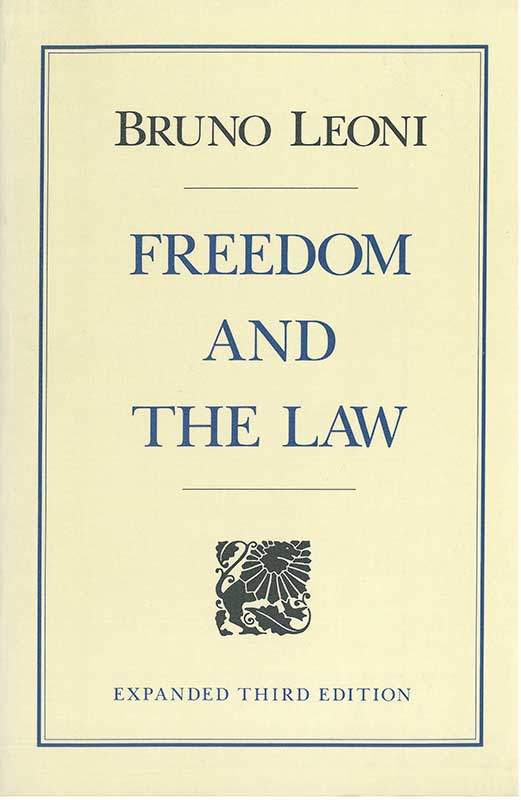
7: Freedom and the Common Will - Bruno Leoni, Freedom and the Law (LF ed.) [1961]Edition used:Freedom and the Law, expanded 3rd edition, foreword by Arthur Kemp (Indianapolis: Liberty Fund 1991).
About Liberty Fund:Liberty Fund, Inc. is a private, educational foundation established to encourage the study of the ideal of a society of free and responsible individuals. Copyright information:This work is copyrighted by the Institute for Humane Studies, George Mason University, Fairfax, Virginia, and is put online with their permission. Fair use statement:This material is put online to further the educational goals of Liberty Fund, Inc. Unless otherwise stated in the Copyright Information section above, this material may be used freely for educational and academic purposes. It may not be used in any way for profit.
7Freedom and the Common WillTo a superficial observer my suggestion of a redrawing of the maps of the areas occupied respectively by individual choices and by group decisions may resemble more a daring attack on the present system, with its emphasis on decision groups and group decisions, than a convincing argument in favor of another system emphasizing individual decisions. In politics there seem to be many issues on which, at least at first, agreement cannot be unanimous, and therefore group decisions, with their appendage of coercive procedures, majority rule, and so on, are unavoidable. This may be true of present systems, but it does not hold true of the same systems after a thorough assessment is made of the issues to be decided by groups in accordance with coercive procedures. Decision groups often remind us of groups of robbers, about whom the eminent American scholar, Lawrence Lowell, once remarked that they do not constitute a “majority” when—after having waited for a traveler in a lonely place—they deprive him of his purse. According to Lowell, a handful of people are not to be called a “majority” in comparison with the man they rob. Nor can the latter be called a “minority.” There are constitutional protections and, of course, criminal legislation in the United States as well as in other countries, tending to prevent the formation of such “majorities.” Unfortunately, many majorities in our time often have much in common with the peculiar “majority” described by Lawrence Lowell. They are legal majorities, constituted according to written law and to the constitutions, or at least according to some rather elastic interpretations of the constitutions, of many present-day countries. Whenever, for instance, a majority of the purported “representatives of the people” manage to obtain a group decision, for example, the present Landlord and Tenant Acts in England or similar statutes in Italy or elsewhere, designed to force landlords to keep in their houses, against their will and against all previous agreements, at a low rent, tenants who could easily pay, in most cases, a rent in accordance with market prices, I cannot see any reason to distinguish this majority from that described by Lawrence Lowell. There is only one difference: the latter is not permitted by the written law of the country, while the former at present is permitted. In fact, the one characteristic that both “majorities” have in common is the constraint exercised on the part of certain more numerous people against other less numerous people to make the latter suffer what they never would suffer if only they could make free choices and free agreements with the former. There is no reason to suppose that the individuals belonging to these majorities would have a different feeling from that of their present victims if the former belonged to the minorities they have managed to constrain. Thus, the Gospel dictum, which goes back at least as far as the Confucian philosophy, and which is probably one of the most strikingly concise rules of the philosophy of individual freedom—“Do not do unto others what you do not wish others to do unto you”—is being modified by all majorities of the Lowell kind as follows: “Do unto others what you do not wish others to do unto you.” In this respect, Schumpeter was correct when he said that the “common will” is a sham in modern political communities. We must agree with him if we consider all the cases of group decisions like those I have mentioned. People who belong to the winning side of the group say that they are deciding for the common interest and according to the “common will.” But whenever decisions are at issue constraining minorities to give up their money or to keep in their houses other people whom they do not want to keep there, there will be no unanimity on the part of all the members of the group. True, many people consider this very lack of unanimity as a good reason for invoking decision groups and coercive procedures. However, this is not a serious objection against the reform I am proposing. If we consider that one of the chief ends of such a reform would be to restore individual freedom as freedom from other people’s constraint, we shall find no reason to grant a place in our system to those decisions which involve the exercise of constraint over less numerous people on behalf of other, more numerous people. There could be no “common will” in these kinds of decisions unless one simply identifies the “common will” with the will of the majorities regardless of the freedom of the people belonging to the minorities. On the other hand, the “common will” has a meaning much more convincing than that adopted by supporters of group decisions. It is the will that emerges from the collaboration of all the people concerned, without any recourse to group decisions and decision groups. This common will creates and keeps alive words in the ordinary language as well as agreements and engagements among various parties without any need of coercion in relations among individuals; exalts popular artists, writers, actors, or wrestlers; and creates and keeps alive fashions, rules of courtesy, moral rules, and so on. This will is “common” in the sense that all those individuals who participate in manifesting and exercising it in a community are free to do so, while all those who eventually do not agree are equally free to do so in their turn without being forced by other people to accept their decision. Under such a system, all the members of the community appear to agree in principle that feelings, actions, forms of behavior, and so on, on the part of individuals belonging to the community are perfectly admissible and permissible without disturbing anybody, regardless of the number of individuals who feel like behaving or acting in these ways. True, this is more a theoretical model of the “common will” than a situation historically ascertainable in all details. But history offers us a number of examples of societies in which a “common will” may be said to have existed in the sense I have described. Even at present and even in those countries where coercive methods are widely applied, there are still many situations in which a true common will emerges and nobody would seriously contest its existence or desire a different state of affairs. Let us now see whether we can imagine a “common will” that reflects itself not only in a common language or in a common law, in common fashions, tastes, and so on, but also in group decisions, with all their paraphernalia of coercive procedures. Strictly speaking, we ought to conclude that no group decision, if it is not unanimous, is the expression of a will common to all the people who participate in that decision at a given time. But decisions are taken in some cases against minorities, as, for instance, when a verdict is reached by a jury against a robber or a murderer, that would not hesitate in their turn to adopt or to favor the same decision if they had been the victims of other people in the same respect. It has been noticed repeatedly since the time of Plato that even pirates and robbers must actually admit a law common to all of them, lest their band be dissolved or destroyed from within. If we take these facts into consideration, we can say that there are decisions which, although not reflecting at every moment the will of all the members of the group, can be considered as “common” to the group, in so far as everybody admits them under similar circumstances. I think that this is the nucleus of truth in certain paradoxical considerations by Rousseau that appear rather silly to his adversaries or to his superficial readers. When saying that a criminal wants his own condemnation, since he has agreed previously with other people to punish all criminals and himself too if that were the case, the French philosopher makes a statement that, literally taken, is nonsense. But it is no nonsense to presume that every criminal would admit and even request condemnation for other criminals in the same circumstances. In this sense, there is a “common will” on the part of every member of a community to hinder and eventually to punish certain kinds of behavior that are defined as crimes in that society. The same applies more or less to all other kinds of behavior called torts in the English-speaking countries, that is, forms of behavior that, according to a commonly shared conviction, are not allowed in the community. There is an obvious difference between the object of group decisions relating to the condemnation of such forms of behavior as crimes or torts and decisions relating to other forms of behavior such as those imposed upon landlords in the above-mentioned statutes. In the former case, sentences are pronounced by the group against an individual or a minority of individual members of the group who have committed robbery within the group itself. In the latter case, decisions are made that simply consist in committing some robbery against other people, namely, against people belonging to a minority of the group. In the former case, everybody, including each member of the minority being condemned for robbery, would approve condemnation in any other instance than his own; whereas in the latter case, just the contrary happens: the decision (for instance, to rob a minority within a group) would not be approved by the very members of the winning majority in any instance in which they themselves were the victims of it. But in both cases all the members of the groups concerned do feel, as we have seen, that some forms of behavior are condemnable. This is what allows us to say that actually there are group decisions which may correspond to a “common will” whenever we may presume that the object of those decisions would be approved under like circumstances by all the members of the group, including the minority members that are their present victims. On the other hand, we cannot consider as corresponding to the “common will” of a group such decisions as would not be approved under like circumstances by any member of the group, including the majority members who are now the beneficiaries. Group decisions of the latter type would have to be removed altogether from the map describing the area of suitable or necessary group decisions in contemporary society. All the group decisions of the former type should be left on the map after a rigorous assessment of their objective. Of course, I do not imagine that eliminating such group decisions would be an easy task on the part of anybody at the present time. Eliminating all group decisions taken by majorities of the Lowell type would mean terminating once and for all the sort of legal warfare that sets group against group in contemporary society because of the perpetual attempt of their respective members to constrain, to their own benefit, other members of the community to accept misproductive actions and treatment. From this point of view, one could apply to a conspicuous part of contemporary legislation the definition that the German theorist Clausewitz applied to war, namely, that it is a means of attaining those ends that it is no longer possible to attain by way of customary bargaining. It is this prevailing concept of the law as an instrument for sectional purposes that suggested, a century ago, to Bastiat his famous definition of the state: “L’État, la grande fiction à travers laquelle tout le monde s’efforce de vivre au dépens de tout le monde” (“that great fictitious entity by which everyone seeks to live at the expense of everyone else”). We must admit that this definition holds good also in our own time. An aggressive concept of legislation to serve sectional interest has subverted the ideal of political society as a homogeneous entity, nay, as a society at all. Minorities constrained to accept the results of legislation they would never agree to under other conditions feel unjustly treated and accept their situation only in order to avoid worse or consider it as an excuse for obtaining on their behalf other laws that in turn injure still other people. Perhaps this picture does not apply to the United States in such full measure as it does to several nations in Europe in which socialistic ideals have covered so many sectional interests of transitory as well as of lasting majorities within each country. But I need only refer to such laws as the Norris-La Guardia Act to convince my readers that what I am saying applies also to this country. Here, however, legal privileges in favor of particular groups are usually paid for, not by another particular group, as is the case in European countries, but by all the citizens in their capacity as taxpayers. Fortunately for all the people who hope that the reform I have suggested will take place some time or other, group decisions in our society are not all of the vexatious kind I have just considered nor are all majorities of the Lowell variety. Group decisions figuring in our present-day political maps concern also objects that would be more properly located on the map of individual decisions. Such objects, for instance, are covered by contemporary legislation whenever the latter limits itself to epitomizing what is commonly held as a right or a duty by the people of a country. I suspect that many of those who invoke written laws against the arbitrary powers of individual men, whether tyrants or state officials or even transitory majorities such as those that prevailed in Athens in the second half of the fifth century bc, more or less consciously think of laws as simply epitomizing unwritten rules already adopted by all the people in a given society. In fact, many written regulations could and still may be considered simply as epitomes of unwritten rules, at least with reference to their content, if not to the intention of the legislators concerned. A classical case is Justinian’s Corpus Juris. This is true notwithstanding the fact that, according to the explicit intention of that emperor, who (we must not forget) belonged to a country and to a people inclined to identify the law of the land with its written law, the whole of the Corpus Juris had to be adopted by his subjects as an enacted statute of the emperor himself. But a strict connection between the ideal of the Corpus Juris as a written law and the common or unwritten law actually embodied in it was strikingly evidenced by the content of the Corpus. Indeed, the central and more lasting part of it, the so-called Pandectae or Digesta, consisted entirely of statements of the old Roman jurists relating to the unwritten law. Their works were now collected and selected by Justinian (who may be considered, incidentally, as the editor of the most famous Reader’s Digest of all times) in order to be presented to his subjects as a particular formulation of his own personal orders. True, according to modern scholars, Justinian’s compilation, selection, and digestion must have been rather a tricky one, at least in several cases when reasonable doubts may arise about the authenticity of the texts included in the Corpus and allegedly belonging to the work of old Roman jurists like Paulus or Ulpian. But there is no doubt among scholars about the authenticity of the selection as a whole. Even doubts about the authenticity of the selection in particular cases have been abandoned to some extent in recent times by most scholars. In its turn, the Justinian selection was the object of a similar process on the part of the Continental jurists in the Middle Ages and in modern times, before our present age of codes and of written constitutions. For the Continental jurists of those days, it was not a question of “selecting” in the Justinian way, but of “interpreting,” that is, of stretching the meaning of the Justinian texts whenever it was necessary to give expression to new exigencies, while leaving the whole of it essentially valid, until recent times, as the law of the land in most of the Continental countries of Europe. Thus, while the old emperor had transformed the common law ascertained by the Roman jurists into a written law formally enacted by him, the medieval and the modern Continental jurists, before the enactment of present-day codes, transformed in their turn the formally enacted law of Justinian into a new law ascertained by the jurists, into a Juristenrecht, as the Germans used to call it, which was approximately a revised edition of the Justinian Corpus and therefore of old Roman law. Much to his surprise, an Italian colleague of mine discovered some years ago that the Justinian Corpus was still literally valid in some countries of the world—for instance, in South Africa. A client of his, a lady resident in Italy who had some property in South Africa, had put him in charge of the transactions concerned, which he duly undertook to carry out. Later on he was requested by his correspondent from South Africa to send him a declaration signed by the lady stating that she renounced availing herself in the future of the privilege conferred upon women by the Senatus Consultum Velleianum, that is, a provision enacted by the Roman Senate nineteen centuries ago in order to authorize women to go back on their word and in general to refuse to keep certain engagements towards other people. Those wise Roman senators were aware of the fact that women were inclined to change their mind and that therefore it would have been unfair to seek from them the same consistency that was usually required of men by the law of the land. The result of the Senate’s provision had been, I gather, slightly different from that expected by the senators. People had very little desire to enter into agreements with women after the enactment of the Senatus Consultum. A remedy for this inconvenience was finally found by admitting that women could renounce the privilege of the Senatus Consultum before engaging in some contracts, such as the sale of land. My colleague sent to South Africa the waiver of his client’s right to invoke the Senatus Consultum Velleianum, signed by the lady, and the sale was performed in due course. When I was told this story, I reflected with amusement that there are people who think that all we need to be happy are new laws. On the contrary, we have impressive historical evidence to support the conclusion that even legislation in many cases, after centuries and generations, has reflected much more a spontaneous process of law-making than the arbitrary will of a majority decision by a group of legislators. The German word Rechtsfindung, i.e., the operation of finding the law, seems to render well the central idea of the Juristenrecht and of the Continental European jurist’s activity as a whole. Law was conceived of, not as something enacted, but as something existing, which it was necessary to find, to discover. This operation was not to be performed directly by ascertaining the meaning of human engagements or of human feelings relating to rights and duties, but, first of all (at least apparently), by ascertaining the meaning of a written text two thousand years old, like the Justinian compilation. This idea is interesting from our point of view as it offers us evidence of the fact that written law is itself not always necessarily legislation, that is, enacted law. The Justinian Corpus Juris in Continental Europe was not legislation any longer, at least in the technical meaning of the word, i.e., law enacted by the legislative authority of the European countries. (This, incidentally, could please those people who cling to the ideal of the certainty of the law in the sense of a precisely worded formula, without sacrificing the ideal of the certainty of the law understood as the possibility of making long-run plans.) The codes of Continental Europe offer another example of a phenomenon very few people are aware of today, viz., the strict connection between the ideal of a formally enacted law and the ideal of a law the content of which is actually independent of legislation. These codes may be considered, in their turn, chiefly as epitomes of the Justinian Corpus Juris and of the interpretations that the Justinian compilation had undergone on the part of European jurists for several centuries during the Middle Ages and in modern times before the enactment of the codes. We could compare the codes of Continental Europe to some extent with the official pronouncements that the authorities, for instance in the Italian municipia of Roman times, used to issue certifying to the purity and the weight of the metals employed by private people in making coins, while present-day legislation may be compared as a rule to the interference by all contemporary governments in the determination of the value of their inconvertible legal tender notes. (Incidentally, legal tender money is itself a striking example of legislation in the contemporary sense, that is, of a group decision the result of which is that some members of the group are sacrificed for the benefit of others, while this could not happen if the former could freely choose which money to accept and which to refuse.) The codes of Continental Europe, like the Code Napoléon or the Austrian Code of 1811 or the German Code of 1900, were the result of several criticisms to which the Justinian compilation, already transformed into the Juristenrecht, had been subjected. A desire for certainty of the law, in the sense of verbal precision, was one of the chief reasons for the suggested codification. The Pandectae appeared to be rather a loose system of rules, many of which could be considered as particular instances of a more general rule that the Roman jurists had never bothered to formulate. Indeed, they had deliberately eschewed such formulations in most instances in order to avoid becoming prisoners of their own rules whenever they had to deal with unprecedented cases. In fact, there was a contradiction in the Justinian compilation. The emperor had attempted to transform into a closed and planned system what the Roman lawyers had always considered as an open and spontaneous system, but he tried to do so by making use of the work of these very lawyers. Thus, the Justinian system proved to be too open for a closed system, while the Juristenrecht in its turn, working in its characteristic piecemeal fashion, had increased, rather than reduced, the original contradiction in the Justinian system. The codification represented a considerable step in the direction of Justinian’s idea that law is a closed system, to be planned by experts under the direction of the political authorities, but it implied also that the planning ought to relate more to the form of the law than to its content. Thus, an eminent German scholar, Eugen Ehrlich, wrote that “the reformation of the law in the German Code of 1900 and in the preceding Continental codes was more apparent than real.”1 The Juristenrecht passed almost untouched into the new codes, although in a rather abridged form, the interpretation of which still implied substantial knowledge of the preceding juridical literature of the Continent. Unfortunately, after a certain time the newly adopted ideal of giving a legislative form to a nonlegislative content proved self-contradictory. Nonlegislative law is always changing, although slowly and in a rather clandestine way. It can no more be transformed into a closed system than can ordinary language, although the attempt has been made by scholars in several countries, such as the founders of Esperanto and of other artificial languages. But the remedy adopted for this inconvenience proved rather inefficient. New written laws had to be enacted to modify the codes, and, gradually, the original closed system of the codes became surrounded and overburdened with an enormous amount of other written rules, the accumulation of which is one of the most striking features of present-day European legal systems. Nevertheless, the codes are still considered in European countries as the nucleus of the law, and so far as their original content has still been preserved, we can recognize in them the connection between the ideal of a formally enacted law and a content tracing back to unwritten law that had first actuated Justinian’s compilation. If we consider, on the other hand, what has happened in comparatively recent times in the English-speaking countries, we can easily find examples of the same process. Several acts of Parliament are more or less epitomes of the rationes decidendi elaborated by courts of judicature during a long process stretching over the whole history of the common law. Those familiar with the history of the English common law will agree on being reminded, for instance, that the Infant Relief Act of 1874 did nothing but reinforce the common-law rule that infants” contracts are voidable at the infant’s option. To take another instance, the Sale of Goods Act of 1893 rendered statutory the common-law rule that when goods are sold by auction, in the absence of a contrary expressed intention the highest bid constitutes the offer, and the fall of the hammer constitutes the acceptance. In their turn, several other acts like the Statute of Frauds of 1677 or the Law of Property Act of 1925 rendered statutory other rules of common law (such as the rule that certain contracts were unenforceable unless evidenced in writing), and the Companies Act of 1948 binding promoters of companies to disclose certain specific matters in their prospectuses merely constituted an application to a particular case of some rules ascertained by the courts relating to the misinterpretation of contracts. It would be supererogatory to cite the other examples that could be mentioned. Finally, as Dicey already pointed out, many modern constitutions and bills of rights may be considered, in their turn, not as creations de nihilo on the part of modern Solons, but as more or less diligent epitomes of a set of rationes decidendi that courts of judicature in England had discovered and applied step by step in decisions concerning the rights of given individuals. The fact that both written codes and constitutions, although presenting themselves in the nineteenth century as enacted law, actually reflect in their content a law-making process based essentially on the spontaneous behavior of private individuals through centuries and generations could and still can induce liberal thinkers to consider written law (conceived of as a set of precisely worded general rules) as an indispensable means for the preservation of individual freedom in our time. In fact, the rules embodied in written codes and in written constitutions could appear as the best expression of the liberal principles in so far as they reflected a long historical process the result of which was not, in its essence, a legislator-made law, but a judge-made or a jurist-made law. This is like describing it as an “everybody-made” law of the variety that old Cato the Censor had exalted as the main cause of the greatness of the Roman system. The fact that enacted rules, although generally formulated, precisely worded, theoretically impartial, and also “certain” in some respects, could also have a content quite incompatible with individual freedom was disregarded by the Continental proponents of written codes and especially of written constitutions. They were convinced that the Rechtsstaat or the état de droit corresponded perfectly to the English rule of law and was also preferable to it because of clearer, more comprehensive, and more certain formulation. When the Rechtsstaat was corrupted, this conviction was soon revealed to be a delusion. In our time subversive parties of all kinds have found it easy, while trying to change altogether the content of the codes and the constitutions, to pretend that they were still respecting the classical idea of the Rechtsstaat, with its concern for the “generality,” “equality,” and “certainty” of the written rules approved by the “representative” deputies of the “people” according to majority rule. The nineteenth-century idea that the Juristenrecht of the Continent had been reinstated successfully and even more clearly rewritten in the codes (and that, moreover, the principles underlying the judge-made constitution of the English people had been successfully transferred into written constitutions enacted by legislative bodies) now paved the way for a new, emasculated concept of the Rechtsstaat—a state of law in which all the rules had to be enacted by the legislature. The fact that in the original codes and constitutions of the nineteenth century the legislature confined itself chiefly to epitomizing a law that had not been enacted was gradually forgotten or considered as of little significance compared with the fact that both codes and constitutions had been enacted by legislatures, the members of which were the “representatives” of the people. Concomitant with this fact was another, also pointed out by Professor Ehrlich. The Juristenrecht introduced into the codes had been abridged, but in a form that contemporary lawyers were able to understand easily by reference to a judicial background with which they had been perfectly familiar before the enactment of the codes.2 However, the lawyers of the second generation no longer were able to do this. They became accustomed to refer much more to the code itself than to its historical background. Aridity and poverty were, according to Ehrlich, the characteristic features of the commentaries of the second and subsequent generations of Continental lawyers—evidence of the fact that the activity of lawyers cannot remain at a high level if based only on a written law without the background of a long tradition. The most important consequence of the new trend was that people on the Continent and to a certain extent also in the English-speaking countries accustomed themselves more and more to conceiving of the whole of the law as written law, that is, as a single series of enactments on the part of legislative bodies according to majority rule. Thus, the law as a whole began to be thought of as the result of group decisions instead of individual choices, and some theorists—like Professor Hans Kelsen—went so far as to deny that it is even possible to speak of juridical or political behavior on the part of individuals without reference to a set of coercive rules by which all behavior is to be qualified as “legal” or not. Another consequence of this revolutionary concept of the law in our times was that the law-making process was no longer regarded as chiefly connected with a theoretical activity on the part of the experts, like judges or lawyers, but rather with the mere will of winning majorities within the legislative bodies. The principle of “representation” appeared to secure in its turn a purported connection between those winning majorities and each individual conceived of as a member of the electorate. Thus, the participation of individuals in the law-making process has ceased to be effective and has become more and more a sort of empty ceremony taking place periodically in the general election of a country. The spontaneous law-making process before the enactment of the codes and constitutions of the nineteenth century was by no means unique if considered in relation to other spontaneous processes like that of the ordinary language or of day-to-day economic transactions or of changing fashion. A characteristic feature of all these processes is that they are performed through the voluntary collaboration of an enormous number of individuals each of whom has a share in the process itself according to his willingness and his ability to maintain or even to modify the present condition of economic affairs, of language, of fashion, etc. There are no group decisions in this process that constrain anybody to adopt a new word instead of an old one or to wear a new type of suit instead of an old-fashioned one or to prefer a moving picture instead of a play. True, the present age does offer the spectacle of huge pressure groups whose propaganda is designed to make people engage in new economic transactions or adopt new fashions or even new words and languages such as Esperanto or Volapuk. We cannot deny that these groups may play a large part in modifying the choices of particular individuals, but this is never done through constraint. To confuse pressure or propaganda with constraint would be a mistake similar to that which we observed in analyzing certain other confusions relating to the meaning of “constraint.” Some forms of pressure can be associated with and even identified with constraint. But these are always connected with constraint in the proper sense of the word, such as occurs, for instance, when the inhabitants of a country are forbidden to import foreign newspapers and magazines or to listen to foreign broadcasts or simply to go abroad at all. In such cases propaganda and pressure inside a country are very similar to forms of constraint properly so called. People cannot hear the propaganda they would like better, cannot make a selection of information, and sometimes cannot even avoid listening to the broadcasts or reading the newspapers edited under the direction of their rulers inside the country. A similar situation arises in the economic field when monopolies are set up within a country with the help of legislation (that is, of group decisions and constraints) the purpose of which, for instance, is to hinder or to limit the importation of goods produced by potential competitors in foreign countries. Here too individuals are coerced in some way, but the cause of this coercion is not traceable to any action or behavior on the part of single individuals in the ordinary process of spontaneous collaboration I have already described. Special cases, such as those of subliminal devices or invisible advertising through infra-red rays acting on our eyes and therefore on our brains or obsessive advertisement and propaganda that one could not avoid seeing or hearing, may be considered as contrary to the rules already commonly accepted in every civilized country in order to protect everyone against other people’s constraint. Such cases may be rightly considered, therefore, as instances of constraint to be avoided by applying rules already existing on behalf of individual freedom. Now, legislation proves to be in the end a much less obvious and a much less usual device than it would appear to be if we did not pay attention to what is happening in other important fields of human action and of human behavior. I would even go so far as to say that legislation, especially if applied to the innumerable choices that individuals make in their daily life, appears to be something absolutely exceptional and even contrary to the rest of what takes place in human society. The most striking contrast between legislation and other processes of human activity emerges whenever we compare the former with the proceedings of science. I would even say that this is one of the greatest paradoxes of contemporary civilization: it has developed scientific methods to such an astonishing degree while at the same time extending, adding, and fostering such antithetic procedures as those of decision groups and majority rule. No truly scientific result has ever been reached through group decisions and majority rule. The whole history of modern science in the West evidences the fact that no majorities, no tyrants, no constraint can prevail in the long run against individuals whenever the latter are able to prove in some definite way that their own scientific theories work better than others and that their own view of things solves problems and difficulties better than others, regardless of the number, the authority, or the power of the latter. Indeed, the history of modern science, if considered from this point of view, constitutes the most convincing evidence of the failure of decision groups and group decisions based on some coercive procedure and more generally of the failure of constraint exercised over individuals as a pretended means of promoting scientific progress and of achieving scientific results. The trial of Galileo, at the dawn of our scientific era, is in this sense a symbol of its whole history, for many trials have since actually taken place in various countries up to the present day in which attempts have been made to constrain individual scientists to abandon some thesis. But no scientific thesis has ever been established or disproved in the end as a result of any contraint whatever exercised upon individual scientists by bigoted tyrants and ignorant majorities. On the contrary, scientific research is the most obvious example of a spontaneous process involving the free collaboration of innumerable individuals, each of whom has a share in it according to his willingness and abilities. The total result of this collaboration has never been anticipated or planned by particular individuals or groups. Nobody could even make a statement about what the outcome of such a collaboration would be without ascertaining it carefully every year, nay, every month and every day throughout the whole history of science. What would have happened in the countries of the West if scientific progress had been confined to group decisions and majority rule based on such principles as that of the “representation” of the scientists conceived of as members of an electorate, not to speak of a “representation” of the people at large? Plato outlined such a situation in his dialogue Politikos when he contrasted the so-called science of government and the sciences in general with the written rules enacted by the majority in the ancient Greek democracies. One of the characters in the dialogue proposes that the rules of medicine, of navigation, of mathematics, of agriculture, and of all the sciences and techniques known at his time be fixed by written rules (syngrammata) enacted by legislatures. It is clear, so the rest of the characters in the dialogue conclude, that in such a case all sciences and techniques will disappear without any hope of reviving again, being banished by a law that would hinder all research, and life, they add sadly, which is so hard already, would become impossible altogether. Yet the final conclusion of this Platonic dialogue is rather different. Although we cannot accept a state of affairs like this in the scientific field, we must, said Plato, accept it in the field of our law and of our institutions. Nobody would be so clever and so honest as to rule over his fellow citizens in disregard of fixed laws without causing many more inconveniences than a system of rigid legislation. This unexpected conclusion is rather similar to that of the authors of the written codes and written constitutions of the nineteenth century. Both Plato and these theorists contrasted written laws with the arbitrary actions of a ruler and maintained that the former were preferable to the latter, since no individual ruler could behave with sufficient wisdom to secure the common welfare of his country. I do not object to this conclusion provided we accept its premise: namely, that the arbitrary orders of tyrants are the only alternative to written rules. But history supplies us with abundant evidence to support the conclusion that this alternative is neither the only nor even the most significant one open to people who value individual freedom. It would be much more consistent with the historical evidence to point out another alternative—for instance, that between arbitrary rules laid down by particular individuals or groups, on the one hand, and spontaneous participation in the law-making process on the part of each and all of the inhabitants of a country, on the other. If we view the alternative in this light, there is no doubt about the choice in favor of individual freedom, conceived of as the condition of each man making his own choices without being constrained by anybody else to do unwillingly what the latter imposes. Nobody likes arbitrary orders on the part of kings, state officials, dictators, and so on. But legislation is not the appropriate alternative to arbitrariness, for arbitrariness may be and actually is exercised in many cases with the help of written rules that people must endure, since nobody participates in the process of making them except a handful of legislators. Professor Hayek, who is one of the most eminent supporters of written, general, and certain rules at the present time as a means of counteracting arbitrariness, is himself perfectly aware of the fact that the rule of law “is not sufficient to achieve the purpose” of safeguarding individual freedom, and admits that it is “not a sufficient condition of individual freedom, as it still leaves open an enormous field for possible action of the State.”3 This is also the reason why free markets and free trade, as a system as much as possible independent of legislation, must be considered not only as the most efficient means of obtaining free choices of goods and services on the part of the individuals concerned, but also as a model for any other system of which the purpose is to allow free individual choices, including those relating to the law and legal institutions. Of course, systems based on the spontaneous participation of each and all of the individuals concerned are not a panacea. Minorities exist in the market as well as in any other field, and their participation in the process is not always satisfactory, at least until their members are sufficiently numerous to induce producers to meet their demands. If I want to buy a rare book or a rare phonograph record in a small town, I may have to give up after some attempts, as no local seller of books or of records may be able to satisfy my request. But this is not at all a defect that coercive systems could avoid, unless we think of those supposedly utopian systems contrived by socialist reformers and dreamers and corresponding to the motto: Everything to everybody according to his needs. The land of Utopia has not yet been discovered. Thus, it would be of little use to criticize a system by contrasting it with nonexisting systems that, perhaps, would avoid the defects of the former. To sum up what I have said in this lecture: Individual freedom cannot be consistent with the “common will” whenever the latter is only a sham to conceal the exercise of constraint by majorities of the Lawrence Lowell variety over minorities that, in turn, would never accept the resulting situation if they were free to reject it. But individual freedom is consistent with the common will whenever the object of it is compatible with the principle formulated by the rule: “Do not do unto others what you do not wish others to do unto you.” In this case, group decisions are compatible with individual freedom in so far as they punish and offer redress for kinds of behavior that all members of the group would disapprove of, including the persons evincing such behavior if they were themselves the victims of it. Moreover, individual freedom may be consistent with decision groups and group decisions in so far as the latter reflect the results of a spontaneous participation of all the members of the group in the formation of a common will, for instance, in a law-making process independent of legislation. But the compatibility between individual freedom and legislation is a precarious one because of the potential contradiction between the ideal of the spontaneous formation of a common will and that of a statement about the latter arrived at by way of a coercive procedure, such as usually happens in legislation. Finally, individual freedom is perfectly compatible with all those processes the result of which is the formation of a common will without recourse to decision groups and group decisions. Ordinary language, day-to-day economic transactions, customs, fashions, spontaneous law-making processes, and, above all, scientific research are the most common and most convincing examples of this compatibility—indeed, of this intimate connection—between individual freedom and the spontaneous formation of a common will. In contrast to this spontaneous mode of determining the common will, legislation appears as a less efficient device for arriving at such a determination, as becomes evident when we pay attention to the imposing area within which the common will has been spontaneously determined in the countries of the West in the past as well as at present. History evidences the fact that legislation does not constitute an appropriate alternative to arbitrariness, but that it often ranks alongside the vexatious orders of tyrants or of arrogant majorities against all kinds of spontaneous processes of forming a common will in the sense I have described. From the point of view of the supporters of individual freedom it is not only a question of being suspicious of officials and rulers, but also of legislators. In this sense, we cannot accept the famous definition that Montesquieu gave of freedom as “the right to do all that the laws allow us to do.” As Benjamin Constant remarked in this connection: “No doubt there is no liberty when people cannot do all that the laws allow them to do; but laws could forbid so many things as to abolish liberty altogether.”4 [1 ] Eugen Ehrlich, Juristische Logik (Tübingen: Mohr, 1918), p. 166. [2 ] Ibid., p. 167. [3 ] F. A. Hayek, op. cit., p. 46. [4 ] B. Constant, Cours de politique constitutionnelle (Brussells, 1851), I, 178. |

Titles (by Subject)