EconlibThe LibraryOther Sites |
Front Page Titles (by Subject) Shelley's Case. - Selected Writings of Sir Edward Coke, vol. I
Return to Title Page for Selected Writings of Sir Edward Coke, vol. IThe Online Library of LibertyA project of Liberty Fund, Inc.Search this Title:Also in the Library:
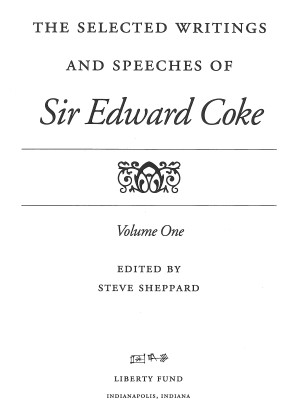
Shelley’s Case. - Sir Edward Coke, Selected Writings of Sir Edward Coke, vol. I [1600]Edition used:The Selected Writings and Speeches of Sir Edward Coke, ed. Steve Sheppard (Indianapolis: Liberty Fund, 2003). Vol. 1.
Part of: Selected Writings of Sir Edward Coke, 3 vols.About Liberty Fund:Liberty Fund, Inc. is a private, educational foundation established to encourage the study of the ideal of a society of free and responsible individuals. Copyright information:The copyright to this edition, in both print and electronic forms, is held by Liberty Fund, Inc. Fair use statement:This material is put online to further the educational goals of Liberty Fund, Inc. Unless otherwise stated in the Copyright Information section above, this material may be used freely for educational and academic purposes. It may not be used in any way for profit.
Shelley’s Case.(1581) Trinity Term, 23 Elizabeth I In the Court of King’s Bench, before all the Justices of England. First Published in the Reports, volume 1, page 93b.* Ed.: Edward Shelley and his wife Joan were tenants in special tail of a very long-term lease for years, which is to say that they held the right to the land under lease for life, although that right would go to their legal children living at their death and on to their children and so forth either until there was a failure of issue (which is to say that the current holder of the lease died and there were no children to take [in which case the lands reverted to Edward or his successors]), or until the lease ran out. Edward and Joan had two sons, Henry and Richard. Joan died. Henry married and had a daughter, Mary, and his wife had conceived a second child, who would be called Henry. Henry the father died before the Henry the younger was born and before his father Edward had died. Edward issued an indenture, or land transfer document, that would recover the old reversion of the fee tail, give the estate to himself for his life, then give it to some people out of the family for 24 years, and then give it to the heirs male of his body lawfully begotten (Edward’s legitimate sons or their legitimate sons and so on), with reversion in the event of a failure of issue to the heirs male of the body of John Shelley and of others. Edward died the morning before the procedure to recover the whole interest and enter the indenture was to be completed. Richard, the younger son of Edward, leased the land to a fellow named Wolfe. Henry the younger (the grandson of Edward and nephew of Richard) was born, and lawyers in his name threw Wolfe off the land. Besides the procedural difficulties of whether the action of recovery was good (it was) and whether Henry the younger had an interest (he did), the argument turned on whether Edward’s grant in tail was any good; if all of its clauses were in force, Richard could have made his lease. The court ruled that Edward’s grant was of an interest for life to Edward with a remainder to Edward’s heirs, which amounted to giving himself the whole of the estate, giving the fee tail to himself, thus extinguishing all of the later interests. Henry won. Richard’s interests, in Wolfe, were represented by three serjeants; Henry’s interests were represented by Popham, who was then the Solicitor General, as well as Cowper and Coke. The case was heard by the entire bench, the judges of Chancery, the Queen’s Bench, the Common Pleas, and the Exchequor. There is considerable discussion of the nature of a grant, the construction of words of a grant, and the vesting of interests in litigants at law. This case has become famous as the origin of the rule now understood that a grant of a life estate to one person, coupled with the grant of a remainder in that person’s heirs, becomes a single estate in fee simple absolute. This rule, here advocated by Coke, was a deliberate attempt by the courts to limit feudal restraints on the transfer of land. Nicholas Wolfe brought an ejectione firmae1 of certain land in B. in the county of Sussex, against Henry Shelley, Esq. defendant, and declared on a lease by Richard Shelley, Esq. to which the defendant pleaded not guilty. And a special verdict was found to the effect following, viz. that Edward Shelley and Joan his wife were seised of the manor of Barhamwick, whereof the said land, wherein the said ejectment was supposed, was and is parcel, in special tail, that is to say, to them and to the heirs of their two bodies lawfully begotten, and shews how, the remainder to the said Edward and his heirs; and it was further found that the said Edward and Joan had issue Henry their eldest son, and the said Richard their younger son, and afterwards the said Joan died, and the said Henry having issue Mary yet living, died in the life of the said Edward, his wife then big with child of the said Henry the now defendant. And afterwards the said Edward Shelley by indenture bearing date the 25th of September, in the first and second year of the late King and Queen Philip and Mary, and first delivered the sixth day of October following, did covenant with Cowper and Martin to suffer a recovery of the said manor, amongst other things: and that the said recovery should be to the use of the said Edward Shelley for the term of his life, without impeachment of waste; and after his decease to the use of Mr. Caril and others for 24 years, and after the said 24 years ended, then to the use of the heirs male of the body of the said Edward Shelley lawfully begotten, and of the heirs male of the body of such heirs male lawfully begotten; and for default of such issue, to the use of the heirs male of the body of John Shelley of Michael Grove, &c. It was also found, that the said Edward Shelley, the 9th day of |[94 a] October, being the first day of the term, between the hours of five and six in the morning died, and afterwards the recovery passed the same day with a voucher over, and immediately after judgment given, an habere facias seisinam2 was awarded, the wife of the said Henry Shelley being at that time great with child with the defendant. And afterwards, that is to say, the 19th day of October next following the recovery was executed; and afterwards the fourth day of December then next following, the wife of the said Henry was delivered of the said Henry now defendant. And it was likewise found that the said manor was in lease for years at the time of the said judgment and recovery, by force of a lease made long before the original writ purchased, upon which the said recovery was had: and that the said Richard Shelley, second son of the said Edward Shelley, and uncle to the said defendant, entered and made a lease to the said Nicholas Wolfe now plaintiff in the ejectione firmae; and that the said Henry Shelley the defendant entered upon the said Nicholas Wolfe and did eject him. And upon the whole matter aforesaid the Jurors pray the advice and judgment of the Court, if the entry of the said Henry the defendant was lawful or not; and if, by the judgment of the Court, the entry of the said Henry should be deemed unlawful, then the jury found that the defendant was guilty, and assessed damages: and if the entry of the defendant should be deemed by the Court to be lawful, then they found for the defendant that he was not guilty, &c. This case was divided into four principal questions: whereof 1. The first was, if tenant in tail suffers a common recovery with a voucher over, and dies before execution, if execution may be sued against the issue in tail. 2. The second, if tenant in tail makes a lease for years, and afterwards suffers a common recovery, if the reversion be presently by judgment of law in the recoveror, before any execution sued. 3. The third, if tenant in tail having issue two sons, and the elder dies in the life-time of his father, his wife privement enseint3 with a son, and then tenant in tail suffers a common recovery to the use of himself for term of his life, and after his death to the use of A. and C. for 24 years, and after to the use of the heirs male of his body lawfully begotten, and of the heirs male of the body of such heirs male lawfully begotten, and presently after judgment an habere facias seisinam is awarded, and before the execution, that is to say, between five and six in the morning of the same day, in |[94 b] which the recovery was suffered, tenant in tail dies, and after his death and before the birth of the son of the elder son, the recovery is executed, by force whereof Richard, the uncle, enters, and after the son of the elder son is born, if his entry upon the uncle be lawful or not. 4. The fourth and last point, if the uncle in this case may take as a purchaser, forasmuch as the elder son had a daughter which was heir general and right heir of Edward Shelley, at the time of the execution of the recovery. And this case was argued by Anderson the Queen’s Serjeant, and Gawdy and Fenner, Serjeants, for the plaintiff, and by Popham, Solicitor-General, Cowper, and Coke, for the defendant. And as to the first point, the plaintiff’s counsel argued, that execution might be sued against the issue in tail; and their principal reason was, because the judgment given against the tenant in tail, and the judgment for the tenant in tail to have in value against the vouchee, bound the right of the estate-tail, and the issue in tail shall not avoid it by the Statute de Donis Conditionalibus, because the law adjudgeth that, in respect of the intended recompense, the issue in tail was not prejudiced: as if tenant in tail grant a rent for the release of one who hath a right to the land, it shall bind the issue in tail, because it is for the benefit of the issue, and so not restrained by the said act, as it is agreed in 44 Edw. 3. 21b. Octavian Lumbard’s Case. And if the recovery, upon which execution is had in the life of the tenant in tail, shall not be a bar to the issue, it would be mischievous and a great impeachment to common assurances of lands. And further, it was said, that the right of the estate-tail was bound by the judgment, and not by the execution; for if the right of the estatetail was not bound by the judgment, it could not be bound or barred by the execution had afterwards. As to the second point, they conceived, that it was not any question, but that the recoverors had not the reversion presently by the judgment, notwithstanding the lands were in lease for years; for they said that the judgment was, that the demandant should recover seisin of the land which was but executory, and could not be executed until execution, entry, or claim. As if a common or reversion, or any other thing which lieth in grant be granted upon condition, if the condition be broken, the thing granted is not in the grantor before claim, for it was said, that when a man may enter, or claim, the law will not adjudge him in possession until entry or claim. As to the third point, which was the great doubt of the case, they argued, that the said Richard, the uncle, was in by purchase, & ex consequenti4 the entry of the defendant upon him was not lawful; and this in effect was their principal reason: |[95 a] Argument. viz., that which originally vests in the heir, and was not in the ancestor, vests in the heir by purchase. But this use originally vests in Richard Shelley, and never was [vested] in Edward Shelley. And therefore the use vests in Richard Shelley by purchase. And they said, that it was manifest that the use never vested in Edward Shelley, for before the recovery executed no use could be raised, for the use ought to be raised out of the estate of the recoverors, but the recovery was not executed in the life of Edward Shelley, and therefore no use could rise during his life. And Serjeant Anderson said, it was impossible that Richard Shelley should be in by descent, because no right, title, action, use, or other thing touching the uses limited by the said indentures did descend to Richard, but only a thing intended to him, which intent in his life received no perfection; and therefore this case was not like any case where a right, title, action, use, or other thing descendeth from the ancestor to the heir, but is like the case in 5 Edw. 4. 6a. where the wife consents to a ravisher, having issue a daughter, the daughter enters by the statute of 6 Rich. 2. a son is afterwards born, he shall never divest it, for it vested in the daughter by purchase; so is the case agreed in 9 Hen. 7. 25a. If a lease be made to one for life, the remainder to the right heirs of J. S., if J. S. dies having a daughter, his wife with child with a son, the daughter claims it by purchase, and therefore the son born after shall never divest it; but they relied principally upon the case in 9 Hen. 7. 25a. that if a condition descends to the daughter, and she enters for the condition broken, the son born afterwards shall never enter upon her, and yet there she is in by descent, and the title of her entry, that is to say, the condition, she hath as heir: and yet because she was the first in whom it vested, the son born after shall not divest it, which is a stronger case than our case at the Bar. And further it was said by the plaintiff’s counsel, that although the recovery had been executed in the life of Edward Shelley, yet ought the heir male to take by purchase; for they said, that the manner of the limitation of the uses is to be observed in this case, which is first to Edward Shelley for the term of his life, and after his death to the use of others for the term of 24 years, and after the 24 years ended, then to the use of the heirs male of the body of the said Edward Shelley, |[95 b] lawfully begotten, and of the heirs male of the body of the said heirs male lawfully begotten; in which case they said, that if the heirs male of the body of Edward Shelley should be words of limitation, then the subsequent words, viz. and of the heirs male of the body of the said heirs male lawfully begotten, would be void: for words of limitation cannot be added and joined to words of limitation, but to words of purchase. And they said, that forasmuch as those words, heirs males of the body of Edward Shelley, might be words of purchase, that in this case the law will construe and take them as words of purchase, for otherwise the said subsequent words, “and of the heirs male of their bodies,” would be void. And such construction is always to be made of a deed that all the words (if possible) agreeable to reason and conformable to law, may take effect according to the intent of the parties without rejecting of any, or by any construction to make them void. And therefore Anderson put this case, if a man makes a feoffment in fee, to the use of himself for life, and after his decease to the use of his heirs, in this case the fee-simple executed; but in the same case, if the limitation be to the use of himself for life, and after his decease to the use of his heirs, and of their heirs female of their bodies, in this case these words “his heirs” are words of purchase, and not of limitation, for then the subsequent words “and of their heirs female of their bodies” would be void. So they concluded this point, first that no use could rise until execution sued, no execution was sued in the life of Edward Shelley, and then it first vested in Richard as a purchaser before the son of the elder son was born: and for the latter reason, admitting the recovery had been executed, notwithstanding the heirs male of the body of Edward Shelley should take by purchase, and so quacunque via data,5 they concluded, that the use first settled in Richard Shelley as a mere purchaser. And as to the latter point, which in effect (admitting, as hath been said, that the said words were words of purchase) was, that a lease for life is made to A. the remainder to the heirs male of the body of Edward Shelley, if in this case Richard may take this estate-tail by purchase as heir male, notwithstanding his elder brother had issue a daughter which is living, and who was his heir general; they said there was no difference as to that, where an estate-tail is limited by gift executed, and when by way of remainder, nor when the heir male of the body claims by descent, nor when by purchase, for if an estate had been made to Edward Shelley, and to the heirs male of his body, in that case |[96 a] Richard Shelley without doubt should have had the land by descent, and that by a construction on the Statute de Donis conditionalibus to fulfil the mind and intent of the donor. And so it is, if I give lands to a man, and to his heirs female, and the donee hath issue male and female, although the female be not heir general, yet she is heir special to claim per formam doni.6 And this was in effect the substance of the three arguments published and delivered at large on the plaintiff’s part before the Justices of the Queen’s Bench in Hilary and Easter terms, in the 23d year of the reign of Queen Elizabeth. And on the defendant’s part it was argued contrary. As to the first point it was argued, that execution could not be sued against the issue in tail; and therefore as it hath been agreed, that the judgment only against the tenant in tail did not bind, but the judgment to have in recompense, sequitur a concessis,7 that the issue in tail cannot be barred: and for proof that in this case the issue in tail could not have any recompense: first it was said, that if execution could not be sued against the issue in tail, then the issue in tail could not take any benefit of the recompense. For it is agreed in 17 Edw. 2. title Recovery in Value, Fitz. 33. 1 Edw. 3. fo. 12. that he who vouches shall never have execution against the vouchee before execution sued against himself; so that the judgment to recover over in value is not material (as the case is) unless execution may be sued against the issue, which cannot be in this case. For he who is in of an estate in possession, by title paramount a recovery, shall not be bound by the same recovery; but the issue in tail in our case is in of an estate in possession, which he had by title paramount the recovery, and therefore the issue in tail shall not be bound by the recovery. In proof of the first proposition, it hath been adjudged in 28 Hen. 8. reported by Serjeant Bendloes, which case began 26 Hen. 8. in the book at large, where the case was, that an executor having judgment to recover a debt due to the testator, and dying intestate before execution, and the Ordinary committing the administration of the first testator to one, that the administrator could not sue execution upon that recovery, because he deriveth his interest from, and represents the person of the testator, and so before the recovery. So it is, if there be two joint-tenants, and one makes a lease for years, rendering rent, the lessor dies, the other shall not have the rent; because he claims by the first feoffor, which is paramount the lease and the reservation. So if tenant for life makes a lease for years, reserving rent, and afterwards surrenders to him in the reversion, not being in by force of his ancient reversion, he cannot have the rent newly reserved. And in proof that the issue in tail was in by a title paramount |[96 b] the recovery, he said, that the issue in tail shall avoid all charges, leases, and other incumbrances made by his ancestor, because he claims per formam doni. And if tenant in fee simple makes a lease for life, and suffers a recovery, he and his heirs are for ever concluded; but he said, if tenant in tail be of a reversion expectant on an estate for life, and he suffers a recovery, and hath judgment to recover over in value, yet his issue shall avoid the recovery, for he shall not be estopped, because he claims in per formam doni: but if execution had been sued in the life of tenant in tail, then forasmuch as the estate-tail doth not descend to the issue; and forasmuch as then he may sue execution over, it is good reason to bar the estate-tail; but if the issue in tail be in by lawful descent in possession of the estate-tail before the recovery [is] executed, then the law seems to be otherwise. Octavian Lumbard’s Case in 44 Edw. 3. which hath been cited on the other side, was not against this opinion, for there the issue in tail reaped the benefit of the release made to his ancestor; but in our case, the issue in tail being in of an estatetail paramount the recovery, cannot take benefit of the recompense over. And wherefore should not the issue in tail in this case, be at liberty to chuse whether he will take the estate-tail, or otherwise to admit execution to be sued against him, and to sue execution over in value, as well as in 14 Hen. 6. fol. 2. in the case of exchange, in which case although assets of greater value descend to him than the land in tail, yet he may chuse to have the one or the other at his election. And if tenant in tail be disseised, and levies a fine to the disseisor without warranty and dies, if the issue in tail enters, and is seised by force of the tail before all the proclamations are made, although the proclamations be afterwards made, yet that does not bar the issue: So if tenant in tail levies a fine and disseises the conusee, and dies before all the proclamations are made, and after the proclamations in the time of the issue in tail pass, yet the issue is not bound thereby, by the statute of 32 Hen. 8. and yet the words of the Act are, that all fines after proclamations, &c. shall bar, &c. But it hath always been held, if the issue in tail be remitted and seised by force of the tail before the bar be complete, that is to say, before the proclamation be passed, the issue is not bound; so in this case before execution sued, the issue in tail is seised by force of the tail, and in per formam doni before the bar is complete, and therefore the execution cannot be sued against him, nor can any bar after the death of his father be made to the estate tail which is descended to him in possession. And it is agreed in 7 Edw. 3. 335. that if a disseisor at the Common Law before the Statute |[97 a] of Non-claim, had levied a fine, or suffered judgment in a writ of right, until execution sued, they were not bars, for the year shall be accounted after the transmutation of the possession by execution of the fine or recovery; and so it is said in Stowel’s Case, Plow. Com. 357e.; and the books in 28 Ass. pl. 32. 7 Hen. 4. fol. 17. 17b. Plow. Com. 55b. 12 Edw. 4. fol. 20a. were cited, that execution upon a feigned recovery against the father, cannot be sued against the issue in tail. To the second point they argued, that forasmuch as the land was in lease for years, that the recovery was executed by judgment of law presently after the judgment. And a difference was taken whenthe lands were in the possession of the tenant at the time of the judgment, and when the lands were in lease for years. And their reason of the difference was, because the recoverors in the one case may sue execution, and in the other case may not; and because the recoverors cannot sue execution, the law will therefore adjudge them in execution presently; the reason thereof is, that otherwise the lessee during the term might commit waste, and would be dispunishable by the recoveror, but if the recoverer may enter or sue execution, then he may prevent it. And therefore, if a fine sur cognizance de droit tantum8 be levied of land in possession, the cognizee hath nothing before entry, as it is agreed 48 Edw. 3. fol. 15b. 10 Hen. 6. fol. 16b. and Littl. in his Chapter of Attornment fol. 131b.: but if a fine sur cognizance de droit tantum be levied of a reversion upon an estate for life or years, or of a seignory, or any other thing which lieth in grant, there the reversion, or thing which lieth in grant, passeth presently. And it was said, that a common recovery is in nature of a common conveyance, and so it appears, that a reversion, or thing which lieth in grant, is more easily transferred from one person to another, than an estate of freehold in possession. A condition is executory as well as a judgment, but if the feoffor cannot enter, there the law will adjudge him in possession presently. And therefore it is holden in 20 Hen. 7. fol. 4b. 20 Edw. 4. fol. 19a. & 22 Edw. 4. that if the condition be collateral, and the feoffee makes a lease back again for years to the feoffor, and then the condition is broken, the law shall adjudge the feoffor in of a present fee-simple, because he cannot enter; and yet in that case he may say, that forasmuch as he cannot enter, therefore he ought to make claim; yet the law in that case requires no claim to be made; but, in the case before, it is otherwise, where no lease for years had been made back again, and the reason may be for the mischief before-mentioned. The case of Littleton fol. 84. was likewise cited, where Littletonis of opinion, that in the case of a condition, the fee-simple shall be revested again in the lessor, because he cannot enter, and the Law will |[97 b] adjudge him in possession without entry or claim. It was likewise said, that those things which lie in grant, as in the case before remembered of the fine, they pass to the conusee immediately, by the fine levied: so in the case of a common recovery (which is now become a common assurance and conveyance) such things, which lie in grant, are in the recoveror by the judgment. And therefore, there are some opinions in the Books in 22 Ass. pl. 84. 45 Edw. 3. fol. 26b. & 30 Edw. 3. fol. 33. that if a man hath judgment to recover a rent, or common, or any thing which lieth in grant, there the thing so recovered is in the recoveror by the judgment, for the Books say, that the demandant is in seisin immediately by the judgment. And they cited the case in 27 Hen. 8. fol. 7a. which is direct in the point, that the recovery is executed immediately by the judgment; the land being in lease for years. So they said, first, that execution could not be sued against issue in tail: secondly, if it was necessary that execution should be had in the life of Edward Shelley, that it was executed by the judgment of the law: And if the judgment was executed by operation of the law, then the estate-tail to his heirs male of his body was in Edward Shelley, and consequently the entry of the defendant was lawful without question. But for the argument of the third point, [which was the great doubt in the case,]9 admitting the Law in both the said points to be against the defendant, that is to say, that execution might be sued against the issue in tail; and that the recovery was not executed in the life of Edward Shelley, but after his death, and before the defendant was born: yet the defendant’s counsel argued that the defendant’s entry was lawful. The first reason in effect was as followeth: When the Law prescribes a means to perfect or settle any right or estate, if by the act of God, this means in some circumstances (as in our case in time) becomes impossible, yet no party who was to have received benefit, if the means had been, with all circumstances, executed, shall receive any prejudice for not executing it in such circumstance which became impossible by the act of God, if every thing be performed without laches that the parties might perform; for it would be unreasonable that those things which are inevitable by the act of God, which no industry can avoid, nor policy prevent, should be construed to the prejudice of any person in whom there was no laches. And therefore the prescript Rule of Law is, that although a man shall not be tenant by the curtesy without actual seisin; yet of a rent, or of an advowson, if the wife dies before the rent-day, or before the avoidance, he shall be tenant by the curtesy, as it is agreed in 7 Edw. 3. |[98 a] 66a, 66b. & 3 Hen. 7. 5b. for by the act of God it is become impossible for him to have actual possession. Also, if lessee for the term of another man’s life, be disseised of certain lands, and the disseisor takes the profits of them, now if the disseisee will recover the mean profits, the means which the Law prescribes for the same is, That the tenant for the other man’s life shall re-enter, and then he shall recover all the mean profits in an action of trespass; but if the means become impossible by the act of God, by the death of the cestuy que vie,10 so that he cannot re-enter, then he shall have an action of trespass without any re-entry, because the means is become impossible by the act of God, viz. the re-entry, as it is held in 38 Hen. 6. fol. 28e. Also, if a lessee covenants to leave a wood in as good plight as the wood was at the time of the lease, and afterwards the trees are blown down by tempest, he is discharged of his covenant, quia impotent’ excusat legem,11 as it is held in 40 Edw. 3. 6a. So if the father be enfeoffed with warranty to him and to his heirs, and afterwards the father enfeoff his son and heir apparent with warranty, and afterwards dies; now in regard the act of God hath destroyed the warranty between the father and the son, the son shall vouch as heir, although he is in by purchase, because the act of God hath determined the warranty between the father and the son, as it is adjudged in 43 Edw. 3. 23b. & 30 Edw. 3. 22. So in this case, when Edward Shelley died the morning of the same day that judgment was given, immediately upon the judgment, the recoverors sued forth an habere fac’ seisinam, so that no laches was in any party, but it became impossible by the act of God, that execution could be had in the life of Edward Shelley; and therefore execution being had after his decease, shall not prejudice the son born after, who at that time was in utero matris.12 The second reason was, because the use vested in Richard Shelley although not directly by descent as to have his age, or to toll an entry, &c. yet in the nature and degree of a descent by reason of the original act begun in the life of the ancestor; and their reason, in substance, was to this purpose. Where the heir takes any thing which might have vested in the ancestor, the heir should be in by descent; [then, although it first vested in the heir and never in the ancestor, yet the heir shall take it in the nature and course of a descent;]13 but in the case here the use might have vested in Edward Shelley, and if it had vested in Edward, then Richard Shelley would have taken it by descent, and therefore Richard, in this case ought to take this use in the nature and course of a descent. And therefore if a fine had been levied sur cognisance de droit tantum to Edward Shelley in fee, and after, and before execution, Edward had died, and Richard had entered before Henry was born; now although Richard be the first who entereth, yet forasmuch as this fine was levied to his ancestor and his |[98 b] heirs, so that he claimeth by words of limitation; and forasmuch as the first and original act was done in the life of the father, and because it might have vested in the ancestor, and if it had vested in the ancestor, it had descended, for this cause Richard had taken it in course and degree of a descent, and the entry of the defendant had been lawful upon him. And yet, in that case, Richard should not have been in directly by descent, either to be in ward, or to have had his age, or to have tolled the entry of one who had right; but otherwise it is when the remainder is limited to the right heirs of J. S., &c. for there it beginneth in the son by name of purchase, and never could have vested in the brother, as the Book in 9 Hen. 7. 24. cited by the other side is agreed. So in the case of ravishment, 5 Edw. 4. fol. 6. which was cited on the other side; for in these cases, and all the others which have been put by the other side, the estate vested originally by purchase, and no beginning was in the life of the ancestor, which could ever have vested in the ancestor. And 16 Edw. 3 tit. Age Br. 51. if Richard Shelley had a seignory by descent, and afterwards the tenancy had escheated, and after the son is born, in that case the son shall enter upon him; for although the tenancy first vested in him, and never was in the father, yet because the original cause, viz. the seignory, was in the father, therefore the son shall enter upon the uncle. And Chapman’s Case in Mr. Plowden’s new reports, fol. 284. was cited, for there it appears, that a covenant was made with Chapman, that he would make a lease for years to Chapman, &c. and before the lease was made Chapman died, and then the lease was made to his executors, so that the term did first commence in the executors; yet forasmuch as the covenant made to the testator was the cause of the making of the estate to the executors, for that reason the term was assets in the executor’s hands, as well as if it had been made to the testator himself. So in our case, although the land first vested in Richard, yet it vested by reason of the recovery had against Edward Shelley, and the indenture made by him, and therefore Richard shall be in course of descent as well as the executors in the course of executors. Further, admitting that Edward Shelley had exchanged certain land with another, and the other had entered into the land of Edward Shelley, but Edward Shelley had died before the entry, the Law is clear that the heir of Edward Shelley may enter into the land taken in exchange if he will, and so Perkins clearly takes it, fol. 57a.; then admitting that Richard Shelley had entered into the land taken in exchange, now he is the first in whom the land vests, but because it might have vested in Edward Shelley, and because he came to it by words of limitation, the son of the elder son born afterwards shall enter upon him: and yet |[99 a] no right, title, use, nor action descends in this case; for at his election the exchange might have been avoided. And so it is, if a man seised of the manor of S. covenants with another, that when J. S. shall enfeoff him of the manor of D., then he will stand seised of the manor of S. to the use of the covenantee and his heirs; the covenantee dies his heir within age, J. S. enfeoffeth the covenantor; in this case it was holden in Wood’s Case, 3 Eliz. in the Court of Wards, that the heir shall be adjudged in, in course and nature of a descent; and yet it was neither a right, title, use, nor action that descended, but only a possibility of a use, which could neither be released nor discharged; yet it might, if the condition had been performed, have vested in the ancestor, and then the heir had claimed it by descent. And therefore in that case the heir was not in by purchase, but in by course of descent. And admitting that in all the cases which have been put, as in the case of ravishment, and in the case of the remainder, &c. he who might first enter dies before entry, and the younger son enters, and afterwards the son of the elder son is born, now it is clear, that the son of the elder son shall divest the land from the uncle, for it might have vested in the ancestor; and so to the case which hath been urged by the plaintiff’s counsel in 9 Hen. 7. 25. of the condition: the solicitor and Coke said, that it might be allowed for law, if the true sense thereof be apprehended. And therefore if the condition be, that the feoffor or his heirs pay the sum of 201. or do any act before a day certain, that they shall re-enter, in that case if the father dies before the day of payment, and the daughter to save the inheritance pays the money, or satisfies the condition; in these cases peradventure the son shall not divest it, for if the daughter had not performed the condition, the land had been utterly lost. And therefore, in that case, a good argument may be made, that the daughter may detain the land, for qui sentit onus, sentire debet & commodum.14 But if the condition was to be performed on the part of the feoffee, or broken in the life of the feoffor, then they said the law was clearly otherwise, for the heir entering for such condition broken shall be in ward, and have his age, and no such special reason as in the case next before. It was also asked, out of what fountain this use should arise, and who was the mother that conceived this use? and the indenture answers, the recovery. For the indentures say, that the recovery shall be to the uses, &c. Then it was said, if the recovery be the mother which conceived this use, and the fountain out of which the use rose; forasmuch as this recovery was had in the life of Edward Shelley, although the use slept, and was as embrio in utero matris15 until execution sued: yet the execution |[99 b] being once had, the execution shall respect the recovery and raise the use, which slept before, which use being once awaked, or raised, takes its life and essence from the recovery which was had in the life of Edward Shelley. And thereupon some of the defendant’s counsel argued in this manner, The execution of every thing which is executory always respects the original act or cause executory, and when the execution is done, it hath relation to the thing executory, and all makes but one act or record, although it be performed at several times: And therefore if A. by deed indented, covenants with B., that B. shall recover against him the manor of D. within a year next following; and that the recovery and execution thereupon to be had within the said year, shall be had to the recoveror in tail, &c. and after the recovery is had within the year, and the execution is sued after the year, in this case it is clear, that although the covenant is not pursued in time according to the precise form of it, yet the use shall be guided by the said indentures: So in the same case, if the same recovery betwixt the same parties of the same land was suffered after the year, yet if no other intervenient agreement were between the parties, the recovery shall be intended to be to the uses of the indentures. For variance in time in such case shall not subvert the original agreement and contract of the parties. And it is held in 6 Edw. 3. 44b. that if the presentment to a church by an usurper be in time of war and the institution and induction, which are but as executions of the presentment be in time of peace, yet it shall be avoided, for the Law regards the original act & causa & origo est materia negotii.16 If a man who is non compos mentis,17 gives himself a mortal wound, and before he dies hebecomes of sanamemoria,18 and afterwards dies of the same wound; in this case, although he dies of sana memoria by reason of his own proper wound, yet because the original cause of his death, viz. the wound was when he was non compos mentis, he shall not be felo de se,19 because the death, &c. hath relation to the original act which was the stroke or wound; which see 22 Edw. 3. titula Corone 244. And so it is 33 Ass. 7. Corone 210. if a servant hath an intent to kill his master, and before execution of his intent goes out of service, and being out of service, executes his purpose, and kills him who was his master; this is petit-treason, for the execution doth respect the original cause, which was the malice conceived when he was servant; and yet if the law should adjudge and make construction according to the several times, then it would be plain, it would be no petit-treason. So in our case, the execution of the use relates to the indentures and recovery. |[100 a] It was also asked, when after that the execution was had, so that now the use, which before slept, is raised, what thing is it that governs and directs this use? And it is to be answered, the indentures. And what is their direction? That the said Edward Shelley shall have it, and after his death the heirs male of his body, so that the indentures direct the use to the heirs male of his body by way of limitation of estate, and not by way of purchase. And from thence this reason was collected; The indentures direct and govern the manner and quality of the use, but the indentures direct that the heirs male of the body of Edward Shelley shall take it by limitation of estate, and not by name of purchase; and therefore Richard ought to have it as heir by limitation of estate, and not by name of purchase; for when the execution was had, the indentures immediately guided the use to Richard, because he was at that time heir male of the body of Edward Shelley, which Richard is not heir after the birth of the son of the elder son. Further it was said, admitting all the matter before would not serve for the defendant (which the defendant’s counselheldstrongly it would) yet it is to be considered, in this case, that the estate vests in Richard by way of limitation of use and not by any conveyance by the Common Law in possession: and therefore admit our case had been before the making of the stat. of 27 Hen. 8., and that the recoverors had sued execution after the death of Edward, and before the son of the elder son was born, and then the son of the elder son had been born. In that case it was asked, which of them should have the subpoena? And the defendant’s counsel conceived that the son of the elder son, although the use did first attach in the uncle, should have the subpoena. For if the intent of Edward Shelley may appear to the Court, that the son of the elder son should have this use, then that is the rule by which the use is to be guided and directed. For at the Common Law the intent of the parties was the direction of the uses, for they were only determinable, and to be adjudged by the Chancellor who is Judge of Equity, and that in Chancery, which is a Court of Conscience: and as Bracton saith, fol. 18. Nihil tam conveniens est naturali aequitati quam voluntatem domini volentis rem suam in alium transferre ratam haberi.20 And therefore in proof, that uses are directed by the intent and meaning of the parties, divers cases were cited, 31 Hen. 6. titulo Subpoena Fitzherbert 23. Statham Conscience 1. A man being cestuy que use, and having an only daughter, declared his intent and meaning to the feoffees, that after his decease his daughter should have his land. And therefore a question |[100 b] arose in Chancery, whether he might revoke this limitation of the use made to his daughter; and in arguing this case, Fortescue held, That if cestuy que use hath issue a daughter, and being sick, declares his intent to his feoffee, that his daughter shall have his land after his decease; and after he recovers his health, and hath issue a son, now he said it is good conscience that the son should have the subpoena, for he is his heir. Note the reason of Fortescue, because he is his heir. And there Fortescue said, that Conscientia dicitur a con & scio, quasi simul scire cum Deo,21 that is to say, the will of God as near as reason wills. We find likewise in divers other cases in our books, that the intent of the parties is the direction of uses, by a considerable and favourable construction. And therefore it is held in 7 Hen. 6. fol. 4b. if a man be seised of land on the part of his mother, and makes a feoffment in fee, reserving rent to him and his heirs, in that case, by the rule of Common Law, as Littleton says, the rent shall go to the heir on the part of the father; but if a man be seised of lands on the part of the mother, and makes a feoffment in fee to the use of him and his heirs, the book is directly agreed in 5 Edw. 4. fol. 7b. that this use shall not go to the heir at the Common Law, but forasmuch as the land and living move from the part of the mother, therefore in equity, the use which is nothing but a trust and confidence, should go also to the heirs on the part of the mother. Littleton likewise says, that a man shall not have a fee-simple by a feoffment or grant without these words “his heirs.” And yet the Law is plain, that if a man had before the statute of 27 Hen. 8. bargained and sold his land for money without these words, “his heirs,” the bargainee hath a fee-simple. And the reason is, because by the Common Law nothing passeth from the bargainor, but a use, which is guided by the intent of the parties, which was to convey the land wholly to the bargainee; and forasmuch as the law intends that the bargainee paid the very value of the land, therefore in equity, and according to the meaning of the parties, the bargainee had the fee-simple without these words “his heirs,” as it is held in 27 Hen. 8. fol. 5. 4 Edw. 6. Br. Estates 78. 6 Edw. 6. and in the time of Hen. 8. Br. Conscience 25. So in our case, although the use first vested in the uncle, admitting the case to be before the stat. of 27 Hen. 8. yet seeing that the intent of Edward Shelley, was to advance the son of his elder son, and because in equity the general heir is to be favoured, therefore the son after born shall have the subpoena. Moreover the rule in Law is, that if an estate be limited to two, the one capable, and the other not capable, he who is capable shall take the whole, as the cases are agreed in 17 Edw. 3. fol. 29. and 18 Edw. 3. 59. If a man gives land to one & primogenito filio,22 if he hath no son |[101 a] the father takes the whole: And so it is 1 lib. Ass. 11. & tempore,23 Edw. 1. Taile 24. if a man gives lands to a man, and to such a woman as shall be his wife, the man takes the whole; but if a man makes a feoffment in fee, to the use of himself and his wife that shall be, and afterwards he marries, his wife shall take jointly with him, as it was held in The Lord Pawlet’s Case, 17 Eliz. Dyer 340., notwithstanding the whole vested at first in the husband. Also, the rule of Law is, that a remainder cannot stand without a particular estate, and yet the Book is agreed in 37 Hen. 6. fol. 36a. that if a man makes a feoffment in fee to the use of one for life, and after to the use of another in fee, although the particular tenant refuses, yet the remainder is good. And so it is said in the Book in the case of a devise. As if a man devises lands for life, the remainder in fee, and the tenant for life refuses, yet the remainder is good: And so note, that the limitation in uses and estates given by devises resemble one another. So the Judges there took the construction of devises, and of estates conveyed in use to be all one, viz. according to the meaning of the parties: And admitting in the case here, the land had been of the custom of gavelkind,24 and upon that it had been asked, if Edward Shelley had had sundry other sons, should the elder son only have had the whole use? surely he only should not have it, but all equally, and yet if he had taken it by purchase, then the elder son only ought to have it. Now the intent of Edward Shelley, is to be proved by divers circumstances apparent in the record; first, if Edward Shelley had intended to have given it to the uncle, he never would have given it him by so general a name as “heir male,” for if the recovery had been executed in the life of Edward Shelley as was fully intended, then it had been in manner agreed, that Richard Shelley could not have had the land, for the “heirs male” are words of limitation; or if the son of the elder son had been born in the life of Edward Shelley, which was impossible for Edward Shelley to have known the contrary, for the defendant was born within one month after his death, then out of all question the uncle could never have had it; and therefore except you will ground uponabsurdities, the one, that Edward Shelley knew that he should die before the recovery executed; the other, that he should die, before the birth of the son of his elder son, which none could know but God; it must be granted, that the intent of Edward Shelley was to advance his elder son, and by no means to disinherit him. Also, at the time of his death Richard Shelley was eighteen years old: And therefore, if he intended to advance Richard, he would not have given his lands to his trusty friends Mr. Carill and others for twenty-four years; but without doubt he intended that the son of his eldest son should have it; and the same moved him to devise such a term which might be ended when the defendant should be of fit age |[101 b] to receive and govern his living. The reason why the said Edward Shelley suffered the said recovery was, (as it seems) because Mary, daughter of his elder son named in the special verdict, would have inherited; and if the wife of his elder son had been delivered of a daughter, then had the land gone out of his name, and therefore for the continuance of the land in his name and family, he suffered the said recovery; and therefore it being by way of limitation of use, the son of the elder son ought to have it, and especially inasmuch as no rule in Law in our case is impugned, but it stands well, as hath been proved before, with the rule of the Common Law. And one of the defendant’s counsel said, that at the Common Law, a use being but a trust and confidence, and, as is said in 14 Hen. 8., resting only in privity betwixt those who had notice thereof; and forasmuch as the consciences of the feoffees and others who were trusted became too large, and would not perform the confidence reposed in them, but made feoffments upon divers considerations to strangers not having notice of the uses, and by divers other fraudulent devices, did deceive and defraud those to whose uses they were seised: therefore first was the stat. of 1 Rich. 3. made, by which authority was given to the cestuy que use to enter and make a feoffment; But after that statute the feoffees oftentimes did prevent the feoffment of cestuy que use by subtle and cunning practices, yet defrauding the cestuy que use, and not discharging the trust reposed in them; and therefore to take away all the power and means of deceiving by the feoffees, the stat. of 27 Hen. 8. was made. And therefore it is holden for the better opinion at this day, that for the raising of future uses after the stat. the regress of the feoffees is not requisite, and that they have not power to bar these future uses, for the statute hath transferred all the estate out of them. But he said, in our case, if the suing of the execution after the death of Edward Shelley, and before the birth of the son of the elder son, should make the uncle have the land, then it would rest in the disposition and pleasure of the recoverors, whom they would make to inherit; for then it would follow, that if they enter and execute the recovery before the birth of the son of the elder son, then the uncle should have it, and if they would not enter until after the birth of the son of the elder son, then without all question the son of the elder son should have the land: so that by this construction, the matter would lie in the breast of the recoverers who were but instruments, and not persons in any manner trusted to settle the inheritance in whom they pleased, which was never any part of the meaning of Edward Shelley, and which is very absurd in reason. And it would be mischievous that the inheritance of any man should be at the appointment and discretion of two strangers, who were named only as instruments, and never in any manner trusted; and it would be a |[102 a] greater mischief than any was at the Common Law. Also, as this case is, if the sheriff had executed the recovery upon the day on which the writ of execution was sued forth, then it had been evident that the son of the elder son should have had the land, for then had execution in judgment of law been in the life of Edward Shelley. But by the construction which hath been made, it would likewise be in the power of the sheriff to settle the inheritance in whom he pleased, for if he had executed the recovery the same day, as might have been done, or after the birth of the son of the elder son, then the son of the elder son should have had the land; but uno absurdo dato infinita sequuntur.25 And therefore for the avoidance of these mischiefs and absurdities, the law will adjudge Richard in the land in course and nature of a descent, and then all the mischiefs and absurdities are avoided, and no ground or rule in the law is thwarted. And note, the stat. of 27 Hen. 8. is, that cestuy que use shall have the possession to all intents, constructions, and purposes in law, and of and in such like estates as they had or ought to have in the use; and that he shall have the possession after such quality, manner, form and condition, as they had before had, or have had the use, trust, or confidence; so if the uncle before the statute had had the use, trust or confidence in nature and course of a descent, yet the son of the elder son shall divest the use, and have the subpoena: and because the statute executes the possession after such quality, manner, form, and condition, as the use, trust, or confidence was in them; for these causes the possession executed by the statute ought to be subject to the entry of the son of the elder son. And therefore, if cestuy que use had issue a daughter, and died before the stat. of 27 Hen. 8. his wife being great with child with a son, and before the birth of the son, the statute had been made, so that the possession had first vested by force of the statute in the daughter, yet the son born after might enter upon her; for the daughter had the possession in the same quality and condition as she had the use, but she had the use by descent, and subject to be divested by the birth of the son, and therefore he ought to have the possession by the statute in the same quality and degree, and that is in the nature and course of descent: But in the case of descent, the son after-born shall enter upon the daughter, and therefore the son in this case shall enter upon the daughter; and the like construction upon the like case hath been made before this time, therefore Justice Mountagu in Wimbishe’s Case, and Plowden in Plowden’s Comm. fol. 56b. held that if a woman hath a jointure made her by her husband in tail, and hath issue a daughter, being great with child with a son, and before the birth of the son she discontinues with warranty; now the stat. of 11 Hen. 7. saith, that such person to whom the title after the death of such wife |[102 b] doth appertain shall enter into the lands, and shall possess and enjoy the same according to their title to the same, as if no such discontinuance had been made; and therefore he held clearly, that although the daughter after such discontinuance first entereth, yet the son born after shall enter upon her by reason of the words of the stat. of 11 Hen. 7. for the words are, that she ought to enjoy the same according to her title; but her title is in tail, and therefore after the birth of the son, he being next heir in tail, the title of the tail shall be devolved from her to the son. So in our case the stat. of 27 Hen. 8. saith, that cestuy que use shall have the possession in the same quality, manner, form, and condition as he had the use. And therefore if a use were limited before the statute to John S. and Jane at Gappe, and to their heirs, and afterwards they intermarry, and after the statute is made, by which the possession is executed to them and their heirs during the coverture; yet they shall not have a divided estate, but the like moieties as they had in the use. So if cestuy que use be of certain lands held by priority and of other land by posteriority, and after the statute is made, by which execution is made of the possession of both at the same time, yet he shall have the possession of both in the same quality as he had the use, and all that by the express words of the statute. And it is to be noted, that the stat. of 27 Hen. 8. doth not speak only of uses, but also of trusts and confidence, so that although no use rose in the time of the life of Edward Shelley, yet there was a trust and confidence expressed in his life. And therefore when the use is once raised, it ought to be vested according to the trust and confidence which Edward Shelley intended and declared by the indentures. Lastly, the defendant’s counsel argued, That the uncle could not have the land as a purchaser, admitting the remainder had been limited to the right heirs male of the body of Edward Shelley, in as much as the eldest son of Edward Shelley had issue Mary his daughter, who is yet alive, as appears by the Record, and who is heir to Edward Shelley. It hath been said, that although Mary at the time of the death of Edward Shelley, was heir general, yet the said Richard was at that time heir male of the body of Edward Shelley. And therefore he might as special heir male of the body of Edward Shelley take the remainder, although Mary is heir general; and therefore it hath been said that if lands had been given to Edward Shelley, and to the heirs male of his body lawfully begotten, that in that case, after his death, Richard Shelley as heir male per formam doni shall inherit, although the daughter of the elder son was general heir to Edward Shelley. To that they answered, and took a difference when the heir male of the body claims by descent, and when he claims by purchase; for in descents the law is as hath been alleged, but it is otherwise in cases of purchase. This |[103 a] difference was proved by the case in 37 Hen. 8. Br. Done 42. If a man makes a gift in tail of lands in gavelkind to a man and his heirs male of his body lawfully begotten, and hath issue four sons, in this case all the sons shall inherit: But if a lease for life be made of lands in gavelkind, the remainder to the right heirs of J. S. and J. S. dies, having issue four sons, in this case the eldest son only shall have the remainder, for there can be but one right heir in the case of purchase. And so is Ellerker’s opinion expresly in 9 Hen. 6. fol. 24a. If a man makes a lease for life, the remainder to the right heirs female of the body of J. S. and J. S. hath issue a son and a daughter, and dieth, in this case the daughter shall not take the remainder, for she is not heir female to take by purchase. And yet it is plain, that if a gift in tail had been made to J. S. himself, and to the heirs female of his body, and J. S. dieth, having issue a son and daughter, the daughter should have had the land by descent. Also in 37 Hen. 8. Br. Done 61. it appears, that the Lord Hussey made a feoffment in fee to the use of Anne his wife for life, and after to the use of the heirs of his body, and after the Lord Hussey was attainted of treason, and although Brook hath not expressed the judgment, yet it was said, it was adjudged, that the right heirs of his body could not as purchaser take the remainder, because he was not heir of his body to take it by purchase, by reason of the attainder of his father. And yet before the stat. of 26 Hen. 8. if tenant in tail had committed high treason the land had descended. And in Brooke’s Reports aforesaid it appears, that Hare, the Master of the Rolls, took the difference between a gift in possession to a man and to his heirs female of his body, and a lease for his life, the remainder to the right heirs female of his body; for in case of a remainder (as he said) she ought to be heir indeed, or else she can never claim it by purchase. So it appears by these authorities, that in case of purchase the heir male of the body ought to be heir indeed. And forasmuch as in our case, the uncle was not heir male for a man cannot have two heirs to claim by purchase, therefore as purchaser the uncle cannot claim it. But it hath been said, that the Statute de Donis Conditionalibus aids and helps the heir male of the body to take, for that the will of the donor appears, that the heir male of his body should have the land; and the statute saith, quod voluntas donatoris secundum formam in charta doni sui manifeste expressa, de caetero observetur.26 In answer of which, one of the defendant’s counsel declared |[103 b] the reason of the other cases and authorities which had been cited, and of the difference which was taken before; and therefore he said that the Statute de Donis Conditionalibus did not help this case. Mr. Littleton in his chapter of Estate-tail saith, that every gift in tail within the Statute de Donis Conditionalibus, before themaking of that statute, was a fee-simple at the Common Law; and therefore he put the case before the Statute de Donis Conditionalibus, and examined if the same had been a fee-simple conditional before the said statute, for otherwise it cannot be an estate in fee-tail by the statute. For he said that the Statute de Donis Conditionalibus was a nurse, and no mother of estates of inheritances tail, and that it preserved the estates of inheritances in fee-tail, but did not beget or procreate any estates tail, which were not fee-simple conditional before. And therefore he took the law to be clear, that if a man gives land to a man & semini suo,27 or to a man & liberis suis de corpore,28 or prolibus suis,29 or exitibus suis,30 or pueris suis de corpore,31 in these cases the donee hath no estate in fee-tail, but only an estate for term of life; for if such gifts had been made before the statute, they had been no fee-simples conditional; and therefore by Mr. Littleton’s rule, no estate-tail by the Statute de Donis Conditionalibus. For the statute creates no new inheritances, which were no inheritances at the Common Law, but only nurses and preserves those which were estates of inheritance at the Common Law. And therefore the law was taken in the Case of Martin Hastings of Norfolk, for the manor of Elsinge, and where an estate was made to one of his ancestors, and to the issue male of his body, that in that case he had but an estate for life. And so it was held by Sir Roger Manwood, then one of the Justices of the Common Pleas, clearly in argument of Clatch’s Case, anno 16 Eliz. and therefore he examined the case here before the said statute; and he took it without question, that if a lease had been made for life, the remainder to the heirs male of the body of J. S. that in that case, if J. S. had issue two sons, and the eldest son having issue a daughter died in the life of J. S. and then J. S. had died; that in that case the younger son of J. S. after his death cannot take this fee-simple conditional by the Common Law, for he was not heir male of the body to take this fee-simple by purchase; for first he ought to be heir, and secondly he ought to be heir male. And in that case if J. S. had been attainted of treason or felony, the heir male of his body could never have taken the remainder, for he was not heir, which might be the reason of The Lord Hussey’s Case before cited. And it is holden in 12 Edw. 3. |[104 a] titulo Variance 77. that where a man makes a gift to the husband and wife, and to the heirs of the body of the husband, and if the husband and wife die without issue of their two bodies, that then it shall remain over; in that case although the will of the donor appears, that the wife shall be also donee in special tail, yet forasmuch as by the order of the Common Law she could not have an estate of fee-simple conditional, for that cause she could not have an estate-tail by the statute. But in the said case where lands are given to a man and the heirs female of his body; here is an estate of inheritance vested in the donee, which estate of in heritance the Statute de Donis Conditionalibus directs to the heir female by descent, although there be an issue male. And as to what hath been objected, that forasmuch as the limitation was to the heirs male of the body of Edward Shelley, and of the heirs male of the body of the heirs male lawfully begotten, that the heirs male of the body of Edward Shelley should be purchasers, for otherwise the subsequent words would be void: The defendant’s counsel answered, that it is a Rule in Law, when the ancestor by any gift or conveyance takes an estate of freehold, and in the same gift or conveyance an estate is limited either mediately or immediately to his heirs in fee or in tail; that always in such cases, “the heirs” are words of limitation of the estate, and not words of purchase. And that appears in 40 Edw. 3. fol. 9a, 9b. in The Provost of Beverley’s Case, in 38 Edw. 3. fol. 31d. 24 Edw. 3. 36b. 27 Edw. 3. fol. 87a. and in divers other books. So inasmuch as in this case Edward Shelley took an estate of freehold, and after an estate is limited to his heirs male of his body, the heirs male of his body must of necessity take by descent, and cannot be purchasers; otherwise is it where an estate for years is limited to the ancestor, the remainder to another for life, the remainder to the right heirs of the lessee for years; there his heirs are purchasers. Or if the remainder be limited to the heir in the singular number upon a lease for life, there the heir takes an estate for term of life by purchase. And if it should be admitted, that in regard of the said subsequent words, the right heirs male should have by purchase to them and the heirs male of their bodies, then a violence would be offered as well to the words as to the meaning of the party, for if the heir male of the body of Edward Shelley should take as purchaser, then all the other issue male of the body of Edward Shelley would be excluded to take any thing by the limitation; and it would be against the express |[104 b] limitation of the party. For the limitation is to the use of the heirs male of the body of Edward Shelley, and of the heirs male of their bodies begotten, and for default of such issue, to divers other persons in remainder; so if Richard Shelley being the heir male of the body of Edward Shelley at the time of his death should take by purchase, then the heirs male of the body of Richard Shelley only would be inheritable, and no other of the sons of Edward Shelley, nor their heirs male, and consequently, if Richard Shelley should die without issue male, the land would remain over to strangers, and all the other sons of Edward Shelley which he then had and might afterwards have, and their issues, would be utterly disinherited; because the words were in the plural number, “heirs male of the body of Edward Shelley,” the former construction will be against the very letter of the indentures, for by that means the plural number will be reduced to the singular number, that is to say, to one heir male of the body of Edward Shelley only: and forasmuch as the first words, viz. (“heirs male of the body of Edward Shelley” include the subsequent words, viz. “the heirs male of their bodies”) for every heir male begotten of the body of the heir male of Edward Shelley is, in construction of law, an heir male of the body of Edward Shelley himself; for this reason the subsequent words are words declaratory, and do not restrain the former words. As in the case of Littleton, if a man makes a feoffment in fee, ita quod32 the feoffee shall do such an act, in that case Littleton said it is commonly used in such cases to have also these words, “and if the act be not done, it shall be lawful for the feoffor to re-enter,” which he said was more than was necessary, for the first words are sufficient in law, and include them, yet he said they were well put in, to declare and express the law to lay-people. And lastly in this case, if Richard Shelley should not be in course and nature of a descent, then he could not take at all; for when an estate is made to a man, and after in the same deed, (to limit the quality of the estate) a further limitation is made to his heirs, or to the heirs of his body; in all these cases his heirs, or the heirs of his body, shall never take as purchasers, but in this case these words, “heirs male of the body of Edward Shelley,” were words of limitation; and therefore the heir male of the body cannot take as a purchaser. And in proof of the first proposition, it was said, that this is the reason of the book in 40 Ass. pl. 19. and of Mr. Littleton’s Case, fol. 128. that if a man grants a reversion, or a seignory, by deed to J. S. and his heirs, if the grantee dies before attornment,33 the attornment to the heir is void, for if the attornment should be good, then the |[105 a] heir would be in as a purchaser, where by the grant and meaning of the parties, these words, “his heirs,” were words of limitation to limit the estate of the grantee himself; and so it was held in Nichol’s Case in Plow. Com. fol. 483. that if a man leases lands to a man for life, and if the lessor dies without heir of his body, that then the lessee shall have the land to him and to his heirs; in that case, if lessee for life dies, and then the lessor dies without heir of his body, the heir of the lessee shall not have the land, as it was held clearly causa qua supra.34 And so the law is clear, as it is commonly agreed in our books, if two men exchange lands in fee-simple, or fee-tail, if both the parties die before the exchange be executed, of each part, the exchange is void; for if the heirs should enter, they would be in as purchasers by force of the words, which were words of limitation of the estate, and not of purchase. And upon the same reason is Brett’s and Rigden’s Case adjudged in Plow. Com fol. 342a stronger case than this case is. For a man devised lands to another and to his heirs, and the devisee died in the life of the devisor, and then the devisor died; and it was adjudged, that the heir should not take by the devise, for in that case the heirs are not named as words of purchase, but only to express and limit the estate which the devisee should have; for without the word “heirs,” the devisee could not have the fee-simple, and the heirs are named only to convey the land in fee-simple, and not to make any other to be purchaser than the first devisee. So in our case the heirs male of the body of Edward Shelley are named only to give Edward Shelley an estate-tail, and not to make any other purchaser than Edward Shelley only, and without those words he could not have had an estatetail; and therefore the uncle in our case cannot claim the land as a mere purchaser, but if he takes it in any sort, he shall take it in nature and course of a descent, and therefore quacunq. via data,35 the uncle cannot have the land; and if he take it in nature and course of a descent, (for as a purchaser he cannot take) then the elder son shall enter upon him, and so quacunq. via data the son of the elder son ought to have the land. And therefore to conclude: first, no execution could be sued against the issue in tail, because no execution was sued in the life of Edward Shelley. Secondly, admitting execution might have been sued against the issue in tail, and that execution was requisite to be had in the life of Edward Shelley, inasmuch as the lands were in lease for years, that the reversion was immediately vested in the recoveror by the judgment: thirdly, admitting execution might be sued against the issue in tail, and that the recovery was not executed till after the death of Edward Shelley; yet first, |[105 b] forasmuch as it was impossible by the act of God that execution should be sued in the life of Edward Shelley; secondly, that the indentures guide the use, and direct it to the heirs male of the body of Edward Shelley by words of limitation; thirdly, that the use and estate do not commence originally in the uncle as a mere purchaser, but first vested in the uncle by force of the indentures made by Edward Shelley and the recovery had against him, and might have vested in Edward Shelley, and if it had been vested in Edward Shelley, then without doubt Richard Shelley had taken by descent; fourthly, that the estate is conveyed by way of limitation of use, which is always directed by the intent of the parties; fifthly, that it would be absurd and mischievous to adjudge the whole inheritance to be at the disposal of the recoverors, or of the sheriff, who never were trusted; and lastly, that Richard the uncle ought either to claim in nature or course of descent; and then no question but the entry of the defendant was lawful, or otherwise merely by purchase, which by the rules of law, and for the reasons aforesaid he cannot; and therefore they concluded that the entry of Henry Shelley the defendant was lawful, and that judgment ought to be given against the plaintiff, that he should take nothing by his bill. After the said case had been openly and at large argued at three several days by the counsel of each side in the King’s Bench, the Queen hearing thereof (for such was the rareness and difficulty of the case, being of importance, that it was generally known) of her gracious disposition, to prevent long, tedious, and chargeable suits between parties so near in blood, which would be the ruin of both, being gentlemen of a good and ancient family, directed her gracious letters to Sir Thomas Bromley, Knight, Lord Chancellor of England, who was of great and profound knowledge and judgment in the law, thereby requiring him to assemble all the justices of England before him, and upon conference had between themselves touching the said questions, to give their resolutions and judgments thereof; and thereupon the Lord Chancellor in Easter term, in the 23d year of her reign, called before him at his house, called York-house, Sir Christopher Wray, Knight Lord Chief Justice of England, and all his companions, Justices of the Queen’s Bench, Sir James Dyer, Knight Lord Chief Justice of the Court of Common Pleas, and all his companions, justices of the same Court; and Sir Roger Manwood, Knight Lord Chief Baron of the Exchequer, and the Barons of the Exchequer, before whom the questions aforesaid were moved and shortly argued by Serjeant Fenner, on the plaintiff’s part, and by one on the defendant’s part.36 At which time the Lord |[106 a] Chancellor was of opinion for the defendant, and openly declared his opinion before all the justices, that upon the third question the law was for the defendant, and therefore the defendant’s entry upon the uncle was lawful: but the said questions were not resolved at that time, the said justices desiring time to consider of the questions. And eight or nine days after in the same term, all the said justices and Barons met together in Serjeant’s-Inn, in Fleet Street, for the resolution of the said case, and there the case was again shortly argued by them; after which arguments the justices at that time did confer among themselves, and took further time to consider of the said questions in the next vacation, till the beginning of Trinity term then next following; and accordingly in the beginning of Trinity term, after great study and consideration of the said record of the special verdict, all the said justices and Barons met again in Serjeant’s Inn, in Fleet Street; at which time upon conference amongst themselves, all the justices of England, the Lord Chief Baron, and the Barons of the Exchequer, except one of the puisne justices of the Court of Common Pleas, agreed that the defendant’s entry upon the said Richard the uncle was lawful; and four or five days after their last meeting, one of the defendant’s counsel came to the Bar in the Queen’s Bench, and moved the justices to know their resolutions in the said case; for their resolution was not before known to the defendant, nor to his counsel. And Sir Christopher Wray, Knight Lord Chief Justice, answered, that they were resolved; and thereupon asked the plaintiff’s counsel being then at the Bar, if they could say any more on the plaintiff’s part, who answered, That they had said as much as they could: and also demanded of the defendant’s counsel, if they had any new matter to say for the defendant, who said, No. And then the said Chief Justice gave judgment, that the plaintiff should take nothing by his bill: And because the counsel of both sides, who were present, were desirous to know upon which of the said points their resolution did depend, the said Chief Justice openly declared, That as to the first point, the better and greater part of all the justices and Barons held that execution might be sued against the issue in tail, because the right of the estate-tail was bound by the judgment against the tenant in tail, and the judgment over to have in value, and that in favour of common |[106 b] recoveries, which are the common assurances of the land. And as to the second point, they were all agreed, that the reversion was not in the recoverors immediately by the judgment: But he said, that all the justices of England and Barons of the Exchequer, except one of the justices of the Common Pleas, were agreed as to the third point. That the uncle was in, in course and nature of a descent, although he should not have his age, nor be in ward, &c.: First, because the original act, viz. the recovery, out of which all the uses and estates had their essence, was had in the life of Edward Shelley, to which the execution after had a retrospect: Secondly, because the use and possession might have vested in Edward Shelley, if execution had been sued in his life: Thirdly, the recoverors by their entry, nor the sheriff by doing of execution, could not make whom they pleased inherit: Fourthly, because the uncle claimed the use by force of the recovery, and of the indentures by words of limitation, and not of purchase. These were, as the Chief Justice said, the principal reasons of their judgment. And it was resolved by them all, that the recovery, notwithstanding the death of Edward Shelley in the morning between the hours of five and six on the same day, was good enough. And so it was resolved by Sir Thomas Bromley, Knight Lord Chancellor of England, Sir Christopher Wray, Knight Lord Chief Justice of England, Sir James Dyer, Knight Lord Chief Justice of the Court of Common Pleas, Sir Roger Manwood, Knight Lord Chief Baron of the Exchequer, Sir Thomas Gawdy, Knight one of the Justices of Her Highness’s Bench, and by all the Justices of the Queen’s Bench, and by all the Justices, saving one of the Common Pleas, and by all the Barons of the Exchequer, that the right of the defendant was good, and his entry lawful, and judgment was given accordingly. Part Two of the ReportsThe Second Part of Coke’s Reports was published in 1602. It was originally published in Law French and entitled Le Second Part Des Reportes Del Edvvard Coke Lattorney General Le Roigne, De Divers matter en Ley, avec graunde & mature consideration resolve, & adjudge, queux ne sueront unques resolve ou adjudge par devant, & les raisons & causes de yceux durant le Raigne de trefillure & renomes Roygne Elizabeth, le fountaine de tout Justice & la vie de la Ley. In English, The Second Part of the Reports of Sir Edward Coke, Knight., Her Majesty’s Attorney-General, of divers Matters In Law, with great and Mature consideration Resolved and Adjudged, which were never Resolved or Adjudged Before: and the Reasons and Causes thereof: During the Reign of the most Illustrious and Renowned Queen Elizabeth, the Fountain of all Justice, and the life of the Law. The whole of the cases in this part is a series of issues in the control, transfer, and obligations arising from the ownership of property, including some cases, such as the problem of bankrupts, dealing with satisfaction of debts from property. There is a lesser emphasis in this part on both the style and the content of pleading and on the effect of pleading in deciding the dispute. Epigrams from the Title Page: Ecclesiasticus Cap. 24. Videte quod non mihi soli laboravi, sed omnibus exquirentibus scientiam.1 Papian. Lib. 1. Definit. Lex est commune praeceptum, vivorum prudentium consultum, delictorum que sponte vel ignorantia contrabuntur, communis reipublicae sponsio.2 Isodorus. Lex dicitur a ligando, quia obligat; vel dicitur a legendo, quia publice legatur.3 Cic. Lib. 1. de Legibus. Cum dico legem, a me dici nihil aliud intelligi volo quam imperium; sine quo domus ulla, nec civitas, nec gens; nec gens, nec hominum universum genus stare, nec rerum natura omnis, nec ipse mundus potest.4 Seneca ad Lucil. Epist. 1085 Illud tamen prius scribam, quemadmodem tibi ista cupiditas discendi, qua flagrare te video, regenda sit, ne ipsa impediat; nec passim carpenda sunt, nec avide invadenda universa: per partes pervenitur ad totum: aptari onus viribus debet, nec plus occupari, quam cui sufficere possumus: non quantum vis, sed quantum capis hauriendum est: Quo plus recipit animus, hoc se magis laxat.6 Idem. Epist. 45. Lectio certa prodest, varia delectat; qui quo destinavit pervenire vult unam sequatur viam, non per multas vagetur, non ire istud sed errare est.7 Idem. ad Lucil. in Epist. Non refert quam multos, sed quam bonos habeas libros; multitido librorum onerat non instruit, & satius est paucis authoribus te tradere, quam errare per multos.8 Jero. Epist. 88
Statue tibi quot horis legas, non ad laborem sed ad delictationem.9 [* ][Ed.: Coke also reports the pleadings, commencing in volume one at page 88b.] [1. ][Ed.: Ejection from the land. (A writ to commence a suit at law for trespass.)] [2. ][Ed.: That you cause to have seisin. (The writ of execution in real actions.)] [3. ][Ed.: secretly pregnant (The 1658 edition translates the phrase into the text as ‘young with child.’ Later editions restore the French term.)] [4. ][Ed.: and as a consequence.] [5. ][Ed.: whichever way you take it,] [6. ][Ed.: by the form of the gift.] [7. ][Ed.: it follows from these premises, (literally, “from the things granted.”)] [8. ][Ed.: ‘upon acknowledgment of right’ only (a term of art for the form of fine, or judicial proceeding to sue to convey land, and sometimes to alter the nature of a prior grant; in particular this form was used to convey an estate in reversion or remainder.)] [9. ][Ed.: This aside was omitted from the 1658 edition; it had been restored by 1793.] [10. ][Ed.: The person whose life measures the duration of the grant, literally, “he for whose life.”] [11. ][Ed.: because impotence (i.e., powerlessness) excuses from the law,] [12. ][Ed.: in [his] mother’s womb.] [13. ][Ed.: Bracketted text omitted from the 1658 edition; it had been restored by 1793.] [14. ][Ed.: who bears the burden ought also to take the benefit.] [15. ][Ed.: an embryo in [his] mother’s womb] [16. ][Ed.: and the substance of the matter lies in the cause and origin.] [17. ][Ed.: not of sound mind,] [18. ][Ed.: sound memory (i.e., sane)] [19. ][Ed.: a suicide,] [20. ][Ed.: Nothing is so consonant to natural equity as that the will of an owner wishing to transfer his property to another should be respected.] [21. ][Ed.: Conscience is so called from con (with) and scio (I know), as if to say, to know together with God,] [22. ][Ed.: [his] firstborn son,] [23. ][Ed.: in the time of,] [24. ][Ed.: “Gavelkind” was a Kentish land-hold by tenure for rents. It descended on the death of the tenant to all of his sons equally, with dower to his widow of one-half rather than one-third of the lands.] [25. ][Ed.: allow one absurdity, and an infinite number follow.] [26. ][Ed.: that the will of the donor be from henceforth observed, according to the form manifestly expressed in the charter of gift.] [27. ][Ed.: and his seed,] [28. ][Ed.: and his children of his body,] [29. ][Ed.: his offspring,] [30. ][Ed.: his issue,] [31. ][Ed.: his children (or boys) of his body,] [32. ][Ed.: so that (i.e., on condition that).] [33. ][Ed.: “Attornment” was the formal recognition of a transfer of a tenancy in land, by which the new tenant acknowledges his duties, either to a lord, to a grantee, or, for a holder of a future interest, to the present interest holder.] [34. ][Ed.: for the above reason.] [35. ][Ed.: Whichever way you take it,] [36. ][Ed.: Sir Edward Coke.] [1. ][Ed.: Behold, I have not labored for myself only, but for all them that seek wisdom.] [2. ][Ed.: Law is a universal command, the resolution of prudent men, restraining offences (whether knowingly or unwittingly committed), a general consensus of the common weal.] [3. ][Ed.: Lex (law) is so called from ligando (binding), because it binds, or it is so called from legendo (reading), because it is read out in public.] [4. ][Ed.: When I say the law, I wish nothing else to be understood to be said by me but imperium (authority), without which no house, no city, no people, nor any kind of man, nor the nature of things, nor even the world itself, can stand.] [5. ][Ed.: These texts were omitted from the 1658 edition, but are included in various others. These translations were included in the 1793 edition.] [6. ][Ed.: This first will I set down, (which else might hinder thee) how thou art to order that servant desire of learning which I find to be in thee; things are not every where alike gathered, nor universally all greedily snatched: the whole is to be attained unto by parts: burdens must be fitted to the strength of the bearers; neither should we undertake more than we are able to effect: draw out so much as may satisfy not thy mind by thy want: the very mind of man, the more it receiveth, the more it loosens and freeth itself.] [7. ][Ed.: Certainty in reading is profitable, variety delightful; he that desireth to come to his journey’s end must pursue one way, not wander in many, for that is rather to err than to go forward.] [8. ][Ed.: It matters not how many books thou hast, but how good, multitude of books do rather burden than instruct, and it is far better thoroughly to acquaint thyself with a few Authors, than to wander through many.] [9. ][Ed.: Tax thyself at so many hours for reading, that thou mayest do it rather with delight than with toil.] |

Titles (by Subject)