Econlib

The Library

Other Sites

Front Page arrow Titles (by Subject) arrow No I.: THE CHURCH IN SOUTHWARK. - The Works of John Robinson, vol. 3

Return to Title Page for The Works of John Robinson, vol. 3

Search this Title:

Also in the Library:

Subject Area: Religion

No I.: THE CHURCH IN SOUTHWARK. - John Robinson, The Works of John Robinson, vol. 3 [1851]

Edition used:

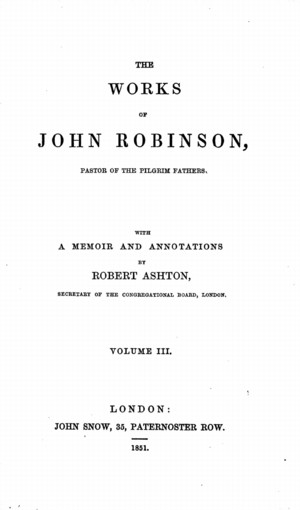
The Works of John Robinson, Pastor of the Pilgrim Fathers, with a Memoir and Annotations by Robert Ashton, 3 vols (London: John Snow, 1851). Vol. 3.

Part of: The Works of John Robinson, Pastor of the Pilgrim Fathers, with a Memoir and Annotations by Robert Ashton, 3 vols.

About Liberty Fund:

Liberty Fund, Inc. is a private, educational foundation established to encourage the study of the ideal of a society of free and responsible individuals.


No I.

THE CHURCH IN SOUTHWARK.

BY JOHN WADDINGTON,

  • PASTOR OF THE CONGREGATIONAL CHURCH, UNION STREET, SOUTHWARK.

An intimate relationship existed between the church at Leyden and the “faithful brethren “in Southwark, recognized by Robinson, in. a letter addressed to them, April 5, 1624, on the removal of their first pastor, as a “true church.” The object of this paper is to trace the incidents which led to its formation, and to give a rapid sketch of its subsequent course.

In 1586, we find John Greenwood, B.A., a close prisoner in the Clink, Southwark, for his testimony to the simple church polity of the New Testament.* On the Lord's-day morning, the 19th of November, in the sam'e year, he was visited by his devoted friend and fellow-collegian, henry barrowe, B.A., the enlightened and zealous advocate, with himself, of congregational principles. The keeper of the prison took advantage of this visit of condolence, to secure an additional captive; and in a quarter of an hour, while these companions in the faith were conversing together, he turned the key upon them both. At one o'clock, Barrowe was put into a boat, and as he was rowed to Lambeth, in the custody of the pursuivant, a letter was placed in his hand, explaining the cause of his arrest. On landing at the palace, he was brought before the commissioners, specially summoned by Archbishop Whitgift for the occasion, and subjected to an examination intended to involve him in the meshes of prelatical power.

At a subsequent period, these noble confessors were, twice, taken in a cart to the foot of the gallows, and by alternate threats and expostulations, urged to recant. They adhered to their convictions, however, and shortly afterward suffered together, on the 6th of May, 1593, attesting, in this way, by a kind of triple martyrdom, their firm persuasion of the truth.* In the “Dialogues of Governor Bradford,” an interesting account is given of Barrowe's conversion.

During an imprisonment, which extended over five or six years, Barrowe and Greenwood found opportunity, though not without difficulty, to write in defence of their scriptural views, and sent their manuscripts to Holland for publication. Amongst other important documents transmitted for this purpose, was a treatise containing their joint answer to the writings of Giffard. Respecting this prison production, the “Ancient Men,” in Governor Bradford's “Dialogues,” relate the following particulars:—

“When Mr. Barrowe's and Mr. Greenwood's refutation of Giffard was privately in printing in this city (Middleburgh), Francis Johnson not only was a means to discover it, but was made the ambassador's instrument to intercept them (the copies) at the press, and see them burnt; the which charge he did so well perform, as he let them go on until they were wholly finished, and then, by the magistrate's authority, caused them to be speedily burnt; himself standing by until they were all consumed to ashes. Only he took up two of them, one to keep in his own study, that he might see their errors, and the other to bestow on a special friend for the like use. But mark the sequel. When he had done this work, he went home and superficially read some things here and there, as his fancy led him. At length, he met with something that begun to work upon his spirit, which so wrought with him, as drew him to this resolution,—seriously to read over the whole book; the which he did once and again. In the end, he was so taken, and his conscience was troubled so, as he could have no rest in himself until he crossed the seas, and came to London to confer with the authors, who were then in prison, and shortly after executed. After which conference, he was so satisfied and confirmed in the truth, as he never returned to his place any more at Middleburgh, but adjoined himself to their society at London, and was afterwards committed to prison, and then banished; and in conclusion, coming to live at Amsterdam, he caused the same books which he had been an instrument to burn, to be new printed, and set out at his own charge. And some of us here present testify this to be a true relation, which we heard from his own mouth before many witnesses.”*

Francis Johnson Fellow of Christ's College, Cambridge, concerning whom the preceding statement is made, became the leader of a Christian society, meeting (1593) in No. 80 Nicholas-lane, Lombard-street, a place not far distant from Southwark, on the opposite bank of the river. His views did not coincide entirely with those of the Congregational order; but for his zeal, intrepidity, and self-denying devotedness, his name is worthy of enduring remembrance. “My care and desire,” he says, “I thank God, have been, and I trust, shall be alway, to receive and follow the truth in love, with peace and holiness.” He is referred to, in terms of great esteem and affection, by John Penry, M.A., the Nonconformist martyr, who was executed at St. Thomas-a-Watering, Old Kent-road, Southwark, May 29, 1593. In the letter, dated April 24, 1593, from his cell, King's Bench prison, then on the north of St. George's church, Borough, that devoted champion, for truth and freedom writes in this affecting strain:—“I thank my God, I am not only ready to be bound and banished, but even to die in this cause, by his strength. Yea, my brethren, I greatly long, in regard of myself, to be dissolved, and to live in the blessed kingdom of heaven, with Jesus Christ and his angels; with Adam, Enoch, Noah, Abraham, Moses, Job, David, Jeremiah, Daniel, Paul, the great apostle of the Gentiles, and the rest of the holy saints, both men and women; with the glorious kings, prophets, and martyrs, and witnesses of Jesus Christ, that have been from the beginning of the world; particularly with my two dear brethren, Mr. Henry Barrowe and Mr. John Greenwood, which have, last of all, yielded their blood for this precious ‘ testimony;’ confessing unto you, my brethren and sisters, that if I might live upon the earth the days of Methuselah twice told, and that in no less comfort than Peter, James, and John were in the Mount; and after this life, might be sure of ‘ the kingdom of heaven,’ that yet to gain all this, I durst not go from the former ‘testimony.’ … . . I would indeed, if it be His good pleasure, live yet with you, to help you to bear that grievous and hard yoke which yet ye are like to sustain, either here or in a strange land.

“And, my good brethren, seeing banishment, with loss of goods, is likely to betide you all, prepare yourselves for this hard entreaty, and rejoice that you are made worthy for Christ's cause to suffer and bear all things. And I beseech you, ‘in the bowels of Jesus Christ,’ that none of you, in this case, look upon his particular estate; but regard the general state of the church of God, that the same may go, and be kept together, whithersoever it shall please God to send you.

“Let not those of you, then, that either have stocks in your hands, or some likely trades to live by, dispose of yourselves where it may be most commodious for your outward estate, and, in the mean time, suffer the poor ones, that have no such means, either to bear the whole work upon their weak shoulders, or to end their days in sorrow and mourning, for want of outward and inward comforts, in the land of strangers; for the Lord will be an avenger of all such dealings. But consult with the whole church, yea, with the brethren of other places, how the church may be kept together and built, whithersoever they go. Let not the poor and the friendless be forced to stay behind here, and to break a good conscience, for want of your support and kindness unto them, that they may go with you. And here I humbly beseech you, not in any outward regard, as I shall answer before my God, that you would take my poor and desolate widow, and my mess of fatherless and friendless orphans, with you into exile, whithersoever you go: and you shall find, I doubt not, that the blessed promises of my God made unto me and mine, will accompany them, and even the whole church, for their sakes; for this also is the Lord's promise unto the holy seed; as you shall not need much to demand what they shall eat, or wherewith they shall be clothed; and in short time, I doubt not but they will be found helpful and not burdensome to the church: only, I beseech you, let them not continue in this land, where they must be forced to go again into Egypt, and my God will bless you even with a joyful return into your own country for it. There are of you, I doubt not, will be careful of the performance of the will of your dead brother, in this point, who may yet live to show this kindness unto yours: I will say no more.

“Be kind, loving, and tender-hearted, the one of you towards the other; labour every way to increase love, and to show the duties of love one of you towards another; by visiting, comforting, and relieving one the other, even for ‘ the reproach of the heathen’ that are round about us, as the Lord saith. Be watching in prayer; especially remember those of our brethren that are especially endangered. … . Pray for them, my brethren, and for our brother, Mr. Francis Johnson, and for me, who am likely to end my days either with them or before them; that our God may spare us unto his church, if it be his good pleasure, or give us exceeding faithfulness. And be every way comfortable unto the sister and wife of the dead, I mean unto my beloved M. Barrowe and M. Greenwood, whom I most heartily salute, and desire much to be comforted in their God, who, by his blessings from above, will countervail unto them the want of so notable a brother and a husband. I would wish you earnestly to write, yea, to send, if you may, to comfort the brethren in the west and north countries, that they faint not in these troubles; and that also you may have of their advice, and they of yours, what to do in these desolate times… Yea, I wish you and them to be together, if you may, whithersoever you shall be banished, and to this purpose, to bethink you beforehand where to be; yea, to send some who may be meet to prepare you some resting-place. And, be all of you assured, that He who is your God in England, will be your God in any land under the whole heaven; for the earth and the fulness thereof are his, and blessed are they that for his cause are bereaved of any part of the same.”*

He died in faith. In the “Protestation before his Death,” addressed to the Lord Treasurer, he says:— “Being now to end my days before I am come to the one half of my years, in the likely course of nature, I leave the success of my labours unto such of my countrymen as the Lord is to raise after me.”

The righteous succession was maintained. Francis Johnson, one of the “specially endangered,” took the place of the martyrs, Greenwood and Barrowe, and while a prisoner in the Clink, in 1596, wrote in defence of Separation.

Henry Jacob, M.A., beneficed at Cheriton, in Kent, entered into a controversy with him, conducted on both sides with great earnestness and ability. The publisher of Jacob's treatises on the “Defence of the Churches and Ministry of England,” tells us in the preface, that “Mr. Jacob, having some speech with certain of the Separation, concerning their peremptory and utter separation from the churches of England, was requested by them, briefly to set down in writing, his reason for the defence of the said churches, and they would either yield unto his proofs, or procure an answer unto the same. Whereupon, the argument following this preface, was set down in writing by Mr. Jacob, which the said parties did send to Mr. F. Johnson, being then a prisoner in the Clink, Southwark.”

In reply to the argument that the martyrs of the Re formation did not formally separate themselves from the Establishment, Mr. Johnson writes: “When M. Cranmer, Ridley, Latimer, &c., died martyrs for the truth of Christ, they neither had themselves, nor joined in spiritual communion with such as had, the prelacy and ministry now pleaded for; and not that only, but were members of that persecuted church in Queen Mary's days, which was separated from the rest of the land as from the world, and joined in covenant by voluntary profession to obey the truth of Christ, and to witness against the abominations of Antichrist. As they also did unto death in the truth they saw, though otherwise, being but as it were in the twilight of the gospel, they had their wants and errors. Yet who is so blind or besotted, as not to see that their errors may not be our rules, neither can be our warrant; but rather that we ought, after their example, faithfully to stand in and for whatsoever truth God revealeth unto us by his Word? And that otherwise these holy martyrs shall rise in judgment against all such, as either withhold the truth in unrighteousness, or in any respect refuse to walk therein.

“Finally, seeing God hath given us his Word to be the light to our feet, and ruler of our lives and religion, what mean you to lead us from it, to the aberrations of any men whatsoever? Should not all people inquire at God, or would you have us to go from the living to the dead? from God and his Word, to men and their errors?”*

Henry Jacob was gained, to the side of truth and became in turn the able and consistent defender of Scriptural Con gregationalism. He published, in 1604, a treatise on the “Necessity of Reforming our Churches in England;” this was followed by his work on ‘ Toleration’ in 1609; and in the succeeding year appeared his treatise on “The Divine Beginning and Institution of Christ's true Visible or Ministerial Church.” This church, he defines to be “a number of faithful people joined, by their willing consent, in a spiritual outward society, or body-politic, ordinarily coming together into one place; instituted by Christ in his New Testament, and having the power to exercise ecclesiastical government, and all God's other spiritual ordinances, the means of salvation, in and for itself immediately from Christ.”

At this period he was at Leyden, in close conference with Robinson. “We, some of us, knew Mr. Parker, Dr. Ames, and Mr. Jacob, in Holland,” say the “Ancient Men,” “when they sojourned for a time in Leyden, and all three boarded together; …. and after Mr. Jacob returned, and Mr. Parker was at Amsterdam, he printed some of his books.”*

The return of Mr. Jacob here mentioned was in 1616. The work of the greatest difficulty, and that which was attended with the most serious peril, was to continue the “testimony borne by the confessors and martyrs in the immediate scene of their sufferings.”

For this arduous service Mr. Jacob was eminently qualified, by his talents, his courage, his discretion and humility. He came to Southwark, the ‘furnace’ of Evangelical nonconformity, to collect the remnant of the London congregation, and to form them into a church state, on the model of the New Testament. The first meeting of this martyrband was held in a private dwelling, on the southern bank of the Thames. The names of Staismore, Browne, Prior, Almey, Troughton, Allen, Gilbert, Farre and Goodal, are mentioned as present on that memorable occasion. “These, with others (we are told), having observed a day of solemn fasting and prayer for a blessing upon their undertaking, towards the close of the solemnity, each of them made open confession of their faith in our Lord Jesus Christ: and then, standing together, they joined hands, and solemnly covenanted with each other in the presence of Almighty God, to walk together in all God's ways and ordinances, according as He had already revealed, or should further” make them known to them. Mr. Jacob was then chosen pastor by the suffrage of the brotherhood, and others were appointed to the office of deacons, with fasting and prayer and imposition of hands.

A declaration of their principles was printed in the same year, accompanied by a petition to James I. This document,* remarkable for the elevation of its sentiments, the sobriety of its diction, and the cogency of its reasoning, will reward the attention of all who take an interest in the march of Christian civilisation. From the charter of man's redemption, the writer asserts, in the name of his brethren, their claim to the full measure of Christian liberty, freedom of inquiry, freedom of association, freedom of worship, freedom of instruction, and freedom in the support of Christian ordinances—freedom in fine, based on conscience, regulated by truth, and perfected in charity.

After a service of eight years, Mr. Jacob, with the consent of his congregation, crossed the Atlantic, to join the pilgrims in America. His motive for this removal was the desire of extended usefulness, But his career was near its close. He reached the pilgrims only to mingle his remains with kindred dust: but his testimony cannot die. With prophetic confidence he said, “The Lord, I doubt not, will raise up others that shall more effectually bear witness unto this truth in due time. Being with much vehemency charged that for no just cause I have refused to conform to the church order in England, I could therefore do no less but give out, yea, unto posterity, the true and most important reasons of my dissenting herein.”

The pilgrims were impelled by the same motive to depart Leyden. Evidence of this is furnished in a small volume printed in 1619 (the year before the sailing of the “Mayflower”), entitled “An Answer to the Ten Counter Demands, &c., &c. by William Euring.”

In answer to the demand, whether the discipline of the Separatists can be of God, since they gain no converts from the “rude and profane,” Mr. Euring says, “Consider, sir, we are a poor, weak, despised people here in England, hated and persecuted of all, or most part in the land; and, therefore, if we have any meetings or coming together on the Lord's-day, they must be very private, for fear of such persecuting adversaries as cannot endure, and are ignorant of the truth of God's ordinances, to be taught and practised; so that ‘ Papists and Atheists,’ and such like ‘profane’ come not at our exercises: and how is it possible we should convert any that come not to hear us? Amongst the churches in this way, beyond the seas, which have their more free meetings and able ministries, this blessing of God, in converting men, is more seen.

“Your following words, wherein you please to term us ‘refined reformers,’ saying that we seduce only the sound, and pervert and estrange from you those that are otherwise well affected, arid of some understanding, &c., are worth considering.

“It is true, that you say, our cause hath wrought most upon such as have some ‘understanding’ and knowledge, and are of tender consciences, pliable to the truth; others, of more corrupt consciences, have set against us, and against our cause, and blasphemed it.”

In answer to the demand, “Whether it were not the Separatists’ best course to return, or, for the avoiding of scandal, to remove to Virginia, and make a colony there, in hope to convert Infidels to Christianity,” Mr. Euring says, “Although I can partly guess in what humour you propounded this your demand, yet I will not answer you according to that your humour.

... “I do once again entreat you to show us the true form and fashion of your church; and lay you apart all wrath and envious anger, that so we may together, in peace and love, you with us, and we with you, take a view, and consider of your church, and compare the form and fashion thereof with the form and fashion of the true and visible church of Christ, as it is described unto you in the Scripture. And if this good and godly course may be accomplished, not only by myself, but all of us that are now separated from you, would much more willingly and gladly return again, and labour to plant ourselves again in the meanest part of England, to enjoy ‘peace with holiness,’ and to follow the truth in love, among our kindred and friends in our own native country, than either to continue where now many of us live, or to plant ourselves in Virginia, or in any other country hi the world, upon any conditions, or hope of anything in this life whatsoever! Yet even for Virginia thus much—when some of ours desired to have planted ourselves there, with his majesty's leave, upon these three grounds:—first, that they might be the means of Re-planting the gospel amongst the heathen; Secondly, that they might live under the king's government; thirdly, that they might make way for and unite with others, what in them lieth, whose consciences are grieved with the state of the church in England; the bishops did, by all means, oppose them and their friends therein.”*

A faithful successor to Mr. Jacob was found in John Lathrop, a man of earnest but humble spirit, who, for conscience sake, relinquished orders in the Establishment. On the 29th April, 1682, forty-two of the members (including their devoted minister) were apprehended, and sentenced to imprisonment for two years.

“During the term of Mr. Lathrop's imprisonment,” says Nathaniel Morton, author of ‘New England's Memorial,’ published in 1669, “his wife fell sick, of which sickness she died. He procured liberty of the bishop to visit his wife before her death, and commended her to God by prayer, who soon after gave up the ghost. At his return to prison, his poor children being many, repaired to the bishop at Lambeth, and made known unto him their miserable condition, by reason of their good father's being continued in close durance, who commiserated their condition so far as to grant him liberty, who soon after came over into New England.”

With thirty of his congregation he arrived in Boston, 18th September, 1634, in the ship “Griffin,” and in a few days after he proceeded to an early settlement, in the wilderness called Scituate, not many miles from Barnstable, upon Cape Cod.

Though deprived of the counsel of their pastor, the brethren in Southwark were not left without the means of spiritual sustenance. Mr. Canne, author of the “Marginal Reference Bible,” in the earlier part of his career, as well as Mr. Jessey, sometime rector of St. George's, ministered to their comfort and instruction. In the first instance, Mr. Jessey declined the overture made to him on the part of the church, on the ground that he had an earnest desire to settle in New England. The people reminded him that, inasmuch as their necessities were greater, their claim on his services was the stronger. They said, “New England was much better provided with able godly preachers than this nation, in the which so many flocks were destitute.”*

“After Mr. Canne,” says Mr. Neal, the historian of the Puritans, “Mr. Samuel How undertook the pastoral care of this little flock.” During his ministry the church endured great affliction, and to avoid the violence of persecution, its members were often compelled to meet in the fields and woods. On the death of Mr. How, after an interval of bereavement, Mr. Stephen More, a beloved and faithful deacon, at the request of the brethren accepted the oversight of them. He was a man of property, and had valuable connexions in the City; but at the hazard of his estate, and of personal liberty, he did not shrink from the duties of his self-denying office. [An interesting work written by him, entitled, “The Wise Gospel Preacher,” is still extant.] The face of affairs beginning now to change, this poor congregation, which had subsisted almost by a miracle for above twenty-four years, shifting from place to place to avoid the notice of the public, ventured to open their doors in Deadman's-place; but it was not long before they were discovered, and many of them committed to prison.

On the 18th of January, 1641, the church being assembled on the Lord's-day for religious worship as usual, though not with their former secrecy, they were discovered and taken, and by Sir John Lenthall, Marshal of the King's Bench, committed to the Clink prison. The next morning, six or seven of the men were summoned to appear before the House of Lords: their names are given in the Journals of the Lords, vol. iv. p. 133: Edw. Chillendon, Nic. Tyne, John Webb, Richard Sturges, Thomas Gunn, Jo. Ellis. The Lords examined them strictly concerning their principles, and they as freely acknowledged that they owned no other head of the church but Christ Jesus; that no prince had power to make laws to bind the consciences of men: and, that laws made contrary to the law of God were of no force. “Thereupon the House did order that the said sectaries should receive for this time an admonition from the House, that they shall hereafter repair to their several parish churches to hear Divine service, and to give obedience thereunto, according to the Acts of Parliament of this realm. To that purpose the order was read unto them, made by the House the 16th of January, 1640, and to be told that, if hereafter they do not observe these commands, they shall be severely punished according to law.” Some of the peers inquired where the place of their meeting was, and intimated that they would come and hear them. And accordingly three or four of the peers did go to their meeting on the Lord's-day following, to the great surprise and wonder of many. The people went on in their usual method, having two sermons, in both of which they treated of those principles for which they had been accused, grounding their discourses on the words of our Saviour, “All power is given unto me in heaven and in earth.” Matt. xxviii. 18. After this, they received the Lord's Supper, and then made a collection for the poor, to which the lords contributed liberally with them, and at their departure signified their satisfaction at what they had heard and seen, and their inclination to come again. But this made too much noise, and gave too great an alarm to the mob, for them to venture a second time.*

After this excitement the church seems to have enjoyed an interval of rest. The calm, however, was but temporary, and was followed by a succession of persecuting enactments, aiming at nothing less than the annihilation of Nonconformity. Within twelve years the Parliament passed six laws for this object: the Corporation Act, in 1661; the Act of Uniformity, in 1662; an Act to suppress Seditious Conventicles, 1664; declaring it to be a transportable offence for more than five persons to unite in religious worship, except according to the forms of the Church of England; the Oxford, or Five Mile Act, in 1665, banishing all Nonconformists from corporate towns; the Conventicle Act, in 1670, with some severe additions; and the Test Act, in 1673.

The storm was violent and of long continuance, but the immortal confessors of religious freedom braved it out. Strong in their weakness, and sheltered in their obscurity, they could not be subdued. Amid the desolations caused by the plague, and the fire of London, in 1666, they found an entrance for the Gospel. In the absence of the court and clergy, who fled from the infected capital, these “spiritual heroes” gained converts from the afflicted remnant.

Thomas Wadsworth, M.A., a native of Southwark, the successor of Stephen More, we find at that calamitous period making collections for his distressed brethren at Deadman's-place,* and dispensing to the people the Word of Life. Richard Baxter says, “The churches being burnt, and the parish ministers gone, for want of place or maintenance, the Nonconformists were more resolute than ever to preach till they were imprisoned. Mr. Wadsworth and others, he tells us, did keep their meetings very openly, and prepared large rooms, and some of them plain chapels, with pulpits, seats, and galleries, for the reception of as many as could come.” [The timber edifice at Deadman's-place was of this character, and stood on the present site of the Park-street Brewery, at a short distance from the Globe Theatre.] In 1677, the author of the “Saint's Best” occupied himself the pulpit of this ancient, sanctuary. Referring to this interesting circumstance, he writes, “It pleased God to take away that excellent faithful minister (Mr. Wadsworth) in Southwark; and just when I was kept out at Swallow-street, his flock invited me to Southwark, where, though I refused to be their pastor, I preached many months in peace, there being no justice willing to disturb us.” Calamy gives this short account of the next minister, Mr. James Lambert:—” He was a celebrated preacher in Southwark, and had a considerable congregation of Dissenters there. He succeeded Mr. Wadsworth. He died August 9th, 1689, and was buried at Bunhill.” His successor, Jonathan Owen, published a sermon in 1700, dedicated to his congregation in Deadman's-place. During his pastorate, the four silver cups, still used by the church, were introduced; the date, 1691, is engraven on each cup. Mr. Killinghall was chosen pastor about 1702, and was followed, in 1740, by Dr. Zephaniah Marryat, who died Sept. 15th, 1754, not many hours after having preached to his congregation from this text: “Casting all your care upon Him, for He careth for you.” Mr. Lamb was pastor from 1755 to 1762. His identity in this honourable lineage, like that of Mr. Owen, is proved by a discourse published with a dedication to the church in Deadman's-place. He was held in great esteem. On his removal, from failing health, Dr. James Watson was elected to the pastorate, and during a ministry of twenty years discharged the duties of his office with exemplary fidelity. He was the tutor of Alexander Cruden, compiler of the “Concordance,” whose remains were deposited in the burial ground adjoining the chapel, in 1770.

Dr. Humphrys,—uncle of Mr. Hanbury,* —and whose memory is precious to many, accepted the pastoral care of this ancient church in 1783; four years after his settlement, the congregation removed from Deadman's-place to Union-street, where they still worship

Subsequently, for more than twenty years, Mr. Arundel, the late excellent secretary of the London Missionary Society, laboured amongst them.

Further it is not needful to trace the history of this witnessing community. From the rapid sketch now given, the links of the historic chain, extending through nearly three centuries, may be distinctly traced. In no part of its eventful course has the church departed from its first principles in doctrine and discipline. It has long been distinguished for its unity and affection, and has ever maintained a character for practical usefulness.

Supplement by the Editor.

A new era is now dawning on this ancient church. The building in which it has long worshipped must shortly be relinquished; its lease having nearly expired. Efforts are being made to remove from the present obscure locality in which it worships, and to erect, in a more public situation, a chapel worthy of its name and history; and “to connect therewith a Pilgrim's Hall and Library, in which shall be securely deposited every document or publication that can be procured to elucidate the course and extend the influence of the pilgrim-fathers—those immortal pioneers of religious freedom.” Appeals have been widely circulated through England and America, to which most cheering and cordial responses have been given. Most gratifying assurances of interest and support have been tendered by Abbot Lawrence, Esq., Ambassador of the United States to the English court; the Hon. Amos Lawrence, brother of the ambassador; the Rev. Dr. Cheever, and numerous other distinguished gentlemen and ministers of America; and especially by the Rev. Seth Bliss, and Rev. E. A. Lawrence, who, on July 28th, 1851, met the congregation in their time-hallowed sanctuary, and assured them of their deep personal interest in the undertaking; and also that they were authorised by their brethren in America to assure them of the sympathy they felt in the object, and of their readiness to co-operate with the church in its accomplishment.

With the new Pilgrim Chapel a new impulse will be given to the zeal and labours of this ancient church with its bishop and deacons; and thus will the sacred principles they have so long and consistently maintained, be more widely diffused, and through a long succession of years increased and perpetuated.

[140]Hanb. Hist. Mem. vol. i. p. 62. Hist. of Corpus Christi, Camb. By R. Masters, B.D. 1753, 4to. page 229.

[141]Harleian Miscel. orig. ed. 4to., vol. iv. page 326.

[142]Ainsworth's Apology, 1604, pages 89–95.

[143]Hanb. Hist. Mem. vol. i. page 49; Young's Chronicles, page 433.

[144]Young's Chron. pages 424, 5.

[145]Hanb. Hist, Mem.vol i. page 87.

[146]Hanb. Hist. Mem. vol. i. page 78. Strype's Whitgift, App xviii. Bk. iv. page 176.

[147]Johnson's Answer to Maister H. Jacob, his Defence, &c. 1600, p. 29

[148]Governor Bradford's Dialogues in Young's Chronicles, pages 439–440

[149]Doubtless the Mr. Staresmore referred to in Mr. Robinson's letter to the Church in London, page 384, supra.

[150]“These fathers of Independency, in that old house of the seventeenth [or rather sixteenth] century, with hearts panting for religious liberty, their hands locked in each other, and solemnly vowing before God, to follow the light he should grant them, has in it a touch of the moral sublime, which, though the background of the picture differs, and the spirit which animated that forgotten band was peaceful instead of warlike, reminds us of the oath of Rutli, and the three-and-thirty who clasped hands under the Seelisberg, by the Lake of Uri, swearing before God the famous league of Swiss liberty.” — Stoughton's Spiritual Heroes, p, 92, second edit. Hanb. Hist. Mem. vol. i. p. 293.

[151]Hanb. Hist. Mem. v. i. p. 293.

[152]Ibid. p. 235.

[153]An Answer &c., by Will. Euring, pages 7–9.

[154]Life of Jessey, p. 8.

[155]Neal, vol. i. ch. vi.

[156]Crosby, Hist. Bap. vol. iii. p. 40.

[157]Life of Wadsworth, worth, printed for Thomas Parkhmrst, 1680.

[158]Benjamin Hanbury, Esq. the senior deacon of the Church, and the venerable compiler of the “Historical Memorials relating to the Independents or Congregationalists: from their Rise to the Restoration of the Monarchy, a.d. mdclx.,”3 vols. 8 vo., London, 1839, so frequently referred to in the notes of this work. The “Memorials” are a valuable compendium of all the extant or known writings of the Independent and Congregationalist brotherhood, during the period specified in the title-page. They supply authentic materials for the History of Independency. No ecclesiastical library can be complete without the “Memorials,” nor should any Nonconformist, especially, deem his library properly furnished without these precious records of the life, labours, and writings of his noble ancestors. Mr. Hanbury is also well known in the literary world by his edition of “The Ecclesiastical Polity, and other works of Richard Hooker,” &c, 3 vols., 8vo., London, 1830—to which he has supplied numerous and copious illustrative notes, and “Life of Thomas Cartwright, B.D.;” and by various other publications.