Econlib

The Library

Other Sites

Front Page arrow Titles (by Subject) arrow CHAPTER X.: OF THINGS INDIFFERENT. - The Works of John Robinson, vol. 3

Return to Title Page for The Works of John Robinson, vol. 3

Search this Title:

Also in the Library:

Subject Area: Religion

CHAPTER X.: OF THINGS INDIFFERENT. - John Robinson, The Works of John Robinson, vol. 3 [1851]

Edition used:

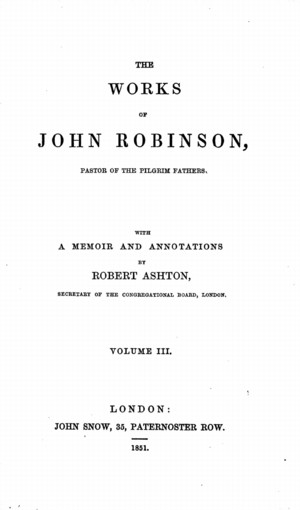
The Works of John Robinson, Pastor of the Pilgrim Fathers, with a Memoir and Annotations by Robert Ashton, 3 vols (London: John Snow, 1851). Vol. 3.

Part of: The Works of John Robinson, Pastor of the Pilgrim Fathers, with a Memoir and Annotations by Robert Ashton, 3 vols.

About Liberty Fund:

Liberty Fund, Inc. is a private, educational foundation established to encourage the study of the ideal of a society of free and responsible individuals.


CHAPTER X.

OF THINGS INDIFFERENT.

We do so repute many things as indifferent, or mean in themselves and their own nature, and as holding a middle place as it were, between the things simply commanded, and the things simply forbidden of God, as that the same things being once drawn into use, and practice, do necessarily undergo the respect and consideration of good or evil. This the apostle teacheth, 1 Cor. xiv., in his so diligently warning the church of Corinth, that all things be done decently, in order, and to edification. The things then thus accounted indifferent, when they onee come into use in the church, do either work the exercises of’ religion the more comely, orderly, and edificative, and are such as without which, the same exercises cannot be performed but confusedly, uncomelily, and unfruitfully, at least in part, or else they swerve from the apostolical canon. With this commandment of the apostle, yea of Christ the Lord, agrees the rule of the philosophers, the accessory followeth the nature of the principal. For example. Let the principal, as they speak, be some natural good thing, the very least accessory or circumstance, by which this principle is rightly and orderly furthered, and promoted undergoes also the consideration of a natural good. The same rule holds in actions civil: much more in the things, which appertain to religion, and God's worship. I therefore conclude, that the least rite or ceremony serving rightly and orderly to further the principal act and exercise of religion, doth worthily obtain, after a sort, the respect and denomination of a religious, and ecclesiastical good thing: which principal act, if it do not truly and effectually promote and advance, it is a vain addition at the best, beseeming only vain purposes, and persons, which “worship God in vain, teaching for doctrines men's traditions,” Matt. xv. 9: seeing whatsoever is to be done in the church, is also, and first to be taught, that so it may be done.

2. Whatsoever hath being in nature, is some certain thing first, and properly, and to be reduced to some certain and distinct head. Now all things whatsoever in use, either in, or about God's worship, may and must be referred necessarily to some one of these three heads. Either they are things natural, and simply necessary to the exercise; of which sort are the natural circumstances of time, and place, without which no finite action can be performed: also for the administering of baptism, either a font or other vessel to hold water: and so for other adjuncts absolutely necessary for the administering of the holy things of the church: or secondly, they are things civil, and comely: as for example, a convenient place in which the church may conveniently, and comelily meet together, not a stable, or swine-stye, also that habit of the minister, that covering of the Lord's table, those ministering vessels, and other accessories and appurtenances whatsoever, without which the holy things of God cannot be dispensed so civilly, and comely, as is meet. Or lastly, they are properly things sacred, and holy, and by consequence, parts of external Divine worship: and the same either commanded by God, and so lawful, or of man's device, and therefore superstitious.

Now if any shall further ask me, what power then I ascribe either to the civil magistrate, or church-governors for making laws about things indifferent? I answer touching church-governors first, being to treat by and by of the magistrate, that no such power, to speak properly, belongs unto them; as being not lords but servants of the church, under Christ the only Lord thereof: Ezek. xliv. 11; Matt. xx. 25; 2 Cor. iv. 5; 1 Pet. v. 3: exercising, as saith Austin, from Christ and the apostles a ministry, not a lordship:* and who therefore are to learn, if they will be content with their scantling, which God hath allowed them, that a weeding-hook better becomes them, than a sceptre as Bernard speaketh. For to make laws by all men's grant, belongs to them, and them only, who do sway sceptres, or are lords at least.

Moreover the Holy Scriptures everywhere teach, that the highest church-officers, and governors are but ambassadors of God, and interpreters, and proclaimers or criers of his Word. But “neither an ambassador, nor interpreter, nor crier, no, nor the herald, the’ most honourable of all proclaimers, or publishers of edicts, can command anything, nor dispose of the least matter by his own authority,” as Junius saith rightly. It is certain, that the governors of churches do stand in need of wisdom and discretion for the applying and determining of the common rules of order and comeliness taken from the Scripture, and common sense, to certain cases, and according to certain circumstances. But what makes this for the power of making laws in the church? which as Mr. Perkins§ makes account, is a part of Christ's prerogative royal: considering withal, that neither the church, nor the meanest member thereof is further bound unto these their determinations, than they appear to agree with order, and comeliness: neither are the ministers in anything at all, as are the magistrates in many things, to be obeyed for the authority of the commander, but for the reason of the commandment,* which the ministers are also bound in duty to manifest, and approve unto the consciences of them over whom they are set.

[61]August, de Civit. Dei, 1. 19.

[62]Bern, de Conf. lib. 2.

[63]Junius contr. 3, lib. 5, c. 7.

[64]Perk, Gold. Chain, c. 18.

[65]Zach, Ursinus Catach on 2 Com.