EconlibThe LibraryOther Sites |
Front Page Titles (by Subject) CHAP. XI. - The History of British India, vol. 6
Return to Title Page for The History of British India, vol. 6The Online Library of LibertyA project of Liberty Fund, Inc.Search this Title:Also in the Library:
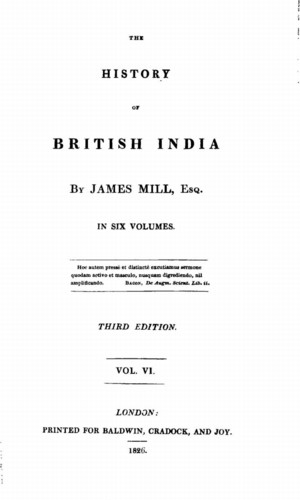
CHAP. XI. - James Mill, The History of British India, vol. 6 [1817]Edition used:The History of British India in 6 vols. (3rd edition) (London: Baldwin, Cradock, and Joy, 1826). Vol. 6.
Part of: The History of British India, 6 vols.About Liberty Fund:Liberty Fund, Inc. is a private, educational foundation established to encourage the study of the ideal of a society of free and responsible individuals. Copyright information:The text is in the public domain. Fair use statement:This material is put online to further the educational goals of Liberty Fund, Inc. Unless otherwise stated in the Copyright Information section above, this material may be used freely for educational and academic purposes. It may not be used in any way for profit.
CHAP. XI.Two sets of Princes, connected with the English; one, whom they made resign both the military, and the civil powers of their government; another, whom they made resign only the military powers—Endeavour to make the Peshwa resign the military part of his government—Negotiations for that purpose from 1798 to 1802—Negotiations with Dowlut Row Scindia for a similar purpose—The dependance of all the Mahratta states expected as the effect of the resignation to the English of the military power of any one of them—Negotiation with Scindia ineffectual—War between Scindia and Holkar—The Peshwa driven from Poona—For the sake of being restored by English arms, the Peshwa consents to the resignation of his military power—A treaty for that purpose signed at Bassein—The Governor-General expects, that the other Mahratta states will not dare to quarrel with the English on account of the treaty of Bassein—Scindia assembles his troops, and marches to the vicinity of Boorhanpore—Persevering attempts to make Scindia execute a treaty similar to that of Bassein—The Peshwa restored—Probability of a war with the Mahratta Princes on account of the treaty of Bassein—Junction of the armies of Scindia and the Rajah of Berar—Scindia and the Rajah required by the English to quit their present menacing position, and replace their armies at their usual stations—Scindia and the Rajah evading compliance, the English regard them as enemies—Arguments by which the Governor-General endeavored to prove that the line of policy which led to this crisis was good—Investigation of those arguments. The relations, which the British government endeavoured BOOK VI. Chap. 11. 1802.to establish with the Princes of India, were different in different circumstances. They with whom their connection was the most intimate, the Nabob of Carnatic, the Rajah of Tanjore, the Nabob of Oude, formed one class. Another was formed by those who stood in the circumstances of the Nizam, of the Peshwa, and other Mahratta powers. From the Princes of the first class, it had lately been the object of the British government to take away not only the military, but likewise the civil power, in the countries to which their titles respectively extended: and, leaving them the name of sovereign, to make them simply pensioners of state. With the rest, this object had been completely attained: With the Nabob of Oude, it was found expedient to make something of a compromise. A sort of delegated administration, which, however, he bound himself to carry on according to the pleasure of the delegator, was left to him in civil affairs, in a portion, not much more than a third, of his former dominions. To this point the pretensions of the British government had advanced by degrees. At first they were neither very high, nor very definite. The English, for their own security, found it necessary to aid the Princes in defending themselves; and the Princes agreed to re-imbrues the English for the expenses which they incurred. The powers of government, that is, in India, the BOOK VI. Chap. 11. 1802.powers of the sovereign, may be looked upon as divided (in India they are very conspicuously divided) into two portions; the one, the military power; the other, the civil power; the one consisting in authority over the military force; the other in the administration of what is called the civil or non-military affairs of the state, the collection of the revenue, judicature, and police. The English arrived at the first remarkable stage, when they made the Princes, with whom they were most nearly connected, strip themselves of their military power, to place it in the hands of the English. At this stage affairs remained during a considerable number of years. The sovereigns, placed in these circumstances, held their civil power in a state of absolute dependence. When the civil power, also, was taken away from them, nothing of sovereign remained, but the name. They were in the situation of the Rajah of Sattarah, only in the hands of a people, to whom it was agreeable to treat them with more indulgence. With the Princes of the second class, the object at which the British government had begun to aim, was, to make each of them resign the military part of his power to the English. In respect to the Nizam, the business had been effectually accomplished by the treaty of 1800; when he agreed to receive the subsidiary force of the English, and alienated a great proportion of his dominions to defray its expense. The eagerness with which Lord Wellesley endeavored to establish the same relations with the principal Mahratta states, he himself informs us, was extreme. It had suited the English, in their transactions with the Mahratta people, to suppose in the chieftain, called the Peshwa, a species of sovereign authority; over the rest of the Mahratta potentates; an BOOK VI. Chap. 11. 1802.authority, which it was abundantly evident that he did not exercise, and to which it was equally evident that the rest of the Princes paid no respect. In the spirit of this policy, it was the wish of Lord Wellesley to induce the Peshwa, in preference to all the rest of the Mahratta chiefs, to consign the defence of his government and dominions to a British force, and to alienate a part of those dominions for the maintenance of that force; an arrangement which that Governor denominates, “an intimate alliance, founded upon principles which should render the British influence and military force the main support of that power.”1 In 1798, when the Nizam consented to transfer the military powers of government within his dominions to the English, a similar proposal of “general defensive alliance, and mutual guarantee,”2 as it is called by Lord Wellesley, was strongly pressed upon the Peshwa. The moment was conceived to be favourable. “The authority of Baajy Rao,” say the Governor-General, “was then reduced to a state of extreme weakness by the imbecility of his counsels, by the instability and treachery of his disposition, and by the prevalence of internal discord; and in that crisis, his government was menaced with destruction, by the overbearing power of Scindia. It was evident that the Peshwa could not expect to be relieved from the oppressive control of Scindia, and to be restored to a due degree of authority within his own dominions, by any other means than by the BOOK VI. Chap. 11. 1802.aid of the British power.”1 The Governor-General informs us, that Bajee Rao did even apply to him for assistance. But when he was made to understand, that it would be granted only on the condition of permanently confiding his defence to a British force; that is, of transferring his military power to the hands of the English, “he deliberately,” says the Governor-General, “preferred a situation of degradation and danger, with nominal independence, to a more intimate connection with the British power; which,” adds the Governor-General, sufficiently disclosing his views, “could not be formed on principles calculated to secure to the Peshwa the constant protection of our arms, without, at the same time, establishing our ascendancy in the Mahratta empire.”2 The length of time, during which the Peshwa amused the Governor-General, is thus commented upon by that disappointed ruler: “Subsequent events justify a conclusion, that the long and systematic course of deceitful policy, pursued by the Peshwa on this occasion, was not less the result of a determined spirit of hostility, than of his characteristic jealousy and irresolution.”3 The prospect of the war between the British power and Tippoo Sultaun inspired not the Peshwa, we are assured by the Governor-General, with any of the sentiments of a generous ally; but turned his attention solely to the advantages which the crisis presented “to the faithless and sordid policy of that Prince;” who not only, “by a course of studied and systematic deceit, avoided all active interference in the contest, but actually maintained an amicable BOOK VI. Chap. 11. 1802.intercourse with the enemy.”1 The Governor-General even makes profession of having been duped by the Peshwa. “His Excellency,” says he, speaking of himself in the third person, a novelty which this Governor-General introduced, and of which, in the end, the Directors complained, “in a letter addressed to the Honourable the Court of Directors, under date the 20th of March, 1799, expressed his conviction, that the disposition of the Court of Poonah continued perfectly favourable to the British interests; and that want of power would be the sole cause of its inaction, in the event of a war with Tippoo Sultaun.” The course of the war, however, he says, suggested doubts; and at the termination of it they were confirmed, “by the correspondence between Tippoo Sultaun and his agents at Poonah, and by letters from Nana Furnavese, and other Mahratta chieftains, to Tippoo Sultaun, which were discovered among the records of Seringapatam. The combined evidence of those documents, and of the Peshwa's conduct during the war, affords unequivocal proofs of the hostility of his disposition towards the British power; and justifies a conclusion, that, if fortune had appeared to favour the enemy, the Peshwa would openly have espoused his cause.”2 Here was the conduct most exactly, which had been ascribed to the Nabob of Arcot, and by which that prince was declared to have forfeited his throne. The Nabob of Arcot, and the Peshwa were both princes, connected, by treaty, in alliance with the British power. Both were accused of violating the obligations of that treaty, by corresponding with Tippoo BOOK VI. Chap. 11. 1802.Sultaun. We have seen the treatment bestowed upon the one; it remains to contrast with it, that which was bestowed upon the other, of the two offenders. “Although,” says the Governor-General, “the faithless conduct of the Peshwa not only deprived him of all title to participate in the advantages of the war, but exposed him to the just resentment of the allies, the Governor-General determined to refrain from any measures of a vindictive nature: and to adopt the more liberal policy—of conciliating the Peshwa's interests—and of providing for the security of the allies, and for the general tranquillity of India—by repeating his invitation to the Peshwa to accede to the proposal of general defensive alliance and mutual guarantee; which his Excellency had before unsuccessfully offered to the Peshwa's acceptance.”1 Such was the difference of treatment intended for the Peshwa. The following was the result. “At the close of the war in 1799,” says the Governor-General, “the propositions for the conclusion of defensive and subsidiary engagements with the Peshwa were renewed; under circumstances of peculiar advantage to the latter; who, by acceding to those propositions, would not only have been emancipated from the oppressive control of Scindia, and have been reinstated in the due exercise of his authority—but would have been admitted to a participation in the conquered territory of Mysore. “But, after a vexatious and illusory discussion of the propositions, during a period of several months, the negotiation was closed, by the Peshwa's rejection of the conditions of defensive alliance, under any admissible modification of them. “The circumstances of that negotiation afford the strongest reason to believe, that the Peshwa never BOOK VI. Chap. 11. 1802.seriously intended to enter into any engagements, on the basis of those propositions; and that he had no other intention, from the commencement of the negociation, than, to avoid the consequences of an unqualified refusal to treat; to deceive the public, and the Governor-General, by the appearances of a disposition to concur in the views of the British government for the tranquillity of India; and to deter Scindia from the prosecution of his ambitious designs, by persuading that chieftain, that the Peshwa had it in his power, and in his contemplation, to avail himself of the protection of the British arms.”1 Nor were these the only occasions on which the Peshwa had been importuned on the same subject. “The negotiations,” continues the same high reporter, “which followed the renewal of the Governor-General's propositions, in the month of April, 1800, were conducted, on the part of the Peshwa, in the same spirit of temporizing policy, and studied evasion, which characterized his conduct in every previous discussion. His long and degrading subjection to the power of Scindia; his repeated experience of the perfidy and violence of that unprincipled chieftain; the internal distraction which prevailed in his government; and the consciousness of his inability to relieve himself from the pressure of his accumulated difficulties, and to secure the efficient exercise of his authority; were insufficient to subdue the emotions of his jealous fears, and to induce him to rely, with confidence on the protection of that state, which alone possessed the power and the will to extricate him from his embarrassments, and to place him in a situation of comparative dignity and security. Those BOOK VI. Chap. 11. 1802.negotiations were closed in the month of September, 1800, when various unprecedented acts of violence and extortion, on the part of Scindia, had aggravated the pressure of the Peshwa, and virtually annihilated his authority—by the Peshwa's absolute rejection of the principal articles of the Governor-General's proposition. “And he may be considered to have rejected those propositions again, by his refusal to become a party in the treaty of general defensive alliance, concluded with the Nizam in October, 1800, which was tendered to his acceptance.”1 But the complaints of the Governor-General are not confined to the arts by which the Peshwa endeavoured to preserve the advantage of appearing to enjoy the friendship of the British government, and at the same time to avoid the transference and loss of his military power. “While these several negotiations were depending,” says the same great informant, “the Peshwa was at different times employed in carrying on intrigues at the court of Hyderabad, to effect the dissolution of the alliance between the Company and the Nizam, and to engage his Highness to unite with the Mahrattas, at any future favourable opportunity, for the subversion of the British power.”2 Towards the end of the year 1801, the Peshwa came forward with a proposal “for subsidizing a body of British troops.” To this, according to the Governor-General, he was “influenced, either by views and intentions similar to those which regulated his conduct during the negotiations of 1799 and 1800; or, if sincere in his proposal, by the hope of obtaining the aid of the British for the re-establishment and security of his authority, without hazarding BOOK VI. Chap. 11. 1802.the introduction of that degree of control and ascendancy, which,” says the Governor-General, “it must be our interest to establish in the Mahratta state, and which it is his object to avoid.”1 “The Peshwa,” continues the Governor-General, “is aware, that the permanent establishment of a British force, in the vicinity of Poonah, would immediately place him, in some degree, in a state of dependance upon the British power. And, therefore, he has stipulated, that the subsidiary force shall be retained within the Company's dominions at all times, except when he shall require its actual services.”2 For the charges of the troops, the Peshwa proposed to assign a territory, in a part of the Peshwa proposed to assign a territory, in a part of the Mahratta country, over which he had only a nominal authority, and “the cession of which,” says the Governor-General, “would not in any degree contribute to render the Peshwa dependant on the support of the British power.”3 Because this arrangement would be extremely advantageous to the Peshwa, without yielding correspondent advantages to the British government, it was the opinion of the Governor-General, that it ought to be rejected. But he was of opinion, that rather than not get a British force subsidized, as he termed it, by the Peshwa; that is, placed in the service, and at the expense of that prince, it was adviseable to consent to his proposition with regard to the station of the troops, provided he would make an acceptable provision in land, or even in money, for their maintenance. The Governor-General reasoned thus: “The measure of subsidizing a British force, even under the limitations which the Peshwa has annexed to that proposal, must immediately BOOK VI. Chap. 11. 1802.place him, in some degree, in a state of dependance upon the British power; provided that measure be uncombined with any other arrangement, calculated to defeat its operation. The dependance of a state, in any degree, upon the power of another, naturally tends to promote a sense of security, derived from the support of a foreign power; produces a relaxation of vigilance and caution; and the operation of natural causes, in augmenting the dependance of the Peshwa on the British power, under the operation of the proposed engagements, would be accelerated by the effect which those engagements would produce, of detaching the state of Poonah from the other members of the Mahratta empire.”1 When “the Governor-General,” these are his own words, “notwithstanding his frequent disappointments in the accomplishment of his salutary views, determined, in June, 1802, to renew his negotiations for the conclusion of an improved system of alliance with the court of Poonah; the increased distraction in the Mahratta state, the rebellion of Jeswunt Rao Holkar, and his successes against the combined forces of the Peshwa and Scindia, appeared to constitute a crisis of affairs, favourable to the success of the proposed negotiation at Poonah. In the course of the discussions which ensued, the Peshwa manifested a desire to contract defensive engagements with the Honourable Company, under circumstances of more apparent solicitude, than had marked his conduct at any former occasion. The Peshwa, however, continued to withhold his consent to any admissible modifications of the Governor-General's propositions, until Jeswunt Rao Holkar, at the head of a formidable army, actually arrived in the vicinity of Poonah.”2 The crisis to which the Mahratta affairs were then BOOK VI. Chap. 11. 1802.approaching, was preceded and produced by the following circumstances. Mulhar Rao Holkar, one of the leaders in the army of the first Peshwa, was instrumental in pushing the conquests of the Mahrattas towards the north; and, according to the usual policy of the Mahratta government, received a portion of territory, in the province of Malwa, for the support of his troops. This happened about the year 1736; and laid the foundation of the sovereignty of the Holkar family; for, as the power of the primary government declined, that of the principal viceroys, according to custom, became independent; and, although the memory of their primitive connexion with the Peshwa was not yet obliterated, they not only acted as his equals, but frequently as his masters; and on no occasion, except when it suited their interest, allowed their will to be governed by his. Mulhar Rao Holkar died in the year 1766. He was succeeded by his nephew Tuckajee Holkar. This Prince reigned till the year 1797. He left four sons, Cashee Rao, Mulhar Rao, Eithojee Holkar, and Jeswunt Rao Holkar; the two former alone by the wife, or principal female in his haram. Cashee Rao succeeded Tuckajee, as the eldest son by his wife. A dispute, however, soon arose between Cashee Rao and his brother Mulhar Rao, who claimed an equal share of the inheritance; and they both repaired to Poonah, for the purpose of settling their disputes by the intervention of the Peshwa. Dowlut Rao Scindia exercised at that time a despotic authority over the Peshwa; and regarded the occasion as highly favourable for adding the possessions of the Holkar family to his own. Having made his terms with Cashee Rao, who is said to have renounced a claim of sixty, and paid a sum of six lacs of rupees, he surprised and slaughtered Mulhar Rao BOOK VI. Chap. 11. 1802.with all his attendants, at Poonah, in the month of September, 1797. The wife of Mulhar Rao, left in a state of pregnancy, produced a son, who was named Khundeh Rao. Scindia possessed himself of the person of the infant; retained Cashee Rao, in a state of dependance; and proposed to govern the Holkar dominions in his name. The two brothers Eithojee and Juswunt Rao had attached themselves to the cause of Mulhar Rao, and were both at Poonah at the time of his murder. Eithojee fled to Kolapoor, where he was taken, in the commission of hostilities; sent to Poonah; and deprived of his life. Jeswunt Rao made his escape to Nagpoor; and was protected for some time; but the instigations of Scindia at last prevailed, and the Rajah placed him in confinement. He contrived to effect his escape, and fled to Mehysser, on the Nerbuddah. Scindia, at that time deeply engaged in his schemes for securing the ascendancy at Poonah, had not leisure to pursue the fugitive with vigour and expedition, and probably thought his resources too contemptible to excite any apprehension. This remissness enabled Jeswunt Rao to avail himself of the means which so plentifully exist in India, of collecting an army of adventurers, by the prospect of plunder. It was not till the year 1801, that Scindia really became alarmed at the progress of Jeswunt Rao. He then began to collect an army on the Nerbuddah, and ordered the chiefs in his dependance to join him with the smallest possible delay. On the 14th of October, 1801, a general engagement took place between the armies of the two chieftains, in the neighbourhood of Indore, the capital of the Holkar family. Holkar was completely vanquished, and fled with the loss of his artillery and baggage.1 In this situation of affairs, a favourable opportunity BOOK VI. Chap. 11. 1802.appeared to the Governor-General to present itself, of extending his favourite plan for engrossing the military power of the princes in India, or (as he himself chose rather to name it) “the system of general defensive alliance and guarantee.” Colonel Collins, who had acted for some time as resident at Futty Ghur, was, in the month of December, 1801, directed to repair to the camp of Dowlut Rao Scindia. And in the instructions of the Governor-General to that officer, dated the 15th of January 1802, are the following words: “The events which have lately occurred in Hindostan, and the actual situation of the affairs of Dowlut Rao Scindia, appear to his Excellency to afford a more favourable opportunity, than any which has hitherto offered, of persuading that chieftain to become a party, in the proposed system of defensive alliance and reciprocal guarantee, under the provisions of the treaty concluded with his Highness the Nizam, on the 12th of October, 1800.” The next paragraph of this official paper is important, as exhibiting the views of the Governor-General, with regard to the effect which this defensive alliance, with any one of the Mahratta powers, would have upon all the rest. According to him it would produce one of two effects. Either it would compel them to give up their military power, in imitation of the state which had submitted to that stipulation; or, it would place them “in a dependent and subordinate condition,”—a condition in which “all their ambitious views, and aggressive designs, would be controlled.” “It may reasonably,” says the Governor-General, “be expected, that the success of a negotiation, for that purpose, with Dowlut Rao Scindia, will materially promote the complete accomplishment of his Excellency's views, by inducing the other Mahratta BOOK VI. Chap. 11. 1802.powers to concur in the proposed arrangement, with a view to avoid the dependant and subordinate condition to which they must be reduced, by their exclusion from an alliance, of which the operation, with respect to them, must be, to control all ambitious views and aggressive designs on their part, without affording to those powers the benefits of the general guarantee.” The doctrine of the Governor-General, therefore, was, that, in this manner, every one of the Mahratta states would become dependent upon the English government; those who accepted the alliance, by the alliance; those who did not accept it, by being deprived of it; the same happy effect, in two opposite cases, by the same ingenious combination of means. In regard to the terms of the proposed alliance, the document in question says, “The general conditions to which, in conformity to the proposed arrangement, it is desirable that Scindia should accede, are, 1st. To subsidize a considerable British force, to be stationed within his dominions: 2dly. To cede in perpetual sovereignty to the Company, an extent of territory, the net produce of which shall be adequate to the charges of that force: 3dly. To admit the arbitration of the British government, in all disputes and differences, between Scindia and his Highness the Nizam, and, eventually, between Scindia, and the other states of Hindostan: and 4thly. To dismiss all the subjects of France now in his service, and to pledge himself never to entertain in his service persons of that description.” It was declared to be “extremely desirable that Scindia should subsidize the same number of British troops, as is subsidized by his Highness the Nizam.” If Scindia, however, as was suspected, would not, unless in a case of extreme necessity, agree to that proposal, the Governor-General was inclined to come BOOK VI. Chap. 11. 1802.down in his terms. He would consent to such a number of troops as even that of two battalions. The obligation of submitting Scindia's relations with other states, to the will of the English, it was not, in the opinion of the Governor-General, very material to exact; for this reason, that, if the other conditions were accepted, this would follow, as a necessary consequence, whether agreeable to Scindia or not. “His Excellency,” says the paper of instructions, “considers Scindia's positive consent to the third condition, to be an object of inferior importance to the rest: as, without any specific stipulation, the arbitration of the British government will necessarily be admitted, to an extent proportioned to the ascendancy, which that government will obtain, over Scindia, under the proposed engagements—and to the power which it will possess of controling his designs.”1 Though Scindia had not only been disposed to receive, but forward to invite the British resident to his camp, he would offer no specific proposition when Colonel Collins arrived. It was the wish of the British negotiator, who joined the camp of Scindia on the 20th of February, 1802, to draw from that chieftain a declaration of a desire for British assistance; and afterwards to present the scheme of the Governor-General as the condition on which that advantage might be obtained. Scindia, however, would not admit that he had any other motive for desiring the presence of a British resident, than to cement the friendship which already subsisted between him and the British government; and to possess a more immediate channel of communication: especially, “as he was guarantee to the treaty between the English government and the Peshwa;” in this expression, BOOK VI. Chap. 11. 1802.exhibiting, even at this early period, his jealousy with respect to the negotiation, which was now carrying on at Poonah, for superseding the existing treaty with the Peshwa, by a treaty upon the Governor-General's favourite system, called “the system of defensive alliance, and mutual guarantee.” After time for ascertaining the state of Scindia's counsels, the resident informed the Governor-General, that “Scindia was anxiously desirous to preserve the relations of friendship at that time subsisting between him and the English government. At the same time,” said he, “I consider it my indispensable duty to apprize your Excellency, that I am firmly persuaded he feels no inclination whatever to improve those relations.” In other words, he was not yet brought so low, as willingly to descend into that situation, in which a participation in the “system of defensive alliance and mutual guarantee” would of necessity place him. It is important, at the same time, to observe the opinion of this select servant of the Company, with regard to the influence which the treaty so eagerly pursued with the Peshwa would have upon the interests of Scindia; an influence sufficient to make him court as a favour what he now rejected as equivalent to the renunciation of his independence and power. “Indeed,” says the resident, “were the Peshwa to accept the aid of a subsidiary force from our government, I should, in this event, entertain strong hopes, that Scindia, apprehensive lest the authority of the head of the Mahratta empire might be exerted against himself, would solicit as a favour to be admitted to the benefit of the treaty of general defensive alliance.” The resident, in this instance, declared his belief, that the same effect would result from this treaty with regard to Scindia, as the Governor-General had stated to him would be the effect of such a treaty, with any one of the Mahratta powers, BOOK VI. Chap. 11. 1802.upon every one of the rest.1 As the resident was convinced, that, in the present circumstances, it was vain to hope for the submission of Scindia to the system of the Governor-General, he thought the dignity of the British government would best be consulted, by forbearing to present the proposition.2 Holkar repaired so quickly the disaster sustained near Indore, that early in 1802 he resolved to change the scene of his operations from Malwa to Poona. Cashee Rao, who had been allowed to repair to Candeish, had for some time shown a disposition to aid in carrying on a joint war against Scindia, for the preservation of the Holkar dominions; but as the resources both of his mind and of his fortune were small, so he had latterly professed his determination to adhere to a system of neutrality in the dispute between Scindia and Jeswunt Rao. The release of the infant Khundeh Rao had been always demanded by Jeswunt Rao, as a condition without which he would listen to no terms of accommodation. Representing Cashee Rao as incapacitated by mental imbecility for the exercise of the powers of government, he proclaimed BOOK VI. Chap. 11. 1802.the infant, head of the Holkar family; demanded, as uncle, the custody of his person, and the administration of his dominions; and gave out his design of marching to Poona, for the purpose of receiving justice at the hand of the Peshwa; that is, of putting down the authority of Scindia, with respect to whom the Peshwa had long been placed in a state of prostrate subjection. Before the middle of the year 1802, Holkar had prepared a large, and as compared with that of his opponents a well disciplined army; and began his march to the south. Scindia, alive to the danger which threatened his interests at Poona, detached a large portion of his army under one of his principal generals, Suddasheo Bhow. This force arrived in the vicinity of Poona, at the close of the month of September; and afterwards effected a junction with the troops of the Peshwa. On the 25th of October the two armies engaged. After a warm cannonade of about three hours, the cavalry of Holkar made a general charge. The cavalry of Scindia gave way, when that of Holkar cutting in upon the line of infantry, put them to flight and obtained a decisive victory.1 Colonel Barry Close had been sent in the capacity BOOK VI. Chap. 11. 1802.of resident to Poona, in the month of December of the preceding year, with much reliance upon his approved ability and diligence for leading the Peshwa to a conformity with the earnest wishes of the English government, on the subject of the defensive alliance. A few days before the arrival of Colonel Close, the Peshwa had communicated to Colonel Palmer, his predecessor, his consent “to subsidize a permanent force of the Company's infantry, to the extent of six battalions, with the corresponding artillery, as the Governor-General had proposed; and to assign territory in Hindustan, producing twenty-five lacs of rupees annual revenue; but that the troops should be retained within the Company's dominions at all times, except when the Peshwa should formally require their actual services.” There was still a great distance between the compliance of the Peshwa, and the Governor-General's demands. “I am to have my last private audience of the Peshwa,” says Colonel Palmer, “this evening: when I will make a final effort to convince his Highness of the lasting security, power, and prosperity,” (such was the language which the Governor-General and his agents held even to one another upon their scheme for reducing to dependance the Princes of Hindustan,) “which he will derive from embracing your Lordship's proposals; though I apprehend, that nothing short of imminent and certain destruction will induce him to make concessions, which militate with his deep-rooted jealousy and prejudices,” (so the aversion to a final renunciation of all independent power was coolly denominated;) “of which he thinks,” continues the dispatch, “that he has already made extraordinary sacrifices.”1 BOOK VI. Chap. 11. 1802.The negotiation languished for six months, because the Governor-General, who, during a considerable part of that time, was earnestly endeavouring to accomplish a similar treaty with Dowlut Rao Scindia, did not transmit to the resident his instructions upon the subject of this proposal, till the month of June. During this interval, the new resident had time to make his observations upon the character and views of the Peshwa, of which he delivered a most unfavourable report. “Every day's experience,” said he, “tends to strengthen the impression, that from the first, your Lordship's amicable and liberal views, in relation to this state, have not only been discordant with the natural disposition of the Peshwa; but totally adverse to that selfish and wicked policy, which, in a certain degree, he seems to have realised: A slight recurrence to the history of his machinations is sufficient to demonstrate, that, in the midst of personal peril, and the lowest debasement, he viewed the admission of permanent support from your Lordship with aversion.” With regard to the Peshwa's government,” he says, “it seems, if possible, to become less respectable every day. The great families of the state, with whom he is at variance, prevail over him at every contest.”1 When the instructions of the Governor-General arrived, he remarked, upon the stipulation of the Peshwa respecting the station of the subsidized battalions, that “if the Peshwa should ever conclude subsidiary engagements on these terms, he would never apply for the aid of the stipulated force, except in cases of the utmost emergency: and his expectation, probably, is, that the knowledge of his ability to command so powerful a body of troops would alone be sufficient to give due weight to his authority, and to BOOK VI. Chap. 11. 1802.preclude any attempt which might otherwise be made for the subversion of it.” On the next great point, “as the Peshwa,” he said, “probably derives no revenue from the territory which he proposes to assign for the charges of the subsidiary force; and his authority in it is merely nominal, his power and resources would not in any degree be reduced by the cession; and the situation of the districts would be too distant and distinct from those territories in which the Peshwa's authority is established and acknowledged, to excite in his mind any apprehension of being overawed or controlled by the proximity of the Company's territorial power and resources. In his Excellency's judgment, therefore, the cession of the proposed territory in Hindustan would not in any degree contribute to render the Peshwa dependent on the support of the British power.” The expense, also, both of taking and of retaining possession of these territories, surrounded as they were by the territories of other Mahratta chiefs, and subject to their claims, was stated by the Governor-General as a ground of objection. Upon the whole, he observes, “By this arrangement, the Peshwa would derive the benefit of our support, without becoming subject to our control.” He, therefore, concludes; “Under all these circumstances his Excellency is decidedly of opinion that an unqualified concurrence in the Peshwa's propositions would produce more injury than benefit to the British interests in India.” At the same time, “From the view,” he declares, “which has thus been taken of the disposition and conduct of the Peshwa towards the British power; and from a consideration of the actual condition of his government, with reference BOOK VI. Chap. 11. 1802.both to its internal weakness, and to the state of its external relations, it is to be inferred, that in the actual situation of affairs, no expectation can reasonably be entertained of the Peshwa's acquiescence in any arrangement founded on the basis of the Governor-General's original propositions.” What then was to be done? Was the pursuit of the subsidizing arrangement to be resigned? The desires of the Governor-General were too ardent for that conclusion. He resolved, on the other hand, to accede to the wishes of the Peshwa, in regard to the station of the troops, provided he would either assign a less exceptionable territory, or even engage to pay a competent annual sum from his treasury.1 Of the discussions on this new proposition, the detailed reports have not been communicated to parliament, and hence the particulars are unknown. Though Baajee Row manifested, as the Governor-General informed his honourable masters, a solicitude apparently more sincere than formerly, to contract defensive engagements with the British government, he would assent to no admissible modification of the proffered plan, till Jeswunt Rao Holkar was in the vicinity of Poona. To whomsoever of the two antagonists the impending contest should yield the ascendancy, the Peshwa perfectly foreknew that the result would be equally fatal to his authority. On the 11th of October, he transmitted through his principal minister a set of proposed to the British resident. In these, it was proposed to agree, that the troops should be permanently stationed within his dominions, and that a district should be assigned for their maintenance in his territories bordering on the Toombudra.1 We BOOK VI. Chap. 11. 1802.are informed by the Governor-General, that “during the discussions which ensued on the basis of these propositions, the evasive conduct of the Peshwa excited considerable doubts of his sincerity, even at that stage of the negotiation: and that on the 24th of October, when the army of Jeswunt Rao Holkar had arrived within a few miles of Poona, the Peshwa dispatched a deputation to that chieftain, with distinct proposals for an accommodation, which Jeswunt Rao Holkar rejected.”2 On the day of the action, the Peshwa, surrounded by a small body of troops, waited for the result, and then fled; leaving in the hands of his minister, for the British resident, a preliminary engagement to subsidize six battalions, with their proportion of artillery, and to cede a country, either in Guzerat or Carnatic, yielding twenty-five lacs of rupees. The wishes of the Governor-General were accomplished, beyond his expectation. And he ratified the engagement on the day on which it was received.3 Two grand objects now solicited the attention of the British government. The first was the restoration of the Peshwa; and his elevation to that height of power, which, nominally his, actually that of the British government, might suffice to control the rest of the Mahratta states. The next was, to improve this event for imposing a similar treaty upon others of the more powerful Mahratta princes; or, at any rate, to prevent, by all possible means, their alarm from giving birth to an immediate war, which (especially in the existing state of the finances) might expose BOOK VI. Chap. 11. 1802.the present arrangement to both unpopularity and trouble. The following occurrences were meanwhile taking place. The Peshwa, having repaired in the first instance to a fortress, not far distant from Poona, afterward pursued his flight to the fortress of Mhar, on the river Bancoote, in the Concan, a maritime country on the western side of the Ghauts. Holkar, whose object it probably was to obtain possession of the person of the Peshwa, and to make the same use of his authority which had been made by Scindia, attempted, but not with sufficient rapidity, to intercept his flight. Disappointed in this prospect, Holkar turned his views to Emrut Rao, the adopted son of the Peshwa's father, the late Ragoba; and detaching a body of troops to the place of his residence, brought him to Poona. The Peshwa's flight from his capital was treated as an abdication, or akin to an abdication, of the government; and affairs were administered in the name of Emrut Rao. To the British resident, who remained at Poona, when it fell into the hands of Holkar, that chieftain, as well as Emrut Rao, diligently represented their views as friendly toward the British state, or even submissive; and they employed their earnest endeavours to prevail upon him to remain at Poona. As this, however, might appear to afford the sanction of his government to the new authority, he thought it his duty to withdraw, and having, not without difficulty, obtained that permission, departed on the 28th of November. “At the conferences,” says the Governor-General, “holden, by the resident, with Emrut Rao and Jeswunt Rao Holkar, on the eve of the resident's departure from Poona, both those chieftains expressed their BOOK VI. Chap. 11. 1802.solicitude for the preservation of the friendship of the British government; and directly and earnestly, appealed to the resident for his advice in the present situation of affairs. Jeswunt Rao Holkar expressly intimated a wish for the mediation of the resident, for the express purpose of effecting an accommodation with the Peshwa.”1 The Peshwa seemed unable to believe himself in safety, in any place accessible to Jeswunt Rao Holkar; and requested that a British ship might be sent to Bancoote, to convey him when he should account it necessary to Bombay. This determination the resident at Poona thought it would not be adviseable to encourage. But, “under the determination,” says the Governor-General, “which I had adopted, of employing every effort, for the restoration of the Peshwa's authority, and in the actual situation of the Peshwa's affairs, it appeared to me, to be extremely desirable, that the Peshwa should immediately place himself under the protection of the British power, by retiring to Bombay.”2 The resident from Poonah arrived at Bombay on the 3d of December. The Peshwa, notwithstanding the BOOK VI. Chap. 11. 1802.permission to place himself under the protection of the British government at Bombay, had yet remained in the Concan, with a declared desire, however, of repairing to his own city of Bassein, where he would enjoy the protection of a British force. His minister arrived at Bombay on the 8th of December. At a conference, the next day, with Colonel Close, he expressed the earnest desire of his master to conclude the proposed engagements with the British government; to the end that, all its demands being complied with, and all obstacles removed, he might as speedily as possible be restored to his authority by the British troops. On the 16th, the Peshwa arrived at Bassein; and was presented with a draught of the proposed treaty. The 18th was appointed for the day on which the arrangement should be completed. After a long discussion, the whole of the draught was accepted, with some alterations in one or two of the articles. And the treaty, called, from the place of transaction, the treaty of Bassein, was signed on the 31st. The great and leading articles were those to which the Peshwa engaged himself, by the paper left behind him, when he fled from Poona; the permanent establishment within his dominions of the force hired from the Company; and the assignment of a portion of territory, convenient for the English, as the equivalent in exchange. Of the remaining articles, the most important was that, by which the Peshwa bound himself never to make war upon any state, but to submit all his differences with other powers to the English; and, in short, not to hold any intercourse with other states, except in concert with the English government. A local affair of considerable importance was commodiously regulated through this treaty. The pecuniary claims of the Peshwa upon Surat, and the territory lately ceded by the Guyckwar in Guzerat were BOOK VI. Chap. 11. 1802.commuted for a territory yielding a revenue of the same annual amount. In one respect this Mahratta ally was left in a situation different from the situation of those other allies, the Nabobs of Oude and Carnatic. In their case the English rulers insisted upon a power of ordering, agreeably to their wisdom, the internal administration of the country; or rather of taking it wholly into their hands; alleging, as cause, the bad government of those rulers, which it was neither consistent with the interest, nor the humanity, nor the honour of the English government, to render itself the means of preserving in existence. With regard to the one of these powers, the design was partially, with regard to the other, it was completely, executed. With the Peshwa, for the present, the same demand for good government produced not the same effects. In the 17th article of the treaty, “The Honourable Company's Government,” it is said, “hereby declare, that they have no manner of concern with any of his Highness's children, relations, subjects, or servants; with respect to whom his Highness is absolute.” Nay more, “the subsidiary force is to be at all times ready for such services, as, the due correction of his Highness's subjects and dependants, and the overawing and chastising of rebels, or exciters of disturbance.” In other words, to what degree, soever, of misery, the vices of the Peshwa's government may reduce his subjects, the English have “no manner of concern” with that: But if these unhappy subjects make any effort to relieve themselves, the English troops shall be employed in exterminating them. When combinations of rulers take place, and the control of subjects is sufficiently removed, the treatment which is carved out for subjects is pretty much the same, whether the BOOK VI. Chap. 11. 1802.soil be Asiatic or European; the subjects, Mahrattas, or French. The turn, which the counsels of Scindia might take, or might take, or might receive, in consequence of the present transactions with the Peshwa, was the object which next solicited, and that in a high degree, the attention of the British government. By a letter, dated the 16th of November, 1802, the resident at Poona is apprized, “that it is the Governor-General's intention to avail himself immediately of the state of affairs at Poona, and of the defeat of Scindia's troops by Holkar, to renew overtures to Scindia, for the purpose of inducing that chieftain to enter into the terms of the general defensive alliance.” And along with the notification of the engagements concluded with the Peshwa, Scindia received, an invitation to co-operate with the British government in the restoration of that chief to his throne, and also proposals for a treaty to be concluded with himself, on terms similar to those which had been accepted by the Peshwa.1 In another letter, on the 22d of the same month, the Governor-General still further unfolded his policy. “In fulfilling the obligation now imposed on us, of re-instating the Peshwa in his government, and restoring his authority, his Excellency is anxious; first, to avoid all contest with either Scindia or Holkar; and secondly, to refrain from checking the progress of the present warfare between these chieftains.” As the immediate march of the British troops for the restoration of the Peshwa would be likely to begin a war between Holkar and the Company, and to terminate that between him and Scindia; as the intermediate period, at the same time, “presented the most favourable crisis for the accomplishment of his Excellency's views of defensive alliance with Scindia;” BOOK VI. Chap. 11. 1802.and, as “a delay in the advance of the troops might afford the further advantage of improving the terms of the defensive alliance with the Peshwa, by obtaining his consent to those conditions which he theretofore rejected,” the resident was informed that there was no occasion to be in a hurry, in commencing operations for the re-instatement of the Peshwa.1 Though the Governor-General expressed his conviction, that “nothing but necessity would induce Scindia to co-operate in the success of the present arrangement;” he yet entertained the hope, that he would perceive his inability to prevent that success; and, as the engagement with the Peshwa would place him under the power of the English, whether he consented to the plan of hired troops, or did not consent to it, that he would account dependance, with the benefit of their alliance, less objectionable, than dependance, without it.2 The home authorities, accordingly, who are always presented with the fair face of things, were told by his Excellency, under date the 24th of December, 1802, “I entertain a confident expectation of the complete accomplishment of all our views, and of the restoration of tranquillity, within the Mahratta dominions, by the means of amicable negotiation. It appears probable, that Scindia will cordially co-operate with the British government, in the restoration of the Peshwa's authority; and will consent, in the actual state of his own affairs, to become a party in the proposed system of defensive arrangements.”3 Yet the resident at Poona is told, in a letter dated the 30th of the same month: “Notwithstanding the Peshwa's recent recognition of his engagements with BOOK VI. Chap. 11. 1803.you, his Excellency the Governor-General is induced to apprehend, from the general tenor of the information contained in your dispatches, and from the character and disposition of the Peshwa, that his Highness is more disposed to rely on the exertions of Scindia, than on those of the British government, for his restoration to the musnud of Poona.” Under such views, “his Highness,” he added, “may possibly evade the conclusion of a definitive treaty, on the basis of the preliminary engagement. This result will be rendered still more probable by an accommodation between Scindia and Holkar. The intelligence contained in a dispatch from the resident with Dowlut Rao Scindia, under date the 19th instant, strongly indicates the probability of that event. And it is apparent, that the principal inducement, both of Scindia and Holkar, to enter into such accomodation, is the apprehension which they entertain of the interference of the British power, for the restoration and establishment of the Peshwa's authority. It may be expected, therefore, that an accommodation between these chieftains will be accompanied by proposals to the Peshwa, under the mediation and guarantee of Scindia, of a nature which his Highness may be disposed to accept, rather than be indebted for the restoration of his authority to the interposition of the British government.”1 It was the 10th of February, 1803, before the Governor-General disclosed to the home authorities his opinion that, “the knowledge,” as he expresses it, “of our arrangement with the Peshwa, may induce Dowlut Rao Scindia, and Holkar, to compromise their differences; and to offer to the Peshwa proposals for restoring his Highness to the musnud of Poona, which his Highness may be disposed to accept, notwithstanding the actual conclusion BOOK VI. Chap. 11. 1803.of engagements for that purpose with the British government.”1 With regard to the policy which the state of things created by this conduct would suggest, he says: “In such an event, it is not my intention to attempt to compel the Peshwa to adhere to the faith of his engagements, at the hazard of involving the Company in a war with the combined Mahratta states.”2 This is an admission, that the probable evil of a war with the combined Mahratta states was more than a counterbalance for the probable good to be derived from placing them all in dependance; the effect, which the treaty with the Peshwa, he said, would produce, whether they entered, or refused to enter, into the scheme for hiring the British troops. Notwithstanding this opinion of the preponderant evil of a war with the combined Mahratta states, the Governor-General declares, that, if the Peshwa adhered to his engagements, and had the concurrence of his principal subjects, he should not allow the chance of any other opposition to deter him. Yet from that preponderant evil, the power of the Peshwa would still be the only defalcation; and how little the account which could be justly made of the power of the Peshwa, the Governor-General was amply informed. To one view, taken by the Marquis Wellesley, of the question of restoring the Mahratta sovereign, philosophy will not withhold unqualified praise. “The stipulations of treaty” (says he, in his instructions, dated 2d of February, 1803, to the Governor of Fort St. George), “on which I founded my intention to facilitate the restoration of the Peshwa's authority, BOOK VI. Chap. 11. 1803.originated in a supposition that the majority of the Mahratta jaghiredars, and the body of the Peshwa's subjects, entertain a desire of co-operating in that measure. Justice and wisdom would forbid any attempt to impose, upon the Mahrattas, a ruler, whose restoration to authority was adverse to every class of his subjects. The recent engagements with the Peshwa involve no obligation of such an extent. Whatever might be the success of our arms, the ultimate objects of these engagements could not be attained, by a course of policy so violent and extreme. If, therefore, it should appear, that a decided opposition to the restoration of the Peshwa is to be expected, from the majority of the Mahratta jaghiredars, and from the body of the Peshwa's subjects, I shall instantly relinquish every attempt to restore the Peshwa to the musnud of Poona.”1 This virtuous example, till such a time as the majority of the people in every civilized country have become sufficiently enlightened to see the depravity of the case in its own essence, will help to stamp with infamy the most flagitious perhaps of all the crimes which can be committed against human nature, the imposing upon a nation, by force of foreign armies, and for the pleasure or interest of foreign rulers, a government, composed of men, and involving principles, which the people for whom it is destined have either rejected from experience of their badness, or repel from the experience or expectation of better. Even where the disparity of civilization and knowledge were very great; and where it were beyond dispute, that a civilized country was about to bestow upon a barbarous one the greatest of all possible benefits, a good and beneficent government; even there, it would require the strongest circumstances BOOK VI. Chap. 11. 1803.to justify the employment of violence or force. But, where nations, upon a level only with another, in point of civilization, or perhaps below it, proceed with bayonets to force upon it a government, confessedly bad, and prodigiously below the knowledge and civilization of the age, under the pretence of fears that such a nation will choose a worse government for itself, these nations, or their rulers, if the people have no voice in the matter, are guided by views of benefit to themselves, and despise the shame of trampling upon the first principles of humanity and justice. In paying the homage which he counted due to the will of a nation of Mahrattas, the Marquis Wellesley was not making a sacrifice of interests, which he held in low esteem. In his address to the home authorities, dated the 24th of December, 1802, he declared his conviction, that “those defensive engagements” which he was desirous of “concluding with the Mahratta states, were essential to the complete consolidation of the British empire in India, and to the future tranquillity of Hindustan.”1 Yet the complete consolidation of the British empire in India, and the future tranquillity of Hindustan, which could never exist till a sufficient bridle was put in the mouth of the Mahratta power, he thought it his duty to sacrifice, or to leave to the care of unforeseen events, rather than violate the freedom of will, in this important concern, of the people of one of the Mahratta states. When the Governor-General resolved on restoring the Peshwa, upon the supposition that he and his subjects were consenting to the plan, a very low estimate BOOK VI. Chap. 11. 1803.of the opposition to be expected from other quarters was presented by the Governor-General to his superiors, in his language of the 10th of February, 1803. “No reason,” said he, “exists, to justify an apprehension, that in the event supposed, Scindia would proceed to such an extremity, as to make opposition, either singly, or united with Holkar. Nor is any such desperate course of proceeding to be apprehended from the Rajah of Berar. Uncombined with the power of Scindia, Holkar will not probably venture to resist the Peshwa. Holkar also has anxiously solicited the arbitration of the British government with respect to his claims. He has transmitted distinct propositions with that view to Lieutenant-Colonel Close.”1 The substance of these propositions was, that the Peshwa should give to him a crore of rupees for the payment of his troops; that he should also give to him a fortress, as he had given Ahmednugger to Scindia; that he should effect the release of Kundee Rao; and grant him investiture, as the heir and representative of the Holkar family. Both the Governor-General and the Peshwa held these demands inadmissible. So far from yielding money to Holkar, the Peshwa thought he ought much rather to get money from him, on account of the depredations committed on his dominions. The gift of a fortress to one person was no reason, he said, why he should be called upon to give one to another: and as to the proposition for disinheriting Cashee Rao, it was forbidden by justice, and by the investiture which had been bestowed upon him during the life of his father; at the same time there was an expedient for reconciling the interests of both, as Cashee Rao had no children, and might secure the succession to Khundee BOOK VI. Chap. 11. 1803.Rao by adoption. The Governor-General held, that the rights of Cashee Rao, founded on descent, should on no account be allowed to be disputed. But he was of opinion, that the Peshwa ought willingly to grant a considerable sum of money, to obtain the departure of Holkar; and was even ready to guarantee a loan raised for that purpose: And, if the grant of a fort and jaghire would suffice to avert a rupture, it would not, he conceived, be good policy to withhold it.1 “On the receipt of these instructions,” says the Governor-General, “Colonel Close endeavoured to persuade his Highness the Peshwa, to offer to Holkar such concessions as might induce Holkar to compromise the subsisting differences, and to admit his Highness's peaceable return to his capital. His Highness, however, manifested an insuperable aversion to offer any concession to Holkar, whom he considered to be a rebel against the legitimate authority of the sovereign power of the Mahratta empire.” It then remained for Colonel Close to communicate by letter to Holkar, the sentiments of the Governor-General on the subject of his demands; the assurance, that the British government would use its influence to adjust his claims upon Scindia; an offer, to guarantee any adjustment which he might accomplish with the Peshwa; and, lastly, the expression of a hope that he would not oppose the execution of the recent engagements between the British and Poonah states.2 The expectations of the Governor-General that he might be able, through the operation of the new treaty with the Peshwa, to intimidate Scindia into BOOK VI. Chap. 11. 1803.an acceptance of the chains which he had forged for him, he did not easily relinquish. That chieftain, after such operations as he had in his power for the increase and equipment of his army, proceeded towards the south; crossed the Nerbuddah on the 4th of February; and on the 23d arrived in the vicinity of Boorhanpore. Colonel Collins, who had left the camp of Scindia early in the preceding May, but had received in the month of December commands to return for the purpose of proposing to him a treaty, on similar terms with that of Bassein, arrived at his camp on the 27th of February, “The advices,” says the Governor-General in his address to the home authorities of the 19th of April, 1802, “which I received from that officer, and from other quarters, induced me to entertain suspicions that Dowlut Rao Scindia meditated an accommodation with Jeswunt Rao Holkar; and a confederacy with that chieftain, and with the Rajah of Berar, for the purpose of frustrating the success of the arrangements concluded between the British government and the Peshwa: without, however, intending to proceed to the desperate extremity of provoking a contest with the British arms. “This suspicion,” he adds, “was corroborated, by the artifices practised, at the camp of Scindia, upon the arrival of Colonel Collins, with a view of eluding the communication of the propositions with which Colonel Collins was charged, under my authority. And the appearance of Scindia's intentions became still more unsatisfactory, from the evasive, and indirect, or vexatious replies, which Colonel Collins received to my propositions, after he had, at length, obtained access to Dowlut Rao Scindia.” At an interview, which the resident at last obtained with Scindia on the 24th of March, that chief informed him that a messenger was on his way to his camp BOOK VI. Chap. 11. 1803.from the Peshwa, for the purpose of explaining to him the nature and extent of the engagements recently concluded between the Peshwa and the British government, and that till the communications of this agent were received, he could not give a decided answer to the proposition about concluding with the English a treaty similar to that of Bassein. He gave, at the same time, the strongest assurance, that he had no intention to obstruct the execution of the agreement between the Peshwa and the British government; on the other hand, that he desired to improve the friendship at present happily existing between that government and the Peshwa, as well as himself. In this declaration, the Governor-General professed his belief that Scindia was perfectly sincere. “Nor is that sincerity,” said he, “inconsistent with a desire to delay his assent to the treaty of Bassein, and to the propositions immediately affecting his separate interests, until he shall have received a direct communication from the Peshwa;—or incompatible with the project for a confederacy between Scindia, Holkar, and the Rajah of Berar, for purposes of a defensive nature—which I consider to be the extreme object of Scindia, in negotiating such a confederacy, without any views whatever of hostility towards the British power.” Berar was the next, in power and consequence, among the Mahratta states. “The intelligence which I have received from the court of the Rajah of Berar,” says the Governor-General, “indicates that chieftain's dissatisfaction at the conclusion of defensive engagements between the British government and his Highness the Peshwa.—Whatever may be the aversion of the Rajah of Berar to the interposition of the British BOOK VI. Chap. 11. 1803.government, in the affairs of the Mahratta empire, any attempt, on the part of that chieftain, to obstruct the execution of the treaty of Bassein, would be inconsistent with the systematic caution of his character; and imprudent, in the actual state of his military power, and in the exposed situation of his territories.”1 At so late a date, therefore, as the 19th of April, 1803, the home authorities were assured by their Indian substitute, that no prospect of a war, the offspring and consequence of the treaty of Bassein, presented itself in any quarter. The same language was employed even so late as the 20th of June. “Every circumstance,” he assured them, “connected with the restoration of the Peshwa, justifies a confident expectation of the complete and pacific accomplishment of the beneficial objects of the late alliance.—Although the information,” he added, “contained in Lieutenant-Colonel Close's address to your Honourable Committee, and the tenor of my latest advices from the courts of Dowlut Rao Scindia, and the Rajah of Berar, tend to countenance the rumours of a projected confederacy, between these chieftains, and Jeswunt Rao Holkar, the existence of any such confederacy is still a subject of considerable doubt.—If any such combination has been formed, its object is probably restricted to purposes of a defensive nature, without involving any views of hostility towards the British power.—The local situation, and comparative power and resources, of Scindia and Ragojee Bhonslah, preclude the apprehension of any attempt of these chiefs to subvert the Peshwa's government, or the treaty of Bassein, at the desperate hazard of a war with the British power. The situation of Holkar's BOOK VI. Chap. 11. 1803.power is entirely precarious and accidental. The instability of the resources of that adventurer reduces the continuance of his power to the utmost degree of uncertainty; and absolutely deprives him of the means of opposing any systematic or formidable resistance to the operation of an alliance with the Poonah state.—My instructions to Colonel Collins of the 5th May, and to Lieutenant-Colonel Close, of the 7th May, together with my letter of the 15th May to the Rajah of Berar, have probably already produced an arrangement of a pacific nature, with all the chiefs of the Mahratta empire, whose formal accession to the treaty of Bassein has not yet been signified to me.”1 The Peshwa received not the treaty, ratified by the Governor-General in council, earlier than the 18th of March, 1803. The Governor-General informs the Court of Directors, that “he received it with demonstrations of the highest satisfaction.”2 As early, however, as the month of November preceding, the Governor of Fort St. George, under intimations from both the Governor-General and the resident at Poona, was induced to assemble a considerable army at Hurryhur, on the Mysore frontier; which, under the character of an army of observation, might be ready to be employed as events should determine. The Governor of Bombay, received, in like manner, instructions to hold in readiness for immediate service the disposable force of that presidency. And a considerable detachment of the subsidiary force at Hyderabad was, through the resident, directed to be placed in a similar state of preparation.3 BOOK VI. Chap. 11. 1803.At the end of February the whole of the subsidiary or hired force in the service of the Nizam, under the command of Colonel Stevenson, together with 6,000 infantry, and 9,000 of that Prince's native cavalry marched from the capital towards the western frontier of the Hyderabad dominions, and reached Paraindah, distant 116 miles from Poona, on the 25th of March. From the army assembled at Hurryhur under the immediate command of General Stuart, the General-in-Chief of the forces under the presidency of Madras, a detachment, consisting of one regiment of European, and three of native cavalry, two regiments of European, and six battalions of native infantry, with a due proportion of artillery, amounting, in the whole, to 1,709 cavalry, and 7,890 infantry, exclusive of 2,500 horse belonging to the Rajah of Mysore, began to advance towards Poonah, on the 8th of March. For the command of this detachment; a service, requiring, as he affirmed, considerable skill, both military and diplomatic; the Governor of Fort St. George recommended the brother of the Governor-General, Major-General the Honourable Arthur Wellesley, as a man who, not only possessed, in a high degree, the other requisite gifts, but who, by his command at Seringapatam, had been accustomed to transactions with the jaghiredars of the Poona state, and successful in gaining their confidence and respect. A man so related, and so recommended, was not likely to see the merits of any competitor set in preference to his own. On the 12th of April, the force under General Wellesley crossed the Toombudra. On the 15th, the distance was not great between him and Colonel Stevenson, who arrived at Aklooss. Jeswunt Rao Holkar, who had some time quitted Poona, arrived at Chandore, 300 miles from Poona, on the same day on which Colonel Stevenson arrived at Aklooss; BOOK VI. Chap. 11. 1803.and nothing remained to oppose the British army. It was unnecessary, therefore, to carry the whole of the troops to Poona, where the country was too recently, and severely ravaged, to yield any supplies. Colonel Stevenson was directed to place the troops of the Nizam at Gardoree, within the Nizam's frontier, and to take post with the subsidiary troops, augmented by the King's Scotch Brigade, further up the Beema, near its junction with the Mota Mola. Emrut Rao was left at Poona, with a guard of about 1,500 men, alone, and helpless, when Holkar marched. It was, nevertheless, reported, that this defenceless individual, who from first to last is represented, by the English themselves, as utterly averse to the part which he was constrained by Holkar to act, had it in contemplation to burn the city of Poona; that is, to render his peace impracticable with the people into whose hands he saw that he must inevitably fall. Intimation of this report, and it would seem of some belief in the danger which it announced, was transmitted (repeatedly we are told) by Colonel Close to General Wellesley. The Peshwa, by whom it is not wonderful that it was believed, transmitted an urgent request that General Wellesley would detach some of the Poona officers with their troops to provide for the safety of his family. Counting the Poona officers, with their troops, a security ill-proportioned to the danger, General Wellesley resolved to attempt an unexpected arrival. Intelligence was received on the 19th, that Emrut Rao was still at Poona on the 18th, and had removed the family of the Peshwa to Servagur; which was concluded to be a step preparatory to the burning of the town. General Wellesley, therefore, taking with him only BOOK VI. Chap. 11. 1803.the cavalry, and making a night march through a difficult pass, and a rugged country, arrived at Poona on the 20th, having accomplished, from the evening of the 19th a march of forty, and from the morning of that day, that is, in a period of about thirty-two hours, a march of sixty miles. Emrut Rao heard of the march of the British cavalry, on the morning of the 20th, and quitted Poona, but without any act implying that he had ever entertained a thought of setting fire to the place. In conducting the Peshwa to Poona, it only now remained to provide a sufficient quantity of pomp. The description shall be given in the words of the Governor-General himself. “During these transactions, arrangements were made by the Governor of Bombay, and by Lieutenant-Colonel Close, for the march of the Peshwa towards Poona. A detachment, consisting of his Majesty's 78th regiment (which left Bengal on the 7th of February, and arrived at Bombay on the 5th of April, 1803), five companies of his Majesty's 84th regiment, a proportion of artillery, and 1,035 sepoys—in all 2,205 men, was formed, and placed under the command of Colonel Murray, of his Majesty's 84th regiment, as an escort to his Highness, who left Bassein, attended by Colonel Close, on the 27th of April. “On the 7th of May, the Peshwa passed General Wellesley's camp, at Panowallah, near Poona. On the 13th, his Highness, attended by his brother Chimnajee Appa, and by a numerous train of the principal chiefs of the Mahratta empire, proceeded towards the city of Poonah; and, having entered his palace, resumed his seat upon the musnud, and received presents from his principal servants. “During the procession, the British resident, accompanied by his suite, paid his compliments to his Highness, when a salute was fired by the British BOOK VI. Chap. 11. 1803.troops, encamped in the vicinity of Poona, under the command of General Wellesley. This salute was immediately answered from the fortress of Seonghur. “While the procession passed the bridge into the city, a second salute was fired from the British camp; and as the Peshwa approached the palace, salutes were fired from the several posts of the Mahratta troops. At sunset salutes were fired from all the hill forts in the vicinity of Poona.”1 Notwithstanding the confident expectation which the Governor-General had expressed to the home authorities, not only on the 19th of April, but as late as the 20th of June, that no war would rise out of the treaty of Bassein;2 yet before that time, as he himself informs us, “he had great cause to doubt the sincerity of Scindia's professions; while the increasing rumours of an hostile confederacy, against the British government, between that chieftain and the Rajah of Berar, rendered it indispensably necessary to ascertain, with the least practicable delay, whether the British government were likely to be exposed to a contest with the confederated chieftains. These considerations determined the Governor-General to lose no time in furnishing Colonel Collins with detailed instructions for the guidance of his conduct, in this important and delicate crisis of affairs. With a view to expedition, the Governor-General's instructions were, in the first instance, transmitted in the form of notes, under date the 5th of May, 1803, and were afterwards formed into a detailed dispatch, which was forwarded to Colonel Collins on the 3d of June.”3 Nay, when the time arrived, at which it was desirable BOOK VI. Chap. 11. 1803.to make it appear, that the hostile mind of Scindia, and not provocation by the British Government, had produced the calamity of war, the Governor-General actually enters into an argument to prove, that from an early date, he had evidence which rendered in no respect doubtful, the existence of hostile projects in the mind of Scindia. After a display of the motives, in their own ambition, which Scindia and the Rajah of Berar had for aversion to the treaty of Bassein, “The belief,” he says, “that those chieftains entertained designs hostile to the British government, at the earliest stages of the negotiation between the resident and Dowlut Rao Scindia, is supported by the information which the Governor-General has from time to time received of the proceedings of that chieftain.” Of this information he specifies three instances; one contained in a letter of Colonel Collins, dated the 9th of March; a second received on the 17th of June; and the third alone, not more conclusive than the former, sent by Colonel Collins on the 14th, not received till after the date of his pacific declaration to the home authorities. “These facts,” he then subjoins, “reciprocally confirm each point of the evidence of Scindia's hostile projects; and, combined with information, at various times communicated, by the resident with Dowlut Rao Scindia, of the proceedings of that chieftain; with the repeated rumours of the formation of an hostile confederacy between Dowlut Rao Scindia, and the Rajah of Berar, and Jeswunt Rao Holkar, and with the tenor and result of the resident negotiations, must be considered to amount to full proof of the alleged design of subverting the alliance formed between the British government and the Peshwa.”1 The resident with Dowlut Rao Scindia, having BOOK VI. Chap. 11. 1803.received the Governor-General's instructions, obtained an audience of that chief on the 28th of May. He was encamped at a place called Chickley, not far from Boorhampore, where his own dominions border on those of the Rajah of Berar. The conference was opened, on the part of the resident, by communicating to Scindia the treaty of Bassein, of which a copy was presented and read. “When the whole of the treaty had been distinctly explained to the Maharajah, I then asked him,” says the resident, “whether he thought it contained any thing injurious to his just rights; since I had reason to think some doubts had arisen in his mind on this head?”—It was one of his ministers who thought proper to reply; “acknowledging,” says the resident, “that the treaty did not contain any stipulation prejudicial to the rights of the Maharajah; to which the latter assented.” “I proceeded,” says Colonel Collins, “to state—that negotiations had of late been carried on between Dowlut Rao Scindia and the Berar Rajah—that these chiefs were, I understood, to have an interview shortly, somewhere in the vicinity of this place—that the Maharajah had concluded a peace with Jeswunt Rao Holkar, in whose camp a vakeel also now resided on the part of Ragojee Bhonslah—that Scindia had likewise avowed an intention of proceeding with his army to Poona, accompanied by the Berar Rajah—and that, on combining these circumstances, I could not but suspect that this court meditated designs adverse to the interests of the British government;—for, since his Highness the Peshwa was restored to the musnud of Poona, the presence of the Maharajah at that capital could not now be of any use, but, on BOOK VI. Chap. 11. 1803.the contrary, might be productive of evil consequences—nor could the longer continuance of the Maharajah in the Deccan be necessary to his security, since he had come to an accommodation with the only enemy from whom he had any thing to apprehend, south of the Nerbuddah; That, therefore, I felt it my duty to require an unreserved explanation from this court, as well respecting the intent of the proposed interview between the Maharajah and the Berar Rajah, as regarding the nature of the engagements entered into by those chiefs with Jeswunt Rao Holkar—as their recent union, and present proceedings, induced some suspicion, that they were confederated, either for the purpose of invading the territories of our allies, his Highness the Peshwa, and Nabob Nizam; or of subverting the arrangements lately concluded between the British government and Baajee Rao.”1 The resident repeated the assurance of the peaceable and even amicable views of the British government; and stated the arguments of himself and of the Governor-General to prove to Scindia, not only that the British government and the Peshwa had a perfect right to contract the engagements into which they had entered, but that the interests of Scindia, by that means, were in no respect affected. On the part of Scindia, it was in like manner, affirmed, that he had no intention whatever to invade either the territory of his Highness the Peshwa, or of the Nabob Nizam. But, in regard to the negotiations with the Berar Rajah and Holkar, the resident was informed, that Scindia could afford him no explanations till the conference between him and BOOK VI. Chap. 11. 1803.Ragojee Bhonslah had taken place. No mode of address, conciliatory or menacing, was left untried by the resident to extort a declaration, whether opposition to the treaty of Bassein was or was not in contemplation. Scindia was informed, that if he maintained his present suspicious attitude, the British government would be called upon to make preparations upon his frontier, which would be attacked in every part the moment that intelligence was received of his accession to any hostile confederacy. After various expostulations, both with the ministers and with Scindia himself, the resident says, that he turned at last to Scindia, and “conjured him, in language both urgent and conciliatory, to remove all his doubts and suspicions, by an immediate and candid avowal of his intentions.” “Dowlut Rao,” he continues, “in reply to these instances on my part, said, that he could not, at present, afford me the satisfaction I demanded, without a violation of the faith which he had pledged to the Rajah of Berar. He then observed, that the Bhonslah was distant no more than forty coss from hence, and would probably arrive here in the course of a few days: that immediately after his interview with the Rajah, I should be informed whether it would be peace or war.” It is proper to state, that the resident, in answer to his remonstrance against the march of Scindia and the Rajah of Berar to Poona, received a solemn assurance, which he appears not to have disbelieved, that the Peshwa, after his return to his capital, had repeatedly written to the Maharajah and the Berar Rajah, inviting them both to Poona. It is also proper to give the following circumstance, in the words of the resident; “Neither Scindia,” says he, “nor his BOOK VI. Chap. 11. 1803.ministers, made any remarks on the treaty of Bassein, nor did they request a copy of it.”1 It will hardly be pretended that the words of Scindia, “after my interview with the Rajah, you shall be informed whether it will be peace or war,” yielded any information which was not conveyed by the more evasive expressions of his ministers; “till after the Maharajah's interview with the Rajah, it is impossible for him to afford you satisfaction with regard to the declaration which you require.” That the words were intended by Scindia to convey a menace or insult, there is not a single circumstance to countenance the slightest suspicion. And it is visible from the words of the resident, that they were not by him understood in that sense. “These words he delivered,” says he, “with much seeming composure. I then asked, whether I must consider this declaration as final, on his part; which question was answered in the affirmative by the ministers of Dowlut Rao Scindia. Here the conference, which had lasted three hours, ended; and I soon after took a respectful leave of the Maharajah.” The Governor-General describes as very great, the effect which was produced upon his mind, by the phrase of the Maharajah. “This unprovoked menace of hostility,” says he, “and the insult offered to the British government, by reference of the question of peace or war to the result of a conference with the Rajah of Berar, who, at the head of a considerable army, had reached the vicinity of Dowlut Rao Scindia's camp, together with the indication which it afforded of a disposition on the part of those chieftains to prosecute the supposed objects of their confederacy, rendered it the duty of the British government to adopt, without delay, the most effectual BOOK VI. Chap. 11. 1803.measures for the vindication of its dignity, and for the security of its rights and interests, and those of its allies, against any attempt on the part of the confederates, to injure or invade them.”1 In consequence of a movement of Holkar towards the frontier of the Nizam, and some depredations committed in the vicinity of Aurungabad, General Wellesley, at the end of April, had directed Colonel Stevenson, with the British force under his command, and the united troops of the Nizam, to move northwards to that city. Towards the end of May, General Stuart, with the army under his command, amounting to three companies of European artillery, one regiment of European, and two regiments of native cavalry, three corps of European infantry, and five battalions of sepoys, with a large train of artillery, crossed the Toombudra, and proceeded forward to Mudgul, a position where, without abandoning the defence of the English frontier, he was sufficiently near the scene of action, to support the advanced detachment, and overawe those who might be found refractory among the Mahratta chiefs. On the 4th of June, Major General Wellesley marched from Poona with the main body of the forces under his command, and on the 15th, encamped at Augah, near Scindia's fortress of Ahmednugger, at the distance of about 80 miles from Poona. “The total number of British troops,” says the Governor-General, “prepared on the 4th of June, 1803, on the western side of India (exclusive of Guzerat), to support the arrangements with the Peshwa, amounted to 28,244 men; of this number 16,823 were under the immediate BOOK VI. Chap. 11. 1803.command of General Wellesley, and destined for active operations against the confederated chieftains, in the event of its being necessary to proceed to hostilities against those chiefs.”1 The expense of bringing such an army as this into the field was no trifling price to pay for those “arrangements with the Peshwa,” which this great force was “prepared on the 4th of June, 1803, to support.” Yet this was not enough; for, immediately on the intelligence of Scindia's phrase about “peace or war,” the Governor-General issued private instructions to the Commander-in-Chief of the Company's forces in India, to assemble the Bengal army on the Company's western frontier, and to prepare for an eventual war. It deserves to be noticed, that the letter of the Governor-General to the home authorities, assuring them confidently that no war would rise out of the recent alliance contracted with the Peshwa, was dated on the 20th of June. The instructions to the Commander-in-chief, which directed the assembling of the army, and laid down a plan of the war, were dated on the 28th of the same month. In the demand for prompt decision which might arise in the present eventual position of the British government with the Mahratta states, the Governor-General considered that his own distance from the scene of action would require a dangerous suspension of operations, if the power of adapting measures to the exigencies as they arose were not consigned to some individual upon the spot. So much would of necessity depend upon the person at the head of the military force, that a peculiar advantage would arise from combining in his hands, if adapted to the trust, the political powers which it was thought adviseable to BOOK VI. Chap. 11. 1803.convey. In General Wellesley the Governor-General imagined he saw the requisite qualifications very happily combined. That officer was accordingly vested with the general control of all affairs in Hindustan and the Deccan, relative either to negotiation or war with the Mahratta states. The instructions with which he was furnished for guidance in the use of those extraordinary powers are dated on the 26th of June. The new authority was to pass to General Stuart, as Commander-in-chief at the Madras presidency, if circumstances (an exigency very unlikely to arise) should render it necessary for that officer to unite the whole force of the army in the field, and to assume in person the general command. And the plenipotentiary commission of General Wellesley remained subject of course to the commands of the authority from which it was derived.1 On the 13th of May, the Governor-General addressed a letter to Scindia, and another to the Rajah of Berar. These letters, while they paid to these chieftains the compliment of conveying immediately from the head of the English government, intimation of the treaty of Bassein, and affirmed that no injury was done to the rights of either of them by that engagement, which it was within the undoubted competence of the Peshwa to contract, offered to each the benefit of a similar engagement, if they were sufficiently wise to see how deeply their interests were concerned in it; asserted the pacific views of the British government, even if they should reject this generous offer; informed them, however, of the suspicions, which several parts of their recent conduct had a tendency to raise, of their intention to form a hostile confederacy BOOK VI. Chap. 11. 1803.against the late arrangements; directed them, if they wished that their pacific declarations should be deemed sincere, to abstain from occupying with their armies an alarming position on the frontier of the Nizam, the British ally; desired Scindia, in particular, to carry back his army to the northern side of the Nerbudda; and declared to them, that, if they persisted in maintaining a warlike attitude, the British government must place itself in a similar situation, and the moment they rendered their hostile designs indubitable, would in its own defence be constrained to attack them.1 The Rajah of Berar, having arrived within one march of Scindia's camp on the 3d of June, was met by that Prince on the following morning. “The secretary of the British resident, who was dispatched to him with a complimentary message on the 5th, he received with distinguished attention: And he expressed, with apparent sincerity,” says the Governor-General, “his solicitude to maintain the relations of friendship which had so long subsisted between the British government and the state of Berar.” A conference between the chieftains took place on the 8th. On the 9th, the British resident sent to importune Scindia for the answer which he promised after his interview with the Rajah of Berar. Having received an evasive reply, the resident addressed, on the 12th, a memorial to Scindia, informing him, that if he should now refuse to give an explicit account of his intentions, and should continue with his army on the south side of the Nerbudda, “such refusal or delay would be regarded as an avowal of hostile designs against the British government.” The resident requested either the satisfaction which he was commissioned to demand, or an escort to convey him from BOOK VI. Chap. 11. 1803.Scindia's camp.1 Having received a verbal message, which he regarded as an evasion, stating that the required explanation should be afforded in two or three days, the resident informed the Maharajah, that he received this communication as a final answer, refusing the satisfaction which the British government required; and that he purposed leaving his camp without further delay. The two Mahratta chiefs invented expedients for preventing the departure of the resident, and at the same time evaded his endeavours to obtain a declaration of their designs. At length, on the 4th of July, he obtained an audience of both together in the tent of the Rajah of Berar. He entertained them with the old story—That “the treaty of Bassein” (I quote the words of the Governor-General, as combining his authority with that of his agent) “contained no stipulation injurious to the rights of any of the feudatory Mahratta chieftains; but, on the contrary, expressly provided for their security and independence—That the Governor-General regarded the Rajah of Berar, and Scindia, as the ancient friends of the British power; and was willing to improve the existing connection between their states and the British government—That the British government only required a confirmation of the assurance made by Scindia that he had no intention whatever to obstruct the completion of the engagements lately concluded at Bassein, together with a similar assurance on the part of the Rajah of Berar—And that it was the earnest desire of the Governor-General to promote the prosperity of the respective governments of Dowlut Rao Scindia, and the Rajah of Berar; so long as BOOK VI. Chap. 11. 1803.they refrained from committing acts of aggression against the English and their allies.” The Mahratta chiefs did not think proper to make any remarks upon the assertions and argumentation of the British resident. They contented themselves with declaring, through the mouth of the Berar minister, by whom on their part the discourse was principally held, that it was the duty of the Peshwa to have consulted with them as chiefs of the Mahratta state, before he concluded a treaty which so deeply affected the interests of that state; and, moreover, that they had a variety of observations to make upon the stipulations themselves of the treaty of Bassein. The British minister insisted, as he had done so frequently before, on the right of the Peshwa to make a treaty for himself; but, with regard to the observations proposed to be made upon the several articles of the treaty of Bassein, he requested they might be committed to writing, and submitted to the consideration of the Governor-General. Notwithstanding these allegations of grounds of complaint, the Mahrattas re-affirmed their sincere disposition to cultivate the friendship of the British government; declared that they had no design whatever to oppose any engagements with it into which the Peshwa might have entered; and promised that their armies should neither advance to Poona, nor ascend the Adjuntee Ghaut, across the mountainous ridge which separated their present position from the frontier of the Nizam. Remarking, however, that the British troops had crossed the Godavery river, and were approaching the Adjuntee Ghaut; they requested that Colonel Collins would use his endeavours to prevent their advance. The Colonel replied that it was incumbent upon Scindia to lead his army across the Nerbudda, and the Rajah of Berar to return to Nagpoor, if they wished their actions to BOOK VI. Chap. 11. 1803.appear in conformity with their pacific declarations; and in that case, the British army, he doubted not, would also be withdrawn.1 On the 14th of July, General Wellesley addressed a letter, couched in respectful terms, to Dowlut Rao Scindia, setting before him the reasons which the British government had to consider his present menacing position an indication of designs, which would render it necessary to act against him as an enemy, unless he withdrew his army across the Nerbudda; but making at the same time the correspondent offer, that, as soon as the Mahratta chiefs should lead back their armies to their usual stations, he would also withdraw from its advanced position the British army under his command. A conference on the subject of this letter took place between the chieftains on the 21st of July. To a note, the next day addressed by the resident to Dowlut Rao Scindia, requesting an answer to the letter of General Wellesley, no reply was returned. The resident received the General's instructions to urge them once more on the separation of their armies; and received an appointment for a conference with Scindia on the 25th. On this occasion he was told, “that the forces of Scindia and the Rajah of Berar were encamped on their own territories; that those chieftains had solemnly promised not to ascend the Adjuntee pass, nor to march to Poona; that they had already given to the Governor-General assurances in writing, that they never would attempt to subvert the treaty of Bassein, which assurances were unequivocal proofs of their amicable intentions; lastly, that the treaty at that time under negotiation between BOOK VI. Chap. 11. 1803.Scindia and Holkar was not completely settled; and that until it should be finally concluded, Dowlut Rao Scindia could not return to Hindustan.” The resident remarked, that, as the actual position of the Mahratta armies could afford no advantage to their respective sovereigns, unless in the event of a war with the British power, the British government could not conclude that the determination of these sovereigns to keep their armies in such a position was for any other than a hostile purpose; and that, for the negotiation with Holkar, Boorhanpore was a much more convenient situation than the frontier, so much more distant, of the British ally. After much discussion, the 28th was named, as the day on which the resident should receive a decisive reply. The 28th was afterwards shifted to the 29th; the resident threatening to depart, and making vehement remonstance against so many delays. The interview on the 29th was not more availing than those which preceded. The resident sent forward his tents on the 30th, intending to begin his march on the 31st, and refused to attend a conference to which he was invited with Scindia and the Rajah of Berar. As he was prevented, however, from setting out on the 31st, by the heaviness of the rain, he complied with a request from both chieftains to meet them on the evening of that day at the tents of the Rajah of Berar. After the usual topics were once more gone over, the Mahratta chieftains offered the following proposition: that the forces of the Rajah and of Scindia should, in conjunction, retire to Boorhanpore; while the British General should withdraw his troops to their usual stations. As these respective movements would leave to the Mahratta chieftains nearly all their present power of injuring the British state, while they would deprive the British government of the security afforded by the present position of its troops, the resident BOOK VI. Chap. 11. 1803.asured them that a proposition to this effect could not be received. The Princes made a second proposal: That the resident should fix a day, on which both the Mahratta and the British armies should begin to withdraw to their respective stations. Beside that the resident had no power to engage for the movements of the British army, he plainly gave the Princes to understand, that their promise about withdrawing their armies was not sufficient security for the performance. The lastly offered to refer it to General Wellesley, to name a day on which the British troops, and theirs, should begin their march; to name also the time at which he thought the British troops might reach their usual stations, when they too would so regulate their marches as to arrive at their usual stations at the same precise period of time. If this proposition were rejected, they said they could not retire without an injury to the honour and dignity of their respective governments. The resident consented to postpone his departure, till time was given for referring the last proposition to General Wellesley; but required as a condition that the letters to that effect should be with him for transmission before noon of the following day. The letters, came; submitting for decision, however, not the last, but the first, of the three propositions which had been previously discussed. Observing this coarse attempt at more evasion and delay, that officer made immediate arrangements for quitting the camp of Dowlut Rao Scindia, and commenced his march towards Aurungabad on the 3d of August.1 BOOK VI. Chap. 11. 1803.Aware of the great unpopularity in England to which wars in India, except wars against Tippoo Saheb, were exposed; aware also of the vast load of debt which his administration had heaped upon the government of India, a load which a new and extensive war must greatly augment, the Governor-General has, in various documents, presented a laboured argument to prove, that the appeal to arms now made by the British government was forced, and altogether unavoidable.1 It may be requisite, as far as it can be done with the due restriction in point of space, to show how far his arguments are supported by the facts. When Dowlut Rao Scindia and the Rajah of Berar united their armies, under circumstances so warlike, and in a position so threatening, as those of the union which took place on the borders of Nizam Ali's dominions in 1803; and when the English, should they begin to act in the rainy season, would enjoy important advantages, of which, if they left the enemy to begin operations in the dry season, they would be deprived, it will hardly be denied that the English had good reasons for commencing hostilities, if no other expedient could be devised to procure the dispersion of those armies, the position of which created that danger, which it was the professed object of the war to avert. Still, however, two questions will remain, both of which must be clearly and decisively answered in the negative, to make good the Governor-General's defence. In the first place, allowing the necessity of war in August, 1803, to have been ever so imperative, was it, or was it not, a necessity of that Governor's own creating, a necessity of whose existence he alone was the author, and for which it is just that he should be held responsible? In the next place, BOOK VI. Chap. 11. 1803.were the objects, on account of which this necessity was created, equal in value to the cost of a war? In the last place, was it true, that the alleged necessity existed, and that no expedient but that of war could avert the danger which the new position of the two Mahratta chieftains appeared to involve. The answer to the first of these questions will not require many words. The necessity, whatever it was, which existed for war at the time when hostilities commenced, was undoubtedly created by the Governor-General himself. The proof is so obvious, that hardly does it require to be stated in words. That necessity was created by the treaty of Bassein; and the treaty of Bassein was the work of the Governor-General. The Governor-General had no apprehension of war, either on the part of Scindia, or of the Rajah of Berar, previous to the treaty of Bassein, as is proved by all his words and all his actions. If we are to believe his solemn declarations, he had little apprehension of it, even after the treaty of Bassein, may till six weeks before the declaration of war. For believing that, but for the treaty of Bassein, war, either on the part of Scindia, or of the Rajah of Berar, was in no degree to be apprehended by the British government, the current of the history, the circumstances and character of those Princes, and even the succeeding results, prove that he had sufficient and superabundant reasons. Undoubtedly those reasons must have been strong, when they sufficed to convince the Governor-General, even after these Princes had received all the alarm and provocation which the treaty of Bassein was calculated to produce, that they would yet be deterred from any resistance to the operation of that treaty, by the awful BOOK VI. Chap. 11. 1803.chances of a conflict with the British power. The weakness of which these Princes were conscious, as compared with the British state, was the first solid ground of the Governor-General's confidence. The extremely indolent and pacific character of the Rajah of Berar was another. Unless in confederacy with the Rajah of Berar, it was not to be apprehended that Scindia would venture upon a war with the British government; and scarcely any thing less rousing to his feelings than the treaty of Bassein would have induced that unwarlike Prince to form a confederacy with Scindia, in defiance of the British power. As for Holkar, it was the weakness of Scindia which made him any thing; and the united force of both, if, without the treaty of Bassein, it would have been possible to unite them, would have constituted a feeble source of danger to the British state. The treaty of Bassein, therefore, as it was the cause assigned, by these Princes themselves, for their union, and the warlike attitude they had assumed, so it will hardly admit of dispute that it was the real cause. The Governor-General himself, when he came at last to the endeavour of making out as strong a case as possible for the necessity of drawing the sword, exhibits reasons which operated both on Scindia and the Rajah of Berar, for going to war on account of the treaty of Bassein, reasons which, to men of their minds, he seems to represent as little less than irresistible. “The conduct,” says he, “of Dowlut Rao Scindia towards the Peshwa, during a long course of time antecedent to the Peshwa's degradation from the musnud of Poona, and the views which that chieftain, and the Rajah of Berar are known to have entertained with respect to the supreme authority of the Mahratta state, afford the means of forming a correct judgment of the motives which may have rendered those chieftains desirous of BOOK VI. Chap. 11. 1803.subverting the treaty of Bassein.” Of these views he then exhibits the following sketch. “The whole course,” says he, “of Dowlut Rao Scindia's proceedings, since his accession to the dominions of Madajee Scindia, has manifested a systematic design of establishing an ascendancy in the Mahratta state upon the ruins of the Peshwa's authority.” After adducing a number of facts in proof of this proposition, he draws the following conclusion: “The actual reestablishment of the Peshwa, in the government of Poona, under the exclusive protection of the British power, and the conclusion of engagements calculated to secure to his Highness the due exercise of his authority on a permanent foundation, deprived Dowlut Rao Scindia of every hope of accomplishing the objects of his ambition, so long as that alliance should be successfully maintained. This statement of facts sufficiently explains the anxiety of Dowlut Rao Scindia to effect the subversion of the treaty of Bassein, and his prosecution of hostile designs against the British government.”1 “The motives which must be supposed to have influenced the Rajah of Berar, in combining his power with that of Dowlut Rao Scindia for the subversion of the alliance concluded between the British government and the Peshwa, were manifestly similar to those which actuated the conduct of Dowlut Rao Scindia. The Rajah of Berar has always maintained pretensions to the supreme ministerial authority in the Mahratta empire, BOOK VI. Chap. 11. 1803.founded on his affinity to the reigning Rajah of Sattarah. Convinced that the permanency of the defensive alliance, concluded between the British government and the Peshwa, would preclude all future opportunity of accomplishing the object of his ambition, the Rajah of Berar appears to have been equally concerned with Dowlut Rao Scindia in the subversion of that alliance.” The Governor-General subjoins a reflection, actually founded upon the improbability there was of a union between those Princes, till the treaty of Bassein gave them so extraordinary a motive. “Although the views ascribed to those chieftains,” says he, “were manifestly incompatible with the accomplishment of their respective designs; the removal of an obstacle which would effectually preclude the success of either chieftain, in obtaining an ascendancy at Poona, constituted an object of common interest to both.” The Governor-General then states his conjecture of the mode in which the treaty of Bassein induced them to reconcile their conflicting interests. “It appears,” he says, “to be chiefly probable, that those chieftains, sensible that the combination of their power afforded the only prospect of subverting the alliance concluded between the British government and the Peshwa, agreed to compromise their respective and contradictory projects, by an arrangement for the partition of the whole power and dominion of the Mahratta state.”1 The circumstances on which these conclusions are founded were all as much known to the Governor-General before as after he concluded the treaty of Bassein. He was, therefore, exceedingly to blame if he formed that agreement, without an expectation, BOOK VI. Chap. 11. 1803.approaching to a full assurance, that a war with the power of Scindia and the Rajah of Berar, if not also (as might have been expected) with that of Holkar combined, would be a part of the price which the British state would have to pay for the advantages, real or supposed, of the treaty of Bassein. The question, then, or at least one of the questions, to which he should have applied the full force of a sound reflection, equally free from oversight or prepossession, was, whether the benefits, which could reasonably be expected from the treaty of Bassein, were a full compensation for the evils ready to spring from the wars to which it was likely to give birth: On the contrary, if he allowed his mind to repel from itself, as far as possible, all expectation of the expensive and bloody consequences likely to issue from the treaty; and, fixing his attention almost exclusively upon the advantages painted in his imagination, decided, upon what may be regarded as a hearing of only one side, that the treaty ought, if possible, to be made, he pursued a course which, in the management of public affairs, is indeed most lamentably common, but which on that account only deserves so much the more to be pointed out to the disapprobation of mankind. The discussion of a question like this requires the use of so many words, because it imports a reference to so many particulars, that it would produce an interruption incompatible with the due continuity of a narrative discourse. It may, notwithstanding, have its use to point out merely the paths of inquiry. To them, on whom, in this instance, peace or war depended, it belonged to ask themselves, whether the act of grasping at a new set of advantages, in relation to other states, which act it is pretty certain that those states, or some of them, will hostilely resent BOOK VI. Chap. 11. 1803.does not constitute the war a war of aggression, on the part of the state which wilfully performs the act out of which it foresees that war will arise. A war, which is truly and indisputably defensive, is a war undertaken in defence, that is, to prevent the loss, of existing advantages. And though a state may justly assert its right to aim at new advantages, yet if it aims at advantages, which it cannot attain without producing a loss of existing advantages to some other state, a loss which that state endeavours to prevent with a war, the war on the part of the latter state is truly a defensive, on the part of the latter state is truly a defensive, on the part of the other is truly an aggressive, and, in almost all cases, an unjust, war. The Governor-General is so far from denying that the treaty of Bassein did import the loss of advantages to Scindia, that we have just heard him enumerating the advantages of which it deprived that Mahratta chief; advantages on which it was natural for him to place the highest possible value; the power, as he imagined, of establishing his controling influence over the Peshwa, and, through him, over the whole or the greater part of the Mahratta states. Many times is the answer of the Governor-General repeated in the documents which he had liberally supplied. These advantages, he cries, on the part of Scindia, existed only for purposes of injustice; his complaints are, therefore, to be treated with indignation. The man who carefully visits the sources of Indian history is often called to observe, and to observe with astonishment, what power the human mind has in deluding itself; and what sort of things a man can pass upon himself for conclusive reasoning, when those against whom his reasoning operates are sure not to be heard, and when he is equally sure that those to whom his discourse is addressed, and whom BOOK VI. Chap. 11. 1803.he is concerned to satisfy, have all the requisites for embracing delusion; to wit, ignorance, negligence, and, in regard to the particulars in question, a supposition, at the least, of concurring, not diverging interests. It is truly surprising, that the object, which is marked by the Governor-General as the most profligate ambition, and the most odious injustice, cruelty, and oppression, in Dowlut Rao Scindia, to aim at, is the same object, exactly, at which he himself was aiming, with so uncommon a degree of ardour and perseverance, and at the expense of so many sacrifices. The object, incontestably, at which both were aiming, was, an all-controling influence over the Peshwa, and through him, as far as possible, over the other Mahratta governments. As far then as concerned the object of pursuit, the coincidence is complete, manifest, and indubitable, between the ambition of Scindia, and the ambition of the Governor-General. Wherein, then, did the ambition of these two leaders differ, so as to entitle the Governor-General to cover the ambition of Scindia with the epithets most expressive of the disapprobation and abhorrence of mankind, his own with epithets the most expressive of their approbation and favour? One mighty difference there was; that the one was the Governor-General's own ambition, the other that of another man; and a man the gratification of whose ambition in this instance was incompatible with the gratification of his. Another difference, which would be felt where it was desirable for the Governor-General that it should be felt, was, that the benefits, which were said to be great, arising from the accomplishment of this object of the Governor-General's ambition, were to be English benefits. From the accomplishment BOOK VI. Chap. 11. 1803.of the same object of Scindia's ambition would arise nothing but the prevention of these English benefits. Under this mode of viewing the question, however, it cannot be disguised, that Scindia would have the same grounds exactly for applying epithets of applause to his own ambition, and of abuse to that of the Governor-General. But differences, such as these, are more frequently the grounds of action in human affairs, than acknowledged, or even known, to be so; since nothing is more easy for the greater part of men, than to be ignorant of the motives by which they are actuated, and, while absorbed in the pursuits of the most vulgar and selfish ambition, to be giving themselves credit for the highest virtue, before the tribunal of their own consciences. What then will be said? That of this controling power, at which Scindia and the English both of them aimed, Scindia would make a bad use, the English a good one? If one ruler has a title to make at his pleasure this assumption in his own favour, so has every other ruler; and a justification is afforded to the strong, who are always in the right, for extending, as far as they please, their oppressions over the weak. If we should allow, that the English government would make a better use of new power than a native one, as it would be disgraceful to think it would not, the reason will go further than the Governor-General would wish; for upon this reason not one native government should be left existing in India. But beside this; what is it that we are precisely to understand by a better use? Is it a use better for the English? Or a use better for the English and Mahrattas both? This latter assertion is the only one which it would answer any purpose to make; meaning, in both cases, the people at large, not the handful of individuals composing the government, whose BOOK VI. Chap. 11. 1803.interests are worth no more than those of any other equally minute portion of the common mass. That the use of it, on the part of the English, would be good even for themselves, was so far from being a decided point, that all connections of the same description stood condemned, and forbidden, by a memorable clause of that very act of parliament, on which the government of the East India Company rested, and of which, by consequence, the treaty of Bassein was a flagrant violation. By how many of the Court of Directors, not to speak of other classes of men, it was condemned as injurious to British interests, we shall afterwards have occasion to observe. But, whatever the effects in regard to the English, unless it appear that the control over the Peshwa and the Mahratta states, which was equally the object of ambition to Scindia and the Governor-General, would have been attended with worse consequences to the Mahrattas, if in the hands of Scindia, than if in the hands of the English, it will be difficult to show in what respect the ambition of Scindia was selfish and wicked; that of the English full of magnanimity and virtue. In what respects then were the people of the Mahratta states to be the better for the control of the English? Not as regarded oppression at the hands of their several and respective governments; for, in regard to the treatment which those governments might yield to their subjects, the English were ready to bind themselves not to interfere; and we have seen, in the case of the Nabobs of Carnatic and Oude, that the motives to misrule in the native governments, upheld by British power, were not diminished; but increased an hundred fold. The grand benefit held out by the Governor-General is, that the Mahrattas would be withheld from war. BOOK VI. Chap. 11. 1803.But this, if foreign war is meant, the Mahrattas had always regarded, and except in a few instances, had always found, a source of benefit, rather than harm. If internal wars are meant, these, it is plain, would be as effectually prevented, if the control of Scindia, as if that of the English, became complete over all the Mahratta states: And Scindia, had he been as skilful a rhetorician as the English rulers, would, as gairishly as they, have described the prevention of internal war, and the union and tranquillity of the Mahratta powers, as the grand, the patriotic, and virtuous aim of all his thoughts, and all his actions. But this is not all. Not only did Scindia lose advantages, in respect to a favourite object of ambition, which was exactly the same object, by the gaining of which the English had deprived him of those advantages; but, if he had been the greatest lover of peace and of justice of all the princes upon the face of the earth, he would still have had the greatest reason to resent the formation of the treaty of Bassein, and to resist to the utmost its execution. What is that, on the strength of which we have already seen the Governor-General boasting of the prodigious value of the treaty of Bassein? Not the circumstance of its having made a dependant of the feeble and degraded Peshwa. This in itself was a matter of little importance. The treaty, for receiving the British troops, concluded with one of the chief Mahratta states, was declared to be valuable, because it afforded a controlling power over all the other governments of the Mahratta nation.1 And what is meant by a controling power? The BOOK VI. Chap. 11. 1803.power, undoubtedly, of preventing them from doing whatever the English government should dislike. But the state, which is prevented from doing whatever another state dislikes, is in reality dependant upon that state; and can regard itself in no other light than that of a vassal. If the loss of independence, therefore, is a loss sufficient to summon the most pacific prince in the world to arms, Dowlut Rao Scindia, and the Rajah of Berar, had that motive for offering resistance to the treaty of Bassein. It will not weaken the argument, to say, that the Governor-General was deceived in ascribing these wonderful powers to the treaty of Bassein; because it was not surely unnatural in the Mahratta princes to apprehend that which the Governor-General hoped, and to do what lay in their power to prevent it. It was idle, too, in the Governor-General, unless for the sake of immediate effect upon the minds of his ministerial and directorial masters, to which it was BOOK VI. Chap. 11. 1803.not ill-adapted, to declare so often, and with so much emphasis, that Scindia himself was unable to show wherein he was injured by the treaty of Bassein, and could not deny that his rights continued unimpaired. What then? Because Scindia and his ministers were far less skilful than the Governor-General in the use of language; had objections to the treaty of Bassein which they did not think it politic to acknowledge; knew not how to separate the objections they might wish, from those they did not wish, to avow; and, agreeably to the rules of Eastern etiquette, which never in general terms condemns, but always approves of, every thing proceeding from the will of a superior, did, in general courtesy, when urged and importuned upon the subject, apply a vague negation of injustice to the treaty of Bassein; does that hinder it from being now clearly seen that the treaty of Bassein had an operation injurious to that prince, an operation which the Governor-General regarded as the great source of all the good which it was expected to produce? One thing, indeed, is to be considered, that in a great part of all that is said by the Governor-General, it is pretty distinctly implied, that to render the Indian princes dependant upon the British government was not an injury to them, but a benefit. If this were allowed to be true; and if it were possible, in other indulgences, to make up to a prince for the loss of his independence; yet, in such cases, the consent of the prince in question would seem a requisite, even were his subject people, as they usually are, counted for nothing; because, if any ruler, who has the power, may proceed to impose by force this kind of benefit upon any other ruler at his pleasure, this allegation would prove to be neither more nor less than another of the pretexts, under which the weak BOOK VI. Chap. 11. 1803.are always exposed to become the prey of the strong. In the only objections, which Dowlut Rao Scindia, and the Rajah of Berar, explicitly produced to the treaty of Bassein, it must be owned they were not very happy. Scindia observed, that he was guarantee of the treaty which was in force between the British and Poona governments at the period when the treaty of Bassein was depending. And both princes affirmed, that the Peshwa, as a member of the Mahratta confederacy, ought not to have concluded a treaty but with consent of the leading chiefs of whom the confederacy was composed. With regard to the first of these pleas, the answer of the Governor-General was conclusive. When a compact is formed between two parties, the office and duty of a guarantee is, to hinder one of the parties from neglecting, while the other fulfils, the obligations which it imposes. He is not vested with a right to hinder them from mutually annulling the obligations, if both of them please. It was not by the dissolution of the treaty of Salbye, nor in his capacity of its guarantee, it was by the formation of the treaty of Bassein, and in his capacity of a sovereign prince, that Scindia was injured, if injured at all. In the answer of the British ruler to the second of those pleas, there is something which will require rather more of development. That the Peshwa had a right to conclude the treaty of Bassein, without consulting any of the Mahratta princes, makes a great figure among the arguments of the Governor-General. The idea of a confederacy does not imply that a member shall make no separate engagement, only no separate engagement, which in any respect BOOK VI. Chap. 11. 1803.affects the confederacy. The Governor-General truly affirmed, that there was nothing in the treaty of Bassein, which affected the Mahratta confederacy, that is, directly; though it was no less true, that, indirectly, it dissolved it. The Governor-General calls the other Mahratta princes, as distinct from the Peshwa, “the feudatory chieftains of the empire,” though feudality is a sort of bondage which never had existence in any part of the world, but in Europe in the barbarous ages. And under this fiction, he proceeds so far as to say, “it may be a question, whether the Peshwa, acting in the name, and under the ostensible sanction of the nominal head of the empire;” (that is, by the right of a gross and violent usurpation, and in the name of a man whom he kept a degraded, wretched, and hopeless prisoner;) “might not conclude treaties which should be obligatory upon the subordinate chiefs and feudatories, without their concurrence.” The Governor-General proceeds to speak a more rational language, in the words which immediately follows. “But,” says he, “it would be absurd to regulate any political question, by the standard of a constitution, which time and events have entirely altered or dissolved. The late Maharajah Scindia and Dowlut Rao Scindia, have uniformly exercised the powers of independent dominion—by making war on the neighbouring states, by concluding engagements with them, and by regulating the whole system of their internal administration—without the participation, or previous consent of the Peshwa, whose supremacy, however, both Maharajah Scindia, and Dowlut Rao Scindia, have uniformly acknowledged; Dowlut Rao Scindia, therefore, could not—even on the supposed principles of the original constitution—deny the right of the Peshwa to conclude his late engagements with the British government, without impeaching BOOK VI. Chap. 11. 1803.the validity of his own proceedings, and those of his predecessor. Nor could he—according to the more admissible rules, derived from practice and prescription—justly refuse to admit the exercise of these independent rights of dominion, on the part of the Peshwa, which both Scindia and his predecessor assumed, in a state of acknowledged subordination to his Highness's paramount authority.”1 The observation is emphatically just. It is the weakness of pedantry, or the villainy of imposture, to affect to “regulate any political question by the standard of a constitution;” when, however the name may remain as it was, the thing is wholly or materially altered. And the inference is conclusive, that, if Scindia and his predecessor had a right to adopt, without reference to the other states, what measures they chose in regard to foreign policy, so had the Peshwa; if it was now unlawful in the Peshwa, it had in them been heretofore unlawful. In his anxiety however to uphold the fiction of a feudal superiority in the Peshwa, the Governor-General uses a language almost contradictory, when he says, both that Scindia and his predecessor had “uniformly exercised the powers of independent dominion,” and that they had “uniformly acknowledged the supremacy of the Peshwa:” the uniform exercise of the powers of independent dominion is the negation of all external supremacy. Besides, the word supremacy is a great deal too strong to express the sort of relation which the Peshwa ever bore to the rest of the Mahratta rulers. It imports, as borrowed from European affairs, a combination of ideas, which represents not any thing BOOK VI. Chap. 11. 1803.which ever existed in India; and, if employed as an accurate representation of any thing which ever existed in India, is only calculated to mislead. It is curious to observe with what assurance the Governor-General makes, and repeats, again and again, the assertion, that “the treaty of Bassein not only offers no injury to the independence of the feudatory Mahratta chiefs; but expressly provides additional security for it.”1 The treaty was so worded, as not, in its terms, to contradict such an assertion. But what sort of a conduct is this? Does it justify the attempt to pass upon the belief of other men a proposition, if it is true only in sound, how great soever the difference between the sound and the substance? The only article of the treaty of Bassein, which referred directly to the other states, was the 12th; according to which the Peshwa bound himself to make no war upon other states, and to submit all his differences with them to the English government. And to this it is that the Governor-General in his said declarations refers. But what was this except transferring the power of attempting to subvert the independence of the “feudatory Mahratta chiefs” from the Peshwa whom they did not fear, to the English whom they excessively feared? In this manner, it was, that the treaty of Bassein afforded additional security for their independence! But let us pass from the question, whether the Mahratta chiefs had or had not just reason for resenting the treaty of Bassein: and let us consider the question of English interests naked, and by itself. What benefits to that people was it calculated to yield? And those benefits, were they an equivalent BOOK VI. Chap. 11. 1803.for the evils which, as it did produce them, so it ought to have been expected to produce? The Governor-General's own opinion of the good things likely to flow from the treaty of Bassein is adumbrated in a great variety of general phrases, though they are exhibited no where in very distinct enumeration. We shall adduce a specimen of the more remarkable of his forms of expression, and endeavor, with as much precision as possible, to ascertain the particulars at which they point. “The stipulations of the treaty of Bassein have been framed exclusively with a view to maintain the general tranquility of India, by preventing the destruction of the Peshwa's power, and by securing his just rights from violence and usurpation.”1 “The object of Lord Wellesley's policy is to establish a permanent foundation of general tranquility in India, by securing to every state the free enjoyment of its just rights and independence, and by frustrating every project, calculated to disturb the possessions, or to violate the rights of the established powers of Hindustan, or of the Deccan.”2 “Every principle of true policy demands, that no effort should be omitted by the British government to establish a permanent foundation of general tranquillity in India, by securing to every state the free enjoyment of its just rights and independence, and by frustrating every project, calculated to disturb the possessions, or to violate the rights, of the established powers of Hindustan, and of the Deccan.”3 “The conclusion of the treaty of Bassein promises to establish the British interests in the Mahratta empire, BOOK VI. Chap. 11. 1803.on the most solid and durable foundations; to afford additional security for the permanent tranquillity and prosperity of the British dominions in India, and to effectually exclude the interests and influence of France from the Mahratta empire.”1 The object of the Governor-General, as he himself is fond of describing it, was, “A system of general defensive alliance between the British power, and the several states of Hindustan.”2 This was indeed a great and operas scheme of policy. Equally great, however, were the effects which the Governor-General expected from it; permanent tranquillity, as he thus declares, and justice, over the whole of India. When the Governor-General, however, after ascribing these grand effects to the consummation of his proposed alliance, not with one, but with all, or most of the leading states of India, proceeds, in the warmth of his mind, to ascribe them all to the single treaty with the Peshwa, we find him practising a very ordinary fallacy, that is, predicating of a part, what ought to have been predicated only of the whole; as if, because the head, limbs, and trunk, constitute a man, it should be affirmed that the human foot is a rational animal. It cannot bear to be affirmed, in a distinct proposition, that the mere addition of the inconsiderable power of the Peshwa gave the British government such a commanding and absolute power all over India as every where to secure justice and tranquillity; that is, to compel undeviating obedience to its commands on the part of every government on that continent.BOOK VI. Chap. 11. 1803. Besides, if it were allowed, for the sake of argument, that such a proposition were capable of being maintained, it followed, that no general system of alliance was required; that an alliance with the Peshwa alone, exclusive of the rest of the Indian princes, accomplished simply all that was proposed to be accomplished, by the immense, and troublesome, and complicated machinery of alliances with all the princes in India. Why, then, did the Governor-General aim at any more? It is reasonable, however, to suppose, that the Governor-General means, what he so often tells us that he means, namely, that the alliance with the Peshwa was to be considered as about to fulfil the hopes which he held forth, only in so far as it had a tendency to produce other alliances, from the union of which, all taken together, those great effects might be expected to proceed. But what tendency, then, had the alliance with the Peshwa to produce other alliances of the same description? We have seen, already, in what manner the Governor-General and his agents supposed, that it would produce them. They supposed that it would place the British power in a situation to coerce completely the other Mahratta sovereigns; that is, to restrain them from every course of action of which the British government should disapprove; and that the Mahratta sovereigns, seeing the coercion unavoidable, would choose coercion with the benefit of having the British government bound to defend them, rather than coercion detached from that benefit. Experience, in a very short time, demonstrated the fallacy of these expectations. The treaty with the Peshwa did not produce an alliance with any other BOOK VI. Chap. 11. 1803.of the Mahratta states whatsoever. It did not produce the tranquillity of all India. It produced one of the most widely extended wars which India had ever seen. If this war reduced the Mahratta princes to the necessity of submitting to the will of the conqueror, it was not the alliance with the Peshwa, but the war, by which that submission was produced; an effect which the same cause might have equally secured, if the treaty of Bassein had never existed. If it be said, that the treaty of Bassein produced the effects which the Governor-General applauds, by producing at any rate the war out of which they flowed; what is this, but to say, that the treaty of Bassein was good, only as creating a pretext for war; and that it was fit and proper to be made, for the mere purpose of creating it? But to perform a public act, with an intention to produce a war, is purposely to be the author of the war, only with a machination contrived to impose a contrary, that is, a wrong belief, upon the world. The good things derived from the treaty of Bassein, must, then, be regarded as all summed up in these two effects; first, the war with the Mahratta chiefs; and secondly, the means which it contributed to the success of the war. As to the war, if that was a good thing, it might have been easily produced without the treaty of Bassein. Therefore the treaty of Bassein deserves but little admiration or applause upon that account. As to the other question; namely, in what proportion it contributed to the success of the war, the Governor-General presents an answer on which he appears to lay the greatest stress. The treaty of Bassein was a contrivance to prevent the union of the Mahratta states. It is necessary, therefore, to inquire, how far the truth of this allegation extends The treaty of Bassein was calculated to withhold BOOK VI. Chap. 11. 1803.the Peshwa from any confederacy hostile to the English. It was so far from calculated to prevent, that it was calculated to produce, a confederacy, hostile to the English, of all the rest of the Mahratta states. A very limited question thus remains to be answered; namely, how much the chance of the accession of the Peshwa would add to the dangers arising from the chance of a confederacy, hostile to the English among the other Mahratta states; and how much would those dangers be lessened, by the certainty of his absence? The item in the account, it is evident, is the power of the Peshwa; and, that being remarkably small, as the danger of a confederacy could not be greatly augmented by its presence, so it could not be greatly diminished by the reverse. There is, however, a view of the danger, which is drawn by the Governor-General, in very frightful colours. He says, that either Scindia or Holkar must have prevailed in the contest subsisting between them at the time when the treaty of Bassein was framed; that the successful prince, whoever it was, would have engrossed the power of the Peshwa; would thence have become too powerful to be resisted by any of the other Mahratta princes; would of course have subdued them all; and, uniting under his sceptre the whole power of the Mahratta nation, would have become a dangerous neighbour to the British state. From this danger it was delivered by the treaty of Bassein. To make of this an argument in favour of the treaty of Bassein, two things must be allowed: it must be allowed that the danger held forth was such as it is represented; and it must be allowed that there was no better method of averting that danger. Both may be disputed. First, it is by no means BOOK VI. Chap. 11. 1803.certain, that the Mahratta state would have assumed a shape more formidable to the English, had the contending princes been left to themselves. It is not even probable. The probability is, that Scindia and Holkar, neither being able to succeed to the extent of his wishes, would have been obliged to compromise their differences; and the Peshwa might have acquired rather more of power and independence, than he had previously enjoyed. But if Scindia prevailed; as the greater power of that chieftain rendered it probable, if any of them prevailed, that he would be the successful contender; in what respect would his power be greater, than it was before Holkar appeared? At that time, he was master of the Peshwa; and yet so little had he increased his strength, that a mere adventurer was able in a few years to raise an army, an army against which he found it difficult to contend. Scindia possessed not talents to bind together the parts of an extensive dominion, as discordant as those of a Mahratta empire; and had he united the Holkar possessions, and even those of the Peshwa, to his own, he would have diminished, rather than increased, his efficient power. Experience showed that by the attention he was obliged to bestow in holding in obedience the Peshwa's dominions in the south, his authority became little more than nominal, over his own in the north. It would be tedious to run over all the possible shapes into which, if left to themselves, the Mahratta states might then have fallen; but it may safely be affirmed that no shape which they had any chance to assume would have been so formidable to the English, as that into which they were thrown by the treaty of Bassein. But if the reality of the danger, which the Governor-General thought he foresaw, were as well proved as it appears to stand unsupported by proof, it would BOOK VI. Chap. 11. 1803.still remain to inquire whether it might not have been averted by other and better means, than the treaty of Bassein. Had the mind of the Governor-General not been imperiously guided by his passion for “the system of general defensive alliance between the British power, and the several states of Hindustan,” he might have interposed, with so much effect, in the character of an arbitrator, as to establish a balance in the Mahratta empire; and a balance, which it would have been easy for the British government to keep perpetually trimmed. He might have so terminated the subsisting disputes, as to make the power of Scindia, of the Peshwa, Holkar, and the Rajah of Berar, nearly equal. In the contests which would of course prevail among them, the British government, by always showing itself disposed to succour the weakest party, might have possessed a pretty complete security for maintaining the Mahratta empire, if there was any use in such a care, in the shape which it had thus been intentionally made to assume. Not only did the power of the British state enable it to interpose with a weight which none of the parties would have been easily induced to resist; but such was in fact the state and disposition of the parties, that they all appealed eagerly to the British government, and most earnestly solicited its interference. The Governor-General, by rushing, with eyes fixed on nothing but the beauties of his “defensive system,” to the conclusion of a treaty which gave to the British the government in fact of one member of the Mahratta state, and threatened in a most alarming manner the independence of all the rest, sacrificed the high advantage of acting as a mediator among the Mahratta princes, and created BOOK VI. Chap. 11. 1803.a confederacy which hardly any other combination of circumstances could have produced. The Governor-General ascribes to the treaty of Bassein only one other advantage, of the importance of which it seems desirable that an estimate should be made; namely, the destruction of the French influence in the Mahratta state. In the first place, it was not the treaty of Bassein by which that destruction was produced; it was the war with Scindia; and a war with Scindia if it had been worth a war, would have produced it without the treaty of Bassein. But, though what the treaty of Bassein did not produce was the destruction of the French influence, what the treaty of Bassein did produce was the union of Scindia with the Rajah of Berar, and the necessity, in order to accomplish that destruction, of vanquishing both of those princes together, instead of one. The Governor-General, as suited his argument, and probably at that time his state of mind, represents the danger from French influence as prodigiously great. Not only does he affirm the power possessed by the French officers in the service of Scindia, to have been highly alarming to the British government; but he holds it out as probable, that some of the contending parties in the Mahratta state would have solicited the aid of the French government, have received a French army from Europe, have prevailed over all its opponents, and so have established a great Mahratta empire, supported and governed by the French. Upon this theory of evil, it will probably not be expected that I should bestow many words. The influence of the French with Scindia was at this time so far from great, that it was completely undermined, and tottering to its fall. So well aware of this was Perron, the officer at the head of the BOOK VI. Chap. 11. 1803.French party, that he had already intimated to the English an intention, which he soon after fulfilled, of withdrawing himself from the Mahratta service. Not only Scindia, but all his chiefs, had become jealous of the French to the highest degree. It was known to the English, that he meditated, and had already begun, a reduction of their power;1 the English found, at the end of the war, that, instead of objecting to the condition which they proposed to him, of excluding the French from his service, he was eager to close with it; and there seems little room for doubt, that if the treaty of Bassein had not been concluded, the Governor-General might, if he chose, have made an arrangement with Scindia for discharging the French, without the lamentable expense of war.2 But if the condition and influence of the French officers had much more nearly corresponded with the apprehensions of the Governor-General, it is high time that a more sober estimate of the danger, than hitherto they have been accustomed to make, should be suggested to him, and to his countrymen. If the assertion were made, that it would not be in the power of French officers to render Scindia, or any native power, much more formidable than it would be without them, it would not be easy to refute that opinion. What renders the native sovereigns weak, is less the badness of their military officers, than the badness of their governments; and, under such governments, no officers can be very instrumental in the BOOK VI. Chap. 11. 1803.creation of strength. If the commanding officer has not land assigned for the maintenance of his troops, he is always without resources: If he has land, he becomes a civil ruler; and the multiplicity and extreme difficulty of his civil functions leave little of his time for military cares. Besides, he has then an interest in peace; both because his country yields most when he is most attentive to it, and because his troops are more easily maintained at home than in the field. In the next place, to form a right judgment on this important subject, it is necessary duly to consider how many powerful causes must all be united, all operate in conjunction, to produce an efficient and formidable army. Of these, some of the most important are incapable of existing in the armies officered by Europeans in the service of the native princes of India. Allowing, what never would happen, that the physical requisites of an army were all provided, and bearing in mind that all the efficiency of these requisites depends upon the sort of machine which the officers, considered as an organized body, compose, the reader will easily perceive, that of the causes necessary to render that machine a good one, some of the most important cannot, in the circumstances we are contemplating, ever be found. To give to a body of men, that most peculiar, that highly artificial, and, when contemplated by itself, most extraordinary turn of mind, which is necessary to convert them into an organ of life, of unity, of order, of action, and energy to the animate and inanimate materials of an army, requires the utmost force of the legal and popular sanctions combined. But neither the legal nor the popular sanction can be made to operate with any considerable force upon Frenchmen, in such a situation as that of officers in the army of an Indian Prince. What is there, in such a situation, to restrain the operation of private views, arising BOOK VI. Chap. 11. 1803.from the love of money, or the love of power, from pique, from jealousy, from envy, from sloth, and the many thousand causes, which are always producing opposition among men when they are not under the operation of the strongest motives to resist them? Under an European government, it is not the power of the general, which produces that unity of will, by which an army is animated. In general, his power would be far from adequate to so extraordinary an effect. The whole power of government, operating with unlimited command over the means both of reward and punishment; the whole force of the popular sanction, holding forth the hatred and contempt, or the love and admiration, of those among whom he is to spend his days, as the portion of every man who conforms, or does not conform, to what is expected of men in his situation, are not only added to the authority of the General, but, so difficult is the effect accounted, that, even when all these forces, operating together, produce it to any considerable degree, the world thinks that it never can express sufficient admiration, never bestow a sufficient portion of applause. Which of these great, and indispensable powers, had any existence in the case of Perron, or any other officer, in a similar case? Upon his officers, it is plain, the popular or moral sanction had no means of operation. What cared they, what should be thought of them, by the people of Scindia's court or kingdom, as soon as it was more agreeable for them to be gone than to remain? What cared they for his punishments, when they had it in their power to make their escape from his dominions? A body of officers, in such a situation, is a rope of sand. The General who leads them is their slave; because he can retain their service only by pleasing them: He can seldom please BOOK VI. Chap. 11. 1803.one set of them, without displeasing another: And he dares not restrain their excesses; which produce two deplorable effects, the unavoidable loss of discipline, and the hatred, wherever he advances, of the people whom he is unable to protect. The chances, therefore, are innumerable, against the event, that any army, officered as that of Scindia by Frenchmen, should ever become formidable to one officered as that of the British in India. Of this truth the Governor-General himself appears to have been not altogether unapprized. The evidence is exhibited in the instructions which he issued to the Commander-in-chief, at the commencement of the war, for holding out to the French officers inducements to abandon the service of Scindia; and in the hopes which he entertained that those invitations would produce their effect.1 It is exhibited also in the declarations which he makes of the acquiescence with which, in several states of circumstances, he would have beheld the continuance of the French officers in the service of Scindia. Thus, the Governor-General, when he conceived suspicions that the Peshwa, even subsequent to his flight from Poona, would refuse to execute his engagements for receiving the English mercenary force, declared that he would not attempt compulsion, nor risk a war with a combination of the Mahratta powers, even for the mighty benefits of the treaty of Bassein.2 Again, when he despaired of inducing Scindia to accede to the terms of his defensive alliance, he assured him, that the English government would still gladly preserve with him the relations of amity and peace, provided he did not resist the treaty of Bassein, or infringe the rights of any British ally.1 In other words; had the Peshwa BOOK VI. Chap. 11. 1803.not agreed to put his military power into the hands of the English, the Governor-General would have quietly beheld the whole of the Mahratta states, Scindia's Frenchmen and all, existing in their usual independence and turbulence, rather than incur the evils of a war for the sake of producing a change; And had Scindia not assumed an attitude which implied a determination to resist the treaty of Bassein, the Governor-General would not have made war upon him, in order to effect the destruction of his European force; a war, which, nevertheless, had that destruction been essential to the security of the state which he ruled, it would have been incumbent upon him to make.2 As to the chance of the arrival of a French army from Europe, a chance which the Governor-General represents as most formidable, how that was diminished by the treaty of Bassein, it is not easy to perceive. If any thing was likely to induce Scindia and the Rajah of Berar to seek assistance from an army BOOK VI. Chap. 11. 1803.of Frenchmen, of whom they were jealous only somewhat less than they were of the English, it was the treaty of Bassein. If it be said, that the reduction which was effected of the power of Scindia would have deprived a French army of the assistance to which it might otherwise have looked, it was the war, by which this effect was produced, not the treaty of Bassein. This is another argument which proves that the treaty of Bassein was good, only as furnishing a pretext for the war with Scindia and Berar. Had Englishmen been capable of forming a sober estimate of the circumstances of France, at that time in a situation very little calculated for sending an army to India, the value attached to this contingency would not have been great. Neither would it be easy to show, that her chances of success, had France conducted an army to India, would not have been fully as great, at the close of the Mahratta war, as before. A prospect of deliverance from the English would probably have roused the whole Mahratta nation, then peculiarly exasperated, to have joined the invaders. As for the loss of Scindia's French officers, it would have been easy to supply their place, and to incorporate with the European battalions as many native troops as their funds could maintain. In regard to pecuniary supply, Scindia could not be less capable of aiding them after the war, than before. He was totally incapable at both times. The Governor-General not only made a very high estimate of the advantages arising from the treaty of Bassein: He had a contrivance for making a very low estimate of the expense which it produced. It produced indeed a war, which laid upon the East India Company a frightful load of debt. But the contending armies of Scindia and Holkar could not, the Governor-General informs us, have been kept in the field, without ravaging the territories of the English BOOK VI. Chap. 11. 1803.and the Nizam; and to stand protected against this danger, armies must have been placed on the frontiers, which would have cost nearly as much as the war. This is one of those vague assertions, which, without much regard to their foundation, are so often hazarded, when they are required, to serve a particular purpose, but which answer that purpose only so long as they are looked at with a distant and a careless eye. In the present case, it may safely be affirmed, that all the expense which a plan of defence required would have been the merest trifle in comparison with the enormous expenditure of the war. That much would have been required for defence, is fully contradicted by the Governor-General himself; who confidently affirmed his belief, that the treaty of Bassein, however alarming and odious to Scindia and Holkar, would yet be unable to move them to hostilities, because they knew their own weakness, and the dreadful consequences of a war with the British power. If for the mighty interests, placed at stake by the treaty of Bassein, it was yet improbable they would dare to provoke the British anger, it was next to a certainty, that they would be careful not to provoke it for the sake of a little plunder. To have placed the subsidiary force with the Nizam upon his frontier, and to have increased to the necessary extent the troops stationed in Mysore, presented but little demand for expenditure, beyond what the maintenance of that portion of the army would have required in any other station. If some little expense must have attended these movements, it would be absurd to speak of it coolly as fit to be compared with the huge expenditure of the Mahratta war. We are now then prepared to exhibit, in a few words, the statement of profit and loss by the treaty BOOK VI. Chap. 11. 1803.of Bassein. What was gained by it was, the dependance of the Peshwa, and nothing more: What was lost by it was, all that was lost by the Mahratta war. The loss by the Mahratta war is the excess of what it produced in evil above what it produced in good. Of the good and the evil which was produced by the Mahratta war, nothing can be spoken with precision till it is known what they are. An account, therefore, of the events, and of the results of the war, will usefully precede the portion which remains of the inquiry into the nature and effects of the treaty of Bassein. [1]Governor-General's Narrative of the late Transactions in the Mahratta empire: East India Papers, Mahratta War, 1803, ordered to be printed 5th and 22d of June, 1804, p. 304. [2]Ibid. [1]Governor-General's instructions to the resident at Poona, dated 23d of June, 1802, transmitted in Letter from the Governor-General to the Secret Committee, dated 24th of December, 1802, and received the 9th of May, 1803. Ibid. p. 34. [2]Ibid. [3]Ibid. [1]Letters, ut supra, p. 34. [2]Ibid. [1]Letter, ut supra, Ibid. p. 34. [1]Letter, ut supra, Ibid. p. 34. [1]Letter, ut supra, Ibid. 35. [2]Ibid. [1]Letter, ut supra, Ibid. p. 35. [2]Ibid. [3]Ibid. [1]Letter, ut supra, Ibid. p. 37. [2]Governor-General's Narrative, Ibid. p. 305 [1]For these particulars, of the dispute between Scindia and Holkar, see the same volume of Parliamentary Papers, p. 258, 1, 5. [1]Papers, ut supra, p. 7–9. [1]On this subject he further says, in the same dispatch; “It must likewise be considered; that, however much it may be the interest of the Peshwa to engage in the defensive alliance, with a view to the restoration of the due exercise of his authority, as head of the Mahratta empire; yet that Scindia is by no means in a similar predicament. On the contrary, as the Maharaja (Scindia), by the real superiority of his power, is now enabled to intimidate Baajee Rao into concessions suitable to his purposes, he is apparently urged, by principles of self-interest, not only to decline becoming a party himself in the treaty, but more-over to exert his utmost influence, in order to prevent the Peshwa from entering into engagements, which, if carried to the extent originally proposed, would completely render him alike independent of Scindia, and of every other chieftain of the Mahratta state.” [2]See the Dispatch of Colonel Collins, dated Ougein, 8th of March, 1802, Ibid. p. 13–15. [1]Papers, ut supra, p. 258, 343.—On the 8th of March Colonel Collins, in the camp of Scindia, estimated the prospects of Holkar thus “Since the defeat of Jeswunt Rao at Indore, where he lost the whole of his artillery, this chief has merely been able to carry on a depredatory war; and as he possesses no other means of subsisting his troops, than by plundering, it is not unlikely that they may disperse during the rainy monsoon. Yet should he even find it practicable to retain them in his service, still they are not so formidable, either from discipline or numbers, as to create any serious grounds of alarm to this court.” (Ibid. p. 14). The Governor-General, in his letter to the Secret Committee, 24th of December, 1802, speaking of the situation of the Peshwa, previous to the battle of the 24th of October, says, “The superiority of Jeswunt Rao Holkar's troops, in number and discipline, to those of the Peshwa and Dowlut Rao Scindia, rendered the issue of any contest nearly certain.” Ibid. p. 29. [1]Papers, ut supra, p. 39, 40. [1]Papers, ut supra. p. 42, 46. [1]See, for these facts and quotations, Gov.-Gen.'s Instructions to the resident at Poona, dated 3d of June, 1802; papers, ut supra, p. 33–39. [1]Papers, ut supra, p. 63. [2]Ibid. p. 30. [3]Ibid. p. 30, 64. [1]Papers, ut supra, iii. p. 32, 223. [2]Ibid. p. 31, 22. “I considered,” he further says, “that this measure would preclude all hazard of precipitating hostilities with Jeswunt Rao Holkar, by any advance of the British troops, for the protection of the Peshwa's person; and would enable the British government to open a negotiation with Jeswunt Rao Holkar for the restoration of the Peshwa on the musnud of Poona, under every circumstance of advantage. This event would also enable us to combine with our other measures, under great advantage, the proposed negotiation with Scindia, for the conclusion of defensive arrangements. It was obvious, also, that the Peshwa's arrival at Bombay would afford the most favourable opportunity for the adjustment of the terms of the defensive alliance with the Peshwa, on the basis of my original propositions, with the addition of such stipulations as might appear to be expedient, with reference to the actual crisis of affairs.” [1]Papers, ut supra, p. 64, 67. [1]Papers, ut supra, p. 64, 65. [2]Ibid. p. 67. [3]Ibid. p. 33. [1]Papers, ut supra, p. 76. [1]Papers, ut supra, p. 68. [2]Ibid. [1]Papers ut supra, p 78. [1]Papers, ut supra, p. 33. [1]Papers, ut supra, p. 69. [1]Papers, ut supra, p. 414, 415, 82, 83. [2]Ibid. p. 86, 87. [1]For the dispatch from which these quotations and facts are extracted, see papers ut supra, p. 85–91. [1]Papers, ut supra, p. 98, 99. [2]Governor-General's Narrative of the late transactions in the Mahratta empire. Ibid. p. 309. [3]Narrative, ut supra. Ibid. p. 307. [1]Governor-General's Narrative: Ibid. 307–311. [2]Vide supra, p. 340. [3]Narrative, ut supra, p. 317, 318. [1]Narrative ut supra. Ibid p. 334. [1]Colonel Collins's dispatch, dated, 29th May, 1803. Ibid, p. 153. [1]Dispatch, ut supra. Ibid. p. 153, 154. [1]Letter from Gov.-Gen. to home authorities, dated 1st August, 1803. Ibid. p. 148. [1]Narrative, ut supra Ibid. p. 325, 326. [1]Narrative, ut supra, p. 149, 162. [1]Narrative, ut supra, p. 133–136. [1]Narrative, ut supra, p. 166, 323. [1]Narrative, ut supra, p. 324. [1]Gov.-Gen.'s Narrative, Ibid. p. 327–331; Notes relative to the late transactions in the Mahratta empire, Ibid. p. 226–230; Letter from Gov. Gen. in Council to the home authorities, dated 25th of September, 1803, Ibid. p. 170–176. [1]In his Narrative, ut supra, p. 331; Notes, ut supra, p. 230; Dispatch of the 25th of September, 1803, ut supra, p. 176. [1]In transcribing these words I have left out three expressions, two of vague reprobation which the Governor-General bestows upon the actions of Scindia, and one of applause which he bestows upon his own, because they have only a tendency to substitute the opinion of the Governor-General upon these points, to the opinion which the pure facts may suggest; and I have so altered another of the expressions as to render it grammatical. [1]See Gov.-Gen.'s Letter, ut supra, p. 179, 180; Narrative, ut supra, p. 331, 332. [1]The following are some of the Governor-General's expressions: “If the negotiation shall prove successful, there is reason to expect that it will promote the complete accomplishment of the general system of defensive alliance, by inducing the other Mahratta powers to concur in the proposed arrangement—with a view to avoid the dependant and subordinate condition to which they must be reduced by their exclusion from an alliance, of which the operation, with respect to them, must be, to control all ambitious views and aggressive designs on their part, without affording to those powers the benefit of the general guarantee.” (Narrative, ut supra, p. 10.)—“The same conveyance will furnish you with a detail of the negotiations, conducted by the resident at Poona, under my authority, with the view to the accomplishment of the important object of comprehending the Mahratta states in the general system of defensive alliance with the Honourable Company and its allies, on the basis of the treaty concluded with his Highness the Nizam in the month of October, 1800.” (Ibid. 29.)—“The intimate connextion with the Peshwa, on principles calculated to secure to him the constant protection of the British arms, could not be formed, without, at the same time, establishing our ascendancy in the Mahratta empire.” (Ibid. 34.)—In the next page (35) he calls it “that degree of control and ascendency, which it must be our interest to establish in the Mahratta state, and which it is his object to avoid.”—“The Peshwa is aware, that the permanent establishment of a British force in the neighbourhood of Poona would immediately place him, in some degree, in a state of dependance upon the British power.” (Ibid.) [1]Governor-General's Narrative, ut supra. Ibid. p. 319: Also the Governor-General's instructions to the resident with Dowlut Rao Scindia. Ibid. p. 129. [1]For this specimen, see Governor-General's Narrative. Ibid. p. 318: See, too, p. 312. Also his instructions to the resident, ut supra, p. 129; and the dispatch 25th September, 1803, commencing Ibid. p. 169. [1]Governor-General's Narrative. Ibid. p. 312. [2]Ibid. [3]Ibid. p. 303. [1]Governor-General's Narrative. Ibid. p. 318. [2]Instructions to Colonel Collins. Ibid. p. 8. See, too, his instructions to the resident at Poona, 22d November, 1802, where he describes it as a plan “to combine the principal powers of Hindustan in a general system of defensive alliance and guarantee.” Ibid. p. 65. See also Governor-General's Narrative. Ibid. p. 307. [1]Col. Collins's Dispatch. Ibid. p. 17, 18. [2]The Governor-General himself was of this opinion, when he first sent Colonel Collins to the camp of Scindia, with an expectation that he would not only dismiss the French officers, but accept the English subsidiary force; that is, give up his military power entirely to the English. [1]See Papers of Instructions. Ibid. p. 156, &c. [2]Papers on the Mahratta War, ut supra, p. 68. [1]Gov.-Gen.'s letter to Scindia, Ibid. p. 134, also 129. [2]When the Governor-General, it may be further observed, tells Scindia, that he had not the means of defending himself against the miserable power of Holkar, (Ibid. p. 131, 133,) he surely made very small account of Perron and his battalions. It has been given, in parliament, as the opinion of two men, not apt to agree on disputable ground, of both Hastings and Francis, that European officers, and disciplined battalions, were to the native princes, especially the Mahrattas, a source of weakness, not of strength, who, though formidable by their irregular warfare, could not be so in a pitched battle. See Report of the debate, on the state of affairs in India, 5th of April, 1805. It was affirmed on that occasion by Mr. Francis, that after the minutest investigation, he found there were not more than twelve French officers in the whole Mahratta service. And it is worthy of remark that no specific statement of the number, nothing but large general expressions, is given by the Indian government. Francis, moreover, affirms, that of the force under the command of Perron, the greater part were ordinary Mahratta troops; but a small portion officered by Europeans, or disciplined in the European manner. |

Titles (by Subject)