EconlibThe LibraryOther Sites |
Front Page Titles (by Subject) CHAP. IX. - The History of British India, vol. 6
Return to Title Page for The History of British India, vol. 6The Online Library of LibertyA project of Liberty Fund, Inc.Search this Title:Also in the Library:
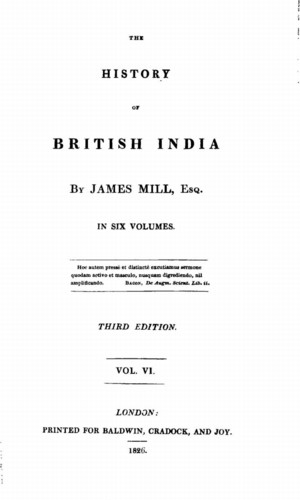
CHAP. IX. - James Mill, The History of British India, vol. 6 [1817]Edition used:The History of British India in 6 vols. (3rd edition) (London: Baldwin, Cradock, and Joy, 1826). Vol. 6.
Part of: The History of British India, 6 vols.About Liberty Fund:Liberty Fund, Inc. is a private, educational foundation established to encourage the study of the ideal of a society of free and responsible individuals. Copyright information:The text is in the public domain. Fair use statement:This material is put online to further the educational goals of Liberty Fund, Inc. Unless otherwise stated in the Copyright Information section above, this material may be used freely for educational and academic purposes. It may not be used in any way for profit.
CHAP. IX.Situation of Oude, as left by Lord Teignmouth, highly satisfactory to the home Authorities—Great Changes meditated by Lord Mornington—Extirpation of British Subjects, not in the Service of the Company—Apprehended Invasion of the Afghauns—Endeavour to obtain the Alliance of Scindia—The Idea abandoned—An Embassy to the King of Persia—Insurrection by Vizir Ali—Reform of his military Establishment pressed on the Nabob of Oude—His Reluctance—He proposes to abdicate in favour of his Son—The Governor-General presses him to abdicate in favour of the Company—He refuses—Indignation of the Governor-General—He resorts to coercion on the Reform, which meant, the Annihilation, of the Nabob's military Establishment—The business of the Annihilation judiciously performed—The Vizir alleges the want of Resources for the Maintenance of so great a British Army—From this, the Governor-General infers the Necessity of taking from him the Government of his Country—If the Nabob would not give up the whole of his Country willingly, such a Portion of it as would cover the Expense of the British Army to be taken by Force—This was more than one half—The Vizir to be allowed no independent Power even in the rest—The Vizir desires to go on a Pilgrimage—The Hon. H. Wellesley sent to get from him an appearance of Consent—The Cession of the Portion necessary for the Expense of the Army effected—A Commission for settling the Country with Mr. H. Wellesley at the head—Governor-General makes a Progress through the Country—Transactions between him and the Nabob of Oude—Proposition of the Bhow Begum—Objections of the Court of Directors to the Appointment of Mr. H. Wellesley—Overruled by the Board of Control—Government of Furruckabad assumed by the Company—Settlement of the ceded Districts—Full Approbation of the home Authorities. BOOK VI. Chap. 9. 1799.The arrangements formed by the late Governor-General, Sir John Shore, with respect to the kingdom of Oude, satisfied the capacious desires of the London authorities. Under date the 15th of May, 1799, a despatch, intended to convey their sentiments to the instruments of government in India, has the following passages: “By the definitive treaty concluded at Lucknow, the Company's influence over the Vizir's country appears to be sufficiently preserved; without the insertion of any article, which, in its operation, might lead to an interference in the collections, on the part of the Company, that might be deemed offensive. And we have the further satisfaction to find, that, (exclusive of the immediate payment of twelve lacs of rupees by the Nabob Vizir),—his annual subsidy is increased upwards of twenty lacs of rupees; besides the acquisition of a fortress in the Oude dominions, of the greatest consequence in the scale of general defence: with other stipulations, which have a tendency to remedy former defects in our political connexion with that country, and to give the Company such an ascendancy as cannot fail to be productiveBOOK VI. Chap. 9. 1799. of material benefit to both parties: and which, we trust, will lead to the establishment of a good system of government in Oude, which hitherto all our endeavors, for a series of years, have been unable to accomplish. “The late Governor-General had given us reason to expect, that, for the first year, or perhaps longer, after Saadut Ali's accession, his revenues would probably fall considerably short of their estimated amount; and that he would find considerable difficulty in fulfilling his pecuniary engagements with the Company:—and very satisfactorily assigned the ground of that opinion. We are, therefore, not surprised to find by the last accounts, that an arrear had accumulated in the payment of the Company's tribute, to the amount of upwards of eighteen lacs of rupees. Lord Mornington having represented, however, that he believes the Nabob is sincerely disposed to make every possible effort for the liquidation of this arrear, as well as for introducing such a system of order and economy into the management of his finances as will enable him to be more punctual in his future payments, we entertain a well-grounded expectation that every cause of complaint upon this head will speedily terminate.” “The affairs of Oude being thus settled in a manner which bids fair to be permanent; and it appearing by your political dispatch of the 17th April, 1798, that the most perfect tranquility continues to prevail in the Vizir's dominions; and as the resolutions of the late Governor-General, of the 9th and 30th October, 1797, for the augmentation of the army, were declared to be connected with the proposed arrangements for that country, we direct that you take into your immediate consideration the propriety BOOK VI. Chap. 9. 1799.of disbanding those new levies, or the necessity of continuing them.”1 While the home authorities were thus congratulating themselves upon the state in which the affairs of Oude were left by the late Governor-General, and pleasing themselves with the belief of its permanence, the new Governor-General was meditating the most important changes. In the political letter from Bengal, as early as the 3d of October, 1798, the authorities at home were informed; “The Right Honorable the Governor-General has now under consideration the present state of affairs in Oude, and particularly the best means of securing the regular payment of the subsidy, and of reforming the Nabob's army.”2 And on the 23d of December of the same year, the Governor-General wrote, in a private letter to the resident at Oude; “The necessity of providing for the defence of the Carnatic, and for the early revival of our alliances in the Peninsula, as well as for the seasonable reduction of the growing influence of France in India, has not admitted either my visiting Oude, or of my turning my undivided attention to the reformof the Vizir's affairs. There are, however, two or three leading considerations, in the state of Oude, to which I wish to direct your particular notice; intending, at an early period, to enter fully into the arrangement in which they must terminate.—Whenever the death of Almas shall happen, an opportunity will offer of securing the benefits of Lord Teignmouth's treaty, by provisions, which seem necessary for the purpose of realizing the subsidy, under all contingencies. The Company ought to succeed to the power of Almas. And the management, if not the sovereignty, of that part of theBOOK VI. Chap. 9. 1799. Doab, which he now rents, ought to be placed in our hands, a proportionate reduction being made from the subsidy; the strength of our north-western frontier would also be increased. On the other hand, in the event of Almas's death, we shall have to apprehend either the dangerous power of a successor equal to him in talents and activity, or the weakness of one inferior in both, or the division of the country among a variety of renters; in the first case we should risk internal commotion; in the two latter the frontier of Oude would be considerably weakened against the attacks either of the Abdalli or of any other invader. The only remedy for these evils will be the possession of the Doab fixed in the hand of our government. The state of the Vizir's troops is another most pressing evil. To you I need not enlarge on their inefficienoy and insubordination. My intention is to persuade his Excellency, at a proper season, to disband the whole of his own army, with the exception of such part of it as may be necessary for the purposes of state, or of collection of revenue. In the place of the armed rabble which now alarms the Vizir, and invites his enemies, I propose to substitute an increased number of the Company's regiments of infantry and cavalry, to be relieved from time to time, and to be paid by his Excellency. I have already increased our establishment to the extent of seventeen regiments of infantry, with the view of transferring three regiments to the service of his Excellency.— With respect to the Vizir's civil establishments, and to his abusive systems for the extortion of revenue, and for the violation of every principle of justice, little can be done before I can be enabled to visit Lucknow.”3 BOOK VI. Chap. 9. 1799.The hostility of the Governor-General to his fellow-subjects, pursuing, independently of the Company, their occupations in any part of India, is expressed, without a word to indicate reasons, in the same letter, thus; “The number of Europeans particularly of British subjects, established in Oude, is a mischief which requires no comment. My resolution is fixed, to dislodge every European, excepting the Company's servants. My wish is, to occasion as little private distress as possible, but the public service must take its course; and it is not to be expected that some cases of hardship will not be found in the extent of so great a measure.” These last words indicate extensive numbers. Why did not the Governor-General, before he dared to strike at the fortunes of great numbers of his countrymen, declare and prove, the evils which they produced? For what reason is it, let them declare, who know what is understood, under such a government as ours, by the responsibility of the ruling few, that he has never yet been effectually called upon to account for such a conduct? The good which they were calculated to produce is obvious to all. The question still remains unanswered, What were the evils? The threats of Zemaun Shah, King of the Abdalees, or Afghauns, became a convenient source of pretexts for urging upon the Vizir the projected innovations. This prince had succeeded his father Timur Shah, the son of the celebrated Ahmed Shah, the founder of the dynasty, in the year 1792. His dominions extended from the mouths of the Indus to the parallel of Cashmere; and from the boundaries of the Seiks, at some distance eastward of the great river Attack, to the vicinity of the Persian Tershish; including the territories of Cabul, Candahar, Peishere, Ghizni, Gaur, Sigistan, Korasan, and Cashmere. In the year 1796, this prince advanced to Lahore; andBOOK VI. Chap. 9. 1799. though his force was not understood to exceed 33,000 men, almost wholly cavalry, he struck terror into the Mahrattas; and excited alarm in the English government itself. The object of the Shah, as announced by rumour, was, to re-establish the House of Timur, to which he was nearly related, and restore the true faith in the empire of the Great Mogul. The Seiks, it appeared, gave no obstructions to his march: The Mahrattas, from their internal distractions, were ill prepared to resist him: And, though they assembled a considerable army, which might have enabled them to dispute the possession of Delhi, or molest him in his retreat, it was still possible for him, in the opinion of the person then at the head of the English government, to advance to Delhi, even with so inconsiderable an army as that which he led to Lahore; in which case, he would have formidably threatened the British interests. The Rohillas, it was imagined, would join him; induced, not only by the affinities of descent and religion, and the cruelties which they had sustained at the hands of the English and Vizir; but, the Governor-General added, by the love of war and plunder; yet the truth is, that they devoted themselves to agriculture, whenever oppression would permit them, with an ardour and success, of which India had no example; and their love of war and plunder meant only a greater degree of courage and vigour than distinguished the other races of the country. The approach of the Shah, it was therefore apprehended, would spread the greatest disorders in the dominions of the Vizir. “The troops under Almas,” who governed, as renter, and defended, that half of the dominions of the Vizir which was most exposed to the incursions both of the Mahrattas and Afghauns, “were,” says the Governor-General, “respectable. BOOK VI. Chap. 9. 1799.The other troops of the Vizir, with little exception, would rather have proved an incumbrance, than an assistance to the British forces; and nothing but the most urgent remonstrances would have ensured the exertions or supplies of the Vizir. His dominions would have been overrun with marauders; a total temporary stoppage of the collections would have ensued; and these disorders, if not speedily quelled, would have ended in general insurrection.” On the measures to be adopted, Sir John Shore found it difficult to decide. The Mahrattas, excited by their fears, made proposals to the English for a union of forces against the Afghaun. But the reduction of the power of the Mahrattas, Sir John would have welcomed as one of the most desirable events. On the other hand, Zemaun Shah, if crowned with success, would be still a greater object of dread. Again; if the Mahrattas, by their own exertions, prevailed over the Shah, they would gain a formidable increase of power. Or, if the French leader, who in the name of Scindia, now governed so great a portion of the provinces, at which the Afghauns were supposed to aim, should, in the midst of commotion, raise himself to the sovereignty of the territories in dispute, this to the mind of the Governor-General appeared the most alarming consequence of all. Before the English government thought itself called upon for any great exertions, a rebellious brother of the Shah excited disturbance in his dominions; and recalled him early in 1797, from Lahore. The troops at the cantonments of Cawnpore and Futty Ghur had, in the mean time, been ordered into camp; and two additional regiments of infantry had been raised. The Governor-General, indeed, imagined, that the march of the Shah to Lahore, with so limited a force, was rather an experiment than the commencement of an expedition; but the question was worthy of hisBOOK VI. Chap. 9. 1799. attention whether it would have been easy for the King of the Afghauns to come with a greater force. It was, too, after all, the opinion of the English ruler, that, though motives were not wanting to prompt the Shah to the invasion of Hindustan, it was nevertheless an event very little probable; and such as there would be little prudence in taking any costly precautions to defeat.4 In 1798, a belief, but solely derived from rumour, of vast preparations making by the Afghaun, for the invasion of India, was excited anew. The apprehensions, however of the British government were allayed, by intelligence received toward the end of September, that the disturbances within the dominions of the Shah had compelled him to leave his capital and march to Candahar. But this was speedily followed by reports, that the 10th of October was fixed for commencing his march from Cabul towards Hindustan; and though the authenticity of these reports was held very doubtful, the English government deemed it, “their duty,” according to their own expressions, “to take every precaution against the possibility of an event, which, combined with the designs of Tippoo and the French, might become of the most serious importance.” Endeavours were used to prevail upon Doulut Row Scindia to return from the south, and put his dominions in the best posture of defence; and great hopes were expressed, that he would follow this advice. “The Governor-General also directed the Resident at the court of Scindia,” I use again the language of the Governor-General in council, “to enter into defensive engagements with BOOK VI. Chap. 9. 1799.that chieftain, upon his return to Hindustan, under such limitations and conditions, as might secure the effectual co-operation of the Mahratta army, with the least possible diversion of the British force from the exclusive protection of the frontier of Oude. His Lordship further directed the resident with Scindia to endeavor to provide the earliest resistance to the progress of the Shah, at the greatest practicable distance from the frontier of Oude, by encouraging the chiefs of the Rajapoots and Seiks to oppose the first approach of the invading army.”5 In the month of October the Commander-in-Chief was directed to prepare for such a disposition of the troops in the upper provinces, and such military operations in general, as would most effectually secure that part of the British frontier against an attack from the Afghauns. The proposition of the Commander-in-Chief was approved, for adding to the army two regiments of native infantry, for the movement of five companies of native invalids to Chunar, and of five other companies to Allahabad; and for assembling a force to cover the city of Benares. The resident at Lucknow was desired “to urge to the Vizir,” these are the words of the official dispatch, “the necessity of collecting as large a body of artillery, infantry, and cavalry, as possible, to be placed, if necessary, under the directions of an European officer, and to be employed in the manner suggested by the Commander in-Chief:” Also, to take immediate measures for sending such a supply of grain to Allahabad as the commanding officer in the field might prescribe, and for obtaining the orders and assistance of the Vizir in dispatching, whenever it should be requisite, all the boats not required for the service of the army. Notwithstanding the hopes, however, which hadBOOK VI. Chap. 9. 1799. been fondly entertained of a defensive alliance with Scindia, the authorities in India write to the authorities in England in the following terms; “From the letter to the resident with Dowlut Row Scindia, dated the 26th of October, you will observe, that Scindia's continuance at Poonah, the dissensions and disaffection which prevail among his commanders, and the unsettled and precarious state of his authority in Hindustan, have prevented our taking any further steps for carrying the intended arrangements into effect.” It was in the beginning of October that the authorities in India delivered it to the authorities in England, as their opinion, that the greatest advantages would arise from a connexion with Scindia: Before the end of the same month, they find the circumstances of Scindia to be such, that no further steps for carrying the intended arrangements into effect are accounted advisable.6 Again; the inability of Scindia, from the disaffection of his commanders, and the tottering state of his authority, was now made the foundation on which measures of policy were built: After an interval of not many months, the necessity was urged of draining the whole resources of the British state, to make war upon him. The fact appears to be, that Scindia knew the improbability of being invaded by the Shah; and though such invasion would bring on him greater evils than it would bring on the government of any other state, he chose to remain at Poonah, for the promotion of those objects of which he was there in eager pursuit. “Under these circumstances,” say the authorities in India, “we have judged it expedient to determine, that in the event of Zemaun Shah's approach to the BOOK VI. Chap. 9. 1799.frontier of our ally the Vizir, our military operations shall be confined to a system of defence; and we have resolved that our arms shall, in no case, pass the limits of his Excellency's dominions, unless such a forward movement shall be deemed by the commanding officer necessary for the protection of the frontier, either of Oude, or of our own dominions.”7 After producing all this preparation and expense, the Shah, who, it seems, had again advanced as far as Lahore, began his retreat on the 4th of January: and Shah Aulum was informed by a letter from the Afghaun Vizir, that no intention remained of prosecuting the expedition into Hindustan that year, but the helpless Mogul might look forward to a more prosperous issue, at some future period. The cause of the retreat was reported, and believed, to be, the alarming progress making by the brother of the Shah at the head of a military force in the neighborhood of Herat.8 In the month of September, Mr. Duncan, the Governor of Bombay, had made the following communication to the Governor-General. A personage, of the name of Mehedi Ali Khan, had intimated, that, as he was about to make a journey into Persia, it might be in his power, and if properly authorized, he had confident hopes that it would be in his power, to excite the Persian rulers, by threatening or attacking the western part of Afghaunistan, to divert the Shah from his projected invasion of Hindustan. The fact was, that Baba Khan, then King of Persia, had espoused the cause of Mahmood, the brother of Zemaun, as the elder son, and hence the rightful heir of the late monarch: and had already threatened, if not attacked, the province of Khorassan. Mehedi Ali Khan was entrusted with a mission, the objects of which, asBOOK VI. Chap. 9. 1799. they fell in with the existing politics of the Persian government were successfully attained. This, however, was not enough to satisfy a mind, which longed to do every thing in magnificent style; and the Governor-General prepared a splendid embassy to the court of Baba Khan. Captain Malcolm, who had lately been assistant to the resident at Hyderabad, was chosen, for his knowledge of the language, and other accomplishments, to conduct the negotiation. “The embassy,” to use the words of the negotiator, “was in a style of splendour corresponding to the character of the monarch, and the manners of the nation, to whom it was sent; and to the wealth and power of that state from whom it proceeded:” A language this, which may be commonly interpreted, lavishly, or, which is the same thing, criminally, expensive. The negotiator continues; “It was completely successful in all its objects. The King of Persia was not only induced by the British envoy to renew his attack upon Khorassan, which had the effect of withdrawing Zemaun Shah from his designs upon India; but entered into treaties of political and commercial alliance with the British government.”9 The embassy proceeded from Bombay on the 29th of December, 1799; and the terms of the treaties were fixed before the end of the succeeding year. It was stipulated, That the King of Persia should lay waste, with a great army, the country of the Afghauns, if ever they should proceed to the invasion of India, and conclude no peace without engagements binding them to abstain from all aggressions upon the English: That should any army, belonging to the French, attempt to form a settlement on any of the islands or BOOK VI. Chap. 9. 1799.shores of Persia, a force should be employed by the two contracting states to co-operate for their extirpation; and that if even any individuals of the French nation should request permission to reside in Persia, it should not be granted. In the firmaun, annexed to this treaty, and addressed to the governors and officers in the Persian provinces, it was said; “Should ever any person of the French nation attempt to pass your ports or boundaries; or desire to establish themselves, either on the shores or frontiers, you are to take means to expel and extirpate them, and never to allow them to obtain a footing in any place; and you are at full liberty, and authorised, to disgrace and slay them.” Though the atrocious part of this order was, no doubt, the pure offspring of Persian ferocity; yet a Briton may justly feel shame, that the ruling men of his nation, a few years ago, (such was the moral corruption of the time!) could contemplate with pleasure so barbarous and inhuman a mandate, or endure to have thought themselves, except in a case of the very last necessity, its procuring cause. On their part, the English were bound, whenever the King of the Afghauns, or any person of the French nation, should make war upon the King of Persia, “to send as many cannon and warlike stores as possible, with necessary apparatus, attendants, and inspectors, and deliver them at one of the ports of Persia.”10 The evil of this condition was, that binding, not merely for a single emergency, it tended to involve the English in all the quarrels between the King of Persia, and a neighbouring people, with whom it was very unlikely that he would almost ever be at peace: and thus extended more widely than ever those fighting connexions, which theBOOK VI. Chap. 9. 1799. legislature had not only prohibited, but stigmatized, as contrary at once to the interest and the honour of the nation. The commercial treaty was of slight importance, and aimed at little more than some security from the ill usage to which in barbarous countries merchants are exposed, and some improvements in the mode of recovering the debts, and securing the property of the English traders. On the attainment of these points, the envoy himself, as natural, sets the highest value. “These treaties,” he tells us, “while they completely excluded the French from Persia, gave the English every benefit which they could derive from this connexion.” He adds, “Nor can there be a doubt, that if this alliance had been cultivated with the same active spirit of foresight and penetration with which it was commenced, it would have secured the influence of the British government in that quarter from many of those attacks to which it has subsequently been exposed.”11 It would have been good, if the envoy had shown, in what advantage the British government could find a compensation, for the expense of upholding such a connexion at the court of Persia. The result, in regard to the Afghauns, is necessary to be known. The year 1800 was spent, partly in war, partly in negotiation, between the King of Persia and Zemaun Shah. In the year 1801, Mahmood, the rebellious prince, collected such a force, as enabled him not only to defeat his brother, but to render him a captive.12 To grant a residence to Vizir Ali, the deposed Nabob or Nawaub of Oude, at a place so near his BOOK VI. Chap. 9. 1799.former dominions as Benares, was not regarded as a measure of prudence, and he had been made acquainted with the resolution of removing him to Calcutta. He viewed the change with the utmost aversion; but all his remonstrances against it had proved in vain; and the time was now approaching, the preparations were even made, for carrying it into execution. On the morning of the 14th of January, 1799, he paid a visit, by appointment, accompanied by his usual suite of attendants, to Mr. Cherry, the British resident, at his house, distant about three miles from Benares. After the usual compliments, he began to speak of the hardship of his coercive removal; and proceeded first to warmth, at last to intemperance of language. Mr. Cherry, whose attentions were understood to have gained his personal favour, is said to have gently attempted to repress his indiscretion, and to remind him that he at least was not the proper object of his resentment; when the impetuous youth, with sudden or premeditated frenzy, started from his seat, and made a blow at him with his sword. This, by the law of Eastern manners, was a signal to his attendants, with or without concert; and in an instant their swords were unsheathed. Mr. Cherry endeavoured to escape through a window, but one of the attendants, reaching him with his poignard, struck him lifeless on the floor. Two other gentlemen in the room being murdered, the assassins hurried to the houses of other Englishmen; but sacrificing only two other lives in their progress, they were so vigorously resisted by a gentleman who possessed himself of a narrow stair-case, and defended himself against their ascent, that time was given for the arrival of a party of horse; upon which they immediately betook themselves to flight. So little preparationBOOK VI. Chap. 9. 1799. had Vizir Ali made for this explosion, that he was obliged to leave behind him whatever property he possessed, the furniture of his zenana, his elephants, and even a part of his horses. He retired to the woody country of Bhotwal, where he was joined by several disaffected Zemindars. The news of this outrage excited considerable emotion at Lucknow, where it was regarded as the eruption of a conspiracy for the overthrow of the government; a conspiracy in which it was unknown to what extent the subjects of Saadut Ali might themselves be concerned. That ruler, in whose character timidity predominated, and who knew that he was hated, suspected every body, even his troops, and prayed that the English battalion might be sent from Cawnpore for the protection of his person. When called upon to join with his forces the British army, for the chastisement of the offender, he found an excuse, which his avarice, his timidity, his desire of ease, and hatred of exertion, all combined in leading him eagerly to adopt. He stated his suspicions of his troops, and represented them as too void, both of discipline and of fidelity, for any advantage to be expected from their aid. He afterwards paid dear for his ingenuousness, when this representation was brought forward as a reason, for thrusting upon him measures which his soul abhorred. Notwithstanding the representations of the former Governor-General, Sir John Shore; that the people of Oude universally regarded Vizir Ali as destitute of all title to the crown, the grand alledged fact, upon which he grounded the important decision of deposing a sovereign, and naming his successor; the Marquis Wellesley, in a letter to the Resident, dated the 22d of January, 1801, expressly says, “Active, and general,BOOK VI. Chap. 9. 1799.support has been afforded, by the subjects of his Excellency, to the impostor who lately assumed the name of Vizir Ali.”13 It also appears that of the troops of the Vizir, which were required to assist in reducing the disturber, a part in reality joined his standard. He found himself in a short time at the head of an army of several thousand men; descended with them into the plains of Goorakpoor, the eastern district of Oude; and threw the whole kingdom into trepidation and alarm. A British force was assembled to oppose him. Some partial rencounters, in which they suffered pretty severely, and the narrow limits for subsistence or plunder to which they were reduced, soon disheartened his followers; when they abandoned him in great numbers; and he himself took refuge with a Rajpoot Rajah. He remained with him till the month of December following; when the Rajpoot made his terms with the British government, and treacherously delivered up Vizir Ali, who was carried to Fort William, and there confined. In the month of January, 1799, the Governor-General addressed letters to the Vizir, and to the resident at Lucknow, of which the object was to urge, what he was pleased to denominate a reform of the military establishment of the Vizir. The London authorities themselves, in the letter which they afterwards wrote on the 15th of May, 1799, expressing their great satisfaction with the arrangements in Oude which had been formed by Sir John Shore, and with the disposition shown by the Vizir, both to make the large pecuniary payments which were required at his hands, and to introduce the reforms into his financial system, which would alone enable him toBOOK VI. Chap. 9. 1799. meet those demands, alluded to his military expenditure in the following terms: “The large, useless, and expensive military establishment, within the Oude dominions, appears to us to be one of the principal objects of economical reform, and we have much satisfaction in finding that the subject has already come under your consideration.”14 In his letter to the resident, the Governor-General says, “My object is, that the Vizir should disband, as speedily as possible, the whole of his military force:” The next part of the plan was to replace that force by an army exclusively British. This was what the Governor-General, with other Englishmen, called a reform of the military establishments of the Vizir: the total annihilation of his military power, and the resignation of himself and his country to the army of another state. The Vizir was indeed to retain as many, as might be necessary, of that kind of troops which were employed in collecting the taxes; and as many as might be necessary for the purposes of state: an establishment of the sort which his own aumils, or tax-gatherers, enjoyed. The resident was instructed to avail himself of the alarm into which the timidity of the Vizir had been thrown by the rumours of the expedition of the King of the Afghauns, to urge upon him the necessity of a ready concurrence with the Governor-General's views. “You will,” says the letter, “remind his Excellency, that his military establishment was represented, by himself, to be not only inadequate to contribute any assistance towards the defence of his dominions; but that, at the moment when the services of the British army were most urgently demanded BOOK VI. Chap. 9. 1799.on his frontier, he required the presence of a part of that force in his capital, for the express purpose of protecting his person and authority against the excesses of his own disaffected and disorderly troops. The inference to be drawn from these events is obviously, that the defence of his Excellency's dominions against foreign attack, as well as their internal tranquillity can only be secured, by a reduction of his own useless, if not dangerous troops, and by a proportionate augmentation of the British force in his pay. I am convinced this measure might be effected with a degree of advantage to his Excellency's finances, little inferior to that which it promises to his military establishments; and that his Excellency might obtain from the Company a force of real efficiency at an expense far below that which he now incurs in maintaining his own army in its present defective condition.” The Vizir, says the Governor-General, “might obtain a force:” when the force was to be the Company's, and the Vizir to have no force. In the very same letter, “It is not my intention,” says the Governor-General, “that the British force to be furnished to his Excellency should become a part of his own army. The British force to be substituted in place of that part of his excellency's army which shall be reduced, will be in every respect the same as the remainder of the Company's troops, and will be relieved from time to time according to the orders of the Governor-General in council.” The negotiations respecting this affair appeared to the Governor-General so important; that he was unwilling to entrust them to the qualifications of the resident, Mr. Lumsden. Colonel Scott had attracted his confidence and esteem; and he resolved that to him the trust should be consigned. “As I am aware,” said he, in the same letter, to the resident,BOOK VI. Chap. 9. 1799. “that you will require the assistance of some able military officer in the execution of the arrangement proposed, I have requested Sir A. Clarke to dispense with the services of Lieutenant Colonel Scott, the Adjutant-General, who will be directed to proceed to Lucknow immediately, and to remain there for as long a period as may be necessary to the accomplishment of the objects which I have in view.”15 In consequence of this intimation Mr. Lumsden resigned; and Major Scott was appointed to the office of resident. Major Scott proceeded to Lucknow in the month of June, bearing a letter from the Commander-in-Chief, executing at that time, in the absence of the Chief, executing at that time, in the absence of the Governor-General, the office of Vice-President of the Supreme Council. The Nawaub was desirous to postpone, rather than accelerate, all discussion upon a project, of which, although he was not yet acquainted with its particulars, the result, he was sufficiently aware, would be a large reduction of his power: And Colonel Scott appears to have been willing to employ some time in making himself acquainted with the situation of affairs, before he strongly pressed upon the Vizir the annihilation, called the reform, of his military establishment. To the usual causes of disorder and mis-rule, was at this time added another, in the suspension of the powers of the ministers, or principal organs of government, whom, having been appointed under English authority, the Vizir dared not remove, but from whom he withheld his confidence, and the management of his affairs. A circumstance, too, which peculiarly attracted the attention of the BOOK VI. Chap. 9. 1799.resident, was the hatred and contempt in which the Nabob himself was held by his subjects. “The information,” says he, “which your Lordship has received, of the unpopularity of his Excellency, is probably far short of the real state; as, confined to the court, the only persons who attend the Durbar, excepting the Nawaub's own sons, and occasionally Almas Ali Khan, are a few pensioners, of whom his Excellency, from their known character, entertains no suspicion of engaging in politics; and it has not been without some difficulty that I have prevailed on native gentlemen of respectable connexions to show themselves at the Durbar.—The present state of things, so degrading to the character of the Nawaub, so prejudicial to his own real interests, and to the welfare of his country; and, I may add—so discreditable to the English name, obviously calls for a radical reform.” Major Scott's ideas of “a radical reform,” however, were all summed up in these words, “An open, efficient, and respectable administration.” Even this, however, he despaired of being able to establish without the immediate interference of the head of the English government. “The evident design of the Nawaub,” he declared, “is to temporize and delay, that he may enjoy as long as possible the fruits of the present system of secret agency and intrigue.”16 On the 8th of September, the resident writes to the Governor-General, that, as soon after his arrival as practicable, he had presented to the Nawaub Vizir the letter from the Vice-President, on the subject of the military reform; that he had delivered to him a brief out-line of the intended plan, and requested to receive his answer as soon as it had received a dueBOOK VI. Chap. 9. 1799. degree of his consideration; that after more than twenty days had elapsed, he had requested a communication from the Vizir, who named the third day preceding the date of the letter he was then writing, to converse with him on the subject. According to the usual style of oriental politeness, which permits no direct contradiction or negative to be applied to any proposition from an exalted man, the Nawaub began by saying, “That the measure proposed was not impracticable, but such as he hoped might be accomplished:” he then observed, that he himself had, however, a proposition to offer, which he would either communicate to the Governor-General, when he should honour Lucknow with his presence, or to the resident if he should be entrusted with the execution of the scheme. He was pressed to disclose the nature of his proposition; but in vain. He said he would call in two days, and dictate to the resident a memorandum on the subject, to be transmitted to the Governor-General; but this, when it was given, indicated no more, than that “the proposition concerned himself personally, that it connected with his own ease the prosperity of his government, and in its operation could be prejudicial to no person.”17 The removal of the minister was the object at which, by the resident, he was supposed to aim. On the 20th of the same month, the resident held it necessary to explain still further the discoveries which he was enabled to make of the disposition and views of the Vizir. “After attentively studying the character of his Excellency, and acquainting myself, as far as circumstances will allow, with the general BOOK VI. Chap. 9. 1799.tenor of his proceedings, I am led to conclude that whilst he is determined to fulfil, with minute regularity, the peculiar engagements with the Company, his views are directed to the enjoyment of a full authority over his household affairs, hereditary dominions, and subjects, according to the most strict interpretation of the clause of the seventeenth article of the treaty executed at Lucknow.—I have no conception that he aspires, either now or in prospect, to political independence. What he aims at is the independent management of the interior concerns of his dominions, to the exclusion of all interference and inspection on the part of the English government, and to the gradual diminution of its influence over the internal administration of his country.” It was only on one account, the cruel and destructive mode in which the country was governed, that the resident thought the interference of the English government was to be desired, “since the exercise of it,” says he, “does not seem to have been intended by the late treaty, and is unequivocally disavowed by several declarations to his predecessor.” He had not thought it fitting, except in the way of allusion, to agitate again the subject of the military reforms.18 Notwithstanding the right which clearly belonged to the Nawaub, of exercising without control the interior government of his country, the Governor-General, by a letter, dated the 26th of September, says, “The present condition of his government appears to preclude you from the information necessary to your first steps in the proposed reforms.” This refers to the complaints of the resident, that the Vizir carried on his administration, by secret agents, not by the ostensible ministers; whence it happened that the resident found no person qualified to giveBOOK VI. Chap. 9. 1799. him the information which he required. “I shall hope,” continues the Governor-General, “that my applications to the Vizir would remove every difficulty of this nature.—But, if I should be disappointed in this expectation, it will then become necessary for you, in my name, to insist, that the Vizir shall place his government in such a state, as shall afford you the requisite means of information, as well as of carrying the intended regulations into complete and speedy effect.” He adds, “The great and immediate object of my solicitude is, to accomplish the reform of his Excellency's military establishment:—and, accordingly, this point must be pressed upon him, with unremitted earnestness. His acquiescence in the measure must, however, be totally unqualified by any conditions not necessarily connected with it.”19 The Vizir procrastinating both the disclosure of his secret, and compliance with the proposition for the annihilation-reform of his military establishment, the Governor-General addressed him by letter on the 5th of November. “The general considerations which render it extremely necessary and desirable that the arrangement respecting your military establishment should be carried into execution without delay, have already been fully explained to your Excellency, and you have concurred with me in my view of the subject. One argument in favour of a speedy determination on this subject possibly may not have occurred to your mind, and I therefore take this occasion explicitly to state it to your Excellency.” This argument was; that the Company were bound by treaties to defend the dominions of his Excellency against all enemies; that his dominions were threatened BOOK VI. Chap. 9. 1799.by Zemaum Shah, and perhaps by others; that “it might not be in the power of the British government, on a sudden emergency, to reinforce the troops in his Excellency's country with sufficient expedition; my firm opinion,” continues the Governor-General, “therefore is, that the Company can in no other manner fulfil effectually their engagement to defend your Excellency's dominions, against all enemies, than by maintaining constantly in those dominions such a force as shall at all times be adequate to your effectual protection, independently of any reinforcements which the exigency might otherwise require.”20 This was, in other words, an explicit declaration, that the military force for the protection of Oude ought to be, at all times, even in the bosom of the most profound peace, at the utmost extent of a war establishment; than which a more monstrous proposition never issued from human organs! As one of the most essential principles of good government consists in reducing the peace establishment of the military force to its lowest possible terms, and one of the most remarkable principles of bad government consists in upholding it beyond the limits of the most severe necessity; so, few countries can be placed in a situation which less demanded a great peace establishment, than the kingdom of Oude. On more than one half of all its frontiers, it was defended by the British dominions, or inaccessible mountains. On the other half, it was not supposed in any danger of being attacked, except, either by the King of the Afghauns, who was separated from it by the extent of several large kingdoms; or by the Mahrattas, who were too distracted and weak to be able to defend themselves. A peace establishment in Oude, at the perpetual extent of a war establishment, for defence against theBOOK VI. Chap. 9. 1799. Afghauns, would be very little more than matched by a proposition for a perpetual war establishment in England, for fear of an invasion from the Turks. Coercion was now to be employed; and the plan of it was this: Without any further regard to the consent of the sovereign, British troops, to the proposed amount, were to march into the country: the sums required for their maintenance were to be immediately demanded: and the want of ability otherwise to comply with the demand would compel him, it was supposed, to relieve himself from the expense of his own army, by putting an end to its existence. On what ground of justice was this proceeding built? The Governor-General exhibited an argument: “The seventh article of the treaty, concluded with your Excellency, by Sir John Shore, provides for the occasional augmentation of the Company's troops in your Excellency's dominions, in terms which evidently render the Company's government competent to decide at all times on the requisite amount of such augmentation. The same article binds your Excellency to defray the expense of any force which shall be deemed necessary by the Company for your defence.”21 The same argumentation was, by his Lordship's military secretary, repeated, more at length, to the resident. The treaty, concluded between the English government and the Nawaub, by Sir John Shore, clearly established two points, with regard to the military force to be maintained at the expense of the sovereign of Oude; that there should be a certain regular, permanent establishment; and also, a power of making occasional augmentations. Enough; said the Governor-General, BOOK VI. Chap. 9. 1799.and his instruments; let the occasional augmentations be made the permanent establishment. When this point was settled, all the benefit was attained of arbitrary will; for, as the amount of these augmentations was not specified, it remained with the Governor-General, upon the foundation of a treaty which exactly defined the permanent establishment, to make that permanent establishment any thing which he pleased. Such is the logic of the strong man towards the weak. Before this letter, written on the 5th of November, could be received by the resident, and delivered to the Vizir, namely, on the 12th of the same month, the measure of which he had before announced the contemplation, and which he had hitherto preserved a mysterious secret, was disclosed. He had already, on several occasions, given vent to expressions of impatience, in regard to the difficulties of his government, and the inability under which he found himself placed of commanding the respect or obedience of his subjects. These expressions had been so pointed as sometimes to raise in the mind of the resident a conjecture, that he was meditating a plan of retreat from the burthens of government. But at the same time, regulations of state were projected, buildings were planned, household arrangements were formed, and other things went on, so much in unison with views of permanency, that the resident would not encourage the conjecture which sometimes presented itself to his mind. Having appointed the morning of the 12th, to meet with him on business of importance, the Vizir, says the resident, “began by observing that he had frequently declared to me the impossibility of his conducting the affairs of his country, under existing circumstances; that probably I had not comprehended the full drift of these expressions, or conceived they were uttered in a momentBOOK VI. Chap. 9. 1799. of ill-humour; that the real meaning of them was an earnest desire to relinquish a government which he could not manage with satisfaction to himself, or advantage to his subjects.” He added, in the course of the conversation, “That his mind was not disposed to the cares and fatigues of government; that as one of his sons would be raised to the musnud, his name would remain; and that he was possessed of money sufficient for his support, and the gratification of all his desires in a private station.” In a second conversation, on the morning of the 14th, the Vizir entered into some further explanation of the motives which impelled him to the design of abdication, which “consisted,” says the resident, “in general accusations against the refractory and perverse disposition of the people at large; of complaints of the want of fidelity and zeal in the men immediately about his person; of the arrogance of some of the aumils, and of the open disobedience of others. “Whatever pleasure,” says the resident, “this exposure of his intentions afforded to myself, and whatever eventual benefits I foresaw to the interests of the two states, from the execution of them, I thought it my duty to expostulate with his Excellency, on so extraordinary a resolution, by such arguments as occurred to me on the occasion. I replied, that the remedy to this aggregate of evils was easy, and within his own power; that a strong and just administration would ensure the obedience of the bulk of his subjects on the firm principle of attachment to his person and government; that a conciliatory and encouraging conduct on his part would secure fidelity and enliven zeal; that the reform of the military establishment was the specific measure that would curb the arrogance of the aumils; and in BOOK VI. Chap. 9. 1799.conclusion I pledged myself, if his Excellency would reject the advice of interested favourites, and be guided by the impartial and friendly counsel which your Lordship would convey to him through me, that the affairs of his government could be conducted with ease to himself, to the acquisition of a high reputation, and to the prosperity and happiness of his subjects.” To a question in regard to the military reform, the Vizir replied, that, under his determination of resigning the government, all discussion of that subject was useless. In this opinion the resident acquiesced; and he deemed it, for the present, inexpedient to produce the Governor-General's letter of the 5th. With respect to the treasures and jewels left by the late Nawaub, he desired instruction; as from the expressions of the Vizir, and his character for avarice, he thought it was probably his intention to carry them along with him to the place of his retreat.22 The pleasure, which the resident expressed, at the prospect of the Nabob's abdication, was faint, compared with the eagerness of the Governor-General in grasping at the prey. “I am directed,” says the military secretary, under date of the 21st of the same month, “by the Right Honourable the Governor-General, to acknowledge the receipt of your letters of the 12th and 14th instant. “His Lordship is preparing detailed instructions to you, for the regulation of your conduct under the delicate and important circumstances stated in those letters. In the mean time he has directed me to communicate to you his sentiments on such parts of your dispatch of the 12th instant, as appears to his Lordship to require immediate notice. “The proposition of the Vizir is pregnant withBOOK VI. Chap. 9. 1799. such benefit, not only to the Company, but to the inhabitants of Oude, that his Lordship thinks it cannot be too much encouraged; and that there are no circumstances which shall be allowed to impede the accomplishment of the grand object which it leads to. This object his Lordship considers to be the acquisition by the Company of the exclusive authority, civil and military, over the dominions of Oude. “His Lordship does not consider the formal abdication of the sovereignty by the Vizir to be necessary to this end. On the contrary, he apprehends, that step, by necessarily raising a question with regard to the succession, would involve us in some embarrassment. His Lordship is rather of opinion, therefore, that the mode of proceeding on the proposition of the Vizir, must be, by a secret treaty with his Excellency; which shall stipulate, on his part, that, from and after a period, to be appointed by this government, the complete authority, civil and military, of the dominions of Oude shall vest in, and be exercised by, and in the name of the Company. “In this treaty his Lordship proposes, that the sons of the Vizir shall be no further mentioned than may be necessary for the purpose of securing to them a suitable provision. “With respect to what you have stated, relative to the wealth of the state, if the arrangement in the contemplation of the Governor-General should be agreed to by the Vizir, his Lordship will feel but little difficulty in allowing his Excellency to appropriate it to his own use, stipulating only on behalf of the Company, that all arrears of subsidy, or of whatever description, due to the Company, BOOK VI. Chap. 9. 1799.shall be previously discharged in full by his Excellency.”23 In conformity with these ideas, the draught of a treaty was speedily prepared, and sent to the resident, accompanied by notes for a memorial explanatory of the grounds of the several articles. The ardour of the Governor-General embraced the object as accomplished, or sure of its accomplishment. In pursuance of orders, the Commander of the troops in Oude delivered in, what was entitled, a “Memoir of the precautionary movements, and distribution of the Company's troops, for the purpose of establishing the exclusive control and authority of the Company over the dominions of Oude.”24 In the transmission of intelligence, receipt of instructions, and other preparatives, time was spent till the 15th of December; on which day, the plan of the Governor-General, in relation to the measure of abdication, was communicated for the first time to the Vizir, in the matured form of the draught of a treaty. After remarking upon the calmness with which the Vizir perused the treaty, and his observations upon some inferior points, “His Excellency,” the resident says, “who had not thoroughly comprehended the extent of the first article, asked what meaning I annexed to it. Referring him to the article itself, I replied, that it vested the whole administration of the country in the hands of the English Company. He then asked, what portion of authority was to remain with his successor; to which I replied that the plan did not provide for a successor. His Excellency continued his inquiries, by asking, whether a family which had been established for a number of years, was to abandon the sovereigntyBOOK VI. Chap. 9. 1799. of its hereditary dominions? I replied that your Lordship's justice and liberality had made an ample provision for the comfort and independence of that family; and briefly explained the consideration which had induced your Lordship to stipulate, that his Excellency should commit the sole and exclusive administration of Oude to the Company in perpetuity.” From this conversation, the resident adds, “I can hardly venture to draw any conclusion: And shall, therefore, only observe, that though his excellency is perfectly master of concealing his passions, yet, if he had entertained an immoveable repugnance to the basis of the treaty, he could scarcely have disguised it under smiles, and an unaltered countenance.”25 A paper drawn up at the request of the Vizir by the resident, and afterwards altered by the Vizir to a correspondence with his own feelings, was transmitted to the Governor-General, as the authentic enunciation of his design of abdication. In answer to this, a very long paper, dated, the 16th of December, was received from the Governor-General. The purpose of this document was to corroborate the ideas on which, in the mind of the Vizir, the plan of abdication was supposed to be founded; and to convince him of the impossibility of reconciling his design with the appointment of a successor, or any other scheme than that of transferring the undivided sovereignty of the country to the English. On the 19th of December the resident again wrote: “After my departure from the Nawaub Vizir, on the 15th instant, his Excellency either really was, or pretended to be, so much affected by the conversation, BOOK VI. Chap. 9. 1799.that he could not conceal the perturbation of his mind, which he betrayed, by forbidding the customary visits, and by refraining to transact any of the ordinary business. Although there is no reason to suspect that he has disclosed the cause of his uneasiness; yet this conduct so indiscreet, so unmanly, necessarily occasioned much talk and speculation amongst his own dependants, and the inhabitants of the city. “His Excellency, on the 17th, informed me of his intention to breakfast with me on the following morning; but at ten o'clock sent a message, that having been in the sun, his eyes were so much affected by a disorder he is liable to, that he could not fulfil his engagement that day, but would call upon me this morning. He accordingly came, and when entered into a private apartment, opened the conversation by observing, that in the paper transmitted to your Lordship, he had adverted to certain circumstances and causes, under the existence of which he found it impossible to conduct the affairs of his government; and that he entertained the hope that your Lordship would have called upon him for an explanation of those circumstances and causes. “His Excellency proceeded, that the proposition offered by your Lordship was so repugnant to his feelings; departed so widely, in a most essential point, from the principle on which he wished to relinquish the government; and would, were he to accept it, bring upon him such indelible disgrace and odium, that he could never voluntarily subscribe to it. The sovereignty, he added, of these dominions, had been in the family near an hundred years; and the transfer of it to the Company, under the stipulations proposed by your Lordship, would, in fact, be a sale of it for money and jewels; that every sentiment of respect for the name of his ancestors, andBOOK VI. Chap. 9. 1799. every consideration for his posterity, combined to preclude him from assenting to so great a sacrifice, for the attainment of his personal ease and advantage. His Excellency concluded; that the power and strength of the Company placed every thing at your Lordship's disposal. “Upon stating to his Excellency all the arguments suggested by your Lordship against the nomination of a successor, his Excellency replied; that under your Lordship's determination not to consent to that part of his proposition, he was ready to abandon his design of retirement, and to retain the charge of the government.” If this resolution was adopted, the resident called to his recollection, the reform of his military establishment, the accomplishment of which would be immediately enforced. “I must here,” says the letter of the resident, “beg leave to call your Lordship's particular attention to his reply on this point; as tending to discover his real sentiments; and perhaps the true meaning of the words ‘certain causes,’ so repeatedly dwelt upon, and so industriously concealed. His excellency observed, that the reform of his military establishment upon the principles proposed by your Lordship, would annihilate his authority in his own dominions.”26 Intelligence of these declarations on the part of the Vizir appears to have disappointed and provoked the Governor-General in no ordinary degree. On the 27th of December the Secretary writes; “My dear Scott, I am directed by Lord Mornington to acknowledge the receipt of your letter of the 19th instant to his Lordship's address. His Lordship is extremely BOOK VI. Chap. 9. 1800.disgusted at the duplicity and insincerity which mark the conduct of the Nabob Vizir on the present occasion; and cannot but strongly suspect, that his Excellency's principal, if not sole, view in the late transaction, has been to ward off the reform of his military establishment, until the advanced period of the season should render it impracticable, at least during the present year.”27 And in the letter of the Governor-General to the home authorities, dated the 25th of January, 1800, he says, “I am concerned to inform your honourable Committee that I have every reason to believe, that the proposition of the Nabob Vizir to abdicate the sovereignty of his dominions (a copy of which was transmitted with my separate letter of the 28th of November) was illusory from the commencement, and designed to defeat, by artificial delays, the proposed reform of his Excellency's military establishments.”28 The truth is, that the vivacity of the Governor-General in the pursuit of his object was far too great. Had the sincerity of the Vizir been ever so indisputable, it was one thing to abdicate in favour of his son; a very different thing to abdicate in favour of the East India Company; and from a proposition to this effect, presented nakedly and impetuously, as that was of the Governor-General, it ought to have been expected that he would revolt. At the same time, it might have been regarded as probable, that if the externals of royalty were left to his son, he would be induced to dispense with the substantials. The Governor-General should have gone to Lucknow himself, when the imposing presence of his authority would have forcibly wrought upon a mind so timid, and accustomed to shrink before superior power, as that of the Vizir. The Governor-General, too, hadBOOK VI. Chap. 9. 1800. so lately recognized the policy of setting up the shadow of a sovereign,29 that the eagerness is the more remarkable, with which in this case he strove to escape from it. When the substance had been held for a time, it would have been easy to deal with the shadow, as experience might direct. Disappointed in his eager expectation, and piqued at the idea of having been duped, the Governor-General resolved to proceed in his plan for the military reform without a moment's delay. The reason for hurry was the greater, because the season approached, when additional inconvenience would attend the movement of the troops. “The resident,” says the Governor-General himself, in another letter to the home authorities,30 “was directed immediately, either from himself, or in concert with the commanding officer at Cawnpore, as the nature of the case might appear to him to require, to direct the several corps to move to such points of his Excellency's dominions, as might appear most adviseable; giving due notice to his Excellency of the entrance of the augmentation of the troops into his territories, and calling upon his Excellency to adopt the requisite measures for the regular payment of the additional force.” On the 4th of January, 1800, “I informed,” says the resident, “his Excellency, that the first division of the troops, intended by your Lordship to augment the force in Oude, as stated in the paper which I had presented to him, was now in a situation immediately to enter his Excellency's dominions; and that I was anxious to advise with him on their destination. He entreated that no steps might be taken for their actual march into his dominions, until I had seen and reflected BOOK VI. Chap. 9. 1800.upon the sentiments which he was then employed in committing to paper, and upon some propositions he had to offer. I assured him it was totally impossible to delay the march of the troops; but that, as it would require a day or two to arrange a place for their distribution, if his Excellency would, in that space, come forward, in an unreserved manner, with any specific propositions, I should be enabled to judge what weight to allow them, and how far they would authorize me to suspend the progress of the corps. His Excellency having observed that his assent had not yet been given to the augmentation of the troops, I explained to him the principle on which your Lordship's determination was founded. To which he replied, that, if the measure was to be carried into execution, whether with or without his approbation, there was no occasion for consulting him.” To this last observation the resident found it not convenient to make any answer, and immediately diverted the discourse to another point of the subject.31 On the 15th of January, the Nabob communicated to the resident a paper, in which he thus addressed him: “You, Sir, well know, that the proposed plan never, in any measure, met with my approbation or acceptance; and that, in the whole course of my correspondence with the Governor-General, on this subject, not one of my letters contains my acquiescence to the said plan.” He says again, “It may fairly be concluded from Lord Mornington's letters, that arrangements for the additional troops were not to take effect, until funds should be provided for their support, by the dismission of my battalions. Nothing having as yet been agreed upon, respecting the disbanding of the latter, and the additional Company's troops being on their march,BOOK VI. Chap. 9. 1800. whence are the funds to be derived for their payment? Their sudden approach too, leaves no time to form arrangements for them.” “Notwithstanding,” says he, “I am well assured that, in consequence of the measure, thousands of people will be deprived of their subsistence; and that, by the disbanding of my troops, serious commotions and alarms will take place in the capital (for which reason I give previous warning of its mischievous effects), yet, dreading his Lordship's displeasure, and with the sole view of pleasing him, I am compelled to grant my assent to the introduction of the plan.” He then proceeds to enumerate certain things, which he still desired, as conditions under which the measure, if unavoidable, might take its effect. The first was, that the augmentation of the troops should not be carried beyond the extent of his means. Another was, that the additional force should be kept in one body, and permanently stationed in one place, which would render it more efficient against Zemaun Shah, and other enemies, defence against whom was its only pretext. A further condition was, that the English commander should not interfere with the collection of the revenue. After several other propositions of minor importance, he said, “From the kindness of the Sircar of the Company I am led to expect, that, having, in the present instance, in order to avoid the Governor-General's displeasure, given my consent to the introduction, as far as possible, of the plan, I shall not in future be troubled with fresh propositions.”32 On the 18th, a paper or memorial, the draught of which had been communicated to the resident on the BOOK VI. Chap. 9. 1800.11th, was dispatched by the Vizir to the Governor-General. He began by adverting to the length of time his ancestors had enjoyed the unlimited sovereignty of these provinces. He described the dangers which had threatened the government of his brother, as well from foreign foes, as the disaffection of his troops. “Notwithstanding,” said he, “these circumstances, it never once entered the imagination of the British rulers to introduce such innovations, and carry into effect such arrangements, as those now suggested by your Lordship.” He then described how completely he was the creature and dependant of the Company, and said, “it was in all ages and countries the practice of powerful and liberal sovereigns to spare neither expense nor trouble in assisting those whom they have once taken under their protection. Should the Company,” said he, “no longer putting confidence in the sincerity of my friendship, deprive me of the direction of my own army, and spread their troops over my dominions, my authority in these provinces would be annihilated; nor would my orders be attended to on any occasion, whether trifling or momentous. Making myself, however, sure,” he adds, “that it never can have been your Lordship's intention, or conformable to your wish, to distrust, degrade me, or lesson my authority in these dominions, I shall without ceremony disclose to your Lordship my unfeigned sentiments and wishes.” And he then proceeds to remonstrate against the measure by a train of reasoning, not unskilfully conceived. “By a reference,” said he, “to the second article of the treaty, it will be evident to your Lordship, that on my accession to the musnud, the force designed for the defence of these dominions was increased beyond what it had been in any former period; whilst on my part I agreed to defray the expense of the said augmentation. But in no part of the said articleBOOK VI. Chap. 9. 1800. is it written or hinted, that, after the lapse of a certain number of years, a further permanent augmentation should take place. And to deviate in any degree from the said treaty appears to be unnecessary.—From an inspection of the 7th article, we learn, that, after the conclusion of the treaty in question, no further augmentation is to be made, excepting in cases of necessity; and that the increase is to be proportioned to the emergency, and endure but as long as the necessity exists. An augmentation of the troops, without existing necessity, and making me answerable for the expense attending the increase, is inconsistent with treaty; and seems inexpedient.—Towards the latter end of the 17th article, it is stipulated, ‘that all transactions between the two states shall be carried on with the greatest cordiality and harmony, and that the Nawaub shall possess full authority over his household affairs, hereditary dominions, his troops, and his subjects.’ Should the management of the army be taken from under my direction, I ask where is my authority over my household affairs, hereditary dominions, over my troops, and over my subjects?—From the above considerations, and from the magnanimity of the Sircar of the English Company, I am induced to expect from your Lordship's kindness, that, putting the fullest trust and confidence in my friendship and attachment on every occasion, you will, in conformity to the treaty, leave me in possession of the full authority over my dominions, army, and subjects.—The fame of the Company will, by these means, be diffused over the face of the earth; and, my reputation increasing, I shall continue to offer up prayers for the prosperity of the Company.”33 BOOK VI. Chap. 9. 1800.This remonstrance, which it was impossible to answer, the Governor-General found, in the forms of ceremony, a pretext for treating as an insult; and for not answering it. The following communication, signed by the secretary, was forwarded by express to the resident. “Your letter of the 18th instant, with its several enclosures, has been received by the Right Honourable the Governor-General.—His Lordship, not thinking proper to receive, in its present form, the written communication made to you by the Nabob Vizir on the 11th instant, as an answer to his Lordship's letter of the 5th November last to his Excellency—directs, that you lose no time in returning the original of that communication to his Excellency, accompanying the delivery of it with the following observations, in the name of the Governor-General:—The mode adopted in the present instance by his Excellency of replying to a public letter from the Governor-General, attested by his Lordship's seal and signature, and written on a subject of the most momentary concern to the mutual interests of the Company and of his Excellency, besides indicating a levity totally unsuitable to the occasion, is highly deficient in the respect due from his Excellency to the first British authority in India:—His Lordship, therefore, declines making any remarks on the paper which you have transmitted, and desires that the Nabob Vizir may be called on to reply to his Lordship's letter of the 5th November, in the manner prescribed no less by reason than by established usage: if, in formally answering his Lordship's letter, his Excellency should think proper to impeach the honour and justice of the British government, in similar terms to those employed in the paper delivered to you on the 11th instant, the Governor-General will then consider, how such unfounded calumnies, and gross misrepresentations, both of facts and arguments, deserve to beBOOK VI. Chap. 9. 1800. noticed.” This was language to a legitimate hereditary sovereign. The course of procedure is worthy of notice. A party to a treaty fulfils all its conditions with a punctuality, which, in his place, was altogether unexampled: A gross infringement of that treaty or at least what appears to him a gross infringement, is about to be committed on the other side: He points out clearly, but in the most humble language savouring of abjectness, much more than disrespect, the inconsistency which appears to him to exist between the treaty and the conduct: This is represented by the other party as an impeachment of their honour and justice; and if no guilt existed before to form a ground for punishing the party who declines compliance with their will, a guilt is now contracted which hardly any punishment can expiate. This, it is evident, is a course, by which no infringement of a treaty can ever be destitute of a justification. If the party injured submits without a word; his consent is alleged. If he complains; he is treated as impeaching the honour and justice of his superior; a crime of so prodigious a magnitude, as to set the superior above all obligation to such a worthless connexion. But this is not the whole of the message which the resident was commanded to deliver, in the name of the Governor-General, to the Vizir: “The Governor-General further directs, that you peremptorily insist on the Nabob Vizir furnishing a detailed answer to the paper transmitted by his Lordship on the 16th December last, for his Excellency's information and consideration; and that such answer be duly attested by his Excellency's signature, in the same manner as his Lordship's paper was formally attested by the signature of his Lordship: his Excellency's early BOOK VI. Chap. 9. 1800.compliance with this demand is equally due to the dignity of this government, and to the candour of its proceedings; in consequence of his Excellency's own spontaneous proposal to abdicate the sovereignty of his dominions; if his Lordship's manner of receiving and answering that extraordinary proposition of the Vizir appears in any degree objectionable to his Excellency, it behoves his Excellency clearly to state his objections, in the most formal and authentic mode; otherwise the Governor-General must, and will conclude, that his Excellency's original proposition was purposely illusory; and it will become his Lordship's duty to treat it accordingly, as an unworthy attempt to deceive the British government:—In all the transactions of his Lordship's government, since his arrival in India, he has pursued a plain and direct course; and he is determined to adhere to the same invariable system of just and honourable policy, nor will he be diverted from the system, by any machination of artifice, duplicity, or treachery, which may be opposed to him: he has already found the advantage of this course in frustrating the projects of the enemies of Great Britain in India; and he is satisfied that it will prove equally efficacious in confirming the faith of his allies.” The earnestness with which the Governor-General desired that this message should be delivered with unimpaired vigour to the Nawaub, is visible in the immediately succeeding paragraph of the same letter: “A copy of the foregoing observations, in Persian, attested by the signature of the Governor-General himself, will be forwarded to you by the Persian translator: and his Lordship directs that you communicate the same to the Nabob Vizir, either in case you should have any reason to suppose that his Excellency is likely to entertain the smallest doubt of your being, not only authorized, but commanded by his Lordship, to convey to his ExcellencyBOOK VI. Chap. 9. 1800. the message contained in the preceding paragraphs, as nearly as possible in the terms in which they are expressed; or in the event of your thinking that the document, attested by his Lordship's signature, will be more impressive than the verbal mode of communication.”34 On the 20th and 28th of January, the resident complained to the Governor-General, that the Vizir, instead of giving his cordial assistance, in carrying into execution the measure of annihilating his army, was rather placing impediments in the way; by insisting that the English additional force should not be dispersed in small bodies over the country; by withholding the statement which had been required of the amount and distribution of his own battalions; and by delaying to issue the perwannahs, necessary to ensure provisions to the additional troops. With regard to the last article, the resident, however, issued his own orders; and such was the state of the government, that they were punctually obeyed.35 The resident deferred the message to the Vizir, till the Persian translation arrived. “Having received,” says he, “on the 28th, in the evening, the translation in Persian of your Lordship's message to the Nawaub Vizir, I waited upon his Excellency on the 29th, in the afternoon, and, in obedience to your Lordship's commands, returned to him, in the most formal manner, the original draught of his proposed letter to your Lordship, accompanied with the paper of observations. His Excellency discovered considerable agitation in the perusal of the paper; and he expressed very poignant regret, at having unintentionally, as he affirmed, drawn upon himself such BOOK VI. Chap. 9. 1800.solemn animadversions from your Lordship.—It would, his Excellency observed, be the extreme of ingratitude and folly, wantonly to provoke the displeasure of that power, on which alone he relied, for the preservation of his honour, and the support of his authority. He attempted to apologize for the paper, by saying, that he meant it merely as a representation of arguments which might be produced, and not as a formal declaration of his own sentiments, and on that account had adopted the mode which your Lordship had viewed in so exceptionable a light.—In respect to the neglect in replying to the paper which had been submitted by your Lordship for his information and consideration, his Excellency assured me, that it arose from his inability to pursue, and reply, in detail, to the extensive train of reasoning which your Lordship had employed; and that he hoped your Lordship would have received the verbal communication, made through me, of the impossibility of his acceding to your Lordship's recommendation, as a full, and respectful answer.—His Excellency asked, for what purpose, or to what avail, could the attempt be, to deceive your Lordship by illusory propositions?”36 The intelligence from the resident, that opposition rather than assistance was given by the Vizir to the execution of a measure of which he so highly disapproved, produced a long letter of violent animadversions from the Governor-General, in which he told the harassed and trembling Vizir, “the means which your Excellency has employed to delay, and ultimately to frustrate, the execution of the above-mentioned plan, are calculated to degrade your character, to destroy all confidence between your Excellency and the British government, to produce confusion and disorder in your dominions, and to injure the mostBOOK VI. Chap. 9. 1801. important interests of the Company, to such a degree, as may be deemed nearly equivalent to positive hostility on your part.”;—“The conduct of your Excellency, in this instance,” he afterwards adds, “is of a nature so unequivocally hostile, and may prove so injurious to every interest, both of your Excellency and of the Company, that your perseverance in so dangerous a course will leave me no other alternative, than that of considering all amicable engagements between the Company and your Excellency to be dissolved.”—This was most distinctly to declare, that if he did not immediately comply, the Governor-General would make war upon him. And since this was the motive depended upon, in truth, from the beginning, would not the direct and manly course have answered the main purpose equally well, and all other purposes a great deal better? We are the masters: such is our will: nothing short of strict and prompt obedience will be endured. So ardent were the desires of the Governor-General, and so much was he accustomed to assume every thing on which his conclusions depended, that he maintained, in this letter, to the face of the Vizir, that of the plan for annihilating his army, the Vizir had, “after full deliberation, expressed his entire approbation.”37 Before the end of February, the Vizir felt convinced, that compliance could not be evaded. The money demanded on account of the additional forces was paid; and orders were issued for commencing the discharge of his own battalions. The business of dismissing the troops occupied a considerable time; and was retarded by the necessity of employing a BOOK VI. Chap. 9. 1801.portion of them in collecting the taxes which then were due. It was a matter of considerable delicacy, to avoid commotion, and the demand for bloodshed, where so many armed men were about to be deprived of their accustomed means of subsistence. The business was conducted in a manner highly creditable to the ability as well as the feelings of the gentlemen upon whom it devolved. It was the disposition, and the principle of the Governor-General, to treat with generosity the individuals upon whom the measures of his government might heavily press. As considerable arrears were always due to native troops, and seldom fully paid, the complete discharge of arrears, on which the English government insisted, was a powerful instrument of conciliation. When dissatisfaction any where appeared, every effort was employed to correct misapprehension; patience was exercised; the means of coercion were rather exhibited, than used; pardon was liberally extended, even where resistance had been overcome; and before the end of the year, the measure was in great part carried into effect without bloodshed or commotion.38 In the month of November, 1800, when demand for a second body of new troops was presented to the Vizir, he complained, by letter, to the resident, in the following terms: “The state of the collections of the country is not unknown to you: You know with what difficulties and exertions they are realized, and hence I feel a great degree of solicitude and apprehension, lest, if I should fail at a season of exigency, my responsibility should be impeached: I therefore wrote to you, that, until I was secure of resources to answer the demands, I could not become responsible: Accordingly, Jye Sookh Roy has been directed to prepare a statement of the condition of the country,BOOK VI. Chap. 9. 1801. with respect to its resources: You shall be informed when it is ready; and you can then come and inspect it; and, in concert, devise resources for the additional demands, according to the assets; and I will act accordingly.” In another part of the same letter, he said, “Formerly, in the plan proposed for the reform of the military, it was written, ‘That the resources for the expense of the new troops would be found in the reduction of those of his Excellency:’ Although the resources for the payment of the new British troops were not found in the reduction of those of the Sircar; now that you write, to have the charges of other new troops added to the debit of the state, when the reduction of the military has not yet supplied resources for the payment of the charges of the former new troops, how can I take upon myself to defray the charges of these new troops, without subjecting the Sircar to the imputation of a breach of faith.”39 Of these complaints the Governor-General rapidly availed himself to found on them pretensions of a new description. “If,” said he, in a letter to the resident, dated 22d of January, 1801, “the alarming crisis be now approaching, in which his Excellency can no longer fulfil his public engagements to the Company, this calamity must be imputed principally to his neglect of my repeated advice and earnest representations. The augmented charges might have been amply provided for, if his Excellency had vigorously and cordially co-operated with me, in the salutary and economical measure of disbanding his own undisciplined troops. It is now become the duty of the British government, to interpose effectually, for the protection of his interests, as BOOK VI. Chap. 9. 1801.well as those of the Company, which are menaced with common and speedy destruction, by the rapid decline of the general resources of his Excellency's dominions.” It may be observed, as we go on, that if the prompt disbanding of the forces of the Vizir would disengage a revenue perfectly equal, and more than equal, as had all along been confidently affirmed, to the charge created by the additional force, the delay which the reluctance of the Vizir occasioned, and which was now overcome, could only occasion a temporary embarrassment; and that menace of common and speedy destruction, of which the Governor-General so tragically spoke, had no existence: Or, that, on the other hand, if the menace of destruction were real, the pretence of finding, in the discharge of the Vizir's battalions, an ample resource for the new impositions, was void of foundation. The letter goes on, “The Vizir is already apprized, that I have long lamented the various defects of the system by which the affairs of his Excellency's government are administered. Conscious of the same defects, his Excellency has repeatedly expressed a wish to correct them by the assistance of the British government. The continuance of the present system will exhaust the country to such a degree, as to preclude the possibility of realizing the subsidy. In place of inveterate and growing abuses must be substituted a wise and benevolent plan of government, calculated to inspire the people with confidence in the security of property and of life; to encourage industry; and establish order and submission to the just authority of the state, on the solid foundations of gratitude for benefits received, and expectation of continued security.” The Governor-General here establishes the goodness of government, “as the solid foundation of submission to its authority.” He would not add, what was equally true, that there ought to be noBOOK VI. Chap. 9. 1801. submission without it. The following passage of the letter deserves profound regard. “Having,” continues the Governor-General, “maturely considered these circumstances, with the attention and deliberation which the importance of the subject requires, I am satisfied that no effectual security can be provided, against the ruin of the province of Oude, until the exclusive management of the civil and military government of that Country shall be transferred to the Company, under suitable provisions for the maintenance of his Excellency and of his family. No other remedy can effect any considerable improvement in the resources of the state, or can ultimately secure its external safety, and internal peace.” If this was the only plan which could avert from the state every species of calamity; absolute master, as he was, of the fate of the country, why did the Governor-General hesitate a moment to carry it into execution? He resolved to offer this proposition to the Vizir in the form of a treaty: but added, “Should his Excellency unfortunately be persuaded, by the interested counsel of evil advisers, absolutely to reject the proposed treaty, you will then proceed to inform his Excellency, in firm, but respectful language, that the funds for the regular payment of the subsidy, to the full extent of the augmented force, must be placed, without a moment of delay, beyond the hazard of failure.—For this purpose, you will require his Excellency to make a cession to the Company, in perpetual sovereignty, of such a portion of his territories, as shall be fully adequate, in their present impoverished condition, to defray those indispensable charges.” In selecting the portions to be demanded, the object was, BOOK VI. Chap. 9. 1801.to insulate the Vizir, as well for the purpose of precluding him from foreign connexions, as of defending him from foreign dangers. To this end choice was made of the Doab, and Rohilcund, in the first instance, with the addition of Azim Ghur, and even Gurrukpoor, if the revenue of the former country should prove inadequate.40 A letter to the same purport, and nearly in the same words, was, at the same time, written by the Governor-General to the Vizir.41 It closes with the following terms: “I request your Excellency to be satisfied, that the whole course of events in Oude, since your accession, has rendered it my indispensable duty to adhere with firmness to the tenor of this letter, as containing principles from which the British government never can depart; nor can your Excellency receive with surprise, or concern, a resolution naturally resulting from your own reiterated representations of the confusion of your affairs, and of your inability either to reduce them to order, or to conciliate the alienated affections of your discontented people.” The corollary from these deductions most necessarily, and most obviously is, that any sovereign, who governs ill, and loses the affections of his people, ought to abdicate, or to be compelled to abdicate, the sovereignty of his dominions. We shall see how energetic and persevering an apostle of this doctrine the Governor-General became. The subsidy which, according to the treaty of Lord Teignmouth, was already paid by the Vizir, amounted to 76,00,000: the annual expense of the additional force with which he was to be loaded, was 54,12,929: the whole would amount to 1,30,12,929 rupees. The Nawaub was required to make a cession of territory, in perpetual sovereignty to the English, the revenue of which, even in its present unproductive state, andBOOK VI. Chap. 9. 1801. without any regard to the improvements of which it might be susceptible, should amount to such a sum, over and above the whole expense of collection. The revenue remaining to the Vizir after such a deduction would have been 1,00,00,000.42 The territory, then, of which he was to be deprived, amounted to more than one half, to not much less than two thirds, of his whole dominions. The address of the Governor-General to the Vizir was presented to that prince on the 16th of February, and the first conversation on the subject between him and the resident was on the 26th. “His Excellency's conversation, on that day,” says the resident, “though it did not amount to a positive rejection of the first proposition, discovered an unreserved repugnance to the acceptance of it.” Before this letter, however, dated on the 6th of March, was closed, a letter addressed to the Governor-General was received from the Vizir. His complaints respecting the want of funds for payment of the enlarged subsidy, he explained as far from amounting to the alarming proposition into which they were framed by the Governor-General; but, as the fund which had been pointed to by the Governor-General as adequate, had not proved adequate; and as he had been repeatedly commanded by the Governor-General to make known to the resident his difficulties, and to make use of his advice, he had, for that reason, explained to him, and had done no more, the perplexities which weighed upon his mind. “In the course, however, of these conferences and communications, no impediment of affairs,” says he, “ever occurred; and no failure or deficiency whatever was experienced in the discharge of the BOOK VI. Chap. 9. 1801.expenses of the new troops, and in the payment of the kists of the fixed subsidy. On the contrary, those expenses and kists were punctually paid; accordingly the kist of the fixed subsidy, and the charges of the additional troops, have been completely paid to the end of January, 1801, and Colonel Scott has expressed his acknowledgements on the occasion.—It is equally a subject of astonishment and concern to me, that whereas, under the former government, the payment of the kists, though so much smaller in amount than the present, was constantly kept in arrear during three or four months, the jumma of the country was diminishing yearly, and yet no such propositions were brought forward,—they should be agitated under the government of a friend, who hopes for every thing from your Lordship's kindness; who is anxious to obey you, and to manifest the steadiness of his attachment; who punctually pays the full amount of his kists, notwithstanding their increased amount; and who has conformed to your Lordship. “As my consent,” says he, to the first proposition is altogether impracticable, (accordingly I have already written an ample reply to that proposition); and, as it is impossible for me, with my own hands, to exclude myself from my patrimonial dominion (for what advantage should I derive from so doing?)—this, therefore, is a measure, which I will never adopt. “With respect to what your Lordship writes, about providing a territorial resource for the payment of the British troops; since I have not, in any way, delayed or neglected to discharge the kists for the expenses of the troops, but have paid them with punctuality, where is the occasion for requiring any territorial resource?—I expect to derive the most substantial profits from bringing into a flourishing condition this country, which has so long been in a state of waste and ruin. By a separation of territory, my hopesBOOK VI. Chap. 9. 1801. of these substantial profits would be entirely cut off, and a great loss would accrue. How then can I consent to any territorial cession?”43 This letter brought an answer of immense length from the Governor-General, under date the 5th of April. Having lamented the refusal which had been given to both his propositions, and given a description of the progressive decline of the country, from the mis-government of the Vizir, the Governor-General says, “I now declare to your Excellency, in the most explicit terms, that I consider it to be my positive duty, to resort to any extremity, rather than to suffer the further progress of that ruin, to which the interests of your Excellency and the honourable Company are exposed, by the continued operation of the evils and abuses, actually existing, in the civil and military administration of the province of Oude.” After noticing the source of embarrassment still existing in the portion of his troops the dismission of which the Vizir had till now contrived to evade, the Governor-General subjoined, “But I must recall to your Excellency's recollection the fact, which you have so emphatically acknowledged on former occasions, that the principal source of all your difficulties is to be found in the state of the country. I have repeatedly represented to your Excellency the effects of the ruinous expedient of anticipating the collections; the destructive practice of realizing them by force of arms; the annual diminution of the jumma of the country; the precarious tenure by which the aumils and farmers hold their possessions; the misery of the lower classes of the people, absolutely excluded from the protection of the government; and BOOK VI. Chap. 9. 1801.the utter insecurity of life and property, throughout the province of Oude. An immediate alteration in the system of management affords the only hope of providing either for the security of the Company's military funds, or for any other interest involved in the fate of Oude.—It would be vain and fruitless to attempt this arduous task, by partial interference, or by imperfect modifications of a system, of which every principle is founded in error and impolicy, and every instrument tainted with injustice and corruption.”—What is here remarkable is, the Governor-General's declared principle of reform; That, of a system of government, radically corrupt, extirpation is the only cure. He proceeds to infer, that as the Vizir professed himself inadequate to the task of reform; and the undiminished prevalence of evil, since the commencement of his reign, proved the truth of his declaration; he ought to renounce the government, and give admission to others, by whom the great reform could be effectually performed. He added, “But whatever may be your Excellency's sentiments with respect to this the first proposition; the right of the Company to demand a cession of territory, adequate to the security of the funds necessary for defraying the expense of our defensive engagements with your excellency is indisputable.” This right he proceeded to found on his fears with regard to the future; lest the progressive decline of the country, the fruit of mismanagement, should quickly render its revenue unequal to the payments required.44 On the 28th of April a letter to the same purport, nearly in the same words, under signature of the Governor-General, was sent to the resident. The determinationBOOK VI. Chap. 9. 1801. was now adopted to seize the territory, if the consent of its reluctant sovereign was any longer withheld. “Any further reference to me from Oude is,” said his Lordship, “unnecessary. I, therefore, empower you to act under the instructions contained in this letter without waiting for additional orders.—If, therefore, his Excellency should persist in rejecting both propositions, you will inform him, that any further remonstrance to me upon this subject will be unavailing; that you are directed to insist upon the immediate cession of the territory proposed to be transferred to the Company; and that in the event of his Excellency's refusal to issue the necessary orders for that purpose, you are authorized to direct the British troops to march for the purpose of establishing the authority of the British government within those districts.”45 The Vizir having stipulated for certain conditions, of which one was, that he should be guaranteed, by a formal obligation, in the future independent exercise of an exclusive authority in the remaining parts of his dominions;” it is declared, in the instructions to the resident, under date the 27th of May; “His Lordship cannot permit the Vizir to maintain an independent power, with a considerable military force, within the territories remaining in his Excellency's possession.—It must never be forgotten that the Governor's original object was not merely to secure the subsidiary funds, but to extinguish the Vizier's military power.”46 This is a part of the design, not only not disclosed by the language held to the Vizir, but hardly consistent with it. In that, he was told, that the vices of his troops were the cause on account of BOOK VI. Chap. 9. 1801.which the English wished them destroyed. According to this new declaration, if the troops had been better, that is more formidable, the English would have liked them only so much the worse.47 In a letter of the 8th of June, the resident gives an account of a conversation the day before between him and the Vizir. “I stated to his Excellency that the general tenor and spirit of his articles of stipulations had excited the greatest concern and surprise in your Lordship's breast, and that I was commanded by your Lordship to communicate to his Excellency your Lordship's absolute rejection of the whole of them. His Excellency replied, that as his paper contained conditions, on which alone his consent to the territorial cession could be granted, your Lordship's rejection of them allowed him no other alternative, than that of passive obedience to whatever measures your Lordship might resolve on.” “I next proceeded to state to his Excellency the terms upon which your Lordship is disposed to guarantee to his Excellency and to his posterity the dominion of his Excellency's remaining territory. They were enumerated in the following order and manner: 1st, The continuance of the Company's right to station the British troops in any part of his Excellency's dominions: 2dly, the restriction of his own military establishment to an extent absolutely necessary for the collection of the revenues, and forBOOK VI. Chap. 9. 1801. the purposes of state: and thirdly, the introduction of such regulations of police, as should be calculated to secure the internal quiet of his Excellency's country, and the orderly and peaceful behaviour of his subjects of every description. “His Excellency's reply to this,” says the resident, “was striking: That the power of stationing the Company's troops in any part of his dominions, together with the other conditions, formed a combination of circumstances, the objects of which would be open to the comprehension of a child; and that it was impossible for him to agree to a territorial cession on such terms. “I entreated his Excellency to reject from his mind such unjustifiable suspicions, and to summon all the good sense which he possesses, and to reflect on the consequences of a refusal of the propositions which your Lordship had prepared with so much thought and deliberation. He said he by no means meant to impute precipitancy to your Lordship's resolution. But if your Lordship's reflection suggested measures to which he could not accede; the utmost which could be suspected from him was passive submission to those measures. And he added, that if your Lordship would give him his dismission, and allow him to go on a pilgrimage; or whether that was permitted or not, the whole of his territorial possessions, and of his treasures, were at the disposal of your Lordship's power: he neither had the inclination nor the strength to resist it; but he could not yield a voluntary consent to propositions so injurious to his reputation.”48 The Governor-General wished to avoid the appearance of force in seizing the greater part of the Vizir's dominions; and was exceedingly anxious to BOOK VI. Chap. 9. 1801.extort by importunity some appearance of consent. Not only was the resident urged to use incessant endeavours for this purpose, but on the 30th of June, notice was sent of the resolution to which the Governor-General had proceeded, of sending his brother Henry Wellesley on a mission to the Vizir, in hopes that his near relation to the head of the government would strike with awe the mind of that Prince, and convince him more fully of the impossibility of eluding its declared determination. Every mode of importunity was tried and exhausted. The scheme of abdication was, with every art of persuasion, and some even of compulsion (if severity in urging pecuniary demands which would have otherwise been relaxed are truly entitled to that designation) urged upon the Vizir, as the measure which, above all, would yield the greatest portion of advantage, with regard, in the first place, to his own tranquillity and happiness; in the second place, to the people of Oude; and in the third, to the British government. If, on the other hand, this measure should unfortunately not obtain his consent, he was desired to consider the territorial cession as a measure which force, if necessary, would be employed to accomplish; and the resident did, in the month of July, proceed so far as to give notice to some of the aumils, or great revenue managers of the territories intended to be seized, to hold themselves in readiness for transferring their payments and allegiance to the British government; a proceeding which the Vizir represented as giving him exquisite pain, and overwhelming him with disgrace. To all the pressing remonstrances with which he was plied, he opposed only professions of passive, helpless, and reluctant obedience. He also pressed and endeavoured to stipulate for leave to retire, in performance of a pilgrimage: that his eyes might notBOOK VI. Chap. 9. 1801. behold the performance of acts, which he could not contemplate without affliction; though he desired to retain the power of resuming the government of all that remained of his dominions, when his scheme of pilgrimage should be at an end. On the 3d of September, Mr. Wellesley arrived at Lucknow; on the 5th presented to the Vizir a memorial explanatory of the principal objects of his mission, and had with him his first conversation on the 6th. The two propositions were again tendered; and, with every expression of submissiveness, the Vizir undertook to give them a renewed consideration. His answer was delayed till the 15th; when his consent to the first proposition, as what would bring “an everlasting stigma on his name by depriving a whole family of such a kingdom,” was again peremptorily refused. The answer which was made by the two negotiators, the resident and Mr. Wellesley in conjunction, is perhaps the most remarkable which occurs in the annals of diplomacy; “That his Excellency reasoned upon the first proposition as if the execution of it deprived him of the possession of the musnud; whereas the true extent and meaning of it, and indeed the primary object, was to establish himself and posterity more firmly and securely on the musnud, with all the state, dignity, and affluence, appertaining to his exalted situation.” A man may be so placed with regard to another, that it is not prudent for him to dispute the truth of what that other advances, should he even assert that black and white are the same colour. It was necessary to be in such a situation, before a proposition like this could be tendered to a man with any hope of escaping exposure. The Vizir was called upon to consign for ever the sovereignty of all his dominions to the Company, and BOOK VI. Chap. 9. 1801.to bind himself never to reside within them, yet this was not to deprive him of his throne! it was more firmly to establish him on it!49 On the subject of the territorial cession, the Nawab still deferred an explicit answer.1 On the 19th of September, instructions were written to the two negotiators, in which they were informed of the determination of the Governor-General, in case of the continued refusal on the part of the Vizir, to give his consent to one of the two propositions, to take from him not a part only, but the whole of his dominions. His Lordship, as usual, supports this resolution with a train of reasoning. The British interests were not secure, unless there was a good government in Oude: Unless the Nawaub Vizir gave his consent to one of the two propositions, a good government could not be established in Oude: Therefore, it would be not only proper, but an imperative duty, to strip that sovereign of all his dominions. “His Lordship has therefore no hesitation,” says the document, “in authorising you, in the event above stated, to declare to his Excellency, in explicit terms, the resolution of the British government to assume the entire civil and military administration in the province of Oude. Should the communication of the intended declaration fail to produce any change in his Excellency's disposition, his Lordship directs that you will immediately proceed to make the necessary disposition of the army, and every other arrangement for carrying that resolution into immediate and complete effect.”50 On the same day, however, on which these instructions were written, the Vizir communicated to the two negotiations a paper, in which he gave his consent to the second proposition, provided he wasBOOK VI. Chap. 9. 1801. allowed to depart on his pilgrimages, and his son, as his representative, was, during his absence, placed on the throne. The reason assigned was in these words; “for I should consider it a disgrace, and it would be highly unpleasant to me, to show my face to my people here.” The negotiators felt embarrassment; resented the imputations which the condition and the manner of it cast upon the British government; but were unwilling, for considerations of slight importance, to lose the advantage of the Vizir's consent, even to the lowest of the two propositions, since they now despaired of it to the first. “Having,” say they, “deliberately reflected on every circumstance immediately connected with the negotiation, or which might eventually influence the result of it, we decidedly and unitedly agreed in the opinion, that the important objects of it could not be accomplished in a more preferable manner than by closing with his Excellency's proposition.” A paper, accordingly, declaring their acceptance of the proposition, and attested by their joint signatures and seals, was delivered to the Vizir on the 24th.51 On the 27th, his Excellency communicated a proposition, of which the purport was, to secure to him the exclusive administration of the reserved territory. On this topic he was informed that enough had already been said: that the right of the British government, in regard to Oude, extended, not only to the alienation of as much of the territory as it chose to say was necessary to defray the cost of defence; but, even with regard to the remainder, to the placing of it in the military possession of the British troops, and the maintaining of a good government BOOK VI. Chap. 9. 1801.within it. What was this, but to declare, that of this part too, the government, civil and military, must rest in the English, the Vizir possessing the name, but none of the powers of a king? “It is evident,” said the Vizir, in a letter on the 29th, “that I can derive no advantage from alienating part of my country, whilst I shall not remain master of the remainder.”52 On this proposition, however, important as he deemed it, he from that time forbore to insist. The negotiators complained of endeavours to protract the conclusion of the treaty; first, by demanding unnecessary explanations, though they related to matters of great importance, expressed in the treaty in terms excessively vague; and secondly, by delays in the delivery of the accounts, though exceedingly voluminous, and somewhat confused. Several discussions took place on the revenues of some of the districts: but on the 10th of November the treaty was mutually exchanged, and, on the 14th, was ratified by the Governor-General at Benares. By this treaty the Nawaub ceded a country, producing 1,35,23,474 rupees of revenue, including expense of collection; and the authority of the British government over the remainder was provided for by the following words; “And the Honourable the East India Company hereby guarantee to his Excellency the Vizir, and to his heirs and successors, the possession of the territories which will remain to his Excellency after the territorial cession, together with the exercise of his and their authority within the said dominions. His Excellency engages that he will establish in his reserved dominions such a system of administration (to be carried into effect by his own officers) as shall be conducive to the prosperity of hisBOOK VI. Chap. 9. 1801. subjects, and be calculated to secure the lives and property of the inhabitants; and his Excellency will always advise with, and act in conformity to the counsel, of the officers of the said Honourable Company.”53 No dominion can be more complete, than that which provides for a perpetual conformity to one's counsel, that is, one's will. On the same day on which the Governor-General ratified the treaty, he created a grand commission for the provisional administration and settlement of the ceded districts. Three of the civil servants of the Company were appointed a Board of Commissioners; and his brother Henry Wellesley was nominated to be Lieutenant-Governor of the new territory, and President of the Board.2 The Governor-General performed another duty on the same day, which was that of giving the home authorities, along with the intelligence of the conclusion of the treaty, an intimation of the several advantages which he wished them to believe it carried in its bosom. These were “the entire extinction of the military power of the Nawaub;” the maintenance of a great part of the Bengal army at the Nawaub's expense; deliverance of the subsidy from all the accidents with which it was liable to be affected “by the corruption, imbecility, and abuse, of that vicious and incorrigible system of vexation and misrule, which constituted the government of Oude;” the power acquired by the Company of becoming “the instrument of restoring to affluence and prosperity one of the most fertile regions of the globe, now reduced to the most afflicting misery and desolation, by the depraved administration of the native government;” BOOK VI. Chap. 9. 1801.deliverance from the stain “on the reputation and honour of the British nation in India, upholding by the terror of their name, and the immediate force of their arms, a system so disgraceful in its principles, and ruinous in its effects.”1 On these supposed advantages a few reflections are required. The impatient desire to extinguish the military power of the Vizir exhibits the sort of relation in which the English government in India wishes to stand with its allies. It exhibits also the basis of hypocrisy, on which that government has so much endeavoured to build itself. The Nawaub was stripped of his dominions; yet things were placed in such a form, that it might still be affirmed he possessed them. With regard to the alleged pecuniary advantages, the case was this. An obligation was contracted to defend and govern a country, for only part of its revenues. The question is, whether this can ever be advantageous. The Company's experience, at least, has been, that the countries of India can, under their administration, hardly ever yield so much as the cost of defence and government. That it is injustice and robbery to take from any people under the pretext of defending and governing them, more than the lowest possible sum for which these services can be performed, needs no demonstration. The necessity, perpetually exposed to view, of defending Oude, as a barrier to the Company's frontier, is a fallacy. When the Company received the taxes paid by the people of Oude, and pledged themselves for their good defence and government, the people of Oude became British subjects to all intents and purposes; and the frontier of Oude became the Company's frontier. The question then is, whether it was best BOOK VI. Chap. 9. 1801.to defend a distant, or a proximate frontier. For the same reason that the Company took Oude for a frontier, they ought to have taken Delhi beyond it; after Delhi, another province, and after that another without end. Had they defended the frontier of Bengal and Bahar, leaving the province of Oude, as they left the country beyond it, would not the nearer frontier have been easier to defend than the one more remote? If the greater difficulty of defending the more distant frontier of Oude consumed all the money which was obtained from Oude, was there in that case any advantage? If it consumed more than all the money which was obtained from it, was there not in that case a positive loss? The means are not afforded us of exhibiting the loss in figures; but the British legislature, which by a solemn enactment prohibited all extension of frontier, as contrary both to the interest and the honour of the British nation, had declared beforehand that money was only a part of the loss. The Governor-General's pretensions, raised on the badness of the native government, seem to be overthrown by his acts. If this was incorrigible, while the country remained in the hands of the Nabob, why, having it completely in his power to deliver the people of Oude from a misery which he delights to describe as unparalleled, did the Governor-General leave a great part of the country with the people in it, to be desolated and tortured by this hateful system of misrule? If it was corrigible, as he contradicts himself immediately by saying it was, and by pledging himself in his letter to the home authorities “to afford every practicable degree of security for the lives and property of the Vizir's remaining subjects,” there was no occasion for wresting from the Vizir BOOK VI. Chap. 9. 1801.the greater part of his dominions, under the plea, and that the single, solitary plea, that any improvement of the intolerable system of government, while the country remained in his hands, was altogether impossible. The truth ought never to be forgotten, which the Governor-General here so eagerly brings forward; That the misery, produced by those native governments which the Company upholds, is misery produced by the Company; and sheds disgrace upon the British name.1 From his first arrival in India, the Governor-General had cherished the idea of paying an early visit to the interior and more distant parts of the provinces more immediately subject to his authority; but the circumstances which had required his presence at Calcutta or Madras, had till now postponed the execution of his design. Part of his object was to ascertain the real effects of the Company's government upon the prosperity of the country, upon the wealth, industry, morals, and happiness of the population; and to acquire a knowledge of the character of the people, and of their modes of thinking, all more perfectly than, without personal inspection, he regarded as possible. The design was laudable. But a short reflection might have convinced him, that, in a progress of a few months, a great part of which was spent on the river, all the observations which he, incapacitated from mixing with the natives, both by his station, and his language, was in a situation to make, were so very few and partial, that they could form a just foundation for few useful conclusions; BOOK VI. Chap. 9. 1801.and only exposed him, if he was inclined to over-rate them, to be more easily duped by the men through whose eyes it behoved him to see, and on whom he was still compelled to rely for all his information. To learn the effects of a government upon a people, and to ascertain their temper and modes of thinking, by personal observation, requires long, and minute, and extensive intercourse. What, in the compass of a few weeks, or months, can a man collect, respecting these important circumstances, by looking, from his barge, or his palanquin, as he proceeds along, and at one or two of the principal places conversing in state with a small number of the leading men, eager not to salute his ears or his eyes with an opinion or a fact, but such as they expect will minister to his gratification? What a man, in these circumstances, is sure to do, is, to confirm himself in all the opinions, right or wrong, with which he sets out; and the more strongly, the higher the value which he attaches to the observing process he is then performing. What was to be expected, therefore, accurately happened; the Governor-General saw none but admirable effects of the Company's admirable effects of the Company's admirable government; and if those of an opposite sort had been ten times as many as they were, they would all have been equally invisible to his eyes. In surveying a country, it is not easy to form sound opinions, even when the means of observation are the most perfect and full: in India, the Company's servants, setting out with strong anticipations, and having means of observation the most scanty and defective, have commonly seen such things only, as it was their desire and expectation to see. Other advantages, which the Governor-General expected to realize by his presence in the different BOOK VI. Chap. 9. 1802.parts of the provinces, were; an increased attention to the discharge of their duties, in the various local ministers of government, civil and military, who would thus be more sensibly convinced of the vigilant inspection which was maintained over them; and, a new degree of confidence and satisfaction, with respect to their government, in the body of the people, thus made to see with their eyes the solicitude with which the conduct of those who commanded them was watched. But the circumstance which most strongly operated upon the mind of the Governor-General, at the time when he resolved to commence his journey, was, the effect which his departure, with the declared intention of visiting Oude, was expected to produce in accelerating the submission of the Vizir to the demands with which he was pressed. Preparations were made for the commencement of the voyage on the river early in July, 1801; but owing to the delay of the dispatches expected from Europe, and other causes, it was the 15th of August before he was enabled to embark. It was on the 18th, in a council held on board the yacht at Barrackpore, that Mr. Speke (the Commander-in-Chief having preceded the Governor-General in this excursion) was chosen, during the absence of the Head Ruler, Vice-President of the Council, and Deputy Governor of Fort William. On the 23th of September, the Governor-General was at Monghir. On the 14th of November, at the time of ratifying the treaty, he was on the Ganges, near Benares. And on the 19th of January, 1802, he was met at Cawnpore by the Nawaub Vizir, who had left his capital to do him honour by the ceremony of anticipation.1 The Governor-General resolved to sooth the mind of the Nabob, under the mortifying sacrifices to which BOOK VI. Chap. 9. 1802.he had so lately been compelled to submit, by a studied display of personal respect; as well for the purpose of substituting pleasurable to painful feelings, as for that of moulding his inclination to the compliances which yet remained to be exacted of him. He abstained accordingly from soliciting his mind on those subjects, till he had made, as he conceived, a very favourable impression upon it. Soon after they had arrived at Lucknow, the Governor-General requested a private conference with his Excellency, and gave him intimation of the acts which he was expected to perform. These were, the immediate discharge of the arrear of the augmented subsidy, amounting to twenty-one lacs of rupees; the immediate reduction of his Excellency's military establishment to the scale described in the treaty; an exchange of one of the new districts for the purpose of removing an interruption in the line of the Company's frontier; the regular payment of the pensions to his relatives and dependants; the reform, on a plan to be given by the English, of the government within his reserved dominions; and the concentration of the British force, which was to be employed within those dominions, at a cantonment in the vicinity of Lucknow. For obedience, on most of these points, the Vizir was prepared, either by inclination, or his knowledge of the inability of resistance. For the payment of arrears he only requested time; and could not help expressing his opinion, that neither necessity nor utility required the concentration of the British force at Lucknow. The object of principal importance was, the introduction of a better government in his reduced dominions. On this subject the Nawaub professed that his opinions coincided with those of the British ruler; but complained that he was not BOOK VI. Chap. 9. 1802.possessed of sufficient authority, within his dominions, to carry any of his own designs into effect. On this subject, he manifested great reluctance to explain what he meant. When explanation was obtained from him, it appeared, that he was galled by the interference of the resident, and made this last effort to obtain such an exemption from that restraint, as would have destroyed, says the Governor-General, “that degree of interference and control which is indispensably necessary for the support of the British influence in Oude; and would have rendered nugatory that stipulation of the treaty which provides for the security of the British influence over the measures of his Excellency's administration.” It also appeared, that he was desirous of a change of the resident, who was personally disagreeable to him. But on no one of these points did the determination of the Governor-General admit of any relaxation. In these circumstances, the Nawaub, whether disgusted with his situation, or in the spirit of stratagem, renewed his request for permission to absent himself on a pilgrimage, and to leave his government in the hands of his second son. Though the Governor-General stated his reasons for disapproving this design, he gave him assurance that he would not oppose it; and expressed the highest indignation when the Nawaub, as in distrust, betrayed afterwards an inclination to render the payment of arrears a condition dependant upon compliance with this request.1 As an introduction to the measures which he designed to propose for improving the government of the Nawaub's dominions, the Governor-General held up to his view, what he regarded as the causes of the existing evils. The abuses arising from the BOOK VI. Chap. 9. 1802.employment of a licentious soldiery in executing the business of government among the people, were once more displayed, but chiefly with intent to declare, that for this evil a remedy, in the annihilation-reform, was already applied. Of all the evils which remained; evils, which the Governor-General had represented as so enormous that nothing less than the abdication of the sovereign, or the complete transfer of all his authority into the hands of the Company, could suffice for their cure, the causes, according to his enumeration, reduced themselves to two; First, “The want of a judicial administration for the protection of the lives and property of the subjects, for the detection and punishment of crimes, for the redress of grievances, and for the adjustment of disputed claims;” Secondly, “The abuses prevailing in the administration of the revenues—arising, principally, from the destructive practice of anticipating the revenues, of assigning the charge of the collections to persons who offer the highest terms, or the largest amount of nuzzerana; from the uncertain tenure by which the aumils hold the charge of their respective districts; the violation of the engagements contracted between the aumils, zemindars, underrenters, and ryots, the arbitrary and oppressive exactions which pervade the whole system of the revenue, through every gradation, from the aumil to the ryot; the defective and injudicious constitution of the whole system of revenue; and the injurious mode of making the collections.”1 By these, the very words, in conjunction with the acts, of the Governor-General, we are given to understand, that a bad judicial, and a bad taxing system BOOK VI. Chap. 9. 1802.(excepting the army, the only causes of evil in Oude), are quite sufficient to render a government, the scourge and desolation of a country; and to make the subversion of such a government, both in name and in reality, but at any rate, in reality, if not also in name, a duty imperiously demanded at the hand of whoever has the power to bring it about. When, however, the Governor-General manifested a sensibility of such uncommon strength (and on such a subject the sensibility of a man is naturally in proportion to the united strength of his moral and intellectual virtues) to the unbounded evils which spring from defective systems of law and taxation, it is remarkable that he did not turn his thoughts to the effects produced by the systems of law and taxation, of which he himself superintended the administration. It is declared, in the strongest and most explicit terms, by several of the Company's servants, best acquainted with Indian affairs, in their examination before the House of Commons, in 1806, that, not in respect to army, judicature, or taxation, was the situation of Oude, though viewed with such horror by the Governor-General, more unfavourable, than that of other native governments of India; with which it might truly be regarded as upon a level.1 The government of Bengal, before it passed into the hands of the English, had been distinguished among the governments of India for its vices rather than its virtues. Yet we have seen it declared, and put upon record, by the most experienced servants of the Company, in their solemn official reports, that in their opinion the new systems of judicature and taxation, so laboriously, and so disinterestedly introduced by the English government, BOOK VI. Chap. 9. 1802.had not improved, but had rather deteriorated the condition of the great body of the people.1 It is not, however, correct to say, that the Governor-General turned not his attention to the effects of the systems of judicature and taxation, the administration of which it was his business to superinted. He thought of them quite sufficiently; but he was altogether deceived. It was perfectly impossible for him to see with his own eyes what was sufficient to convince a mind, impressed both by anticipation and interest with other notions, that the British systems were ill adapted to the ends they had in view; and he was daily assured by those whose anticipations and interests were similar to his own, and who paid their court by speaking opinions calculated to please, that the effects produced were all excellent; he, therefore, believed that they were all excellent; he, therefore, believed that they were all excellent, and assured the home authorities, that he had been enabled to ascertain, by actual observation on his journey, that they were all excellent, and that in the highest degree. He concluded, therefore, most conscientiously, that nothing happier could be done for the people of Oude, than to assimilate their situation as nearly as practicable to that of the people in the Company's provinces. From the specimens of the loose, and defective, and tautological language of the Governor-General, exhibited in his statement of the sources of evil in the government of Oude, the intelligent reader will perceive in what obscurity, on the subjects of judicature and taxation, the mind of that ruler remained; and how crude and insufficient were the ideas which, upon these subjects, floated in his brain. He had nothing further to recommend than, First, on the subject of BOOK VI. Chap. 9. 1802.judicature, to establish district courts, and a general court of appeal and control, upon the plan of the district courts, and the courts of Sudder Dewanny, and Nizamut Adaulut, in the Company's dominions; And, secondly, on the subject of taxation, to give the districts in charge to persons of undoubted character and qualifications, to pay those persons by a salary, and make their further profits depend upon the augmentation of their collections; to continue them in their office while their behaviour yielded satisfaction; to compel them, through the courts of justice, to fulfil their engagements with the middlemen, and the middlemen to fulfil their engagements with one another, and with the ryots. Along with the establishment of courts of justice, the Governor-General stated, also, the necessity of “an efficient system of police, calculated to secure the apprehension of offenders, for the purpose of bringing them to justice.” And he did not prescribe conformity with the practice of the Company in matters of detail, for which he referred the Nawaub to the advice of the resident, because matters of detail must, he said, be regulated by local circumstances, and adapted to the constitution of the government, and the actual condition of the people.1 How little security, for an improvement of the government, these changes afforded, it requires but a feeble insight into the springs of human affairs, sufficiently to discern. He would appoint new officers of justice and police; but where was any security that they would perform their duty, and not multiply, by the abuse of their powers, the evils they were intended to extinguish? It appears that the Governor-General was ignorant how completely the English systems of law and taxation were unprovided with securities for the protection of the people, notwithstanding BOOK VI. Chap. 9. 1802.the superior intelligence and good intention of the English government itself. For preventing the gatherers and farmers of the taxes from their usual exactions and oppressions, the Governor-General trusted entirely to the courts of justice; but unless sufficient securities were created in the constitution of the courts, and code of law, the officers of justice would only become the sharers and protectors of every profitable crime. Though it appears that the Governor-General had very little knowledge of what properties are required in systems of judicature, and of taxation, to prevent them from ensuring the misery of the people; yet of one security, he gives a just conception: “The rights of property, of all descriptions, of landholders, should be defined; and the definition of those rights should form the basis of adjudication.”1 When he mentions landlords, of course it is not exclusively. He means not that the rights of that class of men should have the protection of law; and the rights of other men be left the sport and prey of arbitrary will. He means that the rights of all men should be accurately defined. And he would allow, that not only their rights but their obligations should be defined, whence alone the violations of them can be effectually suppressed. These definitions, he would, in like manner, allow, ought, by all means, to be made known to every individual whom they concern, that is, the whole community; in other words, they should be formed into a book, and effectually disseminated and taught.2 But when the Governor-General expressed his conviction BOOK VI. Chap. 9. 1802.of the great importance of embodying law in accurate definitions, that is, in a well-constructed code; in what degree was it unknown to him that this indispensable requisite to the good administration of justice was, over the greater part of the field of law, altogether wanting in the provinces which he BOOK VI. Chap. 9. 1802.governed, and even in his native country itself? Having accomplished all the measures to which his notions of reform for Oude were extended, the Governor-General quitted Lucknow at the end of February, and proceeded to Benares, on his way to Calcutta. He had appointed the agents of the Bhow Begum to meet him there, for the adjustment of certain claims, which she preferred, both against the Vizir, and the English government. But he was still obliged to defer the decision. A circumstance had occurred with regard to the Begum which is too intimately connected with other proceedings of the English government in Oude, not to require to be shortly adduced. While the negotiations were proceeding with the Vizir, the Begum had formerly tendered to the English government an offer to constitute the Company her heir. The object of the Begum in this determination was to secure herself completely, by the protection of the English government, against the exactions to which she was exposed at the hand of her grandson. Against this disposal of her property, however, the law of the country, and the law of nations, interposed; it being an established principle of Mahomedan jurisprudence, that the sovereign is legal heir to the property of all his subjects; and the Governor-General acknowledging “the justice and policy of preventing the transfer of individual property, by gift or testament to a foreign state.” He determined, however, to accept the legacy, and reasoned in favour of his determination in the following words: “The exalted rank of the Begum, and the superior relation in which she stands towards his Excellency the Vizir, are circumstances which distinguish her condition from that of a subject possessing no rights of property independent of the will of his BOOK VI. Chap. 9. 1802.despotic sovereign: She derives her title to her present possessions from the same source from which his Excellency derives his title to the musnud; her right therefore to dispose of her personal property, in any manner she may deem expedient, except for purposes injurious to the interests of the state, must be admitted—and the peculiar nature of the connection subsisting between his Excellency the Vizir and the Honourable Company, renders the Begum's proposed transfer of her wealth to the latter, at the period of her decease, wholly unobjectionable with reference to the public interests of the state of Oude.” The remarkable contrast, between this doctrine relative to the property of the Begum, and the doctrine which was promulgated by Mr. Hastings, as the ground on which he bartered to the late Vizir the liberty of taking it away from her, the doctrine too on which that Governor was defended, aye, and acquitted, before the high court of parliament,1 will not escape the attentive student of Indian history, to the latest generation. The Governor-General adds; “The character of his Excellency the Vizir, and his inordinate passion for the accumulation of wealth, justify the Begum in seeking timely protection for herself, her family, and dependants, from the effects of his Excellency's known views, and sordid disposition.” Recollecting, it seems, the traffic, between a predecessor of the Governor-General, and a predecessor of his own, when certain benefits to the Company were exchanged for a permission to spoil the Begum, and other members of the royal family, the Vizir had looked to this quarter, as a source of indemnity for the cessions to which he was urged, and had signified his disposition to conclude a similar bargain. The indignation of the Governor-General is expressed in the following words: “The inclination manifested by his Excellency the Vizir, BOOK VI. Chap. 9. 1802.in the form of a conditional assent to Lieutenant Colonel Scott's proposal for a territorial cession, to degrade and despoil the most distinguished characters of his family and his court—a design, though under some degree of disguise, particularly directed to the Begum—and his insidious and disgraceful attempt to obtain the sanction of the British name to such unwarrantable acts of proscription, have given additional weight, in his Lordship's mind, to the arguments above detailed, and have determined his Lordship not only to acquiesce in the Begum's proposal to its utmost extent, if it should be revived on her part; but to encourage her Highness to renew her proposition at the earliest period of time, and by every justifiable means.”1 Such is the language, in which Marquis Wellesley treats a conduct, which had been pursued by one of his most distinguished predecessors; defended, as meritorious, by some of the most powerful of the public men in England; snd solemnly declared to be innocent, by a judicial decision of the High Court of Parliament itself. In the mean time, the substitution of the forms and agents of the Company's government to those of the government of the Vizir was carrying on in the ceded provinces. The Governor-General had stated to the home authorities, in the letter in which he announced the ratification of the treaty, that the reasons which induced him to vest his brother with extraordinary powers for the superintendance of this service, were the great difficulty of the task, the peculiarly appropriate qualifications which Mr. Wellesley had displayed in the negotiation with the Vizir, and the authority which he would derive from BOOK VI. Chap. 9. 1802.his relationship with himself. And he expressed his “trust, that in the course of a year or possibly within a shorter period of time, the settlement of the ceded districts might be so far advanced, as to enable him to withdraw Mr. Wellesley, and to leave the administration of the country nearly in the same form as that of Benares.”1 When this letter reached the Court of Directors, that body of rulers, professing their inability, till they received the proper documents, to decide upon the means by which the treaty had been accomplished, declared the obligation, under which they felt themselves, to lose no time, in condemning the appointment of Mr. Wellesley, who was the private secretary of the Governor-General, and belonged not to the class of Company's servants, as “a virtual supercession of the just rights” of those servants, whom the Court of Directors were bound to protect; and a violation of the act of parliament which expressly confines the filling up of vacancies in the civil line of the Company's service in India to the civil servants of the Company. They directed accordingly, “that Mr. Wellesley be removed forthwith.” This letter, dated the 19th of August, 1802, transmitted, as was legally necessary, to the Board of Control, was returned, on the 20th of September, with a prohibition to express for the present any decision upon the appointment of Mr. Wellesley, for the following reasons; first, because the service to which Mr. Wellesley was appointed, being not in the fixed and ordinary line of the Company's service, and not permanent, but extraordinary and temporary, it did not appear that the rights of the covenanted servants, or the law which prescribed the mode of supplying vacancies, were infringed; secondly, because occasions might occur in which, for extraordinary duties, the BOOK VI. Chap. 9. 1802.employment of persons, without the line of the Company's service, might be expedient; thirdly, because, if there existed any such cases, it was proper to wait for the reasons of the Governor-General, before a decision was pronounced; especially, as Mr. Wellesley, it was probable, would have resigned his office, before the order for his removal could be received, and as he had disinterestedly declined all emoluments beyond the amount of what would have belonged to him, as private secretary to the Governor-General.1 On the 13th of March, 1802, the Governor-General wrote to the Court of Directors in the following words: “I have the satisfaction to assure your Honourable Court, that the settlement of the ceded provinces has proceeded with a degree of facility and success, which has exceeded my most sanguine expectations.” A business, relating to another territorial cession, in the mean time occupied the attention of the Lieutenant-Governor. In addition to the territorial cessions which had been extorted from the Nawaub Vizir, was the tribute paid to the government of Oude by the sovereign of Furruckabad. The ancestors of this Prince had long solicited, and enjoyed, the protection of the East India Company, against the wish to dispossess them, which they knew was cherished by the Nabobs of Oude. Their principality extended along the western banks of the Ganges, adjoining the north-western boundary of the principality of Oude, a space of about 150 miles in length, and a third of that extent in breadth; yielding a revenue of nearly ten and a half lacs of rupees. It was surrounded for the greater part by the territories belonging to Oude, which had been recently BOOK VI. Chap. 9. 1802.transferred to the East India Company. For terminating the disputes, which had long subsisted between the princes of Furruckabad and Oude, a treaty, under the influence of the English government, was concluded in 1786; according to which it was agreed, that the Nawaub of Furruckabad should not retain any military force, beyond what was required for purposes of state; that the Nawaub of Oude should always maintain a battalion of Sepoys in Furruckabad for the protection of the territories and person of the Nawaub; and “on account,” says the treaty, “of the troops which the Nawaub Asoph ul Dowlah shall so maintain, the Nawaub Muzuffer Jung will pay him the sum of four lacs and fifty thousand rupees yearly, instead of all the sums which the said Asoph ul Dowlah, in capacity of Vizir, used formerly to take from him; and henceforth his people shall be at his own disposal.” The English government having, in its quality of protector, quartered a resident upon the Nawaub of Furruckabad, and a use having been made of his power, which the Marquis Cornwallis, in a dispatch to his masters, described as “having ever been highly offensive to the Vizir, as having in no degree promoted the interest or the satisfaction of the Nawaub, and as having—while it produced no sort of advantage to the Company—by no means contributed to the credit of the government of Hindustan,” that Supreme Governor, in 1787, determined, “That the English resident at Furruckabad should be recalled, and that no other should afterwards be appointed.” The eldest son of the Nawaub Muzuffer Jung, being convicted of the murder of his father, was carried to Lucknow, and confined by orders of the Vizir, when the succession devolved upon the second son of the late Nawaub, at that time a minor. The appointment of a regent was regarded as a point of too BOOK VI. Chap. 9. 1802.much importance to be left to the Vizir; the English government interfered, and made choice of an uncle of the young Nabob, who had formerly been minister. On the visit paid by the late Governor-General to Lucknow in 1797, he was waited upon by the young Nawaub, and the Regent, who had numerous complaints to prefer against one another. The regent was continued in his office, and terms were drawn up for better regulating the administration. The Marquis Wellesley, in his progress towards Oude, had required the presence of both the Nawaub and the Regent at Caunpore, and had carried them with him to Lucknow. His purpose was, both to receive their acknowledgments upon the late transfer of the Furruckabad tribute; and “to adjust,” as he himself expresses it, “the terms of a new and improved arrangement of the affairs of that principality—upon terms calculated to secure its prosperity, and beneficial to the interests of the Honourable Company.” The pressure, notwithstanding, of other affairs, prevented him from engaging in the business of the meditated changes; and he left the execution of them to the Lieutenant-Governor of the ceded country, to whom the Nawaub and Regent were desired to repair with all practicable expedition.1 The termination of the Nawaub's minority was now approaching, when he desired that the power and management of his principality should be put into his own hands. In writing his instructions to Mr. Wellesley, the Governor-General remarks, that the time was now come, when it became necessary, either to vest the Nawaub with the general government BOOK VI. Chap. 9. 1802.of the country, or to demand the cession of it to the Honourable Company. The advantages of the cession to the Company “both in a political and pecuniary point of view,” he said, “were obvious.” And to leave the principality to the rightful heir of its ancient masters, was extremely objectionable; inasmuch as the Regent, who had an interest in defaming him, had given him a very bad character. It is true, the Nawaub had also given the Regent a bad character; but the Regent, it seems, met with belief, the Nawaub not. Two remarks are here unavoidable. The first is, that whatever were the springs of action in the mind of the Governor-General, he was forcibly drawn to believe, in conformity with his wishes; and few men, where the case is involved in any obscurity, are capable of believing in opposition to them. The next remark is, that we have here another instance of the doctrine, taught to the world, both by the reasonings, and still more remarkably by the practice of the Governor-General, that, whenever the character of a sovereign is bad, and his government either bad, or so much as likely to be so, he ought to be deposed, and his power transferred to hands, in which a better use may be expected to be made of it. It is not to be supposed, that the Governor-General would wish to narrow his doctrine to the basis of his particular case; because that would reduce it to the atrocious Machiavelism, That it is always lawful for a strong prince to depose a weak one, at least if he has first kept him a while in the thraldom of dependance, whenever he chooses to suppose that he himself would govern better than the weak one. The Regent arrived at Bareilly, which the Lieutenant-Governor of the ceded districts had made the seat of his administration, on the 30th of April, 1802, a few days earlier than the Nawaub. The Lieutenant-Governor BOOK VI. Chap. 9. 1802.requested to know what plan of reform he would recommend, for the government of the Nabob's country. “He appeared at first,” says the Lieutenant-Governor, “very unwilling to disclose his sentiments, stating in general terms that he was unable to form any judgment of what was best for the country; but that he was willing to subscribe to any arrangement which the Governor-General might deem adviseable.” The Lieutenant-Governor proceeded to press him, declaring to him, that “without a free and unreserved communication on his part, no confidential intercourse could subsist between them.” The Regent stated his wish to decline the suggestion of any opinions, and entreated to hear what were the designs of the British government. “Being desirous,” says the Lieutenant-Governor, “that the proposal, of vesting the civil and military authority in the hands of the British government, should originate with the Regent, I continued to urge him to an unreserved disclosure of his sentiments with respect to the most eligible plan for the future government.” He then stated, that three modes occurred to his mind. One was, that the administration should still remain in his own hands. Another was, that the Nawaub, upon the expiration of his minority, should assume the reins of government. The third was, that the English should take the government to themselves. As to the first plan, the Lieutenant-Governor replied, that the aversion of the Nawaub would render it impracticable. From the second, if the character ascribed to the Nawaub, by the Regent himself, were true, the effects of good government could not be expected. Remained, as the only unobjectionable scheme, the transfer of all the powers of government to the Honourable Company. “Here,” BOOK VI. Chap. 9. 1802.says Mr. Wellesley, in his account transmitted to the Governor-General, “I stated, that your Lordship had long been of opinion that this was the only arrangement which could ultimately afford satisfaction to all parties, and establish the welfare and prosperity of the province upon a secure and permanent foundation.” The Regent was assured that a liberal provision would be made for all the persons whom this arrangement affected, and that his interests in particular would not be neglected. The Regent “stated in reply, that he had the fullest reliance upon the British government; and that he was ready to promote the Governor-General's views, by all the means in his power.” Upon the arrival of the Nawaub, a representation was made to him of the necessity of a radical reform in the government of his country, and of the plan which the Governor-General approved. Requesting to receive the proposition in writing, it was transmitted to him in the following words; “That the Nawaub should be continued on the musnud of his ancestors with all honour, consigning over the civil and military administration of the province of Furruckabad into the hands of the Company's government: That whatever balance should remain from the revenues collected, after paying the amount of the Company's tribute, the charges of government, and the expense of a battalion of Sepoys, in the room of an army now maintained by the Regent, should be paid without fail into the Nawaub's treasury.” What is here remarkable is the language; the Nawaub was to be continued on the throne of his ancestors, with all honour; at the same time that the government and dominion of the country were wholly and for ever to be taken from him, and he was to be reduced to the condition of a powerless individual, a mere pensioner of the state. A new degree of skill, BOOK VI. Chap. 9. 1802.in the mode of stating things, had been acquired, since abdication was proposed to the Vizir. The Nawaub remonstrated, in moderate, but pathetic terms: “I have understood the proposition for delivering up the country of Furruckabad into the hands of the Company's government. I have no power to make any objections, to whatever you propose: but you know that the Governor-General, during my minority, delivered over the country to Kirrud Mund Khan, as deputy: Now that my minority has passed, when I was in hopes that I should be put in possession of the country and property, this proposition is made to me. I am totally at a loss what to do. If I deliver over the country to the English government, all my relations and my neighbours, and all the nobility of Hindustan, will say that I have been found so unfit by the English government, that they did not think proper to entrust me with the management of such a country: and I shall never escape, for many generations, from the sneers of the people. If, on the contrary, I say any thing in disobedience to your orders, it will be against all rules of submission and propriety.” He then proceeded to propose, that the English government should appoint one of its own servants, as superintendant of revenue; who should take cognizance of the collections; send even his own agents to the villages, to act in common with the Furruckabad collectors; and transmit the stated tribute to the Company. “In this way,” said he, “your wishes may be accomplished, and my honour and name preserved among the people.—As hitherto no person, throughout Hindustan, without a fault, has been deprived of the Company's friendship and generosity, if I should also gain my desires, it would not derogate from your friendship and generosity.” BOOK VI. Chap. 9. 1802.The Lieutenant-Governor immediately replied, that his proposition was inadmissible; that, according to the conviction of the Governor-General, nothing but the transfer of the government could answer the ends proposed; and “he renewed that proposition with an earnest request that the Nabob would take it into his cool and dispassionate consideration.” The Nawaub, still venturing to declare it “extraordinary, that no other mode could be devised,” for the rectification of what was amiss, entreated to be furnished with a statement of the revenues, of the demands of the English, and of the balance which would remain for his subsistence, after deduction of them was made. By the account which was delivered to him, it appeared that he would receive 62,366 rupees, per annum. The Nawaub offered little further objection. Some moderate requests which he preferred were liberally granted. And a treaty was concluded on the 4th of June, 1802, by which the country was ceded in perpetuity to the English, but instead of the balance of the revenues, a fixed sum of one lac and 8,000 rupees per annum was settled on the Nawaub. “It may be proper,” says the Lieutenant-Governor, in concluding his report, upon this transaction, to the Governor-General, “to observe, that Khirrud Mund Khan (the Regent) has afforded me no assistance towards obtaining the Nawaub's consent to the cession, although upon his arrival at Bareilly, he confessed himself to be aware of the necessity of it.—I have great reason to be satisfied with the conduct of the Nawaub; who, if he had been suffered to follow the dictates of his own judgment, would, I am persuaded, have acceded to your Lordship's proposals with very little hesitation. He has invariably expressed himself desirous of promoting your Lordship's views by all the means in his power.” The BOOK VI. Chap. 9. 1802.ground, then, upon which the necessity of taking the country was founded; namely, the bad character of the Nabob; was discovered, and that before the conclusion of the business, to be false.1 “It is satisfactory,” says the Lieutenant-Governor in another dispatch, “to reflect that the transfer of the province of Furruckabad has not been less beneficial to the interests of the Nabob, than to those of the Company. Previously to my departure from the ceded provinces, I had an interview with the Nabob at Furruckabad, who expressed himself highly gratified by the arrangement which had taken place; and whose respectable appearance, surrounded by his family and dependants, formed a striking contrast with the state of degradation in which he appeared, when the affairs of Furruckabad were administered by his uncle, the Nabob Khirrund Mund Khan.”2 It is curious enough to observe the doctrine which is held forth by the Anglo-Indian government. Uniformly, as they desire to transfer the sovereignty of any prince—the Nabob of Furruckabad, the Nabob of Oude, the Nabob of Carnatic, the Rajah of Tanjore,—to themselves, they represent it as no injury to the Prince to be deprived of his sovereignty, but, on the other hand a benefit, and a great one, if they are allowed to live upon a handsome income, as private men. Do the East India Company, and the servants and masters of the East India Company, limit their doctrine to the case of East India Princes, or do they hold it as a general doctrine, applicable to Princes in every part of the globe? In what was called the settlement of the country, for which the Lieutenant-Governor was specially BOOK VI. Chap. 9. 1802.appointed, the principal duty which he prescribed to himself, the principal duty which was expected of him, was to put in play the English machinery for the collection of the revenue. The English collectors were distributed; and, after as much knowledge as they could, by inquiry and personal inspection, obtain respecting the ability of the contributors, an assessment at so much per village was laid on the land; and the terms of it settled for three years. In some of the districts, in which the present desolation seemed easy to be repaired, an increase of rent was to be levied each succeeding year. The Sayer, including duties of transit, and some other taxes, the Lieutenant-Governor found here to be characterized by the same inconvenience, which had recommended the abolition of them in Bengal; namely, great expense of collection, great vexation to the people, and little revenue to the government. He, therefore, took them away; and established a regular custom house tax, in their place. Salt, in the ceded districts, had heretofore only paid certain duties to the government; and was imported into the districts by dealers. These dealers are represented by the Lieutenant-Governor as few in number, able to support a kind of monopoly, and regulate the price at their will. The sale of salt was now erected into a monopoly in the hands of government. The Lieutenant-Governor calculated, that the profit to government, “without,” he says, “materially enhancing the price to consumers,” would be eleven lacs of rupees per annum. The commercial resources of the country presented to the Lieutenant-Governor an object of particular care. There was no obstruction, but what might easily be removed, in the navigation of the Jumna, from its entrance into the country, to its junction with the Ganges. By removing the evils which had driven BOOK VI. Chap. 9. 1802.commerce from this river, piracy, and vexatious duties, he expected to increase exceedingly the commercial transactions of the country, and to render Allahabad, which was a sacred city of great resort, a remarkable emporium between the eastern and western quarters of Hindustan.1 The Commissioners of the Board of Settlement, in addition to their administrative duties, as assistants of the Lieutenant-Governor, were appointed the judges of circuit and appeal; and six judges, with the title of registers, were destined to hold Zillah Courts, at the six principal places of the country.2 In the new country were several Zemindars, who, as usual, under the native governments, had enjoyed a sort of sovereignty, and of whom little more was exacted than an annual tribute, and sometimes the use of their troops in war. In the first year of the Company's possession, these Zemindars were only required to yield the same tribute which they had paid to the Vizir. To the alterations which were proposed in the second year, a Rajah, named Bugwunt Sing, who possessed the two forts of Sasnee and Bidgeghur, and maintained an army of 20,000 men, showed an aversion to submit. He was given to understand, that in the terms no alteration would be made, and that non-compliance must be followed by the surrender of his forts. It was deemed a matter of more than ordinary importance to dispossess Bugwunt Sing of these two forts, both as they rendered him too powerful for a compliant subject, and as his example afforded encouragement to other Zemindars. On the 12th of December, 1802, Lieutenant-Colonel Blair, with a force consisting of four troops BOOK VI. Chap. 9. 1802.of native cavalry, four battalions of native infantry, and a supply of ordnance, took a position about two miles distant from the fort of Sasnee. He was not ready to commence the operations of the siege till the 27th, when the approaches were begun, at the distance of 800 yards from the place. On the 28th the garrison began for the first time to fire. On the 30th, towards evening, a sally was made against the head of the trenches, and repulsed with a very trifling loss. On the 3d of January, 1803, about the same time of the day, another sally was made on the trenches, by a large body of infantry, under cover of a heavy fire from the fort; but though some of the enemy rushed impetuously into the trenches, they speedily retired. The breaching and enfilading batteries were completed on the night of the 4th. It was found necessary to increase the force, employed in the reduction of the Rajah. The 4th regiment of native cavalry, the 2d battalion of the 17th regiment, and five companies of his Majesty's 76th regiment were added; and the Honourable Major General St. John was sent to take the command. On the evening of the 14th, Lieutenant-Colonel Blair, judging the breach to be practicable, selected fifteen of the flank companies for the assault, and ordered them to storm a little before day-break, while a false attack was made on the opposite side of the fort. They descended into the ditch, and planted their ladders; but unhappily found that by the unexpected depth of the ditch, and the sinking of the ladders in the mud, they came short of the necessary length by several feet. After an ineffectual endeavour to mount, and after the sepoys had remained fifteen minutes upon the ladders, exposed to a heavy fire, the party was withdrawn, with the loss of ten men killed, and somewhat more than double the number wounded. BOOK VI. Chap. 9. 1802.The Commander-in-Chief repaired to Sasnee with the reinforcement of another regiment of cavalry; joined the besiegers on the 31st; ordered the approaches to be advanced 200 yards, and the place to be invested as closely as possible. On the 8th, the town adjoining the fort was taken. The enemy defended it feebly; but made a strong, though unsuccessful, attempt, to recover it the following night. About eight o'clock on the evening of the 11th, the garrison evacuated the fort without being perceived. As soon as the event was known, a party of cavalry hastened, and with some success, to prevent them from getting into the fort of Bidgegur. The Rajah withdrew to a fort, which belonged to him, within the line of the Mahratta frontier. The army proceeded on the 13th, and summoned Bidgegur, which the commander, without the consent of his master, declined giving up. Weather being adverse, the batteries were not ready till the morning of the 21st. On the evening of the 27th, the breach was made practicable, and at five o'clock in the morning, the assault was to begin; but during the night exceedingly dark and rainy, the garrison were discovered evacuating the fort. Though many were killed, the majority, and all the principal leaders escaped. The loss during the siege was trifling, but Lieutenant-Colonel James Gordon, an officer of merit, was killed by the explosion of a powder magazine in the fort, the morning after it was taken.1 In the month of March, the commission appointed for the provisional government of the ceded provinces was dissolved; Mr. Wellesley resigned his situation of Lieutenant-Governor; and immediately returned to Europe. In a dispatch, dated 19th of November BOOK VI. Chap. 9. 1803.1803, the home authorities declare their entire approbation of the late transactions with the Vizir; “the stipulations of the treaty being calculated to improve and secure the interests of the Vizir, as well as those of the Company;” nay more, “to provide more effectually hereafter for the good government of Oude, and consequently for the happiness of its inhabitants.” “We cannot conclude,” they say, “without expressing our satisfaction, that the cessions in question have been transferred, and provisionally settled, with so little delay, as already to admit of their being brought under the general administration of the Bengal government. The special commission, at the head of which Mr. Henry Wellesley was placed, appears to us to have executed their trust, with zeal, diligence, and ability; and the settlement of the revenue, which they have concluded for a period of three years, holds out flattering prospects of future increase. The general report, delivered in by Mr. Wellesley, on the termination of his mission, has afforded us much satisfactory information with respect to the resources of the upper provinces; and we are happy to take this occasion of approving the conduct, and acknowledging the services of that gentleman.”1 As the temptation of administrators to exaggerate the success of their measures is almost irresistible; as the distance of Indian administrators affords them, in this respect, peculiar advantages; and as it is pleasing to be led by flattering representations, this is a deception against which the public, as yet, are by no means sufficiently on their guard. “It is with the highest degree of satisfaction,” says the Governor-General in Council, in a dispatch in the revenue department, to the home authorities, dated the 20th of October, 1803, “that his Excellency in Council BOOK VI. Chap. 9. 1803.acquaints your Honourable Court, that the wisdom of those measures, adopted during the administration of Mr. Wellesley, for promoting the improvement and prosperity of the ceded provinces, appears to have been fully confirmed, by the tranquillity which has generally prevailed through the country, and by the punctuality and facility with which the revenue, on account of the first year of the triennial settlement has been realized.”1 From such a representation as this, every man would conclude, that great contentment and satisfaction prevailed. Hear Mr. Ryley, who was appointed judge and magistrate of the district of Etaawah, in February, 1803, and there remained till 1805. Being asked, as a witness before the House of Commons, on the 20th of June, 1806, “Were the Zemindars, and higher orders of the people attached to our government, during the whole period you were judge and magistrate of the Ettawah district?”—he answered; “Generally speaking, I believe the higher orders of people in our district were not at all well-inclined to the British government—Do BOOK VI. Chap. 9. 1803.you not believe that they are ripe for a revolt if a favourable opportunity should offer?—They certainly showed that disposition once or twice during the time I held that office.—During your residence there, did the inhabitants become more or did they become less reconciled to the British government?—I conceive they were subsequently much less reconciled, certainly, than they were at first.—To what cause do you attribute that?—To their being dissatisfied with the rules and regulations introduced into the country for their government.—Did that prevail principally among the Zemindars, or the inhabitants in general?—The inhabitants, in general, are so influenced by the conduct and desires of the Zemindars, who are independent princes, that their desire is principally that of the head men. Do you consider that the Zemindars, while they were nominally under the Nabob, considered themselves as independent princes, and acted as such?—Certainly, they considered themselves as independent princes.”1 It by no means follows, that any blame was due to the government, on account of the disaffection of the Zemindars; because they were dissatisfied, from the loss of their power; and so long as they retained it, good government could not be introduced. Yet a desire existed, on the part of administration, to conceal the fact, to conceal it probably even from themselves. After several manifestations of a refractory spirit, the Zemindar of Cutchoura agreed to deliver up his fort. On the 4th of March, 1803, an English captain, and two companies of sepoys, were admitted within the outer wall, when the army of intimidation, which had accompanied them, was withdrawn. After they had been delayed, under various pretences, BOOK VI. Chap. 9. 1803.for several hours, a gun was run out from the upper fort to a position in which it could rake the passage in which the sepoys were drawn up, and the parapets of the walls on each side, were lined immediately with about eight hundred armed men; when a message was received from the Zemindar, that unless they retired, they would all be destroyed. As nothing could be gained by resistance, the commanding officer obeyed, and was not molested in his retreat. When the army had taken up its position before the place, the Zemindar wrote a letter, in which he affirmed, that he had been treated with indignity by the gentlemen who had arrived to demand surrender of the fort, that hostilities were begun by the English troops, and that so far from intentions of war, he was ready to yield implicit obedience. After what had happened, he was told, that nothing would suffice but the unconditional surrender of himself and all that appertained to him. The trenches were begun on the night of the 8th; the breaching battery opened on the morning of the 12th; and before night, had made such progress, that with two hours more of day-light, the breach would have been effected. Between seven and eight o'clock in the evening, the enemy rushed from the fort, with a resolution to force their way through the chain of posts which surrounded them. They were attacked, and pursued for several miles with considerable slaughter. The principal loss of the English was in Major Nairne, an officer of the highest promise, who was killed by a match-lock ball, as he was leading his corps to the charge.1 The evidence of disaffection in the ceded districts BOOK VI. Chap. 9. 1803.broke out, in a manner somewhat alarming, at the commencement of the Mahratta war. On the 4th of September, 1803, a party of Mahrattas, led by a French officer, made an incursion in the neighbourhood of Shekoabad, in the district of Etaawah. Mr. Ryley is asked by the House of Commons, “Did the Zemindars and the other people not show an inclination to join him?” He answered, “They not only showed an inclination, but they actually did join him.”1 The Rajah Chutter Saul possessed the fort of Tetteeah, and had not only shown a refractory, but a predatory disposition; he was therefore considered in rebellion, and a reward offered for his person, either dead or alive. On the 30th of September, Lieutenant-Colonel Guthrie marched to Tetteeah; and, as it had been dismantled by a detachment of the British army a few months before, expected to take it by assault. After a severe contest of some hours, he was overpowered by the enemy, and sent a message to Captain Dalston to hasten to his relief. On the arrival of that officer, he found the force under Colonel Guthrie completely broken, and sheltering themselves in the ditch, immediately under the wall of the fort: while the people within, not able to take aim at them with their matchlocks, were throwing powder pots, which exploded among them in the ditch, and the people of the surrounding villages were assembling to attack them from without. Captain Dalston with his field pieces soon cleared the tops of the walls; and enabled Colonel Guthrie and his party to make their escape from the ditch. The loss was serious. Colonel Guthrie and three other English officers were BOOK VI. Chap. 9. 1803.wounded, the first mortally. Of the native officers nearly one third were either killed or wounded. They were unable to bring off either their gun or tumbril, of which the one was spiked, the other blown up. On the following night, the enemy evacuated the fort, and the Rajah fled to the other side of the Jumna. Whatever belonged to the offenders was, in these cases, taken, as forfeited to the government; for their persons, all the more eminent among them found the means of escape.1 [1]Papers printed by order of the House of Commons in 1806, i. 30. [2]Papers, ut supra, v. 3. [3]Papers, ut supra, iii. 2, 3. [4]Minute of the Governor-General, 4th of July 1797. See also Malcolm's Sketch, p. 210. [5]Papers, ut supra, ii. 36. [6]Papers ut supra, p. 36, 37. [7]Papers, ut supra, ii. 37. [8]Ibid. p. 38. [9]Malcolm's Sketch, p. 317. [10]See Collection of Treaties, &c. between the East India Company and the Asiatic Powers; also the Appendix to Malcolm's Sketch. [11]Malcolm's Sketch, p. 318. [12]Papers, ut supra, p. 22, 23. [13]Papers, ut supra, iii. 146. [14]Papers, ut supra, i. 3. [15]See the Letter, with that to Sir A. Clarke, in papers, ut supra, iii. 4–6. [16]Letter to the Governor-General, dated 7th September, 1799; papers ut supra, p. 10. [17]Papers, ut supra, p. 14. [18]Papers, ut supra, p. 15, 16. [19]Papers, ut supra, p. 16, 17. [20]Papers, ut supra, p. 24, 25. [21]Papers, ut supra, p. 25. [22]Papers, ut supra, p. 27–31. [23]Papers, ut supra, p. 31, 32. [24]Ibid. p. 40–48. [25]Papers, ut supra, p. 53. [26]Papers, ut supra, p. 62 [27]Papers, ut supra, p. 67 [28]Ibid. v. 4. [29]Vide supra, p. 140, (viz, the case of Mysore.) [30]Dated the 31st of August, 1800; papers, ut supra, v. 10. [31]Papers, ut supra, iii. 73. [32]Papers, ut supra, iii. 77, 78. [33]Papers, ut supra, iii. 87, 88. [34]Papers, ut supra, iii. 89. [35]Ibid. iii. 89, 90. [36]Papers, ut supra, iii. 91, 92. [37]Papers, ut supra, iii. 96–101. [38]Papers, ut supra, iii. 110–140, containing the correspondence on the disbanding of the troops. [39]Papers, ut supra, iii. 141. [40]Papers, ut supra, iii. 145–148. [41]Ibid. p. 148–151. [42]Papers, ut supra, iii. p. 161–208. [43]Papers, ut supra, iii. 163, 164. [44]Papers, ut supra, iii. 185–192. [45]Papers, ut supra, iii. p. 198. [46]Ibid, p. 213. [47]Contrast the language, in the last quoted sentence, with the following passage of an address delivered to the Vizir in the name of the Governor-General, by his brother Henry Wellesley, in September, 1801; where, after a description of the undisciplined and mutinous condition of the troops of the Vizir, and his own declared opinion of them, these, says the address, “were the primary causes which moved the Governor-General to consider the means of applying an effectual reform to the military establishment of Oude. The plan of this reform originated, not in the voluntary suggestion of his Lordship's mind, but in the alarming state of your Excellency's dominions and power, and in your own express desire.” Papers, ut supra, iv. 7. [48]Papers ut supra, iv. 231. [49]Papers, ut supra, iv. 1–15. [50]Ibid. p. 17. [51]Papers, ut supra, iv. 21–23. [52]Papers, ut supra, iv. 39. [53]Papers, ut supra, iv. p. 29 and 35. [2]Ibid. p. 27. [1]Papers, ut supra, v. 14, 15. [1]This sentiment is expressed by Mr. Henry Wellesley, in his account of the progress of the negotiation; letter to the Governor-General, dated 7th January, 1802; papers, ut supra, iv. 35. It is several times expressed by Colonel Scott, especially in his conversations with the Vizir, during the course of the negotiation; see papers, vol. iii. passim. [1]Papers, ut supra, v. 11–17. [1]Papers, ut supra, v. 20–25. [1]Papers, ut supra, v. 25, 26. [1]See the Minutes of Evidence on the Oude Charge, p. 32, 35, 49, 53, 74. [1]See ch. vi. passim. [1]Papers, ut supra, v. 25, 26. [1]Papers, ut supra, v. p. 26. [2]It may be useful to some persons to see, what real good sense, without the aid of systematic inquiry, has taught on this subject in a remarkable age and country. Συνιετε καθ᾽ ὁν τροπον, ω ανδρες Αϑηναιοι, ὁ Σολων τβς ψ῾ς καλως κελευει τιθεναι; ...... ἱν᾽ ἑις ν περι των οντων εκαςβ νομος, καιμη τβς ιδιωτας αυτο τβτο ταραττν, και ποιη των ἁπαντας ειδοτων τβς νομβς εχειν᾽ αλλα πασιν ν ταυτα αναγνωναι, και μαϑειν ἁπλα και σαφη τα δικαια, και προ τβτων γε επεταξεν εκθειναι προσθεν των επωνυμων, και τψ γραμματει μαραδβναι᾽ τβτονδ᾽ εν ταις εκκλησιαις αναγινωσκειν, ἱν᾽ ἑκαςος ὑμων, ακβσας πολλακις, και κατα σχολην σκεψαμενος, ἁ αν ν και δικαια και συμφεροντα, ταυτα νομοθετν. Demosth, contra Leptinem: Reiske, i. 485. The circumstances here pointed out, on the authority of Solon, are, first, clearness, simplicity, and certainty in the laws; so great, that any private man may be as well acquainted with them, as little liable to sustain any evil by his ignorance of them, as the man who makes them the study of his life: Secondly, that the most effectual means should be taken to make every man fully acquainted with the laws, by exposing them, in terms, to public view, even before enactment, and making them be read by the public reader, in the congregations or assemblies. [1]Vide supra. [1]Instructions, under the signature of the Secretary of Government; sent to Mr. Wellesley and Colonel Scott, at Lucknow, under date Monghir, 21st September, 1801. Papers, ut supra, iv. 18, 19. [1]See the Letter in which he announced the ratification of the treaty, dated, on the Ganges, 14th of November, 1801, papers, ut supra, v. 15. [1]Papers, ut supra, ii. 42–44. [1]Papers, ut supra, xii. 9. See also the article of charge against Marquis Wellesley, relating to Furruckabad. For the statistics of Furruckabad, see Rennel, and Hamilton's East India Gazetteer. [1]Papers, ut supra, xii. 9–28. [2]Ibid. i. 36. [1]Papers, ut supra, i. 34–42. [2]Ibid. p. 64. [1]Papers, ut supra, Supplement, No. 2, to vol. iii. [1]Papers, i. 58. [1]Papers, ut supra, p. 46. “The satisfaction,” says the judicial letter from Bengal, in the department of ceded provinces, dated on the same 20th of October, “generally manifested by all descriptions of persons in the ceded provinces, at the transfer of these provinces to the authority of the British government, and the uninterrupted success which attended the measures adopted under the sanction of the Governor-General in Council, by the late Lieutenant-Governor, and the Board of Commissioners, for the complete establishment of the authority of the British government in these provinces, appeared to his Excellency in Council, to leave no room to doubt of the expediency of immediately introducing into the ceded provinces the system of internal government established in Bengal. It is with the highest degree of satisfaction, his Excellency in Council is enabled to add; that the tranquillity which has in general prevailed throughout the country, and the submission and obedience, manifested by all classes of people to the authority of the laws, afford abundant proof, both of the beneficial operation of the new form of government, and of the expediency of its introduction.” Supplement, ut supra, p. 301. [1]Minutes of Evidence, p. 54–59. [1]Papers, ut supra, Supplement, No. 2, to vol. iii. [1]Minutes of Evidence, p. 55. “From the general spirit of revolt which the Zemindars of this country exhibited, on the small check which our troops received at Shekoabad, &c.” says a letter of Captain M. White, commanding at Etaawah, dated 12th September, 1803. Papers ut supra, Supplement, No. 2, to vol. iii. [1]Minutes of Evidence, p. 55. |

Titles (by Subject)