EconlibThe LibraryOther Sites |
Front Page Titles (by Subject) CHAP. VIII. - The History of British India, vol. 6
Return to Title Page for The History of British India, vol. 6The Online Library of LibertyA project of Liberty Fund, Inc.Search this Title:Also in the Library:
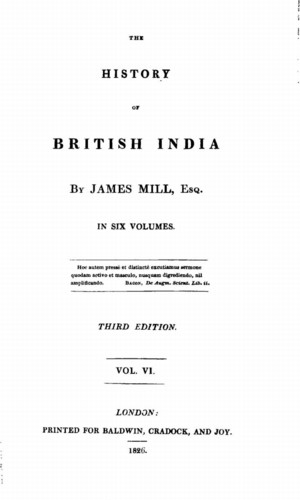
CHAP. VIII. - James Mill, The History of British India, vol. 6 [1817]Edition used:The History of British India in 6 vols. (3rd edition) (London: Baldwin, Cradock, and Joy, 1826). Vol. 6.
Part of: The History of British India, 6 vols.About Liberty Fund:Liberty Fund, Inc. is a private, educational foundation established to encourage the study of the ideal of a society of free and responsible individuals. Copyright information:The text is in the public domain. Fair use statement:This material is put online to further the educational goals of Liberty Fund, Inc. Unless otherwise stated in the Copyright Information section above, this material may be used freely for educational and academic purposes. It may not be used in any way for profit.
CHAP. VIII.Lord Mornington Governor-General—Agents of Tippoo at the Isle of France—Governor-General resolves on immediate War—Import of the Circumstances—Opinions in India—Nizam Ali receives more English Troops and dismisses the French—Unfruitful Negotiations at Poonah—Progression of Governor-General's Demands—War begins—Plan of the Campaign.—March of the Army—Siege of Seringapatam—Alarming Situation of the British Army in regard to Food—Seringapatam taken, and the Sultan killed—Division and Settlement of the conquered Country. BOOK VI. Chap. 8. 1798.When the play of private interest is not instructive, either by the inferences which may be drawn from it, or by the consequences to which it leads, it escapes the curiosity of the historian, whose views are directed by utility alone. Whatever share ministerial intrigues may have had, in the fluctuations of counsel, which attended the choice of a new Governor-General, it is sufficient for us to relate, that after Lord Hobart was appointed, on the 23d of October, 1793, to be Governor at Madras, he was nominated, on the 24th of December, in the same year, to succeed the Marquis Cornwallis, as Governor-General of India. That, enjoying honourable and affluent prospects at home, and at that time filling an office of high dignity and trust, Lord Hobart would not have left his country for less than the assurance of the highest place in India, was well understood. Ministerial volition, ofBOOK VI. Chap. 8. 1798. course, was the origin of both the one appointment and the other. The administration, however, of Sir John Shore, who succeeded to the place of Governor-General, as senior member of the council, immediately upon the resignation of Lord Cornwallis, was not interrupted till the month of March, in the year 1797; when Lord Cornwallis was nominated a second time to fill the offices of Governor-General and Commander-in-Chief. The appointment was announced to the different Presidencies in India; and a measure, so extraordinary, seemed to declare that there was something extraordinary in the cause of it. Extra-traordinary as it was, it remained without effect. In the month of October, of the same year, it was notified to the different Presidencies, that the Earl of Mornington was appointed to be Governor-General, in lieu of Marquis Cornwallis. He was appointed, it was said, “under circumstances, and for reasons, of a peculiar nature.” The Directors added, that “various circumstances had induced the Marquis to resign his appointments.”1 Such were the mysterious terms to which the actors thought fit to confine themselves. The Earl of Mornington had recently distinguished himself by a brilliant speech, in the House of Lords, against Jacobinism, which recommended him to the ministry, as a personage both of good principles, and of good abilities. The breach of faith to Lord Hobart it was proposed to compensate, viz. by money; and that out of the Company's purse. A proposition was brought forward for bestowing upon him a pension of 1,500l. per annum, and this after being once BOOK VI. Chap. 8. 1798.rejected in the General Court, was, nevertheless, by the due application of influence, finally confirmed. The Directors, when pushed for their reasons, hinted, that the attempt of Lord Hobart to transfer to the Company the civil, as well as the military, government of the Carnatic, was, in some way, which they said it was delicate to explain, the cause which rendered it inexpedient that he should continue longer in India. “That attempt,” they observed, “whether owing to the ardour of Lord Hobart, or some other cause, unfortunately failed. This failure involved his Lordship in an altercation with the Supreme Government; upon which the Court of Directors thought it right to support their Government-General and to recall Lord Hobart.”2 Lord Mornington arrived at Calcutta on the 17th of May, 1798, carrying out with him a mind more than usually inflamed with the ministerial passions then burning in England; and in a state peculiarly apt to be seized both with dread and with hatred of any power that was French. He had possessed but little time for acquainting himself with the complicated affairs of India, when all his attention was attracted to a particular point. On the 8th of June, about three weeks after his arrival, a paper was received at Calcutta, which purported to be a proclamation issued by the Governor at the Isle of France. The paper imported, that two ambassadors had arrived from Tippoo Sultan, with letters addressed to the constituted authorities of the island, and dispatches to be forwarded to the government of France; that the object of the embassy was, to propose an alliance offensive and defensive with the French; and to request a supply of troops for the purpose of aBOOK VI. Chap. 8. 1798. war against the English; a war, which, with an earnest desire to expel the said English from India, the Sultan was ready to commence, as soon as the French should arrive to assist him. The proclamation then invited the citizens to offer their services, on the liberal terms, which the ambassadors of the Sultan were ready to offer. This paper, which the Governor-General calls truly an “extraordinary publication,” he was at first inclined to regard as a forgery; because, if a scheme, of the nature here described, were really entertained, it was so much the interest both of Tippoo and the French, to conceal, and an act of such contemptible folly, to divulge it, that such a total want of all capacity for business was scarcely credible, on the part either of a man entrusted with the government of the Isle of France, or of men whom Tippoo would choose for a delicate and important commission. The Governor-General, nevertheless, received so violent an impulse from the paper that the dispatched a copy of it, even on the following day, to General Harris, the Commander-in-Chief on the coast of Coromandel, at that time occupying, temporarily, the station of Governor of Fort St. George. His doubts respecting the authenticity of the document were declared; but General Harris was commanded “to consider without delay the means of assembling the army on the coast of Coromandel, if necessity should unfortunately require such a precaution.” On the 18th of June a letter was received, written by the Earl of Macartney at the Cape of Good Hope, for the purpose of conveying to the Indian government intelligence, that such a proclamation had in fact been issued at the Isle of France. And about BOOK VI. Chap. 8. 1798.the same time, several persons arrived at Calcutta, who had been present on the island, when the incident occurred. “A strict examination” of those, whom the Governor-General calls “the most respectable of those persons,” was performed. If their information was to be relied upon, it appeared that toward the close of the month of January, 1798, two persons arrived at the Isle of France, by a ship from Mangalore; that they were received with great demonstrations of respect, treated as ambassadors from Tippoo, and, during their stay on the island, entertained at the public expense; that, without any previous rumour or notion on the island that aid was about to be given to that prince, or a war about to commence between him and the English, the proclamation in question, two days after their arrival, was fixed up, and circulated; that the persons, thus treated as ambassadors, were so far from disowning the publication, that they ostentatiously held the same language, saw it publicly distributed by their agents at the place of their residence, and made promises in the name of the Sultaun, according to its terms; and that on the 7th of March they embarked on board the French frigate La Preneuse, accompanied by the men on whom the inducements held out by them had prevailed, to the amount of about two hundred, including some officers.3 From other sources the Governor-General was informed, that the French frigate arrivedBOOK VI. Chap. 8. 1798. at Mangalore on the 26th of April; that both the Frenchmen and the persons by whom they had been brought, were received with great marks of satisfaction by the Sultan, and that the principal part of the Frenchmen were admitted into his service. That the Governor-General should have regarded these incidents as tokens of the hostile mind of Tippoo, was natural. The only material question relates to the nature of the impression on the mind of a wise man, which that inference was calculated to produce. That the mind of Tippoo, in regard to the English, was full of hatred, and the spirit of revenge, it needed no new incident to disclose, or to confirm. In fact, the peace of Seringapatam was concluded with him, under a perfect conviction that his mind was breathing all the rage of disappointed ambition and humiliated pride; and if the hostility of his sentiments had constituted a reason for war, in the opinion of the persons in India and Europe, who at that time composed the compound government of India, that peace would never have been made, as it was made, abroad; nor applauded, as it was applauded, at home. The basis on which the wisdom of that agreement rested was the supposed soundness of the conclusion, that the power of Tippoo, far from able to resist the British when entire, was so little formidable when diminished to one half, that the hostility of his sentiments, however intense, and however certainly known, was a matter unworthy of particular regard, on the part of a people who declared all increase of territory unfavourable to their interests, BOOK VI. Chap. 8. 1798.and who, in the opposition of interest between Tippoo and the Mahrattas, could not fail to behold a security against the most formidable of the enemies whom India could raise them up. The impression made upon the mind of the Governor-General, by the incidents of which the above is the account, appears to have been strong and agitating in the highest degree. “Under all these circumstances, an immediate attack,” says he, “upon Tippoo Sultan, for the purpose of frustrating the execution of his unprovoked and unwarrantable projects of ambition and revenge, appeared to me to be demanded by the soundest maxims both of justice and policy.—Such was the tenor of my opinions as early as the 20th of June, 1798;” that is, only two days after any authentic information of the facts had been received. “I therefore,” continues he, “recorded my decided judgment, that it was necessary to assemble the armies on the coasts of Coromandel and Malabar without delay, and I issued my final orders for this purpose on that day. I have no hesitation in declaring, that my original intention was—if circumstances would have admitted—to have attacked the Sultaun instantly, and on both sides of his dominions, for the purpose of defeating his hostile preparations and of anticipating their declared object. I was concerned, however, to learn, from persons most conversant in military details at Fort St. George, that the dispersed state of the army on the coast of Coromandel, and certain radical defects in its establishments, would render the assembling a force equal to offensive movements against Tippoo, a much more tedious and difficult operation than I had apprehended.”4 Either the Governor-General condemned the policyBOOK VI. Chap. 8. 1798. of the treaty which was concluded by Lord Cornwallis, and highly applauded by the ministers, by the parliament, and by the people of England; Or, such was the change in circumstances, that the enmity of Tippoo, which was neither formidable, nor offered any reasonable prospect of being formidable, in 1792, had become intensely formidable in 1798; Or, lastly, the mind of the Governor-General was in a state of inflammation, and decided upon suggestion totally different from a cool and accurate contemplation of the circumstances of the case. No where, in his official correspondence, as he lays down the reasons of his conduct, does he state any disapprobation of the treaty of Seringapatam. It seems, therefore, a proper conclusion, that no disapprobation of it existed in his mind. Whether, in the circumstances of Tippoo or the English, there was any thing at that time, which rendered the inimical mind of Tippoo more alarming, than at the date of the peace, is the next point of rational enquiry. The English, unless we are to suppose that the government which they had established in India was too bad to admit of progression, must have advanced in all the elements of political power. They had enjoyed uninterrupted peace; they had BOOK VI. Chap. 8. 1798.taken possession, almost unresisted, of both the French and Dutch settlements in India; time had been given to improve their experience, and their institutions, and to reap the greatest possible fruit from the extensive district which the partition of one half of Tippoo's former territories had added to their dominions. On the side of Tippoo on change could possibly have taken place, except by the exertions which he might have made to improve his revenues, and his army—revenues completely exhausted, and an army conquered and reduced—out of the resources of a country desolated in every quarter, by the ravages of war; and reduced to one half of that extent, over which the English had found it so easy to prevail. It would be ridiculous, and at the same time the deepest imputation upon the English government, to suppose, that, intrinsically, the power of the English had not risen upon that of Tippoo, and rendered its preponderance still greater, during the interval of only six years which had elapsed since the pacification of Seringapatam. If then any danger to the English now accrued from Tippoo greater than the danger of 1792, it must be sought for in causes exterior to the condition and resources of the countries appertaining to each. The connection with allies was the only circumstance from without, by which the power of either government was affected. With respect to the English, it was indeed alleged that their allies, the Nizam and the Mahrattas yielded a prospect rather of danger than of aid. This, however, was a circumstance which presented consequences of two different sorts. If the want of allies increased the causes of their dread of Tippoo, it rendered them less able to fight with him, and therefore increased the motives to peace. If they were perfectly able to fight with him, notwithstanding the want of allies, this very circumstance proved, thatBOOK VI. Chap. 8. 1798. they had nothing to apprehend from remaining at peace. If it was alleged that they were able to fight now, but should not be able, after the lapse of some time, it implied that Tippoo's government was better than theirs, and would more rapidly increase his resources. Besides; it was not true, that the English were to a considerable, if to any degree, less sure of auxiliary operations, than at the commencement, or any moment since the commencement of the peace. The Mahrattas, it was supposed, would stand aloof, even if the Company were attacked. But, in the first place, it was to be remembered, that as the Mahrattas dreaded nothing more than the increase of Tippoo's power, the natural conclusion was, that, if they saw the Company in any danger, they would be too strongly impressed with a sense of interest not to offer effectual assistance, and if at present they showed indifference to the dispute, or rather a jealousy of the English, the reason was, because they saw the English not likely, by suffering at the hand of Tippoo, to make Tippoo formidably strong, but much more likely, by crushing Tippoo, to raise their own power to a great and formidable height. It was also true, that at the moment when Lord Cornwallis concluded the treaty, a knowledge of the case was all that was necessary to convince any man, that hardly any dependance could, even then, be placed on assistance from the Mahrattas, in the event of a subsequent dispute; and in fact, every circumstance, to which a hope of the co-operation of that people against the aggressions of Tippoo could be attached in 1792, existed in equal force at the present hour, and was as likely to produce the desired effect. The only source of jealousy which regarded the BOOK VI. Chap. 8. 1798.Nizam, the second of the English allies, was the corps of sepoys commanded by Frenchmen. In the state of mind by which the Governor-General, and Englishmen of his intellectual and moral cast, were at that time distinguished, the very existence of a Frenchman was a cause of alarm: and a military corps, under the direction of Frenchmen, assumed the dreadful aspect of a most enormous evil. It was, at the same time, however, a circumstance perfectly known, that this evil, whatever it was, it depended upon the English themselves, by an act totally free from difficulty, completely to remove. The Nizam had already proposed to Sir John Shore the dismissal of the French officers in his service, and the abolition of the corps, provided the English troops in his pay were so increased, and their services so extended, as to enable them to defend him against the aggressions of the Mahrattas. The English themselves indeed were eager to hold forth, that the French officers, by the avidity with which they absorbed the powers of the state, had become odious to the Nizam, who was now alarmed at their daring encroachments, and eager for their destruction. In point of fact, it was found, that, as soon as the Governor-General proposed to agree to the conditions upon which the Nizam had already offered to dismiss the French, his assent was obtained, and this cause, if such it is to be deemed, of seeking the destruction of Tippoo, was speedily taken away. The truth is, that the English were, in the first place, stronger, intrinsically; and, in the next place, not weaker, on any rational ground of computation, in respect of allies, in the year 1798, than in the year 1792. If there was any thing real, therefore, in the ground of alarm, it is not in the circumstances of the English, but in those of Tippoo, that it is to be found. The revenue which it was possible for the very limited territory of the Sultan to yield, and the moderateBOOK VI. Chap. 8. 1798. army which that revenue could maintain, it is miserable to contemplate as having been a subject of alarm, to a people, possessing the resources of the English, and so many degrees advanced beyond their opponents in the art and science of war. Of course, it is in circumstances extrinsic to his dominions, if in any, that Tippoo can be regarded as having been formidable to the English, or as laying them under any obligation, beyond that which existed in 1792, to adopt extraordinary measures of self-defence. But of such circumstances one only can be named; and that is, his union with the French. To clear up, therefore, every difficulty in this question of policy, it only remains to inquire how much of danger was implied in the connexion which he had formed with that formidable people. Tippoo was by no means without a connexion with the French at the date of the treaty of Seringapatam. A French corps had formed a distinguished part of his army from the moment he ascended the throne. When that treaty was concluded, a war was impending between the English and the French; and no man could have a doubt that Tippoo would gladly join the enemies of those whom he regarded as his inveterate foes, should those enemies think of carrying their arms to that distant part of the globe. With all these circumstances fully before him, Lord Cornwallis thought it wise to make peace. Had any new circumstance occurred, to make it wise in Lord Wellesley to come to the determination, which he says he had formed on the 20th of June, 1798, of attacking Tippoo immediately, if he had found it possible to assemble the troops? Two men had appeared at the isle of France, and a proclamation had been issued by the Governor. From this, as far as then BOOK VI. Chap. 8. 1798.was known, only one of three inferences could rationally be drawn: Either that it set forth a number of falsehoods, for the purpose of precipitating the English into an Indian war: Or that it was the act of a madman making public a communication which it was so much the interest of both parties to keep in the profoundest secresy: Or, which was by far the most probable supposition, that it was nothing but an act of boasting, bragging, folly, with something of very small importance for its foundation. Nothing was more likely than that Tippoo, seeing the increase which had taken place in the French corps in the service of other native powers, both in that of the Nizam, and that of the principal Mahratta power, was very desirous of increasing his own; and might have sent agents to the Isle of France for the purpose of engaging both officers and men. It is well known, how much of boasting, and of exaggeration, enters into the verbal intercourse of the East; it is well known, also, that Tippoo carried this weakness to excess, and might be regarded as a braggart even among orientals. It is still further known, that on nothing was he fonder of bragging, than his power in relation to the English, and the vengeance which, if provoked by them, he should one day inflict. It was, therefore, not incredible, it was highly probable, that with a view to obtain a more favorable reception to his application for leave to enlist soldiers in the Isle of France, his agents were instructed to talk very high, to boast of his enmity to the English, and even his power, if well supported by the French, to expel them from India. Vapour, of this kind, was a thing too common in India to excite any particular regard. But it was not surprising, if it produced on the French Governor a very different effect. It was very well known, at the period when the Governor-General was called upon to deliberate,BOOK VI. Chap. 8. 1798. or to decide without deliberation, upon the question of peace or war, that a high degree of excitability had, by the events of their revolution, been conveyed to the minds of Frenchmen; that they were almost as much disposed to the language of vanity and ostentation as the orientals themselves: and the only rational conclusion was, that the French Governor, evidently a very ignorant and foolish man, had been eager to adopt any occasion, however insignificant, of indulging his propensity for boasting, exaggeration, and display; that the loose, hyperbolical talk of Indians had been held forth as the momentous language of a solemn negotiation; and that two agents for recruiting soldiers had been transformed into ambassadors, for the purpose of contracting an alliance, offensive and defensive, between the Sultan of Mysore, and the Republic of France. But, even should we go so far as to allow the wisdom of supposing that Tippoo had made an overture of the most serious kind for an alliance offensive and defensive against the English, an important question is still to be asked. Did this, in the smallest degree, alter the circumstances of the English in regard to Tippoo? Was their danger, in any respect, increased? Would they have been perfectly safe to remain at peace, had not this overture been made? If so, in what respect did this overture increase the probability of evil? It may be affirmed, without any dread of refutation, that it produced no effect of that description whatsoever. In reality, the incident disclosed nothing with regard to the mind of Tippoo, which was not perfectly known, believed, and acted upon before; namely, his eager desire to do mischief to the English, and to unite with any power that would embark in the same design, more especially with the BOOK VI. Chap. 8. 1798.French, whose power and hatred appeared to offer so great a resource. In fact, the incident made a disclosure, which might have been regarded as agreeable; that the connection between Tippoo and the French was so trifling, and their mode of intercourse so very childish and absurd. It might have been expected, and it ought to have been beforehand supposed, that a perfect and regular channel of communication was opened between them, and that their conjoint means of annoying the English had been well digested, and perfectly understood. But, if this incident disclosed nothing with regard to the minds of Tippoo, and the French, except that they were less capable of doing mischief to the English, than might before have been reasonably expected, it can hardly be supposed, that an overture so loose, indefinite, full of negligence and mismanagement, could add any thing to the motives of the French for carrying hostilities to India, if their circumstances admitted so costly an experiment. And, lastly, if this overture intrinsically altered nothing, either in regard to the dangers of the English, or their knowledge of that danger, except by showing that it was less than they might have supposed, was there any thing (for that is the last hypothesis) in the state and condition of the French nation, at that particular time, which rendered it more likely they should now send an army to India, than at any period since the conclusion of the treaty of Seringapatam? During the two days between the 18th and the 20th of June, 1798, in which contracted space the Governor-General made up his mind, upon the strength of the incident in question, to attack the sovereign of Mysore instantly; it may be affirmed, that he had no rational ground for supposing it more likely that the French would then make war upon India, than it had been at any period since the war between them and England began. ItBOOK VI. Chap. 8. 1798. evidently follows, that there was no reason for destroying Tippoo, at this particular moment, which had not existed at every moment since the commencement of the negotiation for peace. Still, the character of the policy which was pursued by the Governor-General remains to be determined, by the solution, not of the question whether more reason, than at any preceding period, existed for the destruction of the Sultan, but of the question, whether then sufficient reason existed as well as, if such were the coincidence, at any antecedent time. More obscurity rests upon this determination. If it be true, that the Governor-General ought to have been guided by the act of parliament, made and provided for the express regulation of his conduct, the answer is not doubtful. By that act, all augmentation of territory, and every act of war against an Indian prince, except for self-defence, in the case of actual hostilities, was declared to be contrary to the interest, and injurious to the honour of the British nation. It will be impossible to show, that the war into which the Governor-General was so eager to plunge, was a war of self-defence, except by such arguments as will show, that no war which has a prospect of adding to the securities of a nation can ever be a war of a different sort. If it was proper in the Governor-General to treat the act of parliament with contempt; as the parliament itself soon after declared that it was, by thanking and applauding him for his flagrant violation of that act; and if the only question was, whether or not the British interests were to be promoted, or the contrary, by the ruin of this dreaded foe, the inquiry is more complicated. What was to be gained was abundantly obvious; it was the saving of the expense, which the maintenance of a force, sufficient BOOK VI. Chap. 8. 1798.to guard against any chance of evil from his malignity, would have required. This expense, if the war by good fortune had not been so very short, would not perhaps have equalled the interest of the money expended by the war. Had this been the fact, more would have been lost, it is evident, than gained by the destruction of Tippoo; for as to the mere increase of dominion, independent of security, that, in the shape of a good, was not less violently renounced by Lord Mornington, than by the parliament, and by the nation at large. It was on this foundation, or otherwise it will be difficult to find one, on which, after conquering the dominions of Tippoo, instead of keeping the whole for the benefit of his country, he gave to others an important part, and even urged upon the Mahrattas a portion which they refused. With regard to what was lost to the British interests by the destruction of Tippoo (for even the power of Tippoo was an evil not without its good), it is much less easy to form any thing like a determinate opinion. While Tippoo existed, the Mahrattas might be confidently expected to be much more subservient to the English, on whom alone they depended for assistance against this their greatly dreaded foe, than they were likely to be after his destruction, when every source of apprehension was taken away. What amount of evil might be involved in thus relieving the Mahrattas from all dependance upon the English cannot of course be exactly defined. The English were able to chastise them when they thought chastisement requisite. A case might even be supposed, in which Tippoo, instead of being an opponent, might have been a confederate of the Mahrattas against the English. This supposition, however, is obviously confined to one case, that in which the English, renouncing their pacific policy, should bring the Mahrattas into greater dread of unprovoked evil from theBOOK VI. Chap. 8. 1793. English, than they lay under in regard to Tippoo. As affairs were actually situated, the effects of their emancipation from the dread of Tippoo soon began to appear; and the Governor-General found himself under the supposed necessity of checking their audacity by a war. That the contemplation of the facts made, on other occasions, an impression, correspondent to the inferences which have here been drawn: made such an impression, at the time, on the minds of the most instructed men in India, there is a remarkable document to show. On the 24th of July, 1798, a meeting was held of the British inhabitants of Calcutta, on the subject of the voluntary contributions in support of the war against the French, contributions promoted with great zeal, by all expectants and dependants on government, in every part of the British dominions. To this meeting great importance was attached; and all the persons highest in their consequence, and warmest in their aspirings, were forward, by the exhibition of their persons, and of their fervour, not to omit so easy an opportunity of establishing a new title of merit in the eyes of their superiors. In this splendid, and numerous assembly, the Advocate-General, Mr. Burroughs, made the introductory address, at great length, and with the best of his eloquence. He introduced in it the following observations, which constitute an article of evidence, of some weight, in determining the questions which arise out of the circumstances of that important era. “Every man,” he said, “at all acquainted with our situation, must know that in India we never before were so powerful and so unassailable, as at the present moment. We have an army infinitely stronger, in number and discipline, than we ever had before in BOOK VI. Chap. 8. 1798.India. We are without an enemy who can venture to attack us; and he would assert that there was not a single native who would now even wish to attack us, unless, indeed, our old enemy Tippoo might have such a wish. But that Prince had received such a lesson in the last Mysore war, as must deter him from any such enterprise again, even if he could have the aid of France in doing so. Any aid from Europe it was impossible he could have, considering the total want of ships in France, on which troops could be transmitted; and we know besides, that the English fleets maintained the entire dominion of the seas, and that our enemies were every day lamenting their inability to send one sail in safety from any of their ports, as they were all blocked up by the British navy. The French islands in India had thrown off all connection with France, and, instead of taking any part against us, must now look to us as friends, to protect them from any attempts which might be made on them by France.”5 Compelled reluctantly to abandon the design of immediately invading Mysore, the Governor-General, nevertheless, renewed his orders for assembling the army with the smallest possible delay. In the policy of this measure the Madras council by no means concurred. Besides the length of time necessary for assembling the army, the expense, they said, would be so enormous; and so much danger would be unavoidably created of provoking hostilities with Tippoo, by vast preparations importing the design of war; that they could not think themselves justified, without a strong representation, in obeying the orders which they had received.6 “Not discouraged,” says the Governor-General, “by these suggestions and representations,BOOK VI. Chap. 8. 1798. I insisted on the immediate execution of my orders.”7 During the interval which was required for assembling the army, the Governor-General found employment in negotiating with Nizam Ali the dismission of the French officers, and the dissolution of their corps. His minister, to whom the business of the state was almost wholly committed, was a partisan of the English, and well disposed for the annihilation of the French party; as soon as the British government would consent to replace them by a force adequate to the service which the French performed in the protection of the country. The Nizam was not altogether blind to the dangers of placing himself in a state of helpless dependance upon a superior power. But totally unequal, as he knew that he was, to the defence of himself, against the Mahrattas, against the Sultan, or against the English, it was easy for the minister to convince him, that he was safer in the hands of the English than of either of the other two. From the attainment of what he regarded as an object of unspeakable importance, the dissolution of a French corps in the service of the Nizam, Lord Mornington was far from allowing himself to be restrained by any dread of offending the Mahrattas; the motive by which the mind of his predecessor had been swayed. His instructions were issued to the acting resident at BOOK VI. Chap. 8. 1798.Hyderabad, on the 8th of July, to open a negotiation with the Nizam; and on the 1st of September a treaty was concluded, by which four battalions of British troops were added to the former two, and the British government was pledged for the protection of the Nizam, against any unjust demands of the Mahrattas. The Nizam, on his part, engaged to disband the French corps in his service; to deliver over its officers to the British government, whenever the whole of the British force should arrive in his capital; and to raise the subsidy, which he paid for the maintenance of the British troops, from 57,713, to 2,01,425 rupees per month. Though the force which the French officers commanded consisted, after all the alarm which it occasioned, of less than 14,000 men, it was necessary to take precautions against the chance of their resistance. Pending the negotiation, the additional troops destined for the service of the Nizam were collected in that part of the Company's territory which touched upon his frontier; and on the 10th of October joined the two former battalions at Hyderabad. Fortunately for the schemes of the Governor-General, Raymond, whose talents and great influence might have been formidably exerted for the preservation of his power, had died a few months before; and a struggle for ascendancy had introduced great animosity and disunion into the corps. Not only the Nizam, but even the minister himself, wavered, however, and drew back, when the enterprise came to the verge of execution. In so little respect was this greatly dreaded corps really held by the British officer, who commanded the six subsidiary battalions, that he did not hesitate to take a decisive step. He declared his determination, unless the Nizam came to the immediate resolution of fulfilling his engagements, to make an attack on the French camp with his own forces,BOOK VI. Chap. 8. 1798. and proclaim the want of faith in the Nizam's government as the cause of all the consequences which might ensue. A proclamation was soon after sent to the French camp, announcing the discharge of the officers, and declaring it treason in the soldiers to obey them. The soldiers were already in a state approaching to mutiny. The disorders now proceeded to greater violence; and the officers were imprisoned by their men. In this helpless situation, the camp, which at the time did not contain above 11,000 men, the rest of the corps being on a distant detachment, was surrounded by the whole of the British battalions, and a strong body of the Nizam's horse. The men, upon a promise of their pay, and continuance of service, laid down their arms; and the arrest of the officers was accomplished without difficulty or danger. Notwithstanding the unfriendly passions which Frenchmen at this moment excited in the breast of the Governor-General, he was careful to insure to the individuals, who had fallen into his power, that generosity of treatment which a gallant mind is ever prompted to bestow. Their property, together with such arrears as were due to them by the Nizam, were secured to their use; they were conveyed to Calcutta, under every indulgence compatible with the security of their persons; and on their arrival in England the Governor-General provided that they should not be treated as prisoners of war, but transported to their country without detention.8 BOOK VI. Chap. 8. 1798.The chances of good or evil from the Mahrattas, also, forced themselves upon the attention of the British government; and negotiations were carried on at Poonah, at the same time with those, which, at Hyderabad, were conducted to an issue deemed so exceedingly favourable. The negotiations, however, attempted with the Mahrattas, produced not equal results. The substance of the treaty negotiated at Hyderabad was communicated to the Peshwa, both before and after its conclusion. “And at both periods,” says the Governor-General to the Court of Directors, “he expressed his entire approbation of the nature and tendency of the new engagements, as well in their operation upon the interests of the Mahratta empire, as upon those of the Nizam.”9 On the other hand, Sir John Malcolm says, “The measures taken at Hyderabad were regularly communicated to the Peshwa: but that prince, either influenced by his weak counsellors, or acting under the control of Dowlut Row Scindia, obstinately continued to withold his formal consent to any acknowledgement of the right of the British government to arbitrate in his disputes with the court of Hyderabad.”10 Of course, it may be said, the Governor-General knew best. It may also, however, with equal certainty be said, that he had the greatest temptation to lay on a colour; that if none except agreeable consequences were supposed to flow from his measures the favour of his employers would be enhanced; that from this species of art, which had been amply practised by his predecessors, Lord Mornington must have been a man far superior to his predecessors to stand always exempt; and that of those expedients for a colour,BOOK VI. Chap. 8. 1798. the two letters which have just been quoted appear to present us with instances. In the first place, when mention is made of the time which would be required for assembling the army of the Carnatic, no mention whatsoever is made of the disapprobation expressed by the Madras council. In the next place, when the execution is described of the measures taken for the destruction of the French corps, in the service of the Nizam, the reluctance exhibited by the Nizam, when the crisis arrived, is not only covered with silence, but with a language which implies uninterrupted alacrity and zeal. Beside the difficulty, in such a situation as that of Sir John Malcolm, of remaining long ignorant of such a general and important fact, the consequences also tally with his representation, for all the efforts of the Governor-General to draw the Mahrattas into an intimate connection with him, totally failed. And again; as Scindia, not the Peshwa, was at this time predominant over the Mahratta councils, the assent of the Peshwa had little value; and if presented to people ignorant of the state of the facts, as equivalent to that of the Mahratta power, was only calculated to produce deception. It seems to be affirmed, from private information, by Colonel Wilks, that both Scindia and the Peshwa, under alarm at the symptoms of ambition which at this moment distinguished the movements of the British power, were actuated by favourable dispositions towards the sovereign of Mysore; but Scindia was afraid to take a positive step, on account of his dominions in the North, which the English had an army ready to invade; and the Peshwa, beside the imminent danger to which the hostility of the English would expose him, had no liberty to act BOOK VI. Chap. 8. 1798.but as Scindia directed. The Governor-General, accordingly, when at last he found that assistance from the Mahrattas was not to be obtained, encouraged by the probability that he would receive no opposition, resolved to proceed in his warlike operations without them.11 On the 18th of June, the Secret Committee of the Court of Directors wrote from England to the Governor-General in Council, that they had just received from his Majesty's ministers, information of a large armament which had sailed from Toulon on the 19th of the preceding month; and that amid the various conjectures respecting its destination, it was not conceived impossible that India might be the object of attack, by way of the Red Sea, or its coast, after conquest of Egypt; “or even,” the Directors add, “by the Black Sea, or by Bussora. His Majesty's ministers,” they continue, “have therefore informed us, that immediate measures will be taken for a considerable augmentation of the European force in the East Indies: You may expect that not less than 4,000 seasoned and disciplined troops, and perhaps a larger number, may be sent to the Company's settlements with all possible expedition, part of which will, we trust, reach India not many months after the receipt of this dispatch.”12 It was not before the 18th of October that the Governor-General first received authentic intelligence of the expedition from Toulon, and the invasion of Egypt; when his preparations against Tippoo were approaching maturity. The constituted authorities in England, under impression of the danger which the invasion of India by so great an army would produce, gave directions to the Governor-General, to make war upon Tippoo, if he appeared to be actuallyBOOK VI. Chap. 8. 1798. accumulating the means of seconding invasion by the French. They seem not to have regarded the proclamation at the Mauritius as satisfactory evidence of any such design; of which they express themselves in the following words: “We are unable to judge, whether this proclamation be in reality what its import declares it to be; or intended merely as a feint, with a view to embroil us with Tippoo.” And they marked out unambiguous preparations for war, as the circumstance by which the judgment of their subordinates in India ought to be determined. “It is highly improbable,” they say, “that Tippoo should have entered into any league with the French, without some apparent preparation, on his part, of an hostile nature, in furtherance of their designs. If such shall have been the case, it would be neither prudent nor politic to wait for actual hostilities on his part.” Preparation for war, in the only sense which can here be applied, is such an augmentation, or such a disposition, of the instruments of war, as, to some considerable degree, is both unusual, and increases the danger of the suspecting state. That any such augmentation or disposition of the instruments of war had taken place on the part of Tippoo, no evidence was ever produced; while evidence to the contrary appears in abundance.13 Even with the permission which the alarm of the French expedition extorted BOOK VI. Chap. 8. 1798.from the Directors, they thought proper to enjoin that in resorting to hostilities, “the utmost discretion” should be used; “that we may not,” they say, “be involved in a war in India, without the most inevitable necessity.”—That inevitable necessity existed, or any necessity at all, will not easily, after the first impartial exposition of the facts, be again alleged. The war might be advantageous, or it might be not advantageous. But the word must be used in an extraordinary sense, if it ever be denominated necessary. On the last day of October, that is, in less than a fortnight after he was informed of the invasion of Egypt, the Governor-General received intelligence of the destruction of the French fleet by Sir Horatio Nelson, at the mouth of the Nile. Notwithstanding this decisive event; “I did not,” he says, “relax any part of the naval or military preparations which had been commenced under my orders;—being still uncertain of the fate of the French army in Egypt, and ignorant whether an additional force might not have been intended to co-operate with it in India, by the ordinary passage round the Cape of Good Hope.”14 The chance of the invasion of India, from either quarter, will not at the present moment be regarded as having been very great. It will not come up to the description of what constituted an “inevitable necessity” for going to war with Tippoo. “The immaturity, however,” says Sir John Malcolm, “of the Sultan's plans formed, in Lord Wellesley's opinion, the strongest reason for an immediate attack upon his possessions; but the delay, which was likely to occur in assembling the army on the coast of Coromandel, which had been reduced to a very low establishment, and was in a very dividedBOOK VI. Chap. 8. 1798. and unequipped state, obliged him to alter it; and he made no communication whatever to Tippoo Sultaun on the subject of his proceedings, till the military preparations, both at Madras and Bombay, were complete; and the alliance with the Nizam had not merely been restored, but rendered so efficient, as to secure the full application of the resources of that Prince in aid of the common cause.”15 During all the time of these remarkable proceedings, it is singular that Tippoo was either without the means, or without the inclination, of making any considerable addition to his habitual state of equipment for war, and, with an appearance of insensibility to all that surrounded him, forbore even to remonstrate against the accumulation which was going forward of the instruments of his destruction. When the beginning of November arrived, the Governor-General thought the opportunity was now favourable to exhibit his complaints. On the 8th of that month, he addressed a letter to the Sultan, in which the expressions were conciliatory, rather than hostile, but in which he informs him of the connection which he was aware had been formed between him and the French, “Whom you know,” says he, “to be the inveterate enemies of the Company, and to be now engaged in an unjust was with the British nation.” He then gives him a lecture, on French principles; which will be appealed to hereafter as a monument of the times. “It appears not,” he adds, “either necessary or proper, that I should any longer conceal from you the surprise and concern with which I perceived you disposed to involve yourself in all the ruinous consequences of a connexion, which threatens, BOOK VI. Chap. 8. 1798.not only to subvert the foundations of friendship between you and the company, but to introduce, into the heart of your kingdom, the principles of anarchy and confusion; to shake your own authority; and to destroy the religion which you revere.” On the disposition of the Company to preserve inviolate the obligations imposed by the relation of amity and peace, the Governor-General cited the remarkable instance which had recently occurred; of a district of country to which, though possessed by the Company, the Sultan laid claim, and of which, his right having been ascertained by arbiters mutually chosen, restitution had been made. As the result of these premises, the Governor-General proposed to send to him a British officer, whom he already knew, to communicate to him, on the part of the English, and of the Peshwa and Nizam, their allies, the plan which in their opinion was calculated “to remove all existing distrust and suspicion, and to establish peace and good understanding on the most durable foundations.”16 Of the terms which, at different periods, the Governor-General was disposed to allow Tippoo Sultaun, he himself has given a very instructive history, in his letter to the Court of Directors, under date the 3d of August, 1799.17 What was the extent of his views in relation to the attack which he was so eager to make immediately after he first received intelligence of the foolish proclamation at the Isle of France, he has no where disclosed. When he found the execution of this design impossible, and how much time it would require to put the army in a condition for action, he would, he says, have been “contentedBOOK VI. Chap. 8. 1798. with any adjustment which offered a reasonable prospect of detaching. Tippoo from his connexion with the French;” and that, “in the arrangement which then occurred to him, his views were limited to the establishment of permanent residents, on the part of the Company, and of the allies, at Seringapatam, to the dismission of all the French then in the Sultaun's service, and to the perpetual exclusion of the French from his armies and dominions.” Before preferring these demands, he first, however, deemed it politic, to place the armies in a posture for action; and to take measures for lessening the chances of evil, as well as improving the chances of good, at the hands of the Nizam and the Mahrattas. The month of November had thus arrived before he was ready to make his first communication. But, at that time the French had invaded Egypt, which appeared to increase the dangers of the English dominion in India; on the other hand, the military preparations of the English were advancing to maturity on a great scale, the French party at Hyderabad was destroyed, the resources of the Nizam's country were by the late arrangement placed at the disposal of the Company's servants, and the English now had power to enforce whatever demands they might think proper to advance. The Governor-General, therefore, resolved not to content himself with the terms which, without having communicated them, he would have thought sufficient for all necessary purposes before. If, however, the real ground of the war was not the love of conquest, which was so fervently disclaimed, but the chance of danger from the power of Tippoo, as was the grand pretence, the new degree of security which had accrued to the Company was a reason, not for war, BOOK VI. Chap. 8. 1799.but peace. The additional chance of invasion, by the presence in Egypt of the French, presented, as far as it went, a demand for additional security. But that chance was to be weighed, and its value ascertained. Except to an eye surrounded by the mists of ignorance or passion, which saw its object hideously enlarged, it could not appear to be great. Besides, as the British government would not long remain without a grand effort to expel the enemy from Egypt, the Company might have quietly rested on its guard, without incurring the mischievous expenditure, not to speak of any more of the detestable consequences of actual war, at least for a little time, till they understood what was the result of the measures adopted against the invaders of Egypt, and whether a few months would not set India free from any danger on account of the French. However, the terms, beyond which the Governor-General did not think as yet of proceeding, were not extravagant. Beside the conditions first meditated, he meant to demand the cession of Canara, a maritime province on the western coast, which appeared to facilitate the communication of Tippoo with the French; but to allow him an equivalent in some other quarter distant from the coast. This, then, in the opinion of the Governor-General, who now felt himself in a condition to enforce any demand, and whose apprehension from French invasion, and the rooted enmity of Tippoo, was then at its height, was all the security, as against Tippoo, which the British interests really required. If nothing followed to create occasion for more security, every addition which was made to the sacrifices exacted of the hated foe, was made either in the spirit of revenge, or from the love of conquest; for no other solution remains. The Governor-General professes, and with all the marks of sincerity, his expectation to have been, thatBOOK VI. Chap. 8. 1799. Tippoo, overawed by the discomfiture of the French fleet in Egypt, by the ascendancy of the English at Hyderabad, the strength of the English army, and an English fleet on the coast of Malabar, would accede to the terms which he meant to propose, and that the calamities of war might still be avoided. For the purpose of accelerating measures, whether of a pacific or hostile description, he thought it expedient to be near the scene, and in a letter dated the 10th of December acquainted the Sultan with his intention of repairing shortly to Madras. He arrived on the 31st of the same month, and found waiting for him an answer from Tippoo. In the letter of the Sultan, the expressions were not less pacific than those of the Governor-General. He declares the highest satisfaction at the naval victory gained on the coast of Egypt by the English over the French; the former of whom he describes as possessing almost every virtue, the latter every vice. The charge which had been urged by the Governor-General, of soliciting an hostile connexion with the French, he endeavoured to answer thus; “In this Sircar (state) there is a mercantile tribe, who employ themselves in trading by sea and land. Their agents purchased a two-masted vessel, and having loaded her with rice, departed with a view to traffic. It happened that she went to the Mauritius, from whence forty persons, French, and of a dark colour, of whom ten or twelve were artificers, and the rest servants, came here in search of employment. Such as chose to take service were entertained, and the remainder departed beyond the confines of this Sircar: And the French, who are full of vice and deceit, have perhaps taken advantage of the departure of the ship to put about reports with the view to ruffle the minds of BOOK VI. Chap. 8. 1799.both Sircars.” He then made protestation of his earnest desire to preserve and to strengthen the bands of peace between himself and the Company; described his own occupations as all in the highest degree pacific; and added, “In this case, the allusion to war in your friendly letter, and the following passage, namely, that prudence required that both the Company and their allies should adopt certain measures of precaution and self-defence, have given me the greatest surprise.” As the proposition of sending to him a deputy, and opening a negotiation, appeared to imply, that new sacrifices were to be exacted of him, he appealed to the existing treaty, as affording the proper and adequate adjustment of the rights and interests of the contracting parties; and said, “I cannot imagine that means more effectual than these can be adopted, for giving stability to the foundations of friendship and harmony, promoting the security of states, or the welfare and advantage of all parties.”18 This letter the Governor-General regarded as marked by prevarication and falsehood, in respect to his intercourse with the French; and by criminal evasion, in regard to the moderate and amicable proposition for opening a negotiation. He replied, accordingly, by a letter, dated the 9th of January, 1799, in which he described the embassy to the Isle of France; and explicitly declared, that the new engagements into which he affirmed that Tippoo had thus entered with the enemies of the allies required a new arrangement for their security. He recommended that only one day should be taken to reply to this letter; intimating that dangerous consequences might result from a greater delay.19 That time might not be wanting for the campaign before the commencement of the rains, was the motive which impelled theBOOK VI. Chap. 8. 1799. Governor-General to hasten; and, beside the established practice, and inveterate habits of all Oriental courts, the same circumstance afforded a strong motive to the Sultan to make use of every expedient for delay. The end of January approached, and an answer from the Sultan had not yet arrived. This was interpreted contempt and obstinacy. It is even assigned as proof of more determined enmity than was previously supposed. The army was now irresistible. “On these grounds,” says the Governor-General, “towards the close of the month of January, 1799, my intention was to have required from Tippoo Sultaun, in addition to the terms already stated, the payment of a considerable sum of money, as an indemnification for the expense to which his hostile and treacherous conduct had subjected the allies.”20 Before the 3d of February, Lord Mornington received intelligence, that Tippoo had prepared two native vakeels, who, together with one of the French officers who had lately arrived from the Isle of Franch, were waiting at Tranquebar, to embark on a mission to the Executive Directory of France. This cannot be regarded as a very extraordinary proceeding in a prince who knew that a vast army had been levied against him before any complaint had been preferred, or so much as an explanation asked, of his conduct; and might by himself have been represented, with surely not less plausibility than by the English their preparations for attack, as a proceeding purely defensive, and imperiously called for by the dangers with which he was conspicuously threatened. At this BOOK VI. Chap. 8. 1799.time, however, the Governor-General determined to suspend all negotiation, until the united forces of the Company and their allies should, to use his own expressions, “have made such an impression on the territories of Mysore, as might give full effect to our just representations.”21 On the 3d of February, his Lordship dispatched his commands to General Harris, to enter the territory of Mysore, with the army which had been assembled at Velore, and to General Stuart to co-operate with the Bombay army from Malabar; while at the same time he gave intimation to the allied courts, and the British admiral on the coast, that he now considered the Company as at war with Tippoo Sultan. Another addition was now made to the severity of the terms. From this time nothing less was to be exacted of the Sultan than a cession of his maritime provinces in perpetuity to the English; an equal territory on their respective frontiers to each of the allies, amounting to about a fourth part of his dominions, and a crore and a half of rupees. But, in the second place, if any decisive advantage should be obtained in the field, or the operations of the war should be advanced to the opening of the batteries upon Seringapatam, the General was not to content himself with less than the cession of one whole half of the territories of which the Sultan was in possession at the commencement of the war, the relinquishment of all claim to any of the places, on the frontiers of the Company and their allies, about which there was any dispute, and the payment of two crores of sicca rupees. The dismission of all Europeans belonging to any country at war with the English, the renunciation of all connexion with the French, an engagement never to retain any individual of that nation in his service, orBOOK VI. Chap. 8. 1799. even to permit him to reside within his dominions, to receive at his court a permanent ambassador from each of the allies, to keep with each of them an ambassador of his own, and to give up certain forts and hostages as security for the execution of the treaty: These were articles common to this, with the former catalogue of terms.22 On the 13th of February, the Governor-General received a letter from Tippoo, in which, after acknowledging the receipt of his letters, he desires, as he is going upon a hunting excursion, in which he frequently indulged, that he would send the deputy (about whom his friendly pen had repeatedly written), slightly attended. This consent, which was sufficiently cold and ungracious, the Governor-General describes, as reluctant and insidious; and he answered it by referring him to General Harris, to whom all his communications were now to be addressed. This answer was even transmitted through that General, who had orders to forward it to the Sultan, on the same day on which the army should pass the frontier. The army, now assembled at Velore, exceeded 20,000 men, whereof 2,635 were cavalry, and 4,381 Europeans: It was joined, before the commencement of its march, by the whole of the British detachment serving with the Nizam, 6,500 strong, by about an equal number of the Nizam's infantry, including a portion of Sepoys lately commanded by the French, but now by British officers, and a large body of cavalry; “an army,” than which, says the Governor-General, one “more completely appointed, more amply and liberally supplied in every department, or BOOK VI. Chap. 8. 1799.more perfect in its discipline, and in the acknowledged experience, ability, and zeal of its officers, never took the field in India:” The army of the western coast, equal in excellence, assembled at Cananore, under General Stuart, amounted to 6,420 fighting men, of whom 1,617 were Europeans: And a force, described as considerable, but of which the amount is not specified, under Colonels Read and Brown, were to join or co-operate with the Commander-in-Chief from the southern districts of Carnatic and Mysore. All this was directed against the chieftain of Mysore, who, six years before, was stripped of one half of his dominions; and left in possession of a territory yielding a revenue of little more than a crore of rupees, or one million sterling; while the revenue of the Anglo-Indian government alone, without speaking of that of its ally, exceeded nine millions. What a mass of talent the petty prince of a petty country must have been supposed to possess!23 The army of Bombay, under the command of General Stuart, marched from Cananore on the 21st of February; it arrived at the head of the Poodicherrum Ghaut on the 25th of the same month; and took post at Seedapore and Seedasere, on the 2d of March, where it both protected the large supplies which had been collected in the district of Coorg; and could readily communicate with the main army as it approached to Seringapatam. General Harris entered the Mysore territory on the 5th of March, and commenced his operations by the reduction of several forts upon the frontier; of which none made any considerableBOOK VI. Chap. 8. 1799. resistance; and some made no resistance at all. At the time when the British General passed the eastern frontier of Mysore, Tippoo was supposed to be encamped in the vicinity of Madoor, and was expected to move in the direction of Bangalore, for the purpose of opposing the progress of the army. Having succeeded in raising this expectation, he left his camp near Senapatam, on the 28th of February, taking with him the principal part of his army; and on the morning of the 5th of March, a large encampment was observed by General Stuart, forming between him and Periapatam, a town about seven miles distant from Seedasere. On the morning of the 6th, little intelligence was yet obtained of the amount of the enemy, or the meaning of their appearance; and General Hartley, the second in command, went forward to reconnoitre. From his hill of observation, at day-break, he perceived the whole of the hostile force in motion; the country, however, was covered with jungle; the atmosphere was hazy, and it was impossible to judge correctly either of their numbers or object. Between the hours of nine and ten, the enemy had penetrated with so much secrecy and expedition through the jungle, that they attacked the front and rear of the British advanced position at almost the same instant. The nature of the country had induced General Stuart to place the army in several divisions. Three native battalions, under Colonel Montresor, were posted at Seedasere, to which another battalion was added, after the appearance of the enemy on the 5th; the main body of the army, with the park and provisions, remained at Seedapore and Ahmootenar, the first eight miles, the latter twelve, in rear of the advanced position. General Hartley remained to aid in BOOK VI. Chap. 8. 1799.repelling the attack. The best position, of which the circumstances admitted, was assumed; and this body of Sepoys, though completely surrounded, and contending not only with a great disparity of numbers, but other unfavourable circumstances, defended themselves with such determined gallantry, that the Sultan's troops were unable to break them. The General hastened forward with the rest of the army, excepting the fourth corps, which being posted at some distance in the rear, was intercepted by a column of the enemy, and unable to join. It was not till half past two, however, that he arrived in sight of the division of the enemy which had penetrated to the rear. It withstood and answered a brisk fire of musquetry, for about half an hour; but then fled with precipitation through the jungles, to join the rest of the army to which it belonged. The General now advanced to join Montresor and his brave companions. The men had for more than six hours been engaged with a superior enemy; were spent with fatigue; and their ammunition almost exhausted. The advance of the troops with the General was the signal for the enemy to intermit the attack, which till this time they had upheld in front; and at twenty minutes past three they were retiring in all directions. General Stuart, apprehending a return of the enemy, which might place them in his rear, and perhaps in possession of the great magazine of rice collected by the Coorg Rajah,24 deemed it of more importance to concentrate his army at Seedapore, than to maintain the position of Seedasere, which was chiefly useful, as the only spot from which the signals, concerted between the two armies, could be observed. The killed, wounded, and missing, according to theBOOK VI. Chap. 8. 1799. regimental returns, in the British army, were only 143. The loss of the enemy was no doubt considerable. Tippoo remained in his camp at Periapatam till the 11th, desiring, but afraid, to strike a second blow; and arrived at Seringapatam on the 14th, whence he hastened to meet the army approaching from the east. So little, in truth, did the Governor-General respect the power of the Sultan, that the plan upon which he determined implied a confidence in the inability of that prince to offer almost any obstruction to the army which was sent to destroy him. It was planned, that it should not wait to reduce any of the intermediate forts between the frontier and the capital of the Sultan, or to form a clear line of communication, but march directly upon Seringapatam, and by a single blow terminate the contest. The Governor-General, amid the talents for command which he possessed in a very unusual degree, displayed two qualities of primary importance: He has seldom been surpassed in the skill with which he made choice of his instruments: And having made choice of his instruments, he communicated to them, with full and unsparing hands, the powers which were necessary for the end they were employed to accomplish. General Harris was not only invested with unrestricted military powers, but was authorized to exert all the civil authority which would have belonged to the Governor-General himself, in his situation. His instructions embraced the two sets of terms, to which, in two events, the Governor-General determined, upon the march of the army, to elevate his demands. And he was further provided with a political and diplomatic commission. This was composed of the Honourable Colonel Wellesley, Lieutenant BOOK VI. Chap. 8. 1799.Colonel Close, Lieutenant Colonel Agnew, and Captain Malcolm, with Captain Macaulay as their secretary. The commission was not entitled to act, except in obedience to the orders of the General. The army was not ready to make its first united movement on the enemy's ground before the 9th of March; within one day of the time which the Commander, in his orders to General Stuart, had described, as the latest moment at which he could with safety arrive at Seringapatam. The British army was overloaded with equipments: It carried an enormous train of battering cannon for the siege of Seringapatam; it required a prodigious mass of vehicles for the provisions and stores of a campaign to be carried on without an open line of communication; to all this was added the cumbrous baggage of the Nizam's army, a host of brinjarries, and the innumerable followers of the camp. No sufficient measures were prepared for the orderly movement of this vast, unwieldy machine. Colonel Wilks alleges that such measures were impossible. If so; either this was one of the most rash and hazardous expeditions that ever was undertaken; or the British leaders must have counted upon a wonderful inferiority, either of means, or of understanding, on the part of their foe. Assuredly, had an enemy, with any thing like an adequate force, employed himself with any considerable degree of activity and skill, in making war upon the movement of this disorderly mass, which it was by no means possible to cover with the troops, it is hardly probable that he would not have retarded it, till the commencement of the rains; and so harassed the infantry, and worn out the cavalry, that a great portion of the baggage, stores, and ammunition would have fallen into his hands. The great thing to be dreaded, in marching at once to Seringapatam, without regard to the communication behind, wasBOOK VI. Chap. 8. 1799. famine. This evil was all but incurred; and nearly the whole of the draught and carriage bullocks died, though the arrival of army was probably not retarded a single day by the efforts of the enemy. So great was the confusion, even on the first day's march, that the army halted on the 11th, to see if a remedy could in any degree be applied. It moved on the 12th, but with so little improvement, that it halted again on the 13th. From Bangalore, within sight of which, now dismantled, the army encamped on the 14th, there were three roads by which it could march upon Seringapatam. The expectation of the enemy was, that the British would occupy and repair Bangalore, form a line of communication in the same manner as before, and advance by the middle and shortest of the roads. The confusion of the march was so great, that the British army halted a third time on the 15th; and destroyed as much of the mass of stores as it was supposed that by any possibility the exigencies of the service would allow. On the 18th, it again halted a fourth day; and “the loss of powder, shot, and other military stores, had already been so considerable, as to excite some degree of alarm, at this early period of the campaign.”25 Of the roads leading to Seringapatam, the southern, by Kaunkanhully, was that selected for the advance of the British army; and so well had the design been disguised, that while the forage on the expected route had been completely destroyed, it was still preserved upon this. No memorable incident occurred BOOK VI. Chap. 8. 1799.from the time when the army entered the Kaunkanhully route on the 16th, till it reached the tanks at Achel, between Kaunkanhully and Sultanpet. These tanks were of so much importance, that “the destruction of them,” says Colonel Wilks, “in 1791, had compelled Lord Cornwallis to make the longer march, the injurious effects of which, on his exhausted cattle, were sensibly and severely felt during the remainder of the campaign.” Of a similar destruction, that intelligent officer adds, “the consequences on this occasion would have been still more injurious than those experienced in 1791.” It was by the merest accident, that this fatal event was prevented. A detachment sent forward on the night of the 21st, arrived not till the breaches were made in the embankment, and were just in time to save the total loss of the waters. When the Sultan, after his return from the attack upon General Stuart, left his capital to meet the advancing army, he made his first movement on the middle road, but being soon made acquainted with its true direction, he deviated by his right to Malvilly, and encamped, on the 18th, at the Madoor river, where he was joined by the two corps of his army, which had been left during his absence to hang upon the British line. “The southern road,” says Colonel Wilks, “from this river, to the point where General Harris first entered it, presented numerous situations, where the advance of the British army might have been obstructed, and at least materially delayed, by steady troops, without any risk of disaster to themselves.” What is more remarkable, Tippoo, as we are told by the same high authority, “after examining and occupying the finest imaginable position for opposing the passage of the river in front, and placing beyond it a strong corps to operate at the same time on his enemy's right flank, from very advantageousBOOK VI. Chap. 8. 1799. ground, with an open rear and a secure retreat from both positions, abandoned the intention of giving battle on this ground;” and determined to fight on ground, about two miles from Malvilly, which, among other advantages gratuitously bestowed on this enemy, gave them, during the intended action, the most convenient cover for their unwieldly impediments.” The slow movement of the English brought them to the Madoor river on the 24th, where they learned the particulars of the march which had been made by the Sultan upon General Stuart; and on the evening of the 27th, on approaching the intended ground of encampment to the westward of Malvilly, they espied the army of the Sultan, at a few miles distance, drawn up on a height. As the first grand object of the General was, to carry his equipments safe to the walls of Seringapatam, he determined neither to seek nor avoid an action. The advanced picquets, however, being attacked by the enemy, and more troops being sent to their aid, a general action came on. The British army under General Harris formed the right wing; the Nizam's army with the 33d regiment, under Colonel Wellesley, formed the left. On the right wing, which had deployed into line, and begun to advance, an opening between two brigades, produced by the ground, tempted the Sultan. He advanced in person with a body of cavalry, till in the very act to charge. The effort was against the Europeans; coolly directed; and executed with so much spirit, that many of the horsemen fell on the bayonets. But it produced not so much as a momentary disorder in the ranks; and the line advancing in such a manner as to outflank the enemy's left, his guns were soon after withdrawn from the heights. The cushoons of the Sultan faced Colonel Wellesley BOOK VI. Chap. 8. 1799.with some steadiness, till within sixty yards, when, the 33d regiment quickening step, they gave way; and Colonel Floyd, seizing the critical moment, charged them with his cavalry, and destroyed them to a man. The efficient state of the Sultan's equipments, and the deplorable state of the British, admitted not an idea of pursuit. The loss of the English was sixty-nine men, that of the Sultan, more than a thousand. Immediately after this injudicious affair, the Sultan marched, with a design to place himself on the rear of General Harris, during the remainder of his march to Seringapatam. But he expected him to advance on the same road which had been taken by Lord Cornwallis in 1791. As it was anticipated, that the forage on this road would be completely destroyed, the project had for some time been contemplated of crossing the Cavery at Sosilla, about fifteen miles east of Seringapatam, if the ford upon examination should appear to be practicable. The success was complete, and the battering train, with the last of the army, was over on the 30th, while the enemy was at a distance looking for them in a different direction. This last disappointment struck a damp to the heart of the Sultan. Having received the whole of his principal officers, “We have arrived,” said he, “at our last stage, what is your determination?” “To die along with you,” was the unanimous reply.26 It was the opinion of this meeting of Tippoo and his friends, that General Harris would not make his friends, that General Harris would not make his attack on the southern side of the fort, but would cross over into the island. The determination was, to meet him on this route, and find either victory or death. The Sultan and his friends took a most affecting leave, as if for the last time inBOOK VI. Chap. 8. 1799. this world, and all were bathed in tears. It was easy for the Sultan, whose equipments were in order, to anticipate the approach of the English. He crossed at the ford of Arakerry, and took up the intended position near the village of Chendgâl. It was not however the intention of the English General to cross into the island; and when, instead of pointing to the fords, he made a circuit to the left, to avoid some inconvenient marching, and reach the ground occupied by General Abercromby in 1792, the Sultan, whose dispositions were not calculated for such a movement, ventured not to make opposition; and the English army took up its ground for the siege of the capital, on the 5th day of April, exactly one month after it passed the enemy's frontier, having advanced at the rate of not seven miles a day on enemy's ground, and not five miles a day from the commencement of its march. A new line of entrenchments had been constructed on this side of the fort, which, reaching from the Dowlut Baug to the Periapatam bridge, and within six or seven hundred yards of the walls, avoided the fault of the redouts in 1792, distant too far to be supported by the guns of the fort. Between these works and the river, the infantry of Tippoo was now encamped. To save the British camp from annoyance, and advance some posts, an attack was ordered the same evening under Colonels Wellesley and Shaw, on a part of the enemy, occupying a water-course in front. It failed, not without loss. But next morning a force was sent, which the party of the enemy could not resist; and strong advanced posts were established within 1800 yards of the fort, with their left on the river, and their right on Sultanpet. On the 6th, General Floyd, with four regiments BOOK VI. Chap. 8. 1799.of cavalry, and the greater part of the left wing of the army, marched for the purpose of bringing on General Stuart; a proceeding, which the cavalry and part of the infantry of the Sultan marched at the same time to impede. The junction was made on the 14th; the active and well-conducted exertions of the Sultan's cavalry having produced no other effect than the necessity of a little more caution, and a little more time. And on the next day the Bombay army, having crossed the river to the north, occupied a ground in continuation of the line of General Harris, with a view particularly to the enfilade both of the face to be attacked, and the exterior trenches. On the 9th, Tippoo, who had not before made any answer to the letter of the Governor-General, forwarded to him when the army crossed his frontier, sent to General Harris a letter, of which the following is a translation: “The Governor-General, Lord Mornington, Bahauder, sent me a letter, copy of which is enclosed: you will understand it. I have adhered firmly to treaties: What then is the meaning of the advance of the English armies, and the occurrence of hostilities? Inform me.—What need I say more.” The British commander replied in the following terms: “Your letter, enclosing copies of the Governor-General's letter, has been received. For the advance of the English and allied armies, and for the actual hostilities, I refer you to the several letters of the Governor-General, which are sufficiently explanatory on the subject.” On the 16th was made an alarming discovery. The General, in his letter to Lord Mornington, dated the 18th, says; “On measuring the bags, to ascertainBOOK VI. Chap. 8. 1799. what rice they really contained, they were found so much diminished by loss or fraud, that eighteen days, provision, for the fighting men, at half allowance, is all that remains in camp. Our supplies must, therefore arrive before the 6th of May, to save us from extreme distress.” On the 17th, operations of considerable importance, less difficult because simultaneous, were accomplished on both sides of the river. The enemy were dislodged from a ground commanding that which was intended for the approaches and batteries of General Stuart; the troops were established under a good cover within 1,000 yards of the western angle of the fort; and while the enemy's attention was engaged with these operations, the bed of a water-course was seized on the southern side, which formed a parallel at an equal distance from the fort. The state of the grain constituted now an object of the greatest solicitude, and every thing was to be done, for the purpose of hastening the arrival of the two corps, which were expected to bring a supply from Coimbetore and Baramahl. To conduct them, General Floyd marched on the 19th toward the Caveriporam pass, with the whole of the regular cavalry, the whole of Nizam Ali's cavalry, and a brigade of infantry, followed by all the brinjarries, and all the superfluous followers of the camp. The 20th produced several events. A battery opened from the northern bank on the enfilade of the south-western face, and of the enemy's entrenchment on the southern side of the river. The enemy were dislodged from a position 400 yards in advance of their general entrenchments; and a parallel was established on the spot within 780 yards of the fort. BOOK VI. Chap. 8. 1799.In the evening, the following letter from the Sultan was received in camp: “In the letter of Lord Mornington, it is written, that the clearing up of matters at issue is proper, and that therefore you, having been empowered for the purpose, will appoint such persons as you judge proper for conducting a conference, and renewing the business of a treaty. You are the well-wisher of both Sircars. In this matter what is your pleasure? Inform me, that a conference may take place.” On the 22d, General Harris replied by a letter, stating, that security, not conquest, was the object of the English government, to whose pacific propositions he complained that Tippoo had hitherto refused to listen; and transmitted the draught of a preliminary treaty, drawn up according to the second and severest set of terms contained in the Governor-General's instructions. In the situation to which affairs were now reduced, the annexation of the following severities was deemed adviseable: That four of the Sultan's sons, and four of his generals, to be named by the British commander, should be given up as hostages; That acceptance of these conditions should be transmitted under his hand and seal within twenty-four hours; and the hostages, and one crore of rupees, be delivered in forty-eight: And that if these pledges were not given, the British commander would hold himself at liberty to extend his demands for security, even to the possession of the fort of Seringapatam, till the conclusion of a definitive treaty. It was the instruction of the Governor-General, that the set of terms now put in the shape of a treaty should be sent just before the opening of the batteries upon the fort of Seringapatam. But the advanced period of the season, and the failure of provisions,BOOK VI. Chap. 8. 1799. when nothing but possession of the fort could, in the opinion of General Harris, justify him in delaying the siege for an instant, made him deem it hazardous to be the leader in an overture toward peace. The sentiments to which the Governor-General was brought by the progress of events are thus described in his own words. “Towards the end of April, fresh circumstances arose which disposed me to think, that if the course of the war should favour the attempt, it would be prudent and justifiable entirely to overthrow the power of Tippoo: Accordingly, on the 23d of April, I signified to Lieutenant-General Harris my wish, that the power and resources of Tippoo Sultan should be reduced to the lowest state, and even utterly destroyed, if the events of the war should furnish the opportunity.”27 On the night of the 24th, the approaches to the fort were advanced 250 yards. On the 25th, a battery of four guns was erected to destroy the defences of some works which bore on the assailants; and it opened with considerable effect on the morning of the 26th. The enemy's guns were now almost wholly silenced. On the evening of the same day, the enemy's entrenchments, in advance, were attacked; and carried, after an obstinate contest, which lasted a great part of the night. This acquisition was important, because it furnished the ground on which the breaching batteries were to be erected. The British troops occupied the works on the 27th; and in the following night made their lodgment secure. On the morning of the 28th, another letter arrived from the Sultan, intimating the magnitude of the questions to be determined, and signifying his intention BOOK VI. Chap. 8. 1799.to send two persons, for the immediate commencement of a conference, without which an adjustment of so much importance could not be satisfactorily performed. To this the General replied, that no modification would be made of the terms already transmitted; that ambassadors were, therefore, unnecessary, and would not be received, unless they were accompanied by the hostages, and specie, already demanded; and that only till three o'clock the next day would time be allowed for an answer. A breaching battery of six guns was erected on the night of the 28th; and on the morning of the 30th it began to fire. On the first day it demolished part of the outward wall at the west angle of the fort, and made an impression on the masonry of the bastion within it. On the second its fire was attended with increased effect. An additional battery, constructed on the night of April the 30th, opened in the morning of the 2d of May. On the 3d, the breach appeared to be practicable, and preparations were eagerly made for the assault. On the morning of the 4th, the troops destined for the service were placed in the trenches before day-light, that no extraordinary movement might serve to put the enemy on their guard. The heat of the day, when the people of the East, having taken their mid-day repast, give themselves up to a season of repose, and when it was expected that the troops in the fort would be least prepared to resist, was chosen for the hour of attack. Four regiments, and ten flank companies of Europeans, three corps of grenadier sepoys, and 200 of the Nizam's troops, formed the party for the assault. Colonels Sherbrooke, Dunlop, Dalrymple, Gardener, and Mignan, commanded the flank corps; and the conduct of the enterprise was entrusted to Major-General Baird, who had solicited the dangerous service. At one o'clock the troops began to move from the trenches.BOOK VI. Chap. 8. 1799. The width, and rocky channel of the river, though at that time it contained but little water, its exposure to the fire of the fort, the imperfection of the breach, the strength of the place, the numbers, courage, and skill of its defenders, constituted such an accumulation of difficulties, that nothing less than unbounded confidence in the force and courage of his men could have inspired a prudent General with hopes of success. The troops descended into the bed of the river, and moved, regardless of a tremendous fire, towards the opposite bank. From the time when General Harris sat down before the fort, the Sultan had remained on the ramparts, varying his position according to the incidents of the siege. The general charge of the angle attacked, was given to Seyed Saheb, and Seyed Ghoffâr, the last, an able officer, who began his career in the English service, and was in the number of the prisoners at the disaster of Colonel Brathwaite. The angle of the fort which the English attacked was of such a nature, that a retrenchment to cut it off might have been easily effected; and this was counselled by the most judicious of the Mysorean officers. But the mind of the Sultan, which was always defective in judgment, appears to have been prematurely weakened by the disadvantages of his situation. By the indulgence of arbitrary power, and the arts of his flatterers, his mind was brought into that situation in which it could endure to hear nothing but what gratified the will of the moment. He had accordingly estranged from his presence every person of a manly character; and surrounded himself with young men and parasites, who made it their business not only to gratify his most childish inclinations, BOOK VI. Chap. 8. 1799.but to occupy him with a perpetual succession of wretched pursuits. He seems, therefore, when adversity came upon him, to have been rendered too effeminate, to look it steadily in the face; and, exploring firmly the nature of the danger, to employ in the best manner the means which were in his power for averting it. The flatterers were able to persuade him, partly that the fort was too strong to be taken, partly that God would protect him; and they maintained successfully that indecision which was now congenial to the relaxed habit of his mind. “He is surrounded,” said Seyed Goffhâr, who was wounded early in the siege, “by boys and flatterers, who will not let him see with his own eyes. I do not wish to survive the result. I am going about in search of death, and cannot find it.” On the morning of the 4th, Seyed Goffhâr, who from the number of men in the trenches inferred the intention to assault, sent information to the Sultan. The Sultan returned for answer, that it was good to be on the alert, but assured him, as persuaded by the flatterers, that the assault would not take place till night. And in the mean time he was absorbed in religious and astrological operations; the one, to purchase the favour of heaven; the other, to ascertain its decrees. Seyed Goffhâr, says Colonel Wilks, “having satisfied himself, by further observation, that one hour would not elapse before the assault would commence, hurried in a state of rage and despair towards the Sultan: ‘I will go,’ said he, ‘and drag him to the breach, and make him see by what a set of wretches he is surrounded; I will compel him to exert himself at this last moment.’ He was going, and met a party of pioneers, whom he had long looked for in vain, to cut off the approach by the southern rampart. ‘I must first,’ said he, ‘show those people the work theyBOOK VI. Chap. 8. 1799. have to do;’ and in the act of giving his instructions, was killed by a cannon shot.”28 The Sultan was about to begin his mid-day repast, under a small tent, at his usual station, on the northern face, when the news was brought him of the death of Seyed Goffhâr, and excited strong agitation. Before the repast was finished, he heard that the assault was begun. He instantly ordered the troops which were about him, to stand to their arms, commanded the carbines to be loaded, which the servants in attendance carried for his own use, and hurried along the northern rampart to the breach. “In less than seven minutes, from the period of issuing from the trenches, the British colours were planted on the summit of the breach.” It was regulated that as soon as the assailants surmounted the rampart, one half of them should wheel to the right, the other to the left, and that they should meet over the eastern gateway. The right, which was led by General Baird, met with little resistance, both as the enemy, lest retreat should be cut off, abandoned the cavaliers, and as the inner rampart of the southwestern face was exposed to a perfect enfilade. The assailants on the left were opposed in a different manner. Lieut.-Col. Dunlop, by whom it was commanded, received a wound in the ascent; and the Sultan passed the nearest traverse, as the column quitted the breach. A succession of well-constructed traverses were most vigorously defended; and a flanking fire of musquetry from the inner rampart did great execution upon the assailants. All the BOOK VI. Chap. 8. 1799.commissioned officers, attached to the leading companies, were soon either killed or disabled; and the loss would, at any rate, have been great, had not a very critical assistance been received. When the assailants first surmounted the breach, they were not a little surprised by the sight of a deep, and, to appearance, impassable ditch between the exterior and interior lines of defence. A detachment of the 12th regiment, having discovered a narrow strip of the terreplein, left for the passage of the workmen, got up the inner rampart of the enfiladed face, without much opposition, and wheeling to the left, drove before them the musqueteers who were galling the assailants of the left attack, and they at last reached the flank of the traverse, which was defended by the Sultan. The two columns of the English, on the outer and inner rampart, then moved in a position to expose the successive traverses to a front and flank fire at the same time; and forced the enemy from one to another, till they perceived the British of the right attack, over the eastern gate, and ready to fall upon them in the rear; when they broke, and hastened to escape. The Sultan continued on foot during the greater part of this time, performing the part rather of a common soldier, than a General, firing several times upon the assailants with his own hands. But a little before the time at which his troops resigned the contest, he complained of pain and weakness in one of his legs, in which he had received a severe wound when young, and ordered a horse. When abandoned by his men, instead of seeking to make his escape, which the proximity of the water gate would have rendered easy, he made his way toward the gate into the interior fort. As he was crossing to the gate by the communication from the outer rampart, he received a musket ball in the right side nearly as high as the breast, but still pressed on, till he arrived at the gate. Fugitives, from within, asBOOK VI. Chap. 8. 1799. well as from without, were crowding in opposite directions to this gate; and the detachment of the 12th had descended into the body of the place, for the purpose of arresting the influx of the fugitives from the outer works. The two columns of the assailants, one without the gate and one within, were now pouring into it a destructive fire from both sides, when the Sultan arrived. Endeavouring to pass, he received another wound from the fire of the inner detachment; his horse also being wounded sunk under him, and his turban fell to the ground, while his friends dropped rapidly around him. His attendants placed him in his palanqueen, but the place was already so crowded, and choked up with the dead and the dying, that he could not be removed. According to the statement of a servant who survived, some English soldiers, a few minutes afterwards, entered the gateway; and one of them offering to pull off the sword belt of the Sultan, which was very rich, Tippoo, who still held his sabre in his hand, made a cut at him with all his remaining strength. The man, wounded in the knee, put his firelock to his shoulder, and the Sultan, receiving the ball in his temple, expired. The two bodies of assailants, from the right and the left had met over the eastern gateway; and the palace was the only place within the fort not now in their possession. In this the faithful adherents of Tippoo, whose fate was yet unknown, were expected to make a desperate stand in defence of their sovereign and his family. The troops, exhausted by the heat and the toils of the day, stood in need of refreshment. In the mean time Major Allan was sent with a guard to inform the persons within the palace, that if they surrendered immediately their lives BOOK VI. Chap. 8. 1799.should be secured; that any resistance on the other hand would be fatal to them all. When that officer arrived at the palace, before which a part of the British troops were already drawn up, he observed several persons in the balcony, apparently in the greatest consternation. Upon communicating his message, the Kelledar, another officer of distinction, and a confidential servant, came over the terrace of the front building, and descended by an unfinished part of the wall. They exhibited great embarrasment, and a disposition to delay; upon which the British officer reminded them of their danger, and pledging himself for the protection of the inmates of the palace, desired admittance, that he might give the same assurance to the Sultan himself. They manifested strong aversion to this proposition; but the Major insisted upon returning with them; and desiring two other officers to join him, they ascended by the broken wall, and lowered themselves down on a terrace, on which there was a number of armed men. The Major, carrying a white flag in his hand, which he had formed on the spur of the occasion by fastening a cloth to a serjeants pike, assured them it was a pledge of security, provided no resistance was attempted: and as an additional proof of his sincerity took off his sword, which he insisted upon placing in the hands of the Kelledar. All affirmed that the family of the Sultan was in the palace, but not the Sultan himself. Their agitation and indecision were conspicuous. The Major was obliged to remind them, that the fury of the troops, by whom they were now surrounded, was with difficulty restrained; and that the consequences of delay would be fatal. The rapid movements of several persons within the palace, where many hundreds of Tippoo's troops still remained, made him begin to think the situation critical even of himself and his companions, by whom he was advisedBOOK VI. Chap. 8. 1799. to take back his sword. As any suspicion, however, of treachery, reaching in their present state the minds of the British soldiers, would inflame them to the most desperate acts, probably the massacre of every human being within the palace walls, he had the gallantry, as well as presence of mind to abstain from such an exhibition of distrust. In the mean time, he was entreated by the people on the terrace to hold the flag in a conspicuous manner, as well to give confidence to the people within the palace, as to prevent the British troops from forcing the gates. Growing impatient of delay, the Major sent another message to the Princes. They now sent him word, that he would be received as soon as a carpet for the purpose could be procured; and in a few minutes the Kelledar returned to conduct him. He found two of the Princes seated on the carpet, surrounded by attendants. “The recollection,” says Major Allan, “of Moiz ad Dien, whom on a former occasion I had seen delivered up with his brother, hostages to Marquis Cornwallis; the sad reverse of their fortunes; their fear, which, notwithstanding their struggles to conceal it, was but too evident, excited the strongest emotions of compassion in my mind.” He endeavoured by every mark of tenderness, and by the strongest assurances of protection and respect, to tranquillize their minds. His first object was, to discover where the Sultan was concealed. He next requested their assent to the opening of the gates. At this proposition they were alarmed. Without the authority of their father, whom they desired to consult, they were afraid to take upon themselves a decision of such unspeakable importance. The Major assured them, that he would post a guard of their own sepoys within the palace, and a guard of BOOK VI. Chap. 8. 1799.Europeans without; that no person should enter but by his authority; that he would return and remain with them, until General Baird should arrive; and that their own lives, as well as that of every person in the palace, depended upon their compliance. Their confidence was gained. Upon opening the gate, Major Allan found General Baird and several officers with a large body of troops assembled. It was not safe to admit the troops assembled. It was not safe to admit the troops who were burning for vengeance. And Major Allan returned to conduct the Princes, whose reluctance to quit the palace was not easy to be overcome, to the presence of the General. General Baird was one of those British officers who had personally experienced the cruelty of their father, and suffered all the horrors of a three years’ imprisonment in the place which he had now victoriously entered. His mind too had been inflamed by a report at that instant received, that Tippoo had murdered all the Europeans made prisoners during the siege. “He was nevertheless,” says Major Allan, “sensibly affected by the sight of the Princes; and his gallantry on the assault was not more conspicuous, than the moderation and humanity which he on this occasion displayed. He received the Princes with every mark of regard: repeatedly assured them that no violence or insult should be offered to them, and he gave them in charge to two officers to conduct them to head quarters in camp.” They were escorted by the light company of a European regiment; and the troops were ordered to pay them the compliment of presented arms as they passed. The mind dwells with peculiar delight upon these instances in which the sweet sympathies which one human being has with another, and which are of infinite importance in private life, prevail over the destructive passions, alternately the cause, and consequence of war. The pleasure, at the same time,BOOK VI. Chap. 8. 1799. which we feel in conceiving the emotions produced in such a scene, lead the bulk of mankind to overvalue greatly the virtues which they imply. When you have glutted upon your victim the passions of ambition and revenge; when you have reduced him from greatness and power, to the weakness and dependance which mark the insect on which you tread, a few tears, and the restraint of the foot from the final stamp, are not a very arduous virtue. The grand misfortune is to be made an insect. When that is done, it is a slight, if any addition to the misfortune to be crushed at once. The virtue to which exalted praise would be due, and to which human nature is gradually ascending, would be, to restrain in time the selfish desires which hurry us on to the havoc we are vain of contemplating with a sort of pity after we have made it. Let not the mercy, however, be slighted, which is shown even to the victim we have made. It is so much gained for human nature. It is a gain which, however late, the progress and diffusion of philosophy at last have produced; they will in time produce other and greater results. When the persons of the Princes were secured, Tippoo was to be searched for in every corner of the palace. A party of English troops were admitted, and those of Tippoo disarmed. After proceeding through several of the apartments, the Kelledar was entreated, if he valued his own life, or that of his master, to discover where he was concealed. That officer, laying his hand upon the hilt of Major Allan's sword, protested, in the most solemn manner, that the Sultan was not in the palace; that he had been wounded during the storm; and was lying in a gateway on the northern side of the fort. He offered to conduct the inquirers; and submit to any punishment if he BOOK VI. Chap. 8. 1799.was found to have deceived. General Baird and the officers who accompanied him, proceeded to the spot; covered with a promiscuous and shocking heap of bodies wounded and dead. At first, the bodies were dragged out of the gateway to be examined, it being already too dark to distinguish them where they lay. As this mode of examination, however, threatened to be very tedious, a light was procured, and Major Allan and the Kelledar went forward to the place. After some search, the Sultan's palankeen was discovered, and under it a person wounded, but not dead. He was afterwards ascertained to be the Rajah Khan, one of Tippoo's most confidential servants, who had attended his master during the whole of the fatal day. This person being made acquainted with the object of the search, pointed out the spot where the Sultan had fallen. The body being brought out and sufficiently recognized, was conveyed in a palankeen to the palace. It was warm when first discovered; the eyes were open, the features not distorted, and Major Allan and Colonel Wellesley were for a few moments doubtful, whether it was not alive. It had four wounds, three in the trunk, and one in the temple, the ball of which, having entered a little above the right ear, had lodged in the cheek. His dress consisted of a jacket of fine white linen, loose drawers of flowered chintz, the usual girdle of the east, crimson-coloured, tied round his waist; and a handsome pouch, with a belt of silk, red and green, hung across his shoulder. He had an amulet on his arm; but his ornaments, if he wore any, were gone.29 The speedy fall of the place was an event of great importance to the British army; for though the General had received a casual supply of provisions fromBOOK VI. Chap. 8. 1799. an officer whose foresight exceeded that of the men who provided for the army, this afforded a supply for not more than a small number of days. The want of draught cattle rendered the magazines in the Coorg country totally useless: and though the General counted upon being in absolute want by the 6th of May, General Floyd did not return before the 13th with the convoys from the south. Of the operations which during the above transactions had taken place under the officers with whom General Floyd now returned to Seringapatam, the following are the principal. The corps which was placed under the command of Colonel Read began by reducing the country north of Rayacottah. The plan of his operations embraced a great extent; but after a little progress he was apprised of the necessity of abandoning every thing to hasten with the grain which he had collected to Seringapatam. The troops under Colonel Brown began the campaign with the siege of Caroor, which surrendered to them without any serious resistance on the 5th of April. On the 8th they proceeded against Errode, and meant to prosecute the reduction of the remaining fortresses in Coimbetore, when they were summoned to join Colonel Read, for the purpose of advancing to Seringapatam. Colonel Read arrived at Cauveryporam, on the 22d of April, which surrendered to him without resistance. Having there collected the Brinjarries, and other supplies, he left them under the protection of the fort, and with his detachment proceeded to clear the pass. This was an operation of considerable difficulty, which required all his exertions till the evening of the 27th; and the 6th of May arrived before the whole of the Brinjarries had ascended. General Floyd had by this time arrived at a place a few miles distant from BOOK VI. Chap. 8. 1799.the pass; and on the same day he was re-inforced by junction of the southern corps of the army under Colonel Brown. On the 7th of May, the whole body, with their convoy, moved from Hannoor towards Seringapatam. As Tippoo's cavalry, under his best General, had closely followed General Floyd from Seringapatam, he expected to meet with considerable interruption to retard him on his return; and from this danger he was saved, only by the great event which had already arrived. Such of the sons and officers of Tippoo, as were not taken in the fort, surrendered within a few days after the fate of the capital and its sovereign was known; and an adventurer of the name of Dhoondia was the only exception to the quiet submission of the whole country. This man, of Mahratta parentage, was born in the kingdom of Mysore, and served in the armies both of Hyder and Tippoo. He deserted during the war with Lord Cornwallis; and headed a predatory band in the region of the Toombudra. Tippoo induced him by fair professions to trust himself in his hand, and then immured him in a prison, where he had lain for several years, when he contrived to make his escape during the capture of Seringapatam; and soon collected around him a band of desperate adventurers; which rendered it necessary for General Harris to move the army to the northward to dislodge him. This, however, was not the last effort of Dhoondia, whose history it is proper to finish at once. He was followed by his band of adventurers to the south; and made such rapid strides toward the establishment even of a sort of empire, that after a little time the government thought it proper to employ against him the army left under Colonel Wellesley for the government of Mysore. Dhoondia displayed no ordinary talents in his defence; and by his activity and judgment protractedBOOK VI. Chap. 8. 1799. for several months the efforts employed for his destruction. He could not, however, permanently resist the great superiority of force which was brought against him; and fell in a charge of cavalry which was led by the Colonel in person. The Sultan, when he lost his empire and his life, was about fifty years of age. He was rather above the middle size, and about five feet eight inches high; had a short neck and square shoulders, and now bordered on corpulency; but his limbs were slender, and his feet and hands remarkably small. His complexion was brown, his eyes large and full, his eyebrows small and arched, his nose aquiline; and in the expression of his countenance there was a dignity, which even the English, in spite of their antipathy and prejudices, felt and confessed. Though French power was the grand resource upon which Tippoo relied, both for the gratification of his resentments, and for his protection against that reduction to the condition of a pensioned Nabob, the fate to which he believed that he was destined by the English, he made some efforts, but marked with his usual want of good sense, for obtaining support from other quarters. Beside his embassy to the Grand Signor at Constantinople, which excited, without much deserving, the attention of the English, he opened a communication in 1796 with Zeman Shah, the King of the Afghauns, and sent an embassy which pointed out to that brother of the faith a glorious career against the nonbelievers or misbelievers of India. The Shah might conquer Delhi, drive out the Mahrattas, and establish his dominion over all that region of India, in one year; in the next, assail the Mahrattas and Deccan from the north, while the Sultan co-operated with him BOOK VI. Chap. 8. 1799.from the south; and after this it would cost them little trouble to extend their empire over every part of India. This invasion of the Afghauns, the English government for several years contemplated as an object of apprehension; and it was the ostensible cause, why the Commander-in-Chief was left in Bengal, and the conduct of the army committed to General Harris, in the last war against Tippoo. The Sultan was too well apprized of the weakness of Nizam Ali, to expect from his alliance any material advantage; and, besides, he expected to induce the Mahrattas to yield him any useful assistance, chiefly by offering to join with them, in seizing the dominions of the Nizam. He maintained, from the time of the accession of Bâjee Row, a secret agent at Poona, whose endeavours were used to effect an intimate union. But Bâjee Row was held in thraldom by Scindia; and any combination of Bâjee Row and Tippoo, which could have a tendency to emancipate the Peshwa from his subjection, was opposed by the interests of Scindia; and though Scindia would have been well contented to join with the Sultan in any scheme of hostilities against the English, if it were not attended with danger, he was too much alarmed for his dominions in the north, which the English could easily invade, to be willing for the present to expose himself to the chance of so great an evil. From this state of affairs Tippoo seems to have despaired of getting the Mahrattas to act with any efficiency on his side; and for that reason not to have made any very strenuous exertions to induce them. In these circumstances, beholding, as he must have done, the great inferiority of his power, his utter inability to maintain a contest against the English, and the probability that resistance would bring on his fall, it may well be regarded as surprising, thatBOOK VI. Chap. 8. 1799. he did not endeavour, by prompt attention to their complaints, and early negotiation, to escape from the storm which he was unable to face. One of the most remarkable characteristics, however, of the Sultan's mind, was the want of judgment. For an eastern prince, he was full of knowledge. His mind was active, acute, and ingenious. But, in the value which he set upon objects, whether as means, or as ends, he was almost perpetually deceived. Besides, a conviction appears to have been rooted in his mind, that the English had now formed a resolution to deprive him of his kingdom, and that it was useless to negotiate, because no submission, to which he could reconcile his mind, would restrain them in the gratification of their ambitious designs. Nor was he deprived of grounds of hope, which over a mind like his were calculated to exert a fatal influence. He never could forget the manner in which his father had triumphed over a host of enemies by shutting himself up in his capital, and defending himself, till the season of the rains; nor had all his experience of the facility with which Europeans overcame the strongest defences in his power to rear, yielded him on this point any decisive instruction. The principal part of his preparations for war had consisted in adding to the works of Seringapatam, and storing it with provisions for a siege. With the attempt to disable the Bombay army, the idea of even obstructing the march of the invaders, if not altogether abandoned, was very feebly pursued. And, till the English were upon the ramparts, he could not persuade himself that the fort of Seringapatam would be taken. His grand military mistake is acknowledged to have been the neglect of his cavalry; a BOOK VI. Chap. 8. 1799.proper use of which would have rendered the conquering of him a far more arduous task. The original defects of his mind, arising from the vices of his education, appear to have increased as he advanced in years, and with peculiar rapidity since the loss of his dominions in 1792. The obedience which the will of princes, especially eastern princes, is habituated to receive, not only renders them wretched when it is opposed, but gluts and palls them with the gratification. Each recurring instance becomes by familiarity insipid, or rather disgusting, and leaves the mind restless and impatient for a new gratification. This serves to account for the fickle and capricious disposition which so commonly marks the character of princes; and in general prevails in them to a greater or less degree, in proportion to the natural vivacity and susceptibility of their minds. This disease infected the whole conduct of Tippoo Sultan, public and private, and latterly in a manner so extraordinary, that, when joined to a similar growth of his impatience at every disagreement between that which he willed and that which fell out, it produced in his subjects a persuasion that his mind was partially deranged. Like many other persons of active, but not powerful minds, he run violently upon the observance of minuteness in minute details, but with little capacity of taking a marshaling view of a great whole. He saw but few therefore of the relations and dependencies of things; and was, of course, unable to anticipate justly their distant consequences. The temptation to please, rather than to serve, excluded Tippoo, as it excludes other princes, from the benefit of counsels wiser than his own. Accustomed to hear, from those who approached him, that every sentiment which he uttered exceeded in wisdom that of every other man, any difference withBOOK VI. Chap. 8. 1799. his opinions struck him at last in the character of a mere demonstration of folly. As a general, he possessed, as had been abundantly proved by the English in former wars, no other talents than the vulgar ones of great activity, courage, and that turn for stratagem, which the cunning of a rude age has a tendency to produce. As a domestic ruler, he sustains an advantageous comparison with the greatest princes of the East. He bestowed a keen attention upon the conduct of his government, from which he allowed himself to be diverted neither by pleasure nor by sloth. He made a methodical distribution of his time for business, in which he was laborious and exact; but in which his passion for detail made him frequently waste that attention upon minor, which ought to have been reserved to the greatest affairs. He had the discernment to perceive, what is so generally hid from the eyes of rulers in a more enlightened state of society, that it is the prosperity of those who labour with their hands which constitutes the principle and cause of the prosperity of states; he therefore made it his business to protect them against the intermediate orders of the community, by whom it is so difficult to prevent them from being oppressed. His country was, accordingly, at least during the first and better part of his reign, the best cultivated, and his population the most flourishing in India; while, under the English, and their dependants, the population of Carnatic and Oude, hastening to the state of deserts, was the most wretched upon the face of the earth; and even Bengal itself, under the operation of laws ill adapted to the circumstances of the case, was suffering almost all the evils which the worst of governments could inflict. That Tippoo was severe, harsh, and perhaps cruel, in superintending BOOK VI. Chap. 8. 1799.the conduct of those who served him, may be so far easily believed, as his inordinate pride would make every offence which appeared to be committed against himself assume gigantic dimensions; and his habit of willing, and seeing his will realized, made him expect every event, willed by himself, as by a law of nature, which nothing but the misconduct of others could have disturbed. That the accounts, however, which we have received from our countrymen, who dreaded and feared him, are marked with exaggeration, is proved by this circumstance, that his servants adhered to him with a fidelity which those of few princes in any age or country have displayed. Of his cruelty we have heard the more, because our own countrymen were among the victims of it. But it is to be observed, that, unless in certain instances, the proof of which cannot be regarded as better than doubtful, their sufferings, however intense, were only the sufferings of a very rigorous imprisonment, of which, considering the manner in which it is lavished by their own laws, Englishmen ought not to be very forward to complain. At that very time, in the dungeons of Madras or Calcutta, it is probable that unhappy sufferers were enduring calamities for debts of 100l.; not less atrocious than those which Tippoo, a prince born and educated in a barbarous country and ruling over a barbarous people, inflicted upon imprisoned enemies; enemies belonging to a nation, who, by the evils they had brought upon him, exasperated him almost to frenzy, and whom he regarded as the enemies both of God and of man.30 Besides, there is among the papers relating to the intercourseBOOK VI. Chap. 8. 1799. of Tippoo with the French, a remarkable proof of his humanity, which, when these papers are ransacked for matters to criminate him, ought not to be suppressed. In the draught which he transmitted to the isle of France, of the conditions on which he wished that a connexion between him and the French should be formed, the following are the very words of a distinct article: “I demand that male and female prisoners, as well English as Portuguese, who shall be taken by the republican troops, or by mine, shall be treated with humanity; and with regard to their persons, that they shall, (their property becoming the right of the allies,) be transported at our joint expense, out of India, to some place far distant from the territories of the allies.” Another feature in the character of Tippoo was his religion, with a sense of which his mind was most deeply impressed. He spent a considerable part of every day in prayer. He gave to his kingdom, or state, a particular religious title, Cudadad, or God-given; and he lived under a peculiarly strong and operative conviction of the superintendance of a Divine Providence. His contidence in the protection of God was, indeed, one of his snares; for he relied upon it to the neglect of other means of safety. To one of his French advisers, who had urged him with peculiar fervour to use greater zeal in obtaining the support of the Mahrattas, he replied, “I rely solely on Providence, expecting that I shall be alone and unsupported; but God, and my courage, will accomplish BOOK VI. Chap. 8. 1799.every thing.”31 It is true, that his zeal for God like the zeal of so many other people, was supported by the notion, and by the desire, of being the favourite of God; of being honoured with the chief-place in his affections, and obtaining the best share in the distribution of his favours. His religion resembled the religion of most of the persons anxious to distinguish themselves for pious zeal, in this respect also; that it contained in it a large infusion of the persecuting spirit. He imagined that he exceedingly pleased the Almighty, by cultivating within himself a hatred of all those whose notions of a God did not correspond with his own; and that he should take one of the most effectual modes of recommending himself to that powerful and good Being, if, in order to multiply the number of true believers, he applied evil to the bodies of those who were not of that blessed description. It would not be reckoned pardonable by Englishmen, if an historian were to omit ambition, and the hatred of the English, among the ingredients in the character of Tippoo. But ambition is too vulgar a quality in the minds of princes to deserve particular commemoration; and as for his hatred of the English, it only resembled the hatred which the English bore to him, or to the French; and which proud individuals, and proud nations, are so prone to feel, to wards all those who excite their fears, or circumscribe their hopes. Besides, among the princes of India, who, except the drivellers, were less ambitious than he? Was it Scindia, or was it Holkar? Even in hatred of the English, is it understood, that these Mahrattas were exceeded by the sovereign of Mysore?BOOK VI. Chap. 8. 1799. When the papers of Tippoo, found in the palace of Seringapatam, were examined, the correspondence was discovered which had passed between him and the French. With this Lord Wellesley shows that he was singularly delighted; as if, without such means of persuasion, he had dreaded, that the grounds of the war, successfully terminated, would not have appeared satisfactory to all those whose approbation he was interested in obtaining. It is, therefore, necessary that the amount of its contents should be declared. Some time before the beginning of April, 1797, the Captain of a privateer from the Mauritius, Citizen Ripaud by name, whose ship, damaged in some engagement, had nearly foundered at sea, arrived in the country of Tippoo, and was conveyed to the capital; where several of his countrymen had long been high in the service of the Prince. This man, so illiterate that he could not spell his own language, and ready, as appears by his letters of the 23d of May, 1797, for the perpetration of any crime, even against his own countrymen, was eager by imposture to recommend himself to the favour of the Sultan. He represented that the French government were not only burning with a desire to invade the possessions of the English in India, but were almost ready for the execution of that great design, having made vast preparations, forwarded a large body of troops to the Isle of France, and chiefly waiting till they could learn how much assistance they might expect from their ancient friend, the Sultan of Mysore. Tippoo, as eager fully as Englishmen, to believe what he eagerly desired, thought he could not be too expeditious in sending men to ascertain the circumstances: and in endeavouring BOOK VI. Chap. 8. 1799.to derive advantage from them should they appear to correspond with report. So completely was Tippoo deceived by the representation of Ripaud, that he thought it was only necessary to name the extent of the assistance which he wished to receive. He demanded an army of from 30,000 to 40,000 men, of whom he required that from 5000 to 10,000 should be veteran troops; and in addition to an army of this magnitude, he thought it proper to exact the assistance of a fleet. In contributing to the common enterprise, he proposed to take the whole expense of the army upon himself; and, as soon as it arrived, to join it with all his forces; when the expulsion of the English, he trusted, would not be a tardy result. As he believed, according to the statement of his informer, that nothing was wanting for the immediate departure of such a body of troops, but his assent to the conditions with which it was expected he should comply, he took the requisite measures for its being immediately bestowed. Four vakeels proceeded to the coast in April, 1797; but before they were ready to depart, the monsoon set in. During the delay which it occasioned, the vakeels are said to have fallen into disputes and dissensions. This, with other causes, induced the Sultan to annul their appointment; and the actual mission, which at last consisted of only two persons, did not depart till the October following. Extreme was the disappointment which these vakeels, whom in the whole of this intercourse, the Governor-General, to exalt the notion of its importance, dubs with the title of ambassadors, though the agent whom the meanest individual employs to transact for him a business of a few rupees, is his vakeel, experienced upon their arrival in the isle of France. They expected to have nothing further to do than to set their seal, in the name of their master, to the conditions which he had givenBOOK VI. Chap. 8. 1799. them in writing. This was called, in the pompous language of citizen Ripaud, to contract an alliance offensive and defensive with the French Republic, one and indivisible, terms which the Sultan could not understand, as his language wanted words to correspond. And, when this simple operation was performed, they expected to return with a grand army to Mysore. They found that not only was there at the Isle of France no force whatsoever, which could be spared for the use of their master, but that no intimation had, by the government of France, been conveyed to the constituted authorities of the island, of any intention to send an army to India; and that those authorities were not vested with a power to form engagements with Tippoo of any description. Nothing did the rulers of the island find themselves competent to perform, except to forward the letters of the Sultan to the government of France, and offer aid to them in raising a few volunteers. Assistance, so contemptible in comparison of what they and their master expected, the vakeels at first refused to accept. And no small importunity appears to have been necessary to conquer their determination. In the report of their proceedings, which they were required to give to their master upon their return, they say, “The four chiefs of Mauritius told us personally, that the European Ripaud had brought us here on a false representation to the Sultaun; and that at present they had no forces.” A member of the legislative body of the island, who, because he had served in a military capacity in India, and was known to the Sultan, sent him a letter along with the returning vakeels, declared; “Our grief was profound to learn that you had been deceived by Ripaud as to our forces on this island. The only reinforcement BOOK VI. Chap. 8. 1799.which has been sent to us from France, since the commencement of the war, is one battalion, which we have sent to Batavia, to assist the Dutch in the preservation of that place. This we did, in return for the assistance which we had drawn from thence in money, provisions, and naval stores; for you must know, great Prince, that our own resources are insufficient for our support; and we have sworn to bury ourselves under the ruins of our island, rather than see our enemies its possessors.”32 The hopes which the French rulers held out that more efficient assistance might possibly be obtained, by application to the French government at Paris, obviously deserve attention merely as expedients to evade the chagrin of the vakeels. The number of Frenchmen in the service of the Sultan amounted not to more than 120 men.33 The confidence which Tippoo reposed in the strength of Seringapatam, especially when protected by God, and his own courage, had prevented him from making any provision against an event which he reckoned so very improbable as its fall. Not only his family, therefore, but the whole of his treasure, was deposited in the fort: and as the palace was obtained by a species of capitulation, without the irruption of the soldiers, there was no suspicion that any portion of the money or jewels which he had in store, was not publicly obtained, and fully brought to account.BOOK VI. Chap. 8. 1799. It hence appeared, to the clearest satisfaction, how exaggerated and extravagant had been the conception of his enormous riches, and hence of his dangerous resources for war. The whole amount of the remaining specie, which Tippoo had treasured up, was about sixteen lacks of pagodas (640,000l.); and his jewels, of which in common with the Princes of the East he was fond, and with which they never part, except in their greatest extremity, were valued at about nine lacs (360,000l.) more. So far was such a sum from rendering its owner formidable to a power like that of the British in India, that the Governor-General in Council did not reckon it too much to be immediately distributed to the army, as a donative, in reward of the virtues which it had displayed during the campaign. The English were now in possession of the kingdom of Mysore; and the only question which it remained for the Governor-General to decide, was the momentous one, how a kingdom was to be disposed of. He was not insensible to the difficulties which attended upon his decision; and the delicacy which was required, in balancing between the love of territory, on the one hand, and the suspicion and odium on the other, to which the destruction of another prince, and the annexation of any considerable part of his kingdom to an empire already of vast dimensions, would be exposed, both in Europe and in India. This part of his task he performed with the greatest address. The Nizam, though from the inferior part which he had taken in the war, he was not entitled to an equal share with the English in the benefits which resulted from it, was gratified by receiving an equal portion of territory. The necessity, however, was inculcated of moderation in the desires of both; and the principle BOOK VI. Chap. 8. 1799.which was laid down was, that they should content themselves with such a portion of territory, as would indemnify them for the charges of the war, and yield security. The word security, brought in upon this occasion, was calculated to answer any purpose, to which they, who made use of it, had, or could have, any desire to apply it. Demands for security had no limit, but the pleasure and power of those by whom they were set up. When the subsequent inquirer asks, Security against whom? It is not easy to find an answer. Security against Tippoo? He was no more. Security to Nizam Ali, and the English, against one another? That was impossible; for they were both to be aggrandized, and in an equal degree. Was it security against the Mahrattas? No, for they also were to be offered a part of the divided territory, which was the way to make them more, not less dangerous neighbours than they were before. On the principle, then, of indemnification and security, it was decreed, that the English, on their part, should take to themselves the whole of the territory possessed by the Sultan on the Malabar coast, the district of Coimbetore and Daramporam, the whole of the country which intervened between the Company's territory on the western, and that on the eastern coast, yielding now an uninterrupted dominion from sea to sea; along with these possessions, the forts and posts forming the heads of the principal passes above the Ghauts on the table land;34 the district of Wynaad; and, lastly, the fortress, city, and island of Seringapatam, as a place which effectually secured the communication between the British territory on both coasts, and strengthened the lines ofBOOK VI. Chap. 8. 1799. defence in every direction. A territory, affording an equal revenue with that which by the English was taken for themselves, was given to Nizam Ali, in the districts of Gooty, Gurrumcondah, and the tract of country which lies along the line of the great forts of Chittledroog, Sera, Nundidroog, and Colar, but without the forts, which it was supposed would render his frontier too strong. With regard to the third party in the alliance against Tippoo, they had entirely abstained from all participation in the war; and it would not, in the opinion of the Governor-General, have been good policy, to place on the same level, in the distribution of the spoil, those who did all, and those who did nothing, in the acquiring of it. This would be to encourage allies to be useless, when their services were required. So much territory as was taken by the English, and given to Nizam Ali, would, also, yield to the Mahrattas more than enough of strength. Still it was desirable to conciliate the good will of that people to the present proceedings; and to give them an interest in the arrangements which were made. A portion of territory, from one half to two thirds of the value of that which was taken by the English and given to Nizam Ali, would, it was concluded, answer all these ends. This portion was to include Harpoonelly, Soonda above the Ghauts, Annagoody, and some other districts; with part of the territory, not however including the fortresses, of Chittledroog and Bednore. Of the portion which still remained of the territory gained from Tippoo, yielding thirteen lacs of pagodas, a revenue greater than that of the ancient Rajahship of Mysore, it was accounted politic to form a separate state. For sovereign, the choice lay between BOOK VI. Chap. 8. 1799.the family of Tippoo, and that of the ancient Hindu Rajahs, who had been kept in confinement, but not extinguished, by Hyder Ali and his son. In the sons of Tippoo, the due degree of passive submission was reckoned much less probable than in those of a family, who, having lost all expectation of reigning, would take even liberty as a boon, much more sovereignty, though in its most shadowy form. The direct male descendant of the Mysore Rajahs was a child of a few years old; and to him it was decreed that the title of sovereign should belong. The conditions upon which he was to receive his dignity were as follows; That the whole of the military force maintained for the defence of the country should be English; That for the expense of it he should annually pay seven lacs of pagodas; That in case of war, or of preparation for war, the English might exact any larger sum, which they deemed proportional to the resources of the Rajah; And last of all, should they be dissatisfied with his government in any respect, they might interpose to any extent in the internal administration of the country, or even take the unlimited management of it to themselves. In this manner, it is evident, that the entire sovereignty of the country was assumed by the British, of whom the Rajah and his ministers could only be regarded as Vicegerents at will. It was, therefore, with some reason the Governor-General said, “I entertain a sanguine expectation, that the Rajah and his ministers, being fully apprised of the extensive powers reserved to the Company, will cheerfully adopt such regulations as shall render the actual exercise of these powers unnecessary;” for knowing themselves to hold a situation totally dependant upon the will of another, whatever emanated from that will, they were bound, without a choice, to obey. How long, with whatever dispositions to obedience, their performanceBOOK VI. Chap. 8. 1799. of the services exacted of them will give satisfaction, depends upon circumstances of a sort which cannot be foreseen. The Governor-General was perfectly aware of the share of the sovereignty which he had taken, and the share which he had left. “Under these arrangements,” he said, “I trust that I shall be enabled to command the whole resources of the Rajah's territory;” adding, what were very desirable results, that under these arrangements he also trusted to be enabled “to improve its cultivation, to extend its commerce, and to secure the welfare of its inhabitants.” For appropriating such “extensive powers,” (so they are called by himself) the reasons which he assigned pronounced a violent condemnation of the policy so long pursued; and of which such applauded rulers as Hastings and Cornwallis had made their boast; the policy of only sharing the powers of government, with the native princes of Oude, Carnatic, and Tanjore. “Recollecting the inconveniencies and embarrassments which have arisen to all parties concerned, under the double government, and conflicting authorities unfortunately established in Oude, the Carnatic, and Tanjore, I resolved to reserve to the Company the most extensive and indisputable powers.” This is to boast explicitly, that no double government, no conflicting authorities, were left in Mysore; that, by consequence, the powers of government were, without participation, engrossed by the English. What then, it may be asked, was the use, of setting up the shadow of a Rajah? The sources of evil were manifest. A considerable expense was rendered necessary for the splendour of his state: And it was utterly impossible to govern the country so well through the agency of him and his ministers, as it might have BOOK VI. Chap. 8. 1799.been governed by the direct application of European intelligence and virtue. But this Rajah was a species of screen, put up to hide, at once from Indian and from European eyes, the extent of aggrandizement which the British territory had received, and it so far answered the purpose, that, though an obvious, it undoubtedly claims the praise of an adroit, and well-timed political expedient. It enabled the Governor-General to dismiss Nizam Ali with a much smaller share of the prey, than would have satisfied him, had the English taken without disguise the whole of what in this manner they actually appropriated.35 It precluded the Mahrattas from those attempts to excite a jealousy of the English, to which it was known they were abundantly disposed. And it imposed completely, as well upon those members of the British legislature, who would have been pleased with an opportunity to criticise; as upon the men whose critieisms are more extensively disseminated through the press; all of whom, or almost all, were too defective, it seems, in the requisite lights to see through the game that was played: For though none of the great acts of Marquis Wellesley's administration is more questionable than the attack upon Tippoo Sultan, that is a part which, till now, has been exempt from censure. The territory, thus in name transferred to a Hindu Rajah, whose residence was to be the ancient city of Mysore, while the benefits of its sovereignty were all transferred to the English, was bounded on the north by a strong line of hill fortresses and posts, Chittledroog, Sera, Nundedroog, and Colar, forming a powerfulBOOK VI. Chap. 8. 1799. barrier towards the southern frontiers of Nizam Ali and the Mahrattas, from Panganoor on the line of the eastern, to Bednore on the line of the western Ghauts, the whole occupied and defended, for the benefit of the English, by English troops; and on the three other sides, east, west, and south, it was entirely surrounded by the territories of the Company, above and below the Ghauts. To the family of Tippoo, if we make allowance for the loss of a throne, as well as to the principal men of his kingdom, the conduct of the Governor-General was considerate and generous. The fortress of Velore, in the Carnatic, was appropriated for the residence of the royal family, and fitted up commodiously for their reception, with an allowance for their support, more liberal than that which they had received from Tippoo himself. The principal men were all provided for by jaghires or pensions, conformable to their rank and influence, with a generosity which not only contented, but greatly astonished themselves. They were the more easily pleased, that Tippoo, centering all authority in his own person, rendered it impossible for his servants to acquire any influence beyond the immediate exercise of their official powers; and as the frugality of his administration was severe, their emoluments were uncommonly small. The same circumstances facilitated the settlement of the country; for, as no individual possessed any authority sufficient to make resistance, when Tippoo was gone, and as the character of the English was sufficiently known to inspire confidence, the chiefs made their submission without hesitation or delay. When one of Tippoo's confidential servants was sent to treat with the officer at the head of the cavalry, the celebrated Kummir ad dien Khan, he refused to stipulate for terms, and BOOK VI. Chap. 8. 1799.said he cast himself entirely upon the generosity of the English. In the treaty which was signed by Nizam Ali and the English, entitled the partition Treaty of Mysore, for establishing the arrangements which have just been described, it was fixed, that, unless the Peshwa acceded to the said treaty within the space of one month, gave satisfaction relative to some disputes with Nizam Ali, and complied with certain conditions, not specified, in favour of the English, the territory, which it was meant to bestow upon him, should be shared between the remaining allies, in the proportion of two thirds to Nizam Ali, and one to the English.36 When the terrors which Tippoo suspended over the Mahrattas, and the dependence which they felt upon the English against the effects of his ambition and power, were destroyed, it was not expected that their hostile dispositions, which had already so ill disguised themselves, could long be restrained. The power of Nizam Ali was now the only barrier between the English possessions in Deccan, and the irruptions of that formidable nation; and how small the resistance which he was capable of yielding, the English had abundantly perceived. In one way, it appeared sufficiently easy to augment his capacity for war. He was acutely sensible of the dangers to which he was exposed at the hands of the Mahrattas, and of his incompetency to his own defence. HeBOOK VI. Chap. 8. 1800. was therefore abundantly desirous of receiving such additions to the number of the British troops already in his pay, as would suffice to allay his apprehensions. But the payment of these troops suggested itself to the foresight of the English rulers, as creating difficulties and dangers which it was not easy to overlook. So fickle and capricious were the councils of the Subahdar, that he might suddenly adopt the resolution of dismissing the English troops from his service; while the impoverishment of his country by mal-administration, and the exhaustion of his resources by useless expenses, portended a moment not far distant, when he would be deprived of power to pay as many troops as would satisfy the ideas of security which the English rulers entertained. One expedient presented itself to the imagination of the Governor-General, as adapted to all the exigencies of the case; and he resolved not to omit so favourable an opportunity of realizing the supposed advantage. If Nizam Ali, instead of paying a monthly or annual subsidy for the maintenance of the troops whose service he was willing to receive, would alienate to the English in perpetuity a territory with revenue sufficient for the expense, a military force might then be established in his dominions, on the least precarious of all securities. The evils were, in the first place, a violation of the act of parliament, which forbid extension of territory; but that had always been violated with so little ceremony, and lately in so extraordinary a manner, that this constituted an objection of trivial importance: in the second place, the real difficulties of administering the ceded territory, so frugally and beneficently, as to render its produce equal to its expense; difficulties, it is probable, which were but little understood: and lastly, the grand general evil, BOOK VI. Chap. 8. 1800.that, in proportion as territory augments, and with it the amount and complexity of the business which its administration involves, it becomes more and more impossible for the superintending power to take securities, that the business of government shall not be negligently and corruptly performed; since, beside the inability of attention to extend itself minutely beyond a limited range of affairs, distance from the eye of government gradually weakens its powers, and at last annihilates a great portion of them. Over-balancing advantages appeared to flow, from the funds which would thus be secured for the maintenance of a considerable army, from the security which this army would afford against the Mahrattas, and from the sovereignty which it would transfer to the English over Nizam Ali and his dominions; though his dominions were governed so ill, that little advantage could be hoped from them. The documents relative to the negotiation have not been made public; and we know not in what manner that Prince at first received the proposition, nor what modes of inducement were employed to obtain his consent. However, on the 12th of October 1800, a treaty was signed; by which important contract, the English added two battalions of sepoys, and a regiment of native cavalry, to the force which they engaged to uphold in the service of the Subahdar, and also bound themselves to defend his dominions against every aggression; while, on his part, Nizam Ali ceded to the English, in perpetual sovereignty, all the acquisitions which he had made from the territory of Tippoo, either by the late treaty, or by that of Seringapatam, in 1792; and agreed neither to make war, nor so much as negotiate, by his own authority; but, referring all disputes between himself and other states to the English, to be governed by their decision, allowing the subsidiary troops in his service to be employedBOOK VI. Chap. 8. 1800. by the English in all their wars, joined by 6,000 of his own horse, and 9,000 of his infantry, only reserving two of the English battalions which should always be attached to his person. For the purpose of obtaining the Tumboodrah as a clear and distinct boundary, Kupoor, Gujunder, Gur, and some other districts, lately acquired from Tippoo, were exchanged for Adoni and a few places on the southern side of the river. With regard to the family and subjects of the Subahdar, it was stipulated that he was to remain absolute, and the English were on no pretext to dispute his authority. A revenue of about 1,758,000 pagodas arose from the territory ceded by this treaty to the English.37 Of this engagement, as it affected the interests of the English, the nature may be described in a single sentence. The English acquired a small territory, with the obligation of defending a large one. If it be said, that it was as easy to defend the Nizam's territory, in addition to their own, as it was to defend their own without that of the Nizam, and that the revenue of the new territory was all therefore clear gain, the declaration is unfounded. If the act of parliament, which was set up for a show, but in practice trampled upon habitually, and by those who made it, as shamelessly, as by those for whose coercion it was made, is worthy on such an occasion to be quoted, it may be recollected, that, according to the doctrine which, in that enactment, guided the legislature, all extension of territory was bad, because it cost more to defend it, than it could be made to produce; much more of course, when a BOOK VI. Chap. 8. 1800.small territory was acquired with the burthen of defending another, several times as large. A clause was inserted, to say, that if the Peshwa or Dowlut Row Scindia, should desire to have a part in this treaty, they should be admitted to all its advantages; in other words, they should have a subsidiary force on the same terms as Nizam Ali. But so far were the Mahrattas from desiring an alliance of this description, that the Peshwa, under the dictation of Scindia, refused to accept the territory which was reserved to him out of the spoils of Tippoo; it was therefore divided by the English between themselves and the Subahdar. [1]Public Letter to Fort St. George, 18th Oct. 1797. Papers relating to the Affairs of the Carnatic, ordered by the House of Commons to be printed 10th August, 1803, i. 244. [2]Speech of the Chairman in the General Court, 6th Feb. 1798. See the Report of the Debate, in the Asiatic Annual Register, vol. i. [3]This is the account which is given in the Governor-General's Letter to the Court of Directors, dated 20th March, 1799. In his minute, in the secret department, 12th of August, 1798, the following is the account. “The ambassadors aided and assisted in the levy of 150 officers and privates, for the service of Tippoo, under the terms, and for the purposes, stated in the proclamation. Few of the officers are of any experience, and the privates are the refuse of the democratic rabble of the island. Some of them are volunteers; others were taken from the prisons, and compelled to embark. Several of them are Caffrees, and people of half cast. With such of these troops as were voluneers, the ambassadors entered into several stipulations and engagements, in the name of Tippoo.” In Tippoo's own letter to the French Directory, under date the 30th of August, 1798, he says he received only sixty soldiers. [4]Letter from Lord Mornington to the Court of Directors, dated 20th March, 1799. Papers presented to the House of Commons relating to the late War in the East Indies with Tippoo Sultaun; ordered to be printed 26th Sept. 1799. “The necessarily dispersed state of the troops,” (says Col. Beatson, View of the Origin and Conduct of the War with Tippoo Sultaun, i. 15,) “would have been of less importance but for those radical defects, which have in a certain degree at all times existed. These proceed from a system of economy, which precludes the expense of establishing depots of grain in different parts of our possessions, and of maintaining a fixed establishment of draught and carriage cattle; without which no portion of the Madras army, however amply it might have been supplied with every other requisite for field operations, was in a condition to act with promptitude and effect.” [5]See a Report of the business of this meeting: Asiatic Annual Register, vol. i. Chronicle, p. 31. [6]A Review of the late War in Mysore, in a Letter from an officer in India. Published by M. Wood, Esq. M. P. Colonel, and late Chief Engineer, Bengal, p. 10. The Governor-General's Letter, ut supra, parag. 38. [7]Ibid. Colonel Beatson says (View of the Origin and Conduct of the War with Tippoo, i. 4), “The apprehensions entertained from the designs of Tippoo Sultan were certainly, at that period, considerably increased by the bold and decided measures of preparation and defence, which the Marquis Wellesley judged proper to adopt, a very few weeks after he had taken charge of the supreme government of India.” [8]Letter of the Governor-General to the Court of Directors, dated 21st Nov. 1798. Printed papers, ut supra, p. 6. Malcolm's Sketch, p. 236–244. Beatson tells us (i. 50) that the secret was well kept; that the cause of sending the detachment from Guntoor to Hyderabad was not made known to the government of Madras; and that the intelligence of the annihilation of the French corps came by surprise upon the English of Calcutta and Madras. He tells us also, that their minds were in such a state as to regard the transaction as a perfect master-piece of policy. [9]Letter, ut supra, parag. 24. [10]Malcolm's Sketch, p. 244. [11]Hist. Sketches, iii. 361–366. [12]Printed papers, ut supra, No. 1. [13]“It was supposed” (says Colonel Beatson, p. 57) “that Tippoo Sultaun's army had suffered essentially, both in numbers and discipline, since the last war: his finances were in disorder: his councils were perplexed by discordant opinions; and his spirits dejected and broken by the disappointment of his hopes of French assistance; by the retreat of Zemaun Shah; by the failure of his intrigues at the courts of Poonah and Hyderabad; and by the unexampled vigor, alacrity, and extent of our military preparations.” “Tippoo Sultaun's field army” (he says p. 204) “was estimated at 47,470 fighting men.” [14]Printed papers, ut supra, No. 8. [15]Malcolm's Sketch, p. 254. [16]Letter from Lord Mornington to Tippoo Sultan, printed papers, ut supra, p. 24. [17]See the papers relating to East India Affairs, printed by order of the House of Commons in the year 1800. [18]Printed papers, ut supra, No. 8, inclosure, No. 4. [19]Ibid. No. 5. [20]Letter from the Governor-General to the Court of Directors, dated 3d August, 1799, ut supra. [21]Letter, 20th March, 1799, ut supra. [22]Inclosures A. and B. of the Gov.-Gen.'s Letter to the Commander-in-Chief, dated 22d January, 1799. [23]“The victories of the Marquis Cornwallis (says Col. Beatson, i. 47) had greatly facilitated any future plan of operation against the power of Tippoo Sultaun. By diminishing his resources, and increasing our own, they had produced a twofold effect. And the extension of our frontier, by the extension of the Barramaul and Salem districts, and a thorough knowledge of the defences of Seringapatam, and of the routes leading to that city, were considered at that moment as inestimable advantages.” [24]The Rajah accompanied General Stuart, and was present with him in the battle; which he described with vast admiration, in a letter to the Governor-General, quoted by Col. Wilks. [25]These are the words of two distinguished officers of the same army; Beatson, p. 65, and Wilks, iii. 407. [26]Wilks, iii. 414. [27]Letter to Directors, 3d August, 1799, ut supra. [28]Hist. Sketches, iii. 436, 437. For the interior history of the Mysoreans, at this time, Colonel Wilks, who afterwards governed the country, enjoyed singular advantages; and we may confide in his discrimination of the sources and qualities of his information. [29]See Major Allan's own account of the scenes at the palace, and the gateway; annexed (Appendix 42) to Beatson's View of the War with Tippoo Sultaun. [30]After the capture of Seringapatam, some native spies, employed by the English, asserted that the Sultan had ordered the death of thirteen English prisoners, taken during the siege: and a scrap of paper was found, said to be in his hand-writing, which bore the character of an order for the death of 100 Coorg prisoners.—All the evidence which accompanies these allegations would not be worthy of regard, but that the moral and intellectual state of the age and country of Tippoo renders such an act by no means improbable, under strong temptation, by any prince of the East. This, however, does not conclude Tippoo to be worse; it only supposes him not to be better than his neighbours. [31]See the letter from Tippoo Sultaun to M. Du Buc, dated Seringapatam, 2d Jan. 1799; papers printed by order of the House of Commons in 1800. [32]See the papers relating to the war with Tippoo, printed by order of the House of Commons, in 1800. In the report which the vakeels, upon their return made to the Sultan of their proceedings, they expressly state, that the Governor of the Isle of France waited upon them, and said, “that Ripaud had made an erroneous representation to your Highness, which occasioned us to be deputed.” And before their departure, they were informed by the Governor, that he would send with them a gentleman, (one of those by whom they were actually accompanied) “who should reside at the presence in quality of vakeel, that the other Frenchmen might not, by telling falsities, like Ripaud, deceive your Highness.” [33]Beatson, i. 139. [34]Col. Beatson says, (p. 254) that in 1788 be “ascertained the position and nature of not less than sixty passes through the mountains, several of which are practicable for armies, and two thirds, at least, of that number sufficiently open to the incursions of cavalry.” [35]The Governor-General expressly declares, that beside the jealousy of the Mahrattas, the partition of Mysore between the English and the Nizam would have raised the power of that Prince to a dangerous height: and would have given him many strong fortresses which could not have been placed in his hands without imminent danger to the British frontier. [36]See the papers relating to the war with Tippoo, printed by order of the House of Commons in 1800. See also the Treaty with the Nizam, and that with the Rajah of Mysore. For the whole of the concluding struggle with Tippoo, we have very complete information, not only in the official papers, which have been pretty fully given in print, but in the valuable works, so frequently quoted, of Beatson and Wilks. For the character of Tippoo, and some parts of his politics, hints are afforded by the volume of his letters, for which we are indebted to Col. Kirkpatrick. [37]A Sketch of the Political History of India, from the Introduction of Mr. Pitt's Bill, A. D. 1784, to the present Date, by Sir John Malcolm, pp. 282–287. Collection of Treacies. |

Titles (by Subject)