EconlibThe LibraryOther Sites |
Front Page Titles (by Subject) CHAP. VII. - The History of British India, vol. 6
Return to Title Page for The History of British India, vol. 6The Online Library of LibertyA project of Liberty Fund, Inc.Search this Title:Also in the Library:
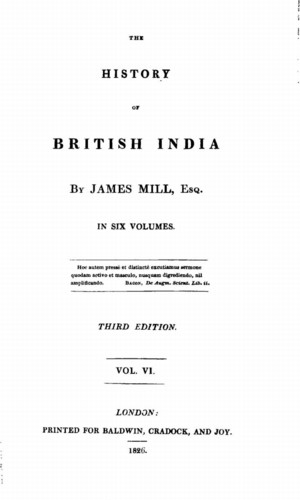
CHAP. VII. - James Mill, The History of British India, vol. 6 [1817]Edition used:The History of British India in 6 vols. (3rd edition) (London: Baldwin, Cradock, and Joy, 1826). Vol. 6.
Part of: The History of British India, 6 vols.About Liberty Fund:Liberty Fund, Inc. is a private, educational foundation established to encourage the study of the ideal of a society of free and responsible individuals. Copyright information:The text is in the public domain. Fair use statement:This material is put online to further the educational goals of Liberty Fund, Inc. Unless otherwise stated in the Copyright Information section above, this material may be used freely for educational and academic purposes. It may not be used in any way for profit.
CHAP. VII.Proceedings in Parliament relative to the renewal of the Company's Charter in 1793—Sir John Shore succeeds Lord Cornwallis as Governor-General—Relations of the English Government to the Nizam and the Mahrattas—Death of Mhadajee Scindia—War between the Nizam and Mahrattas—Guarantee of the Treaty of Alliance—Death of the Peshwa, and its Effects—Treaty fulfilled by Tippoo, and the Hostages restored—State of Oude—Death of the Nabob of Oude, and Succession of his Son—The young Nabob dethroned by the English on a charge of Spuriousness, and Saadut Ali made Nabob—Affairs at Madras—Death of Mahomed Ali—Lord Hobart endeavours to obtain the Transfer of part of the Nabob's Country—Dispute between Lord Hobart and the Supreme board—Capture of the Dutch Settlements. BOOK VI. Chap. 7. 1793.In 1793, the termination of the period assigned to the exclusive privileges of the Company so nearly approached, that the question of renewing the charter, and of confirming or changing the present system of government, could no longer be deferred. People had now so generally acquired the habit of lifting their eyes to the management of national affairs; and equal treatment to all so forcibly recommended itself as the best rule of government, that the commercial and manufacturing population were impelled to make an effort, more than usually strong, for the freedom of the Eastern trade. The principal places of manufacture and commerce, in the kingdom; Liverpool, Glasgow, Paisley, Manchester, Norwich, Exeter; exhibited combinations of the merchants and manufacturers, who passed the strongest resolutions; importuned the ministers; petitioned the legislature; and desired to have an opportunity of proving how much the real policy of commerce was violated, and the wealth of the country kept down, by the monopoly of so large a field of trade as that unhappily consigned to the East India Company. The Indian government was so organized, as now very well to answer ministerial purposes; it was therefore the study of ministers to preserve things as they were. The Board of Control and the Court of Directors cast, with some skill, the parts which they had respectively to perform. A committee of Directors was appointed whose business it was to draw up reports upon the subject of the Eastern trade, and to answer the arguments of those by whom the freedom of that trade was advocated or claimed. Three suchBOOK VI. Chap. 7. 1793. reports were exhibited. They were in the first instance referred to the Committee of the Privy Council relating to trade and plantations; and in the proper stage of the business were submitted to the House of Commons. On the 25th of February, Mr. Dundas, in the House of Commons, made a display of the pecuniary state of the Company. Fortunately for the designs which were in agitation, the accounts of receipt and disbursement presented, just at that moment, a balance of a large amount, on the favourable side. Of this circumstance, the greater possible advantage was taken. Every thing which could be effected by the confident assertions, so potent in persuasion, of men of influence and power, was done, to captivate the general mind with a prospect of Indian prosperity; to generate a belief that a great fountain, whence a perennial stream of wealth would flow upon the British nation, was, by the wisdom of its rulers, secured to them in India. Estimates were formed, with all the airs of accuracy, or rather of moderation, by which it was made to appear, that the surplus, exhibited by the accounts of the year immediately passed, would, in future years, rather increase than diminish. And with profound solemnity an appropriation, as if for perpetuity, was proposed, of a large superabounding sum, which would, it was said, be annually received from India. The eyes of men were successfully dazzled; and when Mr. Dundas called out to them, “Will you stop the tide of so much prosperity for untried theories,” those who knew but little either about the theory or the practice of the case, that is, the greater number, were easily made to believe, that there was a great certainty of securing what they were told was the actual influx of BOOK VI. Chap. 7. 1793.wealth, if they persevered in the present course; a great danger of losing it, if they allowed themselves to be drawn, by delusive prospects, into another. The friend of Mr. Dundas, and, as well from intellect as from office, the advocate of his schemes, Mr. Bruce, the historiographer of the Company, says, “Upon no occasion, perhaps, have men's minds been less prepared for a decision, on a subject of such magnitude and importance.”1 It is, indeed, true, that the people were deplorably ignorant of the history and management of their East India affairs; and it was, on this account, the more easy to make them throw themselves, with blind confidence, upon the assertions of men, whose knowledge was presumed from their situation and pretensions. An annual surplus of 1,239,241l. from the revenues and Commerce of India, after paying the Company's Indian charges of every description, was assumed. Of this magnificent sum, the following distribution was to be made. In the first place, as most due, it was proposed, that 500,000l. should be annually appropriated to liquidate the debt of the Company contracted in India. But in the next place, it was patriotically determined, that 500,000l. should be annually given to the nation, as a tribute from its Indian dominion. With regard to the remainder of the grand surplus, it was represented, by the Indian minister, as no more than equitable, that the meritorious proprietors of East India stock should not be forgotten. He recommended an increase of dividend from eight to ten per cent. By this, 100,000l. more of the annual surplus would be absorbed. A circumstance,BOOK VI. Chap. 7. 1793. which might have excited suspicion, but which appears to have been perfectly guiltless of any such disagreeable effect, was this; that, amid all these promises of wealth, the Company was in want of pecuniary assistance; and was to receive immediate authority for raising what was equivalent to a loan of 2,000,000l. It was not indeed to be called a loan. The name of a loan, associated with the idea of poverty, was at this time to be avoided. The Company were to be empowered to add 1,000,000l. to their capital stock, which, being subscribed, on the faith of a dividend of ten per cent., at 200 per cent., produced to the Company's treasury a sum of 2,000,000l. By this, it was said, the Company's bond debt in England would be reduced to 1,500,000l. The dividend upon this new capital would exhaust 100,000l. more of the surplus revenue. Of the appropriation of the remainder, which, to show accuracy, and because even small sums are of great importance, was carried to the last degree of minuteness, it would here, however, be out of place to render any account. After some affectation of discord between the Board of Control and the Court of Directors, Mr. Dundas having even pretended in parliament to beleive it possible that the Company might decline to petition for the renewal of their charter on the terms which the minister desired to impose, the petition of the Company was presented to the House of Commons, and taken into consideration on the 23d of April. It was, to some of the opposing members, a source of complaint, when a measure, on which interests of so much importance depended, and about which so profound an ignorance prevailed, was to be considered and determined, that a committee, to collect and to communicate information, had not, as on former occasions, BOOK VI. Chap. 7. 1793.preceded the decision, for which a call upon the legislature was now about to be made. Such a committee, by which ministerial purposes were more likely at the present moment to be thwarted than served, the ministers represented as altogether unnecessary; because, there was no material circumstance, they asserted, relating to India, about which there was not sufficient information, in the valuable and numerous documents, which they had communicated to the House. The speech of Mr. Dundas displayed and recommended the projected plan. In all the great and leading particulars, the scheme which had been introduced by Mr. Pitt's bill of 1784, and better adapted to ministerial or national purposes by the amendments or declarations of succeeding acts, remained without alteration. The powers of the Board of Control, and of the Court of Directors, were established on the same footing, on which they had been placed by the declaratory act of 1788. The powers of the Governor-General and his Council, of whom was composed the supreme organ of government in India, with the powers of the Governors and Councils at the subordinate presidencies, remained as they had been established by the act of 1784, and the amending act of 1786. The monopoly of the Eastern trade was still secured to the Company. The appropriations recommended by Mr. Dundas, of a supposed surplus of revenue, were dressed in the formalities of law. The increase of dividend, and the increase of capital, were authorized. And the lease of the exclusive privileges was renewed for a term of twenty years. Only two alterations were introduced, of sufficient importance to require statement and explanation. When the bill of Mr. Pitt entered the lists against that of Mr. Fox, the ground of patronage was theBOOK VI. Chap. 7. 1793. field of contention. On this it was, that, as the demerit of the one was to suffer defeat, the merit of the other was to be crowned with victory. On the part, therefore, of Mr. Pitt, Mr. Dundas, and their party, was required, either the reality, or, in place of the reality, the affectation, of a sort of horror at the enormity of increasing ministerial influence. To evade objections from this source; objections which they themselves had raised to such a height of importance, it was arranged, on the introduction of the plan, that no salary should be annexed to the duties of the Board of Control. These duties were to be executed by Members of His Majesty's Privy Council, who had good emoluments, on some other score, and so little to do for them, as to be very well paid for discharging the duties of the Board of Control into the bargain. This make-shift, unless it be contemplated in the light of a trick, to amuse the spectators till their attention relaxed, when paid functionaries of the usual sort might be quietly introduced, is a species of burlesque on legislation. To attach to one office a salary whose magnitude is out of all proportion to the duties; next to create another office with ample duties but no salary: and then to jumble both sets of duties, however heterogeneous, into one set of hands, exhibits a singular contrast with the rule of securing every service by its own appropriate reward; and paying no more for any service, than the performance of the service strictly demands. The time was now come, when the same aversion to patronage was not necessary to be displayed. It was therefore enacted, that a salary, to be paid by the Company, should be annexed to the office of certain of the Commissioners of the India Board; and that, in the appointment of those Commissioners, the circle BOOK VI. Chap. 7. 1793.of the Privy Council should no longer be the boundary of His Majesty's choice. The second alteration regarded the Indian trade. As an expedient, for softening the opposition of the commercial bodies, it was devised, that the Company should afford annually not less than 3,000 tons of shipping, in which private individuals might on their own account traffic with India, subject to the restriction of not importing military stores, or importing piece goods, and subject also to the restriction of lodging imports in the Company's warehouses, and disposing of them at the Company's sales. In adducing motives for the approbation of these measures, Mr. Dundas was successful and unsuccessful: unsuccessful in offering any reasons which can now satisfy an enlightened inquirer, but completely successful in offering reasons which satisfied the bulk of his auditory. He began with what he knew to be a favourite topic for a British Parliament—the wisdom of contempt for theory. On this occasion, however, theory was treated by him with unusual lenity; for though Mr. Dundas affirmed that the theories to which he was opposed did not hold true in the case for which he had to provide; he was not very unwilling to allow that they held good in all other cases. The propositions, which Mr. Dundas here vilified by the name of theories, were two; the first, That the business of government, and the business of commerce, cannot, with advantage to the governed, be lodged in the same hands; the second, That freedom is the life of commerce, and restraint and monopoly its bane. What argument did Mr. Dundas produce to show that these propositions did not hold true in the case of India? India, said he, has hitherto been governed in contempt of them: ergo, they do not hold true in the case of India. Mr. Dundas, it is true, asserted also, that IndiaBOOK VI. Chap. 7. 1793. had been governed well; but “governed well,” in this case, means simply governed, and nothing more; “governed,” somehow or other. As to the quality of the government, besides that it was the gratuitous and interested assumption, therefore worth nothing, of Mr. Dundas, what is the standard of comparison? India had been governed well, as compared with what? As compared with the highest state of advantage in which human nature is capable of being placed? This is what Mr. Dundas himself would not have ventured, even in his boldest moments of affirmation, to state. As compared with the ancient Mogul government? Was that the meaning of Mr. Dundas? A mighty boast! That the pride of British legislation should produce something not quite so bad as the despotism of barbarians. And this, even at that time, was a matter of doubt. It is, now, something more. If this, however, was the meaning; the logic of the ministers and of parliament, the one inventing, the other assenting, stood as follows: “India, in the hands of a civilized people, has been governed, not quite so badly, say the ministers; quite as badly, say other persons; as when it was under the despotism of barbarians: Therefore, it is true, that the union of commerce with government, and the monopoly of trade, are good things in India.” This is a logic by which a man may be helped to a great variety of convenient conclusions. With Mr. Dundas, the Grand Vizir of Constantinople might say, The empire of the Sublime Port is “governed well;” ergo, janisaries, and the bow-string, are excellent in the empire of the Sublime Port. The above reasoning Mr. Dundas corroborated by an established parliamentary axiom, which he often found of unspeakable utility, That all change in matters of government is bad. Allow BOOK VI. Chap. 7. 1793.this, and it followed, with undeniable certainty, that all change in the government of India was bad. On the other hand, if the absolute and universal truth of that celebrated axiom should be susceptible of dispute, all the oratory which Mr. Dundas expended on the topic of change in general, falls, unsupported, to the ground. The particular change which his opponents contemplated, the removal of the government of India from the hands of a commercial corporation, would, he said, produce the following effects; It would retard the payment of the Company's debts; it would check the growing commerce between the two countries; and it would endanger the allegiance of India. He asked, if it would be wise to incur so much danger for a theory? With regard to the first two of these bare, unsupported assumptions, which ought to have passed for nothing, experience has provided the answer. The government has remained as Mr. Dundas desired, and the Company, so far from paying its debts, has enormously increased them; it has remained as Mr. Dundas desired, and the commerce, instead of increasing, has dwindled to a trifle. That in a well-ordered attempt to improve the mode of governing the people of India, there was any thing to weaken their allegiance, is so evidently untrue, that it is only wonderful there should be a legislative assembly, in a civilized country, in which it could be asserted without derision and disgrace. “All this danger, said the Indian minister, “to be incurred for a theory?” First, Mr. Dundas's eagerness to escape from theory has not avoided the danger, but realized a great part of it. Secondly, when he treats the word theory; when all that class of politicians, to which he belonged, treat the word theory, with so much contempt, what is it they mean? Thought: All application of the thinkingBOOK VI. Chap. 7. 1793. powers to the business of government, they call theory; every thing, in short, except mechanical trudging in a beaten track. In the present case, thought, applying the results of experience to the circumstances of India, endeavoured to foresee what mode of government would be attended with the happiest effects: But if ever thought, in consequence of this operation, recommends any thing different in government from that which actually exists, it is by Mr. Dundas and his fellows, to receive the name of theory, and to be exploded. “All the good which now exists, will you sacrifice it to a theory?” When thought has accurately weighed the value of that which exists, and accurately weighed the value of that which may be got by a change; and, after all that is good and evil on both sides is maturely considered, pronounces deliberately that the second value is greater than the first; what is meant by asking, whether it is wise to sacrifice so much good to a theory? Is it not asking us whether it is wise to sacrifice the less good to the greater? In such cases the answer is, That it is wise, to sacrifice so much good to theory. It is only an abuse of language to express the facts in such inappropriate terms. Mr. Dundas said, that no two persons agreed, in the substitutes which were proposed for the present plan. This, too, however ridiculous, is a standing argument against improvement. Yet it is not the question, whether few or many schemes are proposed; but whether any of them is good. It would be a strange maxim of government, that, where a great end is in view, and men have different opinions about the means, in that case all power of choice should be extinguished, and things must remain as they are. How numerous soever the opinions, it is still the business BOOK VI. Chap. 7. 1793.of wisdom to inquire what is best; and take the most effectual measures for carrying it into happy execution. It is worthy of particular regard, that almost all the general arguments of those who oppose the improvement of political institutions, may thus be traced up to one assumption; viz. That the original condition of human beings, the brutal savage state, ought never to have been altered: and that all those men who have laboured to make human nature what it is, ought to be condemned as wicked. Among his other arguments, or more properly speaking his assertions, Mr. Dundas affirmed, that the surplus revenue of India could not be carried to England, which he affectedly called realizing, but by the Company's trade. There is nothing, it appears from experience, too absurd to pass for an argument in an aristocratically assembly. That neither money nor goods could be conveyed from India to England, except by the East India Company, was a proposition which it required no ordinary share of credulity to digest. Experience, moreover, has proved, what a knowledge of the theory of man would have foretold, that there would be no surplus revenue to bring. Mr. Dundas made use of other assertions. He asserted, that free trade would produce colonization; and that colonization would produce the loss of India. Unhappily, it is almost impossible to establish any considerable number of Europeans in India; because the natives subsist upon so little, that the wages of labour are too low to enable Europeans to live. If it were possible, nothing would be of so much advantage, both to the people of India, and to the people of England. As a weight to counterbalance the arguments of those who pleaded for the separation of the commerce from the government of India, and for the dissolution of the Company, Mr. Dundas delivered it as his old,BOOK VI. Chap. 7. 1793. and, after much time and experience, his present and confirmed opinion, that, if the patronage of India were added to the other sources of the influence of the crown, it would be sufficient to ensure to the crown a majority in both houses of parliament, and would destroy the substance of the constitution, through the medium of its forms. The patronage of India was transferred to the crown. It was the express purpose of the declaratory act of 1788, to place the government of India fully and completely in the hands of the ministers. Is the patronage of the Admiralty Board, the patronage of the Commander-in-Chief, or that of the Lord Chancellor less ministerial patronage, because it is by these functionaries it is dispensed? Was it possible to give to ministers the unlimited power over the government of India, and not to give the benefit of the patronage along with it? The two great crimes of which the government in India had been accused were; pillage of the natives; and wars of conquest. The present bill, Mr. Dundas asserted, would cure these evils. How? It had two expedients for that purpose: The land-tax was now fixed: And the Governor-General was responsible to parliament. For annexing salaries to the Board of Control, and enabling his Majesty to make any body a Commissioner, little trouble in search of a reason seems to have been thought necessary. Without a salary, and without a choice of other persons than members of the Privy Council, no body, said Mr. Dundas, could be got who would keep the office so long, or attend to its business so much, as to be capable of taking a useful part in its management. Nine years before, was this incapable of being foreseen? But foresight BOOK VI. Chap. 7. 1793.is theory. When the Commissioners of Control were first appointed, there were persons who had so much salary, and so little to do for it, that they would be very well paid for both services, viz those of the India Board, and those attached to the salary, added together. After an additional salary was got for the India Commissioners, what was done with the surplus salary of those who had too much for the services which it was intended to pay? Was any of it taken away? No. Why? To this last question, no answer is required. By allowing 3,000 tons for private trade in the Company's ships, Mr. Dundas took credit for having done something considerable in favour of the manufacturers and merchants. The source of advantage in private trade would be found in the more expeditious and economical methods to which private interest would give birth. By subjecting the private trader to the delays and expenses of the Company, Mr. Dundas cut off the possibility of advantage; and the merchants declined to occupy the unprofitable channel which he had opened. In every one of the particular objects which this bill pretended to have in view; the enlargement of British commerce; the extinction of debt; and the prevention of conquest; its failure, on experience, has proved to be complete. It encountered very little opposition till its third reading in the lower house. On that occasion it was furiously assaulted by Mr. Fox. The House of Commons, he observed, had, in the year 1780, proclaimed their solemn opinion, that, “the influence of the Crown had increased, was increasing, and ought to be diminished.” In defiance of this alarming declaration, in violation of the solemn protestations with which the nation were amused, upon the first introduction of the present system of Indian government,BOOK VI. Chap. 7. 1793. a new lot of influence was avowedly created. This was little. The mighty mass of evil existed in the influence which was warehoused for ministerial use with the Court of Directors. This was the most dangerous patronage at the disposal of the Crown. Why? because it was irresponsible. “Is it,” said Mr. Fox, “to be placed in the hands of those who really have the power over it? No! it is to be given to their agents and dependents; whose responsibility, from the nature of their situation, it is absurd to speak of.—It has been asserted,” he cried, “that the patronage of India consists in the appointment of a few writers. If there is a man in this House! if there is a man in this country! if there is one man in the British territory in India! who can believe this assertion, I wish him joy of his credulity! I ask any man, who is not insane,—in whom, if this bill shall pass into a law, will the whole of the patronage of India be invested? Will not the Company and their Directors be the mere tools of the minister? Who appointed Lord Cornwallis? who Sir John Shore? The clear effect of the measure is to give to the minister all the power, and screen him from all responsibility”2 Mr. Pitt answered; By complaining that his opponent had deferred to the last stage the statement of his objections; And by endeavoring to show, that the appointment of writers to India, who begin as clerks, and rise by seniority to places of importance, could not greatly increase the influence of ministers, even if their power over Directors were as complete as the argument of the opposition supposed. This, however, was not to deny, that ministers possessed BOOK VI. Chap. 7. 1793.all the influence created by the patronage of India; a fact which, at this time, Mr. Pitt did not affect to dispute: It was only to assert, that this influence, when it was got, was of inconsiderable importance. This was to contradict his own arguments against the bill of Mr Fox; and to recant every assertion by which he had successfully covered it with odium. It was also to contradict the principal argument by which Mr. Dundas had defended the propriety of continuing the government of India in the hands of a commercial company. But it did not subvert the truth, that a mass of wealth equivalent to all the lucrative offices in India, ready to be employed by the Crown, in purchasing the co-operation of those who were appointed to check it, would contribute largely to convert the checking into a confederate body; and to establish a fatal union of King and parliament upon the ruin of the people. The views of the parties who demanded, on this occasion, a change in the management of Indian affairs, are too nearly the same with the views, which have already been discussed, of preceding parties, to require any particular examination. The merchants petitioned chiefly for freedom of trade. On what grounds of reason, has been, as far as compatible with the nature of the present undertaking, already disclosed. The political change which most of the complaining parties appeared to contemplate, was the transfer of the details of government from the Court of Directors to his Majesty's ministers. On what ground, it appears to me, that the transfer of power which has already been made from the Court of Directors to his Majesty's ministers is not an improvement, and, by parity of reason, that any further transfer would not be an improvement, has been seen in my explanation of the nature of the instrument for the good government of India, whichBOOK VI. Chap. 7. 1793. was provided, by Mr. Pitt, in the Board of Control. To communicate the whole of the impression, made upon a mind, which has taken a survey of the government of India, by the East India Company, more completely through the whole field of its action, than was ever taken before, and which has not spared to bring forward into the same light the unfavourable and the favourable points, it may be necessary to state, and this I conceive to be the most convenient occasion for stating, That, in regard to intention, I know no government, either in past or present times, that can be placed equally high with that of the East India Company; That I can hardly point out an occasion on which the schemes they have adopted, and even the particular measures they pursued, were not by themselves considered as conducive to the welfare of the people whom they governed; That I know no government which has on all occasions shown so much of a disposition to make sacrifices of its own interests to the interests of the people whom it governed, and which has, in fact, made so many and such important sacrifices; That, if the East India Company have been so little successful in ameliorating the practical operation of their government, it has been owing chiefly to the disadvantage of their situation, distant a voyage of several months from the scene of action, and to that imperfect knowledge which was common to them with almost all their countrymen: But that they have never erred so much, as when, distrusting their own knowledge, they have followed the directions of men whom they unhappily thought wiser than themselves, viz. practical Statesmen, and Lawyers; And that, lastly, in the highly important point of the servants, or subordinate agents of government, there is nothing BOOK VI. Chap. 7. 1793.in the world to be compared with the East India Company, whose servants, as a body, have not only exhibited a portion of talent which forms a contrast with that of the ill-chosen instruments of other governments: but have, except in some remarkable instances, as that of the loan transactions with the Nabob of Arcot, maintained a virtue, which, under the temptations of their situation, is worthy of the highest applause. For the immediate successor of Lord Cornwallis, choice was mude of Mr. Shore, a civil servant of the Company, whose knowledge of the revenue system of India was held in peculiar esteem. Pacific habits, and skill in revenue, were possibly regarded as means abundantly necessary for realizing those pecuniary promises, which had been so loudly and confidently made to both the parliament and people of England. About the same time that Mr. Shore, dignified for his new station with the title of Sir John Shore, succeeded to the substantial power of the government of Bengal, its nominal sovereign, the Nabob Mubarek ul Dowla, died, after a life of thirty-seven years, and a reign of twenty-three. He left twelve sons and thirteen daughters, and was succeeded by his eldest son Uzeer ul Dowla, who was solemnly proclaimed at Calcutta on the 28th of September. The first important circumstance which solicited the attention of the new Governor-General, was the appearance of an approaching rupture between two of the late confederates; the Nizam, and the Mahrattas. The views, upon one another, of these two states, had undergone no permanent alteration from the union to which the desire of sharing in the spoils of Tippoo had given a temporary existence. Intervening circumstances had nearly matured into act their inimical designs. The treaty of alliance, offensive and defensive,BOOK VI. Chap. 7. 1793. between the English, the Nizam, and Mahrattas, included a mutual guarantee against the common object of their hatred and apprehensions, the sovereign of Mysore. This guarantee Lord Cornwallis appears to have thought of great importance for English security. It follows, that he must have expected greater benefit from the co-operation of the Nizam and Mahrattas, in case of an attack, than mischief from entanglement in the wars to which the turbulent politics of these native states would certainly give occasion. The mode in which the contracting parties were to act, in accomplishing the objects of the guarantee, was left, in the treaty concluded previously to the war, to be settled by subsequent regulation. So much had the Governor-General this affair of the guarantee at heart, that he endeavoured, as soon after the war as possible, to secure it by an express treaty devoted to that particular object. It was, however, to be an extraordinary treaty; for Lord Cornwallis, not being altogether without foresight of the evils likely to abound from an obligation to take a part in the wars which the Nizam and Mahrattas might kindle, was for inserting an article, by which the allies were not to assist one another, except, just when they pleased; or, as he chose to express it, “until they were convinced that the party requiring assistance had justice on his side, and all measures of conciliation had proved fruitless.”3 A draught of a treaty, to this effect, was transmitted to the courts of Hyderabad and Poonah. The BOOK VI. Chap. 7. 1793.Nizam, though fully sensible that the English alone stood between him and destruction, was yet encouraged to the hope of drawing his profit out of the eagerness for this treaty which the Governor-General displayed. A dispute had already sprung up between him and Tippoo Sultan. The Nabob of Kernoul was the dependant of the Nizam. On that chief Tippoo was urging claims which the Nizam contested. When solicited on the subject of the treaty, the Nizam demanded, as the price of his consent, the support of the English in the affair with Tippoo. This behaviour, the English, who knew their advantages, treated as a crime; and expressed so much of anger, that the Nizam was eager to redeem his offence by unlimited complaisance. As the power of the Mahrattas was different, so was their temper. The Poonah Councils were still governed by Nana Furnaveze, who now despairing of assistance from the English to support him against the designs of Scindia, opposed to the importunities of the Governor-General, on the subject of his treaty, evasion and delay. At last the Mahratta minister produced a sketch of a treaty of guarantee to which he expressed his willingness to accede, but involving terms, the acceptance of which, it is probable, he did not expect. Among these was an engagement for realizing the claims of chout upon the dominions of Tippoo. The Mahrattas were jealous of the enlarged, and growing power of the English. They were impatient to reap the spoils of the feeble Nizam; an acquisition, to which they regarded the connexion of that prince with the English as the only obstruction. Scindia, whose power had been so greatly increased, now exerted a decisive influence on the Mahratta councils; and entertained designs of future grandeur with which the ascendancy, or rather the existence,BOOK VI. Chap. 7. 1794. of the English in India was altogether incompatible. He was not solicitous to disguise his hatred of the connexion between them and the Nizam; or the satisfaction with which he regarded the power of Tippoo, as a counterpoise to the still more formidable power of the English. After a negotiation of more than a year, the accession of the Mahrattas to the union so fondly projected by Lord Cornwallis, was regarded as hopeless. The Nizam, who saw in their aversion to the proposed engagements, a design of holding themselves at liberty to fall upon him, was kindled to an ardent pursuit of the guarantee; and urged upon the English government the propriety of concluding the treaty singly with him; as it could be no reason, because a third party swerved from its engagements, that the other two should abandon theirs.4 It entered, however, into the policy of Sir John Shore, to avoid whatever could excite the jealousy of the Mahrattas: The English government, accordingly, declared its satisfaction with the verbal acquiescence of the Nizam; and on the part of the Mahrattas, with a promise, incidentally given, that they would act agreeably to existing treaties. The Nizam became at last so much impressed with the prospect of the dangers around him, that on the 1st of January, 1794, Sir John Kennaway, the English resident at Hyderabad, described him to the Governor-General, as prepared to form, with the English, engagements, which would render them masters of his country for ever; and urged the wisdom of not allowing so favourable an opportunity to escape.5 BOOK VI. Chap. 7. 1794.The course into which the Mahrattas had been guided, by impulse of the circumstances in which they were placed, very highly favoured the extension of their dominion, by gradual encroachments upon the slothful and improvident governments of India. Enabled from the nature of their country, and their state of society, to exercise with advantage a continual war of depredation against the surrounding states, they were often bribed to forbearance, by those who could find no other security against their ravages. The terms of this agreement came at last to be fixed, at a fourth part of the revenues of the country which they consented to spare. This was an opening, at which the stronger party generally found the means of introducing whatever was required for the final subjugation of the country. The fourth part of the revenues was always a disputed sum; and as the Mahrattas endeavoured to make it appear to be greater than it really was, the government of the country endeavoured to make it less. Nothing is ever paid by an Indian government, so long as it can help it; least of all, an odious tribute. The Mahratta chout therefore was seldom paid, except by the terror of a Mahratta army; and by consequence it was almost always in arrear. Under the pretension of security against imposition and delay inBOOK VI. Chap. 7. 1794. the receipt of the chout, the Mahrattas as often as possible insisted upon sending their own officers into the country to collect it. This gave them a power of interference in every measure of the government, and the support of a body of partisans, who, exercising the powers of Indian tax-gatherers, were masters of the property, and to a great degree of the person of every man subject to their exactions. The dominions of the Nizam had long sustained the Mahratta chout; and previous to the connexion which was formed between the Hyderabad government and Lord Cornwallis, the Mahrattas exercised so great an authority in his country, that the minister of the Nizam was more attentive to the wishes of the Mahrattas than the commands of his Master. During the necessity of exertion against Tippoo, and the union formed for his subjugation, the Mahrattas had yielded to a temporary relaxation of their influence over the country of the Nizam. But they now intended to resume it with improvements; and a long arrear of chout afforded the pretext for interference. The English government offered its mediation. The ready acceptance of the Nizam was not a matter of doubt. The Mahrattas employed evasion; and as soon as they were convinced that the interposition of the Governor-General would certainly not be with arms, they treated his mediating propositions with frigid indifference. A circumstance, calculated to alarm the English government, occurred. Tippoo Sultan had an army in the field, and either intended, or under terror was suspected of intending, a confederacy with the Mahrattas for the subjugation of the Nizam. The question was, what course it now behoved the English government to pursue. BOOK VI. Chap. 7. 1794.By the treaty of alliance, the Nizam, it might be urged, was entitled to the assistance of the English against Tippoo; and so little were they released from their engagement, by the infidelity of the Mahrattas, that they were rather bound to compel them to fulfil the conditions of a treaty, of which the parties were implied guarantees. Besides, the Nizam had declared, that his accession to the alliance against Tippoo was founded, not upon any confidence which he could place in Mahratta, but on that alone which he reposed in English, faith: Receiving him into the alliance upon this declaration was a virtual pledge, that the protection to which he looked from the English was not to depend upon that security which he expressly rejected: To make it depend upon that security, was, therefore, a breach of engagement. At the time when the Nizam, confiding in the security of English protection, took part with the English, the value attached to his alliance was such, that it would have been purchased with eagerness at the expense of an engagement offensive and defensive with himself. Would the Nizam, being attacked by Tippoo, have been entitled to assistance from the English, if defended by the Mahrattas? And was his title less, when about to be attacked by Tippoo, with the Mahrattas conjoined? Such a disappointment in hopes, on which he had staked the very existence of his throne, could not do less than ensure to the English the enmity of the Nizam. Nor could the English abandon him, without the appearance at once of weakness and infidelity; without descending from that high station in which they now over-awed the Princes of India, as well by the terror of their arms, as the purity of their faith. Considerations presented themselves of an opposite tendency. If the co-operation of all the parties in a treaty were necessary to the attainment of its end,BOOK VI. Chap. 7. 1794. and the defection of any one of them rendered the attainment of the end no longer possible, the defection of one dissolved, of course, the obligation of all. Again, the treaty of alliance between the English, the Nizam, and the Mahrattas, bound the parties not to assist the enemies of one another. In the case, therefore, of a war between any two of the parties, the third could not interfere. In such a case, the neutrality of the third party was that which the terms of the treaty expressly required. If the friendship of the Nizam would be lost; if the opinion which prevailed of English power, and of the tenacity of English engagements, should endure a slight and temporary diminution, war was beyond comparison a greater evil. It was impossible for any body to suppose, that a war against Tippoo and the Mahrattas would be easily sustained. And as the revenue of the Company was confessedly unequal to the expenditure of war, a protracted contest was to be regarded as pregnant with ruin. Even the destruction of the Nizam could not be considered as adding to the dangers of the English; since, after subverting that power, the Mahrattas and Tippoo were much more likely to make war upon one another than to combine their arms for an attack upon the British state. Finally, by the act of parliament the Company's servants were clearly prohibited from interfering in the quarrels of the native princes, and from taking up arms against them, unless to oppose an actual invasion of the British provinces. By these considerations, the mind of the Governor-General was determined; and he purposed to leave the Nizam to his fate. That such a determination was contrary to the expectations upon which the Nizam was induced to enter into the alliance, BOOK VI. Chap. 7. 1794.expectations which for that purpose he was encouraged to entertain, there seems no reason to doubt. The difficulties of the Governor-General, and the disappointment of the Nizam, were created by the looseness of the treaty. Two obvious cases, the authors of that treaty had not been able to foresee; First, if one of the three contracting parties were attacked by Tippoo, and one of the two who in that case were bound to assist should decline; Secondly, if one of the three were attacked, and one of the two, who ought to assist, instead of assisting, should join the aggressor. There was nothing in the treaty which determined what was to be done by the third party in either of those cases. If Tippoo had attacked the English, and the Mahrattas had either not assisted, or joined in the attack, it may be strongly suspected that the English, in that case, would not have held the Nizam released from his engagement. The opinion has also been urged, and it is not without probability, that, by declaring themselves bound to protect the Nizam, the English would not have involved themselves in the calamities of war, but would have prevented hostilities by the terror of their interference.6 When once the English have thoroughly imbibed the dread of an enemy, Tippoo, or any other; that dread, after the cause of it is weakened, or, peradventure, wholly removed, continues for a long time to warp their policy. In the opinion of the Governor-General, great danger still impended over the Company by the existence of Tippoo: The Nizam he regarded as too weak; the Mahrattas alone as sufficiently powerful to yield a counterpoise to that detested sovereign: His policy, therefore, was to retain,BOOK VI. Chap. 7. 1794. at some cost, the friendship of the Mahrattas; and for this purpose not to grudge the sacrifice of the Nizam. He was relieved from a portion of his difficulties by the assurance that, if Tippoo had entertained the project of an attack upon the Nizam, it was now laid aside. In the dispute between the Nizam and Mahrattas, the treaty, he thought, created, certainly, no obligation to interfere. In the opinion of Sir John Malcolm, an obligation existed, which cannot fail to be considered as a little extraordinary. He seems to say, for it is seldom that a rhetorical writer is entirely free from ambiguity, that the native powers, by joining the English in any war in which they were engaged, established a right, which nothing but their own misconduct could ever forfeit, to their friendship, and to protection against any power to whom by that conduct they might have given offence.7 He adduces Lord Cornwallis as a party to this speculation; who, “in his letter, under date the 28th of February, 1790, to the resident at Poonah, declared, that the Mahratta state, by acting against Tippoo in concert with the British government, became entitled, in reason and equity, to a defensive alliance against that prince, even though no previous engagement existed.” If this proposition means any thing real; and if assistance in war creates an obligation to assistance in return, except an obligation of which the party obliged is alone to judge, in other words an obligation binding him only when agreeable, that is, no obligation at all; the receipt of assistance in war is a snare, which carries ruin in its consequences, and ought for ever to be shunned. BOOK VI. Chap. 7. 1795.One little consequence, in the present instance, it would appear that Sir John Malcolm overlooked. The Nizam and Mahrattas were about to go to war: The English had received assistance from both of them: The English were therefore bound to lend assistance to both of them; that is, to send one body of English troops to fight against another. Before hostilities commenced between the Subahdar and the Mahrattas, Mahdajee Scindia died. The power of this chief, and his ascendancy in the Mahratta confederacy, had lately been so great, that his death was expected to produce considerable changes; and the resident at Poonah thought it probable, that the opportunity might be so improved, as to effect an adjustment between the Nizam and Mahrattas. The Governor-General however would not risk offence to the Poonah government, by any sort of interference more forcible than words; and the successor of Mahdajee Scindia, his nephew Doulut Row, soon assembled his army from the remotest parts of his dominions, and obtained an ascendancy at once in the Poonah councils, and in the confederacy which was forming against the dominions of the Nizam. The Nizam was the party in danger, but the first in the field. He advanced to Beder, if not with a view to actual aggression, at least with a view to interfere in the internal affairs of the Mahratta government, a considerable time before the movement of the Mahratta armies. Early in March, 1795, the advanced corps of the Mahratta army, under the command of Doulut Row Scindia approached; and the Nizam advanced from Beder to meet him. A general action took place. Both armies were thrown into some confusion, and neither obtained any considerable advantage. But the women of the Nizam were frightened; and under their influence he retreated from the scene of action during the night. He soughtBOOK VI. Chap. 7. 1795. protection in the small fort of Kurdlah, where the Mahrattas had the advantage of terminating the war without another blow. The fort is completely surrounded by hills, except at one particular spot. The Mahrattas took possession of this outlet, by which they completely shut up the Nizam, and cut him off from supplies. After remaining some weeks in this miserable situation, he found himself at the mercy of his enemy, and concluded a peace on such terms as they were pleased to dictate. The particulars of the treaty were not fully made known; but, beside establishing all their former claims, the Mahrattas compelled him to cede to them a country of thirty-five lacs revenue, including the celebrated fort of Doulutabad; to pay three crores of rupees, one-third immediately, the rest by instalments of twenty-five lacs perannum; and to give up, as a hostage for the performance of these conditions, his minister Azeem ul Omrah, whose abilities had for some time been the great support of his throne; who was the zealous friend of the English connexion; and a firm opponent of the Mahrattas. No part of the conduct of the English had more offended the Nizam, than the refusal to permit his two battalions of British troops to accompany him to the war. As the Mahrattas were the great source from which he apprehended danger, an expensive force which could not be employed against the Mahrattas, was a loss, rather than advantage. He, therefore, shortly after his return to Hyderabad, intimated his desire to dispense with the service of the English battalions; and they marched to the territories of the Company. The Subahdar of Deccan had never, from the time of Bussy, been without French officers in his service. BOOK VI. Chap. 7. 1795.In the confederate war against Tippoo, he had two battalions of regular infantry, officered by Frenchmen, and commanded by a gentleman of the name of Raymond; who began his military career in India, at an early age, in the disastrous campaigns of Lally. At first his establishment amounted to no more than 300 men; and he hired their arms from a merchant of his own country, at the rate of eight annas8 a month. By his services and address, he rapidly increased the favour and liberalities of the Subahdar; of which he availed himself for the augmentation and equipment of his corps. It had received great accessions both to its numbers, and appointments, since the peace of Seringapatam; and the English resident reported, probably with great exaggeration, that twenty-three battalions of this description, with twelve field pieces, accompanied the Nizam in his campaign against the Mahrattas. After the return of that Prince to his capital, he ordered new levies of this corps; and assigned a portion of territory for its regular payment. The expostulations of the British resident, and his intimations that so much encouragement of the French portended serious changes in his relations with the English, were but little regarded. A part of this corps was sent to occupy the districts of Kurpah, and Cummum. These districts lay upon the frontier of the Company's possessions; and the Governor-General took the alarm. “The measure itself,” he remarked,9 “had a suspicious not to say criminal appearance;” and he directed “the strongest representations to be made, to induce the Nizam to recall the detachment of Monsieur Raymond.” In case of refusal, the resident was even instructed to threaten him with the march of a body of EnglishBOOK VI. Chap. 7. 1795. troops to his frontier. The apprehensions of the English government were increased by some French officers, prisoners at Madras, who were detected in a project of escape, and suspected of a design to join M. Raymond. Whether the Nizam could have been led on to risk the displeasure of the English, or whether the knowledge of his defenceless condition would soon have brought him back to court their support, sufficient time was not afforded to try. On the 28th of June, his eldest son Ali Jah fled from the capital, and placed himself in open rebellion; when his fears were so vehemently excited, that he applied himself with the utmost eagerness to recover the friendship of the English. He agreed to the recall of Raymond's corps from the district of Kurpah; and warmly solicited the return of the subsidiary force. The battalions were ordered to join him with the greatest possible expedition; but before they were able to arrive, an action had taken place, in which Ali Jah was made prisoner. He did not long survive his captivity. The Nizam, however, enjoyed but a few months tranquillity, when another member of his family revolted, at the head of a large body of troops. In quelling this rebellion, and recovering the fort of Rachore, which the insurgents had occupied, the English battalions had an opportunity of rendering conspicuous service. The Nizam, though brought again to a sufficient sense of his dependance upon the English, could not help reflecting that from them he had nothing to expect in seeking the means of his defence against that insatiate neighbour, whom nothing less than his ruin would content; nor could he forbear turning with particular favour to that body of his troops, on whom, BOOK VI. Chap. 7. 1795.in contending with the Mahrattas, his principal dependance must rest. The value of M. Raymond's corps had risen in his estimation by the activity which it had displayed in the reduction of Ali Jah. Its numbers and appointments were increased; additional lands for its support were assigned to its commander; and arsenals and foundaries were established for its equipment. The abilities of M. Raymond qualified him to improve the favourable sentiments of his prince; the discipline and equipment of his corps were carried to the highest perfection, of which his circumstances would admit; and his connexions with the principal officers of the government were industriously cultivated and enlarged. He was not anxious to avoid those little displays, by which the fears and hatred of the English were most likely to be inflamed. The colours of the French republic were borne by his battalions; and the cap of liberty was engraved on their buttons. While a detachment of this corps was stationed on the frontier of the Company's territories, a partial mutiny was raised in a battalion of Madras sepoys. It was ascribed, of course, to the intrigues of the French abominable officers. Whether this was, or was not the fact; two native commissioned officers, with a number of men, went over to the French. It was by no means without jealousy and apprehension, that the English government beheld the progress of a French interest in the councils of the Nizam. That Prince declared his readiness to dismiss the rival corps, provided the English subsidiary force was so increased, and its service so regulated, as to render it available for his defence. This, however, the desire of standing fair with the Mahrattas dissuaded, and a succedaneum was devised. It was thought expedient to encourage the entrance of English adventurers into the service of the Nizam, whoBOOK VI. Chap. 7. 1795. might form a rival corps to counterbalance the French. But the English were less qualified than the French for this species of adventure; there was no man to be found whose abilities and address could balance those of M. Raymond; and this project totally failed. An event, in the mean time, occurred, which materially affected the politics of this part of India. On the 27th of October, 1795, happened the death of the young Peshwa, Madhoo Row; and introduced the most serious divisions among the Mahratta chiefs. Nanah Furnavese desired to place upon the vacant throne an infant whom he could use as a tool. Bâjee Row, undoubted heir, the son of Ragoba, was supported by the influence of Scindia. In these circumstances, Nanah Furnavese was anxious to strengthen himself by the alliance of the Nizam. He released Azeem ul Omrah, opened a negotiation with that minister on behalf of his master; and concluded a treaty, by which all the cessions extorted at Curdlagh were resigned. In the mean time, Scindia hastened to Poonah, with an army which his rival was unable to oppose; and Bâjee Row was placed upon the musnud of Poona. The treaty with the minister of the Nizam was of course annulled; but a new one was concluded, by which the Nizam was required to make good only one fourth of the cessions and payments which had been fixed by the convention of Curdlah. The intercourse with Tippoo, during the administration of Sir John Shore, was bounded by the execution of the treaty of Seringapatam. When the sons of Tippoo were restored,10 the officer who conducted BOOK VI. Chap. 7. 1795.them was empowered to make overtures towards a more amicable connection, provided a favourable disposition appeared on the part of the Sultan. But the pride of that Prince was too much wounded to consort with friendship; and on this occasion, the tyrant, as the English called him, disdained to practise hypocrisy. He received the officer with frigid civility. Though Lord Cornwallis, upon taking the reins of the Company's government, had agreed with the Nabob of Oude, that the government of his country should be divided into two parts, of which the one, namely, the business of defence, and all transactions with foreign states, should belong to the Company, and the other, namely, the internal administration, including the collection of the revenue, the coercion of the people, and the distribution of justice, should, without interference or control, belong to himself the English rulers had, nevertheless, observed the extraordinary vices of his government with great solicitude, as leading necessarily to that desolation of the country, with which the payment of the Company's subsidy would soon be incompatible. On the visit of Lord Cornwallis to Lucknow, in the first year of his administration, “I cannot,” he said, express how much I was concerned, during my short residence at the capital of the Vizir, and my progress through his dominions, to be witness of the disordered state of his finances and government, and of the desolated appearance of the country.”11 The Directors, with an extraordinary candour, declared, that theBOOK VI. Chap. 7. 1795. vices of the native government were not the only cause of this desolation; that for a great part of it the vices of their own administration were justly accountable. “Under a system,” they say, “defective in almost every part of it, and the abuses which arose out of that system, the present unfortunate state of the country may, in our opinion, be fairly attributed to a combination of causes. Among these is a claim which is now very wisely relinquished, of right of pre-emptions, and of exemptions from duties, in the province of Oude; made, and exercised, by contractors employed in providing the investment; and which, in the opinion of Lord Cornwallis, has essentially contributed to its ruin. The immense drain of specie from that country of late years, amounting, from February 1794, to September 1783, to the enormous sum of two crores and thirty-nine lacs of rupees, exclusive of what may have been sent down to Calcutta to answer the bills drawn for the payment of the troops, and on private account, stands foremost in our opinion, among the causes that have operated so much to its prejudice.”12 Though the Directors saw but imperfectly the mode in which connexion with their government had been ruinous to Oude, they had the merit of tracing, in a general way, the relation between cause and effect.13 In the year 1792 died Hyder Beg Khan, the minister. As the Nabob was a cipher in the hands of his minister, and the minister was a mere instrument BOOK VI. Chap. 7. 1795.in the hands of the Company, this was an event which deeply interested the Company's government. The Nabob appointed a person of the name of Hossein Reza Khan, who had enjoyed the principal share of his confidence even in the time of the deceased minister, to execute provisionally the duties of the vacant office. As this person, however, was but little acquainted with the business of revenue, Raja Tickait Roy, to whom that business was confided under Hyder Beg, was placed at the head of the financial department. The final election remained till the pleasure of the Governor-General should be known; who, satisfied of the inclination of both the men to rely upon the English government, and not acquainted with any persons who were better qualified, signified his approbation of the choice of the Nabob; and, on condition of their good behaviour, gave to the new ministers assurance of his support. The influence of the new ministers was still less able, than that of their predecessor, to limit either the expenses of the Vizir, or the ruinous exactions upon the people which those expenses, the English subsidy, and the extortions of the tax-gatherers, imposed. In the month of January, 1793, Lord Cornwallis thought it necessary to write to the Vizir a solemn letter of expostulation and advice. “On my return,” said he, “from the war in the Deccan, I had the mortification to find that, after a period of five years, the evils which prevailed at the beginning of that time had increased; that your finances had fallen into a worse state by an enormous accumulated debt; that the same oppressions continue to be exercised by rapacious and overgrown aumils towards the ryots; and that not only the subjects and merchants of your own dominions, but those residing under the Company's protection, suffered many exactions contrary to theBOOK VI. Chap. 7. 1795. commercial treaty, from the custom-house officers, from Zemindars, aumils, and others.” The Governor-General then proceeded to pen advices, which, though they were lost upon a sensual and profligate prince, will not be lost upon the people of England. “As in a state,” said he “the evils that are practised, by the lower class of men, are to be attributed to the example held out to them by their superiors, and to their connivance, or to their weak government; so am I obliged to represent, that all the oppressions and extortions committed by the aumils on the peasantry, take their source in the connivance and irregularities of the administration of Lucknow.” His meaning, as he himself explains it, is, That an expensive government is, by the very nature of things, an unjust and oppressive government; and that expense, when it proceeds to a certain pitch, is the cause, not of misery alone, but of ruin and desolation. “Though the Company's subsidy,” said he, “is at present paid up with regularity, yet I cannot risk my reputation, nor neglect my duty, by remaining a silent spectator of evils which will, in the end, and perhaps that end is not very remote, render abortive even your Excellency's earnest desire that the subsidy should be punctually paid. Thus, I recommend economy in your own household disbursements, as the first measure, whence all other corrections are to take place.—I do not neglect the dignity of your station: nor am I actuated by views for the Company's subsidy only. Your dignity does not flow from a splendid retinue; and unnecessary establishment of household servants, elephants, sumptuous ceremonies, and other circumstances of similar nature: BOOK VI. Chap. 7. 1795.But from a just and wise administration of your government and finances.”14 Just before the departure of Lord Cornwallis, the new ministers repaired to Calcutta; in order more fully to explain the deplorable state in which the government and population of the country were placed, and to pray for counsel and support in conducting the affairs of a prodigal government and an impoverished people. The Governor-General, before leaving India, addressed to the Vizir another letter, of great length, from Madras. In this he repeats, that the effects of an expensive government are two, First, the oppression and misery of the people; and secondly, the fall of the government itself. “It is well known,” says he; “not only throughout Hindustan but to all Europe, that the revenues of your Excellency's dominions are diminished beyond all conjecture.—Does not this consideration alarm your Excellency?—Can any thing but ruin result from such circumstances?—Are not these facts a decisive proof of tyranny, extortion, and mismanagement, in the aumils?—And, what must be the situation of the ryots who are placed under such people?—But your Excellency knows, that the prayers of the oppressed are attended to by the Almighty; and often call down his vengeance upon their oppressors.—History confirms the observation, by exhibiting innumerable examples of monarchies overturned, and families effaced from the earth, by a violation of justice in the sovereign, or neglect in him to enforce its laws.” He continues; “The evils flowing from this source would have been less felt, if, in proportion as the revenues declined, a diminution of expenses had takenBOOK VI. Chap. 7. 1795. place. But profusion, in fact, was the cause of the first evil: and the continuance of it increased its magnitude.” He adds, “All the world concurs in encomiums upon the dignity and splendour which adorned the court of your illustrious father; but his splendour did not arise from the gaudiness of equipage, from frivolous dissipation, or from profuse expenditure. He well knew, that the best ornament of sovereignty is justice: that due economy is the source of order and dignity: that the true splendour of a court is derived from equity and wisdom.” “If,” says he, “the information which I have received of the state of the country be true, the disorders exceed all bounds, and all description. The consequence is, that the revenues are collected, without system, by force of arms; that the aumils (revenue agents) are left to plunder uncontrouled; and the ryots have no security from oppression, nor means of redress for injustice exercised upon them.”15 In May 1794, Sir John Shore, in his letter to the Resident at Lucknow, said; “It has long been my anxious wish, no less than that of my predecessor, the Marquis Cornwallis, to prevail upon the Nabob Vizir to arrange the internal administration of his country, and establish it upon principles calculated to promote the happiness of his subjects and the permanency of his own authority. I cannot, therefore, observe, without regret, that his Excellency does not appear to have adopted any measures for this purpose, in consequence of the letter addressed to him by Marquis Cornwallis from Madras, and which I delivered to his ministers in Calcutta, with the most BOOK VI. Chap. 7. 1795.serious recommendation to them to use their utmost exertions in giving effect to the advice and representations of his Lordship.”16 Fyzoollah Khan, the Rohilla chief, to whom the district of Rampore had been preserved, at the time when the rest of his nation were exterminated from the country to which they had given their name, died, at an advanced age, in 1794, leaving the country over which he had ruled, in a high state of cultivation and prosperity. The succession went to Mahommed Ali, his eldest son, who was duly confirmed by the Vizir, and acknowledged by the principal Rohilla chiefs. His younger brother Gholaum Mahomed, an ambitious man, contrived in a little time to get him into his power; when he put him to death; and sent a large present to the Vizir, with a promise of augmented tribute, if he were confirmed in the government of Rampore. Though the murdered Prince left a son, in a state of nonage, the Vizir was by no means disinclined to the proposition of Gholaum Mahomed. It was, however, a proceeding of too much importance to be concluded without the permission of the British government; and that was refused. The British troops, under Sir Robert Abercromby, joined by such forces as the Vizir could afford, were ordered to march against the usurper, and treat him as a rebel. It was the purpose of the Governor-General, to wrest the country entirely from the family of Fyzoolah Khan, notwithstanding the rights of the son of Mahomed Ali, guaranteed by the British government;17 and notwithstanding the rights of the people of the Country, happy under the frugal government of the Rohilla chief, menaced with misery and ruin under the exactions of the Vizir, toBOOK VI. Chap. 7. 1795. which, with a full knowledge of the circumstances, the British ruler was about to condemn them. The rapidity of Sir Robert Abercromby anticipated the arrival of the instructions which were forwarded to this effect. A battle was fought at Bittawrah; in which, after making a partial impression upon the British line, the Rohillas were defeated. Negotiation followed, and an arrangement was made. The treasures of the late prince, Fyzollah Khan, were given up to the Vizir. And a jaghire, of ten lacs of revenue, under the express guarantee of the English government was granted to Asoph Jah, the son of Mahomed Ali.18 The retrograde movement was uninterrupted in the Nabob's affairs. “The exigencies of his government,” as we are informed by the Directors, “were supplied by loans, on terms increasing in proportion to the sums demanded, and the discharge of one debt was effected, not from the revenue, but by contracting another of an increasing interest.” The ministers Hussein Reza Khan, and Rajah Tickait Roy, had become odious to him, by opposing obstructions to his will: and he accused them of the embarrassments which had grown upon him during their administration. His desire was to make Rajah Jao Loll his minister; who had been one of his intimates for several years, and professed absolute subserviency. The aversion of the English government to this minion was not unknown. The Nabob therefore was advised to assume the appearance of acting as his own minister; while the business and power, in reality, passed into the hands of Jao Loll. BOOK VI. Chap. 7. 1796.The English troops, employed in the country of the Vizir, were always on the increase. Instead of the single brigade, which Hastings had pronounced sufficient, even the two brigades, for which Lord Cornwallis had made provision, in the subsidy of fifty lacs, were now exceeded. In their dispatch of the 22d of April, 1796, the Directors commanded the two regiments of native cavalry, serving under the Presidency of Bengal, to be augmented to four; and, “in order to relieve the Company from a considerable part of the expense, they directed that every possible effort should be made to induce the Vizir to disband his own useless cavalry, and to apply a part of the sums expended in their support to defraying a part of the charges which the Company incurred by the proposed augmentation.”19 With this proposition, the Vizir, at first, would by no means comply. And in March, 1797, the Governor-General paid a visit to Lucknow, for the “two avowed objects,” as he himself expressed it, “of inducing the Vizir to establish a reform in his administration, and to pay part of the new cavalry establishment, which he had already peremptorily refused.”20 The influence of the British ruler was not entirely without success; and agreement was obtained from the wretched Vizir to add to his former subsidy the expense of one European and one native regiment of English cavalry, provided the annual amount should not exceed five and a half lacs of rupees; and Tuffeizel Hussein Khan, a man in whose probity and talents the Governor-General placed great reliance, was appointed minister. Only a few months elapsed, when, after a short illness, the Vizir expired. The eldest of his brothers was Saadut Ali, who, in fear of intrigues, had beenBOOK VI. Chap. 7. 1797. compelled to reside on a pension at Benares. To the succession of Mirza Ali, the eldest son of Asoph ul Dowlah, Saadut Ali offered objections, asserting that neither he, nor any other of the reputed children of the late Vizir, was really his offspring: And he urged his own pretensions to the vacant throne. The arbiter in this great dispute was the Governor-General. The acknowledgement of the late Vizir, who had treated Mirza Ali as his son and successor; the undoubted principle of the Moslem law, which renders that acknowledgement a valid title; the acquiescence of the Begums, the wife and mother of Asoph ul Dowlah; the concurrence of the capital; and the danger of admitting reports on the filiation of princes to decide the question of their succession, swayed the mind of the Governor-General; and Mirza Ali, commonly known by the name of Vizir Ali, was placed on the musnud, and recognized by the English government as Nabob of Oude. The young sovereign had not long enjoyed his power and dignity, when complaints were received by the Governor-General, both respecting his title, and respecting his conduct. The situation of affairs appeared to require the presence of the English ruler; and he began his journey to Lucknow. Upon his arrival, he found a scene of intrigue of extraordinary activity, and extraordinary complication. The elder Begum, having interfered with the conduct of the Nabob, had been urged to return to Fyzabad; and animosity succeeded to friendship. Almas Ali Khan, who had been an object of district to the British government for many years, and forced to keep aloof from public affairs, had so successfully employed his leisure, in carrying on the business of renter, that a great proportion of the country was now placed in his BOOK VI. Chap. 7. 1797.hands; and he was the most powerful individual in the state. Upon her quarrel with the Nabob, the Begum had resigned herself to the councils of this man; who advised an apparent reconciliation with the Nabob. “On my arrival at Lucknow,” says the Governor-General, “the confederacy between the Nabob and Begum appeared indissoluble, and it was the opinion of the minister that they could not be disunited. The principal adviser of the Begum was Almas, either directly, or through (her principal eunuch) Jewahur Ali Khan. And Hossein Reza Khan, and Tickait Roy, ranged under their banners. With the Nabob, his father-in-law Sherf Ali Khan was supposed to have the most influence.—The object of all parties was to oppose the English influence.” Presently the views of the actors began to disclose themselves. And a malady which attacked the Nabob, the measles, or small-pox, shortly after the arrival of the Governor-General, afforded a favourable opportunity for intrigue.—“I confess,” says the Governor-General, “without reserve, that I never was involved in a scene of more perplexity and profligacy.” “On the 29th of December,” (I still use the language of the Governor-General's report,) “Almas, who has most sedulously studied appearances, waited on the minister, and entered into conferences with him which lasted several days. He began with strong complaints of the conduct of Vizir Ali, whom he designated by a most opprobrious term. He spoke of him as spurious and profligate; as a man who would ruin the country by his vices and profusion. He mentioned the earnest wish of the Begum and himself, that he should be deposed, and some one of the sons of Suja ud Dowlah, be placed on the musnud, excluding all the sons of Asoph ul Dowlah, as spurious.” The same representations were successively repeated to the Governor-General, and to the Governor-GeneralBOOK VI. Chap. 7. 1797. in company with the Commander-in-Chief. Mirza Jungly, a brother of the late Nabob, younger than Saadut Ali, was the person whom the Begum and Almas combined in recommending. And “a large pecuniary sacrifice,” says the Governor-General, “was promised, as a compensation for my acquiescence.”—“Almas,” he continues, “acts in the name of the Begum; and while he pretends to disavow, on her part, all wish to interfere in the administration, his propositions to me were directly calculated to place it in her power.” Great industry and skill had been employed in prepossessing the mind of the Governor-General with the most unfavourable opinion of the young Nabob, as a man between whose character, and the interests of the English, an irreconcileable contrariety was placed. He was represented as extremely profuse in his expenditure, and therefore likely to absorb the funds from which annual payments to the English might proceed; as of a violent, ungovernable will, and therefore unlikely to be obedient to the English; and finally, as altogether averse to the English, and likely to use his utmost endeavors to free himself from their yoke. The belief of these representations, communicated to the Governor-General, appears to have decided the question. It prepared his mind for annexing weight to any evidence which might be preferred of the spuriousness of the man whom he wished not to reign. It was no objection to the legitimacy of the Nabob, that he was not the son of the Begum, who had no child; that he was the son of a female, menially employed in the zenana. He was acknowledged by Asoph ul Dowlah as his son, and, according to the law of the Moslems, that was enough. Tehzeen Ali BOOK VI. Chap. 7. 1797.Khan, however, a confidential eunuch of the late Vizir, told the following story; That the mother of Vizir Ali had a husband of her own rank; was never confined to the zenana, but quitted it daily, as is customary with menials of the same description, and went to her husband's house; that Vizir Ali was not the son of the Nabob, but purchased of his mother for 500 rupees after his birth; that it was customary for the Nabob, having no progeny, to purchase women who were pregnant, and bring up their children as his own; and that this was the origin of all the children who were now regarded as the offspring of Asoph ul Dowlah.21 In this statement, the only point of real importance was, whether Asoph ul Dowlah was, or thought that he was, the father of the child produced by the mother of Vizir Ali. Tehzeen Ali Khan said, that he was not, and did not know of her pregnancy till after the birth of the child. And upon this story, told privately to the Governor-General by Tehzeen, who complained of having been traded with injustice by the Nabob, and who might have been suborned by his enemies; told without confrontation with the public, without confrontation with the Nabob, without cross examination, without counter evidence, without hearing any thing the party affected might have to adduce in his behalf, without pushing the inquiry by examination of other persons to whom the secrets of the zenana might be known, and corroborated only by what he was told was the public opinion, did the Governor-General declare, that a man whom he had acknowledged as Nabob of Oude, and who succeeded to the throne with the apparent concurrence of all ranks, except the single voice of SaadutBOOK VI. Chap. 7. 1797. Ali, was not the son of the late Vizir, and ought to be displaced from the throne. It is impossible, to read the account of this transaction, drawn up by the Governor-General, and not to be impressed with a conviction of his sincerity, and his desire to do justice. But it is easy also to perceive how much his understanding was bewildered; and impossible not to confess that he decided against the unfortunate Nabob the great question of a kingdom, upon evidence upon which a court of English law would not have decided against him a question of a few pounds.”22 When the resolution of deposing Vizir Ali was taken, the choice of a successor was easily made. Saadut Ali was the eldest surviving son of Suja Dowlah; and would not, as Mirza Jungly, become a tool in the hands of the Begum and Almas. When the treaty proposed by the Governor-General was communicated to Saadut Ali, it was not the time to dispute about terms. He gave his consent to every particular. He then proceeded to Caw pore; from which he was escorted by a large body of European troops to Lucknow. The military force of the country was almost wholly English. The Nabob was, therefore, completely helpless; and Saadut Ali BOOK VI. Chap. 7. 1798.was proclaimed, without opposition, on the 21st of January, 1798. The terms, to which he had at first assented, were somewhat modified after he came to the throne. It was finally established, that the annual subsidy should be raised to seventy-six lacs of rupees, and that the fort of Allahabad should be made over to the English. It was also arranged, that the regular amount of the English forces stationed in Oude should be 10,000 men, including all descriptions; that, if at any time the amount should exceed 13,000 men, the expense of all the troops above that number should be defrayed by the Nabob; if it should fall below 8,000, a proportional deduction should be made. The Nabob further agreed, to pay twelve lacs of rupees to the English, as compensation money, for the expense of placing him on the mosnud; and not, without their consent, to hold communication with any foreign state, to employ no Europeans in his service, or to permit any to settle in his dominions. Finally he agreed to allow a lac and a half of rupees as an annual pension to the deposed Vizir Ali, who was removed to Benares; and to afford a suitable maintenance to the rest of the reputed children of his brother, the deceased Nabob.23 The transaction had one attractive feature; that of gain to the Company: And it received the most cordial approbation of the powers, ministerial, and directorial, at home. The political letter to Bengal, dated 15th May, 1799, after a full commentary upon the proceedings, thus declares: “Having taken this general view of the subject, with a minute attention, however, to all the papers and proceedings, we are, upon the whole, decidedly of opinion, that the lateBOOK VI. Chap. 7. 1795. Governor-General, Lord Teignmouth, in a most arduous situation, and under circumstances of much delicacy and embarrassment, conducted himself with great temper, impartiality, ability, and firmness; and that he finished a long course of faithful services, by planning and carrying into execution an arrangement, which not only redounds highly to his own honour, but which will also operate to the reciprocal advantage of the Company, and the Nabob Vizir.”24 On the 1st of August, 1792, Sir Charles Oakley succeeded General Medows, as Governor of Fort St. George, and President of the Council at Madras. Sir Charles remained in the government till the 7th of September, 1794, when Lord Hobart was placed at the head of the Carnatic Presidency. On the 13th of October, 1795, died, at the age of seventy-eight, the Nabob Mahomed Ali, Walau Jaw; and was succeeded by Omdut ul Omrah, his eldest son. From the date of the treaty, framed by Lord Cornwallis in 1792, the payments of the Nabob, being in years of peace, had, through the agency of the money-lenders, been regular. But the country, made over to the cruel exactions of this description of men, had rapidly declined. The continued operation of the same causes threatened to extinguish the resources of the government; and, though no attempt had been made to ameliorate the state of affairs, during the life of Mahomed Ali, the succession of Omdut ul Omrah appeared to Lord Hobart to present a favourable opportunity for introducing those reforms of which the necessity had become so urgent. On the 24th of the same month, in which the Nabob died, the President deemed it expedient to place on record, by a Minute in Council, a descriptionBOOK VI. Chap. 7. 1795. of the ruinous course in which affairs had proceeded, under the arrangement of 1792. The source of the evil was laid in “the usurious loans, which,” says he, “it has long been the practice, principally among the European gentlemen of the Presidency, to make to the Durbar for mortgages upon the different provinces of the Carnatic.” Some of the principal houses of business at Madras, said the Governor, or even some of the Company's servants, enter into an agreement with the Nabob for the payment of the sums which may have become due to the Company's treasury. They receive a mortgage upon a portion of the territory. To render this availing, they stipulate for the appointment of the manager of the territory. It is also requisite to establish an understanding with the military commanding officer of the district. And, then, the chain of power is complete. Then, the unhappy ryots are delivered over to the uncontrolled operations of men who have an interest in nothing but exacting the greatest sums in the shortest time, of men “hardened by practice, and with consciences lulled to rest by the delusive opiate of interest upon interest.”25 It is not in the way of direct exaction alone, that the mischief was accomplished. Another “endeavour,” said the President, “of those engaged in a concern of this nature is to enhance the price of grain by artificial means, lest the ordinary price of that article, the sole subsistence of the natives, should fail to answer the large advance of money, and the exorbitant advantage expected upon it, by the soukars,” or subordinate money lenders, to whose ruinous assistance the ryots are compelled to have recourse.BOOK VI. Chap. 7. 1795. “The means of effecting this purpose,” continues the magistrate, “is easy; for the necessitous condition of the ryots compels them to dispose of their grain as soon as it comes into their possession, in order to satisfy the urgent demands upon them which I have already described: the purchasers of this grain monopolize it, until the demand advances the price. If, towards the expiration of the season, any part of the grain should yet remain on hand, the expedient is, to divide the whole quantity, in whatever condition it may be, among the inhabitants: and the people are compelled (in general the manufacturers) to take it at a valuation considerably above the market price.” Such was the general course of oppression. The modes were infinite. “The subject,” says the indignant Governor, “is exhaustless.”26 “After this exposition, no comment,” he cries, “can be required, to show that this species of government, if it deserves the name of government, contains the most grievous oppression of the people, the certain impoverishment of the country, and, consequently, the inevitable decay of revenue.” A fact is here very forcibly urged upon our attention, BOOK VI. Chap. 7. 1795.of which it is important to find the true explanation. Under their dependence upon the English government, it has been seen, that the people of Oude and Carnatic, two of the noblest portions of India, were, by misgovernment, plunged into a state of wretchedness, with which no other part of India, hardly any other part of the earth, had any thing to compare. In what manner did the dependence of the native states upon the English tend to produce those horrid effects? The difficulty of the answer is not very great. The oppressions of the native governments were limited by their weakness. When they received the use of English strength, their oppressions were limited by nothing, but the physical powers of the people to exist under oppression. So ill has the science of government been hitherto understood, that under all the governments which ever yet existed, except perhaps one or two, there is no regular and effective restraint upon bad government, except from the dread of the insurrection and rebellion of the people. In the government of Asia, this produces no inconsiderable effects; as the frequent revolutions and changes of dynasty abundantly demonstrate. When misery had produced disaffection, and disaffection had increased to a certain height, there was generally some popular leader who offered himself to the nation as an instrument of revenge, and cast the unworthy possessor from his throne. The progress, in general, was rapid, and easy. When oppression produced a decline of revenue, the evident instability of the government deterred lenders; money became wanting to pay the troops; the troops first clamoured and then mutinied; the voice of the nation joined that of the army; a revolution took place; and commonly, for two or three generations, the new family governed comparatively well. Among the small sovereignties of India, misgovernment producedBOOK VI. Chap. 7. 1795. weakness, and weakness invited conquest. The misgovernment, for example, of Carnatic and Oude, would infallibly have produced the conquest, of the one by Tippoo, and of the other by the Mahrattas; and as a Prince was commonly strong, only because he governed well, to be conquered was among the happiest results which the people knew. Till, indeed, governments attain that high pitch of excellence, at which they really perform in the best manner, and at the cheapest rate, the services of government to the people, all changes are, in general, for the good of the people. It is the stability of governments, which, before this state of excellence, human nature has to dread. Now it is evident that when the uncontrollable force of a British army is lent to an Indian prince, his subjects are immediately placed without the pale of hope. The Prince is completely set above the only fears, which, in his situation, could operate as a restraint upon his disposition to oppress; that of insurrection, and that of being conquered. The source of almost all oppression, in Asiatic and European governments alike, is the rage of extorting more and more of their earnings from the people. This passion, instead of being abated by connexion with the English, is prodigiously inflamed; when the tributary prince is carried to all the excesses of taxation, not only by his own rapacity, but the necessity of supplying the enormous demands of his European masters; and when his soldiers, as well as people, are kept in abject and hopeless subjection, by the terror of European arms. The progress of this oppression produced in the English any determinate resolution of reform, only when the visible desolation of the country presented the prospect of a rapidly approaching moment, at BOOK VI. Chap. 7. 1795.which the English subsidy could no longer be found. We have seen what anticipations of this disastrous period the English rulers had already expressed with regard to Oude. The danger was still more imminent in the case of Carnatic. “I cannot,” says Lord Hobart, “but look with extreme anxiety to the nature of the security, provided by the treaty of 1792, for those resources on which the British interests on the coast of Coromandel materially depend. I cannot but see that the present system of collecting the revenues of the Carnatic manifestly invalidates that security: And that, whenever a failure may happen in the payment of his Highness's kists, we shall in vain have recourse to it for the recovery of the defalcation.” A palliative, if not a remedy, suggested itself, in the prohibition of loans to the Nabob by Europeans; because, “though the dealings of Soukars (native money lenders) in the collection of revenue, were not of recent establishment, yet the terms of loans had never been carried to so usurious an extent as since the practice had been introduced among Europeans.” This, however, the Governor declared to be completely ineffectual. “The prohibitory orders hitherto published, have,” he says, “all failed of their object: Because the evasion of them is easy to Europeans, through the agency of their native servants; and because the enormous profits which arise from those usurious loans, hold out an irresistible temptation to adventurers. To prohibit the intercourse of Europeans at the Durbar, is ineffectual. Other channels of communication are open; and the superintendant of an usurious loan at Palamcotah conveys his demands to the ears of the Nabob with no less certainty than he who lives in the precincts of Chepauk. As long, therefore, as his Highness shall be so regardless of his true interests, as to deliver up hisBOOK VI. Chap. 7. 1795. provinces, and his people, to public depredation, so long will there be found men, who, in the pursuit of extravagant advantages, will overleap the bounds of discretion and moral obligation.” In these circumstances, what is to be done? “So desperate a malady,” said the President, “requires a remedy that shall reach its source. And I have no hesitation in stating my opinion, that there is no mode of eradicating the disease, but by removing the original cause; and placing those districts, which are pledged for the security of his kists, beyond the reach of his Highness's management;” in other words, assuming the collection of the revenue, and the whole of the internal government. And even this was a partial remedy; for though it might alleviate the distress of those particular districts, it left the remainder of the country to all the deplorable consequences of the misgovernment of the Nabob. The Governor describes, in a style instructive for other occasions, the tissue of interests by which radical reform was opposed. “The disposition,” says he, “which his Highness has already evinced to oppose such an arrangement, leaves me no doubt of the real cause. It is not possible to calculate the extent and variety of interests which are involved in this one pursuit. And, though they are subdivided in every direction of the Carnatic, yet at the call of danger they all rally round a common centre. The great houses of business, who are the principal money-lenders at the Durbar, borrow from individuals, who, though not absolutely engaged in the loan itself, are partakers of the speculation in a remote degree, and feel, with no less sensibility than their principals, the approach of danger. Similarity of interest makes a common cause. And the great body of interest which is condensed BOOK VI. Chap. 7. 1795.upon this principle, is uniformly exerted to support his Highness in an inflexible resistance against a melioration of system, and to oppose a reformation which I consider essential to the national welfare.”27 This representation is the more worthy of regard, as it is applicable, mutatis mutandis, to every government under the sun, in which there is need of reform. On the day following the date of the Minute from which these particulars have been taken, the Governor of Fort St. George addressed a letter to the Governor-General in Council, in which he represents, that, in consequence of several communications which he had with Mr. Dundas, and with Lord Cornwallis, before leaving England, respecting the necessity of a change in that state of things which was established by the treaty of 1792, he had opened a negotiation for that purpose with Omdut ul Omrah; and that he had not communicated his intention to the Supreme Government, or waited for its concurrence, on account of the intrigues of those, who, from personal interest, endeavoured to prevent the accomplishment of his object. The first of the points, which the Governor endeavoured to gain, was the transfer of the collections, including all the powers of internal government, in the districts pledged for the subsidy. The benefits would be; to the Nabob, the saving of the exorbitant interest which the usurers received; to the people, deliverance from extortion; to the Company, security against the desolation of the country. The second point regarded the Southern Polygars. The right of collecting the tribute from the country of the Polygars had been yielded to the Company by the treaty of 1792, but the nominal right of sovereignty reservedBOOK VI. Chap. 7. 1795. to the Nabob. This proved a source of obstruction to the right ordering of the country; and the Governor was desirous of seeing it resigned. In the third place he endeavoured to obtain the cession of the forts in Carnatic, which, according to an expression in the treaty of Cornwallis, were to be garrisoned by the troops of the Company. To obtain the consent of the Nabob, Lord Hobart offered to relinquish certain claims, to the amount of thirty lacs of pagodas, or more. The influence of those who had opposite interests prevailed. “It has been with the deepest regret,” said the Governor, “that I have found the Nabob unmoved by my entreaties and remonstrances upon this subject: Not that he has been insensible to the justice and expediency of what I have proposed; but, as he has candidly confessed at several interviews with me, that he has not the resolution to comply; informing me, that his native ministers and European advisers, so perplexed, plagued, and intimidated him, that he could not venture upon the measure, notwithstanding his conviction that he ought to do so.”28 The Members of the Supreme Government carried BOOK VI. Chap. 7. 1795.their expectations even farther than the President of the Council of Madras; for no sooner was the decease of the preceding Nabob known than they sent to that Governor their instructions, dated the 28th of October, 1795, to endeavour to obtain the consent of Omdut ul Omrah to the cession of all his territories. Upon the failure of his endeavours to obtain the concurrence of the Nabob, Lord Hobart intimated his intention, to assume the district of Tinivelly, for the liquidation of the debt termed the cavalry loan; and to insist upon possession of the Carnatic forts. To this the Supreme Government objected, as an indirect mode of compelling the Nabob. They argued, that the treaty, in which that loan was not mentioned, gave no right to any assumption of territory for its liquidation; and, although the treaty did say absolutely, and without any specification either of time or circumstances, that “all the forts in the Carnatic were to be garrisoned with the troops of the Company;” as some case had not occurred which was specified in one of the negotiating letters of Lord Cornwallis, the Supreme Government contended that even this measure it was not lawful to enforce. Lord Hobart was of opinion, That the Nabob had himself infringed the treaty, and thereby liberated the Company from its engagements, by granting assignments, which the treaty prohibited, upon the districts mortgaged for security of his annual payments: That self-preservation, threatened by the rapid desolation of the country, and the loss of resources which it implied, justified the Company in such interference as the necessity of the case required: And, above all, that the people of the Carnatic, to whom, beside the claims of humanity, it would be infamous to suppose, that the Company had not, by sharing the fruits of their labour, contracted sacred obligations, ought not to be sacrificed in millions, to any obligations, to anyBOOK VI. Chap. 7. 1795. one man, which it was possible to contract. On this subject, the Supreme Government declared “That their principles were fairly at issue with those of the Governor of Fort St. George,” and appealed to the authorities at home. That jealousy, which was so apt to arise between the heads of the two Presidencies, especially when the head of the Supreme was inferior in rank to the head of the subordinate government, appears on this occasion to have embittered the opposition of the Governor-General. In the address from the Supreme Government to the Court of Directors, commenting upon the arguments of the Governor of Fort St. George, it is said; “On the language of declamation or intemperance we shall never animadvert, unless it becomes necessary to the support of the authority of the Supreme Government; leaving it, on this, as on former occasions, to the observation and notice of your Honourable Court.” On this expression Lord Hobart remarked; “If I am not to defend my conduct, when attacked—attacked in terms, not indeed of intemperance and declamation, but of cool, deliberate censure and severity, impeaching my character, as a public servant, in a manner not possible to be misunderstood, I am placed in a situation wholly incompatible with a due regard to my own reputation.” As for the principles stated by the Supreme Government as in opposition to his, he remarked that they could only be useful, in as far as they afforded “rules sufficiently definite to refer to, when exigencies called for specific measures of government; but that principles, professedly admitting of deviation, fluctuating with circumstances, neither alluded to, nor enumerated, but to be estimated, as they arise, by the existing government—the propriety, or impropriety of that BOOK VI. Chap. 7. 1795.estimation to depend, not upon precedent, analogy, or any written law, but upon the subsequent opinion of the world—can never be productive of those beneficial effects, avowedly sought for by the Supreme Board.”29 In this instance, the Governor of Fort St. George saw clearly, and justly exposed, the futility of those loose and indefinite expressions of obligation, which are so fondly and frequently made use of by the half-informed persons at the heads of governments; expressions which are so effectual in misleading their understandings; but, at the same time, so fortunately adapted to enlarge the sphere of their arbitrary power. Though, by the compound opposition of the Supreme Government, and of the powerful class of individuals whose profit depended upon the misgovernment of the country, no reform could be introduced, the war, which the progress of the French revolution brought on with the Dutch, provided for the Governor a sort of triumph, to which the enemies of reform, that is, of mankind, have seldom any objection. In 1795, an armament was fitted out at Madras, which, aided by a squadron of his Majesty's fleet under Admiral Ranier, completely reduced the settlements of the Dutch, on Ceylon, Malacca, Banda, and Amboyna, without any incident of sufficient importance to require a particular description. Their possessions on the Peninsula were likewise subdued; Cochin, after a great resistance. And their grand settlement at the Cape of Good Hope fell into the hands of the English, the same year. In 1797, preparation was made for expeditions against Mauritius, and the Spanish settlement of Manilla. The first division of the armament against ManillaBOOK VI. Chap. 7. 1795. had actually sailed to Penang, the port of rendezvous; when the accounts received of the treaty of Campo Formio, and the suspicions excited of Tippoo and the Mahrattas, frightened the government, after incurring the expense, into a renunciation of both enterprises. In the beginning of the year 1798, Sir John Shore, who had been raised to the peerage, by the title of Lord Teignmouth, resigned the government of India, and sailed for England. Lord Clive, who was appointed to succeed Lord Hobart in December, 1797, arrived at Madras on the 21st of August, 1798. [1]Report on the Negotiation between the Honourable East India Company and the Public, respecting the renewal of the Company's exclusive Privilege of Trade, for Twenty Years from March 1794. By John Bruce, Esq. M. P., F. R. S. Historiographer to the Honourable East India Company, p. 13. [2]Parliamentary Debates, 24th May, 1798. [3]Letter from Governor-General to the Resident at Poonah, dated 7th August, 1792. Colonel Wilks says, on this occasion, “The policy of his Mahratta allies was in direct and systematic opposition to every thing explicit and definite in its connexion with other powers.” In this way, it might be supposed, that this was a clause exactly to suit them. [4]Sir John Malcolm thinks this good reasoning, p. 142. [5]See his dispatch to the Governor-General, dated Hyderabad, 1st Jan. 1794. The words of Sir John Malcolm, reporting and applauding this advice, are worthy of insertion. “In this [the dispatch in question] the resident states his conviction, that the circumstances in which the court of Hyderabad was then placed, and the character of those by whom it was ruled, were such, as gave us an opportunity, which it was wise and politic to use, to establish an influence and power in its councils, which would enable us to command its future exertions, and benefit from its resources under any events that could occur.” Sketch, &c. p. 144. The opinion of two such distinguished functionaries of the Company, so thoroughly conversant in the politics of India, respecting the real import of those engagements, by which the native Princes accepted the Company's troops as the instrument of their defence, is more instructive as throwing light upon the hypocrisy of preceding, than the plain dealing of, subsequent, times. [6]This opinion is given with confidence by Sir John Malcolm. [7]Sketch, &c. p. 167. [8]1s. 3d. [9]In his Minute, 15th June, 1795. [10]29th March, 1794. [11]Letter from Lord Cornwallis, dated, “On the Ganges, 16th Nov. 1787;” Papers relating to India, printed by the House of Commons in 1806, No. 2. p. 4. In the same letter his Lordship says, the Nabob, “urged, as apologies—that whilst he was not certain of the extent of our demands upon him, he had no real interest in being economical in his expenses; and that while we interfered in the internal management of his affairs, his own authority, and that of his ministers, were despised by his own subjects.” [12]Political Letter to Gov.-Gen. 8th April, 1789; printed papers, ut supra, p. 5. [13]The mystery is explained in a subsequent page. [14]Letter from Lord Cornwallis to the Vizir, dated 29th Jan. 1793; printed papers ut supra, p. 11–13. [15]Printed papers, ut supra, p. 16, 17, 19. [16]Printed papers, ut supra, p. 14. [17]Sir John Malcolm, Sketch of the Political History of India, p. 195. [18]Collection of Treaties and Engagements, with the Native Princes and States of Asia, &c. printed for the East India Company in 1812, p. 150–161. [19]Printed Papers, ut supra, p. 28. [20]Ibid. [21]Minute of Sir John Shore, detailing the measures which led to the deposition of Vizir Ali, &c, printed papers, ut supra, No. 1. p. 1. [22]The tale of Tehzeen, said the Governor-General, concorded with public opinion. But what knew the Governor-General about the public opinion of Oude, except what he was told? And what was he told except by a few individuals who surrounded him; and who concurred, for their own purposes, in wishing Vizir Ali to be deposed? The utmost that can be said for the tale of Tehzeen is, that it is not in itself incredible, or, perhaps improbable. But that was not the question. The only question was, whether there was or was not evidence to establish the allegations. Undoubtedly his private conversation with the Governor-General, aided by what a few individuals told the Governor-General about public opinion—was not evidence sufficient to vest allegations with the character of facts. [23]Printed Papers, ut supra, p. 19–22.—Collection of Treaties, ut supra, p. 177. [24]Printed Papers, ut supra, p. 31. [25]Papers relating to the Affairs of the Carnatic, No. 2; printed by order of the House of Commons, in 1803. [26]“I should hesitate,” he says, “to advance if I was not supported by the authority of public record, that during a late scarcity of grain in the southern provinces, the Manager had the hardiness to write a public complaint, to the Company's collector, against the Polygars, for selling grain to the inhabitants.—Nor was the evil removed, without the interposition of this government, who, by sending vessels loaded with grain, induced the monopolizers, from regard to their own interests, to restore their usual supplies to the market.” He adds; “As the means of cultivation decrease, the price of grain is enhanced;—and it is a notorious, but inhuman maxim of eastern finances, [Query, how much it differs from the principle of an English corn law]—that a time of scarcity is more productive to the Sirkar than a time of plenty, owing to the price at which the diminished quantity is sold.” Ibid. [27]See the Minute of Lord Hobart, printed papers, ut supra, p. 99–104. [28]President's Minute in Council, 24th November, 1795, printed papers, ut supra, p. 104. Lord Hobart felt what reformers are sure to experience, wherever the interests opposed to reform continue to exist: “I am aware,” said he, “of the numerous enemies who will start up against me, for the part I have taken. But I have a shield in the consciousness of an honest execution of my duty, which blunts their arrows, and which will ultimately render all their efforts impotent and unavailable.—I have forborne to bring forward the names of individuals, not because I am not able to do so, but because the subject is above personal considerations.—Let those who have amassed wealth, by such means, enjoy it as well as they can. Let it be my pride to have paid this tribute to suffering humanity, by deterring others from the commission of similar enormities.” Ibid. The enemies of reform in India, and the enemies of reform in England, are of one and the same caste. [29]Letter from Lord Hobart to the Court of Directors; printed papers, ut supra, p. 87–93. |

Titles (by Subject)