EconlibThe LibraryOther Sites |
Front Page Titles (by Subject) CHAP IV. - The History of British India, vol. 5
Return to Title Page for The History of British India, vol. 5The Online Library of LibertyA project of Liberty Fund, Inc.Search this Title:Also in the Library:
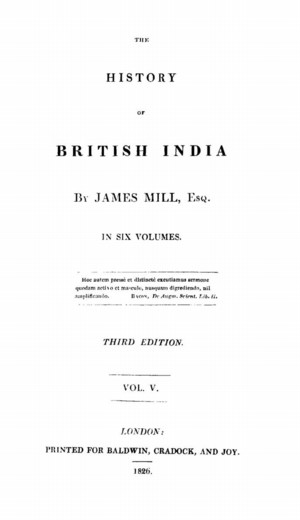
CHAP IV. - James Mill, The History of British India, vol. 5 [1817]Edition used:The History of British India in 6 vols. (3rd edition) (London: Baldwin, Cradock, and Joy, 1826). Vol. 5.
Part of: The History of British India, 6 vols.About Liberty Fund:Liberty Fund, Inc. is a private, educational foundation established to encourage the study of the ideal of a society of free and responsible individuals. Copyright information:The text is in the public domain. Fair use statement:This material is put online to further the educational goals of Liberty Fund, Inc. Unless otherwise stated in the Copyright Information section above, this material may be used freely for educational and academic purposes. It may not be used in any way for profit. CHAP IV.Cornwallis takes the Command—Second Campaign begins—Siege of Bangalore—March to Seringapatam—Operations of the Bombay Army—Battle at Arikera between Cornwallis and Tippoo—Army in Distress for Bullocks and Provisions—Obliged to return—Operations of the Mahratta Contingent—Negotiations with Tippoo—Debate in the House of Commons on the War with Tippoo—Preparations for a third Campaign—Reduction of the Fortresses which commanded the Passes into Carnatic, and threatened the Communications—Operations of the Nizam’s Army, and of the Mahratta Contingent, in the Interval between the first and second March upon Seringapatam—Operations of the Bombay Army—Operations of Tippoo—March to Seringapatam—Entrenched Camp of the Enemy stormed before Seringapatam—Preparations for the Siege—Negotiations—Peace—Subsequent Arrangements. BOOK VI. Chap. 4. 1791.When the breach with Tippoo first appeared inevitable, the Governor-General formed the design of proceeding to the coast, and of taking upon himself the conduct of the war. He resigned that intention, upon learning that General Medows was appointed Governor of Fort St. George. But he resumed it, when the success of the first campaign fell short of his hopes; and on the 17th of November, wrote to the Court of Directors, that, notwithstanding the good conduct, both of the General and of the troops,BOOK VI. Chap. 4. 1791. yet, by the irruption of Tippoo into Coimbetore, by the loss of stores and magazines, and by the check given to Colonel Floyd, enough had been effected to impress unfavourably the country powers, and create a danger lest the Mahrattas and the Nizam should incline to a separate peace: That his purpose, therefore, was, to place himself at the head of the army, not with the overweening conceit that he would act more skillfully than General Medows, but from the supposition, that, holding the higher situation in the government, he could act with the greater weight, and at any rate convince the native powers, by his appearance in the field, of the serious determination with which the East India Company had engaged in the war. The routes to the centre of Tippoo’s dominions, that by one of the southern passes, and that by the line of Velore, Amboor, and Bangalore, presented a choice of difficulties: as the route by the southern passes, gave a line of operation, from Madras, the grand source of supply, both very long, and, owing to the weakness of several of the posts, very difficult to defend; and that, in the direction of Velore, afforded little in the way of supply for the wants of the army, and demanded the preliminary operation of the siege of Bangalore, one of the strongest places in Mysore, distant ninety miles from Amboor, the nearest depot of the besieging army. The issue of the preceding campaign contributed probably to determine Lord Cornwallis in the choice of the latter. Tippoo, summoned from his negotiations in the neighbourhood of Pondicherry, by intelligence of the march of Lord Cornwallis toward Velore, on the 5th of February, ascended rapidly by the passes of Changama and Policode; and was ready to meet BOOK VI. Chap. 4. 1791.the English army in its attempt to penetrate by any of the usual and easiest of the passes. Contriving the appearances of a march toward Amboor, which completely imposed upon the Sultan, Lord Cornwallis turned suddenly to the north, and was at the head of the pass of Mooglee, before it was in the power of the enemy to offer any obstruction to his march. The English army began to move from the head of the pass on the 21st of February; and it was the 4th of March before the cavalry of the enemy appeared in considerable force. A mind like that of the Sultan was not very capable of entertaining more than one object at a time. All his military operations were suspended while he was preparing at Pondicherry the means of assistance from the French. When he was frustrated in his hopes of resisting the English in the pass, by their ascent at Mooglee, he was wholly engrossed by the thought of his Harem, left at Bangalore. Dispositions might have been made, to impede his enemy in front, and harass them in the rear, in every possible route. The Sultan, on the other hand, chose to go, in person, at the head of his army, to remove his women and valuables from Bangalore, a service which might have been performed by any of his officers with 500 men; and he allowed the English General to arrive within ten miles of his object, before he had occasion to fire a gun. An intended assault on the baggage on the morning of the 5th was frustrated by a skilful movement of the General; and in the evening the English took up their position before Bangalore, without any loss of stores and only five casualties, after a day’s exertion of the whole army of Tippoo. Next day, as the cavalry, commanded by Colonel Floyd, and a brigade of infantry, were performing in the afternoon an observation to the south-west of the fort, they unexpectedly approached the line ofBOOK VI. Chap. 4. 1791. encampment, which the Sultan had marked out, and which his army, by a circuitous and undiscovered march, were just beginning to enter. A body of about 1,000 horse, all who were not foraging, ordered to check the approach of the English, were the only part of the enemy yet seen by Colonel Floyd; and he moved against them with his cavalry, leaving the infantry in a swampy hollow, with orders there to wait his return. The retreat of Tippoo’s horse discovered the rear of his infantry with baggage and guns; the temptation was great; the orders against an enterprise were forgotten; the flying enemy left their guns; the ground became irregular and strong; several charges had been made successfully on the right and the left, when Colonel Floyd advancing to dislodge the largest body of the enemy, received a musket ball, and fell. Though he was not mortally wounded, a retreat commenced; orders could not be distinctly communicated; great confusion ensued; but the infantry, which had been left under Major Gowdie, advanced with their guns to an eminence which commanded the line of retreat, and after allowing the cavalry to pass, opened a fire upon the enemy which soon cleared the field. The danger was over, when Lord Cornwallis arrived with a division of the army to the support of the fugitives. The Pettah, a considerable town surrounded by a wall and a ditch, was assaulted on the 7th. “Two ladders,” says Colonel Wilks, “would probably have saved many lives, but there was not one in camp; and after a long delay in making a practicable opening in the gate, which the troops bore with the greatest steadiness and patience, the place was at length carried.” The Sultan, the very same day, made a powerful effort for its recovery. A part of his army BOOK VI. Chap. 4. 1791.endeavoured to gain the attention of the English by a feint to turn their right, while the main body, by a concealed movement, entered the Pettah. Cornwallis had understood the stratagem, and reinforced the Pettah. So long as the struggle was confined to firing, the superiority was on the side of the Sultan; but when the British troops had recourse to the bayonet, they pressed the enemy from one place to another, and after a contest of some duration, drove them out of the town, with a loss of upwards of two thousand men.1 The siege had continued till the 20th of March, the besiegers incessantly threatened by the whole of the enemy’s force, the place not only not invested, but relieved at pleasure with fresh troops; when the Sultan, perceiving that operations were approaching to maturity for the assault, placed his guns, during a fog, on the 21st, in a situation of some strength, whence he could enfilade and destroy the whole of the trenches, and open sap. The English General struck his camp as soon as he perceived this alarming design, and endeavoured to deter the enemy by threatening a general attack. The guns were removed, but carried back in the evening. And this with other causes determined the English General to overlook all the impediments which yet remained to be removed, and to give the assault on that very night. The intention was concealed from his own army till the last moment; and only communicatedBOOK VI. Chap. 4. 1791. to the senior officer of artillery, who employed the intermediate space in perfecting, as far as possible, the breach, and taking off the defences of all the works which commanded it. The ladders were nearly planted before the garrison took the alarm. However carefully the intention of assaulting had been concealed, it was not unknown to the Sultan, who, at night-fall, moved his whole army within a mile and a half of the Mysore gate, warned the garrison of the impending trial, and appointed two heavy corps to fall upon both flanks of the assailants; though such effectual precautions were employed to protect them as frustrated all his designs. The serious struggle had just begun in the breach, when a narrow circuitous way was discovered, which led a few men to the rampart. They waited coolly till joined by a sufficient number of their comrades to enable them to charge with the bayonet. Till the Kelledar fell, the garrison maintained a vigorous resistance. The English, as they penetrated, proceeded by alternate companies to the right and left, every where overcoming a respectable opposition, till they met at the opposite gate. The fury which almost always animates soldiers in a storm, when their own safety depends upon the terror they inspire, led to a deplorable carnage. The enemy crowding to escape had choked up the gate: and the bodies of upwards of one thousand men were buried after the assault. The Sultan, when advertised of the attack, sent a large column to reinforce the garrison, which was approaching the Mysore gate, at the moment when the invaders had met above it from the right and the left. A few shots from the ramparts apprized them of the catastrophe; and the Sultan, who had shown great timidity during the siege, and availed BOOK VI. Chap. 4. 1791.himself very feebly of his means to annoy the besiegers, and waste their time, remained in a sort of torpid astonishment till the dawn, when he returned to his camp. Nothing but the blunders of Tippoo appears to have prevented this enterprise from failing. And to the evil consequences of that failure, the limit is not easy to assign. “The forage and grain found in the Petta,” says Colonel Wilks, “had long been consumed; the neighbouring villages had all been effectually destroyed: and the resource of digging for the roots of grass within the limits of the piquets had been so exhausted, that scarcely a fiber remained. The draught and carriage cattle were daily dying by hundreds at their piquets; and those intended for food scarcely furnished the unwholesome means of satisfying hunger. Grain, and every other necessary, including ammunition, were at the lowest ebb.” Such were the circumstances of the British army. “Of raising the siege,” says Colonel Wilks, “the most favourable result would have been, the loss of the whole battering train; and a retreat upon the depots of Coromandel, pressed by all the energy with which such an event could have inspired the Sultan’s army.” On the 28th, Lord Cornwallis was able to move from Bangalore, and proceeded in a northern direction, “the cattle reduced to skeletons, and scarcely able to move their own weight.” The intention of this movement was to effect a junction with the corps of cavalry destined for him by the Nizam, his ally. The English and the Sultan crossed each other on the march, when the Sultan declined a reencounter. The forts of Deonhully and Little Balipoor surrendered to Cornwallis without opposition as he passed; and he was joined by the polygars, who paid dearly afterwards to the Sultan for their fault. Intelligence again desertedBOOK VI. Chap. 4. 1791. the English army. After a march of about seventy miles, notwithstanding, in their situation, the unspeakable importance of time, they came to a stand, not knowing what to do; and halted for five days. False information at last induced the General, in despair of meeting the Nizam’s cavalry, to terminate his movement in that direction, and proceed southwards, to meet a convoy advancing by the pass of Amboor. After marching a day in this retrograde direction, he received fresh information, which induced him to trace back his steps; and in two days more he was met by his ally. The force of this ally was nominally 15,000, in reality 10,000 well-mounted horsemen, who were expected to render good service, in performing the duties of light troops, and extending the command of the army over the resources of the country. The hope of any assistance from them, whatsoever, was almost immediately found to be perfectly groundless. “They soon,” says Colonel Wilks, “showed themselves unequal to the protection of their own foragers on ordinary occasions; and, after the lapse of a few days, from leaving Bangalore, they never stirred beyond the English piquets, consuming forage and grain, and augmenting distress of every kind, without the slightest return of even apparent utility.” All the means procurable, for the siege of Seringapatam, were now prepared at Bangalore. By the beginning of May, the equipments of the army, except in the article of cattle, were reckoned complete; and beside the motives of economy, and other local advantages attending the termination of the war, Lord Cornwallis, we are informed, was stimulated by a consideration of the French revolution, to a degree of precipitation, of which, in other circumstances, he BOOK VI. Chap. 4. 1791.might not have approved. The apprehensions and jealousy of the Sultan, and some discoveries at this time of treachery, fired him to various acts of cruelty. Before the departure of Lord Cornwallis from Bangalore, he had taken a strong position on the main road to his capital. To avoid this position, and also a road on which the forage had been carefully destroyed, the English General took the route of Caunkanhully; but the Sultan soon found the means of rendering this, also, a march through a desert. On the 13th of May, the English army reached Arikera, about nine miles from Seringapatam; the failure of the cattle increasing every day, and the followers of the camp already in the greatest distress for grain, of which a quantity had been destroyed from want of ability to carry it on. It had been planned that General Abercromby, with the Bombay army, should ascend the Ghauts from Malabar, and penetrate to the centre of the Sultan’s dominions, in co-operation with the main army from the east. With infinite labour, that army had constructed roads, and carried a battering train, with a large supply of provisions and stores, over fifty miles of stupendous mountains; “every separate gun being hoisted over a succession of ascents by ropes and tackle.” They had reached Poodicherrum by the first of March. But as Lord Cornwallis was not yet ready to advance, he transmitted instructions to that General to halt; and only after he returned to Bangalore, with the cavalry of the Nizam, sent him orders to advance to Periapatam, a place distant about three marches from Seringapatam. When the army, led by the Governor-General, arrived at Arikera, the river was already so full, as to render impracticable, or at any rate dangerous, his original plan of crossing at that place. Communication,BOOK VI. Chap. 4. 1791. however, was necessary with the army of Abercromby; and he resolved to march to the ford of Caniambaddy, eight miles above Seringapatam. The Sultan, in the mean time, not daring to leave his capital to strike a blow at the army descending from the west, and ashamed to let it be invested without a struggle, had mustered resolution for a battle. On the same day on which the English army arrived at Arikera, the enemy took up a strong position about six miles in their front. As the ground for the direct approach of the English army was unfavourable, being a narrow broken space between the river and a ridge of hills, the commander resolved, by a march, which he learned was practicable, to cross, during the night, the ridge of hills on the enemy’s right, to turn his left flank before day-light, and gaining his rear, cut off the retreat of the main body of his army to Seringapatam. A dreadful storm disconcerted this well-concerted enterprise; by rendering it impossible for the corps to find their way, and proceed in the dark. Lord Cornwallis, however, halting till dawn, resolved to persevere, as he could not repeat his stratagem, after the enemy was apprised; and expected some advantage, by forcing him to an action on other ground than that which he had deliberately chosen. “Tippoo Sultaun did not decline the meeting; and the praise,” (says Colonel Wilks, who appears to have little pleasure in praising the Sultan, but great in imputing to him all the bad qualities which belong to the most despicable, as well as the most odious, of the human race) “cannot, in justice, be denied to him on this occasion, of seeing his ground, and executing his movements, with a degree of promptitude and judgment, which would have been creditable BOOK VI. Chap. 4. 1791.to any officer.” The loss of the English was chiefly sustained during the time necessary to form under the guns of the enemy. For after they were in a condition to advance, the troops of Tippoo did not long maintain their ground; and were pursued till they found refuge under the works of Seringapatam. So ill were the arrangements of the English taken for procuring intelligence, and so well those of Tippoo for intercepting it, that no information was possessed of General Abercromby, to open communication with whom, it was now resolved to march to Caniambaddy. In this march, lengthened by a circuit to twenty miles, three days were consumed; exhibiting to the enemy, in the battering train, and almost every public cart in the army, dragged by the troops, “conclusive evidence,” says Colonel Wilks, “of the utter failure of all the equipments of the English army.” Not only were food and carriage wanting; but fatigue, with the rains, which were now almost incessant, and defective, unwholesome food, had filled the camp with disease, in which, in addition to other horrors, the small-pox raged with uncommon violence. Such, in the mind of Lord Cornwallis, was the state of the faculties on which foresight depends, that, after he had brought the army to the extreme point of its line of operations, on the day after his arrival at Caniambaddy, when the official reports of the morning were presented to him, and not before, did he discover, that all this fatigue, all this misery, all this loss of lives, and all this enormous expense, were to no purpose; that he could not attempt a single operation, that he must destroy the whole of the battering train and heavy equipments, and lose no time in endeavouring, by retreat, to save, if it yet were possible, the army from destruction. To General Abercromby, of whom as yet no intelligenceBOOK VI. Chap. 4. 1791. was obtained, orders were written to return to Malabar. On the same day the appearance of considerable bodies of troops marching, as toward General Abercromby, from Seringapatam, so greatly alarmed the Governor-General, that he sent three brigades across the river, merely to attract the enemy’s attention; though it was not improbable that the river would fill, and, precluding return, place them in a situation from which they could hardly expect to escape. General Abercromby received, not without surprise, the orders to return. They were followed by a similar destruction of the heavy guns and equipments, as that which took place in the army of Cornwallis; except that a part of the guns were buried at the head of the pass. Almost all the cattle lost their lives, and the men their health, in performing back a long and unprovided march at a dreadful season. And the cost of this expedition, in men, in money, and in labour, was added to the loss occasioned by the fruitless march of the army from the east. On the 26th of May, the army commenced its melancholy return. Before the first six miles were accomplished, a party of horse unexpectedly rode in upon the baggage flank. They were taken for enemies; but proved to be Mahrattas, from whom was received the joyful intelligence of the near approach of two armies, led by two of the Poonah Chiefs, Hurry Punt, and Purseram Bhow. The tardy arrival of the Mahrattas has been accused, as the cause of the disaster sustained by the British army, and of their disappointment in respect to the capture of Seringapatam. How far it was in the power of the General to have provided himself better with bullocks and provisions, we are without the BOOK VI. Chap. 4. 1791.means of accurate knowledge. That no dependance ought to have been placed upon the punctuality of the Mahrattas, it would be extraordinary indeed if there was not, at that time, sufficient experience in his camp to give him full information. Of the campaign of this portion of the confederate force a very brief account must suffice. The detachment of the British troops, for whose service with the Mahrattas an agreement had been made in the recent treaty, left Bombay on the 20th of May, 1790; disembarked in the Jaigur river; ascended the Ghauts by the Ambah pass; and joined the army of Purseram Bhow, consisting of about 20,000 horse, and 10,000 foot, near the town of Coompta, about fifty miles from the pass, on the 26th of June. They proceeded without resistance till they arrived at Darwar, one of the great barriers of Tippoo’s northern frontier, situated some miles south of the river Malpurba, and from Goa eastward about seventy miles. The Mahrattas took ground before the place on the 18th of September; and it was not till the 3d of April, after a wretched siege of twenty-nine weeks, that it surrendered upon capitulation. The Mahrattas, when battering in breach, aim at no particular spot, but fire at random all over the wall. “From their method of proceeding,” says Lieutenant Moore, who was an indignant witness of so much loss of time, “we are convinced they would not, with twenty guns against the present garrison, approach and breach Darwar in seven years. A gun is loaded, and the whole of the people in the battery sit down, talk, and smoke for half an hour, when it is fired, and if it knocks up a great dust, it is thought sufficient; it is reloaded, and the parties resume their smoking and conversation. During two hours in the middle of the day, generally from one to three, a gun is seldom fired on either side, that time being, as it wouldBOOK VI. Chap. 4. 1791. appear, by mutual consent set apart for meals. In the night the fire from guns is slackened, but musquetry is increased on both sides, and shells are sparingly thrown into the fort with tolerable precision.” The same intelligent officer makes the following remarks. “March the 1st.—Our line is more sickly than it has hitherto been; many officers are ill: and among them our Colonel; whose situation is peculiarly cruel, being the only Company’s officer, commanding in the field, set down before a fort of this importance, without a single requisite for reducing it, and subject to the delays, and irksome frivolity, of our tardy allies.—Too much confidence seems to have been placed in their promises of supplies: And it should be a caution, how, again, the success and credit of the British arms is suffered to depend upon the punctuality of a country power.—If any can be at all trusted, it certainly is the Mahrattas: But, even with them, it seems a matter of little moment to what extent their promises are made. And although, at the time, they may have no intention of breaking them, it is to be understood that failure is no discredit: Nor must punctuality be expected any further than their own views are forwarded by observing it.” “March the 13th.—We were this morning,” continues Mr. Moore, much surprised to hear of the death of our much respected Colonel; for none but the medical gentlemen had any idea of its being so near. Actuated by the ardour of a soldier, his enterprising spirit could not brook the procrastination to which he was obliged to submit; and, losing, with the unsuccessful attempt of the 7th of February, all expectation of an honourable conquest of the fort, he had from that time been on the decline. No event could BOOK VI. Chap. 4. 1791.have been more acute to his detachment, for with them he was universally beloved; nor could the Bombay army, of which he was at the head, have sustained a severer loss.”1 Colonel Frederick, such was the name of this meritorious officer, was succeeded by Major Sartorius, in the command of the detachment; and by Captain Little, when that officer returned to Bombay, after the surrender of Darwar. The original garrison was estimated at 10,000 men; but from the numbers which were sent away after the Pettah was taken, and the desertions and casualties during the siege, it was at last reduced to 3,000. To have placed Darwar in blockade, nothing less than an army would have sufficed; and the capture was necessary to secure the Mahratta communications. Had it fallen earlier, the Mahratta army would have been employed in ravaging Tippoo’s dominions, and cutting off supplies from the country to the north. The Bhow’s army, after leaving Darwar, proceeded by easy marches to the Toombudra, and had subdued the little resistance opposed to them at all the forts which protected the possessions of Tippoo north of that river, early in May. Lord Cornwallis had written to Poona that he expected to be joined by this chief at Seringapatam. And as soon as the Bhow obtained intelligence of the arrival of the English at Seringapatam, he proceeded towards them with all the expedition in his power. As he approached, he was joined by Hurry Punt, who had advanced by a more easterly route through Gooty, Raidroog, and Sera, recovering, in that direction, the conquests made upon the Mahrattas by Hyder and his son; and on the 28th of May, the interview between them andBOOK VI. Chap. 4. 1791. the British commander took place. At this period the army of the Bhow was estimated at 20,000, that of Hurry Punt at 12,000, horse and foot.1 But the Mahrattas, now when they had arrived, were unable to keep the field, or at least persuaded Lord Cornwallis that they were unable, unless they received from the English pecuniary support. He agreed to advance to them a loan of twelve lacks of rupees; and in order to obtain the money had recourse to one of those bold expedients which would have proved the ruin of any of his less protected predecessors. From his camp, near Ootradroog, on the 21st of June, he wrote to the Governor and Council of Madras, to take the treasure out of the China ships, and, coining it into rupees, to send it to him with the utmost possible dispatch.2 Tippoo announced to his own people the battle on the 15th as a victory, the effect of which had been to make the English destroy their battering train, and force them to retreat, and on the 26th, he ordered a salute to be fired from the fort. In the mean time, certain communications had taken place between him and Lord Cornwallis on the subject of peace. So early as the 18th of February a letter from the Sultan, dated the 13th, was received at Muglee, proposing to send or receive an ambassador. Lord Cornwallis replied on the 23d, that as the infraction of the treaty was on the part of the Sultan, it was necessary to know whether he was prepared to make reparation. On the 3d of March an answer arrived, in which the BOOK VI. Chap. 4. 1791.Sultan endeavoured to show, that the conduct of the Rajah of Travancore justified the attack upon his lines; at the same time disclaiming all idea of insult to the British government; and expressing a wish for negotiation. To this he received no reply. On the 27th of March the Sultan dispatched another letter, offering directly to send an ambassador. Lord Cornwallis declined receiving an ambassador, on the ground of his not as yet having with him any persons qualified to treat on the part of his allies; but if the Sultan would send his propositions in writing, he would transmit them to those allies, and return an answer. On the 17th of May, when Lord Cornwallis released the wounded prisoners after the action of Arikera, Tippoo renewed the proposal of negotiation. Lord Cornwallis, having persons now with him, on the part of the Mahrattas and the Nizam, answered, on the 19th, that if the Sultan would state his propositions in writing, commissioners might be chosen to meet; and that he would consent to a cessation of hostilities, if it were the Sultan’s desire. On the 24th, when Lord Cornwallis was at Caniambaddy, had destroyed his battering train, and sent three brigrades across the river, Tippoo answered. He took no notice of the proposition for a cessation of hostilities, and only urged anew the propriety of mutually appointing confidential persons to discuss. Lord Cornwallis now departed from the point of written propositions, on which he had hitherto insisted, as an indispensable preliminary, and proposed that the allies should send deputies to Bangalore. On the 27th, when this letter was not yet answered, and the army, now joined by the Mahrattas, was advancing in view of Seringapatam, a present of fruit was sent to Lord Cornwallis, accompanied by a letter from the Sultan’s secretary to the Persian interpreter. This was regarded as a contrivance to sow jealousy between the English andBOOK VI. Chap. 4. 1791. their allies: and the present was returned.1 On the 29th, Tippoo replied; and after some prolix and vague explanations, recommended that Lord Cornwallis should return to the frontier, and then act as his last letter proposed. With the Mahratta army, provisions and draught cattle arrived; though these allies, knowing well the situation of the English army, would part with nothing at a moderate price. The loss, however, of the battering train, the return of General Abercromby, and the state of the season, forbidding the siege of Seringapatam; the combined army, having resolved upon falling back to Bangalore, proceeded on the 6th of June, in a northern direction, to Naugmungul, and thence eastward to the river Madoor, which they crossed on the 19th of the same month. While encamped on the eastern bank of this river, a detachment of the English army went forward to summon and threaten Hoolydroog; a hill fort, six miles east from the pass of the river, too strong to have been taken, had the courage of the garrison allowed them to defend it; but they dreaded resistance of European soldiers, and agreed to surrender, upon condition of security to themselves and their private property. A provision was found in it of sheep, cattle, and grain; BOOK VI. Chap. 4. 1791.a seasonable relief to the army; and the fort was destroyed, as neither the English nor the Mahrattas thought it worth retaining. The fortresses of Ootradroog, and Savendroog, were likewise summoned during the march; but without effect; and in present circumstances, it was not expedient to attempt their reduction. The combined army arrived in the neighbourhood of Bangalore early in July; and were exhilarated by several articles of agreeable intelligence. To supply the demand of the army for draught bullocks and rice, the following were the plans which, upon the discovery of that deficiency which occasioned the retreat, were adopted. The trade of corn in India is carried on in a mode peculiar to that country. The merchants in corn are a particular caste denoted by the term Brinjarries. They traverse the country, conveying the grain, often from the greatest distances, in large bodies which resemble the march of an army. They encamp with regularity, never lodging in houses; are strongly armed; and ready to fight no contemptible battle in their own defence. The practice comes down from a remote antiquity; and marks that unsettled and barbarous state of society, when merchants are obliged to depend upon themselves for the means of their defence. The experienced utility of their services has procured them considerable privileges. They are regarded as neutral in all wars; they enjoy a right of transit through all countries; and the armies, which spare nothing else, act under a species of obligation, seldom violated, of respecting the property of the Brinjarries. One of the officers of the Company, Captain Alexander Read, well acquainted with the language and customs of the natives, suggested to the Commander in Chief the expedient of availing himself of the extensive resources of the Brinjarries. It was resolved, in consequence, thatBOOK VI. Chap. 4. 1791. encouragement should be held out to them, to resort with their cargoes to the English camp. Captain Read was employed to circulate intelligence; and before the arrival of the army he had collected more than ten thousand bullock loads of grain. For the supply of bullocks, nearly forty thousand of which had been lost in the last campaign, Lord Cornwallis, beside the contractors, employed agents to purchase them on the part of the government, and directed the same to be done at Madras. As a relief to the exigencies of this department, he also made an agreement with the officers, to carry and provide their own tents for a monthly allowance, during the remainder of the war, and a similar arrangement with the officers commanding battalions of sepoys, for the tents of their corps, and the carriage of their ammunition and stores. Upon the arrival of the army at Bangalore, it was found that success had attended those exertions; and that 100 elephants from Bengal had arrived at Velore. The army had the further satisfaction of learning that Gunjcotah, which had been for some time besieged by the Nizam’s troops, including the British detachment, had surrendered on the 12th of June; and had given a valuable country to that ally. The intelligence also from Europe was exhilarating, to an army keen for the continuance of the war. On the 22d of December, 1790, Mr. Hippesly, in the House of Commons, had called in question the justice and policy of the war: had affirmed that the Rajah of Travancore was the aggressor, by his lines on the Cochin territory, and his purchase from the Dutch; that the Mahrattas were the people from whom in India the greatest danger impended over the interests of England, and that the Mysore sovereign was BOOK VI. Chap. 4. 1791.valuable as a balancing power; that the resources and genius of Tippoo rendered a war against him an undertaking of no common difficulty and hazard; and that the finances of the Company, feeble and exhausted as they were acknowledged to be, could ill endure the burthen of an expensive war. Mr. Francis and Mr. Fox repeated and enforced the same considerations. On the 28th of February, Mr. Hippesly renewed the discussion, when the alliance concluded with the Nizam and Mahrattas afforded a new topic. He complained that, in those treaties, though made ostensibly on account of the attack on Travancore, the Rajah was not mentioned. The cause however of the Rajah was included in that of the English; and the interposition of such a people as the Mahrattas and the Nizam, in any shape, between the English and their allies, was incapable on almost any occasion of conducing to good, far from incapable on many occasions of conducting to evil. Mr. Fox assailed the alliance in a tone of vehement reprobation. He denounced it a plundering confederacy for the purpose of extirpating a lawful Prince. He said, that when the progress of civilization had rendered men ashamed of offensive alliances in Europe, we had signalized our virtue by renewing them in India. He described the family compact of the House of Bourbon, as the last of those odious leagues which had disgraced the policy of civilized Europe. As soon as a better order of things in France arose, it dissolved, he said, that wretched engagement, and put an end, he hoped for ever, to those expedients of wicked governments in a barbarous age. In reply to these accusations, circumstances were presented to show; that the war in the first place was defensive; in the next place necessary to deter an insatiable enemy from perpetual encroachments;BOOK VI. Chap. 4. 1791. and lastly politic, as affording every prospect of a favourable termination. And on the 22d of March, Mr. Dundas moved three resolutions, which passed without a division, declaring that Tippoo had broken the treaty by his attack on the lines of Travancore, and that Lord Cornwallis deserved approbation, as well for his determination to prosecute the war, as well for his determination to prosecute the war, as for the treaties he had formed with the Nizam and Mahrattas. The favour manifested to the war in England, was by no means confined to empty praise. The Company resolved to send out 500,000l. in specie: An augmentation was voted to the establishment of the King’s regiments in India: Another detachment of the royal artillery was destined for the same service; The Company exterted themselves to send out recruits: And all these reinforcements and supplies, the General was given to understand he might receive by the ships of the season. It was necessary for the facility of subsistence, and certain preparatory operations, that the allied armies should separate during the inactive season. The Bhow, with the detachment of Captain Little, shaped his course toward Sera. The greater part of the Nizam’s horse went to join the rest of the Nizam’s army Hurry Punt, with the English remained at Bangalore. Tippoo, it was supposed, would not dare to make an advance against any of these detached armies, for fear of being intercepted in his retreat. The Policade pass afforded the easiest communication with Carnatic; and one of the most commodious issues for the sudden incursions of the enemy. It was commanded by several forts, of which Oossoor and Rayacottah were the chief. With four heavy iron guns, which had not been carried to Seringapatam, and four iron twelve-pounders, which had been kept BOOK VI. Chap. 4. 1791.for field service, when the heavier guns were destroyed, the army on the 15th of July began to move towards Oossoor. Tippoo had lately made exertions to improve the defences of this important place; fortunately they were not so far advanced as to render it tenable in the opinion of its defenders; and upon the approach of the English they made a precipitate retreat. From Oossoor, left with a strong garrison, a brigade of the army under Major Gowdie, proceeded against Rayacottah; which consisted of two forts, one at the bottom, the other at the top of a stupendous rock. They carried the first by assault; and, pursuing the fugitives, got possession of two walls, which formed a rampart between the higher and lower fort. The place, if well defended, was too strong by nature to be reduced; and Major Gowdie had instructions to return, if it was not surrendered upon the first attack. As the lodgement, however which he had effected on the hill, covered the troops from the fire of the upper fort; and he believed the enemy intimidated, he begged permission to persevere. The daring conduct of the assailants, with aid from the main army soon produced the desired effect upon the mind of the Kelledar; and on condition of security to private property, and leave to reside with his family in Carnatic, he surrendered this “lofty and spacious fort, so strong and complete, in all respects, that it ought to have yielded only to famine and a tedious blockade.”1 The rest of the forts by which the pass was defended, either obeyed the summons, or made but a feeble resistance. The convoy which had reached Amboor, on its way from Madras, received directions to proceed by the newly opened route, and the army remained in the neighbourhood of Oossoor to cover its march. One hundred elephants, allBOOK VI. Chap. 4. 1791. loaded with treasure, marching two a breast, with the British standard displayed; 6000 bullocks with rice, 100 carts, with arrack, and several hundreds of coolies, with other supplies, entered the camp on the 10th of August: a convoy to which nothing similar had ever joined a British army on Indian ground. While the army remained at Oossoor, a vakeel, commissioned to treat with all the allies conjointly, was sent by Tippoo. Lord Cornwallis consented, it seems, to receive him, “at the warm instances of Hurry Punt;” little expecting that Tippoo would yet submit to the terms he was disposed to require, but desirous of avoiding every appearance, which might be thought to indicate a disinclination to peace. Upon a point of form, the ambassador being commissioned to treat only with principals, and Lord Cornwallis declining to treat with an agent, and upon the surmise that the object of Tippoo was intrigue, and the consumption of time, the messenger was sent back to his master without being permitted to enter the camp.1 Between Bangalore and Goorumconda lay some hill forts, which interrupted the communication with the Nizam’s army, and rendered it difficult to receive supplies from the country to the north. The brigade of Major Gowdie was again in requisition. The only fortress which made any considerable resistance was BOOK VI. Chap. 4. 1791.Nundydroog, before which the Major arrived on the 22d of September with a force, consisting of one regiment of Europeans, six battalions of sepoys, six battering guns, and four mortars. The fort was situated on the summit of a mountain, about one thousand seven hundred feet in height, of which threefourths of the circumference was absolutely inaccessible, and the only part which could be ascended was guarded by two excellent walls, and by an outwork which covered the gate-way and yielded a flank fire. A road was cut, and the guns dragged with infinite difficulty to the top of an adjacent hill; but there, after a battery was erected, the guns were found to be too distant even to take off the defences of the fort. No alternative remained, but either to work up the face of the principal hill, or lose the advantage of the impression struck on the minds of the enemy’s garrisons, who believed that no strength, either of nature or of art, was sufficient to protect them against an English attack. The exertions demanded were excessive. Without the strength and sagacity of the elephants, the steepness of the ascent would have rendered it impossible to carry up the guns. Fortunately the shot of the fort, from a height so nearly perpendicular, seldom took effect; but the men were severely galled by the ginjall, a species of wall pieces, which threw with precision, to a great distance, a ball of considerable size. Batteries were erected after a labour of fourteen days; and in a short time two breaches were effected, one on the re-entering angle of the outwork, the other in the curtain of the outer wall; while the inner wall, at the distance of eighty yards, could not be reached by the shot. The Governor still refused to surrender, and the British commander made an offer, which it is pleasing to record, to send out the women, and other persons not bearing arms,BOOK VI. Chap. 4. 1791. that they might not suffer in the storm. The breaches being reported practicable to the Commander-in-Chief, he detached the flank companies of the 36th and 71st regiments to lead the assault; and General Medows, who, though superseded in the chief command, had seconded every operation of the war with an ardour and fidelity which did him the highest honour, offered to conduct the perilous enterprize. It was determined to storm the breaches, to attempt the inner wall by escalade, and, if this should fall, to make a lodgement behind a cavalier between the walls, and thence proceed by regular attack. A trench which had been dug within a hundred yards of the wall was formed into an advanced parallel, and the flank companies were lodged in it before day break. At midnight, the orders were given, when the men moved out from the right and left of the parallel, and rushed to the assault.1 The fort was instantly illuminated with blue lights; a heavy fire was opened; and large stones were rolled down the hill. The fire was ill-directed; but the stones rushing down the precipice were exceedingly formidable, and had considerable effect. Both the breaches were quickly mounted; and the storming party penetrated with such rapidity, that time was not allowed for barricading completely the gate of the inner wall, and, after some difficulty, it was fortunately opened. The meritorious exertions of Captain Robertson, who led the grenadier companies to the breach in the curtain, prevented the carnage which so often attends the capture of places by assault; BOOK VI. Chap. 4. 1791.and of the whole garrison, about forty only were killed and wounded. The storming party had two men killed and twenty-eight wounded, the latter chiefly by the stones descending the hill. By this time the ships of the season had brought out the expected reinforcements, money and military stores, with 300 troops from St. Helena, who coming a shorter voyage, and seasoned to a warm climate, arrived in perfect health: The powers of the several Presidencies had been strained to the utmost to make provision for the war: The preparations were upon a great scale; and now in a high state of perfection. From Nundrydoog the army moved toward the passes, for the protection of the convoys proceeding from Madras; while a detachment, commanded by Col. Maxwell, was sent to clear the Baramhal valley, in which, and the adjoining districts, a party of the enemy were effecting depredations. The principal protection of this predatory party was Penagra, a strong mud fort at the south end of the valley. By forced marches the detachment arrived before it on the 31st of October. A flag of truce, sent to summon, was invited to advance, by signs from the wall, and then repeatedly fired upon. The wall was scaled; and the enemy hung out the flag for quarter in the middle of the assault. It was too late: the troops had closed with them; and out of 300 men who composed the garrison, 150 were slain. Of the captors, seven alone were slightly wounded. The detachment returned, and encamped within a few miles of Kistnaghery. This was another of those stupendous rocks, or rather insulated mountains, which form the strong holds of India, and one which yielded to few of them in natural strength. Although it was not supposed that the reduction of the upper fort was an undertaking to which the detachment was equal, it was of importance, in order, as much asBOOK VI. Chap. 4. 1791. possible, to cut off whatever afforded cover to the predatory incursions of the enemy, to destroy the Pettah, and the works, at the bottom of the hill. They were attacked under cover of the night; and the troops escalading the walls, got possession of them without much resistance. The ardour of the assailants made them conceive the hope of entering the upper fort with the fugitives. They rushed up with such rapidity, that, notwithstanding the length and steepness of the ascent, the enemy had barely time to shut the gate; a standard of the regulars was taken on the very steps of the gateway; and had the ladders been up at this critical moment, it is probable that the walls would have been escaladed. The enemy had time to begin their operation of rolling down enormous stones, which, descending in vast quantities, crushed, at once, the ladders and the men. During two hours the strongest exertions were made, to get the ladders up the small part of the road which was most exposed to the stones. But a clear moon-light discovered every motion; and, when most of the ladders were broken, and the troops had severely suffered, Colonel Maxwell was compelled to put an end to the attempt. After this, having reduced several petty forts, he rejoined the army. Between Bangalore and Seringapatam, lies a track of hills, thickly covered with wood, extending from the vicinity of Bangalore to the river Madoor. This difficult country, which of itself formed a strong barrier to the capital of Mysore, was studded with forts, of which some, particularly Savendroog, was of extraordinary strength. It offered such advantages to the enemy, for interrupting the communication with Bangalore, when the army should advance BOOK VI. Chap. 4. 1791.to Seringapatam, that the Brinjarries, who engaged for large quantities of grain at Bangalore, would not undertake to supply it beyond Savendroog, if that fortress remained in the enemy’s hands. Lord Cornwallis was now provided with his battering train; and resolved, while delayed by the Mahrattas, and waiting for the last of the convoys, to make an effort to gain possession of this important, but formidable post. It is a vast mountain of rock, computed to rise above half a mile in perpendicular height, from a base of eight or ten miles in circumference, surrounded by a close forest, or jungle, several miles in depth, having its natural impenetrability heightened by thickets of planted bamboos. A narrow path, cut through the jungle, in a winding direction, and defended by barriers, served as the only approach to the fort: The natural strength of the mountain had been increased by enormous walls, and barriers, which defended every accessible point: And to these advantages was added the division of the mountain, by a great chasm, into two parts at the top, on each of which was erected a citadel; the one affording a secure retreat, though the other were taken; and by that means doubling the labour of reduction. Lieutenant Colonel Stuart, employed during the first campaign in reducing Dindegul and Palacatcherry, was destined to command at the siege of Savendroog. On the 10th of December, he encamped within three miles of that side of the rock from which it was proposed to carry on the attack; while the Commander-in-Chief made that disposition of the rest of the army, which seemed best adapted to cover the besiegers, and secure the convoy. The first labour was immense, that of cutting a way through the powerful jungle, and transporting heavy guns over the rocks and hills which intervened.BOOK VI. Chap. 4. 1791. The closeness of the surrounding hills and woods had rendered this fortress as remarkable for its noxious atmosphere as its strength. Its name signified literally the rock of death. And the Sultan congratulated his army upon the siege; at which one half, he said, of the English army would be destroyed by sickness, the other by the sword. The confidence of the garrison in the strength of the place had this good effect, that it made them regard the approach of the besiegers as of little importance; and they were allowed to erect their batteries without any further opposition than the fire of the fort. Within three days after the opening of the batteries the breach was practicable. The jungle was now of advantage; for growing close up to the very wall the troops were able to scramble up unseen by the crevices and rugged parts of the rock, and made a lodgment within twenty yards of the breach. The 21st of December was the day chosen for the assault; and Lord Cornwallis and General Medows arrived to witness the terrible scene. The grenadiers of the 52d, and flank companies of the 76th regiment, led by Captain Gage, were to gain the eastern summit; Captain Monson, with the light company of the 52d, was to scour the works on the western; the flank companies of the 71st, under Captains Lindsay and Robertson, were to engage whatever works or parties might be found in the chasm between; the 52d and 72d regiments to follow the flank companies; and parties, under Colonel Baird and Major Petrie, were to proceed round the mountain, for the purpose of attracting the attention of the enemy, and preventing escape. At an hour before noon, on a signal of two guns BOOK VI. Chap. 4. 1791.from the batteries, the flank companies advanced to the breach, and mounted, while the band of the 52d regiment played Britons strike home. The enemy who had descended for the defence of the breach, when they beheld the Europeans advancing, were seized with a panic; and Captain Gage had little difficulty in carrying the eastern top: The danger was, lest the flying enemy should gain the western summit, which, from the steepness of the approach, and the strength of the works, might require a repetition of the siege. To provide for this contingency, Captain Monson had directions, if he thought advancing imprudent, to effect a lodgment in some part of the hill from which the operations might be carried on. Fortunately the enemy impeded one another in the steep and narrow path up which they crowded to the citadel, while some shot, which opportunely fell among them from the batteries, increased their confusion. Captain Monson, with the light company of the 52d regiment, and a serjeant and twelve grenadiers of the 71st, pressed after the fugitives, and, so critical was the moment, that the serjeant of the 71st regiment shot, at a distance, the man who was closing the first of the gates. All the other barriers the English entered along with the enemy, about 100 of whom were killed on the western hill, and several fell down the precipices endeavouring to escape. The prisoners taken were few. The garrison, they said, had consisted of 1,500 men, but a great part of them had deserted during the siege. Of the English, only one private soldier was slightly wounded. On the 23d of December, Colonel Stuart was again detached against Ootradroog. This was another fortress of thesamedescription, about twelve miles from Savendroog. It had been summoned, when the army retreated the preceding year from Seringapatam. But the Kelledar replied, “I have eaten Tippoo’sBOOK VI. Chap. 4. 1791. salt for twenty years, and will not give up my post, till you first take Seringapatam.” He was still so determined in his resistance, that he would admit of no communication, and fired on the flag. Next morning the lower fort was carried by escalade; when the Governor requested a parley. While this was taking place, the assailants imagined they saw the garrison moving, and treacherously pointing their guns; upon which they rushed to the assault. Some of the gateways they broke, others they escaladed. Though many parts of the road were so narrow and steep, that a few resolute men might have defended themselves against any attack, so great was the alarm of the enemy, that they fled wherever they saw a single European above the walls. At the last gate only, they fired a few shot, by which two soldiers were wounded. Masters of the summit, the assailants fell upon the garrison, of whom many, to avoid the bayonets, precipitated themselves from the rock. The Kelledar, with some others, was taken prisoner. He reported, that his garrison, on the arrival of the detachment, had mutinied; and that 400 had deserted during the night. After the success of these hazardous enterprises, none of the inferior places had courage to resist; and the line of communication for the ultimate operations of the war was now rendered secure. The last great convoy from Madras, of which the fall of the rains, and the state of the roads, had rendered the progress very slow, arrived, on the 2d of January, at Bangalore. The Brinjarries had 50,000 bullocks, conducting grain to the army, even from the enemy’s country itself, in quantities which no exertions of the public service could have matched. From the state of public credit, and the money sent out from England, BOOK VI. Chap. 4. 1791.Lord Cornwallis had, what in no former war the Indian rulers had ever enjoyed, an overflowing treasury. At the same time it was ascertained that the treasury of the enemy was in a far different situation; for several of his principal Brinjarries brought their grain to the British camp, complaining that Tippoo was unable to pay them, and could give them nothing but ineffectual orders upon the collectors of his revenues. Such were the proceedings of the army under Lord Cornwallis, during the season in which the main operations of the war were suspended. A short account is required of what, during the same time, was performed, by the other divisions of the confederate force. By the army of the Nizam, only two objects had been effected during the war; the reduction of Gunjicottah, and that of Kopaul. Not one even of these places could have been taken without the British detachment; and the reduction of the latter might be regarded as more a consequence of the fall of Bangalore than of the operations of the siege. This army had been employed, since the month of August, in the attack of Goorumconda; but, depending on the Nizam’s artillery, were not able to breach the lower fort, till the guns which had been employed at Nundydroog, and a supply of ammunition, were sent from Bangalore. With British guns, the British artillery-men completed a breach in two days; and prepared for the assault. As the small party of artillery-men were the only Europeans present, they gallantly offered, after breaching the place, to quit their guns, and lead the assault. The reduction of the lower fort had not long been effected, when a large reinforcement arrived from Hyderabad, under the Nizam’s second son. The upper fort being regarded as too strong for assault, a body of troopsBOOK VI. Chap. 4. 1791. was left to establish a blockade; while the main army, by concert with Lord Cornwallis, moved into the neighbourhood of Colar, to cover the convoy, which was proceeding from Madras with the last of the ammunition and stores for the siege of Seringapatam. This movement escaped not the attention of Tippoo; Hyder Saib, his eldest son, appeared suddenly before Goorumconda, with a flying party; and took the lower fort, with the whole of the detachment left for the blockade. This immediately recalled the main army, and exposed the convoy, which had ascended the Ghauts, and arrived at Vincatighery, to a danger which would have been great, had the detachment with Hyder Saib been sufficiently strong. But he satisfied himself with throwing succour into Goorumconda; and carrying with him the families of some principal people, he returned to Seringapatam. Purseram Bhow passed Serah, which had surrendered to Hurry Punt, on his march to the southward; and arrived, without any memorable event, in the neighbourhood of Chittledroog, early in September. This was the capital of a considerable Rajah, whose dominions Hyder added to his own about the year 1776. It was one of the strongest hill-forts in India, and said to be garrisoned by upwards of 10,000 men. The Bhow, who had no idea of gaining it by force, thought he might succeed by treachery, and endeavoured to seduce the commander, but in vain. The Bhow seemed to have hardly any other object than to procure repose and refreshment to his army in the neighbourhood of Chittledroog, till after the beginning of December, when forage began to fail. A fertile country was intersected by the Toom, and BOOK VI. Chap. 4. 1791.the Budra, which, by their junction, form the river, the name of which is also composed by the union of theirs. It was defended, however, by several forts. Hooly Honore, one of the most important of them, situated at the conflux of the rivers, Captain Little, with his detachment, undertook to reduce. He took up his ground on the 19th of December; effected a breach the following day; and carried the place by storm in the night. After this, the smaller forts surrendered without opposition; and only Simoga remained. Tippoo, at a preceding period of the season, had sent one of his generals, with a considerable army, to keep open his communication with the rich provinces of Bednore and Mangalore, almost the only part of his dominions which was not either in the possession of his enemies, or had sustained the ravages of the war. This officer had taken post near Simoga. But on the approach of the Mahrattas, he left his entrenchments, for a position in the woods, some miles to the westward, from which he purposed to act upon them during the siege. It was of great importance to begin by dislodging this enemy. But all the difficulties and hazard of the attempt were by no means understood. His position was one of the strongest which the choice of circumstances could have given. His right was completely defended by the river Toom: his left by hills covered with jungle, which approached within a mile of the river; his rear was secured by an impenetrable jungle; and a deep ravine, having a jungle beyond it, protected his front. “The open space,” says Lieutenant Moore, “on which the enemy had pitched their camp, was not more than six hundred yards wide; and was, upon the whole, naturally, the strongest place we ever saw; nor can we form an idea of one more disadvantageous to an assault. HadBOOK VI. Chap. 4. 1791. their situation been accurately known, no one, but an officer who had the most unlimited confidence in his troops, could, in prudence, have hazarded an attack.” Of course the enterprise fell to the English. In such a position the Mahratta cavalry were unable to act; and a corps of infantry, who had advanced into the jungle, when directed to a position where possibly they might have been of some use, declared they had no ammunition. Not only were the Mahrattas useless; “so far as we observed,” says Lieutenant Moore, “they were no trifling impediment.” Leaving, by the Bhow’s desire, four guns with nine companies, to guard the camp, Captain Little, with the remainder of his detachment, less than 750 bayonets, and two guns, proceeded to the attack. About one o’clock they entered the jungle, tolerably open at first, but extremely thick as they approached the enemy; who opened upon them a heavy discharge of guns, musquetry, and rockets. Both officers of the 8th grenadiers fell; and Captain Little had some difficulty in supporting the Sepoys under their loss. The action continued doubtful a considerable time; for as only small and broken parties could pass the ravine, which was very deep, the English could not come to the decision of the bayonet. After the repulse of several parties, some of whom had penetrated into the camp, Captain Little rallied the grenadiers, and, putting himself at their head, carried the posts on the enemy’s right, when the rest of the line pressed onwards, and, in a short time, cleared the field. The English pursued, and captured the whole of the guns, ten in number; and during that time the Mahrattas plundered the camp with their usual skill. The amount of the enemy was not exactly ascertained. BOOK VI. Chap. 4. 1791.By the account of the prisoners it exceeded 10,000 men. This is allowed to have been one of the most spirited and brilliant actions of the war. The men were under arms, and actively employed, without refreshment, for six and thirty hours. Though it was dark, when they returned to the camp, the Bhow sent to inform Captain Little, that he was coming to embrace him. The Captain excused himself on account of his fatigue and the lateness of the hour; but was not prevented, says Lieutemant Moore, from visiting his wounded officers. The Bhow was at head quarters by sun-rise the next morning, complimenting the detachment in the most flattering terms. The siege of Simoga was now undertaken without fear of interruption. A battery of five guns was ready to open on the 2d of January, and by noon the next day had effected a breach nearly practicable; when the garrison, on condition of security to private property, offered to surrender. It may be remarked that they required the guarantee of the English detachment. Such is the depravity of Hindu morals, that it is no affront, either to a nation or an individual, to be charged with the want of faith; and the Bhow totally overlooked the opprobrium which the enemy scrupled not to cast upon him and his nation. The place was capable of a good defence; but the garrison were dispirited by the defeat of the protecting army, and the greater part of them had deserted. The valuable country which the Bhow had thus conquered, and which he regarded as an accession to his own personal dominions, so raised his ambition, that he aspired to the conquest, or at any rate the plunder of Bednore. After remaining inactive in the neighbourhood of Simoga till the middle of January, he arrived by a few marches, through a country inBOOK VI. Chap. 4. 1791. great part covered with jungle, at Futteh Pet, one of the great barriers of the province of Bednore; and passing this fortress, without any serious attempt upon it, he sent forward a detachment, which began on the 28th to cannonade Bednore. It was recalled, however, the following day; when the army, to its great surprise, received orders to retreat. To stop the progress of the Mahrattas, Tippoo had detached an army, under one of his best generals, who had already advanced as far as Simoga and taken it. The Bhow was by no means desirous of meeting an equal enemy in a close country, in which cavalry could not advantageously act. He crossed the Toom near Simoga on the 10th of February, and the Budra the next day near Binkapoor: He obtained the fort of Adjampoor by capitulation on the 12th: And he joined the allies on the 10th of March, before Seringapatam. Recovered in health, reinforced, and equipped, the Bombay army, under General Abercromby, left their cantonments in the neighbourhood of Tellicherry; assembled at Cannanore on the 23d of November; and on the 5th of December began their march for the Poodicherrum Ghaut. Vast labour was necessary to repair the road, which the torrents of the monsoon had destroyed. Three weeks, of constant exertion, barely sufficed to bring up the heavy guns; but on the 18th of January, the whole of the artillery, amounting to eighty-six carriages, of which eighteen were heavy, with the usual proportion of ammunition, and forty days’ rice for the men, was at the top of the pass. Lord Cornwallis had depended upon the army of Purseram Bhow, with the three battalions of British Sepoys, under Captain Little, to cross the Cavery, and join Abercromby; BOOK VI. Chap. 4. 1791.for the purpose of enabling him, to bring on his heavy artillery, to march without dread of Tippoo, and to complete the investment on the southern side of Seringapatam. Disappointed in this expectation, by the avaricious expedition of the Mahrattas to Bednore, he sent his orders to General Abercromby to place his artillery in a secure post at the top of the Ghauts, and hold his corps in readiness to move at the shortest notice, lightly equipped. Abercromby had already performed his first march from the top of the Ghauts, on the 22d of January, when these orders arrived; he had, therefore, to send back the heavy part of his guns, and encamped at the bottom of the Seedaseer Ghaut, to wait for future instructions. During these proceedings of the confederate armies, the operations of Tippoo were but feeble; and betrayed the inferiority of his means. Toward the end of June, he sent a detachment, as well to attack Coimbetore, as to raise contributions and collect supplies in the province. Lieutenant Chalmers had been left in the command of the place; with a company of topasses, and a battalion of Travancore Sepoys, commanded by a French officer, named Migot de la Combe, in the service of the Rajah. The heavy guns, ammunition, and stores, had been removed from Coimbetore, as a place not sufficient to stand a siege, and placed in the fort of Palgaut, or Palacatcherry, where Major Cuppage, who was now the commanding officer in the province, established his head quarters. As it was convenient to retain Coimbetore for the fiscal business of the province, a few bad guns, not worth removing, and a small quantity of ammunition, were left in it; with directions to the commandant to fall back to Palacatcherry, if a powerful enemy should appear. The party who were now sent against Coimbetore appeared not to Lieutenant Chalmers sufficiently formidable to remove him fromBOOK VI. Chap. 4. 1791. his post. After a siege, however, of some duration, a breach was made, and on the 11th of July the enemy attempted to storm. It was with great difficulty that order was preserved among the Travancore troops; but the zeal of their French commander ably seconded the exertions of the Lieutenant, and the enemy were repulsed with great slaughter. Major Cuppage, who advanced with expedition from Palacatcherry, completed their discomfiture, taking the two guns with which they had breached the fort, and pursuing them till they crossed the Bowani. At the time of this transaction the Sultan with his army had made a movement towards the north; with the intention as was at first supposed, of proceeding against Purseram Bhow in the province of Chittledroog. This alarmed Cornwallis so much, that he thought it necessary to make a few marches in the same direction, for the purpose of recalling the hostile army. But Tippoo, having covered a large convoy which he expected from Bednore; having routed, by a detachment, a corps of the army of Purseram Bhow, left by that chief, on his route to Sera, for the purpose of masking Mudgerry; and having terrified into flight the garrison thrown by the Mahrattas at the same time into Great Balipoor, returned to the neighbourhood of his capital. As soon as there, he dispatched Kummer u Deen Khan, his second in command, into Coimbetore. Beside the army which this General led into Coimbetore; a light party, chiefly horse, proceeded with him till after he descended the Gujelhutty pass, and then crossing the Cavery, proceeded through the Tapoor pass; and with great secrecy and dispatch conducted a new Kelledar with a reinforcement, to Kistnagherry; the only place of importance which Tippoo now possessed, between Bangalore and Carnatic. BOOK VI. Chap. 4. 1791.This service performed, they remained to ravage the country; and threatened interruption to the British convoys. The Khan arrived before Coimbetore, towards the end of October, with a force, of which the estimate, at 500 regular cavalry, 8,000 regular infantry, and fourteen pieces of cannon with a body of irregulars, both horse and foot, is probably overcharged. Lieutenant Chalmers, re-inforced by the two heavy guns which were taken from the enemy’s routed detachment, and Lieutenant Nash, with a company of regular Sepoys from Palacatcherry, expected to hold the place till relieved by Major Cuppage. The want of ammunition was the chief defect, supplies of which the Major repeatedly sent by Sepoys, who contrived to enter during the night. On the 22d of October Cuppage marched from Palachatcherry with three battalions without guns. The enemy determined, with their superiority of number, to anticipate his approach; and met him at the distance of about six miles from Coimbetore. The Khan appeared to decline engaging; but made a dexterous movement to the right of the English detachment, and placed them in such a position that it was necessary for the commander either to force his way to Coimbetore, leaving the Khan behind him, and the road open to Palacatcherry, or to fall back for the security of that more important post, and leave Coimbetore to its fate. Thus outgeneraled, the British officer, considering, that if the enemy got possession of the strong and narrow defile which led to Palacatcherry, it might be no easy task to return; considering also that a large convoy from Madras, of bullocks for the use of the Bombay army, was now on its way, and might be taken by the enemy if they got between him and the pass; and not thinking himself sufficiently strong to spare a detachmentBOOK VI. Chap. 4. 1792. to take possession of the defile, when, allowing the enemy to pass, and following them close into the defile, he might have taken them between two fires, made up his mind to retreat. On seeing the English begin to recede, the enemy rapidly advanced to the attack; showers of rockets attempted to break the detachment; and the cavalry approached with boldness to the charge. They were received by the flank companies of the rear guard, and several times repulsed; when the Khan, unable to prevent the march of the column, proclaimed a victory and returned to Coimbetore. The ammunition of the place was nearly expended; a breach was made; and all hope of relief had expired. Lieutenant Chalmers capitulated on the 2d of November, on condition that private property should be secured, and the garrison sent to Palacatcherry, on their parole. The capitulation was violated. The garrison were detained as prisoners, till Tippoo was consulted; and he ordered them to Seringapatam. It is worthy of mention that, about the middle of January, notwithstanding the powerful armies with which Carnatic was defended, and the enemy pressed in the very centre of his dominions, a party of horse suddenly appeared in the neighbourhood of Madras; and made some trifling depredations, but ventured not to remain beyond the space of a day. Madras was thrown into the most violent alarm; and the gentlemen of the settlement furnished horses to mount a party of troopers, who with another of infantry were sent to the Mount. Tippoo, at this time, renewed his offer to send vakeels for the settlement of disputes; but his messengers were immediately sent back, with an answer that no embassy would be admitted, so long as the BOOK VI. Chap. 4. 1792.prisoners taken at Coimbetore were retained in breach of the capitulation. In the beginning of January the army was encamped in the neighbourhood of Ootradroog, and only waited for the arrival of the heavy cannon, and the junction of the Hyderabad army, to set forward on the grand design.1 The Hyderabad army had not yet taken Goorumconda, and was obliged to leave the place with a party behind to retain the pettah and continue the blockade. On the 25th of January, when the Hyderabad army was approaching the British camp, the Governor-General went out to receive, in pomp, the Prince who was placed at its head. As the great men of the East would hurt their dignity, if they did not exceed the time of their appointment by several hours, the British commander spent a tedious day in attendance, and only met with his Prince, as the evening approached. Hoolydroog, ten miles in advance, had been re-occupied by the enemy; and as it was inaccessible to assault, and had been repaired with great diligence, it might have been expected, though small, to make a serious defence. But when the Kelledar was summoned by Colonel Maxwell, and was told, that the attack would instantly commence, he was so dismayedBOOK VI. Chap. 4. 1792. as to surrender without resistance. Before the march, the eastern chiefs were invited to an imposing spectacle, that of the British army in battle array; at which they gazed with childish, more than rational curiosity. On the first of February the combined forces began to advance from Hoolydroog. The English army, as usual, moved off at break of day. A change, of sufficient importance to require a description, had been introduced into the order of the march. In former wars and at the beginning of the present, the army advanced in one column, with the battering train in the rear; which was apt to fall behind so far, that sometimes it reached not the ground of encampment before the following day. It was next tried in the centre of the column; but in that case it separated the wings and produced still greater delay. The succeeding experiment was, to march with it in front: an improvement; as it had the first of the road, and being parked on the leading flank, got earlier off the ground, and without interruption from the line. As the train however became enlarged, it occupied so great an extent of road as to draw out the line of march to a very inconvenient length; and the plan was then adopted of marching with it, on one road, and the troops and light guns on another road, on its flank. The success of this experiment suggested an additional improvement. After wheel-carriages became very numerous, and prolonged to an inconvenient length the line of the march, a third road was taken by vehicles of that description on the other flank of the train. The English army, according to this arrangement was seen in three columns; 1. The battering guns, tumbrels, and heavy carriages, on the great road, in the centre; 2. The line of infantry and BOOK VI. Chap. 4. 1792.field pieces, parallel to the first, at the distance of about one hundred yards, on the right flank, which was nearest to the enemy; and 3. On the left of the battering train, all the lighter part of the store-carts, with the baggage conveyances, and the followers of the camp. The line of march was, in this manner, shortened to one third of the space to which a single column would have drawn it out; and every part of the moving body was much nearer protection.1 The armies of the allies followed, at their usual hour, and in their usual confusion. The last day’s march, on the 5th of February, over the barren heights which lie to the north-east of Seringapatam, afforded the allies a view of the Mysorean capital, and the enemy encamped under its walls. They took up their ground, across the valley of Milgotah, at the distance of about six miles from the Sultan; a body of whose horse had hovered about the army from nearly the beginning of the march; but with little power of giving annoyance. Separated from the chain of hills which the army had immediately crossed, there stood, at a little distance on the plain, a cluster of high rocks called the French rocks, with a large adjoining tank, or reservoir of water. The space between these rocks, and the hills, was occupied by the line of the British, fronting the Sultan; the hills affording protection on the left, and the French rocks affording not only protection on the right, but covering from the view of the enemy a part of the line which extended behind them. The reserve encamped about a mile in theBOOK VI. Chap. 4. 1792. rear, facing outwards, with the stores and baggage in the interval between. The armies of the Hyderabad Prince and the Mahrattas, were somewhat further in the rear, the one on the right, the other on the left of the British reserve. After his arrival before Seringapatam, Lord Cornwallis wrote immediately to General Abercromby, to march, and occupy as strong a position as he could find on the south side of a particular ford, which had been described as one of the best on the river, at a distance of nearly forty miles from the Sultan’s capital. It was the intention of the English commander to employ the troops of the Nizam, along with the English battalions attached to it, in the service originally destined for Purseram Bhow, namely, that of forming a junction with General Abercromby, and completing the investment of Seringapatam: and the minister of the Nizam, who, under the nominal authority of the Prince, possessed in reality the whole command of the army, showed a real desire to second the wishes of Lord Cornwallis: on taking cognizance however of the state of this part of the confederate force, the Commander-in-Chief discovered, that the Hyderabad minister was so little qualified for the business he was sent to perform, that he could not, if removed from the English markets, and the northern communications, provide, even for a few days, supplies to his troops. Greatly displeased with Purseram Bhow, whose army was well qualified to have yielded assistance, either in completing the investment of the capital, or making head against the corps with which Tippoo might endeavour to interrupt the supplies of the besiegers, Lord Cornwallis wrote letters as well to Poonah to complain of his conduct, as to himself to accelerate his approach. As the armies of the Nizam BOOK VI. Chap. 4. 1792.and Hurry Punt could not act on detached service, they remained completely useless and unemployed. Seringapatam is situated on an island, formed by two branches of the Cavery, which, after separating to a distance of a mile and a half, again unite, about four miles below the place of their separation. Around Seringapatam ran the usual hedge, called the bound hedge, composed of the bamboos, and other strong and prickly shrubs of the country, forming a rampart of considerable strength. On the northern side, that on which the confederate army had taken up their ground, an oblong space of about three miles in length, and from half a mile to a mile in breadth, was enclosed between the hedge and the river. In this enclosure Tippoo was encamped. It contained the most commanding ground on that side of the fort; and was further guarded in front by a large tank or canal; by rice fields which it watered; and by the windings of a river called the Lockany, which crossed the line of the British camp, and intersected the intermediate valley by three streams, of which one fell into the Cavery near the eastern point of the island. To the natural strength of this position was added the assistance of six large redoubts erected on commanding ground; of which one, called the Mosque redoubt, situated at the western extremity, on an eminence somewhat advanced beyond the line of the rest, and in the corner of the bound hedge which was here carried out to surround it, was a post of great strength, and covered the left of the encampment. The mountainous range which protected the left of the British line, extended close to the river at the eastern end of the island; and by a hill called the Carrighaut, the fortifications of which had been lately improved, together with the branch of the Lockany which entered the Cavery at its base, afforded strong protection to the right of the Sultan’s encampment.BOOK VI. Chap. 4. 1792. In the western angle of the island was situated the strong fortress of Seringapatam. The eastern part was fortified towards the river by redoubts and batteries, connected by a strong entrenchment with a deep ditch. The fort and island therefore constituted a second line, which supported the defences of the first; and afforded a secure retreat, as from the outworks to the body of a place. Heavy cannon in the redoubts, and the field train disposed to the best advantage, to the amount of 100 pieces of artillery, defended the first line; and at least three times that number were employed in the fort and island. The Sultan’s army was supposed, at a low estimation, to amount to 5,000 cavalry, and from forty to fifty thousand infantry. He commanded the centre and right of his line in person, and had his tent pitched near the most easterly of the six redoubts, which from that circumstance was called the Sultan’s redoubt. Tippoo, having abandoned the design of keeping the field against so powerful a combination of foes, had directed his attention to the fortification of this position, and the improvement of his defences in the island and fort. His plan of defence was founded on the hope of being able to protract the siege, till the want of supplies in a country already exhausted, or at any rate the recurrence of the monsoon, should compel his enemies to retreat. He was probably the more confirmed in the anticipation of this result, because it was the same expedient by which his father had baffled the potent combination by which he was attacked in 1767. The British troops had just been dismissed from the parade, at six o’clock on the evening of the 6th, BOOK VI. Chap. 4. 1792.when they were directed to fall in again with their arms and ammunition. Every thing was in its proper place at half an hour after eight o’clock, when the order was given to march. The evening was calm and serene; the moon shone bright; and the troops advanced in silence. The security of the northern supplies, and the difficulty of crossing the river with all the stores and heavy artillery, pointed out the necessity of dislodging the enemy. But his position, every where protected by the guns of the fort, or the batteries of the island, was so strong, that in an open attack in day light, the event was doubtful, the loss of a great number of the best soldiers of the army unavoidable. The night was therefore chosen, and an early night for the greater certainty of surprise. As guns could be of little service in the dark, and the state of the ground made it difficult to convey them, it was resolved that none should be employed. The army was formed into three columns: The right column composed of two European, and five native battalions, under the command of General Medows: The centre column, of three European, and five native battalions, led by the Commander-in-Chief: And the left, of one battalion of European, with three of native troops, under the command of Colonel Maxwell. According to the plan of attack, the centre column, under the Commander in Chief, was to penetrate the centre of the enemy’s camp, while the columns on the right and the left were to take possession of the posts which defended the enemy’s flanks: And the front divisions of all the three columns, after carrying what was immediately opposed to them, were to cross with the fugitives, and endeavour to get possession of the batteries on the island. So early an attack, before the junction of the Bombay army, and during theBOOK VI. Chap. 4. 1792. darkness of the night, was probably unexpected by Tippoo. The allies, to whom the plan of the attack was not communicated, till after the columns had marched, were in the greatest consternation. To attack with a handful of infantry, and without cannon, the whole of Tippoo’s army in a fortified camp under the walls of his capital, appeared to them an extraordinary attempt. And their surprise was increased, when told that Lord Cornwallis in person commanded the division which was to penetrate the centre of the enemy’s camp, and had gone to fight, as they expressed it, like a private soldier. When the columns were on the march, the camp was struck, and the baggage packed; the corps of artillery, and the quarter and rear guards of the line, stood to their guns and arms; while the reserve, consisting of the cavalry and the 7th brigade, were drawn up in front of the camp, to act as occasion might require, or to pass a night of the keenest anxiety. Between ten and eleven o’clock the centre column touched upon the enemy’s grand guard, who were escorting a party of rocket men for the annoyance, during the night, of the English camp. The horsemen galloped back to the line; but the men with the rockets remained, and endeavoured by discharging them to harass the march. At the time when the rocketing began, the left division were ascending the Carighaut hill, which soon became illumined with the discharge of musquetry. The centre column (the men, as soon as discovered, lengthening the step, though silence was not broken by a single voice, and in one minute moving at double the former pace) gained the hedge, and entered the enemy’s lines, about fifteen minutes after the BOOK VI. Chap. 4. 1792.return of the horsemen had communicated to the enemy the alarm. The right division, which had a more difficult march, and was misguided to a point more distant than was intended, entered the bound hedge about half past eleven, when the discharge of cannon and musquetry showed that the rest of the troops had every when closed with the enemy. Of the centre column, 3,700 firelocks, the front corps had for its primary object to pass into the island with the fugitives: the corps in the centre was first to clear the right of the camp, and next, if possible, to gain the island; while that in the rear was to form a reserve under Lord Cornwallis, in a position where he might support the other two, and wait the co-operation of the columns on his right and left. The head of the column penetrated the hedge, under a heavy but ill directed fire, both of cannon and musquetry; and as it advanced, the enemy gave way. The leading companies, the Captains of which had been instructed to charge themselves, each particularly with the men of his own command, and, in getting to the fort, to regard the celerity more than the solidity of their movement, pushed their way directly to the river. Amid the entanglements of the rice fields, and the darkness and hurry of the night, the front companies separated into two bodies. The party which first reached the ford, crossed without opposition under the very walls of the fort. Captain Lindsay pushed into the sortie in hopes of entering the gate with the fugitives; but it had been shut immediately before, and the bridge drawn up. The second party reached the same ford about five minutes after the first had gained the opposite side. The passage was now more difficult, for the ford was choked up by the crowds of the enemy pressing into the island. No resistance was, however, attempted, and though someBOOK VI. Chap. 4. 1792. guns were discharged from the fort, they were not directed to the ford. The first party marched across the island, and took post near the southern side. Colonel Knox who commanded the second, proceeded towards the eastern angle of the island, near which there was a pettah, or town, called Shaher Ganjam, with lines and batteries towards the river commanding the eastern ford. The pettah was hardly carried, when a firing began from the batteries on the river. It indicated that the troops on the left had penetrated the enemy’s camp, and, it might be, were forcing their way into the island. The Colonel dispatched the greater part of his corps to take these batteries in reverse. As soon as the men came down upon them in the rear, where they were open, the enemy, who could not judge of their numbers, and trembled at the bayonet in European hands, abandoned the works and dispersed. Beside these two parties, a third, consisting chiefly of the seven battalion companies of the fifty second regiment under Captain Hunter, came to the river soon after the party of Colonel Knox, but at a place about half way between the two fords, where they crossed, and took post in what was called the Rajah’s garden. Ignorant that any other troops had passed into the island, Captain Hunter resolved to remain in the garden till a greater force should arrive, or circumstances recommend an enterprise. He soon, however, perceived that his post, being exposed to the guns of the fort, would not be tenable at break of day; and endeavoured, but in vain, to send intelligence of his situation to Lord Cornwallis. After he had been two hours in the garden, a part of the enemy brought two field-pieces to the opposite bank; when he plunged into the river to cross and attack them before BOOK VI. Chap. 4. 1792.the guns were unlimbered for action; succeeded, though not without loss from a heavy fire both of musquetry and cannon; passed through the enemy’s camp without opposition; and joined Lord Cornwallis at a critical moment. Such were the operations of the front division of the centre column; and such was the first part of the operations on the island. One of the native regiments of the first division lost its commander in passing the hedge, and fell into some disorder in taking ground to the right. The centre division hastened to its support, and thence proceeded to the left to attack the right wing of the enemy. On approaching the Sultan’s redoubt, a large body of horse opposed themselves. Major Dalrymple formed the seventy-first regiment, and gave orders to fire one round, to load and shoulder. On the clearing up of the smoke, the horse were seen at a distance scattered over the field. The corps proceeded to attack the Sultan’s redoubt; but on mounting the walls, and entering the embrasures, found it abandoned. Leaving two companies of the seventy-first regiment, a detachment of artillery, and fifty sepoys for its defence, they advanced and completed the defeat of the enemy’s right, which had been turned by the column of Maxwell. The rear division Lord Cornwallis formed near the Sultan’s redoubt, and waited, in anxious expectation, for the column of General Medows from the right. About two hours before day-light, he was joined by Captain Hunter, after his return from the island. The men had scarcely time to replace their cartridges, which had been damaged in the river, when a large body of troops, part of Tippoo’s centre and left, who had recovered from the early panic of the night, made a disposition, and advanced with a considerable degree of order and resolution. The party, animatedBOOK VI. Chap. 4. 1792. by the presence of the commander in chief, returned with coolness the fire of the enemy, and charged them with the bayonet on their approach. They returned several times, however, with great bravery, to the attack, and were not finally repulsed till the day was about to break. Cornwallis then ordered his men to retire towards the Carighaut hill, that they might not be exposed to the fire of the fort, or surrounded by the enemy at day light; and was met by General Medows, hastening to support him.1 It was the intention of the Commander-in-Chief, that the column of the right, 3,300 firelocks, under General Medows, should penetrate the line about half a mile east from the mosque redoubt, which was not intended to be attacked, as it was understood to be very strong, stood at a considerable distance from the enemy’s front, and would not doubt be evacuated, if the rout of the army was completed. By a mistake of the guides,2 the column was led to a point further west than that which was intended, and at no considerable distance from the formidable redoubt. On approaching the hedge, one battalion of the front division was desired to make a circuit to the right, to call the attention of the enemy, while the column penetrated, and having done so, left two battalions as a reserve, just within the hedge. Colonel Nesbit, who led the column, the station of the General being BOOK VI. Chap. 4. 1792.in the centre, agreeably to the orders of the Commander-in-Chief, finding no opposition, nor any camp, the extremity of which was at a considerable distance to the east, and perceiving one of the posts protecting the enemy’s left which it was the business of the column to subdue, wheeled his division to the right, and ascended the hill of the redoubt. No opposition was made till the leading division crossed the canal, and was approaching the redoubt, when they were received by a heavy discharge of musquetry and grape. Part of the column rushed forward, gave the enemy their fire, and drove them from the covert way. But the inner works were strongly manned; many of the ladders were missing; and several ineffectual attempts were made to pass the ditch, before a path was fortunately discovered which led from the end of the mosque into the redoubt. The redoubt was carried after a severe conflict, in which its commandant, and nearly four hundred of the enemy, lost their lives; with eleven officers, and about eighty men, killed and wounded on the part of the assailants. Tippoo’s European corps, commanded by Mon. Vigie, had been stationed in the angle of the hedge in front of the redoubt; but their attention was attracted by the party making the circuit without the hedge, till finding themselves surrounded, they broke, and made their escape. Leaving a force sufficient for the defence of the post, General Medows commanded the troops to be again formed in their original order; and was impatient to proceed to the real point of attack. Several other redoubts remained on the left of the enemy’s position; but he held it more adviseable to leave them behind, than waste additional time. Before he was in a condition to march, the firing had ceased in every part of the line; and finding it very difficult, from swamps and ravines, to march within the hedge, he proceededBOOK VI. Chap. 4. 1792. to the outside, and marched along its front to the Carighaut Hill: where he had not long remained, when his attention was fixed by the firing of the attack upon the Commander-in-Chief. The object of the left column of the British army, 1,700 firelocks, was, to clear the Carighaut Hill, to join in the attack upon the right of the enemy’s encampment, and make their way into the island. The attack on the hill was so well conducted, and the surprise of the enemy so complete, that this post, strong as it was both by nature and art, made but a feeble resistance; the walls were instantly scaled; and the loss was inconsiderable. In descending, however, towards the camp, the column had to sustain the fire of the right of Tippoo’s line; and were galled by a party who enjoyed the shelter of a watercourse at the bottom of the hill. They bore down every obstacle, and proceeded through the camp, till met by the centre division of the Commander-in-Chief. To pass into the island was the next exploit. A party plunged into the river opposite to the batteries, which, opening upon them, had called the attention of Colonel Knox, and they crossed with considerable difficulty, as the water was deep. Their cartridges were rendered useless; and they must have trusted to their bayonets to clear the batteries and lines, had not the enemy, at that critical period, been dislodged by Colonel Knox. The rest of the column moved higher up the river, in search of a better ford, and joined a part of the centre column, which was crossing, under the command of Colonel Stuart. These corps united at the eastern end of the island; and, towards morning, were joined by the party which first had entered the island, and taken post on the southern side. The separate position BOOK VI. Chap. 4. 1792.of this corps, as well as that of the corps under Captain Hunter, in the Rajah’s garden, had not been without their advantage; as they had distracted the enemy’s attention, and checked him from reinforcing his positions on the river, or making a speedy effort to dislodge the assailants before they could establish themselves in force upon the island. Such were the operations of the night. The Sultan had just finished his evening’s repast, when the alarm was given. He mounted; and before he had time to receive intelligence of the nature and quality of the attack, not only perceived, by the mass of the fugitives, that the centre of his camp was entered, but discovered, by the light of the moon, an extended column passing through his camp, and pointing directly to the main ford. As this threatened his retreat, he went off with great celerity, and, having barely time to cross before the English, took his station on a part of the fort best calculated for the view, and there continued, issuing his commands till the morning. In the retreat a great number of his troops deserted. One corps, 10,000 strong, consisting of the persons whom he had forcibly removed from Coorg, wholly disappeared, having escaped to their native woods: And a number of Europeans, in his service, from which he gave no allowance to depart, seized this opportunity of making their escape. The day broke only to vary the features of the conflict. The most easterly of the six redoubts, the Sultan’s; and the most westerly, the mosque redoubt, were taken; but the intervening four were in possession of the enemy. The scattered parties collected themselves. And the guns of the fort, which, during the night had been kept silent by order of the Sultan, lest they should persuade the troops in camp that the fort was attacked, and make them imitate the example of the deserters, were opened as soon as day-lightBOOK VI. Chap. 4. 1792. fully appeared, and fired upon the assailants wherever they could be reached. The eastern fork of the two branches of the river which surround the island, Tippoo had occupied with a palace and gardens. The English took up a strong position in front of the gardens, completely across the island, where they commanded the ford to the Carighaut hill, and occupied the lines and batteries by which it was guarded. A little after day-light a body of the enemy’s infantry approached under cover of old houses and walls. Their fire was but feebly returned; because the ammunition of the English troops had been nearly expended during the night, or damaged in the river. The Commander-in-Chief, who had taken his station upon the Carighaut Hill, whence every operation could be seen, immediately detached several corps to support them; and, upon the arrival of this reinforcement, the enemy withdrew, Colonel Maxwell, thinking that his services, no longer necessary in the island, might elsewere be useful, left the troops to the command of Colonel Stuart, and joined Cornwallis on the hill. In the mean time the enemy were assembling from every quarter for an attack on the Sultan’s redoubt, which it was deemed expedient to recover, before the serious attempt was made to dislodge the English from the island. This redoubt was nearly of the same size and construction with that which had been stormed by General Medows at the left of the enemy’s position; it stood, however, within reach of the guns of the fort; and the gorge was left open to the fort and island, to keep it untenable by an enemy. The corps which had been left in it amounted to about 100 Europeans, and fifty Sepoys, with their officers. And as the army was kept at a distance by the cannon BOOK VI. Chap. 4. 1792.of the island, the fate of the post was left to the constancy of its defenders. An attempt was made to shut up the gorge, by some broken litters, and the carriage of a gun. This was no sooner perceived by the fort, than it opened three guns on the gorge, and two field-pieces were advanced to certain rocks, which stood at a little distance from the redoubt, and sheltered the enemy. The slender barrier was soon destroyed, and the works considerably impaired, when the enemy advanced to the assault. They were repulsed with slaughter, and retired to their station behind the rocks. Considerable loss, however, was sustained in the redoubt. The commanding officer fell; and as the day was extremely sultry, the wounded men were dying for want of water, of which not a drop remained in the place. Great apprehensions, for a time, prevailed, of the failure of ammunition, with which the party had been scantily supplied. But happily, two of the bullocks that carried spare ammunition for the regiments, were found astray in the ditch. Scarcely had the men filled their cartridge boxes, when a body of cavalry, at least two thousand strong, were seen advancing to the redoubt; of whom three or four hundred dismounted just without musket shot of the redoubt, and, drawing their sabres, rushed toward the gorge. The fire of the defenders was ready, given coolly, and brought down so many, that the rest fell into confusion, and retired. The lapse of an hour brought forward another attack. The troops which now advanced, supposed to be the remains of Lally’s brigade, were headed by Europeans; and the English prepared themselves for a more dreadful contest than any which they had yet sustained. They were disappointed; for this party had advanced but a little way from the rocks, when, a few of them falling, they hesitated, got into disorder,BOOK VI. Chap. 4. 1792. and went off. This was the last of the enemy’s attempts. The redoubt was a scene of carnage. Two officers, and nineteen privates, lay dead upon the ground: three officers, and twenty-two privates, grievously wounded, were perishing for assistance; and the rest were nearly exhausted with want and fatigue. About four in the afternoon, the fire from the rocks began to slacken, and the enemy withdrew. The battle every where seemed now to be given up. The enemy, however, was only preparing for his attack on the troops in the island. A considerable force advanced, about five o’clock, which was without much difficulty repulsed. But the English received information, that a desperate attempt would be made to drive them from the island during the night. They made their dispositions for defence; and the troops lay upon their arms in anxious expectation of the assault; but the morning dawned without an alarm. In the preceding evening, Lord Cornwallis issued, in the shape of general orders, a flattering compliment to the army; and seldom has a tribute of applause been more richly deserved. The plan of the attack has the character of good sense upon the face of it, and is stamped with the approbation of military men, while it is evident to all, that the conduct of the army in its execution, whether intellect or bravery be considered, was such as it would not be easy to surpass. The only point of failure regarded, as usual, the article of intelligence. The localities of the quarter against which General Medows was directed, were ill understood; and hence arose his defect of success. The total of killed, wounded, and missing, according to the returns of the British army, was 535. The BOOK VI. Chap. 4. 1792.loss of the enemy was estimated at 4000 slain; but the desertions were the principal cause of his diminution of force. His troops were withdrawn from the redoubts on the north side of the river, during the night of the 7th; and on the morning of the 8th, the remains of his army were collected, the infantry within the works of the fort, the cavalry and baggage on the south side of the river towards Mysore. Arrangements were now made and executed for besieging the fort. Three European regiments, seven battalions of sepoys, and a captain’s command of artillery, were established in the island; and occupied the position taken originally by Colonel Stuart, in front of the Sultan’s gardens. While the fort occupied the western extremity of the island, and with its works comprehended the space of a mile, the Sultan’s new palace and gardens covered a similar extent at the eastern extremity. Previous to the war, the space between these gardens and the fort, was occupied by the houses and streets of the most flourishing capital at that time in the dominions of any native prince in India. With the exception of the pettah, or suburb, already mentioned, which constituted the eastern extremity of the town, the rest had all been destroyed, to make room for the batteries of the island, and to form an esplanade to the fort. The gardens in which the Sultan delighted, laid out in shady walks of large cypress trees, and enriched with all the vegetable treasures of the East, were cut to pieces, and destroyed, to furnish materials for the siege; while the gorgeous palace adjoining, was converted into an hospital for the sick. On the evening of the 8th, Tippoo sent for Lieutenants Chalmers and Nash, whom he had retained in contempt of the capitulation of Coimbetore. They found him sitting under the fly of a small tent on the south glacis of the fort, very plainly dressed, andBOOK VI. Chap. 4. 1792. with a small number of attendants. He gave them presents, and charged them with letters to Lord Cornwallis, on the subject of peace, which he gave them assurance he had never ceased to desire. Contrary to the usual custom of Tippoo, their confinement had not been cruel. At day-break on the 10th, the cavalry of Tippoo, who had crossed the river about six miles below the island, got round undiscovered to the rear of the left wing of the English camp, and advancing between the position of the English, and that of the Hyderabad army, were taken by the English picquets and rear guards for a part of the confederate troops. On passing the park of artillery, they asked some of the camp followers for the Burra Saib, or commander; who, supposing they meant the officer of artillery, pointed to his tent. They galloped towards it immediately, drawing their sabres; but receiving the fire of a party of sepoy draughts and recruits, who turned out with great alacrity, they dispersed, and, recrossing the hills, disappeared. The incident produced alarm in the British camp, as a blow struck at the life of the Commander-in-Chief, whose popularity was deservedly great. Unable to accomplish his design of strengthening General Abercromby by the junction of the Mahratta or Hyderabad armies, Lord Cornwallis directed him to cross the river, and join the main army, on the northern side. He began his march on the 8th, sending back his sick to the hospitals at Poodicherrum, and leaving a detachment, strongly posted at the Seidaseer Ghaut. On the 11th, he crossed the Cavery at Eratore. A party of the enemy’s horse, breaking in upon the baggage, as it was crossing a small river on the 13th, captured a part of it, and BOOK VI. Chap. 4. 1792.continued to infest the march for the remainder of the day. A still larger body appeared in front on the 14th, when the army was halted and formed for action: The supposed enemy was a strong detachment which Lord Cornwallis had sent to protect this army in its approach. On the 16th, without further interruption, it gave to the force before Seringapatam, an accession, fit for duty, of 2000 Europeans, and double that number of native troops. To this junction Tippoo intended a more serious opposition. He detached the whole of his cavalry on the evening of the 13th; but they sustained a rencounter with the protecting detachment, and were afraid to preceed. The fort of Seringapatam is of a triangular shape, to correspond with the ground on which it stands; two sides, and those the longest, being in this manner, defended by a deep and broad river, and only one, that towards the island, without a natural obstacle to oppose an attack. This, of course, was the side which had received the strongest fortifications. This was covered with strong outworks, and two broad and massy ramparts, one a considerable distance within the other, having flank defences, a deep ditch, drawbridges, and every advantage of modern fortification. Upon a computation of all obstructions, it was resolved, notwithstanding the river, to carry on the English attack on the northern side. About eight o’clock, on the evening of the 18th, a detachment, consisting of one European regiment and one battalion of sepoys, crossed the south branch of the river from the island, and making a circuit of several miles, over rice fields, and broken ground, approached the enemy’s camp before midnight. The commanding officer halted, about a mile from the camp, sending forward the party destined for the attack. They entered the camp undiscovered; killedBOOK VI. Chap. 4. 1792. about a hundred troopers, and as many horses, with the bayonet, before the alarm became general; then fired several volleys to keep up the consternation, without losing a single man, without a man’s having broken his rank to plunder, and without bringing in so much as a horse. The fort was immediately, on all sides, a blaze of light, as if expecting a general assault; but was afraid of firing, which might hurt its enemies less than its friends. On the same evening, as soon as dark, the party which was destined to open the trenches marched to the chosen spot; and, before day-light, formed a nullah, which was situated within eight hundred yards of the fort, into a large parallel, having its left flank covered by a redoubt which they constructed, its right defended by a ravine. When Tippoo found that one of the most interesting operations of the siege had been performed without opposition, while his attention was successfully drawn off to another quarter, he opened every gun which could bear upon the works; sent parties of infantry across the river, to harass the troops in flank, and interrupt their proceedings; and attempted, but in vain, to cut off the stream of water which supplied the camp. On the 19th, the Bombay army, under General Abercromby, crossed the river; and though Tippoo went out to oppose them, at the head of his infantry, successfully invested the south side of the fort, and prepared to carry on the enfilade. During the 19th, 20th, and 21st, traverses were finished, to connect the first parallel with a large redoubt in the rear; and on the night of the 21st, the line was marked out for the second parallel, two hundred yards in advance; from which, as the ground was favourable, no doubt was entertained that the fort could be breached. The counsels of the British army went forward, as wisdom directs, to every contingency; and, even anticipating the case, that a brave and able prince, who had declared his resolution to perish in the breach, and was surrounded by a band of followers, who, like himself, had every thing at stake, might, with the assistance of the rugged channel of a deep and rapid river, be able to defend his principal fortress against an assault, had made arrangements for completing the enterprise by the irsesistible operations of a blockade. The army of Purseram Bhow, with Captain Little’s detachment, a force sufficient to complete the investment, was now daily expected: Major Cuppage,BOOK VI. Chap. 4. 1792. from the Coimbetore country, with a brigade of 400 Europeans, and three battalions of sepoys, had ascended the Goojelhutty pass; and, without difficulty, would take the forts of Ardinelly and Mysore as he advanced: Large supplies collected in the southern countries were ready to ascend the Goojelhutty pass: General Abercromby had perfected a line of communication with the Malabar coast, whence supplies were constantly arriving: Arrangements were made for providing the Mahratta and Hyderabad armies from their own countries: And the Brinjarries maintained such abundance in the camp of Cornwallis, as had not been known since the commencement of the war. On the morning of the 24th, orders were received by the troops in the trenches, to forbear working, and desist from hostilities. “The soldiers,” says Major Dirom, “dejected to a degree not to be described, could with difficulty be restrained from continuing their work.” The troops of Tippoo fired, both with cannon and musquetry, upon the British troops, for some time after they had ceased; a barbarous bravado, intended to show, that he was the last to resign the contest, and effected peace by the vigour of his defence. The general orders which were issued on the English side concluded with the following passage, not less honourable to the presiding counsels, than the most brilliant operations of the war. “Lord Cornwallis thinks it almost unnecessary to desire the army to advert, that moderation, in success, is no less expected from brave men, than gallantry in action; and he trusts, that the officers and soldiers in his army will not only be incapable of committing violence, in any intercourse that may happen between them and Tippoo’s troops, but that they will even abstain from BOOK VI. Chap. 4. 1792.making use of any kind of insulting expression, towards an enemy now subdued and humbled.” Of the preliminary treaty which Tippoo was constrained to accept, the substantial conditions were, That he should cede one half of his territories to the allies; pay three crores and thirty lacks of rupees; and give up two of his three eldest sons, as hostages for the due execution of the treaty. Lord Cornwallis, though it required no little patience and discretion to manage his allies, had gained over them so great an ascendancy, by a condescending attention to their forms and prejudices, by the dazzling superiority of his power, and by firmness of decision in matters of importance, that they disturbed not the negotiation by urging any points of their own; and professing the fullest confidence in his discretion, declared their willingness, either to go on with the war, or conclude a peace, and to agree to any terms which should meet with his approbation. The eldest of Tippoo’s sons was about twenty years of age; and had at last taken a considerable share in the war. Of the next two, who were destined to become the hostages, one was about ten, the other eight. The uneasiness which parting with them produced in the Seraglio, occasioned a delay which Cornwallis was too generous to resent: To satisfy the mind of the Sultan, he sent him information by his vakeels, that he would in person wait upon the Princes, as soon as they arrived at their tents, and beside their own attendants, would appoint a careful officer, with a battalion of Sepoys for their guard. Tippoo answered with like courtsey; “That he could by no means consent that his Lordship should have the trouble of waiting first upon his sons; that, having the most perfect reliance on the honour of Lord Cornwallis, it was his own particular desire andBOOK VI. Chap. 4. 1792. request, that he would allow them to be brought at once to his own tent, and delivered into his hands.” On the 26th, about noon, the Princes left the fort. It appeared to be manned for the occasion, and was crowded with people to see them depart. The Sultan himself was on the rampart above the gateway, the fort saluting as the princes went out. On approaching the English camp, they were received by a salute of twenty-one guns from the park. At their own tents, they were met by Captain Kennaway, the English negotiator, with the vakeels of the Nizam and Mahrattas, and by them conducted to the Commander-in-Chief. They were each mounted on an elephant, richly caparisoned, and seated in a silver houdah. They were attended by their father’s vakeels on elephants. The procession was led by several camel hircarrahs, and seven standard bearers, carrying small green flags, followed by 100 pikemen with spears inlaid with silver. Their guard of 200 of their father’s Sepoys, and a party of horse, brought up their rear. As they drew near to head-quarters, the battalion of Sepoys intended for their English guard, formed an avenue to conduct them. Lord Cornwallis, attended by his staff, and some of the principal officers of his army, received them as they dismounted from their elephants, at the door of his great tent; embraced them; led them in by the hand; and seated them, one on each side of himself; when he was thus addressed by the head vakeel: “These children were this morning the sons of the Sultan, my master; They now must look up to your Lordship as a father!” His Lordship assured, with earnestness, both the vakeels and the princes, that they should not feel the loss of a father’s care. The faces of the children brightened up, and every spectator BOOK VI. Chap. 4. 1792.was moved. At this interview Lord Cornwallis presented each of them with a gold watch, which appeared to give them great satisfaction. Bred up, as usual with the children of the East, to imitate the reserve and politeness of age, and educated with infinite care, all were astonished to behold the propriety of their deportment. The next day Lord Cornwallis paid them a visit at their tents. They came out to receive him; when he embraced them, and led them as before, one in each hand into the tent. They were now more at their ease, and spoke with animation and grace. Each of the princes presented his Lordship with a fine Persian sword; and he made them a present of some elegant fire-arms in return. “There was,” says Major Dirom, “a degree of state, order, and magnificence, in every thing, much superior to what we had seen amongst our allies. The guard of Sepoys, drawn up without, were clothed in uniform; and not only regularly and well armed, but, compared to the rabble of infantry in the service of the other native powers, appeared well disciplined, and in high order.” On the morning of the 28th a royal salute was fired from the fort; which was said to announce the satisfaction of the Sultan at the reception given to his sons. Considerable difficulties occurred in adjusting the terms of the definitive treaty. During the delay, it was observed, that repairs were actively carried on within the fort; And Lord Cornwallis remonstrated. The Sultan with a disdainful submission replied; “His Lordship was misinformed; but for his satisfaction if he desired it, he would throw down one of the bastions, to let him see into the fort. The condition which regarded the Rajah of Coorg was the principle cause of delay. Of the great chain of the western mountains, this country occupied the eastern part of the range which extended from theBOOK VI. Chap. 4. 1792. Tambercherry pass on the south to the confines of the Bednore country on the north. Periapatam was in former times the capital. But after the growth of the Mysore power, the Rajahs had lived at Mercara, a place more protected by the mountains, about twenty miles north from the Poodicherrum pass. The Coorgs are considered as related to the Nairs, that singular caste, of high pretensions to rank, on the coast of Malabar. Their country, placed at a medium elevation, between the sultry plains, and the tempestuous tops of the mountains, enjoyed a temperate and delightful climate, with a fertile soil. Hyder laboured for its subjugation in vain, till a dispute about the succession arose between two brothers. Upon usurping the government of the country, Hyder confined the royal family in the fort of Cuddoor, on the eastern frontier of Bednore. Tippoo removed them to Periapatam, on the eastern side of the woods of Coorg. A son of the Rajah, then dead, made his escape from Periapatam in 1788.1 The discontented and inflexible spirit of the Coorgs, and the cruelty with which they had been treated, had rendered the country a scene of devastation and bloodshed. Upon the appearance among them of BOOK VI. Chap. 4. 1792.their native Prince, they renounced with enthusiasm their obedience to the Sultan; and defeated a detachment of his army descending with a convoy to the western coast. Before the commencement of the war between the English and Tippoo, the Rajah had repaired to Tellicherry, to form if possible a connexion with the English, of whose sentiments with regard to the Sultan he was sufficiently apprised. A regard to the existing treaty made him unable to obtain their consent, at that time, to the engagements which he was desirous of contracting. But no sooner had the war broken out, than he offered his services; and, though his country was miserably drained both of men and resources, he was able by his intelligence and activity to aid materially the operations of the Bombay army. The circumstances in which he had been placed by misfortunes had broken many of the fetters which bind the understandings of his countrymen; and he manifested an enlargement of mind seldom witnessed among those matchless slaves of prejudice. Not only had trials invigorated his faculties, but he displayed a generosity, and a heroism, worthy of a more civilized state of society. Lord Cornwallis included his country by name, in the territory which Tippoo was called upon to resign. The proposal, it seems, excited his astonishment and rage. He had destined the Rajah, no doubt, for a conspicuous example of the direful consequences of renouncing his allegiance: The territory of the Rajah commanded the best approach to his capital from the sea: And he complained, not without reason, that to demand a territory which approached to his very capital, and was not contiguous to the country of any of the allies, was a real infringement of the preliminary articles.1 Lord Cornwallis.BOOK VI. Chap. 4. 1792. having enjoyed the advantages of the Rajah’s rebellion, was determined not to leave him at the mercy of his foe. The vakeels of the Sultan returned to the English camp with a declaration that their master refused to see them, or to deliberate on the point. Lord Cornwallis ordered preparations for resuming the siege. The guns were sent back to the island and the redoubts; and the working parties resumed their labours. The army of Purseram Bhow, having at last joined Cornwallis, was sent across the Cavery, to assist General Abercromby in completing the investment of the fort; and exceeded the intentions of the British commander, by plundering the country. The princes were informed of the necessity which had arrived of removing them to Carnatic. Their guard was disarmed, and treated as prisoners of war. The Princes were actually, next morning, on the march to Bangalore, not a little affected with the change of their situation; when Lord Cornwallis, at the urgent request of the vakeels, agreed to suspend, for one day, the execution of his orders. The submission of the Sultan was intimated. And on the 19th of March, the hostage Princes performed the ceremony of delivering the definitive treaty to Lord Cornwallis and the allies.2 As some recompense for the virtues and exertionsBOOK VI. Chap. 4. 1792. of the troops, the Commander in Chief took upon him to order them a donative equal to six months batta, out of the money exacted from Tippoo; and he and General Medows resigned their shares both in this and the prize money. For the satisfaction of the army, and to obviate the jealousies and inconveniencies which had been formerly experienced, Lord Cornwallis, at the commencement of the war, agreed, that the plunder taken from the enemy should form one general fund; and that prize agents to take care of it should be appointed by the army themselves. The officers of the King’s army nominated two delegates; those of the Company’s Madras army, two; and those of the Bengal battalions, one. A committee was also chosen of seven officers, whose business it was to inspect the accounts of the agents, and make reports upon them to the army. The effects of this arrangement, as might be expected, were admirable. But the democratical complexion of an elective and deliberative body formed in the army, would, at a short distance afterwards, have made the very proposal be regarded with alarm and abhorrence. It is so common for nations to ascribe the most odious qualities to every party whom they dread, that the excess to which this low passion is carried in England would be less wonderful did not the superior attainments of the nation render it far less excusable BOOK VI. Chap. 4. 1792.in them, than it is in a people less favourably situated. Several remarkable instances stand in our history of a sort of epidemical frenzy in abusing our enemies. The frenzy, too, appears to have corresponded pretty exactly in violence with the degree of terror, which each of those foes, in their several times and places, happened to inspire. Louis the Fourteenth, Tippoo Sultan, and Napoleon Bonaparte may be adduced as conspicuous examples. As in regard to Louis in his day, and Napoleon in his; so among our countrymen, either in India, or in England, scarcely was Tippoo ever spoken of but under the description of a hideous monster; disfigured by almost every vice which renders human nature, in the exercise of power, an object of dread and abhorrence. Even Major Rennell, who is not an example of a man easily hurried away by the prejudices of his countrymen, had already described him as “cruel to an extreme degree;” and though possessed of talents, held in such utter detestation by his own subjects, that it was improbable his reign would be long.”1 And Lieutenant Moore informs us, that “many highly respectable persons, impressed with the same sentiments, doubted not, at the commencement of the late war, but the defection of his whole army would be the immediate consequence of the approach of the confederate forces.”2 The fact, however, was, that when the English advanced into the dominions of Tippoo, they discovered such indications of good government as altogetherBOOK VI. Chap. 4. 1792. surprised them; a country highly cultivated, and abounding in population; in short, a prosperity far surpassing that which any other part of India exhibited, not excepting the British dominions themselves. And for the sentiments with which he was regarded, some information may be derived from the conduct they inspired. The fidelity with which his people adhered to him under the most trying reverses of fortune, would have done honour to the most wise and beneficent Prince. Not an instance of treachery occurred among his commanders during the whole course of the war. His troops, with the exception of the men who had been cruelly dragged from the conquered countries, though disheartened by a constant succession of disasters, fought with constancy to the last. The people of the ceded countries yielded as to inevitable fate; but no sooner did an opportunity occur, than they replaced themselves with eagerness under the government of Tippoo.1 But Tippoo was a braggart, and talked so loftily of his own power, and with so much contempt of the power of the English, that he both hurt their pride, and awakened their apprehensions. The little delicacy which he displayed in construing in his own favour whatever points the treaty left without definition, was no more than what is practised regularly by every Indian Prince, and every other Prince, where he sees no danger of being made to suffer for his encroachments. But the little regard he paid to theBOOK VI. Chap. 4. 1792. anger of the English, and the indifference with which he provoked them, arose from two causes: The hope of assistance from the French, which, had the government of the Bourbons remained undisturbed, he was sure of receiving; and his incapability of estimating the change in regard to the English which had recently taken place. Only a few years before, he had seen his father reduce them to the very brink of destruction; and no change, which to his eye was visible, had added to their power. Their dominions had received no extension; and the Carnatic, which was all that he saw of their dominions, was in a state of rapid deterioration, while his own were in a state of gradual improvement. It was impossible for Tippoo to understand that his father had to contend with only the East India Company, feeble from a defective treasury, and timid, from the jealousy with which they were watched at home, and from the want of protection which they were sure to experience: That the ministry had now transferred the government of India to themselves: That it was their own ruler into whose hands they had put the reins; and who, if he acted agreeably to them, was sure of their protection: That it was not, in reality, the East India Company with which he had now to contend; but the English government and the East India Company combined, the resources of both of which were clubbed to provide for the war. Not only were the whole revenues of the East India Company devoted to that purpose, and their credit in India stretched to an extent, of which they would have trembled to think without the firm assurance of ministerial support, and which, without that support, would more than probably have accomplished their ruin; but the ministers gave them parliamentary authority and ministerial BOOK VI. Chap. 4. 1792.countenance, to raise, that is to say, the ministers raised for them, repeated sums in England to a very large amount. In drawing the balance of profit and loss, upon the speculation which they had in this manner closed, the only advantage which the English could imagine they had gained, was the chance of having rendered Tippoo more pacific, and less dangerous in case of a future war. That there was no other advantage, will appear from a very simple reflection. They had indeed a new territory. But in overbalance of that, it is to be considered that they had expended a sum of money in the war, the interest of which would have exceeded the net revenues of the country which they gained. Their income therefore, would have been greater had they never entered into the war. Then, as to the question in what degree it lessened either the chance or mischievousness of future wars, experience seemed to show that if Tippoo was not exasperated into a more eager propensity for war, he was not more humbled into a tame desire of peace; and the conduct of the government speedily showed, that if he had ceased to be equally dangerous, he was far from ceasing to be equally dreaded. That the Company had added by conquest to their territories in violation of the declared sense and enactments of parliament, and were nevertheless applauded by parliament and the nation, the world beheld, and have not yet forgotten.1 The weakness of the Nizam, and his need of restingBOOK VI. Chap. 4. 1792. upon the English for support against the Mahrattas, when no longer checked by the dread of Tippoo, made that chief desirous of maintaining the fortunate and useful connexion he had formed. Between the English and Mahrattas jealousies quickly arose. The Mahrattas saw with regret the shield of the British power held up between them and the Nizam, whom they had long destined for their prey. While the armies were before Seringapatam, and the Sultan was yet unsubdued, Mahdajee Scindiah marched towards Poonah with an army; and not only alarmed Nanah Furnavese who governed in the name of the Peshwa, and whose authority Scindiah wished to usurp; but was regarded with suspicion by the English themselves. When the English before the war were bidding so high for alliances against Tippoo, Scindiah, too, offered his services to sale; but asked an exorbitant price. He required that two battalions of the British troops should join his army as an auxiliary force, in the same manner as the armies of the Nizam and Peshwa; that the English government should engage to protect his dominions in the upper provinces during his absence; and should become bound to assist him in BOOK VI. Chap. 4. 1792.the reduction of the Rajpoot Princes, who resisted the extension of his conquests. To involve themselves in war in the distant provinces of Hindustan, for the aggrandizement of Scindiah, whose power was already an object of alarm, by no means accorded with the policy of the English; and the alliance of Scindiah was not obtained. Upon the conclusion of the peace with Tippoo, a proposition was made to the British commander, by Hurry Punt; that the service of the British troops with the army of the Peshwa should be rendered permanent, in the same manner as that of the corps which was attached to the army of the Nizam. It was the opinion of Lord Cornwallis, that this subsidiary force, though asked under the pretext that it would only be employed in enabling the Peshwa to reduce to obedience any of his refractory dependants, was really desired as a weapon against Mahdajee Scindiah, whose power endangered the authority of the minister at Poonah. But though Lord Cornwallis could not fail to be sensible of the extraordinary increase of the power of Scindiah, who had established the dominion given him, by the policy of Mr. Hastings, over the Mogul provinces, and employed in his own favour the remaining authority of his imperial captive, while he had formed a large and formidable corps of regular infantry under European officers mostly French, and erected foundaries and arsenals, in short had made the most formidable accumulation of all the instruments of war belonging to any Prince in India; he regarded all attempts to check the career of Scindia, as either imprudent, or contrary to the act of parliament, and unlikely to obtain the concurrence of the ruling powers at home. He therefore refused to accede to the wishes of the Poonah minister; though he directed the British resident at the Court of Scindiah, to make a spirited remonstrance, when intelligenceBOOK VI. Chap. 4. 1792. arrived in July that the claims of the Emperor to his tribute from Bengal began to be renewed. According to the terms on which the receipt and disbursement of the Carnatic revenues had been assumed by the English, they were now to be restored, when the war was at an end. As soon as Lord Cornwallis led back the army from Seringapatam to Madras, he entered upon the discussion of a new arrangement, which, as usual, was somewhat affectedly, if not ludicrously, denominated a treaty. Of the former agreement both parties complained; the Nabob, that its pecuniary conditions were heavier than the country was able to bear; the English, that the securities it provided for the payments of the Nabob, were inadequate to their end. The treaty, therefore, which was made with Sir Archibald Campbell, and the obligation of the Nabob, respecting the annual payments to his private creditors, were annulled: and it was declared, that the agreement which was now concluded with Lord Cornwallis, provided for the objects of both. According to the terms of this new arrangement, the contribution of the Nabob towards the peace establishment was fixed at nine lacs of pagodas, per annum; the payment to his creditors was reduced from twelve to six lacs, 21,105 pagodas; and for the expences of war, he was to contribute, as by the last agreement, four-fifths of his revenues. As security for these payments, it was agreed, That during war, the Company should assume entirely the receipt and disbursement of the Nabob’s revenues, which he should recover upon the restoration of peace: And that, if any failure of payment occurred during peace, the Company should enter upon the receipt of the revenues of certain specified BOOK VI. Chap. 4. 1793.districts, from which the Nabob’s officers should, in that event, be withdrawn. The Polygars of Madura and Tinivelly, whose power enabled them to resist the feeble government of the Nabob, and, in a great measure, to prevent the collection of his revenue, were transferred to the management of the English. It appears from the dispatches of Lord Cornwallis, that he set a great value upon this arrangement; and fondly believed it was calculated to answer all the ends which it was the object of himself and his countrymen to secure. The complaints of which he had heard, were chiefly complaints respecting the securities for the payments of the Nabob. The securities for the payments of the Nabob. The securities which he had taken had the appearance of being complete; and he saw not far beyond first appearances. The observation is just, “that though this engagement simplified in some points, and greatly ameliorated in others, the engagement which Sir Archibald Campbell had contracted; it corrected none of its radical defects.”1 Management during a limited and precarious period excluded that minute knowledge on which alone could be founded an assessment, just either to the Company or the inhabitants; ensured the bad offices of all descriptions of the people, who had an interest in courting the government which they were again to obey; and totally prevented the introduction of a new management, in place of that cruel and oppressive system which, under the government of the Nabob, desolated the country. Of the transactions of Lord Cornwallis with foreign powers, one yet remains of sufficient importance to require a separate statement. In 1793, the change of government in France precipitated the people of England into a war with that country. It followed, as a matter of course, that in India the possessionsBOOK VI. Chap. 4. 1793. of the French should be attacked. The interests of the French in India had now, for a great while, languished under poverty and neglect. The progressive embarrassments of the government at home, and the progressive intensity with which the eyes of the nation were turned upon that government, left the Indian establishments in a state of weakness, ill fitted to resist the weight of the English power, when the bonds of peace were broken asunder. The forces of Madras were sent against Pondicherry, with Major-General Sir John Brathwaite at their head. And Lord Cornwallis hastened from Bengal, to obtain the honour of extirpating the republicans. The difficulty, however, was so very small, that the enterprise was accomplished before he arrived; and the whole of the French settlements in India were added to the English possessions. [1]“The casualties of the English on this day,” (says Colonel Wilks, iii. 125) amounted to 131, but no loss made so deep an impression as that of Lieutenant-Colonel Moorhouse” (he commanded the artillery) “who was killed at the gate. He had risen from the ranks. But nature herself had made him a gentleman. Uneducated, he had made himself a man of science. A career of uninterrupted distinction had commanded general respect; and his amiable character universal attachment. The regret of his general, and the respect of his government, were testified by a monument erected at the public expense in the Church at Madras.” This is a generous tribute to singular worth; and deserves remembrance on account of both parties. [1]Moore’s Narrative of the Operations of Captain Little’s Detachment, p. 30, 32. [1]This is the statement of Major Dirom, who was Deputy Adjutant-General of his Majesty’s forces in India, and with the army at the time. Lieutenant Moore thinks that the army of the Bhow is thus considerably under-rated. [2]Papers (No. 4) ordered by the House of Commons to be printed, 16th February, 1792. [1]The passion with which soldiers are averted from peace is a phenomenon awfully interesting. The arrival of these presents indicated a good understanding; which, if it existed, might be supposed to exist, on grounds deemed more favorable to the nation than war. “It will be difficult,” says Colonel Wilks, “for the reader to conceive the intense delight with which on the ensuing morning the whole army beheld the loads of fruit untouched, and the camel unaccepted, returning to Seringapatam.” The fact is, that the English in India, at that time, had been worked up into a mixture of fury and rage against Tippoo, more resembling the passion of savages against their enemy, in fact more resembling his passion towards them, than the feelings with which a civilized nation regards the worst of its foes. [1]The words of Major Dirom. [1]On this occasion, as well as on that of the overture on the 27th of May, Major Dirom is careful to mention the joy which pervaded the army when the overture was rejected.—It is another, among the many proofs of a most remarkable fact, that whole masses of men are capable of desiring the death of thousands of their fellow creatures, at once, simply for their own profit. Had the negotiation proceeded and been productive of peace, it might have been supposed, by an army which had confidence in Lord Cornwallis, that the peace, which he deliberately approved, was better for their country than war. Better for their country.—Yes. But not better for them, because it precluded the acquisition of plunder, promotion, and glory. [1]When the hour was approaching, some person said, in the hearing of the troops, that a mine was reported to be near the breach. General Medows, anticipating the effect upon their minds, cried aloud, “If there be a mine, it is a mine of gold.” [1]Colonel Wilks accuses the Mahrattas, rather than the Nizam, of causing delay. “The demonstrations of Tippoo Sultaun,” he says, “to the northward had induced his Lordship to request, that Purseram Bhow should advance simultaneously on the direct road from Sera, as well to prevent a detachment to Goorumconda, which actually occurred, as to form a column on his right to unite at the proper time with General Abercromby: but the general purposes of the war were of secondary consideration in all the movements of this chief: he had a political illness which produced an embarrassing correspondence, and it was the necessity of delay arising from this circumstance which induced Lord Cornwallis to occupy the time intended for advance in the siege of Savendroog, which he had determined to leave in his rear from the great improbability of being able to reduce it; and thus in the actual result the delay was useful.” Historical Sketches, iii. p. 212. [1]It had also been found an improvement of the greatest importance, to harness the bullocks to the heavy guns four a-breast, instead of two; carrying back the chain by which they drew, to the axle of the gun instead of that of the limber. In the first campaign, a few eighteen pounders created the greatest difficulty and delay. At this time, the battering train moved with a facility not much less than that of the rest of the army. [1]The Commander-in-Chief paid a heart-felt compliment to the spirit and fidelity of General Medows. When the enemy began to attack him, “If General Medows,” said he, “be above ground, this will bring him.” The harmony of these leaders is one of the finest features of the campaign: the zeal with which Medows strove to perform the duties of the second, after being deprived of the honours of the first command; and the pleasure which Cornwallis displayed in proclaiming the merit of General Medows, and the importance of the services which he received from him. [2]By an ambiguity of the orders, says Col. Wilks. iii. 220. [1]The story is told somewhat differently by Colonel Wilks and by Major Dirom. Major Dirom says, that the interference of Hyder, between the brothers, being admitted, he destroyed the family of the elder brother, carried that of the younger to Seringapatam, and took possession of the country. In the year 1785, the son of that brother made his escape. He had been a prisoner in Seringapatam from his infancy. It was part of the policy or piety of Tippoo, to make converts to his religion; and that by force as well as persuasion. The occasion was not omitted in the case of the young Rajah. He was subjected to the painful rite of the Mussulman religion, and enrolled among the Chelas, or corps of slaves; of whom he had, though strictly guarded, the nominal command of a battalion, at the time of his escape. [1]The words of the article were, “One half of the dominions of which Tippoo Sultan was possessed before the war, to be ceded to the allies, from the countries adjacent, according to their situation.” [2]When Tippoo sent out the vakeels with the documents finally prepared, he charged them with a remonstrance on the subject of the outrage which had been committed by Purseram Bhow; and with a request that he might be recalled, with his 20,000 horse, across the river, and made to answer for his conduct; or, “which would be a still greater favour,” added the Sultan, “that Lord Cornwallis would be pleased to permit me to go out and chastise him myself.” When the eldest of the Princes delivered the treaty, we are told, that a manly acquiescence appeared in the manner of performing the delivery to Lord Cornwallis; that an air of compulsion and dislike was observed to accompany the ceremony when repeated towards the vakeels of the allies; and that some expressions, not distinctly heard, which the boy took for words of disrespect or dissatisfaction, falling from one of the vakeels, he asked “at what he muttered;” adding, “You may well be silent; your masters have reason to be pleased.” Dirom’s Narrative, p. 246. [1]Rennell’s Memoir, Introd. p. cxxxix. [2]Moore’s Narrative of the Operations of Captain Little’s Detachment, p. 197. That officer, having a mind above the ordinary standard, thus describes the defamatory mania of his countrymen. “Of late years, our language has been ransacked for terms in which well-disposed persons were desirous to express their detestation of his name and character; vocabularies of vile epithets have been exhausted; and doubtless many have lamented that the English language is not copious enough to furnish terms of obloquy sufficiently expressive of the ignominy wherewith they in justice deem his memory deserves to be branded. Ibid. p. 193. [1]The following passages from the two intelligent officers to whom we are chiefly indebted for our knowledge of this war, are so honourable to the writers, and instructive to their countrymen, that the insertion of them cannot be declined, “When a person,” says Lieutenant Moore, “travelling through a strange country, finds it well cultivated, populous with industrious inhabitants, cities newly founded, commerce extending, towns increasing, and every thing flourishing, so as to indicate happiness, he will naturally conclude it to be under a form of government congenial to the minds of the people. This is a picture of Tippoo’s country; and this is our conclusion respecting its government. It has fallen to our lot to tarry some time in Tippoo’s dominions, and to travel through them as much if not more than any other officer in the field during the war; and we have reason to suppose his subjects to be as happy as those of any other sovereign: For we do not recollect to have heard any complaints or murmurings among them; although, had causes existed, no time would have been more favourable for their utterance, because the enemies of Tippoo were in power, and would have been gratified by any aspersion of his character. The inhabitants of the conquered countries submitted with apparent resignation to the direction of their conquerors, but by no means as if relieved from an oppressive yoke in their former government; on the contrary, no sooner did an opportunity offer, than they scouted their new masters, and gladly returned to their loyalty again.” Moore’s Narrative, p. 201. “Whether from the operation of the system established by Hyder, from the principles which Tippoo has adopted for his own conduct, or from his dominions having suffered little by invasion for many years, or from the effect of these several causes united, his country was found every where full of inhabitants, and apparently cultivated to the utmost extent of which the soil was capable; while the discipline and fidelity of his troops in the field, until their last overthrow, were testimonies equally strong, of the excellent regulations which existed in his army. His government, though strict and arbitrary, was the despotism of a politic and able sovereign, who nourishes, not oppresses, the subjects who are to be the means of his future aggrandisement: And his cruelties were, in general, inflicted only on those whom be considered as his enemies.” Dirom’s Narrative, p. 249. [1]Sir John Malcolm, whose loyalty offends not commonly on the score of weakness, seems to regard it as one of the principal advantages of the war, that it displayed Lord Cornwallis’s contempt for the act of parliament. “The policy” (says that writer, Sketch of the Political History of India, p. 94) “of Lord Cornwallis was neither directed to obtain a delay of hostilities, nor limited to the object of repelling the immediate danger, with which the state over whose counsels he presided, was threatened.” That is to say, it was not confined to the express object to which he was limited by act of parliament. “When fully satisfied of the designs of Tippoo, he hastened to attack him; he saw the great advantages which were likely to result from early offensive operations; and the moment he resolved on war, he contemplated (as appears from the whole tenour of his correspondence previous to the commencement of hostilities) the increase of the Company’s territories in the quarters of the Carnatic and Malabar, as a desirable object of policy.” The grand object indeed of Sir John’s intelligent work, is to point out the impolicy of the restricting act of parliament; to demonstrate that the most eminent of the Indian governors, Mr. Hastings, Lord Cornwallis, and Lord Wellesley, have treated it with uninterrupted contempt; and received applause for every successful violation of it. [1]Sir John Malcolm, ut supra, p. 114. |

Titles (by Subject)