EconlibThe LibraryOther Sites |
Front Page Titles (by Subject) CHAP III. - The History of British India, vol. 5
Return to Title Page for The History of British India, vol. 5The Online Library of LibertyA project of Liberty Fund, Inc.Search this Title:Also in the Library:
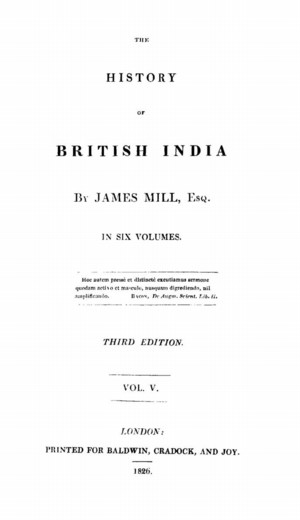
CHAP III. - James Mill, The History of British India, vol. 5 [1817]Edition used:The History of British India in 6 vols. (3rd edition) (London: Baldwin, Cradock, and Joy, 1826). Vol. 5.
Part of: The History of British India, 6 vols.About Liberty Fund:Liberty Fund, Inc. is a private, educational foundation established to encourage the study of the ideal of a society of free and responsible individuals. Copyright information:The text is in the public domain. Fair use statement:This material is put online to further the educational goals of Liberty Fund, Inc. Unless otherwise stated in the Copyright Information section above, this material may be used freely for educational and academic purposes. It may not be used in any way for profit. CHAP III.Arrangement about troops and money with theBOOK VI. Chap. 3. 1786. Nabob of Oude—The Guntoor Circar obtained from the Nizam, and a new arrangement made with that Prince—Aspect which that arrangement bore to Tippoo Saib—Dispute of Tippoo with the Rajah of Travancore—Tippoo attacks the lines of Travancore—The English prepare for war—Form an alliance with the Nizam, and with the Mahrattas—Plan of the Campaign—General Meadows takes possession of Coimbetore, and establishes a chain of depots to the bottom of the Gujelhutty Pass—Tippoo descends by the Gujelhutty Pass—And compels the English General to return for the Defence of Carnatic—End of the campaign, and arrival of Lord Cornwallis at Madras—Operations in Malabar—A new arrangement with Mahomed Ali, respecting the revenues of Carnatic. Lord Cornwallis took in his hand the reins of the Indian government in the month of September, 1786; and was guided by a pretty extensive code of instructions, carried out from the joint manufacture of the Board of Control and the Court of Directors. Of the two grand divisions into which the measures of this Governor-General are distinguished; those which regarded the interior management of the empire, and those which regarded its external relations; the one constitutes a subject distinct from the other; and BOOK VI. Chap. 3. 1786.we shall consult utility, by reserving the attempts which he made to improve the state of the government, till after the narrative is presented of the transactions which took place between him and the neighbouring powers. The state of the connection with the Nabob of Oude was the object which first solicited the attention of Lord Cornwallis. The preceding Governor-General and Council had pledged themselves to Mr. Hastings for the support of that arrangement which was one of the last measures of his administration. But no sooner had Lord Cornwallis arrived in India, than the Nabob proposed to come even in person to Calcutta, and pressed in the most earnest manner for leave to send Hyder Beg Khan his minister. The object was, to represent as insupportable the weight of the burthen which was still imposed upon his country: and to entreat that the temporary brigade, now called the Futty Gur brigade, should, agreeably to the contract which Mr. Hastings had formed, but which had never been observed, now be withdrawn. To Lord Cornwallis, it appeared, however, by no means safe, to entrust the defence of the Nabob’s dominions to the stipulated amount of the Company’s troops, a single brigade at Cawnpore. In the minute which he recorded upon this occasion, he represented the discipline of the Nabob’s own troops as too imperfect to be depended upon, even for the obedience of his subjects; who were retained in submission solely by their dread of the Company’s arms; He described the character of the Nabob as a pure compound of negligence and profusion: And though, at that time, Oude was threatened with no particular danger; and the expense attending the continuance of the brigade at Futty Ghur exceeded the sum which he was entitled to exact of the Nabob; he adhered to the resolution that the troops should not be removed.BOOK VI. Chap. 3. 1786. In the pecuniary burthen, however, he admitted some alteration. It appeared that, during the nine preceding years, the Nabob had paid to the Company, under different titles, at the rate of eighty-four lacs of rupees per amnum; though by the treaty of 1775, he had bound himself to the annual payment of only 31,21,000, and by the treaty of 1781, to that of 34,20,000 rupees. It was agreed that fifty lacs should be the annual payment of the Nabob; and that this should embrace every possible claim. The Governor-General declared that this was sufficient to indemnify the Company for all the expense which it was necessary for them to incur in consequence of their connection with the Vizir. In other words, he declared that, for the nine preceding years, unjustifiable extortion, to the amount of thirty-four lacs per annum, had been practised on that dependant prince. The relation now established between the Nabob of Oude and the Honourable Company was described by the Governor-General in the following words: “We undertake the defence of his country: In return, he agrees to defray the real expenses incurred by an engagement of so much value to himself: and the internal administration of his affairs is left to his exclusive management.”1 Among the instructions with which Lord Cornwallis was furnished for his government in India, he carried out with him explicit orders to demand from the Nizam the surrender of the circar of Guntoor. Bazalut Jung had died in 1782; but Nizam Ali BOOK VI. Chap. 3. 1788.retained possession of the circar; and the English had withheld the payment of the peshcush. Upon the arrival of Lord Cornwallis in India, he was deterred from obeying immediately the peremptory orders of his European masters, with regard to the surrender of Guntoor, on account of the advantage which it appeared that a dispute with the Nizam might lend to the ambition of Tippoo, and the apprehension which was entertained of a rupture with France. In the year 1788, however, the prospect of uninterrupted peace with France, the great addition to the English military strength expected in the course of the season, and the general position of the other powers in India, presented the appearance of as favourable an opportunity for making the demand, as any which was regarded as sufficiently probable to form a rational basis of action. Immediately after the return of Tippoo from the siege of Mangalore, and the conclusion of his treaty with the English in 1784, he set up against the Nizam a demand for Beejapore. About the same time a dispute arose between Tippoo and the Poona ministers, respecting a part of those acquisitions from the Mahratta territory, which had been made by Hyder, during the Peshwaship of Ragoba. These circumstances, together with the jealousy, if not the fears, which the power and character of Tippoo inspired into these neighbouring chiefs, produced a connection between them, in consequence of which a junction was formed between a Poona and Hyderabad army, in the beginning of the year 1786. The terms of reprobation in which Englishmen in India were accustomed to speak of the peace of 1784, led the Poona ministers, according to the opinion of Colonel Wilks, to expect that the English would take part in this confederacy against Mysore; and he is not well pleased with Lord Cornwallis, who lost no time in lettingBOOK VI. Chap. 3. 1788. them know, that no project of an alliance, or any other measure of an aggressive nature, would be entertained by his nation. After a year of warring, attended by no considerable result, Tippoo and his enemies were both weary of the contest. A peace was concluded, on terms not very favourable to the Sultan, who was alarmed at the progressive accumulation of the instruments of war in the hands of the English; and desirous of an interval to settle his dominions on the coast of Malabar. In these circumstances, Lord Cornwallis was under no apprehension of a union between Tippoo and the Mahrattas: He thought it by no means probable, that, without the prospect of alliance with the French, he would provoke the dangers of an English war: And he concluded with some assurance that, with the support of Tippoo alone, the Nizam would not hazard the dangers of resistance. Still, though not probable, it was by no means impossible, that a connection subsisted, or might in consequence of this requisition be formed, between the Nizam and Tippoo; which, “no doubt,” said the Governor-General, “would bring on a war, calamitous to the Carnatic, and distressing to the Company’s affairs.” Yet if ever the claim upon the Guntoor circar was to be enforced, the time was now arrived; and with regard to the result, should war ensue, it was, in the opinion of this ruler, impossible that for one moment a doubt could be entertained.1 The resolution being taken, the execution was skilfully planned. Captain Kennaway, a gentleman whose address was supposed well calculated to soften what might appear offensive in his commission, was BOOK VI. Chap. 3. 1788.sent to the court of the Nizam, instructed to employ conciliatory language, and to show the utmost liberality, in regard to every other point respecting which adjustment was required. No intimation was to be given to the Nizam of the proposed demand, till after the arrival of Captain Kennaway at his court. At the same time, instructions were sent to the residents at the several durbars, of the Peshwa, Scindia, and the Rajah of Berar, to give to these powers a full explanation of the proceeding, before intelligence of it could reach them from any other source. The government of Madras, under specious pretences, conveyed a body of troops to the neighbourhood of the circar; and held themselves in readiness to seize the territory before any other power could interpose, either with arms or remonstrance. Captain Kennaway was yet on his journey to Hyderabad, when the following letter from the Governor-General, dated 3d of July, 1788, went after him by dispatch: “Sir—I have this instant received advice from Sir Archibald Campbell, that the Rajah of Chericka has actually committed hostilities on the Company’s possessions at Tellicherry by order from Tippoo. Sir Archibald appears likewise to be decidedly of opinion, that Tippoo will immediately attack the Rajah of Travancore. This may, however, I think be doubtful. Unless this alarm should be blown over, previous to your arrival at Hyderabad, of which you cannot fail of having certain information, you will of course recollect that part of your instructions, and, instead of declaring the real object of your mission, confine yourself to the general expressions of friendship, and assurances of our earnest desire to cultivate a good understanding between the two governments.” The situation of the Nizam was such, that he regarded himself as having more to hope, and lessBOOK VI. Chap. 3. 1788. to apprehend, from a connection with the English, than with either of the other powers which bordered upon his dominions. Greatly inferior to either the Mahrattas or Tippoo, he was ever in dread of being swallowed up by the one or the other of these formidable neighbours, and was no doubt protected from that destiny by the assistance which, in case of an attack from the one, he was more than likely to receive from the other. An alliance with the one of those powers threatened hostility with the other. An alliance with the English, though disagreeable to both, would not, he concluded, be sufficient, with pretensions irreconcileable as theirs, to unite them for his destruction; while the effect of it would be to lessen his dependance upon both. Under the influence of those views; possibly, too, attaching no great value to the possession of Guntoor, which, under the bad management of his renters, had yielded little revenue, the Nizam manifested an unexpected readiness to comply with the Company’s demands; and, without even waiting for a decision upon the other points which were to be adjusted between them, he surrendered the circar in September, 1788. The settlement of the arrears of the peshcush, which the Company had forborne to pay; and the set-off which was constituted by the revenue of the Guntoor circar, from the time of the death of Bazalut Jung, occasioned some difficulty and delay. To remove these difficulties, but more with a view to prevail upon the Governor-General to form with him at least a defensive alliance, which would raise him above his fears from Tippoo and the Mahrattas, he sent his confidential minister to Calcutta. A few amicable conferences sufficed to produce an adjustment of the pecuniary claims. But with regard to the formation of new and more comprehensive BOOK VI. Chap. 3. 1788.ties between the two governments, the English ruler was restrained, by two powerful considerations. In the first place, they were forbidden by the act of parliament. And in the next place, they could not fail to excite the jealousy and displeasure of the Mahrattas, the friendship of whom he was desirous to cultivate.1 The expedient, which suggested itself to the British Indian government, as happily calculated to answer all purposes, was, To profess the continued existence of the old treaty of 1768, in which both the Mysorean and Mahratta governments, as well as the English at home, had so long acquiesced; and to give to the clauses such an extent of meaning as would satisfy the inevitable demands of the Nizam. To the clause in that treaty, by which it was stipulated that English troops, to the amount of two battalions of sepoys, and six pieces of cannon, manned by Europeans, should be lent to the Nabob, were annexed the words, “whenever the necessity of the Company’s affairs would permit.” It was now agreed that these words2 should mean, Whenever the Nizam should thinkBOOK VI. Chap. 3. 1788. proper to apply for them; under one limitation, that they should not be employed against the Company’s allies, among whom were enumerated the Mahratta chiefs, the Nabobs of Oude and Arcot, and the Rajahs of Travancore and Tanjore. Of the treaty of 1768, one memorable article related to the transfer to the Company of the Carnatic Balaghaut; an article which, if the ancient treaty were binding, still continued in force. The propositions of the Nizam, that measures should now be taken for carrying this engagement into effect, the Governor-General was obliged to elude, by observing that the lapse of time by the alteration of circumstances, had not left that part of the agreement on the same foundation on which it originally stood; and that the English were bound in a treaty of peace with the prince whose territory it actually went to dismember: “but,” said his Lordship, “should it hereafter happen that the Company should obtain possession of the country mentioned in these articles with your Highness’s assistance, they will strictly perform the stipulations in favour of your Highness and the Mahrattas.”1 “The desire of not offending,” says Sir John Malcolm, “against the letter of the act of parliament, would appear on this occasion to have led to a trespass on its spirit. Two treaties had been concluded, subsequently to the treaty of 1768, between Hyder Ali Khan and the British government: And the latter state had concluded a treaty of peace with his son Tippoo Sultaun in 1784; by which it had fully recognised his right of sovereignty to the territories which he possessed. And assuredly under such circumstances BOOK VI. Chap. 3. 1788.the revival with any modification of an offensive alliance (for such the treaty of 1768 undoubtedly was) could not but alarm that Prince.” Sir John Malcolm proceeds; “Nor was that alarm likely to be dispelled, by that qualification in the engagement which provided that no immediate operation should be undertaken against his dominions, as the expression by which that qualification was followed, showed, that the eventual execution of those articles, which went to divest him of his territories, was not deemed an improbable or at least an impossible occurrence by the contracting powers. Another part of this engagement which appeared calculated to excite apprehension in the mind of Tippoo was, the stipulations which regarded the employment of the subsidiary force granted to the Nizam; which was made discretional, with the exception of not acting against some specified Prince and chiefs, among whom he was not included.”1 Sir John Malcolm wrote under the strongest impression of the hostile designs of Tippoo, and of the wisdom and virtue of Lord Cornwallis, yet he makes the following severe reflection, “that the liberal construction of the restrictions of the act of parliament had, upon this occasion, the effect of making the Governor-General pursue a course, which was, perhaps, not only questionable in point of faith; but which must have been more offensive to Tippoo Sultaun, and more calculated to produce a war with that Prince, than the avowed contract of a defensive engagement,BOOK VI. Chap. 3. 1788. framed for the express and legitimate purpose of limiting his inordinate ambition.”1 The Rajah of Cherika was a petty prince on the Malabar coast, in whose territory was situated the Company’s factory at Tellicherry. This prince, with his neighbours, had been subdued by Hyder Ali, and remained a tributary under Tippoo his son. A friendly connexion had long subsisted between the English and the Rajahs of Cherika, whom the English were in the habit of accommodating with loans of money and military stores. In 1765, the debt had accumulated to a considerable sum; and the Rajah assigned to the Company a territory called Rhandaterrah for security and payment. Among other transactions with the Rajah, the English farmed of him, in 1761, the customs of the port of Tellicherry, for which they agreed to pay at the rate of 4,200 rupees per annum. Since 1765, accounts had not been adjusted, but the Rajah had received additional supplies both of money and stores. About the beginning of the year 1786, the Rajah sent a body of men, drove away the English guard, consisting of a serjeant and eight or ten sepoys, and took possession of Rhandaterrah. The government of Bombay directed the chief and factors of Tellicherry to make out the Rajah’s account, whence it appeared that he was still to a large amount in debt to the Company; and to represent the outrage of which he had been guilty to his master Tippoo; but not by force to attempt the recovery of Rhandaterrah, BOOK VI. Chap. 3. 1788.lest it should bring on a renewal of the war. The Rajah, under frivolous pretences, evaded acknowledgement of the account; Tippoo returned for answer that he had commanded the district to be restored; the Rajah disavowed the receipt of any such injunction; and produced a letter from Tippoo which merely commanded him to settle his accounts. The affair remained in suspense till 1788. Early in that year Tippoo descended the Ghauts, at the head of an army, for the ostensible purpose of taking cognizance of his dominions on the coast. Before his much from Calicut towards Palacatcherry on the 8th of May, he addressed a letter to the English chief at Tellicherry, stating it as the information of the Rajah of Cherika, that he had paid his debt to the English, and was entitled to the restitution of his country: upon which the Sultan recommended a settlement of accounts. A letter was soon after received from the Rajah, in which he stated the amount for twenty-seven years of rent due on the customs of the port, without making any mention of the much larger sums which the Company charged to his account; and he demanded the immediate payment of a lack of rupees. It was this which alarmed the Governor-General during the journey of his negociator to Hyderabad; as the apprehension was, that the Rajah was instigated by Tippoo; might proceed to hostilities; and involve the government in war. The territory of the Rajah of Travancore commences near the island of Vipeen, at the mouth of the Chinnamangalum river, about twenty miles to the north of Cochin. From this point it extends to the southern extremity of India, bounded on the west by the sea, and on the east by the celebrated chain of mountains which terminate near the southern cape. The situation of this Prince made a connexion between him and the English of importance to both: He wasBOOK VI. Chap. 3. 1788. placed at so great a distance, that he had little to apprehend from the encroachments of the Company: His country, which was only separated from their province of Tinivelly by the ridge of mountains, formed a barrier to the invasion of an enemy into that province, and through that province into Carnatic itself: The support of the Company was necessary to preserve the Rajah against the designs of such powerful and rapacious neighbours as Hyder Ali and his son: The productiveness of his dominions enabled him to contribute considerably to the military resources of the English: And, in the last war with Hyder, his co-operation had been sufficiently extensive, to entitle him to be inserted in the Treaty with Tippoo, under the character of an ally. The descent of Tippoo, with an army, into the western country, filled the Rajah with apprehensions. He was the only prey on that side of the Ghants, opposite to the dominions of Tippoo, which remained undevoured; and the only obstruction to the extension of his dominions from the Mahratta frontier to Cape Comorin; an extension, attended with the highly coveted advantage of placing him in contract with Tinivelly, the most distant, and most defenceless part of the English possessions in Coromandel. The occurrences which took place between Tippoo and the Rajah of Cochin, added greatly to the terror and alarms of the King of Travancore. There had been a period at which the Rajah of Calicut, known by the name of the Zamorin, had endeavoured to subdue the Cochin Rajah. At that time the Cochin Rajah had received assistance from the Rajah of Travancore. The Cochin Rajah had continued to need support; and the predecessor of the reigning Prince had made over to his benefactor, the BOOK VI. Chap. 3. 1788.Rajah of Travancore, under the title of compensation for expense, two small districts on the northern side of Travancore. Another motive may be supposed to have contributed to this territorial arrangement. Hyder Ali had at the time commenced his inroads on the coast of Malabar; and alarmed the Rajahs for their safety. As a means of defence, the Rajah of Travancore projected a great wall or barrier, on his northern frontier, to the formation of which the districts in question were of peculiar importance. Though part of the territory of the King of Cochin lay north of the projected line of defence, yet a considerable part, including his capital, was blended with Travancore on the opposite side, and would receive protection by it against the designs of Hyder, no less than the dominions of the Travancore Rajah themselves. The works were constructed about twentyfive years previous to the period at which this narrative has arrived. They consisted of a ditch about sixteen feet broad and twenty deep, a strong bamboo hedge, a slight parapet, and good rampart, with bastions on rising grounds, which almost flanked one another. They commenced at the sea, on the island of Vipeen, and extended eastwards, about thirty miles, to the Anamalaiah, or Elephant mountains, a part of the great Indian chain. On the north they were assailable only by regular approaches; but in the case of such an enemy as Tippoo, rather provoked attack, than afforded any permanent protection. Some time after the erection of the lines, Hyder, who was extending his conquests over the Malabar Rajahs, carried his arms against the territory of the King of Cochin, at least the part which was without the wall of Travancore; and the King, rather than lose that part of his dominions, consented to become the tributary of Hyder. The Rajah of Cochin waited upon Tippoo, in 1778,BOOK VI. Chap. 3. 1789. at Palacatcherry, whither he had proceeded after leaving Calicut. Upon his return, this Rajah reported the substance of his conference with Tippoo to the Rajah of Travancore. Tippoo questioned him why his visit had not been earlier; when something useful might have been effected; but now the rainy season was at hand. Tippoo asked, if the delay had been occasioned by the Rajah of Travancore. He told the Rajah that he should demand back those distriots of Cochin, which had been given to the Rajah of Travancore, and that he might receive the aid of the Mysore troops to enforce the claim. It was doubtful to the Rajah of Travancore whether the report of the King of Cochin was deceitful or true; but it indicated in either case the hostile designs of Tippoo. The Rajah made known his fears to the government of Madras, and requested a company of sepoys, with an English officer, as a demonstration to the Sultan of the assistance which he might expect to receive. Sir Archibald Campbell, who then presided over the Councils of Madras, not only complied with the Rajah’s demand, but desired his permission to canton some battalions of the Company’s troops, along the strong grounds behind the wall. For this service, two battalions of sepoys, with their proportion of artillery, were soon after sent from Bombay. The arrival of the rainy season prevented active operations during the remainder of the year 1788, but in the month of May of the following year, Tippoo again descended to the coast, and began with summoning the fort of Cranganore. This, and another place, named Jaycotah,1 belonged to the Dutch, and were maintained as a species of outwork to their BOOK VI. Chap. 3. 1789.grand settlement at Cochin. They were situated close upon the wall of Travancore, at its maritime extremity, and regarded by the Rajah as of the utmost importance for the defence of the lines. He prepared himself to join with the Dutch in defending them; he represented to the English not only that Cranganore and Jeycotah were the very key to his country, but that he was bound in a defensive treaty with the Dutch; he therefore made earnest application to the English government to grant him that assistance which the present exigency appeared to require. Mr. Holland, who was now placed at the head of the Madras government, happened to be very pacifically inclined. He informed the Rajah, that, except for the immediate protection of his own dominions, he could not receive assistance from the English; and enjoined him, in a particular manner, to abstain from every act which could raise the jealousy of Tippoo, or afford him a pretext for invading Travancore. Though Tippoo made several demonstrations, and went so far as to bring heavy guns from Palacatcherry, as if for the reduction of Cranganore, he retired before the middle of May, without commencing the attack; and placed his troops at Palacatcherry and Coimbetore. It was confidently expected, that he would return, at the end of the monsoon; and that his first operations would be against the possessions of the Dutch. Were these in his hands, Travancore would be an easy conquest; and, in the opinion of the Company’s resident it would even be difficult, if not impossible, for the English detachment to retreat. In the mean time intelligence was received from the Commandant at Tellicherry, that, during the whole of the rains, that settlement had been environed by the troops of Tippoo, and shut up as in a state of rigorous blockade; that a chain of posts had beenBOOK VI. Chap. 3. 1789. established surrounding the place, some of them so near as to be within musket shot of the lines; that his troops had strict orders, which they rigidly obeyed, to prevent the admission of every article of supply; that his boats were as vigilant for the same purpose by sea, as the troops were by land; and that the necessaries of life had, in consequence, risen to an exorbitant price. The assurance, conveyed from the Company’s governor at Madras, that the English would interfere in the defence of no territory but that which immediately belonged to the Rajah himself, suggested to the Rajah and the Dutch an expedient for realizing the condition on which was made to depend the assistance which they required. A negotiation, which was said to have been pending for two years, was concluded in the beginning of August, for rendering Cranganore and Jeycotah, part of the dominions of the Rajah; that is, by purchase from the Dutch. Of this transaction, however, the government of Madras disapproved; and they dispatched a peremptory command to the Rajah, that he should annul the contract, and restore the places to the Dutch. Tippoo affirmed, that the Dutch had built the fort of Cranganore upon ground which belonged to his tributary and subject, the Rajah of Cochin; that the Dutch had even paid rent for that ground, in the same manner as the ryots; and that the purchase and sale of it was the purchase and sale of a part of the kingdom of Mysore. The Rajah asserted the falsehood of the allegations of Tippoo; and remonstrated against the orders which he had received from Madras. The resident and he concurred in representing, and produced documents from the Dutch which proved; that Cochin was one BOOK VI. Chap. 3. 1789.of the early conquests of the Portuguese, and their capital in that part of India; that Cranganore and Jaycotah were their dependencies; that the Rajahs of Cochin paid them tribute; that in the year 1654, the Dutch were at war with the Portuguese, and attacked their settlement of Cochin; that they expelled the Portuguese entirely from that part of India, and seized their possessions; that they held no lands of the Rajah of Cochin, whom they rather considered as dependent upon them; that the Rajah of Cochin had not been a tributary of the Mysore chiefs for more than about twelve years; and considered himself as such for that territory only, for which he paid choute; the territory, namely, which was situated without the wall of Travancore. On the 23d of September the Governor-General made answer to the representations which had been transmitted to him by the Governor in Council of Madras: That, without a hope of assistance from the French, which Tippoo at this time could not entertain, he would not, it was probable, desire to draw upon himself the resentment of the Company; that Tippoo was aware, and had indeed been expressly informed, of the certainty with which an attack upon the Travancore Rajah, included in the late treaty as an ally of the English, would be followed by war; that the character at the same time of that violent Prince rendered calculation upon his conduct from the rules of prudence somewhat precarious; and that provision should be made, not only for securing the dominions of the Company and their allies, but for obtaining ample satisfaction, in case of any injury which they might be made to sustain. He, therefore, directed that the best mode of assembling the army, and of opposing resistance to an enemy, should be concerted with the commanding officer; that from the moment Tippoo should invade any part of theBOOK VI. Chap. 3. 1789. territory of the Rajah of Travancore or Nabob of Arcot, he should be considered as in a state of war; that all payments to the private creditors of the Nabob of Arcot should in that case be suspended; and that even the advances for providing the Company’s investment should be withheld. It was well for Lord Cornwallis, that he possessed an influence, which enabled him to take such a licence with impunity. The creditors of the Nabob were, as appeared by important consequences, favourites with the Board of Control. And a rich investment, which filled the coffers of the India House, was the principal source of delight to the Court of Directors. A man of less authority would not have dared to offer disappointment to such commanding inclinations. And perhaps it required the brilliant success which crowned the operations of Lord Cornwallis to exempt even his audacity from disagreeable consequences. The efforts made by Mr. Hastings, to prevent a failure in the article of investments, produced the principal errors of his administration, and the great misfortunes of his life. The Governor-General concluded his letter with the following words; “We sincerely hope and believe that the case will not happen: But should the Carnatic unfortunately be involved in war, you may, in addition to all the means that are in your own power to command, be assured that this government will make the utmost exertions to give you effectual assistance, and to terminate, as speedily as possible, a contest that cannot, even if attended with the utmost success, prove advantageous to our affairs in this country.” In the representation first transmitted to Bengal, regarding the transfer of Jaycotah and Cranganore, BOOK VI. Chap. 3. 1789.it appeared as if they did belong to the dependant of Tippoo, and had been alienated without his consent. In this view of the circumstances Lord Cornwallis condemned the transaction; and confirmed the injunction which had been given by the government of Madras. When it was affirmed, that neither Tippoo, nor his tributary, had any title to the territory, that it had for centuries been the independent possession of Europeans, and more than a hundred years ago had been taken in lawful war from the Portuguese by the Dutch, he thought proper to suspend his decision. He directed that a proposition should be transmitted to Tippoo for a mutual appointment of commissioners to try the point in dispute; and proposed to agree that if the ground was proved to belong to the Rajah of Cochin, the transfer should be annulled; if it was proved to belong to the Dutch, the transaction should be confirmed. Towards the end of October the army of Tippoo was known to be encamped in the neighbourhood of Palgaut; and the Rajah was confirmed in his expectation of an attack. On the 14th of December Tippoo arrived at a place about twenty-five miles distant from the boundary of Travancore, and the ravages of his cavalry were carried within a mile of the wall. On the following day a vakeel, a sort of character in which the capacities of the messenger and negotiator were compounded, arrived from the camp of the Sultan, bearing a letter to the Rajah. It contained the annunciation of Tippoo’s demands; That, as the Rajah had given protection within his dominions to certain Rajahs, and other refractory subjects of the Mysore government, he should deliver them up, and in future abstain from similar offences; 2. That as the Dutch had sold to him that which was not theirs to sell, he should withdraw his troops from Cranganore; 3. That he should demolish that part of his linesBOOK VI. Chap. 3. 1789. which crossed the territory of Cochin, because it belonged to the kingdom of Mysore. The Rajah replied; 1. That the Rajahs of whose protection the Sultan complained had obtained an asylum in his country, because they were his relations, at the distance of many years; that no objection to their residence had ever been taken before; that to prove his amicable disposition, they should nevertheless be removed; and that no refractory subject of the Mysore government had ever, with his knowledge, been harboured in Travancore; 2. That the fort and territory which he had purchased from the Dutch belonged to the Dutch, and was in no respect the property of the dependant of Tippoo; 3. That the ground on which he had erected his lines was ceded to him in full sovereignty by the Rajah of Cochin before that Rajah became tributary to the sovereign of Mysore; and that the lines, existing at the time when he was included in the late treaty between the English and the Sultan, were sanctioned by the silence of that important deed. On the 24th of December Tippoo encamped at not more than four miles distance from the lines; began to erect batteries on the 25th; early in the morning of the 29th turned by surprise the right flank of the lines, where no passage was supposed to exist; and introduced a portion of his army within the wall. Before he could reach the gate which he intended to open, and at which he expected to admit the rest of his army, his troops were thrown into confusion by some slight resistance, and fled in disorder, with a heavy slaughter, across the ditch. Tippoo himself was present at the attack, and, not without personal danger, made his escape. BOOK VI. Chap. 3. 1790.Intelligence of these events was received by the Supreme Government from Madras on the 26th of January; and on the morrow instructions were dispatched to that Presidency. The Governor-General expressed his expectation that the Madras rulers had considered Tippoo as at war, from the first moment when they heard of the attack; that they had diligently executed the measures which he had formerly prescribed; and in particular, that all payments to the Nabob’s creditors, and all disbursements on the score of investment, had immediately ceased. He added, that his intention was to employ all the resources which were within his reach “to exact a full reparation from Tippoo for this wanton and unprovoked violation of treaty;” that for this purpose endeavours should be employed to procure the assistance both of the Mahrattas and of the Nizam; that instructions should be dispatched to the government of Bombay to attack his possessions on the coast of Malabar; and that in every part of India the army should be increased. The instructions to the government of Madras were dated on the 27th of January; those to the resident at the Court of the Nizam were dated on the 28th. The actual commencement of hostilities relieved Cornwallis from all restraint with regard to new connexions; and it was now his part to solicit from the Nizam an alliance, which, a few months before, that Prince would have received as the greatest of favours. The resident was instructed to expose in the strongest colours the faithless and rapacious character of Tippoo; to raise in the minds of the Nizam and his ministers as high a conception as possible of the advantages of an intimate connexion with the English; to promise him a full participation in the fruits of victory, and a mutualBOOK VI. Chap. 3. 1790. guarantee of their respective dominions, against the ambition and hatred of Tippoo. The chief difficulty in this negotiation arose from the violent apprehensions of the Nizam with respect to the Mahrattas. To such a degree was he impressed with an opinion of the villainy of that nation, and of their determination to rob him of his dominions, whenever an opportunity should occur, that he desired the English resident to inform him, if the Peshwa should invade his kingdom, while his army was absent, co-operating with the English, what measures, in that case, the English government would pursue: and he displayed intense reluctance to spare any portion of his forces from his own defence, without an article for the unlimited guarantee of his country. But the Governor-General, who was anxious for the alliance of the Mahrattas, and reckoned them “the people whose friendship was of by far the greatest value,”1 in the contest with Tippoo, was careful not to give umbrage to the Poonah rulers, by appearing to raise a barrier against their ambitious designs. The instructions to the resident at Poonah were of the same description; and dated the preceding day. The relation with the Mahrattas, from the conclusion of the treaty of Salbhye, had been that of general amity; which the Poonah government, with some eagerness and some address, had endeavoured to improve into an engagement for mutual protection against Tippoo. The restrictions, however, imposed by act of parliament, had prevented the Governor-General from acceding to their desire; and of that policy he now expressed his opinion. “Some considerable advantages,” he said, “have no doubt been BOOK VI. Chap. 3. 1790.experienced by the system of neutrality which the legislature required of the governments in this country: But it has, at the same time, been attended with the unavoidable inconvenience of our being constantly exposed to the necessity of commencing a war, without having previously received the assistance of efficient allies.”1 The offer of a defensive alliance against Tippoo was now made to the Mahrattas; and they had the advantage of holding themselves up as the party who bestowed the favour, which, a twelvemonth before, they would have been well contented to appear as the party who received. The Indian desire, to make the most of every circumstance in a bargain, and to sell every favour at the highest price, made them higgle and wrangle for advantages, and protract the negotiation to a considerable length. A treaty, however, with the Nizam, and another with the Mahrattas, of which the conditions were nearly the same, were signed, the former on the 4th day of July, the latter on the 1st of June. A triple league was formed, to punish Tippoo for the treachery, of which he was declared to have been guilty to all the contracting parties: The Nizam and Peshwa bound themselves to prosecute vigorously the war with a potent and well appointed army: The Peshwa received the option of being joined, during the war, by an English force equal to that which served with the Nizam: And the parties jointly engaged, never to make peace, except with mutual consent; to make an equal partition of conquests; and to resist and punish by their combined forces any injury to any of them which Tippoo thereafter might accomplish or attempt. It was declared by the Governor-General to bothBOOK VI. Chap. 3. 1790. the parties with whom he was endeavouring to contract, that the objects were four, at which he should aim by the war: To exact from the enemy indemnification for the expense or loss imposed upon the Company by the war: To make him restore to the Nizam and Peshwa, if they should take part in the conflict, whatever he or his father might have taken from those powers: To wrest from him all that he possessed of the Carnatic Payen Ghaut: And, in consequence of the barbarity which he had exercised on the Nairs of Malabar, to set them free from his dominion.1 The gratification of their resentment for the losses inflicted on them by Tippoo and his father; the removal of the terrors with which they were haunted by his ambition and power; the prospect of recovering what they had lost, and of elevating themselves upon his ruin, were powerful aids toward obtaining the alliance of the Nizam and Mahrattas. While the mind of the Governor-General was thus intensely engaged in preparing the means of war upon the largest scale, a very different spirit prevailed at Madras; and, on the 8th of February, he dispatched to that Presidency a letter of complaint and crimination. He charged the President and Council with neglect of duty, and disobedience of orders, in not having made the prescribed provision of draught cattle for the army; in not having suspended the business of the Company’s investment;2 and, after they had received an explicit declaration from the BOOK VI. Chap. 3. 1790.Governor-General in Council of his determination to protect the Rajah of Travancore in his purchase of Cranganore and Jaycotah if those places belonged not to the Rajah of Cochin but the Dutch, in their having, in their correspondence with Tippoo and even with the Rajah of Travancore and the English resident in his camp, withheld that declaration, and thereby “discouraged a faithful ally in the defence of his country against an enemy, who was within a few miles of his frontiers, and with the insolence and violence of whose character they had long been fully acquainted.” To his early decision against the purchase of the two forts, Governor Hollond adhered: On the allegation of the Rajah that Sir Archibald Campbell encouraged the purchase, he had replied;1 “As you received early information of Governor Campbell’s departure, it was not acting a friendly part to prosecute negotiations of so much importance without communicating their commencement and progress to me, upon my advising you of my succession to the government:” Even after the right of the Dutch appeared to be decidedly proved, still he maintained that the bargain was an offence against Tippoo, not to be justified by the law of nations: because with equal propriety might the Dutch make sale to the French of Sadras and Pulicate, within a few miles of Fort St. George: And lastly, he denied that the importance of the places in question was an adequate compensation for the evils of war. To these reasonings the Governor-General made the following reply: “In your letter, dated 3d of January, you thought proper to lay down principles, as being, in your opinion, founded on the law of nations, respecting the Rajah and the Dutch, whichBOOK VI. Chap. 3. 1790. militate against the spirit of our orders, and which we conceive it was not regularly within your province to discuss, as you are not responsible for the measure directed.” In as far as the government of Madras acted upon their own notions of justice or policy in disobedience to the express orders of those whose commands they had undertaken to obey, they were guilty of a most serious offence; but in laying their opinions and reasons before the governing authority, they practised a virtue, from which the governing authority might derive essential advantage, and merited no insolence of reply. To their reasoning, at the same time, very strong objections applied. In the two cases, that of Cranganore and Jaycotah, and that of Pulicate and Sadras, the circumstance which constituted the material part of the question, that, on which its decision, if founded on rational principles, would depend, was perfectly reversed. Pulicate and Sadras could not be held by the French, without essentially impairing the security of Madras: Cranganore and Jaycotah were of no importance to the security of Tippoo; and were evidently desired by him, as a means of aggression against the Rajah of Travancore. With regard to the value of the places in question, the value, as it had at an early period been, by the Governor-General in Council, declared to the government of Madras, “could not, however great, be opposed to the serious consequences of war; but a tame submission to insult or injury, he was equally convinced, would, in its effects, prove the most fatal policy.” This was the question, and the only question; not whether Cranganore and Jaycotah were a compensation for the consequences of war. Scarcely any single injury can BOOK VI. Chap. 3. 1790.ever approach to an equivalent for the expense, which is but a small part of the evils, of war; and it is then only when there is a decided probability that the permission of one injury will draw on a second, and after the second, a third, and so on, that the advantages of war can be an equivalent for its evils, and recourse to it the dictate of wisdom. At the moment of action, this is often a question not easy to decide; because there is seldom a rule to guide, and the party who has power in his hand, is prone to over-rate the probabilities of that repetition of injury which forbearance may produce. Whether the forbearance of the English would, on the present occasion, have produced the repetition of injury, it is even now impossible with any assurance to pronounce. But the probabilities were so great, that either the decision of the Governor-General was right, or his error excusable. After the repulse of Tippoo, on the 29th of December, from the rampart of Travancore, he disavowed the outrage; described it as the unauthorized act of his troops, who had been accidentally provoked to hostility by the people of the Rajah; gave assurance that his affections were pacific, and that he had no intention to invade the ancient territories of Travancore; but he repeated his claims, on the score of protection afforded to his refractory subjects, the purchase of Cranganore and Jaycotah, and the erection of works upon the territory of his dependant, the Rajah of Cochin. The persuasion that peace might be preserved with Tippoo, continued in the Madras government as long as Mr. Hollond remained at its head. On the 12th of February, having learned that General Medows, who commanded the Bombay army, was appointed to succeed him, he transmitted by letter to the Governor-General his intention of departing immediatelyBOOK VI. Chap. 3. 1790. for Europe; and omitted not the opportunity of repeating his conviction, that Tippoo “had no intention to break with the Company, and would be disposed to enter into negotiation for the adjustment of the points in dispute.” In a letter, dated on the 7th of February, in answer to the proposition respecting the examination by commissioners, Tippoo wrote, that since he had examined in person the foundation of the claims, there was nothing which remained for commissioners to perform; but if it were the wish of the English, they might send “one or two trusty persons to the presence, where, having arrived, they might settle the business;” that he wrote from regard to the ties of friendship which subsisted between him and the Engglish, “otherwise the taking of the lines would not be a work of much difficulty or time.” To descend to the measure of sending commissioners to the presence of Tippoo, appeared to the Madras government to import a loss of dignity in the eyes of the Princes of Hindustan; and before intelligence of this proposition, the Governor-General had communicated his sentiments to General Medows, in the following words: “Good policy, as well as a regard to our reputation in this country, requires, that we should not only exact severe reparation from Tippoo; but also, that we should take this opportunity to reduce the power of a Prince, who avows upon every occasion so rancorous an enmity to our nation—At present we have every prospect of aid from the country powers, whilst he can expect no assistance from France. And if he is suffered to retain his present importance, and to insult and bully all his neighbours, until the French are again in a condition to support him, it would almost certainly leave the seeds of a BOOK VI. Chap. 3. 1790.future dangerous war.”1 In the letter which made answer to that in which the proposal of Tippoo was transmitted to the Governor-General, a hope was expressed that the government of Madras had been exerting themselves to the utmost in the business of the war. They were told, that the attack on the lines of Travancore left no further room for deliberation; and that the Company’s government could not with honour commence a negotiation with Tippoo, till he offered reparation for such an outrage, much less send commissioners to his presence. Instructed to make no relaxation, while answering his letters, in the vigour of their military operations; they were ordered to inform him, that Cranganore and Jaycotah belonged incontestably to the Dutch; that, as the lines of the Rajah were in his possession at the period of the late treaty, his right was thereby recognized; and that the violation of them could not be regarded as accidental, since it was ascertained that the Sultan was upon the spot, and conducted the attack in person.2 On the 2d of March, a skirmish happened, between the troops of the Sultan, and a party of the Rajah’s people sent to clear away a jungle which stood in front of the lines. On the 6th, Tippoo began to fire on the wall, and completed the erection of five batteries on the 10th. A considerable time was spent in making such an opening in the lines as appeared to him to make it expedient to venture the assault. At last, on the 7th of May, he advanced to the breach with his whole army; when the troops of the Rajah were struck with apprehension, and fled in allBOOK VI. Chap. 3. 1790. directions. Having rendered himself master of the lines, he appeared immediately before Cranganore; of which he soon obtained possession. All the northern quarter of Travancore was now seized by the conqueror, who rased the lines, and spread desolation over the country. The necessity, however, of defending his own dominions soon recalled him from his prey. On the 24th of May, he hurried back to his capital, attended by a small body of troops.1 Though he had received a letter from General Medows, dated the 7th of April, declaring, that all his complaints against the Rajah of Travancore were unfounded, that his first attack on the lines was a breach of the treaty, and together with his renewal of hostilities, left no room for deliberation, calling for action rather than words; he wrote again, under date the 22d of May, professing his desire of amity, lamenting the misunderstandings which had occasioned the assemblage of the respective armies, and offering to send a person of dignity to Madras, who might give and receive explanations on the subjects of dispute, and “remove the dust by which the upright mind of the General had been obscured.” To this, the following was the answer returned. “I received yours, and I understand its contents. You are a great Prince, and, but for your cruelty to your prisoners, I should add an enlightened one. The English, equally incapable of offering an insult, as of submitting BOOK VI. Chap. 3. 1790.to one, have always looked upon war as declared, from the moment you attacked their ally, the king of Travancore. God does not always give the battle to the strong, nor the race to the swift, but generally success to those whose cause is just.—Upon that we depend.” For conducting the operations of the campaign, it was planned; that General Medows, with the principal part of the Carnatic army, should take possession of the Coimbetore country, and endeavour, through the Gujelhutty pass, to penetrate into the heart of Mysore; that General Abercromby, with the army of Bombay, should reduce the territory of Tippoo on the coast of Malabar, and effect a junction with Medows if events should render it desirable; and that Colonel Kelly should remain, for the security of Carnatic, with a small army before the passes which led most directly from Mysore. From the plain of Trichinopoly, where the army had assembled, the General marched on the 15th of June. It was of great importance that Coimbetore, formerly a Rajahship of considerable extent and opulence, should be occupied; both as depriving Tippoo of one principal source of his supplies; and as affording resources to the English army for the remainder of the campaign. It was also necessary, for the subsequent operations against Mysore, that a chain of posts should be established from the Coromandel coast to the foot of the pass; and Tanjore, Trichinopoly, Caroor, Erroad, and Sattimungul, were the places of which, for that purpose, selection was made. Having entered the enemy’s country, and taken possession of Caroor, the General halted for eighteen days, while he collected provisions and formed a magazine. From Caroor he marched to Daraporam, which he took without opposition, and made a depot. Leaving there a considerable garrison, and all hisBOOK VI. Chap. 3. 1790. superfluous baggage, he pushed on to the city of Coimbetore, which he found evacuated. No enemy had as yet appeared, except some bodies of irregular cavalry, who had made attempts to harass the march. On the day after the army arrived at Coimbetore, the presence was announced of one of Tippoo’s ablest captains, with 3,000 horse, at the distance of about forty miles. A detachment was sent with directions to surprise them, but returned with only a few prisoners. At the same time, another detachment was employed in the capture of Erroad, which yielded after a trifling resistance. Dindigul, and Palacatcherry, though not in the adopted line of communication, were fortresses of too much importance to be left with safety in the enemy’s hands. A strong detachment, under Colonel Stuart, proceeded to the attack of Dindigul. The garrison were summoned, with a declaration, that, if they surrendered, private property should be respected, if they persisted in a fruitless defence, they should be all put to the sword. The Governor returned the summons by the messenger who brought it: “Inform your commander,” said he, verbally, “that I cannot account to my master for the surrender of such a fort as Dindigul: If, therefore, a second messenger comes with a similar errand, I will blow him back again to his comrades, from one of my guns.” Batteries were erected; and after a heavy cannonade of two days, an assault was projected on the following night. The breach was imperfect, but ammunition expended. The troops advanced to the attack with their usual gallantry, and made great and persevering efforts to penetrate. The strength, however, of the fortification was still so great, and the BOOK VI. Chap. 3. 1790.defence so vigorously maintained, that they were compelled to retire. It was matter of surprise to the assailants, to behold at day-break the flag of surrender displayed on the breach. The garrison, afraid to abide the effects of another assault, had deserted their commander during the night. The same detachment proceeded to the fort of Palacatcherry, which yielded after a short and feeble resistance. And Colonel Floyd was sent against Sattimungul, which he surprised and took without bloodshed. The first important section of the operations of the campaign was thus completed with happy expedition and ease. The line of communication was established; an enemy’s country was obtained for the supply of the troops; and nothing remained but to ascend the Gujelhutty pass, and make Tippoo contend for his throne in the centre of his dominions. The army was at this time separated into three divisions of nearly equal strength; one with General Medows, whose head quarters were at Coimbetore; one with General Floyd, distant about sixty miles, at the advanced post of Sattimungul, near the bottom of the Gujelhutty pass; and the other with Colonel Stuart at Palacatcherry, about thirty miles in the rear; constituting between the advanced and ultimate positions of the army a distance of ninety miles. On the 13th of September, in the morning, a reconnoitring party, sent from the camp of Colonel Floyd, toward the mouth of the pass, was encountered by a body of the enemy; and after a little time the whole army of the Sultan commenced an attack upon the English detachment. The commander was able to choose a position which induced Tippoo to confine his operations to a distant cannonade; which he continued, however, during the whole of the day, and with considerable execution. The descent of Tippoo,BOOK VI. Chap. 3. 1790. by the very pass through which the English meant to ascend, has been represented as a perfect surprise, according to the usual want of intelligence in the English camp. Colonel Wilks, however, affirms; that Floyd had early intelligence of the movements of the Sultan; that he forwarded the intelligence to General Medows, with a suggestion, considering the dispersed situation of the army, of the propriety of falling back; that his intelligence was not credited; and that he had orders to remain. A council of war having determined on retreat, the troops had crossed the river in basket boats, and were on the march next morning by eight o’clock, leaving the provisions collected in Sattimungul, and three pieces of cannon, behind. Tippoo found considerable difficulty in getting his army ready for pursuit, and marched at last with only a part of it. Two o’clock arrived before he could bring his infantry into action. He then meditated a decisive blow; but met with great obstructions from the strong hedges with which the ground was enclosed; and, being at last alarmed, by the report that General Medows was at hand, a report of which the English commander dexterously availed himself, he drew off, on the approach of night. During the action, Colonel Floyd received a dispatch, in which he was told that General Medows on the 14th would march for Velladi. This was not on the direct road from Coimbetore to Sattimungul, nor that in which Floyd was retreating, and from the place at which he had arrived, to Velladi, as twenty miles. The only chance however for saving the army, was, to force the junction. He began his march at two o’clock in the morning, and without seeing the enemy, reached Velladi at eight BOOK VI. Chap. 3. 1790.at night, when the troops had been without provisions, and literally fasting, for three days. The General had already passed ten miles in advance of Velladi. He was immediately apprised of the state of the detachment, and next morning retraced his steps. The army then marched back to Coimbetore, where they were joined by the division of Colonel Stuart from Palacatcherry. The Sultan, disappointed in his expectation of cutting off the dispersed divisions of the English army in detail, now turned his operations against the chain of their depots. This is described by Colonel Wilks as very imperfect. “Caroor,” he says,” “could scarcely be deemed a good depot; Erroad was better qualified to contain than protect stores; and Sattimungul was ill adapted to either purpose.” Erroad, from which, in contemplation of what happened, the greater part of the garrison had been withdrawn, capitulated as soon as the enemy appeared: After emptying the storehouses of Erroad, the Sultan marched in a line directly south, and was followed by the English army, which left Coimbetore on the 29th of September, and in six marches arrived at Erroad. On the day on which the English left Erroad, the Sultan proposed to encamp in a situation about sixteen miles distant, whence he could march, either upon a convoy that was advancing from Caroor, or upon Daraporam, or upon Coimbetore, according to the direction which the English might take. The English army came up; and he increased his distance by a nocturnal march. General Medows waited to protect his convoy from Caroor; and the Sultan marched towards Coimbetore. He knew that the field hospital, valuable stores, and the battering train, were left with a very feeble garrison; but after performing a march in that direction, his intelligence, which never failed him, announced theBOOK VI. Chap. 3. 1790. important fact, that Colonel Hartley had just ascended from the Malabar coast, and reinforced Coimbetore. One point of his plan yet remained; he marched rapidly toward the south; found Daraporam miserably provided for defence; carried his approaches to the ditch; and on the 8th of October entered the place by capitulation. The English General, alarmed by the danger which had threatened the loss of Coimbetore, returned in haste to that grand depot; which he resolved to render as strong as circumstances would admit. While he was employed in strengthening Coimbetore, an object of great importance engaged the attention of Tippoo. Colonel Kelly, the officer who commanded the corps of defence before the passes which led more immediately to Carnatic from Mysore, died, and was succeeded by Colonel Maxwell, toward the end of September. On the 24th of October, in obedience to orders received from General Medows, this corps invaded Baramahl. Of this the Sultan was not long without intelligence. Leaving about one fourth of his army to watch the motions of General Medows, he marched with the remainder in great haste toward Baramahl. On the 9th of November, several bodies of his light cavalry reached Colonel Maxwell’s ground. On the 11th, the Colonel’s cavalry, one regiment, allowed themselves, inveigled in pursuit in a defile, to be attacked by a great superiority of force, and were driven back with considerable loss. The Sultan appeared with his whole army on the 12th; and if he had not been baffled by the superior skill of Maxwell, who chose his ground, and made his dispositions, in such a manner, as allowed not the Sultan an opportunity of attacking him, except with the greatest disadvantage, BOOK VI. Chap. 3. 1790.this movement of Tippoo would have been celebrated as a specimen of generalship, not easy to be matched. After his operations for strengthening Coimbetore, General Medows put the army in motion, to look for the enemy in the direction of Erroad; which he approached on the 2d of November. A strong corps, sent out under Colonel Floyd, to force an extensive reconnoissance, at last ascertained that the Sultan’s whole army had crossed the river several days before, and gone to the northward. The English army crossed, not without difficulty; and began to follow on the 10th. On the 14th they encamped at the southern extremity of the pass of Tapoor. Next day they cleared the pass; and on reaching the ground intended for their encampment on the northern face of the hills, discovered the flags and tents of an army, on the plain, at about six miles distance, below. Nearly three weeks had elapsed since they had direct intelligence from Colonel Maxwell; they had performed an anxious and laborious march; they hailed with delight the sight of their comrades, and the prospect of a speedy conjunction; and three signal guns were fired to announce their approach. It was the Sultan, who had so completely eluded their observation, and whom they now had in their view. During three days he had endeavoured, with all his art, to obtain an opportunity of attacking Colonel Maxwell; and had withdrawn, the preceding evening, with a supposition that General Medows would require another day to clear the pass. He immediately removed to a greater distance up the Palicode valley; and General Medows proceeded fifteen miles next morning in the direction of Caveripatam; where the important junction with Maxwell was effected on the following day. After the disruption of their chain of posts, and the defeat of their original plan for invading Mysore, itBOOK VI. Chap. 3. 1790. was not easy for the Sultan to divine what scheme of hostilities the English would afterwards pursue. Concluding, however, that whither he should go, they would follow, he resolved upon carrying the war into their own country, and in such a manner, if possible, as would afford him the means of recovering the places he had lost. Both armies intended to double back by the pass of Tapoor. Both armies arrived at the head of the pass at the same time. Yet the Sultan, only sending back his baggage, and rear guard, contrived to pass through before the English without loss; and never halted till he was opposite the weak but important depot of Trichinopoly. The English General reached the banks of the Cavery, opposite Caroor, on the 27th of November, and was talking of a plan for calling Tippoo from Carnatic, by ascending the Caveripatam pass, taking post at the head of the Gujelhutty, opening that of Tambercherry, and preserving his communication with Coimbetore, Palacatcherry, and the other coast, on the execution of which plan he expected to enter by the 8th of December; when he was summoned to the defence of Trichinopoly, by intelligence of what the Sultan had performed. The English General arrived at Trichinopoly on the 14th of December, where the swelling of the river had contributed to prevent the Sultan from effecting any thing by surprise, and confined his mischief to the plunder of the island of Seringham. On the approach of the English army he proceeded with his usualdevastations, latterly exchanged for contributions, northward, through the heart of Coromandel, and approached Tiagar. It was commanded by an officer, Captain Flint, who had already distinguished himself in the wars of Carnatic and Mysore; and the efforts BOOK VI. Chap. 3. 1790.of Tippoo, who had no time for tedious operations, were defeated. He was more successful, however, at Trinomalee and Permacoil; from which he proceeded to the neighbourhood of Pondicherry, where he had some communication with the French governor, and engaged a French gentleman to go upon a mission for 6,000 French troops to the King of France. The King of France, it is said, out of compunction, which he strongly expressed, for having aided the Americans in resisting the crown of England, declined compliance; and amused himself “with the shabby finery of Tippoo’s presents to himself and the Queen.” The English army followed that of the Sultan as far as Trinomalee. Lord Cornwallis had arrived at Madras on the 12th of December, and directed General Medows to return to the Presidency. From Trinomalee, therefore, the army turned off to Arnee, where the guns and heavy stores were deposited under Colonel Musgrave, the second in command; and the remainder of the army reached the encampment at Vellout, eighteen miles from Madras, on the 27th of January. On the Malabar side, Colonel Hartley was left, after the Madras troops were withdrawn, with one European regiment and two battalions of sepoys. Happily the General left by Tippoo gave him the opportunity of a pitched battle on the 10th of December, and being routed escaped with the public treasure up the Tambercherry pass. General Abercromby, the Governor of Bombay, had not been able to take the field till late in the season. He arrived at Tellicherry with a respectable force a few days preceding the battle of Hartley; and on the 14th, appeared before Cannanore, which after a very short resistance made an unconditional surrender. As the population was thoroughly disaffected to the government of Mysore, and none of the forts wasBOOK VI. Chap. 3. 1790. strong, the task of the English army was little more than that of over-running the country; and in the space of a few weeks every place which belonged to Tippoo in Malabar was subdued, and the whole province placed in possession of the English.1 During this campaign the Governor-General had been engaged in a transaction of considerable importance with the Nabob of Arcot. When Sir Archibald Campbell arrived at Madras, after the Carnatic revenues, which had been placed under British management by Lord Macartney, had been restored to the Nabob, one of the principal services which he was called upon to perform, was, that of effecting a new arrangement with the said master of those revenues. By the memorable arrangement of the Board of Control, the creditors of the Nabob were to receive annually twelve lacs of pagodas. The expense at which the President in Council estimated the peace establishment was twenty-one lacs. It was, therefore, his proposal, that the Nabob, the English Presidency, and the Rajah of Tanjore, should each contribute to this expense, in exact proportion to the gross amount of their several and respective revenues. According to this principle, the contingent of the Nabob towards the peace establishment would have amounted to ten and a half lacs of pagodas. But upon a very pathetic remonstrance, setting forth his inability to sustain so vast a burthen, the President was induced to admit an abatement of a lac and a half; and upon this agreement, of nine lacs to the state, and twelve to the creditors, an instrument, which they called a treaty, was signed on the 24th of February, 1787. For punctuality of payment, it was arranged, that the following securities should be taken. In case of failure or delay in the contribution for the season of peace, certain districts were named, the aumildars and collectors of which were to make their payments, not to the Nabob, but to receivers appointed by the Company. For securing payment of the four fifths of the revenues which were to be received by the Company in the season of war, the government of Madras might appoint one or more inspectors of accounts to examine the receipts of the districts; and on failure of payment, they might appoint receivers to obtain the money from the aumildars, in the same manner for the whole country, as had been stipulated in the case of certain districts, on failure of the payment of the subsidy during peace. Sir Archibald took to himself a high degree of credit for this arrangement. In his letter to the Court of Directors in which he announced the completion of it, a letter bearing date the very day on which the treaty was signed, he first announces the pecuniary terms, and thus proceeds: “The care I have taken in securing to the Company the punctual payment of the several sums agreed upon, will be sufficiently illustrated by the treaty itself, which I have the honour to inclose. It is therefore only necessary to observe, that this, as well as all the other objects, recommended to me by the Court of Directors, have been minutely attended to in this treaty. The power of the purse and sword is now completely securedBOOK VI. Chap. 3. 1790. to the Company; without lessening the consequence of the Nabob: and I pledge myself that these powers, so long as I have the honour to preside in this government, will be exerted with discretion, and to the utmost of my abilities, to secure the interests, and promote the honour and prosperity, of the India Company. If the articles of this treaty appear satisfactory to you; if they produce, as I trust they will, solid and lasting advantages to the India Company, by the very respectable addition of five lacs of pagodas to their annual receipts, while the Nabob of the Carnatic is happy and pleased with the arrangement, I shall think my labours well bestowed, and feel that I am fully rewarded for all the fatigue and anxiety of mind I have undergone, preparatory to, and during the whole of this negotiation, which I can with truth say has greatly exceeded any description that I can possibly convey.” Hardly was Sir Archibald more pleased with himself, than he was with the Nabob. “I should not,” he says, “discharge my duty to the Honourable Company, were I not to recommend the present state of the Nabob’s finances to your most serious consideration. The voluntary grant of so large a proportion of his revenues to the public and private creditors of his Highness, does, in my opinion, infinite honour, and marks his real character. But it ought to be considered, that this grant was made at a time when he thought his proportion for the defence of the Carnatic would not exceed the sum of four lacs of pagodas annually. His contribution for this defence is now extended to nine lacs; and I can easily perceive, that although he has cheerfully agreed to pay for that purpose five lacs of pagodas more than he expected, yet it is from a conviction BOOK VI. Chap. 3. 1790.that such a contribution is indispensable for the general security; and that this venerable Prince would rather subject himself and family to the feelings of difficulty and distress, than be thought backward for a single moment, in contributing most liberally to any arrangement which might tend effectually to the defence and prosperity of the Carnatic. I have narrowly watched the Nabob’s conduct and sentiments since my arrival in this country, and I am ready to declare, that I do not think it possible that any Prince or person on earth can be more sincerely attached to the prosperity of the Honourable Company than his Highness, or that any one has a higher claim to their favour and liberality.”1 Of this arrangement in general, the Directors expressed great approbation. Injustice, however, they remarked had been done to the Rajah of Tanjore, and undue favour shown to the Nabob, in one particular: For as the Rajah paid an annual tribute to the Nabob, and this had not been deducted from the estimate of the Rajah’s revenues, and added to that of the revenues of the Nabob, a burthen of 50,000 pagodas annually, more than his due, had thus been laid upon the one; a burthen of 50,000 pagodas, which he ought to bear, had been thus removed from the other. With regard to the abatement which, on the score of inability, had been allowed to the Nabob, in the proportional payments, the Directors expressed a wish, that the indulgence had rather been shown by diminishing the payments exacted for the creditors than by reducing the annual subsidy. They directed, accordingly, that the payment of ten lacs and a half on that account should still be required, together with the above-mentioned 50,000 pagodas which hadBOOK VI. Chap. 3. 1790. been wrongfully charged to the Rajah of Tanjore. The regular contingent of the Nabob was therefore established at the sum of eleven lacs; but, in consideration of his poverty, something less would be accepted for a few years. Before the proposal for a new arrangement in conformity to these conditions of the Directors was communicated to the Nabob, his payments had, as usual, fallen in arrear; and in an answer to the importunities of Governor Hollond, he thus expressed himself: “The treaty that was entered into, in the government of Sir Archibald Campbell, I was induced to accede to, in the fullest hopes that I should obtain possession of Tanjore. I have exerted myself beyond my ability; and exercised every kind of hardship and oppression over the ryots, in collecting money to pay the Company; though in doing this I suffer all those pangs which a father feels when he is obliged to oppress and injure his own son. Such is the impoverished state of the country, that it is by no means equal to the burden; and I most sincerely, and with great truth do declare, that I am necessitated to draw the very blood of my ryots to pay my present heavy instalment to the Company.” He not only remonstrated with the utmost vehemence against the additional payments which the Directors commanded to be imposed upon him; but he earnestly prayed for relief, even from those which by the treaty with Sir Archibald Campbell he had engaged himself to sustain. Nor was it till a period subsequent to the arrival of General Medows, that his consent to the new burthens was obtained.1 While the Nabob was pressed on this important BOOK VI. Chap. 3. 1790.subject, he had recourse to an expedient which succeeded so well when employed with Mr. Hastings. He lodged an accusation against the Governor of Madras: and sent a letter privately to the Governor-General through a subaltern in the Company’s army. The grounds of the accusation the Governor-General directed to be examined by a committee. In regard to the private letter and its bearer, he adopted a line of conduct differing widely from that which on a similar occasion had been pursued by Mr. Hastings. “If I had not,” said he, in his answer to the Nabob, “believed that the conduct of Lieutenant Cochrane proceeded only from inadvertency, I should have been highly displeased with him for presuming to undertake the delivery of a letter to me of such serious import from your Highness, without the knowledge or sanction of the Madras government; which I am sure, upon a little reflection, your Highness must agree with me, in thinking the only regular and proper channel of communication between us.”1 When the war broke out, the demands of the English for money became more urgent; the backwardness of the Nabob in his payments continued the same. “After a most attentive consideration of the subject,” say the President and Council of Madras, in their political letter dated the 16th of September, 1790, “we resolved to submit to the supreme government the correspondence which had taken place between our President and the Nabob; and to point out to his Lordship in Council the impolicy of depending for our principal resources, at a time when the greatest exertions were necessary, and pecuniary supplies were of the utmost importance, upon the operations and management of the Nabob’s government,BOOK VI. Chap. 3. 1790. of which the system was perhaps as defective and insufficient as any upon earth. And we did not hesitate to declare it as our unqualified opinion, that this government ought, during the war, to take the Nabob’s country under their own management, as affording the only means by which the resources to be derived from it could be realized, and the fidelity and attachment of the polygars and tributaries secured, which is of the utmost importance to the successful operations of the war. In the event of his Lordship’s agreeing with us in opinion, and instructing us to act in conformity, we submitted to him the necessity of our adopting the measure in so comprehensive a manner, as to preclude any kind of interference on the part of the Nabob, while the country might be under our management; and stating that, if this were not done, the expected advantages could not be derived.” Instead of nine lacs, which it had been found impossible to make the Nabob pay during peace, fourfifths of his whole revenues were payable to the Company during war. But, whereas Sir Archibald Campbell had boasted to the Directors, that the arrangements, which he had made, “secured the punctual payment of the sums agreed upon;” the President and Council of Madras affirmed that they were totally inadequate to the securing of payment; and pointing out, what was a strange defect in practical policy, “It might,” they say, “have been expected, that the securities for the performance of the war stipulations, which are of such importance, would have been made stronger than those which are provided in the event of failures on the part of his Highness in time of peace: But they are, in fact, less efficient; and the process prescribed for failures BOOK VI. Chap. 3. 1790.in time of war is so tedious and complicated, that it can scarce be said to deserve the name of any security or provision whatever.” “As to the appointment,” they said, “of inspectors of accounts, provided for in the treaty of Sir Archibald Campbell, we think they are so little calculated to have any good effect, that we are not disposed to put the Company to expense on this account; being convinced that, in this country, no power, excepting the one which governs, can obtain a true state of Cutcherry accounts.”1 The Governor-General lost no time in expressing his full conviction of the necessity of assuming the government of the country; but recommended that the acquiescence of the Nabob should, if possible, be obtained. The most vehement opposition which it was within the power of the Nabob to make, the Nabob on this occasion displayed. “We cannot say,” replied the Madras Council, “that the event has surprised us;—for, when it is considered, how many people, attached to the Durbar, are interested in the Nabob’s retaining the management of his country in his hands, it will not be a matter of wonder that every effort should be made to prevent his again ceding what in a former instance he had much difficulty in recovering.—We are convinced he will never make a voluntary assignment of his country.”2 On the 21st of June, the Supreme Government, declaring their “perfect persuasion of the impossibility of obtaining in future the stipulated proportion of the Nabob’s revenues, through the medium of his own managers, which also precluded all hopes of being able, by those means, to recover the immense amountBOOK VI. Chap. 3. 1790. of his balance; authorized and directed the Governor and Council of Madras, to take effectual measures to put the Company into immediate possession of the management of his Highness’s revenues and country; in order that the total amount of the collections might be applied with fidelity and economy, in the proportions that had been already settled, to defray the exigencies of the war, and to support his Highness’s own family and dignity.” Tanjore was included in the same arrangement.1 The Letter of the Governor-General and Council was continued in the following words: “We sincerely lament, that your endeavours to prevail upon the Nabob, by argument and persuasion, to sacrifice his ideas and private feelings, respecting his own personal dignity and importance, to the real and substantial good of his subjects—and for that purpose to make a voluntary surrender2 to the Company of the management of his country, during the continuance of the BOOK VI. Chap. 3. 1790.present war, have proved so fruitless and ineffectual. We trust, however, that before long, his Highness will be fully sensible of the interested and criminal motives of the advisers, by whom he has been influenced to resist your solicitations; and that he will soon see, that, whilst his people will be treated with justice and humanity, a liberal fund will be secured for the maintenance of his own family and dignity, and that the remainder of the revenues will be secured from the hands of extortioners and usurers, and honourably applied to the defence and protection of his subjects and dominions.”1 In reporting upon these transactions to the Court of Directors, the Governor-General drew a picture of the government and circumstances of the Nabob, which is too material to this part of the history, not to be inserted in its original shape. “I was impelled,” says he, “to the determination of assuming the revenues of Carnatic, by the strongest considerations of humanity, justice, and public necessity. The flagrant failure, on the part of the Nabob, in the performance of the stipulations of the treaty with the Company, ought long ago to have awakened the government of Fort St. George to a sense of their public duty; and would, in strictness, at any time, have merited the serious interference of this government. But, at a dangerous juncture, when the resources of Bengal are totally inadequate alone to support the expense of the war into which we have been forced, by one of the most inveterate enemies of his Highness’s family, and of the British name, I could not for a moment hesitateBOOK VI. Chap. 3. 1790. in discharging what clearly appeared to me to be the duty of my station—by taking the only measures that could be effectual for securing the proportional assistance, to which we are entitled, from the funds of the Carnatic.—I must likewise observe, that, by executing this resolution, I have every reason to believe, that whilst we provide for the general safety, we, at the same time, greatly promote the interests of humanity. For, by the concurrent accounts that I have received from many quarters, I am perfectly convinced, that, from the Nabob’s being unacquainted with the details of business, and, either from an indifference to the distresses of his subjects, or from a total incapacity to superintend and control the conduct of his renters and managers, the most insatiable extortions, and cruel oppressions, are no where in India more openly and generally committed, with impunity, upon the mass of the miserable inhabitants, than by his Highness’s officers in the internal management of his country. And it will, therefore, not only be felt as a relief, by the body of the people, to be put under the authority of the Company’s servants; but we shall probably be able, by mild and just treatment, to conciliate, on this critical occasion, the attachment of the southern Polygars, who, from being harassed by the unreasonable exactions of the Nabob’s renters, have almost always been ripe for disturbance and revolt. I trust, likewise, that, in addition to the other advantages that may be expected from the measure of taking the management of the Carnatic into your own hands, it may tend to break off a connexion between the Durbar and many of your servants—from which nothing but the most baneful effects can result, both to your own and his Highness’s interests.—The relation between his Highness and the Company’s BOOK VI. Chap. 3. 1790.government; the delusive schemes, into which he has at different times been drawn by the acts of intriguing and interested men, to seek for support in England, against regulations and orders, no less calculated for his real good, than for the advantage of the Company; and the ease which Europeans of all descriptions have found, by the vicinity of his residence to Madras, in carrying on an intercourse with him, in defiance of all your prohibitions, have thrown out temptations that have proved irresistible to several of your servants and other persons, not only recently, but during a long period of years, to engage in unjustifiable and usurious transactions with the Durbar. And I believe I may venture to assure you, that it is to these causes, so highly injurious to the Company’s interests, and so disgraceful to the national character,1 that the present state of disorder and ruin, in his Highness’s affairs, is principally to be attributed.—It will required much mature consideration to deviseBOOK VI. Chap. 3. 1790. means that will be effectual to prevent a repetition of these evils; and, indeed, I must freely own, that I could not venture to propose any plan, on the success of which I could have a firm reliance, unless the Nabob could be induced, by a large annual revenue, to surrender the management of his country for a long term of years to the Company.”1 For the details of management, the same regulations were adopted which had been devised by Lord Macartney; and the highest testimony was now borne to the wisdom of the plan which he established, and which the Board of Control had overturned. General Medows, as early as the 31st of March, was not restrained from declaring, in his letter of that date to the Court of Directors, “His Highness, the Nabob, is so backward in his payments, and oppressive to his Polygars, whom at this time it is so necessary to have on our side, that I conceive it will be absolutely necessary, upon his first material delay of payment, to take the management of his country into your own hands; a measure, in spite of the opposition made to it, so advantageous to you, the country, and even his Highness himself, when so wisely projected, and ably executed, by Lord Macartney.”2 This important arrangement was followed by the complete approbation of the Directors,3 who expressed themselves, even upon the first assignment, procured by Lord Macartney, in the following terms: “If the absolute necessity of recurring to the measure in question were not, in our opinion, to be completely BOOK VI. Chap. 3. 1790.justified upon its own merits, we might recall to our recollection the circumstances of a former period. At the commencement of the preceding war, the Nabob agreed to appropriate the whole of his revenues for its support, and the Company appointed superintendants, or receivers, to collect and receive all the rents, &c. from the Nabob’s aumildars. But, whether it arose from the bad system of management in general, or from this double system in particular; or whether there was a predominant influence in the Nabob’s Durbar, inimical to the interests of the Company—all of which were repeatedly suggested—the measure did not afford any relief to the Company’s finances in the prosecution of the war. Nor, till the country was absolutely made over by a deed of assignment, in December, 1781, did the Company receive a thousand pagodas into their treasure.”1 Not in exact conformity with the character which had been given of him by Sir Archibald Campbell, the Nabob now practised all the arts which, in the case of Lord Macartney, had been employed to defeat the purposes of the assignment. This time, however, they were practised with inferior success, because they were not, as when employed against Lord Macartney, supported by the superior powers. Even in this case, the Nabob had the boldness to circulate instructions to his aumils, or revenue agents in the country, calculated to prevent co-operation with the English government. The remarks of the Directors upon these proceedings of his are necessary to be known. “Having signified our approbation of the determination of the Bengal government, authorizing you to assume the management of the Nabob’s revenues during the continuance of the war, and which seems to have been carried into effect with as much delicacyBOOK VI. Chap. 3. 1790. towards the Nabob, as a circumstance so totally against his inclination would admit of; we are sorry to remark on the nature and tendency of the Nabob’s orders to his aumildars. Surely his Highness must have forgot, for a moment, the nature of his connexion with the Company; and that he is entirely indebted to their support for the preservation of his country. If the Nabob’s professions and actions had not been very much at variance, with what reason could Lieutenant Boisdaun, commanding at Nellore, complain, that the Nabob’s managers seemed rather the enemies of the detachment than their friends. We likewise have the mortification to find that his Highness’s phousdar and aumildar, at Nellore, absolutely refused to submit to the Company’s authority; a resistance, which, say the Board of Revenue, might be expected from the nature of the Nabob’s circular orders. We find also that the collector at Trichinopoly was encountering many difficulties, in establishing the Company’s authority in the different districts, from the opposition of an armed force; and that so very industrious have the Nabob’s sons been in throwing obstacles in the way, that not an account was to be found in any of the village Cutcheries, nor any public servant who could give the smallest information; and that they have been particularly active in disposing of all the grain in the country. We likewise observe, in the intelligence from Tanjore, that the Rajah had been recently alienating several villages, and that the repairs of tanks and water-courses had been neglected, that the Company’s collectors might not be able to produce much income. Such friends and allies can be looked upon as little better than open and declared enemies. And such a conduct on their part is an ill BOOK VI. Chap. 3. 1790.return for the protection that has been constantly afforded them by the British nation.”1 The opposition which the English encountered on the part of the people themselves was naturally created by the course which the English pursued. They professed, that they were to retain the government of the country, only during the war. After one or two years, the business and the power would again be consigned to the Nabob; when those who during that interval had acted agreeably to his inclinations would be favoured; those who had conformed to the inclinations of the English would be oppressed. The English collections, therefore, continued far below the amount to which a permanent arrangement might have been expected to bring them. Hypocrisy was the cause which produced the difficulties resulting to the English from their connexion with the Nabob. They desired to hold him up to the world, as an independent Prince, their ally, when it was necessary they should act as his lord and master. If they succeeded in persuading no other person that he was an independent Prince, they succeeded in persuading himself. And very naturally, on every occasion, he opposed the most strenuous resistance, to every scheme of theirs which had the appearance of invading his authority. If the defence of the country rested with the English; and if they found that to govern it through the agency of the Nabob deprived them of its resources, and above all inflicted the most grievous oppression upon the inhabitants; results, the whole of which might have been easily foreseen, without waiting for the bitter fruits of a long experience; they ought from the beginning, if the real substance, not the false colours ofBOOK VI. Chap. 3. 1790. the case, are taken for the ground of our decision, to have made the Nabob in appearance, what he had always been in reality, a pensioner of the Company. What may be said in defence of the Company is, that parliament scanned their actions with so much ignorance, as to make them often afraid to pursue their own views of utility, and rather take another course, which would save them from the hostile operation of vulgar prejudices. [1]See Papers relating to the East Indies, printed by order of the House of Commons in 1806, No. 2. p. 1–14. [1]Copy of a Letter from Earl Cornwallis to Sir Archibald Campbell, dated Calcutta, 30th of May, 1788. Ordered to be printed 1792. Wilks’s Hist. Sketches, ii. 535–559; iii. 36. [1]“As his Highness’s political situation with the Mahrattas has long approached almost to a state of dependance upon the Poonah government, we could make no alteration in the terms of our agreement with the Nizam, without its being construed by the Peshwa’s ministers as an attempt to detach him from them.” Lett. Cornwallis to Secret Committee, 1st of November, 1789. We are informed by Col. Wilks, that at the same time with this embassy to the English government, the Nizam sent one Tippoo, to propose an alliance offensive and defensive; whether to supersede the agreement with the English, or as a further security, does not appear. Tippoo proposed the adjunct of a matrimonial connexion between the families; but this, not suiting the family pride of the Nizam, broke off the negotiation. Hist. Sketches, iii. 26, 36. [2]The Governor-General imputes bad faith to those who inserted them, as well as the clause relating to the grant of the Carnatic Balaghaut, and the consequent peshcush: “The sixth and twelfth articles are couched in terms which do not manifest a very sincere intention in the framers of the treaty to perform them.” Minute of Governor-General, 10th of July, 1789. [1]Letter, Cornwallis to the Nizam, 7th of July, 1789. [1]Sir John says further, “that such ideas were entertained by Tippoo, from the moment he heard of the conclusion of this engagement, there cannot be a doubt. It would indeed appear by a letter from the resident at Poonah, that the minister of that Court considered this engagement as one of an offensive nature, against Tippoo Soltaun.” Sketch, ut supra, p. 68. [1]Malcolm’s Sketch, ut supra, p. 66–69. See the papers relative to this treaty, laid before parliament in 1792. To the same purpose, another enlightened Indian Soldier: “It is highly instructive to observe a statesman, justly extolled for moderate and pacific dispositions, thus indirectly violating a law, enacted for the enforcement of these virtues, by entering into a very intelligible offensive alliance.” Wills’s Hist. Sketches, iii. 38. [1]Written Ayacottah, by Col. Wilks. [1]Lett. Gov. Gen. to the Secret Committee, 1st Nov. 1789. [1]Dispatch to Mr. Malet, 28th Feb. 1790. [1]See the dispatch to the Resident at Poonah, dated the 22d of March. [2]On the point of investment the Governor-General afterwards retracted his censure, as it was explained, that nothing more had been done than what was necessary to fultil the contract with the Philippine Company. [1]In his letter of the 16th of November. [1]Letter dated 8th March, 1790. [2]Letter to Gen. Medows, Governor in Council, dated 17th March, 1790. The papers lard before Parliament, relative to the commencement of this war, have furnished the materials of the preceding narrative. [1]Colonel Wilks says, “In plain fact he was unprepared for war.” And yet the Colonel supposes, that “he had calculated on possessing every part of Travancore in December, 1789, when the option would have been in his hands of a sudden invasion of the southern provinces at once from Travancore in Dindigul, and Carour; and of being ready, by the time an English army could be assembled, to commence the war with the Caveri as his northern frontier towards Coromandel.” Hist. Sketches, iii. 65. [1]For the facts of this campaign, Col. Wilks is undoubted authority; but for opinions, his partialities deserve to be watched. [1]See a volume of papers, on this subject, ordered by the House of Commons to be printed on the 16th of March, 1792. [1]See a volume of papers, ut supra, p. 17, 19, and 50. [1]See a volume of papers, ut supra, p. 24. [1]Lett. to Gov. Gen. 1st May, and 7th June, 1790. See a volume of papers, ut supra, p. 91 and 102. [2]Letter from the Presidency of Madras to the Gov. Gen. in Council, dated 7th June, 1790. Ibid. p. 103. [1]Letter from the Gov. Gen. in Council, to the Gov. in Council of Fort St. George. Ibid. p. 114. [2]“For the real and substantial good of his subjects make a voluntary surrender” of his sovereignty! The Governor-General and his Council could not be simple enough to expect it. Where would he have found a prince, in much more civilized countries, capable of that sacrifice?—”We trust that before long his Highness will be fully sensible of the interested and criminal motives of his advisers.” What prince is without such interested and criminal advisers? And what can be expected from the advisers of any prince—advisers who, as long as they have the wielding of his power, how destructive soever to the community, gain by its magnitude; would lose by its diminution?—“While his people will be treated with justice and humanity, a liberal fund will be secured for his own family and dignity.” If every prince, upon the securing of a liberal fund for his family and dignity, would consent to lose all that portion of his power which obstructs the exercise of humanity and justice to his people, what a different world should we speedily behold! That the doctrine, however, of Lord Cornwallis, so earnestly preached to this Indian prince, and recommended to his acceptance by more effectual means, when preaching would not suffice, was a doctrine which ought to be recommended to princes, few will dispute. But history provides for a just judgment upon Mahomed Ali, and his advisers; who certainly deserve no peculiar measure of disapprobation for preferring the existence to the annihilation of his power, notwithstanding the claims of humanity and justice, which I fully admit, with respect to his people. [1]Letter, ut supra, ibid. p. 117. [1]English virtue—his Lordship is not restrained by the common cry, that an Englishman should never speak of English virtue except with praise, from pointing out where English want of virtue has been productive of undesirable effects. “I am sensible,” says he, “that many individuals, conceiving that they are actuated by the best of motives, will differ with me in the sentiments which I have taken the liberty to offer upon this subject, and I cannot be confident that they will meet with a favourable reception from the nation at large.—The Nabob’s age, his long connexion with us, his rights to the possession of the country; and exaggerated accounts of his former services, may furnish topics for popular declamation, and may possibly engage the nation, upon mistaken ideas of humanity, to support a system of cruelty and oppression. But whilst I feel conscious that I am endeavouring to promote the happiness of mankind, and the good of my country, I shall give very little weight to such considerations: And should conceive, that I had not performed the duty of the high and responsible office in which you did me the honour to place me, if I did not declare—That the present mixed government cannot prosper; even in the best hands in which your part of it can be placed: And that, unless some such plan as that which I have proposed, should be adopted, the inhabitants of the Carnatic must continue to be wretched; the Nabob must remain an indigent bankrupt; and his country an useless and expensive burden to the Company and to the nation.” Ibid. p. 58. [1]Letter from Lord Cornwallis to the Court of Directors, dated 10th August, 1790. Ibid. p. 57, 58. [2]Ibid. p. 55. [3]See the vol. of papers on the subject, ordered to be printed by the House of Commons, on the 2d of April, 1792, p. 5. [1]Court’s Political Letter to Fort St. George, dated 6th May, 1791. [1]Court’s Political Letter to Fort St. George, dated 6th May, 1791. |

Titles (by Subject)