EconlibThe LibraryOther Sites |
Front Page Titles (by Subject) TO WILLIAM H. CRAWFORD - The Works, vol. 11 (Correspondence and Papers 1808-1816)
Return to Title Page for The Works, vol. 11 (Correspondence and Papers 1808-1816)The Online Library of LibertyA project of Liberty Fund, Inc.Search this Title:Also in the Library:
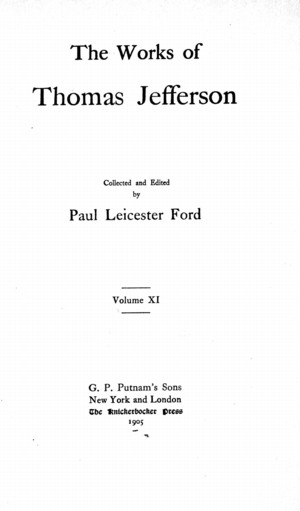
TO WILLIAM H. CRAWFORD - Thomas Jefferson, The Works, vol. 11 (Correspondence and Papers 1808-1816) [1905]Edition used:The Works of Thomas Jefferson, Federal Edition (New York and London, G.P. Putnam’s Sons, 1904-5). Vol. 11.
Part of: The Works of Thomas Jefferson, 12 vols.About Liberty Fund:Liberty Fund, Inc. is a private, educational foundation established to encourage the study of the ideal of a society of free and responsible individuals. Copyright information:The text is in the public domain. Fair use statement:This material is put online to further the educational goals of Liberty Fund, Inc. Unless otherwise stated in the Copyright Information section above, this material may be used freely for educational and academic purposes. It may not be used in any way for profit.
TO WILLIAM H. CRAWFORDj. mss. Monticello, June 20, 1816 Dear Sir, —I am about to sin against all discretion, and knowingly, by adding to the drudgery of your letter-reading, this acknowledgment of the receipt of your favor of May the 31st, with the papers it covered. I cannot, however, deny myself the gratification of expressing the satisfaction I have received, not only from the general statement of affairs at Paris, in yours of December the 12th, 1814, (as a matter of history which I had not before received,) but most especially and superlatively, from the perusal of your letter of the 8th of the same month to Mr. Fisk, on the subject of draw-backs. This most heterogeneous principle was transplanted into ours from the British system, by a man whose mind was really powerful, but chained by native partialities to everything English; who had formed exaggerated ideas of the superior perfection of the English constitution, the superior wisdom of their government, and sincerely believed it for the good of this country to make them their model in everything; without considering that what might be wise and good for a nation essentially commercial, and entangled in complicated intercourse with numerous and powerful neighbors, might not be so for one essentially agricultural, and insulated by nature from the abusive governments of the old world. The exercise, by our own citizens, of so much commerce as may suffice to exchange our superfluities for our wants, may be advantageous for the whole. But it does not follow, that with a territory so boundless, it is the interest of the whole to become a mere city of London, to carry on the business of one half the world at the expense of eternal war with the other half. The agricultural capacities of our country constitute its distinguishing feature; and the adapting our policy and pursuits to that, is more likely to make us a numerous and happy people, than the mimicry of an Amsterdam, a Hamburgh, or a city of London. Every society has a right to fix the fundamental principles of its association, and to say to all individuals, that, if they contemplate pursuits beyond the limits of these principles, and involving dangers which the society chooses to avoid, they must go somewhere else for their exercise; that we want no citizens, and still less ephemeral and pseudo-citizens, on such terms. We may exclude them from our territory, as we do persons infected with disease. Such is the situation of our country. We have most abundant resources of happiness within ourselves, which we may enjoy in peace and safety, without permitting a few citizens, infected with the mania of rambling and gambling, to bring danger on the great mass engaged in innocent and safe pursuits at home. In your letter to Fisk, you have fairly stated the alternatives between which we are to choose: 1, licentious commerce and gambling speculations for a few, with eternal war for the many; or, 2, restricted commerce, peace, and steady occupations for all. If any State in the Union will declare that it prefers separation with the first alternative, to a continuance in union without it, I have no hesitation in saying, “let us separate.” I would rather the States should withdraw, which are for unlimited commerce and war, and confederate with those alone which are for peace and agriculture. I know that every nation in Europe would join in sincere amity with the latter, and hold the former at arm’s length, by jealousies, prohibitions, restrictions, vexations and war. No earthly consideration could induce my consent to contract such a debt as England has by her wars for commerce, to reduce our citizens by taxes to such wretchedness, as that laboring sixteen of the twenty-four hours, they are still unable to afford themselves bread, or barely to earn as much oatmeal or potatoes as will keep soul and body together. And all this to feed the avidity of a few millionary merchants, and to keep up one thousand ships of war for the protection of their commercial speculations. I returned from Europe after our government had got under way, and had adopted from the British code the law of draw-backs. I early saw its effects in the jealousies and vexations of Britain; and that, retaining it, we must become like her an essentially warring nation, and meet, in the end, the catastrophe impending over her. No one can doubt that this alone produced the orders of council, the depredations which preceded, and the war which followed them. Had we carried but our own produce, and brought back but our own wants, no nation would have troubled us. Our commercial dashers, then, have already cost us so many thousand lives, so many millions of dollars, more than their persons and all their commerce were worth. When war was declared, and especially after Massachusetts, who had produced it, took side with the enemy waging it, I pressed on some confidential friends in Congress to avail us of the happy opportunity of repealing the draw-back; and I do rejoice to find that you are in that sentiment. You are young, and may be in the way of bringing it into effect. Perhaps time, even yet, and change of tone, (for there are symptoms of that in Massachusetts,) may not have obliterated altogether the sense of our late feelings and sufferings; may not have induced oblivion of the friends we have lost, the depredations and conflagrations we have suffered, and the debts we have incurred, and have to labor for through the lives of the present generation. The earlier the repeal is proposed, the more it will be befriended by all these recollections and considerations. This is one of three great measures necessary to insure us permanent prosperity. This preserves our peace. A second should enable us to meet any war, by adopting the report of the war department, for placing the force of the nation at effectual command; and a third should insure resources of money by the suppression of all paper circulation during peace, and licensing that of the nation alone during war. The metallic medium of which we should be possessed at the commencement of a war, would be a sufficient fund for all the loans we should need through its continuance; and if the national bills issued, be bottomed (as is indespensable) on pledges of specific taxes for their redemption within certain and moderate epochs, and be of proper denominations for circulation, no interest on them would be necessary or just, because they would answer to every one the purposes of the metallic money withdrawn and replaced by them. [1 ]Jefferson further wrote to Col. William Duane: Monticello, April 30, 1811 Dear Sir,—Yours of the 19th is received. I have carefully examined my letter files from July 1808 to this day, & find among them no such anonymous letter as you mention. Indeed the strong impression on my memory is that I never received an Anonymous letter from England, or from any other country than our own. Certain newspapers are taking a turn which gives me uneasiness. Before I was aware of it, I was led to an interference which tho’ from just motives, I should not, at a later moment, have shaped exactly as I did. I cannot therefore repress the desire to communicate it fully to you. On the 24th of March I received a friendly letter from Duane, informing me of the distress into which he had been thrown by his former friends, Lieper & Clay, withdrawing their endorsements for him at the banks; the latter expressly for his attacks on John Randolph, the former without assigning any particular cause: & he concluded by asking whether, in Virginia, where he had been flattered by the support of his paper, 80. gentlemen could not be found, who would advance him their hundred Dollars apiece, to be repaid at short periods. I immediately engaged Mr. Peter Carr here, & Mr. Wirt in Richmond to set the experiment afoot, & one of these engaged a friend in Baltimore to do the same. But I mentioned to these gentlemen that to apprise Duane of the grounds on which we interested ourselves for him, to wit, his past services to the cause of republicanism, & that he might not mistake it as an approbation of his late attacks on Mr. Gallatin, of which we unequivocally disapproved, I would write him a letter. I accordingly wrote him the one now inclosed, which I previously communicated to Messrs. Carr & Wirt. It did not leave this till the 1st of April. The thing was going on hopefully enough, when his papers of the 4th & 8th arrived here, the latter written probably after he had received my letter. The effect at Baltimore I have not learned, but every person who had offered, here or at Richmond to join in aiding him, immediately withdrew, considering him as unequivocally joining the banners of the opposition, federal or factious. I have to give an account of this to Duane, but am waiting, in expectation of an answer to mine of March 26. In that I shall make one effort more to reclaim him from the dominion of his passions, but I expect it will be the last, and as unavailing as the former. I could not be satisfied until I informed you of this transaction and must even request you to communicate it to Mr. Gallatin: for altho the just tribute rendered him in the letter was certainly never meant to meet his eyes yet it is there, among other things, it must go to him. Ritchie has been under hesitation. His paper of the 16th decides his course as to yourself, and I propose to set him to rights, as to Mr. Gallatin, through a letter to Wirt, in which I shall expose the falsehood or futility of the facts they have harped upon. All this however is confidential to yourself & Mr. Gallatin; because, while I wish to do justice to truth, I wish also to avoid newspaper observation. With respect to the opposition threatened, altho it may give some pain, no injury of consequence is to be apprehended. Duane flying off from the government, may, for a little while, throw confusion into our ranks as John Randolph did. But, after a moment of time to reflect & rally, & to see where he is, we shall stand our ground with firmness. A few malcontents will follow him, as they did John Randolph, & perhaps he may carry off some well meaning Anti-Snyderites of Pennsylvania. The federalists will sing Hosannas, & the world will thus know of a truth what they are. This new minority will perhaps bring forward their new favorite, who seems already to have betrayed symptoms of consent. They will blast him in the bud, which will be no misfortune. They will sound the tocsin against the antient dominion, and anti-dominionism may become their rallying point. And it is better that all this should happen two than six years hence. Disregarding all this, I am sure you will pursue steadily your own wise plans, that peace, with the great belligerents at least, will be preserved until it becomes more losing than war, & that the total extinction of the national debt, & liberation of our revenues, for defence in war and improvement in peace, will seal your retirement with the blessings of your country. For all this, & for your health & happiness I pray to God fervently. P. S. Be so good as to return the inclosed as I have no other copy. |

Titles (by Subject)