EconlibThe LibraryOther Sites |
Front Page Titles (by Subject) 1798 - TO JOHN PAGE J. MSS. - The Works, vol. 8 (Correspondence 1793-1798)
Return to Title Page for The Works, vol. 8 (Correspondence 1793-1798)The Online Library of LibertyA project of Liberty Fund, Inc.Search this Title:Also in the Library:
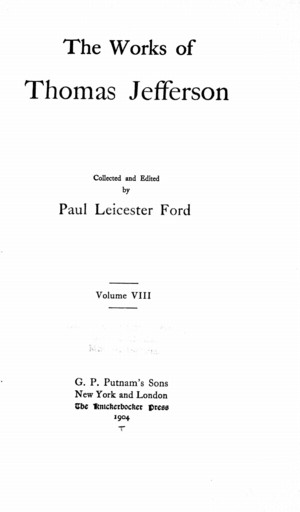
1798 - TO JOHN PAGE J. MSS. - Thomas Jefferson, The Works, vol. 8 (Correspondence 1793-1798) [1905]Edition used:The Works of Thomas Jefferson, Federal Edition (New York and London, G.P. Putnam’s Sons, 1904-5). Vol. 8
Part of: The Works of Thomas Jefferson, 12 vols.About Liberty Fund:Liberty Fund, Inc. is a private, educational foundation established to encourage the study of the ideal of a society of free and responsible individuals. Copyright information:The text is in the public domain. Fair use statement:This material is put online to further the educational goals of Liberty Fund, Inc. Unless otherwise stated in the Copyright Information section above, this material may be used freely for educational and academic purposes. It may not be used in any way for profit.
TO JOHN PAGEJ. MSS.Philadelphia Jan. 1. 1798. My dear Page,—You have probably seen or heard of some very abusive letters addressed to me in the publick papers by a mr. Martin of Baltimore on the subject of Logan’s speech cited in the Notes on Virginia. I do not mean to notice mr. Martin or to go into the newspapers on the subject, but I am still anxious to inquire into the foundation of that story, and if I find anything wrong in it it shall be corrected, & what is right supported either in some new edition of that work or in an Appendix to it. You & I were so much together about the year 1774, that I take for granted that whatsoever I heard you heard also, & therefore that your memory can assist mine in recollecting the substance of the story, how it came to us, & who could now be applied to to give information relative to it. You were more in Ld Dunmore’s & Foy’s company than I was, & probably heard more of it from that family than I did. I must pray you to rub up your recollection & communicate to me as fully as you can what you can recall to your mind relative to it. & if you can procure me the evidence, or the recollections of any other persons on it, it will much oblige me. We have now been met 7. weeks & have done nothing except put off the stamp act to July next. Nor does it seem as if there would be anything to do. We are waiting for news from France. A letter from Talleyrand (French Minister of Foreign Affairs) to mr. Le Tombe consul here, dated the day after the arrival of our ministers at Paris, says they will be well received, & that every disposition exists on the side of France to accommodate their differences with us. I imagine you will have seen Monroe’s work, as many copies were sent to Richmond by Bache. We hourly expect Fauchet’s pamphlet from the same press. I will send you a copy. Present me respectfully to mrs. Page & accept assurances of the constant friendship of my Dear Sir, Yours affectionately. TO MANN PAGEJ. MSS.Philadelphia, Jan. 2, 1798. Dear Sir,—I do not know whether you have seen some very furious abuse of me in the Baltimore papers by a mr. Luther Martin, on account of Logan’s speech, published in the Notes on Virginia. He supposes both the speech & story made by me to support an argument against Buffon. I mean not to enter into a newspaper contest with mr. Martin; but I wish to collect, as well as the lapse of time will permit, the evidence on which we received that story. It was brought to us I remember by Ld Dunmore & his officers on their return from the expedition of 1774. I am sure it was from them that I got it. As you were very much in the same circle of society in Wmsburg with myself, I am in hopes your memory will be able to help out mine, and recall some facts which have escaped me. I ask it as a great favor of you to endeavor to recollect, & to communicate to me all the circumstances you possibly can relative to this matter, particularly the authority on which we received it, & the names of any persons who you think can give me information. I mean to fix the fact with all possible care and truth, and either to establish or correct the former statement in an Appendix to the Notes on Virginia, or in the first republication of the work. Congress have done nothing interesting except postponing the Stamp Act. An act continuing the currency of the foreign coins 3. years longer has passed the Representatives, but was lost in the Senate. We have hopes that our envoys will be received decently at Paris, and some compromise agreed on. There seems to be little appearance of peace in Europe. Those among us who were so timid when they apprehended war with England, are now bold in propositions to arm. I do not think however that the Representatives will change the policy pursued by them at their summer session. The land tax will not be brought forward this year. Congress of course have no real business to be employed on. We may expect in a month or six weeks to hear so far from our commissioners at Paris as to judge what will be the aspect of our situation with France. If peaceable, as we hope, I know of nothing which should keep us together. In my late journey to this place, I came through Culpeper & Prince William to Georgetown. When I return, it will be through the eastern shore (a country I have never seen), by Norfolk & Petersburg; so that I shall fail then also of the pleasure of seeing you. Present my respectful compliments to mrs. Page, and accept assurances of the sincere esteem of, dear Sir, your friend and servant. TO JAMES MADISONMAD. MSS.P, Jan, 3, 1798. Dear Sir,—* * * Our weather has been here, as with you, cold & dry. The thermometer has been at 8°. The river closed here the first week of December, which has caught a vast number of vessels destined for departure. It deadens also the demand for wheat. The price at New York is 1.75 & of flour 8.50 to 9.; tobacco 11. to 12. D.; there need be no doubt of greater prices. The bankruptcies here continue: the prison is full of the most reputable merchants, & it is understood that the scene has not yet got to its height. Prices have fallen greatly. The market is cheaper than it has been for 4. years. Labor & house rent much reduced. Dry goods somewhat. It is expected they will fall till they get nearly to old prices. Money scarce beyond all example. The Representatives have rejected the President’s proposition for enabling him to prorogue them. A law is passed putting off the stamp act till July next. The land tax will not be brought on. The Secretary of the Treasury says he has money enough. No doubt these two measures may be taken up more boldly at the next session, when most of the elections will be over. It is imagined the stamp act will be extended or attempted on every possible object. A bill has passed the Rep to suspend for 3. years the law arresting the currency of foreign coins. The Senate propose an amendment, continuing the currency of the foreign gold only. Very possibly the bill may be lost. The object of opposing the bill is to make the French crowns a subject of speculation (for it seems they fell on the President’s proclamation to a Dollar in most of the states), and to force bank paper (for want of other medium) through all the states generally. Tench Coxe is displaced & no reason ever spoken of. It is therefore understood to be for his activity during the late election. It is said, that the people from hence quite to the Eastern extremity are beginning to be sensible that their government has been playing a foul game. In Vermont, Chipman was elected Senator by a majority of one, against the republican candidate. In Maryland, Lloyd by a majority of one, against Winder the republican candidate. Tichenor chosen Governor of Vermont by a very small majority. The house of Representatives of this state has become republican by a firm majority of 6. Two counties, it is said, have come over generally to the republican side. It is thought the republicans have also a majority in the N York H of representatives. Hard elections are expected there between Jay & Livingston, & here between Ross & McKean. In the H of Representatives of Congress, the republican interest has at present, on strong questions, a majority of about half a dozen, as is conjectured, & there are as many of their firmest men absent; not one of the anti-republicans is from his post. The bill for permitting private vessels to arm, was put off to the 1st Monday in February by a sudden vote, & a majority of five. It was considered as an index of their dispositions on that subject, tho some voted both ways on other ground. It is most evident, that the anti-republicans wish to get rid of Blount’s impeachment. Many metaphysical niceties are handing about in conversation, to shew that it cannot be sustained. To show the contrary, it is evident must be the task of the republicans, or of nobody. Monroe’s book is considered as masterly by all those who are not opposed in principle, and it is deemed unanswerable. An answer, however, is commenced in Fenno’s paper of yesterday, under the signature of Scipio. The real author not yet conjectured.1 As I take these papers merely to preserve them, I will forward them to you, as you can easily return them to me on my arrival at home; for I shall not see you on my way, as I mean to go by the Eastern Shore & Petersburg. Perhaps the paragraphs in some of these abominable papers may draw from you now & then a squib. A pamphlet of Fauchet’s appeared yesterday. I send you a copy under another cover. A handbill is just arrived here from N Y, where they learn from a vessel which left Havre about the 9th of Nov, that the emperor had signed the definitive articles, given up Mantua, evacuated Mentz, agreed to give passage to the French troops into Hanover, and that the Portuguese ambassador had been ordered to quit Paris, on account of the seizure of fort St. Julian’s by the English, supposed with the connivance of Portugal. Tho this is ordinary mercantile news, it looks like truth. The latest official intelligence from Paris is from Talleyrand Perigord to the French consul here, (Letombe,) dated Sep 28, saying that our Envoys were arrived, & would find every disposition on the part of his government to accommodate with us. TO JAMES MADISONJ. MSS.Philadelphia, January 25, 1798. Dear Sir,—I wrote you last on the 2d inst, on which day I received yours of Decr 25. I have not resumed my pen, because there has really been nothing worth writing about, but what you would see in the newspapers. There is, as yet, no certainty what will be the aspect of our affairs with France. Either the Envoys have not written to the government, or their communications are hushed up. This last is suspected, because so many arrivals have happened from Bordeaux & Havre. The letters from American correspondents in France have been always to Boston; & the experience we had last summer of their adroitness in counterfeiting this kind of intelligence, inspires doubts as to their late paragraphs. A letter is certainly received here by an individual from Talleyrand, which says our Envoys have been heard, that their pretensions are high, that possibly no arrangement may take place, but that there will be no declaration of war by France. It is said that Bournonville has written that he has hopes of an accommodation (3. audiences having then, Nov, been had), and to be himself a member of a new diplomatic mission to this country. On the whole, I am entirely suspended as to what is to be expected. The representatives have been several days in debate on the bill for foreign intercourse. A motion has been made to reduce it to what it was before the extension of 1796. The debate will probably have good effects, in several ways, on the public mind, but the advocates for the reformation expect to lose the question. They find themselves deceived in the expectation entertained in the beginning of the session, that they had a majority. They now think the majority is on the other side by 2. or 3., and there are moreover 2. or 3. of them absent. Blount’s affair is to come on next. In the mean time the Senate have before them a bill for regulating proceedings in impeachment. This will be made the occasion of offering a clause for the introduction of juries into these trials. (Compare the paragraph in the constitution which says, that the trial of all crimes, except in cases ofimpeachment, shall be by jury, with the VIIIth amendment, which says, that in all criminal prosecutions the trial shall be by jury.) There is no expectation of carrying this; because the division in the Senate is of 2. to 1., but it will draw forth the principles of the parties, and concur in accumulating proofs on which side all the sound principles are to be found. Very acrimonious altercations are going on between the Spanish minister & the Executive, and at the Natchez something worse than mere altercation. If hostilities have not begun there, it has not been for want of endeavors to bring them on by our agents. Marshall, of Kentucky, this day proposed in Senate some amendments to the constitution. They were barely read just as we were adjourning, & not a word of explanation given. As far as I caught them in my ear, they went only to modifications of the elections of President & V President, by authorizing voters to add the office for which they name each, & giving to the Senate the decision of a disputed election of President, & to the Representatives that of Vice President. But I am apprehensive I caught the thing imperfectly, & probably incorrectly. Perhaps this occasion may be taken of proposing again the Virginia amendments, as also to condemn elections by the legislatures, themselves to transfer the power of trying impeachments from the Senate to some better constituted court, &c., &c. Good tobo here is 13. doll., flour 8.50, wheat 1.50, but dull, because only the millers buy. The river, however, is nearly open, & the merchants will now come to market & give a spur to the price. But their competition will not be what it has been. Bankruptcies thicken, & the height of them has by no means yet come on. It is thought this winter will be very trying. Friendly salutations to mrs. Madison. Adieu affectionately. January 28. I enclose Marshall’s propositions. They have been this day postponed to the 1st of June, chiefly by the vote of the anti-republicans, under the acknoleged fear that other amendments would be also proposed, and that this is not the time for agitating the public mind. TO HENRY TAZEWELLJ. MSS.Jan. 27. 98. As you mentioned that some of your Commee admitted that the introduction of juries into trials by impeachment under the VIIIth amendment depended on the question Whether an impeachment for a misdemeanor be a criminal prosecution? I devoted yesterday evening to the extracting passages from Law authors showing that in Law-language the term crime is in common use applied to misdemeanors, & that impeachments, even when for misdemeanors only are criminal prosecutions: These proofs were so numerous that my patience could go no further than two authors, Blackstone & Wooddeson. They shew that you may meet that question without the danger of being contradicted. The constitution closes the proofs by explaining its own meaning when speaking of impeachments, crimes, misdemeanors. The object in supporting this engraftment into impeachments is to lessen the dangers of the court of impeachment under its present form & to induce dispositions in all parties in favor of a better constituted court of impeachment, which I own I consider as an useful thing, if so composed as to be clear of the spirit of faction. Do not let the enclosed paper be seen in my handwriting. TO JAMES MADISONMAD. MSS.Philadelphia, Feb. 8, 98. I wrote you last on the 25th Ult; since which yours of the 21st has been received. Bache had put 500. copies of Monroe’s book on board a vessel, which was stopped by the early & unexpected freezing of the river. He then tried in vain to get them carried by fifties at a time, by the stage. The river is now open here, the vessels have fallen down, and if they can get through the ice below, the one with Bache’s packet will soon be at Richmond. It is surmised here that Scipio is written by C. Lee. Articles of impeachment were yesterday given in against Blount. But many knotty preliminary questions will arise. Must not a formal law settle the oath of the Senators, forms of pleadings, process against person & goods, &c.? May he not appear by attorney? Must he not be tried by jury? Is a Senator impeachable? Is an ex-Senator impeachable? You will readily conceive that these questions, to be settled by 29. lawyers, are not likely to come to speedy issue. A very disagreeable question of privilege has suspended all other proceedings for several days. You will see this in the newspapers. The question of arming was to have come on, on Monday last; that morning, the President sent in an inflammatory message about a vessel taken & burnt by a French privateer, near Charleston. Of this he had been possessed some time, and it had run through all the newspapers. It seemed to come in very apropos for spurring on the disposition to arm. However, the question is not come on. In the meantime, the general spirit, even of the merchants, is becoming adverse to it. New Hampshire & Rhode island are unanimously against arming; so is Baltimore. This place becoming more so. Boston divided & desponding. I know nothing of New York; but I think there is no danger of the question being carried, unless something favorable to it is received from our Envoys. From them we hear nothing. Yet it seems reasonably believed that the Executive has heard, & that it is something which would not promote their views of arming. For every action of theirs shews they are panting to come to blows. Walker’s bill will be applied to answer a draught of Colo. Monroe’s on Barnes. I have not heard yet from Bailey. I wrote to you about procuring a rider for the Fredsbg post. The proposition should be here by the 14th inst., but I can get it kept open a little longer. There is no bidder yet but Green, the printer. £100 Virga. will be given. Giles has arrived. TO JAMES MONROEMON. MSS.[Post marked, Feby 8, 1798] I received yesterday by mr. Giles yours of Jan. 27, and am well pleased with the indications of republicanism in our assembly. Their law respecting the printer is a good one. I only wish they would give the printing of the laws to one & journals to another. This would secure two, as each portion of the business would be object enough to the printer, and two places in their gift would keep within bounds the other printers also who would be in expectancy of catching something in case of either vacancy. Bache was prevented sending 500 copies of your book to Richmond by the freezing of this river after they were aboard the vessel. He tried in vain to get boxes of fifties carried on by the stages. However, the river is now open here, the vessels have fallen down, and if they find it open below, that with Bache’s packets will soon be in Richmond. It has been said here that C. Lee was the author of Scipio, but I know of no authority for it. I had expected Hamilton would have taken the field, and that in that case you might have come forward yourself very shortly merely to strengthen and present in a compact view those points which you expected yourself they would lay hold of, particularly the disposition expressed to acquiesce under their spoiliatory decree. Scipio’s attack is so weak as to make no impression. I understand that the opposite party admit that there is nothing in your conduct which can be blamed, except the divulging secrets: & this I think might be answered by a few sentences, discussing the question whether an Ambassador is the representative of his country or of the President. Barnes has accepted your bill. As to the question of your practising the law in Richmond, I have been too long out of the way in Virginia to give an opinion on it worth attention. I have understood the business is very profitable, much more so than in my time: and an opening of great importance must be made by the retirement of Marshall & Washington, which will be filled by somebody. I do expect that your farm will not sufficiently employ your time to shield you from ennui. Your mind is active, & would suffer if unemployed. Perhaps it’s energies could not be more justifiably employed than for your own comfort. I should doubt very much however, whether you should combine with this the idea of living in Richmond, at least till you see farther before you. I have always seen that tho’ a residence at the seat of government gave some advantages yet it increased expences also so seriously as to overbalance the advantages. I have always seen too that a good stand in the country intercepted more business than was shared by the residents of the city. Yours is a good stand. You need only visit Staunton Cts. some times to put yourself in the way of seeing clients.—The articles of impeachment against Blount were yesterday received by the Senate. Some great questions will immediately arise. 1. Can they prescribe their own oath, the forms of pleadings, issue process against person or goods by their own orders, without the formality of a law authorizing it? Has not the 8th amendment of the constitution rendered trial by jury necessary? Is a Senator impeachable? These and other questions promise no very short issue. The Representatives have a dirty business now before them on a question of privilege. This you will see in the public papers.—The question of arming our vessels was to have come on on Monday last. Accordingly the President that morning sent in an inflammatory message about a vessel taken near Charleston & burned by a French privateer, of which fact he had been sometime possessed, & it had been in all the newspapers. It seemed thrown in on that day precisely to give a spur to the question. However it did not come on. In the mean time the spirit of the merchants is going fast over to the safe side of the question. In New Hampshire and Rhode Island they are unanimous; in Baltimore also. In this place becoming more so. In Boston divided & desponding. Of New York I have no information. But I think the Proposition will not be carried, unless something befriending it should come from our envoys. Nothing transpires yet of their mission. Yet it cannot be well doubted but that the Executive must have received information. Perhaps it is of a nature to damp the spirit for arming.—Pray tell Colo. Bell (to whom I wrote about getting a rider for the Fredsbg. post) that the 14th. inst. is the day by which the proposition should come in. I can get it kept open a little longer. £100. our money will be given. My friendly salutations to mrs. Monroe. Adieu affectionately. TO HUGH WILLIAMSONJ. MSS.Philadelphia Feb. 11. 98. Dear Sir,—I have to acknolege the receipt of your favor of the 2d. inst. I will with great pleasure sound opinions on the subject you mention & see whether it can be brought forward with any degree of strength. I doubt it however & for this reason. You may recollect that a report which I gave into Congress in 93. & mr. Madison’s propositions of Jan. 94. went directly to establish a navigation act on the British principle. On the last vote given on this (which was in Feb. 94.) from the three states of Massachusetts, Connecticut & Rhode island there were 2. votes for it & 20. against it; & from the 3. states of Virginia, Kentuckey, & N. Carolina, wherein not a single top mast vessel is, I believe owned by a native citizen, there were 25. votes for & 4. against the measure. I very much suspect that were the same proposition now brought forward, the northern vote would be nearly the same, while the southern one I am afraid, would be radically varied. The suggestion of their disinterested endeavors for placing our navigation on an independent footing & forcing on them the British treaty have not had a tendency to invite new offers of sacrifice & especially under the prospect of a new rejection. You observe that the rejection would change the politics of New England. But it would afford no evidence which they have not already in the records of Jan. & Feb. 94. However as I before mentioned I will with pleasure, sound the dispositions on that subject. If the proposition should be likely to obtain a reputable vote it may do good. As to myself I sincerely wish that the whole Union may accommodate their interests to each other, & play into their hands mutually as members of the same family, that the wealth & strength of any one part should be viewed as the wealth & strength of the whole. The countervailing act of G. Britain lately laid before us by the President, offers a just occasion of looking to our navigation. For the merchants here say that the effect of it will be that they themselves shall never think of employing an American vessel to carry produce to Gr. Britain after a peace. Not having as yet any conversation on this subject I cannot say whether it has excited sensibility either in the north or south. It shall be tried however. Accept assurances of the sincere esteem of Dear Sir your friend & servant. TO JAMES MADISONMAD. MSS.Philadelphia, Feb 15. 98. I wrote you last on the 8th. We have still not a word from our Envoys. This long silence (if they have been silent) proves things are not going on very roughly. If they have not been silent, it proves their information, if made public, would check the disposition to arm. I am flattered myself, from the progress of the public sentiment against arming, that the same progress had taken place in the legislature. But I am assured by those who have better opportunities of forming a good judgment, that if the question against arming is carried at all, it will not be by more than a majority of two; & particularly, that there will not be more than 4. votes against it from the 5. eastern states, or 5. votes at the utmost. You will have perceived that Dayton is gone over compleatly. He expects to be appointed Secretary of war, in the room of M’Henry, who, it is said, will retire. He has been told, as report goes, that they would not have confidence enough in him to appoint him. The desire of inspiring them with more, seems the only way to account for the eclat which he chuses to give to his conversion. You will have seen the disgusting proceedings in the case of Lyon: if they would have accepted even of a commitment to the serjeant, it might have been had. But to get rid of his vote was the most material object. These proceedings must degrade the General Government, and lead the people to lean more on their state governments, which have been sunk under the early popularity of the former. This day, the question of the jury in cases of impeachment comes on. There is no doubt how it will go. The general division in the Senate is 22. and 10.; and under the probable prospect of what it will forever be, I see nothing in the mode of proceeding by impeachment but the most formidable weapon for the purposes of a dominant faction that ever was contrived. It would be the most effectual one for getting rid of any man whom they consider as dangerous to their views, and I do not know that we could count on one-third on an emergency. It depends then on the H. of Representatives, who are the impeachers; & there the majorities are of 1., 2., or 3 only; & these sometimes one way & sometimes another: in a question of pure party they have the majority, and we do not know what circumstances may turn up to increase that majority temporarily, if not permanently. I know of no solid purpose of punishment which the courts of law are not equal to, and history shows, that in England, impeachment has been an engine more of passion than justice. A great ball is to be given here on the 22d, and in other great towns of the Union. This is, at least, very indelicate, & probably excites uneasy sensations in some. I see in it, however, this useful deduction, that the birth days which have been kept, have been, not those of the President, but of the General. I enclose with the newspapers, the two acts of parliament passed on the subject of our commerce, which are interesting. The merchants here say, that the effect of the countervailing tonnage on American vessels, will throw them completely out of employ as soon as there is peace. The eastern members say nothing but among themselves. But it is said that it is working like gravel in their stomachs. Our only comfort is, that they have brought it on themselves. My respectful salutation to mrs. Madison; & to yourself, friendship and adieu. TO HORATIO GATESJ. MSS.Philadelphia, Feb 21, 98. Dear General,—I received duly your welcome favor of the 15th, and had an opportunity of immediately delivering the one it enclosed to General Kosciusko. I see him often, and with great pleasure mixed with commiseration. He is as pure a son of liberty as I have ever known, and of that liberty which is to go to all, and not to the few or the rich alone. We are here under great anxiety to hear from our Envoys. But I think this is one of the cases where no news is good news. If the dispositions at Paris threatened war, it is impossible that our envoys should not find some means of putting us on our guard, of warning us to begin our preparations: especially too when so many vessels have come from ports of France. And if writing were dangerous (which cannot be) there are so many of our countrymen at Paris who would bring us their viva voce communications. Peace then must be probable. I agree with you, that some of our merchants have been milking the cow: yet the great mass of them have become deranged; they are daily falling down by bankruptcies, and on the whole, the condition of our commerce far less firm & really prosperous, than it would have been by the regular operations and steady advances which a state of peace would have occasioned. Were a war to take place, and throw our agriculture into equal convulsions with our commerce, our business would be done at both ends. But this I hope will not be. The good news from the Natchez has cut off the fear of a breach in that quarter, where a crisis was brought on which has astonished every one. How this mighty duel is to end between Gr Britain and France, is a momentous question. The sea which divides them makes it a game of chance; but it is narrow, and all the chances are not on one side. Should they make peace, still our fate is problematical. The countervailing acts of Gr Brit, now laid before Congress, threaten, in the opinion of merchants, the entire loss of our navigation to England. It makes a difference, from the present state of things, of 500. guineas on a vessel of 350 tons. If, as the newspapers have told us, France has renewed her Arret of 1789, laying a duty of 7. livres a hundred on all tobo brought in foreign bottoms (even our own), and should extend it to rice & other commodities, we are done, as navigators, to that country also. In fact, I apprehend that those two great nations will think it their interest not to permit us to be navigators. France had thought otherwise, and had shown an equal desire to encourage our navigation as her own, while she hoped it’s weight would at least not be thrown into the scale of her enemies. She sees now that that is not to be relied on, and will probably use her own means, and those of the nations under her influence, to exclude us from the ocean. How far it may lessen our happiness to be rendered merely agricultural, how far that state is more friendly to principles of virtue & liberty, are questions yet to be solved. Kosciusko has been disappointed by the sudden peace between France & Austria. A ray of hope seemed to gleam on his mind for a moment, that the extension of the revolutionary spirit through Italy and Germany, might so have occupied the remnants of monarchy there, as that his country might have risen again. I sincerely rejoice to find that you preserve your health so well. That you may so go on to the end of the chapter, & that it may be a long one I sincerely pray. Make my friendly salutations acceptable to mrs. Gates, & accept yourself assurances of the great & constant esteem & respect of, dear Sir, your friend and servant. TO JAMES MADISONMAD. MSS.Philadelphia, February 22, 98. Yours of the 12th is received. I wrote you last on the 15th, but the letter getting misplaced, will only go by this post. We still hear nothing from our envoys. Whether the Executive hear, we know not. But if war were to be apprehended, it is impossible our envoys should not find means of putting us on our guard, or that the Executive should hold back their information. No news, therefore, is good news. The countervailing act, which I sent you by the last post, will, confessedly, put American bottoms out of employ in our trade with Gr Britain. So say well-informed merchants. Indeed, it seems probable, when we consider that hitherto, with the advantage of our foreign tonnage, our vessels could only share with the British, and the countervailing duties will, it is said, make a difference of 500. guineas to our prejudice on a ship of 350. tons. Still the Eastern men say nothing. Every appearance & consideration render it probable, that on the restoration of peace, both France & Britain will consider it their interest to exclude us from the ocean, by such peaceable means as are in their power. Should this take place, perhaps it may be thought just & politic to give to our native capitalists the monopoly of our internal commerce. This may at once relieve us from the danger of wars abroad and British thraldom at home. The news from the Natchez, of the delivery of the posts, which you will see in the papers, is to be relied on. We have escaped a dangerous crisis there. The great contest between Israel & Morgan, of which you will see the papers full, is to be decided this day. It is snowing fast at this time, and the most sloppy walking I ever saw. This will be to the disadvantage of the party which has the most invalids. Whether the event will be known this evening, I am uncertain. I rather presume not, & therefore, that you will not learn it till next post. You will see in the papers, the ground on which the introduction of the jury into the trial by impeachment was advocated by mr. Tazewell, & the fate of the question. Reade’s motion, which I enclosed you, will probably be amended & established, so as to declare a Senator unimpeachable, absolutely; and yesterday an opinion was declared, that not only officers of the State governments, but every private citizen of the U S, is impeachable. Whether they will think this the time to make the declaration, I know not; but if they bring it on, I think there will be not more than two votes north of the Patowmac against the universality of the impeaching power. The system of the Senate may be inferred from their transactions heretofore, and from the following declaration made to me personally by their oracle.1 No republic can ever be of any duration, without a Senate, & a Senate deeply and strongly rooted, strong enough to bear up against all popular storms & passions. The only fault in the constitution of our Senate is, that their term of office is not durable enough. Hitherto they have done well, but probably they will be forced to give way in time. I suppose their having done well hitherto, alluded to the stand they made on the British treaty. This declaration may be considered as their text; that they consider themselves as the bulwarks of the government, and will be rendering that the more secure, in proportion as they can assume greater powers. The foreign intercourse bill is set for to-day; but the parties are so equal on that in the H Repr that they seem mutually to fear the encounter. * * * TO PEREGRINE FITZHUGHJ. MSS.Philadelphia, Feb 23, 1798. Dear Sir,—I have yet to acknolege your last favor which I received at Monticello, and therefore cannot now recur to the date. The perversion of the expressions of a former letter to you which you mention to have been made in the newspapers, I had not till then heard of. Yet the spirit of it was not new. I have been for some time used as the property of the newspapers, a fair mark for every man’s dirt. Some, too, have indulged themselves in this exercise who would not have done it, had they known me otherwise than thro these impure and injurious channels. It is hard treatment, and for a singular kind of offence, that of having obtained by the labors of a life the indulgent opinions of a part of one’s fellow citizens. However, these moral evils must be submitted to, like the physical scourges of tempest, fire, &c. We are waiting with great anxiety to hear from our envoys at Paris. But the very circumstance of silence speaks, I think, plain enough. If there were danger of war we should certainly hear from them. It is impossible, if that were the aspect of their negociations, that they should not find or make occasion of putting us on our guard, & of warning us to prepare. I consider therefore their silence as a proof of peace. Indeed I had before imagined that when France had thrown down the gauntlet to England, and was pointing all her energies to that object, her regard for the subsistence of her islands would keep her from cutting off our resources from them. I hope, therefore, we shall rub through the war, without engaging in it ourselves, and that when in a state of peace our legislature & executive will endeavor to provide peaceable means of obliging foreign nations to be just to us, and of making their injustice recoil on themselves. The advantages of our commerce to them may be made the engine for this purpose, provided we shall be willing to submit to occasional sacrifices, which will be nothing in comparison with the calamities of war. Congress has nothing of any importance before them, except the bill on foreign intercourse, & the proposition to arm our merchant vessels. These will be soon decided, and if we then get peaceable news from our envoys, I know of nothing which ought to prevent our immediate separation. It had been expected that we must have laid a land tax this session. However, it is thought we can get along another year without it. Some very disagreeable differences have taken place in Congress. They cannot fail to lessen the respect of the public for the general government, and to replace their State governments in a greater degree of comparative respectability. I do not think it for the interest of the general government itself, & still less of the Union at large, that the State governments should be so little respected as they have been. However, I dare say that in time all these as well as their central government, like the planets revolving round their common sun, acting & acted upon according to their respective weights & distances, will produce that beautiful equilibrium on which our Constitution is founded, and which I believe it will exhibit to the world in a degree of perfection, unexampled but in the planetary system itself. The enlightened statesman, therefore, will endeavor to preserve the weight and influence of every part, as too much given to any member of it would destroy the general equilibrium. The ensuing month will probably be the most eventful ever yet seen in Modern Europe. It may probably be the season preferred for the projected invasion of England. It is indeed a game of chances. The sea which divides the combatants gives to fortune as well as to valor it’s share of influence on the enterprise. But all the chances are not on one side. The subjugation of England would indeed be a general calamity. But happily it is impossible. Should it end in her being only republicanized, I know not on what principle a true republican of our country could lament it, whether he considers it as extending the blessings of a purer government to other portions of mankind, or strengthening the cause of liberty in our own country by the influence of that example. I do not indeed wish to see any nation have a form of government forced on them; but if it is to be done, I should rejoice at it’s being a freer one. Permit me to place here the tribute of my regrets for the affecting loss lately sustained within your walls, and to add that of the esteem & respect with which I am, dear Sir, your friend and servant. TO JAMES MADISONMAD. MSS.P, March 2, 98. I wrote you last on the 22; since which I have received yours without date, but probably of about the 18th or 19th. An arrival to the Eastward brings us some news, which you see detailed in the papers. The new partition of Europe is sketched, but how far authentic we know not. It has some probability in it’s favor. The French appear busy in their preparations for the invasion of England; nor is there any appearance of movements on the part of Russia & Prussia which might divert them from it. The late birth-night has certainly sown tares among the exclusive federals, It has winnowed the grain from the chaff. The sincerely Adamites did not go. The Washingtonians went religiously, & took the secession of the others in high dudgeon. The one sect threaten to desert the levees, the other the evening parties. The whigs went in number, to encourage the idea that the birth-nights hitherto kept had been for the General & not the President, and of course that time would bring an end to them. Goodhue, Tracy, Sedgwick, &c., did not attend; but the three Secretaries & Attorney General did. We were surprised, the last week, with a symptom of a disposition to repeal the stamp act. Petitions for that purpose had come from Rhode island & Virginia, & had been committed to rest with the Ways & Means. Mr. Harper, their chairman, in order to enter on the law for amending it, observed it would be necessary first to put the petitions for repeal out of the way, and moved an immediate decision on them. The Rhode islanders begged & prayed for a postponement; that not expecting that that question was to be called up, they were not at all prepared; but Harper would shew no mercy; not a moment’s delay should be allowed. It was taken up, and, on a question without debate, determined in favor of the petitions by a majority of 10. Astonished & confounded, when an order to bring in a bill for repeal was moved, they began in turn to beg for time; 3. weeks, one week, 3. days, 1. day; not a moment would be yielded. They made three attempts for adjournment. But the majorities appeared to grow. It was decided, by a majority of 16., that the bill should be brought in. It was brought in the next day, & on the day after passed, sent up to the Senate, who instantly sent it back rejected by a silent vote of 15. to 12. R I & N Hampshire voted for the repeal in Senate. The act will therefore go into operation July 1, but probably without amendments. However, I am persuaded it will be short-lived. It has already excited great commotion in Vermont, and grumblings in Connecticut. But they are so priest-ridden, that nothing is expected from them, but the most bigoted passive obedience. No news yet from our commissioners; but their silence is admitted to augur peace. There is no talk yet of the time of adjourning, tho’ admitted we have nothing to do, but what could be done in a fortnight or three weeks. When the spring opens, and we hear from our commissioners, we shall probably draw pretty rapidly to conclusion. A friend of mine here wishes to get a copy of Mazzei’s Recherches historiques et politiques. Where are they? Salutations & adieu. Wheat 1.50. flour 8.50 tobo 13.50. TO JAMES MONROEMON. MSS.Philadelphia Mar. 8. 98. Dear Sir,—I have to acknolege the receipt of yours of Feb. 12. 19. & 25. At length the charm is broke, and letters have been received from our envoys at Paris. One only of them has been communicated, of which I enclose you a copy with the documents accompanying it. The decree therein proposed to be passed has struck the greatest alarm through the merchants I have ever yet witnessed. As it has not been known more than two or three days, it’s particular operations are not yet developed. It will probably drive our vessels out of the British trade, because as they will not have the benefit of convoy they cannot bring a return cargo from Great Britain, but on much higher insurance than the British vessels who will have convoy: nor can they carry out produce but on much higher freight because they will be to return empty, in which case the British will underwork them. It seems then as if one effect would be to increase the British navigation. Unless indeed our vessels instead of laying themselves up in port, should go to other markets with their produce & for return cargoes. However it is not probable this state of things will last long enough to have any great effect. The month of April I think will see the experiment of the invasion, and that will be a short one. You will see in Bache’s paper of this morning the 5th. number of some pieces written by T. Coxe, in which this proposed decree is well viewed. How it will operate on our question about arming, we do not yet know. Some talk of letters of marque & reprisal, yet on the whole I rather believe it will not add to the number of voters for arming. This measure with the decrees of the British courts that British subjects adopted here since the peace and carrying on commerce from hence, are still British subjects, & their cargoes British property, has shaken these quasi-citizens in their condition. The French adopt the same principle as to their cargoes when captured. A privateer lately took near our coast an E. Indiaman worth 250.000 D. belonging to one of these lately emigrated houses. Is it worth our while to go to war to support the contrary doctrine? The British principle is clearly against the law of nations, but which way our interest lies is also worthy consideration. The influence of this description of merchants on our government & on the public opinion is not merely innocent, it’s absence would not weaken our union—the issue of the question on foreign intercourse has enabled us to count the strength of the two parties in the H. of representatives. It is 51. & 55 if all the members were present. The whigs being a minority of 4. but in this computation all wavering characters are given to the other side. Jersey has laid itself off into districts, which instead of an uniform delegation, will give one chequered as the state is. They will at their next election send whigs from two districts. Pennsylvania, at her next election (in October) will add two more to the whig list. Let us hope that Morgan & Macher will give place to whig successors. I do not know that this can be hoped for from our Eastern shore. This much I think tolerably certain, besides the natural progress of public sentiment in other quarters, & the effect of the events of the time. We do not think then that the partizans of Republican government should despair.—They do not yet talk of the time of adjournment though confessedly they have nothing to do. Yet I trust it will be early in the ensueing month.—How far it may be eligible for you to engage in the practice of the law I know not. On the question of your removal to Richmond, I may doubtless be under bias, when I suppose it’s expediency questionable. The expence to be incurred in the first moments will certainly be great. Could it be only deferred for a while it would enable you to judge whether the prospect opened will be worth that dislocation of your affairs, or whether some other career may not open on you. Of these things nobody but yourself can judge. It is a question too for yourself whether a seat among the judges of the state would be an object for you. On all these points your friends can only offer motives for consideration: on which none but yourself can decide avec connoissance de cause. I really believe that some employment, more than your farms will furnish, will be necessary to your happiness. You are young, your mind active, and your health vigorous. The languor of ennui would, in such a condition of things, be intolerable. Make my most respectful salutations to mrs. Monroe, & accept friendly adieux to yourself. TO JAMES MADISONMAD. MSS.Philadelphia, Mar 15, 98. I wrote you last on the 2d instt. Your’s of the 4th is now at hand. The public papers will give you the news of Europe. The French decree making the vessel friendly or enemy, according to the hands by which the cargo was manufactured, has produced a great sensation among the merchants here. Its operation is not yet perhaps well understood; but probably it will put our shipping out of competition, because British bottoms, which can come under convoy, will alone be trusted with return cargoes. Our’s, losing this benefit, would need a higher freight out, in which, therefore, they will be underbid by the British. They must then retire from the competition. Some no doubt will try other channels of commerce, and return cargoes from other countries. This effect would be salutary. A very well-informed merchant, too, (a Scotsman, entirely in the English trade,) told me, he thought it would have another good effect, by checking & withdrawing our overextensive commerce & navign (the fruit of our neutral position) within those bounds to which peace must necessarily bring them. That this being done by degrees, will probably prevent those numerous failures produced generally by a peace coming on suddenly. Notwithstanding this decree, the sentiments of the merchants become more & more cooled & settled down against arming. Yet it is believed the Representatives do not cool; and tho’ we think the question against arming will be carried, yet probably by a majority of only 4. or 5. Their plan is, to have convoys furnished for our vessels going to Europe, & smaller vessels for the coasting defence. On this condition, they will agree to fortify Southern harbors, and build some galleys. It has been concluded among them, that if war takes place, Wolcott is to be retained in office, that the Pt must give up M’Henry, & as to Pickering they are divided, the Eastern men being determined to retain him, their middle & Southern brethren wishing to get rid of him. They have talked of Genl. Pinckney as successor to M’Henry. This information is certain. However, I hope that we shall avoid war, & save them the trouble of a change of ministry. The P has nominated J Q Adams Commissioner Plenipoty to renew the treaty with Sweden. Tazewell made a great stand against it, on the general ground that we should let our treaties drop, & remain without any. He could only get 8. votes against 20. A trial will be made to-day in another form, which he thinks will give 10. or 11. against 16. or 17. declaring the renewal inexpedient. In this case, notwithstanding the nomination has been confirmed, it is supposed the P would perhaps not act under it, on the probability that more than a third would be against the ratification. I believe, however, that he would act, & that a third could not be got to oppose the ratification. It is acknoleged we have nothing to do but to decide the question about arming. Yet not a word is said about adjourning; and some even talk of continuing the session permanently; others talk of July & August. An effort, however, will soon be made for an early adjournment. My friendly salutations to mrs. Madison; to yourself affectionate adieux. TO JAMES MADISONMAD. MSS.Philadelphia, Mar 21, 98. I wrote you last on the 15th; since that, yours of the 12th is received. Since that, too, a great change has taken place in the appearance of our political atmosphere. The merchants, as before, continue, a respectable part of them, to wish to avoid arming. The French decree operated on them as a sedative, producing more alarm than resentment; on the Representatives, differently. It excited indignation highly in the war party, tho’ I do not know that it had added any new friends to that side of the question. We still hoped a majority of about 4.; but the insane message which you will see in the public papers has had great effect. Exultation on the one side, & a certainty of victory; while the other is petrified with astonishment. Our Evans, tho’ his soul is wrapt up in the sentiments of this message, yet afraid to give a vote openly for it, is going off to-morrow, as is said. Those who count, say there are still 2. members of the other side who will come over to that of peace. If so, the numbers will be for war measures, 52., against them 53.; if all are present except Evans. The question is, what is to be attempted, supposing we have a majority? I suggest two things: 1. As the President declares he has withdrawn the Executive prohibition to arm, that Congress should pass a Legislative one. If that should fail in the Senate, it would heap coals of fire on their head. 2. As to do nothing & to gain time is everything with us, I propose that they shall come to a resolution of adjournment, “in order to go home & consult their constituents on the great crisis of American affairs now existing.” Besides gaining time enough by this, to allow the descent on England to have it’s effect here as well as there, it will be a means of exciting the whole body of the people from the state of inattention in which they are; it will require every member to call for the sense of his district by petition or instruction; it will shew the people with which side of the House their safety as well as their rights rest, by shewing them which is for war & which for peace; & their representatives will return here invigorated by the avowed support of the American people. I do not know, however, whether this will be approved, as there has been little consultation on the subject. We see a new instance of the inefficiency of Constitutional guards. We had relied with great security on that provision, which requires two-thirds of the Legislature to declare war. But this is completely eluded by a majority’s taking such measures as will be sure to produce war. I wrote you in my last, that an attempt was to be made on that day in Senate, to declare an inexpediency to renew our treaties. But the measure is put off under a hope of it’s being attempted under better auspices. To return to the subject of war, it is quite impossible, when we consider all it’s existing circumstances, to find any reason in it’s favor resulting from views either of interest or honor, & plausible enough to impose even on the weakest mind; and especially, when it would be undertaken by a majority of one or two only. Whatever then be our stock of charity or liberality, we must resort to other views. And those so well known to have been entertained at Annapolis, & afterwards at the grand convention, by a particular set of men, present themselves as those alone which can account for so extraordinary a degree of impetuosity. Perhaps, instead of what was then in contemplation, a separation of the union, which has been so much the topic to the Eastward of late, may be the thing aimed at. I have written so far, two days before the departure of the post. Should anything more occur to-day or to-morrow, it shall be added. 22d. At night. Nothing more. TO JAMES MONROEMON. MSS.Philadelphia Mar. 21. 98. The public papers will present to you the almost insane message sent to both houses of Congress 2. or 3. days ago. This has added to the alarm of the sounder and most respectable part of our merchants. I mean those who are natives, are solid in their circumstances & do not need the lottery of war to get themselves to rights. The effect of the French decree on the representatives had been to render the war party inveterate & more firm in their purpose without adding to their numbers. In that state of things we had hoped to avert war measures by a majority of 4. At this time, those who court talk of it’s being reduced to a majority of 1. or 2. if a Majority be with us at all. This is produced by the weight of the Executive opinion. The first thing proposed by the whigs will be a call for papers. For if Congress are to act on the question of war, they have a right to information. The 2d. to pass a Legislative prohibition to arm vessels instead of the Executive one which the President informs them he has withdrawn. These questions will try the whig strength, on the ground of war. The 3d. to adjourn to consult our constituents on the great crisis of American affairs now existing. This measure appears to me under a very favorable aspect. It gives time for the French operations on England to have their effect here as well as there. It awakens the people from the slumber over public proceedings in which they are involved. It obliges every member to consult his district on the simple question of war or peace: it shews the people on which side of the house are the friends of their peace as well as their rights, & brings back those friends to the next session supported by the whole American people. I do not know however whether this last measure will be proposed. The late maneuvres have added another proof to the inefficiency of constitutional barriers. We had reposed great confidence in that provision of the Constitution which requires ⅔ of the Legislature to declare war. Yet it can be entirely eluded by a majority’s taking such measures as will bring on war.—My last to you was of the 8th inst. The last recd from you was of Feb. 25. TO DR. SAMUEL BROWNJ. MSS.Philadelphia Mar. 25. 98. Dear Sir,—You were a witness, before you left our side of the continent, to the endeavours of the tory part among us, to write me down as far as they could find or make materials. “O! that mine enemy would write a book!” has been a well known prayer against an enemy. I had written a book, & it has furnished matter for abuse for want of something better. Mr. Martin’s polite attack on the subject of Cresap & Logan, as stated in the Notes on Virginia, had begun before you left us, it has continued & still continues; though after the perusal of the first letter had shown me what was to be the style of those subsequent, I have avoided reading a single one. A friend of mine having wished for a general explanation of the foundation of the case of Logan, I wrote him a letter of which I had a few copies printed, to give to particular friends for their satisfaction, & on whom I could rely against the danger of its being published. I enclose you a copy as well for these purposes, as that I think it may be in your power to obtain some information for me. Indeed I suppose it probable that General Clarke may know something of the facts relative to Logan or Cresap. I shall be much obliged to you for any information you can procure on this subject. You will see by the enclosed in what way I mean to make use of it. I am told you are preparing to give us an account of the General, which for its matter I know, & for its manner I doubt not, will be highly interesting. I am in hopes in connecting with it some account of Kentuckey that your information & his together will be able to correct & supply what I had collected relative to it in a very early day. Indeed it was to Genl. Clarke I was indebted for what degree of accuracy there was in most of my statements. I wish you to attend particularly to the overflowage of the Mississippi, on which I have been accused of error. Present me affectionately to the General & assure him of my constant remembrance & esteem: & accept yourself salutations & sentiments of sincere attachment from, Dear Sir, your friend & servant. TO JAMES MADISONMAD. MSS.Philadelphia, Mar 29, 98. I wrote you last on the 21st. Your’s of the 12th, therein acknoleged, is the last recd. The measure I suggested in mine, of adjourning for consultation with their constituents, was not brought forward; but on Tuesday 3. resolutions were moved, which you will see in the public papers. They were offered in committee, to prevent their being suppressed by the previous question, & in the commee on the state of the Union, to put it out of their power, by the rising of the commee & not sitting again, to get rid of them. They were taken by surprise, not expecting to be called to vote on such a proposition as “that it is inexpedient to resort to war against the French republic.” After spending the first day in seeking on every side some hole to get out at, like an animal first put into a cage, they gave up that resource. Yesterday they came forward boldly, and openly combated the proposition. Mr. Harper & Mr. Pinckney pronounced bitter philippics against France, selecting such circumstances & aggravations as to give the worst picture they could present. The latter, on this, as in the affair of Lyon & Griswold, went far beyond that moderation he has on other occasions recommended. We know not how it will go. Some think the resolution will be lost, some, that it will be carried; but neither way, by a majority of more than 1. or 2. The decision of the Executive, of two-thirds of the Senate, & half the house of representatives, is too much for the other half of that house. We therefore fear it will be borne down, and are under the most gloomy apprehensions. In fact, the question of war & peace depends now on a toss of cross & pile. If we could but gain this season, we should be saved. The affairs of Europe would of themselves relieve us. Besides this, there can be no doubt that a revolution of opinion in Massachusetts & Connecticut is working. Two whig presses have been set up in each of those States. There has been for some days a rumor, that a treaty of alliance, offensive & defensive with G Britain, is arrived. Some circumstances have occasioned it to be listened to; to wit, the arrival of mr. King’s Secretary, which is affirmed, the departure of mr. Liston’s secretary, which I know is to take place on Wednesday next, the high tone of the executive measures at the last & present session, calculated to raise things to the unison of such a compact, and supported so desperately in both houses in opposition to the pacific wishes of the people, & at the risque of their approbation at the ensuing election. Langdon yesterday, in debate, mentioned this current report. Tracy, in reply, declared he knew of no such thing, did not believe it, nor would be it’s advocate. The Senate are proceeding on the plan communicated in mine of Mar. 15. They are now passing a bill to purchase 12. vessels of from 14. to 22. guns, which with our frigates are to be employed as convoys & guarda costas. They are estimated, when manned & fitted for sea, at 2. millions. They have past a bill for buying one or more founderies. They are about bringing in a bill for regulating private arming, and the defensive works in our harbors have been proceeded on some time since. An attempt has been made to get the Quakers to come forward with a petition, to aid with the weight of their body the feeble band of peace. They have, with some effort, got a petition signed by a few of their society; the main body of their society refuse it. Mc’Lay’s peace motion in the assembly of Pennsylvania was rejected with an unanimity of the Quaker vote, and it seems to be well understood, that their attachment to England is stronger than to their principles or their country. The revolution war was a first proof of this. Mr. White, from the federal city, is here, soliciting money for the buildings at Washington. A bill for 200.000 D has passed the H R, & is before the Senate, where it’s fate is entirely uncertain. He is become perfectly satisfied that mr. A is radically against the government’s being there. Goodhue (his oracle) openly said in commee, in presence of White, that he knew the government was obliged to go there, but they would not be obliged to stay there. Mr. A said to White, that it would be better that the President should rent a common house there, to live in; that no President would live in the one now building. This harmonizes with Goodhue’s idea of a short residence. I write this in the morning, but need not part with it till night. If anything occurs in the day it shall be added. P. M. Nothing material has occurred. Adieu. TO EDMUND PENDLETONJ. MSS.Philadelphia, Apr 2, 98. Dear Sir,—I have to acknolege the receipt of your favor of Jany 29. and as the rising of Congress seems now to be contemplated for about the last of this month, and it is necessary that I settle mr. Short’s matter with the Treasury before my departure, I take the liberty of saying a word on that subject. The sum you are to pay is to go to the credit of a demand which mr. Short has on the treasury of the U.S and for which they consider mr. Randolph as liable to them, so that the sum he pays to Short directly lessens so much the balance to be otherwise settled. Mr. Short, by a letter received a few days ago, has directed an immediate employment of the whole sum in a particular way. I wish your sum settled, therefore, that I may call on the Treasury for the exact balance. I should have thought your best market for stock would have been here, and I am convinced, the quicker sold the better; for, should the war measures recommended by the Executive, & taken up by the legislature, be carried through, the fall of stock will be very sudden, war being then more than probable. Mr. Short holds some stock here, and, should the first of Mr. Sprigg’s resolutions, now under debate in the lower house be rejected, I shall, within 24. hours from the rejection, sell out the whole of mr. Short’s stock. How that resolution will be disposed of (to wit, that against the expediency of war with the French republic), is very doubtful. Those who count votes vary the issue from a majority of 4. against the resolution to 2. or 3. majority in it’s favor. So that the scales of peace & war are very nearly in equilibrio. Should the debate hold many days, we shall derive aid from the delay. Letters received from France by a vessel just arrived, concur in assuring us, that, as all the French measures bear equally on the Swedes & Danes as on us, so they have no more purpose of declaring war against us than against them. Besides this, a wonderful stir is commencing in the Eastern states. The dirty business of Lyon & Griswold was of a nature to fly through the newspapers, both whig & tory, & to excite the attention of all classes. It, of course, carried to their attention, at the same time, the debates out of which that affair sprung. The subject of these debates was, whether the representatives of the people were to have no check on the expenditure of the public money, & the executive to squander it at their will, leaving to the Legislature only the drudgery of furnishing the money. They begin to open their eyes on this to the Eastward & to suspect they have been hoodwinked. Two or three whig presses have set up in Massachusetts, & as many more in Connecticut. The late war message of the president has added new alarm. Town meetings have begun in Massachusetts, and are sending on their petitions & remonstrances by great majorities, against war-measures, and these meetings are likely to spread. The present debate, as it gets abroad, will further show them, that it is their members who are for war measures. It happens, fortunately, that these gentlemen are obliged to bring themselves forward exactly in time for the Eastern elections to Congress, which come on in the course of the ensuing summer. We have, therefore, great reason to expect some favorable changes in the representatives from that quarter. The same is counted on with confidence from Jersey, Pennsylvania, & Maryland; perhaps one or two also in Virginia; so that, after the next election, the whigs think themselves certain of a very strong majority in the H of Representatives; and tho’ against the other branches they can do nothing good, yet they can hinder them from doing ill. The only source of anxiety, therefore, is to avoid war for the present moment. If we can defeat the measures leading to that during this session, so as to gain this summer, time will be given, as well for the public mind to make itself felt, as for the operations of France to have their effect in England as well as here. If, on the contrary war is forced on, the tory interest continues dominant, and to them alone must be left, as they alone desire to ride on the whirlwind, & direct the storm. The present period, therefore, of two or three weeks, is the most eventful ever known since that of 1775. and will decide whether the principles established by that contest are to prevail, or give way to those they subverted. Accept the friendly salutations & prayers for your health & happiness, of, dear Sir, your sincere and affectionate friend. P. S. Compliments to Mr. Taylor. I shall write to him in a few days. TO JAMES MADISONMAD. MSS.Philadelphia, April 5, 98. I wrote you last on the 29th ult; since which I have no letter from you. These acknolegments regularly made and attended to, will shew whether any of my letters are intercepted, and the impression of my seal on wax (which shall be constant hereafter) will discover whether they are opened by the way. The nature of some of my communications furnishes ground of inquietude for their safe conveyance. The bill for the federal buildings labors hard in Senate, tho’, to lessen opposition, the Maryland Senator himself proposed to reduce the 200.000 D to one-third of that sum. Sedgwick & Hillhouse violently opposed it. I conjecture that the votes will be either 13. for & 15. against it, or 14. & 14. Every member declares he means to go there, but tho’ charged with an intention to come away again, not one of them disavowed it. This will engender incurable distrust. The debate on mr. Sprigg’s resolutions has been interrupted by a motion to call for papers. This was carried by a great majority. In this case, there appeared a separate squad, to wit, the Pinckney interest, which is a distinct thing, and will be seen sometimes to lurch the President. It is in truth the Hamilton party, whereof P is only made the stalking horse. The papers have been sent in & read, & it is now under debate in both houses, whether they shall be published. I write in the morning, & if determined in the course of the day in favor of publication, I will add in the evening a general idea of their character. Private letters from France, by a late vessel which sailed from Havre, Feb 5, assure us that France, classing us in her measures with the Swedes & Danes, has no more notion of declaring war against us than them. You will see a letter in Bache’s paper of yesterday, which came addressed to me. Still the fate of Sprigg’s resolutions seems in perfect equilibrio. You will see in Fenno two numbers of a paper signed Marcellus. They promise much mischief, and are ascribed, without any difference of opinion, to Hamilton. You must, my dear Sir, take up your pen against this champion. You know the ingenuity of his talents; & there is not a person but yourself who can foil him. For heaven’s sake, then take up your pen, and do not desert the public cause altogether. Thursday evening. The Senate have, to-day, voted the publication of the communications from our envoys. The House of Repr. decided against the publication by a majority of 75 to 24. The Senate adjourned, over to-morrow (good Friday), to Saturday morning; but as the papers cannot be printed within that time, perhaps the vote of the H of R may induce the Senate to reconsider theirs. For this reason, I think it my duty to be silent on them. Adieu. TO JAMES MONROEMON. MSS.Philadelphia, Apr. 5, 98. I wrote you last on the 21st. of Mar. Since which yours of the 26th. of March is received. Yesterday I had a consultation with mr. Dawson on the matter respecting Skipwith. We have neither of us the least hesitation, on a view of the ground, to pronounce against your coming forward in it at all. Your name would be the watchword of party at this moment, and the question would give opportunities of slander, personal hatred, and injustice, the effect of which on the justice of the case cannot be calculated. Let it therefore come forward in Skipwith’s name, without your appearing even to know of it. But is it not a case which the auditor can decide? If it is, that tribunal must be first resorted to. I do not think Scipio worth your notice. He has not been noticed here but by those who were already determined. Your narrative and letters wherever they are read produce irresistable conviction, and cannot be attacked but by a contradiction of facts, on which they do not venture. Finding you unassailable in that quarter, I have reason to believe they are preparing a batch of small stuff, such as refusing to drink Genl. Washington’s health, speaking ill of him, & the government, withdrawing civilities from those attached to him, countenancing Paine to which they add connivance at the equipment of privateers by Americans. I am told some sort of an attack is preparing, founded on the depositions of 2. or 3. Americans. We are therefore of opinion here that Dr. Edward’s certificate (which he will give very fully) should not be published, but reserved to repel these slanders, adding to it such others as the nature of them may call for. Mr. Dawson thinks he can easily settle the disagreeable business with M. The difficulty & delicacy will be with G. He is to open the matter to them to day and will write to you this evening. It is really a most afflicting consideration that it is impossible for a man to act in any office for the public without encountering a persecution which even his retirement will not withdraw him from. At this moment my name is running through all the city as detected in a criminal correspondence with the French directory, & fixed upon me by the documents from our envoys now before the two houses. The detection of this by the publication of the papers, should they be published, will not relieve all the effects of the lie, and should they not be published, they may keep it up as long and as successfully as they did and do that of my being involved in Blount’s conspiracy. The question for the publication of the communications from our envoys is now under consideration in both houses. But if published, you cannot get them till another post. The event of mr. Sprigg’s resolutions is extremely doubtful. The first one now under consideration (to wit that it is not expedient to resort to war) will perhaps be carried or rejected by a majority of 1. or 2. only. Consequently it is impossible previously to say how it will be. All war-measures, debtors of our country will follow the fortunes of that resolution. Measures for internal defence will be agreed to. Letters from France by a vessel which left Havre Feb. 5. express the greatest certainty that the French government, classing us in all her measures with Denmark & Sweden, has no more idea of declaring war against us than against them. Consequently it rests with ourselves. Present my best respects to mrs. Monroe & accept yourself friendly salutations & adieux. P. S. I will hereafter seal my letters with wax, & the same seal. Pay attention if you please to the state of the impression. TO JAMES MADISONMAD. MSS.Apr. 6, 98. So much of the communications from our envoys has got abroad, & so partially, that there can now be no ground for reconsideration with the Senate. I may therefore, consistently with duty, do what every member of the body is doing. Still, I would rather you would use the communication with reserve till you see the whole papers. The first impressions from them are very disagreeable & confused. Reflection, however, & analysis resolves them into this. Mr. A’s speech to Congress in May is deemed such a national affront, that no explanation on other topics can be entered on till that, as a preliminary, is wiped away by humiliating disavowals or acknolegments. This working hard with our envoys, & indeed seeming impracticable for want of that sort of authority, submission to a heavy amercement (upwards of a million sterl.) was, at an after meeting, suggested as an alternative, which might be admitted if proposed by us. These overtures had been through informal agents; and both the alternatives bringing the envoys to their ne plus, they resolve to have no more communication through inofficial characters, but to address a letter directly to the government, to bring forward their pretensions. This letter had not yet, however, been prepared. There were, interwoven with these overtures some base propositions on the part of Taleyrand, through one of his agents, to sell his interest & influence with the Directory towards smoothing difficulties with them, in consideration of a large sum (50.000 £ sterl); and the arguments to which his agent resorted to induce compliance with this demand, were very unworthy of a great nation, (could they be imputed to them,) and calculated to excite disgust & indignation in Americans generally, and alienation in the republicans particularly, whom they so far mistake, as to presume an attachment to France and hatred to the Federal party, & not the love of their country, to be their first passion. No difficulty was expressed towards an adjustment of all differences & misunderstandings, or even ultimately a paiment for spoliations, if the insult from our Executive should be first wiped away. Observe, that I state all this from only a single hearing of the papers, & therefore it may not be rigorously correct. The little slanderous imputation before mentioned, has been the bait which hurried the opposite party into this publication. The first impressions with the people will be disagreeable, but the last & permanent one will be, that the speech in May is now the only obstacle to accommodation, and the real cause of war, if war takes place. And how much will be added to this by the speech of November, is yet to be learnt. It is evident, however, on reflection, that these papers do not offer one motive the more for our going to war. Yet such is their effect on the minds of wavering characters, that I fear, that to wipe off the imputation of being French partisans, they will go over to the war measures so furiously pushed by the other party. It seems, indeed, as if they were afraid they should not be able to get into war till Great Britain will be blown up, and the prudence of our countrymen from that circumstance, have influence enough to prevent it. The most artful misrepresentations of the contents of these papers were published yesterday, & produced such a shock on the republican mind, as has never been seen since our independence. We are to dread the effects of this dismay till their fuller information. Adieu. P. M. Evening papers have come out since writing the above. I therefore inclose them. Be so good as to return Brown’s by post, as I keep his set here. The representatives are still unfaithful. TO JAMES MADISONMAD. MSS.Philadelphia, Apr. 12, 98. I wrote you two letters on the 5th inst; since which I have recd yours of the 2d. I send you, in a separate package, the instructions to our envoys & their communications: You will find that my representation of their contents from memory, was substantially just. The public mind appears still in a state of astonishment. There never was a moment in which the aid of an able pen was so important to place things in their just attitude. On this depend the inchoate movement in the Eastern mind, and the fate of the elections in that quarter, now beginning & to continue through the summer. I would not propose to you such a task on any ordinary occasion. But be assured that a well-digested analysis of these papers would now decide the future turn of things, which are at this moment on the creen. The merchants here are meeting under the auspices of Fitzsimmons, to address the President & approve his propositions. Nothing will be spared on that side. Sprigg’s first resolution against the expediency of war, proper at the time it was moved, is now postponed as improper, because to declare that, after we have understood it has been proposed to us to buy peace, would imply an acquiescence under that proposition. All, therefore, which the advocates of peace can now attempt, is to prevent war measures externally, consenting to every rational measure of internal defence & preparation. Great expences will be incurred; & it will be left to those whose measures render them necessary, to provide to meet them. They already talk of stopping all paiments of interest, & of a land tax. These will probably not be opposed. The only question will be, how to modify the land tax. On this there may be great diversity of sentiment. One party will want to make it a new source of patronage & expence. If this business is taken up, it will lengthen our session. We had pretty generally, till now, fixed on the beginning of May for adjournment. I shall return by my usual routes, & not by the Eastern shore, on account of the advance of the season. Friendly salutations to mrs. Madison & yourself. Adieu. TO PETER CARRJ. MSS.Philadelphia, Apr. 12, 98. As the instructions to our envoys & their communications have excited a great deal of curiosity, I enclose you a copy. You will perceive that they have been assailed by swindlers, whether with or without the participation of Taleyrand is not very apparent. The known corruption of his character renders it very possible he may have intended to share largely in the 50,000£ demanded. But that the Directory knew anything of it is neither proved nor probable. On the contrary, when the Portuguese ambassador yielded to like attempts of swindlers, the conduct of the Directory in imprisoning him for an attempt at corruption, as well as their general conduct really magnanimous, places them above suspicion. It is pretty evident that mr. A.’s speech is in truth the only obstacle to negociation. That humiliating disavowals of that are demanded as a preliminary, or as a commutation for that a heavy sum of money, about a million sterling. This obstacle removed, they seem not to object to an arrangement of all differences, and even to settle & acknolege themselves debtors for spoliations. Nor does it seem that negociation is at an end, as the P’s message says, but that it is in it’s commencement only. The instructions comply with the wishes expressed in debate in the May session to place France on as good footing as England, & not to make a sine qua non of the indemnification for spoliation; but they declare the war in which France is engaged is not a defensive one, they reject the naturalization of French ships, that is to say the exchange of naturalization which France had formerly proposed to us, & which would lay open to us the unrestrained trade of her West Indies & all her other possessions; they declare the 10th article of the British treaty, against sequestering debts, money in the funds, bank stock, &c., to be founded in morality, & therefore of perpetual obligation, & some other heterodoxes. You will have seen in the newspapers some resolutions proposed by mr. Sprigg, the first of which was, that it is inexpedient under existing circumstances to resort to war with France. Whether this could have been carried before is doubtful, but since it is known that a sum of money has been demanded, it is thought this resolution, were it now to be passed, would imply a willingness to avoid war even by purchasing peace. It is therefore postponed. The peace party will agree to all reasonable measures of internal defence, but oppose all external preparations. Tho’ it is evident that these communications do not present one motive the more for going to war, yet it may be doubted whether we are now strong enough to keep within the defensive line. It is thought the expences contemplated will render a land tax necessary before we separate. If so, it will lengthen the session. The first impressions from these communications are disagreeable; but their ultimate effect on the public mind will not be favorable to the war party. They may have some effect in the first moment in stopping the movement in the Eastern states, which were on the creen, & were running into town meetings, yet it is believed this will be momentary only, and will be over before their elections. Considerable expectations were formed of changes in the Eastern delegations favorable to the whig interest. Present my best respects to mrs. Carr, & accept yourself assurance of affectionate esteem. TO JAMES MONROEMON. MSS.April 19. 98. I wrote you on the 5th. inst. and on the 12th. I enclosed you a copy of the instructions & communications from our envoys. In that of the 5th I acknoleged the receipt of your last at hand of Mar. 26. The impressions first made by those communications continue strong & prejudicial here. They have enabled the merchants to get a war-petition very extensively signed. They have also carried over to the war-party most of the waverers in the H. of R. This circumstance with the departure of 4. Southern members, & others going, have given a strong majority to the other party. The expences will probably bring them up: but in the mean time great & dangerous follies will have been committed. A salt-tax, land-tax, & stoppage of interest on the public debt are the resources spoken of for procuring from 3. to 7. millions of Dollars of preparatory expence. I think it probable that France, instead of declaring war, will worry us with decrees. A new one is proposed making neutral armed ships good prize. Such measures, and the bottom of our purse which we shall get to even by the expences of preparation, will still prevent serious war. Bankruptcy is a terrible foundation to begin a war on, against the conquerors of the universe. A governor, secretary & 3. judges are named for the missisipi territory. Of these, two are agents for the land companies, 2. are bankrupt speculators, & the other unknown. Your matter with Morris is well settled. With respect to your accounts mr. Dawson will inclose you the difficulties objected by the Department of State. Considering how much better items of an account can be explained vivâ voce, how much more impressive personal remonstrance is than written, we have imagined you will think it adviseable to come on yourself, and have these matters settled, or at least to narrow them down to a few articles as to which you may take measures from hence to procure vouchers from Europe if necessary. But of this you alone are the competent judge. Present my affectionate salutations to mrs. Monroe. Friendly adieux to yourself. P. S. Wheat & flour not saleable at this moment. Tobacco (old) d13.50 & likely to rise. TO JAMES MADISONMAD. MSS.Apr. 19. 98. I wrote you last on the 12th. & then acknoleged your last at hand of the 2d. inst. The sensations first occasioned by the late publications have been kept up and increased at this place. A petition from the merchants & traders & others was so industriously pushed as to have obtained a very extensive signature. The same measure is pursuing in New York. As the election of their governor comes on next Tuesday, these impressions will just be in time to affect that. We have no information yet of their effect to the Eastward. In the meantime petitions to Congress against arming from the towns of Massachusetts were multiplying. They will no doubt have been immediately checked. The P.’s answer to the address of the merchants here you will see in Fenno of yesterday. It is a pretty strong declaration that a neutral & pacific conduct on our part is no longer the existing state of things. The vibraters in the H. of R. have chiefly gone over to the war party. Still if our members were all here, it is believed the Navalbill would be thrown out. Giles, Clopton, & Cabell are gone. The debate began yesterday, & tho’ the question will be lost, the effect on the public mind will be victory. For certainly there is nothing new which may render war more palatable to the people. On the contrary the war-members themselves are becoming alarmed at the expences, & whittling down the estimates to the lowest sums. You will see by a report of the Secretary at War which I inclose you that he estimates the expences of preparation at seven millions of Dollars; which it is proposed to lower to about 3. millions. If it can be reduced to this, a stoppage of public interest will suffice & is the project of some. This idea has already knocked down the public paper, which can no longer be sold at all. If the expences should exceed 3. m. they will undertake a land tax. Indeed a land tax is the decided resource of many, perhaps of a majority. There is an idea of some of the Connecticut members to raise the whole money wanted by a tax on salt; so much do they dread a land tax. The middle or last of May is still counted on for adjournment. Colo Innes is just arrived here, heavily laden with gout & dropsy. It is scarcely thought he can ever get home again. The principles likely to be adopted by that board have thrown the administration into deep alarm. It is admitted they will be worse than the English, French, & Algerine depredations added together. It is even suggested that, if persevered in, their proceedings will be stopped. These things are not public.—Your letter, by occasioning my recurrence to the constitution, has corrected an error under which a former one of mine had been written. I had erroneously conceived that the declaration of war was among the things confided by the Constitution to two thirds of the legislature. We are told here that you are probably elected to the state legislature. It has given great joy, as we know your presence will be felt any where, and the times do not admit of the inactivity of such talents as yours. I hope therefore it is true. As much good may be done by a proper direction of the local force. Present my friendly salutations to Mrs. Madison & to yourself affectionately adieu. TO JAMES MADISONMAD. MSS.Philadelphia, April 26, 1798. Dear Sir,—* * * The bill for the naval armament (12 vessels) passed by a majority of about 4 to 3 in the H of R; all restrictions on the objects for which the vessels should be used were struck out. The bill for establishing a department of Secretary of the navy was tried yesterday, on its passage to the 3d reading, & prevailed by 47 against 41. It will be read the 3d time to-day. The Provisional army of 20,000. men will meet some difficulty. It would surely be rejected if our members were all here. Giles, Clopton, Cabell & Nicholas are gone, & Clay goes to-morrow. He received here news of the death of his wife. Parker is completely gone over to the war party. In this state of things they will carry what they please. One of the war party, in a fit of unguarded passion, declared some time ago they would pass a citizen bill, an alien bill, & a sedition bill; accordingly, some days ago, Coit laid a motion on the table of the H of R for modifying the citizen law. Their threats point at Gallatin, & it is believed they will endeavor to reach him by this bill. Yesterday mr. Hillhouse laid on the table of the Senate a motion for giving power to send away suspected aliens. This is understood to be meant for Volney & Collot. But it will not stop there when it gets into a course of execution. There is now only wanting, to accomplish the whole declaration before mentioned, a sedition bill, which we shall certainly soon see proposed. The object of that, is the suppression of the whig presses. Bache’s has been particularly named. That paper & also Cary’s totter for want of subscriptions. We should really exert ourselves to procure them, for if these papers fall, republicanism will be entirely brow beaten. Cary’s paper comes out 3 times a week, @ 5 D. The meeting of the people which was called at New York, did nothing. It was found that the majority would be against the Address. They therefore chose to circulate it individually. The committee of ways & means have voted a land tax. An additional tax on salt will certainly be proposed in the House, and probably prevail to some degree. The stoppage of interest on the public debt will also, perhaps, be proposed, but not with effect. In the meantime, that paper cannot be sold. Hamilton is coming on as Senator from N. Y. There has been so much contrivance & combination in that, as to shew there is some great object in hand. Troup, the district judge of N Y, resigns towards the close of the session of their Assembly. The appointment of mr. Hobart, then Senator, to succeed Troup, is not made by the President till after the Assembly had risen. Otherwise, they would have chosen the Senator in place of Hobart. Jay then names Hamilton, Senator, but not till a day or two before his own election as Governor was to come on, lest the unpopularity of the nomination should be in time to affect his own election. We shall see in what all this is to end; but surely in something. The popular movement in the eastern states is checked, as we expected, and war addresses are showering in from New Jersey & the great trading towns. However, we still trust that a nearer view of war & a land tax will oblige the great mass of the people to attend. At present, the war hawks talk of septembrizing, Deportation, and the examples for quelling sedition set by the French Executive. All the firmness of the human mind is now in a state of requisition. Salutations to mrs. Madison; & to yourself, friendship & adieu. P. M. The bill for the naval department is passed. TO JAMES MADISONMAD. MSS.Philadelphia, May 3, 98. I wrote you last on the 26th; since which yours of the 22d of April is received, acknoleging mine of the 12th; so that all appear to have been received to that date. The spirit kindled up in the towns is wonderful. These and N Jersey are pouring in their addresses, offering life & fortune. Even these addresses are not the worst things. For indiscreet declarations and expressions of passion may be pardoned to a multitude acting from the impulse of the moment. But we cannot expect a foreign nation to shew that apathy to the answers of the President, which are more thrasonic than the addresses. Whatever chance for peace might have been left us after the publication of the despatches, is compleatly lost by these answers. Nor is it France alone, but his own fellow citizens, against whom his threats are uttered. In Fenno, of yesterday, you will see one, wherein he says to the address from Newark, “the delusions & misrepresentations which have misled so many citizens, must be discountenanced by authority as well as by the citizens at large;” evidently alluding to those letters from the representatives to their constituents, which they have been in the habit of seeking after & publishing; while those sent by the Tory part of the house to their constituents, are ten times more numerous, & replete with the most atrocious falsehoods & calumnies. What new law they will propose on this subject, has not yet leaked out. The citizen bill sleeps. The alien bill, proposed by the Senate, has not yet been brought in. That proposed by the H of R has been so moderated, that it will not answer the passionate purposes of the war gentlemen. Whether, therefore, the Senate will push their bolder plan, I know not. The provisional army does not go down so smoothly in the R. as it did in the Senate. They are whittling away some of it’s choice ingredients; particularly that of transferring their own constitutional discretion over the raising of armies to the President. A commtee of the R have struck out his discretion, and hang the raising of the men on the contingencies of invasion, insurrection, or declaration of war. Were all our members here, the bill would not pass. But it will, probably, as the House now is. It’s expence is differently estimated, from 5. to 8. millions of dollars a year. Their purposes before voted, require 2. millions above all the other taxes, which, therefore, are voted to be raised on lands, houses & slaves. The provisional army will be additional to this. The threatening appearances from the Alien bills have so alarmed the French who are among us, that they are going off. A ship, chartered by themselves for this purpose, will sail within about a fortnight for France, with as many as she can carry. Among these I believe will be Volney, who has in truth been the principal object aimed at by the law. Notwithstanding the unfavorableness of the late impressions, it is believed the New York elections, which are over, will give us two or three republicans more than we now have. But it is supposed Jay is re-elected. It is said Hamilton declines coming to the Senate. He very soon stopped his Marcellus. It was rather the sequel that was feared than what actually appeared. He comes out on a different plan in his Titus Manlius, if that be really his. The appointments to the Missisipi territory were so abominable that the Senate could not swallow them. They referred them to a commte to inquire into characters, and the P withdrew the nomination & has now named Winthrop Sergeant Governor, Steele of Augusta in Virginia, Secretary, Tilton & — two of the Judges, the other not yet named. * * * As there is nothing material now to be proposed, we generally expect to rise in about three weeks. However, I do not yet venture to order my horses. My respectful salutations to mrs. Madison. To yourself affectionate friendship, & adieu. Perhaps the Pr’s expression before quoted, may look to the Sedition bill which has been spoken of, and which may be meant to put the Printing presses under the Imprimatur of the executive. Bache is thought a main object of it. Cabot, of Massachusetts, is appointed Secretary of the Navy. It is said Hamilton declines coming to the Senate. TO JAMES LEWIS, JUNIORJ. MSS.Philadelphia, May 9, 1798. Dear Sir,—I am much obliged by your friendly letter of the 4th inst. As soon as I saw the first of mr. Martin’s letters, I turned to the newspapers of the day, & found Logan’s speech, as translated by a common Indian interpreter. The version I had used, had been made by Genl Gibson. Finding from mr. Martin’s style, that his object was not merely truth, but to gratify party passions, I never read another of his letters. I determined to do my duty by searching into the truth, & publishing it to the world, whatever it should be. This I shall do at a proper season. I am much indebted to many persons, who, without any acquaintance with me, have voluntarily sent me information on the subject. Party passions are indeed high. Nobody has more reason to know it than myself. I receive daily bitter proofs of it from people who never saw me, nor know anything of me but through Porcupine & Fenno. At this moment all the passions are boiling over, and one who keeps himself cool and clear of the contagion, is so far below the point of ordinary conversation, that he finds himself insulated in every society. However, the fever will not last. War, land tax & stamp tax, are sedatives which must calm its ardor. They will bring on reflection, and that, with information, is all which our countrymen need, to bring themselves and their affairs to rights. They are essentially republican. They retain unadulterated the principles of ’75, and those who are conscious of no change in themselves have nothing to fear in the long run. It is our duty still to endeavor to avoid war; but if it shall actually take place, no matter by whom brought on, we must defend ourselves. If our house be on fire, without inquiring whether it was fired from within or without, we must try to extinguish it. In that, I have no doubt, we shall act as one man. But if we can ward off actual war till the crisis of England is over, I shall hope we may escape it altogether. I am, with much esteem, dear Sir, your most obedient humble servant. TO JAMES MADISONMAD. MSS.May 10. 98. * * * No bill has passed since my last. The alien bill now before the Senate you will see in Bache. I shall make no comment on it. The first clause was debated through the whole of Tuesday. To judge from that we cannot expect above 5. or 6. votes against it. We suppose the lower house will throw it out & proceed on that which they have prepared. The bill for the provision of army is under debate. It will probably pass or be rejected by a very minute majority. If our members were here it would be rejected with ease. The tax on lands, slaves & houses is proceeding. The questions on that will only be of modification. The event of the N. York elections is not yet absolutely known, but it is still believed we have gained 2. more republicans to Congress. Burr was here a day or two ago. He says they have got a decided majority of Whigs in their state H. of R. He thinks that Connecticut has chosen one Whig, a mr. Granger, & calculates much on the effect of his election. An election here of town officers for Southwark, where it was said the people had entirely gone over to the tory side, showed them unmoved. The Whig ticket was carried by ten to one. The informations are so different as to the effect of the late dispatches on the people here that one does not know what to conclude: but I am of opinion they are little moved. Some of the young men who addressed the President on Monday mounted the Black (or English) cockade. The next day numbers of the people appeared with the tricolored (or French) cockade. Yesterday being the fast day the black cockade again appeared, on which the tricolour also showed itself. A fray ensued, the light horse were called in, & the city was so filled with confusion from about 6. to 10. o’clock last night that it was dangerous going out. I write in the morning & therefore know nothing of the particulars as yet, but as I do not send my letter to the post office till night, I shall probably be able by that time to add some details. It is also possible some question may be taken which may indicate the fate of the provisional army. There is a report, which comes from Baltimore, of peace between France & England on terms entirely dictated by the former. But we do not hear how it comes, nor pay the least attention to it. P. M. By the proceedings in Senate today I conclude the alien bill will pass 17 to NA. The provisional army has been under debate in the lower house. A motion was made to strike out the first section confessedly for the purpose of trying the fate of the bill. The motion was lost by 44. to 17. Had all the members in town been present, & the question in the house instead of the committee, the vote would have been 45. against the bill & 46. for it. No further particulars about the riot appear. * * * TO JAMES MADISONJ. MSS.May 17. 98 My last to you was of the 10th. Since that I have received yours of the 5th. I immediately sent a note to Carey to forward his paper to your brother as you desired. The first vote of any importance on the alien bill was taken yesterday. It was one agreeing on the 1st section, which was carried by 12. to 7. If all the Senators in town had been present it would have been 17. to 7. The Provisional army gets along. The Rep. have reduced the 28. to 10. M. They have struck out the clauses for calling out & exercising 20,000 militia at a time. The 1st Volunteer clause has been carried by a great majority. But endeavours will be made to render it less destructive & less injurious to the militia. I shall enclose you a copy of the land-tax bill. In the first moments of the tumult here, mentioned in my last, the cockade assumed by one party was mistaken to be the tricolor. It was the old blue & red adopted in some places in an early part of the revolution war. However it is laid aside. But the black is still frequent. I am a little apprehensive Burr will have miscalculated on Granger’s election in Connecticut. However it is not yet known here. It was expected Hillhouse would have been elected their Lt. Govr. but Treadwell is chosen. We know nothing more certain yet of the New York elections. Hamilton declined his appointment as Senator, & Jay has named North, a quondam aid of Steuben. All sorts of artifices have been descended to, to agitate the popular mind. The President received 3. anonymous letters (written probably by some of the war men) announcing plots to burn the city on the fast-day. He thought them worth being known, & great preparations were proposed by the way of caution, & some were yielded to by the governor. Many weak people packed their most valuable movables to be ready for transportation. However the day passed without justifying the alarms. Other idle stories have been since circulated, & the popular mind has not been proof against them. The addresses & answers go on. Some parts of Maryland & of this state are following the example of N. Jersey. The addresses are probably written here; those which come purely from the country are merely against the French, those written here are pointed with acrimony to party. You will observe one answer in which a most unjustifiable mention has been made of Monroe, without the least occasion leading to it from the address. It is now openly avowed by some of the eastern men that Congress ought not to separate. And their reasons are drawn from circumstances which will exist through the year. I was in hopes that all efforts to render the sessions of Congress permanent were abandoned. But a clear profit of 3. or 4. Dollars a day is sufficient to reconcile some to their absence from home. A French privateer has lately taken 3. American vessels from York & Phila. bound to England. We do not know their loading, but it has alarmed the merchants much. Wheat & flour are scarcely bought at all. Tobacco, old, of the best quality, has long been 14. D. My respects to Mrs. Madison & to the family. Affectionate adieus to yourself. TO AARON BURRJ. MSS.Philadelphia, May 20. 98. Dear Sir,—When I had the pleasure of seeing you here, I spoke to you on the case of a friend of mine, Dr. James Currie, of Richmond, and asked the favor of you to proceed, in the way then spoken of, to recover against Robert Morris, Dr. Currie’s demand, the papers establishing which you had received. I have just received a letter from him wishing this matter to be pressed. I take the liberty therefore of repeating my request, & that you will be so good as to send to mr. John Barnes, merchant south 3d street, who is my agent here a note of your own fee & of any costs which it may be necessary to advance & he will answer them now & from time to time on my account, whether I am here or not. I have not heard from mr. Burwell: but I know it to be his wish to have the same proceedings as shall be pursued for Dr. Currie. Mr. Barnes is his agent for his money matters at this place, so that his costs you will be so good as to note separately to him. His name is Lewis Burwell. He is also of Richmond. This being merely a letter of business I shall only add assurances of the esteem & respect with which I am dear sir your most obedient & most humble servant.1 TO JAMES MONROEJ. MSS.Philadelphia, May 21, 1798. Yours of Apr 8 14, & May 4 & 14, have been received in due time. I have not written to you since the 19th ult., because I knew you would be out on a circuit, and would receive the letters only when they would be as old almanacs. The bill for the Provisional army has got through the lower house, the regulars reduced to 10,000, and the volunteers unlimited. It was carried by a majority of 11. The land-tax is now on the carpet to raise 2. millions of dollars; yet I think they must at least double it, as the expenses of the provisional army were not provided for in it, and will require of itself 4. millions a year. I presume, therefore, the tax on lands, houses, & negroes, will be a dollar a head on the population of each state. There are alien bills, sedition bills, &c., also before both houses. The severity of their aspect determines a great number of French to go off. A ship-load sails on Monday next; among them Volney. If no new business is brought on, I think they may get through the tax bill in 3 weeks. You will have seen, among numerous addresses & answers, one from Lancaster in this State, and it’s answer. The latter travelling out of the topics of the address altogether, to mention you in a most injurious manner. Your feelings have no doubt been much irritated by it, as in truth it had all the characters necessary to produce irritation. What notice you should take of it is difficult to say. But there is one step in which two or three with whom I have spoken concur with me, that feeble as the hand is from which this shaft is thrown, yet with a great mass of our citizens, strangers to the leading traits of the character from which it came, it will have considerable effect; & that in order to replace yourself on the high ground you are entitled to, it is absolutely necessary you should reappear on the public theatre, and take an independent stand, from which you can be seen & known to your fellow citizens. The He of Repr appears the only place which can answer this end, as the proceedings of the other house are too obscure. Cabell has said he would give way to you, whenever you should chuse to come in, and I really think it would be expedient for yourself as well as the public, that you should not wait until another election, but come to the next session. No interval should be admitted between this last attack of enmity and your re-appearance with the approving voice of your constituents, & your taking a commanding attitude. I have not before been anxious for your return to public life, lest it should interfere with a proper pursuit of your private interests, but the next session will not at all interfere with your courts, because it must end Mar 4, and I verily believe the next election will give us such a majority in the He of R as to enable the republican party to shorten the alternate unlimited session, as it is evident that to shorten the sessions is to lessen the evils & burthens of the government on our country. The present session has already cost 200,000 D, besides the wounds it has inflicted on the prosperity of the Union. I have no doubt Cabell can be induced to retire immediately, & that a writ may be issued at once. The very idea of this will strike the public mind, & raise its confidence in you. If this be done, I should think it best you should take no notice at all of the answer to Lancaster. Because, were you to shew a personal hostility against the answer, it would deaden the effect of everything you should say or do in your public place hereafter. All would be ascribed to an enmity to Mr. A., and you know with what facility such insinuations enter the minds of men. I have not seen Dawson since this answer has appeared, & therefore have not yet learnt his sentiments on it. My respectful salutations to Mrs. Monroe; & to yourself, affectionately adieu. P. S. Always examine the seal before you open my letters.1 TO JAMES MADISONMAD. MSS.Philadelphia, May 31, 98. I wrote to you last on the 24th, since which yours of the 20th is received. I must begin by correcting two errors in my last. It was false arithmetic to say, that two measures therein mentioned to be carried by majorities of 11., would have failed if the 14. absentees (wherein a majority of 6 was ours) had been present. Six coming over from the other side would have turned the scale, and this was the idea floating in my mind, which produced the mistake. The 2d error was in the version of mr. A’s expression, which I stated to you. His real expression was “that he would not unbrace a single nerve for any treaty France could offer; such was their entire want of faith, morality,” &c. The bill from the Senate for capturing French armed vessels found hovering on our coast was passed in two days by the lower house, without a single alteration; and the Ganges, a 20-gun sloop, fell down the river instantly to go on a cruise. She has since been ordered to New York, to convoy a vessel from that to this port. The Alien bill will be ready to day, probably, for it’s 3d reading in the Senate. It has been considerably mollified, particularly by a proviso saving the rights of treaties. Still, it is a most detestable thing. I was glad, in yesterday’s discussion, to hear it admitted on all hands, that laws of the U S, subsequent to a treaty, controul it’s operation, and that the legislature is the only power which can controul a treaty. Both points are sound beyond doubt. This bill will unquestionably pass the He of R, the majority there being decisive, consolidated, and bold enough to do anything. I have no doubt from the hints dropped, they will pass a bill to declare the French treaty void. I question if they will think a declaration of war prudent, as it might alarm, and all it’s effects are answered by the act authorizing captures. A bill is brought in for suspending all communication with the dominions of France, which will no doubt pass. It is suspected they mean to borrow money of individuals in London, on the credit of our land tax, & perhaps the guarantee of Gt Britain. The land tax was yesterday debated, and a majority of 6. struck out the 13th. section of the classification of houses, and taxing them by a different scale from the lands. Instead of this, is to be proposed a valuation of the houses & lands together. Macon yesterday laid a motion on the table for adjourning on the 14th. Some think they do not mean to adjourn; others, that they wait first the return of the envoys, for whom it is now avowed the brig Sophia was sent. It is expected she would bring them off about the middle of this month. They may, therefore, be expected here about the 2d week of July. Whatever be their decision as to adjournment, I think it probable my next letter will convey orders for my horses, and that I shall leave this place from the 20th to the 25th of June; for I have no expectation they will actually adjourn sooner. Volney & a ship-load of others sail on Sunday next. Another ship-load will go off in about 3 weeks. It is natural to expect they go under irritations calculated to fan the flame. Not so Volney. He is most thoroughly impressed with the importance of preventing war, whether considered with reference to the interests of the two countries, of the cause of republicanism, or of man on the broad scale. But an eagerness to render this prevention impossible, leaves me without any hope. Some of those who have insisted that it was long since war on the part of France, are candid enough to admit that it is now begun on our part also. I enclose for your perusal a poem on the alien bill, written by mr. Marshall. I do this, as well for your amusement, as to get you to take care of this copy for me till I return; for it will be lost by lending, if I retain it here, as the publication was suppressed after the sale of a few copies, of which I was fortunate enough to get one. Your locks, hinges, &c., shall be immediately attended to. My respectful salutations & friendship to mrs. Madison, to the family, & to yourself. Adieu. P. S. The President, it is said, has refused an Exequatur to the Consul General of France, Dupont. P. P. S. This fact is true. I have it this moment from Dupont, and he goes off with Volney to France in two or three days. TO JOHN TAYLOR1ED. OF 1829.Philadelphia, June 1, 1798. * * * Mr. New showed me your letter on the subject of the patent, which gave me an opportunity of observing what you said as to the effect, with you, of public proceedings, and that it was not unwise now to estimate the separate mass of Virginia and North Carolina, with a view to their separate existence. It is true that we are completely under the saddle of Massachusetts and Connecticut, and that they ride us very hard, cruelly insulting our feelings, as well as exhausting our strength and subsistence. Their natural friends, the three other eastern States, join them from a sort of family pride, and they have the art to divide certain other parts of the Union, so as to make use of them to govern the whole. This is not new, it is the old practice of despots; to use a part of the people to keep the rest in order. And those who have once got an ascendancy, and possessed themselves of all the resources of the nation, their revenues and offices, have immense means for retaining their advantage. But our present situation is not a natural one. The republicans, through every part of the Union, say, that it was the irresistible influence and popularity of General Washington played off by the cunning of Hamilton, which turned the government over to anti-republican hands, or turned the republicans chosen by the people into anti-republicans. He delivered it over to his successor in this state, and very untoward events since, improved with great artifice, have produced on the public mind the impressions we see. But still I repeat it, this is not the natural state. Time alone would bring round an order of things more correspondent to the sentiments of our constituents. But are there no events impending, which will do it within a few months? The crisis with England, the public and authentic avowal of sentiments hostile to the leading principles of our Constitution, the prospect of a war, in which we shall stand alone, land tax, stamp tax, increase of public debt, &c. Be this as it may, in every free and deliberating society, there must, from the nature of man, be opposite parties, and violent dissensions and discords; and one of these, for the most part, must prevail over the other for a longer or shorter time. Perhaps this party division is necessary to induce each to watch and delate to the people the proceedings of the other. But if on a temporary superiority of the one party, the other is to resort to a scission of the Union, no federal government can ever exist. If to rid ourselves of the present rule of Massachusetts and Connecticut, we break the Union, will the evil stop there? Suppose the New England States alone cut off, will our nature be changed? Are we not men still to the south of that, and with all the passions of men? Immediately, we shall see a Pennsylvania and a Virginia party arise in the residuary confederacy, and the public mind will be distracted with the same party spirit. What a game too will the one party have in their hands, by eternally threatening the other that unless they do so and so, they will join their northern neighbors. If we reduce our Union to Virginia and North Carolina, immediately the conflict will be established between the representatives of these two States, and they will end by breaking into their simple units. Seeing, therefore, that an association of men who will not quarrel with one another is a thing which never yet existed, from the greatest confederacy of nations down to a town meeting or a vestry; seeing that we must have somebody to quarrel with, I had rather keep our New England associates for that purpose, than to see our bickerings transferred to others. They are circumscribed within such narrow limits, and their population so full, that their numbers will ever be the minority, and they are marked, like the Jews, with such a perversity of character, as to constitute, from that circumstance, the natural division of our parties. A little patience, and we shall see the reign of witches pass over, their spells dissolved, and the people recovering their true sight, restoring their government to its true principles. It is true, that in the meantime, we are suffering deeply in spirit, and incurring the horrors of a war, and long oppressions of enormous public debt. But who can say what would be the evils of a scission, and when and where they would end? Better keep together as we are, haul off from Europe as soon as we can, and from all attachments to any portions of it; and if they show their power just sufficiently to hoop us together, it will be the happiest situation in which we can exist. If the game runs sometimes against us at home, we must have patience till luck turns, and then we shall have an opportunity of winning back the principles we have lost. For this is a game where principles are the stake. Better luck, therefore, to us all, and health, happiness and friendly salutations to yourself. Adieu. P. S. It is hardly necessary to caution you to let nothing of mine get before the public; a single sentence got hold of by the Porcupines, will suffice to abuse and persecute me in their papers for months. TO JAMES MADISONMAD. MSS.Philadelphia June 7. 98. I wrote you last on the 31st since which yours of the 27th of May is received. The alien bill when we had nearly got through it, on the 2d reading (on a report from the committee of the whole) was referred to a special committee. by a vote of it’s friends (12) against 11. who thought it could be rejected on the question for the 3d reading. It is reported again very much softened, and if the proviso can be added to it, saving treaties, it will be less objectionable than I thought it possible to have obtained. Still it would place aliens not protected by treaties [illegible] absolute government. They have brought into the lower house a sedition bill, which among other enormities, undertakes to make printing certain matters criminal, tho’ one of the amendments to the Constitution has so expressly taken religion, printing presses &c. out of their coercion. Indeed this bill & the alien bill both are so palpably in the teeth of the Constitution as to shew they mean to pay no respect to it. The citizen bill passed by the lower house sleeps in a Committee of the Senate. In the mean time Callendar, a principal object of it, has eluded it, by getting himself made a citizen. Volney is gone. So is Dupont, the rejected consul. The bill suspending intercourse with the French dominions will pass the Senate today with a small amendment. The real object of this bill is to evade the counter-irritations of the English who under the late orders for taking all vessels from French ports, are now taking as many of our vessels as the French. By forbidding our vessels to go to or from French ports we remove the pabulum for these violations of our rights by the English, undertaking to do the work for them ourselves in another way. The tax on lands, houses, & slaves is still before the H. of R. They have determined to have the houses & lands valued separately though to pay the same tax ad valorem, but they avow that when they shall have got at the number & value of houses, they shall be free hereafter to tax houses separately, as by an indirect tax. This is to avoid the quotaing of which they cannot bear the idea. Requeries under a quotaing law can only shift the burthen from one part to another of the same state; but relieve them from the bridle of the quota & all requeries go to the relief of the states. So odious is the quota to the N. E. members that many think they will not pass the bill at all. The question of adjournment was lost by two votes. Had our members been here it would have been carried & much mischief prevented. I think now they will make their session permanent. I have therefore in my letters of today ordered my horses to be at Fredsbg on the 24. & shall probably be with you on the 25th or 26th. I send you further communications from our envoys. To these I believe I may add on good grounds that Pinckney is gone with his family into the south of France for the health of his daughter, Marshal to Amsterdam (but whether coming here for instructions or not is a secret not entrusted to us) & Gerry remains at Paris. It is rumored & I believe with probability that there is a schism between Gerry & his colleagues. Perhaps the directory may make a treaty with Gerry, if they can get through it before the brig Sophia takes him off. She sailed the 1st of April. It is evident from these communications that our envoys had not the least idea of a war between the two countries; much less that their dispatches are the cause of it. I mentioned to you in my last that I expected they would bring in a bill to declare the treaty with France void. Dwight Foster yesterday brought in resolutions for that purpose, & for authorizing general reprisals on the French armed vessels: & such is their preponderance by the number & talents of our absentees withdrawing from us that they will carry it. Never was any event so important to this country since it’s revolution, as the issue of the invasion of England. With that we shall stand or fall. Colo. Jones’s situation is desperate. Every day is now expected to be his last. The petition for the reform of the British parliament enclosed in your last shall be disposed of as you desire. And the first vessel for Fredericksburg will carry your locks, hinges, pulleys & glass. My respectful salutations to Mrs. Madison & the family. Friendship & adieus to yourself. TO ARCHIBALD STUART1Philadelphia. June 8. 98. Dear Sir,—I inclose you some further communications from our envoys at Paris. To the information contained in these I can add that by the latest accounts Mr. Pinckney was gone into the south of France for the health of his family, Mr. Marshall to Amsterdam, and Mr. Gerry remained at Paris. It appears that neither themselves nor the French government dreamt of war between the two countries. It seems also fairly presumable that the douceur of 50,000 Guineas mentioned in the former dispatches was merely from X. and Y. as not a word is ever said by Taleyrand to our envoys, nor by them to him on the subject. It is now thought possible that Gerry may be pursuing the treaty for he was always viewed with more favor by the French government than his collegues whom they considered as personally hostile to them. It seems they offered to pay in time for unjustifiable spoliations, and insist on a present loan (and it would be much more than an equivalent). There seems nothing to prevent a conclusion, unless indeed the bring Sophia should arrive too soon & bring him away. She sailed from hence the 1st of April with positive orders to the envoys to come away. In the meantime, besides accumulating irritations we are proceeding to actual hostilities. You will have seen in the papers the bills already passed, and the measures now proposed. Every thing will be carried which is proposed. Nobody denies but that France has given just cause of war, but so has Gr. Britain & she is now capturing our vessels as much as France, but the question was one merely of prudence, whether seeing that both powers in order to injure one another, bear down every thing in their way, without regard to the rights of others, spoliating equally Danes, Swedes & Americans, it would not be more prudent in us to bear with it as the Danes & Swedes do, curtailing our commerce, and waiting for the moment of peace, when it is probable both nations would for their own interest & honour retribute for their wrongs. However the public mind has been artfully inflamed by publications well calculated to deceive them & them only and especially in the towns, and irritations have been multiplied so as to shut the door of accomodation, and war is now inevitable. I imagine that France will do little with us till she has made her peace with England, which, whether her invasion succeeds or fails, must be made this summer and autumn. The game on both sides is too heavy to be continued. When she shall turn her arms on us, I imagine it will be chiefly against our commerce and fisheries. If any thing is attempted by land it will probably be to the westward. Our great expence will be in equipping a navy to be lost as fast as equipped, or to be maintained at an expence which will sink us with itself, as the like course is sinking Great Britain. Of the two millions of Dollars now to be raised by a tax on lands, houses & slaves, Virginia is to furnish between 3 & 400,000 but this is not more than half of the actual expence if the provisional army be raised, nor one tenth of what must be the annual expences. I see no way in which we can injure France so as to advance to negociation (as we must do in the end) on better ground than at present and I believe it will thus appear to our citizens generally as soon as the present fervor cools down and there will be many sedatives to effect this. For the present however, nothing can be done. Silence and patience are necessary for a while; and I must pray you, as to what I now write, to take care it does not get out of your own hand, nor a breath of it in a newspaper. I wrote to Mr. Clarke some time ago mentioning that I had been here for six months advancing for all the nail rods for my nailery without the possibility of receiving any thing from it till my return. That this will render it necessary to receive immediately on my return whatever sums my customers may have in hand for me. I yesterday received a letter from him informing me he had left Staunton, & with our approbation had turned over my matters to a Mr. John McDowell. As I am not acquainted with him, nor as yet in correspondence with him, will you be so good as to mention to him that I shall have great need of whatever sum he may have on hand for me, as soon as I return, and should be very glad if he could lodge it with Colo Bell by our July court, at which I shall be, or if no conveyance occurs he can send me a line by post to Charlottesville informing me what sum I can count on. His future orders for nails I shall be able to attend to in person. I leave this for Monticello on the 20th. inst. The adjournment of Congress is not yet fixed. TO JAMES MADISONMAD. MSS.Philadelphia, June 21, 98. Yours of the 10th inst is received. I expected mine of the 14th would have been my last from hence, as I had proposed to have set out on the 20th; but on the morning of the 19th, we heard of the arrival of Marshall at New York and I concluded to stay & see whether that circumstance would produce any new projects. No doubt he there received more than hints from Hamilton as to the tone required to be assumed. Yet I apprehend he is not hot enough for his friends. Livingston came with him from New York. M told him they had no idea in France of a war with us. That Taleyrand sent passports to him & Pinckney, but none for Gerry. Upon this, Gerry staid, without explaining to them the reason. He wrote, however, to the President by Marshall, who knew nothing of the contents of the letter. So that there must have been a previous understanding between Taleyrand & Gerry. M was received here with the utmost eclat. The Secretary of state & many carriages, with all the city cavalry, went to Frankfort to meet him, and on his arrival here in the evening, the bells rung till late in the night, & immense crowds were collected to see & make part of the shew, which was circuitously paraded through the streets before he was set down at the city tavern. All this was to secure him to their views, that he might say nothing which would expose the game they have been playing. Since his arrival I can hear of nothing directly from him, while they are disseminating through the town things, as from him, diametrically opposite to what he said to Livingston. Dr Logan, about a fortnight ago, sailed for Hamburg. Tho for a twelvemonth past he had been intending to go to Europe as soon as he could get money enough to carry him there, yet when he had accomplished this, and fixed a time for going, he very unwisely made a mystery of it: so that his disappearance without notice excited conversation. This was seized by the war hawks, and given out as a secret mission from the Jacobins here to solicit an army from France, instruct them as to their landing, &c. This extravagance produced a real panic among the citizens; & happening just when Bache published Taleyrand’s letter, Harper, on the 18th, gravely announced to the He of R, that there existed a traitorous correspondence between the Jacobins here and the French Directory; that he had got hold of some threads & clues of it, and would soon be able to develop the whole. This increased the alarm; their libelists immediately set to work, directly & indirectly to implicate whom they pleased. Porcupine gave me a principal share in it, as I am told, for I never read his papers. This state of things added to my reasons for not departing at the time I intended. These follies seem to have died away in some degree already. Perhaps I may renew my purpose by the 25th. Their system is, professedly, to keep up an alarm. Tracy, at the meeting of the joint committee for adjournment, declared it necessary for Congress to stay together to keep up the inflammation of the public mind; and Otis expressed a similar sentiment since. However, they will adjourn. The opposers of adjournment in Senate, yesterday agreed to adjourn on the 10th of July. But I think the 1st of July will be carried. That is one of the objects which detains myself, as well as one or two more of the Senate, who had got leave of absence. I imagine it will be decided to-morrow or next day. To separate Congress now, will be withdrawing the fire from under a boiling pot. Your commissions here are all in readiness, but no vessel for Fredericksburg has yet occurred. My respectful salutations to mrs. Madison, & the family, & cordial friendship to yourself. P. M. A message to both houses this day from the Prt, with the following communications. “Mar 23. Pickering’s letter to the envoys, directing them, if they are not actually engaged in negociation with authorized persons, or not conducted bona fide, & not merely for procrastination, to break up & come home, and at any rate to consent to no loan. “Apr 3. Talleyrand to Gerry. He supposes the other two gentlemen, perceiving that their known principles are an obstacle to negociation, will leave the republic, and proposing to renew the negociations with Gerry immediately. “Apr 4. Gerry to Talleyrand. Disclaims a power to conclude anything separately, can only confer informally & as an unaccredited individual, reserving to lay everything before the government of the U S for approbation. “Apr 14. Gerry to the President. He communicates the preceding, and hopes the President will send other persons instead of his collegues & himself, if it shall appear that anything can be done.” The President’s message says, that as the instructions were not to consent to any loan, he considers the negociation as at an end, and that he will never send another minister to France, until he shall be assured that he will be received and treated with the respect due to a great, powerful, free & independent nation. A bill is brought into the Senate this day, to declare the treaties with France void, prefaced by a list of grievances in the style of a manifesto. It passed to the 2d. reading by 14 to 5. A bill for punishing forgeries of bank paper, passed to the 3d. reading by 14 to 6. Three of the 14. (Laurence, Bingham & Read) bank directors. TO SAMUEL SMITHJ. MSS.Monticello, Aug. 22, 98. Dear Sir,—Your favor of Aug 4 came to hand by our last post, together with the “extract of a letter from a gentleman of Philadelphia, dated July 10,” cut from a newspaper stating some facts which respect me. I shall notice these facts. The writer says that “the day after the last despatches were communicated to Congress, Bache, Leib, &c., and a Dr. Reynolds were closeted with me.” If the receipt of visits in my public room, the door continuing free to every one who should call at the same time, may be called closeting, then it is true that I was closeted with every person who visited me; in no other sense is it true as to any person. I sometimes received visits from Mr. Bache & Dr. Leib. I received them always with pleasure, because they are men of abilities, and of principles the most friendly to liberty & our present form of government. Mr. Bache has another claim on my respect, as being the grandson of Dr. Franklin, the greatest man & ornament of the age and country in which he lived. Whether I was visited by Mr. Bache or Dr. Leib the day after the communication referred to, I do not remember. I know that all my motions at Philadelphia, here, and everywhere, are watched & recorded. Some of these spies, therefore, may remember better than I do, the dates of these visits. If they say these two gentlemen visited me on the day after the communications, as their trade proves their accuracy, I shall not contradict them, tho’ I affirm that I do not recollect it. However, as to Dr. Reynolds I can be more particular, because I never saw him but once, which was on an introductory visit he was so kind as to pay me. This, I well remember, was before the communication alluded to, & that during the short conversation I had with him, not one word was said on the subject of any of the communications. Not that I should not have spoken freely on their subject to Dr. Reynolds, as I should also have done to the letter writer, or to any other person who should have introduced the subject. I know my own principles to be pure, & therefore am not ashamed of them. On the contrary, I wish them known, & therefore willingly express them to every one. They are the same I have acted on from the year 1775 to this day, and are the same, I am sure, with those of the great body of the American people. I only wish the real principles of those who censure mine were also known. But warring against those of the people, the delusion of the people is necessary to the dominant party. I see the extent to which that delusion has been already carried, and I see there is no length to which it may not be pushed by a party in possession of the revenues & the legal authorities of the U S, for a short time indeed, but yet long enough to admit much particular mischief. There is no event, therefore, however atrocious, which may not be expected. I have contemplated every event which the Maratists of the day can perpetrate, and am prepared to meet every one in such a way, as shall not be derogatory either to the public liberty or my own personal honor. The letter writer says, I am “for peace; but it is only with France.” He has told half the truth. He would have told the whole, if he had added England. I am for peace with both countries. I know that both of them have given, & are daily giving, sufficient cause of war; that in defiance of the laws of nations, they are every day trampling on the rights of all the neutral powers, whenever they can thereby do the least injury, either to the other. But, as I view a peace between France & England the ensuing winter to be certain, I have thought it would have been better for us to continue to bear from France through the present summer, what we have been bearing both from her & England these four years, and still continue to bear from England, and to have required indemnification in the hour of peace, when I verily believe it would have been yielded by both. This seems to be the plan of the other neutral nations; and whether this, or the commencing war on one of them, as we have done, would have been wisest, time & events must decide. But I am quite at a loss on what ground the letter writer can question the opinion, that France had no intention of making war on us, & was willing to treat with Mr. Gerry, when we have this from Taleyrand’s letter, and from the written and verbal information of our envoys. It is true then, that, as with England, we might of right have chosen either peace or war, & have chosen peace, and prudently in my opinion, so with France, we might also of right have chosen either peace or war, & we have chosen war. Whether the choice may be a popular one in the other States, I know not. Here it certainly is not; & I have no doubt the whole American people will rally ere long to the same sentiment, & rejudge those who, at present, think they have all judgment in their own hands. These observations will show you, how far the imputations in the paragraph sent me approach the truth. Yet they are not intended for a newspaper. At a very early period of my life, I determined never to put a sentence into any newspaper. I have religiously adhered to the resolution through my life, and have great reason to be contented with it. Were I to undertake to answer the calumnies of the newspapers, it would be more than all my own time, & that of 20. aids could effect. For while I should be answering one, twenty new ones would be invented. I have thought it better to trust to the justice of my countrymen, that they would judge me by what they see of my conduct on the stage where they have placed me, & what they knew of me before the epoch since which a particular party has supposed it might answer some view of theirs to vilify me in the public eye. Some, I know, will not reflect how apocryphal is the testimony of enemies so palpably betraying the views with which they give it. But this is an injury to which duty requires every one to submit whom the public think proper to call into it’s councils. I thank you, my dear Sir, for the interest you have taken for me on this occasion. Though I have made up my mind not to suffer calumny to disturb my tranquillity, yet I retain all my sensibilities for the approbation of the good & just. That is, indeed, the chief consolation for the hatred of so many, who, without the least personal knowledge, & on the sacred evidence of Porcupine & Fenno alone, cover me with their implacable hatred. The only return I will ever make them, will be to do them all the good I can, in spite of their teeth. I have the pleasure to inform you that all your friends in this quarter are well, and to assure you of the sentiments of sincere esteem & respect with which I am, dear Sir, your friend and servant. TO ARCHIBALD HAMILTON ROWANJ. MSS.Monticello, Sep. 26, 98. Sir,—To avoid the suspicions & curiosity of the post office, which would have been excited by seeing your name and mine on the back of a letter, I have delayed acknowleging the receipt of your favor of July last, till an occasion to write to an inhabitant of Wilmington gives me an opportunity of putting my letter under cover to him. The system of alarm & jealousy which has been so powerfully played off in England, has been mimicked here, not entirely without success. The most long-sighted politician could not, seven years ago, have imagined that the people of this wide-extended country could have been enveloped in such delusion, and made so much afraid of themselves and their own power, as to surrender it spontaneously to those who are manœuvring them into a form of government, the principal branches of which may be beyond their control. The commerce of England, however, has spread its roots over the whole face of our country. This is a real source of all the obliquities of the public mind; and I should have had doubts of the ultimate term they might attain; but happily, the game, to be worth the playing of those engaged in it, must flush them with money. The authorized expenses of this year are beyond those of any year in the late war for independence, & they are of a nature to beget great & constant expenses. The purse of the people is the real seat of sensibility. It is to be drawn upon largely, and they will then listen to truths which could not excite them through any other organ. In this State, however, the delusion has not prevailed. They are sufficiently on their guard to have justified the assurance, that should you chuse it for your asylum, the laws of the land, administered by upright judges, would protect you from any exercise of power unauthorized by the Constitution of the United States. The Habeas corpus secures every man here, alien or citizen, against everything which is not law, whatever shape it may assume. Should this, or any other circumstance, draw your footsteps this way, I shall be happy to be among those who may have an opportunity of testifying, by every attention in our power, the sentiments of esteem & respect which the circumstances of your history have inspired, and which are peculiarly felt by, Sir, your most obedient, and most humble servant. TO WILSON CARY NICHOLAS1J. MSS.Monticello Oct. 5. 98. Dr. Sir,—I entirely approve of the confidence you have reposed in mr Brackenridge, as he possesses mine entirely. I had imagined it better those resolutions should have originated with N. Carolina. But perhaps the late changes in their representation may indicate some doubt whether they could have passed. In that case it is better they should come from Kentucky. I understand you intend soon to go as far as mr Madison’s. You know of course I have no secrets from him. I wish him therefore to be consulted as to these resolutions. The post boy waiting at the door obliges me to finish here with assurances of the esteem of Dr Sir your friend & servt. TO STEPHENS THOMPSON MASONJ. MSS.Monticello, Oct 11, 98. Dear Sir,—I received lately a letter from mr. Callendar to which the inclosed is an answer. After perusing it, be so good to stick a wafer in it and (after it is dry) deliver it. You will perceive that I propose to you the trouble of drawing for 50. D. for mr. Callendar on my correspondent in Richmond, George Jefferson, merchant. This is to keep his name out of sight. Make your draught if you please in some such form as this ‘Pay to. . . . . . . .or order, (or ‘Send me in bank bills by post) 50. Dollars on account of Thomas Jefferson according to advice received from him &c.’ I shall immediately direct him to pay such a draught from you, without mentioning to him the purpose. I have to thank you for your favor of July 6. from Philadelphia. I did not immediately acknolege it, because I knew you would be come away. The X. Y. Z. fever has considerably abated through the country, as I am informed, and the alien & sedition laws are working hard. I fancy that some of the State legislatures will take strong ground on this occasion. For my own part, I consider those laws as merely an experiment on the American mind, to see how far it will bear an avowed violation of the constitution. If this goes down we shall immediately see attempted another act of Congress, declaring that the President shall continue in office during life, reserving to another occasion the transfer of the succession to his heirs, and the establishment of the Senate for life. At least, this may be the aim of the Oliverians, while Monk & the Cavaliers (who are perhaps the strongest) may be playing their game for the restoration of his most gracious Majesty George the Third. That these things are in contemplation, I have no doubt; nor can I be confident of their failure, after the dupery of which our countrymen have shewn themselves susceptible. You promised to endeavor to send me some tenants. I am waiting for them, having broken up two excellent farms with 12. fields in them of 40. acres each, some of which I have sowed with small grain, Tenants of any size may be accommodated with the number of fields suited to their force. Only send me good people, and write me what they are. Adieu. Yours affectionately. PETITION ON ELECTION OF JURORS1[October 1798.] To the General Assembly of the Commonwealth of Virginia The Petition of Sundry persons inhabitants of the county of Albemarle and citizens of the said Commonwealth respectfully sheweth. That though civil govmt. duly framed and administered be one of the greatest blessings and most powerful instruments for procuring safety and happiness to men collected in large societies, yet such is the proneness of those to whom its powers are necessarily deputed to pervert them to the attainment of personal wealth and dominion & to the utter oppression of their fellow-men, that it has become questionable whether the condition of our aboriginal neighbors who live without laws or magistracies be not preferable to that of the great mass of the nations of the earth who feel their laws and magistrates but in the weight of their burthens. That the citizens of these U. S. impressed with this mortifying truth when they deposed the abusive govmt under which they have lived, founded their new forms, as well particular as general in that fact and principle, that the people themselves are the safest deposit of power, and that none therefore should be trusted to others which they can competently exercise themselves, that their own experience having proved that the people are competent to the appointment or election of their agents, that of their chief executive magistrates was reserved to be made by themselves or by others chosen by themselves: as was also the choice of their legislatures whether composed of one or more branches: that in the judiciary department, sensible that they were inadequate to questions of law, these were in ordinary cases confided to permanent judges, reserving to juries only extraordinary cases where a bias in the permanent judge might be suspected, and where honest ignorance would be safer than perverted science: and reserving to themselves also the whole department of fact which constitutes indeed the great mass of judiciary litigations: that the wisdom of these reservations will be apparent on a recurrence to the history of that country from which we chiefly emigrated, where the faint glimmerings of liberty and safety now remaining to the nation are kept in feeble life by the reserved powers of the people only. That in the establishment of the trial by jury, however, a great inconsistence has been overlooked in this and some others of the states, or rather has been copied from their original without due attention: for while the competence of the people to the appointmt even of the highest executive and the legislative agents is admitted & established, and their competence to be themselves the triers of judiciary facts, the appointment of the special individuals from among themselves who shall be such triers of fact has not been left in their hands, but has been placed by law in officers dependent on the executive or judiciary bodies: that triers of fact are therefore habitually taken in this state from among accidental bystanders and too often composed of foreigners attending on matters of business and of idle persons collected for purposes of dissipation, and in cases interesting to the powers of the public functionaries may be specially selected from descriptions of persons to be found in every country, whose ignorance or dependance renders them pliable to the will and designs of power. That in others of these states, [and particularly in those to the eastward of the union,1 ] this germ of rottedness in the constitution of juries has been carefully excluded, and their laws have provided with laudable foresight for the appointment of jurors by selectmen chosen by the people themselves: and to a like restitution of principle and salutary precaution against the abuse of power by the public functionaries, who never did yet in any country fail to betray and oppress those for the care of whose affairs they were appointed, by force if they possessed it, or by fraud and delusion if they did not, your petitioners pray the timely attention of their legislature, while that legislature (and with a heartfelt satisfaction the petitioners pronounce it) are still honest enough to wish the preservation of the rights of the people, and wise enough to circumscribe in time the spread of that gangrene which sooner than many are aware may reach the vitals of our political existence. And lest it should be supposed that the popular appointmt of jurors may scarcely be practicable in a state so exclusive and circumstanced as ours, your petitioners will undertake to suggest one mode, not presumg to propose it for the adoption of the legislature, but firmly relying that their wisdom will devise a better: they observe then that by a law already passed for the establishment of schools provision has been made for laying off every county into districts or precincts; that this division which offers so many valuable resources for the purposes of information, of justice, of order and police, may be recurred to for the object now in contemplation, and may be completed for this purpose where it has not been done for the other, and the inhabitants of every precinct may meet at a given time and place in their precinct and in the presence of the constable or other head officer of the precinct, elect from among themselves some one to be a juror, that from among those so chosen in every county some one may be designated by lot, who shall attend the ensuing session of the federal court within the state to act as grand and petty jurors, one of those from every senatorial district being designated by lot for a grand juror, and the residue attending to serve as petty jurors to be in like manner designated by lot in every particular case: that of the others so chosen in every county composing a district for the itinerant courts of this Commonwealth so many may be taken by lot as shall suffice for grand and petty juries for the district court next ensuing their election; and the residue so chosen in each county may attend their own county courts for the same purposes till another election, or if too numerous the supernumeraries may be discharged by lot: and that such compensation may be allowed for these services as without rendering the office an object worth canvassing may yet protect the juror from actual loss. That an institution on this outline, or such better as the wisdom of the Gen. ass. will devise, so modified as to guard it against the intrigue of parties, the influence of power, or irregularities of conduct, and further matured from time to time as experience shall develop its imperfections, may long preserve the trial by jury, in its pure and original spirit, as the true tribunal of the people, for a mitigation in the execution of hard laws when the power of preventing their passage is lost, and may afford some protection to persecuted man, whether alien or citizen, which the aspect of the times warns we may want. And your petitioners, waiving the expression of many important considerations which will offer themselves readily to the reflection of the general assembly, pray them to take the premises into deep and serious consideration and to do therein for their country what their wisdom shall deem best, and they as in duty bound shall ever pray &c. TO JAMES MADISONJ. MSS.Oct. 26th. 98. The day after you left us, I sat down and wrote the petition I mentioned to you. It is not yet correct enough, & I enclose you a copy to which I pray your corrections, and to return it by the next post, that it may be set in motion. On turning to the judiciary law of the U. S. I find they established the designation of jurors by lot or otherwise as NOW practised in the several states; should this prevent, in the first moment the execution of so much of the proposed law, as respects the federal courts, the people will be in possession of the right of electing jurors as to the state courts, & either Congress will agree to conform their courts to the same rule, or they will be loaded with an odium in the eyes of the people generally which will force the matter through. I will send you a copy of the other paper by Richardson. Do not send for him till Monday sennight, because that gives us another post-day to warn you of any unexpected delays in winding up his work here for the season, which, tho’ I do not foresee, may yet happen. Adieu affectionately. TO JAMES MADISONJ. MSS.Monticello, November 17, 1798. Mr. Richardson has been detained by several jobs indespensible to the progress of the carpenters, & to the securing what is done against winter. When will Whitten be done with you? or could you by any means dispense with his services till I set out for Philadelphia? My floors can only be laid while I am at home, and I can not get a workman here. Perhaps you have some other with you or near you who could go on with your work till his return to you. I only mention these things that if you have any other person who could enable you to spare him a few weeks, I could employ him to much accommodation till my departure in laying my floors. But in this consult your own convenience only. I enclose you a copy of the draught of the Kentucky resolves. I think we should distinctly affirm all the important principles they contain, so as to hold to that ground in future, and leave the matter in such a train as that we may not be committed absolutely to push the matter to extremities, & yet may be free to push as far as events will render prudent. I think to set out so as to arrive in Philadelphia the Saturday before Christmas. My friendly respects to mrs. Madison, to your father & family; health, happiness & adieu to yourself. 40. lbs. of [ ] nails @ 14½d per lb. were sent this morning, being all we had. They contained (according to the count of a single pound) 314 × 40 = 12.560. DRAFTS OF THE KENTUCKY RESOLUTIONS OF 17981J. MSS.[Nov. 1798] ROUGH DRAFT1. Resolved that the several states composing the U. S. of America did are not united on the principle of unlimited submission to their general government; but that by a compact under the style & title of a Constitution for the U. S. and of Amendments thereto, they constituted a General government for special purposes; delegated to that government certain definite powers, reserving, each state to itself, the residuary mass of right to their own self-government; and that whensoever the General government assumes undelegated powers, it’s acts are unauthoritative, void & of no force. That to this compact each state acceded as a state, and is an integral party, it’s costates forming, as to itself, the other party. That the constitutional form of action for this commonwealth as a party with respect to any other party is by it’s organized powers & not by it’s citizens in a body. That the government created by this compact was not made the exclusive or final judge of the extent of the powers delegated to itself, since that would have made it’s discretion, & not the constitution, the measure of it’s powers: but that, as in all other cases of compact among powers having no common judge, each party has an equal right to judge for itself, as well of infractions, as of the mode & measure of redress. 2. Resolved that, one of the Amendments to the Constitution having declared that “Congress shall make no law respecting an establishment of religion, or prohibiting the free exercise thereof, or abridging the freedom of speech, or of the press, the act of the Congress of the U. S. passed on the 1st day of July 1798, intituled “An act in addition to the act intituled an Act for the punishment of certain crimes against the U. S.” which does abridge the freedom of speech & of the press, is not law, but is altogether void and of no force. 2. Resolved that, the Constitution of the U. S. having delegated to Congress a power to punish treason, conterfeiting the securities & current coin of the U. S. and piracies & felonies committed on the high seas and offences against the law of nations, and no other crimes whatsoever, and it being true as a general principle, and one of the Amendments to the Constitution having also declared, that “the powers not delegated to the U. S. by the constitution, nor prohibited by it to the states, are reserved to the states respectively, or to the people,” therefore also, the same act of Congress passed by Congress on the 14th day of July 1798, and intituled “an Act in addition to the act intituled an Act for the punishment of certain crimes against the U. S.” as also the act passed by them on the day of June 1798, intituled “an Act to punish frauds committed on the bank of the U. S.,” (and all their other acts which assume to create, define, or punish crimes, other than those so enumerated in the Constitution) are altogether void and of no force and that the power to create, define, & punish such other crimes is reserved, and of right appurtains solely and exclusively to the respective states, each within it’s own territory. 3. Resolved that it is true as a general principle and is also expressly declared by one of the amendments to the constitution that “the powers not delegated to the U. S. by the constitution nor prohibited by it to the states, are reserved to the states respectively or to the people:” and that no power over the freedom of religion, freedom of speech, or freedom of the press being delegated to the U. S. by the constitution, nor prohibited by it to the states, all lawful powers respecting the same did of right remain, & were reserved to the states or the people: that thus was manifested their determination to retain to themselves the right of judging how far the licentiousness of speech and of the press may be abridged without lessening their useful freedom, and how far these abuses which cannot be separated from their use should be tolerated rather than the use be destroyed; and thus also they guarded against all abridgment by the U. S. of the freedom of religious opinions and exercises, & retained to themselves the right of protecting the same, as this state by a law passed on the general demand of it’s citizens had already protected them from all human restraint and interference. And that in addition to this general principle & the express declaration, another & more special provision has been made by one of the amendments to the constitution which expressly declares that “Congress shall make no law respecting an establishment of religion or prohibiting the free exercise thereof or abridging the freedom of speech of the press” thereby guarding in the same sentence and under the same words the freedom of religion, of speech & of the press, insomuch that whatever violates one either throws down the sanctuary which covers the others, and that putting witholding libels, falsehood and defamation equally with heresy & false religion are witheld from federal the cognisance of the federal tribunals, that therefore the act of the Congress of the U. S. passed on the 14th day of July 1798 intituled “an act in addition to the act intituled an Act for the punishment of certain crimes against the U.S.” which does abridge the freedom of the press is not law, but is altogether void and of no force. 4. Resolved that Alien-friends are under the jurisdiction and protection of the laws of the state wherein they are, that no power over them has been delegated to the U. S. nor prohibited to the individual states distinct from their power over citizens: and it being true as a general principle, and one of the Amendments to the constitution having also declared, that “the powers not delegated to the U. S. by the constitution, nor prohibited by it to the States are reserved to the states respectively, or to the people,” the act of the Congress of the U. S. passed on the day of July 1798 intituled “an Act concerning Aliens” which assumes powers over alien friends not delegated by the constitution is not law, but is altogether void & of no force. 5. Resolved that in addition to the general principle, as well as the express declaration, that powers not delegated are reserved, another and more special provision, inserted in the constitution from abundant caution, has declared that “the migration or importation of such persons as any of the states now existing shall think proper to admit, shall not be prohibited by the Congress prior to the year 1808,” that this commonwealth does admit the migration of Alien friends described as the subject of the said act concerning aliens; that a provision against prohibiting their migration, is a provision against all acts equivalent thereto, or it would be nugatory; that to remove them when migrated is equivalent to a prohibition of their migration, and is therefore contrary to the said provision of the constitution, and void. 6. Resolved that the imprisonment of a person under the protection of the laws of this commonwealth on his failure to obey the simple order of the President to depart out of the U. S. as is undertaken by the said act intituled “an act concerning Aliens” is contrary to the constitution, one amendment to which has provided that “no person shall be deprived of liberty, without due process of law”; and that another having provided that “in all criminal cases prosecutions the accused shall enjoy the right to a public trial, by an impartial jury, to be informed of the nature & cause of the accusation to be confronted with the witnesses against him, to have compulsory process for obtaining witnesses in his favor and to have the assistance of counsel for his defence” the same act undertaking to authorise the President to remove a person out of the U. S. who is under the protection of the law, on his own suspicion without accusation, without jury, without public trial, without confrontation of the witnesses against him, without hearing witnesses in his favor, without defence, without counsel, is contrary to these provisions also of the constitution, is therefore not law, but utterly void and of no force. That transferring the power of judging any person who is under the protection of the laws from the courts to the President of the U. S. as is undertaken by the same act concerning aliens, is against the article of the constitution which provides that “the judicial power of the U. S. shall be vested in courts the judges of which shall hold their offices during good behavior,” and that the s’d act is void for that reason also. And it is further to be noted that this transfer of judiciary power is to that magistrate of the general government who already possesses all the Executive and a negative on all the Legislative proceed. 7. Resolved that the construction applied by the general government, (as is evidenced by sundry of their proceedings) to those parts of the constitution of the U. S. which delegate to Congress a power “to lay & collect taxes, duties, imposts, & excises, to pay the debt and provide for the common defence and welfare of the U. S.” and “to make all laws which shall be necessary & proper for carrying into execution the powers vested by the constitution in the government of the U. S. or in any department or officers thereof,” goes to the destruction of all the limits prescribed to their power by the constitution; that words meant by that instrument to be subsidiary only to the execution of limited powers, ought not to be so construed as themselves to give unlimited powers nor a part to be so taken as to destroy the whole residue of the instrument. That the proceedings of the general government under colour of these articles, will be a fit and necessary subject of revisal & correction at a time of greater tranquillity, while those specified, in the preceding resolutions, call for immediate redress. 8. Resolved that a committee of conference & correspondence be appointed who shall have in charge to communicate the preceding resolutions to the legislatures of the several states, to assure them that this commonwealth continues in the same esteem for their friendship and union which it has manifested from that moment at which a common danger first suggested a common union: that it considers union, for specified national purposes, and particularly for those specified in their late federal compact, to be friendly to the peace, happiness and prosperity of all the states: that faithful to that compact, according to the plain intent & meaning in which it was understood & acceded to by the several parties, it is sincerely anxious for it’s preservation. That it does also believe that to take from the states all the powers of self-government, & transfer them to a general & consolidated government, without regard to the special delegations and reservations solemnly agreed to in that compact, is not for the peace, happiness or prosperity of these states: and that therefore this commonwealth is determined, as it doubts not it’s co-states are, to submit to undelegated & consequently unlimited powers in no man, or body of men on earth: that it ought not that in cases of an abuse of the delegated powers, the members of the general government being chosen by the people, a change by the people would be the constitutional remedy; but where powers are assumed which have not been delegated, a nullification of the act is the rightful remedy: that every state has a natural right in cases not within the compact (casus non fœderis) to nullify of their own authority, all assumptions of power by others within their limits, that without this right they would be under the dominion, absolute and unlimited, of whosoever might exercise this right of judgment for them: that nevertheless this commonwealth from motives of regard & respect for it’s co-states has wished to communicate with them on the subject; that with them alone it is proper to communicate, they alone being parties to the compact, & solely authorised to judge in the last resort of the powers exercised under it; Congress being not a party, but merely the creature of the compact & subject as to it’s assumptions of power to the final judgment of those by whom & for whose use itself and it’s powers were all created and modified, that if those acts before specified should stand, these conclusions would flow from them; that the General government may place any act they think proper on the list of crimes and punish it themselves whether enumerated or not enumerated by the constitution as cognizable by them, that they may transfer its cognisance to the President or any other person, who may himself be the accuser, counsel, judge & jury, whose suspicions may be the evidence, his order the sentence, his officer the executioner, & his breast the sole record of the transaction: that a very numerous & valuable description of the inhabitants of these states being, by this precedent reduced as Outlaws to the absolute dominion of one man, and the barrier of the constitution thus swept away for us all, no rampart now remains against the will and the passions and the power of a majority in Congress, to protect from a like exportation or other more grievous punishment, the minority of the same body, the legislatures, judges, & governors, & counsellors of the states nor their other peaceable inhabitants who may venture to reclaim the constitutional rights and liberties of the states and the people, or who for other causes good or bad, may be obnoxious to the views, or marked by the suspicions of the President, or be thought dangerous to his or their elections or other interests public or personal: that the friendless alien has indeed been selected as the safest subject of a first experiment: but the citizen will soon follow, or rather has already followed; for already has a Sedition act marked him as it’s prey: that these and successive acts of the same character unless arrested at the threshold necessarily drive these states into revolution and blood and will furnish new calumnies against republican government and new pretexts for those who wish it to be believed that man cannot be governed but by a rod of iron that it would be a dangerous delusion were a confidence in the men of our choice to silence our fears for the safety of our rights: that confidence is every where the parent of despotism, free government is founded in jealousy and not in confidence, it is jealousy and not confidence which prescribes limited constitutions, to bind down those whom we are obliged to trust with power that our constitution has accordingly so fixed the limits to which and no further our confidence may go: and let the honest advocate of confidence read the Alien and Sedition Acts, and say if the constitution has not been wise in fixing limits to the government it created and whether we should be wise in destroying those limits? Let him say what the government is, if it be not a tyranny which the men of our choice have conferred on the President and the President of our choice has assented to and accepted over the friendly strangers to whom the mild spirit of our country & it’s laws had pledged hospitality & protection: that the men of our choice have more respected the bare suspicions of the President than the solid rights of innocence, the claims of justification, the sacred force of truth and the forms and substance of law & justice: in questions of power then let no more be heard of confidence in man, but bind him down from mischief by the chains of the constitution. That this commonwealth does therefore call on it’s co-states for an expression of their sentiments on the acts concerning aliens and for the punishment of certain crimes, herein before specified, plainly declaring whether these acts are, or are not, authorised by the federal compact? And it doubts not that their sense will be so enounced as to prove their attachment unaltered to limited government whether general or particular; & that the rights & liberties of their co-states will be exposed to no dangers by remaining embarked in a common bottom with their own: But that however confident at other times this commonwealth would have been in the deliberate judgment of the co-states and that but one opinion would be entertained on the unjustiable character of the acts herein specified, yet it cannot be insensible that circumstances do exist, & that passions are at this time afloat which may give a bias to the judgment to be pronounced on this subject, that times of passion are peculiarly those when precedents of wrong are yielded to with the last caution, when encroachments of powers are most usually made & principles are least watched. That whether the coincidence of the occasion & the encroachment in the present case has been from accident or design, the right of the commonwealth to the government of itself in cases not [illegible] parted with, is too vitally important to be yielded from temporary or secondary considerations: that a fixed determination therefore to retain it, requires us in candor and without reserve to declare & to warn our co-states that considering the said acts to be so palpably against the constitution as to amount to an undisguised declaration that that compact is not meant to be the measure of the powers of the general government, but that it is to proceed in the exercise over these states of any & all powers whatever, considering this as seizing the rights of the states & consolidating them in the hands of the general government, with power to bind the states (not merely in the cases made federal casus fœderis but) in all cases whatsoever by laws not made with their consent, but by other states against their consent; considering all the consequences as nothing in comparison with that of yielding the form of government we have chosen & of living under one [struck out] deriving it’s powers by from it’s own will and not from our authority, this commonwealth, as an integral party, does in that case protest against such opinions and exercises of undelegated & unauthorised power, and does declare that recurring to it’s natural right of judging & acting for itself, it will be constrained to take care of itself, & to provide by measures of it’s own that no power not plainly & intentionally delegated by the constitution to the general government, shall be exercised within the territory of this commonwealth. that they will concur with this comm. in considering the said acts so palpably against the const. as to amount to an undisguised declarn. that that compact is not meant to be the measure of the powers of the genl. govmt, but that it will proceed in the exercise over these states of all powers whatsoever, that they will view this as seizing the right of the states & consolidating them in the hands of the genl govt with power assumed to bind the states (not merely in the cases made federal) but in all cases whatsoever, by laws made not with their consent but by others against their consent, that this would be to surrender the form of govmt we have chosen & to live under one deriving it’s powers from it’s own will and not from our authority that the co-states recurring to their natural right in cases not made federal will concur in declaring these acts void and of no force & will each take measures of it’s own providing that neither these acts nor any others of the government not plainly & intentionally authorized by the country to the genl govmt shall be exercised within their respective territories. 9. That the said committee be authorised to communicate by writing or personal conference, at any times or place whatever, with any person or persons who may be appointed by any one or more of the co-states to correspond or confer with them: & that they lay their proceedings before the next session of assembly: that the members of the said committee, while acting within the state, have the same allowance as the members of the General assembly, and while acting without the commonwealth, the same as members of Congress: and that the Treasurer be authorized, on warrants from the Governor, to advance them monies on account for the said services. FAIR COPY1.Resolved, That the several States composing the United States of America, are not united on the principle of unlimited submission to their general government; but that, by a compact under the style and title of a Constitution for the United States, and of amendments thereto, they constituted a general government for special purposes,—delegated to that government certain definite powers, reserving, each State to itself, the residuary mass of right to their own self-government; and that whensoever the general government assumes undelegated powers, its acts are unauthoritative, void, and of no force: that to this compact each State acceded as a State, and is an integral party, its co-States forming, as to itself, the other party: that the government created by this compact was not made the exclusive or final judge of the extent of the powers delegated to itself; since that would have made its discretion, and not the Constitution, the measure of its powers; but that, as in all other cases of compact among powers having no common judge, each party has an equal right to judge for itself, as well of infractions as of the mode and measure of redress. 2.Resolved, That the Constitution of the United States having delegated to Congress a power to punish treason, counterfeiting the securities and current coin of the United States, piracies, and felonies committed on the high seas, and offences against the law of nations, and no other crimes whatsoever; and it being true as a general principle, and one of the amendments to the Constitution having also declared, that “the powers not delegated to the United States by the Constitution, nor prohibited by it to the States, are reserved to the States respectively, or to the people,” therefore the act of Congress, passed on the 14th day of July, 1798, and intituled “An Act in addition to the act intituled An Act for the punishment of certain crimes against the United States,” as also the act passed by them on the — day of June, 1798, intituled “An Act to punish frauds committed on the banks of the United States,” (and all their other acts which assume to create, define, or punish crimes, other than those so enumerated in the Constitution,) are altogether void, and of no force; and that the power to create, define, and punish such other crimes is reserved, and, of right, appertains solely and exclusively to the respective States each within its own territory. 3.Resolved, That it is true as a general principle, and is also expressly declared by one of the amendments to the Constitution, that “the powers not delegated to the United States by the Constitution, nor prohibited by it to the States, are reserved to the States respectively, or to the people”; and that no power over the freedom of religion, freedom of speech, or freedom of the press being delegated to the United States by the Constitution, nor prohibited by it to the States, all lawful powers respecting the same did of right remain, and were reserved to the States or the people: that thus was manifested their determination to retain to themselves the right of judging how far the licentiousness of speech and of the press may be abridged without lessening their useful freedom, and how far those abuses which cannot be separated from their use should be tolerated, rather than the use be destroyed. And thus also they guarded against all abridgment by the United States of the freedom of religious opinions and exercises, and retained to themselves the right of protecting the same, as this State, by a law passed on the general demand of its citizens, had already protected them from all human restraint or interference. And that in addition to this general principle and express declaration, another and more special provision has been made by one of the amendments to the Constitution, which expressly declares that “Congress shall make no law respecting an establishment of religion, or prohibiting the free exercise thereof, or abridging the freedom of speech or of the press”: thereby guarding in the same sentence, and under the same words, the freedom of religion, of speech, and of the press: insomuch, that whatever violates either, throws down the sanctuary which covers the others, and that libels, falsehood, and defamation, equally with heresy and false religion, are withheld from the cognizance of federal tribunals. That, therefore, the act of Congress of the United States, passed on the 14th day of July, 1798, intituled “An Act in addition to the act intituled An Act for the punishment of certain crimes against the United States,” which does abridge the freedom of the press, is not law, but is altogether void, and of no force. 4.Resolved, That alien friends are under the jurisdiction and protection of the laws of the State wherein they are: that no power over them has been delegated to the United States, nor prohibited to the individual States, distinct from their power over citizens. And it being true as a general principle, and one of the amendments to the Constitution having also declared, that “the powers not delegated to the United States by the Constitution, nor prohibited by it to the States, are reserved to the States respectively, or to the people,” the act of the Congress of the United States, passed on the — day of July, 1798, intituled “An Act concerning aliens,” which assumes powers over alien friends, not delegated by the Constitution, is not law, but is altogether void, and of no force. 5.Resolved, That in addition to the general principle, as well as the express declaration, that powers not delegated are reserved, another and more special provision, inserted in the Constitution from abundant caution, has declared that “the migration or importation of such persons as any of the States now existing shall think proper to admit, shall not be prohibited by the Congress prior to the year 1808”: that this commonwealth does admit the migration of alien friends, described as the subject of the said act concerning aliens: that a provision against prohibiting their migration, is a provision against all acts equivalent thereto, or it would be nugatory: that to remove them when migrated, is equivalent to a prohibition of their migration, and is, therefore, contrary to the said provision of the Constitution, and void. 6.Resolved, That the imprisonment of a person under the protection of the laws of this commonwealth, on his failure to obey the simple order of the President to depart out of the United States, as is undertaken by said act intituled “An Act concerning aliens,” is contrary to the Constitution, one amendment to which has provided that “no person shall be deprived of liberty without due process of law” and that another having provided that “in all criminal prosecutions the accused shall enjoy the right to public trial by an impartial jury, to be informed of the nature and cause of the accusation, to be confronted with the witnesses against him, to have compulsory process for obtaining witnesses in his favor, and to have the assistance of counsel for his defence,” the same act, undertaking to authorize the President to remove a person out of the United States, who is under the protection of the law, on his own suspicion, without accusation, without jury, without public trial, without confrontation of the witnesses against him, without hearing witnesses in his favor, without defence, without counsel, is contrary to the provision also of the Constitution, is therefore not law, but utterly void, and of no force: that transferring the power of judging any person, who is under the protection of the laws, from the courts to the President of the United States, as is undertaken by the same act concerning aliens, is against the article of the Constitution which provides that “the judicial power of the United States shall be vested in courts, the judges of which shall hold their offices during good behavior”; and that the said act is void for that reason also. And it is further to be noted, that this transfer of judiciary power is to that magistrate of the general government who already possesses all the Executive, and a negative on all Legislative powers. 7.Resolved, That the construction applied by the General Government (as is evidenced by sundry of their proceedings) to those parts of the Constitution of the United States which delegate to Congress a power “to lay and collect taxes, duties, imposts, and excises, to pay the debts, and provide for the common defence and general welfare of the United States,” and “to make all laws which shall be necessary and proper for carrying into execution the powers vested by the Constitution in the government of the United States, or in any department or officer thereof,” goes to the destruction of all limits prescribed to their power by the Constitution: that words meant by the instrument to be subsidiary only to the execution of limited powers, ought not to be so construed as themselves to give unlimited powers, nor a part to be so taken as to destroy the whole residue of that instrument: that the proceedings of the General Government under color of these articles, will be a fit and necessary subject of revisal and correction, at a time of greater tranquillity, while those specified in the preceding resolutions call for immediate redress. 8th.Resolved, That a committee of conference and correspondence be appointed, who shall have in charge to communicate the preceding resolutions to the Legislatures of the several States; to assure them that this commonwealth continues in the same esteem of their friendship and union which it has manifested from that moment at which a common danger first suggested a common union: that it considers union, for specified national purposes, and particularly to those specified in the late federal compact, to be friendly to the peace, happiness, and prosperity of all the States: that faithful to that compact, according to the plain intent and meaning in which it was understood and acceded to by the several parties, it is sincerely anxious for its preservation: that it does also believe, that to take from the States all the powers of self-government and transfer them to a general and consolidated government, without regard to the special delegations and reservations solemnly agreed to in that compact, is not for the peace, happiness, or prosperity of these States; and that therefore this commonwealth is determined, as it doubts not its co-States are, to submit to undelegated, and consequently unlimited powers in no man, or body of men on earth: that in cases of an abuse of the delegated powers, the members of the general government, being chosen by the people, a change by the people would be the constitutional remedy; but, where powers are assumed which have not been delegated, a nullification of the act is the rightful remedy: that every State has a natural right in cases not within the compact, (casus non fœderis,) to nullify of their own authority all assumptions of power by others within their limits: that without this right they would be under the dominion, absolute and unlimited, of whosoever might exercise this right of judgment for them: that nevertheless, this commonwealth from motives of regard and respect for its co-States, has wished to communicate with them on the subject: that with them alone it is proper to communicate, they alone being parties to the compact, and solely authorized to judge the last resort of the powers exercised under it, Congress being not a party, but merely the creature of the compact, and subject as to its assumptions of power to the final judgment of those by whom, and for whose use itself and its powers were all created and modified: that if the acts before specified should stand, these conclusions would flow from them; that the general government may place any act they think proper on the list of crimes, and punish it themselves whether enumerated or not enumerated by the constitution as cognizable by them: that they may transfer its cognizance to the President, or any other person, who may himself be the accuser, counsel, judge and jury, whose suspicions may be the evidence, his order the sentence, his officer the executioner, and his breast the sole record of the transaction: that a very numerous and valuable description of the inhabitants of these States being, by this precedent, reduced, as outlaws, to the absolute dominion of one man, and the barrier of the Constitution thus swept away from us all, no rampart now remains against the passions and the powers of a majority in Congress to protect from a like exportation, or other more grievous punishment the minority of the same body, the legislatures, judges, governors and counsellors of the States, nor their other peaceable inhabitants, who may venture to reclaim the constitutional rights and liberties of the States and people, or who for other causes, good or bad, may be obnoxious to the views, or marked by the suspicions of the President, or be thought dangerous to his or their election, or other interests public or personal: that the friendless alien has indeed been selected as the safest subject of a first experiment; but the citizen will soon follow, or rather, has already followed, for already has a sedition act marked him as its prey: that these and successive acts of the same character, unless arrested at the threshold, necessarily drive these States into revolution and blood, and will furnish new calumnies against republican government, and new pretexts for those who wish it to be believed that man cannot be governed but by a rod of iron: that it would be a dangerous delusion were a confidence in the men of our choice to silence our fears for the safety of our rights: that confidence is everywhere the parent of despotism—free government is founded in jealousy, and not in confidence; it is jealousy and not confidence which prescribes limited constitutions, to bind down those whom we are obliged to trust with power: that our Constitution has accordingly fixed the limits to which, and no further, our confidence may go; and let the honest advocate of confidence read the Alien and Sedition acts, and say if the Constitution has not been wise in fixing limits to the government it created, and whether we should be wise in destroying those limits. Let him say what the government is, if it be not a tyranny, which the men of our choice have conferred on our President, and the President of our choice has assented to, and accepted over the friendly strangers to whom the mild spirit of our country and its laws have pledged hospitality and protection: that the men of our choice have more respected the bare suspicions of the President, than the solid right of innocence, the claims of justification, the sacred force of truth and the forms and substance of law and justice. In questions of power, then, let no more be heard of confidence in man, but bind him down from mischief by the chains of the Constitution. That this commonwealth does therefore call on its co-States for an expression of their sentiments on the acts concerning aliens, and for the punishment of certain crimes herein before specified, plainly declaring whether these acts are or are not authorized by the federal compact. And it doubts not that their sense will be so announced as to prove their attachment unaltered to limited government, whether general or particular. And that the rights and liberties of their co-States will be exposed to no dangers by remaining embarked in a common bottom with their own. That they will concur with this commonwealth in considering the said acts as so palpably against the Constitution as to amount to an undisguised declaration that that compact is not meant to be the measure of the powers of the General Government, but that it will proceed in the exercise over these States, of all powers whatsoever: that they will view this as seizing the rights of the States, and consolidating them in the hands of the General Government, with a power assumed to bind the States, (not merely in the cases made federal, (casus fœderis,) but) in all cases whatsoever, by laws made, not with their consent, but by others against their consent; that this would be to surrender the form of government we have chosen, and live under one deriving its powers from its own will, and not from our authority; and that the co-States, recurring to their natural right in cases not made federal, will concur in declaring these acts void, and of no force, and will each take measures of its own for providing that neither these acts, nor any others of the General Government not plainly and intentionally authorized by the Constitution, shall be exercised within their respective territories. 9th.Resolved, That the said committee be authorized to communicate by writing or personal conferences, at any times or places whatever, with any person or persons who may be appointed by any one or more co-States to correspond or confer with them; and that they lay their proceedings before the next session of Assembly. TO JOHN TAYLORJ. MSS.November 26, 98. Dear Sir,—We formerly had a debtor & creditor account of letters on farming; but the high price of tobo, which is likely to continue for some short time, has tempted me to go entirely into that culture, and in the meantime, my farming schemes are in abeyance, and my farming fields at nurse against the time of my resuming them. But I owe you a political letter. Yet the infidelities of the post office and the circumstances of the times are against my writing fully & freely, whilst my own dispositions are as much against mysteries, innuendoes & half-confidences. I know not which mortifies me most, that I should fear to write what I think, or my country bear such a state of things. Yet Lyon’s judges, and a jury of all nations, are objects of rational fear. We agree in all the essential ideas of your letter. We agree particularly in the necessity of some reform, and of some better security for civil liberty. But perhaps we do not see the existing circumstances in the same point of view. There are many consideration dehors of the State, which will occur to you without enumeration. I should not apprehend them, if all was sound within. But there is a most respectable part of our State who have been enveloped in the X. Y. Z. delusion, and who destroy our unanimity for the present moment. This disease of the imagination will pass over, because the patients are essentially republican. Indeed, the Doctor is now on his way to cure it, in the guise of a tax gatherer. But give time for the medicine to work, & for the repetition of stronger doses, which must be administered. The principle of the present majority is excessive expense, money enough to fill all their maws, or it will not be worth the risk of their supporting. They cannot borrow a dollar in Europe, or above 2. or 3. millions in America. This is not the fourth of the expences of this year, unprovided for. Paper money would be perillous even to the paper men. Nothing then but excessive taxation can get us along; and this will carry reason & reflection to every man’s door, and particularly in the hour of election. I wish it were possible to obtain a single amendment to our constitution. I would be willing to depend on that alone for the reduction of the administration of our government to the genuine principles of it’s constitution; I mean an additional article, taking from the federal government the power of borrowing. I now deny their power of making paper money or anything else a legal tender. I know that to pay all proper expences within the year, would, in case of war, be hard on us. But not so hard as ten wars instead of one. For wars would be reduced in that proportion; besides that the State governments would be free to lend their credit in borrowing quotas. For the present, I should be for resolving the alien & sedition laws to be against the constitution & merely void, and for addressing the other States to obtain similar declarations; and I would not do anything at this moment which should commit us further, but reserve ourselves to shape our future measures or no measures, by the events which may happen. It is a singular phenomenon, that while our State governments are the very best in the world, without exception or comparison, our general government has, in the rapid course of 9. or 10. years, become more arbitrary, and has swallowed more of the public liberty than even that of England. I enclose you a column, cut out of a London paper, to show you that the English, though charmed with our making their enemies our enemies, yet blush and weep over our sedition law. But I enclose you something more important. It is a petition for a reformation in the manner of appointing our juries, and a remedy against the jury of all nations, which is handing about here for signature, and will be presented to your house. I know it will require but little ingenuity to make objections to the details of its execution; but do not be discouraged by small difficulties; make it as perfect as you can at a first essay, and depend on amending its defects as they develop themselves in practice. I hope it will meet with your approbation & patronage. It is the only thing which can yield us a little present protection against the dominion of a faction, while circumstances are maturing for bringing & keeping the government in real unison with the spirit of their constituents. I am aware that the act of Congress has directed that juries shall be appointed by lot or otherwise, as the laws now (at the date of the act) in force in the several States provide. The New England States have always had them elected by their select men, who are elected by the people. Several or most of the other States have a large number appointed (I do not know how) to attend, out of whom 12. for each cause are taken by lot. This provision of Congress will render it necessary for our Senators or Delegates to apply for an amendatory law, accommodated to that prayed for in the petition. In the meantime, I would pass the law as if the amendatory one existed, in reliance, that our select jurors attending, the federal judge will, under a sense of right, direct the juries to be taken from among them. If he does not, or if Congress refuses to pass the amendatory law, it will serve as eye-water for their constituents. Health, happiness, safety & esteem to yourself and my ever-honored & antient friend, mr. Pendleton. Adieu. TO WILSON CARY NICHOLASJ. MSS.Nov. 29. 98. The more I have reflected on the phrase in the paper you shewed me, the more strongly I think it should be altered. Suppose you were instead of the invitation to cooperate in the annulment of the acts, to make it an invitation “to concur with this commonwealth in declaring, as it does hereby declare, that the said acts are, and were ab initio, null, void and of no force, or effect”. I should like it better. Health, happiness, and Adieu. END OF VOLUME VIII. KENTUCKY LEGISLATURE.In the House of Representatives,
THE HOUSE according to the standing Order of the Day, resolved itself into a Committee of the Whole on the state of the Commonwealth, Mr. CALDWELL in the Chair, And after sometime spent therein the Speaker resumed the Chair, and Mr. Caldwell reported, that the Committee had according to order had under consideration the Governor’s Address, and had come to the following Resolutions thereupon, which he delivered in at the Clerk’s table, where they were twice read and agreed to by the House. I. RESOLVED, that the several states composing the United States of America, are not united on the principle of unlimited submission to their General Government; but that by compact under the style and title of a Constitution for the United States and of amendments thereto, they constituted a General Government for special purposes, delegated to that Government certain definite powers, reserving each state to itself, the residuary mass of right to their own self Government; and that whensoever the General Government assumes undelegated powers, its acts are unauthoritative, void, and of no force: That to this compact each state acceded as a state, and is an integral party, its co-states forming as to itself, the other party; That the Government created by this compact was not made the exclusive or final judge of the extent of the powers delegated to itself; since that would have made its discretion, and not the constitution, the measure of its powers; but that as in all other cases of compact among parties having no common Judge, each party has an equal right to judge for itself, as well of infractions as of the mode and measure of redress. II. Resolved, that the Constitution of the United States having delegated to Congress a power to punish treason, counterfeiting the securities and current coin of the United States, piracies and felonies committed on the High Seas and offences against the laws of nations, and no other crimes whatever, and it being true as a general principle, and one of the amendments to the Constitution having also declared, “that the powers not delegated to the United States by the Constitation, nor prohibited by it to the states, are reserved to the states respectively, or to the people,” therefore also the same act of Congress passed on the 14th day of July, 1798, and entitled “An act in addition to the act entitled an act for the punishment of certain crimes against the United States;” as also the act passed by them on the 27th day of June, 1798, entitled “An act to punish frauds committed on the Bank of the United States” (and all other their acts which assume to create, define, or punish crimes other than those enumerated in the constitution) are altogether void and of no force, and that the power to create, define, and punish such other crimes is reserved, and of right appertains solely and exclusively to the respective states, each within its own Territory. III. Resolved, that it is true as a general principle, and is also expressly declared by one of the amendments to the Constitution that “the powers not delegated to the United States by the Constitution, nor prohibited by it to the states, are reserved to the states respectively or to the people;” and that no power over the freedom of religion, freedom of speech, or freedom of the press being delegated to the United States by the Constitution, nor prohibited by it to the states, all lawful powers respecting the same did of right remain, and were reserved to the states, or to the people: That thus was manifested their determination to retain to themselves the right of judging how far the licentiousness of speech and of the press may be abridged without lessening their useful freedom, and how far those abuses which cannot be separated from their use, should be tolerated rather than the use be destroyed; and thus also they guarded against all abridgement by the United States of the freedom of religious opinions and exercises, and retained to themselves the right of protecting the same, as this state by a Law passed on the general demand of its Citizens, had already protected them from all human restraint or interference: And that in addition to this general principle and express declaration, another and more special provision has been made by one of the amendments to the Constitution which expressly declares, that “Congress shall make no law respecting an Establishment of religion, or prohibiting the free exercise thereof, or abridging the freedom of speech, or of the press,” thereby guarding in the same sentence, and under the same words, the freedom of religion, of speech, and of the press, insomuch, that whatever violates either, throws down the sanctuary which covers the others, and that libels, falsehoods, and defamation, equally with heresy and false religion, are withheld from the cognizance of federal tribunals. That therefore the act of the Congress of the United States passed on the 14th day of July 1798, entitled “An act in addition to the act for the punishment of certain crimes against the United States,” which does abridge the freedom of the press, is not law, but is altogether void and of no effect. IV. Resolved, that alien friends are under the jurisdiction and protection of the laws of the state wherein they are; that no power over them has been delegated to the United States, nor prohibited to the individual states distinct from their power over citizens; and it being true as a general principle, and one of the amendments to the Constitution having also declared, that “the powers not delegated to the United States by the Constitution nor prohibited by it to the states are reserved to the states respectively or to the people,” the act of the Congress of the United States passed on the 22d day of June, 1798, entitled “An act concerning aliens,” which assumes power over alien friends not delegated by the Constitution, is not law, but is altogether void and of no force. V. Resolved, that in addition to the general principle as well as the express declaration, that powers not delegated are reserved, another and more special provision inserted in the Constitution from abundant caution has declared, “that the migration or importation of such persons as any of the states now existing shall think proper to admit, shall not be prohibited by the Congress prior to the year 1808.” That this Commonwealth does admit the migration of alien friends described as the subject of the said act concerning aliens; that a provision against prohibiting their migration, is a provision against all acts equivalent thereto, or it would be nugatory; that to remove them when migrated is equivalent to a prohibition of their migration, and is therefore contrary to the said provision of the Constitution, and void. VI. Resolved, that the imprisonment of a person under the protection of the Laws of this Commonwealth on his failure to obey the simple order of the President to depart out of the United States, as is undertaken by the said act entitled “An act concerning Aliens,” is contrary to the Constitution, one amendments to which has provided, that “no person shall be deprived of liberty without due process of law” and that another having provided “that in all criminal prosecutions, the accused shall enjoy the right to a public trial by an impartial jury, to be informed of the nature and cause of the accusation, to be confronted with the witnesses against him, to have compulsory process for obtaining witnesses in his favour, and to have the assistance of counsel for his defence,” the same act undertaking to authorize the President to remove a person out of the United States who is under the protection of the Law, on his own suspicion, without accusation, without jury, without public trial, without confrontation of the witnesses against him, without having witnesses in his favour, without defence, without counsel, is contrary to these provisions also of the Constitution, it therefore not law but utterly void and of no force. That transferring the power of judging any person who is under the protection of the laws, from the Courts to the President of the United States, as is undertaken by the same act concerning Aliens, is against the article of the Constitution which provides, that “the judicial power of the United States shall be vested in Courts, the Judges of which shall hold their offices during good behaviour,” and that the said act is void for that reason also; and it is further to be noted, that this transfer of Judiciary power is to that magistrate of the General Government who already possesses all the Executive, and a qualified negative in all the Legislative powers. VII. Resolved, that the construction applied by the General Government (as is evinced by sundry of their proceedings) to those parts of the Constitution of the United States which delegate to Congress a power to lay and collect taxes, duties, imposts, and excises; to pay the debts, and provide for the common defence, and general welfare of the United States, and to make all laws which shall be necessary and proper for carrying into execution the powers vested by the Constitution in the Government of the United States, or any department thereof, goes to the destruction of all the limits prescribed to their power by the Constitution—That words meant by that instrument to be subsiduary only to the execution of the limited powers, ought not to be so construed as themselves to give unlimited powers, nor a part so to be taken, as to destroy the whole residue of the instrument: That the proceedings of the General Government under colour of these articles, will be a fit and necessary subject for revisal and correction at a time of greater tranquility, while those specified in the preceding, resolutions call for immediate redress. VIII. Resolved, that the preceding Resolutions be transmitted to the Senators and Representatives in Congress from this Commonwealth, who are hereby enjoined to present the same-to their respective Houses, and to use their best endeavours to procure at the next session of Congress, a repeal of the aforesaid unconstitutional and obnoxious acts. IX. Resolved lastly, that the Governor of this Commonwealth bestand is hereby authorised and requested to communicate the preceding Resolutions to the Legislatures of the several States, to assure them that this Commonwealth considers Union for specified National purposes, and particularly for those specified in their late Federal Compact, to be friendly to the peace, happiness, and prosperity of all the states: that faithful to that compact, according to the plain intent and meaning in which it was understood and acceded to by the several parties, it is sincerely anxious for its preservation: that it does also believe, that to take from the states all the powers of self government, and transfer them to a general and consolidated Government, without regard to the special delegations and reservations solemnly agreed to in that compact, is not for the peace, happiness, or prosperity of these states: And that therefore, this Commonwealth is determined, as it doubts not its Co-states are, tamely-to submit to undelegated & consequently unlimited powers in no man or body of men on earth: that if the acts before specified should stand, these conclusions would flow from them; that the General Government may place any act they think proper on the list of crimes & punish it themselves, whether enumerated or not enumerated by the Constitution as cognizable by them: that they may transfer its cognizance to the President or any other person, who may himself be the accuser, counsel, judge, and jury, whose suspicions may be the evidence, his order the sentence, his officer the executioner, and his breast the sole record of the transaction: that a very numerous and valuable description of the inhabitants of these states, being by this precedent reduced as outlaws to the absolute dominion of one man and the bar are of the Constitution thus swept away from us all, no rampart now remaines against the passions and the power of a majority of Congress, to protect from a like exportation or other more grievous punishment the minority of the same body, the Legislatures, Judges, Governors, & Counsellors of the states, nor their other peaceable inhabitants who may venture to reclaim the constitutional rights & liberties of the states & people, or who for other causes, good or bad, may be obnoxious to the views or marked by the suspicions of the President, or be thought dangerous to his or their elections or other interests public or personal: that the friendless alien has indeed been selected as the safest subject of a first experiment: but the citizen will soon follow, or rather has already followed; for, already has a Sedition Act marked him as its prey: that these and successive acts of the same character, unless arrested on the threshold, may tend to drive these states into revolution and blood, and will furnish new calumnies against Republican Governments, and new pretexts for those who wish it to be believed, that man cannot be governed but by a rod of iron: that it would be a dangerous delusion were a confidence in the men of our choice to silence our fears for the safety of our rights: that confidence is every where the parent of despotism: free government is founded in jealousy and not in confidence; it is jealousy, and not confidence which prescribes limited Constitutions to bind down those whom we are obliged to trust with power: that our Constitution has accordingly fixed the limits to which and no further our confidence may go; and let the honest advocate of confidence read the Alien and Sedition Acts, and say if the Constitution has not been wise in fixing limits to the Government it created, and whether we should be wise in destroying those limits? Let him say what the Government is if it be not a tyranny, which the men of our choice have conferred on the President, and the President of our choice has assented to and accepted over the friendly strangers, to whom the mild spirit of our Country and its laws had pledged hospitality and protection: that the men of our choice have more respected the bare suspicions of the President than the solid rights of innocence, the claims of justification, the sacred force of truth, and the forms & substance of law and justice. In questions of power then let no [Editor: illegible word] be heard of confidence in man, but bind him down from mischief by the claim of the Constitution. That this Commonwealth does therefore call on its Co-states for an expression of their sentiments on the acts concerning Aliens, and for the punishment of certain crimes herein before specified, plainly declaring whether these acts are or are not authorised by the Federal Compact? And it doubts not that their sense will be so announced as to prove their attachment unaltered to limited Government, whether general or particular, and that the rights and liberties of their Co-states will be exposed to no dangers by remaining embarked on a common bottom with their own: That they will concur with this Commonwealth in considering the said acts as so palpably against the Constitution as to amount to an undisguised declaration, that the Compact is not meant to be the measure of the powers of the General Government, but that it will proceed in the exercise over these states of all powers whatsoever: That they will view this as seizing the rights of the states and consolidating them in the hands of the General Government with a power assumed to bind the states (not merely in cases made federal) but in all cases whatsoever, by laws made, not with their consent, but by others against their consent: That this would be to surrender the form of Government we have chosen, and to live under one deriving it powers from its own will, and not from our authority; and that the Co-states recurring to their natural right in cases not made federal, will concur in declaring these acts void and of no force, and will each unite with this Commonwealth in requesting their repeal at the next session of Congress. EDMUND BULLOCK, S. H. R. JOHN CAMPBELL, S. S. P. T. Passed the House of Representatives, Nov. 10th, 1798. Attest, THOMAS TODD, C. H. R. IN SENATE, November 13th, 1798, unanimously concurred in, Attest, B. THRUSTON, Clk. Sen Approved November 16th, 1798. JAMES GARRARD, G. K. BY THE GOVERNOR, HARRY TOULMIN, Secretary of States [1 ]Scipio was Uriah Tracy, and the letters were afterwards collected in book form. [1 ]On the margin of the press copy Jefferson has noted in pencil “Mr. Adams.” [1 ]Other letters to Burr on this subject are as follows: Philadelphia May 26th. 98. Dear Sir,—I received yesterday your favor of the 24th. The other notes delivered by Mr. Burwell to Mr. Ludlow belonged three of them to Dr Currie, & the rest to himself. To wit
If Congress mean to adjourn at all (which I doubt) I shall stay here till they adjourn. If they do not, after passing the land tax, I shall consider it as evidence they mean to make their sessions permanent, & shall then go home for the season. I am with great & sincere esteem, Dear Sir, your friend & servant. Philadelphia, June 16. 98. Dear Sir,—In my letter of May 26. I mentioned to you that Dr. Currie had another demand by judgment against John Tayloe Griffin as principal, & Robert Morris garnishee, which should be the subject of a future letter to you. I now enclose you a transcript by the record of the Supreme Court of this state. It seems by this (I have not examined the record with minute attention) that the court have considered Robert Morris as holding property of Griffin’s to the amount of £4305 Pensva currency = 11480 Dolls not due, as stated on interrogatory, till Dec. 3. 1800. But that interest at 5 per cent must have been payable annually, as he confesses judgment for £959-8-8 interest on that sum to Dec. 3, 95. which was paid to mr. Ingersoll, & a scire facias issued for the interest of the year 1796 being £215-5 has been issued since. On this last, nothing has been done, as no effects here can be got at. This interest therefore for the year 1796. & now also for the year 1797, is due & immediately recoverable as to the principal. I know not how the laws may be with you: but in Virginia, where we have courts of Chancery on the principles of that of England, tho’ in a court of law the principal could not be demanded before due, yet the Chancery, in consideration of the hazard in which it is placed by the change of circumstances of Rob. Morris would either oblige him to give security or sequester any property of his which the plaintiff would point out. If it be so with you, then we may hope that the principal may be secured so as to be received in 1800, & the interest for 96. & 97. immediately recovered. I will pray you however to have done for Dr. Currie both as to principal & interest whatever your laws will authorize for the best. I enclose you a letter from him referring you to me, & I hereby give you as full powers to act herein as he has given to me. I leave this place in the morning of the 20th. & would thank you to be informed what prospect you think there is of these several matters. If I am gone, the letter will follow & find me at home. I am with great esteem dear sir your friend & servant. Monticello, Nov. 12. 1798. Dear Sir,—Dr. Currie, on whose behalf I troubled you last summer, being anxious to learn something of the prospect he may have of recovering from Robert Morris, I take the liberty of asking a line directed to me at this place where I shall still be long enough to receive it. I should not have troubled you but that you expected early in the summer to be able to judge what could be done. I am aware at the same time that the fever at New York may have disturbed all legal proceedings. I did not mean to say a word on politics, but it occurs that I have seen in the New York papers a calumny which I suppose will run through the union, that I had written by Doctr. Logan letters to Merlin & Taleyrand. On retiring from the Secretary of state’s office, I determined to drop all correspondence with France, knowing the base calumnies which would be built on the most innocent correspondence. I have not therefore written a single letter to that country, within that period except to Mr. Short on his own affairs merely which are under my direction, and once or twice to Colo. Monroe. By Logan I did not write even a letter to Mr. Short, nor to any other person whatever. I thought this notice of the matter due to my friends, though I do not go into the newspapers with a formal declaration of it. I am &c. [1 ]On outside of letter. [1 ]Since this letter to Taylor was printed, Prof. W. P. Trent has called my attention to a note by George Tucker, in the Southern Literary Messenger for May, 1838 (iv. 344), in which the expression imputed to Taylor that “it is not unwise now to estimate the separate mass of Virginia and North Carolina” is stated to have been an error due to the fading of the letter-press copy, the true reading being “it is not usual now.” This correction was made at the suggestion of a descendant of Taylor’s, and no proof is produced beyond the mere assertion of Mr. Tucker. What is more, the letter-press copy was one of those destroyed before the Jefferson papers were purchased by the government, so it is now impossible to verify the facts. The correction, however, is so material, that it seems necessary to note the assertion. [1 ]From the original in the possession of the Virginia Historical Society. [1 ]“See his letter of Oct. 4. 98. to which this is an answer. Copy of a letter time not permitting a press copy this was immediately written from recollection & is nearly verbal.”—T. J. [1 ]See letters to Madison of October 26, 1798, and to John Taylor of November 26, 1798. [1 ]This clause is struck out in MS. [1 ]The text in the first column is from the rough draft, and that in the second from a fair copy. The facsimile is the text actually moved by Breckenridge, adopted by the Kentucky legislature, and sent to the other state legislatures. “Monticello, November 17, 1798.
“I enclose you a copy of the draught of the Kentucky resolves. I think we should distinctly affirm all the important principles they contain, so as to hold to that ground in future, and leave the matter in such a train as that we may not be committed to push matters to extremities, & yet may be free to push as far as events will render prudent.” To Taylor he wrote: “Monticello, Nov. 26, 1798.
“For the present I should be for resolving the alien & sedition laws to be against the constitution & merely void, and for addressing the other States to obtain similar declarations; and I would not do anything at this moment which should commit us further, but reserve ourselves to shape our future measures or no measures, by the events which may happen.” The history of the resolutions Jefferson stated in a letter to John Cabel Breckenridge: “Monticello, December 11, 1821.
“Dear Sir,—Your letter of December 19th places me under a dilemma which I cannot solve but by an exposition of the naked truth. I would have wished this rather to have remained as hitherto, without inquiry, but your inquiries have a right to be answered. I will do it as exactly as the great lapse of time and a waning memory will enable me. I may misremember indifferent circumstances, but can be right in substance. At the time when the Republicans of our country were so much alarmed at the proceedings of the Federal ascendancy in Congress, in the Executive and the Judiciary departments, it became a matter of serious consideration how head could be made against their enterprises on the Constitution. The leading republicans in Congress found themselves of no use there, browbeaten as they were by a bold and overwhelming majority. They concluded to retire from that field, take a stand in their state legislatures, and endeavor there to arrest their progress. The Alien and Sedition laws furnished the particular occasion. The sympathy between Virginia and Kentucky was more cordial and more intimately confidential than between any other two States of republican policy. Mr. Madison came into the Virginia legislature. I was then in the Vice-Presidency, and could not leave my station; but your father, Colonel W. C. Nicholas, and myself, happening to be together, the engaging the co-operation of Kentucky in an energetic protestation against the constitutionality of those laws became a subject of consultation. Those gentlemen pressed me strongly to sketch resolutions for that purpose, your father undertaking to introduce them to that legislature, with a solemn assurance, which I strictly required, that it should not be known from what quarter they came. I drew and delivered them to him, and in keeping their origin secret he fulfilled his pledge of honor. Some years after this, Colonel Nicholas asked me if I had any objection to it being known that I had drawn them. I pointedly enjoined that it should not. Whether he had unguardedly intimated before to any one I know not, but I afterwards observed in the papers repeated imputations of them to me, on which, as has been my practice on all occasions of imputation, I have observed entire silence. The question, indeed, has never before been put to me, nor should I answer it to any other than yourself, seeing no good end to be proposed by it, and the desire of tranquility inducing with me a wish to be withdrawn from public notice. Your father’s zeal and talents were too well known to desire any additional distinction from the penning these resolutions. That circumstance surely was of far less merit than the proposing and carrying them through the legislature of his state. The only fact in this statement on which my memory is not distinct, is the time and occasion of the consultation with your father and Mr. Nicholas. It took place here I know, but whether any other person was present or communicated with is my doubt. I think Mr. Madison was either with us or consulted, but my memory is uncertain as to minor details. I fear, dear sir, we are now in such another crisis, with this difference only, that the judiciary branch is alone and singlehanded in the present assaults on the Constitution; but its assaults are more sure and deadly, as from an agent seemingly passive and unassuming. May you and your contemporaries meet them with the same determination and effect as your father and his did the ‘alien and sedition’ laws and preserve inviolate a constitution which, cherished in all its chastity and purity, will prove in the end a blessing to all the nations of the earth. With these prayers, accept those for your own happiness and prosperity.” The resolutions, with those of Virginia of 1798 and 1799, produced an extensive pamphlet literature at the time, a bibliography of which is a distinct desideratum, and has since then been the cause of many publications. The most interesting arguments on the questions involved are those of Story, Calhoun, Van Holst, and Johnston, and minute histories of the Kentucky resolutions have been written by R. T. Durrett (Southern Bivouac, 1, 577, 658, 760), and by E. D. Warfield (New York: 1887). |

Titles (by Subject)