EconlibThe LibraryOther Sites |
Return to Title Page for Select Works of Edmund Burke, vol. 1The Online Library of LibertyA project of Liberty Fund, Inc.Search this Title:Also in the Library:
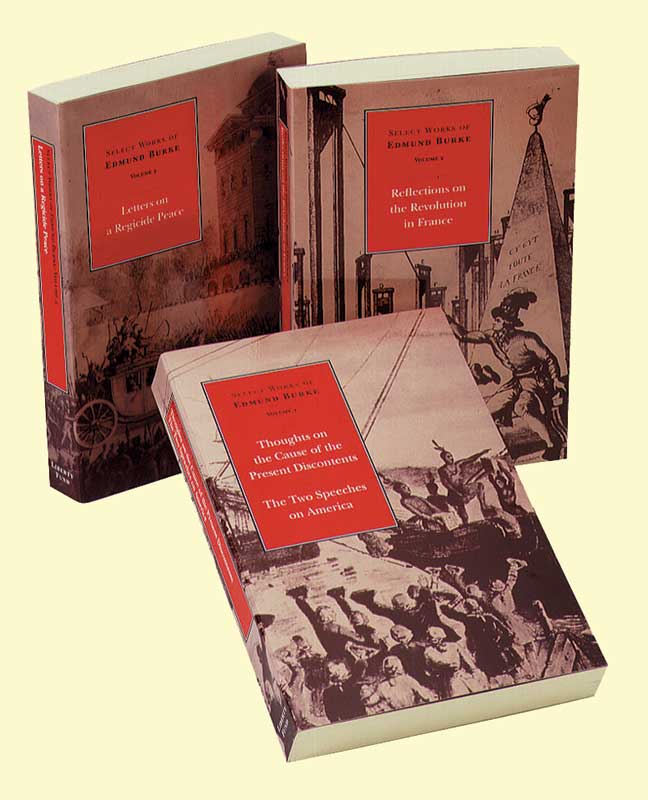
Thoughts on the Cause of the Present Discontents - Edmund Burke, Select Works of Edmund Burke, vol. 1 [1770]Edition used:Select Works of Edmund Burke. A New Imprint of the Payne Edition. Foreword and Biographical Note by Francis Canavan (Indianapolis: Liberty Fund, 1999). Vol. 1.
Part of: Select Works of Edmund Burke, 4 vols.About Liberty Fund:Liberty Fund, Inc. is a private, educational foundation established to encourage the study of the ideal of a society of free and responsible individuals. Copyright information:The copyright to this edition, in both print and electronic forms, is held by Liberty Fund, Inc. Fair use statement:This material is put online to further the educational goals of Liberty Fund, Inc. Unless otherwise stated in the Copyright Information section above, this material may be used freely for educational and academic purposes. It may not be used in any way for profit.
Thoughts on the Cause of the Present Discontents[1770. Sixth Edition, Dodsley, 1784.]
Hoc vero occultum, intestinum ac domesticum malum, non modo non existit, verum etiam opprimit, antequam prospicere atque explorare potueris.—Cicero. It is an undertaking of some degree of delicacy to examine into the cause of public disorders. If a man happens not to succeed in such an enquiry, he will be thought weak and visionary; if he touches the true grievance, there is a[2] danger that he may come near to persons of weight and consequence, who will rather be exasperated at the discovery of their errors, than thankful for the occasion of correcting them. If he should be obliged to blame the favourites of the people, he will be considered as the tool of power; if he censures those in power, he will be looked on as an instrument of faction. But in all exertions of duty something is to be hazarded. In cases of tumult and disorder, our law has invested every man, in some sort, with the authority of a magistrate. When the affairs of the nation are distracted, private people are, by the spirit of that law, justified in stepping a little out of their ordinary sphere. They enjoy a privilege, of somewhat more dignity and effect, than that of idle lamentation over the calamities of their country. They may look into them narrowly; they may reason upon them liberally; and if they should be so fortunate as to discover the true source of the mischief, and to suggest any probable method of removing it, though they may displease the rulers for the day, they are certainly of service to the cause of Government. Government is deeply interested in everything which, even through the medium of some temporary uneasiness, may tend finally to compose the minds of the subject, and to conciliate their affections. I have nothing to do here with the abstract value of the voice of the people. But as long as reputation, the most precious possession of every individual, and as long as opinion, the great support of the State, depend entirely upon that voice, it can never be considered as a thing of little consequence either to individuals or to Government. Nations are not primarily ruled by laws; less by violence. Whatever original energy may be supposed either in force or regulation; the operation of both is, in truth, merely instrumental. Nations are governed by the same methods, and on the same principles, by which an individual without authority is often able to govern[3] those who are his equals or his superiours; by a knowledge of their temper, and by a judicious management of it; I mean, when public affairs are steadily and quietly conducted: not when Government is nothing but a continued scuffle between the magistrate and the multitude; in which sometimes the one and sometimes the other is uppermost; in which they alternately yield and prevail, in a series of contemptible victories, and scandalous submissions. The temper of the people amongst whom he presides ought therefore to be the first study of a Statesman. And the knowledge of this temper it is by no means impossible for him to attain, if he has not an interest in being ignorant of what it is his duty to learn. To complain of the age we live in, to murmur at the present possessors of power, to lament the past, to conceive extravagant hopes of the future, are the common dispositions of the greatest part of mankind; indeed the necessary effects of the ignorance and levity of the vulgar. Such complaints and humours have existed in all times; yet as all times have not been alike, true political sagacity manifests itself, in distinguishing that complaint which only characterizes the general infirmity of human nature, from those which are symptoms of the particular distemperature of our own air and season. Nobody, I believe, will consider it merely as the language of spleen or disappointment, if I say, that there is something particularly alarming in the present conjuncture. There is hardly a man, in or out of power, who holds any other language. That Government is at once dreaded and contemned; that the laws are despoiled of all their respected and salutary terrors; that their inaction is a subject of ridicule, and their exertion of abhorrence; that rank, and office, and title, and all the solemn plausibilities of the world, have lost their reverence and effect; that our foreign politicks[4] are as much deranged as our domestic oeconomy; that our dependencies are slackened in their affection, and loosened from their obedience; that we know neither how to yield nor how to enforce; that hardly anything above or below, abroad or at home, is sound and entire; but that disconnexion and confusion, in offices, in parties, in families, in Parliament, in the nation, prevail beyond the disorders of any former time: these are facts universally admitted and lamented. This state of things is the more extraordinary, because the great parties which formerly divided and agitated the kingdom are known to be in a manner entirely dissolved. No great external calamity has visited the nation; no pestilence or famine. We do not labour at present under any scheme of taxation new or oppressive in the quantity or in the mode. Nor are we engaged in unsuccessful war; in which, our misfortunes might easily pervert our judgement; and our minds, sore from the loss of national glory, might feel every blow of Fortune as a crime in Government. It is impossible that the cause of this strange distemper should not sometimes become a subject of discourse. It is a compliment due, and which I willingly pay, to those who administer our affairs, to take notice in the first place of their speculation. Our Ministers are of opinion, that the increase of our trade and manufactures, that our growth by colonization and by conquest, have concurred to accumulate immense wealth in the hands of some individuals; and this again being dispersed amongst the people, has rendered them universally proud, ferocious, and ungovernable; that the insolence of some from their enormous wealth, and the boldness of others from a guilty poverty, have rendered them capable of the most atrocious attempts; so that they have trampled upon all subordination, and violently borne down the unarmed laws of a free Government; barriers too feeble [5] against the fury of a populace so fierce and licentious as ours. They contend, that no adequate provocation has been given for so spreading a discontent; our affairs having been conducted throughout with remarkable temper and consummate wisdom. The wicked industry of some libellers, joined to the intrigues of a few disappointed politicians, have, in their opinion, been able to produce this unnatural ferment in the nation. Nothing indeed can be more unnatural than the present convulsions of this country, if the above account be a true one. I confess I shall assent to it with great reluctance, and only on the compulsion of the clearest and firmest proofs; because their account resolves itself into this short, but discouraging proposition, “That we have a very good Ministry, but that we are a very bad people”; that we set ourselves to bite the hand that feeds us; that with a malignant insanity we oppose the measures, and ungratefully vilify the persons, of those whose sole object is our own peace and prosperity. If a few puny libellers, acting under a knot of factious politicians, without virtue, parts, or character, (such they are constantly represented by these gentlemen,) are sufficient to excite this disturbance, very perverse must be the disposition of that people, amongst whom such a disturbance can be excited by such means. It is besides no small aggravation of the public misfortune, that the disease, on this hypothesis, appears to be without remedy. If the wealth of the nation be the cause of its turbulence, I imagine it is not proposed to introduce poverty, as a constable to keep the peace. If our dominions abroad are the roots which feed all this rank luxuriance of sedition, it is not intended to cut them off in order to famish the fruit. If our liberty has enfeebled the executive power, there is no design, I hope, to call in the aid of despotism, to fill up the deficiencies of law. Whatever may be intended, these things are not yet professed. We[6] seem therefore to be driven to absolute despair; for we have no other materials to work upon, but those out of which God has been pleased to form the inhabitants of this island. If these be radically and essentially vitious, all that can be said is that those men are very unhappy, to whose fortune or duty it falls to administer the affairs of this untoward people. I hear it indeed sometimes asserted, that a steady perseverance in the present measures, and a rigorous punishment of those who oppose them, will in course of time infallibly put an end to these disorders. But this, in my opinion, is said without much observation of our present disposition, and without any knowledge at all of the general nature of mankind. If the matter of which this nation is composed be so very fermentable as these gentlemen describe it, leaven never will be wanting to work it up, as long as discontent, revenge, and ambition have existence in the world. Particular punishments are the cure for accidental distempers in the State; they inflame rather than allay those heats which arise from the settled mismanagement of the Government, or from a natural ill disposition in the people. It is of the utmost moment not to make mistakes in the use of strong measures; and firmness is then only a virtue when it accompanies the most perfect wisdom. In truth, inconstancy is a sort of natural corrective of folly and ignorance. I am not one of those who think that the people are never in the wrong. They have been so, frequently and outrageously, both in other countries and in this. But I do say, that in all disputes between them and their rulers, the presumption is at least upon a par in favour of the people. Experience may perhaps justify me in going further. When popular discontents have been very prevalent; it may well be affirmed and supported, that there has been generally something found amiss in the constitution, or in the conduct of Government. The people have no interest in disorder. [7]When they do wrong, it is their error, and not their crime. But with the governing part of the State, it is far otherwise. They certainly may act ill by design, as well as by mistake. “Les révolutions qui arrivent dans les grands états ne sont point un effect du hazard, ni du caprice des peuples. Rien ne révolte les grands d’un royaume comme un Gouvernement foible et dérangé. Pour la populace, ce n’est jamais par envie d’attaquer qu’elle se soulève, mais par impatience de souffrir.” These are the words of a great man; of a Minister of state; and a zealous assertor of Monarchy. They are applied to the system of Favouritism which was adopted by Henry the Third of France, and to the dreadful consequences it produced. What he says of revolutions, is equally true of all great disturbances. If this presumption in favour of the subjects against the trustees of power be not the more probable, I am sure it is the more comfortable speculation; because it is more easy to change an administration than to reform a people. Upon a supposition, therefore, that, in the opening of the cause, the presumptions stand equally balanced between the parties, there seems sufficient ground to entitle any person to a fair hearing, who attempts some other scheme beside that easy one which is fashionable in some fashionable companies, to account for the present discontents. It is not to be argued that we endure no grievance, because our grievances are not of the same sort with those under which we laboured formerly; not precisely those which we bore from the Tudors, or vindicated on the Stuarts. A great change has taken place in the affairs of this country. For in the silent lapse of events as material alterations have been insensibly brought about in the policy and character of governments and nations, as those which have been marked by the tumult of public revolutions. [8]It is very rare indeed for men to be wrong in their feelings concerning public misconduct; as rare to be right in their speculation upon the cause of it. I have constantly observed, that the generality of people are fifty years, at least, behindhand in their politicks. There are but very few, who are capable of comparing and digesting what passes before their eyes at different times and occasions, so as to form the whole into a distinct system. But in books everything is settled for them, without the exertion of any considerable diligence or sagacity. For which reason men are wise with but little reflexion, and good with little self-denial, in the business of all times except their own. We are very uncorrupt and tolerably enlightened judges of the transactions of past ages; where no passions deceive, and where the whole train of circumstances, from the trifling cause to the tragical event, is set in an orderly series before us. Few are the partizans of departed tyranny; and to be a Whig on the business of an hundred years ago, is very consistent with every advantage of present servility. This retrospective wisdom, and historical patriotism, are things of wonderful convenience; and serve admirably to reconcile the old quarrel between speculation and practice. Many a stern republican, after gorging himself with a full feast of admiration of the Grecian commonwealths and of our true Saxon constitution, and discharging all the splendid bile of his virtuous indignation on King John and King James, sits down perfectly satisfied to the coarsest work and homeliest job of the day he lives in. I believe there was no professed admirer of Henry the Eighth among the instruments of the last King James; nor in the court of Henry the Eighth was there, I dare say, to be found a single advocate for the favourites of Richard the Second. No complaisance to our Court, or to our age, can make me believe nature to be so changed, but that public liberty will be among us, as among our ancestors, obnoxious to some[9] person or other; and that opportunities will be furnished for attempting, at least, some alteration to the prejudice of our constitution.These attempts will naturally vary in their mode, according to times and circumstances. For ambition, though it has ever the same general views, has not at all times the same means, nor the same particular objects. A great deal of the furniture of ancient tyranny is worn to rags; the rest is entirely out of fashion. Besides, there are few Statesmen so very clumsy and awkward in their business, as to fall into the identical snare which has proved fatal to their predecessors. When an arbitrary imposition is attempted upon the subject, undoubtedly it will not bear on its forehead the name of Ship-money. There is no danger that an extension of the Forest laws should be the chosen mode of oppression in this age. And when we hear any instance of ministerial rapacity, to the prejudice of the rights of private life, it will certainly not be the exaction of two hundred pullets, from a woman of fashion, for leave to lye with her own husband. Every age has its own manners, and its politicks dependent upon them; and the same attempts will not be made against a constitution fully formed and matured, that were used to destroy it in the cradle, or to resist its growth during its infancy. Against the being of Parliament, I am satisfied, no designs have ever been entertained since the Revolution. Every one must perceive, that it is strongly the interest of the Court, to have some second cause interposed between the Ministers and the people. The gentlemen of the House of Commons have an interest equally strong, in sustaining the part of that intermediate cause. However they may hire out the usufruct of their voices, they never will part with the fee and inheritance. Accordingly those who have been of the most known devotion to the will and pleasure of a Court, have, at the same time, been most forward in asserting an[10] high authority in the House of Commons. When they knew who were to use that authority, and how it was to be employed, they thought it never could be carried too far. It must be always the wish of an unconstitutional Statesman, that an House of Commons who are entirely dependent upon him, should have every right of the people entirely dependent upon their pleasure. It was soon discovered, that the forms of a free, and the ends of an arbitrary Government, were things not altogether incompatible. The power of the Crown, almost dead and rotten as Prerogative, has grown up anew, with much more strength, and far less odium, under the name of Influence. An influence, which operated without noise and without violence; an influence, which converted the very antagonist, into the instrument, of power; which contained in itself a perpetual principle of growth and renovation; and which the distresses and the prosperity of the country equally tended to augment, was an admirable substitute for a Prerogative, that, being only the offspring of antiquated prejudices, had moulded in its original stamina irresistible principles of decay and dissolution. The ignorance of the people is a bottom but for a temporary system; the interest of active men in the State is a foundation perpetual and infallible. However, some circumstances, arising, it must be confessed, in a great degree from accident, prevented the effects of this influence for a long time from breaking out in a manner capable of exciting any serious apprehensions. Although Government was strong and flourished exceedingly, the Court had drawn far less advantage than one would imagine from this great source of power. At the Revolution, the Crown, deprived, for the ends of the Revolution itself, of many prerogatives, was found too weak to struggle against all the difficulties which pressed so[11] new and unsettled a Government. The Court was obliged therefore to delegate a part of its powers to men of such interest as could support, and of such fidelity as would adhere to, its establishment. Such men were able to draw in a greater number to a concurrence in the common defence. This connexion, necessary at first, continued long after convenient; and properly conducted might indeed, in all situations, be an useful instrument of Government. At the same time, through the intervention of men of popular weight and character, the people possessed a security for their just proportion of importance in the State. But as the title to the Crown grew stronger by long possession, and by the constant increase of its influence, these helps have of late seemed to certain persons no better than incumbrances. The powerful managers for Government were not sufficiently submissive to the pleasure of the possessors of immediate and personal favour, sometimes from a confidence in their own strength natural and acquired; sometimes from a fear of offending their friends, and weakening that lead in the country, which gave them a consideration independent of the Court. Men acted as if the Court could receive, as well as confer, an obligation. The influence of Government, thus divided in appearance between the Court and the leaders of parties, became in many cases an accession rather to the popular than to the royal scale; and some part of that influence, which would otherwise have been possessed as in a sort of mortmain and unalienable domain, returned again to the great ocean from whence it arose, and circulated among the people. This method therefore of governing by men of great natural interest or great acquired consideration, was viewed in a very invidious light by the true lovers of absolute monarchy. It is the nature of despotism to abhor power held by any means but its own momentary pleasure; and to annihilate all intermediate situations between boundless[12] strength on its own part, and total debility on the part of the people. To get rid of all this intermediate and independent importance, and to secure to the Court the unlimited and uncontrouled use of its own vast influence, under the sole direction of its own private favour, has for some years past been the great object of policy. If this were compassed, the influence of the Crown must of course produce all the effects which the most sanguine partizans of the Court could possibly desire. Government might then be carried on without any concurrence on the part of the people; without any attention to the dignity of the greater, or to the affections of the lower sorts. A new project was therefore devised by a certain set of intriguing men, totally different from the system of Administration which had prevailed since the accession of the House of Brunswick. This project, I have heard, was first conceived by some persons in the court of Frederick Prince of Wales. The earliest attempt in the execution of this design was to set up for Minister, a person, in rank indeed respectable, and very ample in fortune; but who, to the moment of this vast and sudden elevation, was little known or considered in the kingdom. To him the whole nation was to yield an immediate and implicit submission. But whether it was from want of firmness to bear up against the first opposition; or that things were not yet fully ripened, or that this method was not found the most eligible; that idea was soon abandoned. The instrumental part of the project was a little altered, to accommodate it to the time, and to bring things more gradually and more surely to the one great end proposed. The first part of the reformed plan was to draw a line which should separate the Court from the Ministry. Hitherto these names had been looked upon as synonymous; but for[13] the future, Court and Administration were to be considered as things totally distinct. By this operation, two systems of Administration were to be formed; one which should be in the real secret and confidence; the other merely ostensible, to perform the official and executory duties of Government. The latter were alone to be responsible; whilst the real advisers, who enjoyed all the power, were effectually removed from all the danger. Secondly, A party under these leaders was to be formed in favour of the Court against the Ministry: this party was to have a large share in the emoluments of Government, and to hold it totally separate from, and independent of, ostensible Administration. The third point, and that on which the success of the whole scheme ultimately depended, was to bring Parliament to an acquiescence in this project. Parliament was therefore to be taught by degrees a total indifference to the persons, rank, influence, abilities, connexions, and character of the Ministers of the Crown. By means of a discipline, on which I shall say more hereafter, that body was to be habituated to the most opposite interests, and the most discordant politicks. All connexions and dependencies among subjects were to be entirely dissolved. As hitherto business had gone through the hands of leaders of Whigs or Tories, men of talents to conciliate the people, and to engage their confidence, now the method was to be altered; and the lead was to be given to men of no sort of consideration or credit in the country. This want of natural importance was to be their very title to delegated power. Members of Parliament were to be hardened into an insensibility to pride as well as to duty. Those high and haughty sentiments, which are the great support of independence, were to be let down gradually. Point of honour and precedence were no more to be regarded in Parliamentary decorum, than in a Turkish[14] army. It was to be avowed, as a constitutional maxim, that the King might appoint one of his footmen, or one of your footmen, for Minister; and that he ought to be, and that he would be, as well followed as the first name for rank or wisdom in the nation. Thus Parliament was to look on, as if perfectly unconcerned, while a cabal of the closet and back-stairs was substituted in the place of a national Administration. With such a degree of acquiescence, any measure of any Court might well be deemed thoroughly secure. The capital objects, and by much the most flattering characteristicks of arbitrary power, would be obtained. Everything would be drawn from its holdings in the country to the personal favour and inclination of the Prince. This favour would be the sole introduction to power, and the only tenure by which it was to be held: so that no person looking towards another, and all looking towards the Court, it was impossible but that the motive which solely influenced every man’s hopes must come in time to govern every man’s conduct; till at last the servility became universal, in spite of the dead letter of any laws or institutions whatsoever. How it should happen that any man could be tempted to venture upon such a project of Government, may at first view appear surprizing. But the fact is, that opportunities very inviting to such an attempt have offered; and the scheme itself was not destitute of some arguments, not wholly unplausible, to recommend it. These opportunities and these arguments, the use that has been made of both, the plan for carrying this new scheme of government into execution, and the effects which it has produced, are in my opinion worthy of our serious consideration. His Majesty came to the throne of these kingdoms with more advantages than any of his predecessors since the Revolution. Fourth in descent, and third in succession of[15] his Royal family, even the zealots of hereditary right, in him, saw something to flatter their favourite prejudices; and to justify a transfer of their attachments, without a change in their principles. The person and cause of the Pretender were become contemptible; his title disowned throughout Europe, his party disbanded in England. His Majesty came indeed to the inheritance of a mighty war; but, victorious in every part of the globe, peace was always in his power, not to negociate, but to dictate. No foreign habitudes or attachments withdrew him from the cultivation of his power at home. His revenue for the civil establishment, fixed (as it was then thought) at a large, but definite sum, was ample, without being invidious. His influence, by additions from conquest, by an augmentation of debt, by an increase of military and naval establishment, much strengthened and extended. And coming to the throne in the prime and full vigour of youth, as from affection there was a strong dislike, so from dread there seemed to be a general averseness, from giving anything like offence to a Monarch, against whose resentment opposition could not look for a refuge in any sort of reversionary hope. These singular advantages inspired his Majesty only with a more ardent desire to preserve unimpaired the spirit of that national freedom, to which he owed a situation so full of glory. But to others it suggested sentiments of a very different nature. They thought they now beheld an opportunity (by a certain sort of Statesmen never long undiscovered or unemployed) of drawing to themselves, by the aggrandisement of a Court Faction, a degree of power which they could never hope to derive from natural influence or from honourable service; and which it was impossible they could hold with the least security, whilst the system of Administration rested upon its former bottom. In order to facilitate the execution of their design, it was necessary to[16] make many alterations in political arrangement, and a signal change in the opinions, habits, and connexions of the greatest part of those who at that time acted in publick. In the first place, they proceeded gradually, but not slowly, to destroy everything of strength which did not derive its principal nourishment from the immediate pleasure of the Court. The greatest weight of popular opinion and party connexion were then with the Duke of Newcastle and Mr. Pitt. Neither of these held their importance by the new tenure of the Court; they were not therefore thought to be so proper as others for the services which were required by that tenure. It happened very favourably for the new system, that under a forced coalition there rankled an incurable alienation and disgust between the parties which composed the Administration. Mr. Pitt was first attacked. Not satisfied with removing him from power, they endeavoured by various artifices to ruin his character. The other party seemed rather pleased to get rid of so oppressive a support; not perceiving that their own fall was prepared by his, and involved in it. Many other reasons prevented them from daring to look their true situation in the face. To the great Whig families it was extremely disagreeable, and seemed almost unnatural, to oppose the Administration of a Prince of the House of Brunswick. Day after day they hesitated, and doubted, and lingered, expecting that other counsels would take place; and were slow to be persuaded, that all which had been done by the Cabal, was the effect not of humour, but of system. It was more strongly and evidently the interest of the new Court Faction, to get rid of the great Whig connexions, than to destroy Mr. Pitt. The power of that gentleman was vast indeed and merited; but it was in a great degree personal, and therefore transient. Theirs was rooted in the country. For, with a good deal less of popularity, they possessed a far more natural[17] and fixed influence. Long possession of Government; vast property; obligations of favours given and received; connexion of office; ties of blood, of alliance, of friendship (things at that time supposed of some force); the name of Whig, dear to the majority of the people; the zeal early begun and steadily continued to the Royal Family: all these together formed a body of power in the nation, which was criminal and devoted. The great ruling principle of the Cabal, and that which animated and harmonized all their proceedings, how various soever they may have been, was to signify to the world, that the Court would proceed upon its own proper forces only; and that the pretence of bringing any other into its service was an affront to it, and not a support. Therefore when the chiefs were removed, in order to go to the root, the whole party was put under a proscription, so general and severe as to take their hard-earned bread from the lowest officers, in a manner which had never been known before, even in general revolutions. But it was thought necessary effectually to destroy all dependencies but one; and to show an example of the firmness and rigour with which the new system was to be supported. Thus for the time were pulled down, in the persons of the Whig leaders and of Mr. Pitt, (in spite of the services of the one at the accession of the Royal Family, and the recent services of the other in the war,) the two only securities for the importance of the people; power arising from popularity; and power arising from connexion.Here and there indeed a few individuals were left standing, who gave security for their total estrangement from the odious principles of party connexion and personal attachment; and it must be confessed that most of them have religiously kept their faith. Such a change could not however be made without a mighty shock to Government. [18]To reconcile the minds of the people to all these movements, principles correspondent to them had been preached up with great zeal. Every one must remember that the Cabal set out with the most astonishing prudery, both moral and political. Those, who in a few months after soused over head and ears into the deepest and dirtiest pits of corruption, cried out violently against the indirect practices in the electing and managing of Parliaments, which had formerly prevailed. This marvellous abhorrence which the Court had suddenly taken to all influence, was not only circulated in conversation through the kingdom, but pompously announced to the publick, with many other extraordinary things, in a pamphlet which had all the appearance of a manifesto preparatory to some considerable enterprize. Throughout, it was a satire, though in terms managed and decent enough, on the politicks of the former Reign. It was indeed written with no small art and address. In this piece appeared the first dawning of the new system; there first appeared the idea (then only in speculation) of separating the Court from the Administration; of carrying everything from national connexion to personal regards; and of forming a regular party for that purpose, under the name of King’s men. To recommend this system to the people, a perspective view of the Court, gorgeously painted, and finely illuminated from within, was exhibited to the gaping multitude. Party was to be totally done away, with all its evil works. Corruption was to be cast down from Court, as Atè was from heaven. Power was thenceforward to be the chosen residence of public spirit; and no one was to be supposed under any sinister influence, except those who had the misfortune to be in disgrace at Court, which was to stand in lieu of all vices and all corruptions. A scheme of perfection to be realized in a Monarchy, far beyond the visionary[19] Republick of Plato. The whole scenery was exactly disposed to captivate those good souls, whose credulous morality is so invaluable a treasure to crafty politicians. Indeed there was wherewithall to charm every body, except those few who are not much pleased with professions of supernatural virtue, who know of what stuff such professions are made, for what purposes they are designed, and in what they are sure constantly to end. Many innocent gentlemen, who had been talking prose all their lives without knowing anything of the matter, began at last to open their eyes upon their own merits, and to attribute their not having been Lords of the Treasury and Lords of Trade many years before, merely to the prevalence of party, and to the Ministerial power, which had frustrated the good intentions of the Court in favour of their abilities. Now was the time to unlock the sealed fountain of Royal bounty, which had been infamously monopolized and huckstered, and to let it flow at large upon the whole people. The time was come, to restore Royalty to its original splendour. Mettre le Roy hors de page, became a sort of watchword. And it was constantly in the mouths of all the runners of the Court, that nothing could preserve the balance of the constitution from being overturned by the rabble, or by a faction of the nobility, but to free the sovereign effectually from that Ministerial tyranny under which the Royal dignity had been oppressed in the person of his Majesty’s grandfather. These were some of the many artifices used to reconcile the people to the great change which was made in the persons who composed the Ministry, and the still greater which was made and avowed in its constitution. As to individuals, other methods were employed with them; in order so thoroughly to disunite every party, and even every family, that no concert, order, or effect, might appear in any future opposition. And in this manner an Administration without[20] connexion with the people, or with one another, was first put in possession of Government. What good consequences followed from it, we have all seen; whether with regard to virtue, public or private; to the ease and happiness of the Sovereign; or to the real strength of Government. But as so much stress was then laid on the necessity of this new project, it will not be amiss to take a view of the effects of this Royal servitude and vile durance, which was so deplored in the reign of the late Monarch, and was so carefully to be avoided in the reign of his Successor. The effects were these. In times full of doubt and danger to his person and family, George the Second maintained the dignity of his Crown connected with the liberty of his people, not only unimpaired, but improved, for the space of thirty-three years. He overcame a dangerous rebellion, abetted by foreign force, and raging in the heart of his kingdoms; and thereby destroyed the seeds of all future rebellion that could arise upon the same principle. He carried the glory, the power, the commerce of England, to an height unknown even to this renowned nation in the times of its greatest prosperity: and he left his succession resting on the true and only true foundation of all national and all regal greatness; affection at home, reputation abroad, trust in allies, terror in rival nations. The most ardent lover of his country cannot wish for Great Britain an happier fate than to continue as she was then left. A people emulous as we are in affection to our present Sovereign, know not how to form a prayer to Heaven for a greater blessing upon his virtues, or an higher state of felicity and glory, than that he should live, and should reign, and, when Providence ordains it, should die, exactly like his illustrious Predecessor. A great Prince may be obliged (though such a thing cannot happen very often) to sacrifice his private inclination[21] to his public interest. A wise Prince will not think that such a restraint implies a condition of servility; and truly, if such was the condition of the last reign, and the effects were also such as we have described, we ought, no less for the sake of the Sovereign whom we love, than for our own, to hear arguments convincing indeed, before we depart from the maxims of that reign, or fly in the face of this great body of strong and recent experience. One of the principal topicks which was then, and has been since, much employed by that political school, is an effectual terror of the growth of an aristocratic power, prejudicial to the rights of the Crown, and the balance of the constitution. Any new powers exercised in the House of Lords, or in the House of Commons, or by the Crown, ought certainly to excite the vigilant and anxious jealousy of a free people. Even a new and unprecedented course of action in the whole Legislature, without great and evident reason, may be a subject of just uneasiness. I will not affirm, that there may not have lately appeared in the House of Lords a disposition to some attempts derogatory to the legal rights of the subject. If any such have really appeared, they have arisen, not from a power properly aristocratic, but from the same influence which is charged with having excited attempts of a similar nature in the House of Commons; which House, if it should have been betrayed into an unfortunate quarrel with its constituents, and involved in a charge of the very same nature, could have neither power nor inclination to repell such attempts in others. Those attempts in the House of Lords can no more be called aristocratic proceedings, than the proceedings with regard to the county of Middlesex in the House of Commons can with any sense be called democratical. It is true, that the Peers have a great influence in the kingdom, and in every part of the public concerns. While[22] they are men of property, it is impossible to prevent it, except by such means as must prevent all property from its natural operation: an event not easily to be compassed, while property is power; nor by any means to be wished, while the least notion exists of the method by which the spirit of liberty acts, and of the means by which it is preserved. If any particular Peers, by their uniform, upright, constitutional conduct, by their public and their private virtues, have acquired an influence in the country; the people on whose favour that influence depends, and from whom it arose, will never be duped into an opinion, that such greatness in a Peer is the despotism of an aristocracy, when they know and feel it to be the effect and pledge of their own importance. I am no friend to aristocracy, in the sense at least in which that word is usually understood. If it were not a bad habit to moot cases on the supposed ruin of the constitution, I should be free to declare, that if it must perish, I would rather by far see it resolved into any other form, than lost in that austere and insolent domination. But, whatever my dislikes may be, my fears are not upon that quarter. The question, on the influence of a Court, and of a Peerage, is not, which of the two dangers is the most eligible, but which is the most imminent. He is but a poor observer, who has not seen, that the generality of Peers, far from supporting themselves in a state of independent greatness, are but too apt to fall into an oblivion of their proper dignity, and to run headlong into an abject servitude. Would to God it were true, that the fault of our Peers were too much spirit! It is worthy of some observation, that these gentlemen, so jealous of aristocracy, make no complaints of the power of those peers (neither few nor inconsiderable) who are always in the train of a Court, and whose whole weight must be considered as a portion of the settled[23] influence of the Crown. This is all safe and right; but if some Peers (I am very sorry they are not as many as they ought to be) set themselves, in the great concern of Peers and Commons, against a back-stairs influence and clandestine government, then the alarm begins; then the constitution is in danger of being forced into an aristocracy. I rest a little the longer on this Court topick, because it was much insisted upon at the time of the great change, and has been since frequently revived by many of the agents of that party: for, whilst they are terrifying the great and opulent with the horrors of mob-government, they are by other managers attempting (though hitherto with little success) to alarm the people with a phantom of tyranny in the Nobles. All this is done upon their favourite principle of disunion, of sowing jealousies amongst the different orders of the State, and of disjointing the natural strength of the kingdom; that it may be rendered incapable of resisting the sinister designs of wicked men, who have engrossed the Royal power. Thus much of the topicks chosen by the Courtiers to recommend their system; it will be necessary to open a little more at large the nature of that party which was formed for its support. Without this, the whole would have been no better than a visionary amusement, like the scheme of Harrington’s political club, and not a business in which the nation had a real concern. As a powerful party, and a party constructed on a new principle, it is a very inviting object of curiosity. It must be remembered, that since the Revolution, until the period we are speaking of, the influence of the Crown had been always employed in supporting the Ministers of State, and in carrying on the public business according to their opinions. But the party now in question is formed[24] upon a very different idea. It is to intercept the favour, protection, and confidence of the Crown in the passage to its Ministers; it is to come between them and their importance in Parliament; it is to separate them from all their natural and acquired dependencies; it is intended as the controul, not the support, of Administration. The machinery of this system is perplexed in its movements, and false in its principle. It is formed on a supposition that the King is something external to his government; and that he may be honoured and aggrandized, even by its debility and disgrace. The plan proceeds expressly on the idea of enfeebling the regular executory power. It proceeds on the idea of weakening the State in order to strengthen the Court. The scheme depending entirely on distrust, on disconnexion, on mutability by principle, on systematic weakness in every particular member; it is impossible that the total result should be substantial strength of any kind. As a foundation of their scheme, the Cabal have established a sort of Rota in the Court. All sorts of parties, by this means, have been brought into Administration, from whence few have had the good fortune to escape without disgrace; none at all without considerable losses. In the beginning of each arrangement no professions of confidence and support are wanting, to induce the leading men to engage. But while the Ministers of the day appear in all the pomp and pride of power, while they have all their canvas spread out to the wind, and every sail filled with the fair and prosperous gale of Royal favour, in a short time they find, they know not how, a current, which sets directly against them; which prevents all progress; and even drives them backwards. They grow ashamed and mortified in a situation, which, by its vicinity to power, only serves to remind them the more strongly of their insignificance. They are obliged either to execute the orders of their inferiors, or to[25] see themselves opposed by the natural instruments of their office. With the loss of their dignity, they lose their temper. In their turn they grow troublesome to that Cabal, which, whether it supports or opposes, equally disgraces and equally betrays them. It is soon found necessary to get rid of the heads of Administration; but it is of the heads only. As there always are many rotten members belonging to the best connexions, it is not hard to persuade several to continue in office without their leaders. By this means the party goes out much thinner than it came in; and is only reduced in strength by its temporary possession of power. Besides, if by accident, or in course of changes, that power should be recovered, the Junto have thrown up a retrenchment of these carcases, which may serve to cover themselves in a day of danger. They conclude, not unwisely, that such rotten members will become the first objects of disgust and resentment to their antient connexions. They contrive to form in the outward Administration two parties at the least; which, whilst they are tearing one another to pieces, are both competitors for the favour and protection of the Cabal; and, by their emulation, contribute to throw everything more and more into the hands of the interior managers. A Minister of State will sometimes keep himself totally estranged from all his collegues; will differ from them in their counsels, will privately traverse, and publicly oppose, their measures. He will, however, continue in his employment. Instead of suffering any mark of displeasure, he will be distinguished by an unbounded profusion of Court rewards and caresses; because he does what is expected, and all that is expected, from men in office. He helps to keep some form of Administration in being, and keeps it at the same time as weak and divided as possible. However, we must take care not to be mistaken, or to[26] imagine that such persons have any weight in their opposition. When, by them, Administration is convinced of its insignificancy, they are soon to be convinced of their own. They never are suffered to succeed in their opposition. They and the world are to be satisfied, that neither office, nor authority, nor property, nor ability, eloquence, counsel, skill, or union, are of the least importance; but that the mere influence of the Court, naked of all support, and destitute of all management, is abundantly sufficient for all its own purposes. When any adverse connexion is to be destroyed, the Cabal seldom appear in the work themselves. They find out some person of whom the party entertains an high opinion. Such a person they endeavour to delude with various pretences. They teach him first to distrust, and then to quarrel with his friends; among whom, by the same arts, they excite a similar diffidence of him; so that in this mutual fear and distrust, he may suffer himself to be employed as the instrument in the change which is brought about. Afterwards they are sure to destroy him in his turn; by setting up in his place some person in whom he had himself reposed the greatest confidence, and who serves to carry off a considerable part of his adherents. When such a person has broke in this manner with his connexions, he is soon compelled to commit some flagrant act of iniquitous personal hostility against some of them (such as an attempt to strip a particular friend of his family estate), by which the Cabal hope to render the parties utterly irreconcileable. In truth, they have so contrived matters, that people have a greater hatred to the subordinate instruments than to the principal movers. As in destroying their enemies they make use of instruments not immediately belonging to their corps, so in advancing their own friends they pursue exactly the same[27] method. To promote any of them to considerable rank or emolument, they commonly take care that the recommendation shall pass through the hands of the ostensible Ministry: such a recommendation might however appear to the world, as some proof of the credit of Ministers, and some means of increasing their strength. To prevent this, the persons so advanced are directed in all companies, industriously to declare, that they are under no obligations whatsoever to Administration; that they have received their office from another quarter; that they are totally free and independent. When the Faction has any job of lucre to obtain, or of vengeance to perpetrate, their way is, to select, for the execution, those very persons to whose habits, friendships, principles, and declarations, such proceedings are publicly known to be the most adverse; at once to render the instruments the more odious, and therefore the more dependent, and to prevent the people from ever reposing a confidence in any appearance of private friendship, or public principle. If the Administration seem now and then, from remissness, or from fear of making themselves disagreeable, to suffer any popular excesses to go unpunished, the Cabal immediately sets up some creature of theirs to raise a clamour against the Ministers, as having shamefully betrayed the dignity of Government. Then they compel the Ministry to become active in conferring rewards and honours on the persons who have been the instruments of their disgrace; and, after having first vilified them with the higher orders for suffering the laws to sleep over the licentiousness of the populace, they drive them (in order to make amends for their former inactivity) to some act of atrocious violence, which renders them completely abhorred by the people. They who remember the riots which attended the Middlesex Election; the opening of the present Parliament; and the[28] transactions relative to Saint George’s Fields, will not be at a loss for an application of these remarks. That this body may be enabled to compass all the ends of its institution, its members are scarcely ever to aim at the high and responsible offices of the State. They are distributed with art and judgement through all the secondary, but efficient, departments of office, and through the households of all the branches of the Royal Family: so as on one hand to occupy all the avenues to the Throne; and on the other to forward or frustrate the execution of any measure, according to their own interests. For with the credit and support which they are known to have, though for the greater part in places which are only a genteel excuse for salary, they possess all the influence of the highest posts; and they dictate publicly in almost every thing, even with a parade of superiority. Whenever they dissent (as it often happens) from their nominal leaders, the trained part of the Senate, instinctively in the secret, is sure to follow them; provided the leaders, sensible of their situation, do not of themselves recede in time from their most declared opinions. This latter is generally the case. It will not be conceivable to any one who has not seen it, what pleasure is taken by the Cabal in rendering these heads of office thoroughly contemptible and ridiculous. And when they are become so, they have then the best chance for being well supported. The members of the Court Faction are fully indemnified for not holding places on the slippery heights of the kingdom, not only by the lead in all affairs, but also by the perfect security in which they enjoy less conspicuous, but very advantageous, situations. Their places are, in express legal tenure, or in effect, all of them for life. Whilst the first and most respectable persons in the kingdom are tossed about like tennis balls, the sport of a blind and insolent caprice, no Minister dares even to cast an oblique glance at[29] the lowest of their body. If an attempt be made upon one of this corps, immediately he flies to sanctuary, and pretends to the most inviolable of all promises. No conveniency of public arrangement is available to remove any one of them from the specific situation he holds; and the slightest attempt upon one of them, by the most powerful Minister, is a certain preliminary to his own destruction. Conscious of their independence, they bear themselves with a lofty air to the exterior Ministers. Like Janissaries, they derive a kind of freedom from the very condition of their servitude. They may act just as they please; provided they are true to the great ruling principle of their institution. It is, therefore, not at all wonderful, that people should be so desirous of adding themselves to that body, in which they may possess and reconcile satisfactions the most alluring, and seemingly the most contradictory; enjoying at once all the spirited pleasure of independence, and all the gross lucre and fat emoluments of servitude. Here is a sketch, though a slight one, of the constitution, laws, and policy, of this new Court corporation. The name by which they chuse to distinguish themselves, is that of King’s men, or the King’s friends, by an invidious exclusion of the rest of his Majesty’s most loyal and affectionate subjects. The whole system, comprehending the exterior and interior Administrations, is commonly called, in the technical language of the Court, Double Cabinet; in French or English, as you chuse to pronounce it. Whether all this be a vision of a distracted brain, or the invention of a malicious heart, or a real Faction in the country, must be judged by the appearances which things have worn for eight years past. Thus far I am certain, that there is not a single public man, in or out of office, who has not, at some time or other, borne testimony to the truth of what I have now related. In particular, no persons have[30] been more strong in their assertions, and louder and more indecent in their complaints, than those who compose all the exterior part of the present Administration; in whose time that Faction has arrived at such an height of power, and of boldness in the use of it, as may, in the end, perhaps bring about its total destruction. It is true, that about four years ago, during the administration of the Marquis of Rockingham, an attempt was made to carry on Government without their concurrence. However, this was only a transient cloud; they were hid but for a moment; and their constellation blazed out with greater brightness, and a far more vigorous influence, some time after it was blown over. An attempt was at that time made (but without any idea of proscription) to break their corps, to discountenance their doctrines, to revive connexions of a different kind, to restore the principles and policy of the Whigs, to reanimate the cause of Liberty by Ministerial countenance; and then for the first time were men seen attached in office to every principle they had maintained in opposition. No one will doubt, that such men were abhorred and violently opposed by the Court Faction, and that such a system could have but a short duration. It may appear somewhat affected, that in so much discourse upon this extraordinary Party, I should say so little of the Earl of Bute, who is the supposed head of it. But this was neither owing to affectation nor inadvertence. I have carefully avoided the introduction of personal reflexions of any kind. Much the greater part of the topicks which have been used to blacken this Nobleman, are either unjust or frivolous. At best, they have a tendency to give the resentment of this bitter calamity a wrong direction, and to turn a public grievance into a mean personal, or a dangerous national, quarrel. Where there is a regular scheme of operations carried on, it is the system, and not any individual[31] person who acts in it, that is truly dangerous. This system has not risen solely from the ambition of Lord Bute, but from the circumstances which favoured it, and from an indifference to the constitution which had been for some time growing among our gentry. We should have been tried with it, if the Earl of Bute had never existed; and it will want neither a contriving head nor active members, when the Earl of Bute exists no longer. It is not, therefore, to rail at Lord Bute, but firmly to embody against this Court Party and its practices, which can afford us any prospect of relief in our present condition. Another motive induces me to put the personal consideration of Lord Bute wholly out of the question. He communicates very little in a direct manner with the greater part of our men of business. This has never been his custom. It is enough for him that he surrounds them with his creatures. Several imagine, therefore, that they have a very good excuse for doing all the work of this Faction, when they have no personal connexion with Lord Bute. But whoever becomes a party to an Administration, composed of insulated individuals, without faith plighted, tie, or common principle; an Administration constitutionally impotent, because supported by no party in the nation; he who contributes to destroy the connexions of men and their trust in one another, or in any sort to throw the dependence of public counsels upon private will and favour, possibly may have nothing to do with the Earl of Bute. It matters little whether he be the friend or the enemy of that particular person. But let him be who or what he will, he abets a Faction that is driving hard to the ruin of his country. He is sapping the foundation of its liberty, disturbing the sources of its domestic tranquillity, weakening its government over its dependencies, degrading it from all its importance in the system of Europe. [32]It is this unnatural infusion of a system of Favouritism into a Government which in a great part of its constitution is popular, that has raised the present ferment in the nation. The people, without entering deeply into its principles, could plainly perceive its effects, in much violence, in a great spirit of innovation, and a general disorder in all the functions of Government. I keep my eye solely on this system; if I speak of those measures which have arisen from it, it will be so far only as they illustrate the general scheme. This is the fountain of all those bitter waters of which, through an hundred different conduits, we have drunk until we are ready to burst. The discretionary power of the Crown in the formation of Ministry, abused by bad or weak men, has given rise to a system, which, without directly violating the letter of any law, operates against the spirit of the whole constitution. A plan of Favouritism for our executory Government is essentially at variance with the plan of our Legislature. One great end undoubtedly of a mixed Government like ours, composed of Monarchy, and of controuls, on the part of the higher people and the lower, is that the Prince shall not be able to violate the laws. This is useful indeed and fundamental. But this, even at first view, is no more than a negative advantage; an armour merely defensive. It is therefore next in order, and equal in importance, that the discretionary powers which are necessarily vested in the Monarch, whether for the execution of the laws, or for the nomination to magistracy and office, or for conducting the affairs of peace and war, or for ordering the revenue, should all be exercised upon public principles and national grounds, and not on the likings or prejudices, the intrigues or policies, of a Court. This, I said, is equal in importance to the securing a Government according to law. The laws reach[33] but a very little way. Constitute Government how you please, infinitely the greater part of it must depend upon the exercise of the powers which are left at large to the prudence and uprightness of Ministers of State. Even all the use and potency of the laws depends upon them. Without them, your Commonwealth is no better than a scheme upon paper; and not a living, active, effective constitution. It is possible, that through negligence, or ignorance, or design artfully conducted, Ministers may suffer one part of Government to languish, another to be perverted from its purposes, and every valuable interest of the country to fall into ruin and decay, without possibility of fixing any single act on which a criminal prosecution can be justly grounded. The due arrangement of men in the active part of the State, far from being foreign to the purposes of a wise Government, ought to be among its very first and dearest objects. When, therefore, the abettors of the new system tell us, that between them and their opposers there is nothing but a struggle for power, and that therefore we are no-ways concerned in it; we must tell those who have the impudence to insult us in this manner, that, of all things, we ought to be the most concerned, who and what sort of men they are, that hold the trust of everything that is dear to us. Nothing can render this a point of indifference to the nation, but what must either render us totally desperate, or soothe us into the security of ideots. We must soften into a credulity below the milkiness of infancy, to think all men virtuous. We must be tainted with a malignity truly diabolical, to believe all the world to be equally wicked and corrupt. Men are in public life as in private, some good, some evil. The elevation of the one, and the depression of the other, are the first objects of all true policy. But that form of Government, which, neither in its direct institutions, nor in their immediate tendency, has contrived to throw its affairs into[34] the most trust-worthy hands, but has left its whole executory system to be disposed of agreeably to the uncontrouled pleasure of any one man, however excellent or virtuous, is a plan of polity defective not only in that member, but consequentially erroneous in every part of it. In arbitrary Governments, the constitution of the Ministry follows the constitution of the Legislature. Both the Law and the Magistrate are the creatures of Will. It must be so. Nothing, indeed, will appear more certain, on any tolerable consideration of this matter, than that every sort of Government ought to have its Administration correspondent to its Legislature. If it should be otherwise, things must fall into an hideous disorder. The people of a free Commonwealth, who have taken such care that their laws should be the result of general consent, cannot be so senseless as to suffer their executory system to be composed of persons on whom they have no dependence, and whom no proofs of the public love and confidence have recommended to those powers, upon the use of which the very being of the State depends. The popular election of magistrates, and popular disposition of rewards and honours, is one of the first advantages of a free State. Without it, or something equivalent to it, perhaps the people cannot long enjoy the substance of freedom; certainly none of the vivifying energy of good Government. The frame of our Commonwealth did not admit of such an actual election: but it provided as well, and (while the spirit of the constitution is preserved) better, for all the effects of it, than by the method of suffrage in any democratic State whatsoever. It had always, until of late, been held the first duty of Parliament, to refuse to support Government, until power was in the hands of persons who were acceptable to the people, or while factions predominated in the Court in which the nation had no confidence. Thus all the good effects of popular[35] election were supposed to be secured to us, without the mischiefs attending on perpetual intrigue, and a distinct canvass for every particular office throughout the body of the people. This was the most noble and refined part of our constitution. The people, by their representatives and grandees, were intrusted with a deliberative power in making laws; the King with the controul of his negative. The King was intrusted with the deliberative choice and the election to office; the people had the negative in a Parliamentary refusal to support. Formerly this power of controul was what kept Ministers in awe of Parliaments, and Parliaments in reverence with the people. If the use of this power of controul on the system and persons of Administration is gone, everything is lost, Parliament and all. We may assure ourselves, that if Parliament will tamely see evil men take possession of all the strong-holds of their country, and allow them time and means to fortify themselves, under a pretence of giving them a fair trial, and upon a hope of discovering, whether they will not be reformed by power, and whether their measures will not be better than their morals; such a Parliament will give countenance to their measures also, whatever that Parliament may pretend, and whatever those measures may be. Every good political institution must have a preventive operation as well as a remedial. It ought to have a natural tendency to exclude bad men from Government, and not to trust for the safety of the State to subsequent punishment alone: punishment, which has ever been tardy and uncertain; and which, when power is suffered in bad hands, may chance to fall rather on the injured than the criminal. Before men are put forward into the great trusts of the State, they ought by their conduct to have obtained such a degree of estimation in their country, as may be some sort of pledge and security to the publick, that they will not abuse[36] those trusts. It is no mean security for a proper use of power, that a man has shown by the general tenor of his actions, that the affection, the good opinion, the confidence, of his fellow-citizens have been among the principal objects of his life; and that he has owed none of the gradations of his power or fortune to a settled contempt, or occasional forfeiture of their esteem. That man who before he comes into power has no friends, or who coming into power is obliged to desert his friends, or who losing it has no friends to sympathize with him; he who has no sway among any part of the landed or commercial interest, but whose whole importance has begun with his office, and is sure to end with it; is a person who ought never to be suffered by a controuling Parliament to continue in any of those situations which confer the lead and direction of all our public affairs; because such a man has no connexion with the interest of the people. Those knots or cabals of men who have got together, avowedly without any public principle, in order to sell their conjunct iniquity at the higher rate, and are therefore universally odious, ought never to be suffered to domineer in the State; because they have no connexion with the sentiments and opinions of the people. These are considerations which in my opinion enforce the necessity of having some better reason, in a free country, and a free Parliament, for supporting the Ministers of the Crown, than that short one, That the King has thought proper to appoint them. There is something very courtly in this. But it is a principle pregnant with all sorts of mischief, in a constitution like ours, to turn the views of active men from the country to the Court. Whatever be the road to power, that is the road which will be trod. If the opinion of the country be of no use as a means of power or consideration, the qualities which usually procure that opinion will be no longer[37] cultivated. And whether it will be right, in a State so popular in its constitution as ours, to leave ambition without popular motives, and to trust all to the operation of pure virtue in the minds of Kings and Ministers, and public men, must be submitted to the judgement and good sense of the people of England. Cunning men are here apt to break in, and, without directly controverting the principle, to raise objections from the difficulty under which the Sovereign labours, to distinguish the genuine voice and sentiments of his people, from the clamour of a faction, by which it is so easily counterfeited. The nation, they say, is generally divided into parties, with views and passions utterly irreconcileable. If the King should put his affairs into the hands of any one of them, he is sure to disgust the rest; if he select particular men from among them all, it is an hazard that he disgusts them all. Those who are left out, however divided before, will soon run into a body of opposition; which, being a collection of many discontents into one focus, will without doubt be hot and violent enough. Faction will make its cries resound through the nation, as if the whole were in an uproar, when by far the majority, and much the better part, will seem for awhile as it were annihilated by the quiet in which their virtue and moderation incline them to enjoy the blessings of Government. Besides that, the opinion of the meer vulgar is a miserable rule even with regard to themselves, on account of their violence and instability. So that if you were to gratify them in their humour to-day, that very gratification would be a ground of their dissatisfaction on the next. Now as all these rules of public opinion are to be collected with great difficulty, and to be applied with equal uncertainty as to the effect, what better can a King of England do, than to employ such men as he finds to have views and inclinations most conformable[38] to his own; who are least infected with pride and self-will; and who are least moved by such popular humours as are perpetually traversing his designs, and disturbing his service; trusting that when he means no ill to his people, he will be supported in his appointments, whether he chooses to keep or to change, as his private judgment or his pleasure leads him? He will find a sure resource in the real weight and influence of the Crown, when it is not suffered to become an instrument in the hands of a faction. I will not pretend to say that there is nothing at all in this mode of reasoning; because I will not assert, that there is no difficulty in the art of Government. Undoubtedly the very best Administration must encounter a great deal of opposition; and the very worst will find more support than it deserves. Sufficient appearances will never be wanting to those who have a mind to deceive themselves. It is a fallacy in constant use with those who would level all things, and confound right with wrong, to insist upon the inconveniences which are attached to every choice, without taking into consideration the different weight and consequence of those inconveniences. The question is not concerning absolute discontent or perfect satisfaction in Government; neither of which can be pure and unmixed at any time, or upon any system. The controversy is about that degree of good-humour in the people, which may possibly be attained, and ought certainly to be looked for. While some politicians may be waiting to know whether the sense of every individual be against them, accurately distinguishing the vulgar from the better sort, drawing lines between the enterprizes of a faction and the efforts of a people, they may chance to see the Government, which they are so nicely weighing, and dividing, and distinguishing, tumble to the ground in the midst of their wise deliberation. Prudent men, when so great an object as the security of Government, or even its[39] peace, is at stake, will not run the risque of a decision which may be fatal to it. They who can read the political sky will see an hurricane in a cloud no bigger than an hand at the very edge of the horizon, and will run into the first harbour. No lines can be laid down for civil or political wisdom. They are a matter incapable of exact definition. But, though no man can draw a stroke between the confines of day and night, yet light and darkness are upon the whole tolerably distinguishable. Nor will it be impossible for a Prince to find out such a mode of Government, and such persons to administer it, as will give a great degree of content to his people; without any curious and anxious research for that abstract, universal, perfect harmony, which while he is seeking, he abandons those means of ordinary tranquillity which are in his power without any research at all. It is not more the duty than it is the interest of a Prince, to aim at giving tranquillity to his Government. But those who advise him may have an interest in disorder and confusion. If the opinion of the people is against them, they will naturally wish that it should have no prevalence. Here it is that the people must on their part show themselves sensible of their own value. Their whole importance, in the first instance, and afterwards their whole freedom, is at stake. Their freedom cannot long survive their importance. Here it is that the natural strength of the kingdom, the great peers, the leading landed gentlemen, the opulent merchants and manufacturers, the substantial yeomanry, must interpose, to rescue their Prince, themselves, and their posterity. We are at present at issue upon this point. We are in the great crisis of this contention; and the part which men take, one way or other, will serve to discriminate their characters and their principles. Until the matter is decided, the country will remain in its present confusion. For while a system of Administration is attempted, entirely repugnant to[40] the genius of the people, and not conformable to the plan of their Government, everything must necessarily be disordered for a time, until this system destroys the constitution, or the constitution gets the better of this system. There is, in my opinion, a peculiar venom and malignity in this political distemper beyond any that I have heard or read of. In former times the projectors of arbitrary Government attacked only the liberties of their country; a design surely mischievous enough to have satisfied a mind of the most unruly ambition. But a system unfavourable to freedom may be so formed, as considerably to exalt the grandeur of the State; and men may find in the pride and splendor of that prosperity some sort of consolation for the loss of their solid privileges. Indeed the increase of the power of the State has often been urged by artful men, as a pretext for some abridgement of the public liberty. But the scheme of the junto under consideration, not only strikes a palsy into every nerve of our free constitution, but in the same degree benumbs and stupifies the whole executive power: rendering Government in all its grand operations languid, uncertain, ineffective; making Ministers fearful of attempting, and incapable of executing, any useful plan of domestic arrangement, or of foreign politicks. It tends to produce neither the security of a free Government, nor the energy of a Monarchy that is absolute. Accordingly, the Crown has dwindled away, in proportion to the unnatural and turgid growth of this excrescence on the Court. The interior Ministry are sensible, that war is a situation which sets in its full light the value of the hearts of a people; and they well know, that the beginning of the importance of the people must be the end of theirs. For this reason they discover upon all occasions the utmost fear of every thing, which by possibility may lead to such an event. I do not[41] mean that they manifest any of that pious fear which is backward to commit the safety of the country to the dubious experiment of war. Such a fear, being the tender sensation of virtue, excited, as it is regulated, by reason, frequently shows itself in a seasonable boldness, which keeps danger at a distance, by seeming to despise it. Their fear betrays to the first glance of the eye, its true cause, and its real object. Foreign powers, confident in the knowledge of their character, have not scrupled to violate the most solemn treaties; and, in defiance of them, to make conquests in the midst of a general peace, and in the heart of Europe. Such was the conquest of Corsica, by the professed enemies of the freedom of mankind, in defiance of those who were formerly its professed defenders. We have had just claims upon the same powers; rights which ought to have been sacred to them as well as to us, as they had their origin in our lenity and generosity towards France and Spain in the day of their great humiliation. Such I call the ransom of Manilla, and the demand on France for the East India prisoners. But these powers put a just confidence in their resource of the double Cabinet. These demands (one of them at least) are hastening fast towards an acquittal by prescription. Oblivion begins to spread her cobwebs over all our spirited remonstrances. Some of the most valuable branches of our trade are also on the point of perishing from the same cause. I do not mean those branches which bear without the hand of the vine-dresser; I mean those which the policy of treaties had formerly secured to us; I mean to mark and distinguish the trade of Portugal, the loss of which, and the power of the Cabal, have one and the same aera. If, by any chance, the Ministers who stand before the curtain possess or affect any spirit, it makes little or no impression. Foreign Courts and Ministers, who were among the first to discover and to profit by this invention of the [42]double Cabinet, attended very little to their remonstrances. They know that those shadows of Ministers have nothing to do in the ultimate disposal of things. Jealousies and animosities are sedulously nourished in the outward Administration, and have been even considered as a causa sine qua non in its constitution: thence foreign Courts have a certainty, that nothing can be done by common counsel in this nation. If one of those Ministers officially takes up a business with spirit, it serves only the better to signalize the meanness of the rest, and the discord of them all. His collegues in office are in haste to shake him off, and to disclaim the whole of his proceedings. Of this nature was that astonishing transaction, in which Lord Rochford, our Ambassador at Paris, remonstrated against the attempt upon Corsica, in consequence of a direct authority from Lord Shelburne. This remonstrance the French Minister treated with the contempt that was natural; as he was assured, from the Ambassador of his Court to ours, that these orders of Lord Shelburne were not supported by the rest of the (I had like to have said British) Administration. Lord Rochford, a man of spirit, could not endure this situation. The consequences were, however, curious. He returns from Paris, and comes home full of anger. Lord Shelburne, who gave the orders, is obliged to give up the seals. Lord Rochford, who obeyed these orders, receives them. He goes, however, into another department of the same office, that he might not be obliged officially to acquiesce, in one situation, under what he had officially remonstrated against, in another. At Paris, the Duke of Choiseul considered this office arrangement as a compliment to him: here it was spoke of as an attention to the delicacy of Lord Rochford. But whether the compliment was to one or both, to this nation it was the same. By this transaction the condition of our Court lay exposed in all its nakedness.[43] Our office correspondence has lost all pretence to authenticity; British policy is brought into derision in those nations, that a while ago trembled at the power of our arms, whilst they looked up with confidence to the equity, firmness, and candour, which shone in all our negociations. I represent this matter exactly in the light in which it has been universally received. Such has been the aspect of our foreign politicks, under the influence of a double Cabinet. With such an arrangement at Court, it is impossible it should have been otherwise. Nor is it possible that this scheme should have a better effect upon the government of our dependencies, the first, the dearest, and most delicate objects, of the interior policy of this empire. The Colonies know, that Administration is separated from the Court, divided within itself, and detested by the nation. The double Cabinet has, in both the parts of it, shown the most malignant dispositions towards them, without being able to do them the smallest mischief. They are convinced, by sufficient experience, that no plan, either of lenity or rigour, can be pursued with uniformity and perseverance. Therefore they turn their eyes entirely from Great Britain, where they have neither dependence on friendship, nor apprehension from enmity. They look to themselves, and their own arrangements. They grow every day into alienation from this country; and whilst they are becoming disconnected with our Government, we have not the consolation to find, that they are even friendly in their new independence. Nothing can equal the futility, the weakness, the rashness, the timidity, the perpetual contradiction, in the management of our affairs in that part of the world. A volume might be written on this melancholy subject; but it were better to leave it entirely to the reflexions[44] of the reader himself, than not to treat it in the extent it deserves. In what manner our domestic oeconomy is affected by this system, it is needless to explain. It is the perpetual subject of their own complaints. The Court Party resolve the whole into faction. Having said something before upon this subject, I shall only observe here, that, when they give this account of the prevalence of faction, they present no very favourable aspect of the confidence of the people in their own Government. They may be assured, that however they amuse themselves with a variety of projects for substituting something else in the place of that great and only foundation of Government, the confidence of the people, every attempt will but make their condition worse. When men imagine that their food is only a cover for poison, and when they neither love nor trust the hand that serves it, it is not the name of the roast beef of Old England, that will persuade them to sit down to the table that is spread for them. When the people conceive that laws, and tribunals, and even popular assemblies, are perverted from the ends of their institution, they find in those names of degenerated establishments only new motives to discontent. Those bodies, which, when full of life and beauty, lay in their arms and were their joy and comfort, when dead and putrid, become but the more loathsome from remembrance of former endearments. A sullen gloom, and furious disorder, prevail by fits: the nation loses its relish for peace and prosperity, as it did in that season of fullness which opened our troubles in the time of Charles the First. A species of men to whom a state of order would become a sentence of obscurity, are nourished into a dangerous magnitude by the heat of intestine disturbances; and it is no wonder that, by a sort of sinister piety, they cherish, in their turn, the disorders which are the[45] parents of all their consequence. Superficial observers consider such persons as the cause of the public uneasiness, when, in truth, they are nothing more than the effect of it. Good men look upon this distracted scene with sorrow and indignation. Their hands are tied behind them. They are despoiled of all the power which might enable them to reconcile the strength of Government with the rights of the people. They stand in a most distressing alternative. But in the election among evils they hope better things from temporary confusion, than from established servitude. In the mean time, the voice of law is not to be heard. Fierce licentiousness begets violent restraints. The military arm is the sole reliance; and then, call your constitution what you please, it is the sword that governs. The civil power, like every other that calls in the aid of an ally stronger than itself, perishes by the assistance it receives. But the contrivers of this scheme of Government will not trust solely to the military power; because they are cunning men. Their restless and crooked spirit drives them to rake in the dirt of every kind of expedient. Unable to rule the multitude, they endeavour to raise divisions amongst them. One mob is hired to destroy another; a procedure which at once encourages the boldness of the populace, and justly increases their discontent. Men become pensioners of state on account of their abilities in the array of riot, and the discipline of confusion. Government is put under the disgraceful necessity of protecting from the severity of the laws that very licentiousness, which the laws had been before violated to repress. Everything partakes of the original disorder. Anarchy predominates without freedom, and servitude without submission or subordination. These are the consequences inevitable to our public peace, from the scheme of rendering the executory Government at once odious and feeble; of freeing Administration from the constitutional and salutary controul of[46] Parliament, and inventing for it a new controul, unknown to the constitution, an interior Cabinet; which brings the whole body of Government into confusion and contempt. After having stated, as shortly as I am able, the effects of this system on our foreign affairs, on the policy of our Government with regard to our dependencies, and on the interior oeconomy of the Commonwealth; there remains only, in this part of my design, to say something of the grand principle which first recommended this system at Court. The pretence was, to prevent the King from being enslaved by a faction, and made a prisoner in his closet. This scheme might have been expected to answer at least its own end, and to indemnify the King, in his personal capacity, for all the confusion into which it has thrown his Government. But has it in reality answered this purpose? I am sure, if it had, every affectionate subject would have one motive for enduring with patience all the evils which attend it. In order to come at the truth in this matter, it may not be amiss to consider it somewhat in detail. I speak here of the King, and not of the Crown; the interests of which we have already touched. Independent of that greatness which a King possesses merely by being a representative of the national dignity, the things in which he may have an individual interest seem to be these: wealth accumulated; wealth spent in magnificence, pleasure, or beneficence; personal respect and attention; and above all, private ease and repose of mind. These compose the inventory of prosperous circumstances, whether they regard a Prince or a subject; their enjoyments differing only in the scale upon which they are formed. Suppose then we were to ask, whether the King has been richer than his predecessors in accumulated wealth, since the establishment of the plan of Favouritism? I believe it will[47] be found that the picture of royal indigence which our Court has presented until this year, has been truly humiliating. Nor has it been relieved from this unseemly distress, but by means which have hazarded the affection of the people, and shaken their confidence in Parliament. If the public treasures had been exhausted in magnificence and splendour, this distress would have been accounted for, and in some measure justified. Nothing would be more unworthy of this nation, than with a mean and mechanical rule, to mete out the splendour of the Crown. Indeed I have found very few persons disposed to so ungenerous a procedure. But the generality of people, it must be confessed, do feel a good deal mortified, when they compare the wants of the Court with its expences. They do not behold the cause of this distress in any part of the apparatus of Royal magnificence. In all this, they see nothing but the operations of parsimony, attended with all the consequences of profusion. Nothing expended, nothing saved. Their wonder is increased by their knowledge, that besides the revenue settled on his Majesty’s Civil List to the amount of 800,000l. a year, he has a farther aid, from a large pension list, near 90,000l. a year, in Ireland; from the produce of the Dutchy of Lancaster (which we are told has been greatly improved); from the revenue of the Dutchy of Cornwall; from the American quit-rents; from the four and a half per cent. duty in the Leeward Islands; this last worth to be sure considerably more than 40,000l. a year. The whole is certainly not much short of a million annually. These are revenues within the knowledge and cognizance of our national Councils. We have no direct right to examine into the receipts from his Majesty’s German Dominions, and the Bishoprick of Osnabrug. This is unquestionably true. But that which is not within the province of Parliament, is yet within the sphere of every man’s own reflexion. If a foreign Prince resided amongst us, the state of his revenues[48] could not fail of becoming the subject of our speculation. Filled with an anxious concern for whatever regards the welfare of our Sovereign, it is impossible, in considering the miserable circumstances into which he has been brought, that this obvious topick should be entirely passed over. There is an opinion universal, that these revenues produce something not inconsiderable, clear of all charges and establishments. This produce the people do not believe to be hoarded, nor perceive to be spent. It is accounted for in the only manner it can, by supposing that it is drawn away, for the support of that Court Faction, which, whilst it distresses the nation, impoverishes the Prince in every one of his resources. I once more caution the reader, that I do not urge this consideration concerning the foreign revenue, as if I supposed we had a direct right to examine into the expenditure of any part of it; but solely for the purpose of showing how little this system of Favouritism has been advantageous to the Monarch himself; which, without magnificence, has sunk him into a state of unnatural poverty; at the same time that he possessed every means of affluence, from ample revenues, both in this country, and in other parts of his dominions. Has this system provided better for the treatment becoming his high and sacred character, and secured the King from those disgusts attached to the necessity of employing men who are not personally agreeable? This is a topick upon which for many reasons I could wish to be silent; but the pretence of securing against such causes of uneasiness, is the corner-stone of the Court Party. It has however so happened, that if I were to fix upon any one point, in which this system has been more particularly and shamefully blameable, the effects which it has produced would justify me in choosing for that point its tendency to degrade the personal dignity of the Sovereign, and to expose him to a thousand contradictions and mortifications. It is but too evident in what[49] manner these projectors of Royal greatness have fulfilled all their magnificent promises. Without recapitulating all the circumstances of the reign, every one of which is more or less a melancholy proof of the truth of what I have advanced, let us consider the language of the Court but a few years ago, concerning most of the persons now in the external Administration: let me ask, whether any enemy to the personal feelings of the Sovereign, could possibly contrive a keener instrument of mortification, and degradation of all dignity, than almost every part and member of the present arrangement? Nor, in the whole course of our history, has any compliance with the will of the people ever been known to extort from any Prince a greater contradiction to all his own declared affections and dislikes, than that which is now adopted, in direct opposition to every thing the people approve and desire. An opinion prevails, that greatness has been more than once advised to submit to certain condescensions towards individuals, which have been denied to the entreaties of a nation. For the meanest and most dependent instrument of this system knows, that there are hours when its existence may depend upon his adherence to it; and he takes his advantage accordingly. Indeed it is a law of nature, that whoever is necessary to what we have made our object, is sure, in some way, or in some time or other, to become our master. All this however is submitted to, in order to avoid that monstrous evil of governing in concurrence with the opinion of the people. For it seems to be laid down as a maxim, that a King has some sort of interest in giving uneasiness to his subjects: that all who are pleasing to them, are to be of course disagreeable to him: that as soon as the persons who are odious at Court are known to be odious to the people, it is snatched at as a lucky occasion of showering down upon them all kinds of emoluments and honours.[50] None are considered as well-wishers to the Crown, but those who advised to some unpopular course of action; none capable of serving it, but those who are obliged to call at every instant upon all its power for the safety of their lives. None are supposed to be fit priests in the temple of Government, but the persons who are compelled to fly into it for sanctuary. Such is the effect of this refined project; such is ever the result of all the contrivances which are used to free men from the servitude of their reason, and from the necessity of ordering their affairs according to their evident interests. These contrivances oblige them to run into a real and ruinous servitude, in order to avoid a supposed restraint that might be attended with advantage. If therefore this system has so ill answered its own grand pretence of saving the King from the necessity of employing persons disagreeable to him, has it given more peace and tranquillity to his Majesty’s private hours? No, most certainly. The father of his people cannot possibly enjoy repose, while his family is in such a state of distraction. Then what has the Crown or the King profited by all this fine-wrought scheme? Is he more rich, or more splendid, or more powerful, or more at his ease, by so many labours and contrivances? Have they not beggared his Exchequer, tarnished the splendor of his Court, sunk his dignity, galled his feelings, discomposed the whole order and happiness of his private life? It will be very hard, I believe, to state in what respect the King has profited by that Faction which presumptuously choose to call themselves his friends. If particular men had grown into an attachment, by the distinguished honour of the society of their Sovereign; and, by being the partakers of his amusements, came sometimes to prefer the gratification of his personal inclinations to the support of his high character, the thing would be very[51] natural, and it would be excusable enough. But the pleasant part of the story is, that these King’s friends have no more ground for usurping such a title, than a resident freeholder in Cumberland or in Cornwall. They are only known to their Sovereign by kissing his hand, for the offices, pensions, and grants, into which they have deceived his benignity. May no storm ever come, which will put the firmness of their attachment to the proof; and which, in the midst of confusions, and terrors, and sufferings, may demonstrate the eternal difference between a true and severe friend to the Monarchy, and a slippery sycophant of the Court; Quantum infido scurrae distabit amicus! So far I have considered the effect of the Court system, chiefly as it operates upon the executive Government, on the temper of the people, and on the happiness of the Sovereign. It remains that we should consider, with a little attention, its operation upon Parliament. Parliament was indeed the great object of all these politicks, the end at which they aimed, as well as the instrument by which they were to operate. But, before Parliament could be made subservient to a system, by which it was to be degraded from the dignity of a national council, into a mere member of the Court, it must be greatly changed from its original character. In speaking of this body, I have my eye chiefly on the House of Commons. I hope I shall be indulged in a few observations on the nature and character of that assembly; not with regard to its legal form and power, but to its spirit, and to the purposes it is meant to answer in the constitution. The House of Commons was supposed originally to be no part of the standing Government of this country. It was considered as a controul, issuing immediately from the people,[52] and speedily to be resolved into the mass from whence it arose. In this respect it was in the higher part of Government what juries are in the lower. The capacity of a magistrate being transitory, and that of a citizen permanent, the latter capacity it was hoped would of course preponderate in all discussions, not only between the people and the standing authority of the Crown, but between the people and the fleeting authority of the House of Commons itself. It was hoped that, being of a middle nature between subject and Government, they would feel with a more tender and a nearer interest everything that concerned the people, than the other remoter and more permanent parts of Legislature. Whatever alterations time and the necessary accommodation of business may have introduced, this character can never be sustained, unless the House of Commons shall be made to bear some stamp of the actual disposition of the people at large. It would (among public misfortunes) be an evil more natural and tolerable, that the House of Commons should be infected with every epidemical phrensy of the people, as this would indicate some consanguinity, some sympathy of nature with their constituents, than that they should in all cases be wholly untouched by the opinions and feelings of the people out of doors. By this want of sympathy they would cease to be an House of Commons. For it is not the derivation of the power of that House from the people, which makes it in a distinct sense their representative. The King is the representative of the people; so are the Lords; so are the Judges. They all are trustees for the people, as well as the Commons; because no power is given for the sole sake of the holder; and although Government certainly is an institution of Divine authority, yet its forms, and the persons who administer it, all originate from the people. A popular origin cannot therefore be the characteristical[53] distinction of a popular representative. This belongs equally to all parts of Government, and in all forms. The virtue, spirit, and essence of an House of Commons consists in its being the express image of the feelings of the nation. It was not instituted to be a controul upon the people, as of late it has been taught, by a doctrine of the most pernicious tendency. It was designed as a controul for the people. Other institutions have been formed for the purpose of checking popular excesses; and they are, I apprehend, fully adequate to their object. If not, they ought to be made so. The House of Commons, as it was never intended for the support of peace and subordination, is miserably appointed for that service; having no stronger weapon than its Mace, and no better officer than its Serjeant at Arms, which it can command of its own proper authority. A vigilant and jealous eye over executory and judicial magistracy; an anxious care of public money, an openness, approaching towards facility, to public complaint: these seem to be the true characteristics of an House of Commons. But an addressing House of Commons, and a petitioning nation; an House of Commons full of confidence, when the nation is plunged in despair; in the utmost harmony with Ministers, whom the people regard with the utmost abhorrence; who vote thanks, when the public opinion calls upon them for impeachments; who are eager to grant, when the general voice demands account; who, in all disputes between the people and Administration, presume against the people; who punish their disorders, but refuse even to inquire into the provocations to them; this is an unnatural, a monstrous state of things in this constitution. Such an Assembly may be a great, wise, aweful senate; but it is not, to any popular purpose, an House of Commons. This change from an immediate state of procuration and delegation to a course of acting as from original power, is the way in which all the[54] popular magistracies in the world have been perverted from their purposes. It is indeed their greatest and sometimes their incurable corruption. For there is a material distinction between that corruption by which particular points are carried against reason, (this is a thing which cannot be prevented by human wisdom, and is of less consequence,) and the corruption of the principle itself. For then the evil is not accidental, but settled. The distemper becomes the natural habit. For my part, I shall be compelled to conclude the principle of Parliament to be totally corrupted, and therefore its ends entirely defeated, when I see two symptoms: first, a rule of indiscriminate support to all Ministers; because this destroys the very end of Parliament as a controul, and is a general previous sanction to misgovernment; and secondly, the setting up any claims adverse to the right of free election; for this tends to subvert the legal authority by which the House of Commons sits. I know that, since the Revolution, along with many dangerous, many useful powers of Government have been weakened. It is absolutely necessary to have frequent recourse to the Legislature. Parliaments must therefore sit every year, and for great part of the year. The dreadful disorders of frequent elections have also necessitated a septennial instead of a triennial duration. These circumstances, I mean the constant habit of authority, and the unfrequency of elections, have tended very much to draw the House of Commons towards the character of a standing Senate. It is a disorder which has arisen from the cure of greater disorders; it has arisen from the extreme difficulty of reconciling liberty under a monarchical Government, with external strength and with internal tranquillity. It is very clear that we cannot free ourselves entirely from this great inconvenience; but I would not increase an evil,[55] because I was not able to remove it; and because it was not in my power to keep the House of Commons religiously true to its first principles, I would not argue for carrying it to a total oblivion of them. This has been the great scheme of power in our time. They who will not conform their conduct to the public good, and cannot support it by the prerogative of the Crown, have adopted a new plan. They have totally abandoned the shattered and old-fashioned fortress of prerogative, and made a lodgement in the strong-hold of Parliament itself. If they have any evil design to which there is no ordinary legal power commensurate, they bring it into Parliament. In Parliament the whole is executed from the beginning to the end. In Parliament the power of obtaining their object is absolute; and the safety in the proceeding perfect: no rules to confine, no after reckonings to terrify. Parliament cannot with any great propriety punish others, for things in which they themselves have been accomplices. Thus the controul of Parliament upon the executory power is lost; because Parliament is made to partake in every considerable act of Government. Impeachment, that great guardian of the purity of the Constitution, is in danger of being lost, even to the idea of it. By this plan several important ends are answered to the Cabal. If the authority of Parliament supports itself, the credit of every act of Government, which they contrive, is saved: but if the act be so very odious that the whole strength of Parliament is insufficient to recommend it, then Parliament is itself discredited; and this discredit increases more and more that indifference to the constitution, which it is the constant aim of its enemies, by their abuse of Parliamentary powers, to render general among the people. Whenever Parliament is persuaded to assume the offices of executive Government, it will lose all the confidence, love, and veneration, which it has ever enjoyed whilst it was[56] supposed the corrective and controul of the acting powers of the State. This would be the event, though its conduct in such a perversion of its functions should be tolerably just and moderate; but if it should be iniquitous, violent, full of passion, and full of faction, it would be considered as the most intolerable of all the modes of tyranny. For a considerable time this separation of the representatives from their constituents went on with a silent progress; and had those, who conducted the plan for their total separation, been persons of temper and abilities any way equal to the magnitude of their design, the success would have been infallible: but by their precipitancy they have laid it open in all its nakedness; the nation is alarmed at it: and the event may not be pleasant to the contrivers of the scheme. In the last session, the corps called the King’s friends made an hardy attempt all at once, to alter the right of election itself; to put it into the power of the House of Commons to disable any person disagreeable to them from sitting in Parliament, without any other rule than their own pleasure; to make incapacities, either general for descriptions of men, or particular for individuals; and to take into their body, persons who avowedly had never been chosen by the majority of legal electors, nor agreeably to any known rule of law. The arguments upon which this claim was founded and combated, are not my business here. Never has a subject been more amply and more learnedly handled, nor upon one side, in my opinion, more satisfactorily; they who are not convinced by what is already written would not receive conviction though one arose from the dead. I too have thought on this subject: but my purpose here, is only to consider it as a part of the favourite project of Government; to observe on the motives which led to it; and to trace its political consequences. [57]A violent rage for the punishment of Mr. Wilkes was the pretence of the whole. This gentleman, by setting himself strongly in opposition to the Court Cabal, had become at once an object of their persecution, and of the popular favour. The hatred of the Court Party pursuing, and the countenance of the people protecting him, it very soon became not at all a question on the man, but a trial of strength between the two parties. The advantage of the victory in this particular contest was the present, but not the only, nor by any means, the principal, object. Its operation upon the character of the House of Commons was the great point in view. The point to be gained by the Cabal was this: that a precedent should be established, tending to show, That the favour of the People was not so sure a road as the favour of the Court even to popular honours and popular trusts. A strenuous resistance to every appearance of lawless power; a spirit of independence carried to some degree of enthusiasm; an inquisitive character to discover, and a bold one to display, every corruption and every error of Government; these are the qualities which recommend a man to a seat in the House of Commons, in open and merely popular elections. An indolent and submissive disposition; a disposition to think charitably of all the actions of men in power, and to live in a mutual intercourse of favours with them; an inclination rather to countenance a strong use of authority, than to bear any sort of licentiousness on the part of the people; these are unfavourable qualities in an open election for Members of Parliament. The instinct which carries the people towards the choice of the former, is justified by reason; because a man of such a character, even in its exorbitancies, does not directly contradict the purposes of a trust, the end of which is a controul on power. The latter character, even when it is not in its extreme, will execute this trust but very imperfectly; and, if[58] deviating to the least excess, will certainly frustrate instead of forwarding the purposes of a controul on Government. But when the House of Commons was to be new modelled, this principle was not only to be changed, but reversed. Whilst any errours committed in support of power were left to the law, with every advantage of favourable construction, of mitigation, and finally of pardon; all excesses on the side of liberty, or in pursuit of popular favour, or in defence of popular rights and privileges, were not only to be punished by the rigour of the known law, but by a discretionary proceeding, which brought on the loss of the popular object itself. Popularity was to be rendered, if not directly penal, at least highly dangerous. The favour of the people might lead even to a disqualification of representing them. Their odium might become, strained through the medium of two or three constructions, the means of sitting as the trustee of all that was dear to them. This is punishing the offence in the offending part. Until this time, the opinion of the people, through the power of an Assembly, still in some sort popular, led to the greatest honours and emoluments in the gift of the Crown. Now the principle is reversed; and the favour of the Court is the only sure way of obtaining and holding those honours which ought to be in the disposal of the people. It signifies very little how this matter may be quibbled away. Example, the only argument of effect in civil life, demonstrates the truth of my proposition. Nothing can alter my opinion concerning the pernicious tendency of this example, until I see some man for his indiscretion in the support of power, for his violent and intemperate servility, rendered incapable of sitting in parliament. For as it now stands, the fault of overstraining popular qualities, and, irregularly if you please, asserting popular privileges, has led to disqualification; the opposite fault never has produced[59] the slightest punishment. Resistance to power has shut the door of the House of Commons to one man; obsequiousness and servility, to none. Not that I would encourage popular disorder, or any disorder. But I would leave such offences to the law, to be punished in measure and proportion. The laws of this country are for the most part constituted, and wisely so, for the general ends of Government, rather than for the preservation of our particular liberties. Whatever therefore is done in support of liberty, by persons not in public trust, or not acting merely in that trust, is liable to be more or less out of the ordinary course of the law; and the law itself is sufficient to animadvert upon it with great severity. Nothing indeed can hinder that severe letter from crushing us, except the temperaments it may receive from a trial by jury. But if the habit prevails of going beyond the law, and superseding this judicature, of carrying offences, real or supposed, into the legislative bodies, who shall establish themselves into courts of criminal equity, (so the Star Chamber has been called by Lord Bacon,) all the evils of the Star Chamber are revived. A large and liberal construction in ascertaining offences, and a discretionary power in punishing them, is the idea of criminal equity; which is in truth a monster in Jurisprudence. It signifies nothing whether a court for this purpose be a Committee of Council, or an House of Commons, or an House of Lords; the liberty of the subject will be equally subverted by it. The true end and purpose of that House of Parliament which entertains such a jurisdiction will be destroyed by it. I will not believe, what no other man living believes, that Mr. Wilkes was punished for the indecency of his publications, or the impiety of his ransacked closet. If he had fallen in a common slaughter of libellers and blasphemers, I could well believe that nothing more was meant than was[60] pretended. But when I see, that, for years together, full as impious, and perhaps more dangerous writings to religion, and virtue, and order, have not been punished, nor their authors discountenanced; that the most audacious libels on Royal Majesty have passed without notice; that the most treasonable invectives against the laws, liberties, and constitution of the country, have not met with the slightest animadversion; I must consider this as a shocking and shameless pretence. Never did an envenomed scurrility against everything sacred and civil, public and private, rage through the kingdom with such a furious and unbridled licence. All this while the peace of the nation must be shaken, to ruin one libeller, and to tear from the populace a single favourite. Nor is it that vice merely skulks in an obscure and contemptible impunity. Does not the public behold with indignation, persons not only generally scandalous in their lives, but the identical persons who, by their society, their instruction, their example, their encouragement, have drawn this man into the very faults which have furnished the Cabal with a pretence for his persecution, loaded with every kind of favour, honour, and distinction, which a Court can bestow? Add but the crime of servility (the foedum crimen servitutis) to every other crime, and the whole mass is immediately transmuted into virtue, and becomes the just subject of reward and honour. When therefore I reflect upon this method pursued by the Cabal in distributing rewards and punishments, I must conclude that Mr. Wilkes is the object of persecution, not on account of what he has done in common with others who are the objects of reward, but for that in which he differs from many of them: that he is pursued for the spirited dispositions which are blended with his vices; for his unconquerable firmness, for his resolute, indefatigable, strenuous resistance against oppression. [61]In this case, therefore, it was not the man that was to be punished, nor his faults that were to be discountenanced. Opposition to acts of power was to be marked by a kind of civil proscription. The popularity which should arise from such an opposition was to be shown unable to protect it. The qualities by which court is made to the people, were to render every fault inexpiable, and every error irretrievable. The qualities by which court is made to power, were to cover and to sanctify everything. He that will have a sure and honourable seat in the House of Commons, must take care how he adventures to cultivate popular qualities; otherwise he may remember the old maxim, Breves et infaustos populi Romani amores. If, therefore, a pursuit of popularity expose a man to greater dangers than a disposition to servility, the principle which is the life and soul of popular elections will perish out of the Constitution. It behoves the people of England to consider how the House of Commons under the operation of these examples must of necessity be constituted. On the side of the Court will be, all honours, offices, emoluments; every sort of personal gratification to avarice or vanity; and, what is of more moment to most gentlemen, the means of growing, by innumerable petty services to individuals, into a spreading interest in their country. On the other hand, let us suppose a person unconnected with the Court, and in opposition to its system. For his own person, no office, or emolument, or title; no promotion ecclesiastical, or civil, or military, or naval, for children, or brothers, or kindred. In vain an expiring interest in a borough calls for offices, or small livings, for the children of mayors, and aldermen, and capital burgesses. His court rival has them all. He can do an infinite number of acts of generosity and kindness, and even of public spirit. He can procure indemnity from quarters. He can procure advantages in trade. He[62] can get pardons for offences. He can obtain a thousand favours, and avert a thousand evils. He may, while he betrays every valuable interest of the kingdom, be a benefactor, a patron, a father, a guardian angel, to his borough. The unfortunate independent member has nothing to offer, but harsh refusal, or pitiful excuse, or despondent representation of an hopeless interest. Except from his private fortune, in which he may be equalled, perhaps exceeded, by his Court competitor, he has no way of showing any one good quality, or of making a single friend. In the House, he votes for ever in a dispirited minority. If he speaks, the doors are locked. A body of loquacious placemen go out to tell the world, that all he aims at, is to get into office. If he has not the talent of elocution, which is the case of many as wise and knowing men as any in the House, he is liable to all these inconveniencies, without the eclat which attends upon any tolerably successful exertion of eloquence. Can we conceive a more discouraging post of duty than this? Strip it of the poor reward of popularity; suffer even the excesses committed in defence of the popular interest to become a ground for the majority of that House to form a disqualification out of the line of the law, and at their pleasure, attended not only with the loss of the franchise, but with every kind of personal disgrace; if this shall happen, the people of this kingdom may be assured that they cannot be firmly or faithfully served by any man. It is out of the nature of men and things that they should; and their presumption will be equal to their folly, if they expect it. The power of the people, within the laws, must show itself sufficient to protect every representative in the animated performance of his duty, or that duty cannot be performed. The House of Commons can never be a controul on other parts of Government, unless they are controuled themselves by their constituents; and unless these constituents possess[63] some right in the choice of that House, which it is not in the power of that House to take away. If they suffer this power of arbitrary incapacitation to stand, they have utterly perverted every other power of the House of Commons. The late proceeding, I will not say, is contrary to law; it must be so; for the power which is claimed cannot, by any possibility, be a legal power in any limited member of Government. The power which they claim, of declaring incapacities, would not be above the just claims of a final judicature, if they had not laid it down as a leading principle, that they had no rule in the exercise of this claim, but their own discretion. Not one of their abettors has ever undertaken to assign the principle of unfitness, the species or degree of delinquency, on which the House of Commons will expel, nor the mode of proceeding upon it, nor the evidence upon which it is established. The direct consequence of which is, that the first franchise of an Englishman, and that on which all the rest vitally depend, is to be forfeited for some offence which no man knows, and which is to be proved by no known rule whatsoever of legal evidence. This is so anomalous to our whole constitution, that I will venture to say, the most trivial right, which the subject claims, never was, nor can be, forfeited in such a manner. The whole of their usurpation is established upon this method of arguing. We do not make laws. No; we do not contend for this power. We only declare law; and, as we are a tribunal both competent and supreme, what we declare to be law becomes law, although it should not have been so before. Thus the circumstance of having no appeal from their jurisdiction is made to imply that they have no rule in the exercise of it: the judgement does not derive its validity from its conformity to the law; but preposterously the law is made to attend on the judgement; and the rule of the[64] judgement is no other than the occasional will of the House. An arbitrary discretion leads, legality follows; which is just the very nature and description of a legislative act. This claim in their hands was no barren theory. It was pursued into its utmost consequences; and a dangerous principle has begot a correspondent practice. A systematic spirit has been shown upon both sides. The electors of Middlesex chose a person whom the House of Commons had voted incapable; and the House of Commons has taken in a member whom the electors of Middlesex had not chosen. By a construction on that legislative power which had been assumed, they declared that the true legal sense of the country was contained in the minority, on that occasion; and might, on a resistance to a vote of incapacity, be contained in any minority. When any construction of law goes against the spirit of the privilege it was meant to support, it is a vicious construction. It is material to us to be represented really and bona fide, and not in forms, in types, and shadows, and fictions of law. The right of election was not established merely as a matter of form, to satisfy some method and rule of technical reasoning; it was not a principle which might substitute a Titius or a Maevius, a John Doe or Richard Roe, in the place of a man specially chosen; not a principle which was just as well satisfied with one man as with another. It is a right, the effect of which is to give to the people that man, and that man only, whom, by their voices, actually, not constructively given, they declare that they know, esteem, love, and trust. This right is a matter within their own power of judging and feeling; not an ens rationis and creature of law: nor can those devices, by which anything else is substituted in the place of such an actual choice, answer in the least degree the end of representation. I know that the courts of law have made as strained constructions[65] in other cases. Such is the construction in common recoveries. The method of construction which in that case gives to the persons in remainder, for their security and representative, the door-keeper, cryer, or sweeper of the Court, or some other shadowy being without substance or effect, is a fiction of a very coarse texture. This was however suffered, by the acquiescence of the whole kingdom, for ages; because the evasion of the old Statute of Westminster, which authorized perpetuities, had more sense and utility than the law which was evaded. But an attempt to turn the right of election into such a farce and mockery as a fictitious fine and recovery, will, I hope, have another fate; because the laws which give it are infinitely dear to us, and the evasion is infinitely contemptible. The people indeed have been told, that this power of discretionary disqualification is vested in hands that they may trust, and who will be sure not to abuse it to their prejudice. Until I find something in this argument differing from that on which every mode of despotism has been defended, I shall not be inclined to pay it any great compliment. The people are satisfied to trust themselves with the exercise of their own privileges, and do not desire this kind intervention of the House of Commons to free them from the burthen. They are certainly in the right. They ought not to trust the House of Commons with a power over their franchises; because the constitution, which placed two other co-ordinate powers to controul it, reposed no such confidence in that body. It were a folly well deserving servitude for its punishment, to be full of confidence where the laws are full of distrust; and to give to an House of Commons, arrogating to its sole resolution the most harsh and odious part of legislative authority, that degree of submission which is due only to the Legislature itself. When the House of Commons, in an endeavour to obtain[66] new advantages at the expence of the other orders of the State, for the benefits of the Commons at large, have pursued strong measures; if it were not just, it was at least natural, that the constituents should connive at all their proceedings; because we were ourselves ultimately to profit. But when this submission is urged to us, in a contest between the representatives and ourselves, and where nothing can be put into their scale which is not taken from ours, they fancy us to be children when they tell us they are our representatives, our own flesh and blood, and that all the stripes they give us are for our good. The very desire of that body to have such a trust contrary to law reposed in them, shews that they are not worthy of it. They certainly will abuse it; because all men possessed of an uncontrouled discretionary power leading to the aggrandisement and profit of their own body have always abused it: and I see no particular sanctity in our times, that is at all likely, by a miraculous operation, to overrule the course of nature. But we must purposely shut our eyes, if we consider this matter merely as a contest between the House of Commons and the Electors. The true contest is between the Electors of the Kingdom and the Crown; the Crown acting by an instrumental House of Commons. It is precisely the same, whether the Ministers of the Crown can disqualify by a dependent House of Commons, or by a dependent court of Star Chamber, or by a dependent court of King’s Bench. If once Members of Parliament can be practically convinced that they do not depend on the affection or opinion of the people for their political being, they will give themselves over, without even an appearance of reserve, to the influence of the Court. Indeed, a Parliament unconnected with the people, is essential to a Ministry unconnected with the people; and therefore those who saw through what mighty difficulties the interior Ministry waded, and the exterior were dragged, in[67] this business, will conceive of what prodigious importance, the new corps of King’s men held this principle of occasional and personal incapacitation, to the whole body of their design. When the House of Commons was thus made to consider itself as the master of its constituents, there wanted but one thing to secure that House against all possible future deviation towards popularity; an unlimited fund of money to be laid out according to the pleasure of the Court. To compleat the scheme of bringing our Court to a resemblance to the neighbouring Monarchies, it was necessary, in effect, to destroy those appropriations of revenue, which seem to limit the property, as the other laws had done the powers, of the Crown. An opportunity for this purpose was taken, upon an application to Parliament for payment of the debts of the Civil List; which in 1769 had amounted to 513,000l. Such application had been made upon former occasions; but to do it in the former manner would by no means answer the present purpose. Whenever the Crown had come to the Commons to desire a supply for the discharging of debts due on the Civil List; it was always asked and granted with one of the three following qualifications; sometimes with all of them. Either it was stated, that the revenue had been diverted from its purposes by Parliament: or that those duties had fallen short of the sum for which they were given by Parliament, and that the intention of the Legislature had not been fulfilled: or that the money required to discharge the Civil List debt was to be raised chargeable on the Civil List duties. In the reign of Queen Anne, the Crown was found in debt. The lessening and granting away some part of her revenue by Parliament was alleged as the cause of that debt, and pleaded as an equitable ground, (such it certainly was,) for discharging it.[68] It does not appear that the duties which were then applied to the ordinary Government produced clear above 580,000l. a year; because, when they were afterwards granted to George the First, 120,000l. was added, to complete the whole to 700,000l. a year. Indeed it was then asserted, and, I have no doubt, truly, that for many years the nett produce did not amount to above 550,000l. The Queen’s extraordinary charges were besides very considerable; equal, at least, to any we have known in our time. The application to Parliament was not for an absolute grant of money; but to empower the Queen to raise it by borrowing upon the Civil List funds. The Civil List debt was twice paid in the reign of George the First. The money was granted upon the same plan which had been followed in the reign of Queen Anne. The Civil List revenues were then mortgaged for the sum to be raised, and stood charged with the ransom of their own deliverance. George the Second received an addition to his Civil List. Duties were granted for the purpose of raising 800,000l. a year. It was not until he had reigned nineteen years, and after the last rebellion, that he called upon Parliament for a discharge of the Civil List debt. The extraordinary charges brought on by the rebellion, account fully for the necessities of the Crown. However, the extraordinary charges of Government were not thought a ground fit to be relied on. A deficiency of the Civil List duties for several years before was stated as the principal, if not the sole, ground on which an application to Parliament could be justified. About this time the produce of these duties had fallen pretty low; and even upon an average of the whole reign they never produced 800,000l. a year clear to the Treasury. That Prince reigned fourteen years afterwards: not only no new demands were made; but with so much good order[69] were his revenues and expenses regulated, that, although many parts of the establishment of the Court were upon a larger and more liberal scale than they have been since, there was a considerable sum in hand, on his decease, amounting to about 170,000l., applicable to the service of the Civil List of his present Majesty. So that, if this Reign commenced with a greater charge than usual, there was enough, and more than enough, abundantly to supply all the extraordinary expence. That the Civil List should have been exceeded in the two former reigns, especially in the reign of George the First, was not at all surprizing. His revenue was but 700,000l. annually; if it ever produced so much clear. The prodigious and dangerous disaffection to the very being of the establishment, and the cause of a Pretender then powerfully abetted from abroad, produced many demands of an extraordinary nature both abroad and at home. Much management and great expenses were necessary. But the throne of no Prince has stood upon more unshaken foundations than that of his present Majesty. To have exceeded the sum given for the Civil List, and to have incurred a debt without special authority of Parliament, was, prima facie, a criminal act: as such, Ministers ought naturally rather to have withdrawn it from the inspection, than to have exposed it to the scrutiny, of Parliament. Certainly they ought, of themselves, officially to have come armed with every sort of argument, which, by explaining, could excuse a matter in itself of presumptive guilt. But the terrors of the House of Commons are no longer for Ministers. On the other hand, the peculiar character of the House of Commons, as trustee of the public purse, would have led them to call with a punctilious solicitude for every public account, and to have examined into them with the most rigorous accuracy. [70]The capital use of an account is, that the reality of the charge, the reason of incurring it, and the justice and necessity of discharging it, should all appear antecedent to the payment. No man ever pays first, and calls for his account afterwards; because he would thereby let out of his hands the principal, and indeed only effectual, means of compelling a full and fair one. But, in national business, there is an additional reason for a previous production of every account. It is a check, perhaps the only one, upon a corrupt and prodigal use of public money. An account after payment is to no rational purpose an account. However, the House of Commons thought all these to be antiquated principles; they were of opinion, that the most Parliamentary way of proceeding was, to pay first what the Court thought proper to demand, and to take its chance for an examination into accounts at some time of greater leisure. The nation had settled 800,000l. a year on the Crown, as sufficient for the purpose of its dignity, upon the estimate of its own Ministers. When Ministers came to Parliament, and said that this allowance had not been sufficient for the purpose, and that they had incurred a debt of 500,000l., would it not have been natural for Parliament first to have asked, how, and by what means, their appropriated allowance came to be insufficient? Would it not have savoured of some attention to justice, to have seen in what periods of Administration this debt had been originally incurred; that they might discover, and if need were, animadvert on the persons who were found the most culpable? To put their hands upon such articles of expenditure as they thought improper or excessive, and to secure, in future, against such misapplication or exceeding? Accounts for any other purposes are but a matter of curiosity, and no genuine Parliamentary object. All the accounts which could answer any Parliamentary end were refused, or postponed by previous questions.[71] Every idea of prevention was rejected, as conveying an improper suspicion of the Ministers of the Crown. When every leading account had been refused, many others were granted with sufficient facility. But with great candour also, the House was informed, that hardly any of them could be ready until the next session; some of them perhaps not so soon. But, in order firmly to establish the precedent of payment previous to account, and to form it into a settled rule of the House, the god in the machine was brought down, nothing less than the wonder-working Law of Parliament. It was alledged, that it is the law of Parliament, when any demand comes from the Crown, that the House must go immediately into the Committee of Supply; in which Committee it was allowed, that the production and examination of accounts would be quite proper and regular. It was therefore carried, that they should go into the Committee without delay, and without accounts, in order to examine with great order and regularity things that could not possibly come before them. After this stroke of orderly and Parliamentary wit and humour, they went into the Committee; and very generously voted the payment. There was a circumstance in that debate too remarkable to be overlooked. This debt of the Civil List was all along argued upon the same footing as a debt of the State, contracted upon national authority. Its payment was urged as equally pressing upon the public faith and honour; and when the whole year’s account was stated, in what is called The Budget, the Ministry valued themselves on the payment of so much public debt, just as if they had discharged 500,000l. of navy or exchequer bills. Though, in truth, their payment, from the Sinking Fund, of debt which was never contracted by Parliamentary authority, was, to all intents and purposes, so much debt incurred. But such is the present[72] notion of public credit, and payment of debt. No wonder that it produces such effects. Nor was the House at all more attentive to a provident security against future, than it had been to a vindictive retrospect to past, mismanagements. I should have thought indeed that a Ministerial promise, during their own continuance in office, might have been given, though this would have been but a poor security for the publick. Mr. Pelham gave such an assurance, and he kept his word. But nothing was capable of extorting from our Ministers anything which had the least resemblance to a promise of confining the expences of the Civil List within the limits which had been settled by Parliament. This reserve of theirs I look upon to be equivalent to the clearest declaration, that they were resolved upon a contrary course. However, to put the matter beyond all doubt, in the Speech from the Throne, after thanking Parliament for the relief so liberally granted, the Ministers inform the two Houses, that they will endeavour to confine the expences of the Civil Government—within what limits, think you? those which the law had prescribed? Not in the least—“such limits as the honour of the Crown can possibly admit.” Thus they established an arbitrary standard for that dignity which Parliament had defined and limited to a legal standard. They gave themselves, under the lax and indeterminate idea of the honour of the Crown, a full loose for all manner of dissipation, and all manner of corruption. This arbitrary standard they were not afraid to hold out to both Houses; while an idle and unoperative Act of Parliament, estimating the dignity of the Crown at 800,000l., and confining it to that sum, adds to the number of obsolete statutes which load the shelves of libraries without any sort of advantage to the people. After this proceeding, I suppose that no man can be so[73] weak as to think that the Crown is limited to any settled allowance whatsoever. For if the Ministry has 800,000l. a year by the law of the land; and if by the law of Parliament all the debts which exceed it are to be paid previous to the production of any account; I presume that this is equivalent to an income with no other limits than the abilities of the subject and the moderation of the Court; that is to say, it is such an income as is possessed by every absolute Monarch in Europe. It amounts, as a person of great ability said in the debate, to an unlimited power of drawing upon the Sinking Fund. Its effect on the public credit of this kingdom must be obvious; for in vain is the Sinking Fund the great buttress of all the rest, if it be in the power of the Ministry to resort to it for the payment of any debts which they may choose to incur, under the name of the Civil List, and through the medium of a Committee, which thinks itself obliged by law to vote supplies without any other account than that of the mere existence of the debt. Five hundred thousand pounds is a serious sum. But it is nothing to the prolific principle upon which the sum was voted; a principle that may be well called, the fruitful mother of an hundred more. Neither is the damage to public credit of very great consequence, when compared with that which results to public morals and to the safety of the constitution, from the exhaustless mine of corruption opened by the precedent, and to be wrought by the principle of the late payment of the debts of the Civil List. The power of discretionary disqualification by one law of Parliament, and the necessity of paying every debt of the Civil List by another law of Parliament, if suffered to pass unnoticed, must establish such a fund of rewards and terrors as will make Parliament the best appendage and support of arbitrary power that ever was invented by the wit of man. This is felt. The quarrel[74] is begun between the Representatives and the People. The Court Faction have at length committed them. In such a strait the wisest may well be perplexed, and the boldest staggered. The circumstances are in a great measure new. We have hardly any land-marks from the wisdom of our ancestors, to guide us. At best we can only follow the spirit of their proceeding in other cases. I know the diligence with which my observations on our public disorders have been made; I am very sure of the integrity of the motives on which they are published: I cannot be equally confident in any plan for the absolute cure of those disorders, or for their certain future prevention. My aim is to bring this matter into more public discussion. Let the sagacity of others work upon it. It is not uncommon for medical writers to describe histories of diseases very accurately, on whose cure they can say but very little. The first ideas which generally suggest themselves, for the cure of Parliamentary disorders, are, to shorten the duration of Parliaments; and to disqualify all, or a great number of placemen, from a seat in the House of Commons. Whatever efficacy there may be in those remedies, I am sure in the present state of things it is impossible to apply them. A restoration of the right of free election is a preliminary indispensable to every other reformation. What alterations ought afterwards to be made in the constitution, is a matter of deep and difficult research. If I wrote merely to please the popular palate, it would indeed be as little troublesome to me as to another, to extol these remedies, so famous in speculation, but to which their greatest admirers have never attempted seriously to resort in practice. I confess then, that I have no sort of reliance upon either a Triennial Parliament, or a Place-bill. With regard to the former, perhaps, it might rather serve to counteract, than[75] to promote, the ends that are proposed by it. To say nothing of the horrible disorders among the people attending frequent elections, I should be fearful of committing, every three years, the independent gentlemen of the country into a contest with the Treasury. It is easy to see which of the contending parties would be ruined first. Whoever has taken a careful view of public proceedings, so as to endeavour to ground his speculations on his experience, must have observed how prodigiously greater the power of Ministry is in the first and last session of a Parliament, than it is in the intermediate periods, when Members sit a little firm on their seats. The persons of the greatest Parliamentary experience, with whom I have conversed, did constantly, in canvassing the fate of questions, allow something to the Court side, upon account of the elections depending or imminent. The evil complained of, if it exists in the present state of things, would hardly be removed by a triennial Parliament: for, unless the influence of Government in elections can be entirely taken away, the more frequently they return, the more they will harass private independence; the more generally men will be compelled to fly to the settled systematic interest of Government, and to the resources of a boundless Civil List. Certainly something may be done, and ought to be done, towards lessening that influence in elections; and this will be necessary upon a plan either of longer or shorter duration of Parliament. But nothing can so perfectly remove the evil, as not to render such contentions, too frequently repeated, utterly ruinous, first to independence of fortune, and then to independence of spirit. As I am only giving an opinion on this point, and not at all debating it in an adverse line, I hope I may be excused in another observation. With great truth I may aver, that I never remember to have talked on this subject with any man much conversant with public business, who considered short Parliaments as a real improvement of[76] the constitution. Gentlemen, warm in a popular cause, are ready enough to attribute all the declarations of such persons to corrupt motives. But the habit of affairs, if, on one hand, it tends to corrupt the mind, furnishes it, on the other, with the means of better information. The authority of such persons will always have some weight. It may stand upon a par with the speculations of those who are less practised in business; and who, with perhaps purer intentions, have not so effectual means of judging. It is besides an effect of vulgar and puerile malignity to imagine, that every Statesman is of course corrupt; and that his opinion, upon every constitutional point, is solely formed upon some sinister interest. The next favourite remedy is a Place-bill. The same principle guides in both; I mean, the opinion which is entertained by many, of the infallibility of laws and regulations, in the cure of public distempers. Without being as unreasonably doubtful as many are unwisely confident, I will only say, that this also is a matter very well worthy of serious and mature reflexion. It is not easy to foresee, what the effect would be of disconnecting with Parliament, the greatest part of those who hold civil employments, and of such mighty and important bodies as the military and naval establishments. It were better, perhaps, that they should have a corrupt interest in the forms of the constitution, than that they should have none at all. This is a question altogether different from the disqualification of a particular description of Revenue Officers from seats in Parliament; or, perhaps, of all the lower sorts of them from votes in elections. In the former case, only the few are affected; in the latter, only the inconsiderable. But a great official, a great professional, a great military and naval interest, all necessarily comprehending many people of the first weight, ability, wealth, and spirit, has been gradually formed in the kingdom. These new interests must be let into a share of representation,[77] else possibly they may be inclined to destroy those institutions of which they are not permitted to partake. This is not a thing to be trifled with; nor is it every well-meaning man that is fit to put his hands to it. Many other serious considerations occur. I do not open them here, because they are not directly to my purpose; proposing only to give the reader some taste of the difficulties that attend all capital changes in the constitution; just to hint the uncertainty, to say no worse, of being able to prevent the Court, as long as it has the means of influence abundantly in its power, from applying that influence to Parliament; and perhaps, if the public method were precluded, of doing it in some worse and more dangerous method. Underhand and oblique ways would be studied. The science of evasion, already tolerably understood, would then be brought to the greatest perfection. It is no inconsiderable part of wisdom, to know how much of an evil ought to be tolerated; lest, by attempting a degree of purity impracticable in degenerate times and manners, instead of cutting off the subsisting ill practices, new corruptions might be produced for the concealment and security of the old. It were better, undoubtedly, that no influence at all could affect the mind of a Member of Parliament. But of all modes of influence, in my opinion, a place under the Government is the least disgraceful to the man who holds it, and by far the most safe to the country. I would not shut out that sort of influence which is open and visible, which is connected with the dignity and the service of the State, when it is not in my power to prevent the influence of contracts, of subscriptions, of direct bribery, and those innumerable methods of clandestine corruption, which are abundantly in the hands of the Court, and which will be applied as long as these means of corruption, and the disposition to be corrupted, have existence amongst us. Our Constitution stands on a nice equipoise, with steep precipices and deep waters upon all sides[78] of it. In removing it from a dangerous leaning towards one side, there may be a risque of oversetting it on the other. Every project of a material change in a Government so complicated as ours, combined at the same time with external circumstances still more complicated, is a matter full of difficulties; in which a considerate man will not be too ready to decide; a prudent man too ready to undertake; or an honest man too ready to promise. They do not respect the publick nor themselves, who engage for more than they are sure that they ought to attempt, or that they are able to perform. These are my sentiments, weak perhaps, but honest and unbiassed; and submitted entirely to the opinion of grave men, well affected to the constitution of their country, and of experience in what may best promote or hurt it. Indeed, in the situation in which we stand, with an immense revenue, an enormous debt, mighty establishments, Government itself a great banker and a great merchant, I see no other way for the preservation of a decent attention to public interest in the Representatives, but the interposition of the body of the people itself, whenever it shall appear, by some flagrant and notorious act, by some capital innovation, that these Representatives are going to over-leap the fences of the law, and to introduce an arbitrary power. This interposition is a most unpleasant remedy. But, if it be a legal remedy, it is intended on some occasion to be used; to be used then only, when it is evident that nothing else can hold the constitution to its true principles. The distempers of Monarchy were the great subjects of apprehension and redress, in the last century; in this, the distempers of Parliament. It is not in Parliament alone that the remedy for Parliamentary disorders can be compleated; hardly indeed can it begin there. Until a confidence in Government is re-established, the people ought to be excited[79] to a more strict and detailed attention to the conduct of their Representatives. Standards, for judging more systematically upon their conduct, ought to be settled in the meetings of counties and corporations. Frequent and correct lists of the voters in all important questions ought to be procured. By such means something may be done. By such means it may appear who those are, that, by an indiscriminate support of all Administrations, have totally banished all integrity and confidence out of public proceedings; have confounded the best men with the worst; and weakened and dissolved, instead of strengthening and compacting, the general frame of Government. If any person is more concerned for government and order, than for the liberties of his country, even he is equally concerned to put an end to this course of indiscriminate support. It is this blind and undistinguishing support, that feeds the spring of those very disorders, by which he is frighted into the arms of the faction which contains in itself the source of all disorders, by enfeebling all the visible and regular authority of the State. The distemper is increased by his injudicious and preposterous endeavours, or pretences, for the cure of it. An exterior Administration, chosen for its impotency, or after it is chosen purposely rendered impotent, in order to be rendered subservient, will not be obeyed. The laws themselves will not be respected, when those who execute them are despised: and they will be despised, when their power is not immediate from the Crown, or natural in the kingdom. Never were Ministers better supported in Parliament. Parliamentary support comes and goes with office, totally regardless of the man, or the merit. Is Government strengthened? It grows weaker and weaker. The popular torrent gains upon it every hour. Let us learn from our experience. It is not support that is wanting to Government,[80] but reformation. When Ministry rests upon public opinion, it is not indeed built upon a rock of adamant; it has, however, some stability. But when it stands upon private humour, its structure is of stubble, and its foundation is on quicksand. I repeat it again—He that supports every Administration, subverts all Government. The reason is this. The whole business in which a Court usually takes an interest goes on at present equally well, in whatever hands, whether high or low, wise or foolish, scandalous or reputable; there is nothing therefore to hold it firm to any one body of men, or to any one consistent scheme of politicks. Nothing interposes, to prevent the full operation of all the caprices and all the passions of a Court upon the servants of the publick. The system of Administration is open to continual shocks and changes, upon the principles of the meanest cabal, and the most contemptible intrigue. Nothing can be solid and permanent. All good men at length fly with horrour from such a service. Men of rank and ability, with the spirit which ought to animate such men in a free state, while they decline the jurisdiction of dark cabal on their actions and their fortunes, will, for both, chearfully put themselves upon their country. They will trust an inquisitive and distinguishing Parliament; because it does enquire, and does distinguish. If they act well, they know that, in such a Parliament, they will be supported against any intrigue; if they act ill, they know that no intrigue can protect them. This situation, however aweful, is honourable. But in one hour, and in the self-same Assembly, without any assigned or assignable cause, to be precipitated from the highest authority to the most marked neglect, possibly into the greatest peril of life and reputation, is a situation full of danger, and destitute of honour. It will be shunned equally by every man of prudence, and every man of spirit. [81]Such are the consequences of the division of Court from the Administration; and of the division of public men among themselves. By the former of these, lawful Government is undone; by the latter, all opposition to lawless power is rendered impotent. Government may in a great measure be restored, if any considerable bodies of men have honesty and resolution enough never to accept Administration, unless this garrison of King’s men, which is stationed, as in a citadel, to controul and enslave it, be entirely broken and disbanded, and every work they have thrown up be levelled with the ground. The disposition of public men to keep this corps together, and to act under it, or to co-operate with it, is a touch-stone by which every Administration ought in future to be tried. There has not been one which has not sufficiently experienced the utter incompatibility of that Faction with the public peace, and with all the ends of good Government: since, if they opposed it, they soon lost every power of serving the Crown; if they submitted to it, they lost all the esteem of their country. Until Ministers give to the publick a full proof of their entire alienation from that system, however plausible their pretences, we may be sure they are more intent on the emoluments than the duties of office. If they refuse to give this proof, we know of what stuff they are made. In this particular, it ought to be the electors’ business to look to their Representatives. The electors ought to esteem it no less culpable in their Member to give a single vote in Parliament to such an Administration, than to take an office under it; to endure it, than to act in it. The notorious infidelity and versatility of Members of Parliament, in their opinions of men and things, ought in a particular manner to be considered by the electors in the enquiry which is recommended to them. This is one of the principal holdings of that destructive system, which has endeavoured to unhinge all the virtuous, honourable, and useful connexions in the kingdom. [82]This Cabal has, with great success, propagated a doctrine which serves for a colour to those acts of treachery; and whilst it receives any degree of countenance, it will be utterly senseless to look for a vigorous opposition to the Court Party. The doctrine is this: That all political connexions are in their nature factious, and as such ought to be dissipated and destroyed; and that the rule for forming Administrations is mere personal ability, rated by the judgment of this Cabal upon it, and taken by draughts from every division and denomination of public men. This decree was solemnly promulgated by the head of the Court corps, the Earl of Bute himself, in a speech which he made, in the year 1766, against the then Administration, the only Administration which he has ever been known directly and publicly to oppose. It is indeed in no way wonderful, that such persons should make such declarations. That connexion and Faction are equivalent terms, is an opinion which has been carefully inculcated at all times by unconstitutional Statesmen. The reason is evident. Whilst men are linked together, they easily and speedily communicate the alarm of an evil design. They are enabled to fathom it with common counsel, and to oppose it with united strength. Whereas, when they lie dispersed, without concert, order, or discipline, communication is uncertain, counsel difficult, and resistance impracticable. Where men are not acquainted with each other’s principles, nor experienced in each other’s talents, nor at all practised in their mutual habitudes and dispositions by joint efforts in business; no personal confidence, no friendship, no common interest, subsisting among them; it is evidently impossible that they can act a public part with uniformity, perseverance, or efficacy. In a connexion, the most inconsiderable man, by adding to the weight of the whole, has his value, and his use; out of it, the greatest talents are wholly unserviceable to the public. No man, who is not inflamed by vain-glory[83] into enthusiasm, can flatter himself that his single, unsupported, desultory, unsystematic endeavours, are of power to defeat the subtle designs and united Cabals of ambitious citizens. When bad men combine, the good must associate; else they will fall, one by one, an unpitied sacrifice in a contemptible struggle. It is not enough in a situation of trust in the commonwealth, that a man means well to his country; it is not enough that in his single person he never did an evil act, but always voted according to his conscience, and even harangued against every design which he apprehended to be prejudicial to the interests of his country. This innoxious and ineffectual character, that seems formed upon a plan of apology and disculpation, falls miserably short of the mark of public duty. That duty demands and requires, that what is right should not only be made known, but made prevalent; that what is evil should not only be detected, but defeated. When the public man omits to put himself in a situation of doing his duty with effect, it is an omission that frustrates the purposes of his trust almost as much as if he had formally betrayed it. It is surely no very rational account of a man’s life, that he has always acted right; but has taken special care to act in such a manner that his endeavours could not possibly be productive of any consequence. I do not wonder that the behaviour of many parties should have made persons of tender and scrupulous virtue somewhat out of humour with all sorts of connexion in politicks. I admit that people frequently acquire in such confederacies a narrow, bigotted, and proscriptive spirit; that they are apt to sink the idea of the general good in this circumscribed and partial interest. But, where duty renders a critical situation a necessary one, it is our business to keep free from the evils attendant upon it; and not to fly from the situation itself. If a fortress is seated in an unwholesome air, an[84] officer of the garrison is obliged to be attentive to his health, but he must not desert his station. Every profession, not excepting the glorious one of a soldier, or the sacred one of a priest, is liable to its own particular vices; which, however, form no argument against those ways of life; nor are the vices themselves inevitable to every individual in those professions. Of such a nature are connexions in politicks; essentially necessary for the full performance of our public duty, accidentally liable to degenerate into faction. Commonwealths are made of families, free commonwealths of parties also; and we may as well affirm, that our natural regards and ties of blood tend inevitably to make men bad citizens, as that the bonds of our party weaken those by which we are held to our country. Some legislators went so far as to make neutrality in party a crime against the State. I do not know whether this might not have been rather to overstrain the principle. Certain it is, the best patriots in the greatest commonwealths have always commended and promoted such connexions. Idem sentire de republica, was with them a principal ground of friendship and attachment; nor do I know any other capable of forming firmer, dearer, more pleasing, more honourable, and more virtuous habitudes. The Romans carried this principle a great way. Even the holding of offices together, the disposition of which arose from chance, not selection, gave rise to a relation which continued for life. It was called necessitudo sortis; and it was looked upon with a sacred reverence. Breaches of any of these kinds of civil relation were considered as acts of the most distinguished turpitude. The whole people was distributed into political societies, in which they acted in support of such interests in the State as they severally affected. For it was then thought no crime, to endeavour by every honest means to advance to superiority and power those of your own[85] sentiments and opinions. This wise people was far from imagining that those connexions had no tie, and obliged to no duty; but that men might quit them without shame, upon every call of interest. They believed private honour to be the great foundation of public trust; that friendship was no mean step towards patriotism; that he who, in the common intercourse of life, shewed he regarded somebody besides himself, when he came to act in a public situation, might probably consult some other interest than his own. Never may we become plus sages que les sages, as the French comedian has happily expressed it—wiser than all the wise and good men who have lived before us. It was their wish, to see public and private virtues, not dissonant and jarring, and mutually destructive, but harmoniously combined, growing out of one another in a noble and orderly gradation, reciprocally supporting and supported. In one of the most fortunate periods of our history this country was governed by a connexion; I mean the great connexion of Whigs in the reign of Queen Anne. They were complimented upon the principle of this connexion by a poet who was in high esteem with them. Addison, who knew their sentiments, could not praise them for what they considered as no proper subject of commendation. As a poet who knew his business, he could not applaud them for a thing which in general estimation was not highly reputable. Addressing himself to Britain, The Whigs of those days believed that the only proper method of rising into power was through hard essays of practised friendship and experimented fidelity. At that time it was not imagined, that patriotism was a bloody idol, which[86] required the sacrifice of children and parents, or dearest connexions in private life, and of all the virtues that rise from those relations. They were not of that ingenious paradoxical morality to imagine that a spirit of moderation was properly shown in patiently bearing the sufferings of your friends; or that disinterestedness was clearly manifested at the expence of other people’s fortune. They believed that no men could act with effect, who did not act in concert; that no men could act in concert, who did not act with confidence; that no men could act with confidence, who were not bound together by common opinions, common affections, and common interests. These wise men, for such I must call Lord Sunderland, Lord Godolphin, Lord Somers, and Lord Marlborough, were too well principled in these maxims upon which the whole fabrick of public strength is built, to be blown off their ground by the breath of every childish talker. They were not afraid that they should be called an ambitious Junto; or that their resolution to stand or fall together should, by placemen, be interpreted into a scuffle for places. Party is a body of men united, for promoting by their joint endeavours the national interest, upon some particular principle in which they are all agreed. For my part, I find it impossible to conceive, that any one believes in his own politicks, or thinks them to be of any weight, who refuses to adopt the means of having them reduced into practice. It is the business of the speculative philosopher to mark the proper ends of Government. It is the business of the politician, who is the philosopher in action, to find out proper means towards those ends, and to employ them with effect. Therefore every honourable connexion will avow it as their first purpose, to pursue every just method to put the men who hold their opinions into such a condition as may enable them to carry their common plans into execution, with all[87] the power and authority of the State. As this power is attached to certain situations, it is their duty to contend for these situations. Without a proscription of others, they are bound to give to their own party the preference in all things; and by no means, for private considerations, to accept any offers of power in which the whole body is not included; nor to suffer themselves to be led, or to be controuled, or to be over-balanced, in office or in council, by those who contradict the very fundamental principles on which their party is formed, and even those upon which every fair connexion must stand. Such a generous contention for power, on such manly and honourable maxims, will easily be distinguished from the mean and interested struggle for place and emolument. The very stile of such persons will serve to discriminate them from those numberless impostors, who have deluded the ignorant with professions incompatible with human practice, and have afterwards incensed them by practices below the level of vulgar rectitude. It is an advantage to all narrow wisdom and narrow morals, that their maxims have a plausible air; and, on a cursory view, appear equal to first principles. They are light and portable. They are as current as copper coin; and about as valuable. They serve equally the first capacities and the lowest; and they are, at least, as useful to the worst men as the best. Of this stamp is the cant of Not men but measures; a sort of charm, by which many people get loose from every honourable engagement. When I see a man acting this desultory and disconnected part, with as much detriment to his own fortune as prejudice to the cause of any party, I am not persuaded that he is right; but I am ready to believe he is in earnest. I respect virtue in all its situations; even when it is found in the unsuitable company of weakness. I lament to see qualities, rare and valuable, squandered away without any public utility. But when a[88] gentleman with great visible emoluments abandons the party in which he has long acted, and tells you, it is because he proceeds upon his own judgement; that he acts on the merits of the several measures as they arise; and that he is obliged to follow his own conscience, and not that of others; he gives reasons which it is impossible to controvert, and discovers a character which it is impossible to mistake. What shall we think of him who never differed from a certain set of men until the moment they lost their power, and who never agreed with them in a single instance afterwards? Would not such a coincidence of interest and opinion be rather fortunate? Would it not be an extraordinary cast upon the dice, that a man’s connexions should degenerate into faction, precisely at the critical moment when they lose their power, or he accepts a place? When people desert their connexions, the desertion is a manifest fact, upon which a direct simple issue lies, triable by plain men. Whether a measure of government be right or wrong, is no matter of fact, but a mere affair of opinion, on which men may, as they do, dispute and wrangle without end. But whether the individual thinks the measure right or wrong, is a point at still a greater distance from the reach of all human decision. It is therefore very convenient to politicians, not to put the judgement of their conduct on overt-acts, cognizable in any ordinary court, but upon such a matter as can be triable only in that secret tribunal, where they are sure of being heard with favour, or where at worst the sentence will be only private whipping. I believe the reader would wish to find no substance in a doctrine which has a tendency to destroy all test of character as deduced from conduct. He will therefore excuse my adding something more, towards the further clearing up a point, which the great convenience of obscurity to dishonesty has been able to cover with some degree of darkness and doubt. [89]In order to throw an odium on political connexion, these politicians suppose it a necessary incident to it, that you are blindly to follow the opinions of your party, when in direct opposition to your own clear ideas; a degree of servitude that no worthy man could bear the thought of submitting to; and such as, I believe, no connexions (except some Court Factions) ever could be so senselessly tyrannical as to impose. Men thinking freely, will, in particular instances, think differently. But still as the greater part of the measures which arise in the course of public business are related to, or dependent on, some great leading general principles in Government, a man must be peculiarly unfortunate in the choice of his political company if he does not agree with them at least nine times in ten. If he does not concur in these general principles upon which the party is founded, and which necessarily draw on a concurrence in their application, he ought from the beginning to have chosen some other, more conformable to his opinions. When the question is in its nature doubtful, or not very material, the modesty which becomes an individual, and (in spite of our Court moralists) that partiality which becomes a well-chosen friendship, will frequently bring on an acquiescence in the general sentiment. Thus the disagreement will naturally be rare; it will be only enough to indulge freedom, without violating concord, or disturbing arrangement. And this is all that ever was required for a character of the greatest uniformity and steadiness in connexion. How men can proceed without any connexion at all, is to me utterly incomprehensible. Of what sort of materials must that man be made, how must he be tempered and put together, who can sit whole years in Parliament, with five hundred and fifty of his fellow-citizens, amidst the storm of such tempestuous passions, in the sharp conflict of so many wits, and tempers, and characters, in the agitation of such mighty questions, in the discussion of such[90] vast and ponderous interests, without seeing any one sort of men, whose character, conduct, or disposition, would lead him to associate himself with them, to aid and be aided, in any one system of public utility? I remember an old scholastic aphorism, which says that “the man who lives wholly detached from others, must be either an angel or a devil.” When I see in any of these detached gentlemen of our times the angelic purity, power, and beneficence, I shall admit them to be angels. In the mean time we are born only to be men. We shall do enough if we form ourselves to be good ones. It is therefore our business carefully to cultivate in our minds, to rear to the most perfect vigour and maturity, every sort of generous and honest feeling that belongs to our nature. To bring the dispositions that are lovely in private life into the service and conduct of the commonwealth; so to be patriots, as not to forget we are gentlemen. To cultivate friendships, and to incur enmities. To have both strong, but both selected: in the one, to be placable; in the other, immoveable. To model our principles to our duties and our situation. To be fully persuaded, that all virtue which is impracticable is spurious; and rather to run the risque of falling into faults in a course which leads us to act with effect and energy, than to loiter out our days without blame, and without use. Public life is a situation of power and energy; he trespasses against his duty who sleeps upon his watch, as well as he that goes over to the enemy. There is, however, a time for all things. It is not every conjuncture which calls with equal force upon the activity of honest men; but critical exigences now and then arise; and I am mistaken, if this be not one of them. Men will see the necessity of honest combination; but they may see it when it is too late. They may embody, when it will be ruinous to themselves, and of no advantage to the country;[91] when, for want of such a timely union as may enable them to oppose in favour of the laws, with the laws on their side, they may at length find themselves under the necessity of conspiring, instead of consulting. The law, for which they stand, may become a weapon in the hands of its bitterest enemies; and they will be cast, at length, into that miserable alternative, between slavery and civil confusion, which no good man can look upon without horror; an alternative in which it is impossible he should take either part, with a conscience perfectly at repose. To keep that situation of guilt and remorse at the utmost distance is, therefore, our first obligation. Early activity may prevent late and fruitless violence. As yet we work in the light. The scheme of the enemies of public tranquillity has disarranged, it has not destroyed us. If the reader believes that there really exists such a Faction as I have described; a Faction ruling by the private inclinations of a Court, against the general sense of the people; and that this Faction, whilst it pursues a scheme for undermining all the foundations of our freedom, weakens (for the present at least) all the powers of executory Government, rendering us abroad contemptible, and at home distracted; he will believe also, that nothing but a firm combination of public men against this body, and that, too, supported by the hearty concurrence of the people at large, can possibly get the better of it. The people will see the necessity of restoring public men to an attention to the public opinion, and of restoring the constitution to its original principles. Above all, they will endeavour to keep the House of Commons from assuming a character which does not belong to it. They will endeavour to keep that House, for its existence, for its powers, and its privileges, as independent of every other, and as dependent upon themselves, as possible. This servitude is to an House of Commons (like obedience to the Divine[92] law,) “perfect freedom.” For if they once quit this natural, rational, and liberal obedience, having deserted the only proper foundation of their power, they must seek a support in an abject and unnatural dependence somewhere else. When, through the medium of this just connexion with their constituents, the genuine dignity of the House of Commons is restored, it will begin to think of casting from it, with scorn, as badges of servility, all the false ornaments of illegal power, with which it has been, for some time, disgraced. It will begin to think of its old office of Controul. It will not suffer that last of evils to predominate in the country; men without popular confidence, public opinion, natural connexion, or natural trust, invested with all the powers of Government. When they have learned this lesson themselves, they will be willing and able to teach the Court, that it is the true interest of the Prince to have but one Administration; and that one composed of those who recommend themselves to their Sovereign through the opinion of their country, and not by their obsequiousness to a favourite. Such men will serve their Sovereign with affection and fidelity; because his choice of them, upon such principles, is a compliment to their virtue. They will be able to serve him effectually; because they will add the weight of the country to the force of the executory power. They will be able to serve their King with dignity; because they will never abuse his name to the gratification of their private spleen or avarice. This, with allowances for human frailty, may probably be the general character of a Ministry, which thinks itself accountable to the House of Commons, when the House of Commons thinks itself accountable to its constituents. If other ideas should prevail, things must remain in their present confusion; until they are hurried into all the rage of civil violence; or until they sink into the dead repose of despotism. Page 69. Hoc vero occultum, intestinum,&c. Cic. in C. Verrem Act. Secunda, lib. i. cap. xv. sec. 39. Burke’s original quotation is faulty, and has been corrected in the text. Translate non existit,“escapes observation.” The allusion is to the treachery of Verres, when quaestor, to his praetor Cn. Carbo: the quaestor being bound to his praetor, according to the official policy of Rome, by a quasi-filial tie, known as necessitudo sortis. This tie is mentioned by Burke (p. 148) as an illustration of the party obligation in English politics. The introduction of the quotation at the commencement of this pamphlet points vaguely to similar treachery on the part of the Court and the House of Commons towards the English nation, and directly to the powerlessness of the nation to resist the poisonous influence of the Court Cabal. The passage was perhaps suggested by Lord Chatham’s speech in the Lords, January 22, 1770: “The grand capital mischief is fixed at home. It corrupts the very foundation of our political existence, and preys upon the vitals of the state.” This quotation almost foreshadows the accusation of Warren Hastings, between whom and Verres Burke always sought to establish a similarity, though it would have been easier to demonstrate a contrast. P. 70, l. 1. It is an undertaking,&c. Burke understood thoroughly the art of the preamble. He never makes it so long as to fatigue the reader or hearer at the outset. If he introduces general observations, it is done in such a way as to prepare for the particular points which are to follow, and with strict reference to that object. Being the most philosophical, he is naturally the most sententious of orators; and the canon of the Roman rhetorician, sententias interponi raro convenit, ut rei actores, non vivendi praeceptores esse[236]videamur (Rhet. ad Herenn. iv. 17), is much relaxed in his practice. Introduced in its proper place, as a preparation for a particular consideration, the sententia stimulates the audience, and heightens the effect. l. 5. come near to persons of weight,&c., i.e. so as to touch, ruffle them. Under the general mention of “persons of weight and consequence,” Burke alludes to the King. l. 8. obliged to blame the favourites of the people, i.e. the popular ex-minister Lord Chatham. The pamphlet in its earliest form contained a severe attack on Chatham, which was expunged previous to publication. Burke’s Correspondence, vol. i. p. 200. l. 10. instrument of faction. Cp. p. 110, l. 4. Among the members of his party Burke was anxious to have it understood that this pamphlet was a manifesto from the whole body (Correspondence, vol i. pp. 198, 199): but he repudiated the idea of being “a mere conduit for the conveyance of other people’s sentiments or principles,” in letters on the subject to his private friends (Correspondence, vol. i. p. 226). l. 12. our law has invested,&c. “All persons, noblemen and others (except women, clergymen, persons decrepit, and infants under fifteen) are bound to attend the justices in suppressing a riot.”—Blackstone. Compare his insisting on the legal nature of the “interposition of the body of the people itself,” infra, p. 142, and the conclusion of the Letter to W. Elliot, Esq.: “Private persons may sometimes assume that magistracy which does not depend on the nomination of Kings,”&c. l. 14. private people . . . stepping a little out of their ordinary sphere. Burke was at this time an active member of Parliament. From this and other passages (see pp. 130–31) it is clear that he wrote in the character of a private citizen. This apology for the public expression of private opinion was a stock piece in English political writing down to the reign of George III. Political pamphlets, and series of pamphlets under a general name by the same author, grew rarer after this time, when anonymous writers could get their letters inserted in the newspapers. l. 19. reason upon them liberally. A favourite epithet with Burke. Cp. “liberal obedience,” p. 288. l. 22. rulers for the day . . . cause of Government. Burke distinguishes between the essence of government, which is permanent and resides rather in the spirit of the governed than in anything outside of them, and the merely temporary external administration. Cp. Speech on the Econ. Reform, near beginning; “the settled, habitual systematick affection I bear to the cause and to the principles of government.” The present passage hints at the distinction between the interests of the King and those of his ministers. l. 26. Compose the minds of the subject. Used collectively for the people. l. 27. abstract value of the voice of the people—of which Burke had a low opinion. See p. 103 and note. l. 28. reputation, the most precious possession of every individual—alluding to the passage from “Othello,” quoted at p. 279. [237]l. 32. Nations are not primarily ruled by laws; less by violence. A commonplace of the politicians of ancient Rome. “So in human societies—however important force may be, it is not the ruling power; it does not govern the destinies; it is the ideas, the moral influences concealed under the accidental forms that force imposes, which regulate the course of societies.” Guizot, Civilisation in Europe. See the doctrine fully developed, Lecture V. P. 71, l. 11. The temper of the people . . . ought to be the first study of a Statesman. Instead of the temper of the House of Commons. Cp. the passage on C. Townshend, pp. 210–11. The maxim is an old commonplace. Tacitus, Ann. lib. 3: “Noscenda tibi natura vulgi est, et quibus modis temperanter habeatur.” Martial:
l. 20. levity of the vulgar.“Multitudinis levitas” is an expression of Cicero, who often insists on the fact. “Vulgo nihil incertius,” Pro Muraena. “In multitudine est varietas, et crebra tanquam tempestatum, sic sententiarum commutatio,” Pro Domo. l. 21. all times have not been alike.“I have read my friend Congreve’s verses to Lord Cobham, which end with a vile and false moral, and I remember is not in Horace to Tibullus, which he imitates, ‘that all times are equally virtuous and vicious,’ wherein he differs from all Poets, Philosophers and Christians that ever writ.” Swift to Bolingbroke, April 5, 1729. But Marcus Antoninus, Bacon, and Guicciardini, have expressed the contrary opinion. It is perhaps put most forcibly by Machiavelli, “giudico il mondo sempre esser stato ad un medesimo modo,”&c. Discorsi sopra T. Livio, Lib. II, Introduction. The question on both sides is stated by Burke in his review of Brown’s “Estimate of the Manners,”&c., Annual Register, 1758, p. 444. Sir T. Browne says: “’Tis better to think that times past have been better than times present, than that times were always bad.” Christian Morals, Part III, Sect. 3. P. 72, l. 6. disconnexion . . . in families—alluding particularly to the Temple family. In general Lord Temple was a staunch opponent of the Court; his brother, George Grenville, a supporter of the Court, and his brother-in-law, Lord Chatham, politically separated from both. A reconciliation however had taken place before the publication of this pamphlet. Ib. disconnexion in offices. See infra p. 206, l. 32, &c., and note. l. 11. great parties . . . . in a manner entirely dissolved. An old commonplace. “These associations are broken; these distinct sets of ideas are shuffled out of their order; new combinations force themselves upon us. . . . The bulk of both parties are really united; united on principles of liberty, in opposition to an obscure remnant of one party, who disown those principles, and a mercenary detachment from the other, who betray them.” Dissertation on Parties, Letter I, Bolingbroke’s Works, 4to. edition, vol. ii. p. 32. The real distinction of Whig and Tory parties faded away after the Revolution: and[238] the names came to signify only particular political combinations based less on political principles than on personal attachments. Dissertation on Parties, Letter VII. Swift, in the Conduct of the Allies, regrets the necessity for using “those foolish terms.”“Every opposition . . . assumed or obtained the title of the popular party. No distinction was made, in this respect, between Whig and Tory. Each party, when out of place, adopted the same principles.” History of the Opposition, 1779, p. 3. In the passage before us Burke rightly mentions parties as a cause of disturbance: nor is he inconsistent in conceiving the remedy for the discontents to consist in restoring and maintaining party connexions (infra, p. 146 sq.). At this time the power of parties was at its lowest. When personal attachments were the basis of political connexion, and principles or intended measures counted for nothing, the royal influence judiciously used naturally prevailed against all opposition. But the instruments of this influence were Whigs, and the plan (Bolingbroke’s) on which the whole of this misdirected policy proceeded, was Whiggish, if there is any meaning in words. (Cp. Lord Lyttelton’s Letters from a Persian, No. 57.) Cp. the beginning of Swift’s Letter to a Whig Lord, 1712: “The dispute between your Lordship and me has, I think, no manner of relation to what in the common style of these times, are called principles; wherein both parties seem well enough to agree, if we will but allow their professions. I can truly affirm that none of the reasonable sober Whigs I have conversed with, did ever avow any opinion concerning religion or government which I was not willing to subscribe; so that, according to my judgment, those terms of distinction ought to be dropped, and other terms introduced in their stead to denominate men as they are inclined to peace or war, to the last or the present ministry; for whoever thoroughly considers the matter will find these to be the only differences that divide the nation at present.” On this subject read especially the Examiner, No. 44, by Swift. l. 14. at present . . . scheme of taxation. There is an allusion to the attempted taxation of America, and to possible attempts of a like nature at home. l. 16. Nor are we engaged in unsuccessful war,&c. “The last means (of averting popular discontents) consists in preventing dangers from abroad; for foreign dangers raise fears at home, and fears among the People raise jealousies of the Prince or State, and give them ill opinions either of their abilities or good intentions,”&c. Sir William Temple on Popular Discontents. l. 22. those who administer our affairs. The Duke of Grafton resigned while this pamphlet was in the press; but Lord North, his Chancellor of the Exchequer, succeeded him, and Onslow, Jenkinson, and Dyson, continued Junior Lords of the Treasury. l. 23. take notice . . . of their speculation, i.e. theory. l. 27. immense wealth in the hands of some individuals. A gloomy picture of the depravation of the country from these causes is drawn by[239] Dr. Brown, Estimate of the Manners and Principles of the Times, 1757–8. Chatham, Speech in the Lords, Jan. 22, 1770: “The riches of Asia have been poured in upon us, and have brought with them not only Asiatic luxury, but I fear, Asiatic principles of government,”&c. l. 31. boldness of others from a guilty poverty. On the frightful prevalence of crime at this time see Phillimore’s Hist. of George III, p. 49. P. 73, l. 5. industry of some libellers—especially of Junius, whose letters began January 21, 1769. Nearly forty of them had been published before Burke’s pamphlet. l. 17. measures . . . persons—the two political categories. Cp. infra. p. 151, l. 11. l. 27. to introduce poverty, as a constable,&c. “He is an unskilful physician that cannot cure one disease without casting his patient into another: so he that can find no other way for correcting the errors of his people but by taking from them the conveniencies of life, shows that he knows not what it is to govern a free nation.” Sir T. More’s Utopia (Bp. Burnet’s translation), Book I. Cp. inf. p. 248, “the exploded problem of tyranny, which proposes to beggar its subjects into submission.” l. 28. If our dominions abroad are the roots which feed all this rank luxuriance of sedition.“The current price of boroughs—for such is the corrupt state of the national representation in England, that this language is authorized by common use—was enormously raised by the rival plunderers of the East and of the West, who, by a new species of alchymy, had transmuted into English gold the Blood of Africa and the Tears of Hindostan. Many private fortunes were ruined, or materially impaired, by contests carried on with the utmost shamelessness of political depravity.” Belsham, History of Great Britain, vol. v. p. 268 (Anno 1768). P. 74, l. 5. this untoward people—“this untoward generation,” Acts ii. 40. Ibid. I hear it indeed sometimes asserted,&c. “On the other hand, several of the Court party cried out for measures of severity. The authority of Parliament had been trampled upon. The K—— had been insulted on his throne. . . . . To support the ministers effectually it was not only necessary to adhere to their grand measure in the Middlesex election, as a perpetual rule of policy; but to punish the contraveners, who, otherwise, might continually keep alive that matter of complaint.” Burke, Ann. Reg. 1770. l. 29. When popular discontents have been very prevalent,&c. “Politicians may say what they please, but it is no hard thing for the meanest person to know whether he be well or ill governed,”&c. Swift, Sermon V, on martyrdom of Charles I. See infra, p. 252. l. 31. something amiss in the conduct of Government.“The disorders of the people, in the present time and in the present place, are owing to the usual and natural cause of such disorders at all times and in all places, when such have prevailed—the misconduct of government; they are owing to plans laid in error, pursued with obstinacy, and conducted without wisdom.” Address to the King (1777). [240]l. 33. When they do wrong, it is their error.“The errors and sufferings of the people are from their governors. … The people cannot see, but they can feel.” Harrington’s Political Aphorisms (1659). P. 75, l. 1. Les révolutions qui arrivent—impatience de souffrir. Memoirs of Sully, tom. i. p. 133. (Burke.) But there follows (p. 97) a partial exculpation of the Earl of Bute, the only man who resembled the favourites of Henry III. The parallel of the discontents will not bear close examination, and it is due to Burke to add that not only is it none of his invention, but that in an earlier pamphlet he had taken some pains to expose its unsoundness. Grenville had introduced it in his pamphlet on the State of the Nation, with the foolish idea of exhibiting himself as the counterpart of Sully. l. 3. “Pour le populace,”&c.“General rebellions and revolts of a whole people never were encouraged, now or at any time. They are always provoked.” This is represented as the lesson of the “whole course of history” (Letter to the Sheriffs of Bristol). l. 11. trustees of power. Cp. p. 118, “They are all Trustees for the people,”&c., and note. l. 32. generality of people,&c. Nothing is more striking than the general truth of Burke’s aphorism that the majority of people are half a century behind-hand in their politics. It will scarcely be credited that in 1777 one Dr. Miles Newton preached a sermon at Oxford strenuously denying the doctrines of power derived from the people, and of the lawfulness of resistance. This effusion was provoked by the recent publication of Dr. Powell’s Sermons. At the present day the Tories, of the two parties, are the least liable to the charge of hoarding worn-out ideas. P. 76, l. 2. in books everything is settled for them,&c. History in the time of Burke had already begun to assume the philosophical tone, which assumes that the reader is either too dull or too indolent to draw an inference for himself. When this pamphlet was written, Robertson’s chief works had been published, and Hume was in his fifth edition. On the difference between Burnet and modern historians, cp. Charles Lamb’s letter to Manning, Works, p. 55. l. 4. Men are wise with but little reflection,&c. “It is natural to mean well, when only abstracted ideas of virtue are proposed to the mind, and no particular passion turns us aside from rectitude: and so willing is every man to flatter himself, that the difference between approving laws and obeying them is frequently forgotten.” Johnson, Rambler, No. 76. See the famous passage in vol. ii. p. 244. l. 8. the whole train of circumstances,&c. “The examples which history presents to us, both of men and of events, are generally complete: the whole example is before us, &c.” Bolingbroke, On the Study of History. l. 11. Whig on the business of an hundred years ago. Alluding to the professed Whigs who had joined the Court party, and to ministers like George Grenville, Charles Townshend, Lord North, and Lord Mansfield, who boasted of the name of Whig, while leading the policy of would-be tyranny. [241]“He who has once been a Whig, let him act never so contrary to his principles, is nevertheless a Whig,”&c. Lyttelton, Letters from a Persian, No. 57. The doggrel character of the Whig member of Parliament, drawn by Soame Jenyns, himself a supporter of Walpole, in his “Modern Fine Gentleman” (1746), will supply many illustrations of this pamphlet:
l. 13. historical patriotism.“You will be wise historically, a fool in practice.” Vol. ii., ubi sup. l. 16. Many a stern republican,&c. In Bubb Dodington’s correspondence with the Duke of Newcastle, in reference to his preferment, which has been described as exhibiting the meanest sentiments that ever were trusted to paper, he declared that a peerage was “not worth the expense of new-painting his coach.” Better men have assumed similar airs. “Halifax was in speculation a strong republican, and did not conceal it. He often made hereditary monarchy and aristocracy the subjects of his keen pleasantry, while he was fighting the battles of the Court, and obtaining for himself step after step in the peerage. In this way he tried to gratify at once his intellectual vanity, and his mere vulgar ambition.” Macaulay, Essay on Sir William Temple. Cp. vol. ii. p. 155. l. 18. Our true Saxon constitution. See Burke’s interesting Fragment of an Essay on the History of English Law. “N. Bacon, in order to establish his republican system, has so distorted all the evidence he has produced, concealed so many things of consequence, and thrown such false colours upon the whole argument, that I know no book so likely to mislead the reader in antiquities, if yet it retains any authority. In reality, that ancient constitution, and those Saxon laws, made little or nothing for any of our modern parties. . . . Nothing has been a larger theme of panegyrick with all our writers on politicks and history, than the Anglo-Saxon government; and it is impossible not to conceive an high opinion of its laws, if we rather consider what is said of them, than what they visibly are,”&c. (Bolingbroke had made large use of N. Bacon as an authority.) The figment of the Saxon constitution, however, long survived the ridicule of Burke. Cp. the once popular Lesson to a Young Prince, intended for Prince George, afterwards George IV, with its absurd copper-plate illustrations of different constitutions. l. 19. splendid bile. Horace, Satires, ii. 3. 141. l. 20. coarsest work—used like “job,”in malam partem:
l. 30. alteration to the prejudice of our constitution. It is a well-known maxim of Machiavelli that a free government must be perpetually making new regulations to secure its liberty. According to this doctrine, it is in the nature of things that some alterations should take place, and if they are not directed in one way they proceed, by a species of gravitation, in the other. Burke professes to enter thoroughly into that spirit of jealousy of government which prevailed for centuries among the English people. Bolingbroke writes in the Patriot King: “Men decline easily from virtue. There is a devil, too, in the political system—a constant tempter at hand.” [243]l. 31. These attempts will naturally vary in their mode, according to times and circumstances.“Seldom have two ages the same fashion in their pretexts and the same modes of mischief. Wickedness is a little more inventive. Whilst you are discussing fashion, the fashion is gone by. The very same vice assumes a new body. The spirit transmigrates; and far from losing its principle of life by the change of its appearance, it is renovated in its new organs with the fresh vigour of a juvenile activity.” And so further in Burke’s very best style, vol. ii. ubi sup. P. 77, l. 1. Furniture of ancient tyranny,&c. “You will find nothing in their houses but the refuse of Knave’s Acre: nothing but the rotten stuff, &c. &c. It is nearly two thousand years since it has been observed that these devices of ambition, avarice, and turbulence, were antiquated.” Appeal from New to Old Whigs. “They have totally abandoned the shattered and old-fashioned fortress of Prerogative,”&c., infra, p. 120. l. 3. to fall into the identical snare.“The unpitied calamity of being repeatedly caught in the same snare,” infra, p. 161.
l. 7. ship-money. See Hallam, Constitutional History, ch. viii. Ibid. An Extension of the Forest Laws. As by Charles I. See Hallam, ibid; Macaulay, History of England, i. 195 (of Clarendon). l. 11. Exaction of two hundred pullets,&c. “Uxor Hugonis de Nevill dat Domino Regi ducentas gallinas, eo quod possit jacere una nocte cum Domino suo Hugone de Nevill.” Madox, Hist. Exch. c. xiii. p. 326. (Burke.) l. 13. Every age has its own manners,&c. Burke sums up, as usual with him, in a single sentence, the conclusions of the two preceding paragraphs. l. 18. Against the being of Parliament. . . . no designs have ever been entertained since the Revolution. Burke might have gone back earlier. Lord Egmont was one of the first to draw attention to the exaggerated importance generally attached to the Revolution as an era of civil liberty. “The Revolution,” says Mr. Hallam, “is justly entitled to honour as the era of religious in a far greater degree than civil liberty: the privileges of conscience having no earlier Magna Charta and Petition of Right whereto they could appeal against encroachment.” Constitutional History, ch. xv. l. 24. However they may hire out the usufruct of their voices,&c. This recalls the irony of Butler’s Characters, published by Thyer in 1759 and noticed by Burke in the Annual Register for that year. Burke’s pungent remark is copied by Macaulay in his essay on Sir William Temple. l. 26. Those who have been of the most known devotion,&c. Dyson was especially forward in asserting it. See G. Grenville’s Speech of February 2, 1769, Parliamentary History, xvi. 550. P. 78, l. 1. forms of a free . . . ends of an arbitrary Government. The policy of Tiberius as described by Tacitus will at once suggest itself to the student. “A constitution may be lost, whilst all its forms are preserved,”[244] Ann. Reg. 1763, p. 42. On the converse possibility, see Macaulay’s essay on Lord Burleigh: “The government of the Tudors was a popular government under the forms of a despotism,”&c. l. 4. The power of the Crown . . . Prerogative . . . Influence.
l. 6. Influence. The name, and the thing itself, were alike borrowed from the great Whig lords. It might seem strange that the King should be the only English gentleman whose rightful possessions and lawful connexions entitled him to no political power or credit, but this doctrine was remorselessly urged by the Whigs. l. 13. moulded in its original stamina irresistible principles,&c. A favourite image of Burke. “The heads of certain families should make it their business, by the whole course of their lives, principally by their example, to mould into the very vital stamina of their descendants, those principles which ought to be transmitted pure and unmixed to posterity.” Letter to the Duke of Richmond, November 17, 1772. l. 22. the Court had drawn far less advantage. This is partly to be explained by the predilections of the first two Georges. George the Third had an Englishman’s passion for state business, and was naturally disposed to claim all the influence to which his active exertions might entitle him. P. 79, l. 9. confidence in their own strength . . . fear of offending their friends. Men of great natural interest—of great acquired consideration. Alluding to Pitt on the one hand, and the great Whig leaders on the other. l. 19. returned again,&c. The image of rain and the ocean was a favourite one with Burke. Readers of Cobbett will remember his attack on Burke for applying it to money raised by taxation and afterwards spent in [245]“refreshing showers” among the people by whom it was supplied. “Mortmain,” a name given to the estate of bodies corporate, is synonymous with “inalienable domain.” l. 24. nature of despotism to abhor power,&c. It was the constant employment of the terms “despotism,”“tyranny,”“liberty,”“the people,”&c., in this pamphlet, that so irritated those who called themselves Supporters of the Bill of Rights (Wilkes, Glynn, Sawbridge, &c.), of whom the “republican virago” (Correspondence i. 230), Mrs Macaulay, was the literary champion. That an aristocratic faction should lisp the Shibboleth of democracy seemed intolerable. P. 80, l. 3. A certain set of intriguing men . . . court of Frederick Prince of Wales. See Introduction. l. 9. a person in rank indeed respectable, &c. The Earl of Bute. “Respectable” is here used in the earlier and French sense = worthy of respect. l. 10. very ample in fortune. This generously contradicts sinister remarks caused by the enormous amount (between 200,000l. and 300,000l.) expended by Lord Bute in purchasing an estate, laying out a park, and building houses, in 1763–1765, whilst his clear income was asserted to be only 5000l. per annum. Cp. Anti-Sejanus (Scott), Letter of August 3, 1765. l. 16. that idea was soon abandoned. Bute resigned in April 1763. l. 20. the reformed plan,&c. “The plan of Bute and George III,” says Earl Russell, “was not so systematic, nor was the Whig government so beneficial as Burke has depicted: but the project was certainly formed of restoring to the Crown that absolute direction and control which Charles I and James II had been forced to relinquish, and from which George I and George II had quietly abstained.” Bedford Corresp. vol. iii, Preface, p. xxix. l. 27. executory duties of government—a legal word, employed by Burke in an unusual sense. He seems to have adopted it from the French phrase puissance exécutrice (Montesquieu). Swift and Addison said, as we do, executive. P. 81, l. 2. to bring Parliament to an acquiescence in this project. The submission was not unprecedented. “The Parliament having resigned all their ecclesiastical liberties, proceeded to an entire surrender of their civil, and without any scruple or deliberation, they made by one act a total subversion of the English constitution.” Hume, c. 37 (Henry VIII), alluding to 31 Hen. VIII. cap. 1, repealed by 1 Edw. VI. c. 12. Filangieri says of this occasion, “This part of the history of England may convince us that in mixed Governments of this nature, the prince may often succeed in his wishes, and even oppress the nation without any alteration in the form of the constitution, and without any risk to his personal safety, if he have only the address to corrupt the assembly which represents the sovereignty.” Scienza della Legislazione, c. 10. Bolingbroke (Diss. on Parties, Letter[246] xvii.) takes exception to the maxim of Bacon, that England could never be undone, unless by parliaments: but the facts of history confirm the conclusion of the elder statesman. The maxim has been attributed to Lord Burleigh. Anecdotes of Lord Chatham, vol. ii. p. 216. l. 21. than in a Turkish army.“As among the Turks, and most of the Eastern tyrannies, there is no nobility, and no man has any considerable advantage above the common people, unless by the immediate favour of the Prince; so in all the legal kingdoms of the North, the strength of the government has always been placed in the nobility; and no better defence has been found against the encroachments of ill Kings than by setting up an order of men, who, by holding large territories, and having great numbers of tenants and dependants, might be able to restrain the exorbitancies that either the Kings or the Commons, might run into.” Sidney, Discourses Concerning Government, chap. iii. sec. 28. l. 22. might appoint one of his footmen. Alluding to Lord Holland’s saying “The King may make a page first minister.” Walpole, Mem. iii. 66. l. 25. first name for rank or wisdom. This distinction again alludes to the Duke of Newcastle and Pitt. P. 82, l. 11. Arguments not wholly unplausible. The case is impartially stated by Burke in the Annual Register for 1763, chap. vii. l. 12. These opportunities and these arguments,&c. A summary of the pamphlet. Cp. Argument, p. 69. l. 26. victorious in every part of the globe. The earlier volumes of the Annual Register contain Burke’s chronicle of these victories. See Macknight’s Life of Burke, vol. i. l. 28. foreign habitudes. As in the case of the two first Georges. l. 31. a large, but definite sum—800,000l. See May’s Const. Hist., ch. iv. l. 32. additions from conquest. Canada and the Floridas, together with some possessions in the West Indies and in Africa. P. 83, l. 3. averseness from. Better than the modern phrase “averse to.” l. 5. reversionary hope. Such as had existed when the return of the Pretender was still possible. l. 6. inspired his Majesty only with a more ardent desire to preserve unimpaired the spirit of that national freedom. The pamphlet was intended to conciliate the monarch, while attacking his instruments. In his speeches and writings Burke always preserved a respectful tone towards the King. Among his friends he was not always so cautious. “One day he (Burke) came into the room (Reynolds’s studio) when Goldsmith was there, full of ire and abuse against the late King (George III), and went on in such a torrent of unqualified invective that Goldsmith threatened to leave the room. The other, however, persisted; and Goldsmith went out, unable to bear it any longer.” Hazlitt, Conversations of Northcote, p. 40. Another of these ebullitions occurred later on, when the King was seized by a fit of mental aberration, on which occasion he said publicly “that the Almighty had hurled him from his throne.” [247]l. 14. natural influence . . . honourable service. See note to p. 81, l. 25. l. 17. former bottom.“Bottom” means here the keel of a ship. l. 22. gradually, but not slowly. Notice the distinction. l. 30. under a forced coalition there rankled an incurable alienation,&c. The formation of Pitt’s first ministry in December 1756 was on a thoroughly popular basis. The refusal of Pitt, Temple, and Legge to support the unfortunate German expedition of the Duke of Cumberland, occasioned their removal: but the public will which had brought them in was strong enough to procure their recall. The second ministry was formed in June 1757, including Lord Anson, Sir R. Henley, and Mr. Fox, of the opposition. Fox was placed in the Pay Office, which Pitt had left: “a triumph,” says his candid biographer, “too diminutive for the dignity of Mr. Pitt’s mind. However, he enjoyed it: which shows the influence of little passions in men of the first abilities.” Anecdotes of Lord Chatham, vol. i. p. 249. l. 34. endeavoured by various artifices to ruin his character. Through fear lest the popular will, which had brought him back to power in 1757, might do so again. The hired press, in the hands of the Leicester House faction, branded him with the names of Pensioner, Apostate, Deserter, &c. A pamphlet of considerable size, says Adolphus, was formed by the republication of paragraphs which appeared against him in the newspapers on this single occasion. The barony of Chatham conferred on his wife at his resignation, and the annuity of 3000l. per. annum, furnished substantial grounds for unpopularity. P. 84, l. 17. Long possession,&c. Burke was fond of recounting the historical merits of the Whig party. “If I have wandered,” he writes in another place, “out of the paths of rectitude into those of an interested faction, it was in company with the Saviles, the Dowdeswells, the Wentworths, the Bentincks; with the Lenoxes, the Manchesters, the Keppels, the Saunderses; with the temperate, permanent, hereditary virtue of the whole house of Cavendish; names among which some have extended your fame and empire in arms, and all have fought the battle of your liberties in fields not less glorious.” l. 30. The whole party was put under a proscription,&c. A more severe political persecution never raged. See Walpole, Memoirs, vol. i. p. 233. “Numberless innocent families which had subsisted on salaries from 50l. to 100l. a year, turned out to misery and ruin.” Speech of Lord Rockingham, Jan. 22, 1770. “A cruel and inhuman proscription at the Customhouse,” Duke of Newcastle. Rockingham Memoirs, i. 235. Noblemen of the first consideration, like the Duke of Newcastle and Earl Temple were deprived of their county lieutenancies. The proscription was directed by Lord Holland. P. 85, l. 9. Here and there . . . a few individuals were left standing. Lord Northington, Lord Granville, the Duke of Bedford, and Lord Halifax, besides Lord Holland (Fox), continued in office under Lord Bute. l. 27. a pamphlet which had all the appearance of a manifesto.[248]“Sentiments of an honest man.” (Burke.) The true title is “Seasonable Hints from an Honest Man on the present important crisis of a new Reign and a new Parliament.” London, printed for A. Millar, 1761 (published March 16, 1761), p. 62. The author was Lord Bath (Pulteney), and the pamphlet is a curious link between two political generations, being the last effort of the great antagonist of Sir Robert Walpole (1725–1742). See Almon’s Anecdotes of Lord Chatham, vol. ii. p. 219, and Walpole’s Memoirs. Lord Bath was among Burke’s earliest political acquaintances. l. 31. written with no small art and address. The only remarkable passage in the pamphlet seems that which contains the aphorism borrowed from Defoe, “Party is the madness of the many for the gain of the few,” p. 32. It is plainly written, and bears marks of declining power. Walpole says, “the author, and some of the doctrines it broached—not any merit in the composition—make it memorable.” Mem. Geo. III. i. 54. “In general the language of the pamphlet was that of the Court, who conducted themselves by the advice bequeathed by Lord Bolingbroke, who had, and with truth, assured the late Prince of Wales that the Tories would be the heartiest in support of prerogative.” Ibid. The reputation of the author as a wit, as well as a politician, was great. “How many Martials are in Pulteney lost!” Pope. “How can I Pult’ney, Chesterfield forget, While Roman spirit charms, and Attic wit?” Id. “All wit, about six years ago, came from L(ord) C(hesterfield): and nobody could say a clever thing that was not by the vox populi placed to his lordship’s general account. For some time every Monitor, with very long sentences in it, was my friend Pitt’s; every political pamphlet the E(arl) of B(ath)’s,”&c. Ann. Register, 1760, p. 211. P. 86, l. 4. a perspective view of the Court, i.e. a transparency, as in a puppet show. l. 15. those good souls, whose credulous morality,&c. “Of all kinds of credulity, the most obstinate and wonderful is that of political zealots; of men, who, being numbered, they know not how nor why, in any of the parties that divide a State, resign the use of their own eyes and ears, and resolve to believe nothing that does not favour those whom they profess to follow.” The Idler, Ann. Register, 1758. With such “good souls,” arguments of a moral character, however misplaced, go a long way. l. 21. sure constantly to end, i.e. without exception—not as now used = frequently. Cp. infra p. 150, and note. l. 22. talking prose all their lives without knowing anything of the matter.“Mr. Jordan: O’ my conscience I have spoke Prose above these forty years, without knowing anything of the matter,”&c. Molière, Bourgeois Gentilhomme (The Cit Turn’d Gentleman: Works French and English, 1755, vol. viii. p. 54). This stock-piece of humour was apparently introduced into English literature in “Martinus Scriblerus,” ch. xii. l. 29. which had been infamously monopolized and huckstered.“I have never deemed it reasonable that any confederacy of great names should monopolize to themselves the whole patronage and authority of the state:[249] should constitute themselves, as it were, into a corporation, a bank for circulating the favours of the Crown and the suffrages of the people, and distributing them only to their own adherents.” Canning on the Whig doctrine of Party, Speech on Embassy to Lisbon, May 6, 1817. l. 32. Mettre le Roy hors de page. A phrase applied by contemporary historians to Louis XI. Sidney, Discourses concerning Government, chap. ii. § 30: “For that reason (increasing the power of the crown) he is said by Mezeray and others ‘to have brought those kings out of guardianship.’ (D’avoir mis les roys hors de page).” It is also quoted by Bolingbroke, 6th “Letter on the Study of History.” l. 34. runners of the Court—those who did the lowest work, spies, messengers, &c. Burke’s Correspondence, vol. ii. p. 205, “One of the runners of Government in the City—a tool of Harley.” Infra, p. 203, “The wretched runners for a wretched cause.” P. 87, l. 10. no concert, order, or effect,&c. This, with many other topics, is repeated from the pamphlet on the State of the Nation. Cp. also p. 146, l. 20. l. 30. carried the glory, the power, the commerce of England,&c. “That infernal chaos, into which he (Bute) from the first plunged affairs, at the time that through his cloudy imbecility it so soon thickened in the clear of the fairest horizon that ever tantalized a country with the promise of meridian splendor.” Public Advertiser, August 30, 1776. P. 88, l. 12. condition of servility. An impression of which George III always found it impossible to disabuse himself. l. 19. topicks . . . much employed by that political school. See the political writings of the late Dr. Brown, and many others. (Burke.) Thoughts on Civil Liberty, Licentiousness, and Faction, Second Edition, 1765. This work is written somewhat in the spirit of Dr. Johnson, to attack Bolingbroke’s views, based on the disavowal of natural religion, and Mandeville’s, based on the alleged incurable depravity of human nature. Like Bolingbroke, however, he attacks the Whig doctrine of “men not measures,” and aims “to unite all honest men of all parties,” p. 124, and with Mandeville he maintains the unconditional necessity of corruption in all free governments, p. 142. The state of things which forced Pitt into power in 1757 is marked as the culminating point of the corruption of the age. He advocates “a general and prescribed improvement in the laws of Education” (p. 156) as a remedy for the disorders of the State (“a correspondent and adequate Code of Education inwrought into its first Essence,” p. 159). A better work is the Estimate of the Manners and Principles of the Times, 2 vols. 1757–8 (reviewed in the Annual Register, 1758), an attack on the existing system of education, beginning with the universities, on effeminacy in manners, luxury in dress, &c.; the exorbitant advance of trade and wealth is adduced as a cause of depravity; and change is advocated on general moral grounds. l. 29. lately appeared in the House of Lords a disposition to some attempts derogatory to the rights of the subject. The allusion is to the Debates on the[250] Bill of Indemnity for those concerned in the Embargo on Wheat and Wheatflour going out of the Kingdom, 1766. This embargo was laid on by the King in Council previous to the meeting of Parliament. It was indignantly animadverted upon in both houses, on the ground that the assumption of a prerogative to dispense with an existing law, under any circumstances, was unconstitutional, and tended directly to establish an unlimited tyranny. But in the House of Lords especially, members and friends of the ministry who had set up as patrons and defenders of liberty, not only defended this exercise of prerogative under the peculiar circumstances which accompanied it (Salus populi suprema lex, “It is but forty days tyranny at the outside”), but supported as a matter of right such a dispensing power in the Crown. See Parliamentary History, vol. xvi. pp. 245–313. P. 89, l. 8. While they are men of property, it is impossible to prevent it . . . property is power. The law that power follows the balance of property, first clearly laid down by Harrington, was thought by Adams to be a discovery comparable with Harvey’s on the circulation of the blood. But Burke’s Aristotelian views of the fallibility of general laws in politics, must be kept in mind. “That power goes with Property is not universally true, and the idea that the operation of it is certain and invariable may mislead us very fatally.” Thoughts on French Affairs, December, 1791. The decline of the power of the crown after the Tudors was thought to be traceable to the alienation of the Crown Lands, which previously included about one fourth of the Kingdom. Bishop Burnet, with a view of reinstating the Crown in its former power, advised the House of Hanover to apply as much surplus revenue as possible (300,000l. or 400,000l. per annum) in repurchasing the Crown Lands. “This would purchase 15,000l. by the year of good land every year; which in about ten or fifteen years’ time would be a good estate of its selfe, and may be so contrived as that the nation shall take but little notice in the doing it, &c.” Memorial to Princess Sophia, p. 67. l. 14. any particular peers—the Rockingham party. l. 23. a bad habit to moot cases,&c. English political writers have always freely indulged in the habit. l. 26. that austere and insolent domination.“The worst imaginable government, a feudal aristocracy,” Burke’s Abridgment of English Hist., Book iii. c. 8. Cp. the description of Poland under such a government, Ann. Reg. 1763. “Every new tribunal, erected for the decision of facts, without the interposition of a jury . . . is a step towards establishing aristocracy, the most oppressive of absolute governments.” Id. 1768, p. 272. l. 29. influence of a Court, and of a Peerage, which . . . is the most imminent. Pope thus describes the supposed paralysing influence of a Whig minister:
P. 90, l. 9. back-stairs influence. P. 81, l. 27. l. 28. Harrington’s political club. See next note. P. 91, l. 20. established a sort of Rota in the Court. Harrington’s club, called the Rota, had for its aim to bring the nation to adopt a scheme of aristocracy. The name is borrowed from the privy council of the Court of Rome. Sidrophel, in Hudibras, is described as being
l. 21. All sorts of parties . . . have been brought into Administration, . . . few have had the good fortune to escape without disgrace,&c. Every statesman of the day, except Lord Temple, was in turn gulled by the King into accepting office, and then left to find out that he was expected to hold it by a tenure inconsistent alike with self-respect and constitutional traditions. [252]“Upon my word,” writes Sir George Savile to Lord Rockingham, “I can see nothing before you, but cutting in again the other rubber with the trumps and strong suits still in one hand; who positively will let no one player so much as get through a game, much less have good cards or win. I am far from being politician enough to analyse or prove all I say, but I do say that it all goes exceedingly well to that tune. You know I always said, with many more, that you—the last set—were humbugged. Granting this, we have now three things which seem all to point one way. G. G. first, your set second, and Lord C—— last (which is precedence in matter of duping); all in turn made to believe that they should be supported; nay, in the last instance actually ostensibly supported, yet all by hook or by crook let down either by ineffectual support, or, as the case seems now, by admitting to a show of power on such previous conditions as shall sow the seeds of dissolution in the very establishment of a Ministry.” Rockingham Memoirs, vol. ii. p. 41. Savile, a shrewd observer and clear speaker, was the first to predict the future greatness of Charles Fox. P. 92, l. 7. many rotten members belonging to the best connexions.“That tail which draggles in the dirt, and which every party in every state must carry about it.” Burke, Correspondence, vol. ii. p. 385. “Parties are like coin: which would never be fit for common use without some considerable alloy of the baser metals.” Lord Stanhope, History of England, vol. v. p. 179. The image is borrowed from Bacon, Essay I. l. 13. the Junto= cabal or faction. The opposite party applied the term to the Whigs; cp. “Seasonable Hints.” l. 14. Retrenchment, Fr. “retranchement”= intrenchment. l. 24. A minister of state. The allusion is not to a Premier. l. 25. collegues, Fr. “collégues,” classical, and always used by Burke. P. 93, l. 10. some person of whom the party entertains an high opinion. The allusion is to the young Duke of Grafton, who was one of the Secretaries in Lord Rockingham’s ministry. l. 17. Afterwards they are sure to destroy him in his turn; by setting up in his place,&c. The Duke of Grafton was displaced in January 1770, when Lord North became First Lord of the Treasury. l. 24. an attempt to strip a particular friend of his family estate. Alluding to the scandalous attempt to deprive the Duke of Portland of Inglewood forest with the Manor and Castle of Carlisle, and extensive appurtenant election influence, by a grant to Sir James Lowther, the son-in-law of Lord Bute. These premises, though not specified in the grant from William III of the honour of Penrith to the Portland family, had been enjoyed by the family for several descents under that tenure. The grant was completed and sealed before the Duke had the opportunity of establishing his title, notwithstanding a caveat entered in the Exchequer, the Treasury relying on the antiquated prerogative maxim nullum tempus occurrit regi. Sir G. Savile’s bill abolishing this maxim, though at first rejected, subsequently became law: and sixty years adverse possession now defeats the title of the Crown[253] to lands. In this way an attempted wrong on an individual, agreeably to the genius of English legislation, became the means of establishing the liberties of the community at large. On the share of the Duke of Grafton in the transaction alluded to by Burke, see Junius, Letter lxvii: “You hastened the grant, with an expedition unknown to the Treasury, that he might have it time enough to give a decisive turn to the election for the county.” On this election the Duke and Sir James are supposed to have spent about 40,000l. apiece. May’s Const. History, i. 354. Sir James Lowther, in one day, served four hundred ejectments on the tenants of three extensive domains: but was nonsuited in the Court of Exchequer. P. 96, l. 1. Like Janissaries, they derive a kind of freedom,&c. Cp. “the ancient household troops of that side of the house.” Infra, p. 164, &c. “In the teeth of all the old mercenary Swiss of state,” p. 195, and p. 197. G. Grenville first applied the term to the King’s men: “a set of Janissaries, who might at any time be ordered to put the bowstring around his neck.” Bedford Correspondence, vol. iii. l. 2. the very condition of their servitude . . . people should be so desirous of adding themselves to that body. Burke, in speaking of the Janissaries, perhaps has in mind the description in the letter of Lady M. W. Montagu to the Countess of Bristol, April 1, 1717. “This (offering to bring the head of the cadi who had neglected her orders) may give you some idea of the unlimited power of these fellows, who are all sworn brothers, and bound to revenge the injuries done to one another, whether at Cairo, Aleppo, or any part of the world. This inviolable league makes them so powerful, that the greatest man at Court never speaks to them but in a flattering tone; and in Asia, any man that is rich is forced to enrol himself a Janizary, to secure his estate.” l. 14. invidious exclusion.“The King of France,” says Machiavelli, “suffers nobody to call himself of the King’s party, because that would imply a party against him.”“The King of England,” pertinently remarks a critic of the day, “has no enemies.” l. 23. for eight years past. The institution was supposed to have been set up after Lord Bute had been forced to resign, as a defence to the Crown against the Whig Ministries. See Butler’s Reminiscences, vol. ii. p. 114. P. 97, l. 1. hid but for a moment. Cp. infra, p. 207. l. 5. without any idea of proscription. Referring to Lord Holland’s proscription. See note to p. 84, l. 31. l. 11. abhorred and violently opposed by the Court Faction,&c. But it was the inherent weakness of the Rockingham administration, and the unhappy schisms among the Whigs, rather than the opposition of the King’s friends, which brought about its fall. This was notorious at the time. Cp. note to p. 196, l. 9. l. 15. I should say so little of the Earl of Bute,&c. Burke wished rather to conciliate than to offend this nobleman. The democratic party were exceedingly enraged at his being treated so leniently. [254]l. 20. to blacken this nobleman. This absolute use of the word is much better than the modern phrase, “to blacken his character.” Cp. South, Serm. xxi.: “Do but paint an angel black, and that is enough to make him pass for a devil. ‘Let us blacken him, let us blacken him what we can,’ said that miscreant Harrison of the blessed King,”&c. Cp. vol. ii. p. 210, l. 4. l. 23. a dangerous national quarrel—alluding to the indecent attacks on the Scotch nation in the North Briton and other publications of that day. l. 28. indifference to the constitution. By a natural reaction from the violent Whiggism of the early part of the century. l. 30. We should have been tried with it, if the Earl of Bute had never existed. Burke here corrects the views of the author of the History of the Minority, p. 10. l. 33. firmly to embody—now seldom used intransitively. Cp. infra, p. 154, l. 12. Ib.to rail—to embody. The idiom is French. P. 98, l. 2. He communicates very little in a direct manner,&c. After 1764 Bute never seems to have directly communicated with the King, much less with Ministers. His visits, however, to Carlton House, on his return from abroad, were as frequent as ever, and were especially remarked during the month preceding the establishment of the Chatham Ministry in 1766. l. 8. whoever becomes a party to an Administration,&c. The attack on Lord Chatham which the pamphlet in an earlier shape contained, and which was afterwards expunged, perhaps followed this paragraph. Ib.But whoever,&c. The sentence is negligently constructed. l. 23. System of Favouritism. Unnatural perhaps, but not uncommon in similar circumstances. Bacon extols a system of Favouritism as the best remedy against the ambitious great. Essay of Ambition. l. 32. bitter waters, Numbers v. 14. The rhetorical phrases and images borrowed from the Holy Scriptures, which always suggested themselves to Burke when rising above the common level of his argument, are naturally less thickly sown in this pamphlet than in his speeches. See pp. 105, 118, 122, 144. l. 33. drunk until we are ready to burst. Pope, Moral Essays, Epistle iii. “Men and dogs shall drink him till they burst.”“Largely drink, e’en till their bowels burst.” Churchill, Gotham, Book ii. 3. l. 35. abused by bad or weak men—and by the King himself, though Burke could only hint this. Yet without an unusually low standard of morality among public men, the King would have been unable to abuse his discretionary power. P. 99, l. 3. A plan of Favouritism,&c.—better of this system. These pages demand attentive study; and the student will beware of taking for aphorisms which can be detached the frequent maxims which form the successive landing-places of the reasoning. Burke here assumes a concealed influence on the part of Lord Bute, though the existence of such an influence at this[255] time has been doubted on good authority. Chatham, Grafton, and North were no favourites. l. 19. The laws reach but a very little way. Vide supra, p. 70. l. 25. scheme upon paper—cp. “paper government,” p. 224. P. 100, l. 3. We are no-ways concerned,&c., i.e. the people. l. 9. security of ideots—the old spelling, derived from the low Latin of the law. l. 23. In arbitrary Governments,&c. . . . Both the Law and the Magistrates are the creatures of Will. All legislative power is in the strict sense arbitrary. “If it be objected that I am a defender of arbitrary powers, I confess I cannot comprehend how any society can be established or subsist without them; for the establishment of government is an arbitrary act, wholly depending on the will of men. . . . Magna Charta, which comprehends our antient laws, and all the subsequent statutes, were not sent from heaven, but made according to the will of men. . . . The difference between good and ill governments is not, that those of one sort have an arbitrary power which the others have not: for they all have it: but that those that are well constituted, place this power so as it may be beneficial to the people, and set such rules as are hardly to be transgressed, &c.” Sidney, ch. iii. s. 45. l. 27. every sort of government,&c. Cp. the principle of Montesquieu, that legislation should be relative to the principle as well as to the organisation of each Government. Raleigh, in his Maxims of State, has a remark very similar to that of Burke. l. 30. free Commonwealth. Burke boldly points out the real character of the English constitution, and shows that the only alternative is a government practically arbitrary. P. 101, l. 1. The popular election of magistrates,&c. The analogy of England with a republic like that of ancient Rome is firmly traced. l. 6. did not admit of such an actual election,&c. Burke’s observations on this point are confirmed by a comparison of the democratic institutions which have been set up in different parts of the world, since they were penned, with the English political system. On the weakness of looking more to the form than to the working of an institution, cp. Aristotle, Pol., Book v. l. 20. the King with the controul of his negative.“The circumstance that in England the royal veto has practically not been exercised for a century and a half, whilst the President of the United States (Tyler) has lately made frequent and energetic use of it, is often adduced as a proof of the powerlessness of the British Crown, whereas it is really of itself a great proof of the advancement of the English Constitution, and its wealth in preventive remedies (Vorbeugungsmitteln).” Dahlmann, Politik, Th. 1. cap. 5. Cp. vol. ii.: “All the struggle, all the dissension, arose afterwards upon the preference of a despotic democracy to a government of reciprocal controul. The triumph of a victorious party was over the principles of a British constitution.” P. 102, l. 1. Every good political institution,&c. The practical doctrines of the[256] English political system are here admirably laid down. Hallam evidently had Burke’s expressions in mind in the following passage: “He has learned in a very different school from myself, who denies to Parliament at the present day a preventive as well as a vindictive control over the administration of affairs; a right of resisting, by those means which lie within its sphere, the appointment of unfit ministers. These means are now indirect; they need not to be the less effectual, and they are certainly more salutary on that account.” Middle Ages, ch. viii. part 3. l. 8. Before men are put forward,&c. England indeed now possesses a far greater security for the excellence of her chief ruler than any other country has ever had. He must be chosen, as it were, by a triple election. A constituency must return him, public opinion and Parliament must accept him as a leader, and the Sovereign must send for him. l. 19. that man,&c. The allusion is to “independent” politicians like Lord Shelburne. l. 29. Those knots or cabals,&c. The allusion is to the Bedford Whigs. P. 103, l. 7. Whatever be the road to power,&c. A favourite image with Burke. Cp. infra, p. 220. “Men will not look to Acts of Parliament, to regulations, to declarations, to votes, and resolutions. No, they are not such fools. They will ask, what is the road to power, credit, wealth, and honour,”&c. Speech on East India Bill. l. 13. operation of pure virtue. The cant of the “Patriot King.” l. 16. Cunning men,&c. Burke states at length the case which he intends to refute. l. 34. opinion of the meer vulgar is a miserable rule.Cp. p. 71, “ignorance and levity of the vulgar.” It has been reserved for our own generation to put forth the monstrous paradox of the inherent wisdom of the mass of a people. The political philosophers of the period of the Commonwealth knew nothing of it. See Milton, and Baxter’s Holy Commonwealth. chap. viii. Dryden is hardly more severe, Absalom and Achitophel;
P. 104, l. 4. public opinion . . . . collected with great difficulty. The chief source was the city of London, where George III encountered the most uncompromising resistance on the Wilkes question and others. It was owing to this limitation of area that productions like the letters of Junius appeared to have so enormous an influence on public opinion. Johnson speaks of this author as working on “the cits of London and the boors of Middlesex.” Owing to well-known circumstances the opinions of the city of London no longer possess this peculiar significance. l. 24. It is a fallacy,&c. Remark the ease with which Burke mounts from a particular case to the widest general principles, and the strength of thought which in this process never lets go the special consideration. In this, as well as in the way of framing and applying his general principles, he resembles Aristotle. [257]l. 25. level all things.
P. 105, l. 9. a cloud no bigger than an hand. 1 Kings xviii. 44. l. 11. no lines can be laid down,&c. The student of Aristotle will be struck with the frequency with which the inestimable axioms of the Greek politician are employed, in an enriched form, by Burke. Not only is this true of detached sayings, but the Aristotelian political method was constantly present to him as a whole. Compare the following: “Nothing universal can be rationally affirmed on any moral or any political subject. Pure metaphysical abstraction does not belong to these matters. The lines of morality are not like ideal lines of mathematicks. They are broad and deep as well as long. They admit of exceptions; they demand modifications. These exceptions and modifications are not made by the process of logick, but by the rules of prudence. Prudence is not only the first in rank of the virtues political and moral, but she is the director, the regulator, the standard of them all. Metaphysicks cannot live without definition; but prudence is careful how she defines.” Appeal from New to Old Whigs. “The state of civil society is a state of nature. Man is by nature reasonable. Art is man’s nature. (Dahlmann commences his Politik with this aphorism.) Men qualified in the manner I have just described, form in nature as she operates on the common modification of society, the leading, guiding, and governing part. It is the soul to the body, without which the man does not exist.” Doctrine of Natural Aristocracy, ib.“The vice of the ancient democracies, and one cause of their ruin was, that they ruled as you do, by occasional decrees, psephismata.” Vol. ii. p. 319. “But as human affairs and human actions are not of a metaphysical nature, but the subject is concrete, complex, and moral, they cannot be subjected (without exceptions which reduce it almost to nothing) to any certain rule.” Report of Committee on Lords’ Journals. “Civil freedom is not, as many have endeavoured to persuade you, a thing that lies hid in the depth of abtruse science. It is a blessing and a benefit, not an abstract speculation; and all the just reasoning that can be upon it is of so coarse a texture as perfectly to suit the ordinary capacities of those who are to enjoy, and of those who are to defend it, &c.” Letter to Sheriffs of Bristol. See also infra, p. 254, &c., the Second Letter on a Regicide Peace, and many other of Burke’s writings. l. 13. though no man can draw a stroke between the confines of day and night,&c.
l. 23. those who advise him may have an interest in disorder and confusion.“The interest of the present Royal family was to succeed without opposition and risque, and to come to the throne in a calm. It was the interest of a faction that they should come to it in a storm.” Bolingbroke, Letter on the State of Parties at the Accession of George I. P. 106, l. 10. a peculiar venom and malignity,&c. It might be said that Burke here pushes his point too far. The student should read the criticism of H. Walpole, Mem. Geo. III, vol. iv. pp. 129–147. l. 15. system unfavourable to freedom. The allusion is to France. l. 29. energy of a Monarchy that is absolute.“Le gouvernement monarchique a un grand avantage sur le républicain; les affaires étant menées par un seul, il y a plus de promptitude dans l’exécution.” Montesquieu, Esp. des Lois, v. 10. l. 33. war is a situation,&c. “Peace at any price” has generally been the maxim of a weak ministry. P. 107, l. 5. pious fear . . . such a fear, being the tender sensation of virtue:cp. p. 195, “Timidity, with regard to the well-being of our country, is heroic virtue.” Burke speaks elsewhere of “the fortitude of rational fear.” l. 9. keeps danger at a distance,&c.
l. 15. the conquest of Corsica. Corsica had groaned in vain from century to century under the Republican tyranny of Genoa, patronised by France. Her last struggle was begun in 1755 under Pascal Paoli, and was advancing towards victory, when the proclamation of George III, in 1762, prohibited British subjects from rendering any assistance to the Rebels of Corsica. (The Mediterranean fleet had in former times given effectual help to the insurgents, having recovered from the Genoese, in 1745, the forts of St. Fiorenzo and Bastia.) This proclamation was a terrible blow to the Corsicans, and probably emboldened France to conclude the subsequent treaty with Genoa, by which the progress of the Corsican general was arrested in the midst of his victories. England was in a position to have[259] established by a single word the independence of Corsica. Had she uttered it, the name of Napoleon Buonaparte would probably never have been heard on the Continent of Europe. Thus the action of the cabinet in 1762, followed by the disgraceful treachery hinted at by Burke, on the union of the still unconquered island to France in 1768, is indirectly connected with the great European struggle of the early years of this century. See Belsham, Book xiv. Junius, Letter xii. Boswell’s Corsica. On the acquisition of Lorraine and Corsica see Lord Chatham’s speech, January 22, 1770. l. 16. professed enemies of the freedom of mankind. The spirit of liberty which existed in France was unsuspected. “Il faut avouer que vos François sont un peuple bien servile, bien vendu à la tyrannie, bien cruel, et bien acharni sur les malheureux. S’ils savoient un homme libre à l’autre bout du monde, je crois qu’ils y iroient pour le seul plaisir de l’exterminer.” Rousseau, Letter to M. de Leyre on the occasion of the Treaty of France and Genoa. Contemporary literature teems with allusions to the French people as the veriest slaves in the world. l. 22. Ransom of Manilla . . . East India prisoners. Manilla was taken October 6, 1762, by General Draper and Admiral Cornish, and the enemy escaped with life, property, and liberty, on promising to pay a ransom of a million sterling. The East India prisoners were the garrison of Pondicherry, to the number of 1400 Europeans. See Ann. Reg. 1761, p. 56. l. 30. vinedresser. Meaning “statesman.” P. 108, l. 2. Foreign Courts and Ministers,&c. “A letter from the Russian Minister to his Court was intercepted, urging his mistress not to conclude too hastily with Ministers, who could not maintain their ground. This the King denied, and assured Lord Rockingham that they had his confidence—having at that very moment determined on their speedy overthrow.” Phillimore’s Hist. of Geo. III, vol. i. p. 558. The belief in the still prevailing influence of Lord Bute, widely spread in England, was universally entertained on the Continent. Chatham was possessed of it till his dying day. The rumour of bribery on the occasion of the peace of 1762 probably gave other courts the cue for future transactions. l. 25. Lord Shelburne . . . is obliged to give up the seals. Burke’s hint that Lord Shelburne’s removal was a penalty for the warmth of his remonstrances to the French court on the subject of Corsica, is disproved by the Duke of Grafton’s MSS., and by other contemporary documents. See Lord Stanhope’s Hist. of England, vol. v. p. 307. P. 109, l. 21. Therefore they turn their eyes,&c. The Colonists rather attributed the encroaching policy of the government to the spirit of the majority of the nation. l. 27. not even friendly in their new independence. The use of such terms in 1770 was truly prophetic. P. 110, l. 4. The Court Party resolve the whole into faction. See the letters of Sir W. Draper to Junius. The cry of “faction!” was common from the Revolution until the Reform of Parliament. “In all political disputes the[260] word faction is much in esteem, and generally applied to the weaker side.” North Briton, No. 30. l. 15. not the name of the roast beef of Old England—alluding to the famous song in Fielding’s “Grub-street Opera,” Act iii. sc. 3. l. 26. season of fullness which opened our troubles in the time of Charles I.
l. 35. look upon this distracted scene,&c. Cp. Goldsmith, Traveller:
P. 111, l. 7. the voice of law is not to be heard … it is the sword that governs.“Inter arma leges silent.” Cic. Pro. Milone. Cp. Bacon, Apophth. 235, and vol. ii. p. 118, l. 11. l. 11. perishes by the assistance,&c. The case of the Britons and the Saxons, among many others, will occur to the student. l. 17. a procedure which at once. Burke, like Swift, uses the term in the same comprehensive sense as in French. l. 22. protecting from the severity,&c. The allusion is to the pardon of the convicted rioters at the Middlesex election. P. 112, l. 6. made a prisoner in his closet. The common phrase. See note to p. 89, l. 28. The words put into the mouth of the monarch by Peter Pindar, twenty years afterwards (Ode to Burke), are substantially the language of his own letters at this time:
[261]l. 28. picture of royal indigence which our Court has presented. This was rather the effect of the simple and parsimonious tastes of the King and Queen, heightened by the regularity of family life. Compare the passage in the Speech on Economical Reform, “Our palaces are vast inhospitable halls,”&c. Burke here alludes also to the debts of the Civil List, to the amount of 513,511l., discharged by the House of Commons in 1769. See infra, p. 132. P. 113, l. 1. with a mean and mechanical rule.“A parcel of mean, mechanical book-keepers.” Speech on Impeachment of Hastings. “Vulgar and mechanical politicians.” Infra, p. 288. l. 18. The whole is certainly not much short of a million annually. In Almon’s Parliamentary Register, 1777, vol. vii. p. 57, it is set down at 1,400,000l. per annum, including, however, items not mentioned by Burke. This is probably an exaggerated estimate. The general accuracy of Burke is witnessed by the following addition of the items here mentioned, estimated from later authorities, which comes exactly to a million. See Sir J. Sinclair’s History of the Public Revenue, Third Edition, vol. ii. p. 81:
l. 23. the Bishoprick of Osnabrug. The infant Prince Frederick had been already made Bishop of Osnabrück. “The King, after keeping the bishoprick of Osnaburgh open near three years . . . bestowed it on his son, a new-born child, before it was christened. . . Of the revenue, which is about 25,000l. a year, only 2,000l belong to the Bishop till he is eighteen, and the rest is divided among the Popish chapter.” Walpole, Mem. Geo. III, vol. i. p. 320. It is hardly necessary to add that the bishoprick was merely titular. Oct. 27, 1784, “His royal highness prince Frederick, Bishop of Osnaburgh, was gazetted colonel of the Coldstream Guards, vice the Earl of Waldegrave, and to be a lieutenant-general in the army.” P. 114, l. 1. drawn away for the support of that Court Faction. Burke writes as if there had been no such thing as Secret Service money in the days of Walpole. In the time of George II the debts of the Civil List had been paid without much scruple on the part of Parliament on this account. The introduction of the question of the foreign revenue is not happy. l. 24. expose him to a thousand contradictions and mortifications. On the alleged outrageous behaviour of the Duke of Bedford to the King in 1765 (“repeatedly gave him the lie, and left him in convulsions,” Junius, Letter xxiii, note) see the remarks of Lord Russell, Bedford Correspondence,[262] vol. iii. But there is no reason to doubt that the Whig leaders took means to show the King that he was helplessly in their hands, while exacting from him concessions galling to his feelings, if not derogatory to his honour. See Percy Anecdotes, The Grenville Administration. “His (Grenville’s) public acts,” says Macaulay, most unfairly, “may be classed under two heads, outrages on the liberty of the people, and outrages on the dignity of the Crown.” l. 30. language of the Court but a few years ago, concerning most of the persons now in the external Administration—consisting as it did mainly of Whigs, with a small remnant of the original Bute party. l. 33. keener instrument of mortification. Burke justly credits the King with acute feelings on this subject. It is difficult however to see that he would have been less mortified by being in the hands of one body of Whig noblemen than of another. Still, the present difference between the Whig veterans Bedford, Temple, &c., and the youthful Lord Rockingham, who had held a post in the Bedchamber, was considerable. P. 115, l. 7. certain condescensions towards individuals. The allusion seems to be to the seat at the Privy Council, and the lucrative contract, bestowed on Lord Mayor Harley for his activity and spirit during the Metropolitan riots of May 1768. See Walpole’s Memoirs, vol. iii. pp. 207, 210, and Letter to Mann, May 12, 1768. l. 29. this refined project—this fine-wrought scheme.“Refined policy ever has been the parent of confusion.” Speech on Conciliation with America, p. 226. The spirit of la fine politique, of the School of Mazarin, was not likely to work well in England. Swift says, “I have frequently observed more causes of discontent arise from the practice of some refined Ministers, to act in common business out of the common road, than from all the usual topicks of displeasure against men in power.” P. 116, l. 9. Have they not beggared his Exchequer,&c. Burke sums up the conclusions of the previous pages. l. 13. It will be very hard, I believe,&c. Burke throughout these pages uses the arguments employed by Swift, fifty years before, against the Whigs. After recalling the cases of Gaveston and the Spencers, Swift proceeds: “However, in the case of minions it must at least be acknowledged that the prince is pleased and happy, though his subjects be aggrieved; and he has the plea of friendship to excuse him, which is a disposition of generous minds. Besides, a wise minion, though he be haughty to others, is humble and insinuating to his master, and cultivates his favour by obedience and respect. But our misfortune has been a great deal worse; we have suffered for some years under the oppression, the avarice, and insolence of those for whom the queen had neither esteem nor friendship: who rather seem to snatch their own dues than receive the favour of their sovereign; and were so far from returning respect, that they forgot common good manners” (cp. p. 114). The Examiner, No. 30. Ibid. in what respect the King has profited,&c. Burke has now fulfilled[263] one of the main objects of his pamphlet, the endeavour to convince the King that the old Whig system revived and worked by the Rockingham party would be more to his personal advantage than any other. The original Whig system rested, as on two pillars, on the Court and the People, both equally necessary to its support. The so-called People’s Party accused the Whigs of quitting the people and veering to the Court, when they had less need of popular support. “Finally,” says Mrs. Macaulay, in her answer to this pamphlet, “the Whigs themselves erected against the liberties and virtue of their trusting countrymen, the undermining and irresistible hydra, Court influence, in the room of the more terrifying, yet less formidable monster, prerogative!” (cp. pp. 77–78). The confusion of images is amusing. l. 18. partakers of his amusements. An allusion to the origin of Lord Bute’s influence with Frederick Prince of Wales. l. 22. these King’s friends . . . May no storm ever come,&c. Burke’s rhetoric seems wasted when we learn that the number of King’s Friends who held paid offices, all subordinate, did not at any time exceed a dozen, and that not more than thirty could at this time be counted in the House of Commons. That all ministers could be thwarted upon system by the instrumentality of a body in every way so insignificant, is incredible. But the name of King’s Friends was also applied to a large number of loyal and independent peers and commoners, who certainly had never “deceived” the King’s “benignity, into offices, pensions and grants”; men like Lord Dudley, “without a thought or wish of office for themselves, but who loved and revered the Crown with all their heart,”&c. (Lord Stanhope, History of England, vol. v. p. 179), devoted to courts and ministers, but wholly indifferent to the favours that they had to bestow (p. 181). Such men formed much of the strength of the administrations of George III. The great question of the American War swelled the body of King’s Friends in the House under the leading of Jenkinson and Rigby, the successors of Bradshaw (the “cream-coloured parasite”) and Jeremiah or Mungo Dyson, who were supposed to head them in earlier days. With the termination of the American War they seemed to become extinct; but after Pitt’s victory over the Coalition, and the New Parliament of 1784, were again found all over the House. The rendezvous of the party at this time seems to have been the Pay-office, where Rigby was wont to entertain them after the House adjourned. The sentiments of the party were thus embodied by Lord Barrington: “The King has long known that I am entirely devoted to him: having no political connexion with any man, being determined never to form one, and conceiving that in this age the country and its constitution are best served by an unbiassed attachment to the Crown.” Foster’s Life of Goldsmith, vol. ii. p. 90. Pope thus describes the “King’s friends” of his time:
[264]l. 31. Quantum infido scurrae,&c. Hor. Epist. Lib. I. xviii. 2. l. 34. So far I have considered,&c. The remainder of the pamphlet consists of an examination of the effects of the Royal policy on Parliament, and a spirited defence of the old Party System which that policy discountenanced. It appears strange that a politician who held these popular views on the nature of Parliament, and who saw so clearly that it had become hopelessly corrupt, should have opposed Parliamentary Reform. But Burke had from the beginning of his political career a theory of Reform, which was likely to commend itself to few practical politicians, viz. “by lessening the number, to add to the weight and independency, of our voters.” Observations on Present State of Nation, 1769. “Every honest man,” wrote Coleridge in 1795, “must wish that the lesser number of the House of Commons were elected as the majority (or actual legislative power), that is, by the 162 Peers, Gentlemen, and Treasury.” The system on its old footing Burke did not regard as incurable, although in this pamphlet he expressed fears that symptoms of an incorrigible decay had appeared (p. 119). He fortified himself in this position by appealing to the widely different proposals of statesmen holding the same general views with himself. The Duke of Richmond and Sir George Savile were both members of the Rockingham party. The Duke was in favour of annual Parliaments, of universal suffrage at the age of eighteen, and of sweeping away at one stroke the privileges of every citizen, burgess, and freeholder, throughout the kingdom. This wild project, when embodied in a Bill, brought in at a most inopportune juncture (June 3, 1780), was negatived without a division. Savile, following the favourite idea of Lord Chatham, was for doubling the power of the freeholders, to swamp the corruption of the towns. “If I am asked,” writes Burke, “who the Duke of Richmond and Sir George Savile are, I must fairly say that I look upon them to be the first men of their age and their country; and that I do not know men of more parts, or of more honour.” Correspondence, ii. 386. When such men were advocates for opposite and sweeping measures, Burke deemed it his duty to throw all his weight into the Conservative scale. Reasonably, indeed, may a statesman revolt from change, on the ground of the partial, the ineffectual, and the contradictory methods, which may have been proposed for effecting it. P. 117, l. 11. In speaking of this body . . . I hope I shall be indulged in a few observations. The expression reminds us of a speech. Burke, like Bolingbroke, carried with him into the closet the manner of the senate; most of his political writings are oratorical dissertations. l. 20. in the higher part of Government what juries are in the lower. By this bold analogy Burke gives the key to the original parliamentary system. As each man was judged by his peers, so was each man to be taxed and legislated for by his peers. So Erskine: “The jury I regard as the Commons’ House of the judicial system, as affording a safeguard to the people, &c.” Speech on the Bill entitled, An Act to remove Doubts respecting the Functions of Juries, &c. And cp. Burke’s Review of Blackstone,[265] Ann. Reg. 1768, p. 268, in which he traces the disuse of trial by jury, in Sweden and elsewhere on the continent, concurrently with the decline of free government. P. 118, l. 10. The King is the representative of the people; so are the Lords; so are the Judges. They all are trustees for the people, as well as the Commons. Cp. the beautiful expression of Bolingbroke, Patriot King, p. 94, “Majesty is not an inherent, but a reflected light.” Burke almost repeats the passionate words of John Adams in New England, in September 1765. “Rulers are no more than attorneys, agents, and trustees for the people: and if the trust is insidiously betrayed,”&c. Bancroft, History of the United States, v. 325. Cp. the same arguments applied to commercial privileges and “self-derived trusts” in the opening of the Speech on the East-India Bill. Cp. p. 254, “the general trust of government,” and vol. ii. p. 188. l. 31. “The Whigs, who consider them (the prerogatives of the Crown) as a trust for the people, a doctrine which the Tories themselves, when pushed in argument, will sometimes admit,”&c. Fox, Hist. of James II, c. 1. l. 20. express image, Hebrews i. 3. l. 23. control for the people. The doctrine is not confined to the old Whiggism. “The House of Commons is properly speaking no more than a Court of Delegates, appointed and commissioned by the whole diffused body of the people of Great Britain to speak in their sense, and act in their name, in order to secure their rights and privileges against all incroachments of ill-disposed princes, rapacious ministers, or aspiring nobles.” The Craftsman, No. 56. l. 28. miserably appointed, i.e. furnished. l. 35. But an addressing House,&c. “We may say, and cannot say it too often, that if the only road to honour and power is the mere personal favour of the sovereign, then that those men alone will be found from time to time possessed of honour and power who are favourable to the maxims of prerogative—to the principles of harsh government; who are very indulgent critics of the measures of ministers; who are very careless auditors of the public expense; who are not made very uneasy by sinecures, jobs, and pensions; who are not very ready to try or punish public defaulters, unless they be indeed the writers of libels; who are in a word always unwilling to assist, or rather who are always willing to impede in its operations, the democratic part of our mixed constitution.” Professor Smyth, Lectures on Modern History, Lect. xxx. P. 119, l. 1. a petitioning nation. It is but fair to commend the reader to Johnson’s amusing description of the origin and progress of these Petitions, in The False Alarm, Works, vol. x. 25. The system of petitioning has, since the Reform Bill, lost most of its significance. At this time it was of considerable constitutional importance. “This unrestricted right of overawing the oligarchy of Parliament by constitutional expression of the general will, forms our liberty: it is the sole boundary that divides us from despotism. . . . By the almost winged communication of the Press, the whole nation[266] becomes one grand Senate, fervent yet untumultuous. By the right of meeting together to petition (which, Milton says, is good old English for requiring) the determinations of this Senate are embodied into legal form, and conveyed to the executive branch of government, the Parliament. The present Bills (the Treason and Sedition Bills) annihilate this right.” S. T. Coleridge, The Plot Discovered, 1795, p. 44. The theory, practice, and history of petitions are well traced by the Craftsman, No. 53. l. 6. to grant, when the general voice demands account—referring to the payment of the debts of the Civil List. Erskine quoted the whole of this eloquent passage in his Speech for Reform (“Sir, this is, in plain English, the degraded, disgraceful state of this assembly at this moment”) 1797. P. 120, l. 1. Parliaments must therefore sit every year. On the technical necessity for this, see Hallam, Constitutional History, chap. xv, and the note to p. 288, l. 23, infra. l. 3. a septennial instead of a triennial duration.“The enormous duration of seventeen years during which Charles II protracted his second Parliament, turned the thoughts of all who desired improvement in the constitution towards some limitation on a prerogative which had not hitherto been thus abused.” Hallam, Constitutional History, chap. xv. Three years were at first deemed a sufficient limitation, without recurring to the ancient but inconvenient system of annual Parliaments. The substitution of septennial for triennial Parliaments, so frequently censured in later times, was based on the prevalent disaffection, and the general danger of the government in the early years of George I. “Nothing,” says Mr. Hallam, “can be more extravagant, than what is sometimes confidently bolted out by the ignorant, that the Legislature exceeded its rights by this enactment. . . . The law for triennial Parliaments was of little more than twenty years’ continuance. It was an experiment, which, as was argued, had proved unsuccessful; it was subject, like every other law, to be repealed entirely, or to be modified at discretion.” Ib. chap. xvi. l. 33. Impeachment, that great guardian of the purity of the Constitution,&c. Cp. Grattan, Dedic. of Baratariana. The liberty of impeaching ministers is the necessary corollary of the theorem that the King can do no wrong. See Bolingbroke, Dedication to Dissertation on Parties. But the practice of impeachment, which had been common from the reign of Edward III to the Revolution, naturally declined with the growth of the system of government by Party. A certain spirit of generosity sprang up between party and party, based, however, on the obvious business-principle of sparing the conquered on the understanding that you were entitled to similar mercy in return. Burke knew this well enough, but he wished to represent the ministry as a constitutional monster, waging a wicked war against all lawful parties. Cp. “the terrours of the House of Commons,” &c., infra, p. 134, and p. 172, “These might have been serious matters formerly.” On a subsequent occasion he spoke yet more menacingly. “There must be blood, I say blood, to atone for the misconduct of those who have transacted[267] this dark affair,—the lives of some concerned in this business must make atonement to this injured nation.” Speech in Debate on Falkland’s Island, January 25, 1771. P. 121, l. 26. an hardy attempt all at once, to alter the right of election itself, in seating Luttrell a member for Middlesex in the place of Wilkes. Wilkes was duly elected in 1768, expelled February 3, 1769, “for having printed and published a seditious libel, and three obscene and impious libels”; elected a second time, February 16; election resolved to be void, February 17; elected a third time, March 16, when the intended opponent retired before the nomination; and a fourth time, April 13, on the election of March being declared void, and a new writ ordered. Colonel Luttrell had in the meantime been induced to vacate his seat and stand; he obtained 296 votes: Wilkes, who received 1143, was returned by the Sheriff. The House, on April 15, declared Luttrell lawfully elected. These unconstitutional votes were afterwards rescinded, and ordered to be expunged from the Journals of the House. l. 35. The arguments upon which this claim was founded and combated.“If a few precedents, and those not before the year 1680, were to determine all controversies of Constitutional law, it is plain enough from the Journals, that the House have assumed the power of incapacitation. But as such an authority is highly dangerous, and unnecessary for any good purpose, and as, according to legal rules, so extraordinary a power could not be supported except by a sort of prescription which cannot be shown, the final resolution of the House of Commons, which condemned the votes, passed in times of great excitement, appears far more consonant to just principles.” Hallam, Constitutional History, chap. xvi. “When we see this power so seldom exercised in old times, so grossly abused when it was, and so entirely abandoned since, we cannot but conclude that usage disclaims the power as much as reason protests against it, and that it does not exist in our constitution.” Annual Register, 1769. P. 122, l. 1. Never has a subject been more amply and more learnedly handled. See the Speech of George Grenville, February 3, 1769, Parliamentary History, xvi. 546; Burke’s own summary in the Annual Register, 1769, and the masterly pamphlet An Enquiry into the Doctrine of Libels. l. 4. would not receive conviction though one arose,&c. Luke xvi. 31. l. 11. by setting himself strongly in opposition to the Court Cabal. Burke might have said, by assailing it with every weapon of calumny and ribaldry. The forcible feebleness of the North Briton is hardly redeemed by its occasional smartness. It derived its effect from a spirit in artful consilience with popular prejudice, and a blunt language, checkered with Billingsgate. Its circulation was enormous, being rivalled only, among works of that class, by the writings of Junius and Paine. P. 123, l. 30. It signifies very little how this matter,&c. This paragraph should be noticed as a conspicuous example of Burke’s method. He begins by an axiom parenthetically introduced. He goes on to put the case in the[268] strongest light, by altering its conditions to their polar opposites. The conclusion is then stated clearly at length; and as a final blow, this conclusion is repeated with a double antithesis, in the most concise and striking form attainable: “Resistance to power has shut the door of the House of Commons to one man; obsequiousness and servility to none.” See the forcible passage in vol. ii. p. 172. “But power, of some kind or other, will survive—Kings will be tyrants from policy, when subjects are rebels from principle.” And compare Bolingbroke’s fine illustration of the “spots on the sun.”“When they continue (for here is the danger, because, if they continue, they will increase) they are spots no longer. They spread a general shade, and obscure the light in which they were drowned before. The virtues of the King are lost in the vices of the man.” Patriot King, p. 224. l. 31. Example, the only argument,&c. Cp. the extract in the Introduction, p. 46. (“Example is the school of mankind,”&c.) P. 124, l. 17. temperaments. In the French sense = restraints. “Il n’y a point de tempérament, de modification, d’accommodements.” Montesquieu. “On prend des tempéraments, on s’arrange,”&c., Ibid. Cp. p. 264, l. 8. l. 21. So the Star Chamber has been called by Lord Bacon—who, of course, highly approves of it. History of Henry VII: “And as the Chancery had the praetorian power for equity; so the Star Chamber had the censorian power for offences under the degree of capital.” The incorrect expression “Lord Bacon,” justified only by the usage of lawyers (so “Lord Coke,”“Lord Hale”) has now become quasi-classical from common use since its adoption by Swift and Bolingbroke. Properly it should be “[Sir] Francis Bacon,”“Lord Verulam,” or “St. Albans,” or “Lord Chancellor Bacon.” Our classical writers down to Addison never use the expression “Lord Bacon.” l. 22. all the evils of the Star Chamber. In the remarkable passage in which public opinion is recognised as the “vehicle and organ of legislative omnipotence,” as the power to which it is the duty of the legislature to give “a direction, a form, a technical dress, a specific sanction” (Letter to the Sheriffs of Bristol), the revival of the Star Chamber is introduced as an example of things which a legislative power, still remaining the same, would be powerless to effect, and insane to attempt. l. 27. Committee of Council. The Star Chamber. P. 125, l. 10. never did an envenomed scurrility,&c. This reminds the reader of Dr. Brown’s lamentations on licentiousness and faction. See note to p. 88, l. 19. l. 13. To ruin one libeller.“The destruction of one man has been, for many years, the sole object of your Government.” Junius, December 19, 1769. Chatham used to say that in his time, the object was the destruction of France; now, it was the destruction of Wilkes. l. 18. The identical persons, who by their society,&c., have drawn this man into the very faults,&c. Wilkes had, in other days, been the intimate associate of Dashwood (Bute’s Chancellor of the Exchequer), and a member of his infamous Medmenham Club. It was one of their associates, Lord[269] Sandwich, who made the complaint in the Lords against the “Essay on Woman,” and the “Veni Creator paraphrased.” Sandwich was a notorious profligate. See Churchill’s “Candidate,” and “Duellist.” Lord March, another of Wilkes’s associates, joined in the attack upon him. The allusion is particularly to Dashwood. The meaningless title of Baron le Despenser was revived in his favour, and he became, per saltum, premier baron of England! l. 23. foedum crimen servitutis. Tacitus, Hist. i. 1. l. 32. his unconquerable firmness,&c. The virtues of Wilkes are freely acknowledged by Burke. He possessed more than the show of patriotism. He was the first to treat the King’s Speech publicly as the work of his ministers. He contributed not a little to make an Englishman’s home really his castle, by making his papers inviolable in all cases except high treason. He was less than a great man, but was honourably distinguished by characteristics which have been wanting to many great men; he could face exile and penury, despise a jail, and resist corruption. See the Annual Register, 1797. P. 126, l. 10. how he adventures: Fr. s’aventurer. More correct than the modern word “venture.” l. 11. Breves et infaustos populi Romani amores. Tacitus, Ann., lib. ii. c. 41. l. 29. Mayors and Aldermen, and Capital Burgesses. Burke had an undisguised contempt for the rotten system which in his Whiggish Conservatism, he supported. “Intrusion into this important debate, of such company as quo warranto, and mandamus, and certiorari; as if we were on a trial about mayors, and aldermen, and capital burgesses; or engaged in a suit concerning the borough of Penryn, or Saltash, or St. Ives, or St. Mawes . . . matter of the lowest and meanest litigation.” Speech on East India Bill, ad init. l. 32. indemnity from quarters, i.e. from having soldiers quartered on inhabitants of his borough. P. 127, l. 11. wise and knowing men. In the old classical sense = intelligent. So in Speech on Econ. Reform; “The inexperienced instruct the knowing.” Now only used ironically. l. 13. without the eclat. Dr. Johnson considers this word “not English.” l. 29. unless they are controuled themselves by their constituents. Burke’s words are applicable enough now that there is a fair approximation to a genuine representation of the nation: but misleading in connexion with a House of Commons of which three-fourths were returned by themselves, the Peers and the Government. (Bentham’s Works, vol. iii. p. 530.) “The people at large exercise no sovereignty either personally or by representation,”&c. Coleridge, Plot Discovered, p. 39. P. 128, l. 21. We do not make laws . . . We only declare law,&c. Cp. Bacon, Ess. of Judicature, ad init. The distinction between a legislative and a juridical act was thus traced by Burke, in a subsequent speech on this subject: “A legislative act has no reference to any rule but these two;[270] original justice, and discretionary application. Therefore it can give rights; rights where no rights existed before; and it can take away rights where they were before established. . . . But a judge, a person exercising a judicial capacity, is neither to apply to original justice, nor to a discretionary application of it. He goes to justice and discretion only at second hand, and through the medium of some superiors. He is to work neither upon his opinions of the one nor of the other; but upon a fixed rule, of which he has not the making, but singly and solely the application to the case.” Speech on the motion for leave to bring in a Bill to ascertain the rights of Electors, &c., February 7, 1771. P. 129, l. 15. Titius, Maevius, John Doe, Richard Roe. The fictitious parties to actions in Roman and English law respectively. l. 26. made as strained constructions. Alluding to the methods of barring entails by levying a fine and suffering a recovery, abolished by 3 & 4 Will. IV, c. 74. l. 34. Statute of Westminster—the Second, 13 Edw. I, c. 1. P. 132, l. 4. payment of the debts of Civil List . . . 513,000l. The actual sum was 513,511l. (See Parliamentary History, xvi. 598.) The Civil List “includes all the civil offices and expenses of Government, and those, whether public or private, which are supposed necessary for the support and dignity of the court: except on extraordinary occasions, as the marriage of a princess, or the establishment of households for the younger branches of the family: when, in either case, the Parliament usually allots a suitable portion for the one, and a sufficient revenue for the support of the other.” Burke, Annual Register, 1769. On an allusion made by Col. Barré, to a similar occasion in the reign of George I on which the King promised “to make enquiry how the exceedings came, and to remedy them for the future,” Lord North, sure of his majority, coolly told the House he should make no such promise, as he was not sure that he could keep it. As Mr. Grenville and Mr. Dowdeswell concurred in demanding accounts, it is obvious that the existing ministry alone were responsible for this increase of expenditure. Lord North fulfilled his anticipation. On April 16, 1777, a second sum of 620,000l. was voted to pay off Civil List debts, and an addition of 100,000l. per annum was made to the income of the crown. This occasioned violent debates in Parliament, and general dissatisfaction throughout the country, which led to Burke’s Scheme of Economical Reform, introduced in one of his greatest speeches, February 11, 1780. P. 134, l. 21. No man ever pays first, and calls for his account afterwards.“Why, you great blockhead, was ever man so foolish? What, pay the debts first, and see the bills afterwards? did ever man in his senses do so before? Why you are not fit to be sent to London at all, &c. &c.” Sir G. Savile’s Speech, March 2, 1769. P. 135, l. 25. god in the machine. (Deus ex machinâ.) A well-known allusion borrowed from the Greek drama. P. 136, l. 10. navy or exchequer bills. Securities issued for raising money for[271] the various needs of public service, and bearing interest, like the funded debt of the nation. See Smith’s Wealth of Nations, Book V, chap. 3. P. 137, l. 4. all manner of dissipation = waste. l. 24. the Sinking Fund the great buttress of all the rest. A favourite image. Compare p. 174, “clumsy buttresses of arbitrary power.” l. 31. prolific principle. Burke generally insisted on the tendency of bad examples to propagate themselves. “Your people were despoiled; and your navy, by a new, dangerous, and prolific example, corrupted with the plunder of their countrymen.” Address to the King. l. 32. the fruitful mother of an hundred more. The inscription on a bag, containing a hundred pounds, represented under the arm of the figure, in the picture of Hobson the carrier (see Milton) at an inn frequented by him in Bishopsgate-street. See the letter of Hezekiah Thrift in the No. 509 of the Spectator. P. 138, l. 13. land-marks from the wisdom of our ancestors. Cp. p. 252. “All this cant about our ancestors is merely an abuse of words, by transferring phrases true of contemporary men to succeeding ages. Whereas of living men the oldest has, caeteris paribus, the most experience; of generations, the oldest has, caeteris paribus, the least experience. Our ancestors, up to the Conquest, were children in arms; chubby boys, in the time of Edward the First; striplings, under Elizabeth; men, in the reign of Queen Anne; and we only are the white-bearded, silver-headed ancients,—who have treasured up and are prepared to profit by, all the experience which human life can supply.” Sydney Smith, Review of Bentham’s Book of Fallacies, Edinburgh Review, vol. xlii. p. 368. This amplification of Bacon’s witty remark (“These times are the ancient times, when the world is ancient,” Advancement of Learning, Book I), is directed rather against the abuse of this question-begging phrase (whether from policy, as by Lord Eldon, or from timidity and ignorance as by “agricolous persons in the Commons”) than against the legitimate use so often made of it by Burke. Burke speaks thoroughly in the spirit of Bacon. “Antiquity deserveth that reverence,” says the latter, “that men should make a stand thereupon, and discover what is the best way; but when the discovery is well taken, then to make progression.” Burke “makes what the ancients call mos majorum, not indeed the sole, but certainly his principal rule of policy, to guide his judgment in whatever regards our laws. Uniformity and analogy can be preserved in them by this process only. That point being fixed, and laying fast hold of a strong bottom, our speculations may swing in all directions, without public detriment, because they will ride with sure anchorage.” (Appeal from New to Old Whigs.) Modern philosophy identifies a recurrence to the wisdom of our forefathers with the custom of some savages, who solemnly go to weep at the tombs of their ancestors and invoke their direction in the affairs of daily life. l. 26. to shorten the duration of Parliaments. The demands of the democratic party, embodied in the annual motions of Alderman Sawbridge (commenced in 1771) for shortening the duration of Parliaments, were based on[272] a complete misunderstanding of that supposed exemplification of the “wisdom of our ancestors,” the Annual Parliament. This incorrect view seems to have been first promulgated by that versatile politician Lord Shaftesbury, in 1675, and after the Revolution taken up by Lord Warrington, Dr. Samuel Johnson the Whig, and others. “In the protest of Lord Nottingham and other Lords against the Septennial Act, it is alleged ‘that frequent and new Parliaments are required by the fundamental constitution of the kingdom’: and in the debate on that bill, the speakers in opposition appear to have taken the same view of the laws for Annual Parliaments that had been suggested by Lord Shaftesbury. The same topics were employed in the debate for the Repeal of the Septennial Act in 1734, and on the motion for Annual Parliaments in 1745.” (Edinburgh Review, vol. xxviii. p. 132.) Chatham was inclined to yield to the popular demands. It is now admitted that the laws of Edward III were intended to secure not annual elections, but annual sessions of the House of Commons. Burke’s view is that of Milton. “The Ship of the Commonwealth is always under sail; they sit at the stern, and if they steer well, what need is there to change them, it being rather dangerous? Add to this, that the Grand Council is both Foundation and main Pillar of the whole State; and to move Pillars and Foundations not faulty, cannot be safe for the Building. I see not, therefore, how we can be advantag’d by successive and transitory Parliaments: but that they are much likelier continually to unsettle rather than to settle a free Government, to breed Commotions, Changes, Novelties, and Uncertainties, to bring neglect upon present Affairs and Opportunities, while all Minds are suspense with expectation of a new Assembly, and the Assembly for a good space taken up with the new settling of it self,”&c. The Ready and Easy Way to establish a Free Commonwealth. Milton’s ideal political system was a combination of elements derived from the aristocratic Republics of mediaeval Italy. l. 27. to disqualify . . . placemen, from a seat in the House of Commons. The expedient of multiplying offices, invented for the control of Parliament by William III, was from the first viewed with suspicion by the country party. In 1693 the first place-bill was introduced, and the principle at one time became law that no placeman or pensioner should sit in the House of Commons. This too stringent provision was repealed before it came into operation. An important Place Act provides that every holder of a new office, created after October 25, 1705, and every holder of a crown pension during pleasure, shall be excluded from Parliament, and that every member of the House, accepting any old office, shall vacate his seat, but be capable of re-election. The Act of 1742 limited still further the extent of Place influence. To carry out strictly the theory of a Place Bill would of course bring Parliament into hopeless conflict with the executive; but the following list will show that it has been the steady policy of Parliament to diminish the number of Placemen and Pensioners belonging to it:
P. 140, l. 9. habit of affairs,&c. Cp. the character of Mr. Grenville, p. 186: “Their habits of office,”&c. l. 21. infallibility of laws,&c. Cp. note to p. 70, l. 32. l. 32. disqualification . . . of all the lower sorts of them from votes in elections. A bill for this purpose, which had hitherto been an opposition measure, was finally carried by the Rockingham ministry in 1782. “Its imperative necessity was proved by Lord Rockingham himself, who stated that seventy elections chiefly depended on the votes of these officers: and that 11,500 officers of customs and excise were electors. In one borough, he said that 120 out of the 500 voters had obtained revenue appointments, through the influence of a single person.” Sir T. E. May, i. 349. P. 141, l. 9. open them. Lat. aperio. l. 20. It is no inconsiderable part of wisdom,&c. Cp. the Aristotelian caution on Reform, ἐατέονἐνίαςἁμαρτίαςκαὶτω̑ννομοθετω̑νκαὶτω̑νἁρχόντων˙οὐγὰρτοσου̑τονὠφελήσεταικινήσας, &c. Pol. ii. 5. “Il ne faut pas tout corriger,” Montesquieu. Dryden, Astraea Redux:
l. 22. degree of purity impracticable,&c. Cp. p. 151, l. 2, and p. 153, l. 35. l. 32. influence of contracts, of subscriptions, of direct bribery,&c. See May’s Const. History, chap. v. P. 142, l. 2. Our Constitution stands on a nice equipoise. An antiquated commonplace, in which sense it is alluded to ante, p. 86, l. 35; p. 88, l. 21, &c. “The true poise of our Constitution, on maintaining which our all depends.” Diss. on Parties, Letter xvi. Cp. the last letters of this famous series. “That nicely-poised Constitution,” Erskine, Speech on Reform. l. 22. interposition of the body of the people itself . . . to be used then only, when it is evident that nothing else can hold the constitution to its true principles. Cp. the quotations from the speech of Sir Joseph Jekyl, in the Appeal from the New to the Old Whigs. And Bolingbroke, Dissertation on Parties, Letter xvii: “If you therefore put so extravagant a case, as to suppose the two houses of Parliament concurring to make at once a formal cession of their own rights and privileges, and of those of the whole nation, to the Crown, and ask who hath the right and the means to resist the supreme legislative power; I answer, the whole nation hath the right; and a people who deserve to enjoy liberty, will find the means.” He goes on to put the case, in prophetic terms, of the exact conjuncture now in question; “Let us suppose our Parliaments, in some future generation, grown so corrupt,[274] and the Crown so rich, that a pecuniary influence constantly prevailing over the majority, they should assemble for little else than to establish grievances, instead of redressing them: to approve the measures of the Court, without information; to engage their country in alliances, in treaties, in wars, without examination; and to give money without account, and almost without stint. The case would be deplorable. Our constitution itself would become our grievance whilst this corruption prevailed; and if it prevailed long, our constitution could not last long; because this slow progress would lead to the destruction of it as surely as the more concise method of giving it up at once. But in this case the constitution would help itself, and effectually too, unless the whole mass of the people was tainted, and the electors were become no honester than the elected.” Cp. the significant language of Lord Chatham, January 22, 1770. “Rather than the nation should surrender their birthright to a despotic Minister, I hope, my Lords, old as I am, I shall see the question brought to issue, and fairly tried between the People and the Government.” Cp. the same expression as Burke’s in Paley’s Principles of Moral and Political Philosophy, quoted in Erskine’s Speech for Paine: “No usage, law, or authority whatever, is so binding, that it need or ought to be continued, when it may be changed with advantage to the community. The family of the prince, the order of succession, the prerogative of the crown, the form and parts of the legislature, together with the respective powers, office, duration and mutual dependency of the several parts; are all only so many laws, mutable like other laws, whenever expediency requires, either by the ordinary act of the legislature, or, if the occasion deserve it, by the interposition of the people.” l. 27. legal remedy. So Locke, who expresses the popular Whig views, is of opinion that “there remains still inherent in the people a supreme power to remove or alter the legislative, when they find the legislative act contrary to the trust reposed in them; for, when such trust is abused, it is thereby forfeited, and devolves to those who gave it.” On Government, Part II, ss. 149, 227. The doctrine is not denied by Blackstone, who expounds the views of the opposite party, but he maintains that it is impossible to carry it legally into execution. P. 143, l. 9. by an indiscriminate support of all Administrations. It is the interest of the public that the amount of support received by a minister should depend wholly on the efficiency and honesty with which he executes his trust. Burke’s criticism is justified not only by the maxims of the Whig system to which it primarily belongs, but by the general laws of the relation between people and government. Caeteris paribus, the supporters of government have the advantage over its adversaries; and it is for the public interest that a vigorous opposition should never be wanting. “A man of no party is, nine times out of ten, a man of no party but his own. Few, very few, can comprehend the whole truth; and it much concerns the general interest that every portion of that truth should have interested and passionate advocates.” Hartley Coleridge, Essays, vol. i. p. 352. “There is no true[275] Whig,” wrote Cowper, “who wishes all power in the hands of his own party.” It was a characteristic sarcasm of Franklin’s, that as Parliament at this time always followed the minister of the day, the country would be as well and cheaper governed without it. l. 13. compacting. A lost verb. G. Herbert:
l. 19. frighted into the arms of the faction. So Shakspeare, Milton, Waller, &c. The only authority quoted by Johnson for frighten, is Prior. P. 144, l. 2. rock of adamant. Paradise Regained, iv. 533. The old English proverb was “He that builds on the people builds on the dirt.” (B. Jonson, Discoveries.) Shelley, perhaps directly contradicting this passage, speaks of Athens as “On the will of man as on a mount of diamond, set.” (Ode to Liberty.) The trite images of sand and stubble are borrowed from St. Matt. vii. 25–27, and St. Paul 1 Cor. iii. 12. The latter occurs in Milton’s lines,
l. 3. its structure is of stubble.“Her (the Church of England) walls . . . are constructed of other materials than of stubble and straw; are built up with the strong and stable matter of the gospel of liberty,”&c. Speech on a Bill for the Relief of Protestant Dissenters, 1773. P. 146, l. 2. The doctrine . . . That all political connexions are in their nature factious—strongly insisted on in the tract of Bolingbroke. “Faction is to party what the superlative is to the positive: party is a political evil, and faction is the worst of all parties.” Patriot King, p. 162. The plausible cry against Party was fortified by the professions of respectable statesmen. Lord Lechmere, says the Craftsman (No. 54, July 15, 1727), “was of no party, nor attached to any interest, but that of his country, which he constantly made the rule and measure of his actions.” l. 34. When bad men combine,&c. “In fatti si danno la mano i malvagi per fare il male, non avrebbero a darsi la mano i buoni per fare il bene?” Silvio Pellico, “Dei doveri degli nomini.”
[276]l. 36. an unpitied sacrifice,“the unpitied calamity,” p. 161. P. 147, l. 1. It is not enough,&c. This paragraph in particular alludes to Lord Chatham. l. 9. That duty demands,&c. “Let a man have a hearty strong opinion, and strive by all fair means to bring it into action. . . . Divisions in a state are a necessary consequence of freedom, and the practical question is, not to dispense with party, but to make the most good of it. The contest may exist, but it may have something of generosity enough; and how is this to be? Not by the better kind of men abstaining altogether from any attention to politics, or shunning party connections altogether. Staying away from a danger which in many instances it is their duty to face would be but a poor way of keeping themselves safe. It would be a doubtful policy to encourage political indifference as a cure for the evils of party-spirit, even if it were a certain cure.” Sir Arthur Helps, Essays at Intervals. Bishop Taylor, when speaking of ecclesiastical party, says: “From all this it comes to pass that it is hard for a man to chuse his side, and he that chuseth wisest takes that which hath in it least hurt, but some he must endure or live without communion.” Sermon on Christian Prudence. l. 10. not only be made known,&c. Cp. the Aristotelian οὐγνω̑σιςἀλλὰπρα̑ξις. l. 22. I admit that people frequently acquire,&c. Cp. p. 206, l. 17. l. 30. Every profession . . . sacred one of a priest. See the review of the clerical character, vol. ii. pp. 246, 247. Cp. also infra, p. 185, l. 26. l. 33. nor are those vices,&c. Cp. p. 185, l. 30, “persons very happily born.” P. 148, l. 1. Burke’s favourite moralist had endeavoured to show
Ib.Commonwealths are made of families,&c.Cp. Refl. on Fr. Rev. p. 136:“To be attached to the subdivision, to love the little platoon we belong to in society, is the first principle (the germ as it were) of public affections,”&c. Cp. Churchill, Farewell:
l. 6. some legislators,&c. The allusion is to Solon. (See Plutarch’s Life of Solon, and Aul. Gell. ii. 12.) Aulus Gellius quotes this law of Solon from Aristotle. The illustration is used in the same sense by Bolingbroke, Occasional Writer, No. 3 (4to. ed. vol. i. p. 180), and by Addison in the Spectator, No. 16. l. 10. Idem sentire de republica. From Cic. de Amicitia, ch. x. At the end, in ch. xxvii, “consensus de republica” is again mentioned as an important element in the friendship of Laelius and Scipio. “Idem sentire de republica, to think alike about political affairs, hath been esteemed necessary to constitute and maintain private friendships. It is obviously more[277] essential in public friendships. Bodies of men in the same society can never unite, unless they unite on this principle,”&c. Diss. on Parties, Letter i. l. 14. The Romans carried this principle a great way. Burke often alludes to the similarity between Roman and English politics. Cp. the allusion to the Claudian and Valerian families in the Letter to the Duke of Richmond, Corr. i. 382. In the panegyric on the great families, in the Letter to the Sheriffs of Bristol, he seems to have had the Roman families in mind. l. 17. necessitudo sortis.See note to p. 69. l. 20. The whole people . . . political societies. The allusion is to the tribes and centuries, which were the constituencies of Roman politics. A separate canvass was carried on in each of them upon public questions. l. 23. to endeavour by every honest means. See the tract attributed to Q. Cicero, “De Petitione Consulatus,” and the remarks of Bacon, Advancement of Learning, Book II, ch. 23. l. 34. plus sages que les sages.“Il sied mal de vouloir être plus sages que celles qui sont sages,” Molière, La Critique de l’École des Femmes, Act i. sc. 3. Cp. Appeal from New to Old Whigs: “They (the Rockingham party) did not affect to be better Whigs than those were who lived in the days in which principle was put to the test.” P. 149, l. 9. a poet who was in high esteem with them. See Macaulay’s Essay on the Life and Writings of Addison. l. 15. Thy favourites . . . friendship’s holy ties. From “The Campaign,” near the beginning. l. 18. friendships holy ties.“Let friendship’s holy band some names assure.” Dryden, Absalom and Achitophel. l. 19. The Whigs of those days,&c. The subjects of this energetic panegyric were far from being equally worthy of it. See note to next page, l. 1. l. 21. experimented fidelity, Fr. “expérimenté”= tried. Fénélon: “Les hommes les moins recueillis et les moins expérimentez.” l. 23. sacrifice of . . . connexions in private life.“Some, perhaps, may expect that the fewer and weaker men’s particular attachments are, the more extensive and the stronger will be their general benevolence; but experience shows the contrary. Break off the nearest ties of affection and you weaken proportionably all that remain,”&c. Powell, Sermon I. l. 25. of that ingenious,&c. Cp. the Lat. is for talis.See note to p. 193, l. 6. l. 27. patiently bearing the sufferings of your friends. Third Letter on Reg. Peace: “In the disasters of their friends, people are seldom wanting in a laudable patience.” P. 150, l. 1. These wise men,&c. See the extracts from the History of the last four years of Queen Anne, published as the work of Swift, in the Ann. Reg., 1758, and the remarks on them, evidently by Burke. l. 6. called an ambitious Junto, which was a term often applied to them[278] by the Tories, as in Swift. The immediate allusion is to its use in the pamphlet “Seasonable Hints.”See note to p. 85, l. 27. l. 9. Party is a body of men united,&c. Fox explains the principle of party union to be “that men of honour, who entertain similar principles, conceive that those principles may be more beneficially and successfully pursued by the force of mutual support, harmony, and confidential connexion.” Speech on Reform, 1797. “Sir, I will tell gentlemen what description of party is beneficial; party united on public principle by the bond of certain specific public measures, which measures cannot be carried by individuals, and can only succeed by party.” Grattan, Speech on Corruption by Government, February 11, 1790. “When the two parties that divide the whole Commonwealth come once to a rupture, without any hopes of forming a third on better principles to balance the others, it seems every man’s duty to choose one of the two sides, though he cannot entirely approve of either: and all pretences to neutrality are justly exploded by both, being too stale and obvious, only intending the safety and ease of a few individuals, while the public is embroiled.” Swift, Sentiments of a Church of England Man. Compare with the theory of Party at the end of this pamphlet, the powerful vindication of it, based on experience, at the end of the Letter to the Sheriffs of Bristol, 1777. “In the way which they call party, I worship the constitution of your fathers,”&c. &c. l. 26. by no means, for private considerations, to accept any offers,&c. For an equally able statement of the other side of the case, the reader is recommended to Swift’s Letter to a Whig Lord, 1712: “Will you declare you cannot serve your queen unless you choose her ministry? Is this forsaking your principles? But that phrase has dropped of late, and they call it forsaking your friends. To serve your queen and country, while any but they are at the helm, is to forsake your friends. This is a new party figure of speech, which I cannot comprehend.” P. 151, l. 2. professions incompatible with human practice . . . practices below the level of vulgar rectitude.“Entre nous, ce sont choses que j’ay tousjours veues de singulier accord, les opinions supercelestes, et les moeurs soubterraines.” Montaigne, Ess., Liv. iii. chap. 13. “Narrow theories, so coincident with the poorest and most miserable practice.” Reynolds, Discourse xiii. “He (Fox) at once set about the purchase of the House of Commons. The lowest bribe given was £200. The treasury was the scene where the traffic was carried on by his emissaries. The demands of the representatives of England were so enormous, that money was actually wanting to defray the necessary expenses of the King’s household. Such was the commentary on the specious professions of purity with which the new reign was ushered in.” Phillimore, Hist. Geo. III, vol. i. p. 335. Cp. Sp. on the Econ. Reform: “I do not hesitate to say, that that state, which lays its foundation in rare and heroic virtues, will be sure to have its superstructure in the basest profligacy and corruption.” l. 6. a plausible air . . . light and portable.“Disposition towards a[279] perpetual recurrence to it, on account of its simplicity and superficial plausibility.” Reynolds, Discourse xiii. l. 8. as current as copper coin: and about as valuable.“It puts me in mind of a Birmingham button, which has passed through an hundred hands, and after all is not worth three halfpence a dozen.” Speech, January 25, 1771. The illustration of “current coin” is applied to personal popularity, Correspondence, i. 108. Molière, Bourgeois Gent. Act i. sc. 2: “Ses louanges sont monnoyées—His praises are Current Coin.” Works, French and English, viii. 15. Lord Brooke wished laws to be written in English, in order to prove “coyns for traffick general.” Treat. of Monarchie, sect. vii. “The greatest part of these opinions, like current coin in its circulation, we are used to take without weighing or examining; but by this inevitable inattention, many adulterated pieces are received, which, when we seriously estimate our wealth, we must throw away. So the collector of popular opinions,”&c. Reynolds, Discourse vii. Cp. Goldsmith, Traveller:
l. 11. cant of “Not men but measures.”“I was always for Liberty and Property, Sir,” says Bristle in the Craftsman’s Dialogue (No. 58, Aug. 12, 1727), “and am so still; and that I thought was a Whiggish principle; but if the parties change sides, ’tis none of my fault d’ye see. I shall always follow the Principles, whatever the Persons may be that espouse them.” Brown, Thoughts on Civil Liberty, &c., p. 124. “As to my future conduct, your Lordship will pardon me if I say, ‘Measures, and not men,’ will be the rule of it.” Lord Shelburne to Lord Rockingham, refusing to join the administration, July 11, 1765; Rockingham Memoirs, i. 235. “How vain, then, how idle, how presumptuous is the opinion, that laws can do every thing! and how weak and pernicious the maxim founded upon it, that measures, not men, are to be attended to!” Fox, Hist. of James II, ch. i; cp. Canning’s Speech on the Army Estimate, December 8, 1802. “Away with the cant of measures, not men—the idle supposition that it is the harness and not the horses that draw the chariot along. No, Sir; if the comparison must be made, if the distinction must be taken; measures are comparatively nothing, men everything. I speak, Sir, of times of difficulty and danger, of times when precedents and general rules of conduct fail. Then it is that not to this or that measure, however prudently desired, however blameless in execution, but to the energy and character of individuals a state must be indebted for its salvation.” On the Whig maxim of “not measures but men,” see the amusing discussion in Bentham’s Book of Fallacies, part iv. ch. 14. Goldsmith (1768) puts[280] the Court phrase into the mouth of Lofty in the “Good-natured Man”: “Measures, not men, have always been my mark,”&c., Act ii. l. 20. a gentleman with great visible emoluments. Most obviously applicable to General Conway, the brother of Lord Hertford. He came in as one of the Secretaries with the Rockingham party in 1765, and continued in office after their resignation under Lord Chatham, and afterwards under the Duke of Grafton, from whom in 1768 he accepted the military appointment of Lieutenant-General of the Ordnance. See the bitter allusions to him in the Speech on Taxation, p. 197, l. 32, and cp. note. l. 30. Would not such a coincidence of interest and opinion,&c. Similarly argues a contemporary Whig divine: “He whose situation obliges him frequently to take a part in the public divisions, must be very fortunate if his sentiments constantly coincide with his interest; or very generous if he never pursues his interest in contradiction to his sentiments.” Powell, Sermon on Public Virtue (1765). P. 153, l. 2. that partiality which becomes a well-chosen friendship. The student will find the bold views of Burke on the important place of inclinations and prejudices in the philosophy of man and states more fully developed as he goes on. In this passage the peculiar happiness of the expression should be noticed. Cp. the expression of Reynolds, “Among the first moral qualities which the student ought to cultivate, is a just and manly confidence in himself,” Discourse xii. l. 22. either an angel or a devil.“Homo solus aut Deus aut Daemon; a man alone is either a Saint or a Devil; mens ejus aut languescit aut tumescit,”&c. Burton, Anat. Mel., Part 1, Sect. 2, Mem. 2, Subs. 7. “Whoever is delighted in solitude, is either a wild beast or a god.” Quoted by Bacon, Essay of Friendship. l. 29. dispositions that are lovely. St. Paul, Phil. iv. 8. l. 32. friendships . . . enmities . . . in the one, to be placable; in the other, immoveable.“What Mr. Fox said finely of himself, could be affirmed with equal truth of his former rival (Lord Shelburne), ‘Amicitiae sempiternae, inimicitiae placabiles.’” May, Const. History, ch. viii. P. 154, l. 7. There is, however, a time for all things. In this paragraph Burke states in clear terms the menace he has foreshadowed at p. 74, l. 35, “Les Révolutions,”&c.; p. 104, “While some politicians,”&c.; p. 110, “A sullen gloom,”&c., with the significant hint at the times of Charles I; and p. 142, in asserting the right of the body of the people to interposition. Ibid. a time for all things. Ecclesiastes, chap. iii. l. 9. critical exigences. Burke sometimes, with Bolingbroke, uses the less classical exigencies. Similarly he uses both inconveniences and inconveniencies. P. 155, l. 2. hearty concurrence of the people at large. To be expressed by addresses and petitions. Cp. note to p. 119, l. 1. l. 9. every other, i. e. “every one else.” l. 10. This servitude is . . . “perfect freedom.”“Whose service is perfect[281] freedom,” Liturgy. This passage seems to have been misunderstood by Mr. Bancroft, History of United States, v. 41. The coincidence of this passage with the close of Sir J. Reynolds’s 12th Discourse is remarkable. “Those artists who have quitted the service of nature (whose service, when well understood, is perfect freedom), and have put themselves under the direction of I know not what capricious fantastical mistress, who fascinates and overpowers their whole mind, and from whose dominion there are no hopes of their being ever reclaimed (since they appear perfectly satisfied, and not at all conscious of their forlorn situation), like the transformed followers of Comus,
l. 18. casting from it, with scorn, . . . all the false ornaments,&c. “Let us cast away from us, with a generous scorn, . . . . . all the other adulterous trinkets that are the pledges of our alienation, and the monuments of our shame.” Ibid. |
||||||||||||||||||||||||||||||||||||||