EconlibThe LibraryOther Sites |
Front Page Titles (by Subject) VARIANT READINGS TO ESSAYS WITHDRAWN AND UNPUBLISHED - Essays Moral, Political, Literary (LF ed.)
Return to Title Page for Essays Moral, Political, Literary (LF ed.)The Online Library of LibertyA project of Liberty Fund, Inc.Search this Title:Also in the Library:
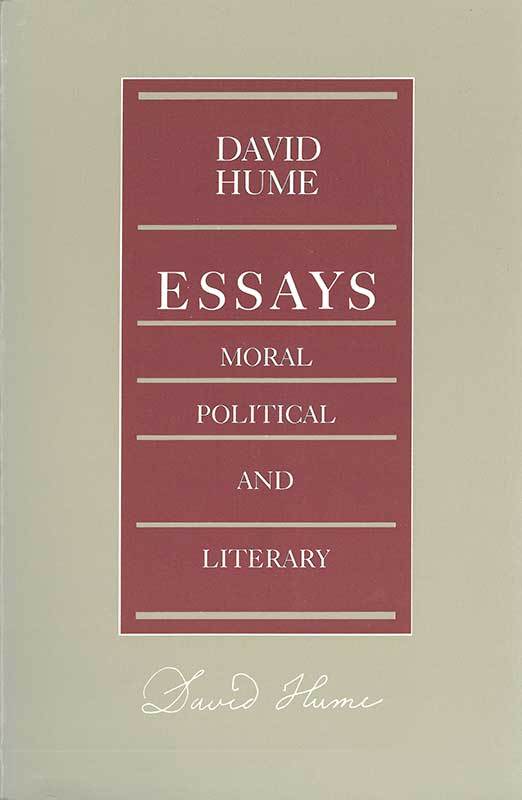
VARIANT READINGS TO ESSAYS WITHDRAWN AND UNPUBLISHED - David Hume, Essays Moral, Political, Literary (LF ed.) [1777]Edition used:Essays Moral, Political, Literary, edited and with a Foreword, Notes, and Glossary by Eugene F. Miller, with an appendix of variant readings from the 1889 edition by T.H. Green and T.H. Grose, revised edition (Indianapolis: Liberty Fund 1987).
About Liberty Fund:Liberty Fund, Inc. is a private, educational foundation established to encourage the study of the ideal of a society of free and responsible individuals. Copyright information:The copyright to this edition, in both print and electronic forms, is held by Liberty Fund, Inc. Fair use statement:This material is put online to further the educational goals of Liberty Fund, Inc. Unless otherwise stated in the Copyright Information section above, this material may be used freely for educational and academic purposes. It may not be used in any way for profit.
Green and Grose’s edition of the Essays has generally been regarded as the most accurate one available,1 and it has thus become a standard source for scholars. A close comparison of their edition with that of 1777 shows, however, that it falls far short of the standards of accuracy that are adopted today in critical-text editing.2 There are hundreds of instances in which it departs, either intentionally or unintentionally, from the text of the 1777 edition. Comparing Green and Grose’s “New Edition,” in the 1889 printing, with the 1777 text, we find at least 100 instances of incorrect wording (words dropped, added, or changed), 175 instances of incorrect punctuation, and 75 errors in capitalization. Probably intentional are over 100 changes in Hume’s spelling, symbols, joining of words, formatting of quotation marks, and such. At least 25 typographical errors in the 1777 edition are corrected silently by Green and Grose, who also corrected some of the Greek passages. The most massive departures from the 1777 edition come in Hume’s footnotes, where his own citations are freely changed or augmented. Only near the end of their volume, in a final footnote to Hume’s essay “Of the Populousness of Ancient Nations,” do Green and Grose inform the reader that such changes have been made. Hume’s essays have many long footnotes, and there are at least 7 instances where Green and Grose, without warning or explanation, print not the 1777 version of the footnote but a different version from an earlier edition, producing substantial variations in wording, punctuation, and spelling besides those tabulated above. In preparing this new edition of Hume’s Essays, Moral, Political, and Literary, fidelity to the text of the 1777 edition has been a paramount aim. Hume’s peculiarities of spelling, punctuation, and capitalization have been retained, because these often bear on the meaning of the text.3 The reader should know, however, that there are some minor departures in the present edition from that of 1777: (1) typographical errors in the 1777 edition have been corrected silently; (2) Greek passages are reprinted as they appear in Green and Grose, with corrections and accents; (3) footnotes are designated by arabic numerals rather than by Hume’s symbols (in cases where these designations are adjacent to the punctuation mark, they have been relocated so that they follow, rather than precede, the mark); (4) whereas Hume’s longer footnotes are lettered and collected at the end of the volume in the 1777 edition, the present edition puts them at the bottom of the appropriate page, as was the practice in editions of the Essays up to 1770 (with the change in location, it was no longer appropriate to capitalize the first word of these footnotes); (5) whereas two sizes of capitals as well as lowercase letters are used in essay titles in the 1777 edition, titles here are in level capitals; (6) the “long s” has been eliminated throughout; and (7) the running quotation marks in the left margin have been omitted, and the use of quotation marks has been made to conform to modern practice. A critical edition of a text is understood today as one that collates the copy-text with all other editions and gives an exhaustive record of variations—formal and material—in the texts. Two excellent examples are Peter H. Nidditch’s critical edition of John Locke’s An Essay Concerning Human Understanding (Oxford: Clarendon Press, 1975)4 and the Glasgow edition of Adam Smith’s Inquiry into the Nature and Causes of the Wealth of Nations (Oxford: Clarendon Press, 1979; Indianapolis: Liberty Classics, 1981), whose general editors are R. H. Campbell and A. S. Skinner and whose textual editor is W. B. Todd. Both editions contain exhaustive lists of variant readings. The preparation of a critical apparatus for Hume’s Essays would require that the 1777 edition be collated with each of the previous editions and that each variation in wording, punctuation, capitalization, spelling, and such be recorded. This task falls beyond the scope of the present edition of the Essays. Yet inasmuch as variants are important for understanding the development of Hume’s thought, I have reprinted the variant readings that Green and Grose record in their edition of the Essays, Moral, Political, and Literary, using for this purpose the “New Edition” in the printing of 1889. Nidditch is certainly correct in pointing out that Green and Grose’s “apparatus of variant readings is very deficient.”5 They do not, for example, record formal variations, and it is clear that they do not show all of the significant material variations. Their list of variant readings is nonetheless quite extensive, and it must suffice for the present. In Green and Grose’s edition, the variant readings appear as footnotes. I have collected them at the end of the volume in order to avoid confusion with Hume’s and my own footnotes. VARIANT READINGS TO ESSAYS WITHDRAWN AND UNPUBLISHEDIV.OF IMPUDENCE AND MODESTYVI.OF THE STUDY OF HISTORYGLOSSARYPage 4Page 6Page 7Page 8Page 9Page 10Page 11Page 12Page 15Page 16Page 17Page 18Page 20Page 21Page 26Page 27Page 28Page 30Page 31Page 32Page 33Page 34Page 38Page 39Page 40Page 41Page 43Page 47Page 48Page 49Page 50Page 51Page 52Page 53Page 55Page 58Page 60Page 61Page 62Page 64Page 70Page 73Page 74Page 75Page 76Page 77Page 78Page 79Page 80Page 81Page 85Page 86Page 92Page 93Page 95Page 103Page 104Page 105Page 107Page 108Page 109Page 111Page 115Page 116Page 119Page 124Page 125Page 130Page 133Page 134Page 138Page 139Page 140Page 141Page 142Page 143Page 144Page 145Page 146Page 147Page 149Page 151Page 157Pages 160–1Page 161Page 163Page 170Page 173Page 175Page 176Page 178Page 180Page 183Page 185Page 187Page 188Page 189Page 191Page 192Page 193Page 194Page 196Page 197Page 198Page 202Page 204Page 206Page 209Page 213Page 215Page 220Page 222Page 224Page 226Page 227Page 231Page 238Page 240Page 244Page 245Page 246Page 247Page 257Page 259Page 261Page 262Page 265Page 266Page 267Page 269Page 270Page 271Page 272Page 273Page 274Page 276Page 284Page 287Page 290Page 292Page 297Page 298Page 308Page 311Page 313Page 314Page 317Page 319Page 329Page 330Page 332Page 335Page 337Page 340Page 341Page 353Page 357Page 358Page 360Page 362Page 363Page 367Page 369Page 381Page 412Page 463Page 474Page 494Page 500Page 503Page 505Page 506Page 507Page 508Page 510Page 517Page 519Page 521Page 522Page 534Page 537Page 543Page 544Page 554Page 557Page 565Page 567Page 572Page 579This book was set in Caslon 540, a typeface derived from the design of William Caslon, the great pioneer of English typefounding. Caslon was born in 1692 and apprenticed as a boy to a London engraver. Both the roman and italic versions of this famous typeface first appeared in 1722. Since that time it has never gone out of style, although it has been recut and modified many times for more-modern typesetting systems. Printed on paper that is acid-free and meets the requirements of the American National Standard for Permanence of Paper for Printed Library Materials, Z39.48-1992. (archival) Editorial services by Harkavy Publishing Service, New York, New York Book design by Betty Binns Graphics, New York, New York Frontispiece photo printed by Hilltop Press, Inc., Indianapolis, Indiana Typography by Typoservice Corporation, Indianapolis, Indiana Printed and bound by Edwards Brothers, Inc., Ann Arbor, Michigan [1. ]A few years ago, Roland Hall observed: “Hume’s Essays, Moral, Political, and Literary have not been properly edited, and the best text may still be that in the Green and Grose Philosophical Works.” See Fifty Years of Hume Scholarship: A Bibliographical Guide (Edinburgh: University Press, 1978), p. 5. [2. ]Peter H. Nidditch writes: “In my view, a suitable and attainable standard of accuracy in the text (from printed materials) offered by an editor working single-handed is an average in his first edition of two brief miswordings and of six erroneous forms per forty thousand words of the text; in the first reprint taking account of his rechecking (which is a pressing duty), these allowances should be halved. This is the standard I have adopted as the General Editor of The Clarendon Edition of the Works of John Locke (Oxford, 1975, in progress).” See An Apparatus of Variant Readings for Hume’s Treatise of Human Nature (Department of Philosophy, University of Sheffield, 1976), p. 34. [3. ]In the 1777 edition of Hume’s Essays and Treatises on Several Subjects, proper names and adjectives derived therefrom (e.g., “British,” “French”) are printed entirely in capital letters, with the first letter being larger than the rest. Abstract nouns are sometimes printed the same way for emphasis or to indicate divisions in the argument (e.g., “Force,” “Power,” and “Property” in “Of the First Principles of Government”; “Authority” and “Liberty” in “Of the Origin of Government”). Occasionally, however, words are printed entirely in large capital letters (“GOD”) or entirely in small capitals (e.g., “interest” and “iight” in “Of the First Principles of Government”). It is uncertain to what extent this reflects Hume’s manuscript practice, as distinguished from contemporary book trade convention, but in any event, Hume did have the opportunity to correct what finally went into print. Since these peculiarities of capitalization may be relevant to the interpretation of the text, they have been preserved in the present edition. [4. ]The Introduction and Appendix to Nidditch’s edition of Locke’s Essay provide a very helpful discussion of the techniques and terminology of critical-text editing. Nidditch’s editorial work on some of Hume’s most important writings is also noteworthy. He has revised the texts and added notes to the standard Selby-Bigge editions of the Enquiries Concerning Human Understanding, and Concerning the Principles of Morals, 3rd ed. (Oxford: Clarendon Press, 1975), and the Treatise of Human Nature, 2nd ed. (Oxford: Clarendon Press, 1978). Nidditch discusses the problems of editing Hume as well as the merits of various editions of Hume’s writings in the aforementioned texts as well as in An Apparatus of Variant Readings for Hume’s Treatise of Human Nature. [5. ]In “Notes” to Hume’s Enquiries Concerning Human Understanding, and Concerning the Principles of Morals, p. 348. |

Titles (by Subject)