Econlib

The Library

Other Sites

Front Page arrow Titles (by Subject) arrow Introduction - Can Capitalism Survive?

Return to Title Page for Can Capitalism Survive?

Search this Title:

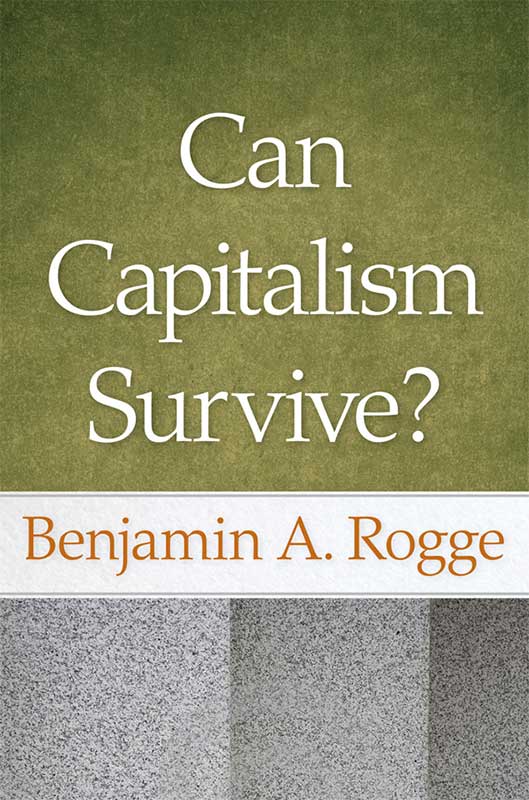
Introduction - Benjamin A. Rogge, Can Capitalism Survive? [1979]

Edition used:

Can Capitalism Survive? (Indianapolis: Liberty Fund, 1979).

About Liberty Fund:

Liberty Fund, Inc. is a private, educational foundation established to encourage the study of the ideal of a society of free and responsible individuals.


Introduction

If you have stuck with me up to this point, you may be weary of one paragraph of despair after another, of one diagnosis after another of the ailments of present-day capitalism. If you share, in whole or in part, my conviction that capitalism is the only economic system consistent with the civilized life, you are probably anxious to move on from diagnosis to therapy. “What can I, as one person or as part of an organization, do about it? What would you have us do?”

As I say in the first paper of this section, “Frankly, I feel more at ease as the diagnostician than as the therapist.” At the same time, I have discussed the question of what to do on various occasions, and three such discussion papers are presented here. The first paper was presented as an explicit follow-up to the Schumpeter-based “Can Capitalism Survive?” Various groups who were exposed to Schumpeter’s analysis of things to come insisted that I come back with a message on how to keep those things from coming to pass. In Marxian language, in this paper I am trying to tell the bourgeoisie how to avoid being expropriated.

The second paper was written approximately a month before the presidential election of 1964. It is now clear that, at that time, I overestimated the damage that would be done to the conservative cause by a crushing defeat of Goldwater. At the same time, the course of events seems to me to have left my general conclusions on what to do largely untouched.

The final paper was given as a tribute to one man and the organization he created—to Leonard Read and the Foundation for Economic Education. It is with pleasure that I make public payment of my great debt to this man, but the paper is presented here because in writing it I found some ways of saying certain things on the practice of freedom that I have not been able to improve upon elsewhere.