EconlibThe LibraryOther Sites |
Front Page Titles (by Subject) THANKSGIVING DAY - Democratick Editorials: Essays in Jacksonian Political Economy
Return to Title Page for Democratick Editorials: Essays in Jacksonian Political EconomyThe Online Library of LibertyA project of Liberty Fund, Inc.Search this Title:Also in the Library:
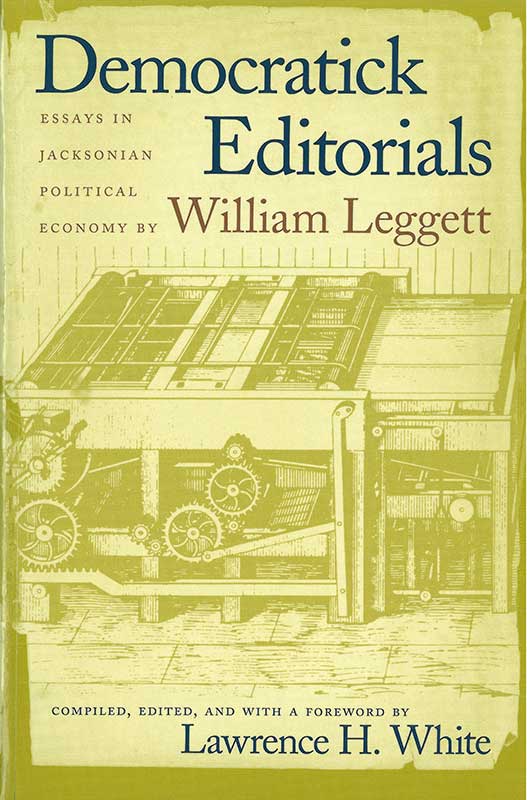
THANKSGIVING DAY - William Leggett, Democratick Editorials: Essays in Jacksonian Political Economy [1834]Edition used:Democratic Editorials: Essays in Jacksonian Political Economy, Foreword by Lawrence H. White (Indianapolis: Liberty Fund, 1984).
About Liberty Fund:Liberty Fund, Inc. is a private, educational foundation established to encourage the study of the ideal of a society of free and responsible individuals. Copyright information:The copyright to this edition, in both print and electronic forms, is held by Liberty Fund, Inc. Fair use statement:This material is put online to further the educational goals of Liberty Fund, Inc. Unless otherwise stated in the Copyright Information section above, this material may be used freely for educational and academic purposes. It may not be used in any way for profit.
THANKSGIVING DAYPlaindealer, December 3, 1836. Thursday, the fifteenth of the present month, has been designated by Governor Marcy, in his annual proclamation, as a day of general thanksgiving throughout this state. This is done in conformity with a long established usage, which has been so generally and so scrupulously observed, that we doubt whether it has ever been pretermitted, for a single year, by the Chief Magistrate of any state in the Confederacy. The people, too, on these occasions, have always responded with such cordiality and unanimity to the recommendation of the Governors, that not even the Sabbath, a day which the scriptures command to be kept holy, is more religiously observed, in most places, than the day set apart as one of thanksgiving and prayer by gubernatorial appointment. There is something exceedingly impressive in the spectacle which a whole people presents, in thus voluntarily withdrawing themselves on some particular day, from all secular employment, and uniting in a tribute of praise for the blessings they enjoy. Against a custom so venerable for its age, and so reverently observed, it may seem presumptuous to suggest an objection; yet there is one which we confess seems to us of weight, and we trust we shall not be thought governed by an irreligious spirit, if we take the liberty to urge it. In framing our political institutions, the great men to whom that important trust was confided, taught, by the example of other countries, the evils which result from mingling civil and ecclesiastical affairs, were particularly careful to keep them entirely distinct. Thus the Constitution of the United States mentions the subject of religion at all, only to declare that “no religious test shall ever be required as a qualification to any office or public trust in the United States.” The Constitution of our own state specifies that “the free exercise and enjoyment of religious professions and worship, without discrimination or preference, shall forever be allowed in this state to all mankind;” and so fearful were the framers of that instrument of the dangers to be apprehended from a union of political and religious concerns, that they inserted a clause of positive interdiction against ministers of the gospel, declaring them forever ineligible to any civil or military office or place within the state. In this last step we think the jealousy of religious interference proceeded too far. We see no good reason why preachers of the gospel should be partially disfranchised, any more than preachers against it, or any more than men devoted to any other profession or pursuit. This curious proscriptive article of our Constitution presents the startling anomaly, that while an infidel, who delivers stated Sunday lectures in a tavern, against all religion, may be elected to the highest executive or legislative trust, the most liberal and enlightened divine is excluded. In our view of the subject neither of them should be proscribed. They should both be left to stand on the broad basis of equal political rights, and the intelligence and virtue of the people should be trusted to make a selection from an unbounded field. This is the true democratic theory; but this is a subject apart from that which it is our present purpose to consider. No one can pay the most cursory attention to the state of religion in the United States, without being satisfied that its true interests have been greatly promoted by divorcing it from all connexion with political affairs. In no other country of the world are the institutions of religion so generally respected, and in no other is so large a proportion of the population included among the communicants of the different christian churches. The number of christian churches or congregations in the United States is estimated, in a carefully prepared article of religious statistics in the American Almanac of the present year, at upwards of sixteen thousand, and the number of communicants at nearly two millions, or one-tenth of the entire population. In this city alone the number of churches is one hundred and fifty, and their aggregate capacity is nearly equal to the accommodation of the whole number of inhabitants. It is impossible to conjecture, from any data within our reach, the amount of the sum annually paid by the American people, of their own free will, for the support of the ministry, and the various expenses of their religious institutions: but it will readily be admitted that it must be enormous. These, then, are the auspicious results of perfect free trade in religion—of leaving it to manage its own concerns, in its own way, without government protection, regulation, or interference, of any kind or degree whatever. The only instance of intermeddling, on the part of the civil authorities, with matters which, being of a religious character, properly belong to the religious guides of the people, is the proclamation which it is the custom for the Governor of each state annually to issue, appointing a day of general thanksgiving, or a day of general fasting and prayer. We regret that even this single exception should exist to that rule of entire separation of the affairs of state from those of the church, the observance of which in all other respects has been followed by the happiest results. It is to the source of the proclamation, not to its purpose, that we chiefly object. The recommending a day of thanksgiving is not properly any part of the duty of a political Chief Magistrate: it belongs, in its nature, to the heads of the church, not to the head of the state. It may very well happen, and, indeed, it has happened, in more instances than one, that the chief executive officer of a state has been a person, who, if not absolutely an infidel or sceptic in religious matters, has at least, in his private sentiments and conduct, been notoriously disregardful of religion. What mockery for such a person to call upon the people to set apart a day for returning acknowledgments to Almighty God for the bounties and blessings bestowed upon them! But even when the contrary is the case, and it is well known that the Governor is a strictly religious man, he departs very widely from the duties of his office, in proclaiming, in his gubernatorial capacity, and under the seal of the state, that he has appointed a particular day as a day of general thanksgiving. This is no part of his official business, as prescribed in the Constitution. It is not one of the purposes for which he was elected. If it were a new question, and a Governor should take upon himself to issue such a proclamation for the first time, the proceeding could scarcely fail to arouse the most sturdy opposition from the people. Religious and irreligious would unite in condemning it: the latter as a gross departure from the specified duties for the discharge of which alone the Governor was chosen; and the former as an unwarrantable interference of the civil authority with ecclesiastical affairs, and a usurpation of the functions of their own duly appointed ministers and church officers. We recollect very distinctly what an excitement arose in this community a few years ago, when our Common Council, following the example of the Governor, undertook to interfere in a matter which belonged wholly to the clerical functionaries, and passed a resolution recommending to the various ministers of the gospel the subject of their next Sunday discourse. The Governor’s proclamation would itself provoke equal opposition, if men’s eyes had not been sealed by custom to its inherent impropriety. If such a proceeding would be wrong, instituted now for the first time, can it be right, because it has existed for a long period? Does age change the nature of principles, and give sanctity to error? Are truth and falsehood of such mutable and shifting qualities, that though, in their original characters, as opposite as the poles, the lapse of a little time may reduce them to a perfect similitude, and render them entirely convertible? If age has in it such power as to render venerable what is not so in its intrinsic nature, then is paganism more venerable than christianity, since it has existed from a much more remote antiquity. But what is wrong in principle must continue to be wrong to the end of time, however sanctioned by custom. It is in this light we consider the gubernatorial recommendation of a day of thanksgiving; and because it is wrong in principle, and not because of any particular harm which the custom has yet been the means of introducing, we should be pleased to see it abrogated. We think it can hardly be doubted that, if the duty of setting apart a day for a general expression of thankfulness for the blessings enjoyed by the community were submitted wholly to the proper representatives of the different religious sects they would find no difficulty in uniting on the subject, and acting in concert in such a manner as should give greater solemnity and weight to their proceeding, than can ever attach to the proclamation of a political governor, stepping out of the sphere of his constitutional duties, and taking upon himself to direct the religious exercises of the people. We cannot too jealously confine our political functionaries within the limits of their prescribed duties. We cannot be too careful to keep entirely separate the things which belong to government from those which belong to religion. The political and the religious interests of the people will both flourish the more prosperously for being wholly distinct. The condition of religious affairs in this country fully proves the truth of the position; and we are satisfied it would receive still further corroboration, if the practice to which we object were reformed. |

Titles (by Subject)