EconlibThe LibraryOther Sites |
Front Page Titles (by Subject) MORALS OF LEGISLATION - Democratick Editorials: Essays in Jacksonian Political Economy
Return to Title Page for Democratick Editorials: Essays in Jacksonian Political EconomyThe Online Library of LibertyA project of Liberty Fund, Inc.Search this Title:Also in the Library:
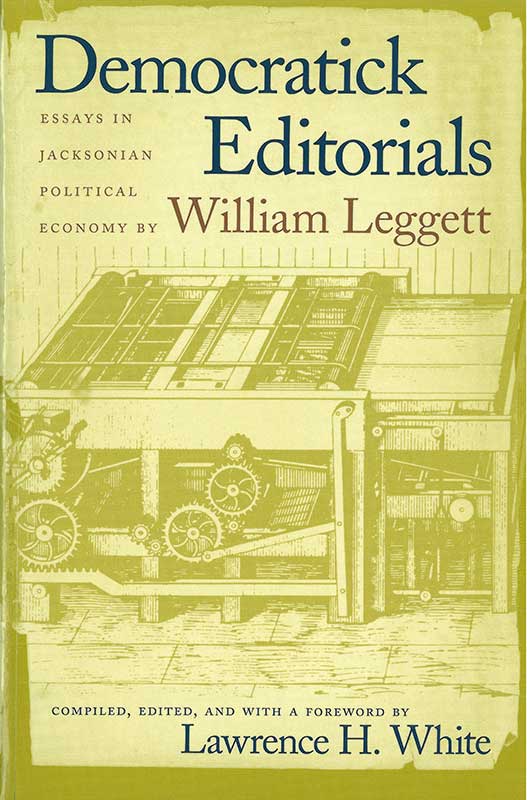
MORALS OF LEGISLATION - William Leggett, Democratick Editorials: Essays in Jacksonian Political Economy [1834]Edition used:Democratic Editorials: Essays in Jacksonian Political Economy, Foreword by Lawrence H. White (Indianapolis: Liberty Fund, 1984).
About Liberty Fund:Liberty Fund, Inc. is a private, educational foundation established to encourage the study of the ideal of a society of free and responsible individuals. Copyright information:The copyright to this edition, in both print and electronic forms, is held by Liberty Fund, Inc. Fair use statement:This material is put online to further the educational goals of Liberty Fund, Inc. Unless otherwise stated in the Copyright Information section above, this material may be used freely for educational and academic purposes. It may not be used in any way for profit.
MORALS OF LEGISLATIONPlaindealer, April 15, 1837. If Jeremy Bentham were alive now, the doings of our legislature would furnish him with some fine subjects for an additional chapter to his “Principles and Morals of Legislation.” There is no subject too high or low for the ken of that sapient and potential body. It undertakes to regulate by statute all sorts of business and all sorts of opinions. A man must neither do anything, nor think anything, except as the law provides. We may eat no meat, burn no fuel, chew no tobacco, nor even visit a theatre, unless such meat, fuel, tobacco, and playhouse, are all stamped with the signet of the law. If you offer a banknote of a certain denomination, you violate a law and incur a penalty. If you receive it from another, you are no less guilty. If a friend desires to borrow money from you, and to accommodate him you withdraw it from a business where it is yielding you twenty percent, you must lend it to him at the rate of seven, or otherwise incur the liability of being sent to prison for your kindness. The good old notion that the world is governed too much, is laughed at as an absurdity by our modern Solons, who act upon the converse of the French merchants’ request, to let trade alone, and undertake to regulate it in every particular. We learn from Albany that Judge Soule’s bill of abominations is likely to be adopted in the Senate by as large a majority, proportionally, as passed it in the other house. By the way, the orthoepy of this wise lawgiver’s name seems to be a matter of dispute, for while some contend that it should be so pronounced as to rhyme with foul, others think the word fool presents the proper symphony. These last perhaps are governed by an analogy which has respect to something more than sound. But whatever difference of opinion there may be as to the gentleman’s name, there is none whatever, in this quarter, as to the true character and effect of his proposed law. It is universally execrated by men acquainted with those laws which should alone regulate financial matters. The motive which we hear alleged for the concurrence this bill is likely to receive in the Senate is a desire to force capital into the old channel of loans on bonds and mortgages. The forcing system is the only system for which our legislature seems to have any fondness. All its business is conducted on the hothouse plan. It first forces credit out of its natural channel, by suddenly acceding to the wishes of dishonest speculators, and multiplying the fatal brood of specially privileged banks. When the floods of paper money which these institutions force upon the community have produced their inevitable consequence, and forced the attention of the community from the regular modes of business to extravagant schemes of speculation, the legislature then undertakes to force things back again to their old positions, heedless of the ruin and distress which these compulsory and contradictory processes may occasion. We trust the day is at hand when the people will exert their moral force, and force the legislature to confine itself to the few and simple objects which alone properly belong to government, leaving men free to make their own bargains, and follow their own pursuits. We do not believe that any great practical evil will follow immediately from the passing of Judge Soule’s usury law. It but compels men to do, what the bad state of things brought about by the opposite forcing system of the legislature was already causing them to do, with an obligation stronger than legal compulsion. The bubble of credit had been inflated to bursting by the prodigal creation of bank monopolies, and astounded by its sudden explosion, the confidence of avarice is too much shaken to allow of his being any longer allured by the bait of three per cent a month. They who have money to lend are now afraid to lend it to men who offer to pay large rates of interest, and capital is on the natural reflux to those borrowers who offer smaller profits and larger securities. The proposed law of Judge Draco, therefore, may do little present harm—it may be, to a great extent, practically inoperative. But it is founded on utterly false principles, and on that account deserves the most earnest opposition. It is not the business of the legislature to make laws for the present hour, framed according to the supposed requirements of instant expediency. It is its business to draw up its code in accordance with the eternal principles of right, so that it may apply with equal justice to-day, to-morrow, and forever. This making a law to force capital one way now, and next winter making a new one to force it another, is the height of legislative folly and injustice. Had the wishes of the people, as emphatically expressed “against all monopolies” four years ago, been respected by their servants; had Andrew Jackson’s veto of the charter of the United States Bank been followed, in the principal commercial states, by legislative measures of a kindred spirit; or had this state alone removed the restrictions on trade, and simply instituted a general corporation partnership law instead, leaving the community to pursue what traffick they pleased, to what extent and in what mode they pleased, we should not, at this time, stand amidst such a scene of financial desolation, having nothing but disorder and ruin to contemplate. We all know and acknowledge the value of political and religious freedom; and we shall yet learn that commercial freedom is the next best blessing that man can enjoy. We shall yet learn, we trust, to practise, as well as to declaim, the noble and just sentiment of Jefferson, that the sum of a good government is to restrain men from injuring one another; to leave them otherwise free to regulate their own pursuits of industry and improvement; and not to take from the mouth of labour the bread it has earned. |

Titles (by Subject)