Econlib

The Library

Other Sites

Front Page arrow Titles (by Subject) arrow chapter 17: Conclusion - The Story of the Law

Return to Title Page for The Story of the Law

Search this Title:

Also in the Library:

Subject Area: Law
Collection: Books Published by Liberty Fund
Topic: Property
Order this book from Liberty Fund

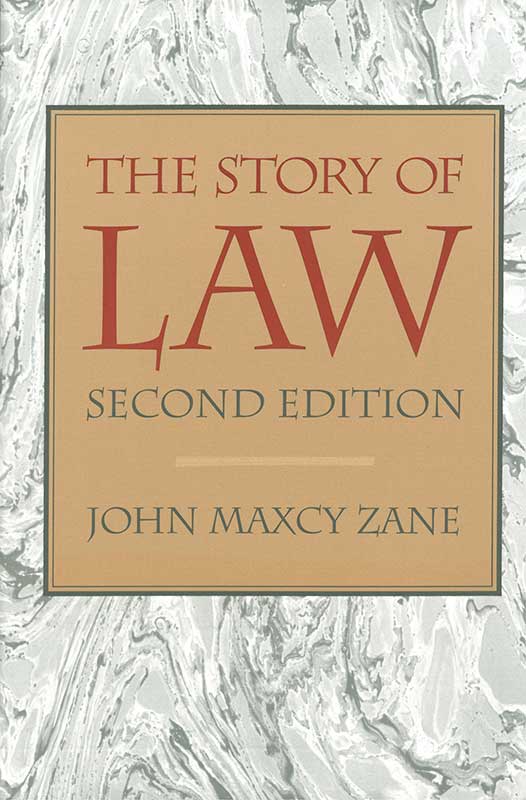
chapter 17: Conclusion - John Maxcy Zane, The Story of the Law [1927]

Edition used:

The Story of Law, 2nd ed., Introduction by James M. Beck. New Foreword, Annotations, and Bibliographies by Charles J. Reid, Jr. (Indianapolis: Liberty Fund 1998).

About Liberty Fund:

Liberty Fund, Inc. is a private, educational foundation established to encourage the study of the ideal of a society of free and responsible individuals.


chapter 17

Conclusion

Some one by way of a casual remark once ventured to say to Lord Chancellor Cottenham that the law was uninteresting. Cottenham replied with the conclusive refutation: “The law uninteresting? I deny it.” It is no doubt true that as a subject of conversation by lawyers, except when they are recounting legal anecdotes which as a rule have for at least a hundred years received the full meed of professional approbation, the law is uninteresting to laymen. Nevertheless, the attempt has been made in this book to put the story of legal development in such a way that it may carry interest to the general reader. One who has passed his life in the law is, perhaps, not a good judge of its interest to those who have had with it no direct connection. With very good reason most laymen are anxious to avoid the law as a forbidding and repellent subject. The Bible speaks of the swine who bore a golden jewel in his snout. The great Dramatist with a more refined touch has “the toad, ugly and venomous, that wears a precious jewel in his head.” Let us say that the law is like the ugly and sometimes venomous toad, which bears the precious jewel in its head of that spirit of social coöperation which enables us to live in conditions of mutual adjustment. If this be recognized the law need be no more uninteresting than are our fellow men.

The story of law beginning with man as a reasonless animal has been followed from age to age in an attempt to explain, not in any occult way nor by the use of weighty technical terms but on principles of common sense, in a way that any intelligent reader can understand, how much of human life and effort is wrapped up in this science of jurisprudence. But there is an initial mystery in the law. Why is it that man alone of all the animal creation has developed a self-conscious reasoning power? Why is it that man alone has escaped from the fatality of mere animal reactions, so that he can by his purposeful acts alter and overcome to an extent his physical environment? We know that none of the philosophical theories of being and reality can explain this initial mystery. No system of pure idealism like those from Plato or Berkeley or of their later imitators is adequate to solve the mystery. The difficulty is that ideas depend upon and are expressed only in language. Let any man attempt to set forth an idea, and he finds that he must use words. Take away language and idealism cannot exist nor can any systems of metaphysics exist. But before man existed, there was no language and before any opportunity for a system of idealism was presented, before metaphysics had been evolved by human thought, the earth and the universe were what they are now, and they would have continued precisely the same, if man had never created or had never gained his mental power. No creation of the mental power of man can explain the mystery. The pure scientist with his inexorable laws will never fairly meet this mystery that transcends all human thought and experience. Certainly man in himself offers no explanation of why the world is what it is. Men in their inmost souls since they became capable of thought and reflection have known this, and so it is the basic conception of law that the law as created by man, has always had in it a molding and controlling element that transcends all human purpose and design. If we go to the very fundamental conception of the law, we find that all law is, in its ultimate analysis, based upon the conception of what we call “the Moral Government of the Universe,” and that on that moral government of the universe has depended the development of reason in man.

Dr. Johnson once said that men of the world were all of one religion and when asked what it was replied: “That, men of the world never tell.” But most men will go far enough to say that they have some religion, and if the thought upon religion, that intelligent men of all shades of thought have in common, could be defined, it would probably amount to the statement that all science and all knowledge have put the mystery of life merely a few steps further back, and that behind the Universe looms the thought that the world and its processes and men and their development are the result of this moral governance whose nature we cannot tell. Closely allied with this idea and as a part of it is that idea of the destiny of men, upon which it will be better to quote a great lawyer, not a divine or a philosopher. Webster was arguing in the Supreme Court against the provisions of Stephen Girard’s will as being illegal in purpose because in contravention of all religion. Using one of the noblest passages in the Book of Job, he said: “For there is hope of a tree, if it be cut down, that it will sprout again, that the tender branch thereof shall not cease but through the scent of water, it will bud and bring forth boughs like a plant....But if a man die shall he live again?...This question nothing but God and the religion of God can answer. Religion does answer it and teaches man that he is to live again and that the duties of this life have reference to the life which is to come.”

Thus it is that in the law there is always the controlling thought that colors men’s ideas in the law and in its application, that man’s moral responsibility is the basis of all law. And in the conception of evolution is after all this divine element of gradually awakening and increasing reasonableness that comes from a better appreciation of what man’s moral nature ought to be and what it may become, and that finally the law as reflecting this improving moral nature will gradually grow to be a better and higher system of reason. As we look back on human life we cannot feel much respect for human attempts to formulate and in precise terms to define “the substance of things hoped for, the evidence of things not seen.” Ever since man ceased to be the pitiful creature cowering in craven fear before the mysteries of nature and of life, he has substituted his own harsh theology and annexed to it a necessity for belief enforced by a bitter intolerance and cruelty, which are but another name for the poor savage’s terrors and attempts to placate an awful deity.

On the other hand religion in its better part with its great emotional appeal has done probably more than all other influences to mold the human race to a reign of law. We have seen that throughout history it is from the priest that the lawyer in all the civilizations that have been examined has received the torch of legal enlightenment. And when the torch was handed to the lawyer the priest still kept the sacred fire burning on the altar by his rites and ceremonies enforcing the moral law. The moral law standing behind and upholding the legal system and improving as religion has improved, has done more for the law than all human statutes. The ordinary man, little of a religionist though he be, unconsciously acts from his long inherited training in the conception of the moral law. The ideals, faith in the things that are good, joy in a well-spent life, hope, mildness, charity and self control, and all things that are of “good report” are yet, though we know it not, the most powerful instinctive emotions to make men just and law-abiding souls. Nowhere has this essential mingling of law and religion been better expressed than by that old lawyer-priest, Bracton, who wrote the first great English law book, and who while his companions slept was toiling upward in the night. “Law,” he said, “is called the science of the just and right, whose priests some one has said we are; for justice is our religion and we minister its holy rites.” Now and then a noble soul stands forth in the history of the law to tell us that our science is not a low system of chicane, but has truly done much for the progress of humanity and more perhaps than all other sciences put together.

This progress we think has been proven to be a wholly natural process. We have seen that every step forward has been a natural step. Men progressed to the hunting stage and the use of weapons. By association with each other men developed spoken language and thus became capable of reasoning and reflection upon the results of sensation. Then came the domestication of animals assuring to men a more fixed means for the support of life. At last came the cultivation of food plants, and then men could live in still closer relations in villages and towns.

Step by step with this development of the means of living arose all the different human institutions which surround us today. First the notion of a kindred through relationship by means of the mother, then the discovery of that much abused institution, the father, and the formation of the family. Naturally came the progression to the fixed institution of monogamy and the recognition of the headship of the family in the father and his control over all the members of the family.

Along with these various changes came the conception of first the tribal property in which each of the tribe had his share. At the same time as a matter of necessity came the recognition of each one’s right to his mere personal belongings and his weapons. As a further necessity came the property of the kindreds when the tribe losing its loose relations began to recognize the tie of kindred, and as the clans or kindreds developed the family, there came by equal necessity the family property, probably in the nomad stage, still retaining the conception of the tribal ownership of the grazing ground. Finally came the aggregations of men for the cultivation of the soil, and at last arose the institution of the family ownership of land with the institution of the inalienable real estate property in the family. As soon as a system of barter developed, this notion of private property became extended to individual property in those kinds of personal property or movables that could be the subject of trade or barter. Real estate where the communities were agricultural would not become the subject of trade or exchange until a higher civilization developed commerce and manufacturers. As soon as the division of labor among men became the rule land itself must become private property, else it could not be sold or conveyed. All these matters and kinds of ownerships require no justification because they could not have been otherwise.

In the course of these various changes it is plain that the human race as a whole never lost any one of these steps that it had gained. But men became divided into civilized men and barbarians. Civilized men dwelt in cities and for hundreds of years waged war upon one another. The barbarian developed a quasi-military organization with kings and leaders in war. Tribes coalesced for the purpose of war. For many centuries went on the continual process of the barbarians descending in overwhelming force upon people of more civilization and property. The better civilized people almost invariably absorbed and elevated the invaders. The great Roman Empire for some hundreds of years held back the barbarians from all the civilized lands. At last the Empire gave way and the half civilized men reduced government and orderly institutions to chaos and wantonly destroyed the larger part of the wealth of the civilized people. Then began the long ascent of the ruined civilization to the modern civilization which we see to-day.

It once was the good fortune of the writer to see brought into sharp contrast the barbarian’s idea of law as compared with the higher and more finished product of the civilized man. There was in the year 1890 and is yet a small Mormon town on the Virgin River in southern Utah. Living about twenty miles above this town nearer the headwaters of the Virgin was the remnant of a disorganized Indian tribe. Being under the charge of no Indian Agent, these thirty or forty Indians were amenable to the ordinary laws which governed the citizens. One day there were brought before the Grand Jury in the Territorial District Court some men from the Mormon town who testified that the Indians and especially their leading man, Big Buffalo, had killed a steer belonging to one of the townsmen and a heifer belonging to another, and had divided the carcasses among the whole number of Indians.

The occurrence was a strange thing in itself, for the Indians had always been quiet and peaceful and had never been known to commit any such act before. By means of an interpreter the hidden facts were ascertained. The cattle belonging to people in the town had been left some time before without any herder and had wandered up the canyon of the river until they came in the night to the patch of ground which the Indians were cultivating. The little fields were surrounded by willow fences to keep out the rabbits but such fences presented no obstacle to the cattle, which had literally eaten up the whole crop of the Indians. The next day the Indians had waited upon the Mormon bishop in the town, considered the head man of the white tribe, with a demand for reimbursement in a modest sum. The bishop had paid no attention to the demand. At the end of a week the Indians had come down again, driven off the steer and heifer, and scrupulously divided the carcasses among the families in the little tribe, even to making a division of the hides. They according to their lights had done a perfectly proper act of self-help and reimbursement.

This homely tale shows the barbarian point of view. The supposed kindred of the town owned the cattle that did the damage. The owner without question was liable for the acts of the cattle, and the owner was the tribe of white men in the town. The demand for reimbursement had been made and, no response being made, the lawful course of self-help had been followed and the property taken by distress had been divided among the Indian kindred according to the number of families. The solid obligation of the one kindred or tribe was owing to the other kindred or tribe. This was sound barbarian law, where only kindred ownership was recognized and the kindred was responsible.

On the other hand was the civilized law with its private property laws, where only the owners of the cattle doing the damage could be liable, where the law applicable was that all cattle could be turned out on the open range, and any proprietor who desired to protect his field must erect an adequate fence. As to the Indian law of self-help, there was no such legal remedy recognized. An action must be brought in a court against those individuals liable, where it would be decided that the Indians could not recover at all. In the meantime the Indian, Big Buffalo, such and such cattle, the property of So-and-so, had feloniously stolen, led, and driven away against the peace and dignity, etc., as the unfeeling indictment would sum up his conduct.

It was apparent that the Indians had acted in entire good faith according to their conceptions of law, which unfortunately were several centuries out of date; but at the same time it would be impossible to say that under such circumstances the subject of the larceny had been taken under a claim of right from the standpoint of the law. All that the court could do was to address some admonitory remarks to the stalwart Big Buffalo, which could not be interpreted to him in the Indian language, and to send him home.

Starting from such conceptions as these Indians had, and with tribal and kindred groups, and at last family property, the law begins its progress. Its very first effort among the Babylonians was to reach an exceedingly high expansion in a social condition of wealth accumulated and of large manufacturing and commercial interests with gold and silver and copper as money and above all a written law. This written law is merely a setting down of the important matters of customary usage, but far more is left out of the written law than is inserted, and as in all other systems there is, as there must be, more unwritten than written law. This written law is a divine law delivered from the god of the city to the king, and no way is presented to change it. Among these Babylonians the written language leads to the use of the written document. It at once takes its place as the controlling means of defining legal obligations. This document cannot be attacked or varied. It binds the parties to all the stipulations which they have agreed upon and put into the document. No evidence will be heard against the written document. The cheapness of the writing material permits the clay document to be used in almost every transaction.

This system of law retains all sorts of barbarian primitive survivals, but a court for deciding controversies exists if people wish to use it, and the great majority of documents provide for submitting any dispute arising to the arbitrament of the courts, and early an appellate court is developed to correct mistakes of law in lower courts. But there is as yet no sufficient reflection to ascertain a legislative or a judicial power as anything distinct in the exercise of the general power of the king. This great Babylonian power is ruined by an Assyrian invasion and conquest and the law’s story passes to the Jews.

They too have a long history of primitive law preceding a written law, but now all the emphasis is placed on the delivery of the law from God amidst the thunder and lightning from the mountain. Gradually the Hebrew law passes through transformations. Its history is constantly interrupted by invasions and conquests. It has its one brief period of glory under its kings and then disunion destroys the state, which fights long for its existence. This race brings into the law the great doctrines of reasoned moral conduct and the religious element of a personal responsibility of man for his conduct, until at last, the next great gain is attained in the law by the defining of individual responsibility. The dispersion of the Jews through all the great cities of Egypt and the East and their contact with Hellenic civilization bring into the Jewish law the commercial law from Babylon, and bring into Hellenic thought the teachings of the Jewish law.

In the meantime the Greeks, first in the Ionian cities of Asia Minor and then at Athens, bring to the law the acute analysis which lays the foundations in the law of the differentiated powers of government, all emanating from the people. But the forms are crude and unworkable. In all the domains of private law the Greeks develop almost every necessary institution for an enlightened law, including the doctrine of obligations, if their institutions had taken a practical form. Gradually almost every primitive inheritance is weeded out. The doctrine that the state must grant justice to its citizens and must provide courts for that purpose becomes fully developed, but the signal failure of the Greeks is to develop either a competent judicial tribunal or a legislative power, beyond the town meeting. The legal profession has no existence as a separate corps of men devoted to the law. The Greeks never rise above the city-state, and until Rome comes with her dominance imposing peace the history of Greece is a long succession of constant jealousies and wars among the city-states.

At last comes Rome, which gradually rids the state of the old primitive notions, and develops a competent tribunal. The subjugation of the whole of the civilized world makes Rome the center of the world’s affairs and of wealth and commerce. A legal profession is developed for the first time in history and this legal profession introduces first the juristic method of attaining law from which the profession has never departed and second the eclectic method of generalizing the legal institutions of all the states subject to the sway of Rome into the one system of the Roman law. The former contributions of the Babylonian, the Hebrew, and the Greek law pass into the Roman law which is finally put into form by the compilers of Justinian.

In the meantime all governmental institutions are destroyed by the German barbarians and the civilized world is reduced to the chaos of the feudal system, out of which emerge the modern states. Feudalism renders real property inalienable and practically destroys all commerce. One of the modern states, England, becomes the chosen home of legal development under the Norman race with its genius for law. It is to make possible the reconciliation of freedom in government with a sound administration of the law. This people, while known as the English, is far back in history the basic race called the Iberian. In their history they produced a cultivation of the soil and a working in the useful metals. The Iberians all over western Europe were overwhelmed by Celtic invaders with a much lower culture. The races amalgamated, and the mixed race had reached almost the former high level of the Iberians when Rome took possession. Rome had introduced a still higher civilization with the finished doctrines of the elevated Roman law. This civilization had been rapidly assimilated but again this race was overwhelmed by hordes of invaders little better than savages. In the course of five hundred years this race recovered some of its ancient culture, but invasions of other barbarians retarded the growth of civilized institutions. At last had come the Normans, then the leading race in Europe, and they came not to ruin but to save; they displayed the same genius for legal institutions that had made the Roman Empire and its law.

Almost at once is developed the separate powers of government. The Norman kings show a method of producing a strong executive, and a competent legislative power. Courts that are competent tribunals are furnished to decide the controversies of citizens in their private relations. The theory that crimes are breaches of the public order to be punished by the public authority is deduced from the dogma of the peace of the king. At last in the exigencies of civil war is produced for the first time in history the representative English Parliament, made up of two houses, representing the different estates of the realm.

From a king in difficulties had already been extorted the Great Charter of Liberties which bound the executive to the rule of law. Immediately followed the Parliamentary power of legislation and the dogma is settled that it is only by the consent of the representatives of the whole nation that taxes can be imposed. At the same time the executive power retains its right to be a constitutive part of the legislative. But finest of all the Norman conceptions of government is the institution of the jury, where the citizen is made a constituent part of the tribunals which pass upon the ordinary rights of citizens. This institution of the jury is of incalculable effect in habituating the citizen to contact with government matters. Supplementing the jury system is the power of the chancery courts to furnish in the field of law relief to the citizen in those cases to which the jury system by its form of judicial administration is wholly incompetent. For centuries this form of judicial administration and of executive and legislative power ruled in England.

The original function of the jury, that of being witnesses and the only witnesses was disorganized by the great burdens laid upon it. The nation was not prepared under any circumstances to give up the jury. The only remedy for its apparent failure was to transform it. In the course of hundreds of years the whole conception of the jury changed. The twelve were made a judicial body to hear evidence and to form their verdict from the evidence. Experience then demonstrated that rules must be devised which would limit the evidence to that which could properly be considered, and thus came into operation the body of law which is called the law of evidence.

It was a wise instinct in the English to cling to the jury and to their common law, whose fortunes were bound up with those of the jury. England in common with other European states passed through a period when the royal power attempted to absorb the legislative power and the judiciary. In that struggle the institutions of the common law and the presence of the jury prevented England from reaching the condition of absolutism from which France was extricated through the bloody processes of the French Revolution. The battles for English freedom, though often apparently lost, were constantly won. This history of legal experience enriched the story of the law with most of those governmental prohibitions and that vast legal experience which can be read in our national Constitution.

Time rolls on and the English hive overflows into the lands inhabited by the barbarian and the savage. Now history is to be reversed all over the world. The barbarian no longer can overwhelm the civilized lands, but the civilized man begins his career of displacement of the uncivilized human being, and every assault of the barbarian in past times is repaid upon him by the cruelty and oppression of the civilized man. Englishmen settled along the coast of North America and founded the American Colonies. The colonists went forth protected by royal charters and carried with them all the rights and laws and traditions that had become the heritage of the English race in its long battles for free institutions. The struggle of the Colonies with the Parliament of England began, and in the struggle was revived the ancient dogma of the Greek and Roman law that power must emanate from the people. A new adaptation of the law was that charters of government create inviolable rights and covenants binding upon rulers and subjects. Upon those ideas of binding and inviolable limitations upon government and of the people as a social community with full power, is based the great charter of our liberties, which is called the Constitution. In it the judicial power with its right to make the supreme law binding upon all departments of the government and upon every governmental officer from the highest to the lowest is securely intrenched. In the Constitution is applied, also, the collected wisdom of all the ages, an application made possible by the fact that a government is being founded in a new land, not tied down and bound by inherited ideas or by fixed divisions among men. That collected wisdom made possible a division of the powers of government among separate and independent departments, a legislative, an executive, and a judicial. With unexampled rapidity the great lands west of the original Colonies were wrested from the savages. Broader and broader extended the national domain until at last men who were children at the adoption of the Constitution were living to see the banners of the Republic dipping “their fringes in the western sea.”

In looking back over English legal history it must appear plain that all the different phases through which the law passed were necessary to give that extended experience, whose results are embodied in our national Constitution. It does not take many words to define those prohibitions upon government but each short phrase represents the settled experience of mankind through hundreds of years. That experience determined what principles of government are necessary to be protected against either popular, or legislative or executive power. Above all it had been shown that the only feasible method of restraining such power was a prohibition by a supreme unalterable law enforced by an independent judiciary.

This prophetic vision was correct. In the years from 1787 to 1860 the institutions of our government were solidified and strengthened under the aegis of the judicial power until at last the whole power of the nation, the posse comitatus of the whole Republic, was to fight out on many a bloody field the two questions: First, was the constitutional rule imposed by the people upon themselves a binding rule when it made an indestructible union? And second, was the age-old Roman doctrine of Ulpian that by the law of nature and of God all men are created free, to become not alone the heritage of a part of the citizens but the inalienable possession of all the citizens? Those questions were forever settled on the anniversary of our Independence Day when the sound of the guns of the Indestructible Union at Gettysburg was echoed from the surrendered heights at Vicksburg. At last it had been proven that the Reign of Law was an accomplished fact. Since then other great federated Commonwealths have come to convince us that our experiment in government has passed from the stage of experiment to that of unalterable success. We may cherish the belief that in the years to come the decisions of our Supreme Court on constitutional questions may be often illustrated by decisions from the highest courts of the Commonwealths of Australia and of Canada.

One jurist, a figure as commanding as that of Papinian, stands forth. Before the Capitol at Washington is the statue of John Marshall, which was erected by the Bar of the United States. Even the most hardened and unimaginative lawyer cannot pass it without reverence, for there sits in serene and sagacious contemplation the man who more than all others molded our constitutional law, and made possible the beneficent government which brings contentment and happiness to so many millions of men. Great judge and great lawyer as he was, he was even greater in that his character even to his inmost soul was without a stain. The simple virtues of goodness, generosity, and kindliness made him a lovable man. Like all men of that description he had quick sympathies.

It must have been an extraordinary sight to see Webster finishing his speech in the Dartmouth College case. The great orator was giving to his close that touch of emotion without which all oratory is a dull and lifeless thing. The advocate was an impressive man. His great head, dark countenance and deep-sunken, gleaming black eyes aroused even the dyspeptic Carlyle to some enthusiasm in his description of this parliamentary Hercules. Webster after his argument as he came to the end, sunk his deep voice. The justices were bending forward to catch his words. He was speaking as if to Marshall alone. No feature of the clear-cut composed countenance of the Chief Justice moved, as Webster in his poignant tone of suppressed feeling, said of his Alma Mater: “It is a small college, but there are those who love it.” He hesitated on the words, his voice broke, the great eyes filled, while down the granite face of the Chief Justice furrowed by years of thought, started the tears. Then lifting his voice Webster made his magnificent close. The scene shows us that the greatest are the most human.

It is something for a court to have the tradition of such a man as Marshall, but it is a greater thing that the profession reverenced him in life and reveres him in death, for he is the personification to all of us of the just man, not only capable and learned in the law, but also endowed with the statesmanlike vision, that is the very soul of aspiring humanity dreaming on things to come.

The fortunes of the law depend upon the profession. From its ranks come the judges. Harsh things can be said of the lawyers, that are all true. But we have seen that this is always true. We can look back to the very finest days of the Roman law, and read the denouncing words of Pliny the Younger upon the profession in his time. But at that time the legal profession was building the structure of law that still rules the world. And so it is with the law itself. At any period in its history we may see how much it failed to reach perfection. In the days of the greatness of the Roman Republic no man was safe from the attacks of the informer or the demagogue, public law was disgraced, bribery at elections was the rule. In the days of the Antonines when the civilized world enjoyed such perfect peace and repose, when men in point of well-being had little of which to complain, when the private law secured to citizens even-handed distributive justice, the public law made the Empire a despotism, and no man of importance, in the event of a bad ruler, could hope for any safety in life, unless he became a sycophant and a slave. The burning fire of patriotism which had made the Republic was extinct and any man of reflection would have gladly gone back to the days when, with all its evils, Rome was free. All through the Dark Ages men were in the black night of despair. Law, security, hope in life or in death seemed to have departed. For a lover of his kind the eye could find nothing on which to repose. The great Pope Gregory VII summed up the times in his dying words: “I have loved righteousness and hated iniquity, so I am dying in exile.” In the fifteenth century of English law, when the jury system had broken down, when nothing in life was safe, when the law seemed a travesty of justice, no one could look forward with any hope. In the next ages savage intolerance left no citizen the right of free speech and for mere beliefs men were burning at the stake. Let one try to conceive how dark seemed the future after our Revolutionary War when it appeared that the Colonies were deliberately committing suicide. In the private law itself the state of the prisons, the institution of imprisonment for debt caused untold human suffering. In the ten years before our Civil War, it seemed that the Union of the States was doomed.

But as we look back for almost a thousand years the law, public and private, has steadily improved. We may praise the good old times, but would any one be willing to go back to them? The blots we see upon the law are all made by human hands and by those hands they can be taken away. The two things of which we can most justly complain, the ineffectiveness of the administration of the criminal law and the corruptions in municipal government, are constantly meeting an awakened public sentiment. The great bulk of the law and the differences in law among the various states are steadily being corrected, while at the present time the disinterested lawyers of the whole country are engaged in the gigantic task of restating in smaller bulk, and in simplifying, the law. There never has been a time upon the earth like the present, when men could look around them not only at their own land, but over the whole civilized world and be so well satisfied with the future of law. This situation is due more to the rule of law than to all other human activities.

The story of the law must teach us that changes are to be made by the innovations of time slowly and by degrees. If suddenly we begin hacking to pieces our aged mother, only evil can result. It must not be true that for some fancied benefit we shall unsettle the landmarks that mark the progress of the ages. Personal desires, the theories of particular men can have little or no effect upon the law, for she must represent the wishes and desires of us all. She must have still the standard that was her standard ages ago, the ordinary reasonable man, not easily moved to action, clinging to his ancestral robe of habits and accustomed ways, yet in the main striving to make this world a better place for his children. The law is like this her favorite son, the average reasonable man. She too must cling to the institutions which she knows and has proven, for she bears upon her shoulders the burdens of humanity. We must not blame her for our many human errors; she gives us the rule, she asks us to apply it reasonably and fairly and when we fail, out of our own want of insight, we turn upon her and bitterly arraign her, but she answers not a word.

  • Yes, we arraign her but she,
  • The weary Titan with deaf
  • Ears and labor-dimmed eyes,
  • Regarding neither to right
  • Nor left, goes passively by,
  • Bearing on shoulders immense,
  • Atlantean, the load
  • Well-nigh not to be borne
  • Of the too vast orb of her fate.