Econlib

The Library

Other Sites

Front Page arrow Titles (by Subject) arrow 18: Liberals and the Burger Court - Government by Judiciary: The Transformation of the Fourteenth Amendment

Return to Title Page for Government by Judiciary: The Transformation of the Fourteenth Amendment

Search this Title:

Also in the Library:

Subject Area: Law
Collection: Books Published by Liberty Fund
Order this book from Liberty Fund

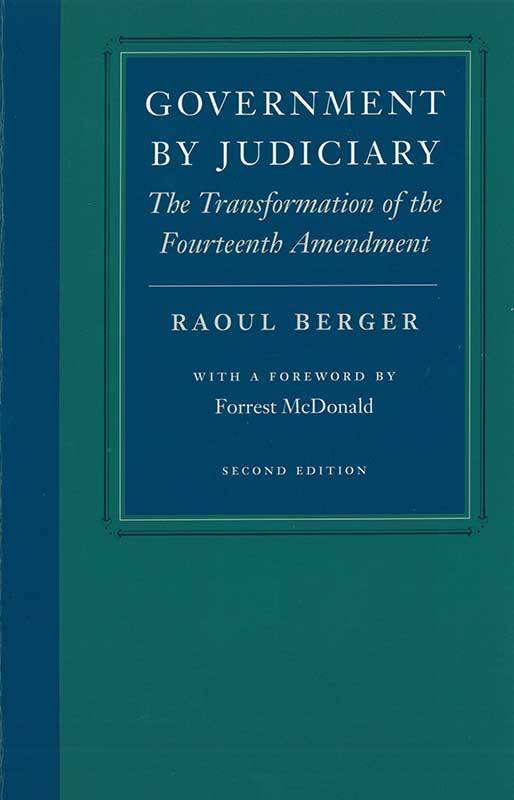
18: Liberals and the Burger Court - Raoul Berger, Government by Judiciary: The Transformation of the Fourteenth Amendment [1977]

Edition used:

Government by Judiciary: The Transformation of the Fourteenth Amendment, Foreword by Forrest McDonald (2nd ed.) (Indianapolis: Liberty Fund, 1997).

About Liberty Fund:

Liberty Fund, Inc. is a private, educational foundation established to encourage the study of the ideal of a society of free and responsible individuals.


18

Liberals and the Burger Court

Lamentations over the “regressive” course of the Burger Court in the field of civil liberties fill the air. The New York Times, for example, stated: “There was a time not so far distant when the United States Supreme Court was the staunch and ultimate defender of civil rights and liberties . . . [T]he Court seems clearly to be beating a path of retreat from its once proud forward position in this delicate and difficult area of the relationship between citizen and state.” 1 Undoubtedly the Court is tilting the scales from what many regarded as excessive tenderness toward criminals;2 it is haltingly attempting to return some criminal administration to the States.3 But, as Leonard Levy points out, “That the Nixon Court favored law-enforcement values” should come as “no surprise. Burger, Blackmun, Powell and Rehnquist got their seats on the bench because of their supposed or known lack of sympathy for the rights of the criminally accused.” 4 This, however, is only the latest of what G. E. White felicitously described as a “series of minor court-packing plans.” 5 Now that a new set of predilections is displacing their own, libertarians who rejoiced in the “creative” role of the “wise and able men” are despondent. But the “revolutionary” changes in the criminal process6 by the Warren Court had not won the assent of the people.7 And it cannot be gainsaid that the Burger Court rulings in this area are closer to the original design than were those of the Warren Court. For, as we have seen, the Bill of Rights was not made applicable to the States, either by its framers or in the 39th Congress.

Not that the Burger Court is abjuring lawmaking; its “six-man jury” decision furnished evidence to the contrary.8 It has not held that the Court has no business regulating State death penalties because the “cruel and unusual punishment” phrase of the Bill of Rights has no application to the States, or because, as Chief Justices Warren and Burger and Justice Black stated, it did not encompass a death penalty for murder.9 Instead, in Gregg v. Georgia and companion cases it has weighed whether a death penalty is or is not a “cruel and unusual punishment” on an apothecary’s scale.10 It would be inopportune to show in detail that the “strict constructionist” Burger Court clings as firmly to judicial governance as its predecessor.11 Archibald Cox observed that “the new Justices seem not to shrink from using constitutional law as an instrument of reform when an existing rule offends their preferences.” 12

It is more to the purpose to examine how the Burger Court has thrown “liberal” analysis into disarray, as Leonard Levy’s recent book Against the Law: The Nixon Court illustrates. Levy’s earlier studies give evidence of incisive analysis and a richly stocked mind; but Against the Law leaves one with a baffling sense of ambivalence, of seeming unawareness that his views are often incongruent. In what follows I am not to be taken as a partisan of the Burger Court, but rather as seeking to test Levy’s theories by his criticism of that Court. By way of background let us begin with his sympathetic introduction to a group of articles on the Warren Court. The phrases of the Constitution are “Delphic”; the Court

is indeed, and cannot help but be [a superlegislature]. The reason is simply that the Constitution, as Jefferson said in exasperation, is “merely a thing of wax” which the Court “may twist and shape into any form they please . . .” Judge Learned Hand observed that . . . “The words [a judge] must construe are empty vessels into which he can pour nearly anything he will.” Legal erudition, legal rules, legal logic, legal precedents do not decide cases involving the ambiguous clauses of the Constitution . . . Inevitably, then, our constitutional law is subjective in character and to a great degree result oriented.13

Levy continues in this strain in his commentary on the Burger Court: “From the beginning . . . the Court . . . read the Constitution to mean whatever it wanted. Despite pretenses to the contrary, the Court could do no other, for . . . American constitutional law exists in the collective eye of those who happen at any moment in time to dominate the Court.” 14 If this be so, how can the decisions of the “Nixon Court” be “Against the Law”? And “why,” to borrow Levy’s adoption of Justice Black’s rhetorical question, “have a written Constitution at all if its interpreters are left only to the admonitions of their own consciences?” 15 Is this reconcilable with Levy’s view that the Court “is and must be for all practical purposes a ‘continuous constitutional convention’ in the sense that it must keep updating the original charter . . . it simply cannot decide cases on the basis of what the Constitution says”?16

Given that constitutional law is “inevitably . . . result-oriented,” one can understand Levy’s view that any decision other than Brown v. Board of Education “would have been unthinkable, unbearable, unspeakable” 17 (though not to Chief Justice Vinson and Justices Reed and Jackson),18 that “strict constructionism means reversing the decision of Appomatox . . . a return to . . . Jim Crow.” 19 That is not a return that I should recommend, but is this not the very “reasoning backwards” so vigorously condemned by Levy: “In constitutional cases . . . the judge who first chooses what the outcome should be and then reasons backwards to apply a rationalization replete with rules and precedents has betrayed his calling; he has decided on the basis of prejudice and prejudgment, and has made constitutional law little more than the embodiment of his policy preferences, reflecting his subjective predilections.” 20 That, however, is “inevitable” once it is postulated that “our constitutional law is subjective in character and to a great degree result-oriented.” 21 Nevertheless Levy states that “result-oriented constitutional adjudication . . . is a corruption of the judicial process that leaves too far behind the rule of law enforced by impersonal or objective judges.” 22 He himself avers, however, “We may not want judges who start with the answer rather than the problem . . . but as long as mere mortals sit on the Court and must construe that majestic but muddy Constitution, we will rarely get any other kind.” 23 Yet he emphasizes in Against the Law that “result-oriented jurisprudence . . . [is a] judicial monstrosity that gains nothing when the Court reaches a just result merely because of its identification with underdog litigants.” 24

Now unless I am sadly at sea, it seems to me that Levy is riding off in opposite directions. He cannot at one and the same time maintain that the words of the Constitution “are empty vessels into which [a judge] can pour nearly anything he will” and then insist that the “ purpose of the Sixth Amendment was to bind the federal government to the system of trial by jury that was traditional and familiar. ” 25 On that analysis the words “trial by jury” are not “empty vessels” but have a fixed content. So, too, he has been unable to decide whether a result-oriented jurisprudence is “inevitable” or a “monstrosity.” It may be one or the other, but it cannot be both.26 The core of Levy’s complaint, unless I grossly misconceive his concluding remarks, seems to be against the Burger Court’s craftsmanship, its failure “to weigh criticism,” “to develop carefully reasoned judgments,” “to make bad law in the sense of being badly crafted.” 27 But, as he recognizes, “experts will doubtless disagree” about “the Nixon Court’s craftsmanship” as “they have about the Warren Court’s craftsmanship.” 28 Whether it be good or bad, however, is of no moment in a jurisprudence that is “inevitably . . . result-oriented.” The result, not the reasoning, is what counts.29

Some of Levy’s severest strictures are reserved for the Burger Court’s treatment of precedents: one new reading “left its precedents in shambles”; the Court “obliterates them.” 30 Yet, he considers that “precedents do not decide cases.” 31 And in disregard of precedents the Burger Court yields the palm to its predecessor. “The list of opinions destroyed by the Warren Court,” Philip Kurland observed, “reads like a table of contents from an old constitutional law casebook.” 32 It is difficult to agree that Chief Justice Burger “displayed an egregious contempt for precedents” when he rejected the “thesis that what the Court said lately controls over the Constitution.” 33 He may be indulged in returning to older precedents that the Warren Court had only recently discarded,34 particularly since, as Justice Henry Baldwin early observed, “There is no more certainty that a last opinion is more correct than the first.” 35 Let Levy sum up:

In all these cases . . . the Burger Court no less than the Warren Court displayed an audacious disregard for and circumvention of precedents, clearly revealing its own values and policy choices. Despite pretenses to the contrary, it could do no other for as beauty exists in the eye of the beholder, so American constitutional law exists in the collective eye of those who happen at any moment to dominate the Supreme Court.36

Such are the fruits of a value-oriented system which makes of “constitutional [case] law” a veritable whirligig. No rhetoric can disguise that this is but the kadi administering justice under a tree.

Where Levy entertained misgivings about judicial review but swallowed them,37 Charles Black was an uncurbed partisan of the Warren Court, a panegyrist of Justice Black who sought to justify the policymaking ways of the Court to man.38 Now Black has come forth with a semi-recantation, taking on himself some of the blame for encouraging a result-focused jurisprudence.39 The “fresh raw wound” caused by the Burger Court’s death penalty cases of July 2, 1976, set him to “wondering whether we liberals . . . may not be in part to blame for a . . . quite evident trend toward the point of view that reason doesn’t matter much, and can be brushed aside, if only the result is thought desirable.” 40 One should not be captious with a repentant sinner, but Black’s semi-recantation contains the seeds of further error; and, as one who wrote in 1942 that the test of constitutionality cannot be the embodiment of predilections which I share,41 I may be forgiven for seeking to lay those errors bare.

There is first Black’s repeated appeal to “reason.” 42 The recent death-penalty cases moved him to ask “whether we do well to entrust this Court with the job of a rational defense of ordered liberty—and even whether we did well to refrain from talking too loud about it when the same [Burger] Court without adequate reason given, decided the abortion case as it did.” 43 Like Professor Black, I too am a devotee of reason and well recall the richly deserved criticisms of the Warren Court, couched in terms of deplorable “craftsmanship” 44 —without a peep from Black.45 He himself recognizes that “painstaking reason often leads to different results in different minds” and that “no important result is dictated wholly by reason; there must lie at its heart a normative judgment not reachable by reason alone.” 46 In other words, “reason” starts from premises that another may reject. Chief Justice Warren proceeded in Reynolds v. Sims (reapportionment) from the Declaration of Independence and the Gettysburg Address, notwithstanding that the framers of the Fourteenth Amendment found that the Declaration had not deprived the States of control over suffrage, and that Lincoln saw no prospect of Negro “equality.” And he totally ignored the incontestable evidence that Justice Harlan spread before the Court that the framers excluded suffrage from the scope of the Amendment. Even now Black does not ask whether the Justices may displace the framers’ value-choices with their own “normative judgments.”

The frailty of “reason” is further illustrated by Black himself; he regards Brown v. Board of Education “as nearly syllogistic as a real law case can be. The Fourteenth Amendment, in the clear light of its history . . . forbade all discrimination against black people.” 47 He may be indulged for his inability to abandon a view to which he was committed as a member of the NAACP legal counsel in that case; he “threw all his passionate brilliance into the NAACP effort.” 48 But, to the astonishment of Kelly, Graham, and others, the “clear” neoabolitionist history they pressed on the court was branded by Chief Justice Warren—anxious though he was to rule in favor of desegregation—as “inconclusive.” How can we rely on “reason” that converts the very limited and “clear” purposes of the framers into a ban on “all” discrimination?

Black recalls that he “expressed some doubt about the application of the equal protection clause to legislative apportionment, in Baker v. Carr, but, looking back, I know that I muted that doubt.” Came Oregon v. Mitchell, and Professor Black perceived “that the plurality opinion of four was plainly wrong, and the deciding concurrence of Mr. Justice Black so egregiously wrong as to be . . . all but incredible.” 49 In justice to Justice Black, it deserves to be repeated that he recanted (though without so stating) with respect to apportionment for State offices, saying that he “agreed” with Justice Harlan’s demonstration that control over suffrage was deliberately left by the framers with the States.50 Of this Professor Black says not a word. One of the remarkable aspects of his address in fact is that not once does he advert to the historical limitations on judicial policymaking with respect to the Bill of Rights, segregation, and reapportionment set forth by Fairman, Bickel, and Harlan; he puts his trust in “reason.” Because reason can lead in different directions, however, the all-but-incontestable proof that suffrage was left by the framers to the States, offers a safer, surer mooring.

But to resume Professor Black’s threnody; looking back to the Warren Court’s extension of the school desegregation case “to other forms of segregation, involving neither schools nor children” in cases “decided per curiam and without opinion,” Black now wishes that he “had fullthroatedly joined Herbert Wechsler in his protest against this procedure, which was so self-evidently wrong that one is ashamed to have glossed it over just because the result was what one wanted and thought right.” 51 This was more than a departure from a lawyer’s “commitment . . . to reason”;52 it represents a departure from standards that led the people to place their trust in scholars. Like scientists, constitutional scholars, as Thomas Huxley said upwards of a century ago, should “respect nothing but evidence, and . . . believe that their highest duty lies in submitting to it, however it may jar against their inclinations.” 53 That duty carries with it, I submit, publication, not suppression, of scholarly findings.

Oregon v. Mitchell induced some soul-searching in Black: “What if all this is turned on us? If real reason goes out of fashion, can we be sure it will not happen? . . . Have we not, after all, asked for it?” 54 It is not unfair to conclude, I trust, that Black’s jeremiad illustrates once more the “whose ox is gored” adage. He held his peace when “the result was what one wanted and thought right,” but now protests against a departure from “reason” when he is “heartbroken that the legal killing of people is to be resumed.” 55 Not a word about the manifest preference of the people to the contrary, about the formidable evidence that the Fourteenth Amendment did not make the Bill of Rights applicable to the States, that the death penalty was not deemed a “cruel and unusual punishment” by the Framers—a view to which the Supreme Court adhered until 1972.56 Instead Black apparently remains faithful to a judicial power to revise the Constitution—if only it be clothed in “reason.”

[1.]N.Y. Times, March 31, 1976, at 36; see also Nathan Lewin, “Avoiding the Supreme Court,” The New York Times Magazine, October 17, 1976, at 31.

[2.]Edward R. Korman, “Book Review,” 4 Hofstra L. Rev. 549, 556 (1976), refers to “the near hysterical response in certain quarters that accompanies every opinion of the ‘Nixon Court’ affirming the conviction of a murderer, rapist or robber.” Professor Louis Jaffe stated that judges “have been insensitive to the public’s need for a sense of security.” “Was Brandeis an Activist? The Search for Intermediate Premises,” 80 Harv. L. Rev. 986, 1002 (1967).

[3.]Cf. Stone v. Powell, 96 S. Ct. 3037 (1976), limiting the use of habeas corpus for review of state court convictions on the basis of illegally obtained evidence.

“Between 1937 and 1961 the Court’s constitutional rulings in criminal cases had rarely touched law enforcement and trial practices that were generally permitted by state law and were in widespread use.” Lusky 159. Justice Harlan, dissenting in Chapman v. Alabama, 386 U.S. 18, 46–47 (1967), stated, “I regard the Court’s assumption of what amounts to a general supervisory power over the trial of federal constitutional issues in state courts as a startling constitutional development that is wholly out of keeping with our federal system and completely unsupported by the Fourteenth Amendment where the source of such power must be found.” A swing of the pendulum was acknowledged by Justice Lewis F. Powell in an address on August 11, 1976, before the American Bar Association convention. The changes were due to a “ ‘leveling off’ in activism by the Court”; “a more traditional, and in my view, a sounder balance is evolving between the rights of accused persons and the right of a civilized society to have a criminal justice system that is effective as well as fair.” N.Y. Times, August 12, 1976, at 18.

[4.]Levy, Against the Law 422 (1974).

[5.]G. E. White, The American Judicial Tradition 197 (1976).

[6.]Lusky 161.

[7.]See supra Chapter 17 note 49. “The Court’s ‘coddling’ of criminals became a major issue in the 1968 elections; [after the election] new appointees were selected in part on their commitment to law enforcement and their hostility to ‘criminal forces.’ ” White, supra note 5 at 364–365.

[8.]Infra Chapter 22.

[9.]Supra Chapter 17 note 48.

[10.]Gregg v. Georgia, 96 S. Ct. 2909 (1976).

[11.]See infra Chapter 22.

[12.]“The New Dimensions of Constitutional Adjudication,” 51 Wash. L. Rev. 791, 803 (1976). Cf. Justice White, Roberts v. Louisiana, 96 S. Ct. 3001, 3020 (1976); see also Cox, The Role of the Supreme Court in American Government 34 (1976).

[13.]Levy, Warren 7, 9, 10. Why then criticize Justice Rehnquist’s approach as “that of an ideologue advocating the embodiment of his political choices in constitutional law”? Levy, Against the Law 58. And if “legal rules, legal precedents” and the like “do not decide cases” then Rodell was not “anti-intellectual” in dismissing the “look-it-up-in-the-library” intellectual. Supra Chapter 15 at notes 11–12.

Jefferson was lamenting that the Court had made of the Constitution “a thing of wax,” letter to Spencer Roane, September 6, 1819, 12 Works of Thomas Jefferson 135, 137 (Fed. ed. 1905). He had hoped that officials would be bound “from mischief by the chains of the Constitution.” See also infra Chapter 20 at note 6. So too, Learned Hand’s reference to words as “empty vessels” must be balanced against his confession of failure to understand the Court’s function as a “third legislative chamber” except as a coup de main. The Bill of Rights 55 (1962).

[14.]Levy, Against the Law 25.

[15.]Levy, Warren 186.

[16.]Levy, Against the Law 29–30. “Burger was quite accurate when he accused the Court of operating as a ‘continuing constitutional convention.’ It cannot operate in any other way.” Id. 230.

[17.]Levy, Warren 10, 20.

[18.]Supra Chapter 7 at notes 43–44, 54–55.

[19.]Levy, Against the Law 30–31.

[20.]Levy, Warren 186.

[21.]Levy, Against the Law 35.

[22.]Id. 438.

[23.]Id. 35.

[24.]Id. xiii.

[25.]Id. 289 (emphasis added).

[26.]So, too, affirmation that “inevitably . . . constitutional law is subjective,” supra at note 13, is incompatible with Levy’s statement that the Brennan-Marshall explanations “were like Band-Aids covering their very personal and humanitarian reading of present-day values,” Levy, Against the Law 398, as well they might do in “updating” the Constitution. For similar criticism see Robert H. Horn, “Book Review,” 88 Harv. L. Rev. 1924, 1925 (1975).

[27.]Levy, Against the Law 438–439. “His alarm arises more from the style, manners and rationale with which the decisions have been rendered than from the decisions themselves . . . he concentrates his detailed analytical criticism on the how instead of the what.” D. G. Stephenson, “Book Review,” 61 Va. L. Rev. 1338, 1341 (1975).

[28.]Levy, Against the Law 438.

[29.]Stephenson, supra note 27 at 1344, justly remarks, “ what the Court does has a greater and more lasting effect on its place in the political system than how it reaches its judgment.” One has only to compare the impact of the “desegregation case” with its inadequate reasoning. Levy, finding a decline in Justice Douglas’ analytical powers, remarks that “Douglas’s opinions provoked some of his liberal admirers to take the cynical position that if constitutional adjudication is basically result-oriented, Douglas voting for the ‘right’ side was better than any Nixon appointee voting the other way.” Levy, Against the Law 38. See Rodell, supra Chapter 15 at note 11, Chapter 17 note 41.

[30.]Levy, Against the Law 260, 423.

[31.]Id. 34.

[32.]Politics, the Constitution and the Warren Court 90 (1970). An ardent admirer of the Warren Court stated that “in a whole series of precedent-shattering decisions, the Court extended the protection of parts of the Bill of Rights well beyond old-established limits and set aside several past Court rulings to do so . . . [a] well-nigh unprecedented display of judicial power.” Fred Rodell, “The ‘Warren Court’ Stands Its Ground,” The New York Times Magazine, September 27, 1964, in Levy, Warren 209, 210.

[33.]Levy, Against the Law 28–29. Like Chief Justice Burger, Justices Douglas and Frankfurter claimed the right to look at the Constitution rather than what the Court had said about it. Supra Chapter 15 note 57.

Burger spoke in a “right to counsel” case, Coleman v. Alabama, 399 U.S. 1, 22 (1970), dissenting opinion. Levy notes that at the adoption of the Constitution, “the counsel clause . . . meant no more than the right to retain counsel of one’s choice at one’s own expense,” that it was only in 1938 that the Court held counsel must be supplied, and “that rule was not extended to state crime proceedings until 1963.” Levy, Against the Law 197. Similarly Levy complains that Kirby v. Illinois, 406 U.S. 682 (1972), “emasculated” United States v. Wade, 388 U.S. 218 (1967) (right to counsel at police lineup). Why should the Burger Court feel bound by a “precedent” first created only five years earlier? Levy notices that “Congress viewed Wade as a ‘harmful blow at the nation-wide effort to control crime.’ ” Levy, id. 252.

[34.]Consider Justice Brennan’s dissent in United States v. Ash, 413 U.S. 300, 326 (1973): “today’s decision marks simply another step towards the complete evisceration of the fundamental constitutional principles established by this Court only six years ago” (emphasis added).

Horn, supra note 26 at 1926–1927 comments, “In large part these decisions were less than a decade old when the Burger era opened. Professor Levy is entitled to regard them as ‘settled meanings of the Constitution’ (422) regardless of how greatly these Warren Court decisions unsettled what in some instances had been an apparently settled meaning since the Bill of Rights itself had been adopted,” i.e., for 150 years.

[35.]Livingston’s Executor v. Story, 36 U.S. (11 Pet.) 351, 400 (1837), dissenting opinion. See also Justice Jackson’s comment on judicial infallibility, supra Chapter 17 at note 45.

[36.]Levy, Warren 251.

[37.]“If there must be an answer, the most satisfying is the most equivocal or gingerly balanced, that of the mugwump caught in the classic stance with his mug on one side of the fence and his wump on the other.” Judicial Review and the Supreme Court 42 (Leonard Levy ed. 1967).

[38.]C. L. Black, The People and the Court (1960); Hugo Black and the Supreme Court: A Symposium, “Foreword” by C. L. Black (S. P. Strickland ed. 1967). As Levy observed, “the defense of judicial review has come mainly from those who have welcomed the trend of judicial decision in recent years and have rushed to the Court’s protection.” Supra note 37 at 24.

[39.]Address, “The Judicial Power as Guardian of Liberties,” before a symposium on “The Supreme Court and Constitutional Liberties in Modern America,” Wayne State University, Detroit, Mich., Oct. 16, 1976 hereinafter cited as Black, Wayne.

[40.]Id. 2.

[41.]Supra Chapter 1 at note 13.

[42.]The death-penalty “cases represented as definite an abandonment of the responsibility to justify a result by coherent reason as has ever occurred in the history of the Court.” Black, Wayne 4. He urges that the bar “never cease to call the Court to account, and to urge reason upon it,” id. 9, lest a “miasma of illegitimacy . . . hang about all judicial work.” Id. 10. Even more vital is it that the Court must act within the bounds of its authority for, as he states, it is “a prime political postulate that the government is not to travel outside its allocated sphere,” supra note 38 at 41, and that also goes for the judiciary.

[43.]Black, Wayne 7.

[44.]Black’s Yale colleagues, Alexander Bickel and Harry Wellington, wrote in 1957, “The Court’s product has shown an increasing incidence of the . . . formulation of results accompanied by little or no effort to support them in reason.” “Legislative Purpose and the Judicial Process: The Lincoln Mills Case,” 71 Harv. L. Rev. 1, 3 (1957). Dissenting Justices complained that the Warren majority failed to “confront complicated constitutional issues with professional expertise and consistency.” Levy, Warren 17. Kurland observed that “the defenders of the [Warren] Court do not tend to argue that the opinions are well reasoned.” Supra note 32 at 183. See also supra at note 28.

[45.]He considered protests against the “reasoning” in the Brown case as “wrong.” Black, Wayne 3. In other contexts he now bemoans his own silence, infra at note 51.

[46.]Black, Wayne 11.

[47.]Id. 2 (emphasis added). In 1959 he wrote that the case “was a debatable one.” Supra note 38 at 137. His Yale colleague, Bickel, wrote what Justice Frankfurter considered an “impressive” memorandum, and advised that “it is impossible to conclude that the 39th Congress intended that segregation be abolished.” Supra Chapter 7 at note 8.

[48.]Kluger 645.

[49.]Black, Wayne 3–4.

[50.]“My Brother Harlan has persuasively demonstrated that the Framers . . . intended to keep for themselves . . . the power to regulate elections . . . I agree as to the State’s power to regulate the elections of their own officials.” Oregon v. Mitchell, 400 U.S. 112, 124–125 (1970), concurring and dissenting in part.

[51.]Black, Wayne 8–9.

[52.]Id. 9.

[53.]Supra Chapter 1 epigraph.

[54.]Black, Wayne 4 (emphasis added).

[55.]Id. 2.

[56.]Supra Chapter 17 note 48.