EconlibThe LibraryOther Sites |
Front Page Titles (by Subject) Supplementary Note on Suffrage - Government by Judiciary: The Transformation of the Fourteenth Amendment
Return to Title Page for Government by Judiciary: The Transformation of the Fourteenth AmendmentThe Online Library of LibertyA project of Liberty Fund, Inc.Search this Title:Also in the Library:
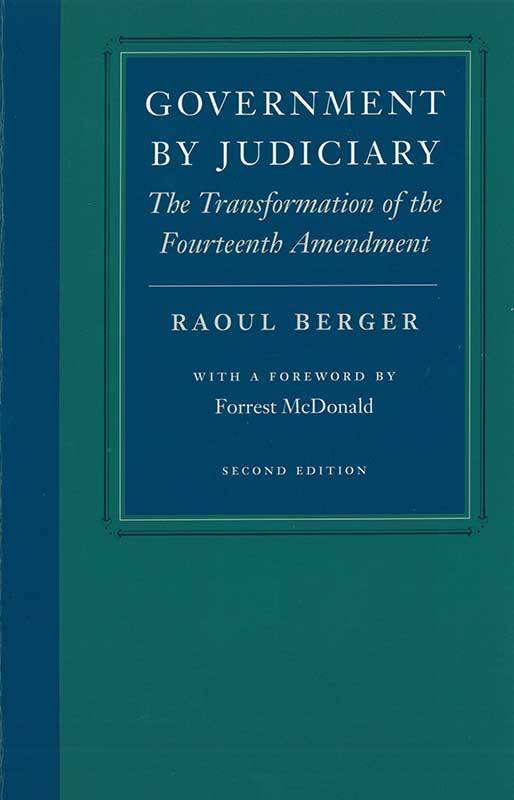
Supplementary Note on Suffrage - Raoul Berger, Government by Judiciary: The Transformation of the Fourteenth Amendment [1977]Edition used:Government by Judiciary: The Transformation of the Fourteenth Amendment, Foreword by Forrest McDonald (2nd ed.) (Indianapolis: Liberty Fund, 1997).
About Liberty Fund:Liberty Fund, Inc. is a private, educational foundation established to encourage the study of the ideal of a society of free and responsible individuals. Copyright information:The copyright to this edition, in both print and electronic forms, is held by Liberty Fund, Inc. Fair use statement:This material is put online to further the educational goals of Liberty Fund, Inc. Unless otherwise stated in the Copyright Information section above, this material may be used freely for educational and academic purposes. It may not be used in any way for profit.
Supplementary Note on SuffrageHoward is confirmed by the Report of the Joint Committee, which drafted the Amendment: “It was doubtful . . . whether the States would surrender a power they had always exercised, and to which they were attached.” 5ReapportionmentBAKER v. Carr (1962), the unprecedented reapportionment decision, said Paul Kauper, opened a “new chapter of judicial adventurism.” 1 When the issue was once again presented in Reynolds v. Sims, Justice Harlan wrote a dissent that to my mind is irrefutable. The majority of the Court made no pretense of meeting his historical demonstration; it remained for William Van Alstyne to essay a rebuttal. Harlan’s reliance on the legislative history to establish the “original understanding,” Van Alstyne writes, pertains solely to “exclusive state power over suffrage qualifications” and has no bearing on “the separate issue of malapportionment”; “there was almost no mention of the subject.” 2 That fact alone gives one pause: how can a revolution in Northern apportionment be based on nonmention? The dominant purpose of the 39th Congress was to maintain Republican hegemony by reducing Southern representation; and only secondarily did they think to secure the “person and property” of the Negro from oppression.3 There were repeated disclaimers of any intention to interfere with State sovereignty beyond those objectives. Moreover, while Negro suffrage was predominantly a Southern problem, reapportionment would invade long-established State practices with respect to white voters in the North.4 But Van Alstyne argues that to read malapportionment in the equal protection clause “is to say only that among the enfranchised [white] elite,” qualified by the State to vote, “no invidious distinction shall be permitted. The States may be as capricious as they please in withholding the ballot but not in perpetuating elites within the elite.” 5 That is a tremendous “only.” Republicans who shrank from interfering with State control of Negro suffrage in the South would scarcely have dared to impose on the North a radical reconstruction of white apportionment patterns.6 Certainly there was no disclosure that such intrusion was contemplated;7 there is in fact striking evidence that malapportionment was an accepted practice. Speaking with respect to reduced representation, Blaine of Maine said, if you cut off the blacks from being enumerated in the basis of representation in the southern States the white population of those States will immediately distribute Representatives within their own territory on the basis of white population. Therefore the most densely populated negro districts will not be allowed to offset the most densely populated white districts . . . Do you suppose that the upland districts of Georgia and South Carolina, inhabited largely by whites, will, in the event of adoption of this amendment, allow the distribution of Representatives to be made on the basis of the whole population? By no means. They will at once insist on the white basis within the State.8 Not a hint that this would be unlawful, but, rather, clear recognition that States were free to apportion representation to suit themselves. Although, as Van Alstyne notices, this would leave “areas populated by non-voters without representation (and not merely without a vote in the choice of ‘their’ representatives),” 9 Bingham replied, “no possible amendment . . . will answer the purpose unless it is followed by further legislation.” 10 Bingham thus confirms Blaine’s recital of the plenary State power over apportionment and implies that the “representation” (§2) proposal was not designed to meet this situation. Van Alstyne’s comment that “Blaine’s remarks were directed only to the apportionment of congressional rather than state representation” implausibly suggests that the States would be readier to surrender control over their own internal patterns—a suggestion that is incompatible with the pervasive attachment to State sovereignty. Blaine’s remarks did not reflect a fleeting improvisation, but responded to established practice. Earlier he had stated: “As an abstract proposition no one will deny that population is the true basis of representation; for women, children and other nonvoting classes may have as vital an interest in the legislation . . . as those who actually cast the ballot.” But, he noted, recognizing existing practice, as had Federalist No. 54 and James Wilson long before,11 “the ratio of voters to population differs very widely in different sections, from a minimum of nineteen per cent to a maximum of fifty-eight per cent.” 12 Even that uncompromising abolitionist Charles Sumner was reconciled to such practices because they reflected “custom and popular faith,” and could not be changed “unless supported by the permanent feelings and conditions of the people.” 13 Then, too, in the congressional debate of June 1868 (that is, prior to ratification of the Fourteenth Amendment), on the readmission of the rebel States, Farnsworth pointed out that the Florida apportionment provision gave “to the sparsely populated portions of the State the control of the Legislature.” But Ben Butler responded that the Senate Judiciary Committee “have found the [Florida] constitution republican and proper,” as did the Senate, the House Committee on Reconstruction,14 and the House itself, thus reaffirming that such malapportionment did not violate the guarantee of a “republican form of government,” nor the equal protection clause which was the work of Butler and his fellows. The Blaine, Sumner, and Butler statements constitute hard evidence which is not overcome by mere speculation.15 Since, moreover, most of the States were malapportioned, it is a strained assumption that by ratification they surrendered a right they had excercised from the outset, and of which surrender they were totally unapprised.16 When Van Alstyne dismissed Harlan’s reading of the §2 phrase “or in any way abridged” because “once the congressional history” of this phrase is “canvassed . . . it becomes clear that the phrase had nothing at all to do with malapportionment,” he scuttled his whole case. For, by the same token, the history of the equal protection clause likewise “had nothing at all to do with malapportionment.” “There is,” he states, “no evidence that §2 was applicable to abridgment of the right to vote resulting from malapportionment of state legislatures.” “It is even likely,” he avers, “that had the subject been discussed there might have been a disavowal of an intention to apply the Equal Protection Clause to malapportionment.” But “hypothetical answers to hypothetical questions . . . would be a most dubious basis for expounding the content of ‘equal protection’ one hundred years later.” 17 There is no need to speculate because Blaine and others plainly recognized malapportionment as an existing practice that was left untouched. I, too, prefer to eschew speculation, particularly when it is unnecessary. One who would bring an unmentioned departure from settled practice within the perimeter of the Amendment has the burden of proof, made heavier here by (1) the fact that Negro suffrage, on which the Court rested its case for reapportionment, was unmistakably excluded; (2) the plainly expressed attachment of the framers to State sovereignty and their intention to intrude no further than the limits of the Civil Rights Act; and (3) the presumption that a diminution of powers reserved to the States by the Tenth Amendment will be clearly stated.18 In one form or another, Van Alstyne would put asunder what the Warren Court hath joined; he would jettison the Court’s “one man, one vote” postulate. Granting arguendo State power “with respect to outright denials of the right to vote,” he asks, “is it equally so with respect to partial disfranchisement through malapportionment?” 19 The simple answer is that the greater includes the less.20 If a State may altogether deny the vote, it may dilute it. It was in these terms that Chief Justice Warren rationalized reapportionment: the Constitution, he held, protects the right to “vote,” the “right to have one’s vote counted.” And “the right of suffrage can be denied by a debasement or dilution of the weight of a citizen’s vote just as effectively as by wholly prohibiting the free exercise of the franchise.” 21 His premise—that the Constitution, that is, the Fourteenth Amendment, protects the right to vote—is contradicted by historical facts. But his logic is impeccable and may be stated inversely: given a right to deny suffrage, it follows that there is a right to dilute it. Republican Form of GovernmentOne of the “other” powers invoked by radical extremists was the guarantee of a “republican form of government.” 22 Senator Sumner, its leading advocate, could do no better than to find it “obscure” and to write in 1865 that “the time has come to fix meaning to those words.” 23 They were not wrapped in obscurity by the Founders. In the Federal Convention, Edmund Randolph stated that “a republican government must be the basis of a national union; and no state in it ought to have it in their power to change its government into a monarchy.” 24 This was echoed by Madison in Federalist No. 43: “the superintending government ought clearly to possess authority to defend the system against aristocratic or monarchical innovations . . . [the members of the Union have] the right to insist that the forms of government under which the compact was entered should be substantially maintained.” The guarantee “supposes a preexisting government of the form which is to be guaranteed. As long, therefore, as the existing republican forms are continued by the States they are guaranteed by the federal Constitution.” 25 Although Federalist No. 52 stated that the “definition of the right of suffrage is very justly regarded as a fundamental act of republican government,” it concluded that the right must be left to the States because “the different qualifications in the different States [could not be reduced] to one uniform rule.” 26 Finally, Federalist No. 54, alluding to the allocation of representation according to the number of inhabitants, added, “the right of choosing their allotted number in each State is to be exercised by such part of the inhabitants as the State itself may designate . . . In every State, a certain proportion of inhabitants are deprived of this right by the Constitution of the State.” 27 Fessenden therefore stood on solid ground when he rebutted Sumner’s reliance on the guarantee, saying, “in the very instrument in which the fathers provided that the United States should guaranty to every State a republican form of government they recognized the existence of slavery unmistakably . . . Did they then consider that the obligation to guaranty a republican form of government extended thus far, giving Congress the right to interfere in Virginia to examine her constitution?” When Sumner argued that the guarantee places Congress under a duty to “see that every man votes who ought to vote,” said Fessenden, “he goes considerably further than those who made the Constitution ever intended to go.” If a State “should choose to have a monarchy, or the controlling portion of the people should choose to have an oligarchy, it then becomes the duty of Congress to interfere.” 28 Such was the view of the Fathers, and it was reiterated by other leaders in the 39th Congress. Meeting a query whether a State would “cease to be republican” if it excluded a race from the franchise, Conkling responded that this “has always been permitted with universal acquiescence by the courts and the nation.” 29 On the admission of Tennessee without provision for Negro enfranchisement, Bingham said in July 1866 that if this was in violation of the guarantee, then Tennessee was in the company of many Northern States. His critics were defeated by a vote of 125 to 12.30 In the Senate, Trumbull stated, “most of us are here under republican forms of government, just like this in Tennessee.” 31 One of the dissentients, William Higby of California—whom Van Alstyne quotes as saying that no “State which excludes any class of citizens [from voting] on account of race or color is republican in form,” and that he was opposed to H.R. No. 51 because “it gives a power to the States to make governments that are not republican in form,” 32 —revealed tellingly that he was merely engaged in wishful thinking. He admitted that by his disenfranchisement test his own State of California is “not republican in form”: “I do not believe there is a single State in the Union, except it may be one of the New England States, which is an exception to that general rule . . . Now, sir, I am aware that the practice has been very different . . . from the establishment of the Government.” 33 When Ralph Hill of Indiana stated that, in placing the guarantee in the Constitution, the Framers “spoke with reference to such governments as then existed, and such as these same framers recognized for a long time afterwards as republican governments,” Higby replied: “that is a very good answer. It is an answer from a standpoint of seventy-five years ago. I speak from the standpoint of the present time.” 34 Like our contemporary apologists for a judicial revisionary power, Higby would displace the established, original meaning with his own new one. Given that the Northern States discriminated against voting by blacks, “they were as subject to reconstruction by the federal authority” as was the South. For Radicals, “this whole argument contained political dynamite”;35 and Higby himself admitted, “I do not know that there are half a dozen in this House who will sustain me.” 36 Like the 125 to 12 vote on the admission of Tennessee, Higby’s concession underscores the framers’ indifference to the dissentient views on which Van Alstyne largely pitches his case. Is it to be wondered that the Court, as Carl Auerbach noted, “agreed in Baker v. Carr that ‘any reliance’ on the Guarantee clause would be futile?” Auerbach pointed out that the Court “never adequately answered Mr. Justice Frankfurter’s argument that the equal protection claim it held to be justiciable was ‘in effect a Guarantee Clause claim masquerading under a different label.’ In fact the Court was being asked ‘to establish an appropriate form of government . . . for all the States in the Union.’ ” 37 Congress, as Auerbach noticed, had expressed its judgment, in one form or another, “as to the nature of a republican form of government,” and it is Congress, not the Court, Luther v. Borden held, to whom that function is confided.38 Where is the evidence that the framers who rejected the argument that Congress had power over State suffrage by virtue of the “republican form of government” guarantee meant to confer that power by the “equal protection” clause? It speaks volumes that Sumner, who employed “equality before the law” in a school desegregation case (wherein Chief Justice Shaw held against him),39 should have turned to the “republican form of government” guarantee in the 39th Congress. After passage of the Amendment he proposed that the admission of Tennessee and Nebraska be conditioned upon no denial of suffrage, a confession that the “equal protection” clause did not preclude such denials.40 Van Alstyne attaches considerable weight to Bingham’s “unusually rewarding” appeal to “a republican form of government,” which Bingham translated as a guarantee of the “right of franchise.” 41 His view was not shared by influential Republicans, and in the course of the debates he shifted his position, stating, “we all agree . . . that the exercise of the elective franchise . . . is exclusively under the control of the States.” 42 Shortly thereafter he changed course on the very “republican form” guarantee. He had moved for the admission of Tennessee, and Boutwell proposed “a condition precedent” that would require Tennessee to establish “suffrage for all male citizens,” without which, he argued, Tennessee would not have a “republican form of government” because of the exclusion of 80,000 blacks.43 Boutwell was twitted by Bingham: “Why does not the gentleman move for an expulsion of Missouri from representation?” “When [the blacks] shall vote rests with the people of the State. There I leave it.” And, he concluded, with respect to the exclusion of Negroes, “So does Ohio, so does Pennsylvania, and so, also, do a majority of the States.” Boutwell was voted down 125 to 12.44 Bingham is invoked still again by Van Alstyne: The second section excludes the conclusion that by the first section suffrage is subjected to congressional law; save indeed, with this exception, that as the right in the people of each State to a republican government and to choose their Representatives in Congress is of the guarantees of the Constitution, by this amendment a remedy might be given directly for a case supposed by Madison, where treason might change a State government from a republican to a despotic government, and thereby deny suffrage to the people.45 Although Van Alstyne finds this statement “puzzling,” it suffices to read the words in their ordinary sense: §2 shows that Congress was given no control of suffrage by §1, except in a case of a treasonable shift to a despotic government which does away with all voting. Manifestly, a change from representative government to a dictatorship calls for effectuation of the guarantee. But what light does this shed on the general control of suffrage? No subtle elucidation of this passage can cancel out Bingham’s flat-footed statement that “the exercise of the elective franchise is exclusively under the control of the States,” at a time when he completely abandoned the “guarantee” as a limitation on State control of suffrage.46 The Supreme Court confirmed the views of the framers in 1874: “All the States had governments when the Constitution was adopted . . . These governments the Constitution did not change. They were accepted precisely as they were . . . Thus we have unmistakable evidence of what was republican in form.” 47 Unless some special magic was deemed to inhere in the words “equal protection” —a supposition hereinafter examined—the evidence, to my mind, that suffrage was excluded from the Amendment is all but incontrovertible.48 The Report of the Joint Committee on Reconstruction, which Stevens, Boutwell, and Bingham signed, furnishes a conclusive summation: Doubts were entertained whether Congress had power, even under the amended Constitution, to prescribe the qualifications of voters in a State, or could act directly on the subject. It was doubtful, in the opinion of your committee, whether the States would consent to surrender a power they had always exercised, and to which they were attached. As the best if not the only method of surmounting the difficulty, and as eminently just and proper in itself, your committee came to the conclusion that political power should be possessed in all the States exactly in proportion as the right of suffrage should be granted, without distinction of color or race. This it was thought would leave the whole question with the people of each State, holding out to all the advantage of increased political power as an inducement to allow all to participate in its exercise.49 To “leave the whole question with the people of each State” is to say that §1 left suffrage untouched and that §2 was merely “an inducement [to the States] to allow all to participate in its exercise.” Chief Justice Warren’s Opinion in Reynolds v. SimsChief Justice Warren made no allusion to Justice Harlan’s historical demonstration of the limited scope of the Fourteenth Amendment, and instead struck off a new version of constitutional principle and history. He premised that “the right to vote freely for the candidate of one’s choice is of the essence of a democratic society, and any restrictions on that right strike at the heart of representative government.” 50 Were Warren drafting a new Constitution that principle would be unexceptionable. But that was not the established principle at the adoption of the Constitution; nor was it embodied therein. On the contrary, Federalist No. 54 recognized that “in every State, a certain proportion of inhabitants are deprived of this right by the constitution of the State.” 51 In the 39th Congress itself, Fessenden said that “everybody has admitted from the foundation of the Government down to the present day that the qualification of voters rested with the States.” 52 Such was the clear consensus in the 39th Congress. Warren postulated that “the conception of political equality from the Declaration of Independence, to Lincoln’s Gettysburg Address, to the Fifteenth, Seventeenth and Nineteenth Amendments can mean only one thing—one person, one vote.” 53 But Lincoln also bowed to “the right of each State to order and control its own domestic institutions,” 54 and reminded a Negro delegation of the ineradicable prejudice toward blacks, who were “far removed from being placed on an equality with the white man.” 55 And if we are to extract a principle from the Fifteenth and Nineteenth Amendments it is that Congress and the people considered that express Amendments were needed to confer suffrage on Negroes and women, that absent these Amendments neither enjoyed “political equality.” 56 The point was made by the Court itself in Minor v. Happersett (1874), wherein a woman claimed that the Fourteenth Amendment endowed her with suffrage: “after the adoption of the fourteenth amendment, it was deemed necessary to adopt a fifteenth . . . If suffrage was one of the privileges and immunities [of the Fourteenth], why amend the Constitution to prevent its being denied on account of race.” 57 The Seventeenth Amendment likewise speaks against Warren, for it provides, with respect to the popular election of Senators, that “the electors in each State shall have the qualifications requisite for electors of the most numerous branch of the State legislature,” qualifications, it will be recalled, that were under exclusive State control from the beginning and were left in place by the Fourteenth Amendment. Reliance upon the Declaration of Independence, to which the Radical left frequently appealed in the 39th Congress, might be dismissed with the remark of neoabolitionist tenBroek: “ ‘All men are created equal’ proclaimed the Declaration of Independence. All men? Well not quite all—not negro slaves like those owned by Jefferson, among others.” 58 To import the Declaration into the Constitution is to overlook their totally different provenance. The Declaration was a product of rebels and revolutionaries; the Constitution came twelve years later, in no small part as a recoil from the “excesses” of popularly controlled legislatures.59 Men of substance felt threatened and, in the words of John Dickinson, sought to protect “the worthy against the licentious.” 60 TenBroek noted that “Equality was the dominant note in the Declaration,” whereas a “stronger position” was accorded in the Constitution to “property,” 61 including property in slaves as the fugitive slave clause testifies. There is no blinking the fact, as Kent Newmeyer recently reminded us, that the Constitution was “racist.” 62 Jefferson himself, author of the Declaration, predicted emancipation, but wrote: “it is equally certain that the two races will never live in a state of equal freedom . . . so insurmountable are the barriers which nature, habit and opinions have established between them.” 63 Stevens powerfully summarized this history at the outset of the 39th Congress: Sir, our fathers made the Declaration of Independence; and that is what they intended to be the foundation of our Government. If they had been able to base their Constitution on the principles of that Declaration it would have needed no amendment during all time, for every human being would have had his rights; every human being would have been equal before the law. But it so happened when our fathers came to reduce the principles on which they founded this Government into order, in shaping the organic law, an institution hot from hell appeared among them . . . It obstructed all their movements and all their actions, and precluded them from carrying out their own principles into the organic law of this Union.64 It needs also to be borne in mind that the Declaration was drawn by the Continental Congress, a league of independent States, each of which jealously guarded its independence.65 One of the reasons advanced by Senator Poland for §1 of the Fourteenth Amendment was doubts as to Congress’ power to “destroy all such partial State legislation” as violated the “principles” of the Declaration of Independence.66 Senator Howard, a favorite of the neoabolitionists, stated that he could not discover the Negro right to vote in the Declaration of Independence and that, “notwithstanding the Declaration of Independence, it is the right of every organized political community to regulate the right of suffrage.” 67 Manifestly, Warren’s appeal to the Declaration as a guiding principle of constitutional construction is out of tune with the historical facts. A word about his appeal to James Wilson’s 1791 Lectures in Philadelphia: “all elections ought to be equal. Elections are equal, when a given number of citizens, in one part of the State, choose as many representatives, as are chosen by the same number of citizens, in any other part of the state.” 68 This stated an ideal, not a constitutional requirement. When Wilson turned to the Article I, §2, provision that “the Electors in each state shall have the qualifications requisite for Electors of the most numerous Branch of the State Legislature,” he said, “the regulation is generous and wise. It is generous for it intrusts to . . . the several states, the very important power of ascertaining the qualifications” of the Electors. It was evidence of confidence, “that this foundation should be continued or altered by the States themselves.” 69 Wilson was thoroughly aware of the disparate State exclusions from suffrage, having made a survey of the different State constitutions, even noticing that Connecticut provided power to exclude freemen, “according to the sentiments which others entertain concerning their conversations and behavior . . . a power of very extraordinary nature.” And he praises “the wisdom . . . which rested one of the principal pillars of the national government upon the foundations prepared for it by the governments of the several states.” 70 Warren’s use of Wilson affords striking illustration of the “lawyers history” so justly condemned by Alfred Kelly. Warren’s pervasive error, to my mind, is to substitute twentieth-century logic for the framers’ intention, so clearly expressed in the legislative history: “Logically, in a society ostensibly grounded on representative government, it would seem reasonable that a majority of the people in a State would elect a majority of that State’s legislators.” 71 “Ostensibly grounded” refuses to come to terms with the historical fact that suffrage and apportionment were the province of the States. Once again is demonstrated the wisdom of Holmes’ aphorism, “a page of history is worth a volume of logic.” 72 That history was summarized with crystal clarity in the Report of the Joint Committee on Reconstruction.73 Justice Brennan’s Opinion in Oregon v. MitchellJustice Brennan recognized that “racial prejudice in the North” was a most “significant” obstacle in the path of equal suffrage: Only five New England States and New York permitted any Negroes to vote as of 1866 . . . and extension of the suffrage was rejected by the voters in 17 of 19 popular referenda held on the subject between 1865 and 1868. Moreover, Republicans suffered some severe election setbacks in 1867 on account of their support of Negro suffrage . . . Meeting in the winter and spring of 1866 and facing elections in the fall of the same year the Republicans thus faced a difficult dilemma: they desperately needed Negro suffrage in order to prevent total Democratic resurgence in the South, yet they feared that by pressing for suffrage they might create a reaction among northern white voters that would lead to massive Democratic electoral gains in the North. Their task was thus to frame a policy that would prevent total Democratic resurgence and simultaneously would serve as a platform upon which Republicans could go before their northern constituents in the fall. What ultimately emerged as the policy and political platform of the Republican Party was the Fourteenth Amendment.74 Why could not the Republicans in Congress tell their constituents that unless Negro suffrage was granted Republican hegemony was doomed? Unless Northern voters preferred Democratic resurgence to Negro suffrage, the interests of Republican voters and members of Congress were one and the same. In fact the framers shared the prejudices of their Northern constituency, to recall only George W. Julian’s statement in the House: “The real trouble is we hate the Negro.” 75 If the Republicans entertained a secret design to slip suffrage into the Amendment over voter opposition in order to hang on to office, they were betraying their constituency, and for this firm evidence needs to be adduced. Given the framers’ awareness of voter antipathy to suffrage, one would expect Justice Brennan to resolve all doubts in favor of those sentiments. Instead he substitutes twentieth-century speculation for historical fact to effectuate his own predilections and commits the very sin he incorrectly lays at Harlan’s door: “historical analysis is flawed by ascription of 20th century meanings to the words of 19th century legislators.” 76 For example, Harlan’s “view would appear to allow a State to exclude any unpopular group on the basis of its political opinions.” 77 But if State control over suffrage was plenary, if the Amendment left States free to exclude Negroes on account of their color, they were equally free to exclude others for their “political opinions,” unpalatable as that appears to twentieth-century thinking. It will be recalled that James Wilson noticed the Connecticut provision for exclusion of freemen, “according to the sentiments which others entertain concerning their conversations and behavior . . . a power of very extraordinary nature.” Historical analysis must proceed from the 1866 facts, not reason backward from 1970 predilections. Justice Brennan would substitute his choices for those of the framers; because we dislike a policy today, it does not follow that it is unconstitutional. That standard was rejected both by the Founders and by Chief Justice Marshall.78 Justice Brennan’s opinion runs to some 38 pages; refutation, as is well known, requires more space than bare assertion; hence only a sampling of the Brennan opinion can here be analyzed. A few examples, however, should suffice to disclose Justice Brennan’s preference for speculation over fact. Section 1 began, he notices, as a “provision aimed at securing equality of ‘political rights and privileges’ ”; but the Joint Committee rejected an express reference “to political and elective rights”; it dropped all references to “political rights” and spoke in terms of “privileges and immunities” and equal protection of “life, liberty, and property” by a vote of seven to six. Commenting on these facts, Justice Brennan stated, “the breakdown of the committee vote suggests that . . . no change in meaning was intended,” because the “substitute was supported by men of all political views,” among them Howard and Boutwell, “who had earlier sought to make the section’s coverage of suffrage explicit,” and Stevens and Fessenden.79 But Boutwell, Fessenden, Howard, and Stevens later agreed that the Amendment did not grant suffrage and signed the Joint Committee Report that so stated. To deduce that Bingham merely “sought to do no more than substitute for his earlier specific language more general language” 80 ignores the repeated rejection of the specific proposals. General language may be construed to comprehend specific language that was earlier approved; but when specific language was rejected, evidence is required to explain why the rejected specific was now embodied in the general, evidence, not speculation. Then, too, Bingham cannot be lifted out of the mainstream of Republican statements that the Amendment did not confer suffrage; in fact he himself so stated.81 At the instigation of Robert Dale Owen, a reformer, Stevens had submitted a proposal that after July 4, 1876, “no discrimination shall be made . . . as to . . . the right of suffrage because of race.” This provision was deleted by the Joint Committee, Justice Brennan notes, but “the reasons for the rewriting are not entirely clear.” He notices, however, that in 1875 Owen furnished Stevens’ explanation: “several state delegations held caucuses which decided that the explicit references to ‘negro suffrage,’ in any shape, ought to be excluded from the platform.” 82 Is this not a “clear” explanation? By Brennan’s own testimony the Republicans feared to endanger the Fall elections by the submission of Negro suffrage. He reasons, however, “Perhaps the changes in §1 of the Amendment were thought by the Committee to be mere linguistic improvements which did not substantially modify Owen’s meaning.” 83 The fact is that the 1876 provision was dropped to avoid alienating the electorate. That the “changes” were not “thought by the Committee to be mere linguistic improvements” is once more demonstrated by the unequivocal statement in its Report that suffrage had proven impossible of achievement and was left in the control of the States. At “the very least,” states Justice Brennan, “the Committee must have realized that it was substituting for Owen’s rather specific language Bingham’s far more elastic language—language that, as one scholar [Alexander Bickel] has noted, is far more ‘capable of growth’ and ‘receptive to “latitudinarian” construction.’ ” 84 Because, Brennan amplified, “political considerations militated against clarification of issues and in favor of compromise,” because “much of the North . . . opposed Negro suffrage, and many Republicans in Congress had to seek reelection from constituencies where racial prejudice remained rampant,” “what Republicans needed, in the words of Wendell Phillips . . . was ‘a party trick to tide over the elections and save time.’ ” 85 This is the Bickel “open-ended” theory which I shall hereafter examine; and I shall also collate the evidence which repels the conclusion that the framers purposely employed “elastic language” to dupe the voters. For Justice Brennan “the purpose of §1 in relation to the suffrage emerges out of the debates . . . with an equal obscurity.” 86 As exhibit #1 he instances Howard’s statement that “the first section of the proposed amendment does not give to either of these classes the right of voting,” which is “not as unambiguous as [it] initially appear[s].” This is because after stating that “the right of suffrage was not one of the privileges and immunities protected by the Constitution . . . he read into the record an excerpt from . . . Corfield v. Coryell . . . which listed the elective franchise as among the privileges and immunities.” 87 But Senator Trumbull, after calling attention to this Corfield listing, had pointed out that suffrage was not included in the Civil Rights Bill.88 One might deduce that Howard felt no need to repeat such a statement after twice stating that the Amendment did not grant suffrage. Moreover, if an ambiguity be assumed, it was cured by his final statement: “the theory of this whole amendment is to leave the power of regulating the suffrage . . . with the States . . . and not to assume to regulate it.” 89 For exhibit #2, Justice Brennan turns to Bingham’s “completely incongruous statement”: “the exercise of the elective franchise though it be one of the privileges of a citizen of the Republic, is exclusively under the control of the States.” 90 Now Bingham was a confused thinker, as I shall show, but on one thing he was clear: the Amendment did not confer suffrage. At a later point he said: “We all agree . . . that the exercise of the elective franchise . . . is exclusively under the control of the States . . . The amendment does not give, as the second section shows, the power of regulating suffrage in the several States.” He further stated, “the second section excludes the conclusion that by the first section suffrage is subjected to congressional law.” 91 Thereafter Bingham vigorously defended the exclusion of Negro suffrage from the Tennessee Constitution. When Boutwell objected during the debate on the readmission of Tennessee that in consequence it did not have a “republican form of government,” Bingham replied that whether a black “shall vote rests with the people of [Tennessee]. There I leave it . . . I ask the gentlemen to weigh well the question when they come to vote, whether Tennessee shall be rejected only because the majority exercises the same power as to colored suffrage claimed for and exercised by all the other States.” 92 This was after Congress submitted the Amendment with its “equal protection” clause to the people, and Bingham was upheld by a vote of 125 to 12,93 an irreducible fact that speaks more loudly than all of Justice Brennan’s speculations. Here were materials that cured the “ambiguity,” 94 that dissipated the “obscurity” conjured up by Justice Brennan, of which he took no notice. And why lean so heavily on the alleged “ambiguities” of two leaders when the vast majority of the leadership and rank and file affirmed or recognized that suffrage was excluded from the Amendment? Then there is Brennan’s citation of Sumner, who was all but ostracized in the Senate, whose proposals were regularly voted down by very large majorities;95 and his appeal to Stevens’ statement that the Amendment “merely allowed ‘Congress to correct the unjust legislation of the States, so far that the law which operates upon one man shall operate equally upon all.’ ” 96 Stevens sought equality with respect to the rights enumerated in the Civil Rights Act, from which suffrage was excluded. But on the issue of suffrage, he stated, “I hold that the States have the right . . . to fix the elective franchise within their own States. And I hold that this [ “representation” proposal] does not take it from them . . . How many States would allow Congress to come within their jurisdiction to fix the qualifications of their voters . . . You could not get five in this Union.” 97 It was on Stevens’ motion that the Joint Committee adopted a reduction of representation proposal; and it rejected Boutwell’s motion to “abolish” any distinction.98 Justice Brennan also refers to three Democratic opponents of the Amendment who, more or less clearly, saw in it a grant of suffrage.99 Opponents of a measure, particularly those who seek to discredit it, are given slight credence, as I shall show; their testimony is not employed to define its scope.100 What are we to think of Brennan’s reference to Senator Stewart, who, “while unhappy that the Amendment did not directly confer suffrage, nevertheless could ‘support this plan’ because it did ‘not preclude Congress from adopting other means by a two-thirds vote’ ”?101 Of course Congress could later propose another amendment by a “two-thirds vote”; Stewart plainly had no reference to congressional implementation by statute, for that could be done by majority vote, given authorization by the Amendment. Finally, Justice Brennan takes over Van Alstyne’s critique of Harlan’s alleged view that “ §2 is specifically concerned with voting rights, and it provides an exclusive remedy that precludes or preempts application of §1.” 102 Apparently this is based on Harlan’s reference to the “Court’s utter disregard of the second section which expressly recognized the State’s power to deny the right . . . to vote and its express provision of a remedy for such denial or abridgment.” 103 This unduly exalts a loose, passing reference to “remedy.” Remedies are given for “wrongs”; it is no “wrong” to exercise the “recognized . . . power to deny the right . . . to vote.” Then, too, since §1 conferred no suffrage, §2 obviously created no remedy for a nonexistent right. Certainly it gave no “remedy” to the black who was denied a vote. Senator Stewart, a Republican, sardonically commented that §2 relieves the Negro “from misrepresentation in Congress by denying him any representation whatever.” 104 Justice Brennan explains that §2 “was of critical importance in assuring that, should the Southern States deny the franchise to Negroes, the Congress called upon to remedy that discrimination would not be controlled by the beneficiaries of discrimination themselves.” 105 The truth is that §2 was the core of the Republican program because, as Brennan himself states, the Republicans needed to “prevent total [Democratic] resurgence,” “massive electoral gains in the North.” Reduction of representation when Negro suffrage was denied was deemed more important than endowing blacks with the vote; perceptive Republicans doubted whether the South would be “induced” to enfranchise Negroes and thus lose control.106 Section 2, therefore, was not so much a “remedy” to enforce rights which §1 had not granted as a mechanism to preserve Republican hegemony. Forlorn hopes that the South could thereby be “induced” to confer suffrage were doomed to disappointment. Enough has been set forth to exhibit Justice Brennan’s strange preference for minority Democrats and dissentient radicals like Sumner over the Republican leadership and its followers who enacted the measure and whose utterances are virtually ignored by him, his preference for “ambiguous” utterances rather than the crystal-clear explanations of the self-same speakers, and for speculation over the mass of stubborn evidence to the contrary.107 Future historians, I confidently predict, will not prefer the “history” of Brennan to that of Harlan. 6The “Open-Ended” Phraseology TheoryWe cannot put into the Constitution, owing to existing prejudices and existing institutions, an entire exclusion of all class distinctions. —Senator William P. Fessenden* The “open-ended” theory, shortly stated, is that the framers dared not submit Negro suffrage and the like to the electorate in 1866 and therefore discarded “specific” terms, as Justice Brennan put it, in favor of “far more elastic language—language that, as one scholar [Alexander Bickel] has noted, is far more ‘capable of growth’ and ‘receptive to “latitudinarian” construction.’ ” 1 This is the classic invocation to extraconstitutional power,2 power to revise the Constitution under the theory that the framers gave a “blank check to posterity.” 3 Bickel had cautiously advanced the theory as a hypothesis; it found favor in scholarly circles,4 and more positively formulated variants were proffered by Alfred Kelly and William Van Alstyne. It has since been enshrined in an opinion by Justice Brennan; and Justice Black, jumping off from Brennan’s paraphrase, announced that it made “the history of the Fourteenth Amendment . . . irrelevant to the present problem.” 5 The theory is therefore deserving of close analysis. alexander bickelAt the time the “desegregation” case, Brown v. Board of Education,6 was first argued before the Supreme Court, Bickel was a law clerk of Justice Frankfurter, who assigned to him the task of compiling the legislative history of the Fourteenth Amendment, a task he performed brilliantly. When he delivered his memorandum in August 1953, he stated in a covering letter: It was preposterous to worry about unsegregated schools, for example, when hardly a beginning had been made at educating Negroes at all and when obviously special efforts, suitable only for the Negroes, would have to be made . . . It is impossible to conclude that the 39th Congress intended that segregation be abolished; impossible also to conclude that they foresaw it might be, under the language they were adopting.7 In 1962 he again wrote: Was it the intention of the framers . . . to forbid the states to enact and enforce segregation statutes? If one goes to the historical materials with this specific question, the only answer is in the negative. The framers did not intend or expect then and there to outlaw segregation, which, of course, was a practice widely prevalent in the North.8 Upon the termination of his clerkship Bickel wrote a farewell letter to Frankfurter in which he adverted to the “living Constitution” dictum of Marshall.9 But when he revised his memorandum for publication in 1955 he sought more solid footing. Were the amendment a statute, he concluded, a “Court might very well hold” on the basis of the evidence “that it was foreclosed from applying it to segregation in the public schools.” Apart from the “immediate effect of the enactment,” he asked, “what if any thought was given to the long-range effect” in the future—a possibility he had labeled “impossible” in 1953. Noting the shift from “equal protection in the rights of life, liberty and property” to “equal protection of the laws, a clause which is plainly capable of being applied to all subjects of state legislation,” 10 he asked, Could the comparison have failed to leave the implication that the new phrase, while it did not necessarily, and certainly not expressly, carry greater coverage than the old, was nevertheless roomier, more receptive to “latitudinarian” construction? No one made the point with regard to this particular clause. But in the opening debate in the Senate, Jacob Howard was frank to say that only the future could tell what application the privileges and immunities would have. So, too, Reverdy Johnson, a Democrat, “confessed his puzzlement about the same clause.” 11 How does the Howard-Johnson “puzzlement” about “privileges or immunities” advance the argument that “due process” and “equal protection” were understood to be open-ended? Neither Johnson nor Howard expressed uncertainty as to the meaning of those terms, and the implication is that there was none, an implication I shall flesh out in subsequent chapters. And given the Republican commitment to a “limited” program of protection for “enumerated” rights,12 why did Bingham, who had insisted on deletion from the Civil Rights Bill of the words “civil rights” as “oppressive,” too “latitudinarian,” 13 now, as author of the Amendment’s §1, resort to phraseology that was “roomier, more receptive to ‘latitudinarian’ construction?” No explanation of his turnabout has been offered, and when we descend from speculation to the facts we shall find that they offer no support for the Bickel hypothesis. Bickel states that some Republicans referred to “the natural rights of man,” 14 but those rights had been specified in the Civil Rights Act, and the Act was understood to exclude suffrage and desegregation of schools, as Bickel himself noted.15 The Act, with its restrictive “enumeration” of the rights to be protected, was represented to be embodied in the Amendment. A repudiation of such representations by the framers, in the teeth of their attachment to State sovereignty, their respect for the rights reserved to the States by the Tenth Amendment, needs to be proved, not assumed. And as will appear, the words “equal protection of the laws” evolved side by side with the framers’ limited objectives and gave perfect expression to their central goal: to prevent discriminatory legislation with respect to the enumerated rights, and those alone. Howard knew well enough what “privileges or immunities” comprised. He stated, “we may gather some intimation of what probably will be the opinion of the judiciary by referring to . . . Corfield v. Coryell.” He quoted therefrom the reference to those “privileges and immunities which are in their nature fundamental . . . They may be comprehended under the following general heads: protection by the Government, the enjoyment of life and liberty, with the right to acquire property” and so on.16 The correlation between these rights, the “privileges and immunities” of Article IV, §2, and the Civil Rights Act had been explained by Trumbull. After Howard’s speech, Reverdy Johnson moved to strike the “privileges or immunities” clause because he “did not understand what will be the effect of that”; but his motion fell to the ground,17 testimony that the Senate did not share his doubts. The “puzzlement” of Howard and Johnson cannot cancel out the repeated association of “privileges or immunities” with “security of person and property”; it cannot vitiate the all but universal understanding that the Amendment was to embody the Civil Rights Act, reiterated after Howard spoke. The Act, said Latham, “covers exactly the same ground as this amendment.” Senator Doolittle said it “was the forerunner of this constitutional amendment, and to give validity to which this constitutional amendment is brought forward,” a view also expressed by Henry Van Aernam of New York.18 The “privileges or immunities” clause, Senator Poland stated, “secures nothing beyond what was intended by the original provision [Article IV, §2] of the Constitution.” 19 In fact, Senator Howard undercuts Bickel, for toward the close of the debates he stated, “the first section of the proposed amendment does not give . . . the right of voting. The right of suffrage is not in law, one of the privileges . . . thus secured.” 20 With respect to suffrage, the “Great Guarantee,” Howard was quite clear that it was excluded; that concept, at least, could not in future change its skin. Bickel noticed that the “no discrimination in civil rights” sentence of the Act had been deleted because Republicans “who had expressed fears concerning its reach . . . would have to go forth and stand on the platform of the fourteenth amendment.” “It remains true,” he said, “that an explicit provision going further than the Civil Rights Act would not have carried in the 39th Congress.” And he noted that the Republicans drew back from “a formulation dangerously vulnerable to attacks pandering to the prejudice of the people.” But, he asked, “may it not be that the Moderates and Radicals reached a compromise permitting them to go to the country with language which they could, where necessary, defend against damaging alarms raised by the opposition but which at the same time was sufficiently elastic to permit reasonable future advances?” 21 Talk of a “compromise” between Moderates and Radicals on “vague” language is without factual basis. Consider the “radical” opposition to readmission of Tennessee because its constitution excluded Negro suffrage, voted down by 125 to 12; or the rejection of Senator Sumner’s suffrage proposal by 34 to 4.22 What need was there to “compromise” with so insignificant a group? Senator Sherman told a Cincinnati audience in September 1866, while the Amendment was up for ratification, “we defeated every radical proposition in it.” 23 Bickel’s theory, to speak plainly, is that the compromisers concealed the future objectives that they dared not avow lest the whole enterprise be imperiled; it is an elegant reformulation of conspiratorial purpose. To begin with, this theory posits that the 39th Congress harbored designs not shared by the voters, when, in fact, as Morton Keller remarks, “most congressional Republicans were aware of (and shared) their constituents’ hostility to black suffrage.” 24 Anticipating that his hypothesis might be “disparaged as putting forth an undisclosed, conspiratorial purpose such as has been imputed to Bingham and others with regard to the protection of corporations,” 25 Bickel invoked statements by Stevens and the Joint Committee Report to the effect that the Amendment’s “imperfections” may be cured by “further legislation, enabling acts,” by “legislative wisdom” 26 —hardly a warrant for judicial changes! What member of the 39th Congress would conclude that by such words was meant that Congress had conferred sub rosa for the future the suffrage it dared not propose in the present? Bickel himself torpedoed that inference. Observing that Stevens stated the Amendment “falls far short of my wishes . . . but . . . is all that can be obtained in the present state of public opinion . . . I . . . leave it to be perfected by better men in better times, ” Bickel states; “In all probability, the disappointment of Thaddeus Stevens centered on failure to make any provision for negro suffrage, immediate or prospective.” 27 Disappointment over failure to provide for prospective suffrage rules out an open-ended design to authorize such provision in the future. What Stevens meant by “further legislation” does not need construction. As Senator Stewart stated, the Amendment “does not preclude Congress from adopting other means by a two-thirds vote [another amendment] when experience shall have demonstrated . . . the necessity for a change of policy,” 28 as it did before long in recommending the Fifteenth Amendment. Studied ambiguity also collides with Fessenden’s suggestion of a change because “there is a little obscurity or, at any rate, the expression in section 4 might be construed to go further than was intended.” 29 A “blank check to posterity” is likewise refuted by Chairman Wilson’s statement: “I fear that comprehensive statesmanship which cares for posterity as well as for itself will not leave its impress upon the measure we are now considering.” 30 There are also several disclaimers of concealed objectives, of playing a trick upon an unsuspecting people.31 Charged with “indirection,” Fessenden said: where a legislator avows his object and his purpose, states what he wishes to accomplish and the mode by which he is to accomplish it, he is [not] to be charged, although it operates indirectly, with what is properly understood by the term “indirection,” which conveys the idea of a trick, a contrivance, to do something by taking advantage of others which you cannot do if you make plain to their senses what is the object.32 Shortly after congressional approval of the Amendment, and during the warm-up for the elections of 1866, a leading Radical, Congressman Robert C. Schenck of Ohio, averred the Democrats “are afraid that it may have some concealed purpose of elevating negroes . . . [to] make them voters. It goes to no such length.” 33 “Equal protection,” as will appear, emerged from the framers’ intention to outlaw laws which discriminated against blacks with respect to the “coverage of the Civil Rights Act.” “Indeed,” Bickel himself concluded, “ no specific purpose going beyond the [limited] coverage of the Civil Rights Act is suggested; rather an awareness on the part of the framers that it was a constitution they were writing, which led to a choice of language capable of growth.” 34 His appeal to the “awareness” of the framers assumes what needs to be proved—that there was in fact such a “choice.” Such speculation is rebutted by the very limited objectives of the Civil Rights Act, embodied in the Amendment, the absence of explanation for a change of direction, and the fact that “due process” and “privileges or immunities” were deemed to be used in their established sense. If there was such a “choice,” 35 it cannot harbor a purpose they confessedly dared not submit. Senator Howard, who has been regarded as “one of the most reckless of the radicals,” one who “served consistently in the vanguard of the extreme negrophiles,” 36 explained to the Senate that he would have preferred to secure suffrage to the colored race to some extent at least . . . But sir, it is not a question what you, or I, or half a dozen other members of the Senate may prefer in respect to colored suffrage . . . the question really is, what will the Legislatures of the various States . . . do in the premises; what is likely to meet the general approbation of the people. The Committee were of the opinion that the States are not yet prepared to sanction so fundamental a change.37 How is Bickel’s “undisclosed” purpose to be reconciled with the fact that an attempt to provide for Negro suffrage after 1876 was rejected? Robert Dale Owen, a pro-suffrage reformer, had brought a proposal which Stevens placed before the Joint Committee. Section 2 of the proposal provided that after July 4, 1876 (a fitting anniversary for enfranchisement), “no discrimination shall be made . . . as to . . . the right of suffrage.” 38 Owen’s reason for the “prospective suffrage,” he explained to Stevens, was that “the negro is, for the present, unprepared wisely to use the right of suffrage.” 39 When this provision was noised about, Stevens told Owen, members from New York, from Illinois . . . from Indiana held, each separately, a caucus to consider whether equality of suffrage, present or prospective, ought to form a part of the Republican programme for the coming canvass. They were afraid . . . some of them . . . might lose their elections . . . [E]ach one of these caucuses decided that negro suffrage, in any shape, ought to be excluded.40 In consequence, the 1876 proposal was dropped and the Committee substituted a “new section simply eliminating from the basis of representation persons to whom the vote was denied,” 41 the present §2. Add to this Senator Howard’s statement of the Joint Committee’s opinion that “three-fourths of the States . . . could not be induced to grant the right of suffrage, even in any degree or under any restriction, to the colored race,” 42 and we have solid evidence which overcomes speculation that there was an unrevealed purpose to confer broader powers in the future. alfred kellyKelly does not follow Bickel’s theory of a behind-the-scenes “compromise” between Radicals and Moderates, but suggests that the Radicals attempted, baldly stated, to hoodwink the Moderates. He regards it as “highly probable” that the Civil Rights Act “was not intended to bar racial segregation and classification laws.” But he finds that The intent of certain Radical leaders to go beyond the restrictive enumeration of the Civil Rights Act and to incorporate a series of expansive guarantees in the Constitution is quite clear . . . the best evidence of this is the language of the guarantees which Bingham and the other authors of the Fourteenth Amendment incorporated in the first section. The guarantees they finally adopted—privileges and immunities, due process and equal protection—were not at all derived from the Civil Rights Act, which . . . had used the restricted enumerative device. Instead, the authors derived their guarantees deliberately from the prewar Radical antislavery movement.43 A Constitution, Chief Justice Marshall stated, cannot have “the prolixity of a code”;44 there the drive is for the most compressed utterance. Moreover, the terms of §1 were far from “vague and amorphous.” 45 “Privileges or immunities” was drawn from Article IV, §2, via the Civil Rights Bill, which adopted the established judicial construction.46 An abolitionist departure needs to be proved, not assumed by reference to “expansive” language. Bingham himself repudiated such notions when he declared that the meaning of “due process” was to be found in the decisions of the courts.47 That his conception of “equal protection” did not go beyond the ban on discriminatory laws with respect to the enumerated “fundamental rights” is again demonstrated by his defense of Tennessee’s disenfranchisement of blacks, regretting that though “We are all for equal and exact justice . . . justice for all is not to be secured in a day.” 48 Next Kelly notices a “curious ambiguity . . . in the Radicals’ advocacy of the measure . . . It was as though the Radical leaders were avoiding a precise delineation of legal consequences,” this on the basis of their resort to the “technique of lofty, expansive and highly generalized language.” 49 Why such avoidance? He explains that there was a substantial block of moderate Republicans who had not yet committed themselves entirely to the Radical position . . . if [Bingham et al.] drove home too far the proposition that this amendment would undoubtedly consummate the destruction of all caste and class legislation . . . moderate Republican support might be alienated and the requisite two-thirds majority necessary to the amendment’s adoption might not be obtained. Political strategy called for ambiguity not clarity.50 Stripped of fig leaves, the Kelly rationale would give the Amendment a meaning which the radicals had concealed even from their Moderate confreres! In truth, there is no evidence of a concealed purpose. How did Bingham’s “lofty generalizations” become freighted with a cargo he had severely condemned as “oppressive” and “unjust” when he insisted upon deletion of the words “civil rights” from the Civil Rights Bill?50a Although Bingham was given to windy oratory,51 his own words show that he did not regard “due process,” “equal protection,” and “privileges or immunities” as “lofty generalizations,” but rather as terms of known and limited content. For example, he explained that “privileges or immunities” was drawn from Article IV, §2, that “due process” had been judicially defined. Then, too, Bingham and Stevens are an odd couple to conspire to pull the wool over the eyes of their colleagues. On the floor of the House in the 39th Congress, Stevens said of Bingham: “In all this contest about reconstruction I do not propose either to take his counsel, recognize his authority, or believe a word he says.” 52 william van alstyneAfter downgrading some statements in the debates, Van Alstyne nevertheless concludes that “the case can safely be made that there was an original understanding that §1 of the proposed Fourteenth Amendment would not itself immediately invalidate state suffrage laws severely restricting the right to vote.” But, he states, “we cannot safely declare that there was also a clear, uniform understanding that the open-ended phrases of §1 . . . would foreclose a different application in the future [because invalidation of State Negro suffrage laws] was avoided . . . from fear that such an amendment would not be ratified and that its Republican sponsors would be turned out of office at the next congressional election.” 53 Van Alstyne reverses the normal order of proof, that a departure from the norm was intended, that what was unmistakably excluded in 1866 was to be embraced in 1966. For such extraordinary drafting proof, not speculation, is required. In an attempt to offer some proof Van Alstyne argues that Congress had based its authority to enact the Civil Rights Act on the fact that it was “appropriate legislation to enforce the mere ban on ‘slavery’ in §1 of the Thirteenth Amendment.” He continues: “fresh from their own experience in developing new applications of the Thirteenth Amendment . . . the Radicals could scarcely have failed to foresee that the still broader contours of the Fourteenth Amendment would offer greater possibilities for the future.” 54 Undeniably some appealed to the Thirteenth Amendment for constitutional authority to enact the Civil Rights Act. But there was vigorous opposition. Conkling declared that “Emancipation vitalizes only natural rights, not political rights.” 55 And most Republicans held that natural rights did not include the right to vote. Senator Henry Wilson, a Massachusetts Radical, stated that the Thirteenth Amendment “was never understood by any man in the Senate or House to confer upon Congress the right to prescribe or regulate the suffrage in any State . . . If it had been supposed that it gave that power the amendment would never have passed the Congress, never have received the sanction of the States.” 56 Considerable impetus to the Fourteenth Amendment was given by Bingham’s insistence that there was no constitutional authority for the Civil Rights Bill and that an amendment was required.57 And the fact that Congress went on to enact the Fourteenth Amendment refutes the view that the Thirteenth was conceived to be “open-ended,” to authorize legislation going beyond emancipation. Even “more significance” is attached by Van Alstyne to what he views as an important parallel between the Civil Rights Act and the Fourteenth Amendment.58 When Bingham objected that the “no discrimination in civil rights” sentence of the Act was oppressive and invaded States’ Rights,59 the Committee deleted the sentence, and Chairman Wilson explained, “I do not think it materially changes the bill, but some gentlemen were apprehensive that the words we propose to strike out might give warrant for a latitudinarian construction not intended.” 60 In contrast, Van Alstyne points out, although “several of the Democrats declared . . . that the Privileges and Immunities Clause would eventually be applied to suffrage . . . the Republicans declined to limit the language of §1 [of the Amendment] to avoid such application.” The moral he draws is that the “Civil Rights Act was, of course, a statute; a law not expected to ‘endure for ages to come.’ The Fourteenth Amendment was something else again.” 61 A more prosaic explanation can serve. Bingham was an influential Republican with a following, and the deletion of the “civil rights” sentence, regarded as gratuitous, was a small price to pay for bringing him into camp; whereas the objections of “several Democrats” could safely be ignored because their votes could be written off.62 The Republicans, who had been assured both during enactment of the Civil Rights Bill and consideration of the Amendment that neither purported to grant suffrage, needed no express exception to make that plain. The established rule is that if a thing is within the intention of the framers, it is as good as written in the text.63 The hypotheses of Bickel, Kelly, and Van Alstyne seem to me a speculative fabric that collapses under the fact, made so clear by the framers, that they did not mean to confer Negro suffrage, present or prospective. And the theory runs into another formidable obstacle. During the ratification process, in the summer election campaign of 1866, the Republicans repeatedly assured the people that, in the words of Senator John Sherman of Ohio, the Amendment “was an embodiment of the Civil Rights Bill,” itemizing several of its provisions. A similar assurance was given by Senator Lane of Indiana.64 Congressman Schenck of Ohio repudiated “a concealed purpose” to confer Negro suffrage; his Ohio colleague Columbus Delano stressed that the Amendment was designed to make citizens “safe in the South.” 65 Logan of Illinois said it was meant to permit the citizen “to sue and be sued, to own property, to have process of court,” a reminder of the limited objectives of the Civil Rights Act, accompanied by a specific disclaimer that §1 “gives the negro the right of suffrage.” 66 These and still other representations collected by Charles Fairman militate against a concealed purpose to go beyond the confines of the Act. Finally, be it assumed that there was an undisclosed purpose, the question arises whether “ratification” extends to objectives that were not disclosed, that were in fact expressly disclaimed. The doctrine of ratification premises that the principal knows what he is ratifying; without full disclosure there can be no ratification.67 And there is the larger issue of political morality. Ours is a generation insistent on full disclosure, for example, in the marketing of corporate securities. To accept dissimulation as a means of obtaining a constitutional amendment would be to condone lower morals in the halls of Congress than is demanded in the marketplace.68 7Segregated SchoolsThe “desegregation” decision in Brown v. Board of Education1 was, as Richard Kluger called it, an act of “Simple Justice,” 2 a long overdue attempt to rectify the grievous wrongs done to the blacks. For the legal historian, however, the question is whether the Fourteenth Amendment authorized the Supreme Court to perform that act.3 For the Court, like every agency of government, may act only within the limits of its constitutional powers. As Lee stated in the Virginia Ratification Convention, “When a question arises with respect to the legality of any power, exercised or assumed,” the question will be, “ Is it enumerated in the Constitution? . . . It is otherwise arbitrary and unconstitutional.” 4 In his illuminating study of the way in which the desegregation case was handled in the Supreme Court, Kluger asks, “Could it be reasonably claimed that segregation had been outlawed by the Fourteenth when the yet more basic emblem of citizenship—the ballot—had been withheld from the Negro under that amendment?” 5 Given the rampant racism in the North of 1866—which still has to loose its grip—it needs to be explained how a North which provided for or mandated segregated schools6 was brought to vote for desegregation in the Amendment. When the “desegregation” case came to the Court in 1952, Justice Frankfurter assigned the task of compiling the legislative history of the Amendment to his brilliant clerk, Alexander Bickel,7 who was destined to become one of the foremost authorities in the field of constitutional law. Upon completing the assignment, in August 1953, Bickel delivered his memorandum to Frankfurter with a covering letter in which he stated: “it is impossible to conclude that the 39th Congress intended that segregation be abolished; impossible also to conclude that they foresaw it might be, under the language they were adopting.” 8 When he later published a revision of that memorandum, he concluded: “there is no evidence whatever showing that for its sponsors the civil rights formula had anything to do with unsegregated schools. Wilson, its sponsor in the House, specifically disclaimed any such notion.” 9 Wilson, chairman of the House Judiciary Committee and the House Manager of the Bill, who could therefore speak authoritatively, had advised the House that the words “civil rights . . . do not mean that all citizens shall sit on juries, or that their children shall attend the same schools. These are not civil rights.” 10 Wilson’s statement is proof positive that segregation was excluded from the scope of the bill. Another piece of evidence, which Alfred Kelly, one of the historians drawn into the case by the NAACP,11 considered “very damning,” was the “removal of the ‘no discrimination’ clause from the Civil Rights Bill.” The Bill, he stated, “was amended specifically to eliminate any reference to discriminatory practices like school segregation . . . it looked as if a specific exclusion had been made.” 12 The deletion was made at the insistence of John A. Bingham, the architect of the Fourteenth Amendment, whom neoabolitionists regard as the conduit through which abolitionist concepts of substantive due process and equal protection were poured into the Amendment.13 Roughly speaking, he moved for instructions to the Judiciary Committee to strike the “no discrimination” sentence of the Bill,14 in order to render it “less oppressive and therefore less objectionable.” The enactment of laws “for the general government of the people” was reserved to the States; “civil rights,” he continued, “include and embrace every right that pertains to a citizen as such,” including “political rights.” On this view the Bill, according to Bingham, proposed “simply to strike down by congressional enactment every state constitution which makes a discrimination on account of race or color in any of the civil rights of the citizen.” With “some few exceptions every state in the Union does make some discrimination . . . in respect of civil rights on account of color.” Hence the “no discrimination” sentence “must be striken out or the constitutions of the States are to be abolished by your act.” Deletion of this sentence would remove what he considered the Bill’s “oppressive and I might say its unjust provisions,” all of which adds up to a States’ Rights manifesto. Bingham’s censure, however, does not extend to the enumerated rights that follow the “no discrimination” clause; these he quotes with approval, but asserts that the needed reform should be accomplished “not by an arbitrary assumption of power, but by amending the Constitution . . . expressly forbidding the States from any such abuse [that is, denial of said specified rights] in the future.” 15 In short, the enumerated rights should be protected by Amendment against State abuse, whereas the “civil rights,” which embraced any and every right, should be excised because “oppressive.” In this Bingham was in accord with the restricted objectives of almost all of his Republican colleagues who spoke to the measure.16 Bickel therefore correctly concluded that Bingham, “while committing himself to the need for safeguarding by constitutional amendment the specific rights enumerated in the body of section 1, was anything but willing to make a similar commitment to ‘civil rights’ in general.” 17 Not without cause was this regarded gloomily in the camp of the NAACP. Kluger relates: In calling for the deletion, Bingham, the former abolition theorist, had openly acknowledged that the bill as drafted would have prohibited statutes such as school segregation. Since that broad language was in fact deleted from the final form of the bill and since many of the proponents of the Fourteenth held that the amendment had no purpose beyond constitutionalizing the Civil Rights Act, it had therefore seemed to Kelly, [Thurgood] Marshall, Ming, and others in the NAACP camp that they could not reasonably argue that the framers intended the amendment to prohibit school segregation.18 Finally, a “light” broke through, “a really plausible interpretation” dawned on Kelly: “Bingham’s objection to the ‘no discrimination’ was based solely on the apparent lack of constitutional authority for so sweeping a congressional enactment.” 19 This was a “light” that failed. Kelly completely overlooked Bingham’s separation between the too-inclusive “civil rights,” which were deleted, and the enumerated rights, which, because they also trenched on traditional State governance, required an amendment. Justice Black understood this if Kelly did not.20 More important, Chairman Wilson confirms that the deletion was merely designed to repel a “latitudinarian” construction: Some members of the House thought, in the general words of the first section in relation to civil rights, it might be held by the courts that the right of suffrage was included in those rights. To obviate that difficulty and the difficulty growing out of any other construction beyond the specific rights named in the section, our amendment strikes out all of those general terms and leaves the bill with the rights specified in the section. The deletion, Wilson further explained, was made because “some gentlemen were apprehensive that the words we propose to strike out might give warrant for a latitudinarian construction not intended.” 21 To Kelly, who later defended the desegregation decision, Bickel’s view “seems a very doubtful reading of Bingham’s position. It ignores his extensive extremist antislavery background as well as his position in Congress as one of the strong Radical Republicans.” 22 But neither Bingham’s background nor his position had dissuaded him from opposition to Negro suffrage.23 Moreover, as Bickel informed Justice Frankfurter, “It was doubtful that an explicit ‘no discrimination’ provision going beyond the enumerated rights in the Civil Rights Bill as finally enacted could have passed in the Thirty-Ninth Congress.” 24 At this time “Eight [Northern] states either provided for separate schools or left it up to local communities to adopt that practice if they wished. Five states outside the old Confederacy either directly or by implication excluded colored children entirely from their public schools.” 25 Kluger comments, “If Congress and state legislatures had understood that the amendment was to wipe away the practices, surely there would have been more than a few howls.” 26 With suffrage unequivocally barred there was no reason to infer that desegregation, a far more touchy matter, was required. Then there was another thorny fact: “Congress had permitted segregated schools in the District of Columbia from 1864 onward.” 27 Sumner’s “long fight to abolish segregated Negro schools in the District of Columbia” had been “unavailing.” 28 With good reason did Judge E. Barrett Prettyman hold in Carr v. Corning29 that congressional support for segregated schools in the District of Columbia contemporaneously with the adoption of the Amendment (and the Civil Rights Act) was conclusive evidence that Congress had not intended §1 of the Amendment to invalidate school segregation laws. Kelly too lightly dismissed this: “technically the parallel is not constitutionally precise or apposite.” 30 To the contrary, the parallel is both “precise and apposite.” It has long been the rule that laws dealing with the same subject—in pari materia—must be construed with reference to each other, “as if they were one law.” 31 The Amendment originated as a congressional Joint Resolution, so it is entirely appropriate to look to the light shed contemporaneously by the District of Columbia bills on the meaning of the Resolution. In truth, it is unrealistic to presume that a Congress which has plenary jurisdiction over the District and yet refused to bar segregation there would turn around to invade State sovereignty, which the framers were zealous to preserve, in order to impose a requirement of desegregation upon the States. The difference was fully appreciated by Senator Henry Wilson, a Radical Republican from Massachusetts, who introduced a bill providing for suffrage in the District of Columbia, but lamented that in “dealing with the States,” State “constitutions block up the way and we may not overleap the barriers.” 32 The relation of mixed schools to the limited objectives that were expressed in the Civil Rights Act was lucidly summarized by John L. Thomas of Maryland: As a freeman, he is entitled to acquire and dispose of real and other property . . . to have his life, liberty, and person protected by the same laws that protect me . . . so shall he not only have the right to enforce his contract, but to that end shall be received as a witness in a court of justice on the same terms . . . It would be an outrage . . . [if] we were to refuse to throw around them such legal guards as will prove their only protection and secure to them the enforcement of their rights. I will go even further . . . and will vote for all measures to elevate their condition and to educate them separate and apart from the whites . . . [B]ut when it comes to placing him upon the same social and political level as my own race, I must refuse to do it.33 There is yet other evidence that the framers had no intention of striking down segregation. The Senate gallery itself was segregated, as Senator Reverdy Johnson mordantly remarked.34 The Carl Schurz report Education of the Freedmen spoke throughout of “ ‘colored schools,’ ‘school houses in which colored children were taught.’ There were no references to unsegregated schools, even as an ultimate objective.” 35 Instead there was a pervasive assumption that segregation would remain. Referring to the burning of black schools in Maryland, Josiah B. Grinnell of Iowa said, give them schoolhouses and “invite schoolmasters from all over the world to come and instruct them.” Senator Daniel Clark of New Hampshire stated, “you may establish for him schools.” Ignatius Donnelly of Minnesota stated, “Educate him and he will himself see to it that the common schools shall forever continue among his people.” 36 Senator William P. Fessenden said of the “representation” proposal that was to become §2 of the Fourteenth Amendment: it “should serve as an inducement to the southern States to build school houses . . . and educate their colored children until they are fit to vote.” 37 In vetoing the antecedent Freedmen’s Bureau Bill, President Johnson noted that it provided for the “erection for their benefit of suitable buildings for asylums and schools,” and objected that Congress “has never founded schools for any class of our own people.” 38 Thaddeus Stevens “did not publicly object to the separation of the races in the schools although he was against segregation in theory . . . But he never pressed for legal enforcement of this kind of equality, as Charles Sumner did, believing it achievement enough that the South would have free schools at all.” 39 Additional light may be gathered from post–Fourteenth Amendment developments, part of Sumner’s continuing campaign for desegregated schools. On March 16, 1867, Sumner moved to amend a Supplementary Bill to require “that State constitutions provide for a system of non-discriminatory public schools.” The motion failed; it “went beyond what majority sentiment would sustain.” 40 Let an impassioned apostle of the incorporation of abolitionist ideology—Howard Jay Graham—sum up: There were many reasons why men’s understanding of equal protection, as applied to educational matters, was imperfect in 1866 . . . Negroes were barred from public schools of the North and still widely regarded as “racially inferior” and “incapable of education.” Even comparatively enlightened leaders then accepted segregation in the schools.41 The “imperfect” “understanding of equal protection” in 1866 means that the framers did not conceive it in the vastly broadened terms given to the phrase by the Warren Court. How did this history fare in the Warren Court? In his painstaking reconstruction of the progress of Brown v. Board of Education, Richard Kluger has furnished some fascinating glimpses behind the portals of the Supreme Court.42 The case was first argued before the Vinson Court; Chief Justice Vinson “found it ‘Hard to get away’ from the contemporary view by its framers that the Fourteenth Amendment did not prohibit segregation.” Jackson noted, “For 90 years segregated schools [existed] in the city [Washington].” 43 Frankfurter, “a keen observer of his colleagues’ voting inclinations,” listed Clark—along with Vinson, Reed, and Jackson—as “probable dissenters if the Court voted to overturn Plessy in the spring of 1953.” 44 If they were to be brought about, time was needed; a decision outlawing segregation by a divided Court would have produced tremendous shock waves.45 With Bickel’s aid Frankfurter framed five questions for reargument, which the Court submitted to counsel and put the case over to the next term.46 The Frankfurter tactic paid off in an unexpected way: the sudden demise of Chief Justice Vinson just before the Brown reargument. How much that mattered may be gathered from Frankfurter’s remark: “This is the first indication I have ever had that there is a God.” 47 And that remark also reveals that men and votes, not the impalpable “consensus of society” picked up by judicial antennae, are what count. The most interesting figure was Frankfurter himself. According to William Coleman, who had clerked for him a few years earlier and was the coordinator of research for the NAACP in the various States, Frankfurter “was for ending segregation from the very start.” 48 A remarkable fact: Frankfurter, the sworn foe of subjective judgment, who disclaimed enforcement of his own “private view rather than the consensus of society’s opinion,” 49 had made up his mind “from the day the cases were taken” 50 that segregation must go! This was before hearing argument or reading briefs in a case of extraordinary national importance.51 Not that he was unaware of the constitutional obstacles. Kluger recounts that Frankfurter “had studied the history of the Fourteenth Amendment” and concluded that “in all likelihood, the framers of the amendment had not intended to outlaw segregation.” 52 His conclusion must have been greatly strengthened by the Bickel memorandum, which he found so impressive that “he had it set up in type in the Court’s basement print shop and distributed among the Justices a few days before the Brown reargument.” 53 Bickel showed, and his demonstration is yet to be successfully controverted, that the 39th Congress meant to leave segregation “as is” —to the States. After the distribution of the Bickel memorandum, Jackson wrote a file memorandum dated February 15, 1954, in which he stated: “despite my personal satisfaction with the Court’s [forthcoming] judgment, I simply cannot find, in surveying all the usual sources of law, anything which warrants me in saying that it is required by the original purpose and intent of the Fourteenth or Fifth Amendment.” 54 He told the Conference that he would “file a separate concurring opinion” if the “Court feigned that the Justices were doing anything other than declaring new law for a new day.” 55 This, Kluger comments, was asking the majority to admit that “there was no judicial basis for its decision,” that “it was acting in a frankly unjudicial way.” 56 Kluger considers it “a scarcely reasonable request to make of the brethren.” 57 Why not? What kind of “consensus of society” (which the Court purportedly effectuates) is it that cannot withstand the truth—that effectuation required “new law for a new day”? An adult jurisprudence for an age of “realism” surely called for an end to the pretense that it was the Constitution, not the Justices, who spoke.58 Concealment suggests there may in fact have been no consensus.59 Perhaps Jackson’s insistence impelled Chief Justice Warren—after labeling the history “inconclusive” 60 —to state that “we cannot turn back the clock to 1868,” 61 a veiled declaration that the intention of the framers was irrelevant and that the Court was revising the Constitution to meet present-day needs.62 Justice Frankfurter, the professed devotee of “self-restraint,” reached a similar conclusion, but in different rhetoric. He had asked, Justice Burton noted, “What justifies us in saying that what was equal in 1868 is not equal now?” 63 and in a file memorandum he formulated his own answer: the equality of laws enshrined in a constitution which was “made for an undefined and expanding future . . .” . . . is not a fixed formula defined with finality at a particular time. It does not reflect, as a congealed summary, the social arrangements and beliefs of a particular epoch . . . The effect of changes in men’s feelings for what is right and just is equally relevant in determining whether a discrimination denies the equal protection of the laws.64 Although the framers were well aware of the nation’s “expanding future,” they nonetheless, for example, rejected suffrage, “present or prospective.” They knew that Article V provided the means to avoid “congealment,” 65 as was before long evidenced by adoption of the Fifteenth Amendment. The real issue, therefore, was not whether the Constitution must be “congealed,” but rather who was to make the change—the people or the Justices. Buried in Frankfurter’s fine phrases is a confession that the people could not be trusted to reflect the “changes in men’s feelings” by an amendment, and that in consequence the Justices had to rewrite the Constitution. Even in a memorandum for his own use, Frankfurter could not bring himself to admit that he was “making new law for a new day,” but sought to disguise the fact with “majestic generalities.” In Chapter 10 I shall show that the framers employed “equal protection of the laws” to express their limited purpose: to secure the rights enumerated in the Civil Rights Act, and those only, against discriminatory State legislation. With respect to those rights there could no longer be one law for whites and another for blacks. The limitless objectives that Frankfurter read into the phrase were utterly beyond the contemplation of the framers. For the stubborn fact is that racism was, and still remains, an ugly fact of American life;66 as Jackson’s file memorandum stated, “Neither North nor South has been willing to adapt its racial practices to its professions.” 67 “It was into this moral void, ” Kluger states, “that the Supreme Court under Earl Warren now stepped,” 68 not to give effect to a national consensus, still less to the Fourteenth Amendment, but to revise it for the people’s own good. But “the criterion of constitutionality,” said Justice Holmes, “is not whether we believe the law to be for the public good.” 69 [1.]Paul Kauper, “Some Comments on the Reapportionment Cases,” 63 Mich. L. Rev. 243, 244 (1964). In more restrained diction, Archibald Cox instances the reapportionment cases as a “dramatic” example of “reading into the generalities of the Due Process and Equal Protection Clauses notions of wise and fundamental policy which are not even faintly suggested by the words of the Constitution, and which lack substantial support in other conventional sources of law.” The Role of the Supreme Court in American Government 100 (1976). [2.]Van Alstyne 78–79. [3.]Supra Chapter 1 at note 55; Chapter 4 at note 4; Kendrick 207; cf. Van Alstyne 57. [4.]Chief Justice Warren, Alfred Kelly states, “carefully neglected the far more important fact that every one of the state legislatures that sent delegates to Philadelphia was grossly malapportioned by any ‘one man, one vote’ standard, and the state conventions that ratified the Constitution were in every instance set up on the same rule of apportionment.” “Clio and the Court: An Illicit Love Affair,” 1965 S. Ct. Rev. 119 at 136–137. Justice Story, commenting on the possible introduction of a clause “to regulate the State elections of members of State legislatures” stated, “It would be deemed a most unwarrantable transfer of power, indicating a premeditated design to destroy the State governments. It would be deemed so flagrant a violation of principle as to require no comment.” 1 Joseph Story, Commentaries on the Constitution of the United States §819 (5th ed. 1905). [In the Convention Nathaniel Gorham said, “ [T]he Constitution of [Massachusetts] had provided that the [representatives of the] larger districts should not be in an exact ratio of their numbers. And experience he thought had shewn the provision to be expedient.” 1 The Records of the Federal Convention of 1787 405 (Max Farrand ed. 1911). In the First Congress, Representative Michael Stone of Maryland said, “the representatives of the States were chosen by the States in the manner they pleased.” 1 Annals of Congress 765 (1834).] [5.]Van Alstyne 80. Stevens stated that “This section [2] allows the States to discriminate among the same class, and receive proportionate credit in representation.” Globe 2460 (emphasis added). So too, the antecedent Civil Rights Bill, Shellabarger stated, “does not prohibit you from discriminating between citizens of the same race . . . as to what their rights to testify, to inherit . . . shall be.” Globe 1293. [6.]With reference to a bill introduced by Sumner in March 1867, David Donald states, “Disturbed by the revolutionary changes Sumner hoped to bring about in the South, Republican Congressmen were horrified that he proposed to extend them to the North as well,” among them to secure “the elective franchise to colored citizens.” Donald, Sumner II 299. Bickel, 16 note 40, states that “Conservative Republicans who considered the Freedmen’s Bureau Bill [applicable only in the South] an appropriate concession to offer to the Radicals, evidently felt quite differently about a statute which might be applied in their constituencies.” “ [N]ational enfranchisement of the Negro—which meant Negro voting in the North—was out of the question.” William Gillette, The Right to Vote: Politics and the Passage of the Fifteenth Amendment 32 (1965). See also Harold M. Hyman, A More Perfect Union 470 (1973). [7.]When the Amendment was submitted to the States for ratification, “the northern press,” states Flack at 145, “with few exceptions, if any, took the view that the first section of the Amendment re-enacted or gave authority for, the Civil Rights Bill.” He quotes a speech of Trumbull in Chicago: §1 “was a reiteration of the Civil Rights Bill”; and one of Sherman in Cincinnati: “the first section embodied the Civil Rights Bill”; id. 148. [8.]Globe 377. Malapportionment was fastened on the Constitution from the outset by the compromise which permitted three-fifths of the voteless Negro population to be counted for purposes of representation in the House of Representatives. Thereby, as John Quincy Adams remarked, “Every planter South of the Potomac has three votes in effect for every five slaves he keeps in bondage; while a New England farmer who contributes ten-fold as much to the support of the Government has only a single vote” (Nov. 8, 1804). Quoted in Samuel F. Bemis, John Quincy Adams and the Foundation of American Foreign Policy 123 note 37 (1949). The result was to give the South twenty-five additional members and to “enable the slave power to keep its grip on the nation.” Samuel F. Bemis, John Quincy Adams and the Union 417, 446 (1956). Malapportionment was also embedded in the Constitution by the provision for two Senators from each State, although, as Thomas Hartley remarked in the First Congress, “their proportions are as ten to one.” 1 Annals of Congress 481. [9.]Van Alstyne 79 note 142. [10.]Id. [11.]Infra at notes 26–27, 69–70. [12.]Globe 141. [13.]“The true basis for representation, Sumner declared in a speech to the [Massachusetts] convention on July 7 [1853], should ideally be founded ‘absolutely upon equality’ so as to make all men, in the enjoyment of the electoral franchise, whatever their diversity of intelligence, education or wealth, and wheresoever they may be within the Commonwealth, whether in small towns or populous city, ‘absolutely equal at the ballot box.’ But, he swiftly backtracked, this system of equal representation could not be advantageously instituted ‘unless supported by the permanent feelings and conditions of the people.’ As the practice of giving Massachusetts small towns disproportionate influence had sprung ‘from custom and popular faith, silently operating with internal power, not from the imposed will of a lawgiver’ . . . no radical change in the admittedly inequitable system should be tried at present, but instead the rural towns should be given more representation so as to protect the Commonwealth against the ‘commercial feudalism’ of the big cities.” Donald, Sumner I 246, quoting 3 Sumner, Works 229–258. See supra note 4. [14.]Quoted in Reynolds v. Sims, 377 U.S. 533, 605 (1964). Stevens likewise stated that the several constitutions had been pronounced “republican in form.” Id. 604 note 42. [15.]See Van Alstyne, quoted infra at note 17. “ [T]o quarrel with the records without abundant cause is to engage in a desperate cause.” H. G. Richardson and G. O. Sayles, “Parliament and Great Councils in Medieval England,” 77 L. Q. Rev. 213, 235–236 (1961). Roughly speaking, unless testimony is inherently incredible it must be countered by evidence, not speculation. Phillips v. Gookin, 231 Mass. 250 , 251, 120 N.E. 691 (1918); Messon v. Liberty Fast Freight Co. 124 F.2d 448, 450 (2d Cir. 1942); Eckenrode v. Pennsylvania R. Co., 164 F.2d 996, 999 note 8 (3d Cir. 1947); cf. Miller v. Herzfeld, 4 F.2d 355, 356 (3d Cir. 1925); Magg v. Miller, 296 F. 973, 979 (D.C. Cir. 1924). [16.]After cataloging the “malapportioned” States, Justice Harlan asked, “Can it be seriously contended that the legislatures of the States, almost two-thirds of those concerned, would have ratified an amendment which might render their own State constitutions unconstitutional?” 377 U.S. at 603. [17.]Van Alstyne 80, 81, 85. Alfred Kelly also dismisses Harlan’s argument; “it neglected one embarrassing fact: both the provision of §2 and the extensive debate . . . were directed at the possibility of a state’s limiting Negro franchise and not to the problem of district legislative apportionment, an entirely different historical question.” Kelly, “Clio,” supra note 4 at 137. Notwithstanding the difference, Chief Justice Warren built his reapportionment case on “one man, one vote.” Because of this “embarassing fact” Kelly charges that Harlan “indulged in a bit of law office history of his own.” Id. That charge, as the above analysis of the same argument by Van Alstyne demonstrates, is without foundation. Nor is Kelly the man to cast stones. [18.]See supra Chapter 1 note 57. “An alleged surrender . . . of a power of government . . . must be shown by clear and unequivocal language; it cannot be inferred from . . . any doubtful or uncertain expressions.” Belmont Bridge v. Wheeling Bridge, 138 U.S. 287, 292–293 (1891). [19.]Van Alstyne 80. [20.]“Nothing is more evident than that the greater must include the less.” Minor v. Happersett, 88 U.S. (21 Wall.) 162, 175 (1874). [21.]Reynolds v. Sims, 377 U.S. 533, 554, 555. “The fundamental issue, as [Solicitor General Archibald Cox] puts it, is whether the State law ‘arbitrarily and unreasonably apportions its legislature so as to deny the real meaning of the right to vote, i.e., effective participation in democratic government.’ ” Phil C. Neal, “Baker v. Carr: Politics in Search of Law,” 1962 S. Ct. Rev. 252, 285. [22.]Van Alstyne 49–51. [23.]Hyman, supra note 6 at 469. Sumner early invoked the “republican form of government” guarantee to secure blacks against “denial of rights, civil or political,” and to make them “equal before the law.” Globe 92. [24.]1 Max Farrand, The Records of the Federal Convention of 1787 206 (1911) (emphasis added). [25.]Federalist 282, 283 (emphasis added). [26.]Id. 341–342. [27.]Id. 356. [28.]Globe 706. David Donald comments that Sumner’s program met with little favor in his own Massachusetts, that it “was not taken seriously,” and that his “Republican colleagues greeted his resolutions and bills” with “total silence.” Donald, Sumner II 234, 235, 240, 243. [29.]Globe 358–359. [30.]Id. 3980. Two of Van Alstyne’s dissentients, Higby and Kelley, were among the twelve who voted against the admission. [31.]Id. 3988. [32.]Van Alstyne 50. [33.]Globe 427. [34.]Id. Shellabarger admitted that although the Southern States disenfranchised blacks, they have “been by common consent regarded as republican and constitutional.” Id. 405. See also Thomas A. Jenckes of Rhode Island, id. 387. Replying to Sumner’s argument that the limitation of suffrage to whites in the Colorado constitution violated the “republican form of government,” Senator Stewart stated, “Nineteen of the free States now exclude blacks from the franchise.” Id. 1330–1331. [35.]Donald, Sumner II 202. [36.]Globe 427. [37.]Auerbach, “The Reapportionment Cases: One Person, One Vote—One Vote, One Value,” 1964 S. Ct. Rev. 1, 85. “Yet to rest the Reapportionment Cases on the Guarantee Clause creates difficulties of its own which must be evaluated . . . Historically the system of legislative representation prevailing in a State was intended to be subject to the requirements of the Guarantee Clause while, as we saw, the Equal Protection Clause was not originally intended to deal with this matter.” Id. Paul Kauper likewise was critical of the conversion of equal protection to the guarantee of a republican form of government. “This is the central issue in these cases—what form of government is compatible with a representative form of government—and the guarantee of a republican form of government is the explicit constitutional provision relevant to the problem.” Kauper, supra note 1 at 244. [38.]Auerbach, supra note 37 at 86; 48 U.S. (7 How.) 1 (1849). Auerbach notices the “serious difficulty” posed by the fact that “Congress has admitted states into the Union and declared their forms of government to be ‘republican,’ even though their constitutions authorized systems of apportionment that the Court would now declare unconstitutional. It would be awkward for the Court to say not only that it has a role in enforcing the Guarantee Clause but that it also may overrule the expressed judgment of Congress as to the nature of a republican form of government” (in an area which Luther v. Borden held was not for the Court but for Congress). “The Court,” Auerbach continues, “thinks it has avoided this contradiction of Congress by resting on the Equal Protection Clause . . . but the Court’s explanation is not very satisfactory.” Id. 86. [39.]Cf. Donald, Sumner I 180; Kelly, Fourteenth 1056. [40.]Senator Sumner proposed as a condition upon the admission of Tennessee that there should be no denial of suffrage; the proposal was rejected by a vote of 34 to 4. Several days later a similar Sumner proposal respecting the admission of Nebraska was defeated by a vote of 34 to 5. Globe 4000, 4232. [41.]Van Alstyne 51–52; Globe 431. [42.]Globe 2542. [43.]Globe 3950, 3975–3976. [44.]Id. 3978–3979, 3980. [45.]Van Alstyne 62–63; Globe 2542; emphasis added; see supra at note 25. [46.]Globe 2542; and supra at notes 43–44. [47.]Minor v. Happersett, 88 U.S. (21 Wall.) 162, 175–176. [48.]“It is clear,” said the Court in Minor v. Happersett, id. 171, “that the Constitution [Fourteenth Amendment] has not added the right of suffrage to the privileges and immunities of citizenship as they existed at the time it was adopted.” [49.]Report of the Joint Committee on Reconstruction, 39th Cong., 1st Sess. (undated, 1866) xiii (emphasis added). At an early stage Conkling stated that the Committee rejected a proposal “To deprive the States of the power to disqualify or discriminate politically on account of race” and instead approved a proposal. “To leave every State perfectly free to decide for itself, not only who shall vote, but who shall belong to the political community in any way.” Globe 357. Chairman Fessenden stated that §2 “leaves the power where it is,” i.e., with the States. Globe 705. When James M. Ashley of Ohio was asked by his Ohio colleague, Francis LeBlond, “why the gentleman yields the question of suffrage, as he does, in supporting the [representation] proposition of the Committee,” he replied, “Because I cannot get it.” Id. 2882. [50.]377 U.S. at 555. [51.]Federalist 356; see supra at notes 26–27; infra at notes 69–70. [52.]Globe 1279. [53.]377 U.S. at 558. This was quoted from the opinion of Justice Douglas in Gray v. Sanders, 372 U.S. 368, 381 (1963). [54.]Supra Chapter 4 at note 38. [55.]Supra Chapter 1 at note 36. [56.]As Justice Harlan stated, “the very fact that constitutional amendments were deemed necessary to bring about federal abolition of state restrictions on voting by reason of race (Amendment XV), sex (Amendment XIX) . . . is itself forceful evidence of the common understanding in 1869, 1919 . . . that the Fourteenth Amendment did not empower Congress to legislate in these respects.” Oregon v. Mitchell, 400 U.S. at 202, dissenting and concurring in part. [57.]88 U.S. (21 Wall.) 162, 175. In United States v. Cruikshank, 92 U.S. 542, 555 (1875), Chief Justice Waite reaffirmed that “the fifteenth amendment has invested the citizens of the United States with a new constitutional right, which is exemption from discrimination in the exercise of the elective franchise on account of race. From this it appears that the right of suffrage is not a necessary attribute of national citizenship” (emphasis added). [58.]TenBroek 14. [59.]Raoul Berger, Congress v. The Supreme Court 10–11 (1969). [60.]Quoted in Gordon Wood, The Creation of the American Republic 1776–1787 475 (1969). [61.]TenBroek 16. [62.]“Book Review,” 19 Am. J. Legal Hist. 66, 67 (1975). Kelly, however, regards efforts to prove that “the Constitution was exclusively a ‘white man’s document’ ” and “to discount the Declaration of Independence” as a lapse into “a priori, fiat technique.” Kelly, “Clio,” supra note 4 at 126 note 26. [63.]Quoted in 1 Alexis de Tocqueville, Democracy in America 378n (1900). [64.]Globe 536. [65.]See Raoul Berger, Executive Privilege: A Constitutional Myth 103–107 (1974). [66.]Globe 2961. [67.]Id. 2175. [68.]Quoted in 377 U.S. at 564 note 41 (emphasis added). The quotation appears at 1 James Wilson, The Works of James Wilson 406 (R. G. McCloskey ed. 1967). [69.]1 Wilson, supra note 68 at 407 (emphasis added). [70.]Id. 409, 411. [71.]377 U.S. at 565 (emphasis added). Ward Elliott justly states that in Reynolds v. Sims the Court fabricated a “fundamental principle of ‘one person, one vote’ that was exactly the reverse of text and stated intent of the equal protection clause.” Elliott, supra note 1 at 129. As a professor, Solicitor General Robert J. Bork wrote, “Chief Justice Warren’s opinions in this series of [state legislative apportionment] cases are remarkable for their inability to muster a single respectable supporting argument. The principle of one man, one vote . . . runs counter to the text of the fourteenth amendment, the history surrounding its adoption and ratification and the political practice of Americans from Colonial times up to the day the Court invented the new formula.” “Neutral Principles and Some First Amendment Problems,” 47 Ind. L.J. 1, 18 (1971). [72.]New York Trust Co. v. Eisner, 256 U.S. 345, 349 (1921). Dissenting in a reapportionment case, Justice Stewart stated, “these decisions mark a long step backward into that unhappy era when a majority of the members of this Court . . . convinced themselves and each other that the demands of the Constitution were to be measured not by what it says, but by their own notions of wise policy . . . What the Court has done is to convert a particular political philosophy into a constitutional rule.” Lucas v. Colorado General Assembly, 377 U.S. 713, 747–748 (1964). [73.]Supra at note 49. [74.]Oregon v. Mitchell, 400 U.S. at 255–256, dissenting in part. [75.]Globe 257. Similar statements are collected supra Chapter 1 at note 40. [76.]400 U.S. at 251. [77.]Id. 252 note 4. [78.]See infra Chapter 14 at notes 103–104. [79.]400 U.S. 257–260. [80.]Id. 260. [81.]See infra at notes 91–93. [82.]400 U.S. at 260–262. This incident is more fully discussed infra Chapter 6 at notes 38–41. [83.]400 U.S. at 263. [84.]Id. [85.]Id. 272, 273. [86.]Id. 263. [87.]Id. 263–264. [88.]Supra Chapter 2 at notes 47, 31. [89.]Globe 3039; and see supra Chapter 4 at note 34. [90.]400 U.S. at 264. [91.]Globe 2542. [92.]Id. 3978, 3979. [93.]Id. 3980. [94.]400 U.S. at 264. [95.]Supra note 40; infra Chapter 7 at note 40. For rejection of another Sumner proposal, see supra Chapter 4 at note 20. A “deep estrangement . . . existed between Sumner and his Republican colleagues . . . More and more Senators came to distrust, when they did not detest, him.” Donald, Sumner II 248. See also supra notes 6 and 28. [96.]400 U.S. at 266. [97.]Globe 536. [98.]Kendrick 51, 55. [99.]400 U.S. at 267. Brennan also cites two other Democrats, Boyer of Pennsylvania and Senator Hendricks of Indiana, id. 274. [100.]Infra Chapter 9. [101.]400 U.S. at 268. [102.]Id. 276–277; Van Alstyne 39. [103.]Reynolds v. Sims, 377 U.S. at 594. [104.]Globe 2801. See also Senator Reverdy Johnson, supra Chapter 4 note 61. [105.]400 U.S. at 277. [106.]Supra Chapter 4. [107.]Unless evidence is inherently incredible, it must be countered by evidence, not speculation. Supra note 15. [*]Globe 705. Fessenden was co-chairman of the Joint Committee on Reconstruction, which drafted the Amendment. [1.]Oregon v. Mitchell, 400 U.S. 112, 263 (1970). [ “Vague and uncertain laws, and more especially Constitutions, are the very instrument of slavery.” 3 Samuel Adams, The Writings of Samuel Adams 262 (Harry A. Cushing ed. 1904).] [2.]Cf. T. C. Grey, “Do We Have an Unwritten Constitution?” 27 Stan. L. Rev. 703, 712–713, 709 (1975); see infra note 9. [3.]“The Constitution is not a blank check to posterity.” Ward Elliott, The Rise of Guardian Democracy viii (1974). For a similar statement by Justice Black see infra Chapter 11 note 27. [4.]Dean Francis Allen stated, “There is evidence that those who drafted Section 1 intended that the meanings of these phrases should evolve and expand with the passage of time and changes of circumstance.” “The Constitution: The Civil War Amendments: XIII–XV,” in American Primer 161, 165 (Daniel J. Boorstin ed. 1966). Carl Auerbach likewise noticed general agreement that the original understanding did not comprehend “immediate” suffrage but that Congress wittingly chose “language capable of growth.” “The Reapportionment Cases: One Person, One Vote—One Vote, One Value,” 1964 S. Ct. Rev. 1, 75–76. Wallace Mendelson said that due process and equal protection “doubtless were designed to have the chameleon’s capacity to change their color with changing moods and circumstances.” Justices Black and Frankfurter: Conflict in the Court viii (1961). [5.]400 U.S. at 139–140. [6.]347 U.S. 483 (1954). [7.]Richard Kluger, Simple Justice 654 (1976) (emphasis added). [8.]Alexander Bickel, The Least Dangerous Branch 100 (1962). [In The Supreme Court and the Idea of Progress 48 (1978) Bickel stated: “The Framers of the Fourteenth Amendment explicitly rejected the option of an open-ended grant of power to Congress freely to meddle with conditions within the States, so as to render them equal in accordance with Congress’s own notions. Rather, federal power, legislative as well as judicial, was to be limited by the terms of the Amendment.” [9.]Kluger, supra note 7 at 655. Professor Robert McKay “finds the answer in the fact that it is not a statute but in Chief Justice Marshall’s words, ‘a constitution we are expounding.’ ” Quoted in Louis Pollak, “The Supreme Court Under Fire,” 6 J. Pub. L. 428, 440 (1950). That Marshall has been utterly misconstrued down the years is shown infra Chapter 21 at notes 1–28. Here it may be noted that the plea for “growth” is in truth a claim for judicial power to revise the Constitution. In one of the great paradoxes of our time, Justice Black, that supreme “revisionist,” dismissed “rhapsodical strains, about the duty of the Court to keep the Constitution in tune with the times. The idea is that the Constitution must be changed from time to time and that this Court is charged with the duty to make those changes . . . The Constitution makers knew the need for change and provided for it” by the amendment process of Article V. Griswold v. Connecticut, 381 U.S. 479, 522 (1965), dissenting opinion. [10.]This shift is discussed infra Chapter 11 at note 35. [11.]Bickel 60–61. [12.]See Kelly infra Chapter 13 at note 53; Thayer supra Chapter 2 at note 28. [13.]See infra Chapter 7 at notes 11–17, and 21. [In 1968 Alexander Bickel testified before the Senate Subcommittee on the Separation of Powers in Hearings on the Supreme Court that the “open-ended” Bingham amendment was voted down because “it left Congress too free.” The framers thought that section 1 “limited, imposed limits on what Congress could do.” An “open-ended power also means that Congress can go there in those States and simply rearrange the social scene, and the legal order in those States, and we don’t want that either.” Hearings on the Supreme Court Before the Subcommittee on the Separation of Powers of the Senate Committee on the Judiciary, 90th Cong., 2d Sess., at 44–45 (June 1968).] [14.]Bickel 61. [15.]“Natural rights” had acquired a settled common law meaning; supra Chapter 2 note 55. “The obvious conclusion, to which the evidence, thus summarized, easily leads is that section 1 of the fourteenth amendment, like section 1 of the Civil Rights Act of 1866, carried out the relatively narrow objectives of the Moderates, and hence, as originally understood, was meant to apply neither to jury service, nor suffrage, nor miscegenation statutes, nor segregation.” Bickel 58. [16.]Globe 2765. [17.]Id. 3041. Just before Johnson spoke, Senator James A. McDougall of California stated that the Civil Rights Act “was simply to carry out the ‘privileges and immunities’ ” provision of Article IV, §2. Id. 3035. [18.]Id. 2883, 2896. Van Aernam stated the Amendment gives “constitutional sanction and protection to the substantial guarantees of the civil rights bill.” Id. 3069. [19.]Id. 2961. [20.]Id. 2766. [21.]Bickel 61–62. Earlier Flack had put the matter more bluntly: the “main purpose [of the Radical leaders] in proposing the first section of the Amendment was to increase the power of the Federal Government very much, but to do so in such a way that the people would not understand the great change intended to be wrought in the fundamental law of the land.” Flack 69. But, he observed, “had the people been informed of what was intended by the Amendment, they would have rejected it.” Flack 237. [In 1830 Madison wrote, “it exceeds the possibility of belief, that the known advocates in the Convention for a jealous grant & cautious definition of federal powers, should have silently permitted the introduction of words or phrases in a sense rendering fruitless the restrictions and definitions elaborated by them.” 3 Records of the Federal Convention of 1787 483, 488 (Max Farrand ed. 1911).] [22.]Supra Chapter 5 at note 30; Chapter 4 at note 33. [23.]James 167; see also infra Chapter 13 at notes 38–45. [24.]Morton Keller, Affairs of State 67 (1977); and see infra Chapter 13 at notes 16–17. [25.]Bickel 63. [26.]Id. “Perhaps the passage of the Civil Rights Act of 1875 ultimately is the most decisive indication of the conviction of a large majority of the Radicals that Congress might properly forbid state caste and segregation legislation under the amendment [ §5], but again this law implied congressional power and discretion, not necessarily the existence of prior mandatory rights enforceable under the amendment alone.” Kelly, Fourteenth 1085 (emphasis added). See infra Chapter 12. [27.]Bickel 45–46 (emphasis added); cf. Globe 2459. Stevens stated “prospective” suffrage would be unacceptable; infra at notes 27, 38–41. In explaining §2, Stevens stated, “True it will take two, three, possibly five years before they [Southern States] conquer their prejudices sufficiently to allow their late slaves to become their equals at the polls.” Globe 2459 (emphasis added). This speaks against a §1 power in the future to compel States to grant suffrage; and it is confirmed by Stevens’ statement that “The large stride which we in vain proposed is dead.” Globe 2460. [28.]Globe 2964. [29.]Id. 2941. [30.]Id. 2947. [31.]In his famous attempt to read corporations out of the Fourteenth Amendment, Justice Black said, “A secret purpose on the part of the members of the Committee, even if such would be the fact, however, would not be sufficient to justify any such construction.” Connecticut General Ins. Co. v. Johnson, 303 U.S. 77, 87 (1938), dissenting opinion. Cf. infra Chapter 8 at notes 77 and 95. [32.]Globe 1275. [33.]Fairman, Stanford 74–75. [34.]Bickel 63 (emphasis added). Yet Bickel noted that “equal protection” had a limited meaning for the “Moderates, led by Trumbull and Fessenden,” the right “of benefitting equally from the laws for the security of person and property.” Id. 56. [35.]Bickel also builds on the fact that §1 of the Fourteenth Amendment deals with discrimination “whether or not based on color” and “this feature of it could not have been deemed to be included in the standard identification of section 1 with the Civil Rights Act,” an indication of future breadth. Id. 60. But §1 of the Civil Rights Act likewise provided that “the inhabitants of every race and color . . . shall have the same right,” and the debates show that its coverage extended to whites. As Bickel noticed, Senator Trumbull stated that “this bill applies to white men as well as black men. It declares that all persons . . . shall be entitled to the same civil rights.” Globe 599; Bickel 14 note 36. In any event, inclusion of whites does not broaden the protection for property and personal security which the Act provided for both blacks and whites. [36.]Kendrick 192. [37.]Globe 2766. [38.]Bickel 41–42; Kendrick 83–84. [39.]Kendrick 298. This view was shared by Senator Fessenden, Globe 704; William A. Newell of New Jersey, id. 867; and Stevens himself, supra Chapter 4 at note 64. See also C. Vann Woodward, The Burden of Southern History 92 (1960). [40.]Kendrick 302 (emphasis added). [41.]Bickel 43. [42.]Globe 2766 (emphasis added). [43.]Kelly, Fourteenth 1069, 1071 (emphasis added). [44.]“A constitution, to contain an accurate detail of all the subdivisions of which its great powers will admit . . . would partake of the prolixity of a legal code, and could scarcely be embraced by the human mind.” M’Culloch v. Maryland, 17 U.S. (4 Wheat.) 316, 407 (1819); cf. Bickel 61. [45.]Kelly, Fourteenth 1071. [46.]Andrew J. Rogers charged that §1 “is no more nor less than an attempt to embody in the Constitution . . . that outrageous and miserable civil rights bill”; later he stated that it “simply embodied the gist of the civil rights bill.” Globe 2538; Globe App. 229; quoted in Bickel 48, 54. This was the all but universal view; supra Chapter 2 at notes 10–13. [47.]Infra Chapter 11 at notes 36–37. [48.]Globe 3979. [49.]Kelly, Fourteenth 1077. [50.]Id. 1084. [50a.]Infra Chapter 7 at notes 11–21. [51.]For example, by way of prelude to a quotation from Kent, who had frequently been cited without florid panegyrics, Bingham must needs gild the lily: “one of those grand intellects who during life illustrated the jurisprudence of our country, and has left in his works a perpetual monument of his genius, his learning, and his wisdom.” Globe 1292. It is instructive to compare the flow of such effusions with the spare, lean style of Fessenden, Trumbull, and Hale. See also infra Chapter 8 note 54. [52.]Cong. Globe, 39th Cong., 2d Sess. 816 (Jan. 28, 1867). See also infra Chapter 13 at notes 30–36; Kluger, infra Chapter 7 note 20. [53.]Van Alstyne 72 (emphasis added). [54.]Id. 74–75. [55.]Globe 356. [56.]Id. 1255. “George Ticknor Curtis typified a large stream of conservative constitutionalism in his argument that the Thirteenth Amendment diminished states’ powers not one whit beyond abolition.” H. M. Hyman, A More Perfect Union 428 (1973). Senator Cowan, a Conservative Republican from Pennsylvania, stated that the Thirteenth Amendment was understood merely “to liberate the negro slave from his master.” Globe 499. On the other hand, Senator Howard, a member of the Judiciary Committee that drafted the Thirteenth Amendment, understood it to authorize the Civil Rights Bill. Globe 503. [United States v. Harris, 106 U.S. 629, 643 (1882) rejected the notion that “under a provision of the Constitution which simply abolished slavery and involuntary servitude, we should with few exceptions invest Congress with power of the whole catalog of crimes.” ] [57.]Globe 1291. [58.]Van Alstyne 75. [59.]Globe 1291; see Chapter 7 at notes 12–15. Van Alstyne, 76, states that “In spite of the declarations that the bill would not affect voting rights, even Bingham was not satisfied. He moved to strike out the opening general phrase . . . he doubted both the wisdom and constitutionality of legislating with respect to the franchise” (emphasis added). Since Bingham was the architect of §1 of the Amendment, how did he become the vehicle of smuggling an undisclosed provision for suffrage into the section? [60.]Globe 1366; Van Alstyne 77. [61.]Van Alstyne 73, 77. [62.]Democratic Senator Saulsbury’s proposal to add to the Civil Rights Bill “except the right to vote in the State” was rebuffed by Senator Trumbull: “This bill relates to civil rights only, and I do not want to bring up the question of negro suffrage in the bill.” Globe 606; Van Alstyne 76; cf. supra at note 17. [63.]Supra Chapter 1 note 24. [64.]Fairman, Stanford 77, 74. [65.]Id. 74, 75. [66.]Id. 70. James, 179, said, “statements of congressmen before their constituents definitely identify the provisions of the first section of the amendment with those of the Civil Rights Bill.” [67.]Infra Chapter 8 at note 93. See supra note 21. [68.]Justice Douglas wrote, “The principle of full disclosure has as much place in government as it does in the market place,” William O. Douglas, “Stare Decisis,” 49 Colum. L. Rev. 735, 754 (1949). [1.]347 U.S. 483 (1954). [2.]Richard Kluger, Simple Justice (1976); hereinafter Kluger. [3.]“The result,” Archibald Cox stated, “can only be described as a revolution in constitutional law.” The Role of the Supreme Court in American Government 57 (1976). [4.]3 Jonathan Eliot, Debates in the Several State Conventions on the Adoption of the Federal Constitution 186 (1836); Berger, Congress v. The Supreme Court 13–16. [5.]Kluger 635. [6.]Infra at notes 24–25. [7.]Kluger 599, 653. [8.]Id. 654. Kluger states that the Bickel memorandum held that “the legislative history, while revealing no evidence that the framers of the amendment had intended to prohibit school segregation, did not foreclose future generations from acting on the question, either by congressional statute or by judicial review.” Id. 655; see also 634. But this is at odds with Bickel’s covering letter, supra Chapter 6 at note 7. In fact, as will shortly appear, the framers deliberately excluded school segregation from the ambit of the Civil Rights Bill and therefore of the Amendment. [9.]Bickel 56. [10.]Globe 1117. Wilson’s statement is more fully quoted supra Chapter 2 at note 26. He later reiterated that the limited objectives of the bill did not extend to “setting aside the school laws and jury laws.” Globe 1294. [11.]Kluger 626. [12.]Id. 635. Among the legal historians drawn into preparation of the briefs by the NAACP was Howard Jay Graham. Id. 625–626. “He was particularly troubled by Representative Wilson’s insistence during the phase of the debates dealing with the ‘no discrimination’ clause that the Civil Rights Bill was not intended to outlaw separate schools. That negative reference, Graham reported, was unfortunate, particularly since he was House Manager of the . . . bill.” Id. 634–635. [13.]TenBroek 145–148; Graham 280, 283. [14.]The Bill is set out in pertinent part supra Chapter 2 at note 14. [Justice Harlan pointed out that Bingham, in the meetings of the Joint Committee on Reconstruction, was “successful in replacing section 1 of Owen’s proposal, which read ‘No discrimination . . . as to the civil rights,’ with the ‘abridge the privileges or immunities of citizens.’ ” Oregon v. Mitchell, 400 U.S. 112, 172 (1970) (emphasis added).] [15.]Globe 1291–1293 (emphasis added). [16.]E.g., Wilson, supra at note 10. [17.]Bickel 24. [18.]Kluger 640–641. The noted historian Henry Steele Commager had advised the NAACP that “The framers of the amendment did not, so far as we know, intend that it should be used to end segregation in schools.” Id. 620. [19.]Id. 641. [20.]Justice Black, for whom Bingham is the authoritative expositor, recognized that Bingham objected to the Civil Rights Bill because “it would actually strip the states of power to govern, centralizing all power in the Federal Government. To this he was opposed.” Adamson v. California, 332 U.S. 46, 100 (1947), dissenting opinion. [21.]Globe 1366. [22.]Kelly, Fourteenth 1068 note 73. In this very article, however, Kelly concluded, “It seems highly probable, then, that the Civil Rights Act, as finally passed, was not intended to ban state racial segregation and classification laws. The main force of the Conservatives’ attack on the ‘no discrimination’ clause was that it would indeed destroy all race classification laws.” Id. 1069–1070. [23.]E.g., supra Chapter 5 at notes 42–43. [24.]Kluger 654–655. [25.]Id. 633–634. [26.]Id. 635. [27.]Id. The problem also troubled Justice Jackson, infra at note 43. [28.]Kelly, Fourteenth 1085. For example, when Senator Wilson proposed to allocate funds for the public schools in the District of Columbia, explaining that existing law provided “for the establishment of colored schools” in the District, and the funds would be divided pro rata, Reverdy Johnson asked for and received assurance that “there is no authority to have a mixture of children in any one school.” Globe 708–709. [29.]182 F.2d 14, 17 (D.C. Cir. 1950). [30.]Kelly, Fourteenth 1085. [31.]United States v. Freeman, 44 U.S. (3 How.) 556, 564 (1845). See also infra Appendix A note 46. [32.]Phillip S. Paludan, A Covenant With Death 50 (1975). [33.]Globe 263–264. For a similar expression by Patterson of New Hampshire, see supra Chapter 2 at note 30. So, too, Republican Senator Cowan of Pennsylvania was willing to secure to blacks “their natural rights” but not to desegregate the schools. Globe 500. See also Republican Thomas T. Davis of New York, infra Chapter 10 at note 21. [34.]Globe 766: “Why is it that [you have] separate places for the respective races even in your own chamber? Why are they not put together?” [35.]Bickel 10 note 29. [36.]Globe 652, 834, 590; cf. Donnelly, id. 513. Recall Lawrence’s exclusion of “political rights [and] those dependent on local law,” as was the privilege of attending public schools, supra Chapter 2 note 28, and Windom’s statement that the Civil Rights Bill does not confer “the privilege of voting” nor “social privileges.” Supra Chapter 2 note 30. [37.]Kendrick 206. [38.]Globe 916. [39.]Fawn Brodie, Thaddeus Stevens: Scourge of the South 320 (1959). Stevens assured the electorate in September 1866 that the Amendment “does not touch social or political rights.” James 201. Perhaps the reason, as Rogers noted, was that in “Pennsylvania there is a discrimination between the schools for white children and the schools for blacks. The laws there provide that certain schools shall be set aside for black persons,” and inquired whether Congress has a right to “interfere with these statutes.” Globe 1121. Senator Cowan of Pennsylvania objected to such interference. Id. 500. [40.]Fairman, History 329. Sumner “placed little stress upon the Fourteenth Amendment guarantee of equal protection of the laws; too many of his colleagues who had helped draft that ambiguous document would reply that they had never intended to outlaw segregation . . . When Senator Morrill insisted upon learning exactly where in the Constitution the federal government was given control ‘over matters of education, worship, amusement . . .’ Sumner discovered authorization in the Sermon on the Mount and in the Declaration of Independence.” Donald, Sumner II 532. [41.]Graham 290 note 70. Nevertheless Graham stated that “no one is obliged or disposed to grant—that an outright majority of 1866–1868 did regard race segregation in their public schools, as a peculiar form of race discrimination—as one which in their judgment, would remain unaffected by the Fourteenth Amendment.” Id. 291. [42.]Among other things, Kluger consulted the notes of Justices Burton, Frankfurter, and Jackson, and interviewed several of the Justices and the Justices’ clerks. Kluger 788–789. [43.]Id. 590. [44.]Id. 612, 614; Plessy v. Ferguson, 163 U.S. 537 (1896), the “separate but equal” decision. [45.]Kluger 600. “Nothing could have been worse, for the Court or the nation itself, than a flurry of conflicting opinions that would confuse and anger the American people.” Id. 696. Desegregation could hardly have been imposed upon the nation by a divided Court; the stakes simply were too high. Frankfurter “played a pivotal role in bringing about a unanimous Court” in Brown. Joseph P. Lash, From the Diaries of Felix Frankfurter 83 (1975). [46.]Kluger 614–616. [47.]Id. 656. As Justice Frankfurter was dressing for the Vinson funeral, Bickel overheard him murmuring, “An act of Providence, an act of Providence.” Lash, supra note 45 at 83. Compare this with his condemnation of “Law” that turns on “contingencies in the choice of successors.” Infra Chapter 17 note 44. [48.]Kluger 624, 601. “When President Eisenhower appointed Earl Warren to the Chief Justiceship, Frankfurter took him to school on the issues in the Brown case in lengthy talks.” Lash, supra note 45 at 83–84. [Alexander Bickel, who was a clerk to Justice Frankfurter at the time Brown v. Board of Education was decided, wrote, “(W)hen the inner history of that case is known, we may find that he was a moving force in its decision.” Alexander Bickel, The Supreme Court and the Idea of Progress 33 (1978).] [49.]Infra Chapter 14 at note 50. In a file memorandum, the essence of which Frankfurter communicated to his brethren at a conference, he emphasized, “it is not our duty to express our personal attitudes towards these issues however deep our individual convictions may be. The opposite is true.” Kluger 684. [Justice Frankfurter stated, “Nor should resentment or injustice displace the controlling history in judicial construction of the Constitution.” United States v. Lovett, 328 U.S. 303, 323 (1946), concurring opinion.] [50.]Kluger 601. Bickel justly remarked that were the ultimate “reality” that judicial review spells nothing more than “personal preference,” the judicial “authority over us is totally intolerable and totally irreconcilable with the theory and practice of political democracy.” The Least Dangerous Branch 80 (1962). [51.]Justice Jackson “was worried about how a Court decision outlawing segregation could affect the nation’s respect for ‘a supposedly stable organic law’ if the Justices were now, overnight, as it were, to alter an interpretation of the Fourteenth Amendment which had stood for more than three-quarters of a century.” Kluger 604. [52.]Id. 598. Justice Tom Clark “had been surprised by the legislative history, since he had always thought that one of the avowed purposes of the Fourteenth Amendment had been to abolish segregation.” Id. 682. [53.]Id. 653. [54.]Id. 688–689. [55.]Id. 681, 609. [56.]Id. 690, 683. [57.]Id. 683. [58.]A deterrent, in Justice Frankfurter’s words, was that the decision required “the adjustment of men’s minds and actions to the unfamiliar and unpleasant.” Id. 615. See infra Chapter 14 notes 140, 143, Chapter 23 at notes 30–34. [59.]Edmond Cahn welcomed judicial intervention precisely because no amendment could have been obtained. Infra Chapter 15 at note 14. [60.]It had not seemed “inconclusive” to Vinson, supra at note 43; Frankfurter, supra at note 52; Jackson, supra at note 54; Clark, supra note 52; and probably not to Reed, Kluger 595–596, 680–692. [61.]347 U.S. at 489, 492. Brown told about Warren’s “unabashed and primary commitment to justice and his willingness to shape the law to achieve it.” Paul Murphy, The Constitution in Crisis Times, 1918–1969 312 (1972). For analysis of Warren’s opinion, see infra Chapter 13 at notes 56–61. [62.]As Graham, 269, stated, Brown v. Board of Education was “decided with scant reference to the historical rebriefings or to framers’ intent or original understanding. Rather, political and judicial ethics, social psychology—what the equal protection of the laws means, and must mean in our time, whatever it may have meant to whomsoever in 1866–1868—these were the grounds and the essence of Chief Justice Warren’s opinion.” “What it must mean in our time” is one way of saying that the Justices may revise the Constitution. Sumner did not rely on equal protection because he knew that many of the draftsmen would affirm “that they had never intended to outlaw segregation.” Supra note 40. [63.]Kluger 601. [64.]Id. 685. But compare Hamilton, infra Chapter 17 at note 15. Frankfurter’s pronouncement that the clearly expressed intention of the framers cannot be regarded as “a fixed formula,” cannot be “congealed,” is incompatible with his insistence that “very specific provisions” such as the prohibition of “bills of attainder” must be read as “defined by history.” Infra Chapter 21 at note 46. Why should an historical definition deserve more respect than the framers’ own explanation of their intention? Courts, Frankfurter had stated, “are not designed to be a good reflex of a democratic society.” Dennis v. United States, 341 U.S. 494, 525 (1951), concurring opinion. [65.]In “recalling that it is a Constitution ‘intended to endure for ages to come,’ ” Justice Black stated, “we also remember that the Founders wisely provided the means for that endurance: changes in the Constitution, when thought necessary, are to be proposed by Congress or conventions and ratified by the States. The Founders gave no such amending power to this Court.” Bell v. Maryland, 378 U.S. 226, 342 (1964). See infra Chapter 17 at notes 15–22. [66.]For 1866 see supra Chapter 1 at notes 36–46; for the present day, see infra Chapter 17 at note 55, and note 55. [67.]Kluger 688. [68.]Id. 710, emphasis added. [69.]Adkins v. Children’s Hospital, 261 U.S. 525, 570 (1923), dissenting opinion. |

Titles (by Subject)