EconlibThe LibraryOther Sites |
Front Page Titles (by Subject) 4: Negro Suffrage Was Excluded - Government by Judiciary: The Transformation of the Fourteenth Amendment
Return to Title Page for Government by Judiciary: The Transformation of the Fourteenth AmendmentThe Online Library of LibertyA project of Liberty Fund, Inc.Search this Title:Also in the Library:
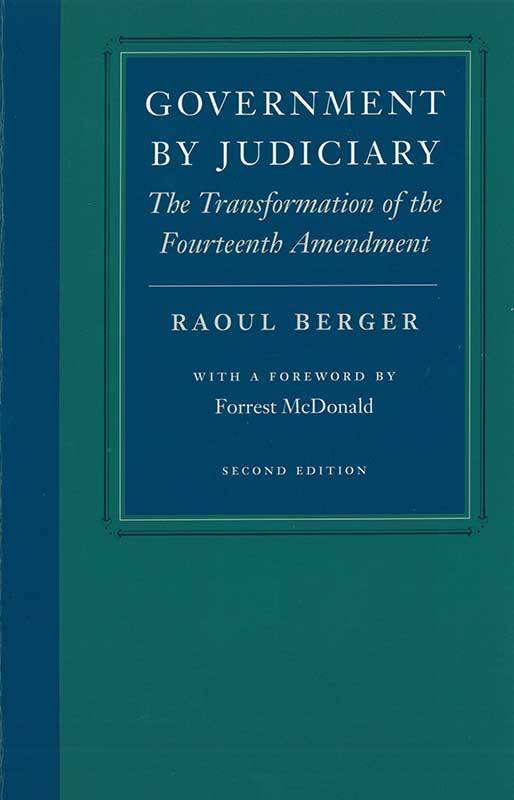
4: Negro Suffrage Was Excluded - Raoul Berger, Government by Judiciary: The Transformation of the Fourteenth Amendment [1977]Edition used:Government by Judiciary: The Transformation of the Fourteenth Amendment, Foreword by Forrest McDonald (2nd ed.) (Indianapolis: Liberty Fund, 1997).
About Liberty Fund:Liberty Fund, Inc. is a private, educational foundation established to encourage the study of the ideal of a society of free and responsible individuals. Copyright information:The copyright to this edition, in both print and electronic forms, is held by Liberty Fund, Inc. Fair use statement:This material is put online to further the educational goals of Liberty Fund, Inc. Unless otherwise stated in the Copyright Information section above, this material may be used freely for educational and academic purposes. It may not be used in any way for profit.
4Negro Suffrage Was ExcludedNo area of Negro rights considered by the 39th Congress was so extensively discussed as Negro suffrage.1 The issue was crucial to the maintenance of Republican ascendancy, a goal boldly proclaimed by Stevens at the very outset. Such ascendancy, the mass of Republicans believed, was to be assured through the reduction of Southern representation in the House of Representatives in proportion as a State denied or abridged suffrage, the device embodied in §2 of the Amendment.2 Some strongly doubted whether the rebel ruling class, outnumbered by blacks, could be induced to “divest itself of the government and hand it over to a subject and despised caste.” 3 But it was more important, Senator George H. Williams of Oregon, member of the Joint Committee, candidly avowed, to limit Southern representation than to provide “that negroes anywhere should immediately vote.” 4 The fact that Negro suffrage was unmistakably excluded from the ambit of the Civil Rights Bill, which proceeded on a parallel track with debate on “representation,” lends substance to his avowal. The intention to exclude suffrage from the Amendment as well5 need not rest entirely on its incorporation of the Civil Rights Act, for there is ample affirmative evidence of that purpose. Chief Justice Warren held in Reynolds v. Sims, a State reapportionment case, that “the right of suffrage can be denied by a debasement or dilution of the weight of a citizen’s vote just as effectively as by wholly prohibiting the free exercise of the franchise.” The premise, he said, that a State may not deny suffrage was derived from a “conception of political equality . . . [that] can mean only one thing—one person, one vote.” 6 Equality, however, did not carry that meaning for the framers;7 and in a powerful dissent, Justice Harlan reproached the Court “for its failure to address itself at all to the Fourteenth Amendment as a whole or to [its] legislative history.” 8 Even one who regards the reapportionment decisions with favor, Carl Auerbach, lamented that “the failure of the Court to mention, let alone deal with, [Harlan’s] argument is indeed, as he charged, remarkable and confounding.” 9 Another proponent of those decisions, William Van Alstyne, states that “the majority seems tacitly to have conceded the argument.” 10 In 1970 Justice Harlan amplified his dissent in Oregon v. Mitchell;11 both of his dissents are models of scholarly exactitude. Having combed the debates for myself, I can confirm his accuracy and scrupulousness in drawing inferences from the facts; one can only complain that he left so few gleanings for those who came after. Since his discussion in the two opinions covers many pages, and since it is contained in law reports that only scholarly specialists are likely to consult, I have undertaken to compress the materials into smaller compass, particularly because they furnish the springboard for much that is to follow. The Grant of Suffrage Was Excluded From §1Senator Sumner labeled the right to vote “the Great Guarantee; and the only sufficient Guarantee,” 12 without which, said Senator Samuel C. Pomeroy of Kansas, the Negro “has no security.” 13 Similar sentiments were expressed by James A. Garfield and James M. Ashley of Ohio, George S. Boutwell of Massachusetts, Ignatius Donnelly of Minnesota, and William A. Newell of New Jersey—Republicans all.14 Nevertheless, as Senator Trumbull emphasized, it was not included in the Civil Rights Bill. Why not? Because, in the words of David Donald, it was “political dynamite.” 15 The reasons have been so admirably compressed by Professor Van Alstyne as to bear quotation in extenso. He notes that the Joint Committee considered a forthright proposal to abolish “any distinctions in political or civil rights . . . on account of race” and states, The decision was made, however, not to propose a limited, single purpose amendment; not to advertise the particular issue of Negro suffrage and to dispose of it through a provision instantly invalidating the laws of all states where equal suffrage regardless of race was denied. The reluctance of the Republicans bluntly to dispose of the issue in this fashion is readily explainable; there was not sufficient prospect that the necessary number of votes would ratify such an amendment. There were, in 1866, but five states in the nation that permitted Negroes to vote on equal terms with whites: Maine, Massachusetts, New Hampshire, Rhode Island, and Vermont. Together, these states contained a mere 6 per cent of the Negro population. New York also permitted Negro suffrage, but only for those possessed of at least a $250 freehold estate, an added “qualification” that whites were not obliged to satisfy. No other state permitted Negroes to vote, regardless of qualification. Moreover, in late 1865, shortly before the Thirty-ninth Congress convened, Connecticut, Minnesota, and Wisconsin voted down impartial suffrage by popular referendum. The Territory of Colorado defeated a referendum for impartial suffrage by a wide margin in September, 1865, and was, nevertheless, admitted to the Union by Congress. The admission of Colorado, with its ban on Negro voting, followed the admission of Nevada, which had a similar ban, and was in turn followed by the readmission of Tennessee on July 24, 1866. The readmission of Tennessee [ after submission of the Fourteenth Amendment with its equal protection clause for ratification] was accomplished, moreover, with complete awareness that its general assembly had, on June 5, 1865, restricted the franchise to white males only. Indeed, all these facts were well known to the Congress, and were gleefully recited by some of the Democrats who challenged the Republicans to dare make an issue of Negro suffrage. All these things and more had a conspicuous and significant influence on the Thirty-Ninth Congress.16 Indeed they had! They explain why the framers rejected Negro suffrage, as may immediately be gathered from two statements among many. Senator Pomeroy stated: “This nation . . . has not yet reached the point of giving all men their rights by a suffrage amendment; three-fourths of the States are not ready.” 17 In opening the debate on the Amendment, Senator Jacob Howard stated on behalf of the Joint Committee, “it was our opinion that three-fourths of the States . . . could not be induced to grant the right of suffrage, even in any degree or under any restriction, to the colored race.” 18 These views were repeated in the Final Report of the Joint Committee on Reconstruction.19 If Negro suffrage was unacceptable to the great mass of Republicans, how can we read into the general terms “equal protection” the very grant they could not swallow? Van Alstyne also notes a number of proposals that would expressly abolish distinctions “in the exercise of the legislative franchise on account of race or color” (including one by Sumner that was rejected by a vote of 38 to 8),20 and explains that “there was not sufficient prospect that the necessary number of States would ratify such an amendment.” Are we to impute to the framers an intention to shroud in ambiguity the Negro suffrage they dared not “advertise” by a “blunt,” unequivocal proposal? Something of the sort is suggested by Van Alstyne,21 but there is no evidence of representations that the Fourteenth would mean one thing in 1866 and the very thing then “feared” in the future. A legislative intention to have words mean one thing in 1866 and the opposite in the future is so remarkable as to call for strict proof, not speculation, particularly when disclosure spelled political disaster.22 But let me defer comment on this “open-ended” theory, fathered by Alexander Bickel, embraced by Alfred Kelly and Van Alstyne, and then picked up by Justice Brennan, to a later chapter, and for the moment permit the framers to speak for themselves. Because the suffrage issue is so vital for my subsequent discussion of the scope of judicial review, because in the eyes of Justice Brennan the historical record is “vague and imprecise,” 23 it is essential by copious documentation to establish firmly the deliberate exclusion of Negro suffrage. Negro Suffrage Was UnacceptableWith but “6% of the Negro population,” New England’s advocacy of Negro suffrage, Senator Edgar Cowan of Pennsylvania acidly lectured Sumner, came cheap: “he simply had no understanding of what it is to live in a community surcharged with an idle, dissolute, vicious, ignorant negro population just emerged from slavery.” 24 At the other end of the political spectrum, the Radical leader Thaddeus Stevens, also of Pennsylvania, wrote, “In my county are fifteen hundred escaped slaves. If they are specimens of the negroes of the South, they are not qualified to vote.” 25 Stevens told Robert Dale Owen, “We haven’t a majority, either in our committee or in Congress, for immediate suffrage; and I don’t believe the States have yet advanced so far that they would ratify it.” 26 William Lloyd Garrison, the indomitable abolitionist, “came out against the forcing of Negro suffrage upon the South.” 27 The Republicans were keenly alive to the situation. Very early in the session, Roscoe Conkling explained, The northern states, most of them, do not permit negroes to vote. Some of them have repeatedly and lately pronounced against it. Therefore, even if it were defensible as a principle for the Central Government to absorb by amendment the power to control the action of the States in such a matter, would it not be futile to ask three-quarters of the States to do for themselves and others, by ratifying such an amendment, the very thing most of them have already refused to do in their own cases?28 Senator Fessenden, chairman of the Joint Committee, said of a suffrage proposal, there is not “the slightest probability that it will be adopted by the States . . . [it] would not commend itself to anybody.” 29 Sumner’s own Massachusetts colleague, Senator Henry Wilson, a leading Radical, commented on Senator Henderson’s proposal of suffrage without distinction of race, “I cannot think . . . there is any hope of adoption after the indications of the last six months.” 30 Another Senator who favored Negro suffrage, Doolittle of Wisconsin, said, “out of New England there are not three States in this Union, neither Nevada nor Colorado, nor any of the new States or the old States that will vote for an amendment . . . by which negro suffrage shall be imposed upon the States.” 31 Similar remarks were made by still others.32 On July 21, 1866, shortly after the Amendment passed the Congress, Sumner proposed an amendment to a bill for admission of Tennessee that “there shall be no denial of the electoral franchise, or of any other rights, on account of color or race, but all persons shall be equal before the law.” It was voted down without debate, 34 to 4.33 This background lends meaning to Senator Howard’s assurance that “the first section of the proposed amendment does not give . . . the right of voting. The right of suffrage is not, in law, one of the privileges or immunities thus secured” 34 —an echo of assurances during debate on the Civil Rights Bill. Bingham likewise stated that “The amendment does not give . . . the power to Congress of regulating suffrage in the several States.” 35 In any event, how can we attribute to the ratifiers approval of Negro suffrage when midway in the course of ratification, in the elections of April 1867, Bingham’s own State, Ohio, “overwhelmed a negro suffrage amendment by 40,000? In every state where the voters expressed themselves on the Negro suffrage issue they turned it down.” 36 attachment to state sovereigntyNotwithstanding that the States’ Right doctrine had been badly tarnished by its association with secession, a potent factor in the exclusion of Negro suffrage was a deep-seated attachment to State sovereignty. That this was no mere rationalization for Negrophobia may be gathered from the objection of Senator James W. Grimes of Iowa to a national livestock quarantine measure: “Let us go back to the original condition of things, and allow the States to take care of themselves.” 37 On the eve of the Civil War, Lincoln stated in his First Inaugural Address, “The right of each State to order and control its own domestic institutions according to its own judgment exclusively is essential to the balance of powers on which the perfection and endurance of our political fabric depends.” 38 So Story had earlier stated,39 and this view was reiterated by Republicans like Thomas T. Davis, Robert S. Hale, and Giles W. Hotchkiss of New York40 and Latham of West Virginia. Congress, Latham said, “has no right to interfere with the internal policy of the several states.” 41 “The proposition to prohibit States from denying civil or political rights to any class of persons,” said Conkling, “encounters a great objection on the threshold. It trenches upon the principle of existing local sovereignty . . . It takes away a right which has been always supposed to inhere in the States.” 42 Bingham, a leader in the Negro cause, stated that “the care of the property, the liberty, and the life of the citizen . . . is in the States and not in the federal government. I have sought to effect no change in that respect.” 43 It was because of the prevalence of such sentiment that Trumbull, defending the Civil Rights Bill after President Johnson’s veto, felt constrained to reassure the Senate that the Bill “in no manner interferes with the municipal regulations of any State which protects all alike in their rights of person and property.” 44 This sentiment emerges even more sharply when suffrage is in issue, as when Conkling stated that interference therewith “meddles with a right reserved to the States . . . and to which they will long cling before they surrender it.” 45 Early in the session, the Radical leader Stevens said of a proposed amendment to reduce State representation in proportion to a denial of Negro suffrage: “I hold that the States have the right . . . to fix the elective franchise within their own States. And I hold that this does not take it from them . . . How many States would allow Congress to come within their jurisdiction to fix the qualification of their voters? . . . You could not get five in this Union.” 46 In the Senate, Chairman Fessenden stated, “everybody has admitted from the foundation of the Government down to the present day that the power to fix the qualifications of voters rested with the States,” and that the proposed “representation” provision “leaves it just as it was before, and does not change it.” 47 After stating his preference for Negro suffrage, Senator Doolittle said that “the Federal Government had no right or constitutional power to impose on a State negro suffrage . . . the right of a State to determine that question was one of the reserved rights of every State.” Like Stevens, he averred that “out of New England” no three States would vote for an amendment “by which negro suffrage shall be imposed upon the States.” 48 Although Senator Henderson of Missouri was an advocate of Negro enfranchisement, he too stated that he was “not now ready to take away from the States the long-enjoyed right of prescribing the qualifications of electors in their own limits.” 49 “The Radical leaders,” Flack stated, “were aware as any one of the attachment of a great majority of the people to the doctrine of States rights . . . the right of the States to regulate their own internal affairs.” 50 These sentiments were accurately summarized by Justice Miller in 1872, shortly after adoption of the Fourteenth and Fifteenth Amendments: we do not see in those amendments any purpose to destroy the main features of the general system. Under the pressure of all the excited feeling growing out of the war, our statesmen have still believed that the existence of the states with power for domestic and local government . . . was essential to the working of our complex form of government.51 This “commitment to traditional state-federal relations meant,” in the words of Alfred Kelly, that “the radical Negro reform program could be only a very limited one.” 52 That it was in fact a program “limited” to a ban on discrimination with respect to “fundamental rights” from which suffrage was excluded is confirmed by §2. The Effect of §2The framers’ intention to leave control of suffrage in the States, untouched by §1, is confirmed by §2 of the Amendment. That section provides, Representation shall be apportioned among the several States according to their respective numbers, counting the whole number of persons in each State. But when the right to vote at any election . . . is denied . . . or in any way abridged . . . the basis of representation therein shall be reduced.53 The denial is not prohibited, it is not declared void, but as Eckley of Ohio put it, if a State “persists in withholding the ballot” from blacks, she will be “confine[d] . . . to the white basis of representation.” 54 It is difficult to dispute Justice Harlan’s conclusion that §2 “expressly recognizes the State’s power to deny ‘or in any way’ abridge the right . . . to vote.” 55 Were this doubtful, doubts are dispelled by the “blinding light” of the legislative history.56 Since that is disputed by Van Alstyne and Justice Brennan, the evidence must be permitted to speak for itself, unfiltered by a commentator’s paraphrase. Bingham, a leading Republican member of the Joint Committee, the pillar of the neoabolitionists, said, “we all agree . . . that the exercise of the elective franchise . . . is exclusively under the control of the States . . . The amendment does not give, as the second section shows, the power of regulating suffrage in the several States.” 57 Instead, as he said of a predecessor proviso, it “offers an inducement to those States . . . to make the franchise universal.” 58 On the Senate side, Chairman Fessenden said of an earlier provision, H.R. No. 51, couched in terms of racial discrimination respecting suffrage, “It takes the Constitution just as it finds it, with the power in the States to fix the qualifications of suffrage precisely as they see fit . . . If in the exercise of the power you [States] have under the Constitution you make an inequality of rights, then you are to suffer such and such consequences.” 59 When illness prevented Fessenden from explaining §2, Senator Howard stated: “The second section leaves the right to regulate the elective franchise with the States, and does not meddle with that right.” Later he added: “We know very well that the States retain the power which they have always possessed of regulating the right of suffrage . . . the theory of this whole amendment is to leave the power of regulating the suffrage with . . . the States.” 60 Senator Yates of Illinois recognized that “we do not obtain suffrage now”; Senator Doolittle of Wisconsin stated, the “amendment proposes to allow the States to say who shall vote”; Senator Poland of Vermont would have preferred that “the right of suffrage had been given at once,” but realized it was not “practicable”; Senator Howe of Wisconsin likewise preferred to say “no man shall be excluded from the right to vote” to saying “hereafter some men may be excluded from the right of representation.” 61 In the House, Blaine of Maine stated, “The effect contemplated . . . is perfectly well understood, and on all hands frankly avowed. It is to deprive the lately rebellious States of the unfair advantage of a large representation in this House, based on their colored population, so long as that people shall be denied political rights. Give them the vote or lose representation.” 62 Conkling stated that the Joint Committee rejected proposals “to deprive the States of the power to disqualify or discriminate politically on account of race or color” and preferred “to leave every State perfectly free to decide for itself . . . who shall vote . . . and thus to say who shall enter into its basis of representation.” “ [E]very State,” he reiterated, “will be left free to extend or withhold the elective franchise on such terms as it pleases, and this without losing anything in representation if the terms are impartial to all.” And he summed up, “every State has the sole control, free from all interference, of its own interests and concerns,” spelling out that if New York chose to withhold suffrage, “her right cannot be challenged.” 63 Stevens, co-chairman of the Joint Committee, stated that the right of a State to disfranchise “has always existed under the Constitution” and the proposed “representation” provision “acknowledges it.” He repeated that “the States have the right . . . to fix the elective franchise” and that the proposed representation provision “does not take it from them.” In fact, he preferred the reduction of representation to an “immediate declaration” that “would make them [Negroes] all voters”; he did not “want them to have the right of suffrage” until they had been educated in “their duties . . . as citizens.” 64 Although Garfield expressed his “profound regret” that the Joint Committee had been unable to “imbed . . . [suffrage] as a part of the fundamental law of the land,” he stated, “I am willing . . . when I cannot get all I wish to take what I can get.” 65 Similarly, John F. Farnsworth of Illinois stated, “I should prefer to see incorporated into the Constitution a guarantee of universal suffrage; as we cannot get the required two-thirds for that, I cordially support this proposition as the next best.” 66 Nathaniel P. Banks of Massachusetts congratulated the Joint Committee for “waiv[ing] this matter in deference to public opinion,” and George F. Miller of Pennsylvania stated, “This amendment will settle the complication in regard to suffrage and representation, leaving each State to regulate that for itself.” 67 Against this mass three Democrats raised the possibility in the House that the amendment might affect suffrage qualifications.68 On the other hand, leading Democrats—Senators Reverdy Johnson and Garrett Davis—better understood that it left suffrage to the States.69 These historical materials, which by no means exhaust the quotable statements,70 seem to me, as to Robert Dixon and Ward Elliott, “overpowering,” “overwhelming.” 71 In discreetly skirting the issue the Court tacitly acknowledged their unimpeachability. The rebuttal thus eschewed by Chief Justice Warren was undertaken by Professor Van Alstyne, and it emboldened Justice Brennan to pick up the cudgels in a later case, Oregon v. Mitchell. Before examining the Warren and Brennan opinions it is desirable to consider in this setting the argument against reapportionment and its relation to suffrage. Supplementary Note on SuffrageHoward is confirmed by the Report of the Joint Committee, which drafted the Amendment: “It was doubtful . . . whether the States would surrender a power they had always exercised, and to which they were attached.” [1.]Van Alstyne 36; James 21. [2.]Supra Chapter 1 at notes 55–56. Roscoe Conkling of New York likewise acknowledged that the “representation” proposal “was primarily for party and sectional advantage.” Kendrick 204; see also id. 207 and infra note 4. [3.]Donnelly remarked, “To pass this law and then hope that South Carolina, moved by the hope of future power, would do justice to the negro is absurd. She has 291,000 whites and 412,000 blacks. To pass such a law would be for the governing power to divest itself of the government and hand it over to a subject and despised caste . . . The same is true, more or less, of all the South.” Globe 378. Julian of Indiana likewise placed little hope in “representation” as an inducement to the grant of suffrage because southern “scorn of an enslaved and downtrodden race is as intense as ever. They hate the negro.” Globe 58. Boutwell of Massachusetts admitted “the possibility that ultimately those eleven States may be restored to representative power without the right of franchise being conferred [by them] upon the colored people.” Globe 2508. [4.]Globe App. 94. Ward Elliott remarks, “The post–Civil War Radical Republicans, as a group, cared very little for the black vote until they came to believe that it would help to secure their position . . . against a Democratic resurgence. Once convinced that theywould profit from the black vote, they passed the Fifteenth Amendment.” The Rise of a Guardian Democracy 2 (1974); see also id. 204. Section 2 “was not primarily devised for the protection of Negro rights and the provision of Negro equality. Its primary purpose . . . was to put the southern states” under northern control. C. Vann Woodward, “Seeds of Failure in Radical Race Policy,” in New Frontiers of the American Reconstruction 135 (Harold M. Hyman ed. 1966). Aaron Harding of Kentucky tauntingly asked “if there is a single man among you who would vote for negro suffrage if he believed the negroes would vote the Democratic ticket? Not one, and you know it.” Globe 449. Although McKee of Kentucky favored the limitation of representation, he opposed Negro suffrage in the District of Columbia because he did not believe “that this race, coming immediately out of bondage, is fit for all rights of citizens.” Id. 452. When John Bright expressed “reservations about enfranchising this large unlettered electorate,” Sumner wrote, “Without them, the old enemy will reappear . . .” Quoted in Donald, Sumner II 201. [5.]As Michael Les Benedict justly remarks, the §2 curtailment of representation was “necessary only if Republicans did not intend to force black suffrage on the reluctant South.” A Compromise of Principle: Conservative Republicans and Reconstruction 1863–1869 136 (1975). [6.]377 U.S. 533, 555, 558 (1964). [7.]See W. R. Brock, An American Crisis: Congress and Reconstruction (1963). This will be discussed infra Chapter 10. [8.]377 U.S. at 590. [9.]C. Auerbach, “The Reapportionment Cases: One Person, One Vote—One Vote, One Value,” 1964 S. Ct. Rev. 1, 75. [10.]Van Alstyne 36. [11.]400 U.S. 112, 152 (1970). [12.]Globe 685. [13.]Id. 1182. Senator Yates of Illinois declared “suffrage . . . the only remedy,” id. 3037. [14.]Id. 2462, 2882, 310, 589, 867. [15.]Donald, Sumner II 202. Senator Garrett Davis of Kentucky stated, “Negro suffrage is political arsenic. If it is not, why do not the free States open wide their throats and gulp down the graceful and invigorating draught?” Globe 246. [16.]Van Alstyne 69–70. See also infra Chapter 5 at note 74. “The off-year state elections of 1867,” during which ratification of the Fourteenth Amendment was debated, “made clear the popular hostility to black suffrage in the North.” Morton Keller, Affairs of State 81 (1977). [17.]Globe 1182. [18.]Id. 2766. [19.]Infra Chapter 5 at note 49. [20.]Van Alstyne 69. [21.]See infra Chapter 6 at note 53. [22.]In an analogous situation Van Alstyne states, “It is even likely, by way of conjecture, that had the subject [reapportionment] been discussed there might have been a disavowal of an intention to apply the Equal Protection clause to malapportionment, at least at that time . . . [But] hypothetical answers to hypothetical questions never actually entertained at the time would be a most dubious basis for expounding the content of ‘equal protection’ one hundred years later.” Van Alstyne 85. [23.]Oregon v. Mitchell, 400 U.S. 112, 278. Justices White and Marshall joined in this opinion. [24.]Donald, Sumner II 158. Sumner himself had stated that “one must not assume ‘that a race, degraded for long generations under the iron heel of bondage, can be taught at once all the political duties of an American citizen’ . . . he thought that most of the negroes, free and contented, would remain in the South as ‘a dependent and amiable peasantry,’ ” Donald, Sumner I 235. But after 1864 he shifted because, as he wrote, “Without them, the old enemy [slave oligarchy] will reappear . . . and in alliance with the Northern democracy, put us all in peril again.” Donald, Sumner II 201. [25.]Fawn M. Brodie, Thaddeus Stevens: Scourge of the South 211 (1959); C. Vann Woodward, The Burden of Southern History 92 (1960). [26.]James 101. [27.]Brodie, supra note 25 at 230–231. [28.]Globe 358. Nathaniel Banks of Massachusetts stated, “The public opinion of the country is such at this precise moment [May 1866] as to make it impossible we should do it.” Id. 2532. [29.]Id. 704. [30.]Id. 1256. [31.]Id. 2143. Senator Henderson stated, “the country is not yet prepared” to grant Negro suffrage. Id. 3035. Senator Sherman said, “no man can doubt . . . there was a strong and powerful prejudice in the Army and among all classes of citizens against extending the right of suffrage to negroes.” Globe App. 127. [32.]See: Senator Lane of Kansas, Globe 1799; Garfield and Ashley of Ohio, id. 2462, 2882; Senators Howard, Poland, and Sherman, id. 2766, 2963, and Globe App. 131. [33.]Globe 4000. His similar motion on July 27 respecting Nebraska was rejected 34 to 5, id. 4222. [34.]Id. 2766 (emphasis added). [35.]Id. 2542. [36.]Woodward, supra note 4 at 137. [37.]Globe 2446. Senator Henry Anthony of Rhode Island asserted that “he would rather have cholera itself than such a bill.” Phillip S. Paludan, A Covenant With Death 48 (1975). [38.]Quoted in Globe 2096. Governor (soon to be Senator) Yates of Illinois stated in 1865, “I am for unlimited state sovereignty in the true sense, in the sense that the State is to control all its municipal and local legislation and I would be the first to resist all attempts upon the part of the Federal Government to interpose tyrannical usurpation of power in controlling the legislation of States.” Paludan, supra note 37 at 34. [39.]The State “police power extends over all subjects within the territorial limits of the States and has never been conceded to the United States.” Prigg v. Pennsylvania, 41 U.S. (16 Pet.) 539, 625 (1842), quoted in Globe 1270. Samuel S. Marshall of Illinois stated, “It is a fundamental principle of American law that the regulation of the local police of all the domestic affairs of a State belong to the State itself, and not to the Federal Government.” Globe 627. [40.]Globe 1083, 1085–1086, 1063; infra Chapter 10 at notes 77–78. [41.]Globe 1295–1296. [42.]Id. 358; see also Delano, Globe App. 158; Charles A. Eldredge, Globe 1154. [43.]Globe 1292. He repeated, “I have always believed that the protection in time of peace within the State of all the rights of person and citizen was of the powers reserved to the States.” Id. 1293. Commenting earlier on Hale’s view that “the citizens must rely upon the State for their protection,” he said, “I admit that such is the rule under the Constitution as it now stands.” Id. 1093. Such reiteration testifies to pervasive uneasiness about the impairment of State sovereignty, uneasiness shared by his fellow Ohioan, Chief Justice Salmon Chase, who regretted that the Joint Committee had gone too far: “Even the loyal people in Northern states, he feared, might oppose the amendment because of its threat to state rights.” James 118. This was a man of “radical tendencies.” Id. [44.]Globe 1761. [45.]Id. 358; see also Thomas N. Stillwell of Indiana, id. 670; Senator Cowan, id. 1286; Shellabarger, id. 1293; Senator Poland, id. 2962. [46.]Id. 536. Senator Lane of Indiana, who favored strong measures against the rebels, said, “the right to determine the qualifications of electors is left with the several States . . . I do not believe that Congress has a right to interfere between [Indiana] and the people and fix the qualifications of voters.” Id. 740. [47.]Id. 1279, 1278; see also id. 704. This assurance was meaningless if §1 conferred suffrage. [48.]Id. 2143. [49.]Globe App. 120. [50.]Flack 68. “One reason the Reconstruction of the South loomed so high to northerners,” Harold Hyman concluded, “was less that blacks were involved than that every one understood the pre-eminence of states . . . in affecting all their citizens’ lives.” Harold M. Hyman, A More Perfect Union 426 (1973). In “early 1865 virtually unhampered state powers were considered fundamental for liberty, federalism and democracy.” Id. 301. “A heavy phalanx of Republican politicos, including Sherman and Trumbull . . . were states rights nationalists, suspicious of any new functional path the nation travelled.” Id. 304. “No one reading the debates carefully,” said Graham at 312, “will question the framers’ devotion to federalism, even the extreme Radicals.” [51.]The Slaughter-House Cases, 83 U.S. (16 Wall.) 36, 82 (1872). [52.]Kelly’s remark in “Comment on Harold M. Hyman’s Paper” in New Frontiers of the American Reconstruction 55 (Harold M. Hyman ed.), written in 1966, constitutes to my mind a tacit repudiation of his earlier pieces. Hyman notes Republican unwillingness “to travel any road more rugged than the Civil Rights—Freedmen’s Bureau extension—Fourteenth Amendment route that left the states masters of their fates.” Hyman, supra note 50 at 470; see also id. 440, 448. [53.]For earlier variants see James, Index, s.v. “Representation.” [54.]Globe 2535. [55.]Reynolds v. Sims, 377 U.S. 533, 594. [56.]Van Alstyne, 36, refers to “the kind of blinding light that Mr. Justice Harlan sees here.” [57.]Globe 2542. [58.]Id. 432. [59.]Id. 1279. Fessenden explained the Committee’s espousal of the “representation” provision subsequently embodied in §2: “we cannot put into the Constitution, owing to existing prejudices and existing institutions, an entire exclusion of all class distinctions.” Id. 705. The effect of the proposed amendment, he stated, “is simply to leave the power where it is, and leave it perfectly in the power of the States to regulate suffrage as they please.” Id. [60.]Id. 2766, 3039. Senator Wilson of Massachusetts stated that the “right to vote . . . has been regulated by the State in every State . . . from the beginning of the Government.” Id. 1255. Senator Yates of Illinois did “not deny the power of the States to regulate suffrage.” Id. [61.]Globe 3038, 2943, 2963–2964, Globe App. 219. Senator Henderson had proposed an amendment to the “representation” proposal, prohibiting discrimination with respect to suffrage (id. 702), but he later supported “representation” because “the country is not yet prepared” for Negro suffrage. Id. 3035. Senator Reverdy Johnson, probably the most open-minded of the Democrats, understood the Amendment to concede “to the States . . . the exclusive right to regulate the franchise” so that the United States would “be impotent to redress” exclusion of blacks. Globe 3027. Another Democrat, Senator Davis, stated that the measure “shrinks from . . . openly forcing suffrage upon the States, but attempts by a great penalty to coerce them to accept it.” Globe App. 240. See also Senator Hendricks, Globe 2939. [62.]Id. 141. [Joint Committee on Reconstruction, Report No. 112, 39th Cong., 1st Sess. 7 (June 8, 1866), reprinted in Avins, The Reconstruction Amendments’ Debates 94 (1967), referring to the effect of emancipation upon the three-fifths representation provision, stated: “When all become free, representation for all necessarily follows. As a consequence the inevitable effect of the rebellion would be to increase the political power of the insurrectionary States . . . The increase of representation necessarily resulting from the abolition of slavery, was considered the most important element in the questions arising out of the changed condition of affairs, and the necessity for some fundamental action in this regard seemed imperative.” The answer was section 2 of the Amendment.] [63.]Globe 357, 358, 359. [64.]Id. 428, 536. [65.]Id. 2462. [66.]Id. 2540. [67.]Id. 2532, 2510. [68.]Niblack, Benjamin M. Boyer of Pennsylvania, and Andrew J. Rogers of New Jersey. Justice Harlan comments on these statements in Oregon v. Mitchell, 400 U.S. at 181–182. [69.]Supra note 61. [70.]See supra note 55 at 626–632. Samuel McKee of Kentucky, who supported the Amendment, stated, “this House is not prepared to enfranchise all men.” Globe 2505. William D. Kelley of Pennsylvania said, “Could I have controlled the report of the Committee of Fifteen, it would have proposed to give the right of suffrage to every loyal man.” Id. 2469. Boutwell of Massachusetts stated, “The proposition in the matter of suffrage falls short of what I desire . . . I demand . . . the franchise for all loyal citizens.” Id. 2508. But like others of the same persuasion, he voted for the Amendment. Broomall understood §2 “to limit the representation of the several States as those States themselves shall limit suffrage.” Id. 2498. Lawrence said that the “representation” amendment “does not propose to extend the right of suffrage to or to withhold it from any class of people . . . It does not propose to disturb the commonly received construction of the Constitution which leaves to the State the right to determine who shall or shall not be voters.” Id. 404. G. F. Miller of Pennsylvania conceded “to each State the right to regulate the right of suffrage . . . they ought not to have a representation for” excluded persons. The Amendment “leav[es] each State to regulate that for itself.” Globe 2510. See also Thayer, id. 282; Eliot, id. 2511. [71.]Robert Dixon, “Reapportionment in the Supreme Court and Congress: Constitutional Struggle for Fair Representation,” 63 Mich. L. Rev. 209, 212 (1964); Elliott, supra note 4 at 127. |

Titles (by Subject)