Econlib

The Library

Other Sites

Front Page arrow Titles (by Subject) arrow 3: The Privileges or Immunities of a Citizen of the United States - Government by Judiciary: The Transformation of the Fourteenth Amendment

Return to Title Page for Government by Judiciary: The Transformation of the Fourteenth Amendment

Search this Title:

Also in the Library:

Subject Area: Law
Collection: Books Published by Liberty Fund
Order this book from Liberty Fund

3: The “Privileges or Immunities of a Citizen of the United States” - Raoul Berger, Government by Judiciary: The Transformation of the Fourteenth Amendment [1977]

Edition used:

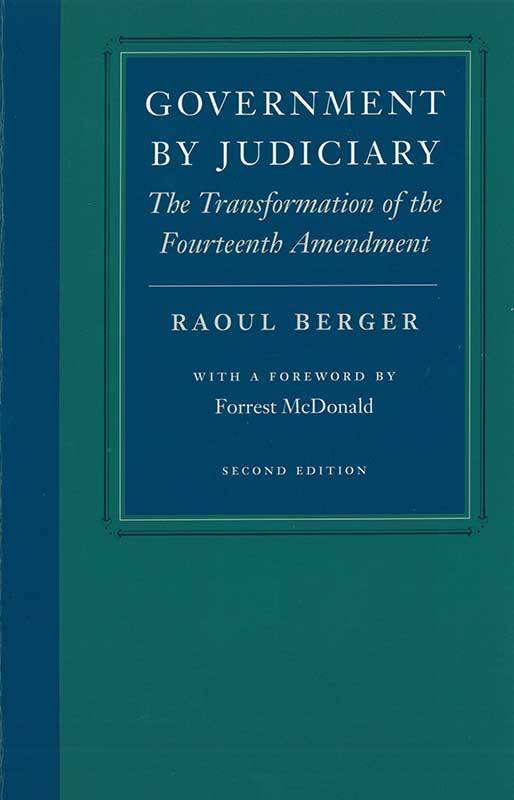
Government by Judiciary: The Transformation of the Fourteenth Amendment, Foreword by Forrest McDonald (2nd ed.) (Indianapolis: Liberty Fund, 1997).

About Liberty Fund:

Liberty Fund, Inc. is a private, educational foundation established to encourage the study of the ideal of a society of free and responsible individuals.


3

The “Privileges or Immunities of a Citizen of the United States”

Narrow as was the protection afforded blacks by the “privileges or immunities” clause, it was at least designed to shield them from violence and oppression. Even that limited goal was soon aborted when the Supreme Court divorced the rights of “a citizen of the United States” from the freedom from the discrimination proscribed by the Amendment. Consequently, the provision has become the all-but-forgotten clause of the Constitution.1 In the Slaughter-House Cases the Supreme Court grounded this view in part on the differentiation between the declaration in the first sentence of §1 that “all persons born or naturalized in the United States . . . are citizens of the United States and of the State wherein they reside” and the second-sentence provision that no State “shall abridge the privileges or immunities of a citizen of the United States.” From this Justice Miller deduced that a “citizenship of the United States and a citizenship of a State . . . are distinct from each other,” and that §1 secured only the privileges of a “citizen of the United States.” 2 So meager was his catalog of those privileges as to move Justice Field to exclaim that if this was all the privileges or immunities clause accomplished, “it was a vain and idle enactment.” 3Slaughter-House was a five-to-four decision, and Field was joined by Chief Justice Chase and Justices Bradley and Swayne in an opinion that took more accurate account of the framers’ intention than did that of Miller.

Preliminarily it will be useful to pull together a few strands that tie the privileges or immunities of §1 to the specific enumeration of the Civil Rights Act of 1866. There is first the correspondence to the Civil Rights Bill’s “civil rights and immunities,” “privileges” being narrower than “civil rights,” which had been deleted at Bingham’s insistence.4 Second, Chairman Trumbull explained that the Bill had been patterned on the “privileges and immunities” of Article IV, §2, and its construction by Justice Washington. Third, in introducing the prototype of §1, Bingham said that the “privileges or immunities” had been drawn from Article IV; fourth, Senator Howard similarly referred back to the Article.5 Speaking after Howard, Senator Luke P. Poland stated that §1 “secures nothing beyond what was intended by” the original privileges and immunities provision.6 More important is the all but universal identification of §1 with the Civil Rights Act. Why, then, were not the terms of the Act incorporated bodily in §1? Constitutional drafting calls for the utmost compression, avoidance of the prolixity of a code;7 “the specific and exclusive enumeration of rights in the Act,” as Bickel remarked, presumably was considered “inappropriate in a constitutional provision.” 8 In sum, the words “privileges or immunities,” it is safe to say, were designed to secure “person and property” against violence and oppression by the rights auxiliary to such protection. How was this design separated from the “privileges or immunities of a citizen of the United States”?

Justice Miller correctly stated that Article IV, §2, did not “profess to control the powers of State governments over the rights of its own citizens.” Its sole purpose was to require that the rights granted by a State to its “own citizens . . . the same, neither more nor less, shall be the measure of the rights of citizens of other States within your jurisdiction.” 9 Without mentioning “citizens of the United States,” the courts had construed Article IV to mean that a migrant citizen from one State would enjoy the “fundamental rights” accorded by a sister State to its own citizens.10 This the framers understood; the cases were quoted, explained, and used as a platform for the Civil Rights Bill.11 The task, however, was not one of outright adoption but of adaptation. For the Negro did not become a migrant by emancipation; generally speaking, he remained in the same State. But he had experienced a transmigration, from that of a slave, a nonperson,12 to a freeman, and the framers meant to secure to this transmigrant the rights that Article IV, §2, had guaranteed to a migrant citizen.

Early on, James A. Garfield of Ohio stated, the goal was that “personal liberty and personal rights are placed in the keeping of the nation, that the right to life, liberty, and property shall be guarantied to the citizen in reality . . . We must make American citizenship the shield that protects every citizen, on every foot of our soil.” 13 That motive manifestly was at the heart of the Civil Rights Bill: “all persons born in the United States . . . are hereby declared to be citizens of the United States,” and it went on to proscribe “discrimination in civil rights or immunities among the inhabitants of any State.” 14 A citizen of the United States who was an “inhabitant” of a State was to be free from discrimination. The Bill, Chairman Wilson stated, “refers to those rights which belong to men as citizens of the United States and none other.” 15 Raymond of New York said that it provided protection for “citizens of the United States . . . against anticipated inequality of legislation in the several States.” 16 Cook of Illinois understood the Bill to provide “that as between citizens of the United States there shall be no discrimination in civil rights or immunities. When these rights which are enumerated in this bill are denied to any class of men on account of race or color, when they are subject to a system of vagrant laws which sells them into slavery or involuntary servitude, which operates upon them as upon no other part of the community, they are not secured in the rights of freedom.” 17

In the Senate, Trumbull stated that Corfield v. Coryell “enumerates the very rights belonging to a citizen of the United States which are set forth in the first section of the bill.” 18 Senator Garrett Davis of Kentucky understood full well what Trumbull was about, and therefore proposed to substitute the Article IV, §2, formula— “The citizens of each State shall be entitled to all the privileges and immunities of citizens in the several States” —explaining that it would apply “only when a citizen of one State goes into another State,” whereas, he stated, Trumbull “proposes now to apply his bill to every citizen of the United States . . . where that citizen is domiciled in the State in which he was born.” In other words, Trumbull would legislate “for the resident Negro in Kentucky, born there, who has always lived there, and who intends to remain there,” to which, he stated, Corfield has no application.19 Thus, Davis sought to restrict the Bill exactly as Justice Miller later did, but his proposal was stillborn. Instead, Trumbull reasoned from Corfield that were a law to declare a “person born in the United States a citizen of the United States, the same rights [listed in Corfield ] would then appertain to all persons who were clothed with American citizenship.” 20 After President Johnson’s veto of the Bill, Trumbull again stated that “citizens of the United States” have “fundamental rights . . . such as the rights enumerated in this bill,” among them, citing Blackstone, that “restraints introduced by law should be equal to all ” and, quoting Kent, “the right of personal security, the right of personal liberty, and the right to acquire and enjoy property.” 21 In short, the Senate rejected the Davis-Miller view in favor of a United States citizenship that would clothe residents of a State with the “fundamental rights” theretofore conferred on migrants.

Did these views, expressed in connection with the Civil Rights Bill, carry over into the Fourteenth Amendment? Here there is more than the intention to constitutionalize the Civil Rights Act. Frederick E. Woodbridge of Vermont stated that the proposed Bingham prototype was “intended to enable Congress . . . to give all citizens the inalienable rights of life and liberty, and to every citizen in whatever State he may be . . . that protection for his property which is extended to the other citizens of the State.” 22 George R. Latham of West Virginia understood the Fourteenth Amendment “privileges and immunities of citizens of the United States” to “provide that no State shall make any discrimination in civil rights of citizens of the United States on account of race . . . the ‘civil rights bill’ which is now a law . . . covers exactly the same ground.” 23 So, too, John M. Broomall of Pennsylvania stated, “We propose, first, to give power to the Government . . . to protect its own citizens within the States,” a proposition for which the House had “already voted . . . in the civil rights bill.” 24 Ephraim R. Eckley of Ohio also stressed the need to provide “security for life, liberty and property to all citizens of all the States.” 25 And Senator Howard referred to the privileges and immunities of Article IV, quoted Corfield to explain the terms, and stated that these rights “are secured to the citizens solely as a citizen of the United States.” 26 Apart from Garrett Davis’ abortive attempt to limit this objective, no one, so far as I could find, disputed that the purpose of both the Civil Rights Act and the Amendment was to guarantee to “citizens of the United States,” whether they were migrants to or residents of a State, the enumerated fundamental rights.

In the process of hammering out the Amendment, the framers had lost sight of the definition of citizenship contained in the Civil Rights Bill, so it was late in the day when Senator Benjamin F. Wade of Ohio remarked anent the word “citizen” in §1, “that is a term about which there has been a great deal of uncertainty in our government.” To “put the question beyond cavil,” he proposed to “strike out the word ‘citizen’ [in what is now the second sentence of §1], and substitute all persons born in the United States.” 27 Howard advanced a counterproposal, the present introductory sentence, “All persons born in the United States . . . are citizens of the United States and of the State wherein they reside.” Wade then withdrew his proposal.28 Presumably the Howard formulation struck Wade as a satisfactory substitute for, not a repudiation of, his own proposal. Although the Negro had been emancipated, the Dred Scott decision threw a shadow over his citizenship;29 the matter had been a source of interminable argument. Trumbull wished “to end that very controversy, whether the Negro is a citizen or not.” 30 Howard stated that his definitional amendment of §1 “settles the great question of citizenship and removes all doubt as to what persons are or are not citizens of the United States.” And he further explained, “we desired to put this question of citizenship and the rights of citizens and freedmen under the civil rights bill beyond the legislative power” of those who would “expose the freedmen again to the oppression of their old masters,” 31 thus confirming that his definition was not a sub rosa abandonment of the paramount goal throughout: protection of the resident Negro against State discrimination. In the House, Thaddeus Stevens of Pennsylvania regarded the Howard interpolation as an “excellent amendment, long needed to settle conflicting decisions.” 32 This limited purpose of Howard’s definition throws doubt on Miller’s view that it was designed to demark the rights of a citizen of the United States from those of a State citizen. Against the manifest purpose of the framers, of which Justice Miller was well aware,33 his reliance on a rule of construction—to express at one point is to exclude at another—should carry little weight.34 Rules of construction are useful guides where other light is lacking, but they are not meant to dim or extinguish available light. The cardinal purpose of interpretation, it cannot too often be emphasized, is to ascertain and effectuate, not defeat, the intention of the framers. Once that purpose is ascertained, it may not be thwarted by a rule of construction.35

In sum, the purpose of the framers was to protect blacks from discrimination with respect to specified “fundamental rights,” enumerated in the Civil Rights Act and epitomized in the §1 “privileges or immunities” clause. To achieve that purpose they made the black both a citizen “of the United States and of the State in which he resides.” They did not intend by the addition of State citizenship to diminish the rights they had been at such pains to specify, but the better to secure them. The notion that by conferring dual citizenship the framers were separating said rights of a citizen of the United States from those of a State citizen not only is without historical warrant but actually does violence to their intention. Fessenden stated that the definition was framed “ to prevent a State from saying that although a person is a citizen of the United States he is not a citizen of the State.” 36 He did not mean to safeguard State citizenship in order to leave blacks at the mercy of Southern States. It was precisely their abuse of the freedmen that led to the Amendment.

Justice Miller next stressed the serious consequences that would follow adoption of a construction contrary to his own; the effect would be to “degrade the State governments by subjecting them to the control of Congress” in unwonted manner. He read “No State shall make or enforce any law which shall abridge the privileges or immunities of citizens of the United States” as transferring “the entire domain of civil right” from the States to the federal government, so that Congress could even “pass laws in advance, limiting and restricting the exercise of legislative power by the States.” 37 Here Miller imported a term into the clause; “abridge” presupposes preliminary State action; before such abridgment there is nothing upon which to act “in advance.” Moreover, Congress was confined to corrective measures, as Miller was aware: “If, however, the States did not conform their laws to its [the Amendment’s] requirements, then by the fifth section . . . Congress was authorized to enforce it by suitable legislation.” 38 It was emphatically not authorized to promulgate a general code “in advance.”

Miller himself found that “the existence of laws in the States where the newly emancipated negroes reside, which discriminated with gross injustice and hardship against them as a class, was the evil to be remedied” —that is, the Black Codes.39 The “one pervading purpose,” he stated, was “protection of the newly-made freeman and citizen from the oppression of those who had formerly exercised unlimited dominion over him.” 40 Consequently, the Amendment did not encompass “all legislation,” 41 but only discriminatory legislation with respect to specified rights, as Justice Field pointed out: “What, then, are the privileges and immunities which are secured against abridgment by State legislation? In the first section of the Civil Rights Act Congress has given its interpretation of these terms [which] . . . include the right ‘to make and enforce contracts . . .’ ” 42 The correction of discriminatory laws with respect to the enumerated “fundamental rights” would hardly constitute the “court a perpetual censor upon all legislation of the States, on the civil rights of their own citizens.” 43 When Miller held that “the citizen of a State” must look to the State for protection,44 he aborted what he himself had declared to be the “pervading purpose”: to protect the Negro from the “evil” of the Black Codes, Codes that handed the Negro back to his oppressors.

Paradoxically, Justice Miller was ready to protect Negroes from “gross injustice and oppression” by resort to the equal protection clause.45 How, one wonders, did “equal protection” escape the blight that struck down “privileges or immunities”? It equally “degrad[ed] the State governments by subjecting them to the control of Congress”; it too constituted a “great departure from the structure and spirit of our institutions.” 46 And whereas the limits of “privileges or immunities” can be discerned in the rights specified in the Civil Rights Act which §1 incorporated, there is no clue whatever to the rights comprehended by the Miller formula—equal protection against “gross injustice and hardship.” One of the ironies that bestrews the path of the Court is that the censorship abjured by Miller under “privileges or immunities” really became unlimited under the converted due process clause.47

No discussion of Slaughter-House may fail to take account of Justice Bradley’s dissent. Where Field won the concurrence of three associates, Bradley stood alone; where Miller held that protection of the citizen was for the State, Bradley propounded a theory of “absolute” rights that neither State nor nation may invade.48 That theory, as will hereinafter appear, can draw small comfort from the intention of the framers; and he himself stated with respect to the preexisting Article IV, §2: “It is true that courts have usually regarded [it] . . . as securing only equality of privileges with the citizens of the State in which the parties are found.” 49 In holding that the Amendment was designed to assure similar equality with respect to specified rights among residents of a State, Justice Field staked out a position midway between the extremes of Miller and Bradley, one that honestly reflected the intention of the framers.

There remain some remarks by Senator Trumbull in 1871, which Graham reads as a denial “that the Fourteenth Amendment authorized Congress to protect citizens in their rights of person and property in the States. Such an interpretation [Trumbull] declared, would mean ‘annihilation of the States.’ ” 50 Little weight has been attached by the Supreme Court to postenactment remarks, even of the Congress itself.51 When they contradict representations made by the speaker during the enactment process, upon which others have been led to rely, they should be treated with special reserve.52 Consider, too, the circumstances that gave rise to Trumbull’s 1871 remarks. President Grant, Graham recounts, “had just called for a second Force Bill to cope with extralegal suppression of Negro rights. The problem . . . had risen not in the contemplated or familiar form of discrimination by carriers, theaters and inns but in the infinitely more tangled context of Southern whites fighting misrule and military government.” Trumbull “flatly declined to go along with the latest proposal”; the tug of new political considerations shaped his version of the past. Now he maintained that the protection afforded by the Fourteenth Amendment was no greater than that accorded by Article IV, §2, that that section “did not have reference to the protection of those persons in individual rights in their respective States, except so far as being citizens of one State entitled them to the privileges and immunities of citizens in every other”; and that the “fourteenth amendment does not define the privileges and immunities of a citizen of the United States any more than the Constitution originally did.” 53

This was only half the story. Trumbull did not mention his rejection of that very argument by Garrett Davis, that he had read the judicial definitions of the Article IV, §2, privileges and immunities to the framers and patterned the Civil Rights Bill on Corfield v. Coryell, that he adapted the Article IV, §2, conception—a migrant citizen was entitled to the same fundamental rights as a resident citizen—to the transmigrant black so suddenly released from slavery, named him a citizen of the United States to assure him of the same rights the migrant enjoyed under Article IV. To say in these circumstances that the Fourteenth Amendment “does not define the privileges and immunities” is therefore a half-truth. The terms, in lawyers’ jargon, had become “words of art”; in borrowing them (with the exclusion of suffrage), Trumbull expressly gave them the meaning which courts had given under Article IV and which he had carefully spelled out in the Civil Rights Bill. It follows that Trumbull’s 1871 argument that “the privileges and immunities belonging to a citizen of the United States as such are of a national character,” that “National citizenship is one thing and State citizenship another” 54 —the precursor of the Slaughter-House dichotomy—was a repudiation of his own explanation to the framers, his enumeration of specific rights in the Bill that were to belong to “citizens of the United States.” He could change his mind but he could not change that of the 39th Congress which had adopted the Civil Rights Act on the strength of his representations and then went on to incorporate the Act in the Amendment.

[1.]Colgate v. Harvey, 296 U.S. 404, 443 (1935), Justice Stone dissenting. D. O. McGovney showed that a goodly number of Justice Miller’s “national” privileges (infra note 3) can be enforced under some specific, direct constitutional grant. “Privileges and Immunities Clause, Fourteenth Amendment,” 4 Iowa L. Bull. 219, 223 (1918). Hence, as Stanley Morrison remarked, “the effect of the decision was to make the privileges and immunities clause practically a dead letter.” “Does the Fourteenth Amendment Incorporate the Bill of Rights?” 2 Stan. L. Rev. 140, 144 (1949).

The clause has received little scholarly attention.

[2.]83 U.S. (16 Wall.) 36, 74 (1872).

[3.]Id. 96. Among the rights Justice Miller enumerated were the right to come to the seat of government, to assert claims against it, to have access to its seaports, courts, and offices, to have protection abroad, to assemble and petition, to use navigable waters, to become a citizen of another State by residence. Id. 79.

It is anomalous that a “citizen of the United States” is limited to these scanty rights whereas as a “citizen of a State” he may continue to invoke in a sister State the broader rights secured to him by Article IV, §2. Chambers v. Baltimore & Ohio R.R., 207 U.S. 142, 148 (1907); Blake v. McClung, 172 U.S. 239, 254 (1898).

[4.]Infra Chapter 7 at notes 11–16.

[5.]Supra Chapter 2 at notes 6, 9, 32, 33; Globe 2765.

[6.]Globe 2961.

[7.]Cf. M’Culloch v. Maryland, 17 U.S. (4 Wheat.) 316, 407 (1819). In the First Congress, Abraham Baldwin, a Framer, commenting on a proposed amendment that “the President should not turn out a good officer,” said that such minute regulation “would have swelled [the Constitution] to the size of a folio volume.” 1 Annals of Congress 559.

[8.]Bickel 61.

[9.]83 U.S. at 77.

[10.]Corfield v. Coryell, 6 F. Cas. (No. 3230) 546 (C. C. E. D. Pa. 1823). Abbott v. Bayley, 6 Pick. 89, 91 (Mass. 1827).

[11.]Trumbull, Globe 474, 475, 600; Senator R. Johnson, id. 505; Senator Davis, id. 595–596; Kerr, id. 1269.

[12.]Roscoe Conkling described a slave as “A man, and yet not a man. In flesh and blood alive; politically dead.” Now emancipated, “They are not slaves, but they are not, in a political sense, ‘persons.’ ” Globe 356.

[13.]Globe App. 67.

[14.]Globe 474; Globe App. 315.

[15.]Id. 1294. Wilson distinguished these “fundamental” rights from rights under State laws, like the right to attend school, to serve on a jury. Kelly labels this a “restrictive interpretation which actually anticipated the dual citizenship doctrine of the ‘privileges and immunities’ clause of the Fourteenth Amendment in the Slaughterhouse Cases. ” Kelly, Fourteenth at 1069. Compare Kelly’s own “restrictive” view, supra Chapter 2 note 52. Kelly completely misreads Wilson. In tune with the limited Republican goals, he emphasized that “citizens of the United States, as such, are entitled to . . . life, liberty, and the right of property.” Globe 1294. His object was to protect Negroes from violence and oppression whereas Justice Miller rejected even those rights, leaving blacks at the mercy of their former masters.

[16.]Globe 1266.

[17.]Id. 1124. Shellabarger also referred to “the ordinary rights of national citizenship, such as the right of . . . holding land, and of protection.” Id. 2104.

[18.]Id. 475.

[19.]Id. 595, 596.

[20.]Id. 600. The Civil Rights Bill, said Raymond, “is intended to secure these citizens against injustice that may be done them in the courts of those States within which they may reside.” Id. 1267. There were, however, some who did not appreciate the difference between Article IV, §2 and §1 of the Amendment; for example, Senator Poland stated that the privileges and immunities clause of §1 “secures nothing beyond what was intended by the original provision” of Article IV, §2. Id. 2961.

[21.]Id. 1757. Justice Field quoted Senator Trumbull’s explanation of the Civil Rights Bill (id. 474): “any statute which is not equal to all, and which deprives any citizen of civil rights, which are secured to other citizens, is an unjust encroachment upon his liberty”; he noted that the Fourteenth Amendment “was adopted to obviate objections which had been raised and pressed with great force to the validity of the Civil Rights Act,” and concluded that “A citizen of a State is now only a citizen of the United States residing in that State. The fundamental rights . . . now belong to him as a citizen of the United States.” 83 U.S. at 92, 93, 95. Corfield v. Coryell, he stated, “was cited by Senator Trumbull with the observation that it enumerated the very rights belonging to a citizen of the United States set forth in the first section of the act, and with the statement that all persons born in the United States, being declared by the act citizens of the United States, would thenceforth be entitled to the rights of citizens, and that these were the fundamental rights set forth in the act.” Id. 98. What Article IV “did for the protection of the citizens of one State against hostile and discriminating legislation of other States,” Field summed up, the “Fourteenth Amendment does for the protection of every citizen of the United States against hostile and discriminating legislation against him in favor of others, whether they reside in the same or different States.” Id. 100–101. Field was faithful to the legislative history, and it is remarkable that successor judges and scholars did not further explore the path he marked. When, however, he came to substantive due process he forgot about those limited goals.

[22.]Globe 1088.

[23.]Id. 2883.

[24.]Id. 2498.

[25.]Id. 2535.

[26.]Id. 2765. So the amended §1 was understood by Senator Stewart: “It declares that all men are entitled to life, liberty, and property, and imposes upon the Government the duty of discharging these obligations.” Id. 2964. After Howard proffered his citizenship definition, Windom summarized the privileges or immunities of §1 as meaning “Your life shall be spared, your liberty shall be unabridged, your property shall be protected.” Id. 3169. See also Bingham: “rights of every person,” id. 2542; Farnsworth: §1 “might as well read . . . ‘No State shall deny to any person within its jurisdiction.’ ” Id. 2539.

[On January 30, 1871, John Bingham submitted a Report of the House Committee on the Judiciary, stating: “The clause of the fourteenth amendment, ‘No State shall make or enforce any law which shall abridge the privileges or immunities of citizens of the United States,’ does not, in the opinion of the committee, refer to the privileges and immunities of citizens of the United States other than privileges and immunities embraced in the original text of the Constitution, article 4, section 2. The fourteenth amendment, it is believed, did not add to the privileges or immunities before mentioned, but was deemed necessary for their enforcement as an express limitation upon the powers of the States.” H.R. No. 22, 41st Cong., 3d Sess. 1 (1871) (emphasis added). Reprinted in The Reconstruction Amendments’ Debates 466 (Alfred Avins ed. 1967).]

[27.]Globe 2768–2769.

[28.]Id. 2869; cf. with supra at note 26.

[29.]Referring to the Dred Scott holding that a Negro could be neither a citizen of a State nor of the United States, Justice Miller said, “To remove this difficulty primarily . . . the first clause of the first section was framed . . . That its main purpose was to establish the citizenship of the negro can admit of no doubt.” 83 U.S. 72.

[30.]Globe 1285.

[31.]Id. 2890, 2896 (emphasis added). Howard stated that his interpolation “is simply declaratory of the law already.” Id. 2890. Trumbull had quoted Chief Justice Marshall’s statement that “A Citizen of the United States, residing in any state of the Union, is a citizen of that state.” Gassies v. Ballon, 31 U.S. (6 Pet.) 761, 762 (1832); Globe 1756.

[32.]Globe 3148.

[33.]Infra at notes 39–40. “It is too clear for argument,” said Justice Miller, “that the change in phraseology was adopted understandingly and with a purpose.” 83 U.S. 75. That is quite true; but the purpose is that expressed by Trumbull, Stevens, Howard, and Fessenden, not exclusion from the benefits that had been so carefully wrought.

[34.]Howard, whose purpose Miller sought to ascertain by this rule, stated that it is “a dangerous principle of construction.” Globe 4001.

[35.]For example, “The rule of ‘ ejusdem generis’ is applied as an aid in ascertaining the intention of the legislature, not to subvert it when ascertained.” United States v. Gilliland, 312 U.S. 86, 93 (1941). The expressio unius rule “serves only as an aid in discovering the legislative intent when that is not otherwise manifest.” United States v. Barnes, 222 U.S. 513, 519 (1912).

[36.]Globe 2897.

[37.]83 U.S. 77–78 (emphasis added).

[38.]Id. 81 (emphasis added). For the “corrective” purpose of §1, see infra Chapter 10 at notes 68–92.

[39.]83 U.S. 81. Miller referred to the “black codes” and recapitulated some of their harsh provisions; id. 70.

[40.]Id. 71, 81. Miller also stated, “We doubt very much whether any action of a State not directed by way of discrimination against the negroes as a class . . . will ever be held to come within the purview of this [equal protection] provision.” Id. 81. If this be read as excluding protection for whites, it runs counter to the history of the Civil Rights Bill. Senator Trumbull explained that the Bill “applies to white men as well as to black men. It declares that all persons . . . shall be entitled to the same civil rights.” Globe 599; see also Globe 41, 158, 516. And the Amendment speaks in terms of “persons,” in order, Bingham stated, to include “aliens” and “strangers,” i.e., whites. Infra Chapter 11 at notes 91–92.

[41.]Justice Miller’s “all legislation” is the more surprising because he noted that “privileges and immunities” was lifted out of Article IV of the Articles of Confederation, where it was particularized— “all the privileges of trade or commerce.” Here, he commented, “we have some of these specifically mentioned, enough perhaps to give some general idea of the class of civil rights meant by the phrase.” 83 U.S. 75. Self-evidently the privileges subsumed under “trade or commerce” are but a segment of the matters embraced by “all legislation.” And his quotation of the Corfield enumeration again suggests that Miller was substituting “statesmanship” for hard-nosed legal interpretation.

[42.]Id. 96. The Court’s statement in Buchanan v. Warley, 245 U.S. 60, 77 (1917), that “The Fourteenth Amendment makes no attempt to enumerate the rights it was designed to protect. It speaks in general terms, and those are as comprehensive as possible,” overlooks the framers’ limited purposes, plainly expressed in the enumeration of the Civil Rights Act which the Amendment incorporated.

[43.]83 U.S. 78.

[44.]Id. 75.

[45.]Id. 81.

[46.]Id. 78.

[47.]Consequently I would dissent from Justice Frankfurter’s reference to the “mischievous uses to which that [privileges and immunities] clause would lend itself if its scope were not confined to that given to it by all but one of the decisions beginning with the Slaughter-House Cases.” Adamson v. California, 332 U.S. 46, 61–62 (1947), concurring opinion.

[48.]83 U.S. 114–115.

[49.]Id. 118.

[50.]Graham 133.

[51.]Rainwater v. United States, 356 U.S. 590, 593 (1958).

[52.]Cf. Raoul Berger, Congress v. The Supreme Court 48 (1969); Raoul Berger, “Judicial Review: Counter Criticism in Tranquillity,” 69 Nw. U. L. Rev. 390, 399–401 (1974).

[53.]Graham 324, 326, 325.

[54.]Id. 528.