EconlibThe LibraryOther Sites |
Front Page Titles (by Subject) Foreword - David Hume: Prophet of the Counter-revolution
Return to Title Page for David Hume: Prophet of the Counter-revolutionThe Online Library of LibertyA project of Liberty Fund, Inc.Search this Title:Also in the Library:
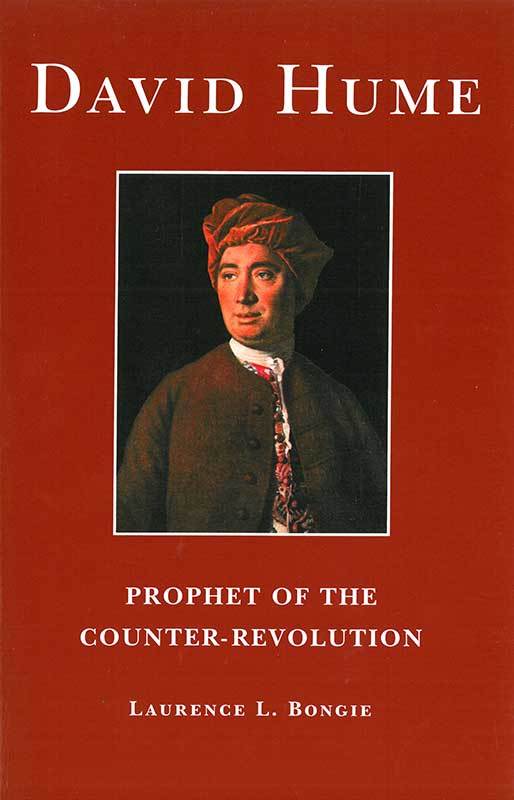
Foreword - Laurence L. Bongie, David Hume: Prophet of the Counter-revolution [1965]Edition used:David Hume: Prophet of the Counter-revolution (2nd ed.), Foreword by Donald W. Livingston (Indianapolis: Liberty Fund, 2000).
About Liberty Fund:Liberty Fund, Inc. is a private, educational foundation established to encourage the study of the ideal of a society of free and responsible individuals. Copyright information:The copyright to this edition, in both print and electronic forms, is held by Liberty Fund, Inc. Fair use statement:This material is put online to further the educational goals of Liberty Fund, Inc. Unless otherwise stated in the Copyright Information section above, this material may be used freely for educational and academic purposes. It may not be used in any way for profit.
ForewordPhilosophers rarely write history, and David Hume (1711-76) is unique in being recognized as one who made canonical contributions to both philosophy and history. Many think of Hume as a philosopher but in his own time he was known as an essayist and author of the six-volume History of England (1754-62). The History was a classic in his lifetime and went through at least 167 posthumous editions. It was the standard work on the subject for nearly a century, until Thomas Babington Macaulay’s History of England began to challenge it in 1849. Even so, Hume’s work was published—if finally only in an abridged form—continually into the twentieth century. Some editions issued in printings of 100,000. The young Winston Churchill learned English history from one of these abridgements known as “the student’s Hume.” The most substantial part of the History is Hume’s account of the reign of the Stuarts, which included the English Civil War, the trial and execution of Charles I, and the establishment of a Puritan republic under Oliver Cromwell. The claim that the people had the legal authority to put to trial and to execute their sovereign shocked seventeenth-century Europe and cast a shadow far into the eighteenth century. Hume’s account of these events quickly became the most forceful and memorable. But the influence of the History was not confined to the English-speaking world. Laurence Bongie demonstrates that during the events leading up to the French Revolution and for a considerable time thereafter, Hume’s account of the English Civil War was used by the French to make sense of the terrible events through which they were living. Hume had interpreted the revolution in England that led to the execution of Charles I and a Puritan republic under the military government of Cromwell as an intellectual and spiritual pathology mingled with ambition. What the Puritans eventually sought was not reform but a total transformation of the social and political order in accord with a religious ideology. Hume’s narrative seemed isomorphic to what was happening in France. The goal of the French Revolution was not reform but a root and branch transformation of society. The Jacobins stood for the Puritans, and the Jacobins’ self-evident truths of the rights of man stood for the self-certifying enthusiasms and revelations of the Puritans; Louis XVI was Charles I, and Napoleon was Cromwell. Edmund Burke’s Reflections on the Revolution in France is commonly viewed as the origin of the modern conservative intellectual tradition, because he deemed the French Revolution to be an event unique to modern times: not at all an effort at reform but the hubristic attempt to transform the whole of society in accord with an ideology. But Hume before Burke had attached essentially this interpretation to the Puritan revolution in England. Additionally, if the intellectual core of conservatism is a critique of ideology in politics, then Hume’s History—not Burke’s Reflections—would appear to be the primal source of modern conservatism. Laurence Bongie, in David Hume: Prophet of the Counter-revolution, gives us good reason to think this was true of French conservative thought. Therefore, one might well wonder whether much of what Burke perceived in the French Revolution as a spiritual disorder was what Hume’s account of the Puritan revolution had prepared him to see. Thomas Jefferson considered Hume’s History such a formidable force that he banned it from the University of Virginia. Of the work he wrote to William Duane on August 12, 1810, that it “has spread universal toryism over the land.” Six years later, on November 25, 1816, Jefferson wrote of Hume’s work to John Adams that, “This single book has done more to sap the free principles of the English Constitution than the largest standing army. . . .” Jefferson preferred John Baxter’s A New and Impartial History of England (1796), which was a reworking of Hume’s History from the Whig perspective and which Jefferson called “Hume’s history republicanized.” What Jefferson did not know (because he had not read the letters of the last decade of Hume’s life) was that Hume supported complete independence for the American colonies as early as 1768 and—to the astonishment of his friends—held to that position until his death on August 25, 1776, five days after the complete text of the Declaration of Independence was published in Edinburgh’s Caledonian Mercury. On October 27, 1775, Hume declared to his old friend Baron Mure, “I am an American in my principles, and wish we would let them alone to govern or misgovern themselves as they think proper.” The man who dared “to shed a generous tear for the fate of Charles I” also resisted using violence to coerce the colonies back into a union from which they wished to secede. Hume’s political philosophy is dialectical and subtle and has given rise to contrary interpretations. But it is not Bongie’s task to interpret it nor to judge whether Hume’s History was correctly understood by those who read it during the revolutionary period in France. Rather, his task is to record the extraordinary influence that Hume’s work exercised during this period. Drawing from a vast deposit of archival materials, Bongie has chipped away to reveal an unexpected glimpse through the wall of time that separates us from the French Revolution. A scene unfolds, rich in detail, in which the participants are allowed to speak for themselves through their words, their mute gestures, and above all their context. As with Bongie’s other archival work—on Diderot, Prince Charles Edward Stuart, Condillac, and De Sade—one is left with an image in the memory more powerful than what a theoretical interpretation could provide. And, one comes away viewing Hume’s History not simply as a narrative of events but as a force in the creation of modern political life. Donald W. Livingston April 1998 |

Titles (by Subject)