EconlibThe LibraryOther Sites |
Front Page Titles (by Subject) 4: Leviathan: a Myth - Hobbes on Civil Association
Return to Title Page for Hobbes on Civil AssociationThe Online Library of LibertyA project of Liberty Fund, Inc.Search this Title:Also in the Library:
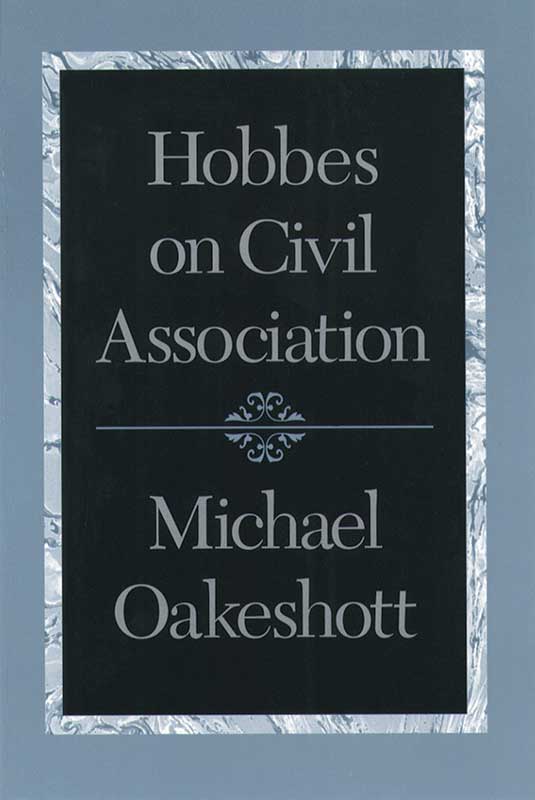
4: Leviathan: a Myth - Michael Oakeshott, Hobbes on Civil Association [1975]Edition used:Hobbes on Civil Association, foreword by Paul Franco (Indianapolis: Liberty Fund, 2000).
About Liberty Fund:Liberty Fund, Inc. is a private, educational foundation established to encourage the study of the ideal of a society of free and responsible individuals. Copyright information:The copyright to this edition, in both print and electronic forms, is held by Liberty Fund, Inc. Fair use statement:This material is put online to further the educational goals of Liberty Fund, Inc. Unless otherwise stated in the Copyright Information section above, this material may be used freely for educational and academic purposes. It may not be used in any way for profit.
4Leviathan: a MythThis is a conversation piece, a flight of fancy; its theme is philosophical literature. Of all the books that have been written since the world began, by far the larger number are books whose virtue is to serve some special and limited interest. These are not works of art; they do not pretend to belong to literature in the proper sense. But now and again, by some odd misunderstanding of its character, a true masterpiece of literature gets hidden away in this vast library of fugitive and functional writings. And there it remains, lost to all except a few professional readers, who themselves (as like as not) understand it only professionally. Something of this sort has happened to the book called Leviathan, written in the seventeenth century by Thomas Hobbes. Leviathan has passed for a book of philosophy and a book about politics, and consequently it has been supposed to interest only the few who concern themselves with such things. But I believe it to be a work of art in the proper sense, one of the masterpieces of the literature of our language and civilization. What does this mean? We are apt to think of a civilization as something solid and external, but at bottom it is a collective dream. “Insofar as the soul is in the body,” says Plotinus, “it lies in deep sleep.” What a people dreams in this earthly sleep is its civilization. And the substance of this dream is a myth, an imaginative interpretation of human existence, the perception (not the solution) of the mystery of human life. The office of literature in a civilization is not to break the dream, but perpetually to recall it, to recreate it in each generation, and even to make more articulate the dream-powers of a people. We, whose participation in the dream is imperfect and largely passive, are, in a sense, its slaves. But the comparative freedom of the artist springs not from any faculty of wakefulness (not from any opposition to the dream), but from his power to dream more profoundly; his genius is to dream that he is dreaming. And it is this that distinguishes him from the scientist, whose perverse genius is to dream that he is awake. The project of science, as I understand it, is to solve the mystery, to wake us from our dream, to destroy the myth; and were this project fully achieved, not only should we find ourselves awake in a profound darkness, but a dreadful insomnia would settle upon mankind, not less intolerable for being only a nightmare. The gift of the greatest literature—of poetry—is a gift of imagination. Its effect is an expansion of our faculty of dreaming. Under its inspiration the familiar outlines of the common dream fade, new perceptions, and emotions hitherto unfelt, are excited within us, the till-now settled fact dissolves once more into infinite possibility, and we become aware that the myth (which is the substance of the dream) has acquired a new quality, without our needing to detect the precise character of the change. But from a book of philosophy, when it reaches the level of literature (as it sometimes does), a more direct, a less subtle consequence may be expected to spring. Its gift is not an access of imaginative power, but an increase of knowledge; it will prompt and it will instruct. In it we shall be reminded of the common dream that binds the generations together, and the myth will be made more intelligible to us. And consequently, we must seek the meaning of such a book in its vision of the myth. The myth which Hobbes inherited was the subtle and complex interpretation of human life which, springing from many sources, distinguished medieval Christian civilization. It is, moreover, the myth which no subsequent experience or reflection has succeeded in displacing from the minds of European peoples. The human race, and the world it inhabits, so runs the myth, sprang from the creative act of God, and was as perfect as its creator. But, by an original sin, mankind became separated from the source of its happiness and peace. This sin was Pride, the perverse exaltation of the creature, by which man became a god to himself. Thenceforth there lay in man’s nature a hidden principle, the antagonist of his happiness. But while corrupted man pursued his blind desires, an enemy of himself and of his kind, divine grace set a limit to human self-destruction, and promised a restoration of the shattered order, an ultimate salvation. This, briefly, is the myth that gave coherence to the dream. Of the many who contributed to its construction, I suppose it owes most to the imagination of St. Paul and St. Augustine. But it was never quite fixed or finished, always there remained within it certain tensions and potentialities. And it was saved from degeneration into a formula, not merely by the theologians, but by the true custodians of the dream, the poets and the artists of the era. And it received at the very moment when Hobbes was writing Leviathan a fresh, if somewhat eccentric, expression in the two epics of Milton. At first sight, it might seem that the project of Leviathan is nothing less than the replacement of this imaginative perception of the mystery of human life by another and altogether different myth. Man, Hobbes tells us, is a solitary creature, the inhabitant of a world which contains the materials for the satisfaction of all his desires save one—the desire to continue forever the enjoyment of an endless series of satisfactions. He is solitary in the sense that he belongs to no order and has no obligations. His world, into which he has been carried as if in his sleep, provides all he can wish for, because his desires are centred upon no final achievement, but are confined to obtaining what he has set his mind upon in each moment of his existence. And it is not the transitoriness of his satisfaction that hinders a man’s happiness, but the constant fear that death may supervene and put an end to satisfaction by terminating desire. There is indeed a lesser fear, the fear that his natural powers will be insufficient to assure him of the satisfaction of his next desire. For a man, though he is solitary, is not alone in the world, and must compete with others of his kind for the good things of life. But this lesser fear may be ignored by those who possess a certain nobility of temperament which refuses the indignity of unconditional competition, or it may be removed by coming to some agreement with his fellow inhabitants of the world, an agreement which may establish a kind of superficial peace and orderliness. But the great fear, the fear of death, is permanent and unassuaged. Life is a dream which no knowledge that mankind can acquire is able to dissipate. The destiny of man is ruled by no Providence, and there is no place in it for perfection or even for lasting satisfaction. He is largely dependent upon his own inventiveness; but this, in spite of its imperfection, is powerful enough to create a civilized life out of the very fears and compulsions that belong to his nature and circumstance. To those brought up in the older myth, this will appear an unduly disenchanted interpretation of the mystery of human life. But there can be no mistaking its character. It is myth, not science. It is a perception of mystery, not a pretended solution. But is it a genuine revision of the myth of our civilization, or must it be regarded as a personal eccentricity, a failure to participate in the common dream? Certainly it appeared shocking to Hobbes’s contemporaries, upon whom it came with but little warning. And certainly, from time to time, there have appeared enemies of our civilization, exponents of a counterfeit myth. But I think if we look closely at Leviathan we may find in it the emphasis, perhaps the overemphasis, of one passage in the inherited myth, rather than the private dream of an eccentric or the malicious invention of an outcast. Pride and sensuality, the too much and the too little—these are the poles between which, according to our dream, human life swings. The subtlety of the old myth lay in the fineness of its perception of these extremes and the imaginative power with which it filled the space between. If it erred, it was perhaps in a partiality for the too much. The myth of the Fall of Man, says Berdyaev, “is at bottom a proud idea.... If man fell away from God, he must have been an exalted creature, endowed with great freedom and power.” But in the myth of our civilization as it appears in Leviathan the emphasis is on the opposite pole; it recalls man to his littleness, his imperfection, his mortality, while at the same time recognizing his importance to himself. This passage in the common dream is one that our literature since the seventeenth century has not allowed us to forget. It cannot, of course, be said that Hobbes was the first to perceive its significance. But he lived at the moment in our history when this potentiality of the traditional myth was ready to declare itself, but before the tide of science, with its project of destroying all myth, had begun to sweep over our civilization. And what makes Levia-than a masterpiece of philosophical literature is the profound logic of Hobbes’s imagination, his power as an artist. Hobbes recalls us to our mortality with a deliberate conviction, with a subtle and sustained argument. He, with a sure and steady irony, does what Swift could do with only an intermittent brilliance, and what the literature of Existentialism is doing today with an exaggerated display of emotion and a false suggestion of novelty. 1947 This book is set in 11 on 13 New Caledonia, redrawn by John Quaranta in 1978 from William Addison Dwiggins’s typeface Caledonia, designed in 1938–39 and first used in 1941. Caledonia has been described as hard-working and lively. Highly legible and straightforward, it is one of the most widely used book types of all time. This book is printed on paper that is acid-free and meets the requirements of the American National Standard for Permanence of Paper for Printed Library Materials, z39.48-1992. (archival) Book design by Erin Kirk New, Athens, Georgia Typography by Graphic Composition, Inc., Athens, Georgia Printed and bound by Sheridan Books, Inc., Ann Arbor, Michigan |

Titles (by Subject)