EconlibThe LibraryOther Sites |
Front Page Titles (by Subject) 2: The Moral Life in the Writings of Thomas Hobbes - Hobbes on Civil Association
Return to Title Page for Hobbes on Civil AssociationThe Online Library of LibertyA project of Liberty Fund, Inc.Search this Title:Also in the Library:
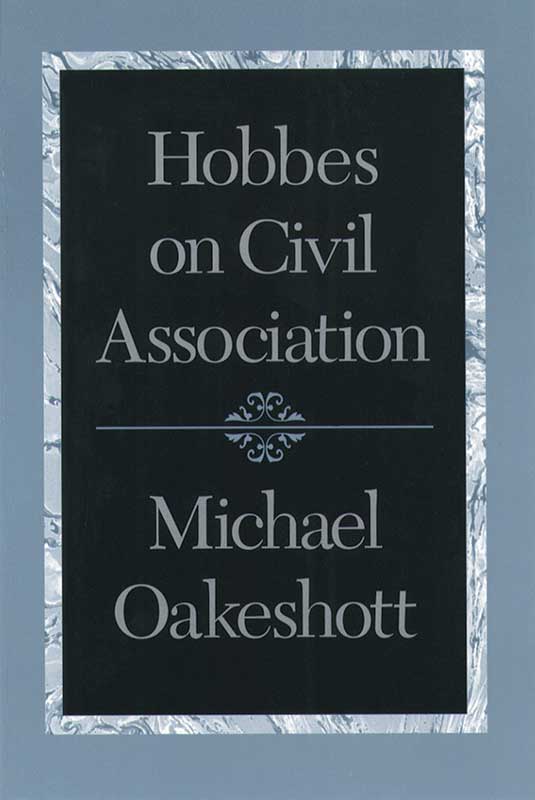
2: The Moral Life in the Writings of Thomas Hobbes - Michael Oakeshott, Hobbes on Civil Association [1975]Edition used:Hobbes on Civil Association, foreword by Paul Franco (Indianapolis: Liberty Fund, 2000).
About Liberty Fund:Liberty Fund, Inc. is a private, educational foundation established to encourage the study of the ideal of a society of free and responsible individuals. Copyright information:The copyright to this edition, in both print and electronic forms, is held by Liberty Fund, Inc. Fair use statement:This material is put online to further the educational goals of Liberty Fund, Inc. Unless otherwise stated in the Copyright Information section above, this material may be used freely for educational and academic purposes. It may not be used in any way for profit.
2The Moral Life in the Writings of Thomas Hobbes1The moral life is a life inter homines. Even if we are disposed to look for a remote ground (such, for example, as the will of God) for our moral obligations, moral conduct concerns the relations of human beings to one another and the power they are capable of exerting over one another. This, no doubt, spills over into other relationships—those with animals, for example, or even with things—but the moral significance of these lies solely in their reflection of the dispositions of men towards one another. Further, the moral life appears only when human behaviour is free from natural necessity; that is, when there are alternatives in human conduct. It does not require that a specific choice should be made on each occasion, for moral conduct may be habit; it does not require that each occasion should find a man without a disposition to behave in a certain manner; and it does not require that on any occasion the range of choices should be unlimited. But it does require the possibility of choice, and we may perhaps suppose that specific choices of some sort (though not necessarily the choice of this action) have been made at some time even though they have become lost and superseded in a settled disposition. In other words, moral conduct is art, not nature: it is the exercise of an acquired skill. But the skill here is not that of knowing how to get what we want with the least expenditure of energy, but knowing how to behave as we ought to behave: the skill, not of desiring, but of approving and of doing what is approved. All this is, of course, well known. Every moralist has perceived a gap between the ascertained inclinations of human beings and what ought to be done about them. But there is something else to be observed, namely, that what we ought to do is unavoidably connected with what in fact we are; and what we are is (in this connection) what we believe ourselves to be. And a moralist who fails to recognize this is apt to fall into absurdity. What Hume complained of was not the attempt to ascertain the connection between moral and factual propositions but the hasty and unsatisfactory manner in which this was done. It was the acute Vauvenargues who detected that it was only by the subterfuge of inventing a “virtu incompatible avec la natur de l’homme” that La Rochefoucauld was able to announce coldly that “il n’y avait aucun virtu.” Indeed, the idioms of moral conduct which our civilization has displayed are distinguished, in the first place, not in respect of their doctrines about how we ought to behave, but in respect of their interpretations of what in fact we are. There are, I believe, three such idioms, which I shall denote: first, the morality of communal ties; secondly, the morality of individuality; and thirdly, the morality of the common good. In the morality of communal ties, human beings are recognized solely as members of a community and all activity whatsoever is understood to be communal activity. Here, separate individuals, capable of making choices for themselves and inclined to do so, are unknown, not because they have been suppressed but because the circumstances in which they might have appeared are absent. And here, good conduct is understood as appropriate participation in the unvarying activities of a community. It is as if all the choices had already been made and what ought to be done appears, not in general rules of conduct, but in a detailed ritual from which divergence is so difficult that there seems to be no visible alternative to it. What ought to be done is indistinguishable from what is done; art appears as nature. Nevertheless, this is an idiom of moral conduct, because the manner of this communal activity is, in fact, art and not nature; it is the product, not (of course) of design, but of numberless, long-forgotten choices. In the morality of individuality, on the other hand, human beings are recognized (because they have come to recognize themselves in this character) as separate and sovereign individuals, associated with one another, not in the pursuit of a single common enterprise, but in an enterprise of give and take, and accommodating themselves to one another as best they can: it is the morality of self and other selves. Here individual choice is preeminent and a great part of happiness is connected with its exercise. Moral conduct is recognized as consisting in determinate relationships between these individuals, and the conduct approved is that which reflects the independent individuality understood to be characteristic of human beings. Morality is the art of mutual accommodation. The morality of the common good springs from a different reading of human nature, or (what is the same thing) the emergence of a different idiom of human character. Human beings are recognized as independent centres of activity, but approval attaches itself to conduct in which this individuality is suppressed whenever it conflicts, not with the individuality of others, but with the interests of a “society” understood to be composed of such human beings. All are engaged in a single, common enterprise. Here the lion and the ox are distinguished from one another, but there is not only one law for both, there is a single approved condition of circumstance for both: the lion shall eat straw like the ox. This single approved condition of human circumstance is called “the social good,” “the good of all,” and morality is the art in which this condition is achieved and maintained. Perhaps a deeper review of the history of European morals would disclose other general moral dispositions to be added to these, and perhaps my descriptions of those I have noticed are unnaturally precise, ideal extrapolations of what has actually been felt; but I have no doubt that dispositions of these kinds have appeared, and (without ever quite superseding one another) they have followed one another during the last thousand years of our history, each in turn provoking moral reflection appropriate to itself. 2In considering the writings of a moralist the first thing to be ascertained is, then, the understanding he has of the nature of human beings. And in Hobbes we may recognize a writer who was engaged in exploring that idiom of the moral life I have called the morality of individuality. Nor is it at all remarkable that this should be so. It is only a very poor moralist who invents for himself either virtues or a version of human nature; both precepts and his reading of human character he must take from the world around him. And, since the emergent human character of western Europe in the seventeenth century was one in which a feeling for individuality was becoming preeminent—the independent, enterprising man out to seek his intellectual or material fortune, and the individual human soul responsible for its own destiny—this unavoidably became for Hobbes, as it was for his contemporary moralists, the subject matter of moral reflection. For Hobbes (or for any other moralist in the seventeenth and eighteenth centuries) to have undertaken to explore either the morality of communal ties or the morality of the common good would have been an anachronism. What, then, distinguishes Hobbes from his contemporaries is not the idiom of the moral life he chose to explore, but the precise manner in which he interpreted this current sentiment for individuality and the doctrine of moral conduct he associated with it, or purported to deduce from it. And if it is the enterprise of every philosopher to translate current sentiments into the idiom of general ideas and to universalize a local version of human character by finding for it some rational ground, this enterprise was fortified in Hobbes by his notion of philosophy as the science of deducing the general causes of observed occurrences. His concern was with both men and things; but he was content to allow a certain looseness in the connection between the two,1 and unlike Spinoza, who presents us with a universe composed of metaphysical individualities (man being only a special case of a universal condition), Hobbes’s starting-point as a moralist was with unique human individuality ; and, as he understood it, his first business was to rationalize this individuality by displaying its “cause,” its components and its structure. Hobbes’s complex image of human character was settled upon what he calls “two most certain postulates of human nature,” namely, the postulate of “natural appetite” or passion, and the postulate of “natural reason.”2 It was an image which, in various idioms, had haunted European reflection for many centuries, and though its most familiar idiom is Christian, it is traceable in the Latin thought of pagan antiquity. It is displayed in the lines of the sixteenth-century poet Fulke Greville:
But, whereas the poet is content to compose an image, the philosopher’s task is to resolve its incoherence and to make it intelligible. Any abridgement of Hobbes’s carefully pondered and exceedingly complicated image of human nature is hazardous, but to follow all its intricacies is impossible now. To be brief—at least as compared with Hobbes himself—he understood a human being to be a bodily structure characterized by internal movements. There is, first, what he called vital movement, the involuntary movement which is identified with being alive and which is exemplified in the circulation of the blood and in breathing. This bodily structure, however, exists in an environment to which it is sensitive, and its contacts with this environment are felt either to assist its vital movements or to impede them. Experiences friendly to vital movement are pleasures and are recognized as good; those which are hostile to it are pains and recognized as evil. Thus, pleasure and pain are our own introspective awareness of being alive; and we prefer pleasure to pain because we prefer life to death. Further, what we prefer we endeavour to bring about. We endeavour to experience those contacts which promote our vital movements and to avoid those which hinder them; and these endeavours are understood by Hobbes as incipient movements towards and away from the components of our environment, movements which he calls respectively appetites and aversions. In general, for Hobbes, this account of being alive applied both to human beings and to animals, and some of it, perhaps, to other organisms also: an original endowment of vital movement stimulated or hindered by contacts with an environment, and a primordial aversion from death. But at this point Hobbes distinguished between human beings and other organisms. An animal, for example, may feel pleasure and pain, but its vital movements are affected only by an environment with which it is in immediate contact, its appetites and aversions are movements of like and dislike only in relation to what is present, and its hunger is the hunger of the moment.3 But human beings have other endowments which amplify the range of their appetites and aversions. The chief of these are memory and imagination. Human beings are capable of storing up their experiences of pleasure and pain and of recollecting their causes at a later time; and, in addition to their inescapable environment of objects, they surround themselves with a world of imagined experiences, and they are capable of desiring what is not present except in imagination. Their appetites are inventive and self-consciously pursued, and they are capable of voluntary movements for the achievement of their imagined ends and not merely of reflex responses to whatever happens to constitute their environment. To the simple passions of desire and love, of aversion and hate and of joy and grief, are added hope and despair, courage and anger, ambition, repentance, covetousness, jealousy, and revenge. They desire not only an environment presently favourable to their vital movements, but a command over that environment which will ensure its friendliness in the future; and the end they seek, Felicity, is not, properly speaking, an end, but merely “continual success in obtaining those things which a man from time to time desireth.”4 They are, however, restless and ever unsatisfied, not merely because the world is continually provoking them to fresh responses, but because the appetite of an imaginative creature is essentially unsatisfiable. They have “a restless desire for power after power which ceaseth only in death,” not because they are driven to seek ever “more intensive delights,” but because they cannot be assured of the power to live well which they have at present without the acquisition of more. Moreover, as Hobbes understood it, although men and animals are alike in their self-centredness, the characteristic difference between them lies in the competitive nature of human appetite and passion: every man wishes to outdo all other men. “Man, whose Joy consisteth in comparing himself with other men, can relish nothing but what is eminent.”5 Human life, consequently, is a race which has “no other goal, nor other garland, but being foremost”; Felicity is “continually to outgo the next before.”6 Indeed, the greatest pleasure of a human being, what most of all stimulates the vital movement of his heart, is the consciousness of his own power; the spring of his natural appetite is not what the present world offers him, but his desire for precedence, his longing to be first, for glory and to be recognized and honoured7 by other men as preeminent. His supreme and characteristic passion is Pride; he wishes above all else to be convinced of his own superiority. And so strong is this desire that he is apt to try to satisfy it in make-believe, if (as is usually the case) actual circumstances deny it to him. Thus, pride may degenerate into vainglory, (the mere supposition of glory “for delight in the consequences of it”); and in the illusions of vainglory he loses ground in the race for precedence.8 The passion of pride has, however, a partner; namely, fear. In animals, fear may be understood as merely being affrighted, but in man it is something much more important. Any creature of imagination engaged in maintaining his superiority over others of his kind must be apprehensive of not being able to do so. Fear, here, is not merely being anxious lest the next pleasure escape him, but dread of falling behind in the race and thus being denied felicity. And every such dread is a reflection of the ultimate fear, the fear of death. But, whereas animals may fear anything which provokes aversion, with men the chief fear (before which all others are of little account) is fear of the other competitors in the race. And whereas with animals the ultimate dread is death in any manner, the ultimate fear in man is the dread of violent (or untimely)9 death at the hand of another man; for this is dishonour, the emblem of all human failure. This is the fear which Hobbes said is the human passion “to be reckoned with”: its spring is not a mere desire to remain alive in adverse circumstances, nor is it a mere aversion from death, least of all from the pain of death; its spring is aversion from shameful death. Human life is, then, a tension between pride and fear; each of these primary passions elucidates the character of the other, and together they define the ambivalent relationship which men enjoy with one another. They need one another, for without others there is no precedence, no recognition of superiority, no honour, no praise, no notable felicity; nevertheless every man is the enemy of every man and is engaged in a competition for superiority in which he is unavoidably apprehensive of failure.10 So much, then, for the postulate of “natural appetite” and its entailments in human disposition and conduct. But there is a second postulate, that of “natural reason.” “Reason,” “rational,” and “reasoning” are words which, in Hobbes’s vocabulary, signify various human powers, endowments, and aptitudes which, though they are related to one another, are not identical. In general, they are words which stand for powers which distinguish men, not from one another, but from animals. Human beings are different from beasts in respect of having two powers which may be recognized as, at least, intimations of rationality. First, they are able to regulate their “Traynes of Thoughts” in such a manner as, not merely to perceive the cause of what has been imagined, but, “when imagining any thing whatsoever, [to] seek all the possible effects, that can be produced by it; that is to say, [to] imagine what [they] can do with it, when [they] have it.”11 In other words, human processes of thinking have a scope and an orderliness denied to those of beasts because in them sensation is supplemented by reasoning. This, it seems, is a natural endowment. Secondly, human beings have the power of Speech;12 and speech is the transference of the “Trayne of our Thoughts into a Trayne of Words.”13 This power is a special endowment received from God (“the first author of Speech”) by Adam when he was taught by God how to name such creatures as were presented to his sight; and it is the condition of that uniquely human power of “reasoning,” the power of putting words together in a significant manner and of composing arguments. Nevertheless, the power of Speech has to be learned afresh by each generation, and a child becomes recognizable as a “Reasonable Creature” only when it has “attained the use of Speech.”14 The first use of words is as “Markes, or Notes of remembrance” and to register the consequences of our thoughts.15 But they may be used also to communicate with other men; to communicate both information and desires. Beasts, it is true, have some means of communicating their desires to one another; but, not having the use of words, they are unable to communicate (what, because of the narrowness of their imaginations, they have not got), namely, those long-term, considered enterprises which in human beings are properly called “wills and purposes.” Their power of communication, and consequently the agreement they may have with one another, is “natural” or instinctive.16 Among men, on the other hand, communication is by means of the artifice of words. By these means they can (among much else) “make known to others [their] wills and purposes, that [they] may have the mutual help of one another.”17 Speech, then, is the ground of such mutual understanding as human beings enjoy among themselves; and this mutual understanding is the ground of any agreement they may have with one another in the pursuit of their desires. Indeed, as Hobbes understands it, Speech itself (as a means of communication) is based upon agreement—agreement about the significance of words. Generally speaking, agreement between human beings appears only in specific agreements, and these may be of three different sorts. Sometimes it happens that a man, wanting what another man has and is willing to part with if he is recompensed, an exchange may be agreed upon and concluded on the spot, as with buying and selling with ready money. This is a situation described by Hobbes as one in which the thing and the right to the thing are transferred together.18 And however mistrustful one may be of the man with whom one makes such a bargain, the only disappointment one may suffer is the disappointment to which every buyer is liable, namely, finding that what he has bought turns out to be different from what he had expected it to be. On other occasions, however, the right may be transferred before the thing itself is handed over, as when for a sum of money paid an undertaking is given to deliver tomorrow what has been purchased, or when a man agrees to do a week’s work for payment to be received at the end of the week. Such an agreement is called a Pact or Covenant, one party promising and the other performing and waiting for the promise to be fulfilled. In other words, Covenant is an agreement entailing credit. And this element of credit is supremely characteristic of the third kind of agreement; what Hobbes calls “covenants of mutual trust.” These are Covenants in which neither party “presently performs,” but both agree to perform later. And it is in respect of these that “reason” gives its most unmistakable warning and in which the true predicament of men in a state of nature is revealed. Human beings, then, on account of the scope of their imaginations (embracing the future as well as the present), and on account of their powers of speech, are recognizable as contract-and-covenant-making creatures: their agreement is not “natural” but executed in “artificial” agreements.19 Moreover, since agreements may be recognized as endeavours to modify the condition of suspicion and hostility which is their natural circumstance, and therefore to modify the fear that this condition entails, human beings have, in general, a sufficient motive for entering into them. But the regrettable fact is that the relief given by this otherwise most useful sort of agreement (that is, Pacts or Covenants of mutual trust) is uncertain and apt to be evanescent. For in these one party must perform first, before the other keeps his part of the bargain, and the risk of him who is to be the second performer not keeping his promise (either because it may not then be in his interest to do so, or, more probably, because “ambition” and “avarice” have intervened) must always be great enough to make it unreasonable for any man to consent to be the first performer. Thus, while such covenants may be entered into reason warns us against being the first to execute them,20 and therefore against entering into them except as second performers. In short, if “reason” merely enabled human beings to communicate and to make covenants with one another, it must be recognized as a valuable endowment but insufficient to resolve the tension between pride and fear. This, however, is not the limit of its usefulness: these “rational” powers also reveal the manner in which the defects of covenanted agreements may be remedied and make possible the emancipation of the human race from the frustrations of natural appetite. “Reason,” here, as Hobbes understood it, is not an arbitrary imposition upon the passionate nature of man; indeed, it is generated by the passion of fear itself. For fear, in human beings, is active and inventive; it provokes in them, not a mere disposition to retreat, but “a certain foresight of future evil” and the impulse to “take heed” and to provide against what is feared. “They who travel carry their swords with them,... and even the strongest armies, and most accomplished for fight, [yet] sometimes parley for peace, as fearing each other’s power, and lest they might be overcome.”21 In short, fear of the mischances that may befall him in the race awakens man from his dreams of vainglory (for any belief in continuous superiority is an illusion) and forces upon his attention the true precariousness of his situation. His first reaction is to triumph by disposing of his immediate enemy, the one next before him in the race for precedence; but “reason” rejects this as a short-sighted triumph—there will always remain others to be disposed of and there will always remain the uncertainty of being able to dispose of them. And besides, to dispose of an enemy is to forgo recognition of one’s own superiority, that is, to forgo felicity.22 What has to be achieved is a permanent release from fear of dishonourable death; and reason, generated by fear and pronouncing for the avoidance of the threat of death as the condition of the satisfaction of any appetite, declares for an agreed modification of the race for precedence, that is, for a condition of peace. The consequence of natural appetite is pride and fear; the “suggestion” and promise of reason is peace. And peace, the product of the mutual recognition of a common enemy (death) is to be achieved only in a condition of common subjection to an artificially created sovereign authority, that is, in the civitas.23 There, under a civil law made and enforced by a Common Power authorized to do so, Covenants lose their uncertainty and become “constant and lasting,” and the war of every man against every man is brought to an end. The endeavour for peace is natural, begotten by human reason upon human fear; the condition of peace is a contrivance, designed (or discerned) by reason and executed in an agreement of “every man with every man” in which each surrenders his “right to govern himself” to a “common authority.”24 To survive, then, is seen to be more desirable than to stand first; proud men must become tame men in order to remain alive. Yet, if we accept this as Hobbes’s solution of the predicament of natural man, incoherence remains. Human life is interpreted as a tension between pride (the passion for preeminence and honour) and fear (the apprehension of dishonour) which reason discerns how to resolve. But there are difficulties. First, the resolution suggested is one-sided: fear is allayed but at the cost of Felicity. And this is a situation to be desired only by a creature who fears to be dishonoured more than he desires to be honoured, a creature content to survive in a world from which both honour and dishonour have been removed—and this is not exactly the creature Hobbes had been describing to us. In the end, it appears, all that reason can teach us is the manner in which we may escape fear, but a man compact of pride will not be disposed to accept this low-grade (if gilt-edged) security as the answer to his needs, even if he believes that to refuse it entails almost inevitable dishonour. In short, either this is a solution appropriate to the character of a more commonplace creature, one who merely desires “success in obtaining those things which a man from time to time desireth,”25 who wants to prosper in a modest sort of way and with as little hindrance and as much help as may be from his fellows, and for whom survival in this condition is more important than Joy; or Hobbes was guilty of defining human Felicity in such a manner that it is inherently impossible to be experienced by human beings as he understands them, guilty of the solecism of making the conditions of Felicity a bar to its attainment. And secondly, we may, perhaps, enquire why, on Hobbes’s reading of the situation, pride and fear should not be allowed to remain without any attempt to resolve the tension between them. No doubt, when reason speaks it may legitimately claim to be heard; for reason, no less than passion, belongs to “nature.” But if (as Hobbes understood it) the office of reason is that of a servant, revealing the probable causes of events, the probable consequences of actions and the probable means by which desired ends may be attained, whence comes its authority to determine a man’s choice of conduct? And if no such authority may be attributed to it, are we constrained to do more than to take note of its deliverances and then choose (with our eyes open) what we shall do? A prudent man, one set upon survival, will not easily be argued out of his prudence, and he may like to support himself with the opinion that he is acting “rationally”; but he may suddenly find his prudence deprived of its value when he sees in another (who has chosen the risky enterprise of glory) the “Joy” he has himself foregone. He will be reminded that there is such a thing as folly; and his gilt-edged security may seem a shade less attractive, a shade less adequate to human character.26 Perhaps, even, he may dimly discern that
At all events (though, as we shall see, Hobbes is unjustly accused of ignoring these considerations), we may, perhaps, suspect that in seeming here to recommend the pursuit of peace and the rejection of glory as “rational” conduct, he was, as on some other occasions, being forgetful of his view that “reason serves only to convince the truth (not of fact, but) of consequence”27 and was taking improper advantage of that older meaning of “reason” in which it was recognized to have the qualities of a master or at least of an authoritative guide. 3As it first appears, the condition of peace is merely a conclusion of natural reason. Awakened from the make-believe of vainglory and inspired by the fear of shameful death, “reason” not only reveals to men the connection between survival and peace, but also “suggesteth” the means by which this condition may be achieved and discerns its structure, which Hobbes called “the convenient articles of peace.”28 With the first (the means of achievement) we are not now concerned, but a consideration of the second discloses what Hobbes meant by “peace.” There are, in all, nineteen of these articles and together they outline a condition in which the struggle for precedence is superseded, not by cooperative enterprise, but by mutual forebearance. This array of articles, said Hobbes, may, however, be “contracted into an easy sum, intelligible even to the meanest capacity, that is, Do not to another, which thou wouldest not have done to oneself.”29 The negative form of the maxim reveals the idiom of the moral life which Hobbes was exploring, but he interprets it (as Confucius did before him) as an injunction to have consideration for others and to avoid partiality for oneself.30 But a transformation has taken place. The conditions of peace, first offered to us rational theorems concerning the nature of shameful-death-avoiding conduct (that is, as a piece of prudential wisdom), now appear as moral obligation. Clearly (on Hobbes’s assumptions) it would be foolish, in the circumstances, not to declare for peace and not to establish it in the only manner in which it can be established; but, somehow, it has also become a dereliction of duty not to do so. Nor is this change of idiom inadvertent. For Hobbes leaves us in no doubt that he properly understood the nature of moral conduct and the difference between it and merely prudent or necessary conduct. It is to be observed, however, that in Hobbes’s vocabulary the words “good” and “evil” had (as a rule) no moral connotation. “Good” merely stood for what is desirable, that is, for whatever may be the object of human appetite; “evil” signified whatever is the object of aversion. They are, therefore, redundant words which merely repeat what is already signified in words such as “pleasurable” and “painful.” When Hobbes said: “Reason declares peace to be good,” he did not mean that all men ought to promote peace, but only that all sensible men will do so.31 And when he said: “Every man desires his own good and his own good is peace,” he could not conclude that every man ought to endeavour peace,32 but only that a man who does not do so is “contradicting himself.”33 There is, it is true, something that Hobbes calls a “precept of reason,” and even a “rule of reason” or a “law of reason” or a “dictate of reason,” thus making it appear that what is rational is, on that account, somehow obligatory. But all the examples he gives make it clear that a “precept of reason” is only a hypothetical precept and not the equivalent of a duty. Temperance, he says, “is a precept of reason, because intemperance tends to sickness and death”;34 but temperance cannot be a duty unless to remain alive and well is a duty, and Hobbes is clear that these are “rights” and therefore not duties. And when he writes of the laws of Nature in general as “dictates of Reason” he makes clear that he means “sayings” or “pronouncements” of reason, and not “commands.”35 But the word “justice” has a moral connotation, and it was the word Hobbes most often used when he was writing in the normative idiom: to behave morally is to do just actions, and to be a virtuous man is to have a just disposition. Nevertheless, although to behave justly is to be identified with the performance of certain actions and with refraining from others, the identification calls for some subtlety. A man’s duty is to have “an un-feigned and constant endeavour”36 to behave justly; what counts, in the first place, is the endeavour and not the external achievement. Indeed, a man may do what, on the surface, is a just action, but because it is done by chance or in pursuance of an unjust endeavour he must be considered, not to be doing justice, but merely not to be guilty; and, conversely, a man may do an injurious action, but if his endeavour is for justice, he may be technically guilty but he has not acted unjustly.37 But it must be understood, first, that for Hobbes “endeavour” is not the same as “intention”: to “endeavour” is to perform actions, to make identifiable movements, and it is, therefore, possible for others to judge of a man’s “endeavour” where it might be difficult to be confident about his intention. And secondly, while it seems to me doubtful whether Hobbes held there to be an obligation to be a just man, duty is fulfilled only where a man both acts justly (that is, makes movements which constitute “endeavouring justice”) and acts guiltlessly (that is, avoids doing injury). Now, as Hobbes understood it, the object of moral endeavour is peace; what we already know to be a rational endeavour is now declared to be the object of just endeavour. Or, to amplify this definition a little, just conduct is the unfeigned and constant endeavour to acknowledge all other men as one’s equal, and when considering their actions in relation to oneself to discount one’s own passion and self-love.38 The word “unfeigned” was, I think, intended to indicate that this endeavour is not moral endeavour unless it is pursued for its own sake and not, for example, in order to avoid punishment or to win an advantage for oneself. And the word “endeavour” meant not only always to intend peace, but always to act in such a manner that peace is the probable consequence of our action. The precept we have before us is, then, that “every man ought to endeavour peace,” and our question is, What reason or justification did Hobbes provide for this delineation of moral conduct? Why ought a man unfeignedly endeavour to keep his word, to accommodate himself to others, not to take more than his share, not to set himself up as a judge in his own cause, not display hatred and contempt towards others, to treat others as his equals and to do everything else that pertains to peace?39 How did Hobbes bridge the gap between men’s natural inclinations and what ought to be done about them? And with this question we reach the obscure heart of Hobbes’s moral theory. For, not only is an answer to it the chief thing we should look for in the writings of any moralist, who normally takes his precepts from current moral opinion and himself contributes only the reasons for believing them to be true; but also, in the case of Hobbes, it is the question which his commentators have had most trouble in discovering the answer to, though some of them have pressed their conclusions upon us and dismissed those of others with remarkable confidence. Hobbes was usually so much more concerned with elucidating adequate motives or “causes” for what is alleged to be just conduct than with finding adequate reasons for calling it just, that those who seek an answer to our question are forced to use all their ingenuity. 4There are three current readings of Hobbes’s answer to this question which deserve consideration because, though none is (I believe) entirely satisfactory, each has been argued acutely and carefully and none is without plausibility.40 1. The first account runs something like this:41 Every man must either endeavour “the preservation of his own nature,” or endeavour something more than this, for example, to be first in the race. To endeavour nothing at all is impossible: “to have no desire is to be dead.” Now every man, in all circumstances, has the right to endeavour “the preservation of his own nature”;42 in doing so he is acting justly. And in no circumstances has any man the right to endeavour more than this (for example by indulging in useless cruelty or by desiring to be first); if he seeks what is superfluous to “the preservation of his own nature,”43 his endeavour is unreasonable, reprehensible, and unjust because it is an endeavour for his own destruction. But to endeavour to preserve his own nature, we have seen, is precisely to endeavour peace; and to endeavour more than this to endeavour war and self-destruction. Therefore a man is just when he endeavours peace, and unjust when he endeavours war. Every man has an obligation to be just, and (in principle) he has no other obligation but to endeavour peace. In short, duty is identified with dispositions and actions which are “rational” in the sense of not being “self-contradictory.” And Hobbes, it is said, found support for this position in the observation that the endeavour of a man to preserve his own nature has the approval of conscience, and the endeavour to do more than this is disapproved by conscience: the feeling of guiltlessness and of guilt attach themselves respectively to each of these endeavours. Thus, activity which springs from fear of shameful death and is designed to mitigate that fear alone has the approval of conscience and is obligatory. Now, there can be no doubt that this is a moral doctrine insofar as it is an attempt to elucidate a distinction between natural appetite and permissible appetite; it does not assimilate right to might or duty to desire. Moreover, it is a doctrine which identifies moral conduct with prudentially rational conduct: the just man is the man who has been tamed by fear. But if Hobbes has said no more than this, he must be considered not to have said enough. And, in any case, he did say something more and something different. In the first place, the answer given here to the question, why ought all men to endeavour peace? itself provokes a question: we want to know why every man has an obligation only to endeavour to preserve his own nature. The whole position rests upon the belief that Hobbes thought every man had an obligation to act in such a manner as not to risk his own destruction, whereas what Hobbes said is that every man has a right to preserve his own nature and that a right is neither a duty nor does it give rise to a duty of any sort.44 Secondly, an interpretation of Hobbes which represents him as saying that dutiful conduct is rational conduct in the sense of being “consistent” or nonself-contradictory conduct, and that it is dutiful because it is rational in this (or any other) sense, must be considered wide of the mark. There are occasions when Hobbes appealed to the principle of “noncontradiction” in order to denote what is desirable in conduct;45 but, it is safe to say, he distinguished clearly between merely rational conduct and obligatory conduct. On no plausible reading of Hobbes is the Law of Nature to be considered obligatory because it represents rational conduct. Thirdly, this interpretation does not recognize moral conduct as the disinterested acknowledgement of all others as one’s equal which Hobbes took to be fundamental for peace; on this showing, all endeavours for peace, however interested, would be equally just. And lastly, there is in this account a confusion between the cause of conduct alleged to be just and the reason for thinking it just. For the apprehension of shameful death and the aversion from it are not reasons why we have an obligation to endeavour peace; they are the causes or motives of our doing so. And if “reason” is added (as Hobbes added it) as a mediator between fear and pride, we have still not made our escape from the realm of causes into the realm of justifications, because “reason” for Hobbes (except where he is being unmistakably equivocal) has no prescriptive force. In short, if Hobbes said no more than this he must be considered not to have had a moral theory at all. 2. There are, however, other interpretations of Hobbes’s views on this matter, which run on different lines. And we may consider next what is, perhaps, the simplest of all the current accounts. It goes as follows: According to Hobbes, all moral obligation derives from law; where there is no law there is no duty and no distinction between just and unjust conduct, and where there is law in the proper sense there is an obligation to obey it upon those who come under it if there is also an adequate motive for obeying it. Now, law properly speaking (we are told) is “the command of him, that by right hath command over others”;46 or (in a more ample description) “law in general,... is command; nor a command of any man to any man; but only of him whose command is addressed to one formerly obliged to obey him.”47 And a law-maker in the proper sense is one who has acquired this antecedent authority to be obeyed by being given it, or by being acknowledged to have it, by those who are to be subject to his commands, “there being no obligation on any man, which ariseth not from some act of his own.”48 This act of authorization or acknowledgement is a necessary condition of genuine law-making authority. In other words, there can be no such thing, for Hobbes, as a “natural,” unacquired, authority to make law.49 To this, two other conditions of obligation are added: law in the proper sense can issue from a “law-maker” only when those who are obliged by it know him as the author of the law, and when they know precisely what he commands. But these conditions are, in fact, entailed in the first condition; for, no subject could know himself to be a subject without this act of authorization or acknowledgement, and it would be impossible to perform such an act and at the same time be ignorant of who the law-maker is and what he commands. In short, it is unmistakably Hobbes’s view that law is something made and that it is binding solely on account of having been made in a certain manner by a law-maker having certain characteristics; and that obligation springs only from law. Or, in other words, no command is inherently (that is, merely on account of what it commands or on account of the reasonableness of what it commands) or self-evidently binding; its obligatoriness is something to be proved or rebutted, and Hobbes told us what evidence is relevant for this proof or rebuttal. This evidence is solely concerned with whether or not the command is law in the proper sense, that is, whether or not it has been made by one who has authority to make it. Now the proposition that the law of the civitas is law in the proper sense was, for Hobbes, not an empirical but an analytic proposition;50civitas is defined as an artificial condition of human life in which there are laws which are known to have been made by a law-maker who has acquired the authority to make them by being given it by those who are subject to him,51 and in which what is commanded is known, and in which there is an authentic interpretation of what is commanded. And further, those who are subject to these laws have an adequate motive for their subjection. All the conditions for law in the proper sense are satisfied by civil law. Consequently (it is argued by those who defend this reading of Hobbes’s writings) Hobbes’s settled view was that civil laws are unquestionably obligatory, and their obligatoriness springs not from their being a reflection of some other “natural” law which carries with it “natural” duties, but solely from the character of their maker and the manner in which they have been made, promulgated, and interpreted. The question, Why am I morally bound to obey the commands of the sovereign of my civitas? (which, for Hobbes, is the important question) requires no other answer than, Because I, in agreement with others in a similar plight to myself, and with a common disposition to make covenants, having “authorized” him, know him indubitably to be a law-giver and know his commands as laws properly speaking.52 Furthermore (it is argued), not only are the laws of a civitas laws in the proper sense, but, in a civitas, they are, for Hobbes, the only laws which have this character. Neither the so-called “laws” of a church, nor the so-called Laws of Nature, are, in a civitas, laws in the proper sense unless and until they have been made so by being promulgated as civil laws.53 Indeed, it is Hobbes’s view that there is no law that is law properly speaking which is not a “civil” law in the sense of being the command of a civil sovereign: God’s laws are laws in the proper sense only where God is a civil sovereign exercising his sovereignty through agents. The civil sovereign does not, of course, “make” the Laws of Nature as rational theorems about human preservation, but he does, in the strictest sense, “make” them laws in the proper sense.54 It may, for example, be accounted reasonable to render unto God (where God is not a civil sovereign) the things that are God’s and unto Caesar the things that are Caesar’s, but, according to Hobbes, this does not become a duty until these respective spheres are defined, and, in both cases, the definition is a matter of civil law. No doubt in a civitas a subject may retain the relics of a Natural Right, but a natural right, according to Hobbes, is not an obligation and has nothing whatever to do with a man’s duties. On this reading of Hobbes’s thoughts on moral obligation, there remains the question whether or not he thought that men who are not subjects of a properly constituted civil sovereign and who therefore have no duties under a civil law nevertheless have duties as well as rights. And this question resolves itself into the question, where there is no civil law, is there a law which is law in the proper sense? This is an interesting question, but for two reasons it is not a highly important question for those who read Hobbes in the manner we are now considering. First, Hobbes is understood to be writing, not for savages, but for men who belong to a civitas; his project is to show what their obligations are and whence they arise, and if he has given a reason for believing that civil law is binding and is the only law that is binding, he does not need to do more than this. And secondly (on the interpretation we are now considering) there can be no question of the obligations of civil law being derived from or being in any way connected with, another law, even if that other “law” were found, in circumstances other than those of the civitas, to be law in the proper sense and to impose duties upon all mankind: in a civitas the only law in the proper sense is civil law. The core of this interpretation is the belief that, for Hobbes, the civitas constituted not a useful addition to human life, but a transformation of the natural conditions of human life. However, the consideration of Hobbes’s thoughts on obligations imposed by a law other than civil law is more appropriate in connection with another interpretation of his moral theory for which this question is central. In the interpretation we are now considering, then, what causes human beings to enter into the agreement by which the civil sovereign is constituted and authorized is their fear of destruction which has been converted into a rational endeavour for peace; but they have no obligation to do so. Their duty to endeavour peace begins with the appearance of civil law, a law properly so-called and the only one of its kind, commanding this endeavour. This interpretation (like any other) depends upon a certain reading of important passages in Hobbes’s writings, and without calling attention to all the relevant passages it may be noticed, first, that it relies upon what must be recognized as the only intelligible reading of the passage in Leviathan where Hobbes maintains what may be called the sovereignty of civil law;55 and secondly, it entails understanding the expression “whose command is addressed to one formerly obliged to obey him”56 (used by Hobbes to define the law-giver in the proper sense) to signify “one who has already covenanted to set him up, or who has otherwise recognized him, or acknowledge him as a sovereign law-maker.” This, I believe, in spite of the weakening of the word “obliged” that it involves, is the most plausible reading of this expression.57 But this reading is not without difficulties and we shall have to consider another reading of it the acceptance of which would go far to make this interpretation of Hobbes’s moral theory untenable. To this interpretation there are three main objections. First (it is observed), if the only obligation of the subject in a civitas is to perform the duties imposed by the law-maker whom he has (by covenant or acknowledgement) authorized, and if it is based solely upon the fact that they are genuine duties because the civil law is undoubtedly law in the proper sense and applies to the subject in a civitas, what, if anything, binds him to go on observing the acknowledgement or covenant which authorizes the law-maker to make law? Has he a duty to continue this acknowledgement, insofar as it can be separated from the duty to obey the laws? If not, does not Hobbes’s account of moral obligation hang suspended for want of an answer to a pertinent question? And if he has such a duty, must not there be a law in the proper sense, other than civil law, which imposes it? This must be recognized as a formidable objection, but in the view of those whose views we are now considering, it is not unanswerable; indeed, there are two possible answers. First, it may be contended that there is little in Hobbes (except what is obscure or equivocal, e.g. L., p. 110) to suggest that he held the making of the Covenant (besides being a prudent act) was also a moral obligation, and that “keeping the covenant” and “obeying the law” were not inseparable activities; and if there is a duty to obey the law (which there is), then there is a constructive duty to keep and protect the covenant.58 But, secondly, if it is conceded that for there to be a duty to “keep the covenant” there must be a law imposing this duty and it cannot be the civil law itself, then, since on this interpretation there is no such “other” law in the proper sense (i.e. no law which is not based on the acknowledgement of the ruler by the subject) to be found in Hobbes’s writings, we must conclude that for Hobbes there was no specific duty to keep the covenant. And why should there be? Neither Hobbes’s moral theory nor any other is to be reckoned defective because it does not show every desirable action to be also a duty. For Hobbes duty is always (directly or indirectly) the activity of endeavouring peace, and to endeavour peace is a duty only when there is a law commanding it. To make and keep the covenant (or the acknowledgement) in which the civitas is set up are activities of endeavouring peace. But if, in this respect, they are eligible to become duties, it is not necessary for them to be duties; and, if they are not duties (for lack of a law commanding them) they are not, on that account, unintelligible. They are for Hobbes (on this reading) acts of prudence which are reasonable and desirable to be performed on condition that others perform them, or acts of “nobility” which make no conditions. It is, of course, true that, for Hobbes, it could never be a duty to act against one’s own interest (that is, to endeavour the war of all against all), but it does not follow from this that endeavouring peace must always be a duty. In short, if Hobbes is understood to have said that there is a duty to obey the law of the civitas because, for the subjects of a civitas, it is law in the proper sense, but that there is no separate duty to make and keep the covenant or acknowledgement which sets up the civil sovereign, he is not being understood to have said anything inherently absurd: he is merely being recognized to have said that there is a proper use for the word “duty,” but that what holds the civitas together is not “duty” (except, for example, the duty imposed by a law against treason) but either self-interest instructed by reason, or the nobility which is too proud to calculate the possible loss entailed in obedience to a “sovereign” who lacks power to enforce his commands.59 The second objection is as follows: it is alleged that, for Hobbes, rational behaviour is endeavouring peace, and that this becomes a duty if and when it is commanded by law in the proper sense. Further, since civil law is law in the proper sense and the only law in the proper sense (owing its propriety not to its being a reflection of some other, superior, and equally proper law, but solely to the manner in which it has been made, published, and authentically interpreted) and commands its subjects to endeavour peace, these have a duty (which persons in other circumstances have not) of “endeavouring peace.” But (it is objected) this is not an accurate account of the situation. What, even for Hobbes, the civil law commands is not merely that a man shall “endeavour peace” but that he shall perform specific actions and refrain from others: it is no defence for the lawbreaker to say, “I am endeavouring peace,” if he neglects to do what the law commands or does what it forbids. The answer to this objection is, however, that, for Hobbes, “endeavouring peace” was always performing specific acts (and not merely having peaceful intentions or a generally peaceful disposition); to be disposed in a certain direction is to make movements in that direction. And, while reason acquaints all but madmen and children with the general pattern of acts which may be expected to promote a peaceful condition of human life, it is the province of law to decide what acts, in specific circumstances, are necessary to a condition of peace and to impose them as duties.60 When “endeavouring peace” is a duty, it is always the duty of obeying a law, and a law is always a set of specific commands and prohibitions. Hence, the duty of endeavouring peace is indistinguishable from the duty of performing the acts prescribed by law: a man cannot at the same time “endeavour peace” and do what the law forbids, though he may do so by actions which the law does not require of him—by being benevolent, for example. But his duty to “endeavour peace” is a duty to obey the law, that is, to be both just and guiltless. The third objection is that Hobbes is often to be found writing about “natural laws” and writing about them as if he considered them to be laws in the proper sense and capable of imposing a “natural obligation” upon all men to endeavour peace, and any account of Hobbes’s moral theory which ignores this is implausible. This, again, is not easily to be disposed of. It is true that Hobbes repeatedly and clearly asserted that Natural Laws are not properly speaking laws at all except where they appear as the commands of a law-giver who owes his authority to a covenant or an acknowledgement; apart from this, they are only “qualities which dispose men to peace and order,” “dictates,” “conclusions,” or “theorems” of natural reason “suggesting” the conduct which belongs to a condition of peace and therefore the rational (but not the moral) foundation of the civitas.61 But these assertions are partnered by others capable of being interpreted to mean that the Laws of Nature themselves impose obligations upon all men (rulers included), and even that the obligation of the subject to obey the laws of his civitas derives from the duty he has under one or more of these natural laws.62 However, since the view that Hobbes believed Natural Law to be law in the proper sense and to be the source of all moral obligation is the central theme of the third important account of Hobbes’s moral theory, the force of this objection to this account will best be considered in that connection. 3. This third interpretation begins at the same place as the one we have just considered.63 It recognizes that, for Hobbes, all moral obligation derives from a law of some sort: where there is authentic law there is, on that account, duty; where there is no law there is no duty. Consequently, endeavouring peace can be shown to be a duty upon all men if there is a valid and universally applicable law commanding it. So far, I think there can be no serious disagreement about what Hobbes thought. But it is now contended that the Law of Nature itself and without further qualification is, in Hobbes’s view, a valid, universal, and perpetually operative law imposing this duty upon all men. Every interpreter of Hobbes recognizes that what Hobbes called the Laws of Nature and what he called “the convenient articles of peace” are, in respect of content, the same thing and that they are the “suggestions” or conclusions of reason about the preservation of human life. What is asserted now is that Hobbes also believed them to be laws in the proper sense; namely, that their author is known and that he has acquired an antecedent right to command, that they have been published and are known, that there is an authentic interpretation of them, and that those who have a duty to obey have a sufficient motive for doing so. And the conclusion suggested is that endeavouring peace was, for Hobbes, an obligation laid upon all men by a Law of Nature and that any further obligation there may be to obey the laws of the civitas, or to obey covenanted commands, derives from this natural and universal obligation.64 Now, it is not to be denied that there are expressions and passages in Hobbes’s writings which appear to be designed to make us believe that this is his view, but before we accept them at their face value we must consider in detail whether Hobbes also held the beliefs which are for him certainly entailed in this view. And if we find this not to be the case, it may be thought that these passages are eligible for some other interpretation, or that we must be content to have detected what, on any reading, is a notable incoherence in his writings. The direction of our first enquiry is unmistakable. Since, according to Hobbes, the obligation a law imposes is due not to the law itself but to its author,65 who must not only be known as its author but known also to have a right to command, our first enquiry must be: Did Hobbes believe the Law of Nature to have an author known as such to all mankind? And if so, who did he think was its author and in what manner did he think this author was known to be the maker of this law? And, together with this, we may appropriately consider what thoughts Hobbes’s writings disclose about the right of this author to make this law. The answer urged upon us in the interpretation we are now considering is that Hobbes unmistakably believed the Law of Nature to have an author who is naturally known to all men as such; that this author is God himself; and that his right to legislate derives, not from his having created those who should obey his commands, but from his Omnipotence.66 The Law of Nature, it is contended, is law in the proper sense; it is binding upon all men in all circumstances because it is known to be the command of an Omnipotent God. The first difficulty which stands in the way of our accepting this interpretation is that it must remain exceedingly doubtful (to say the least) whether Hobbes thought that our natural knowledge includes (or could possibly include) a knowledge of God as the author of imperative laws for human conduct. He reasoned thus about the word “God”: divinities appear first as projections of human fear consequent upon our frequent ignorance of the causes of the good and ill fortunes which befall us, but the notion of “one God, Infinite and Omnipotent” derives, not from our fears, but from our curiosity about “the causes of natural bodies, their several virtues and operations”: in tracing these causes backwards we unavoidably “come to this, that there must be one First Mover; that is, a First, and Eternal cause of all things; which is that which men mean by the name of God.”67 It is this God, then, a necessary hypothesis, of whom we may be said, in the first place, to have natural knowledge. And in virtue of the Omnipotence of this God (his “rule” as a First Cause being inescapable and absolute) we may speak of him as “King of all the earth,” and we may speak of the earth as his natural Kingdom and everything on earth as his natural subject; but if we do speak in this manner, we must recognize that we are using the words “King” and “Kingdom” in only a metaphorical sense.68 Nevertheless, the name God may also be used with another signification in which he may be said to be a “King” and to have a natural Kingdom and natural subjects in the proper meaning of these expressions: he is a genuine ruler over those “that believe that there is a God that governeth the world, and hath given Praecepts, and propounded Rewards and Punishments to Mankind.”69 But, about this there are two observations to be made. First, these beliefs fall short of natural knowledge, which is confined (in this connection) to the necessary hypothesis of God as the Omnipotent First Cause;70 the “providential” God is no less a “projection” of human thought than the God who is the First Cause, but whereas the First Cause is a projection of human reason, the providential God is a projection of human desire.71 And secondly, since these beliefs about a “providential” God are avowedly not common to all mankind,72 God’s natural subjects (i.e. those who have an obligation to obey his commands) are those only who have acknowledged a “providential” God concerned with human conduct and who hope for his rewards and fear his punishments. (And it may be remarked here, in passing, that this circumstance qualifies the distinction Hobbes was apt to make between God’s natural subjects and his subjects by covenant: the only proper understanding of the expression “Kingdom of God” is when it is taken to signify “a Commonwealth, instituted (by the consent of those who were to be subject thereto) for their Civil Government”73 ). The law which the subjects of this God are bound to obey is the Law of Nature,74 they have a duty always to endeavour peace. Others, it is true, may feel the weight of this law, may find themselves in receipt of pleasure for following its precepts or pain for not doing so, but these have no moral obligation to obey it and this pleasure is not a reward and this pain is not a punishment. It would appear, then, that, according to Hobbes, God as the author of a law imposing the duty of endeavouring peace, is the ruler, not of all mankind, but only of those who acknowledge him in this character and therefore know him as its author; and this acknowledgement is a matter of “belief,” not of natural knowledge.75 It is a loose way of talking to say that Hobbes anywhere said that we are obliged by the Laws of Nature because they are the Laws of God; what he said is that we would be obliged by them if they were laws in the proper sense, and that they are laws in the proper sense only if they are known to have been made by God.76 And this means that they are laws in the proper sense only to those who know them to have been made by God. And who are these persons? Certainly not all mankind; and certainly only those of mankind who have acknowledged God to be maker of this law. The proposition, then, that Hobbes thought the Law of Nature to be law in the proper sense and to bind all mankind to an endeavour for peace, cannot seriously be entertained, whatever detached expressions (most of them ambiguous) there may be in his writings to support it.77 But further, if it is clear that even God’s so-called “natural subjects” can have no natural knowledge of God as the author of a universally binding precept to endeavour peace, it is clear also that Hobbes did not allow them to have any other sort of knowledge of God as the author of a Law of Nature of this kind. He expressly affirmed that if they claim to know God as the author of a law imposing the duty of endeavouring peace on all mankind by means of “Sense Supernatural” (or “Revelation,” or “Inspiration”) their claim must be disallowed;78 whatever else “Sense Supernatural” might acquaint a man with, it cannot acquaint him with a universal law or with God as the author of a universal law. Nor can “Prophecy” supply what “natural knowledge” and “Sense Supernatural” have failed to supply. It is true that by “Faith” a man may know God as the author of a law, but what “Faith” can show us is not God as the author of a “Natural Law” imposing duties on all men, but God as the author of a “Positive Law” enjoining duties only upon those who by indirect covenant have acknowledged him as their ruler and have authorized him by their consent. In short, only where the endeavour for peace is enjoined by a positive law does it become a duty, this law alone being law in the proper sense as having a known author; and this law is binding only upon those who know its author. The question, Did Hobbes think the Law of Nature to be law in the proper sense in respect of having a known author? resolves itself into the question, Who among mankind, because they know God as the author of a precept to endeavour peace, did Hobbes think to be bound to obey this precept? And in answering this question, we have found that Hobbes’s much advertised distinction between God’s “natural subjects” and his subjects by covenant or acknowledgement is not as firmly based as we at first supposed: God’s only “Kingdom,” in the proper sense, is a civitas in which God is owned as the author of the civil law. And the same conclusion appears when we consider the related question, By what authority does God impose this obligation? In the interpretation of Hobbes’s writings we are now considering the authority of God over his so-called “natural subjects” is said to derive from Irresistible Power and consequently to be an authority to make law for all mankind.79 But this cannot be so, whatever Hobbes seems to have said in these passages and elsewhere. Omnipotence or Irresistible Power is the characteristic of God as “the First, and Eternal Cause of all things,” but this God is not a law-maker or a “ruler,” and we have been warned that to speak of him as a “King” and as having a “Kingdom” is to speak metaphorically. The God who appears as, in the proper sense, a “ruler” (the imposer of authentic obligations) is not the “ruler” of everybody and everything in the world, but only of “as many of mankind as acknowledge his Providence.” It is in their acknowledgement of him as their ruler that he comes to be known as the author of law properly speaking; this acknowledgement is the necessary “act” from which all obligation “ariseth” because it is the act without which the ruler remains unknown.80 Not Omnipotence, then, but a covenant or an acknowledgement is the spring of God’s authority to make laws in the proper sense. Now, besides having a known author, the Law of Nature, if it is to be law in the proper sense, must have two other characteristics; namely, it must be known or knowable by those who are obliged to obey it (that is, it must have been in some manner “published” or “declared”), and there must be an “authentique interpretation” of it. Did Hobbes think that the Law of Nature has these characteristics? In regard to the first, the interpretation of Hobbes we are now considering appears to be in no difficulty: it relies upon Hobbes’s statements that the Law of Nature is declared by God to his natural subjects in the “Dictates of Natural Reason” or of “Right Reason”; that it is known in this manner “without other word of God”; and that a sufficient knowledge of it is available even to those whose power of reasoning is not very conspicuous.81 But, it may be asked, how can a man know “by the Dictates of Right Reason” that the endeavour for peace is a command emanating from a proper authority, and therefore imposing upon him a duty to obey, when “Reason” (being, according to Hobbes, the power of discerning the probable causes of given occurrences or the probable effects of given actions or movements serving “to convince the truth (not of fact, but) of consequence”)82 can neither itself supply, nor be the means of ascertaining, categorical injunctions? How can God “declare his laws” (as laws and not merely as theorems) to mankind in “the Dictates of Natural Reason”? And the answer to these enquiries is clear: nobody holding Hobbes’s views about the nature of “reason” could possibly hold God to be able to do anything of the sort. And if God cannot do this, then the whole idea of the Law of Nature being law in the proper sense and imposing duties on all mankind because it is known and known to be the law of God, collapses. No doubt there are occasions when Hobbes encourages us to think that he thought the Law of Nature was naturally known, as a law in the proper sense imposing upon all mankind the duty of endeavouring peace; he was not above speaking of “natural duties”83 (though he refused to recognize the expression “natural justice”),84 and we shall have to consider later why he encourages us to think in this manner. But there is also no doubt that, according to his own understanding of “Reason,” all that he may legitimately think is that the Law of Nature as a set of theorems about human preservation is known to all mankind in this manner.85 In default, then, of evidence from the writings of Hobbes other than these unmistakably equivocal references to “natural reason,” we must conclude that the Law of Nature is not law in the proper sense, and that the duty to endeavour peace is not naturally known either to all mankind or even to God’s so-called “natural subjects.” What is known is the duty to endeavour peace when it is recognized as imposed by the positive law of God upon those who by indirect covenant have acknowledged his authority to impose this duty; it is known to them because it has been published to them either in the “propheticall” word of God, or in the positive law of the civitas; and in the civitas “prophecy” and the command of the Sovereign are not to be distinguished, for the Civil Sovereign is “God’s prophet.”86 The third characteristic of law in the proper sense is the existence of an “authentique interpretation” of its meaning;87 and this the Law of Nature manifestly lacks unless it is supplied by some positive and acknowledged authority, such as a civil sovereign or a “prophet” instructed by God and acknowledged by his followers:88 God himself cannot be the interpreter of the Law of Nature any more than he can be the interpreter of his Scriptural “word.” In short, for Hobbes, there can be no interpreter or interpretation of the Law of Nature which is at once “natural” or “uncovenanted” and “authentique.” It is true that the “natural reason” or the “conscience” of private men may be represented as interpreters of the Law of Nature,89 but they cannot be thought to supply an “authentique” interpretation of it as a law. When each man is his own interpreter, not only is it impossible to exclude the partiality of passion (and conscience, in the end, is only a man’s good opinion of what he has done or is inclined to do), but the obligation of the law thus interpreted ceases to be a universal obligation to endeavour peace and becomes, at most, an obligation upon each man to obey his own bona fide version of the law—which is not enough. A law which may be different for each man under “it” is not a law at all but merely a multiplicity of opinions about how the legislator (in this case, God) wishes us to behave.90 There is, in fact, no law where there is no common authority to declare and interpret it.91 Nor does it mend matters to suggest that each man is responsible to God for the bona fide character of his interpretation: this responsibility could only apply to that fraction of mankind who believed in a providential God concerned with human conduct. The enquiry provoked by the interpretation of Hobbes’s writings we are now considering has led us to the view that the question, Has the Law of Nature, according to Hobbes, the necessary and sufficient characteristics of a law in the proper sense binding all mankind to the duty of endeavouring peace? or (in another form) Is the duty of endeavouring peace a “natural,” uncovenanted duty, binding upon all men? must be answered in the negative. But this enquiry has also suggested that perhaps the more relevant questions are, In what circumstances did Hobbes think the Law of Nature acquires these characteristics? and, To whom is the endeavour for peace not only a rational course of conduct for those intent upon survival but a morally binding injunction? For, although Hobbes said much that pushes our thoughts in another direction, it seems clear that for him the Law of Nature possessed these characteristics only in certain circumstances and imposed duties only upon certain persons. In general, these circumstances are those in which to endeavour peace has become a rule of positive law, human or divine; and, in general, the persons bound are those only who know the author of this law and have acknowledged his authority to make it.92 This seems to correspond with what I take to be Hobbes’s deepest conviction about moral duties; namely, that there can be “no obligation upon any man which ariseth not from some act of his own.”93 But the bearing of this principle is not that, for Hobbes, the choice of him who is obliged creates the duty, but that where there has been no choice (covenant or acknowledgement) there is no known law-giver and therefore no law in the proper sense and no duty. And it is a principle which seems to me to exclude the possibility of “natural” (that is, uncovenanted) duties. The necessary “act” may be the acknowledgement of God in the belief in a “providential” God concerned with human conduct; but, for those who live in a civitas, it is the act which creates and authorizes the civil sovereign because, for such persons, there are no duties which do not reach them as the commands of this sovereign. There may be other and more obscure thoughts to be taken into account, but it seems to me certain that Hobbes thought that, whatever may or may not belong to other conditions of human circumstance, the civitas is unquestionably a condition in which there is a law in the proper sense94 (namely, the civil law), in which this law is the only law in the proper sense, and in which it is the duty of all subjects to endeavour peace. The reading of Hobbes in which this covenanted duty derives from a “natural” duty, imposed antecedently upon all mankind by an independent and perpetually operative Law of Nature, ignores so many of Hobbes’s conclusions about God, “reason,” human knowledge, “the signification of words,” and the conditions of moral obligation, that what it explains is little compared with what it leaves unaccounted for, and cannot be accepted as a satisfactory account. And besides these fundamental discrepancies, perhaps the most fertile source of the misunderstanding reflected in this interpretation is the confusion (for which Hobbes is responsible) between what he said about the “Laws of Nature” as “theorems concerning what conduceth to the conservation and defence” of mankind (namely, their availability to natural reason and their unquestionable intelligibility to even the meanest intellect) and what he said about them as morally binding injunctions—the confusion between reason which teaches and laws which enjoin. 5It is safe to say that every interpretation of Hobbes’s moral theory leaves something that Hobbes wrote imperfectly accounted for. But it is reasonable to distinguish between those interpretations which conflict with some (perhaps, many and repeated) detached statements in the writings, and those which conflict with what may, perhaps, be considered the structural principles of Hobbes’s view of things, though it is difficult to decide where to draw the line. Of the interpretations we have before us, the first seems to me the least possible to accept, and the second (in which duty is understood to be an endeavour for peace according to the laws of the civitas) to be the most plausible because it conflicts least with what I take to be the structural principles of Hobbes’s philosophy. Nevertheless, it must be acknowledged that Hobbes’s statements about “natural” duties imposed by a Natural Law (which are the central theme of the third interpretation) are not to be regarded as mere inadvertencies. It is true that they are inconsistent with some of Hobbes’s most cherished principles, but they are far too numerous to be merely ignored; indeed, Mr. Warrender has shown that, if they are abstracted from the whole, they are capable of composing together a tolerably complete moral theory. The situation we have on our hands (as I understand it) is, then, a set of philosophical writings in which there appear (not side by side, but almost inextricably mixed) a theory of moral obligation at once original and consistent with the other philosophical novelties to be found in them, and another account of moral obligation the vocabulary and general principles of which are conventional (though there are original touches of detail); and anyone disposed to find the The Moral Life in the Writings of Thomas Hobbes one more significant than the other95 may be expected to offer a more plausible explanation of the presence of what he finds less significant than that it springs merely from the confusion of Hobbes’s thoughts. No doubt there is confusion at some points, but the presence of these two theories of obligation cannot be taken as an example of mere confusion. Our question, in general, is: Why did Hobbes, in an enterprise designed to elucidate the ground and character of the obligations entailed in living in a civitas, run together two strikingly different (and at some points contradictory) accounts of moral obligation? And, in detail, our puzzle is to account for the discrepancies which appear in his writings of which the following are a brief selection. 1. He tells us that in nature “every man has a right to everything; even to another’s body,” a right to govern himself according to his own judgement, “to do anything he liketh,” and to preserve himself in any manner that he finds expedient.96 And he tells us that in nature every man has a “natural” obligation to endeavour peace, imposed by a Natural Law which is the command of an omnipotent God. 2. He tells us that “Reason” serves only to convince the truth (not of fact, but) of consequence,”97 that it deals only in hypothetical propositions about causes and effects, that its business in human conduct is to suggest fit means for achieving desired ends, and that nothing is obligatory on account of being reasonable; but he tells us also that the Laws of Nature, as laws and not merely as hypothetical conclusions about human preservation, are made known to us in “the dictates of natural reason.”98 3. He tells us that, by means of reason, we may know God as the author of a moral law; and he tells us also that by reason we can know nothing whatever about God as the author of a moral law (or about his rewards and punishments in another life), but may know God only as a First Cause. 4. He tells that “our obligation to civil obedience . . . is before all civil law,”99 and suggests that it is a “natural” and universal obligation and derives from it an obligation not to rebel against the civil sovereign; but elsewhere he denies the universality of this “natural” obligation and specifies a class of person to whom it applies and makes it rest upon a covenant or an acknowledgement. 5. He asserts the independent authority of both Natural Law and Scripture, the one based on reason and the other on revelation, but elsewhere he tells us that, as members of a civitas, the authority of Natural Law derives from the imprimatur of the civil sovereign and that the precepts of Scripture are what the civil sovereign says they are. 6. He uses the word “precept” of reason as an alternative to the expression “general rule” of reason100 to describe the first Law of Nature in an account which ends by denying that the prescriptive character of Natural Law has anything to do with its reasonableness.101 7. He uses the expression “natural Laws” both when he means to denote the hypothetical conclusions of human reason about human self-preservation and to denote obligations imposed by God upon those who believe in a providential God and obligations alleged to be imposed by God upon all men except atheists(?), lunatics, and children. This is a manner of speaking which is almost a confession of a design to confuse. 8. He says that a sovereign (without qualification) is obliged by the Law of Nature to “procure the safety (and welfare) of the people” and must “render an account thereof to God, the Author of the Law, and to none but him”;102 but, on his own showing (and apart from numerous other difficulties), that is at best true of a sovereign who belongs to that class of person who believes in a providential God concerned with human conduct, a class which (in Hobbes’s writings) it is exceedingly difficult to distinguish from that of Christian believers. 9. He makes great play with a distinction between “God’s natural kingdom” and his “natural subjects,” and then tells us that the word “kingdom” and the word “subject” are merely metaphorical expressions in default of the “artifice” of a “covenant.” 10. He distinguishes between “the first Founders, and Legislators of Commonwealths among the Gentiles”103 who, in order to promote civil obedience and peace, encourage their subjects to believe the civil law has divine sanction, and the situation (as among the ancient Jews) where “God himself” is said to establish a kingdom by covenant; but he ignores the fact that all that he has said about God and human imagination brands the expression “God himself” as meaningless: God “is” what he is believed or “dreamed” to be, and he “does” what he is believed or “dreamed” to do. Some commentators have believed themselves to have satisfactorily resolved some of these examples of discrepancy without having to resort to a general explanation, and perhaps the most notable of these resolutions is that attempted by Mr. Warrender in respect of Leviathan, p. 205.104 But even that cannot be considered successful. He finds in this passage a reductio ad absurdum of natural-law theory which he conjectures Hobbes could not have intended, and he rejects what must be recognized as the literal meaning of the passage because he cannot bring himself to believe that Hobbes (who certainly both asserts and denies them elsewhere) could have concurred with its entailments. But whatever success or lack of success commentators have had in resolving some of the more superficial discrepancies of Hobbes’s writings, there remains a core of discrepancy impervious to this kind of treatment, and we are provoked to seek a general explanation more plausible than mere native confusion of mind, careless reasoning, and a propensity to exaggeration. Hobbes’s writings on civil obedience (and Leviathan in particular) may be taken to have a twofold purpose. It would appear that his project was to display a theory of obligation consistent with the tenets of his general philosophy and with his reading of human nature; and also to show his contemporaries where their civil duties lay and why they lay there, in order to combat the confusion and anarchical tendencies of current thought and conduct.105 The first of these enterprises is an exercise in logic, and it is appropriately conducted in the vocabulary which Hobbes had made his own. The second, on the other hand, could not be successful unless it were framed in the idiom and the vocabulary of current political theory and thus present a doctrine whose novelties (if any) were assimilated to current prejudices about moral conduct. Now, as it turned out, these two enterprises (which in a more conventional writer might have been run together without notable discrepancy) conflicted with one another, not in matters of peripheral importance but in matters of central importance. Hooker, in an earlier generation, had found it possible to expound a doctrine of civil obedience, not very unlike Hobbes’s more conventional theory, by making a few adjustments in the current natural-law theory, and Hobbes may be read (in one of his moods) as attempting the same sort of enterprise, though his adjustments were more radical and did not escape giving offence. But no conceivable adjustment of this conventional natural-law doctrine could result in an account of civil obligation even remotely compatible with his general philosophy. In short, if we have to choose between an explanation of the more important discrepancies in Hobbes’s writing in terms of mere confusion or an explanation in terms of artful equivocation, I think the probability lies with the latter. And if we do settle for an explanation of this sort, which recognizes Hobbes to have two doctrines, one for the initiated (those whose heads were strong enough to withstand the giddiness provoked by his scepticism) and the other for the ordinary man who must be spoken to in an idiom and a vocabulary he is accustomed to, and to whom novelties (both in respect of duties and in respect of their grounds) must be made to appear commonplaces, we are not attributing a unique and hitherto unheard of character to Leviathan. Numerous other writers on these topics (Plato, for example, Machiavelli, and even Bentham) were the authors of works which contain at once, and imperfectly distinguished from one another, an esoteric and an exoteric doctrine; and the view that matters of this sort (indeed, political questions generally) are “mysteries” to be discussed candidly and directly only with the initiated goes back to the beginnings of political speculation and was by no means dead in the seventeenth century. I do not suppose that this account of Hobbes’s thoughts on obligation will commend itself to everyone, and in the nature of the case it cannot be demonstrated to be true. But what appears to me probable is that the discrepancies in Hobbes’s writings are of a character to require some such general explanation. 6Our study of Hobbes has reached some conclusions which most readers will find difficult to avoid. It seems clear that he believed that a rational disposition in human beings was to be identified as an endeavour for peace. And peace meant acknowledging all others as our equal, keeping our promises, not displaying contempt and hatred, and not endeavouring to outdo all others in order to have the elation of being recognized to occupy first place. This manner of living is suggested by reason, which also suggests the means by which it may be instituted and maintained: it is the civitas. The reward of its accomplishment is emancipation from the constant fear of violent and shameful death at the hands of other men. And, so far, the sufficient cause or motive for endeavouring peace is found in fear of shameful death: fear prompts reason and reason discloses what must be done to avoid the circumstances which generate fear. We have looked further to find if Hobbes had anything to say in support of his view that this endeavour is, in fact, not only reasonable, but also just—that is, morally obligatory. Here, we have observed, first, that Hobbes was certainly capable of distinguishing between the sufficient causes for human conduct and the reasons which may be given in justification of it. And further, we have observed the sort of reason which Hobbes considered adequate; namely, the existence of a law in the proper sense commanding this endeavour. Beyond this, there lies a region difficult to map. And the best an explorer can do is to determine what he thinks to be its more significant features and to give his reasons for preferring these to others. And this is what I have done. But there is still something more to be said. The morality we have seen Hobbes to be defending is the morality of the tame man. It is still true that the greatest stimulus to the vital movement of the heart is the elation generated by being continuously recognized to be superior. But this greatest good must be foregone: pride, even when it does not degenerate into vainglory, is too dangerous a passion to be allowed, even if its suppression somewhat dims the brilliance of life. But, in the writings of Hobbes there is another line of argument, not extensively elaborated, but enough to push our thoughts in a different direction. In this line of thought the just disposition is still recognized to be an endeavour for peace and what is sought is still emancipation from the fear of violent and shameful death at the hands of other men, but the desired condition is to be attained, not by proud man, awakened by fear, surrendering his pride and becoming (by covenant) tame man, but by the moralization of pride itself. How can this happen? Let us suppose a man of the character Hobbes supposed all men to be: a man unavoidably his own best friend and (on account of his weakness) subject to the fear of finding himself shamed and dishonoured and even killed. But let us also suppose that the preponderant passion of this man remains pride rather than fear; that he is a man who would find greater shame in the meanness of settling for mere survival than in suffering the dishonour of being recognized a failure; a man whose disposition is to overcome fear not by reason (that is, by seeking a secure condition of external human circumstances) but by his own courage; a man not at all without imperfections and not deceived about himself, but who is proud enough to be spared the sorrow of his imperfections and the illusion of his achievements; not exactly a hero, too negligent for that, but perhaps with a touch of careless heroism about him; a man, in short, who (in Montaigne’s phrase) “knows how to belong to himself,” and who, if fortune turned out so, would feel no shame in the epitaph:
Now, a man of this sort would not lack stimulus for the vital movement of his heart, but he is in a high degree self-moved. His endeavour is for peace; and if the peace he enjoys is largely his own unaided achievement and is secure against the mishaps that may befall him, it is not in any way unfriendly to the peace of other men of a different kind. There is nothing hostile in his conduct, nothing in it to provoke hostility, nothing censorious. What he achieves for himself and what he contributes to a common life is a complete alternative to what others may achieve by means of agreement inspired by fear and dictated by reason; for, if the unavoidable endeavour of every man is for self-preservation, and if self-preservation is interpreted (as Hobbes interprets it), not as immunity from death but from the fear of shameful death, then this man achieves in one manner (by courage) what others may achieve in another (by rational calculation). And, unlike others, he not only abstains from doing injury but is able to be indifferent to having to suffer it from others. In short, although this character looks, at first sight, much more like the âme forte of Vauvenargues than anything we might expect to find in Hobbes, there is nothing in it which conflicts with Hobbes’s psychology, which in fact, identifies differences between men as differences in their preponderant passions and can accommodate the man in whom pride occupies a greater place than fear. Indeed, it is a character which actually appears in Hobbes’s writings, and is, moreover, recognized there as just character. “That which gives to human actions the relish of justice,” he says, “is a certain Nobleness or Gallantness of courage (rarely found), by which a man scorns to be beholden for the contentment of life, to fraud or breach of promise. This justice of Manners, is that which is meant, where justice is called a virtue.”106 He recognized that a man may keep his word, not merely because he fears the consequences of breaking it, but from “a glory or pride in appearing not to need to break it.”107 He identified magnanimity with just conduct that springs from “contempt” of injustice, and recognized that men are sometimes prepared to lose their lives rather than suffer some sorts of shame.108 And the only hindrance to our recognizing this as a genuinely Hobbesian character is the general assertion that Hobbes always used the word “pride” in a derogatory sense.109 But this assertion is, in fact, too sweeping. It is, of course, true that Hobbes sometimes used the word “pride” in a derogatory sense to indicate one of the three passions preeminent in causing strife;110 but he also identified it with generosity, courage, nobleness, magnanimity, and an endeavour for glory,111 and he distinguished it from “vainglory,” which is always a vice because it entails illusion and strife without the possibility of felicity.112 In short, Hobbes (who took the conception “pride” from the Augustinian tradition of moral and political theology) recognized the twofold meaning which the word has always carried. Pride, in that tradition, was the passion to be Godlike. But it was recognized that this may be either the endeavour to put oneself in the place of God, or the endeavour to imitate God. The first is a delusive insolence in which a Satanic self-love, believing itself to be omnipotent, is not only the last analysis of every passion but the only operative motive, and conduct becomes the imposition of oneself upon the world of men and of things. This Hobbes, like every other moralist, recognized as a vice and an absolute bar to a peaceful condition of human circumstance: it is the pride which provokes a destroying nemesis, the pride which Heraclitus said should be put out even more than a fire. But, as Duns Scotus said, there is no vice but it is the shadow of a virtue; and in the second manner of being Godlike, self-love appears as self-knowledge and self-respect, the delusion of power over others is replaced by the reality of self-control, and the glory of the invulnerability which comes from courage generates magnanimity, peace. This is the virtue of pride whose lineage is to be traced back to the nymph Hybris, the reputed mother of Pan by Zeus; the pride which is reflected in the megalopsychos of Aristotle and at a lower level in the wise man of the Stoics; the sancta superbia which had its place in medieval moral theology; and which was recognized by Hobbes as an alternative manner to that suggested by fear and reason of preserving one’s own nature and emancipating oneself from the fear of shameful death and from the strife which this fear generates. Nor is this idiom of the character of the just man without its counterpart in the writings of other moralists of the same general disposition as Hobbes. Spinoza, considering the same problem as Hobbes, indicated two alternative escapes into peace from the competitive propensities of human nature; the one generated by fear and prudential foresight which results in the law and order of the civitas, and the other the escape offered by the power of the mind over the circumstances of human life. And Hume, taking pride and humility (which, like Hobbes, he identified with fear)113 as the simple passions, equally self-centred, recognized both as generators of virtue, but “self-esteem” as the generator of the “shining virtues”—courage, intrepidity, magnanimity, and the endeavour for the sort of glory in which “death loses its terrors” and human life its contentiousness. But whereas Hume found the merit of pride as the motive for just conduct not only in its “agreeableness” (identifying it with pleasure and humility with frustration) but also in its superior “utility,”114 the question we have to ask ourselves about Hobbes is, Why did he not pursue this line of argument further? Why did he deny utility to pride and conclude that, in the end, “the passion to be reckoned with is fear”? And to this question Hobbes himself provided a clear answer, an answer less fully elaborated than Spinoza’s but in principle the same: it is not because pride does not provide an adequate motive for a successful endeavour for peace, but because of the dearth of noble characters. “This,” he says, “is a generosity too rarely to be found to be presumed, especially in pursuers of wealth, command, and sensual pleasure; which are the greatest part of Mankind.”115 In short, Hobbes perceived that men lack passion rather than reason, and lack, above all, this passion. But where it is present, it is to be recognized as capable of generating an endeavour for peace more firmly based than any other and therefore (even in the civitas, where it is safe to be just) the surest motive for just conduct. Indeed, it seems almost to have been Hobbes’s view that men of this character are a necessary cause of the civitas; and certainly it is only they who, having an adequate motive for doing so, may be depended upon to defend it when dissension deprives the sovereign of his power. And he saw in Sidney Godolphin the emblem of this character.116 Nevertheless, even here Hobbes displays his disposition to be more interested in the causes or motives of just conduct than in the reasons for believing that we have an obligation to endeavour peace: “pride” does not supply a reason, it is only a possible alternative cause. There is, perhaps, one further observation to be made. Fear of shameful death, provoking reason to suggest the convenient articles of peace and the manner in which they may become the pattern of human life, generates the morality of the tame man, the man who has settled for safety and has no need of nobility, generosity, magnanimity, or an endeavour for glory in order to move him to behave justly. And, insofar as this was Hobbes’s view, he has been recognized as the philosopher of a so-called “bourgeois” morality. But this is an idiom of the moral life which, in spite of Hobbes’s individualistic reading of human nature, seems to intimate and point towards the notion of a “common good.” It seems to suggest a single approved condition of human circumstances for all conditions of men, and morality as the art in which this condition is achieved and maintained. But there are qualifications to be noticed which tend to confirm the view that, with Kant and others, he was preeminently a philosopher of the morality of individuality. First, Hobbes was primarily concerned with motives for obeying civil law; he is less concerned with what a man might otherwise do with his life than with the minimum conditions in which the endeavour for peace could be the pattern of conduct for even the least well-disposed man. These minimum conditions are that there shall be one law for the lion and the ox and that both should have known and adequate motives for obeying it. And this, while perhaps intimating the disposition which generated the morality of the “common good,” does not itself entail it: one law does not entail one purpose. And secondly, Hobbes had this other mood, in which pride and self-esteem are recognized to supply an adequate motive for endeavouring peace, and in this mood he was unmistakably a philosopher of the morality of individuality. This idiom of morality is “aristocratic”; and it is neither inappropriate nor unexpected to find it reflected in the writings of one who (though he felt constrained to write for those whose chief desire was to “prosper”) himself understood human beings as creatures more properly concerned with honour than with either survival or prosperity. AppendixThe precise manner in which Hobbes believed a civitas may be “caused,” or may be imagined to emerge, lies to one side of the subject of this essay, but it is an interesting topic, attractive if for no other reason than because of its difficulty, and I propose to consider it briefly.117 Hobbes’s position is that unless something is done to change his natural condition, no man is secure against the natural “covetousness, lust, anger, and the like” of his fellows and (consequently) has nothing better to look forward to than a nasty and brutish existence, frustrated and full of contention. Even in this state of nature, men (it is true) are capable of making contracts, agreements, covenants, etc., with one another, but these, so far from substantially modifying the condition of insecurity, are themselves infected with this insecurity. And this is specially the case with covenants of mutual trust. For in these, one of the covenanters must perform his part of the bargain first, but he who does so risks being bilked; indeed, the risk that he whose part it is to be the second performer will not keep his promise (not necessarily because it may be against his interest to do so, but because “avarice” and “ambition” are apt to triumph over reason) must always be great enough to make it unreasonable for any man to consent to be a first performer. Thus, while in these conditions contracts may be made and executed, and even covenants of mutual trust, they always entail a risk which no reasonable man will take and they offer no extensive or reliable modification of the war of all men against all men. This situation, however, would be transformed if there were a “common power” acknowledged by all men to have the authority to compel the keeping of covenants; and Hobbes’s question is: How may such a “common power” be imagined to be “caused” and what must be its character? The only manner in which such a “common power” may be erected, he tells us, is for every man to covenant with every man to transfer his natural right to govern himself and to preserve his own nature, and to relinquish his natural power (such as it is) to secure the fulfilment of his own desires, to one man or an assembly of men, and to “acknowledge himself to be the author of whatsoever he that so beareth their person, shall act, or cause to be acted, in those things which concern the common peace and safety; and therein to submit their wills, every one to his will, and their judgments, to his judgment.” Now, accepting for the moment the conclusion, namely, that those who have put themselves in this situation will enjoy what they seek to enjoy, peace, what we have to consider is the intelligibility of the process by which it is reached. Certain difficulties appear. The covenant by means of which this common power is purported to be established is unmistakably what Hobbes calls a covenant of mutual trust, and it is made by men in a state of nature, consequently (unless we are given some cogent reason for thinking otherwise) it cannot be supposed to be exempt from the considerations which make all such covenants unreasonably risky undertakings for the first performer and therefore not to be relied upon by reasonable men. It is true that its terms are different from the terms of any other covenant of mutual trust; but how can its terms (that is, what is promised) transform a covenant of a kind in which it is unreasonably risky to be the first performer into one in which the risk (if any) is not unreasonable? It is true, also, that it is (what not all other covenants of mutual trust are) a covenant to which many are parties; but, since there is no reason why an ordinary covenant of mutual trust should not be of this sort, and if it were so, there is no reason why it should be less reasonable to suspect nonperformance on the part of at least some of the participants, the multilateral character of this covenant does not appear to distinguish it to any advantage. And further, Hobbes’s words often seem to suggest that the mere entering into this covenant, the mere “signing” of it (so to speak), generates the “common power,” and it is not easy to understand how this can be so. But if we go again to what Hobbes wrote we may, perhaps, find him to be saying something that avoids these difficulties. This would, I think, be so if we were to interpret him as follows: There will be “peace” and a condition in which covenants will be lasting and constant, only if there is a Sovereign to enforce peace and to compel the keeping of covenants. This Sovereign, in order to perform his office, must have authority (that is, right), and he must have power. The only way in which he can be imagined to acquire authority is by means of a covenant of the sort already described, and in order to have authority nothing more than this covenant is needed. Therefore such a covenant (or something like it) may be recognized as a necessary “cause” of a civitas. And, further, it may, perhaps, also be recognized as empirically necessary as a means of generating the power required by the Sovereign, because it is hardly to be imagined that a number of individuals will in fact acknowledge his authority in the acts and dispositions of obedience which constitute his power unless they have covenanted to do so. Nevertheless, the covenant by itself is not the sufficient cause of a civitas; it gives authority, but it merely promises power. The necessary and sufficient cause of a Sovereign possessed of the authority and the power required to establish a condition of “peace” is a covenant of this sort combined with a sufficiently widespread disposition (displayed in overt acts) to observe its terms; for the Sovereign’s power is only the counterpart of his subjects’ disposition to obey. And consequently, we are provoked to look in Hobbes’s account for some argument which will convince us that it is reasonable to expect that this covenant, unlike others made in the state of nature, will be kept. For, perhaps with some colour of paradox, it now appears that the power necessary to establish peace and to compel the keeping of covenants is generated not by making the covenant but only in the process of keeping it, that is, in dispositions and acts of obedience. In short, we have been convinced that it must always be unreasonable to be the first performer in an ordinary covenant of mutual trust in the state of nature, and what Hobbes has now to demonstrate to us is that it is not unreasonable for any man to be the first performer in this covenant of mutual trust. And it may be observed, at once, that this condition of affairs cannot be made to spring from there being a power to compel those who are to be the second performers to keep their promises, because what we are seeking is an intelligible explanation of how such a power can be “erected.” Now, on this question Hobbes seems to have made his position doubly secure. He undertakes to show us: first, that it is reasonable to be the first performer in this covenant even if there is no reasonable expectation that the other covenanters will keep their promises; and further, that there is in fact a reasonable expectation that a significant number of covenanters will keep their promises, and that in the case of this covenant (unlike that of ordinary covenants) this is enough to make it not unreasonable to be a first performer. First, a party to this covenant is, to be sure, taking some risk if he obeys a Sovereign authority who is unable to compel the obedience of the other parties and if he has no reasonable expectation that they also will obey. Nevertheless, it is not an unreasonable risk because what he stands to lose is insignificant compared with what he stands to gain, and because, in fact, unless someone is the first performer in this covenant the “common power” necessary to peace can never come into existence.118 This is a cogent argument; it observes a relevant distinction between the covenant to authorize the exercise of sovereign authority and other covenants of mutual trust, and it points out the entailment of this in respect of the reasonableness of being a first performer in this covenant; but most readers of Hobbes will look for something to fortify it. And, at least without going against anything he wrote, this may be found in the following considerations. One of the important differences between the covenant to acknowledge the authority of a Sovereign and thus endow him with power and any other covenant of mutual trust is that it may be effectively fulfilled even if all the parties do not behave as they have promised to behave. In an ordinary covenant of mutual trust between two the first performer is not requited unless the other keeps his word when his time comes. And this is true, also, in an ordinary covenant of mutual trust (one concerned with goods and services) in which there are many participants; the first performer, and each other performer, is deprived of something significant unless all the participants perform. But in this covenant among many to obey a Sovereign authority, the first performer, and each other willing performer, loses nothing if, instead of all performing, only some do so—as long as those who do are sufficient in number to generate the power necessary to compel those who are not disposed to obey. And while it may be unreasonable to expect that ambition and avarice will distract none of the parties to this covenant from keeping their promise to obey, it is not unreasonable to expect that a sufficient number will be immune from this distraction. Thus, there is a feature in this covenant which distinguishes it from all others and makes it not unreasonable to be a first performer; and every party to it is potentially a first performer. But, since what is sought by all reasonable men and what is counted upon by a first performer in this covenant is a durable condition of peace, the position is, perhaps, better understood as one in which it is not unreasonable to be a first performer and to go on performing because it is not unreasonable to expect that enough of the other parties will themselves voluntarily perform for enough of the time to generate enough power in the sovereign to force those who on any particular occasion may not be disposed to obey. For, the reasonableness of being a first performer does not depend upon his having a reasonable expectation that there will be a permanent body of particular persons who will always be disposed to requite his trust in them; it will suffice if he has a reasonable expectation that at any particular time there will be enough who are so disposed. The clouds of avarice, ambition, and the like sweep over the sky and their shadows fall now upon this man and now upon that; no single man can be depended upon to keep the covenant all the time and upon every occasion. But this is not necessary; it is enough if enough may on any occasion be reasonably depended upon to endow by their willing obedience the sovereign with enough power to terrify into obedience those who on that occasion are not disposed to obey. The argument, then, seems to run, briefly, as follows: Natural reason warns us against being the first performer in all ordinary covenants of mutual trust; and it tells us, also, that it is in our interest to seek peace and it suggests the manner in which peace may emerge. The necessary condition of peace is a Sovereign at once authoritative and powerful. The authority of this Sovereign can derive only from a covenant of mutual trust of every man with every man in which they transfer to him their natural right to govern themselves and in which they own and acknowledge all his commands in respect of those things which concern the common peace and safety as if they were their own. But the power of this Sovereign to enforce his commands derives only from those who have thus covenanted to obey actually obeying. A start must be made somewhere, and it must be shown to be a reasonable beginning. Is it not reasonable to expect that, having been reasonable enough to have made the covenant, enough men at any one time will be reasonable enough (that is, will be free enough from avarice and ambition and the like to recognize where their interest lies) to be disposed to keep it? And if this is so, it becomes a not unreasonable risk for any man to be the first performer. And every party to this covenant is a potential first performer. “This is the generation of that great Leviathan . . . to which we owe under the Immortal God, our peace and defence.” It must be acknowledged, however, that this account shows not that it is undeniably reasonable to be a first performer in this covenant to set up a sovereign authority (or even that it is undeniably not unreasonable to be such), but only that the risk entailed here is far more reasonable (or far less unreasonable) than the risk entailed in an ordinary covenant of mutual trust. And since, as I understand it, what Hobbes is seeking is a demonstration of reasonableness and not merely the probability of superior reasonableness, I must suspect that this account is either faulty or incomplete. To what extent the supposition of a man (such as Hobbes understood Sidney Godolphin to have been) careless of the consequences of being bilked as the first performer in this covenant, a man of “pride” and not of “reason,” supplies what is lacking, the reader must decide for himself. 1960 [1. ]E.W., II, xx. [2. ]E.W., II, vii. [3. ]Leviathan, p. 82. [4. ]L., p. 48. [5. ]L., p. 130. [6. ]Elements of Law, I, ix, 21. [7. ]To “honour” a man is to esteem him to be of great power. E.W., IV, 257. [8. ]Elements, I, ix, 1 ; L., pp. 44, 77. [9. ]L., p. 100. [10. ]This is the “warre of every man, against every man” (L., p. 96), understood by Hobbes to be a permanent condition of universal hostility. It is, of course, a mistake to suppose that Hobbes invented this image of “natural” human relations (it goes back at least to Augustine, who took the story of Cain and Abel to be the emblem of it), what he did was to rationalize it in a new manner, detaching it from “sin.” Further, Hobbes distinguished this condition from another, also called “warre,” where hostility is both intermittent and particular and which he recognized as a means by which a condition of peace (a civitas) might be established and defended, which the “warre of every man against every man” could never be. [11. ]L., p. 20. [12. ]L., ch. iv. [13. ]L., p. 24. [14. ]L., p. 37. [15. ]L., p. 25. [16. ]L., pp. 130 sq. [17. ]L., p. 25. [18. ]L., p. 102. [19. ]L., p. 131. Covenants, of course, are not possible between men and beasts; but they are also impossible without an intermediary with God. L., p. 106. [20. ]L., p. 131. [21. ]E.W., II, 6 fn. [22. ]Cf. L., pp. 549–50. [23. ]See p. 133, Appendix. [24. ]L., pp. 131–32. [25. ]L., p. 48. [26. ]But against this may be set the fact that in the civitas there is still some opportunity for competition and taking risks; all that we are deprived of is the “joy” of success in utterly unprotected imprudence. [27. ]L., p. 292, etc. [28. ]L., p. 98. [29. ]L., p. 121 ; E.W., IV, 107. [30. ]Analects, XV, 23. [31. ]E.W., II, 48 ;V, 192. [32. ]In Hobbes’s idiom it is meaningless to say that a man ought to desire anything, though there are occasions when he falls into this way of speaking. Cf. L., p. 121. [33. ]Cf. L., pp. 101, 548 ; E.W., II, 12, 31. [34. ]E.W., II, 49. [35. ]L., pp. 122 sq. [36. ]L., p. 121. [37. ]E.W., II, 32 ;IV, 109. [38. ]L., pp. 118, 121. [39. ]L., ch. xv. [40. ]In all, of course, there are many more than three. [41. ]L. Strauss, The Political Philosophy of Hobbes. [42. ]L., p. 99. [43. ]E.W., II, 45 n; L., pp. 116 sq. [44. ]L., p. 99. [45. ]E.g. E.W., II, 12, 31 ; L., pp. 101, 548. [46. ]L., p. 123. [47. ]L., pp. 203, 406 ; E.W., II, 49. [48. ]L., pp. 166, 220, 317, 403, 448 ; E.W., II, 113, 191 ;IV, 148. [49. ]Those passages in which Hobbes seems inclined to recognize mere Omnipotence as authority to make law are not to be excluded from this condition. Omnipotence, no less than any other authoritative characteristic, is something accorded; he only is Omnipotent who is admitted or acknowledged to be so or who has been expressly accorded unlimited power. And this is true of God (except where the name God denotes merely a First Cause) no less than of men, for “God” is a name to which men have agreed to accord a certain significance. L., pp. 282, 525. [50. ]Cf. L., p. 443. [51. ]This is true both in respect of sovereigns whose authority is by Acquisition and those who acquire it by Institution (L., pp. 549 sq.). And it is taken by Hobbes to have been true also of the ancient “Kingdom” of the Jews (L., ch. xxxv). [52. ]L., pp. 131, 135, 166, 220, 317. [53. ]L., pp. 205, 222, 405, 406, 469. [54. ]L., p. 437. [55. ]L., p. 205. [56. ]L., p. 203. [57. ]Cf. Pollock, An Introduction to the History of the Science of Politics, p. 65. [58. ]Cf. E.W., II, 31 ; L., pp. 101, 548. [59. ]In the Conclusion of Leviathan (p. 548) Hobbes added a twentieth Law of Nature, namely, “that every man is bound by Nature, as much as in him lieth, to protect in Warre, the Authority, by which he himself is protected in time of Peace.” And he explains that this is so because not to act in this way would be self-contradictory. But to demonstrate self-consistency is not to demonstrate duty: and the conduct which is here asserted to be self-consistent becomes a duty only when there is a law in the proper sense imposing it, and for members of a civitas such a law must be a civil law. [60. ]L., p. 136. [61. ]L., pp. 97, 122, 205, 211, etc.; E.W., II, 49–50, etc. [62. ]L., pp. 99, 110, 121, 203, 258–59, 273, 363.; E.W., II, 46, 47, 190, 200. [63. ]H. Warrender, The Political Philosophy of Hobbes; J. M. Brown, Political Studies, Vol. I, No. 1 ; Vol. II, No. 2. [64. ]There are further subtleties in some versions of this interpretation which I do not propose to consider here because, whether or not they can be shown to be components of Hobbes’s view of things, they do not affect the main point. For example, the suggestion that the civitas is a condition in which the obligation to endeavour peace (already imposed by a Natural Law) is “validated.” Clearly, this suggestion is cogent only when it is believed that, for Hobbes, the Law of Nature is law in the proper sense. Our main concern is with the question: Is the Law of Nature, by itself and without qualification of circumstances or persons, law in the proper sense and capable of imposing upon all mankind the duty of “endeavouring peace”? [65. ]E.g. E.W., II, 191 sq. [66. ]This excludes two otherwise possible views. First, that it is a duty to conform to the Law of Nature because it is self-evidently rational or because it is axiomatically obligatory: there is, I think, no plausible reading of Hobbes in which the Law of Nature is recognized to be obligatory except in respect of its authorship. And secondly, that the Law of Nature is obligatory on account of its authorship, but that the author is not God. For this third interpretation of Hobbes’s theory, God is essential. [67. ]L., p. 83. [68. ]L., pp. 90, 314 sq. [69. ]L., pp. 274, 314. This is a necessary condition, but (as we shall see shortly) the necessary and sufficient condition is that they should not only “believe” in a God of this sort, but that they should have acknowledged him as their ruler. [70. ]According to Hobbes we have no natural knowledge of God’s nature, or of a life after death. L., p. 113. [71. ]L., p. 525. [72. ]L., p. 275. This is not because some men are atheists. An “atheist,” according to Hobbes, is an ill-reasoner who fails to arrive at the hypothesis of a First Cause and is only inferentially a man who does not believe in a “providential” God concerned with human conduct. Hobbes recognizes various classes of person in this respect— Atheists; those who recognize a First Cause but do not believe in a “providential” God; the insane and the immature; and those who recognize a First Cause and believe in a “providential” God. It is only those who compose the last of these classes who are obliged by the Law of Nature. [73. ]L., p. 317, etc. But E.W., II, 206, should be noticed. [74. ]L., p. 276. [75. ]Cf. L., p. 300. [76. ]L., p. 403. [77. ]E.g. L., pp. 315, 363. [78. ]L., p. 275. [79. ]L., pp. 90, 276, 315, 474, 551 ; E.W., II, 209 ; VI, 170. [80. ]L., pp. 97, 166, 317. [81. ]L., pp. 225, 275, 277, 554. [82. ]L., p. 292 ; E.W., I, 3. [83. ]L., p. 277. [84. ]E.W., II, vi. [85. ]L., p. 286. The expression “Right Reason” belongs to a well-established view of things in which it was supposed that “reason,” a “divine spark,” could acquaint mankind with at least some of its moral duties, but it is a view of things which Hobbes on most occasions is concerned expressly to deny. For Hobbes “our natural reason” is “the undoubted word of God” (L., p. 286), but what it conveys is hypothetical information about causes and effects, not categorical information about duties; and there is even some inconsistency in his use of the expression “our reason”—“reason,” properly speaking, is, for him, the power of reasoning, i.e. of drawing warrantable conclusions. The appearance, then, of this expression “Right Reason” in Hobbes’s writings is a signal to the attentive reader to be on his guard and to suspect equivocation. [86. ]L., p. 337. [87. ]L., pp. 211 sq., 534 ; E.W., II, 220. [88. ]L., pp. 85, 317. [89. ]L., p. 249. [90. ]Cf. L., pp. 453, 531, 534. Compare Hobbes’s rejection of “writers” and “books of Moral Philosophy” as authentic interpreters of the civil law (L., p. 212). An “authentique” interpretation must be single and authoritative, and without an interpretation there is no known law and therefore no law and no duty. [91. ]L., p. 98. [92. ]Hobbes, it is well known, distinguished between two classes of obligation— in foro interno and in foro externo. This distinction has been elucidated with great care and subtlety by Mr. Warrender, but it will be agreed that it is subsidiary to the question we are now concerned with, namely: What, in Hobbes’s view, are the necessary conditions of obligation of any sort? Consequently I do not propose to go into it here. It may, however, be remarked that Mr. Warrender’s view that Hobbes held that, in the State of Nature, the Laws of Nature bind always in foro interno, and in foro externo not always (Warrender, p. 52 ; L., p. 121), is not quite convincing. What Hobbes must be understood to be saying is that the Laws of Nature, where they are laws in the proper sense, oblige always in foro interno and in foro externo not always. Is it not going further than the text warrants to interpret “always” as meaning “in all conditions of human life,” including the State of Nature? [93. ]L., pp. 314, 317, 403, 448. [94. ]L., p. 443. [95. ]Besides the other reasons I have already stated for finding less to object to in the first of these two than the second, as an interpretation of Hobbes’s writings, some weight may perhaps be given to the fact that Hobbes believed what he had written on the subject of moral obligation would appear offensively eccentric to his contemporaries (e.g. L., p. 557), and he could scarcely have believed this if his theory were of the character Mr. Warrender attributes to it. [96. ]L., p. 99. [97. ]L., p. 292, etc. [98. ]L., p. 275, etc. [99. ]E.W., II, 200. [100. ]L., p. 100. [101. ]L., p. 122. [102. ]L., p. 258. [103. ]L., pp. 89–90. [104. ]Warrender, p. 167. [105. ]If we distinguish (as we may) between an account of the dispositions and actions alleged to be morally obligatory and a doctrine designed to display the reason why whatever is believed to be obligatory is so, it may be observed, first, that, insofar as Hobbes was engaged in recommending new duties (which he is loth to do, E.W., II, xxii), they were not inventions of his own but were the duties inherent in the emerging conditions of a modern State where governing is recognized as a sovereign activity; and secondly, that the two enterprises upon which Hobbes was (on this reading of him) engaged conflict (where they do conflict) not notably in respect of the duties recognized but in respect of the reason given for their being duties. [106. ]L., p. 114. [107. ]L., pp. 108 ; cf. 229. [108. ]E.W., II, 38. [109. ]Strauss, p. 25. [110. ]L., pp. 57, 128, 246. [111. ]L., p. 96. [112. ]L., pp. 44, 77. [113. ]Elements, I, ix, 2. [114. ]Treatise, II, i and iii; Enquiries, § 263 ; Essays, xvi; The Stoic. [115. ]L., p. 108. [116. ]L., Dedication, p. 548 ; Vita (1681), p. 240. [117. ]In the following account I have had the advantage of suggestions kindly offered me by Mr. J. M. Brown, who nevertheless must not be held responsible for the blunders it may still contain. [118. ]Perhaps, for the generation of the civitas, it is necessary to assume a man, not “reasonable,” but proudly careless of the consequences of being the first for peace; if so, there is some authority in Hobbes for this assumption. |

Titles (by Subject)