EconlibThe LibraryOther Sites |
Front Page Titles (by Subject) Preface to the First Edition - The Making of Tocqueville's Democracy in America
Return to Title Page for The Making of Tocqueville’s Democracy in AmericaThe Online Library of LibertyA project of Liberty Fund, Inc.Search this Title:Also in the Library:
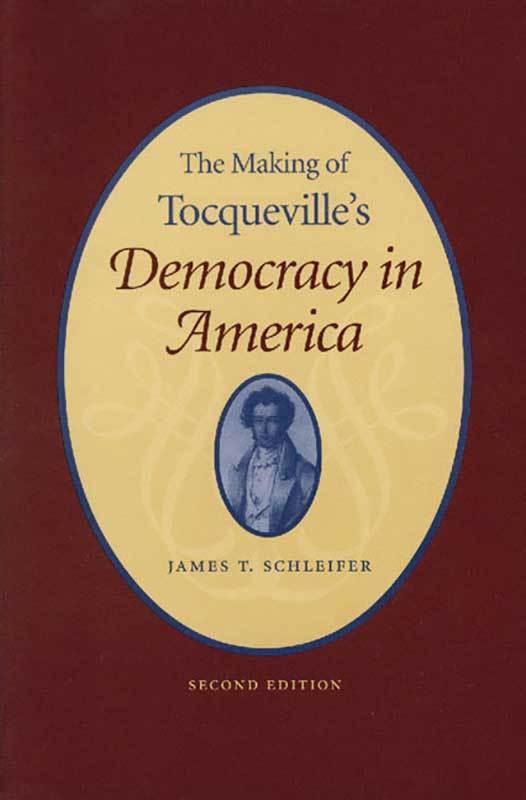
Preface to the First Edition - James T. Schleifer, The Making of Tocqueville’s Democracy in America [1980]Edition used:The Making of Tocqueville’s Democracy in America, Foreword by George W. Pierson (2nd edition) (Indianapolis: Liberty Fund, 2000).
About Liberty Fund:Liberty Fund, Inc. is a private, educational foundation established to encourage the study of the ideal of a society of free and responsible individuals. Copyright information:The copyright to this edition, in both print and electronic forms, is held by Liberty Fund, Inc. Fair use statement:This material is put online to further the educational goals of Liberty Fund, Inc. Unless otherwise stated in the Copyright Information section above, this material may be used freely for educational and academic purposes. It may not be used in any way for profit.
Preface to the First EditionAlexis de Tocqueville’s first journey to America ended on 20 February 1832, when the Havre sailed from New York for France. But his nine-month visit had been only a preface to a second voyage that would consume the next eight years: the writing of the Democracy in America. Until now, the story of that mental return to America, that lengthy time of reconsideration and introspection, has remained largely unexplored.1 For the undertaking of such a project, most of the necessary materials are readily available. The Yale Tocqueville Manuscripts Collection, housed at the Beinecke Rare Book and Manuscript Library and sum of the successful collecting efforts of Paul Lambert White, John M. S. Allison, and, especially, of George Wilson Pierson, contains the bulk of letters, notes, outlines, drafts, and other papers relating to the young Frenchman’s work on America. Even the original working manuscript in Tocqueville’s own hand is included among the Yale materials. The collection offers, in short, an invaluable opportunity for a detailed retracing of the gestation and final shaping of Tocqueville’s classic work.2 The accessibility of the original documents and working papers solves only one of the difficulties presented by any attempt to reconstruct the growth of Tocqueville’s book. Beyond the mechanics of his writing process, his sources, his ideas, and his methods must all be reconsidered. Scholars have long been aware that the ingredients that went into the making of the Democracy were numerous and diverse. The book owed something to the influence of Tocqueville’s milieu, particularly the intellectual and political setting of early nineteenth-century France. It showed the marks of Tocqueville’s early life and education. It was based on the intense firsthand experience that he and Gustave de Beaumont had had of Jacksonian America. It drew also on the letters and essays of helpful American and European acquaintances; a long list of printed materials; the opinions and criticisms of family and friends who read early drafts; his experiences in France while writing the Democracy; and his personal beliefs, doubts, and ambitions. Yet the tale of the Democracy’s making demands a general reevaluation of these sources and raises several more specific questions as well. When and how did particular men, books, or events affect the Democracy? Were Tocqueville’s readings and conversations on various topics adequate? How did he reconcile conflicting opinions and information? Which sources were ultimately most important? Do his drafts or working manuscripts reveal any new and unsuspected roots? The re-creation of Tocqueville’s mental return to America also enables us to trace various ideas from germination in early notes to full maturation in Tocqueville’s final drafts. How did his thought develop? When did particular concepts first appear and how did they evolve? Did certain notions undergo unusual stages of development? Do his unpublished papers disclose any ideas which were forgotten or abandoned along the way? The retelling of the second voyage offers us as well an opportunity to reexamine the techniques and approaches that characterized his research, thinking, and writing. Did he, for example, rely on any special methods to stimulate his thinking? Exactly how did he organize the task of composition? Did he have favorite ways to resolve the troublesome quandaries that arose during the drafting of the Democracy? Did he follow any particular patterns of thought? With these and other questions and possibilities in mind, the following volume begins by discussing the actual writing of Tocqueville’s masterpiece and then focuses successively on many of the major themes of the Democracy. The general movement is from some of the more tangible bits of Tocqueville’s book to some of the more elusive concepts which form the core of his work. The closely interrelated nature of Tocqueville’s great themes will quickly become evident; his key ideas appear and reappear in many different contexts and break through in unexpected places. But this volume in no way claims to unravel all the threads of the Democracy. Certain major strands are only just touched: the link between démocratie and materialism, for example, and the role of religion in Tocqueville’s thought.3 A word or two should be added about the long quotations that appear below. Some of the passages are not directly quoted from the original papers, but from French transcriptions made decades ago. During the late 1920s, in the days before photocopying was possible, many original papers from the Tocqueville family château were copied for Yale by the local schoolteacher, M. Bonnel. Whenever originals are now available, I have used them. But in some cases, the originals disappeared long ago, and the Yale versions have acquired an unexpected value; in other cases, the original papers are as yet unpublished and thus still unavailable to anyone not working on the new edition of Tocqueville’s Oeuvres complètes.4 So often I have had no choice but to use the Yale copies. An explanation is also in order about the problem of translation. For Tocqueville’s travel diaries I have relied on the versions of either George Wilson Pierson, from his Tocqueville and Beaumont in America, or George Lawrence, from Journey to America, edited by J. P. Mayer.5 Because of different sources and the individual preferences and styles of the translators, the Pierson and Mayer works occasionally disagree. Mayer’s volume is a convenient English form of Tocqueville’s travel diaries and is based, where possible, upon existing French originals. Pierson often used duplicates as a starting point and so occasionally reproduced errors first made by the copyist. But in addition to extensive selections from the American notebooks, he also offers valuable English versions of a variety of letters and other papers relating to Tocqueville’s book. (For these I have also sometimes relied on his translations.) For the Democracy in America itself, I have almost always quoted from the more recent paperback edition, again translated by George Lawrence and edited by J. P. Mayer.6 This edition, though flawed by occasional errors and awkwardness, has the virtue of more consistently modern English throughout. In a few cases, I have reproduced the older Phillips Bradley edition.7 My choice has depended on the accuracy, clarity, and felicity of the two translations. Once or twice I have also attempted an entirely new translation of a significant sentence or passage; these are always indicated. Apart from excerpts from the American notebooks, some miscellaneous correspondence, and the published Democracy itself, the translations appearing in this volume are my own. I have translated all materials presented below which directly relate to the development of the Democracy: outlines, drafts, marginalia, original working manuscript, “Rubish,” and other papers. So the responsibility for fairly rendering the meaning and tone of Tocqueville’s own words is mine. I would like to acknowledge my debt, first of all, to my fellow tocquevillien, George Wilson Pierson, who, by his careful readings of my manuscript at its various stages, by his perceptive comments and suggestions, and by his own high standards of scholarship and style, has left his mark throughout this work. His advice, support, friendship, and inspiration have been invaluable to me. I am grateful to various other members of the community of scholars: especially André Jardin, for his ready help, meticulous example, and warm friendship; Doris Goldstein, for her interest and encouragement along the way; and Joseph Hamburger and Edmund S. Morgan, for their willingness to read and comment upon the final draft of this volume. I owe thanks to several institutions: the Yale University history department which, in 1972, honored an earlier dissertation version of the first three sections of this book with the George Washington Egleston Prize; the Society for French Historical Studies and the Institut français de Washington, which jointly granted that same manuscript the Gilbert Chinard Incentive Award for 1974; the American Council of Learned Societies for a fellowship in 1974–75 which allowed me, for several months, to devote my full time and energy to this book; and to the College of New Rochelle, which, though small and of limited financial resources, supports the scholarly work of its faculty in many ways and helped me particularly by bearing most of the costs of preparing the final typed copy of this manuscript and by defraying the expense of large unanticipated permission fees. And finally I am grateful to the staff at the Beinecke Rare Book and Manuscript Library, especially Miss Marjorie Wynne, Edwin J. Beinecke Research Librarian, who has for some years been closely involved (with George Wilson Pierson) in overseeing the development of the Yale Tocqueville Collection; and to the Public Services staff behind the main desk. Their assistance to me over the past decade has been unfailingly gracious. Tocqueville specialists should note that a fuller typescript version of this book has been added to the Yale Tocqueville Manuscripts Collection at the Beinecke Library. In that uncut manuscript, interested scholars will find some additional textual material and more numerous and detailed notes. [1. ]I am indebted to George Wilson Pierson for both the phrase and the concept “second voyage.” Consult his provocative essay, “Le ‘second voyage’ de Tocqueville en Amerique” (hereafter cited as Pierson, “Second voyage”) in the commemorative collection entitled Alexis de Tocqueville: Livre du centenaire, 1859–1959, pp. 71–85 (hereafter cited as Tocqueville: centenaire). In addition, Pierson has written a superb and thorough account of Tocqueville’s first journey and a brief description of some episodes of the second in Tocqueville and Beaumont in America (hereafter cited as Pierson, Toc. and Bt.). His work is also available in an abridged edition prepared by Dudley C. Lunt in both paper and hardback versions, Pierson, Tocqueville in America. [2. ]The largest depository of Tocqueville papers is located in Paris under the supervision of the Commission nationale pour l’édition des oeuvres d’Alexis de Tocqueville. But for this study, the Yale Tocqueville Manuscripts Collection, which includes either originals or copies of almost all materials relating to the Democracy, is fully adequate when used in conjunction with published materials. The appearance and importance of many of the Yale manuscripts are described more fully in chapters 1 and 2 below. [3. ]See the excellent book by Doris Goldstein, Trial of Faith: Religion and Politics in Tocqueville’s Thought. [4. ]Oeuvres, papiers et correspondances d’Alexis de Tocqueville, Edition définitive sous la direction de J.-P. Mayer, sous le patronage de la commission nationale pour l’édition des oeuvres d’Alexis de Tocqueville; hereafter cited as O.C. (Mayer). [5. ]Journey to America, hereafter cited as Mayer, Journey, is a translation of pertinent parts of Voyages en Sicile et aux Etats-Unis, also edited by J. P. Mayer, O.C. (Mayer), vol. 5. [6. ]Democracy in America; hereafter cited as Democracy (Mayer). The hardcover version, jointly edited by J. P. Mayer and Max Lerner, first appeared in 1966. [7. ]Democracy in America, edited by Phillips Bradley, based on the Henry Reeve translation as revised by Francis Bowen, 2 vols.; hereafter cited as Democracy (Bradley). |

Titles (by Subject)