6
Letter to William Elliot
May 1795
As the revolutionary decade wore on, Burke grew increasingly despondent over the aptitude of the British revolutionaries for forming clubs, societies, and informal ideological alliances, while his political allies either languished or lashed out in shortsighted reaction. Burke had hoped his son Richard would become a leader, especially among younger men, to oppose radicals like Joseph Priestley, Thomas Paine, and their followers in the Revolution Society. Richard’s death in August 1794, however, forced Burke to turn to others, including William Elliot.
Burke’s hopes were being dashed on the international as well as on the domestic front. The German powers and Russia had never been able to overcome their mutual suspicion or their desire for Polish land. By late 1794 the First Coalition had broken up when Prussia sued for peace with France. The resulting Treaty of Basle (April 5, 1795), to which this letter refers, effectively annulled the Declaration of Pillnitz, which had united the Austrian Emperor and Prussian King since August 1791.
The immediate motive for Burke’s letter was a speech on May 8, 1795, by the Duke of Norfolk, designated in the text below by “His Grace” and by asterisks. The speech had condemned the Reflections for “inculcating principles and broaching doctrines, not only subversive of the constitutional rights of Englishmen, but diametrically contradictory to the whig principles which he in common with his party, professed.”
The Letter laments the willingness of the European monarchies to abandon their principles in the face of revolutionary propaganda. It describes the fundamental importance of a proper education, of the security of property, and of religion to a free people. Finally, it calls for a new leader possessed of civic courage and piety toward ancient practices, symbolized by Judas Maccabeus.
Letter to William Elliot
Beaconsfield, May 26, 1795
My dear Sir,
I have been told of the voluntary, which, for the entertainment of the House of Lords, has been lately played by His Grace the **** of *******, a great deal at my expence, and a little at his own. I confess I should have liked the composition rather better, if it had been quite new. But every man has his taste, and His Grace is an admirer of antient musick.
There may be sometimes too much even of a good thing. A toast is good, and a bumper is not bad: but the best toasts may be so often repeated as to disgust the palate, and ceaseless rounds of bumpers may nauseate and overload the stomach. The ears of the most steady-voting politicians may at last be stunned with three times three. I am sure I have been very grateful for the flattering remembrance made of me in the toasts of the Revolution Society, and of other clubs formed on the same laudable plan. After giving the brimming honours to Citizen Thomas Paine, and to Citizen Dr. Priestley, the gentlemen of these clubs seldom failed to bring me forth in my turn, and to drink, “Mr. Burke, and thanks to him for the discussion he has provoked.”
I found myself elevated with this honour; for even by the collision of resistance, to be the means of striking out sparkles of truth, if not merit, is at least felicity.
Here I might have rested. But when I found that the great advocate, Mr. Erskine, condescended to resort to these bumper toasts, as the pure and exuberant fountains of politicks and of rhetorick (as I hear he did, in three or four speeches made in defence of certain worthy citizens), I was rather let down a little. Though still somewhat proud of myself, I was not quite so proud of my voucher. Though he is no idolater of fame, in some way or other, Mr. Erskine will always do himself honour. Methinks, however, in following the precedents of these toasts, he seemed to do more credit to his diligence, as a special pleader, than to his invention as an orator. To those who did not know the abundance of his resources, both of genius and erudition, there was something in it that indicated the want of a good assortment, with regard to richness and variety, in the magazine of topicks and common-places, which I suppose he keeps by him, in imitation of Cicero and other renowned declaimers of antiquity.
Mr. Erskine supplied something, I allow, from the stores of his imagination, in metamorphosing the jovial toasts of clubs, into solemn special arguments at the bar. So far the thing shewed talent: however I must still prefer the bar of the tavern to the other bar. The toasts at the first hand were better than the arguments at the second. Even when the toasts began to grow old as sarcasms, they were washed down with still older pricked election port; then the acid of the wine made some amends for the want of any thing piquant in the wit. But when His Grace gave them a second transformation, and brought out the vapid stuff, which had wearied the clubs and disgusted the courts; the drug made up of the bottoms of rejected bottles, all smelling so woefully of the cork and of the cask, and of every thing except the honest old lamp, and when that sad draught had been farther infected with the gaol pollution of the Old Bailey, and was dashed and brewed, and ineffectually stummed again into a senatorial exordium in the House of Lords, I found all the high flavour and mantling of my honours, tasteless, flat, and stale. Unluckily, the new tax on wine is felt even in the greatest fortunes, and His Grace submits to take up with the heel-taps of Mr. Erskine.
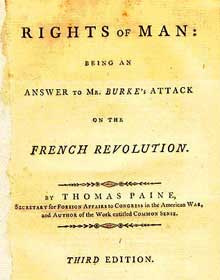
I have had the ill or good fortune to provoke two great men of this age to the publication of their opinions; I mean, Citizen Thomas Paine, and His Grace the **** of *******. I am not so great a leveller as to put these two great men on a par, either in the state, or the republick of letters: but, “the field of glory is a field for all.” It is a large one indeed, and we all may run, God knows where, in chace of glory, over the boundless expanse of that wild heath, whose horizon always flies before us. I assure His Grace (if he will yet give me leave to call him so) whatever may be said on the authority of the clubs, or of the bar, that Citizen Paine (who, they will have it, hunts with me in couples, and who only moves as I drag him along), has a sufficient activity in his own native benevolence to dispose and enable him to take the lead for himself. He is ready to blaspheme his God, to insult his king, and to libel the constitution of his country, without any provocation from me, or any encouragement from His Grace. I assure him, that I shall not be guilty of the injustice of charging Mr. Paine’s next work against religion and human society, upon His Grace’s excellent speech in the House of Lords. I farther assure this noble Duke, that I neither encouraged nor provoked that worthy citizen to seek for plenty, liberty, safety, justice or lenity, in the famine, in the prisons, in the decrees of convention, in the revolutionary tribunal, and in the guillotine of Paris, rather than quietly to take up with what he could find in the glutted markets, the unbarricadoed streets, the drowsy Old Bailey judges, or, at worst, the airy, wholesome pillory of Old England. The choice of country was his own taste. The writings were the effects of his own zeal. In spite of his friend Dr. Priestley, he was a free agent. I admit, indeed, that my praises of the British government loaded with all its encumbrances; clogged with its peers and its beef; its parsons and its pudding; its Commons and its beer; and its dull slavish liberty of going about just as one pleases, had something to provoke a Jockey of Norfolk, who was inspired with the resolute ambition of becoming a citizen of France, to do something which might render him worthy of naturalization in that grand asylum of persecuted merit: something which should intitle him to a place in the senate of the adoptive country of all the gallant, generous and humane. This, I say, was possible. But the truth is (with great deference to His Grace I say it) Citizen Paine acted without any provocation at all; he acted solely from the native impulses of his own excellent heart.
His Grace, like an able orator, as he is, begins with giving me a great deal of praise for talents which I do not possess. He does this to intitle himself, on the credit of this gratuitous kindness, to exaggerate my abuse of the parts which his bounty, and not that of nature has bestowed upon me. In this, too, he has condescended to copy Mr. Erskine. These priests (I hope they will excuse me: I mean priests of the Rights of Man) begin by crowning me with their flowers and their fillets, and bedewing me with their odours, as a preface to their knocking me on the head with their consecrated axes. I have injured, say they, the Constitution; and I have abandoned the whig party and the whig principles that I professed. I do not mean, my dear sir, to defend myself against His Grace. I have not much interest in what the world shall think or say of me; as little has the world an interest in what I shall think or say of any one in it; and I wish that His Grace had suffered an unhappy man to enjoy, in his retreat, the melancholy privileges of obscurity and sorrow. At any rate, I have spoken, and I have written on the subject. If I have written or spoken so poorly as to be quite forgot, a fresh apology will not make a more lasting impression. “I must let the tree lie as it falls.” Perhaps I must take some shame to myself. I confess that I have acted on my own principles of government, and not on those of His Grace, which are, I dare say, profound and wise; but which I do not pretend to understand. As to the party to which he alludes, and which has long taken its leave of me, I believe the principles of the book which he condemns, are very conformable to the opinions of many of the most considerable and most grave in that description of politicians. A few indeed, who, I admit, are equally respectable in all points, differ from me, and talk His Grace’s language. I am too feeble to contend with them. They have the field to themselves. There are others very young and very ingenious persons, who form, probably, the largest part of what His Grace, I believe, is pleased to consider as that party. Some of them were not born into the world, and all of them were children, when I entered into that connexion. I give due credit to the censorial brow, to the broad phylacteries, and to the imposing gravity of those magisterial rabbins and doctors in the cabala of political science. I admit that “wisdom is as the grey hair to man, and that learning is like honourable old age.” But, at a time when liberty is a good deal talked of, perhaps I might be excused, if I caught something of the general indocility. It might not be surprising, if I lengthened my chain a link or two, and in an age of relaxed discipline, gave a trifling indulgence to my own notions. If that could be allowed, perhaps I might sometimes (by accident, and without an unpardonable crime) trust as much to my own very careful and very laborious, though, perhaps, somewhat purblind disquisitions, as to their soaring, intuitive, eagle-eyed authority; but the modern liberty is a precious thing. It must not be profaned by too vulgar an use. It belongs only to the chosen few, who are born to the hereditary representation of the whole democracy, and who leave nothing at all, no, not the offal, to us poor outcasts of the plebeian race.
Amongst those gentlemen who came to authority, as soon, or sooner than they came of age, I do not mean to include His Grace. With all those native titles to empire over our minds which distinguish the others, he has a large share of experience. He certainly ought to understand the British Constitution better than I do. He has studied it in the fundamental part. For one election I have seen, he has been concerned in twenty. Nobody is less of a visionary theorist; nobody has drawn his speculations more from practice. No Peer has condescended to superintend with more vigilance the declining franchises of the poor Commons. “With thrice great Hermes he has out-watched the bear.” Often have his candles been burned to the snuff, and glimmered and stunk in the sockets, whilst he grew pale at his constitutional studies; long sleepless nights has he wasted; long, laborious, shiftless journies has he made, and great sums has he expended, in order to secure the purity, the independence, and the sobriety of elections, and to give a check, if possible, to the ruinous charges that go nearly to the destruction of the right of election itself.
Amidst these his labours, his Grace will be pleased to forgive me, if my zeal, less enlightened to be sure than his by midnight lamps and studies, has presumed to talk too favourably of this Constitution, and even to say something sounding like approbation of that body which has the honour to reckon his Grace at the head of it. Those who dislike this partiality, or, if his Grace pleases, this flattery of mine, have a comfort at hand. I may be refuted and brought to shame by the most convincing of all refutations, a practical refutation. Every individual Peer for himself may shew that I was ridiculously wrong; the whole body of those noble persons may refute me for the whole corps. If they please, they are more powerful advocates against themselves, than a thousand scribblers like me can be in their favour. If I were even possessed of those powers which his Grace, in order to heighten my offence, is pleased to attribute to me, there would be little difference. The eloquence of Mr. Erskine might save Mr. ***** from the gallows, but no eloquence could save Mr. Jackson from the effects of his own potion.
In that unfortunate book of mine, which is put in the index expurgatorius of the modern whigs, I might have spoken too favourably not only of those who wear coronets, but of those who wear crowns. Kings however have not only long arms, but strong ones too. A great Northern Potentate for instance, is able in one moment, and with one bold stroke of his diplomatick pen, to efface all the volumes which I could write in a century, or which the most laborious publicists of Germany ever carried to the fair of Leipsick, as an apology for monarchs and monarchy. Whilst I, or any other poor puny private sophist, was defending the declaration of Pilnitz, his Majesty might refute me by the treaty of Bâsle. Such a monarch may destroy one republick because it had a king at its head, and he may balance this extraordinary act by founding another republick that has cut off the head of its king. I defended that great Potentate for associating in a grand alliance for the preservation of the old governments of Europe; but he puts me to silence by delivering up all those governments (his own virtually included) to the new system of France. If he is accused before the Parisian tribunal (constituted for the trial of kings) for having polluted the soil of liberty by the tracks of his disciplined slaves, he clears himself by surrendering the finest parts of Germany (with a handsome cut of his own territories) to the offended majesty of the regicides of France. Can I resist this? Am I responsible for it, if with a torch in his hand, and a rope about his neck, he makes amende honorable to the Sans-Culotterie of the republick one and indivisible? In that humiliating attitude, in spite of my protests, he may supplicate pardon for his menacing proclamations; and as an expiation to those whom he failed to terrify with his threats, he may abandon those whom he had seduced by his promises. He may sacrifice the Royalists of France whom he had called to his standard, as a salutary example to those who shall adhere to their native Sovereign, or shall confide in any other who undertakes the cause of oppressed kings and of loyal subjects.
How can I help it, if this high-minded Prince will subscribe to the invectives which the regicides have made against all kings, and particularly against himself? How can I help it, if this Royal propagandist will preach the doctrine of the rights of men? Is it my fault, if his professors of literature read lectures on that code in all his academies, and if all the pensioned managers of the news-papers in his dominions diffuse it throughout Europe in an hundred journals? Can it be attributed to me, if he will initiate all his grenadiers, and all his hussars in these high mysteries? Am I responsible, if he will make le Droit de l’Homme, or la Souveraineté du Peuple the favourite parole of his military orders? Now that his troops are to act with the brave legions of freedom, no doubt he will fit them for their fraternity. He will teach the Prussians to think, to feel and to act like them, and to emulate the glories of the Regiment de l’Echaffaut. He will employ the illustrious Citizen Santerre, the general of his new allies, to instruct the dull Germans how they shall conduct themselves toward persons who, like Louis the XVIth (whose cause and person, he once took into his protection), shall dare without the sanction of the people, or with it, to consider themselves as hereditary kings. Can I arrest this great Potentate in his career of glory? Am I blameable in recommending virtue and religion as the true foundation of all monarchies, because the Protector of the three religions of the Westphalian arrangement, to ingratiate himself with the Republic of Philosophy, shall abolish all the three? It is not in my power to prevent the grand Patron of the reformed church, if he chuses it, from annulling the Calvinistick Sabbath, and establishing the Decadi of Atheism in all his states. He may even renounce and abjure his favourite mysticism in the temple of reason. In these things, at least, he is truly despotick. He has now shaken hands with every thing which at first had inspired him with horrour. It would be curious indeed to see (what I shall not however travel so far to see), the ingenious devices, and the elegant transparencies which on the restoration of peace and the commencement of Prussian liberty are to decorate Potzdam and Charlottenburg festigiante. What shades of his armed ancestors of the House of Brandenburgh will the Committee of Illuminés raise up in the opera-house of Berlin, to dance a grand ballet in the rejoicings for this auspicious event? Is it a Grand Master of the Teutonick Order, or is it the great Elector? Is it the first King of Prussia or the last? or is the whole long line (long, I mean a parte antè ) to appear like Banquo’s royal procession in the tragedy of Macbeth?
How can I prevent all these arts of Royal policy and all these displays of Royal magnificence? How can I prevent the Successor of Frederick the Great from aspiring to a new, and in this age unexampled kind of glory? Is it in my power to say, that he shall not make his confessions in the style of St. Austin or of Rousseau? That he shall not assume the character of the penitent and flagellant, and grafting monkery on philosophy, strip himself of his regal purple, clothe his gigantick limbs in the sackcloth and the hair-shirt, and exercise on his broad shoulders the disciplinary scourge of the holy order of the Sans-Culottes? It is not in me to hinder Kings from making new orders of religious and martial knighthood. I am not Hercules enough to uphold those orbs which the Atlasses of the world are so desirous of shifting from their weary shoulders. What can be done against the magnanimous resolution of the great to accomplish the degradation and the ruin of their own character and situation?
What I say of the German Princes, that I say of all the other dignities and all the other institutions of the Holy Roman Empire. If they have a mind to destroy themselves, they may put their advocates to silence and their advisers to shame. I have often praised the Aulick Council. It is very true I did so. I thought it a tribunal, as well formed as human wisdom could form a tribunal, for coercing the great, the rich and the powerful; for obliging them to submit their necks to the imperial laws, and to those of nature and of nations; a tribunal well conceived for extirpating peculation, corruption and oppression, from all the parts of that vast heterogeneous mass called the Germanic Body. I should not be inclined to retract these praises upon any of the ordinary lapses into which human infirmity will fall; they might still stand, though some of their conclusums should taste of the prejudices of country or of faction, whether political or religious. Some degree, even of corruption, should not make me think them guilty of suicide; but if we could suppose, that the Aulick Council not regarding duty, or even common decorum, listening neither to the secret admonitions of conscience, nor to the publick voice of fame, some of the members basely abandoning their post, and others continuing in it, only the more infamously to betray it, should give a judgment so shameless and so prostitute, of such monstrous and even portentous corruption, that no example in the history of human depravity, or even in the fictions of poëtick imagination, could possibly match it; if it should be a judgment which with cold unfeeling cruelty, after long deliberations should condemn millions of innocent people to extortion, to rapine and to blood, and should devote some of the finest countries upon earth to ravage and desolation—does any one think that any servile apologies of mine, or any strutting and bullying insolence of their own, can save them from the ruin that must fall on all institutions of dignity or of authority that are perverted from their purport to the oppression of human nature in others, and to its disgrace in themselves. As the wisdom of men makes such institutions, the folly of men destroys them. Whatever we may pretend, there is always more in the soundness of the materials, than in the fashion of the work. The order of a good building is something. But if it be wholly declined from its perpendicular; if the cement is loose and incoherent; if the stones are scaling with every change of the weather, and the whole toppling on our heads, what matter is it whether we are crushed by a Corinthian or a Dorick ruin? The fine form of a vessel is a matter of use and of delight. It is pleasant to see her decorated with cost and art. But what signifies even the mathematical truth of her form? What signify all the art and cost with which she can be carved, and painted, and gilded, and covered with decorations from stem to stern; what signify all her rigging and sails, her flags, her pendants and her streamers? what signify even her cannon, her stores and her provisions, if all her planks and timbers be unsound and rotten?
- Quamvis Pontica pinus
- Silvae filia nobilis
Jactes & genus & nomen inutile.
I have been stimulated, I know not how, to give you this trouble by what very few, except myself, would think worth any trouble at all. In a speech in the House of Lords, I have been attacked for the defence of a scheme of government, in which that body inheres, and in which alone it can exist. Peers of Great Britain may become as penitent as the Sovereign of Prussia. They may repent of what they have done in assertion of the honour of their King, and in favour of their own safety. But never the gloom that lowers over the fortune of the cause, nor any thing which the great may do towards hastening their own fall, can make me repent of what I have done by pen or voice (the only arms I possess) in favour of the order of things into which I was born, and in which I fondly hoped to die.
In the long series of ages which have furnished the matter of history, never was so beautiful and so august a spectacle presented to the moral eye, as Europe afforded the day before the revolution in France. I knew indeed that this prosperity contained in itself the seeds of its own danger. In one part of the society it caused laxity and debility. In the other it produced bold spirits and dark designs. A false philosophy passed from academies into courts, and the great themselves were infected with the theories which conducted to their ruin. Knowledge which in the two last centuries either did not exist at all, or existed solidly on right principles and in chosen hands, was now diffused, weakened and perverted. General wealth loosened morals, relaxed vigilance, and increased presumption. Men of talent began to compare, in the partition of the common stock of public prosperity, the proportions of the dividends, with the merits of the claimants. As usual, they found their portion not equal to their estimate (or perhaps to the public estimate) of their own worth. When it was once discovered by the revolution in France that a struggle between establishment and rapacity could be maintained, though but for one year, and in one place, I was sure that a practicable breach was made in the whole order of things and in every country. Religion, that held the materials of the fabrick together, was first systematically loosened. All other opinions, under the name of prejudices, must fall along with it; and Property, left undefended by principles, became a repository of spoils to tempt cupidity, and not a magazine to furnish arms for defence. I knew, that attacked on all sides by the infernal energies of talents set in action by vice and disorder, authority could not stand upon authority alone. It wanted some other support than the poise of its own gravity. Situations formerly supported persons. It now became necessary that personal qualities should support situations. Formerly, where authority was found, wisdom and virtue were presumed. But now the veil was torn, and to keep off sacrilegious intrusion, it was necessary that in the sanctuary of government something should be disclosed not only venerable, but dreadful. Government was at once to shew itself full of virtue and full of force. It was to invite partizans by making it appear to the world that a generous cause was to be asserted; one fit for a generous people to engage in. From passive submission was it to expect resolute defence? No! It must have warm advocates and passionate defenders, which an heavy, discontented acquiescence never could produce. What a base and foolish thing is it for any consolidated body of authority to say, or to act as if it said, “I will put my trust not in my own virtue, but in your patience; I will indulge in effeminacy, in indolence, in corruption; I will give way to all my perverse and vitious humours, because you cannot punish me without the hazard of ruining yourselves?”
I wished to warn the people against the greatest of all evils: a blind and furious spirit of innovation, under the name of reform. I was indeed well aware that power rarely reforms itself. So it is undoubtedly when all is quiet about it. But I was in hopes that provident fear might prevent fruitless penitence. I trusted that danger might produce at least circumspection; I flattered myself in a moment like this that nothing would be added to make authority top-heavy; that the very moment of an earth-quake would not be the time chosen for adding a story to our houses. I hoped to see the surest of all reforms, perhaps the only sure reform, the ceasing to do ill. In the mean time I wished to the people, the wisdom of knowing how to tolerate a condition which none of their efforts can render much more than tolerable. It was a condition, however, in which every thing was to be found that could enable them to live to nature, and if so they pleased, to live to virtue and to honour.
I do not repent that I thought better of those to whom I wished well, than they will suffer me long to think that they deserved. Far from repenting, I would to God, that new faculties had been called up in me, in favour not of this or that man, or this or that system, but of the general vital principle that whilst it was in its vigour produced the state of things transmitted to us from our fathers; but which, through the joint operation of the abuses of authority and liberty, may perish in our hands. I am not of opinion that the race of men, and the commonwealths they create, like the bodies of individuals, grow effete and languid and bloodless, and ossify by the necessities of their own conformation, and the fatal operation of longevity and time. These analogies between bodies natural and politick, though they may some times illustrate arguments, furnish no argument of themselves. They are but too often used under the colour of a specious philosophy, to find apologies for the despair of laziness and pusillanimity, and to excuse the want of all manly efforts, when the exigencies of our country call for them the more loudly.
How often has public calamity been arrested on the very brink of ruin by the seasonable energy of a single man? Have we no such man amongst us? I am as sure as I am of my being, that one vigorous mind without office, without situation, without public functions of any kind (at a time when the want of such a thing is felt, as I am sure it is) I say, one such man, confiding in the aid of God, and full of just reliance in his own fortitude, vigour, enterprize and perseverance, would first draw to him some few like himself, and then that multitudes, hardly thought to be in existence, would appear and troop about him.
If I saw this auspicious beginning, baffled and frustrated as I am, yet on the very verge of a timely grave, abandoned abroad and desolate at home, stripped of my boast, my hope, my consolation, my helper, my counsellor and my guide (you know in part what I have lost, and would to God I could clear myself of all neglect and fault in that loss), yet thus, even thus, I would rake up the fire under all the ashes that oppress it. I am no longer patient of the public eye; nor am I of force to win my way and to justle and elbow in a crowd. But even in solitude, something may be done for society. The meditations of the closet have infected senates with a subtle frenzy, and inflamed armies with the brands of the furies. The cure might come from the same source with the distemper. I would add my part to those who would animate the people (whose hearts are yet right) to new exertions in the old cause.
*Novelty is not the only source of zeal. Why should not a Maccabeus and his brethren arise to assert the honour of the ancient law, and to defend the temple of their forefathers, with as ardent a spirit, as can inspire any innovator to destroy the monuments of the piety and the glory of antient ages? It is not a hazarded assertion, it is a great truth, that when once things are gone out of their ordinary course, it is by acts out of the ordinary course they can alone be re-established. Republican spirit can only be combated by a spirit of the same nature: of the same nature, but informed with another principle and pointing to another end. I would persuade a resistance both to the corruption and to the reformation that prevails. It will not be the weaker, but much the stronger, for combating both together. A victory over real corruptions would enable us to baffle the spurious and pretended reformations. I would not wish to excite, or even to tolerate, that kind of evil spirit which evokes the powers of hell to rectify the disorders of the earth. No! I would add my voice with better, and I trust, more potent charms, to draw down justice and wisdom and fortitude from heaven, for the correction of human vice, and the recalling of human errour from the devious ways into which it has been betrayed. I would wish to call the impulses of individuals at once to the aid and to the controul of authority. By this which I call the true republican spirit, paradoxical as it may appear, monarchies alone can be rescued from the imbecillity of courts and the madness of the crowd. This republican spirit would not suffer men in high place to bring ruin on their country and on themselves. It would reform, not by destroying, but by saving, the great, the rich and the powerful. Such a republican spirit, we perhaps fondly conceive to have animated the distinguished heroes and patriots of old, who knew no mode of policy but religion and virtue. These, they would have paramount to all constitutions; they would not suffer Monarchs or Senates or popular Assemblies, under pretences of dignity or authority, or freedom, to shake off those moral riders which reason has appointed to govern every sort of rude power. These, in appearance loading them by their weight, do by that pressure augment their essential force. The momentum is encreased by the extraneous weight. It is true in moral, as it is in mechanical science. It is true, not only in the draught, but in the race. These riders of the great, in effect, hold the reins which guide them in their course, and wear the spur that stimulates them to the goals of honour and of safety. The great must submit to the dominion of prudence and of virtue; or none will long submit to the dominion of the great.
- “Dis te minorem quod geris imperas.”
This is the feudal tenure which they cannot alter.
Indeed, my dear Sir, things are in a bad state. I do not deny a good share of diligence, a very great share of ability, and much publick virtue to those who direct our affairs. But they are encumbered, not aided, by their very instruments, and by all the apparatus of the state. I think that our Ministry (though there are things against them, which neither you nor I can dissemble, and which grieve to the heart) is by far the most honest and by far the wisest system of administration in Europe. Their fall would be no trivial calamity.
Not meaning to depreciate the Minority in Parliament, whose talents are also great, and to whom I do not deny virtues, their system seems to me to be fundamentally wrong. But whether wrong or right, they have not enough of coherence among themselves, nor of estimation with the publick, nor of numbers. They cannot make up an administration. Nothing is more visible. Many other things are against them, which I do not charge as faults, but reckon among national misfortunes. Extraordinary things must be done, or one of the parties cannot stand as a Ministry, nor the other even as an Opposition. They cannot change their situations, nor can any useful coalition be made between them. I do not see the mode of it, nor the way to it. This aspect of things I do not contemplate with pleasure.
I well know that every thing of the daring kind which I speak of, is critical—But the times are critical. New things in a new world! I see no hopes in the common tracks. If men are not to be found who can be got to feel within them some impulse
- “—— quod nequeo monstrare, & sentio tantum,”
and which makes them impatient of the present; if none can be got to feel that private persons may sometimes assume that sort of magistracy which does not depend on the nomination of Kings, or the election of the people, but has an inherent and self-existent power which both would recognize; I see nothing in the world to hope.
If I saw such a group beginning to cluster, such as they are, they should have (all that I can give) my prayers and my advice. People talk of war, or cry for peace—have they to the bottom considered the questions either of war, or peace, upon the scale of the existing world? No. I fear they have not.
Why should not you, yourself, be one of those to enter your name in such a list as I speak of. You are young; you have great talents, you have a clear head, you have a natural, fluent and unforced elocution; your ideas are just, your sentiments benevolent, open and enlarged—but this is too big for your modesty. Oh! this modesty in time and place is a charming virtue, and the grace of all other virtues. But it is sometimes the worst enemy they have. Let him, whose print I gave you the other day, be engraved in your memory! Had it pleased Providence to have spared him for the trying situations that seem to be coming on, notwithstanding that he was sometimes a little dispirited by the disposition which we thought shewn to depress him and set him aside; yet he was always buoyed up again; and on one or two occasions, he discovered what might be expected from the vigour and elevation of his mind, from his unconquerable fortitude, and from the extent of his resources for every purpose of speculation and of action. Remember him, my friend, who in the highest degree honoured and respected you, and remember that great parts are a great trust. Remember too that mistaken or misapplied virtues, if they are not as pernicious as vice, frustrate at least their own natural tendencies, and disappoint the purposes of the great giver.
Adieu. My dreams are finished.