Econlib

The Library

Other Sites

Front Page arrow Titles (by Subject) arrow LETTER LXXXIV.: The Bath Waters injurious: Complaints of Injustice: Hume's Autobiography: Dialogues on Natural Religion. - Letters of David Hume to William Strahan

Return to Title Page for Letters of David Hume to William Strahan

Search this Title:

Also in the Library:

Subject Area: Philosophy

LETTER LXXXIV.: The Bath Waters injurious: Complaints of Injustice: Hume's Autobiography: Dialogues on Natural Religion. - David Hume, Letters of David Hume to William Strahan [1756]

Edition used:

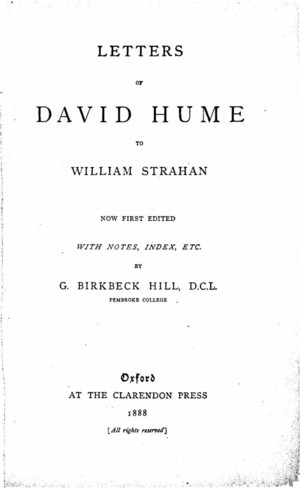
Letters of David Hume to William Strahan, ed. G. Birkbeck Hill (Oxford: Clarendon Press, 1888).

About Liberty Fund:

Liberty Fund, Inc. is a private, educational foundation established to encourage the study of the ideal of a society of free and responsible individuals.


LETTER LXXXIV.

The Bath Waters injurious: Complaints of Injustice: Hume's Autobiography: Dialogues on Natural Religion.

  • Bath,

My Dear Sir

You will be sorry to hear, that I must retract all the good Accounts, which I gave you of my Health. The Waters, after seeming to agree with me, have sensibly a bad Effect, and I have entirely dropped the Use of them. I wait only Sir John Pringle's Directions before I leave this place; and I shall, I believe, set out for the North in a few days1 . If any Letters for me come under your Cover, be so good as to detain them, till I can inform you of my Route.

I am glad to find, that you have been able to set about this New Edition in earnest. I have made it extremely correct; at least I believe that, if I were to live twenty Years longer, I shoud never be able to give it any further Improvements. This is some small Satisfaction to me in my present Situation; and I may add that it is almost the only one that my Writings ever afforded me: For as to any suitable Returns of Approbation from the Public, for the Care, Accuracy, Labour, Disinterestedness, and Courage2 of my Compositions, they are yet to come. Though, I own to you, I see many Symptoms that they are approaching3 . But it will happen to me as to many other Writers: Though I have reached a considerable Age, I shall not live to see any Justice done to me4 . It is not improbable, however, that my Self-conceit and Prepossessions may lead me into this way of thinking5 .

As soon as this Edition is finished, please to send a Copy of all the ten Volumes6 to Sir John Pringle, the same to Mr. Gibbon7 , a Copy of the History to Mistress Elliott8 in Brewer Street; six Copies of the whole to me in Edinburgh or to my Brother there in case of my Death9 .

If this Event shall happen, as is probable, before the Publication of this Edition, there is one Request I have to make to you: Before I left Edinburgh, I wrote a small piece (you may believe it woud be but a small one) which I call the History of my own Life10 : I desire it may be prefixed to this Edition: It will be thought curious and entertaining. My Brother or Dr. Adam Smith will send it to you, and I shall give them Directions to that Purpose.

I am also to speak to you of another Work more important: Some Years ago, I composed a piece, which woud make a small Volume in Twelves. I call it Dialogues on natural Religion: Some of my Friends flatter me, that it is the best thing I ever wrote. I have hitherto forborne to publish it, because I was of late desirous to live quietly, and keep remote from all Clamour: For though it be not more exceptionable than some things I had formerly published; yet you know some of these were thought very exceptionable; and in prudence, perhaps, I ought to have suppressed them. I there introduce a Sceptic, who is indeed refuted, and at last gives up the Argument, nay confesses that he was only amusing himself by all his Cavils11 ; yet before he is silenced, he advances several Topics, which will give Umbrage, and will be deemed very bold and free, as well as much out of the common Road. As soon as I arrive at Edinburgh, I intend to print a small Edition of 500, of which I may give away about 100 in Presents; and shall make you a Present of the Remainder, together with the literary Property of the whole, provided you have no Scruple, in your present Situation, of being the Editor: It is not necessary you shoud prefix your Name to the Title Page. I seriously declare, that after Mr. Millar and You and Mr. Cadell have publickly avowed your Publication of the Enquiry concerning human Understanding12 , I know no Reason why you shoud have the least Scruple with regard to these Dialogues. They will be much less obnoxious to the Law13 , and not more exposed to popular Clamour. Whatever your Resolution be, I beg you wou’d keep an entire Silence on this Subject. If I leave them to you by Will, your executing the Desire of a dead Friend, will render the publication still more excusable14 . Mallet never sufferd any thing by being the Editor of Boling-broke's Works15 .

Two posts ago, I sent you a Copy of the small Essay which I mentioned16 .

I am Dear Sir with great Regard and Sincerity Your most obedient humble Servant

David Hume.

[1]Note 1. ‘They may say what they will,’ wrote Horace Walpole nearly ten years earlier, ‘but it does one ten times more good to leave Bath than to go to it.’ Letters, v. 19.

[2]Note 2. Hume's courage had not grown with increase of days and prosperity, as the following extracts from his letters show. Writing in 1754 of the first volume of his History of England under the Stuarts, he says:—‘A few Christians only (and but a few) think I speak like a Libertine in religion; be assured I am tolerably reserved on this head. Elliot tells me that you had entertained apprehensions of my discretion: what I had done to forfeit with you the character of prudence I cannot tell, but you will see little or no occasion for any such imputation in this work. I composed it ad populum, as well as ad clerum, and thought that scepticism was not in its place in an historical production.’ Burton's Hume, i. 397. In this very volume of his History (ch. lix), speaking of the trial of Charles I, he says:—‘If ever on any occasion it were laudable to conceal truth from the populace, it must be confessed that the doctrine of resistance affords such an example; and that all speculative reasoners ought to observe, with regard to this principle, the same cautious silence which the laws in every species of government have ever prescribed to themselves. Government is instituted in order to restrain the fury and injustice of the people; and being always founded on opinion, not on force, it is dangerous to weaken by these speculations the reverence which the multitude owe to authority, and to instruct them beforehand that the case can ever happen when they may be freed from their duty of allegiance.’ Ed. 1802, vii. 148.

In 1761, writing to Dr. Blair about a sermon by a Dr. Campbell in which he was attacked, he says:—‘I could wish your friend had not denominated me an infidel writer on account of ten or twelve pages which seem to him to have that tendency, while I have wrote so many volumes on history, literature, politics, trade, morals, which in that particular at least are entirely inoffensive. Is a man to be called a drunkard, because he has been seen fuddled once in his lifetime?’ Burton's Hume, ii. 116. Dr. Burton hereupon quotes the following anecdote by Lord Charlemont:—‘One day that Hume visited me in London, he came into my room laughing, and apparently well pleased. “What has put you into this good humour, Hume?” said I. ‘Why man,” replied he, “I have just now had the best thing said to me I ever heard. I was complaining in a company where I spent the morning, that I was very ill-treated by the world; that I had written many volumes, throughout the whole of which there were but a few pages that contained any reprehensible matter, and yet for those few pages I was abused and torn to pieces. “You put me in mind,” said an honest fellow in the company, “of an acquaintance of mine, a notary public, who having been condemned to be hanged for forgery, lamented the hardness of his case; that after having written many thousand inoffensive sheets he should be hanged for one line.”’ Memoirs of Charlemont, ed. 1812, i. 232.

Though Hume wrote his Dialogues concerning Natural Religion at least as early as the year 1751 (Burton's Hume, i. 328), he had not courage to publish them in the remaining quarter of a century that he lived. To the full violence of the attack made by Johnson on Bolingbroke—about its justice I say nothing—he was himself exposed. Johnson would not have hesitated to say of him:—'sir, he was a scoundrel and a coward; a scoundrel for charging a blunderbuss against religion and morality; a coward because he had not resolution to fire it off himself, but left half-a-crown to a beggarly Scotchman to draw the trigger after his death.’ Boswell's Johnson, i. 268. Hume withdrew also from publication at the last moment his Essays on Suicide and the Immortality of the Soul, (ante, p. 232, n. 8).

In 1762 he wrote to Millar:—‘I give you full authority to contradict the report that I am writing or intend to write an ecclesiastical history; I have no such intention; and I believe never shall. I am beginning to love peace very much, and resolve to be more cautious than formerly in creating myself enemies.’ Burton's Hume, ii. 130. In an undated letter, believed to be written to Dr. Trail, speaking of his philosophical writings he says:—‘I wish I had always confined myself to the more easy parts of erudition.’ M. S. R. S. E. Yet when Lord Charlemont asked him ‘whether he thought that, if his opinions were universally to take place, mankind would not be rendered more unhappy than they now were; and whether he did not suppose that the curb of religion was necessary to human nature; “The objections,” answered he, “are not without weight; but error never can produce good, and truth ought to take place of all considerations.”’ Memoirs of Charlemont, i. 232.

Landor thus introduces him in his Dialogue between Alfieri and Metastasio:—

Metastasio. “Hume was thought a free-thinker: was he one?”

Alfieri. “Quite the contrary. A narrow ribbon tied him, neck and heels, to the hinder quarters of a broken throne. If you mean religion, I believe he was addicted to no formulary. His life was indolently and innocently Epicurean.”’ Landor's Works, ed. 1876, v. 132. See ante, p. 217, n. 3, for his cowardly advice to a young clergyman.

[3]Note 3. In his Autobiography he says:—‘Though I see many symptoms of my literary reputation's breaking out at last with additional lustre, I knew that I could have but few years to enjoy it.’ He speaks of his ‘love of literary fame’ as his ‘ruling-passion.’

[4]Note 4. Sir James Mackintosh, writing in the year 1811, says:—‘Perhaps the name of no man of letters in Great Britain, in the middle of the eighteenth century, was better known throughout Europe than that of Mr. Hume.’ Speaking of his philosophical works Mackintosh continues:—‘They may be regarded as the cause, either directly or indirectly, of almost all the metaphysical writings in Europe for seventy years; during the whole of that period Mr. Hume filled the schools of Europe with his disciples or his antagonists.’ Life of Mackintosh, ii. 168.

[5]Note 5. Hume at first wrote:—‘It is probable that my Prepossessions lead me into this way of thinking.’

[6]Note 6. The ten volumes are the eight of his History and the two of his Essays.

[7]Note 7. Gibbon had sent Hume ‘the agreeable present’ of the first volume of his Decline and Fall. Gibbon's Misc. Works, i. 224.

[8]Note 8. See ante, p. 94, n. 8.

[9]Note 9. See post, p. 358.

[10]Note 10. Hume had written to Adam Smith on May 3:—‘You will find among my papers a very inoffensive paper called “my own Life,” which I composed a few days before I left Edinburgh; when I thought, as did all my friends, that my life was despaired of. There can be no objection that the small piece should be sent to Messrs. Strahan and Cadell, and the proprietors of my other works, to be prefixed to any future edition of them.’ Burton's Hume, ii. 493.

[11]Note 11. ‘“Believe me, Demea,” replied Cleanthes, “your friend Philo from the beginning has been amusing himself at both our expense; and it must be confessed that the injudicious reasoning of our vulgar theology has given him but too just a handle of ridicule. The total infirmity of human reason, the absolute incomprehensibility of the Divine Nature, the great and universal misery, and still greater wickedness of men; these are strange topics, surely, to be so fondly cherished by orthodox divines and doctors. In ages of stupidity and ignorance, indeed, these principles may safely be espoused; and perhaps no views of things are more proper to promote superstition than such as encourage the blind amazement, the diffidence, and the melancholy of mankind.” ... “I must confess,” replied Philo, “that I am less cautious on the subject of Natural Religion than on any other; both because I know that I can never on that head corrupt the principles of any man of common sense; and because no one, I am confident, in whose eyes I appear a man of common sense, will ever mistake my intentions. You, in particular, Cleanthes, with whom I live in unreserved intimacy; you are sensible that notwithstanding the freedom of my conversation, and my love of singular arguments, no one has a deeper sense of religion impressed on his mind, or pays more profound adoration to the Divine Being, as he discovers himself to reason, in the inexplicable contrivance and artifice of nature. A purpose, an intention, a design, strikes everywhere the most careless, the most stupid thinker; and no man can be so hardened in absurd systems as at all times to reject it.”’ Hume's Philosophical Works, ed. 1854, ii. 520, 522.

[12]Note 12. Millar, it should seem, had had no fear of publishing sceptical works. Hume writing to him on May 20, 1757, said:—‘When Bailie Hamilton [the Edinburgh bookseller] was in London, he wrote me that the stop in the sale of my History proceeded from some strokes of irreligion, which had raised the cry of the clergy against me. This gave me occasion to remark to you that the Bailie's complaint must have proceeded from his own misconduct; that the cause he assigned could never have produced that effect; that it was rather likely to increase the sale according to all past experience; that you had offered (as I heard) a large sum for Bolingbroke's Works, trusting to this consequence.’ Burton's Hume, ii. 24. It is stated in Knight's Cyclo. of Biog. iv. 69, that ‘Mallet refused the bookseller's offer of £3000 for Bolingbroke's Works, and then published them on his own account.’ According to Nichols ‘they were published with success very inadequate to our Editor's expectation.’ Lit. Anec. ii. 370.

[13]Note 13. Blackstone, only seven years earlier, had said:—‘All affronts to Christianity, or endeavours to depreciate its efficacy, are highly deserving of human punishment.... About the close of the last century, the civil liberties to which we were then restored being used as a cloak of maliciousness, and the most horrid doctrines subversive of all religion being publicly avowed both in discourse and writings, it was found necessary again for the civil power to interpose, by not admitting those miscreants to the privileges of society who maintained such principles as destroyed all moral obligation. To this end it was enacted by statute 9 & 10 William III. c. 32, that if any person educated in or having made profession of the Christian religion shall by writing, printing, teaching, or advised speaking deny the Christian religion to be true, or the Holy Scriptures to be of divine authority, he shall upon the first offence be rendered incapable to hold any office or place of trust; and for the second, be rendered incapable of bringing any action, being guardian, executor, legatee, or purchaser of lands, and shall suffer three years’ imprisonment without bail.’ Blackstone's Commentaries, 1st ed. iv. 44. Under the penalties of this bad Act fell those who denied any of the persons of the Trinity to be God. In 1813 an Act was passed to relieve Unitarians from the operations of this statute. Penny Cyclo. ed. 1835, iv. 508.

On Sept. 30, 1773, Boswell records:—‘I asked Dr. Johnson if it was not strange that government should permit so many infidel writings to pass without censure. Johnson. “Sir, it is mighty foolish. It is for want of knowing their own power. The present family on the throne came to the crown against the will of nine-tenths of the people. Whether those nine-tenths were right or wrong, it is not our business now to inquire. But such being the situation of the Royal Family, they were glad to encourage all who would be their friends. Now you know every bad man is a Whig; every man who has loose notions. The Church was all against this family. They were, as I say, glad to encourage any friends; and therefore since their accession there is no instance of any man being kept back on account of his bad principles; and hence this inundation of impiety.” I observed that Mr. Hume, some of whose writings were very unfavourable to religion, was however a Tory. Johnson. “Sir, Hume is a Tory by chance, as being a Scotchman; but not upon a principle of duty; for he has no principle. If he is anything, he is a Hobbist.”’ Boswell's Johnson, v. 271. ‘Hobbes's politics,’ wrote Hume, ‘are fitted only to promote tyranny, and his ethics to encourage licentiousness. Though an enemy to religion, he partakes nothing of the spirit of scepticism; but is as positive and dogmatical as if human reason, and his reason in particular, could attain a thorough conviction in these subjects.’ Hist. of England, ed. 1802, vii. 346.

[14]Note 14. Hume, in his will, dated Jan. 4, 1776, after leaving to Adam Smith full power over all his papers except the Dialogues, which he desired him to publish, continues:—‘Though I can trust to that intimate and sincere friendship, which has ever subsisted between us, for his faithful execution of this part of my will, yet, as a small recompense of his pains in correcting and publishing this work, I leave him two hundred pounds, to be paid immediately after the publication of it.’ Hume's Philosophical Works, ed. 1854, i. xxxi.

On May 3 of this year, in what he called ‘an ostensible letter’ which Smith could produce as his justification for whatever course he might take, he wrote to him:—‘After reflecting more maturely on that article of my will by which I left you the disposal of all my papers, with a request that you should publish my Dialogues concerning Natural Religion, I have become sensible that both on account of the nature of the work and of your situation1 it may be improper to hurry on that publication. I therefore take the present opportunity of qualifying that friendly request. I am content to leave it entirely to your discretion, at what time you will publish that piece, or whether you will publish it at all.’ Later on, seeing Smith's unwillingness to publish the work, he added a codicil to his will dated Aug. 7, in which he says:—‘In my later will and disposition I made some destinations with regard to my manuscripts: All these I now retract, and leave my manuscripts to the care of Mr. William Strahan, of London, Member of Parliament, trusting to the friendship that has long subsisted between us for his careful and faithful execution of my intentions. I desire that my Dialogues concerning Natural Religion may be printed and published any time within two years after my death.’ In ‘a new paragraph appended’ to the codicil he says:—‘I do ordain that if my Dialogues, from whatever cause, be not published within two years and a-half after my death, as also the account of my life, the property shall return to my nephew, David, whose duty in publishing them, as the last request of his uncle, must be approved of by all the world.’ Burton's Hume, ii. 491–4.

As Adam Smith had been relieved from the trust of publication, he steadily refused to accept payment of the legacy. It was in vain that Hume's brother, ‘the sole executor and universal legatee,’ ‘urged such pleas as this, “My brother, knowing your liberal way of thinking, laid on you something as an equivalent, not imagining you would refuse a small gratuity from the funds it was to come from, as a testimony of his friendship.”’ Ib. p. 490. There can be no question that had Adam Smith set the wishes of his dead friend before his own delicate sense of honour, he would have accepted the legacy. In the will the bequest follows two of the same amount to Dr. Adam Ferguson and D‘Alembert. To neither of these friends, I feel sure, was he so strongly attached as to the author of the Wealth of Nations.

Adam Smith three years earlier had made Hume his literary executor. He wrote to him on April 16, 1773:—‘I have left the care of all my literary papers to you.’ M. S. R. S. E.

[15]Note 15. Hume in his unostensible letter to Adam Smith, of the same date as his ostensible one, said:—‘I think your scruples groundless. Was Mallet anywise hurt by his publication of Lord Bolingbroke? He received an office afterwards from the present King and Lord Bute, the most prudish men in the world; and he always justified himself by his sacred regard to the will of a dead friend.’ Burton's Hume, ii. 491. On Feb. 8, 1763, Mallet was appointed Keeper of the Book of Entries for Ships in the Port of London. Gent. Mag. 1763, p. 98. He was left moreover in the enjoyment of ‘a considerable pension’ which had been bestowed on him in the previous reign, for the vilest of services. ‘He was employed to turn the public vengeance upon Byng, and wrote a letter of accusation under the character of a Plain Man. The paper was with great industry circulated and dispersed.’ Johnson's Works, viii. 467. Adam Smith, if, as is likely, he had heard of Johnson's stinging sarcasm against Mallet, by which the name of that ‘beggarly Scot’ chiefly lives, might well have questioned Hume's assertion that the editor of Bolingbroke's Works had suffered nothing by their publication.

[16]Note 16. See ante, p. 279, n. 5.

[14]Note 14. Hume, in his will, dated Jan. 4, 1776, after leaving to Adam Smith full power over all his papers except the Dialogues, which he desired him to publish, continues:—‘Though I can trust to that intimate and sincere friendship, which has ever subsisted between us, for his faithful execution of this part of my will, yet, as a small recompense of his pains in correcting and publishing this work, I leave him two hundred pounds, to be paid immediately after the publication of it.’ Hume's Philosophical Works, ed. 1854, i. xxxi.

On May 3 of this year, in what he called ‘an ostensible letter’ which Smith could produce as his justification for whatever course he might take, he wrote to him:—‘After reflecting more maturely on that article of my will by which I left you the disposal of all my papers, with a request that you should publish my Dialogues concerning Natural Religion, I have become sensible that both on account of the nature of the work and of your situation1 it may be improper to hurry on that publication. I therefore take the present opportunity of qualifying that friendly request. I am content to leave it entirely to your discretion, at what time you will publish that piece, or whether you will publish it at all.’ Later on, seeing Smith's unwillingness to publish the work, he added a codicil to his will dated Aug. 7, in which he says:—‘In my later will and disposition I made some destinations with regard to my manuscripts: All these I now retract, and leave my manuscripts to the care of Mr. William Strahan, of London, Member of Parliament, trusting to the friendship that has long subsisted between us for his careful and faithful execution of my intentions. I desire that my Dialogues concerning Natural Religion may be printed and published any time within two years after my death.’ In ‘a new paragraph appended’ to the codicil he says:—‘I do ordain that if my Dialogues, from whatever cause, be not published within two years and a-half after my death, as also the account of my life, the property shall return to my nephew, David, whose duty in publishing them, as the last request of his uncle, must be approved of by all the world.’ Burton's Hume, ii. 491–4.

As Adam Smith had been relieved from the trust of publication, he steadily refused to accept payment of the legacy. It was in vain that Hume's brother, ‘the sole executor and universal legatee,’ ‘urged such pleas as this, “My brother, knowing your liberal way of thinking, laid on you something as an equivalent, not imagining you would refuse a small gratuity from the funds it was to come from, as a testimony of his friendship.”’ Ib. p. 490. There can be no question that had Adam Smith set the wishes of his dead friend before his own delicate sense of honour, he would have accepted the legacy. In the will the bequest follows two of the same amount to Dr. Adam Ferguson and D‘Alembert. To neither of these friends, I feel sure, was he so strongly attached as to the author of the Wealth of Nations.

Adam Smith three years earlier had made Hume his literary executor. He wrote to him on April 16, 1773:—‘I have left the care of all my literary papers to you.’ M. S. R. S. E.

[1]Adam Smith was in hopes of receiving some appointment under Government.