Econlib

The Library

Other Sites

Front Page arrow Titles (by Subject) arrow LETTER LXIX.: Dalrymple's Memoirs: Memoirs of King James II. - Letters of David Hume to William Strahan

Return to Title Page for Letters of David Hume to William Strahan

Search this Title:

Also in the Library:

Subject Area: Philosophy

LETTER LXIX.: Dalrymple's Memoirs: Memoirs of King James II. - David Hume, Letters of David Hume to William Strahan [1756]

Edition used:

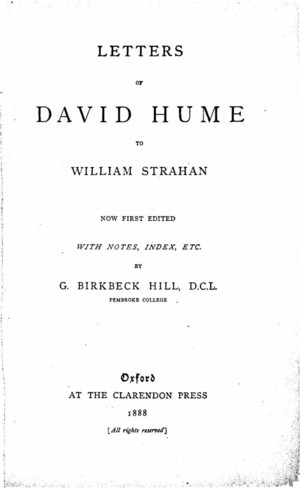
Letters of David Hume to William Strahan, ed. G. Birkbeck Hill (Oxford: Clarendon Press, 1888).

About Liberty Fund:

Liberty Fund, Inc. is a private, educational foundation established to encourage the study of the ideal of a society of free and responsible individuals.


LETTER LXIX.

Dalrymple's Memoirs: Memoirs of King James II.

  • Edinburgh,

Dear Sir

I have read twice over all Sir John Dalrymple's new Publication1 , which contains many curious Papers2 ; but it gives me great Satisfaction to find, that there is not one single Mistake in my History, either great or small, which it gives me occasion to correct. I could only wish to have an Opportunity of adding one Note in order to correct a mistake into which Sir John is very anxious to lead his Readers, as if the French Intrigues had had a sensible Influence in the Determinations of the English Parliament3 : And I believe it is not too late even yet to annex it. I remember Mr. Millar added a similar Note to the last Octavo Edition drawn from K. James's Memoirs4 ; and it was inserted in more than the half of the Copies. I have sent you the Note, which I beg may be printed on a Leaf apart, and annexd to all the Copies afterwards disposd of, and even sent to all the Booksellers that have purchasd any considerable Numbers, as well as joind to my own Copies.

I hear you have given Sir John 2000 pounds for the Property of this Volume, which I scarcely believe5 . The Book is curious, but far from being agreeable Reading; and the Sale will probably be all at first. I again repeat my Entreaties that this Note may be annexd.

I am Dear Sir Very sincerely Yours

David Hume.

[William Strahan to David Hume1 ]

[1]Note 1. This letter, though written a day later than Strahan's answer to Hume's letter of the 15th, had not, of course, been received by Strahan when he wrote. I therefore give it before the next letter in the series.

[2]Note 2. This must be the second volume of Dalrymple's Memoirs of Great Britain and Ireland, for the first was published in the spring of 1771 (ante, p. 174). This work excited great anger among the Whigs. ‘I mentioned,’ records Boswell on April 3 of this year, ‘Sir John Dalrymple's Memoirs of Great Britain and Ireland, and his discoveries to the prejudice of Lord Russell and Algernon Sidney. JOHNSON. “Why, Sir, everybody who had just notions of government thought them rascals before. It is well that all mankind now see them to be rascals.... This Dalrymple seems to be an honest fellow; for he tells equally what makes against both sides.’ Boswell's Johnson, ii. 210.

Hume, in the note mentioned in the next sentence of his letter, says:—‘It is amusing to observe the general, and I may say national rage, excited by the late discovery of this secret negotiation [with the French Court]; chiefly on account of Algernon Sidney, whom the blind prejudices of party had exalted into a hero. His ingratitude and breach of faith in applying for the King's pardon, and immediately on his return entering into cabals for rebellion, form a conduct much more criminal than the taking of French gold. Yet the former circumstance was always known, and always disregarded. But everything connected with France is supposed in England to be polluted beyond all possibility of expiation. Even Lord Russell, whose conduct in this negotiation was only factious, and that in an ordinary degree, is imagined to be dishonoured by the same discovery.’ History of England, ed. 1802, viii. 43.

In a letter to Adam Smith dated April 10, 1773, Hume says:—‘Have you seen Sir John Dalrymple? It is strange what a rage is against him, on account of the most commendable action in his life. His collection is curious; but introduces no new light into the civil, whatever it may into the biographical and anecdotical history of the times.’ Burton's Hume, ii. 467. Horace Walpole wrote on March 2:—‘Need I tell you that Sir John Dalrymple, the accuser of bribery, was turned out of his place of Solicitor of the Customs for taking bribes from brewers?’ Letters, v. 441. A fortnight later he wrote:—‘The town and the newspapers have so fully discussed the book, that I neither listen to the one nor read the other. If it is comfortable to any scoundrel to find himself in better company than he expected, to be sure he has nothing to do but to be introduced by Sir John Dalrymple into History.’ Ib. p. 451.

[3]Note 3. Hume corrects Dalrymple's mistake in the following words:—‘Sir John Dalrymple has given us from Barillon's dispatches in the Secretary's office at Paris a more particular detail of these intrigues.’ Hume hereupon gives a list of the men with whom they were carried on, and continues:—‘Of these Lord Russel and Lord Hollis alone refused to touch any French money. All the others received presents or bribes from Barillon. But we are to remark that the party view of these men and their well-founded jealousies of the King and Duke engaged them, independently of the money, into the same measures that were suggested to them by the French ambassador. The intrigues of France therefore with the Parliament were a mighty small engine in the political machine.’ History of England, viii. 43.

[4]Note 4. Hume wrote to Dr. Robertson from Paris on Dec. 1, 1763:—‘I have here met with a prodigious historical curiosity, the Memoirs of King James II in fourteen volumes, all wrote with his own hand, and kept in the Scots College. I have looked into it, and have made great discoveries.’ Burton's Hume, ii. 179. ‘These volumes,’ adds Dr. Burton, ‘were lost during the French Revolution. It is said that an attempt was made to convey them to St. Omers; but having to be committed for some time to the care of a Frenchman, his wife became alarmed lest the regal emblems on the binding might expose the family to danger from the Terrorists. She first cut off the binding and buried the manuscripts, but being still haunted by fears she exhumed and burned them.’ Some of these volumes had narrowly escaped destruction a little more than a hundred years earlier, when the London house of the minister of the Grand Duke of Tuscany was sacked in the Revolution of 1688. Macaulay's History of England, ed. 1873, iii. 300. The note which Hume had added to his History is given in vol. viii. p. 4 of the edition of 1802.

[5]Note 5. The same statement had been made, but falsely, about Dalrymple's first volume. See ante, p. 174. Perhaps the price mentioned is that for the whole work. Dalrymple, when pleading on May 10 of this year at the bar of the House of Commons against the Booksellers’ Copyright Bill, said:—‘It had been thrown out against him, that after having sold for £2000 the copy of a book, which had the misfortune universally to displease, although it was universally read, he had taken an active part to destroy the value of the very property which he had so disposed of.’ Parl. Hist. xvii. 1092.

[1]Strahan fortunately kept a copy of his answer to Hume, for the original is not preserved among the Hume Papers in the possession of the Royal Society of Edinburgh.