EconlibThe LibraryOther Sites |
Front Page Titles (by Subject) LETTER XXXII.: An Appointment sought for Strahan. - Letters of David Hume to William Strahan
Return to Title Page for Letters of David Hume to William StrahanThe Online Library of LibertyA project of Liberty Fund, Inc.Search this Title:Also in the Library:
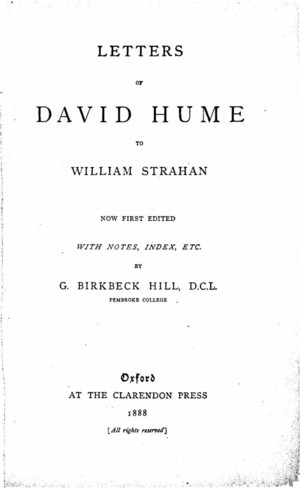
LETTER XXXII.: An Appointment sought for Strahan. - David Hume, Letters of David Hume to William Strahan [1756]Edition used:Letters of David Hume to William Strahan, ed. G. Birkbeck Hill (Oxford: Clarendon Press, 1888).
About Liberty Fund:Liberty Fund, Inc. is a private, educational foundation established to encourage the study of the ideal of a society of free and responsible individuals. Copyright information:The text is in the public domain. Fair use statement:This material is put online to further the educational goals of Liberty Fund, Inc. Unless otherwise stated in the Copyright Information section above, this material may be used freely for educational and academic purposes. It may not be used in any way for profit.
LETTER XXXII.An Appointment sought for Strahan.[Spring of 1767.] DearSirI spoke to Lord Hertford on Sunday Evening: I know not if what I said woud have any Influence; but he seemd to think, that the Determination of that Question woud depend on the Lords who had been active in conducting the Affair, viz: Marchmont1. , Sandes2. and Bautitout3. : I know not by what means you can have Access to them. I send you a Volume of Olivet's Cicero4. at Mr. Millar's Desire, who proposes instantly to begin an Edition of my Essays in that Form, as a Forerunner to the like Edition of my History5. . Let us see a Sample of your English Press: I do not believe you can make such a Book; and I give you a Defiance. Pray return the Book carefully, after you have carefully survey’d it. If Becket has a few Copies to spare of the French Edition of my Controversy with Rousseau, I shoud be glad to have three or four of them. There was a good pleasant Paper, inserted, I believe in your Chronicle6. , about three months ago. It containd Rousseau's Articles of Charge against me, and then some good humourd Raillery against him and Voltaire and me7. . I shoud be glad to have two or three Copies of it, if you can readily find them. I know not if Becket printed Voltaire's Letter to me8. , but if he did he may perhaps have two or three Copies to spare, which woud oblige me. I am DrSir Yours sincerelyD. H. [1.]Note 1. Hugh, third Earl of Marchmont, the friend and executor of Pope. He is the ‘Polwarth’ in Pope's Seventeen Hundred and Thirty Eight (ii. 130), and the ‘Marchmont’ of his Grotto. ‘Were there no other memorials,’ writes Boswell, ‘ he will be immortalised by that line of Pope in the verses on his Grotto:— [2.]Note 2. Samuel Sandys, first Baron Sandys, who was known in his House of Commons days as ‘the Motion-maker.’ Smollett's History of England, ed. 1800, iii. 16. Horace Walpole describes him as ‘a republican, raised on the fall of Sir Robert Walpole to be Chancellor of the Exchequer, then degraded to a peer and cofferer1 ,and soon afterwards laid aside.’ Letters, i. 104. Sir Denis Le Marchant, in a note on Walpole's Memoirs of George III, iv. 119, says that Sandys ‘had been placed at the Board of Trade in 1760. He seems to have regarded the post as a sinecure—as indeed it in a great measure became by the withdrawal of the West Indies from the department.’ [3.]Note 3. Norborne Berkeley, Lord Bottetourt. Horace Walpole, writing on Aug. 9, 1768, about a visit to London, says:—‘I saw nothing there but the ruins of 100, Lady Hertford's cribbage, and Lord Bottetourt, like patience on a monument, smiling in grief. He is totally ruined and quite charmed. Yet I heartily pity him. To Virginia he cannot be indifferent; he must turn their heads somehow or other. If his graces do not captivate them, he will enrage them to fury, for I take all his douceur to be enamelled on iron.’ Letters, v. 116. On Aug. 14, Walpole wrote :—‘There is a disagreeable affair at home, resulting from the disquiets in America. Virginia, though not the most mutinous, contains the best heads and the principal boutes-feux1 . It was thought necessary that the Governor should reside there. It was known that Sir Jeffery Amherst [the governor] would not like that…. At the same time, Lord Bottetourt, a court favourite, yet ruined in fortune, was thought of by his friend, Lord Hillsborough. This was mentioned to Sir Jeffery with the offer of a pension. He boggled at the word pension; but neither cared to go to his government, nor seemed to dislike giving it up.’ Ib. p. 120. Walpole in his Memoirs of George III, iii. 151, describes Bottetourt as ‘of the Bedchamber and a kind of second-rate favourite. He had engaged in an adventure with a company of copper-workers at Warmley. They broke. In order to cover his estate from the creditors he begged a privy seal, to incorporate the Company, as private estates would not then be answerable. The King granted his request, but Lord Chatham, aware of the deception, honestly refused to affix the Seal to the Patent.’ In the end ‘he did acquiesce in resigning the Seal for a short time, that, being put into commission, it might be set to the grant.’ (See also the Chatham Corres. iii. 306–322.) Such was the swindler who on the eve of the outbreak with America was sent there as Lieutenant and Governor-General of Virginia. ‘Whom,’ asked Burke, ‘have they selected in these perilous times to soothe the animosity, and reconcile the differences that now unhappily subsist between our colonies and the mother-country? I need not name the man; everybody knows him as a projector, as one who by wild and chimerical schemes has not only so embarrassed his own affairs as to render his stay in this country impracticable, but brought irretrievable ruin upon many others.’ Parl. Hist. xvi. 723. He died in Virginia on Nov. 9, 1770, ‘greatly lamented by the whole colony.’ Ann. Reg. xiii. 191. Junius described him as ‘a cringing, bowing, fawning, sword-bearing courtier who had ruined himself by an enterprise, which would have ruined thousands if it had succeeded.’ Letters of Junius, ed. 1812, iii. 109. He it is, I believe, whom Churchill introduces in the following couplet:—
I have little doubt that ‘the affair’ which these three Lords were ‘conducting’ was connected with the printing of the Rolls of Parliament, and the Journals of the House of Lords. Nichols says that in 1767 William Bowyer was made printer, being ‘principally indebted for the appointment to the Earl of Marchmont.’ Lit. Anec. iii. 39. In a curious inscription written by Bowyer under his own bust in Stationers’ Hall it is stated, that ‘he was appointed to print the Journals of the House of Lords, at near LXX Years of age, by the patronage of a noble Peer.’ Ib. p. 293. In the Journals of the House of Lords, xxxi. 509, there is an order on March 9, 1767, to leave to a Sub-committee, to which these three Lords belonged, the question of printing the Rolls and the Journals. Ib. p. 429. [4.]Note 4. Gibbon describing his student days at Lausanne, says of the writings of Cicero:—‘The most perfect editions, that of Olivet, which may adorn the shelves of the rich, that of Ernesti, which should lie on the table of the learned, were not within my reach.’ Gibbon's Misc. Works, i. 89. [5.]Note 5. A new edition of Hume's Essays and Treatises in 2 vols. quarto was published by A. Millar, London, and A. Kincaid and A. Donaldson, Edinburgh, in 1768. A quarto edition of his History in 8 vols. was published in 1770. [6.]Note 6. See ante, p. 64, n. 9. [7.]Note 7. This paper, I have little doubt, is one quoted in Burton's Hume, ii. 340. Voltaire is only once mentioned. It begins:— [8.]Note 8. Dr. Burton thinks that this letter only reached Hume through the press. At all events there is no trace of it among his manuscripts. Life of Hume, ii. 358. Rousseau had accused Voltaire of having written a letter against him, which was published as Voltaire's at London, under the title of Lettre au docteur Jean-Jacques Pansophe. The author was M. Bordes, of Lyons. Œuvres de Voltaire, liii. 497. An English translation, published by Payne, is in the list of publications in the Gent. Mag. for April, 1766, p. 192. See also Ib. p. 563. Hume himself at first had no doubt of its authenticity. On May 16, 1766, some weeks before Rousseau's outbreak against him, he wrote to the Countess de Boufflers:—‘You have probably seen Voltaire's letter to our exotic philosopher. I fancy it will rouse him from his lethargy. These two gladiators are very well matched; it is like the combat of Dares and Entellus in Virgil [Æneid. v. 362–484]. The sprightliness and grace, and irony and pleasantry of the one will be a good contrast to the force and vehemence of the other.’ Private Corres. p. 171. Rousseau, after charging Voltaire with being the author of the letter, continues:—‘Le noble objet de ce spirituel ouvrage est de m’attirer le mépris et la haine de ceux chez qui je me suis réfugié.’ Œuvres de Rousseau, ed. 1782, xxiv. 368. Voltaire replied to this accusation in a letter addressed to Hume, dated ‘Ferney, 24 Octobre.’ He says:—‘Il m’a fait l’honneur de me mettre au nombre de ses ennemis et de ses persécuteurs. Intimement persuadé qu’on doit lui élever une statue … il pense que la moitié de l’univers est occupée à dresser cette statue sur son piédestal, et l’autre moitié à la renverser.’ Œuvres de Voltaire, liii. 497. See ante, p. 90, for another extract from this letter. Grimm, writing on Nov. 1, 1766, says:—‘M. de Voltaire a fait imprimer une petite lettre adressée à M. Hume, où il a, pour ainsi dire, donné le coup de grace à ce pauvre Jean-Jacques. Cette lettre a eu beaucoup de succès à Paris, et elle a peutêtre fait plus de tort à M. Rousseau que la brochure de M. Hume.’ Corres. Lit. v. 211. An English translation was published by S. Bladon in Paternoster Row, 1766. It is curious in all the translations to find Jean Jacques turned into John James. ‘The great soul of John James’ reads as comically as ‘la grande âme de Jean-Jacques’ reads naturally. [2.]Note 2. Samuel Sandys, first Baron Sandys, who was known in his House of Commons days as ‘the Motion-maker.’ Smollett's History of England, ed. 1800, iii. 16. Horace Walpole describes him as ‘a republican, raised on the fall of Sir Robert Walpole to be Chancellor of the Exchequer, then degraded to a peer and cofferer1 ,and soon afterwards laid aside.’ Letters, i. 104. Sir Denis Le Marchant, in a note on Walpole's Memoirs of George III, iv. 119, says that Sandys ‘had been placed at the Board of Trade in 1760. He seems to have regarded the post as a sinecure—as indeed it in a great measure became by the withdrawal of the West Indies from the department.’ [3.]Note 3. Norborne Berkeley, Lord Bottetourt. Horace Walpole, writing on Aug. 9, 1768, about a visit to London, says:—‘I saw nothing there but the ruins of 100, Lady Hertford's cribbage, and Lord Bottetourt, like patience on a monument, smiling in grief. He is totally ruined and quite charmed. Yet I heartily pity him. To Virginia he cannot be indifferent; he must turn their heads somehow or other. If his graces do not captivate them, he will enrage them to fury, for I take all his douceur to be enamelled on iron.’ Letters, v. 116. On Aug. 14, Walpole wrote :—‘There is a disagreeable affair at home, resulting from the disquiets in America. Virginia, though not the most mutinous, contains the best heads and the principal boutes-feux1 . It was thought necessary that the Governor should reside there. It was known that Sir Jeffery Amherst [the governor] would not like that…. At the same time, Lord Bottetourt, a court favourite, yet ruined in fortune, was thought of by his friend, Lord Hillsborough. This was mentioned to Sir Jeffery with the offer of a pension. He boggled at the word pension; but neither cared to go to his government, nor seemed to dislike giving it up.’ Ib. p. 120. Walpole in his Memoirs of George III, iii. 151, describes Bottetourt as ‘of the Bedchamber and a kind of second-rate favourite. He had engaged in an adventure with a company of copper-workers at Warmley. They broke. In order to cover his estate from the creditors he begged a privy seal, to incorporate the Company, as private estates would not then be answerable. The King granted his request, but Lord Chatham, aware of the deception, honestly refused to affix the Seal to the Patent.’ In the end ‘he did acquiesce in resigning the Seal for a short time, that, being put into commission, it might be set to the grant.’ (See also the Chatham Corres. iii. 306–322.) Such was the swindler who on the eve of the outbreak with America was sent there as Lieutenant and Governor-General of Virginia. ‘Whom,’ asked Burke, ‘have they selected in these perilous times to soothe the animosity, and reconcile the differences that now unhappily subsist between our colonies and the mother-country? I need not name the man; everybody knows him as a projector, as one who by wild and chimerical schemes has not only so embarrassed his own affairs as to render his stay in this country impracticable, but brought irretrievable ruin upon many others.’ Parl. Hist. xvi. 723. He died in Virginia on Nov. 9, 1770, ‘greatly lamented by the whole colony.’ Ann. Reg. xiii. 191. Junius described him as ‘a cringing, bowing, fawning, sword-bearing courtier who had ruined himself by an enterprise, which would have ruined thousands if it had succeeded.’ Letters of Junius, ed. 1812, iii. 109. He it is, I believe, whom Churchill introduces in the following couplet:—
I have little doubt that ‘the affair’ which these three Lords were ‘conducting’ was connected with the printing of the Rolls of Parliament, and the Journals of the House of Lords. Nichols says that in 1767 William Bowyer was made printer, being ‘principally indebted for the appointment to the Earl of Marchmont.’ Lit. Anec. iii. 39. In a curious inscription written by Bowyer under his own bust in Stationers’ Hall it is stated, that ‘he was appointed to print the Journals of the House of Lords, at near LXX Years of age, by the patronage of a noble Peer.’ Ib. p. 293. In the Journals of the House of Lords, xxxi. 509, there is an order on March 9, 1767, to leave to a Sub-committee, to which these three Lords belonged, the question of printing the Rolls and the Journals. Ib. p. 429. [7.]Note 7. This paper, I have little doubt, is one quoted in Burton's Hume, ii. 340. Voltaire is only once mentioned. It begins:— [1]‘A principal officer of his majesty's Court, next under the Comptroller.’ Johnson's Dictionary. [1]Boute-feux, Incendiaries. [1]‘To sham Abram: to feign sickness, a phrase in use among sailors.’ Murray's New Eng. Dict. |

Titles (by Subject)